Vale: $1.7 Billion for Shareholders, Almost $1.6 Billion for Two Dam Collapses — in the Same Half-Year
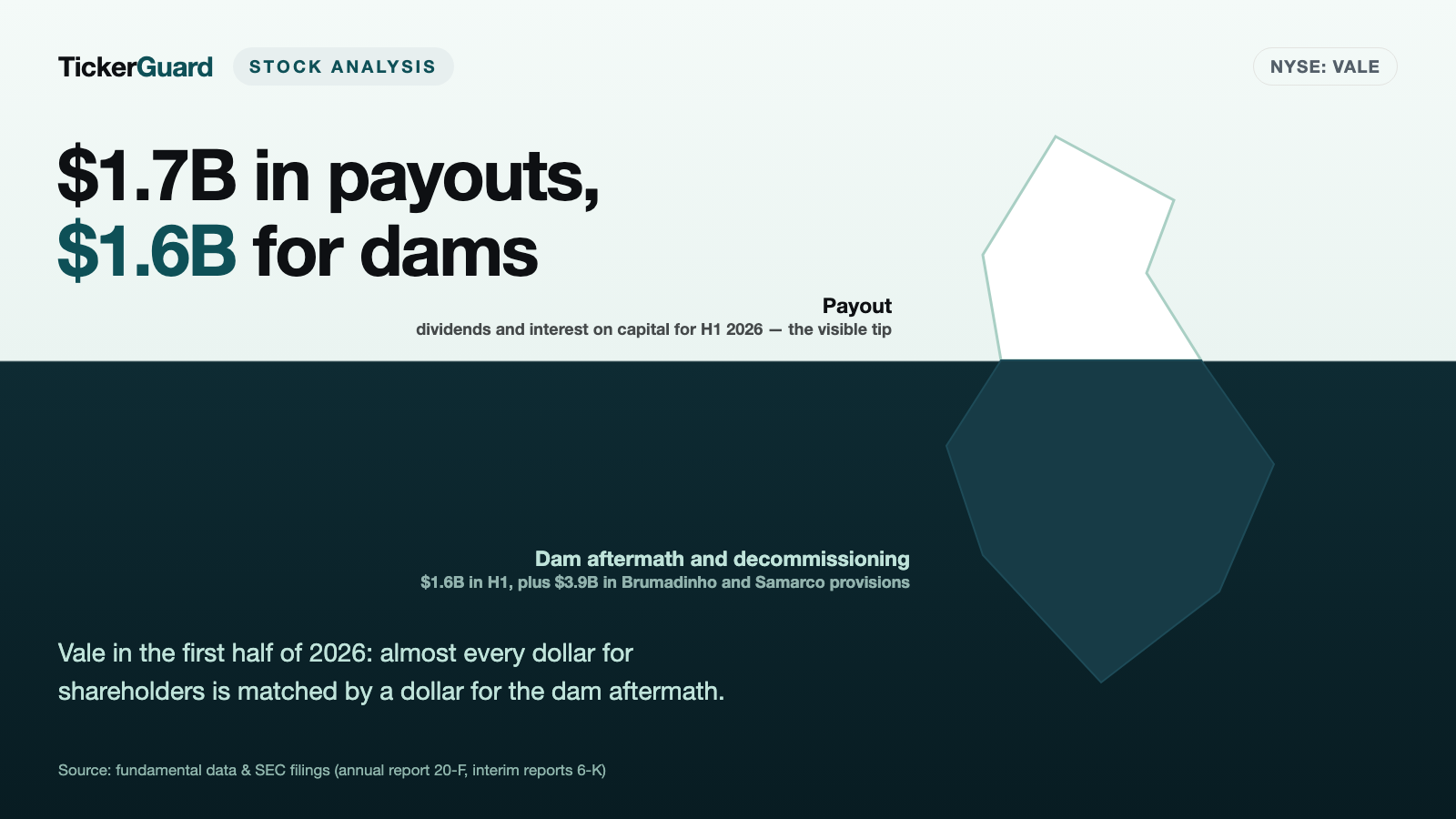
Vale is paying out $1.7 billion for the first half of 2026 — and in the same half-year almost $1.6 billion went to the aftermath of the Mariana and Brumadinho dam collapses and to decommissioning old dams. The disasters of 2015 and 2019, which killed 289 people, still show up in every quarterly report.
 Thomas Mücke
Founder & Publisher
Thomas Mücke
Founder & Publisher
As of Today
As of: October 11, 2026
- Closing price
- 13.60 $ +1.49%
- Market Capitalisation
- 58.0 $B
- P/E
- 27.2
Price change since October 9, 2026: -0.1%
This analysis has a cut-off date. The Stock Guard tells you when something material changes in the numbers. Reserve your free spot
Chart
Interactive price chart (TradingView).
Last price: 13.60 $ (As of: October 11, 2026)
Note: pure fact-based analysis, not investment advice and not a solicitation to buy or sell. All figures without guarantee.
For the first half of 2026 the Brazilian mining group Vale is paying out $1.7 billion to its shareholders. In the same half-year almost $1.6 billion went to the aftermath of two dam collapses and to decommissioning old dams — at Vale, almost every dollar for shareholders is matched by a dollar for the dam aftermath and decommissioning. Behind that sit 76.6% of revenue from iron ore and pellets, 63% of ore shipments going to China, and a profit that fell from $22.4 billion in 2021 to $2.4 billion in 2025.
Most people only see the first number. Psychologists call this salience: whatever stands out gets more weight in our judgment than it deserves. A dividend yield is exactly that kind of number: it sits in every stock screen and feels like money in the bank. Measured against the market value on October 9, 2026, Vale's 2025 payouts alone came to about 6%, and a new buyback program covers up to 100 million shares. As with an iceberg, the tip shines. What lies below the waterline sits in the notes to the mandatory filings, for example in note 23 of the interim financial statements. So here is the deal: let's look below the waterline together, using the mandatory filings Vale submits to the US Securities and Exchange Commission (SEC). The tension running through this analysis: Vale is generating plenty of cash again and handing a lot of it out — but that money depends on a single commodity, a single dominant buyer country, and the bills from two dam collapses that will keep coming for years.
What Vale actually does — iron ore, copper and a railroad to the Atlantic
Vale digs ore out of the ground and gets it to the customer. That sounds simple, but it is an enormous machine. In northern Brazil, in the Carajás region of Pará state, Vale runs its largest iron ore mines. From there the ore travels on the Carajás railroad, which Vale operates, to the port of Ponta da Madeira on the Atlantic coast; according to the annual report, that line carried about 176 million metric tons of iron ore in 2025. Add mines in the southeast, pellet plants that bake fine ore into small balls for blast furnaces, and very large ore carriers from other shipowners that Vale has under long-term contracts. Iron ore and pellets together brought in 76.6% of 2025 revenue of $38.4 billion.
The second pillar is Vale Base Metals, or VBM: copper from Brazil, nickel mainly from Canada, plus gold, cobalt and platinum-group metals as by-products. Vale owns 90% of VBM; the remaining 10% belongs to Manara Minerals, an investment company from Saudi Arabia. Nickel contributed 11.2% of 2025 revenue, copper 9.8%. At the end of 2025 Vale employed 65,805 people, plus about 111,000 contractor employees. Gustavo Pimenta has been CEO since 2024.
For the evidence trail: Vale is a foreign issuer listed in New York. Instead of a 10-K annual report it files Form 20-F, and quarterly figures and announcements come as Form 6-K. It reports under IFRS in US dollars, and the fiscal year is the calendar year. In New York you trade American depositary receipts (ADRs) under the ticker VALE; one ADR equals exactly one Vale share, which trades in São Paulo as VALE3. The company was formerly called Companhia Vale do Rio Doce; the former state-owned group was privatized in 1997.
Company history for investors
-
2015
Mariana dam collapse
Samarco's Fundão dam (Vale and BHP 50% each) fails, 19 dead, and the tailings wave devastates communities along the Doce River. A 170 billion reais settlement only followed in 2024.
-
2019
Brumadinho dam collapse
A dam at Vale's Córrego do Feijão mine fails, 270 dead. Since then Vale has paid every quarter for reparation and for dismantling old dams.
-
2021
Peak profit in the commodity boom
$22.4bn profit at an average of $159.5 per ton of iron ore; Vale pays out $13.5bn and buys back $5.5bn of stock.
-
2025
Profit low and the London ruling
Profit of only $2.4bn after a nickel write-off and a heavy tax charge; an English court finds BHP liable for Mariana, Vale books a $449m provision.
-
2026
Strong quarter, higher costs
Q2 revenue up 19%, copper strong; at the same time the iron ore cost estimate rises, and BHP fails in London to get permission to appeal.
How the stock landed on our desk
Vale made our research list through the forum ranking of wallstreet-online, the list of stocks most discussed by German retail investors (as of October 11, 2026). That is a signal of attention, not of quality. But our in-house stock scanner knows Vale too: the stock shows up in the price-to-cash-flow ranking, which collects companies trading at no more than 10 times their operating cash flow (as of October 11, 2026). The ratio compares market value with the operating cash inflow of the last four quarters; for Vale it came to about 6 by our calculation. Put differently, the market values Vale at roughly six times the cash its ongoing business brings in over a year.
So it is not just the dividend that looks cheap — the valuation does too. That is exactly why it pays to look below the waterline: a stock is rarely cheap for no reason. If you want to see Vale's mines through the eyes of a financier, our analysis of Wheaton Precious Metals offers the other side: about half of Wheaton's 2025 revenue came from purchase agreements with Vale covering precious metals and cobalt from Vale mines. Another large Latin American copper producer is covered in our analysis of Southern Copper.
The numbers over the years — credit where it is due
First, what is genuinely impressive. The second quarter of 2026 was strong: revenue rose 19% year over year to $10.5 billion, and adjusted earnings before interest, taxes, depreciation and amortization (Vale calls it pro forma EBITDA) also rose 19% to $4.1 billion. According to Vale, iron ore output was the highest for any second quarter since 2018 and copper had its best second quarter in nine years. Free cash flow — the money left after operations and investment — rose 49% to $1.5 billion.
The quiet winner is copper. Vale realized an average of $14,062 per metric ton in Q2 2026, 57% more than a year earlier. Copper EBITDA nearly doubled to just over $1.0 billion. And because Vale's copper concentrates contain a lot of gold that is sold at high prices alongside, Vale now expects all-in copper costs of just $0 to $500 per ton in 2026. By 2035 the group wants to lift copper output to about 700,000 tons a year; for 2026 it is targeting 360,000 to 380,000 tons.
The balance sheet is solid, too. Net debt stood at $13.2 billion on June 30, 2026 — according to Vale 0.8 times adjusted EBITDA for the last twelve months (here Vale's "adjusted EBITDA" definition: $3.7 billion in Q2 versus $4.1 billion of pro forma EBITDA). The same measure covered last-twelve-month gross interest almost 16 times. The average remaining maturity of the debt was 8.1 years. Equity attributable to Vale's shareholders was $38.0 billion.
Now the sobering part, and it is in the chart.
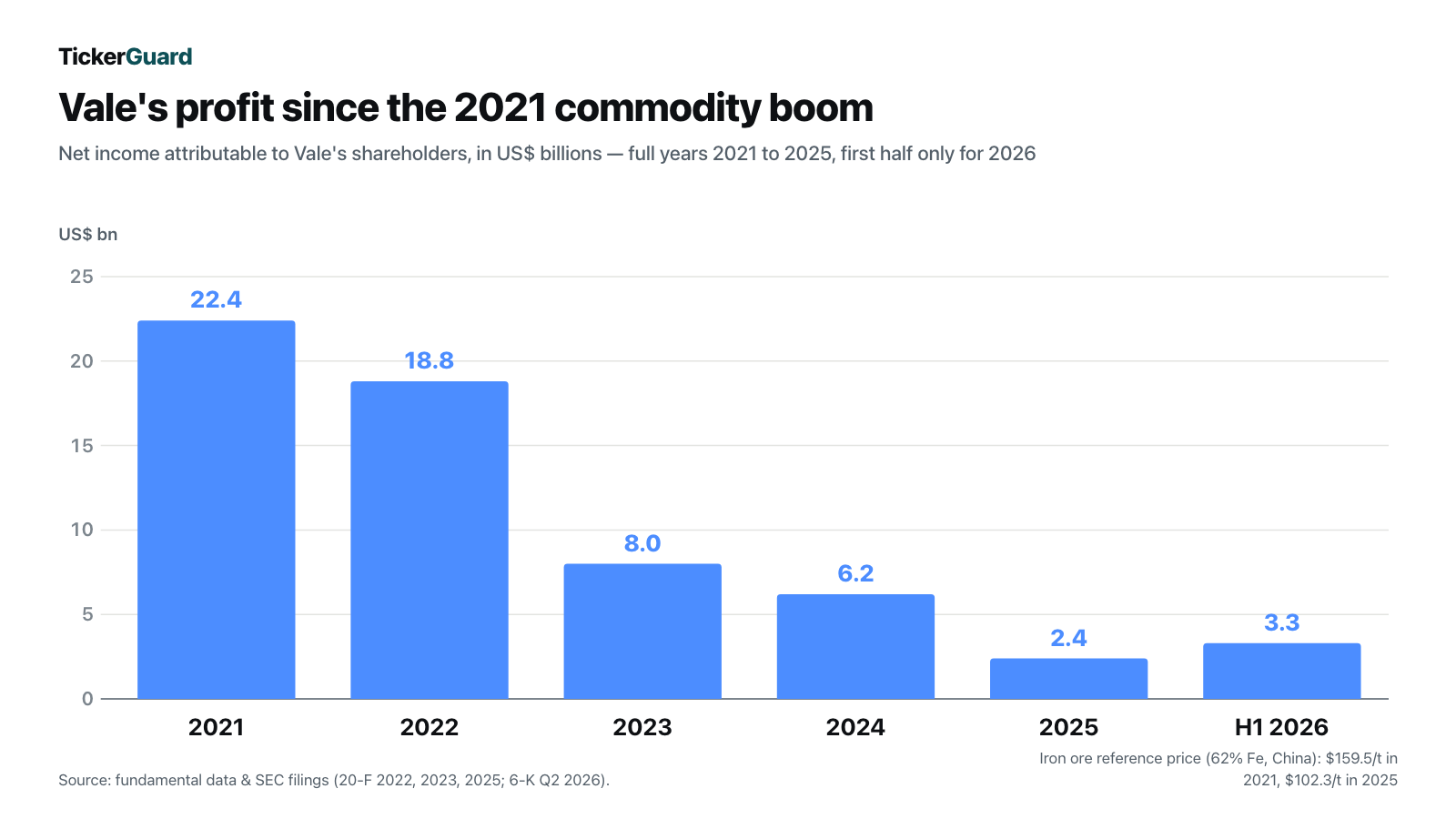
In 2021, riding the post-pandemic iron ore price, Vale earned $22.4 billion. In 2025 it was $2.4 billion. Part of that slide is accounting: in 2025 Vale wrote off the entire goodwill of its Canadian nickel business, $1.7 billion, because expected nickel prices had fallen, and impaired its Newfoundland and Labrador nickel unit in Canada by another $1.7 billion; impairments and disposals cost $4.6 billion in total in 2025. On top came a tax charge of $2.7 billion versus $0.7 billion the year before, mainly because Vale wrote off deferred tax assets on tax losses of foreign subsidiaries. The bigger part, however, is the market: according to the annual report, the iron ore reference price fell from an average of $159.5 per ton in 2021 to $102.3 in 2025. In the first half of 2026, profit of $3.3 billion was below the $3.5 billion of the prior-year period even though revenue grew 17%. The next three chapters explain why.
Uncomfortable truth #1: one commodity, one buyer country
Concentration risk means too many eggs in one basket. At Vale there are two baskets, one inside the other. The first is iron ore:
“Iron ore and iron ore pellets, which together accounted for 76.6% of our 2025 net operating revenue, are used to produce carbon steel.”
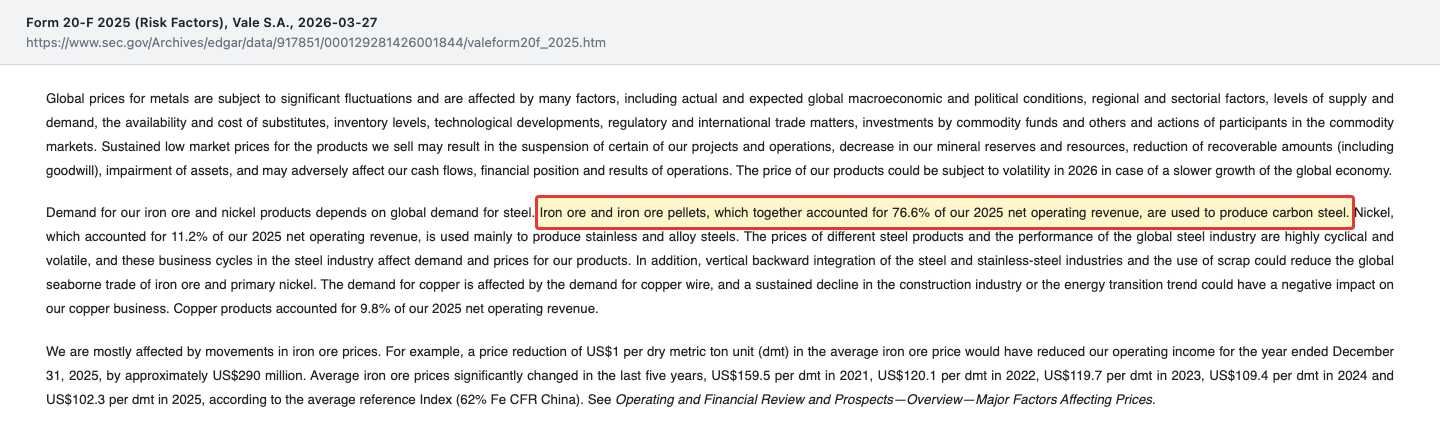
Vale itself spells out how hard that hits: every dollar the average iron ore price per ton comes in lower would have cut 2025 operating income by about $290 million. Ten dollars lower, and almost $3 billion of operating income is gone. Vale cannot control that price, only its costs.
The second basket is China. The annual report contains two numbers worth putting side by side:
“In 2025, China accounted for 63% of our iron ore and iron ore pellet shipments, and Asia as a whole accounted for 80%, Brazil accounted for 11%, Europe accounted for 4% followed by the Middle East with 2% and others with 3%.”
The financial statements supply the matching revenue figure: $19.0 billion came from customers in mainland China in 2025, just under half of total group revenue. In 2025 no single customer reached 10% of revenue; the ten largest ore customers together took 36.3% of ore volumes. So Vale does not depend on one customer — it depends on one economy and its construction cycle. Remember: a company that books almost half of its revenue in one country shares that country's business cycle, for better and for worse.
Uncomfortable truth #2: the dams are not history
Two dates belong to Vale as much as Carajás does. In November 2015 the Fundão dam near Mariana collapsed; it belonged to Samarco, a joint venture owned equally by Vale and BHP. Nineteen people died and the tailings flooded communities along the Doce River. In January 2019 a dam at Vale's Córrego do Feijão mine near Brumadinho collapsed; 270 people died. Both lie years in the past. In the numbers they are the present. The following chart shows where the money went in the second quarter of 2026:
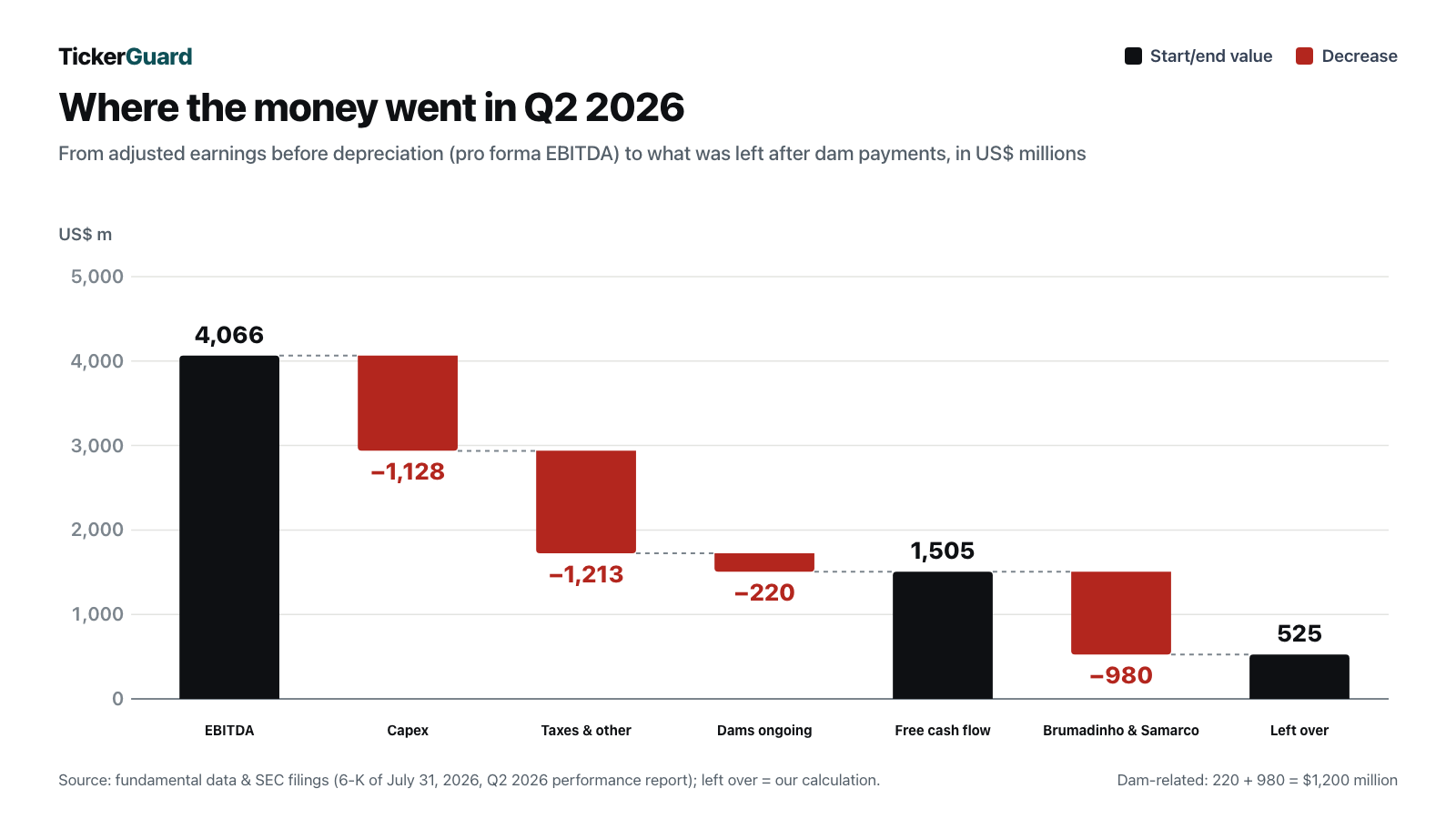
Let's add it up: $220 million of ongoing costs for Brumadinho and the mandatory dismantling of old dams, plus $980 million of payments for Brumadinho and Samarco (settlements and indemnifications). That is $1.2 billion in one quarter, nearly 30% of pro forma EBITDA. On the same basis the first quarter of 2026 came to $373 million, the first half to about $1.6 billion combined; the payments swing from quarter to quarter. The "taxes & other" bar bundles taxes, financial items, working capital, associates, the streaming agreements, railway concession payments and other items; financial items alone were a net inflow of $26 million in the quarter, because settled derivatives more than offset interest payments. The Mariana settlement of October 2024 is estimated at 170 billion reais in total, including earlier payments; the new commitments run over 20 years, and Vale is budgeting its own contributions through 2030. On June 30, 2026, the balance sheet still carried $1.8 billion of provisions for Brumadinho and $2.1 billion for Samarco, $3.9 billion in total.
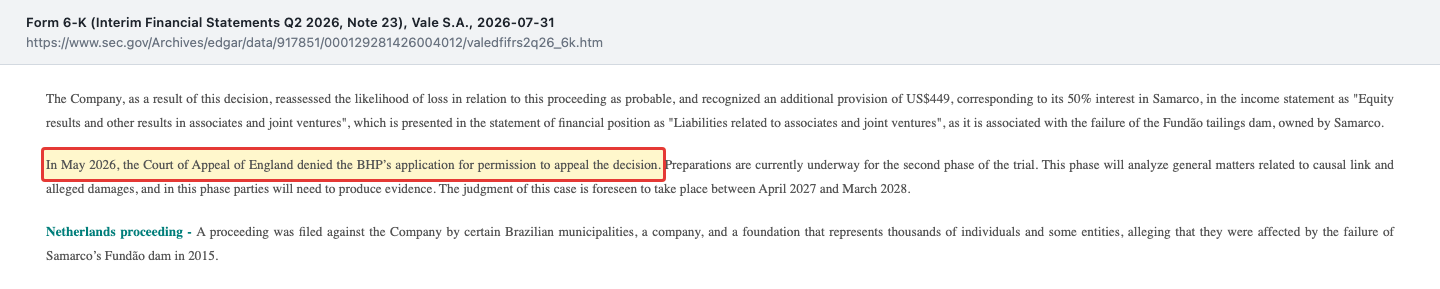
And new fronts keep opening. In London, according to the interim financial statements as of June 30, 2026, about 610,000 claimants from Brazil, including municipalities and companies, are suing BHP over Mariana; that number is likely to fall, because the court upheld the waivers signed by claimants already compensated in Brazil. On August 20, 2026, another 19 municipalities joined the Brazilian settlement, bringing the total to 45 of 49 eligible ones; in return they must waive lawsuits in Brazil and abroad. In November 2025 the English court found BHP liable under Brazilian law. Back in July 2024 Vale had agreed with BHP to share equally any payments arising from the cases in London and the Netherlands; after the ruling, Vale classified a loss as probable and booked an additional provision of $449 million, corresponding to its 50% interest in Samarco. BHP has since failed in its application for permission to appeal:
“In May 2026, the Court of Appeal of England denied the BHP’s application for permission to appeal the decision.”
— Vale, interim financial statements as of June 30, 2026 (Form 6-K of July 31, 2026), note 23
In the Netherlands a second case is running, this time directly against Vale. An Amsterdam court secured assets for it as early as 2024:
“In March 2024, a court in Amsterdam granted a preliminary injunction freezing the shares in Vale Holdings B.V., a wholly owned subsidiary incorporated in the Netherlands, and the economic rights attached to those shares, for securing the approximate amount of US$1,050 (EUR920 million).”
— Vale, interim financial statements as of June 30, 2026 (Form 6-K of July 31, 2026), note 23
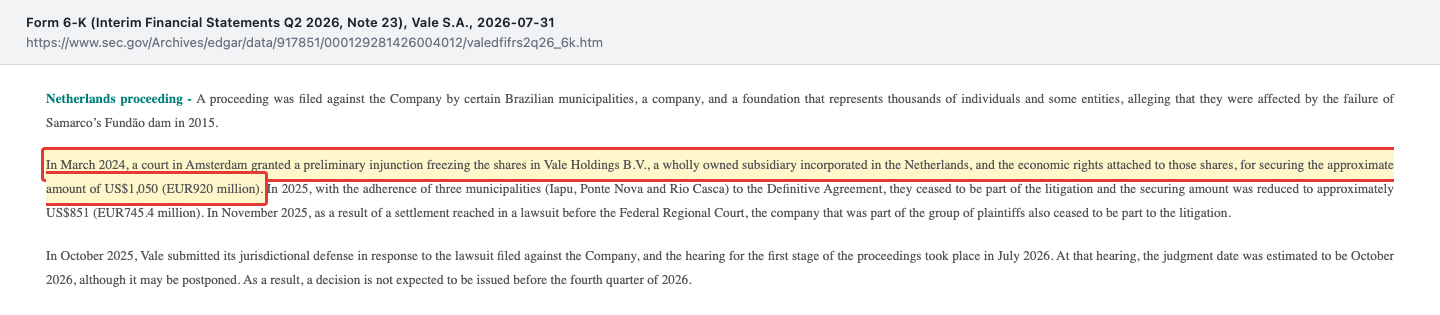
Because three plaintiff municipalities (Iapu, Ponte Nova and Rio Casca) joined the Brazilian settlement in 2025, the secured amount fell to about $851 million (EUR 745.4 million). Vale contests the court's jurisdiction; the hearing for the first stage of the proceedings took place in July 2026; according to Vale, the judgment date was estimated there for October 2026 but may be postponed, and no decision is expected before the fourth quarter of 2026. Vale considers a loss possible but cannot yet estimate it.
And then there is 2026 itself. In January, water carrying sediment leaked at the Fábrica and Viga mines in Minas Gerais; the municipality of Congonhas temporarily suspended operating permits. Vale puts four related lawsuits at about $606 million combined, with a possible loss; environmental contingent liabilities rose from $1.2 billion to $2.2 billion in the first half. In September 2026 Vale announced a partial restart at Fábrica, authorized by the Court of Justice of the State of Minas Gerais and based on an agreement with the state and the state prosecutor's office. Remember: at Vale, a dam collapse is not a closed chapter but a line item that shows up in the cash flow statement every quarter.
Uncomfortable truth #3: costs are outrunning the ore
Which leaves the question of why profit fell despite higher revenue: in Q2 2026 net income attributable to Vale's shareholders dropped 35% to $1.4 billion while revenue rose 19%. Part of it is financial items: derivatives contributed $798 million less than in the strong prior-year quarter, currency effects on tax loss carryforwards weighed on taxes, and there was a one-time provision. The other part is more stubborn, and Vale put it in black and white in a separate announcement on July 30, 2026:
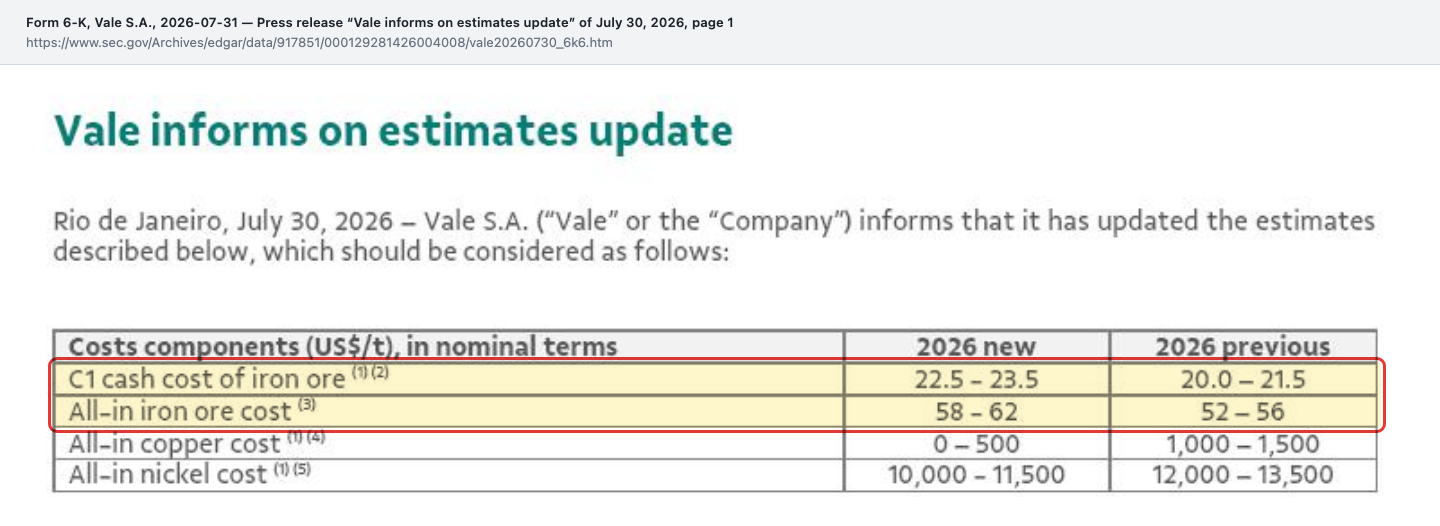
Two terms, translated. C1 cash cost is what a ton of ore costs directly in the mine, the processing plant, on the railroad and at the port — like a baker's spend on flour and electricity. All-in cost counts everything up to the customer in China, including ocean freight, selling expenses and royalties. On that all-in basis the new 2026 range is $58 to $62 per ton instead of $52 to $56. In the second quarter the actual figure was $61.6, 18% higher than a year earlier. Vale gives the reasons in its performance report:
“C1 cash costs and all-in costs were revised to US$ 22.5-23.5/t and US$ 58-62/t, respectively, largely reflecting a stronger BRL and higher oil price expectations.”
— Vale, Q2 2026 performance report (Form 6-K of July 31, 2026)
Vale can barely influence either driver. Vale sells in dollars but pays almost half of its cost of goods sold in reais (47.6% in 2025, per the annual report); when the real strengthens, every ton gets more expensive. And ocean freight to China depends on bunker fuel: it rose to $22.0 per ton in Q2 2026, 20% more than a year earlier. Vale has hedged part of its oil exposure, and the hedge contributed $99 million in the quarter. The reference price for iron ore with 61% iron content averaged $105.0 per ton in Q2 2026, higher than a year earlier ($94.5). Remember: a higher ore price helps little when freight and currency eat up the gain on the way to China.
Uncomfortable truth #4: the state still has a seat at the table
Vale has been private since 1997 and has had no controlling shareholder since 2020. The largest shareholders each hold between almost 7% and 9%: Capital World Investors reported about 9.0% as of June 30, 2026, and according to the interim financial statements BlackRock, Previ (the pension fund of Banco do Brasil employees) and Mitsui follow with almost 7% to just over 7% each. But Brazil has not let go entirely:
“The Brazilian government holds all 12 of our golden shares, granting it limited veto power over certain company actions, such as changes to our name, the location of our headquarters and our corporate purpose as it relates to mining activities.”
The veto is narrow. The state's influence reaches further, though, through regulators and levies. On iron ore Vale pays a mining royalty called CFEM of 3.5%; in August 2026 media reported CFEM charges by the mining agency; Vale considers them unfounded and points to a dispute already disclosed in its 2025 consolidated financial statements. And when media reported in September 2026 that Vale had shelved an IPO of its base metals unit under political pressure, Vale clarified that there were no studies and no decision on such an offering. For you this means: at Vale, decisions are made not only by shareholders and management but always partly in Brasília as well.
What the stock costs
At the closing price of $13.62 on October 9, 2026 and 4.26 billion shares, Vale was worth about $58.0 billion. The classic price-to-earnings ratio on the last four quarters is about 27, but it is distorted by the write-off and the tax charge at the end of 2025. Other yardsticks say more (our calculations, as of June 30, 2026 and October 9, 2026): the market value equaled about 1.4 times last-twelve-month revenue, 1.5 times equity and six times operating cash flow. Adding net debt, the whole group cost about 4.3 times its last-twelve-month adjusted EBITDA; including the dam provisions, which Vale itself counts in its "expanded net debt" of $16.7 billion, about 4.5 times.
And the payout? In 2025 Vale paid $3.6 billion in dividends and interest on capital; in 2021 it was $13.5 billion, plus share buybacks of $5.5 billion at the time. The payout follows profit, and profit follows the ore price. For the first half of 2026 Vale declared $1.7 billion, the minimum under its own shareholder remuneration policy. For comparison: after the Brumadinho and Samarco payments, only about $1.1 billion of free cash flow was left in the first half (2,318 minus 370 minus 846 million dollars, our calculation from the performance report). The payout for the same half-year is therefore larger; Vale covers the rest from cash, new debt or second-half cash flow. The new buyback program allows purchases of up to 100 million shares through January 2028, about 2.3% of shares outstanding; in Q2 2026 Vale bought back $140 million worth.
The view from the pros: of 25 analysts covering the stock, 10 rated it a buy, 14 a hold and one a sell; the consensus price target was $16.60 (as of October 11, 2026, source: fundamental data). A price target is an opinion, not a promise; for Vale it rests mainly on the iron ore price assumption.
Upside and risks at a glance
What speaks for Vale:
- Strong Q2 2026: revenue up 19% to $10.5 billion, free cash flow up 49% to $1.5 billion.
- Copper is becoming a second engine: Q2 2026 copper EBITDA up 91% to just over $1.0 billion, a target of about 700,000 tons a year by 2035, and the Bacaba project (start-up in Q3 2027 instead of H1 2028, per the July 30, 2026 performance report) and Salobo CPF, a coarse particle flotation plant at the existing Salobo copper complex (start-up in H1 2028, about a year early, per the August 12, 2026 announcement), both running ahead of schedule.
- Solid balance sheet: net debt at 0.8 times EBITDA, interest coverage of almost 16 times, average debt maturity of 8.1 years (June 30, 2026).
- Low valuation relative to cash flow: market value about six times operating cash flow; ongoing buybacks and a minimum payout under a set policy.
What speaks against Vale:
- 76.6% of 2025 revenue came from iron ore and pellets, and 63% of ore shipments went to China; every dollar of ore price per ton moved 2025 operating income by about $290 million.
- Profit fell from $22.4 billion (2021) to $2.4 billion (2025), payouts from $13.5 billion to $3.6 billion.
- The dam collapses keep costing: $1.2 billion in Q2 2026 alone, plus open cases in London (about 610,000 claimants from Brazil, judgment expected between April 2027 and March 2028) and Amsterdam (about $851 million secured).
- The iron ore cost estimate rose in July 2026 to $58–62 per ton all-in; Vale can barely influence the real or the oil price.
- New environmental cases in 2026 (Fábrica and Viga, estimated possible loss of about $606 million) and state influence through golden shares, regulators and levies.
A human conclusion
Remember the iceberg? At Vale the tip is real: the business is throwing off more cash again, copper is growing, debt is manageable and a lot of money flows to shareholders. That deserves credit. But salience quickly turns it into a conclusion the filings do not support — that the dividend is the whole picture. Below the waterline sits the mass: one commodity that brings in just over three quarters of revenue, one country that takes almost two thirds of the ore and accounts for just under half of group revenue, costs tied to the real and to oil, and two dam collapses that will cost money for years and keep new courts busy.
The next test has a date: on October 29, 2026, after the market close, Vale reports its third quarter. Three lines are worth a look: all-in cost per ton of iron ore against the $58–62 range, the payments for Brumadinho and Samarco, and the note on the Amsterdam case. If you only see the payout at Vale, you see the tip. If you read the notes, you see the iceberg. What you make of it is your decision. And that is exactly how it should be.
Sources
- Vale — Form 6-K of July 31, 2026 (latest periodic report): Q2 2026 performance report, interim financial statements (IFRS) as of June 30, 2026, estimates update, shareholder remuneration, new share buyback program, Serra Sul +20 commissioning
- Annual report on Form 20-F for 2025 (filed March 27, 2026); prior years: 20-F for 2024, 20-F for 2023, 20-F for 2022
- Vale — announcements after the quarterly report (each Form 6-K): CFEM claims (August 5, 2026), Salobo project (August 12, 2026), more municipalities join the Mariana settlement (August 20, 2026), statement on a Vale Base Metals IPO (September 8, 2026), stake in Ligga (September 22, 2026), partial restart of the Fábrica mine (September 23, 2026), Q3 results date (October 1, 2026)
- Source: fundamental data & SEC filings (annual report on Form 20-F, interim reports and announcements on Form 6-K) (closing price October 9, 2026, analyst ratings as of October 11, 2026)
This analysis is a journalistic assessment based on publicly available company filings. It is not investment advice and not a solicitation to buy or sell securities. Stocks can lose value, up to a total loss. All figures carry the date of their source; prices are dated snapshots. Positions held by the operator are disclosed daily; where one exists, it appears as a notice at the top of this analysis.
Our Bottom Line at a Glance
- Business model positive
- One of the world's largest iron ore producers, running large railroad and port logistics; Q2 2026 brought the highest iron ore output of any second quarter since 2018 and the best second copper quarter in nine years.
- Balance sheet positive
- Net debt of $13.2 billion, 0.8 times adjusted EBITDA; interest coverage of almost 16 times, equity attributable to shareholders of $38.0 billion (June 30, 2026).
- Concentration risk negative
- 76.6% of 2025 revenue from iron ore and pellets, 63% of ore shipments to China; every dollar of ore price per ton moved 2025 operating income by about $290 million.
- Dam legacy negative
- About $1.2 billion of outflows in Q2 2026 alone; open cases in London (judgment expected 2027/2028) and Amsterdam (about $851 million secured), new environmental cases at Fábrica and Viga in 2026.
- Costs negative
- Iron ore cost estimate raised in July 2026 to $58–62 per ton all-in (previously $52–56); Q2 2026 profit down 35% despite 19% higher revenue, partly due to higher costs, partly due to financial items.
- Copper positive
- Q2 2026 copper EBITDA up 91% to just over $1.0 billion; all-in costs expected at $0 to $500 per ton in 2026 thanks to gold by-products.
Vale is growing revenue and operating earnings, expanding copper and has a solid balance sheet; net income attributable to shareholders in the first half of 2026, at $3.3 billion, was below the prior year, though. Just over three quarters of revenue comes from iron ore and pellets, most of which goes to China; profit fell from $22.4 billion in 2021 to $2.4 billion in 2025. The dam collapses cost about $1.2 billion in Q2 2026 alone and $1.6 billion in the first half, and keep courts in London and Amsterdam busy; on top, costs per ton are rising. At $13.62 (October 9, 2026), Vale was worth about $58 billion. Not investment advice.
What Our Rating Means
Open questions
The business works in principle, but one material question is open. As long as it stays open, our findings do not carry a quality verdict.
Yellow: the business works and the balance sheet is solid, but earnings swing hard with a single commodity price — from $22.4 billion of profit in 2021 to $2.4 billion in 2025. Not red, because no substance risk is documented: net debt at 0.8 times EBITDA, interest coverage of almost 16 times, positive free cash flow, and most of the dam legacy is settled and provisioned. Not green, because profitability hinges on the iron ore price, on China and on rising costs, and the cases in London and Amsterdam are still open. The decision is yours.
A journalistic assessment by our editorial team at the time of the deep dive, based on public sources — not investment advice and not a solicitation to buy or sell. Your personal circumstances (investment goals, risk capacity, taxes) cannot be taken into account. What our levels mean, how verdicts are formed, and what conflicts of interest exist →
Worth Noting
- This analysis was prompted by the wallstreet-online forum ranking (stocks most discussed by German retail investors), as of October 11, 2026. Our in-house stock scanner lists Vale in its price-to-cash-flow ranking (price-to-cash-flow of 10 or less), as of October 11, 2026. The analysis uses the image of an iceberg (salience): whatever stands out gets more weight than it deserves.
- On the evidence base: Vale is a foreign private issuer (Form 20-F/6-K) with SEC CIK 0000917851. We reviewed Form 20-F for 2025 (2026-03-27) and for 2022 through 2024, the performance report and interim financial statements as of 2026-06-30 (Form 6-K of 2026-07-31) with the same-day announcements, and all Form 6-K filings through October 2, 2026. The report for September 30, 2026 had not been filed by October 11, 2026; Vale scheduled it for October 29, 2026.
- Our calculations: market value (4,255,762,795 shares times $13.62 = $57.96 billion); last-four-quarter profit (2,352 + 3,268 − 3,511 = $2,109 million, P/E about 27); last-four-quarter revenue (38,403 + 19,756 − 16,923 = $41,236 million, P/S about 1.4); last-four-quarter operating cash flow (8,801 + 4,291 − 3,525 = $9,567 million, price-to-cash-flow about 6); last-four-quarter adjusted EBITDA (Vale's adjusted EBITDA, not pro forma EBITDA) (15,458 + 7,506 − 6,501 = $16,463 million); enterprise value 57.96 + 13.17 = $71.1 billion (about 4.3 times), with expanded net debt $74.6 billion (about 4.5 times); price-to-book $57.96 billion to $38.01 billion; dam-related outflows in Q2 2026 220 + 980 = $1,200 million, about 30% of $4,066 million; dam-related outflows in H1 2026 373 (Q1: 137 + 107 + 129) + 1,200 (Q2) = $1,573 million, equivalent to the half-year column of the performance report 357 + 370 + 846 (almost $1.6 billion, about 92% of the $1,701 million payout for the first half); H1 free cash flow after Brumadinho and Samarco payments 2,318 − 370 − 846 = $1,102 million; 2025 payout of $3,561 million against a $57.96 billion market value (about 6%); China share of revenue 19,038 to 38,403 million (49.6%); major shareholder stakes based on 4,255,762,795 shares (Capital World Investors: 384,837,491 shares per Schedule 13G/A of 2026-08-12 with a June 30, 2026 event date, about 9.0%; the interim financial statements still cite an older filing of 2026-01-08 for this holder).
- Prices: closing price $13.62 on October 9, 2026 on the NYSE (fundamental data). Analyst ratings and average price target per fundamental data, as of October 11, 2026. The 2021 ($22.4 billion) and 2022 ($18.8 billion) profits are totals including discontinued operations; continuing operations alone came to $24.7 billion and $16.7 billion respectively.
- Possible confusion: VALE on the NYSE is the depositary receipt (ADR) for the share VALE3 in São Paulo; one ADR equals one share. Samarco is owned 50/50 by Vale and BHP; the London case targets BHP, the Amsterdam case targets Vale directly; under an agreement with BHP of July 2024, Vale bears half of any payments arising from both cases.
Stock Watch
This analysis is as of October 11, 2026. Stock Watch will tell you what's changed at VALE since then.
Later $1 a month per stock — signing up is free, and you'll be the first to know when it launches.
The full analysis as a PDF for later
We will send you this analysis as a PDF — to print, file away, and read at your own pace. And we will add you to the free Stock Watch list for Vale SA ADR (VALE), so you hear about it when something material in this analysis changes.
Frequently Asked Questions
Vale is a Brazilian mining group and one of the world's largest iron ore producers. Iron ore and pellets brought in 76.6% of 2025 revenue of $38.4 billion. Through its subsidiary Vale Base Metals (90% owned) it also mines copper and nickel, and it operates railroads and ports in Brazil.
Very. According to the annual report, 63% of iron ore and pellet shipments went to China in 2025, and 80% to Asia. Customers in mainland China generated $19.0 billion of revenue, just under half of group revenue. In 2025 no single customer reached 10% of revenue.
In Q2 2026 about $1.2 billion went to dam-related items: $220 million of ongoing costs and $980 million of payments for Brumadinho and Samarco (settlements and indemnifications). On June 30, 2026, the balance sheet still carried $1.8 billion of provisions for Brumadinho and $2.1 billion for Samarco. Additional Mariana cases are pending in London and Amsterdam.
Mainly because of the iron ore price: the reference price fell from an average of $159.5 per ton in 2021 to $102.3 in 2025. In 2025 impairments and disposals of $4.6 billion in total, mainly in Canadian nickel, and a $2.7 billion tax charge came on top. Profit dropped from $22.4 billion to $2.4 billion.
For the first half of 2026 Vale declared $1.7 billion in dividends and interest on capital, paid in September 2026. In 2025 Vale paid a total of $3.6 billion, about 6% of its market value on October 9, 2026; in 2021 it was $13.5 billion. The payout moves with profit.
Vale is a foreign issuer listed in New York. Its annual report is therefore a Form 20-F, and quarterly figures and announcements come on Form 6-K. It reports under IFRS in US dollars, and the fiscal year is the calendar year. In New York investors trade ADRs; one ADR equals one Vale share.
Found an error?
Did you spot a factual error, an outdated number, or a typo in this deep dive? Let us know briefly — your report goes straight to the editorial team.