Wheaton Precious Metals: The Debt-Free Streaming Giant Suddenly Owes $1.9 Billion
For two decades, "debt-free" was the core promise of Wheaton Precious Metals, the world's largest precious metals streamer. As of December 31, 2025, the balance sheet still showed net cash of $1.15 billion. Six months later, on June 30, 2026, that had flipped to net debt of $1.87 billion — the result of the biggest deal in company history, a $4.3 billion silver stream with BHP on the Peruvian Antamina mine. Around the same time, Haytham Hodaly took over as CEO from co-founder Randy Smallwood. And buried in the company's own annual report is a number worth reading twice: about 49 percent of 2025 revenue came from a single mining group. Not investment advice — just a look at what the company itself disclosed to the SEC.
 Thomas Mücke
Founder & Publisher
Thomas Mücke
Founder & Publisher
Chart
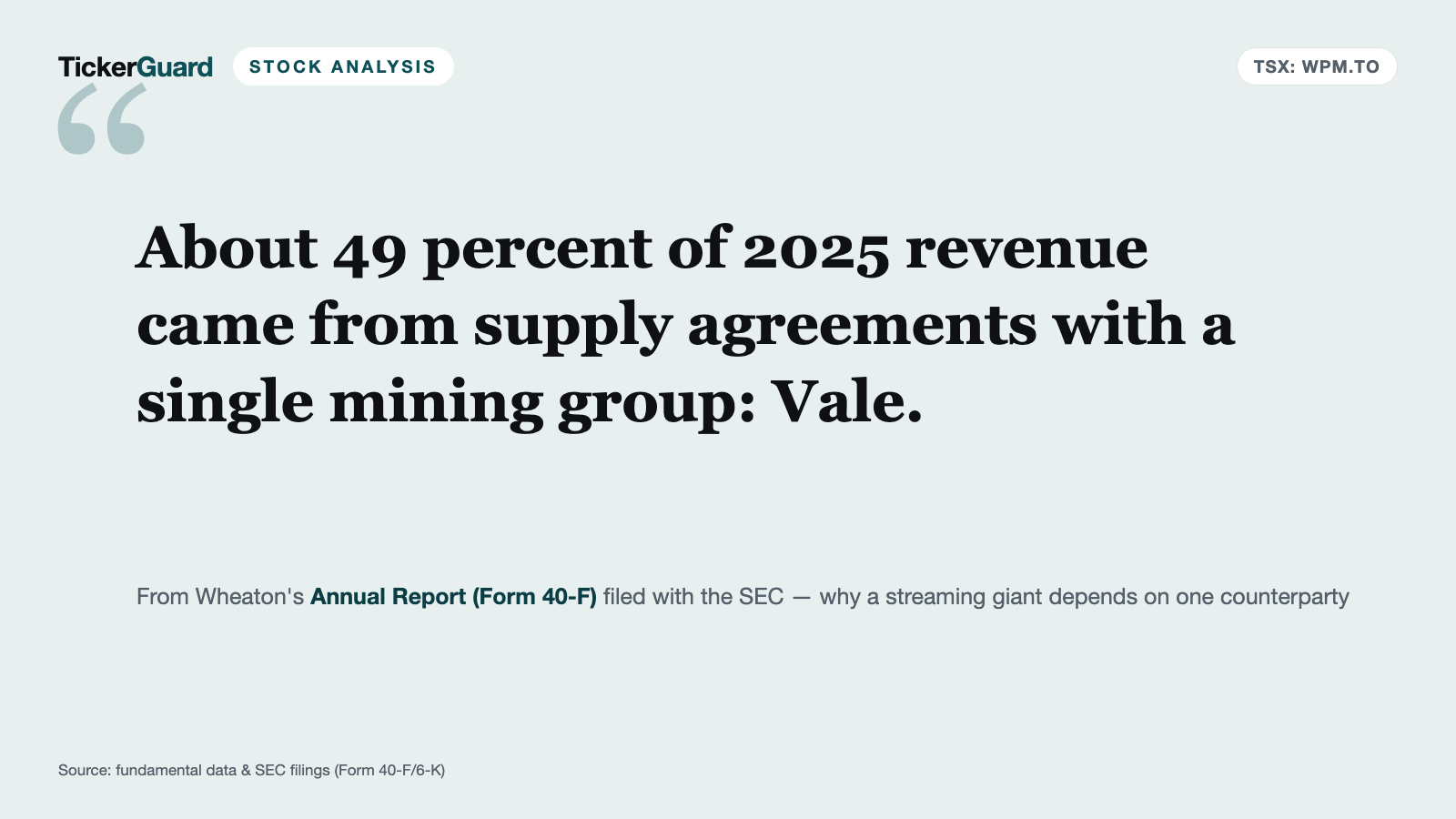
Interactive price chart (TradingView).
Note: pure fact-based analysis, not investment advice and not a solicitation to buy or sell. All figures without guarantee.
There is an investor weakness that trips up experienced investors especially — because it feels like knowledge, not a shortcut: label trust. A company earns a label over years — "debt-free," "conservatively financed," "the safest way to own gold" — and at some point you stop checking the label and just assume it still applies. Wheaton Precious Metals (TSX: WPM.TO, NYSE: WPM), based in Vancouver, wore that label longer and more credibly than almost any other company in its industry: the world's largest precious metals streaming company, telling shareholders for years how it funds growth without borrowing a dime. On December 31, 2025, that was still true — $1.15 billion in net cash, the credit facility completely untouched. Six months later, on June 30, 2026, that had become a net debt pile of $1.87 billion. Around the same time, a new CEO took over from the man who had co-founded the company. And the company's own annual report to the SEC contains a number that shows just how concentrated this "safe" business really is. Let's look at what actually changed — and what didn't.
What Wheaton Precious Metals actually does
Wheaton is not a mining company. It doesn't dig a single gram of gold out of the ground itself — it buys future production in advance. The principle, in everyday terms: picture a farmer who needs money to develop a new field. An investor pays him a lump sum upfront in exchange for the right to buy a fixed share of the harvest, for the life of the field, at a low, contractually fixed price — regardless of where the market price for grain ends up later. The investor bears no risk for planting, weather, or machinery; the only risk is whether the field produces anything at all. That is exactly what Wheaton does with mines: it pays operators like Vale, Newmont, Glencore, or BHP an upfront deposit in exchange for the right to buy a fixed percentage of their gold, silver, palladium, or cobalt production at a low price, often set as a percentage of the spot price. As of August 6, 2026, Wheaton held 57 such streaming and royalty interests — 22 on already-producing mines, 20 on projects under construction or in development, 15 at the exploration stage. The company employs just 47 people (as of March 26, 2026) to run all of it — a fraction of what a mining operator of comparable size would need, because Wheaton never operates a mine itself.
The appeal of the model: Wheaton carries no operating risk (no mine accidents, no strikes, no exploding diesel and labor costs) and benefits disproportionately from rising precious metal prices, because its own purchase price stays fixed while the sale price rises with the market. The catch: Wheaton also has no control. Whether a mine gets built on time, whether it delivers the promised tonnage, whether the operator stays solvent — someone else decides that. Which brings us to the central tension of this analysis: a business model that markets itself as unusually safe in fact depends entirely on how few, and how reliable, its counterparties are — and that is exactly where 2026 gets interesting. The same financing logic shows up at younger, smaller companies that don't operate a mine yet: in our Solaris Resources analysis, an exploration company sold its future gold before a mine even existed — the same upfront-purchase logic, just viewed from the other side of the contract.
Company history for investors
-
2004
Founded as Silver Wheaton Corp.
Spun out with a streaming agreement with Goldcorp — the origin of the business model Wheaton still runs today.
-
2017
Renamed Wheaton Precious Metals Corp.
On May 10, 2017, the company's name opened up beyond silver to gold, palladium, and later cobalt.
-
2025
CMOC exercises Cangrejos buy-back option
In Q3, CMOC paid $102 million to buy its way out of a third of a stream — evidence that these contracts aren't as unbreakable as often portrayed.
-
2026
Leadership transition announced
On Feb 5, 2026, Haytham Hodaly succeeded co-founder Randy Smallwood as CEO effective Mar 31, 2026 — the end of a 15-year era at the top.
-
2026
Third consecutive annual dividend increase
With its 2025 full-year results on Mar 12, 2026, Wheaton set the 2026 quarterly dividend 18% higher at $0.195.
-
2026
BHP Antamina deal closes
On Apr 1, 2026, the $4.3 billion upfront payment went out — the biggest single deal in company history also ended its debt-free run.
-
2026
Record quarter Q2 2026
On Aug 6, 2026, Wheaton reported record revenue, earnings, and cash flow for the second quarter — the third 2026 quarterly dividend stayed unchanged at $0.195.
Why we're looking at this stock right now
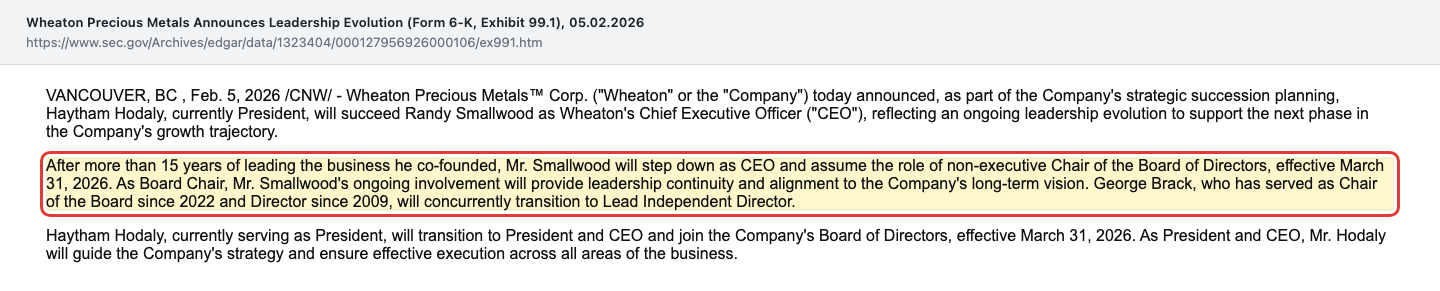
Two public events reframed Wheaton in 2026. First: on February 5, 2026, the company disclosed a leadership transition to the SEC via Form 6-K. Randy Smallwood, who co-founded the company in 2004 and had served as CEO since 2011, stepped down to become Chair effective March 31, 2026; his successor as President & CEO was Haytham Hodaly, with the company since 2012 and most recently President, a mining engineer and former RBC analyst who the company says has worked on more than $11 billion in streaming transactions. A founder who was the face of the company for 15 years stepping aside is, on its own, an event worth a fresh look.
Second, and almost simultaneously: on February 16, 2026, Wheaton signed the largest single deal in its history — a $4.3 billion silver stream with BHP on the giant Antamina mine in Peru, closing April 1, 2026. On August 6, 2026 came record second-quarter 2026 results. Taken together, this is a company in transition: new leadership, its biggest deal ever, a balance sheet carrying real debt for the first time — and, at the same time, the best quarterly numbers in company history. That combination is exactly the moment to look closely instead of relying on the old label.
The numbers over the years
Let's start with what speaks for Wheaton — and there's a lot of it. Revenue and net earnings have grown over six years, with a real jump in 2025:
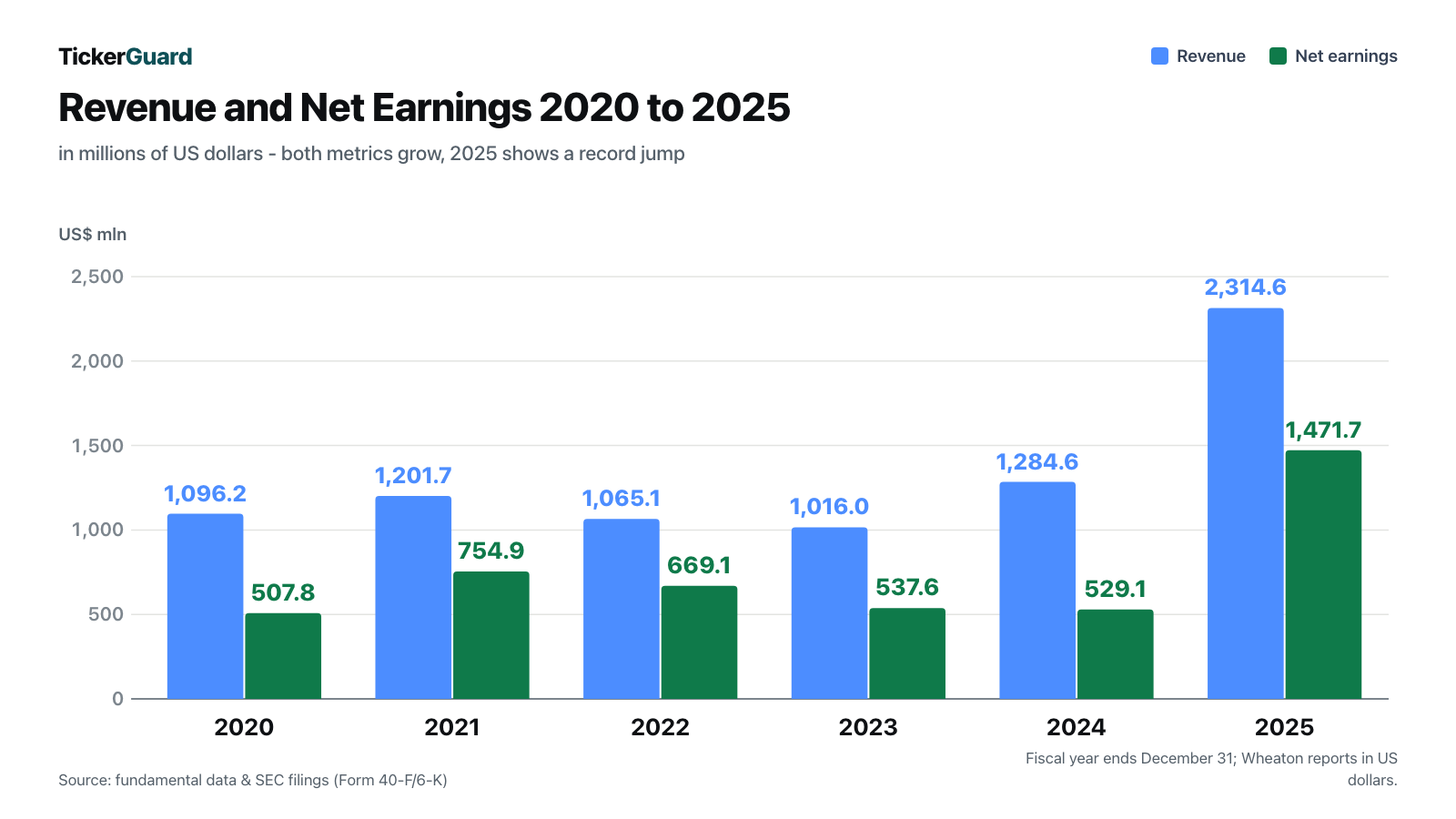
That trend continued into 2026: in the first half of the year, Wheaton posted record revenue of $1.8 billion and record net earnings of $1.1 billion. In the second quarter of 2026 alone, that was $929 million in revenue, $543 million in net earnings, and $650 million in operating cash flow — a record quarter on all three counts, per the company. Average cash costs per gold-equivalent ounce (GEO) were $568 in Q2 2026 (versus $406 a year earlier), producing a cash operating margin of $3,875 per GEO — up 65% year over year, because the margin grew faster than the gold price itself. CEO Haytham Hodaly put it this way:
"Wheaton delivered another strong quarter, with solid production across the portfolio driving record year-to-date production, sales volumes, revenue, earnings and cash flow. […] Our financial position provides significant flexibility to pursue accretive streaming opportunities while continuing to advance one of the strongest growth profiles in the industry."
— Haytham Hodaly, President & CEO, Wheaton Q2 2026 earnings release (Form 6-K, Exhibit 99.1), August 6, 2026
These numbers are real and impressive. But a record quarter doesn't answer how the company finances itself, how concentrated its earnings are, or whether management delivers on what it promises. That's worth a look beneath the surface.
What the filings show — the uncomfortable truths
Uncomfortable truth #1: From debt-free poster child to billion-dollar borrower — in six months
Wheaton's brand identity for years was its debt-free balance sheet. As of December 31, 2025, that was still nearly true, word for word: the unsecured, sustainability-linked $2.0 billion revolving credit facility was completely undrawn, with its maturity just extended by a year. Then came the Antamina deal. On April 1, 2026, Wheaton drew a new two-year, $1.5 billion term loan plus part of its revolving facility to pay its share of the $4.3 billion BHP silver stream. In the second quarter of 2026, the company also upsized its revolving facility by $500 million to $2.5 billion and extended its maturity to June 2031. The result fits in one chart:
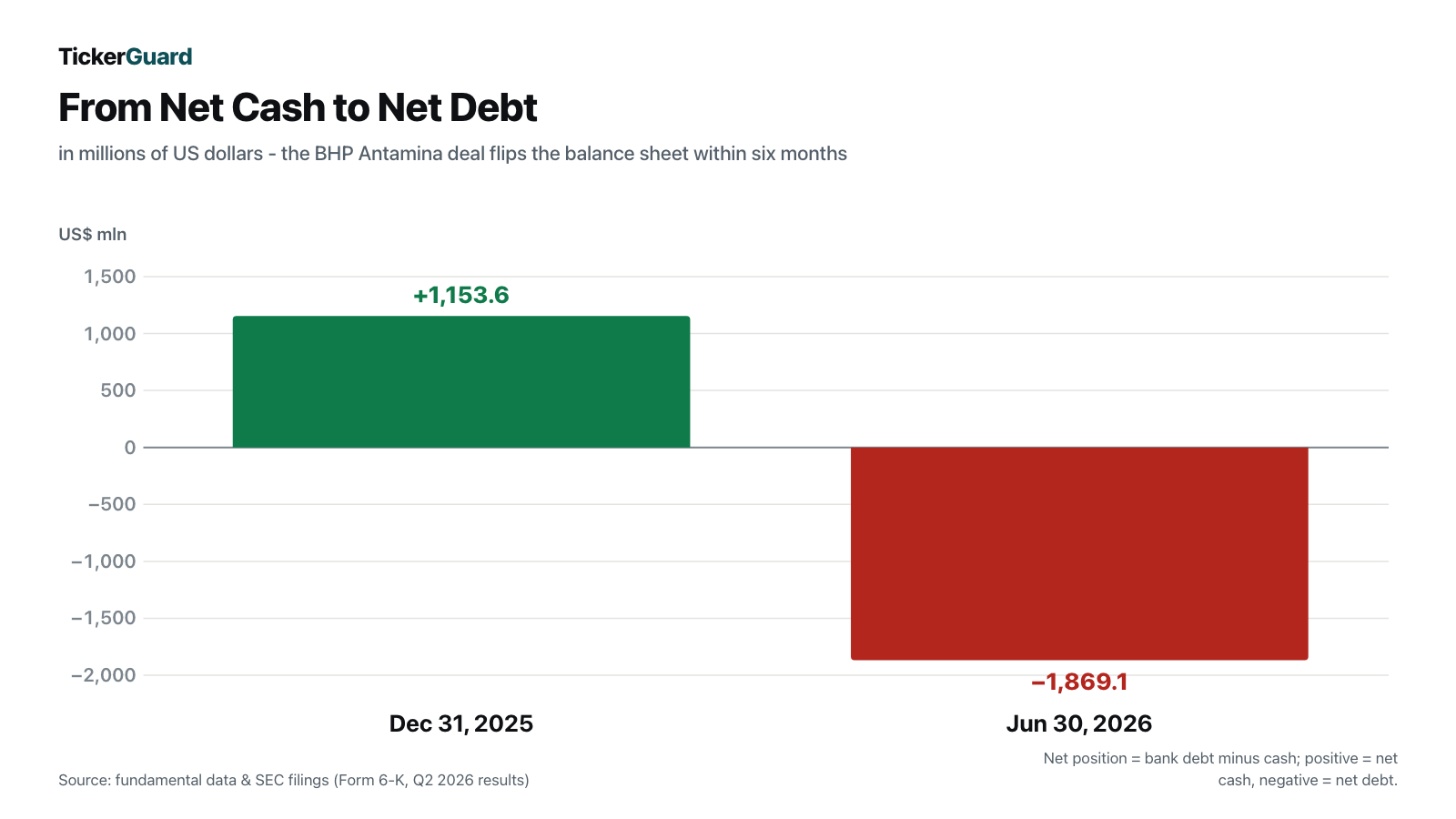
"Balance Sheet: Cash balance of $100 million and debt outstanding totaling $2.0 billion, resulting in total net debt of $1.9 billion."
— Wheaton Precious Metals Corp., Q2 2026 earnings release (Form 6-K, Exhibit 99.1), August 6, 2026

To put this in perspective, so it doesn't sound more dramatic than it is: $1.87 billion in net debt against $8.7 billion in equity (Dec 31, 2025) and $1.4 billion in operating cash flow in the first half of 2026 alone is moderate leverage — not a solvency red flag. The point is different: a company that told a "debt-free" story as the core of its investment case for two decades simply doesn't get to wear that label anymore, as of April 2026. If you're buying the stock today for that reputation, you're buying a memory, not the present.
Uncomfortable truth #2: Nearly half the business depends on a single group
The second uncomfortable number doesn't come from a critic — it's in the risk factors section of Wheaton's own 2025 Annual Information Form, filed March 31, 2026 as an exhibit to Form 40-F:
"Total revenues relative to PMPAs with Vale were approximately 49% and 46% of the Company's total revenue for the years ended December 31, 2025 and December 31, 2024, respectively; operating cash flows from the PMPAs with Vale represented approximately 52% and 48% of the Company's operating cash flows for the years ended December 31, 2025 and December 31, 2024, respectively."
— Wheaton Precious Metals Corp., Annual Information Form 2025 (Form 40-F, Exhibit 99.1), March 31, 2026
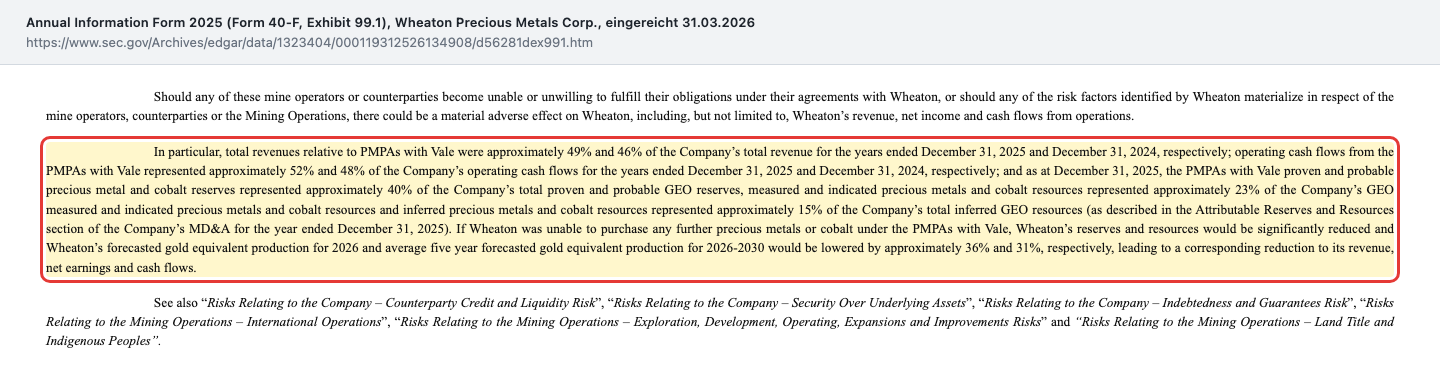
In everyday terms: imagine a landlord proudly pointing to a "diversified" portfolio of 57 properties — but half his rental income comes from a single large tenant. If that tenant leaves, the building doesn't collapse, but the diversification story was always thinner than the raw property count suggested. Wheaton's three largest Vale-sourced mines — Salobo (Brazil, gold), Sudbury (Canada, gold), and Voisey's Bay (Canada, cobalt) — together account for nearly half the business. The new Antamina deal with BHP does little to change that: it doesn't diversify away from Vale, it builds a second, similarly sized dependency on a single mine — through two separate agreements (the existing one with Glencore and the new one with BHP), Wheaton now has a combined claim on up to 67.5% of Antamina's silver production until a contractually fixed delivery threshold is reached. The headline "57 interests" figure obscures how concentrated actual earnings are in a handful of large mines.
Uncomfortable truth #3: Even seemingly permanent contracts are buyable
A third detail from the annual report tempers the "locked in for the life of the mine" image of streaming income. In the third quarter of 2025, mining group CMOC, as part of its acquisition of Lumina Gold, exercised a contractual buy-back option for a third of Wheaton's gold stream on the Cangrejos project in Ecuador:
"During Q3 2025, in connection with its acquisition of Lumina Gold Corp., CMOC exercised its 33% buy-back option under the Cangrejos PMPA for a cash payment of $102 million, resulting in a gain of $86 million on partial disposal of the Cangrejos PMPA."
— Wheaton Precious Metals Corp., Annual Information Form 2025 (Form 40-F, Exhibit 99.1), footnote 16, March 31, 2026

Financially, this was a good outcome for Wheaton — an $86 million gain on a $102 million payment. But the structure is notable: streaming agreements are often sold as near-permanent assets running for the "life of the mine." In practice, some of these contracts include change-of-control clauses that let a new mine owner buy its way partially or fully out of the agreement — more detail in the side find on this contract pattern. For the long-term production guidance of 1.2 million gold-equivalent ounces by 2030, that's a caveat the headline "57 interests" figure doesn't show.
The earnings calls: what management promised — and what happened
Verbatim earnings call transcripts are not filed with the SEC — that requirement applies only to certain US domestic filers, not to Canadian MJDS filers like Wheaton. The quotes below therefore come from published transcript services (Motley Fool, Investing.com), dated and attributed to a speaker, not from an SEC filing.
On the fourth-quarter 2025 earnings call (March 2026) — still under outgoing CEO Randy Smallwood — management defended the coming shift on leverage before the Antamina deal had even closed:
"The use of debt effectively over the last 10 years has dramatically improved the returns for our existing shareholders."
— Randy Smallwood, then CEO, Q4 2025 earnings call, quoted via Investing.com, March 2026
Asked by analyst Lawson Winder (BofA Securities) whether the dividend was safe even if gold fell, CFO Vincent Lau answered:
"Even if we went down to $3,000 gold, the amount we're paying out is still only kinda in the mid-30s% in terms of percentage of operating cash flow."
— Vincent Lau, CFO, same call
And asked how much Wheaton could fund on short notice for another large deal, then-President and incoming CEO Haytham Hodaly said, already in March 2026:
"We would easily be able to fund a transaction in the $1.5-$3 billion range if we needed in the next little while."
— Haytham Hodaly, then President, same call
What followed lines up with those statements: on February 16, 2026 — before this earnings call even took place — Wheaton had already signed the $4.3 billion Antamina deal with BHP, above the range mentioned but in the same ballpark as flagged. On the second-quarter 2026 earnings call (August 7, 2026) — now under new CEO Hodaly — CFO Lau confirmed that the new Antamina streams (with Glencore and with BHP) will be subject to separate impairment tests going forward, with no trigger currently in sight. Asked about the deal pipeline, Hodaly said the focus remains mostly on transactions "focused on sub-$500 million," with occasional $1–2 billion deals. The takeaway from the earnings calls: management didn't hide the break with debt-free financing — it flagged it early and has since executed roughly at the scale it described. The tonal shift from "we're proud to be debt-free" to "debt is a value-creation tool" is real, but it isn't a broken promise.
Valuation: a premium with — or without — substance?
On August 28, 2026, the stock closed on the Toronto Stock Exchange at CAD 213.27 — converted at that day's exchange rates (USD/CAD around 1.3901, EUR/CAD around 1.6101), that works out to roughly US$153.4 or about €132.5. With 454.2 million shares outstanding, that implies a market capitalization of roughly CAD 96.9 billion (about US$69.7 billion or roughly €60.2 billion). The stock closed about 5.9% below its 52-week high (CAD 226.61) and roughly 65% above its 52-week low (CAD 128.92).
On trailing twelve-month earnings, that implies a price-to-earnings ratio of roughly 34 — a valuation market commentators regularly flag as a premium to traditional mining operators: an August 2026 analysis by Simply Wall St put the average P/E for Canadian metals-and-mining peers at around 15, and its own calculated "fair" multiple at around 17 — both well below Wheaton's actual price-to-earnings ratio. That's a market assessment, not a fact from a financial statement, and it's internally inconsistent in an interesting way: a discounted-cash-flow model in the same analysis pointed to undervaluation, while the plain earnings multiple showed a clear premium. That premium is arguably justified by the business model — streaming carries no operating risk, no capital costs for new mines, and delivers high, predictable margins (Q2 2026 cash margin: $3,875 per ounce). Whether it's justified at this scale, indefinitely, now that real debt sits on the balance sheet for the first time in years and nearly half the business depends on one group, is a pricing question this analysis doesn't answer — it just lays out the facts so you can answer it for yourself.
Opportunities and risks at a glance
What speaks for Wheaton Precious Metals:
- Proven, capital-light business model with no operating risk: 47 employees manage 57 streaming and royalty interests (as of Aug 6, 2026), Q2 2026 cash margin of $3,875 per gold-equivalent ounce.
- Record results across multiple consecutive quarters: 2025 revenue nearly doubled ($2,314.6 million), net earnings nearly tripled ($1,471.7 million); first half of 2026 again record revenue ($1.8 billion) and net earnings ($1.1 billion).
- Third consecutive annual dividend increase, declared March 2026 (+18% to $0.195 per quarter for all of 2026); per the CFO, the payout ratio would remain "only in the mid-30s percent" of operating cash flow even at $3,000 gold.
- Solid balance-sheet ratios despite new debt: $1.87 billion in net debt against $8.7 billion in equity (Dec 31, 2025) and $1.4 billion in operating cash flow in H1 2026 alone; available liquidity around $2.6 billion.
- Long-term growth guidance (1.2 million gold-equivalent ounces by 2030, +50% versus 2026) was reaffirmed, not walked back, after the Antamina deal.
What speaks against it:
- Documented concentration risk: about 49% of 2025 revenue and 52% of operating cash flow came from agreements with a single group (Vale); losing them would, per the company's own annual report, cut 2026 production guidance by roughly 36%.
- The balance sheet flipped in six months from $1.15 billion in net cash to $1.87 billion in net debt — the "debt-free" label maintained for two decades has not applied since April 2026.
- Streaming agreements aren't as unbreakable as often portrayed: CMOC contractually bought its way out of a third of the Cangrejos stream in 2025 — a precedent for change-of-control clauses in future mine-operator acquisitions.
- Elevated valuation: a price-to-earnings ratio of roughly 34, well above the peer average for comparable mining operators per market commentary — a premium that assumes flawless execution of the growth plan.
- Fresh leadership transition (CEO since March 31, 2026; CFO since March 31, 2025): the new team hasn't yet been tested through a full commodity cycle.
A human takeaway
Back to the label trust from the start. Its core problem isn't that the label was a lie — Wheaton really was unusually conservatively financed for an unusually long time, and the streaming model really is structurally safer than traditional mining. Its core problem is that a label, once earned, eventually stops getting checked — and it's in exactly that gap that things change without anyone noticing. If you still think "Wheaton is debt-free," you're thinking of a company that hasn't existed since April 1, 2026. The new company isn't a bad one: solidly financed, posting record numbers, run by a seasoned new management team that has so far delivered on what it announced, with a long-term growth story that remains intact. But it now carries two things at once that can't be argued away: real debt, and a dependency on a single group for nearly half the business. So the honest question isn't "Is Wheaton still the safe bet it used to be?" It's: are you willing to keep paying a valuation premium well above the industry average for a streaming model that now carries both of these new traits? The facts are in front of you now. What you do with them is your call — and that's exactly how it should be.
Sources
All original documents used in this analysis — for your own review:
- Wheaton Precious Metals Corp. — Annual Information Form 2025 (Form 40-F, Exhibit 99.1, filed March 31, 2026)
- Wheaton Precious Metals Corp. — Second quarter 2026 earnings release (Form 6-K, Exhibit 99.1, August 6, 2026)
- Wheaton Precious Metals Corp. — Leadership transition announcement (Form 6-K, Exhibit 99.1, February 5, 2026)
- Full SEC filing history for Wheaton Precious Metals Corp.: EDGAR overview (sec.gov)
- Earnings call quotes: Investing.com, Q4 2025 transcript (March 2026); Motley Fool, Q2 2026 transcript (August 14, 2026)
- Fundamental data (metrics, price history; as of August 28–29, 2026), cross-checked against the SEC filings.
Transparency & disclaimer: this analysis is a journalistic assessment of publicly available information and does not constitute investment advice, a regulated financial analysis, or a solicitation to buy or sell securities. Stock investments carry substantial risk, including total loss. All information is provided without guarantee; data dates are noted in the text. The author holds no position in Wheaton Precious Metals shares as of publication.
Our Bottom Line at a Glance
- Business model & operating substance positive
- Capital-light streaming model with no operating risk of its own: 47 employees manage 57 interests. Consecutive record results — 2025 revenue nearly doubled ($2,314.6 million), net earnings nearly tripled ($1,471.7 million), H1 2026 again record (revenue $1.8B, earnings $1.1B), Q2 2026 cash margin of $3,875 per ounce.
- Balance sheet & leverage neutral
- Flipped from $1.15 billion net cash (Dec 31, 2025) to $1.87 billion net debt (Jun 30, 2026) within six months, driven by the $4.3 billion Antamina deal. Moderate relative to $8.7 billion in equity and $1.4 billion in H1 2026 operating cash flow, but a genuine break from the long-standing "debt-free" profile.
- Concentration risk negative
- About 49% of 2025 revenue and 52% of operating cash flow came from agreements with a single group (Vale) — the company's own annual report says losing them would cut 2026 production guidance by about 36%. The new Antamina deal builds a second, similarly concentrated dependency rather than diversifying.
- Leadership & continuity neutral
- CEO (since Mar 31, 2026) and CFO (since Mar 31, 2025) are both newly in role, both long-tenured internal promotions. Public commitments made so far (deal sizing, financing strategy) have been kept — but without a full commodity cycle under the new leadership yet.
- Valuation neutral
- Price-to-earnings ratio of roughly 34, well above the peer average for comparable mining operators (around 15) per market commentary (Simply Wall St, August 2026). The premium is explainable by the lower-risk business model, but it is a pricing argument — not a statement about company quality.
Wheaton Precious Metals is a streaming business with record results and an intact growth path — but two traits that did not apply before 2026: real net debt ($1.87 billion as of Jun 30, 2026, versus $1.15 billion net cash just six months earlier) and documented concentration risk (about 49% of 2025 revenue from a single group). Both are financially manageable, but they change the "unusually safe" label the stock has long traded on. Not investment advice.
What Our Rating Means
Open questions
The business works in principle, but one material question is open. As long as it stays open, our findings do not carry a quality verdict.
The business model demonstrably works — record revenue, high margins, moderate leverage relative to equity and cash flow. This analysis rates it yellow because of an open operating question, not a solvency threat: nearly half of 2025 revenue and cash flow depends on a single group (Vale), and the latest multi-billion-dollar deal deepens a comparable dependency on another single mine (Antamina) instead of diluting it. That is strong customer concentration without an existential threat to Wheaton itself — but a material, unresolved operating question. The high valuation (P/E around 34) deliberately does not factor into this rating: that is a pricing argument, not a quality argument. The decision is yours.
A journalistic assessment by our editorial team at the time of the deep dive, based on public sources — not investment advice and not a solicitation to buy or sell. Your personal circumstances (investment goals, risk capacity, taxes) cannot be taken into account. What our levels mean, how verdicts are formed, and what conflicts of interest exist →
Worth Noting
- This analysis was prompted by two public 2026 events: the announced leadership transition (Feb 5, 2026, effective Mar 31, 2026) and the record Q2 2026 quarter (reported Aug 6, 2026) — not an internal screening hit.
- Verbatim SEC earnings-call transcripts are not available for Wheaton as a Canadian MJDS filer; the quotes cited in "The earnings calls" chapter come from transcript services (Motley Fool, Investing.com) with date and speaker attribution, not from an SEC filing.
- Valuation figures are dated and evergreen: price CAD 213.27 as of Aug 28, 2026, exchange rates as of Aug 28-29, 2026 (USD/CAD ≈ 1.3901, EUR/CAD ≈ 1.6101). Note: WPM.TO (Toronto, home listing in Canadian dollars) and WPM (NYSE, priced in US dollars) are the same stock on two exchanges.
The full analysis as a PDF for later
We will send you this analysis as a PDF — to print, file away, and read at your own pace.
Frequently Asked Questions
Wheaton Precious Metals Corp. (TSX: WPM.TO, NYSE: WPM) is the world's largest precious metals streaming company. It pays mine operators an upfront deposit for the right to buy a fixed share of their future gold, silver, palladium, or cobalt production at a low, often fixed price — without operating a mine itself. As of August 6, 2026, the company held 57 such streaming and royalty interests with 47 employees.
For decades, Wheaton financed its growth almost entirely through equity and operating cash flow. As of December 31, 2025, that was still true: net cash of $1.15 billion, credit facility untouched. Not anymore since the $4.3 billion BHP Antamina deal closed on April 1, 2026: as of June 30, 2026, the company reported $1.87 billion in net debt.
Significantly, per its own annual report: about 49% of 2025 revenue and 52% of operating cash flow came from purchase agreements with a single group, Vale (Salobo, Sudbury, Voisey's Bay mines). Losing those agreements would cut 2026 production guidance by about 36%, according to the 2025 Annual Information Form.
Haytham Hodaly, with the company since 2012 and most recently President, succeeded co-founder Randy Smallwood as President & CEO effective March 31, 2026. Smallwood, who co-founded Wheaton in 2004 and had served as CEO since 2011, moved into the role of Non-Executive Chair. Vincent Lau has been CFO since March 31, 2025.
On August 28, 2026, the stock closed on the Toronto Stock Exchange at CAD 213.27 (roughly $153.4 or €132.5), for a market capitalization of about CAD 96.9 billion. The price-to-earnings ratio sits at roughly 34 — well above the peer average for comparable mining operators (around 15, per a Simply Wall St analysis from August 2026).
Yes. With its 2025 full-year results on March 12, 2026, Wheaton raised its quarterly dividend for all of 2026 by 18% to $0.195 per share — the third consecutive annual increase. The August 6, 2026 declaration simply confirmed the unchanged third quarterly rate for 2026. CFO Vincent Lau said the payout ratio would remain only in the mid-30s percent of operating cash flow even at a gold price of $3,000 per ounce (Q4 2025 earnings call, March 2026).
Found an error?
Did you spot a factual error, an outdated number, or a typo in this deep dive? Let us know briefly — your report goes straight to the editorial team.