Fluence Energy: $6.4 Billion of Orders on the Books — and Still the Forecast Shrinks by Almost a Third
Fluence Energy, founded by Siemens and AES, builds battery storage for power grids and data centers — and has never had more orders: $6.4 billion as of June 30, 2026. Even so, the company cut its fiscal 2026 revenue guidance twice within six weeks, from $3.4 billion to roughly $2.4 billion, and now expects adjusted EBITDA of roughly negative $200 million instead of positive $50 million. The stock fell from $32.23 (Feb. 3, 2026) to $7.07 (Oct. 12, 2026), about 78 percent. 94.7 million of the founders' shares are registered for resale. We read the filings to see why a full order book is not a full bank account.
 Thomas Mücke
Founder & Publisher
Thomas Mücke
Founder & Publisher
As of Today
As of: October 12, 2026
- Closing price
- 7.10 $ -4.80%
- Market Capitalisation
- 1.4 $B
- Growth Score
- 5/10
- AAQS
- 5/10
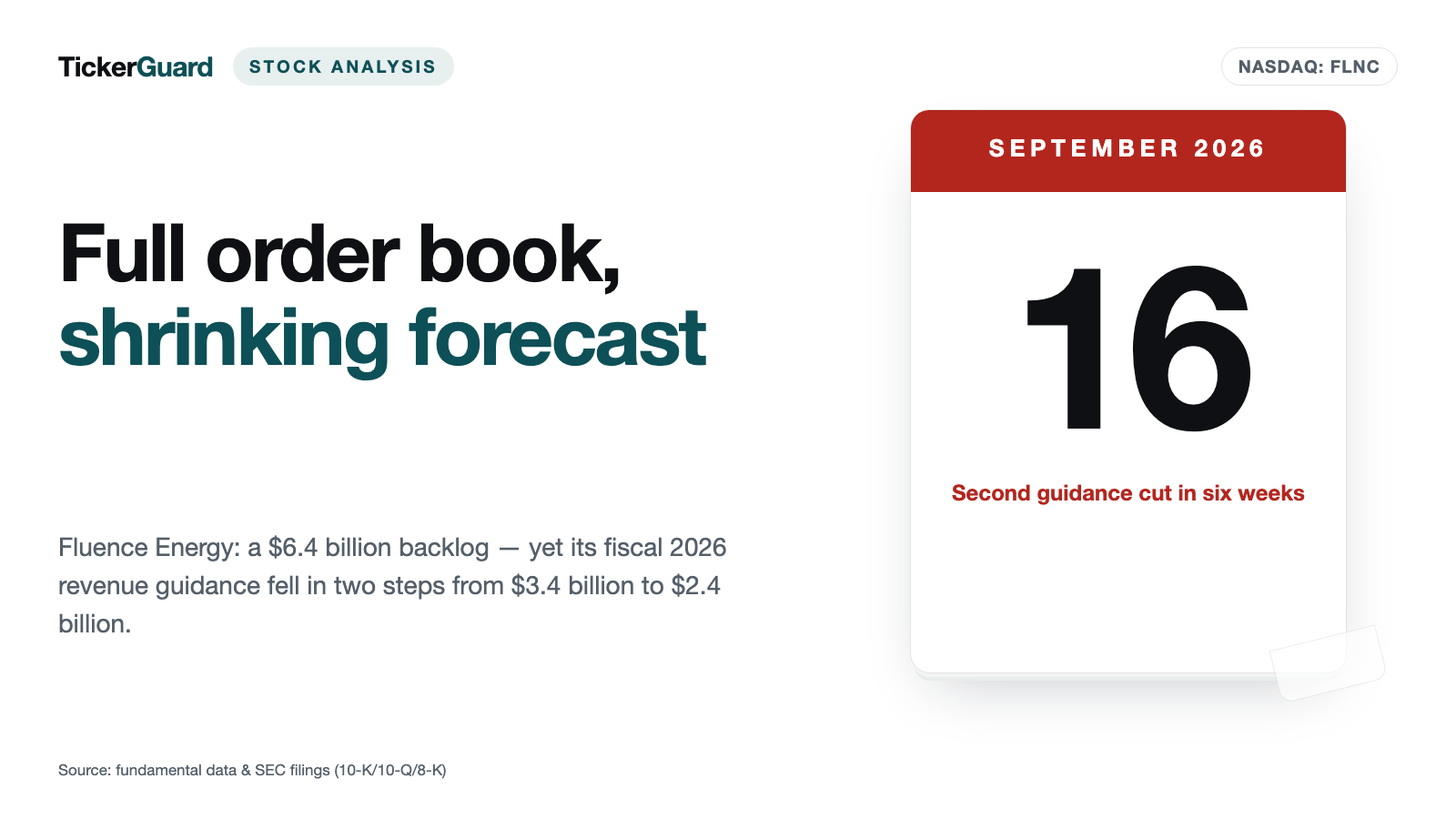
Price change since October 12, 2026: +0.4%
This analysis has a cut-off date. The Stock Guard tells you when something material changes in the numbers. Reserve your free spot
Chart
Interactive price chart (TradingView).
52-week range: 7.10 $ to 32.20 $ · Last price: 7.10 $ (As of: October 12, 2026)
Note: pure fact-based analysis, not investment advice and not a solicitation to buy or sell. All figures without guarantee.
The Packing-Slip Trap: When an Order Already Looks Like Revenue
Few numbers reassure investors like the backlog. It sounds like certainty. The customers have signed, the money is as good as in the bank, the company just has to deliver. Call it the packing-slip trap: you see a huge number in the order book and mentally convert it into revenue and profit — as if the customer had already signed the packing slip. What you forget is the part in between: actually delivering. And that is exactly where it is decided whether an order turns into money or into a penalty.
Fluence Energy is the textbook case right now. On June 30, 2026 the company reported a backlog of $6.4 billion, the highest in its history. In the quarter through June, it booked more than $1.44 billion of new orders, nearly three times the figure a year earlier. And yet Fluence had to cut its revenue guidance for the current fiscal year twice within six weeks. The central tension of this analysis is easy to name: demand has never been stronger — but Fluence has so far failed to deliver it on time and at a profit. Let's read what the company has told the U.S. securities regulator, the SEC. No recommendation, no forecast — just the filings.
Company history for investors
-
2018
Launch as a Siemens/AES joint venture
Fluence begins operating on January 1, 2018. The founders remain major shareholders, customers and suppliers at once — a close web that still shapes control today.
-
2021
Nasdaq listing
Fluence goes public on November 1, 2021. AES keeps high-vote Class B-1 shares with five votes each; since then Fluence has been a “controlled company.”
-
2024
First profitable year
In fiscal 2024 revenue rises to $2,698.6 million, gross margin to 12.6% and the bottom line shows a $30.4 million profit. In December 2024 Fluence issues $400 million of convertible notes.
-
2025
Guidance 85 percent covered
On November 24, 2025 Fluence guides to $3.2–3.6 billion of fiscal 2026 revenue, about 85% covered by backlog by its own account. Fiscal 2025 ended with a $68.0 million loss.
-
2026
Founders sell, guidance falls twice
In May, AES, the Siemens pension trust and Qatar sell 23 million shares; 94.7 million more are registered for resale. On August 5 and September 16, revenue guidance drops to about $2.4 billion.
What Fluence Actually Does
Fluence Energy, Inc., based in Arlington, Virginia, builds utility-scale battery storage. Picture a row of shipping containers packed with lithium-ion batteries, cooling, inverters and controls. These systems soak up electricity when it is plentiful and cheap — at midday from solar farms — and release it when it is scarce. Grid operators, power producers and, increasingly, data centers buy them to keep their power supply stable. The products are called Gridstack Pro and Smartstack.
One thing is key to understanding the business: Fluence does not make battery cells. It buys cells and modules, has the systems assembled by contract manufacturers — third-party factories that produce on its behalf — and delivers them turnkey. On top of that it sells service contracts and software. That makes Fluence a systems integrator: it earns money on design, assembly, logistics and commissioning. A business built this way has large revenue but thin margins — and depends on other companies' factories delivering on time.
Fluence was founded by two heavyweights: the joint venture of Siemens and U.S. power company AES began operating on January 1, 2018, and the Nasdaq listing followed on November 1, 2021. For how co-founder AES itself is doing, see our analysis of AES stock. As of September 30, 2025, Fluence had roughly 1,670 employees in 15 countries.
A note on the calendar, because it matters here: Fluence's fiscal year ends September 30. Fiscal 2026 therefore ran from October 1, 2025 to September 30, 2026; the “third quarter” is April through June 2026. Fiscal 2026 has just ended, but its annual report (10-K) had not been filed as of October 13, 2026 — the prior-year report was filed on November 25, 2025. The latest audited annual figures are therefore for fiscal 2025, and the latest quarterly figures come from the report for June 30, 2026.
And where is the artificial intelligence the filings mention? In two places. First, Fluence sells software: Fluence Mosaic optimizes bids in power markets, and Fluence Nispera monitors assets and is described in the 10-Q as “AI-driven.” Second, the power needs of AI data centers drive demand: by its own account Fluence had secured roughly $850 million of data center business through July 2026, including about $550 million awarded by a single hyperscaler in July 2026. For perspective: software brought in only $6.2 million of $1,590.0 million in revenue in the first nine months of fiscal 2026 — about 0.4 percent.
How the Stock Landed on Our Desk
Fluence reached us through two filings, not a screening metric. On August 5, 2026 the company cut its annual guidance alongside its quarterly results. On September 16, 2026 the second cut followed, outside the regular reporting cycle. The next day, September 17, the stock fell from $9.05 to $7.66 — a one-day drop of 15.4 percent. From its highest close of the prior twelve months ($32.23 on February 3, 2026), it had lost about 78 percent by October 12, 2026.
There is a second reason the stock is interesting: Siemens is not just a co-founder but still a major shareholder. According to its ownership filing of August 10, 2026, Siemens AG and a subsidiary of the Siemens pension trust together hold 41.4 million Fluence shares. What the founders intend to do with their stakes is therefore one of the uncomfortable truths below. Keep one line in mind from the start: an order is a promise in both directions.
The Numbers Over the Years — Given Their Due
First, what genuinely impresses. Fluence more than doubled its revenue in two years: from $1,198.6 million in fiscal 2022 to $2,698.6 million in fiscal 2024. Gross margin — the share of revenue left after the direct costs of materials, manufacturing and delivery — rose from negative 5.2 percent to positive 12.6 percent over the same period. In fiscal 2024 Fluence posted its first net profit since going public, $30.4 million. It also has a cushion many industrial companies lack: Fluence bills customers for part of the price in advance as projects progress. On June 30, 2026, $956.5 million of such amounts from third-party customers — billed but not yet recognized as revenue — sat on the balance sheet, plus $57.5 million from related parties, $1,014.0 million in total.
Then came the break. In fiscal 2025, revenue fell 16.1 percent to $2,262.8 million, and the bottom line showed a $68.0 million loss. In fiscal 2026 gross margin falls back to its fiscal 2023 level: 6.5 percent in the first nine months versus 6.4 percent in fiscal 2023.
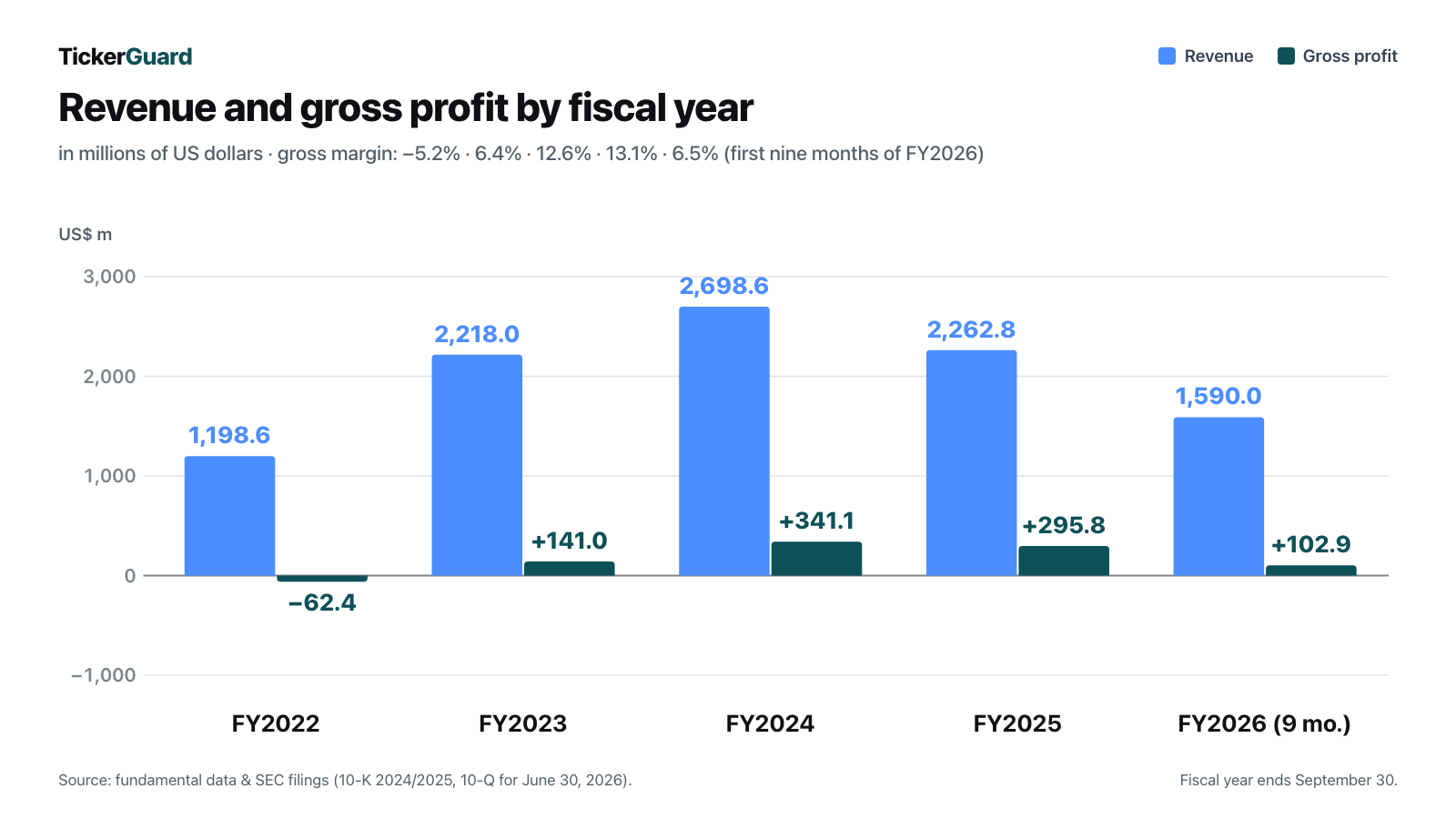
In the first nine months of fiscal 2026 (October 2025 through June 2026), revenue rose 30 percent to $1,590.0 million. But gross profit fell 33 percent to $102.9 million, the net loss widened to $136.1 million, and operating activities used $366.5 million of cash. Adjusted EBITDA — roughly what day-to-day operations earn before interest, taxes, depreciation and one-off items — came to negative $90.8 million. In the third quarter alone, gross margin was 5.1 percent, versus 14.8 percent a year earlier. Keep the picture in mind: Fluence is selling more — and earning less on every dollar of revenue than before.
What the Filings Say — the Uncomfortable Truths
Uncomfortable Truth No. 1: 85 Percent “Covered” — and Still a Billion Short
When Fluence presented its fiscal 2026 guidance on November 24, 2025, it sounded solid: $3.2 billion to $3.6 billion of revenue, $40 million to $60 million of adjusted EBITDA. And then the sentence that feeds the packing-slip trap perfectly:
“As of September 30, 2025 approximately 85% of the midpoint of the Company’s revenue guidance is covered by the backlog as of that date.”
— Fluence Energy, Inc., fiscal 2025 earnings release, Exhibit 99.1 to the 8-K of November 24, 2025
Nine months later, little of that was left. On August 5, 2026, Fluence cut guidance to $2.9 billion to $3.1 billion of revenue and adjusted EBITDA of negative $30 million to positive $10 million. The reason came with it:
“The Company now expects that $400.0 million in project deliveries will be delayed into fiscal 2027 due to production issues at a new international contract manufacturing facility and construction related delays that affected the completion and start-up of a new U.S. contract manufacturing facility.”
— Fluence Energy, Inc., Q3 fiscal 2026 earnings release, Exhibit 99.1 to the 8-K of August 5, 2026
Six weeks later, on September 16, 2026, the second cut arrived: about $2.4 billion of revenue and adjusted EBITDA of about negative $200 million. CEO Julian Nebreda named the cause:
“However, we continue to experience delays in the ramp up of our contract manufacturing facility in Houston which is the primary reason we are now lowering our fiscal year 2026 financial guidance”
— Julian Nebreda, CEO, release of September 16, 2026, Exhibit 99.1 to the 8-K
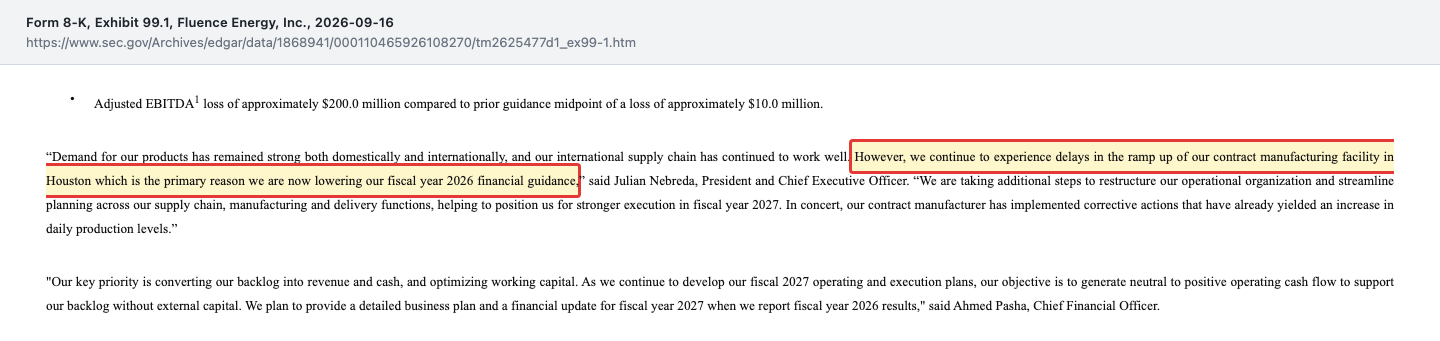
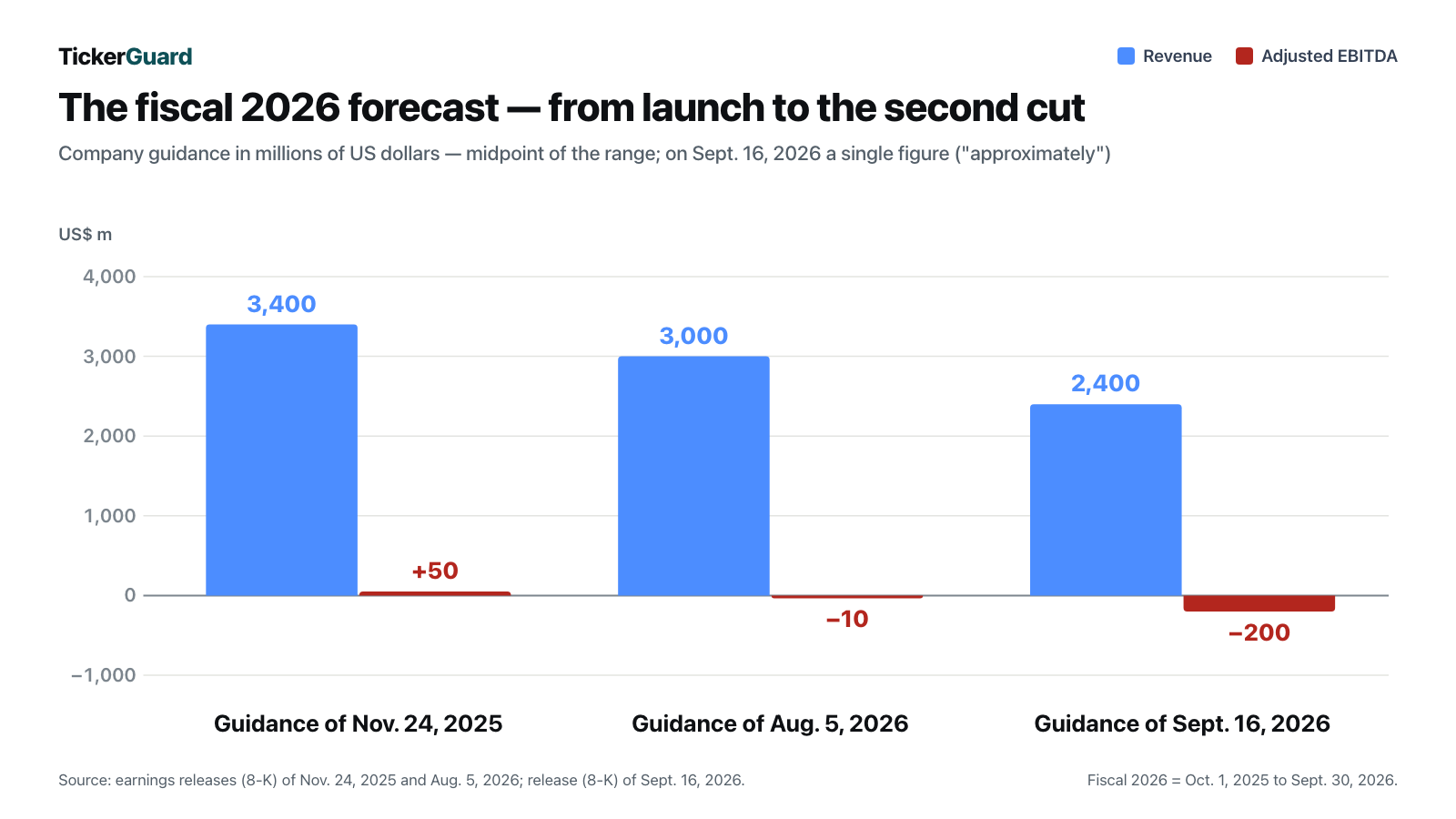
Do the math and the fourth quarter (July through September 2026) is left with roughly $810 million of revenue ($2.4 billion of annual guidance minus $1,590.0 million from the first nine months) and adjusted EBITDA of roughly negative $109 million. That would be the year's worst quarter. Back on August 5, 2026, CFO Ahmed Pasha had said that the revenue delayed at that time ($400 million) remained in backlog and was expected to be recognized in fiscal 2027; there is no such statement for the further cut of September 16, 2026. That may turn out to be true. But the lesson of this year is: “covered by orders” does not mean “covered by factories.”
Uncomfortable Truth No. 2: Delays Cost Twice — Liquidated Damages and Pricier Batteries
Why did margins fall so sharply even though third-quarter revenue rose 8 percent? The 10-Q names three reasons in one sentence:
“The decrease in gross profit for the three months ended June 30, 2026 was primarily due to, (i) liquidated damages incurred due to project delays as described above in “Revenue”, (ii) cost overruns primarily related to deployment of newer solutions offerings, and (iii) increased estimated total contract costs on certain projects due to increases in battery prices, partially offset by the IEEPA tariff refunds as described above in “Cost of goods and services.””
— Fluence Energy, Inc., SEC quarterly report 10-Q for June 30, 2026, Item 2 MD&A

Here is an everyday picture: imagine a builder who sells houses at a fixed price. If a house is late, he pays the buyer an agreed penalty — those are the liquidated damages Fluence deducts directly from revenue. And if bricks get more expensive during construction, he absorbs the extra cost himself. That is exactly what is happening with Fluence's batteries: according to the 10-Q, prices for lithium carbonate, and with them for lithium-ion batteries, have been rising again since December 2025. Every delay makes both problems bigger. Refunds of U.S. tariffs (claimed: $57.0 million; received by June 30, 2026: $32.0 million) only softened the blow. Remember: a fixed-price order is only as good as the cost at which you fulfill it.
Uncomfortable Truth No. 3: The Bank's House Rules Get Stricter in 2027
Fluence has a secured $500 million revolving credit facility under which it can issue letters of credit and, within limits, borrow (cash draws capped at $150 million); as of June 30, 2026, $193 million of letters of credit were outstanding under it. A facility like this comes with covenants — the bank's house rules. They were already loosened and pushed out once, on March 31, 2026:
“Pursuant to the changes to the Credit Agreement upon entry into Amendment No. 4 on March 31, 2026, we are now required to maintain (i) Total Liquidity of no less than $150.0 million through and including December 31, 2026, (ii) from January 1, 2027, and thereafter, (a) Total Liquidity of no less than $100.0 million and (b) Consolidated Leverage Ratio as of the last day of any Measurement Period not to exceed 3.50:1.00, and (iii) certain other financial requirements on certain dates.”
— Fluence Energy, Inc., SEC quarterly report 10-Q for June 30, 2026, Note 11 “Debt”

As of June 30, 2026, Fluence met all covenants; total liquidity was $863.0 million and cash including restricted cash $365.0 million. Management says its resources are sufficient for at least the next twelve months. The open question lies in 2027: a leverage ratio measures debt against operating earnings — and fiscal 2026 adjusted EBITDA is expected at roughly negative $200 million, while $400 million of convertible notes (2.25 percent coupon, due 2030) are outstanding. How the credit agreement defines the relevant earnings figure is not spelled out in the quarterly report. What is clear: without markedly better results, this cap becomes an issue.
Then there are obligations that do not appear on the balance sheet at all. Fluence has committed to buy battery cells and modules worth at least $2,913.4 million through 2030 and beyond. The company says it “currently expects to meet the minimum committed volumes of purchases and spend.” But the 10-Q also states: “Liquidated damages apply if the minimum purchase volumes or spend are not met.” Those penalties add up to as much as $396.3 million. The notes also list guarantees, letters of credit and surety bonds of $6,909 million, mostly backing customer projects. Remember: for a systems integrator, the biggest risk often sits below the line, not on it.
Uncomfortable Truth No. 4: The Founders' Shares Are Registered for Sale
Siemens and AES built Fluence, and together with Qatar's sovereign wealth fund (through Qatar Holding) they remain its largest owners. In May 2026 they sold shares for the first time: on May 15, 2026, AES, a subsidiary of the Siemens pension trust and Qatar Holding closed an underwritten public offering of 23 million shares — shortly after the stock had closed at $25.23 on May 11. Fluence received none of the proceeds but paid about $0.5 million of the sellers' expenses. And the rest is already set up:
“The Form S-3 allows us to offer and sell from time to time Class A common stock, preferred stock, depository shares, debt securities, warrants, purchase contracts or units comprised of any combination of these securities for our own account and allows certain selling stockholders to offer and sell a remaining 94,666,665 shares of Class A common stock in one or more offerings.”
— Fluence Energy, Inc., SEC quarterly report 10-Q for June 30, 2026, Item 2 “Shelf Registration Statement”

For scale: as of July 31, 2026 there were 143,163,588 Class A shares and 41,432,781 Class B-1 shares, which AES holds and can exchange for Class A shares — 184.6 million economic interests in total. The registered 94.7 million are about 51 percent of that. This does not mean they will be sold. It does mean that an offering covering more than half the company hangs over every rally — an “overhang.” At the same time the founders keep control: each Class B-1 share carries five votes. By our calculation that gives AES about 59 percent of the votes; Fluence is a “controlled company” under Nasdaq rules, which exempts it from certain independence requirements. The new chief operating officer since September 15, 2026, Bernerd Da Santos, came straight from AES's leadership. The 10-Q also contains an item worth watching: in the first nine months, Fluence paid about $3.8 million in legal and consulting fees related to “potential strategic transactions,” without further detail.
Valuation: A Backlog Five Times the Market Value
At the October 12, 2026 close ($7.07), Fluence was worth roughly $1.3 billion, counting all 184.6 million economic interests; the listed Class A shares alone come to about $1.0 billion. Add the $400 million of convertible notes and subtract the $365.0 million of cash, and enterprise value is also roughly $1.3 billion. Measured against fiscal 2026 revenue guidance of about $2.4 billion, the market is paying about 0.5 times revenue. A price-to-earnings ratio cannot be calculated because Fluence is losing money.
That sounds cheap, and the $6.4 billion backlog is almost five times the market value. But this is where the packing-slip trap snaps shut again: with a gross margin of 5 to 13 percent, only a small slice of each order dollar remains before all other costs — and in the current year not even enough for positive operating earnings. According to the 10-Q, 48 to 53 percent of the backlog is expected to become revenue within the next twelve months. Whether it becomes profit depends on the factories, not the contracts.
The professionals are correspondingly cautious: of 23 analysts whose ratings appear in the fundamental data, 4 rate the stock a buy, 14 a hold and 5 a sell; the average price target is $10 (as of October 13, 2026). That is third-party information for context, not a price target of ours. Fluence intends to present a detailed plan for fiscal 2027 with its annual results; on September 16, 2026, CFO Ahmed Pasha described the objective as being “to generate neutral to positive operating cash flow to support our backlog without external capital.”
Opportunities and Risks at a Glance
What speaks for Fluence Energy:
- Record demand: a $6.4 billion backlog on June 30, 2026 and more than $1.44 billion of orders in the third quarter of fiscal 2026 — nearly three times the prior-year quarter.
- A new growth market in data centers: roughly $850 million of data center business through July 2026, including about $550 million from a hyperscaler.
- Billed in advance: $1,014.0 million billed but not yet recognized as revenue on June 30, 2026 ($956.5 million from third-party customers, $57.5 million from related parties); total liquidity of $863.0 million, no convertible maturity before 2030.
- Proven earnings power in good years: in fiscal 2024 gross margin was 12.6 percent and the bottom line showed a $30.4 million profit.
- U.S. manufacturing with domestic cells can help customers capture tax incentives; Fluence believes its U.S. suppliers comply with the new foreign-entity restrictions (as of August 5, 2026).
What speaks against it:
- Delivery problems: fiscal 2026 guidance cut twice, from $3.4 billion to about $2.4 billion of revenue; adjusted EBITDA is expected at about negative $200 million.
- Thin and falling margins: 5.1 percent gross margin in the third quarter of fiscal 2026, down from 14.8 percent, hit by liquidated damages, cost overruns and rising battery prices.
- Stricter covenants from January 1, 2027 (leverage ratio of at most 3.50) while an EBITDA loss is expected; off-balance-sheet purchase commitments of $2.91 billion with up to $396.3 million of liquidated damages.
- Overhang and control: 94.7 million founder shares (about 51 percent) registered for sale; AES holds about 59 percent of the votes by our calculation.
- Customer concentration: the three largest customers accounted for about 48 percent of revenue in the first nine months of fiscal 2026.
A Human Conclusion
Back to the packing-slip trap from the beginning. Its core is not that the backlog is wrong — the $6.4 billion are real, signed contracts, and demand for battery storage is growing, not least because of data centers. Its core is that a big number in the order book makes you forget to ask whether the company can deliver those orders on time and at a profit. For Fluence, the answer in fiscal 2026 was twice: not as promised. In November 2025 the company said 85 percent of its forecast was covered by orders. By September 2026, a billion dollars of revenue was missing, and instead of a small profit, an adjusted EBITDA loss of about $200 million is in prospect.
So the honest question for you is not “How big is the order book?” but: Do you trust this company to get its factories under control before the 2027 covenants kick in and before the founders possibly sell their registered shares? If you can back a yes with reasons, you have a thesis. If all you have in mind is the $6.4 billion, you had a number. What you make of it is your decision. And that is how it should be.
Sources
All original documents used in this analysis — so you can check for yourself:
- Fluence Energy, Inc. — SEC quarterly report 10-Q for June 30, 2026 (filed August 5, 2026)
- Fluence Energy, Inc. — SEC annual report 10-K for fiscal 2025 (filed November 25, 2025)
- Fluence Energy, Inc. — SEC annual report 10-K for fiscal 2024 (filed November 29, 2024)
- Fluence Energy, Inc. — fiscal 2025 earnings release with fiscal 2026 guidance, Exhibit 99.1 to the 8-K of November 24, 2025
- Fluence Energy, Inc. — Q3 fiscal 2026 earnings release, Exhibit 99.1 to the 8-K of August 5, 2026
- Fluence Energy, Inc. — current report 8-K of September 16, 2026 with Exhibit 99.1 (revised guidance)
- Fluence Energy, Inc. — 8-K of September 1, 2026 and 8-K of October 9, 2026 (personnel)
- Fluence Energy, Inc. — prospectus supplement 424B7 of May 13, 2026 (secondary offering by existing stockholders)
- Siemens AG et al. — ownership filing Schedule 13G/A of August 10, 2026
- Complete SEC filing history: EDGAR overview (sec.gov)
- Fundamental data (prices, analyst estimates; as of October 13, 2026), reconciled with the SEC filings. Another battery storage name in our archive: our analysis of Eos Energy.
Transparency & disclaimer: This analysis is a journalistic assessment of publicly available information. It is not investment advice, not a financial analysis in the regulatory sense and not a solicitation to buy or sell securities. Investing in stocks involves substantial risk, up to and including the total loss of capital. All information without guarantee; data dates are noted in the text. Positions held by the operator are disclosed daily; where one exists, it appears as a notice at the top of this deep dive.
Key figures at a glance
All monetary figures in millions of $; earnings per share as reported.
| Metric | 2021 | 2022 | 2023 | 2024 | 2025 |
|---|---|---|---|---|---|
| Revenue | 680.8 | 1,198.6 | 2,218.0 | 2,698.6 | 2,262.8 |
| Operating Income (EBIT) | -158.5 | -276.4 | -112.6 | 26.6 | -46.3 |
| Net Income | -162.0 | -104.5 | -69.6 | 22.7 | -48.3 |
| Net Margin | -23.8% | -8.7% | -3.1% | 0.8% | -2.1% |
| Earnings Per Share | -2.99 $ | -0.90 $ | -0.60 $ | 0.12 $ | -0.37 $ |
Source: fundamental data & SEC filings (annual and quarterly reports, 10-K/10-Q)
Our Bottom Line at a Glance
- Demand & backlog positive
- A record $6.4 billion backlog on June 30, 2026, more than $1.44 billion of orders in the third quarter of fiscal 2026 and roughly $850 million of data center business through July 2026. Demand is documented and broad.
- Execution & guidance reliability negative
- Fiscal 2026 guidance was cut twice within six weeks: revenue from $3.4 billion to about $2.4 billion, adjusted EBITDA from +$50 million to about −$200 million (midpoints). The company blames production problems at contract manufacturers, Houston above all — even though the original guidance was about 85 percent covered by backlog.
- Margins & earnings power negative
- Gross margin of 5.1 percent in the third quarter of fiscal 2026, down from 14.8 percent, hit by liquidated damages, cost overruns and rising battery prices; nine months: −$136.1 million net result. Only fiscal 2024 showed a profit (+$30.4 million).
- Balance sheet & financing neutral
- $863.0 million of total liquidity and $1,014.0 million billed in advance (including $57.5 million from related parties) on June 30, 2026; the convertible notes do not mature until 2030. But $366.5 million of operating cash outflows in nine months, a leverage cap from January 1, 2027 and $2.91 billion of off-balance-sheet purchase commitments.
- Ownership & control negative
- 94.7 million shares of founders AES, Siemens and Qatar Holding (about 51 percent of economic interests) are registered for resale; the founders already sold 23 million in May 2026; AES controls about 59 percent of the votes by our calculation, and Fluence is a “controlled company” under Nasdaq rules.
Fluence Energy is the packing-slip trap in its purest form: a $6.4 billion backlog, record order intake and a market growing on the back of data centers — but in fiscal 2026 two guidance cuts from $3.4 billion to about $2.4 billion of revenue, a gross margin of 5.1 percent in the latest quarter and an expected adjusted EBITDA loss of about $200 million, which the company attributes to delays at its contract manufacturers. The balance sheet holds for now, but stricter covenants apply from 2027, and about 51 percent of economic interests — the founders' shares — are registered for resale. Not investment advice.
What Our Rating Means
Open questions
The business works in principle, but one material question is open. As long as it stays open, our findings do not carry a quality verdict.
Demand is not in question; the core operational question is open: can Fluence get production at its contract manufacturers under control so that its backlog once again yields a double-digit gross margin? The filings show no existential risk such as going-concern doubts or negative equity — liquidity stood at $863.0 million on June 30, 2026. But the ongoing cash outflow and the leverage cap from 2027 sit close to the red line. If you wait, check the fiscal 2026 annual report: how large was the fourth-quarter loss, what does Fluence plan for 2027, and does the credit facility hold? The decision is yours.
A journalistic assessment by our editorial team at the time of the deep dive, based on public sources — not investment advice and not a solicitation to buy or sell. Your personal circumstances (investment goals, risk capacity, taxes) cannot be taken into account. What our levels mean, how verdicts are formed, and what conflicts of interest exist →
Worth Noting
- Fluence's fiscal year ends September 30. Fiscal 2026 ran from October 1, 2025 to September 30, 2026; its annual report (10-K) had not been filed as of October 13, 2026. The latest periodic report is the 10-Q for June 30, 2026 (filed August 5, 2026); all current reports through October 9, 2026 have been reviewed.
- The market value of about $1.3 billion is calculated from 184,596,369 economic interests (143,163,588 Class A plus 41,432,781 Class B-1 held by AES and exchangeable into Class A, as of July 31, 2026) and the October 12, 2026 close ($7.07). The last price cited in a filing ($25.23 on May 11, 2026, prospectus supplement 424B7) predates the share price decline and does not serve as a cross-check.
- The AES voting share of about 59 percent is our own calculation: 41,432,781 Class B-1 shares with five votes each versus 143,163,588 Class A shares with one vote each (as of July 31, 2026). The fourth-quarter figures (about $810 million of revenue, about −$109 million of adjusted EBITDA) are derived from annual guidance minus nine-month results, not company figures.
- The average analyst price target of $10 (fundamental data, 23 ratings, as of October 13, 2026) is third-party information for context, not a price target of ours.
Stock Watch
This analysis is as of October 13, 2026. Stock Watch will tell you what's changed at FLNC since then.
Later $1 a month per stock — signing up is free, and you'll be the first to know when it launches.
The full analysis as a PDF for later
We will send you this analysis as a PDF — to print, file away, and read at your own pace. And we will add you to the free Stock Watch list for Fluence Energy Inc (FLNC), so you hear about it when something material in this analysis changes.
Frequently Asked Questions
Fluence Energy, Inc. (NASDAQ: FLNC) of Arlington, Virginia, delivers turnkey battery storage systems for power grids, generators and data centers, plus services and software. Fluence buys the cells; contract manufacturers assemble the systems. The company started as a joint venture of Siemens and AES (operations began January 1, 2018) and has been listed on Nasdaq since November 1, 2021.
Because of production delays at contract manufacturers. On August 5, 2026 Fluence pushed $400 million of deliveries into fiscal 2027 and cut revenue guidance from $3.2–3.6 billion to $2.9–3.1 billion. On September 16, 2026 a second cut followed, to about $2.4 billion of revenue and an adjusted EBITDA loss of about $200 million; according to the CEO, the main reason is the slow ramp-up of a facility in Houston.
On September 30. Fiscal 2026 covers October 1, 2025 through September 30, 2026; the third quarter is April through June 2026. The annual report (10-K) for fiscal 2026 had not been filed as of October 13, 2026; Fluence filed the prior-year report on November 25, 2025.
The founder group of AES, Siemens (Siemens AG and a subsidiary of the Siemens pension trust) and Qatar Holding holds 94,666,665 shares together, about 51 percent of 184.6 million economic interests (as of June 30 and July 31, 2026). AES owns 41.4 million Class B-1 shares carrying five votes each and controls about 59 percent of the votes by our calculation. All founder shares have been registered for resale since May 2026.
On June 30, 2026 Fluence had $365.0 million of cash including restricted cash and $863.0 million of total liquidity; management considers its resources sufficient for at least twelve months. It has $400 million of convertible notes outstanding (due 2030). From January 1, 2027 the credit agreement caps the leverage ratio at 3.50, while fiscal 2026 adjusted EBITDA is expected at about negative $200 million.
Directly, very little. Fluence sells the software products Fluence Mosaic and Fluence Nispera, which use machine learning and AI, but they contributed only $6.2 million of $1,590.0 million in revenue in the first nine months of fiscal 2026. The indirect effect matters more: AI data centers need power, and Fluence secured roughly $850 million of data center business through July 2026.
At the October 12, 2026 close ($7.07), market value was roughly $1.3 billion, counting 184.6 million economic interests. That is about 0.5 times fiscal 2026 revenue guidance of roughly $2.4 billion; there is no price-to-earnings ratio because of the losses. The $6.4 billion backlog is almost five times the market value — at a gross margin of 5.1 percent in the latest quarter.
Found an error?
Did you spot a factual error, an outdated number, or a typo in this deep dive? Let us know briefly — your report goes straight to the editorial team.