GoPro: The Camera Legend Sells Itself — for $1.14 in Cash and a Tenth of the Future
Everyone knows the camera; hardly anyone knows the balance sheet. GoPro’s revenue fell to $651.5 million in 2025, 40 percent below 2022, its equity has turned negative, and the company itself doubts it can continue as a going concern. Since September 1, 2026, a merger agreement with Starman Optical has been on the table: $1.14 in cash per share plus 0.1 share of the surviving company. One man effectively decides whether it passes, and he is also a lender. What a strong brand promises and what the SEC filings show are far apart here.
 Thomas Mücke
Founder & Publisher
Thomas Mücke
Founder & Publisher
As of Today
As of: October 12, 2026
- Closing price
- 1.20 $ 0.00%
- Market Capitalisation
- 0.2 $B
- Growth Score
- 2/10
- AAQS
- 2/10
Price change since October 12, 2026: +0.8%
This analysis has a cut-off date. The Stock Guard tells you when something material changes in the numbers. Reserve your free spot
Chart
Interactive price chart (TradingView).
52-week range: 0.575 $ to 2.40 $ · Last price: 1.20 $ (As of: October 12, 2026)
Note: pure fact-based analysis, not investment advice and not a solicitation to buy or sell. All figures without guarantee.
You know the camera. Maybe it sits in a drawer, maybe you filmed your first jump off the high dive with it, a ski run or a family vacation. GoPro is one of those brands nobody has to explain. And that is exactly where a mental trap hides, one psychologists call the halo effect: a single trait that impresses us colors our judgment of everything else. A great product feels like a great company. A brand everyone knows seems as if nothing could happen to it.
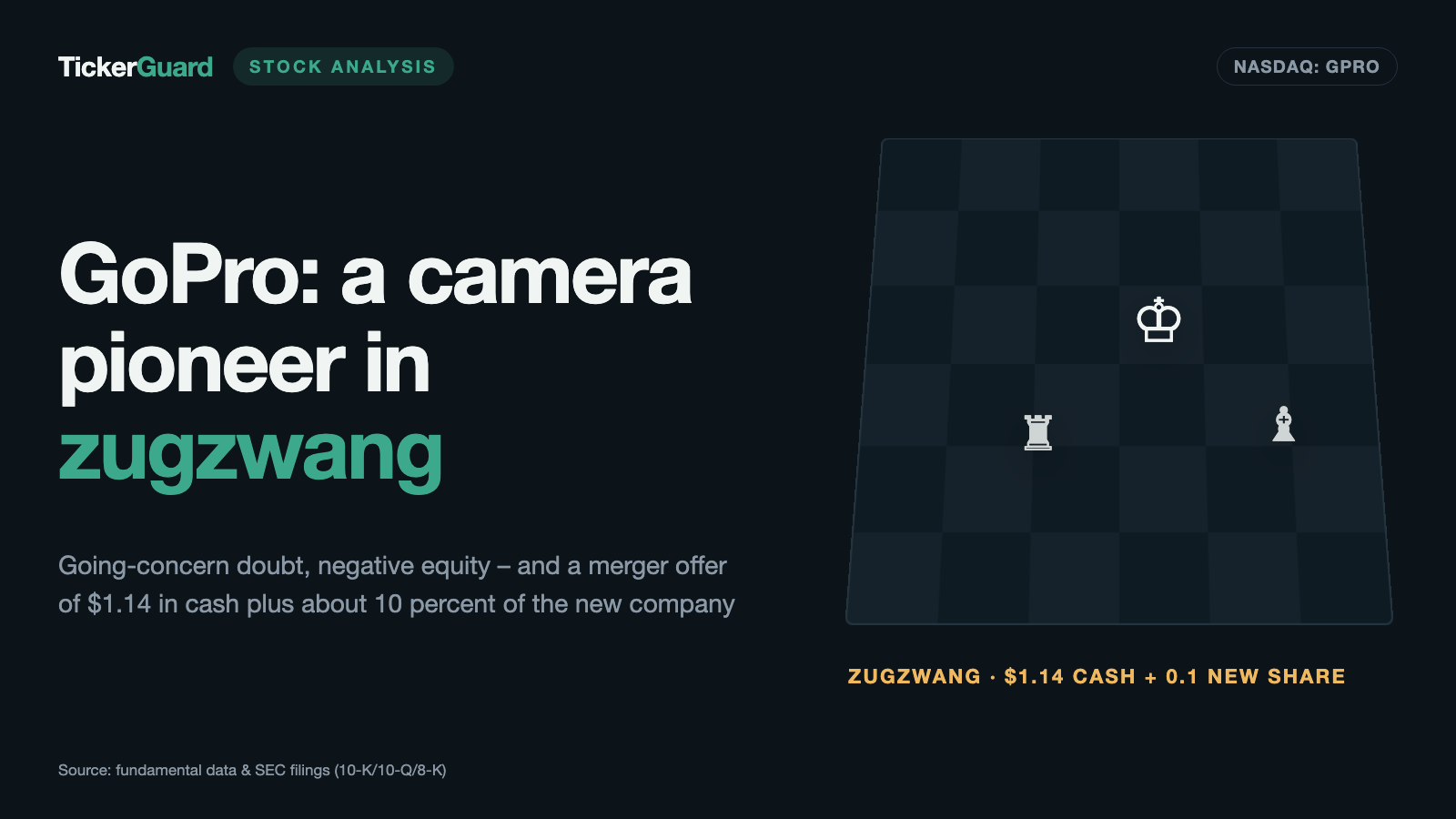
The reports GoPro files with the U.S. securities regulator, the SEC, tell a different story. Revenue fell from $1.09 billion (2022) to $651.5 million (2025). As of June 30, 2026, stockholders’ equity was negative, and GoPro writes in its quarterly report that there is substantial doubt about its ability to continue as a going concern. On September 1, 2026, GoPro signed a merger agreement: stockholders are to receive $1.14 in cash per share plus 0.1 share of the company that survives the merger.
So let’s make a deal: we put the memory of the camera aside for a moment and read together what GoPro reports to the SEC. The tension at the heart of this analysis: The brand is world-famous and held about 2,476 issued patents worldwide at the end of 2025, but the company behind it can no longer reliably service its debt without outside help. The rescue now on the table leaves existing stockholders with about 10 percent of the future company, and whether it happens is effectively decided by one person: the founder, who has also lent GoPro money.
What GoPro actually does
GoPro designs cameras and sells them through retailers such as Best Buy and Walmart and through its own web store, GoPro.com. Its best-known line is the HERO series, small, rugged cameras that clip onto a helmet, handlebar or surfboard. Then there is the MAX2 360-degree camera and, since May 2026, the MISSION 1 series, compact cameras for filmmakers who want more than a phone. GoPro does not build most of the devices itself; the majority of manufacturing is outsourced to contract manufacturers in China, Thailand and Vietnam.
The second pillar is a subscription: for an annual fee, GoPro owners get unlimited cloud storage, editing tools and damaged-camera replacement. In the second quarter of 2026, subscription and service revenue came to $29.0 million, up 10.6 percent year over year and now 28 percent of revenue. The growth did not come from more customers, though: according to the quarterly report, higher prices lifted revenue per subscriber, and according to the earnings release the $29.0 million included about $2 million from licensing videos for AI training. The number of subscribers was 10.7 percent lower than a year earlier (2.18 million) because fewer cameras were sold. Think of the subscription like coffee pods for a coffee machine: profitable, but only as long as machines keep selling.
Since August 2025, U.S. subscribers can also opt in to make their videos available for training AI models and earn money from it. By early March 2026, according to the annual report, they had opted in more than 500,000 hours of video. The company was founded by Nicholas Woodman, who still runs it as CEO and chairman of the board. It was incorporated as Woodman Labs, Inc., has done business as GoPro since February 2004, formally changed its name to GoPro, Inc. in February 2014 and went public in July 2014. GoPro employed 636 people at the end of 2025; in April 2026 it approved a plan to cut about 23 percent of its workforce compared with March 31, 2026.
Company history for investors
-
2014
Woodman Labs becomes GoPro, Inc.
In February the company formally adopts the name GoPro, Inc., and the IPO follows in July; the founder keeps the voting majority through Class B shares.
-
2022
Last profitable year
$1.09 billion in revenue and $28.8 million in profit; since then revenue has fallen every year, and every year has ended in a loss.
-
2024
$432 million loss
GoPro sets up a valuation allowance against most of its deferred tax assets, no longer seeing their use as likely enough, and cuts a quarter of its workforce.
-
2026
Going-concern doubt, Starman merger
Convertibles, a going-concern disclosure, a loan from the founder and, on September 1, the merger agreement: $1.14 in cash plus 0.1 new share per share.
How the stock landed on our desk
GoPro made our research list through the merger announcement of September 1, 2026 and the price swing that followed. On August 28, 2026, the stock closed at $0.60. On September 1, about 500 million GoPro shares changed hands, more than twice the number of shares outstanding, and on September 4 the stock closed at $1.70. By October 12, 2026, it had fallen back to $1.19 (all prices and volumes: fundamental data). That is a signal of attention, not of quality.
Our in-house stock scanner calculates two warning signals for GoPro (as of October 13, 2026). The Altman Z-score, a formula built from balance sheet and earnings figures that estimates bankruptcy risk, stands at minus 1.13. Values below 1.8 are considered the distress zone; a negative value is an alarm bell. The Piotroski score, a health check of nine yes-or-no questions on profit, debt and efficiency, stands at 3 out of 9. A thoroughly healthy company scores 8 or 9. For another consumer electronics brand with a shrinking hardware business, see our analysis of Zepp Health.
The numbers over the years
First, what impresses. GoPro has a brand that shows up in commercials, sports broadcasts and millions of vacation videos, and, according to the annual report, about 1,608 issued U.S. patents and 868 issued foreign patents as of December 31, 2025, plus 326 pending applications. The merger announcement of September 1, 2026 speaks of “more than 2500 U.S. patents”; the annual report does not support that figure. The subscription business is growing in revenue per customer; according to the quarterly report, 69 percent of camera buyers signed up for a subscription in the second quarter of 2026, up from 54 percent a year earlier, a record according to the earnings release. The company’s own web store brought in $46.5 million in the second quarter of 2026, or 44 percent of revenue. And the new MISSION 1 cameras and the MAX2 are lifting average selling prices.
Now the sobering part, and it is in the chart.
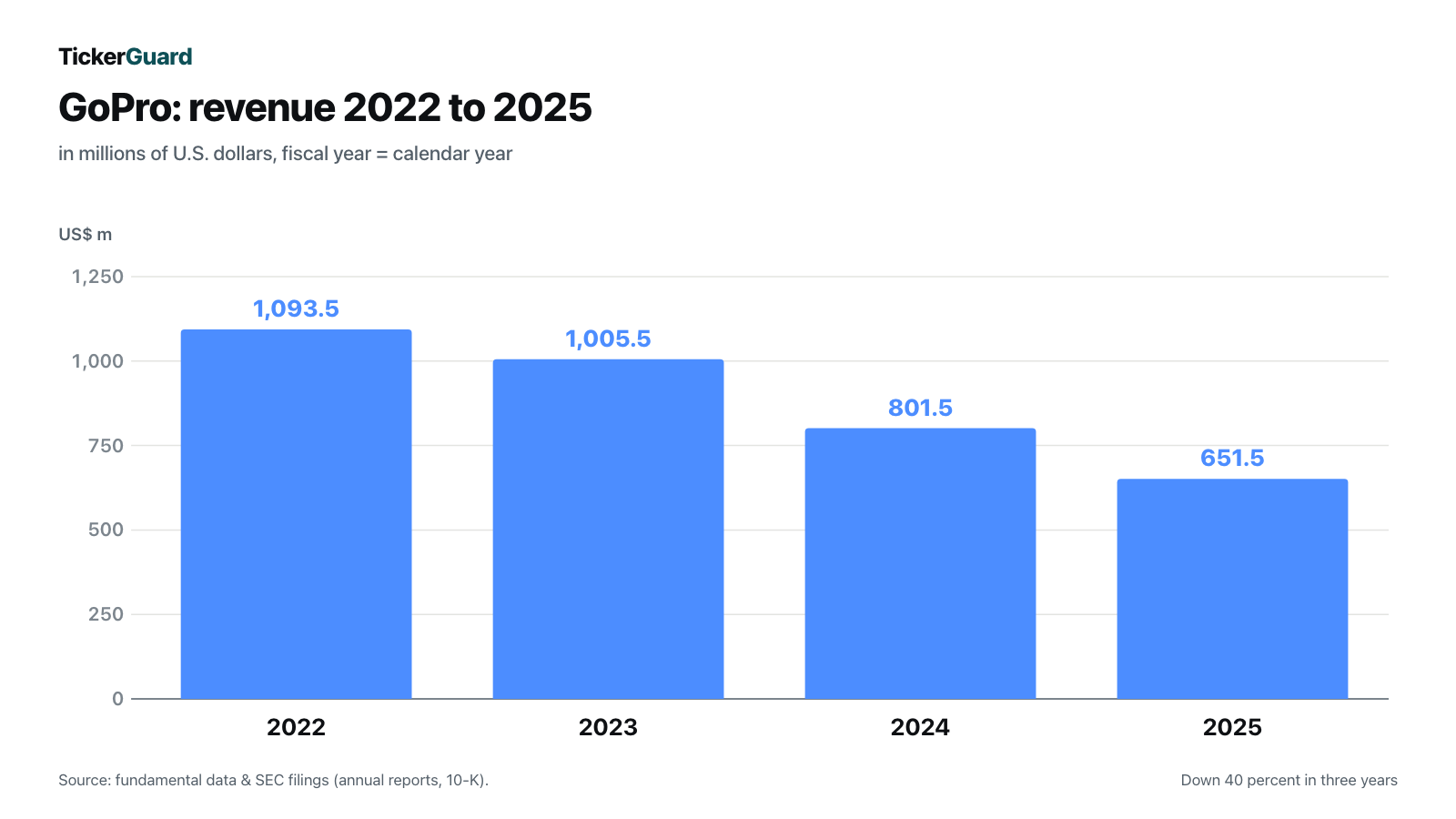
In 2022, GoPro still earned $28.8 million. Losses followed: $53.2 million (2023), $432.3 million (2024) and $93.5 million (2025). Most of the huge 2024 loss came from a tax charge: GoPro set up a valuation allowance against most of its deferred tax assets, meaning it no longer considered it likely enough that it could use them against future profits. Income tax expense was $299.2 million in 2024, against a pretax loss of $133.1 million. That is a statement in itself.
In 2026 the slide accelerated. First-half 2026 revenue was $204.0 million, 28.9 percent below the prior year. The second quarter alone brought $104.9 million, down 31 percent. Camera units shipped more than halved (down 51.7 percent), partly because retailers cut their inventories by about 228,000 cameras year over year.
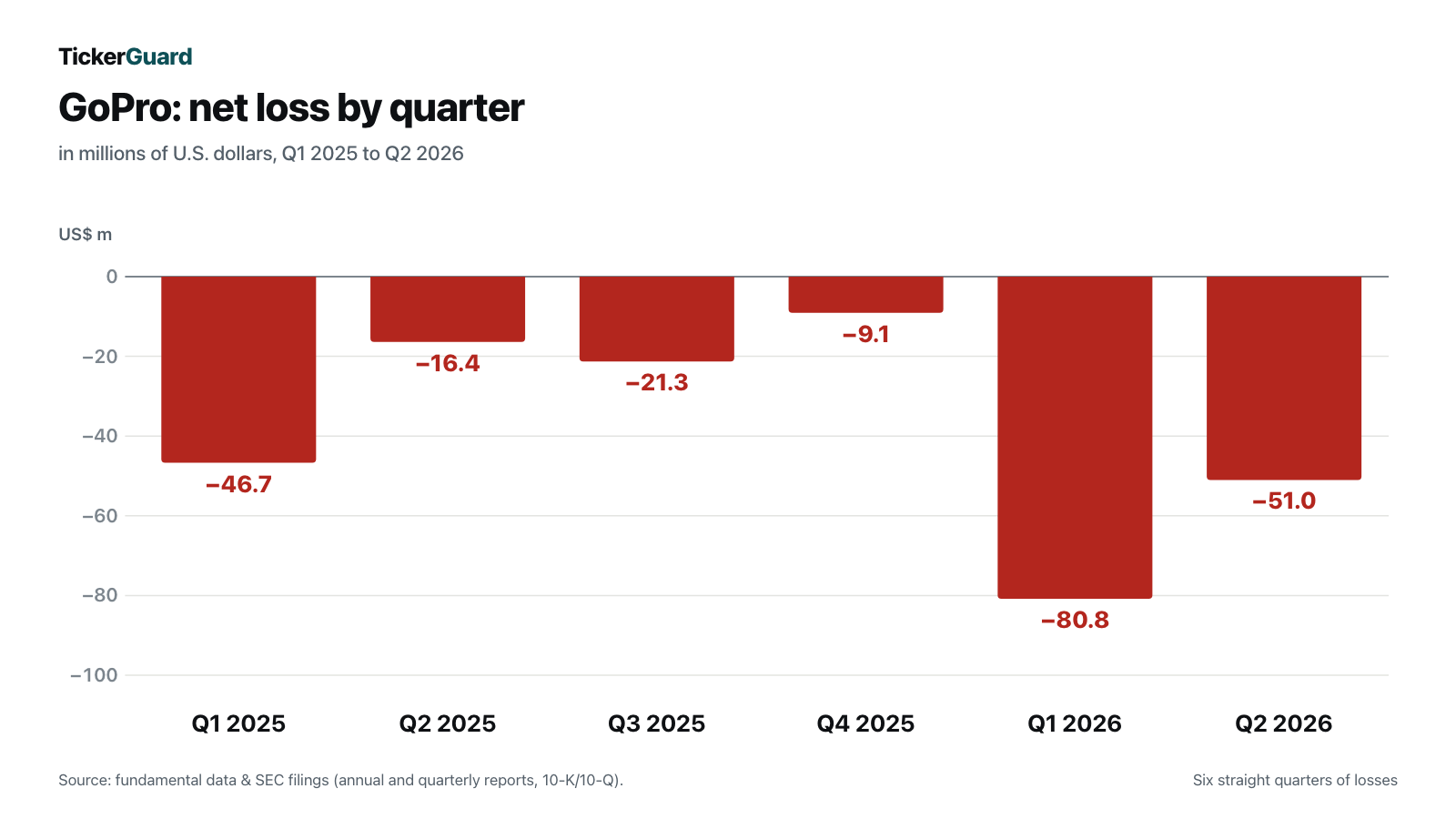
In the first half of 2026, the net loss added up to $131.8 million and the operating loss to $96.2 million, and operations consumed $47.4 million in cash. Cash and cash equivalents shrank from $49.7 million at the end of 2025 to $27.3 million on June 30, 2026. Remember: a strong brand does not protect a business from burning money faster than it brings it in.
Uncomfortable truth No. 1: Doubt about survival
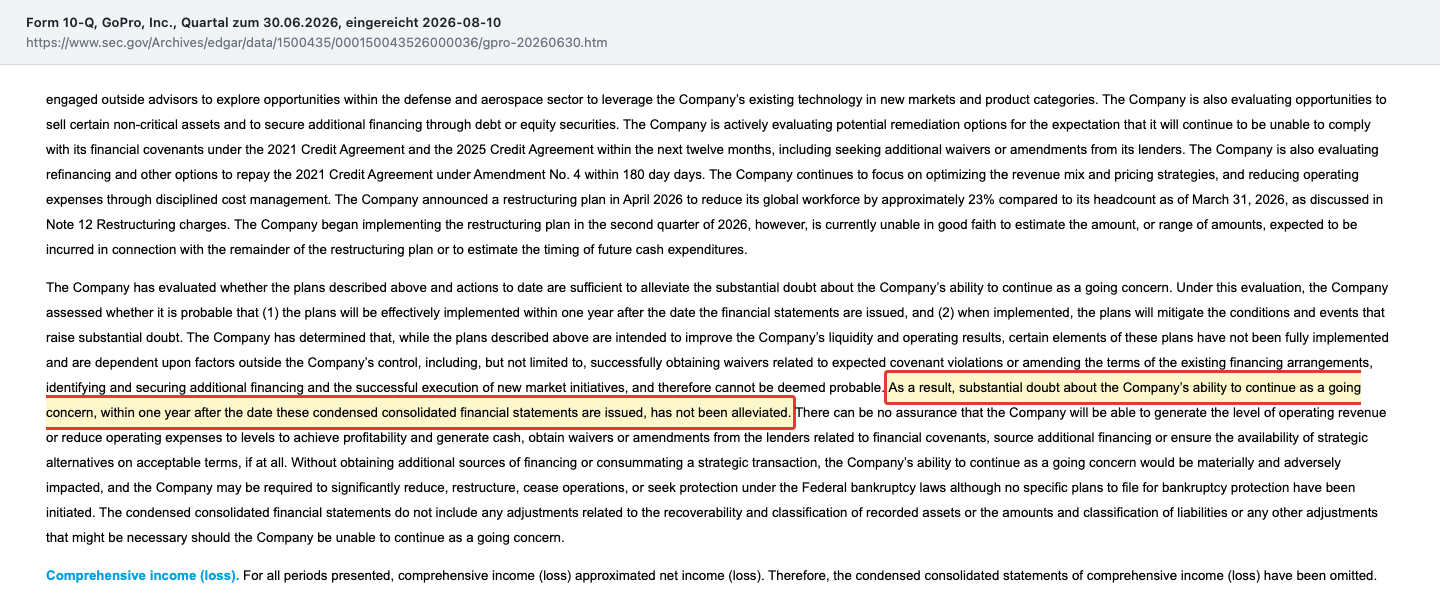
In every set of financial statements, companies must assess whether they can make it through the next twelve months on their own. If the answer is not clear, the report uses the term “going concern”: there is substantial doubt that the company can continue. Think of a doctor saying, without treatment, I don’t like the outlook. GoPro first wrote this into its quarterly report for March 31, 2026 (filed May 11, 2026; the annual report of March 12, 2026 did not yet contain it) and repeated it in the report for June 30, 2026:
“As a result, substantial doubt about the Company’s ability to continue as a going concern, within one year after the date these condensed consolidated financial statements are issued, has not been alleviated.”
— GoPro, SEC quarterly report 10-Q for June 30, 2026, Note 1 (Liquidity and Going Concern)
On June 1, 2026, GoPro even refiled its 2025 financial statements, now with this disclosure and a corresponding explanatory paragraph in the report of its auditor, PricewaterhouseCoopers. A few sentences further on, the 10-Q for June 30, 2026 spells out the worst case: without new financing or a strategic transaction, GoPro may have to significantly reduce or restructure its business, cease operations or seek protection under federal bankruptcy law, although it says no specific plans to file for bankruptcy have been initiated.
GoPro lists the reasons itself. As of June 30, 2026, it was not in compliance with the financial covenants of its 2025 credit agreement and needed waivers from its lenders. Under an amendment dated July 9, 2026, the Wells Fargo revolving credit facility, with $24.4 million drawn, must be repaid in full within 180 days, so by early January 2027, in weekly installments starting October 9, 2026. And of all things, the AI boom is making GoPro’s cameras more expensive to build. The 2025 annual report puts it this way:
“There has been a worldwide, unprecedented shortage of available semiconductor components due to the increase of demand by artificial intelligence data centers, which require substantially higher processing bandwidth and memory capacity, competition from other consumer products that use similar components as our cameras, and manufacturing capacity constraints, including back-end assembly and test.”
— GoPro, SEC annual report 10-K for 2025, Item 1A Risk Factors
The 10-Q for June 30, 2026 turns this into numbers: in the last week of March 2026, memory prices rose unexpectedly by 80 to 115 percent, and in April suppliers announced they would produce less of the memory GoPro uses. For non-cancelable component purchase commitments, GoPro recorded charges of $39.6 million in the first half of 2026, $15.2 million of them in the second quarter. Approved tariff refunds did reduce second-quarter cost of revenue by $18.9 million, but according to the quarterly report the money does not go to GoPro: the company had transferred the refund claims to the lender under its 2025 credit agreement in February 2026.
Uncomfortable truth No. 2: A rescue in installments
Since February 2026, GoPro has kept itself afloat with money that is expensive and costs stockholders ownership. On February 27, 2026, GoPro agreed with YA II PN, a fund of Yorkville Advisors, on convertible debentures of up to $50 million. A convertible is a loan that the lender can take back in shares instead of cash, here at the lower of $1.1453 and 98 percent of the lowest daily volume-weighted average price of the preceding five trading days. Think of a cake from which the lender cuts a slice every time it wants its money back. In the second quarter of 2026, Yorkville converted $11.2 million into 15.5 million new shares, and on August 3 and 4 another $1.8 million into about 2.7 million shares. The final $20 million tranche arrived on September 8, 2026; its conversion price can fall as low as $0.1736 per share.
The share count shows how large the dilution was overall: there were 136.1 million Class A shares at the end of 2025 and 180.1 million on August 31, 2026, about 32 percent more in eight months (our calculation). About 18.2 million of those shares are documented as Yorkville conversions; no filing made through October 13, 2026 fully accounts for the rest. Your slice of the cake has shrunk accordingly, without you selling anything.
In July 2026, the founder stepped in himself. On July 9, entities affiliated with Nicholas Woodman lent GoPro $20 million, $15 million of it from his family trust. The notes carry 6.50 percent interest, paid in kind by adding it to the principal, are secured by GoPro’s assets and mature in July 2028. The lenders also received warrants for 25.7 million Class B shares at $0.778. A warrant is the right to buy shares later at a fixed price; it is worth more the further the stock rises above that price. Important: under the agreement, these warrants became exercisable as soon as GoPro publicly announced a definitive agreement for a change of control. That happened on September 1, 2026.
Uncomfortable truth No. 3: An offer with fine print
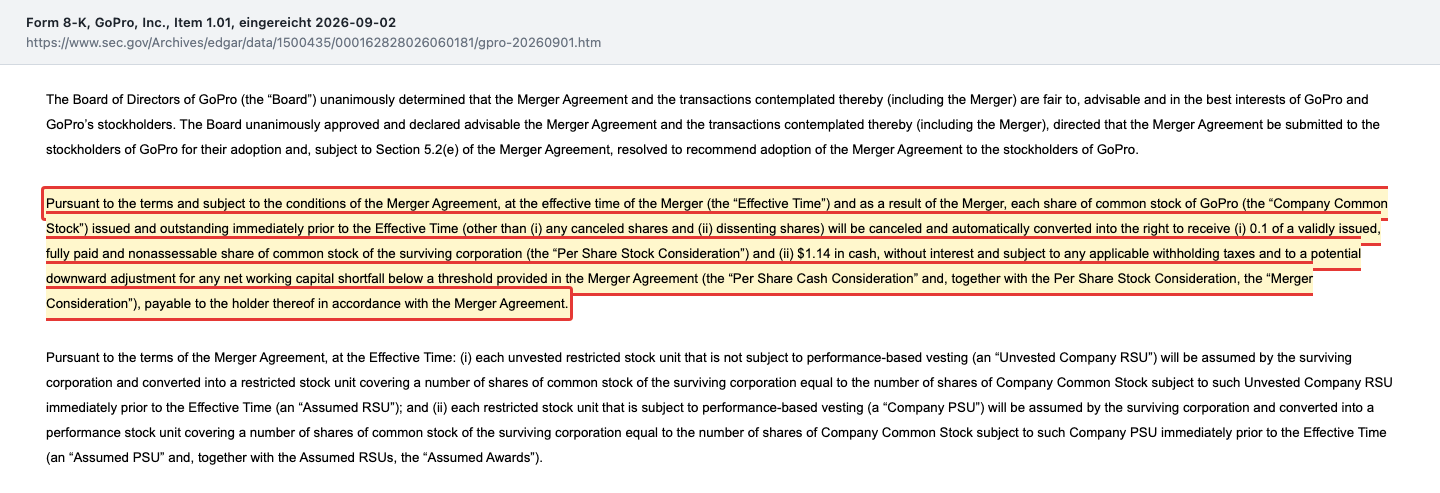
On September 1, 2026, GoPro signed the merger agreement with Action Acquisitions LLC and its subsidiary Starman Optical, Inc., a privately held U.S. maker of optical transceivers, components that move data by light inside data centers. The irony is hard to miss: the AI boom drove up GoPro’s memory costs, and now a supplier to AI data centers is supposed to be the rescuer. The offer to stockholders is set out in the merger agreement:
“Pursuant to the terms and subject to the conditions of the Merger Agreement, at the effective time of the Merger (the “Effective Time”) and as a result of the Merger, each share of common stock of GoPro (the “Company Common Stock”) issued and outstanding immediately prior to the Effective Time (other than (i) any canceled shares and (ii) dissenting shares) will be canceled and automatically converted into the right to receive (i) 0.1 of a validly issued, fully paid and nonassessable share of common stock of the surviving corporation (the “Per Share Stock Consideration”) and (ii) $1.14 in cash, without interest and subject to any applicable withholding taxes and to a potential downward adjustment for any net working capital shortfall below a threshold provided in the Merger Agreement (the “Per Share Cash Consideration” and, together with the Per Share Stock Consideration, the “Merger Consideration”), payable to the holder thereof in accordance with the Merger Agreement.”
— GoPro, SEC current report 8-K of September 2, 2026, Item 1.01
Three things are in the fine print. First, the cash amount can go down if GoPro’s net working capital at closing falls below a threshold; the 8-K does not state the threshold. Second, stockholders do not just get cash; according to the press release, they keep about 10 percent of the new company, whose business is set to change sharply: Starman’s transceivers are to be added, and the combined company wants to grow in AI data centers, defense and aerospace. GoPro’s debt, about $92 million according to the press release (as of the merger announcement, after the founder’s July loan; principal was $87.2 million on June 30, 2026), is to be repaid in full at closing. Third, the financing is a commitment: under the agreement, the cash is to be funded by Midtown Equities LLC. The filing says nothing more about its resources.
According to the announcement, the merger is expected to close by the end of 2026; it needs stockholder approval and antitrust clearance. If it has not closed by December 31, 2026, either side may walk away unless the deadline is extended by mutual consent. If GoPro accepts a superior proposal, a $10 million termination fee is due. As of October 13, 2026, GoPro had not filed a proxy statement disclosing the background of the deal, the fairness opinion and the interests of the parties involved.
Uncomfortable truth No. 4: One vote for all
GoPro has two classes of stock. The Class A shares that trade on the exchange carry one vote. Class B shares carry ten votes. And most Class B shares belong to the founder:
“Stockholders who hold shares of Class B common stock held approximately 62.8% of the voting power of our outstanding capital stock as of June 30, 2026, with Mr. Woodman, our Chairman and CEO, holding approximately 60.3% of the outstanding voting power.”
— GoPro, SEC quarterly report 10-Q for June 30, 2026, Item 1A Risk Factors
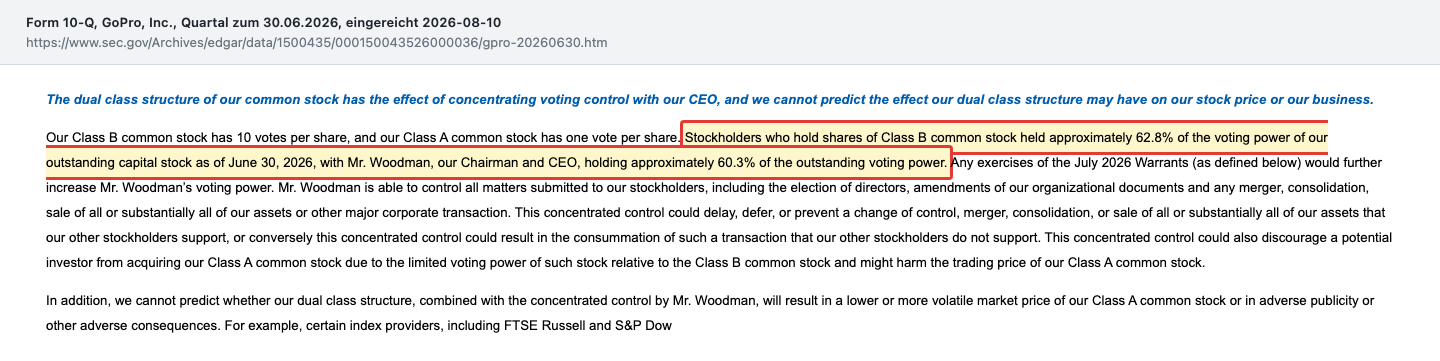
The merger needs a majority of the votes. With about 60 percent (as of June 30, 2026), Woodman can deliver it on his own; in the same section, GoPro itself states that he is able to control all matters submitted to stockholders, including a merger. According to his Schedule 13D of September 9, 2026, he is deemed to beneficially own about 20.6 percent of the Class A stock, including convertible Class B shares and the July warrants.
That voting power does have a built-in limit, though. If Class B shares fall below 10 percent of all shares outstanding, the quarterly report says, all Class B shares automatically convert into ordinary Class A shares, and the founder’s voting majority would be gone. By our calculation, the share stood at about 12.7 percent (26.3 million Class B shares as of August 7, 2026, against 206.4 million shares in total using the Class A count of August 31, 2026). With the Class B count unchanged, by our calculation the threshold would be reached after about 56 million additional Class A shares. Whether that happens depends mainly on further Yorkville conversions.
Woodman is not only a stockholder but also a lender. What happens to his warrants in the merger is set out in the agreement:
“Each outstanding warrant to purchase shares of Company Common Stock (a “Company Warrant”) will be canceled and converted into, and will become a right to receive, an amount in cash, without interest, equal to the Black Scholes Value (as defined in the applicable Company Warrant) for such Company Warrant.”
— GoPro, SEC current report 8-K of September 2, 2026, Item 1.01
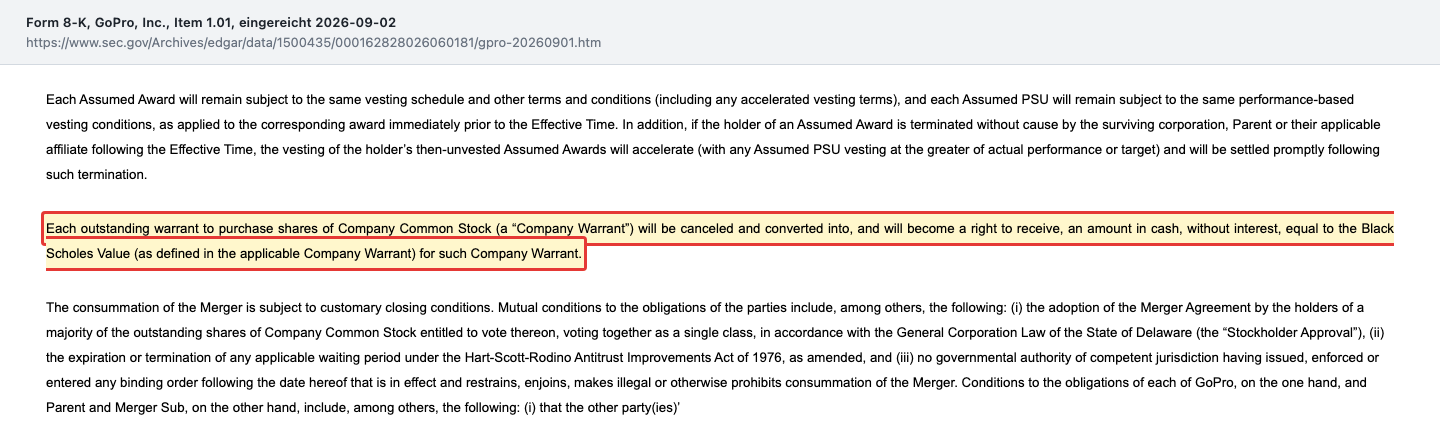
The Black-Scholes value is a formula that prices a warrant based on the stock price, exercise price, remaining term and volatility. The agreement expressly lists the Woodman Family Trust warrant of July 9, 2026 among the warrants to be cashed out this way. The July notes are to be repaid along with the rest of the debt. None of the filings so far puts a number on what this means for Woodman. He lent GoPro $20 million in July 2026. The man who decides on the merger is therefore affected by it differently than you are: his loan is to be repaid and his warrants are to be cashed out.
What the stock costs
At the closing price of $1.19 on October 12, 2026 and about 206.4 million shares of both classes, GoPro was worth about $245.6 million (our calculation: 180.1 million Class A shares as of August 31, 2026 plus 26.3 million Class B shares as of August 7, 2026). Classic ratios hardly help: there is no price-to-earnings ratio without earnings, and a price-to-book ratio makes no sense with negative equity (minus $32.7 million as of June 30, 2026). Measured against revenue for the last four quarters of about $568.6 million, the market paid about 0.4 times sales (price-to-sales ratio, fundamental data).
Since September 1, the stock has mainly been a bet on the merger. The October 12, 2026 price was just 5 cents above the $1.14 cash amount. Anyone buying at that price is, in effect, paying about 5 cents for the 0.1 share of the new company, or about 50 cents per new share (our calculation, before taxes and costs), and taking on three risks: that the cash amount is cut because of working capital, that the merger fails, and that the new company is worth less than hoped. If the merger fails, GoPro is back where the going-concern disclosure describes it, and the Wells Fargo repayment deadline keeps running.
Opportunities and risks at a glance
What speaks for GoPro:
- A signed merger agreement (September 1, 2026): $1.14 in cash per share, about $285 million in total according to the press release of September 1, 2026 (it does not state the basis; 206.4 million shares times $1.14 would come to about $235 million), plus about 10 percent of the surviving company; debt of about $92 million is to be repaid.
- A world-famous brand with about 1,608 issued U.S. patents and 868 abroad (December 31, 2025) and new products (MISSION 1, MAX2) that lift average selling prices.
- Rising revenue per subscriber: subscription and service revenue up 10.6 percent to $29.0 million in Q2 2026 (including about $2 million from AI licensing according to the earnings release, with 10.7 percent fewer subscribers); attach rate of 69 percent of camera buyers according to the quarterly report.
- The Nasdaq $1 minimum bid price requirement is met again (exchange notice of September 16, 2026).
What speaks against GoPro:
- Substantial doubt about its ability to continue as a going concern (10-Qs for March 31 and June 30, 2026), negative equity of minus $32.7 million and only $27.3 million in cash (June 30, 2026).
- Revenue down 40 percent from 2022 to 2025 and another 28.9 percent in the first half of 2026; six straight quarters of losses.
- Covenants missed, the Wells Fargo facility ($24.4 million) to be repaid within 180 days of July 9, 2026, expensive memory chips.
- Dilution: Class A shares up from 136.1 million (end of 2025) to 180.1 million (August 31, 2026); conversion price of the last Yorkville tranche as low as $0.1736.
- The merger depends on a funding commitment, antitrust clearance and working capital; the founder controls about 60 percent of the votes and is also a lender whose warrants are to be cashed out.
A human conclusion
Remember the halo effect? It makes us think of the camera when we hear GoPro: waves, snow, adrenaline. The SEC filings show a company whose revenue shrank 40 percent in three years, whose equity has been used up and which doubts in writing that it can continue as a going concern. Both are true: the brand is strong, the company no longer is. Anyone buying the stock because of the camera is today mainly buying a bet on a merger whose terms one person can push through and whose fine print is not yet fully on the table.
The next test has two dates: the proxy statement, which must disclose the background of the merger, the fairness opinion of investment bank Houlihan Lokey (GoPro’s financial advisor according to the press release of September 1, 2026) and the interests of those involved, and December 31, 2026, the date by which the merger is supposed to close. Three numbers are decisive for the assessment: the final cash amount after the working capital check, the amount paid for the founder’s warrants, and the cash balance in the quarterly report for September 30, 2026. What you make of it is your decision. And that is how it should be.
Sources
- GoPro — quarterly report 10-Q for June 30, 2026 (filed August 10, 2026, latest periodic report) and 10-Q for March 31, 2026 (May 11, 2026)
- Annual report 10-K for 2025 (filed March 12, 2026) and 10-K for 2024 (March 17, 2025)
- Current reports 8-K: Q2 2026 earnings release (August 10, 2026), refiled 2025 financial statements with going-concern disclosure (June 1, 2026), notes and warrants of the Woodman entities (July 8, 2026), closing of the financing and credit agreement amendments (July 13, 2026), Nasdaq minimum bid price notice (July 24, 2026), CFO promotion (August 18, 2026), merger press release (September 1, 2026), merger agreement (September 2, 2026), Yorkville convertible debenture (September 8, 2026), Nasdaq compliance regained (September 17, 2026)
- Merger communications (DEFA14A) of September 1, 2026 and September 4, 2026
- Nicholas Woodman, Schedule 13D (September 9, 2026)
- Source: fundamental data & SEC filings (annual and quarterly reports, 10-K/10-Q) (closing prices through October 12, 2026; price-to-sales ratio, Altman Z-score and Piotroski score as of October 13, 2026)
This analysis is a journalistic assessment based on publicly available company filings. It is not investment advice and not a solicitation to buy or sell securities. Stocks can lose value, up to a total loss. All figures carry the date of their source; prices are dated snapshots. Positions held by the operator are disclosed daily; where one exists, it appears as a notice at the top of this analysis.
Key figures at a glance
All monetary figures in millions of $; earnings per share as reported.
| Metric | 2021 | 2022 | 2023 | 2024 | 2025 |
|---|---|---|---|---|---|
| Revenue | 1,161.1 | 1,093.5 | 1,005.5 | 801.5 | 651.5 |
| Operating Income (EBIT) | 113.2 | 39.0 | -75.5 | -135.0 | -60.2 |
| Net Income | 371.2 | 28.8 | -53.2 | -432.3 | -93.5 |
| Net Margin | 32.0% | 2.6% | -5.3% | -53.9% | -14.3% |
| Earnings Per Share | 2.27 $ | 0.16 $ | -0.35 $ | -2.82 $ | -0.59 $ |
Source: fundamental data & SEC filings (annual and quarterly reports, 10-K/10-Q)
Our Bottom Line at a Glance
- Brand and products positive
- World-famous camera brand with about 1,608 issued U.S. patents and 868 abroad (December 31, 2025); MISSION 1 and MAX2 lift average selling prices, and subscription revenue rose 10.6 percent to $29.0 million in Q2 2026.
- Revenue and earnings negative
- Revenue fell from $1,093.5 million (2022) to $651.5 million (2025) and another 28.9 percent in the first half of 2026; net loss of $131.8 million in the first half of 2026.
- Balance sheet and liquidity negative
- Going-concern disclosure since the 10-Q for March 31, 2026 (filed May 11, 2026), equity of minus $32.7 million and cash of $27.3 million (June 30, 2026); covenants missed, Wells Fargo facility to be repaid within 180 days of July 9, 2026.
- Starman Optical merger neutral
- $1.14 in cash plus 0.1 share per GoPro share, with repayment of about $92 million of debt planned (September 1, 2026); open items are the working capital check, the funding commitment, antitrust clearance and the proxy statement.
- Stockholder rights negative
- Class A shares up 32 percent since the end of 2025, about 18 million of them documented as conversions; founder Woodman, with about 60.3 percent of the votes (June 30, 2026), is also a lender whose warrants are to be cashed out in the merger.
GoPro has a strong brand but a shrinking business: revenue fell 40 percent from 2022 to 2025, and as of June 30, 2026, both equity and the going-concern assessment were negative. The Starman Optical merger agreed on September 1, 2026 offers $1.14 in cash plus 0.1 share per share but is subject to several conditions; founder Nicholas Woodman effectively decides whether it passes. At $1.19 (October 12, 2026), GoPro was worth about $245.6 million. Not investment advice.
What Our Rating Means
Substance risk
We found at least one documented issue that threatens the company itself — regardless of how the stock is currently valued.
Red: several documented threats to the company itself come together. GoPro itself reports substantial doubt about its ability to continue as a going concern, equity was negative as of June 30, 2026, covenants were missed, and operations consumed cash in the first half of 2026 while cash shrank to $27.3 million. The Starman Optical merger could repay the debt but has not closed and is subject to conditions. Only the signed agreement argues for a milder rating; as long as it has not closed, our rule of doubt applies the more cautious level. The decision is yours.
A journalistic assessment by our editorial team at the time of the deep dive, based on public sources — not investment advice and not a solicitation to buy or sell. Your personal circumstances (investment goals, risk capacity, taxes) cannot be taken into account. What our levels mean, how verdicts are formed, and what conflicts of interest exist →
Worth Noting
- This analysis was prompted by the merger announcement of September 1, 2026 and the price swing that followed (about 500 million shares traded on September 1; closing price $0.60 on August 28 and $1.70 on September 4, 2026; fundamental data). Our in-house stock scanner shows an Altman Z-score of −1.13 and a Piotroski score of 3 for GoPro (as of October 13, 2026). The analysis uses the image of the halo effect (a strong brand colors the judgment of the whole company).
- Evidence base: the annual reports 10-K for 2025 (03/12/2026) and 2024 (03/17/2025), the quarterly reports 10-Q for 03/31/2026 and 06/30/2026 (08/10/2026, latest periodic report), the 8-Ks of 06/01, 07/08, 07/13, 07/24, 08/10 (earnings release), 08/18, 09/01, 09/02 (merger agreement), 09/08 and 09/17/2026, the DEFA14A communications of 09/01 and 09/04/2026 and Nicholas Woodman’s Schedule 13D of 09/09/2026. After 09/17/2026, GoPro filed nothing further through 10/13/2026; no merger proxy statement and no report for 09/30/2026 were available. Earnings call transcripts were not reviewed for this analysis; it rests on the filings and current reports.
- Our calculations: market value (180,097,818 Class A shares as of 08/31/2026 per the merger agreement, cited in the Schedule 13D, plus 26,258,546 Class B shares as of 08/07/2026 per the 10-Q cover) = 206.4 million shares times $1.19 = $245.6 million, matching the fundamental data; dilution 180.1 versus 136.1 million Class A shares = up 32.3 percent; revenue decline 651.5 versus 1,093.5 million dollars = down 40.4 percent; Q1 2026 net loss = 131.8 minus 51.0 = $80.8 million; gap between price and cash amount 1.19 minus 1.14 = $0.05; Wells Fargo deadline July 9, 2026 plus 180 days = January 5, 2027. Class B share 26.26 of 206.36 million shares = 12.7 percent; 10 percent threshold with the Class B count unchanged = 262.6 million shares in total, i.e. 236.3 million Class A shares, about 56.2 million more than on 08/31/2026. Price-to-sales about 0.4 = 245.6 versus $568.6 million revenue for the last four quarters (fundamental data).
- Risk of confusion: GoPro has two classes of stock; only Class A (GPRO) trades, while Class B with ten votes per share is not listed. “Starman Optical” is the merger subsidiary of Action Acquisitions LLC and, according to the press release, part of Starman Holding. The 69 percent subscription attach rate appears in the 10-Q for 06/30/2026 and in the earnings release of 08/10/2026; calling it a record and the roughly $2 million from the AI licensing program come only from the earnings release.
Stock Watch
This analysis is as of October 13, 2026. Stock Watch will tell you what's changed at GPRO since then.
Later $1 a month per stock — signing up is free, and you'll be the first to know when it launches.
The full analysis as a PDF for later
We will send you this analysis as a PDF — to print, file away, and read at your own pace. And we will add you to the free Stock Watch list for GoPro Inc (GPRO), so you hear about it when something material in this analysis changes.
Frequently Asked Questions
Under the merger agreement of September 1, 2026, each GoPro share receives $1.14 in cash and 0.1 share of the company that survives the merger. The cash amount can be reduced if net working capital at closing falls below a threshold set in the agreement. According to the press release, existing stockholders keep about 10 percent of the new company in total.
GoPro and Starman expect to close by the end of 2026. Stockholder approval, U.S. antitrust clearance and other customary conditions are required. If the merger has not closed by December 31, 2026, either side may terminate the agreement unless both agree to extend the deadline.
No, GoPro has not filed for bankruptcy and says no specific plans to do so have been initiated. Since its quarterly report for March 31, 2026 (filed May 11, 2026), however, the company has reported substantial doubt about its ability to continue as a going concern. As of June 30, 2026, equity was negative (minus $32.7 million) and cash stood at $27.3 million.
According to the press release of September 1, 2026, Starman Optical, Inc. is a privately held U.S. maker of optical transceivers, components that move data by light inside data centers, and part of Starman Holding. Under the merger agreement, the cash for GoPro stockholders is to be funded by Midtown Equities LLC.
GoPro has two classes of stock: Class A shares with one vote and Class B shares with ten votes. Founder Nicholas Woodman held about 60.3 percent of the total voting power as of June 30, 2026. That lets him deliver the majority the merger needs on his own, even if most Class A holders were opposed.
The number of Class A shares rose from 136.1 million at the end of 2025 to 180.1 million on August 31, 2026, about 32 percent more. About 18 million of those shares are documented as conversions of debentures held by YA II PN (Yorkville), which may swap debt for new shares; the final tranche of September 8, 2026 can convert at as little as $0.1736 per share.
Found an error?
Did you spot a factual error, an outdated number, or a typo in this deep dive? Let us know briefly — your report goes straight to the editorial team.