Lucid: A Sovereign Wealth Fund Keeps the Factory Running — and Common Shareholders Stand at the Back of the Line
Saudi Arabia's sovereign wealth fund has lent Lucid more than the whole company is worth on the stock market — and every rescue puts the fund ahead of you in line. Lucid builds luxury electric cars and has Uber signed up for at least 35,000 robotaxis. Yet in the second quarter of 2026 every dollar of revenue cost $2.05, stockholders' equity has been negative since March 2026, and by early October 2026 roughly $2.1 billion had been drawn on the PIF credit line. We read the filings to find out who is actually rescuing whom.
 Thomas Mücke
Founder & Publisher
Thomas Mücke
Founder & Publisher
As of Today
As of: October 12, 2026
- Closing price
- 3.44 $ -9.37%
- Market Capitalisation
- 1.4 $B
- Growth Score
- 5/10
- AAQS
- 4/10
This analysis has a cut-off date. The Stock Guard tells you when something material changes in the numbers. Reserve your free spot

Chart
Interactive price chart (TradingView).
52-week range: 3.40 $ to 21.90 $ · Last price: 3.44 $ (As of: October 12, 2026)
Note: pure fact-based analysis, not investment advice and not a solicitation to buy or sell. All figures without guarantee.
The Guardian Angel Trap: When a Rich Backer Makes the Risk Invisible
There is a kind of comfort in the stock market that feels almost like a guarantee: someone with bottomless pockets stands behind the company. A sovereign wealth fund, a billionaire, a conglomerate. What could possibly go wrong? If money runs short, the guardian angel will simply put in more. Call it the guardian angel trap: you see that somebody keeps rescuing the company — and you forget to ask whom exactly they are rescuing. Because whoever provides the money gets something in return. And more often than not, they stand ahead of you in line.
Lucid is the textbook case. Behind the California EV maker stands Saudi Arabia's Public Investment Fund (PIF), which through its subsidiary Ayar is attributed roughly 56.7 percent of the stock according to its April 30, 2026 ownership filing, including shares issuable on conversion of preferred stock. Since 2024 it has supplied Lucid with billions through preferred stock and a credit line — and it keeps doing so. The central tension of this analysis is therefore simple: Lucid gets rescued, again and again. But does the rescue reach the common stock? Let's read what the company has told the U.S. securities regulator, the SEC. No recommendation, no forecast — just the filings.
Company history for investors
-
2021
Public listing through a shell company
On July 23, 2021, SPAC Churchill Capital Corp IV merges with Lucid predecessor Atieva. On November 16, 2021 the stock closes at a split-adjusted $555.20 — its highest close to date.
-
2024
PIF funds Lucid through preferred stock
In March and August 2024, PIF affiliate Ayar buys $1.0 billion and $750 million of preferred stock and provides a $750 million credit line. For common holders, a series of senior claims begins.
-
2025
Uber deal and 1-for-10 reverse split
In July 2025 Uber commits to at least 20,000 Gravity robotaxis and agrees to invest $300 million (completed in September). On August 29, 2025 every ten shares become one — the stock had last traded at $1.98.
-
2026
Negative equity and new leadership
Equity turns negative at March 31, 2026. In April PIF buys $550 million of preferred stock; June brings a new CEO, the end of a production shift and an 18 percent cut in the U.S. workforce.
-
2026
Credit line about 84 percent drawn
Between July and October 2026 Lucid draws $1.6 billion on the PIF credit line. On October 6, 2026 about $2.1 billion is outstanding and about $400 million left — room for more draws is tight.
What Lucid Actually Does
Lucid Group, Inc. builds luxury electric vehicles: the Lucid Air sedan and the Lucid Gravity SUV. Both are assembled at the company's own plant in Casa Grande, Arizona (AMP-1); Lucid develops its own powertrain, battery system and software. According to its annual report, the plant has had installed capacity of 90,000 vehicles a year since 2024. A second plant in Saudi Arabia (AMP-2) currently reassembles kits pre-built in Arizona and, according to the 10-Q, is expected to start producing complete vehicles in 2027. Sales are mostly direct to customers through 62 company-owned studios and service centers in North America, Europe and the Middle East (as of June 30, 2026). Lucid had approximately 9,000 employees at December 31, 2025.
Lucid went public in 2021 through a blank-check company: SPAC Churchill Capital Corp IV merged with Lucid's predecessor Atieva on July 23, 2021 and renamed itself Lucid Group — which is why the SEC lists the company under the shell's CIK 0001811210. On August 29, 2025, Lucid combined every ten shares into one. All share counts and prices in this article are adjusted for that reverse split.
The big hope is Uber. In July 2025 the ride-hailing company committed to buy at least 20,000 Gravity vehicles as robotaxis over six years; in April 2026 a second agreement added at least 25,000 robotaxi versions of the upcoming midsize platform (“Midsize Plus”), whose production is targeted to start in late 2028; series production of the midsize platform itself is expected to ramp up in the second half of 2027, according to the 10-Q. Because of an offset clause in the first agreement, the two minimums do not add up to 45,000: according to the 8-K of April 14, 2026, Uber's total commitment for Gravity and midsize robotaxis rose to 35,000 vehicles — but it is conditional: Lucid has to meet volume, quality and delivery requirements. For how the robotaxi story looks in the filings of another EV maker, see our analysis of XPeng.
Silvio Napoli has led the company since June 1, 2026; Alexander De Bock became CFO on August 5, 2026. Napoli put his diagnosis into the earnings release of August 4, 2026:
“Lucid has leading technology, compelling products and deeply committed people, but potential is not performance”
— Silvio Napoli, CEO, Q2 2026 earnings release, Exhibit 99.1 to the 8-K of August 4, 2026
How the Stock Landed on Our Desk
Lucid did not come to us through a screening hit but through two filings in early October 2026. On October 5 the company reported 2,954 vehicles produced and 3,806 delivered in the third quarter of 2026 — fewer deliveries than in the prior-year quarter (4,078). Four days later it disclosed that it had drawn another $400 million on the sovereign wealth fund's credit line. A company that sells less and borrows more: that is exactly where reading the fine print pays off.
The share price shows how much confidence the market has lost since the listing. The highest close — adjusted for the 1-for-10 reverse split — was $555.20 on November 16, 2021. On October 12, 2026 the stock closed at $3.435, a decline of more than 99 percent. The 52-week range ran from $2.37 to $22.42 according to fundamental data (as of October 13, 2026). Keep one line in mind from the start: a rescuer is not a business model.
The Numbers Over the Years — An Honest Assessment
First, what genuinely impresses. In a few years Lucid has taken two vehicle lines from nothing to series production and grew 2025 revenue by 68 percent to $1,353.8 million. It built 18,378 cars in 2025 — more than twice as many as in 2024 — and delivered 15,841. Second-quarter 2026 revenue of $405.3 million was up 56 percent year over year, driven by the pricier Gravity SUV. A robotaxi contract with Uber for tens of thousands of vehicles, a plant with room for 90,000 cars, a second one under construction: that is more substance than many EV newcomers ever reach.
Now the sobering part. The decisive line sits right below revenue: cost of revenue — what building, materials, warranty and inventory write-downs cost for the cars that were sold. It exceeded revenue in every single period.
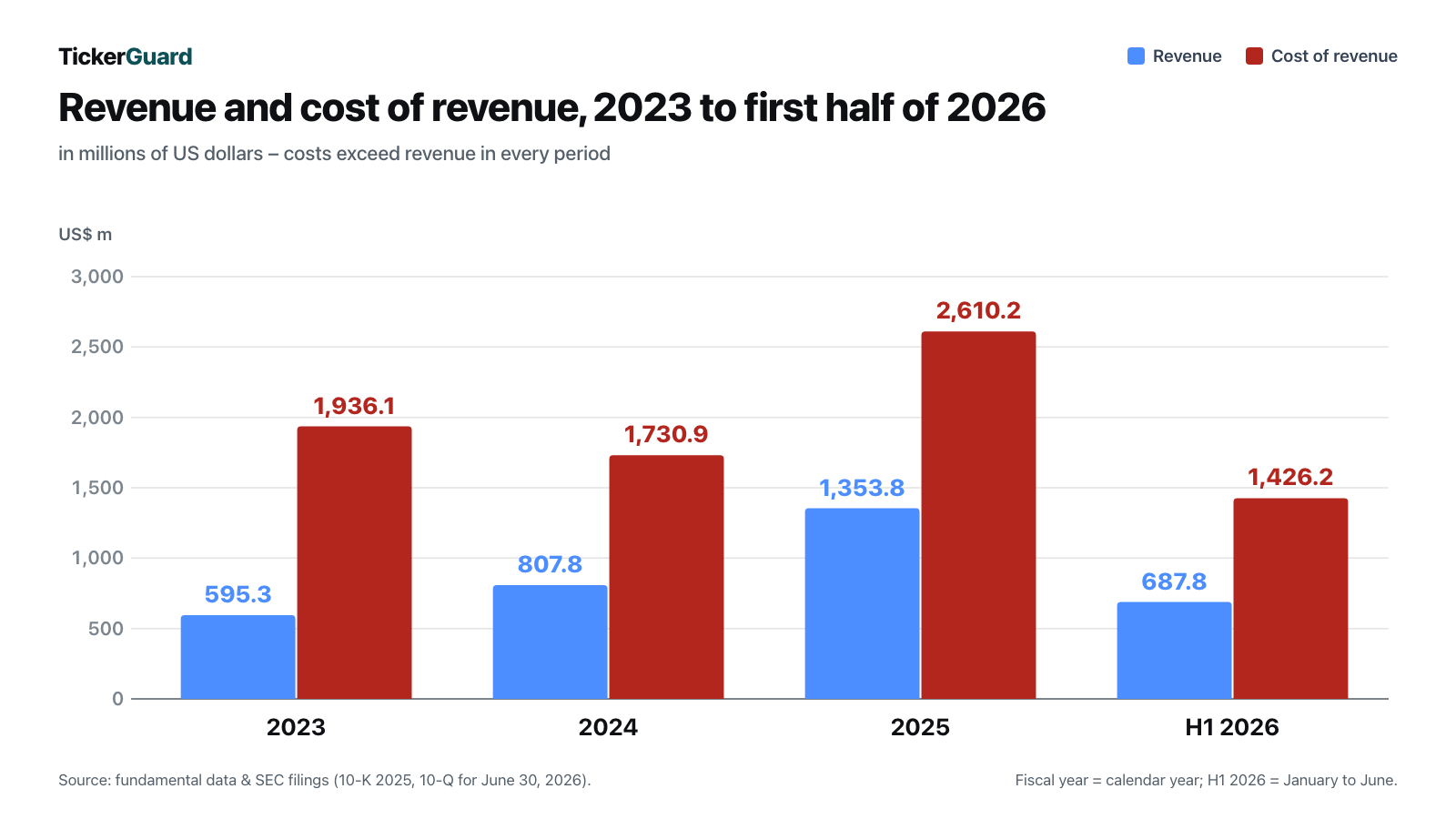
The bottom line was a loss every year: $2,828.4 million (2023), $2,713.9 million (2024) and $2,698.1 million (2025). Including the claims of preferred holders, the net loss attributable to common stockholders was $3,681.7 million in 2025. The first half of 2026 added another $2,063.2 million of net loss — despite a $142.2 million non-cash gain from the valuation of the subscription agreement for PIF's Series C preferred stock. Even more important than the accounting loss is the cash that actually leaves: operating activities used $2,931.9 million in 2025 and $2,407.9 million in the first half of 2026, plus $507.0 million of capital expenditures. The company sums it up itself:
“We have generated significant losses from our operations as reflected in our accumulated deficit of $17.7 billion and $15.6 billion as of June 30, 2026 and December 31, 2025, respectively.”
— Lucid Group, Inc., Form 10-Q for the period ended June 30, 2026, MD&A, “Liquidity and Capital Resources” (10-Q 2026)
Two billion dollars of losses in half a year — on $687.8 million of revenue. Put plainly: for every dollar customers paid, the company booked roughly three dollars of net loss — a different measure from cost of revenue alone, which ran at about two dollars per revenue dollar, as the next section shows.
What the Filings Say — The Uncomfortable Truths
Uncomfortable Truth No. 1: $2.05 in Costs for Every Dollar of Revenue
In the second quarter of 2026, $405.3 million of revenue came with $832.1 million of cost of revenue. Gross margin — the share of the selling price left after direct costs — was negative 105.3 percent, and negative 107.4 percent for the first half. So every dollar of revenue carried about $2.05 of cost before a single engineer was paid or a single ad aired. Research and development ($321.3 million) and selling, general and administrative expenses ($300.4 million) come on top in the quarter.
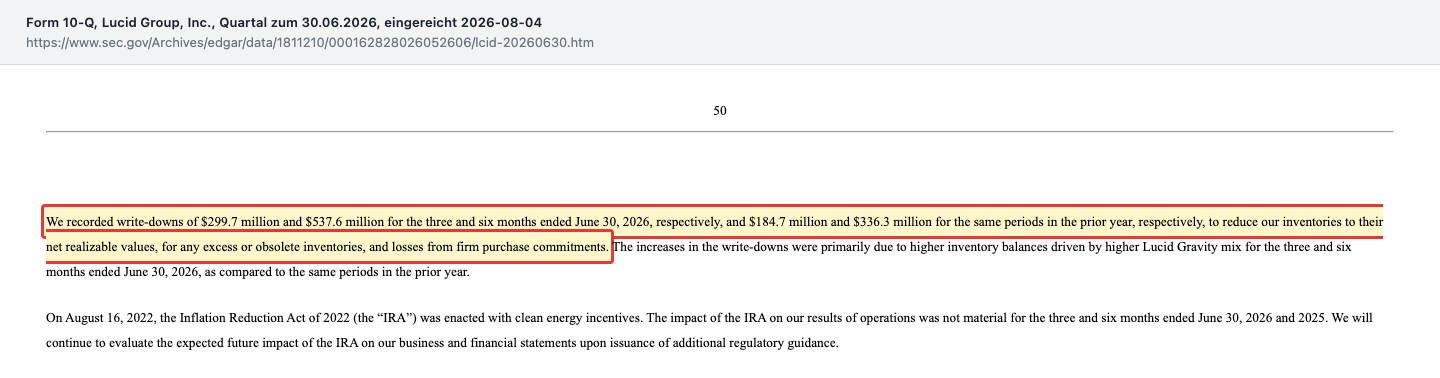
A big part of those costs is not assembly lines and batteries but write-downs: Lucid had to mark down its inventory because cars and parts in inventory are worth less than they cost. The 10-Q puts a number on it:
“We recorded write-downs of $299.7 million and $537.6 million for the three and six months ended June 30, 2026, respectively, and $184.7 million and $336.3 million for the same periods in the prior year, respectively, to reduce our inventories to their net realizable values, for any excess or obsolete inventories, and losses from firm purchase commitments.”
— Lucid Group, Inc., Form 10-Q for the period ended June 30, 2026, MD&A, “Cost of Revenue and Gross Profit (Loss)” (10-Q 2026)
On top of that comes a utilization problem. A plant built for 90,000 cars that turned out only 2,954 in the third quarter of 2026 spreads its fixed costs over very few vehicles. In June 2026 Lucid deliberately eliminated the second shift and cut roughly 18 percent of its U.S. workforce to align output with demand. The company estimates annualized savings of about $158 million — measured against $832.1 million of cost of revenue in a single quarter, that is a start, not a turnaround.
Uncomfortable Truth No. 2: Common Stockholders' Equity Is Gone
Stockholders' equity is the part of a company's assets that belongs to the owners after all debts are paid — your share of the house once the mortgage is gone. At Lucid that share has disappeared. At the end of 2024, common stockholders' equity still stood at $3,872.8 million. It has been negative since March 31, 2026, and reached negative $1,058.0 million on June 30, 2026.
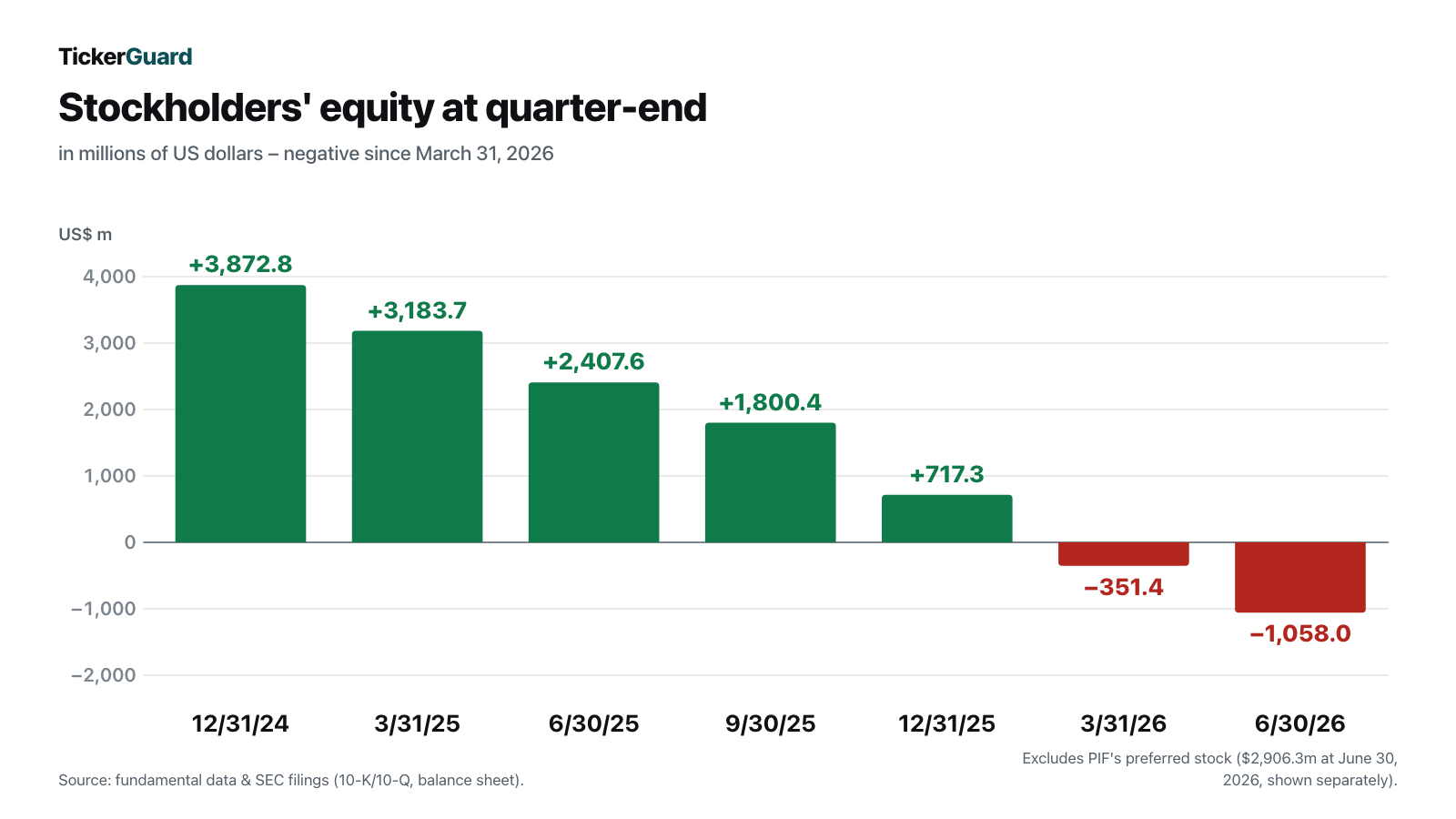
What matters for the guardian angel trap is where you stand in line. On June 30, 2026, the balance sheet showed liabilities of $5,850.5 million. Between those debts and the common stockholders sits PIF's preferred stock, carried at $2,906.3 million — Series A ($1.0 billion, March 2024), Series B ($750 million, August 2024) and Series C ($550 million, April 2026). The newest series accrues a 9 percent annual dividend that is not paid out but added to the claim, and it ranks ahead of the common stock in a liquidation. The guardian angel has not just stepped next to you. It has stepped in front of you.
Uncomfortable Truth No. 3: One Lender, One Lifeline — and It Is Getting Shorter
On June 30, 2026, cash and investments stood at $775.5 million. For comparison: operating activities and capital expenditures together consumed $2,914.9 million in the first half of 2026. At that pace, the cash balance alone would have lasted roughly seven weeks. Lucid keeps going because of a single source: the delayed draw term loan (DDTL) from Ayar Third Investment Company, a PIF affiliate. The facility was increased from $750 million to roughly $2.0 billion on November 4, 2025 and by another $500 million to roughly $2.5 billion on April 14, 2026. The first draw of $500 million came on April 1, 2026, followed by $800 million on July 6, $400 million on August 24 and $400 million on October 6, 2026. The latest filing gives the tally:
“Following this draw, the aggregate principal amount outstanding under the DDTL is approximately $2.1 billion, with approximately $400 million of additional borrowing capacity remaining.”
— Lucid Group, Inc., Form 8-K filed October 9, 2026, Item 2.03 (8-K 2026)

The loan comes at a price: the interest rate was 9.54 percent as of June 30, 2026. Applied to $2.1 billion, that would be roughly $200 million of interest a year — more than the June layoffs are expected to save. The minimum liquidity covenant that once required Lucid to keep a cushion was eliminated in the April 2026 amendment. Alongside the DDTL sit convertible notes of $1,100 million (due 2030, 5 percent) and $975 million (due 2031, 7 percent, with a holder put on November 1, 2029), a short-term facility from Gulf International Bank with about $503 million drawn, and $204.3 million left on notes that mature on December 15, 2026.
How nervously the market views this dependence became clear on July 14, 2026. That day Lucid responded to rumors in a filing with the SEC:
“The Company has sufficient liquidity to carry its operations well into next year, as recently published in its last quarterly filings, and it has not formed any special Board committee to explore the scenarios reported today.”
— Lucid Group, Inc., Form 8-K filed July 14, 2026, Item 7.01 (8-K 2026)
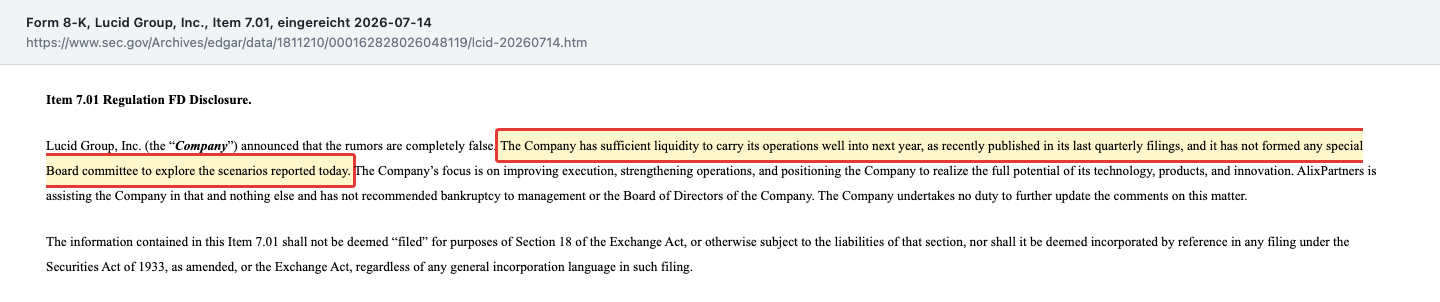
In the same paragraph Lucid says AlixPartners is helping it improve execution “and nothing else” and has not recommended bankruptcy to management or the board. A denial is information — but it also tells you which question the market was asking. On the day of the filing, according to fundamental data, the stock briefly dropped to $2.37 and closed at $4.62.
Uncomfortable Truth No. 4: Your Slice of the Pie Keeps Shrinking
When a company issues new shares, your ownership stake gets smaller — that is dilution: the same pie cut into more slices. Lucid's share count rose from 303.1 million (December 31, 2024) to 394.1 million (July 29, 2026), an increase of 30 percent. In April 2026 alone, 36.1 million shares came from a public offering and 24.0 million went to Uber. And the 10-Q lists another 216.7 million shares as of June 30, 2026 that could arise from convertible notes, the three PIF preferred series, options and employee awards — 55 percent of shares outstanding. The company itself says:
“If we raise additional funds through further issuances of equity or equity-linked securities, our stockholders could experience significant dilution, and any new equity securities we issue could have rights, preferences and privileges superior to those of holders of our common stock.”
— Lucid Group, Inc., Form 10-Q for the period ended June 30, 2026, Risk Factors (Item 1A) (10-Q 2026)
That is exactly what the Series C did in April 2026: it ranks senior, accrues 9 percent a year and converts into common stock at a set conversion price. On August 12, 2026 Lucid also registered PIF's Series C preferred stock (convertible into 51.7 million shares) and Uber's 24.0 million shares from April 2026 for resale, 75.7 million shares in total; according to the company, the lock-ups end in April 2027 (PIF) and October 2027 (Uber). Whether anyone sells then is open. That they could sell has been official since August.
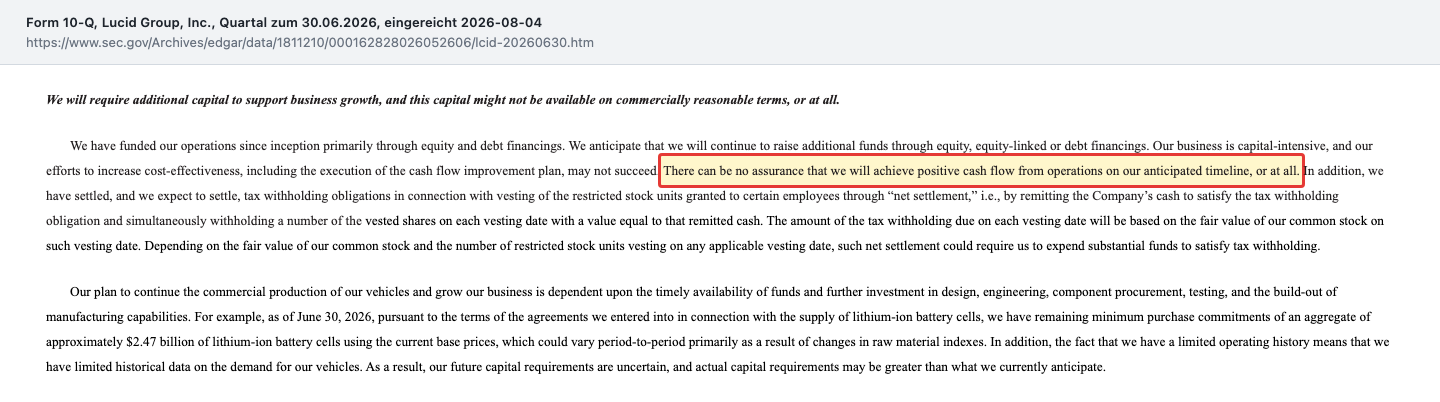
Above it all sits one sentence from the risk factors of the 10-Q that sums up the whole chapter:
“There can be no assurance that we will achieve positive cash flow from operations on our anticipated timeline, or at all.”
— Lucid Group, Inc., Form 10-Q for the period ended June 30, 2026, Risk Factors (Item 1A) (10-Q 2026)
Valuation: What the Market Still Pays for Lucid
There is no price-to-earnings ratio without earnings, and no price-to-book ratio without positive equity. That leaves revenue: with 394.1 million shares and a closing price of $3.435 on October 12, 2026, the market value was roughly $1.35 billion. Against $1,547.1 million of revenue over the four quarters through June 30, 2026, that is a price-to-sales ratio of about 0.9. (The “As of Today” box at the top takes the data provider's price and market value in its daily update and can therefore differ from this calculation.) For a growth company that sounds cheap. But revenue earned at a loss is worth only so much — each additional dollar of revenue recently cost Lucid more than it brought in.
The more honest comparison is on the balance sheet: the drawn PIF credit line alone (roughly $2.1 billion on October 6, 2026) is larger than the entire market value, and so is PIF's preferred stock ($2,906.3 million carrying value at June 30, 2026). Buying a Lucid share today means buying what is left after every claim ahead of it is served — and betting that growth will one day make that remainder larger than it is now.
The professionals are correspondingly cautious: according to fundamental data (as of October 13, 2026), 11 analysts rated the stock — 1 “Strong Buy,” 7 “Hold,” 2 “Sell” and 1 “Strong Sell” — with an average price target of $7.94. That is a third-party view for context, not a price target of ours. For a stock whose future hinges on the funding decisions of a single large holder, price targets deserve extra caution anyway.
Upside and Risks at a Glance
The case for:
- Products with substance: two vehicle lines in series production, in-house powertrain and software; revenue rose 68 percent to $1,353.8 million in 2025 and 56 percent to $405.3 million in the second quarter of 2026.
- A major customer: Uber has committed, subject to conditions, to at least 35,000 robotaxi vehicles and itself holds 37,753,583 shares (about 9.6 percent of the 394,070,176 shares outstanding on July 29, 2026, per the 424B7 prospectus supplement of August 12, 2026): 13,715,121 from a $300 million investment agreed in July 2025 and completed in September 2025, and 24,038,462 from April 2026. According to the earnings release, Uber and Nuro are testing a fleet of nearly 100 vehicles in the San Francisco Bay Area and Houston.
- A large holder that has always stepped up so far: more than $2.3 billion of preferred stock since 2024 and a credit line with roughly $2.1 billion drawn by October 2026.
- A savings plan with numbers: Lucid aims to improve 2026 cash flow by $1.4 billion — $600 million to $800 million from inventory, about $500 million from capital expenditures and about $200 million from operating expenses. In the third quarter of 2026 deliveries (3,806) exceeded production (2,954) for the first time this year.
- New leadership: CEO since June 1, 2026, CFO since August 5, 2026, and an organization with half as many direct reports to the CEO.
The case against:
- Losing money before any fixed costs: gross margin of negative 105.3 percent in the second quarter of 2026 and $299.7 million of inventory write-downs in the same quarter.
- Negative equity: negative $1,058.0 million at June 30, 2026 and a $17.7 billion accumulated deficit; ahead of the common stock sit $5,850.5 million of liabilities and preferred stock carried at $2,906.3 million.
- Dependence on a single source: without the PIF credit line, the $775.5 million of cash (June 30, 2026) would have lasted roughly seven weeks at the first-half pace; about $400 million remained available on October 6, 2026.
- Dilution: 30 percent more shares since the end of 2024, another 216.7 million potential shares at June 30, 2026, and 75.7 million shares registered for resale.
- Falling deliveries: 3,806 in the third quarter of 2026 versus 4,078 a year earlier; a class action filed May 29, 2026 alleges the company failed to disclose Gravity delivery problems (according to the 10-Q for the period ended June 30, 2026, the defendants deny the allegations).
A Human Conclusion
Back to the guardian angel trap. It works so well because it rests on a true observation: PIF really has rescued Lucid again and again — with preferred stock in 2024, a credit line increased to roughly $2.0 billion in November 2025, and in 2026 more preferred stock and four draws since April ($500 million on April 1, $800 million on July 6, $400 million on August 24 and $400 million on October 6). Without it, the company would not exist in its current form. The trap is not that the guardian angel is imaginary. It is that the help does not come free. Every rescue has secured PIF a place in line — ahead of you: as a lender charging 9.54 percent, as a preferred holder with a 9 percent annual dividend and liquidation priority, as a majority holder with a say in where the company goes.
So the honest question for you is not “Will PIF let Lucid fail?” but rather: If PIF keeps rescuing Lucid — what will be left for common stockholders? The next checkpoints are set: the third-quarter results on November 9, 2026, which will show whether the inventory reduction is really slowing the cash burn; the credit line, which has roughly $400 million left after the October draw; and the end of PIF's lock-up on the Series C preferred stock registered for resale in April 2027 (Uber's shares follow in October 2027). If you believe in Lucid's technology and in Uber as an anchor customer, these filings contain a possible turnaround. If you do the math, you find a company that currently spends two dollars for every dollar of revenue. The guardian angel stands in front of you, not beside you. What you make of it is your decision. And that is how it should be.
Sources
All original documents used in this analysis — to read for yourself:
- Lucid Group, Inc. — Form 10-Q for the period ended June 30, 2026 (filed August 4, 2026)
- Lucid Group, Inc. — Form 8-K of August 4, 2026, Exhibit 99.1 (second-quarter 2026 earnings release)
- Lucid Group, Inc. — Form 10-Q for the period ended March 31, 2026 (filed May 5, 2026)
- Lucid Group, Inc. — Form 10-K for fiscal 2025 (filed February 24, 2026)
- Lucid Group, Inc. — Form 8-K of October 9, 2026, Item 2.03 (credit line draw), plus the draws disclosed in the 8-K of July 6, 2026 and the 8-K of August 28, 2026
- Lucid Group, Inc. — Form 8-K of October 5, 2026, Exhibit 99.1 (third-quarter 2026 production and deliveries)
- Lucid Group, Inc. — Form 8-K of July 14, 2026, Item 7.01 (statement on rumors)
- Lucid Group, Inc. — Form 8-K of June 22, 2026, Item 2.05 (workforce reduction)
- Lucid Group, Inc. — Form 8-K of April 14, 2026 (PIF Series C preferred, Uber investment, second Uber vehicle production agreement)
- Lucid Group, Inc. — Prospectus supplement 424B7 of August 12, 2026 (resale registration)
- Public Investment Fund / Ayar Third Investment Company — Schedule 13D/A of April 30, 2026 (beneficial ownership report)
- Full SEC filing history of Lucid Group, Inc.: EDGAR overview (sec.gov)
- Fundamental data (price, 52-week range, analyst estimates; data as of October 12/13, 2026), reconciled with the SEC filings.
Transparency & disclaimer: This analysis is a journalistic assessment of publicly available information. It is not investment advice, not financial research in the regulatory sense and not a solicitation to buy or sell securities. Investing in stocks involves substantial risk, up to and including the total loss of capital. All information without guarantee; the data date is noted in the text. We disclose any positions held by the publisher on a current basis; if one exists, it appears as a note at the top of this analysis.
Key figures at a glance
All monetary figures in millions of $; earnings per share as reported.
| Metric | 2021 | 2022 | 2023 | 2024 | 2025 |
|---|---|---|---|---|---|
| Revenue | 27.1 | 608.2 | 595.3 | 807.8 | 1,353.8 |
| Operating Income (EBIT) | -1,530.4 | -2,594.0 | -3,099.6 | -3,020.8 | -3,501.8 |
| Net Income | -2,579.8 | -1,304.5 | -2,828.4 | -2,713.9 | -2,698.1 |
| Net Margin | -9,515.6% | -214.5% | -475.1% | -336.0% | -199.3% |
| Earnings Per Share | -34.84 $ | -7.70 $ | -13.59 $ | -11.10 $ | -8.24 $ |
Source: fundamental data & SEC filings (annual and quarterly reports, 10-K/10-Q)
Our Bottom Line at a Glance
- Products and customers positive
- Two vehicle lines in series production, in-house powertrain and software; 2025 revenue +68% to $1,353.8m, Q2 2026 +56% to $405.3m. Uber has committed, subject to conditions, to at least 35,000 robotaxi vehicles (agreements of July 2025 and 04/14/2026) and is a shareholder itself.
- Profitability negative
- In Q2 2026, $405.3m of revenue came with $832.1m of cost of revenue, a gross margin of −105.3%, including $299.7m of inventory write-downs. Net loss of $2,698.1m (2025) and $2,063.2m in H1 2026. The plant built for 90,000 cars produced only 2,954 in Q3 2026.
- Balance sheet negative
- Common stockholders' equity of −$1,058.0m at 06/30/2026 (12/31/2024: +$3,872.8m), accumulated deficit $17.7bn. Ranking ahead: $5,850.5m of liabilities and PIF preferred stock carried at $2,906.3m; the Series C accrues a 9% annual dividend.
- Funding and dependence negative
- Cash and investments of $775.5m (06/30/2026) against $2,914.9m used by operations and capital expenditures in H1 2026. The business runs on the PIF credit line: about $2.1bn drawn, about $400m available (10/06/2026), interest rate 9.54% (06/30/2026). On 07/14/2026 Lucid responded to rumors in a filing with the SEC.
- Dilution negative
- Share count up from 303.1m (12/31/2024) to 394.1m (07/29/2026), +30%; another 216.7m potential shares at 06/30/2026 (55% of shares outstanding). 75.7m PIF and Uber shares have been registered for resale since 08/12/2026; the lock-ups end in April and October 2027.
- Restructuring neutral
- New CEO since 06/01/2026, new CFO since 08/05/2026; 18% fewer U.S. employees (about $158m in annualized savings) and a target of $1.4bn in 2026 cash flow improvements. In Q3 2026 deliveries (3,806) exceeded production (2,954) — evidence of a turnaround is still missing.
Lucid builds EVs with substance and has Uber signed up as a major robotaxi customer — but the business loses money before any fixed costs: in Q2 2026, $405.3 million of revenue cost $832.1 million. Common stockholders' equity has been negative since March 2026 (−$1,058.0 million at June 30, 2026), operations depend on the credit line of majority holder PIF, with roughly $2.1 billion drawn by October 6, 2026, and the share count has risen 30 percent since the end of 2024. PIF has always rescued Lucid so far — with claims that rank ahead of common stockholders. Not investment advice.
What Our Rating Means
Substance risk
We found at least one documented issue that threatens the company itself — regardless of how the stock is currently valued.
Without the PIF credit line, $775.5 million of cash and investments (June 30, 2026) would have lasted roughly seven weeks at the first-half 2026 pace. Further substance risks are documented: common stockholders' equity is negative (−$1,058.0 million at June 30, 2026), and operating cash flow has been negative every year, at −$2,407.9 million in the first half of 2026. Lucid keeps operating because of a single counterparty — majority holder PIF and its credit line, which had only about $400 million left on October 6, 2026. That is an existential dependence under our criteria, even though PIF has reliably stepped up so far. The products, the growth and the Uber agreement are real strengths, but they do not offset these findings. The low share price plays no role in this rating — red describes the condition of the company, not the price of the stock. The decision is yours.
A journalistic assessment by our editorial team at the time of the deep dive, based on public sources — not investment advice and not a solicitation to buy or sell. Your personal circumstances (investment goals, risk capacity, taxes) cannot be taken into account. What our levels mean, how verdicts are formed, and what conflicts of interest exist →
Worth Noting
- This analysis was prompted by the filings of October 5, 2026 (third-quarter 2026 production and deliveries) and October 9, 2026 (another $400 million draw on the PIF credit line).
- Data as of October 13, 2026. Company figures from the Form 10-Q for the period ended June 30, 2026 (filed August 4, 2026), the 10-Q for March 31, 2026, the Form 10-K for 2025 (filed February 24, 2026) and the Form 8-K filings through October 9, 2026. Price and valuation data from fundamental data as of October 12/13, 2026.
- All prices and share counts are adjusted for the 1-for-10 reverse split of August 29, 2025. The record close of $555.20 (November 16, 2021) corresponds to $55.52 before the split.
- Not to be confused: the SEC lists Lucid under CIK 0001811210, which belonged to the former shell company Churchill Capital Corp IV; Lucid's actual predecessor, Atieva, Inc., has been a subsidiary since July 23, 2021.
- The market value of roughly $1.35 billion is calculated from the share count on the 10-Q cover (394,070,176 as of July 29, 2026) and the October 12, 2026 close ($3.435). The last price documented in a filing ($9.24 on April 13, 2026, prospectus supplement 424B5) predates the summer sell-off and is therefore not usable as a cross-check.
- The average analyst price target of $7.94 (fundamental data, 11 ratings, as of October 13, 2026) is a third-party figure for context, not a price target of ours.
Stock Watch
This analysis is as of October 13, 2026. Stock Watch will tell you what's changed at LCID since then.
Later $1 a month per stock — signing up is free, and you'll be the first to know when it launches.
The full analysis as a PDF for later
We will send you this analysis as a PDF — to print, file away, and read at your own pace. And we will add you to the free Stock Watch list for Lucid Group Inc (LCID), so you hear about it when something material in this analysis changes.
Frequently Asked Questions
Lucid Group, Inc. (NASDAQ: LCID) builds luxury electric vehicles, the Lucid Air sedan and the Lucid Gravity SUV, at its own plant in Casa Grande, Arizona, which has had installed capacity of 90,000 vehicles a year since 2024. A second plant is being built out in Saudi Arabia. Lucid develops its own powertrain, battery system and software and had approximately 9,000 employees at December 31, 2025.
The majority holder is Saudi Arabia's Public Investment Fund (PIF), through its subsidiary Ayar Third Investment Company. According to the Schedule 13D/A of April 30, 2026, it was attributed roughly 56.7 percent of the stock, including convertible preferred shares. That makes Lucid a “controlled company” under Nasdaq rules. Uber, through its subsidiary SMB Holding, holds 37,753,583 shares (about 9.6 percent; 13,715,121 from September 2025, 24,038,462 from April 2026).
No. Lucid lost roughly $2.7 billion to $2.8 billion in each of 2023, 2024 and 2025, and another $2,063.2 million in the first half of 2026. Revenue does not even cover direct costs: in the second quarter of 2026, $405.3 million of revenue came with $832.1 million of cost of revenue, a gross margin of negative 105.3 percent. The accumulated deficit reached $17.7 billion at June 30, 2026.
Lucid reported total liquidity of $3.0 billion at June 30, 2026 including undrawn credit lines and said its runway extends “well into 2027.” Of that, $775.5 million was cash and investments. Since then Lucid has drawn $1.6 billion on the PIF credit line; about $400 million remained available on October 6, 2026. Operating activities and capital expenditures used $2,914.9 million in the first half of 2026.
Because losses have used up the capital paid in. Common stockholders' equity fell from $3,872.8 million (December 31, 2024) to negative $1,058.0 million (June 30, 2026). PIF's preferred stock, carried at $2,906.3 million, is presented separately between liabilities and equity and ranks ahead of the common stock in a liquidation.
In July 2025 Uber committed to buy at least 20,000 Lucid Gravity vehicles as robotaxis over six years, with self-driving software from Nuro. In April 2026 a second agreement added at least 25,000 robotaxi vehicles from the midsize platform (“Midsize Plus”), with production targeted to start in late 2028; because of an offset clause, the total commitment rises to 35,000 rather than 45,000 vehicles. The commitments apply only if Lucid meets volume, quality and delivery requirements.
On August 29, 2025 Lucid combined every ten shares into one; the stock began trading on that basis on September 2, 2025. The price rose tenfold on paper while the value of your stake stayed the same. All prices and share counts here are adjusted accordingly: the August 29, 2025 close of $1.98 equals $19.80 after the split.
With 394.1 million shares and a closing price of $3.435 on October 12, 2026, the market value was roughly $1.35 billion, about 0.9 times revenue for the four quarters through June 30, 2026. There is no P/E ratio without earnings, and equity is negative. The roughly $2.1 billion drawn on the PIF credit line is larger than the entire market value.
Found an error?
Did you spot a factual error, an outdated number, or a typo in this deep dive? Let us know briefly — your report goes straight to the editorial team.