Medical Properties Trust: $413 Million for Two Hospitals — and the Lenders Stand First in Line
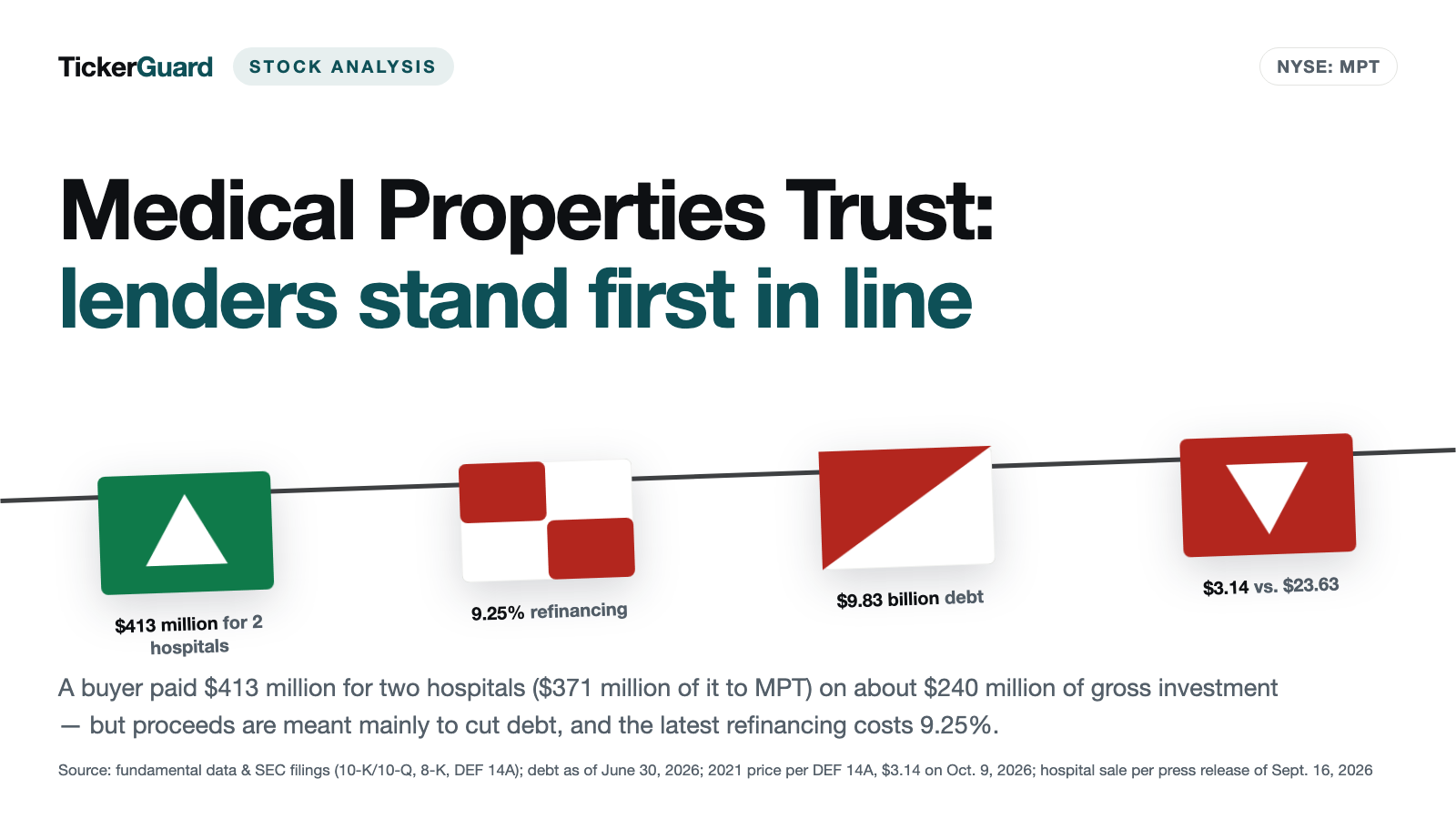
From $23.63 (2021) to $3.14 in October 2026: anyone who bought at the end of 2021 and added at every year-end since averaged down each time and is under water on every one of those purchases. In 2026, a buyer paid far more for two hospitals than had once been invested. But the latest refinancing costs 9.25 percent, and MPT plans to use most of the sale proceeds to pay down debt.
 Thomas Mücke
Founder & Publisher
Thomas Mücke
Founder & Publisher
As of Today
As of: October 9, 2026
- Closing price
- 3.10 $ -1.60%
- Market Capitalisation
- 1.9 $B
- Growth Score
- 6/10
- AAQS
- 5/10
Price change since October 9, 2026: -1.3%
This analysis has a cut-off date. The Stock Guard tells you when something material changes in the numbers. Reserve your free spot
Chart
Interactive price chart (TradingView).
52-week range: 3.20 $ to 6.00 $ · Last price: 3.10 $ (As of: October 9, 2026)
Note: pure fact-based analysis, not investment advice and not a solicitation to buy or sell. All figures without guarantee.
The pay-versus-performance table in Medical Properties Trust’s 2026 proxy statement (DEF 14A) lists the stock price at $23.63 for 2021, $11.14 for 2022, $4.91 for 2023, $3.95 for 2024 and $5.00 for 2025. On October 9, 2026, the stock closed at $3.14. Anyone who bought at the end of 2021 and added at every year-end since always had a reason: the price is already so low, the dividend so high, and every purchase pulls your own average price down.
Investors call this averaging down. It feels like progress, because the number in your brokerage account, your cost basis, keeps falling. The trap: your own purchase price becomes the yardstick for whether a stock is “cheap.” The company does not care about that price. What the stock is really worth depends on rents, debt and interest, not on the memory of $23. The same table puts total shareholder return at the end of 2025 at 37.95, measured against 100 at the start of the table period in 2021, with dividends reinvested. A health care real estate index came in at 163.81 over the same period.
So let’s make a deal: we forget the old prices and read together what Medical Properties Trust itself reports to the U.S. securities regulator, the SEC. The tension at the heart of this analysis: At least some of MPT’s hospitals are worth more than they carry on the books — for two hospitals in Idaho, a buyer paid well above the original investment in 2026. But MPT plans to use most of the money from those sales to pay down debt, and its most recent major refinancing had to be secured by real estate and carries 9.25 percent interest.
What Medical Properties Trust actually does
Medical Properties Trust, or MPT, does not run hospitals. It owns the buildings and leases them to hospital operators on long contracts; according to the 2025 annual report, the weighted average remaining initial term of its leases and loans was 16.7 years. Think of a landlord that rents out entire hospitals instead of apartments. Tenants pay operating costs, taxes, insurance and maintenance themselves (a “net lease”). MPT collects the rent, which rises every year under leases representing 99 percent of current monthly revenue (as of year-end 2025). Rent makes up about 95 percent of revenue.
As of June 30, 2026, MPT owned 373 properties with roughly 38,000 beds, leased to or mortgaged by 51 operators in nine countries: the United States, the United Kingdom, Switzerland, Germany, Spain, Finland, Colombia, Italy and Portugal. Half of its assets sit in the U.S., 27.6 percent in the U.K. The largest tenant is British hospital group Circle Health, with 21.1 percent of second-quarter 2026 revenue, followed by British mental health group Priory at 10.6 percent. All of this is managed by 121 employees (as of February 2026). MPT was founded in 2003 in Birmingham, Alabama. Founder Edward K. Aldag Jr. leads it today as chairman, president and CEO; he has been a director since 2004.
MPT is a REIT (real estate investment trust), a property company with a tax privilege: it pays no U.S. corporate income tax on the income it distributes (foreign taxes and taxes at taxable subsidiaries still apply; $38.6 million in 2025), but must distribute at least 90 percent of its taxable income. That is why many investors buy REITs for the dividend. Since February 2026, the stock has traded on the New York Stock Exchange under the symbol MPT instead of MPW; the company is the same.
Company history for investors
-
2003
Founded in Birmingham
MPT is set up as a landlord for hospital buildings; founder Edward K. Aldag Jr. still leads MPT as CEO.
-
2023
First dividend cut
In August, the quarterly dividend falls from $0.29 to $0.15; Steward costs MPT $714 million in impairments and reserves.
-
2024
Steward bankruptcy
Steward files for bankruptcy in May and MPT books $1.56 billion of impairments; in August, the dividend drops to $0.08.
-
2025
Prospect bankruptcy, first secured notes
Prospect files for bankruptcy in January; in February, MPT refinances with secured notes at 8.5 and 7.0 percent.
-
2026
New ticker, new money at 9.25 percent
MPW becomes MPT; in August come $2.4 billion of secured notes at 9.25 percent, in September the sale of two hospitals for $413 million.
How the stock landed on our desk
MPT made our research list through the forum ranking of wallstreet-online, the list of stocks most discussed by German retail investors (as of October 11, 2026). That is a signal of attention, not of quality. But our in-house stock scanner knows MPT too: the stock appears in the price-to-cash-flow ranking, which collects stocks trading at no more than 10 times operating cash flow (as of October 11, 2026). By our calculation, MPT’s market value came to about 8 times the operating cash flow of the last four quarters ($1.875 billion against $227 million). One caveat: that cash flow is already counted after interest payments, so interest does not eat into it a second time. But it still has to cover the dividend.
And there is another number showing that retail investors are not the only ones watching: about 146 million MPT shares were sold short (source: fundamental data, retrieved October 11, 2026), about 30 to 33 percent of the freely tradable shares: the fundamental data show 32.8 percent; using the float stated there, our own calculation gives 29.8 percent. Short sellers profit when the price falls. A share that high means a lot of money is betting against MPT. That can reverse if the news improves, but for now it is a clear vote of no confidence. For a hospital landlord with a smaller balance sheet and a different tenant base, see our analysis of Community Healthcare Trust.
The numbers over the years
First, what impresses. The second quarter of 2026 shows a recovery: rent billed rose 14 percent year over year to $203.4 million, revenue 8 percent to $259.3 million. Normalized FFO, the measure REITs use for their ongoing earnings from operations (net income plus depreciation, excluding one-off items; it still includes straight-line rent not yet received in cash), rose to $0.15 per share from $0.14 a year earlier. According to the quarterly report, the biggest contribution to higher lease revenue came from the re-tenanted former Steward and Prospect hospitals, up $16.4 million year over year.
And the buildings themselves are in demand. On September 16, 2026, MPT sold two hospitals in Idaho to Intermountain Health for $413 million; MPT received $371 million in cash, with $42 million going to minority owners. According to MPT, the gross investment in the two properties was about $240 million; MPT puts the gain over gross book value at about $130 million. Together with the IPO of its Swiss hospital real estate holding Infracore in July and the sale of its interest in five Utah hospitals in August, MPT reports roughly $680 million of sale proceeds for the third quarter of 2026. Most of it is meant to pay down debt.
Now the sobering part, and it is in the chart.
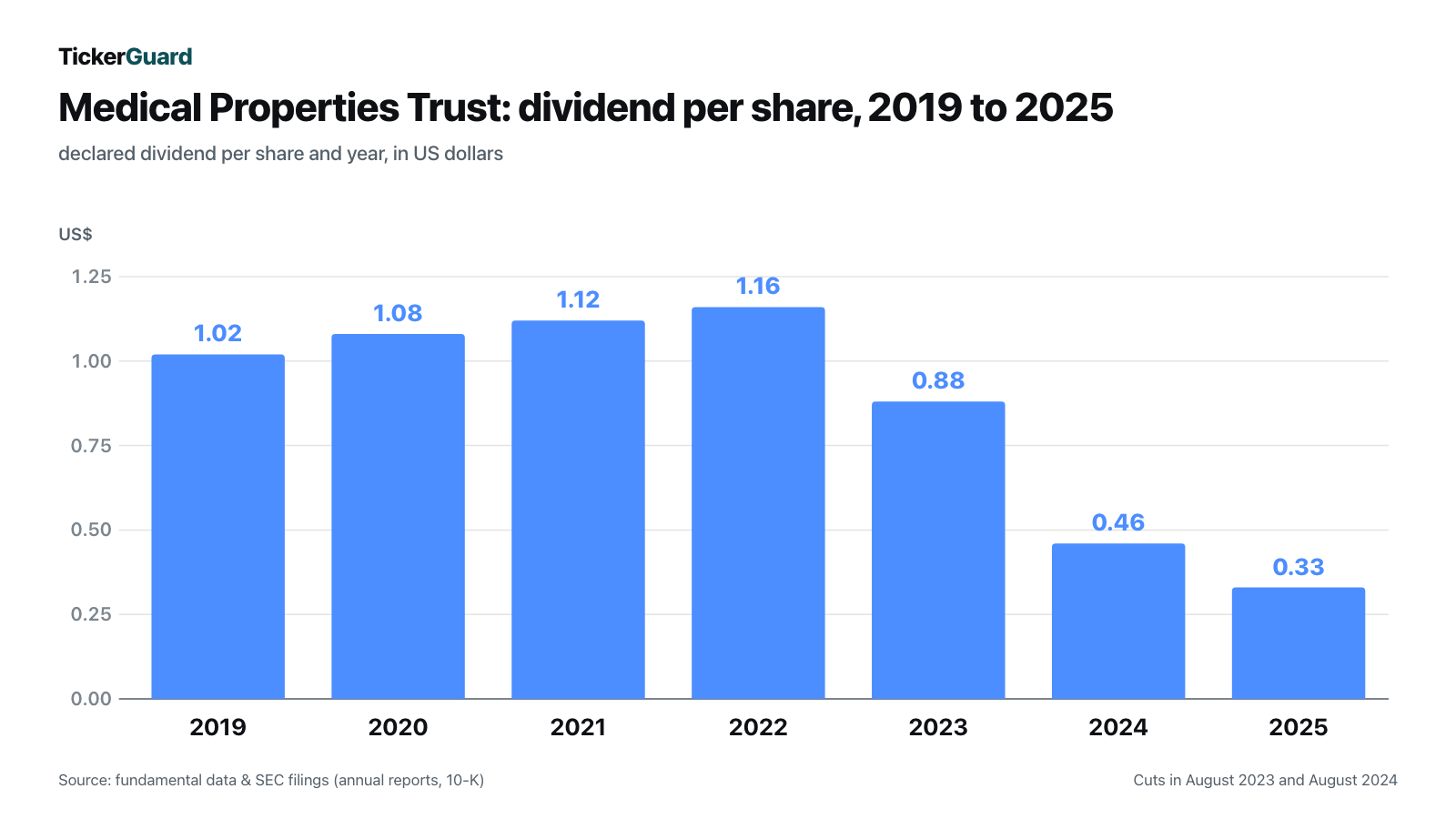
In 2022, MPT still paid $0.29 per share per quarter. In August 2023, it nearly halved the dividend to $0.15, and in August 2024 cut it again to $0.08. Since the increase declared in November 2025 (first paid in January 2026), it has been $0.09 per quarter. The cuts came while two major tenants were sliding into trouble. For Steward Health Care, once one of the largest tenants, MPT already recorded $714 million of impairments and reserves in 2023; Steward filed for bankruptcy in May 2024, and in 2024 alone it cost MPT $1.56 billion in impairments. In January 2025, Prospect Medical Holdings, another major tenant, filed for bankruptcy as well. Net income attributable to shareholders swung from $902.6 million in 2022 to losses of $556.5 million (2023), $2.41 billion (2024) and $277.0 million (2025). The first half of 2026 brought a small profit of $30.2 million, mostly thanks to a $22.7 million income tax benefit, driven largely by a one-time deferred tax adjustment in the U.K.
Ongoing operating earnings have shrunk too: normalized FFO per share fell from $1.59 (2023) to $0.80 (2024) and $0.58 (2025). Revenue was $972.0 million in 2025, down from $1.54 billion in 2021. Remember: the 2026 recovery is real, but it starts from a level that is only a fraction of what it used to be.
Uncomfortable truth no. 1: Money is getting more expensive
A landlord that buys buildings on credit earns the spread between rental yield and interest. At MPT, that spread has become thin. As of June 30, 2026, the company had $9.83 billion of debt at a weighted average interest rate of 5.37 percent. Interest expense was $510.4 million in 2025, or 52.5 percent of revenue. In 2021 it was 23.8 percent. More than every second dollar of revenue now goes to lenders before overhead, depreciation or shareholders get their turn.
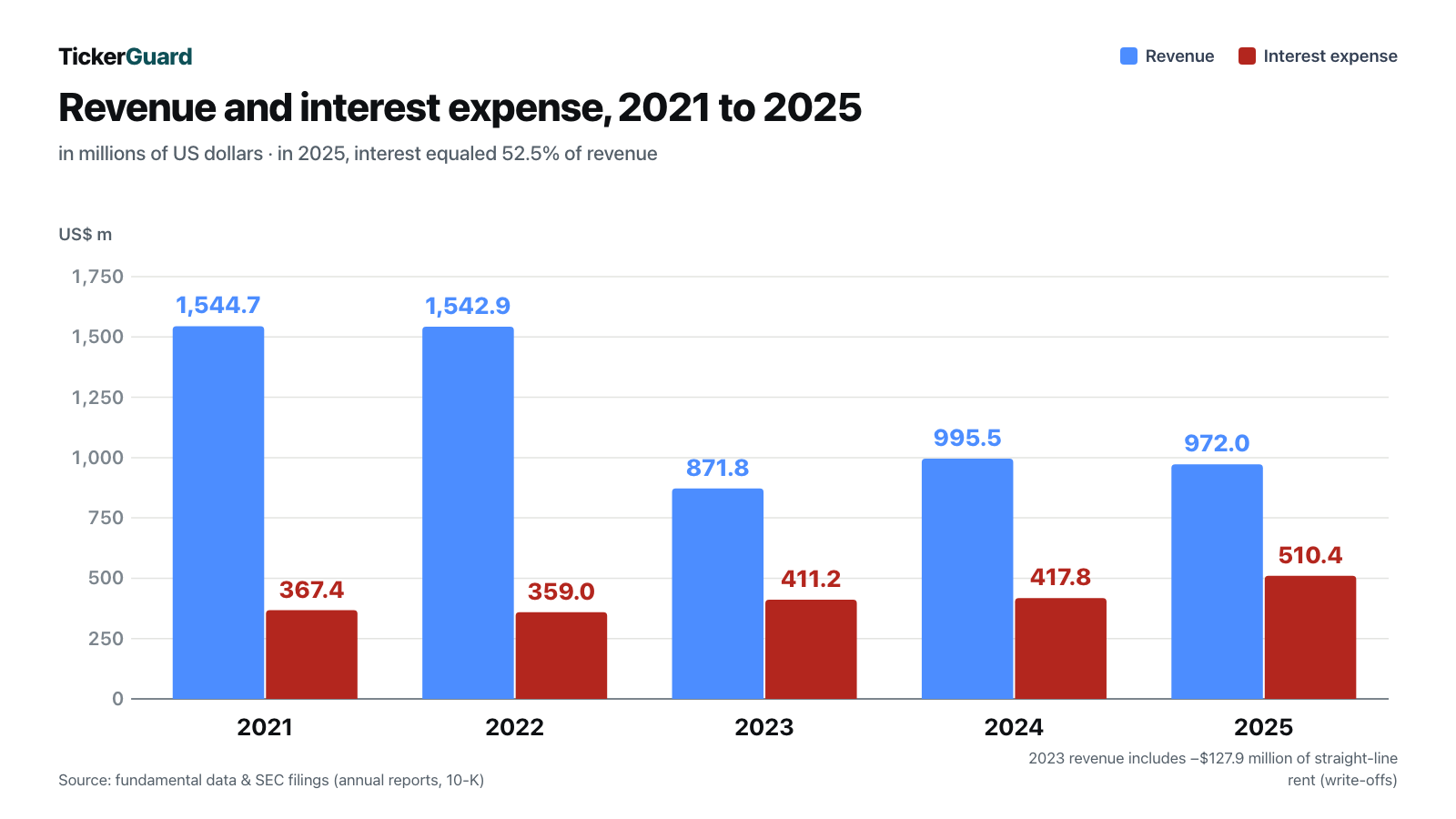
The 2023 revenue figure is depressed: it includes the straight-line rent line at minus $127.9 million, because MPT wrote off such receivables, mainly at Steward. That does not change the picture. Most of MPT’s debt comes due in a single payment at maturity and then has to be refinanced. The annual report is candid about what that means:
“There is a risk that we may not be able to extend, refinance, or pay off debt maturing in 2026 and future years or that the terms of any refinancing will not be as favorable as the terms of the then-existing debt.”
— Medical Properties Trust, SEC annual report 10-K for 2025, Item 1A Risk Factors (Financing Risks)
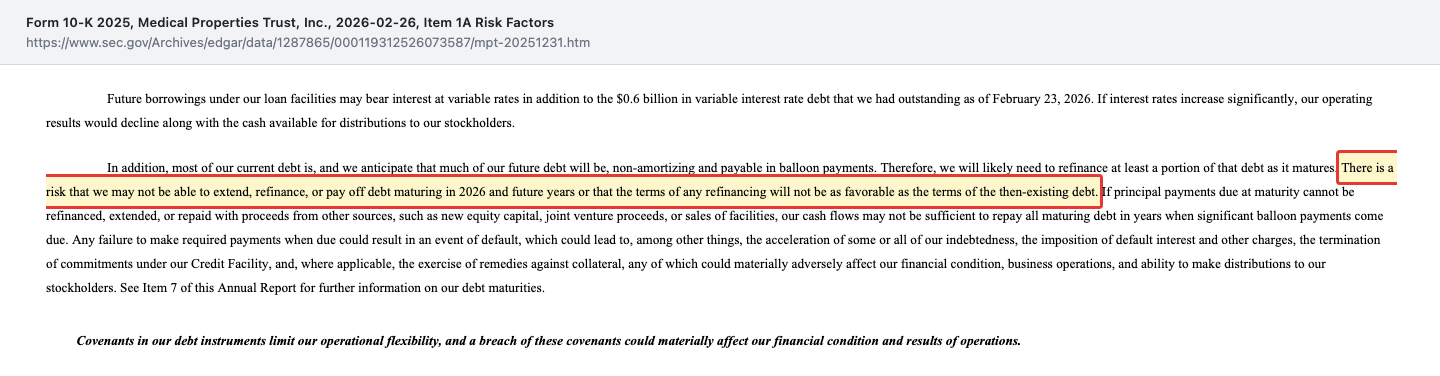
That is exactly what happened on August 10, 2026. MPT issued $2.4 billion of new notes due 2032, at 9.25 percent interest and secured by real estate. About $1.0 billion came in as cash, earmarked to retire the 2026 euro notes (0.993 percent) in full and about 27 percent of the 2027 notes (5.0 percent). The rest was an exchange in which holders swapped older unsecured notes maturing between 2027 and 2031, with coupons between 3.375 and 5.0 percent. MPT expects to capture a discount of about $123 million, net of certain lender fees. But the new notes alone cost $222 million in interest a year ($2.4 billion times 9.25 percent). MPT does not quantify how much the overall interest burden rises; only the direction is clear: the retired notes carried coupons between 0.993 and 5.0 percent, the new ones carry 9.25 percent.
Back in February 2025, MPT had already issued $1.5 billion of secured notes at 8.5 percent and €1.0 billion at 7.0 percent. According to the contractual commitments table in the quarterly report, the secured notes alone will require $430.2 million in each year from 2027 through 2030. And “secured” means: specific properties stand behind these lenders first. If you want to understand the pecking order in a crisis: secured lenders at the front, unsecured lenders next, shareholders at the very back.
Add a deadline: MPT’s credit facility matures on December 30, 2026, with an option to extend six months to June 30, 2027, subject to certain conditions. As of August 10, 2026, $475.3 million was drawn. According to the quarterly report, MPT was in compliance with all covenants as of August 10, 2026, and lists a new multi-year credit facility as one option. MPT’s adjusted net debt (excluding about $559 million spent on development and capital addition projects) stood at 8.9 times adjusted EBITDAre (earnings before interest, taxes, depreciation and amortization for real estate, annualized from the second quarter of 2026); without that adjustment it would be about 9.5 times by our calculation.
Uncomfortable truth no. 2: Part of the rent is not cash yet
MPT’s leases include annual rent increases. Accounting rules require the rent to be smoothed over the full lease term (“straight-line rent”). That means part of the increases that will only be paid many years from now already shows up as revenue today. Picture a tenant who pays $1,000 today and $1,500 in 20 years. The books record an average in between from day one. The difference is a receivable, not money in the bank.
At MPT, that is a big number. In the second quarter of 2026, $33.3 million of $259.3 million in revenue was straight-line rent, about 13 percent; in 2025 it was almost 16 percent (our calculations). On the balance sheet, these future rents have grown to $927.5 million, 20.6 percent of equity (June 30, 2026). They only turn into cash if the tenant lasts to the end of the lease. If it fails, the receivable is written off. That has already happened at MPT: in 2023, among other things, it set up a $413 million reserve for Steward rent arrears and straight-line rent.
There is a second effect: several tenants pay so unreliably that MPT only books their rent as revenue once the cash arrives. The quarterly report puts it this way:
“We currently have several tenants on the cash basis from a revenue recognition perspective, which can result in variability of our lease revenue quarter-to-quarter.”
— Medical Properties Trust, SEC quarterly report 10-Q for June 30, 2026, Item 2 (Results of Operations)

One of these tenants is NOR Healthcare Systems, to which MPT re-leased six former Prospect hospitals in California in December 2025. All rent there was deferred for the first six months, and half of it is deferred for another six; in the second quarter of 2026, MPT booked just $1 million of revenue from NOR. And at Prospect itself, MPT’s remaining investment was about $67 million as of June 30, 2026, including a $3 million commitment MPT still expected to fund in the third quarter of 2026. MPT believes the amount is fully recoverable, from remaining Connecticut receivables and from litigation and other causes of action, but says their ultimate outcome and timing are uncertain.
Uncomfortable truth no. 3: The new tenants need loans
The good news above has a flip side. The six operators that took over 18 of the former Steward hospitals in September 2024 are indeed paying much more: about $3.4 million in the first quarter of 2025, already $29.7 million in the second quarter of 2026. From October 2026 they are scheduled to pay about 100 percent of contractual rent. The catch: MPT is also financing these tenants. As of June 30, 2026, it had lent them about $172 million in working capital and other loans. And for the largest of them, Healthcare Systems of America (HSA), MPT had to add more in the second quarter of 2026:
“In the 2026 second quarter, we advanced an additional $50 million to HSA due to ongoing revenue cycle management issues, of which we have subsequently received approximately $25 million.”
— Medical Properties Trust, SEC quarterly report 10-Q for June 30, 2026, Note 3 (Other Re-tenanting Activity)
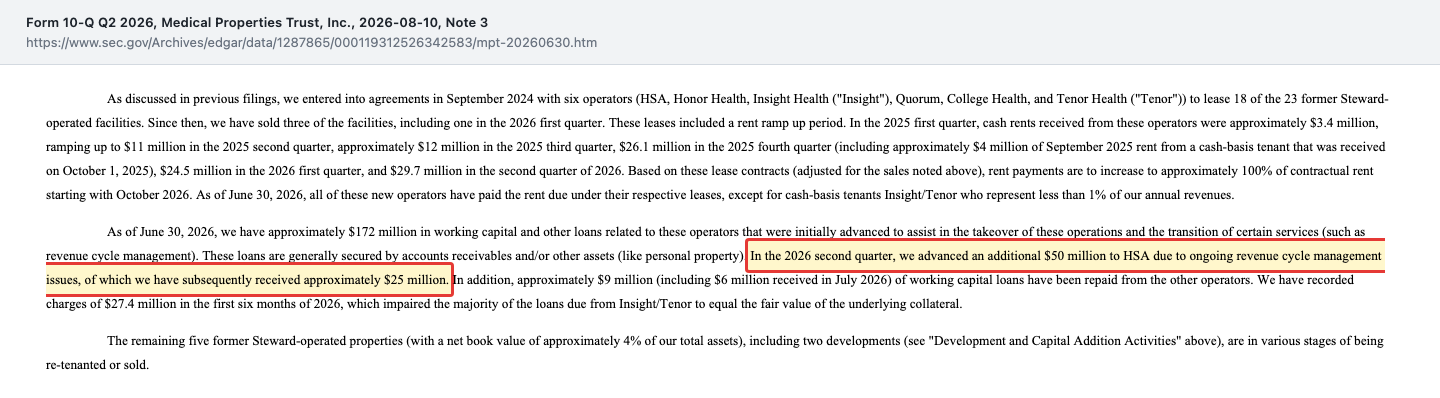
Why this matters: with 8.5 percent of assets, HSA is MPT’s third-largest tenant. MPT publishes no rent coverage for HSA, meaning no figure for how many times the operator could pay its rent out of its own earnings. The same is true for 14 operators with a combined investment of about $2.96 billion, NOR among them; in part the figure is simply not required, and the 14 also include investment-grade tenants and Britain’s state-run NHS. And for two of the smaller transition tenants, Insight and Tenor, MPT already recorded $27.4 million of loan impairments in the first half of 2026. A landlord that lends working capital to its tenant carries that tenant’s risk twice: as landlord and as lender. Whether rent flows on its own will only show in the quarters after October 2026.
Then there is the concentration in the U.K.: Circle Health alone brings in a little over a fifth of revenue, Priory another tenth. MPT itself writes that it has no operational control over its tenants’ business. If a large tenant with cross-defaulted leases fails, the annual report says, the hit to MPT would be even more pronounced.
Uncomfortable truth no. 4: The dividend is on the list
In the first half of 2026, operations generated just $48.2 million of cash, after interest payments of $279.5 million (a year earlier: $220.3 million). In the first quarter, operating cash flow was actually negative, at minus $14.3 million. In the same half-year, MPT paid out $109.6 million in dividends, more than twice as much. Cash on hand, the credit facility and property sales close the gap. In its quarterly report, MPT lists where money for upcoming maturities could come from, and one item on that list is the dividend:
“reducing our dividend (or switching to a stock dividend), while still complying with REIT requirements and credit facility covenants;”
— Medical Properties Trust, SEC quarterly report 10-Q for June 30, 2026, Item 2 (Long-term Liquidity Requirements)
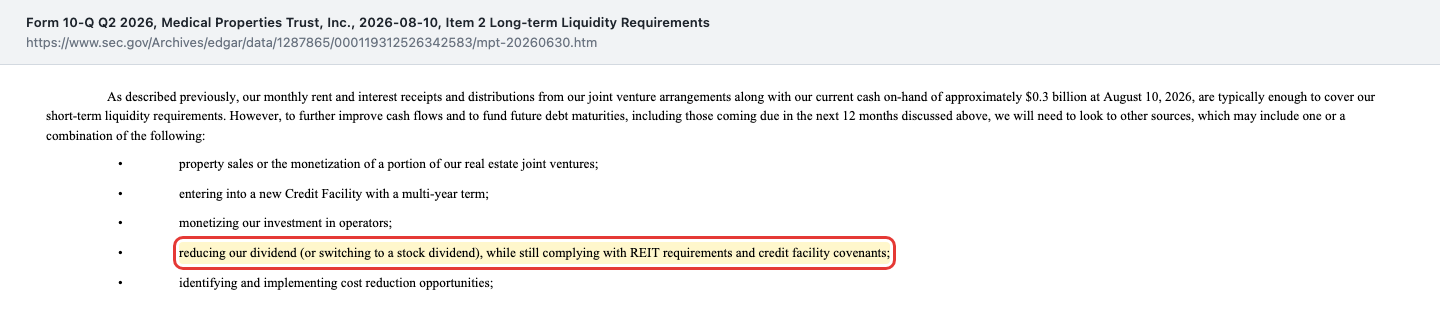
To be fair: this is a list of options, not an announcement. The same list includes property sales, a new credit facility and monetizing investments in operators, and with roughly $680 million from the third quarter, MPT has delivered on sales. On August 13, 2026, MPT again declared $0.09 per share, payable on October 8, 2026. Measured against normalized FFO of $0.29 in the first half, the $0.18 dividend is covered. Measured against the cash that actually came out of the business after interest, it was not covered in the first half. This is where a metric and a bank balance part ways.
What the stock costs
At the closing price of $3.14 on October 9, 2026, and 597.2 million shares, MPT was worth about $1.88 billion. Add debt minus cash (as of June 30, 2026) and the whole company costs about $11.3 billion. That shows the proportions: about 83 percent of enterprise value is debt net of cash, about 17 percent is shareholders’ equity. A 10 percent rise in property values would benefit shareholders disproportionately, but a 10 percent drop would hit them disproportionately too. That is the leverage built into every heavily indebted stock.
At first glance the stock looks cheap: equity stood at $7.54 per share on June 30, 2026, so the market valued it at less than half of book value (about 0.42). Based on second-quarter normalized FFO annualized ($0.60 a year), you pay about 5 times. The $0.36 annual dividend equals a yield of about 11.5 percent at the October 9, 2026, price (all our calculations). These are exactly the numbers that invite averaging down. That the market prices them this low is unlikely to be an accident: after billions in write-downs, investors apparently distrust book values and price in the interest burden of the coming years.
The view from the pros: of eight analysts covering the stock, three rated it a buy, three a hold and two a sell; the average price target was $5.13 (as of October 11, 2026, source: fundamental data). A price target is an opinion, not a promise; for MPT it hinges mainly on whether the new tenants really pay in full from October 2026.
Upside and risks at a glance
What speaks for MPT:
- The buildings have market value: two Idaho hospitals sold for $413 million ($371 million of it in cash to MPT) against roughly $240 million of gross investment (September 16, 2026); about $680 million of sale proceeds in the third quarter of 2026.
- Rental income is rising again: rent billed up 14 percent to $203.4 million in the second quarter of 2026; Steward’s successors paid $29.7 million in the quarter and are scheduled to pay about full contractual rent from October 2026.
- Long leases: 85.8 percent of annual base rent and interest expires only after 2035 (June 30, 2026), and leases representing 99 percent of monthly revenue include annual escalators (year-end 2025).
- The next big maturities are defused: after the August 10, 2026, refinancing, only the credit facility ($475.3 million) comes due in 2026 and about $865 million in 2027.
What speaks against MPT:
- High and increasingly expensive debt: $9.83 billion as of June 30, 2026 (about $9.51 billion as of August 10, 2026, after the refinancing and a partial paydown of the credit facility), adjusted net debt at 8.9 times adjusted EBITDAre (company figure); new notes at 9.25 percent, secured by real estate.
- Interest eats more than half of revenue (52.5 percent in 2025); in the first half of 2026, operating cash flow of $48.2 million fell short of $109.6 million in dividends paid.
- Uncertain tenants: several tenants on the cash basis, a $50 million additional advance to HSA, no published rent coverage for HSA and NOR, concentration risk in Circle Health (21.1 percent of revenue).
- $927.5 million of straight-line future rent on the balance sheet that only turns into cash if tenants honor their leases.
- The credit facility matures on December 30, 2026 (option to June 30, 2027, subject to conditions); MPT itself lists a dividend cut as a possible source of cash.
A human conclusion
Remember averaging down? With MPT, anyone who bought at the end of 2021 and added at every year-end through 2025 would have lowered the average price each time, and every one of those purchases would be under water at the October 9, 2026, price. That is not only about the buildings. The Idaho sale shows that at least some of them hold their value: the buyer paid $413 million for two hospitals, $371 million of which went to MPT; the gross investment was about $240 million. It is because of who gets paid first if things go wrong. Between the buildings and the shareholders sat $9.8 billion of debt as of June 30, 2026, about $9.5 billion as of August 10, 2026; a growing share of it is secured, and the notes issued in 2025 and 2026 pay 7 to 9.25 percent. Whoever averages down is not buying the buildings, but what is left after the lenders. With about 30 to 33 percent of the freely tradable shares sold short, the stakes run both ways: if the next reports confirm the turnaround, many short sellers could buy back; if they do not, the short sellers will have been right.
The next test has a month attached: from October 2026, the new operators of the former Steward hospitals are supposed to pay about full contractual rent. In the quarterly report for September 30, 2026, and above all in the annual report for 2026, three lines are worth a look: cash rent from the transition tenants (most recently $29.7 million a quarter), the loan balance at HSA, and operating cash flow against the dividend. Only when these three numbers fit together will the dividend be earned by the business itself. Until then, a lower price is information, not a discount. What you make of it is your decision. And that is how it should be.
Sources
- Medical Properties Trust — quarterly report 10-Q for June 30, 2026 (filed August 10, 2026, latest periodic report) and 10-Q for March 31, 2026 (May 8, 2026)
- Annual report 10-K for 2025 (filed February 26, 2026) and 10-K for 2024 (March 3, 2025)
- Current reports 8-K of August 10, 2026: second-quarter 2026 earnings release, quarterly supplemental Q2 2026, new 9.25 percent notes due 2032; 8-K of January 20, 2026 (ticker change from MPW to MPT)
- Proxy statement DEF 14A 2026 (April 13, 2026; total shareholder return and stock prices 2021 to 2025)
- Medical Properties Trust press releases: dividend of August 13, 2026, sale of two hospitals of September 16, 2026
- Source: fundamental data & SEC filings (annual and quarterly reports, 10-K/10-Q) (closing price October 9, 2026; short interest, analyst ratings and price target as of October 11, 2026)
This analysis is a journalistic assessment based on publicly available company filings. It is not investment advice and not a solicitation to buy or sell securities. Stocks can lose value, up to a total loss. All figures carry the date of their source; prices are dated snapshots. Positions held by the operator are disclosed daily; where one exists, it appears as a notice at the top of this analysis.
Key figures at a glance
All monetary figures in millions of $; earnings per share as reported.
| Metric | 2021 | 2022 | 2023 | 2024 | 2025 |
|---|---|---|---|---|---|
| Revenue | 1,544.7 | 1,542.9 | 871.8 | 995.5 | 972.0 |
| Operating Income (EBIT) | 1,038.7 | 1,003.7 | 81.3 | 386.8 | 539.8 |
| Net Income | 656.0 | 902.6 | -556.5 | -2,410.3 | -277.0 |
| Net Margin | 42.5% | 58.5% | -63.8% | -242.1% | -28.5% |
| Earnings Per Share | 1.11 $ | 1.51 $ | -0.93 $ | -4.02 $ | -0.46 $ |
Source: fundamental data & SEC filings (annual and quarterly reports, 10-K/10-Q)
Our Bottom Line at a Glance
- Real estate positive
- 373 properties in nine countries with long leases (85.8 percent of base rent and interest expires after 2035); sale of two Idaho hospitals in September 2026 for $413 million ($371 million of it to MPT) on about $240 million of gross investment.
- Debt and interest negative
- $9.83 billion of debt (June 30, 2026), adjusted net debt at 8.9 times adjusted EBITDAre (company figure); interest at 52.5 percent of 2025 revenue; new secured notes of $2.4 billion at 9.25 percent.
- Tenants negative
- After Steward and Prospect, several tenants on the cash basis; a $50 million additional advance to HSA in the second quarter of 2026; no published rent coverage for HSA and NOR.
- Rent recovery positive
- Rent billed up 14 percent in the second quarter of 2026; Steward’s successors paid $29.7 million in the quarter (first quarter 2025: $3.4 million) and are scheduled to pay about full contractual rent from October 2026.
- Dividend negative
- Quarterly dividend down from $0.29 (2022) to $0.09; first-half 2026 operating cash flow of $48.2 million against $109.6 million of dividends paid; a cut is listed in the 10-Q as a possible source of cash.
Medical Properties Trust sold two hospitals in September 2026 far above the original investment, and rent from Steward’s successors is rising. Against that stood $9.83 billion of debt as of June 30, 2026, which cost more than half of 2025 revenue in interest; the latest refinancing is secured and costs 9.25 percent. Operating cash flow in the first half of 2026 fell short of dividends paid. At $3.14 (October 9, 2026), MPT was worth about $1.88 billion. Not investment advice.
What Our Rating Means
Substance risk
We found at least one documented issue that threatens the company itself — regardless of how the stock is currently valued.
Red: the debt threatens the substance. Net debt is about nine times adjusted EBITDAre, interest ate more than half of 2025 revenue, and the latest refinancing is secured by real estate and costs 9.25 percent. Operating cash flow after interest covered less than half of the dividend in the first half of 2026, and the credit facility matures at the end of 2026. In favor of yellow: there is no going-concern warning, MPT reported compliance with its covenants as of August 10, 2026, and the sales show valuable real estate. Under our rule of doubt, the more cautious rating applies. The decision is yours.
A journalistic assessment by our editorial team at the time of the deep dive, based on public sources — not investment advice and not a solicitation to buy or sell. Your personal circumstances (investment goals, risk capacity, taxes) cannot be taken into account. What our levels mean, how verdicts are formed, and what conflicts of interest exist →
Worth Noting
- This analysis was prompted by the wallstreet-online forum ranking (stocks most discussed by German retail investors), as of October 11, 2026. Our in-house stock scanner lists MPT in its price-to-cash-flow ranking (price-to-cash-flow of 10 or less), as of October 11, 2026. The analysis uses the image of averaging down (buying more as the price falls, with your cost basis as the wrong yardstick).
- Evidence base: annual report 10-K for 2025 (Feb. 26, 2026) and for 2024 (March 3, 2025), quarterly reports 10-Q for March 31, 2026, and June 30, 2026 (Aug. 10, 2026, latest periodic report), current reports 8-K of Aug. 10, 2026 (earnings, supplemental, new notes) and Jan. 20, 2026 (ticker change), and the proxy statement DEF 14A of April 13, 2026. After Aug. 10, 2026, MPT filed only insider reports (Form 4) through Oct. 11, 2026; press releases of Aug. 13, 2026 (dividend) and Sept. 16, 2026 (Idaho hospital sale) were also reviewed. The report for Sept. 30, 2026, was not yet available on Oct. 11, 2026.
- Our calculations: market value 597.2 million shares (10-Q cover, Aug. 10, 2026) times $3.14 = $1.875 billion; enterprise value 1.875 + 9.829 (debt at face value) − 0.397 (cash) = $11.31 billion; debt net of cash 9.432 / 11.31 = about 83 percent, shareholders 1.875 / 11.31 = about 17 percent; operating cash flow over the last four quarters 230.8 + 48.2 − 52.1 = $226.9 million (price-to-cash-flow about 8.3); price-to-book 3.14 / 7.54 (equity of $4,498.8 million over 596.8 million shares at June 30, 2026) = 0.42; second-quarter normalized FFO $0.15 times 4 = $0.60, price-to-FFO about 5.2; dividend yield 4 × 0.09 = $0.36 / $3.14 = 11.5 percent; interest to revenue 2025 510.4 / 972.0 = 52.5 percent, 2021 367.4 / 1,544.7 = 23.8 percent; straight-line rent Q2 2026 33.3 / 259.3 = 12.8 percent, 2025 152.2 / 972.0 = 15.7 percent; balance 927.5 / 4,498.8 equity = 20.6 percent; interest on the new notes 2,400 × 9.25 percent = $222 million a year; net debt without the development adjustment (9,705.0 book debt − 396.6) over $981.3 million of annualized adjusted EBITDAre = about 9.5.
- Prices: stock prices 2021 to 2025 ($23.63 / $11.14 / $4.91 / $3.95 / $5.00; “Stock Price” column of the pay-versus-performance table, $5.00 matches the Dec. 31, 2025, close) and total shareholder return (37.95 per $100 initial value; Dow Jones U.S. Real Estate Health Care index 163.81) from the pay-versus-performance table of the DEF 14A of April 13, 2026; closing price $3.14 on Oct. 9, 2026, on the NYSE; short interest (about 146 million shares; fundamental data put it at 32.8 percent of float, while 146.2 over 489.9 million float shares would give 29.8 percent), analyst ratings and average price target from fundamental data, as of Oct. 11, 2026.
- Possible confusion: until Feb. 1, 2026, the stock traded as MPW. “MPT” is also shorthand for the operating subsidiary MPT Operating Partnership, L.P., which issues the notes. “MEDIAN” in MPT’s filings is the German hospital operator MEDIAN Kliniken, not a statistical value.
Stock Watch
This analysis is as of October 11, 2026. Stock Watch will tell you what's changed at MPT since then.
Later $1 a month per stock — signing up is free, and you'll be the first to know when it launches.
The full analysis as a PDF for later
We will send you this analysis as a PDF — to print, file away, and read at your own pace. And we will add you to the free Stock Watch list for Medical Properties Trust, Inc. (MPT), so you hear about it when something material in this analysis changes.
Frequently Asked Questions
Medical Properties Trust is a REIT, a real estate company required to distribute most of its income, that owns hospital buildings and leases them long term to hospital operators. As of June 30, 2026, MPT owned 373 properties with about 38,000 beds, leased to or mortgaged by 51 operators in nine countries, mainly in the U.S. and the U.K.
Medical Properties Trust changed its New York Stock Exchange ticker from MPW to MPT effective February 2, 2026 (Form 8-K of January 20, 2026). The company, the exchange and the CUSIP stayed the same; at the same time, the company announced the previously planned move of its headquarters to a new site in Birmingham, Alabama.
It is not guaranteed. Since January 2026, MPT has paid $0.09 per quarter (declared since November 2025), covered by normalized FFO ($0.29 in the first half of 2026). Operating cash flow after interest, however, was only $48.2 million in the first half of 2026, against $109.6 million paid. In its quarterly report, MPT lists a dividend cut or a stock dividend as a possible source of cash for future maturities.
As of June 30, 2026, $9.83 billion at an average interest rate of 5.37 percent; according to MPT, adjusted net debt was 8.9 times adjusted EBITDAre. On August 10, 2026, it added $2.4 billion of new secured notes at 9.25 percent, used to retire older, cheaper notes.
Steward Health Care, once one of the largest tenants, filed for bankruptcy in May 2024; in 2024 alone, MPT recorded $1.56 billion of related impairments and re-leased 18 of the hospitals to six new operators. Prospect Medical Holdings followed in January 2025. As of June 30, 2026, MPT’s remaining Prospect investment was about $67 million (including a $3 million commitment still to be funded); MPT believes it is fully recoverable, but says the outcome and timing of the related proceedings are uncertain.
The metrics look low: at $3.14 (October 9, 2026), the market valued MPT at about 0.42 times book value and about 5 times annualized normalized FFO; the dividend yield was about 11.5 percent. Against that stood $9.8 billion of debt as of June 30, 2026; about 83 percent of enterprise value is debt net of cash.
Found an error?
Did you spot a factual error, an outdated number, or a typo in this deep dive? Let us know briefly — your report goes straight to the editorial team.