PNE Stock: Up to 100 Percent Is for Sale — but Price Expectations Came in Below the Market in August
The buyer everyone is waiting for would come with a side effect at PNE: if an investor acquires more than 50 percent of the shares, lenders and bondholders gain a termination right. The German wind farm developer is looking for exactly such a buyer in a process for up to 100 percent of its shares, but according to its ad hoc release of August 10, 2026, potential acquirers' price expectations were below the market price of around €10 at the time. A for-sale sign is not a price tag.
 Thomas Mücke
Founder & Publisher
Thomas Mücke
Founder & Publisher
As of Today
As of: October 11, 2026
- Closing price
- 7.20 € +0.42%
- Market Capitalisation
- 0.6 €B
Price change since October 9, 2026: +0.1%
This analysis has a cut-off date. The Stock Guard tells you when something material changes in the numbers. Reserve your free spot

Chart
Interactive price chart (TradingView).
Last price: 7.20 € (As of: October 11, 2026)
Note: pure fact-based analysis, not investment advice and not a solicitation to buy or sell. All figures without guarantee.
On December 9, 2022, PNE AG stock closed at €24.10. On October 9, 2026, it closed at €7.19 — about 70 percent lower. Anyone who has held it since knows the feeling: selling would make the loss final. So you wait. For better numbers, for more wind, for a buyer who takes the company over and brings the old price back.
Finance researchers Hersh Shefrin and Meir Statman gave this behavior a name in 1985: the disposition effect. Investors sell winners too early and ride losers too long, because a paper loss does not yet feel like a real one. At PNE, that hope even got a reason in the summer of 2026: the company is running a structured process to find investors for up to 100 percent of its shares. Then came the ad hoc release of August 10, 2026, which did not fit the script: according to PNE, potential acquirers' price expectations were below the market price at the time. So let's make a deal: instead of doing the math on your purchase price, we read together what PNE itself reports — in its 2025 annual report and its 2026 half-year report. The tension running through this analysis: PNE owns valuable wind farms and a large project pipeline, but its equity is shrinking, authorized capital failed the 75 percent hurdle three times, and buyers' price expectations came in below the market price.
What PNE Actually Does — Planning, Selling and Running Wind Farms
PNE is based in Cuxhaven on Germany's North Sea coast and has been developing renewable energy projects for about 30 years. The business rests on three pillars. The first is project development: PNE secures land, signs leases, commissions surveys, obtains permits and sells the finished projects to investors — sometimes as a permitted project, sometimes built and ready to run. Think of a homebuilder that builds wind farms instead of houses. As of June 30, 2026, the pipeline comprised projects with 21.7 gigawatts, including 14.6 gigawatts of onshore wind and 7.1 gigawatts of solar. About 12 gigawatts are in the three core markets of Germany, France and Poland.
The second pillar is power generation: PNE keeps some wind farms instead of selling them. At the end of June 2026, that portfolio stood at 484 megawatts, 33 wind farms plus a wood-fired power plant. According to the half-year investor presentation, more than 90 percent of these assets earn a fixed feed-in tariff for 20 years — the company's predictable income. In the first half of 2026, they generated about 408 gigawatt hours of electricity, 42 more than a year earlier, because the wind was stronger. The third pillar is services: operations management for other owners' wind farms (about 3,256 megawatts as of June 30, 2026), wind measurements, expert reports and brokering power purchase agreements.
One thing matters for reading the numbers: a project developer earns money in bursts. One big sale can save a quarter, one delayed sale can spoil a year. And as long as PNE builds a wind farm itself and has not decided whether to sell or keep it, the project sits in inventories and is financed with bank loans. That is why operating cash flow says less about earnings power at PNE than at a manufacturer.
Company history for investors
-
2022
2022/2027 bond and price peak
PNE placed a €55 million bond at 5.0 percent; in December, the stock closed at €24.10, its highest close since.
-
2024
First AGM without new capital
On May 30, 2024, the proposal for authorized capital missed the 75 percent majority — for shareholders, the start of a series that continued in 2025 and 2026.
-
2025
Higher output, bigger loss
Total output of €376.4 million, but a group loss of €47.4 million after project write-downs; the guidance was cut in January 2026.
-
2026
Smaller bond, price ideas below market
June: a €36 million bond at 7 percent instead of up to €65 million. August: according to PNE, potential buyers' price expectations below the market price at the time; the stock fell 19.5 percent.
How the Stock Landed on Our Desk
Not through our in-house stock scanner, but through the forum ranking of wallstreet-online, the list of stocks most discussed by German retail investors (as of October 11, 2026). That is an attention signal, not a quality signal. The attention has a clear trigger, the ad hoc release of August 10, 2026: between the Xetra closing prices of August 10 and 11, the stock fell from €9.89 to €7.96, a drop of 19.5 percent. Since then, it has hovered around €7; on October 9, 2026, it closed at €7.19.
PNE is not alone in this business model. Its competitor Energiekontor from Bremen also lives off the mix of project sales and an owned wind portfolio; our Energiekontor analysis shows how differently two developers with the same model can be financed.
The Numbers Over the Years — Fairly Assessed
First, what genuinely holds up. PNE sells projects, even in a tough market. In 2025, according to the company, they added up to about 428 megawatts. In the first half of 2026, eight wind and solar projects with 163.2 megawatts followed in Germany, Poland and France; in July, two repowering wind farms with a combined 45 megawatts went to private investors; and on September 29, 2026, the Polish subsidiary announced the sale of the 153-megawatt “Karolew” project to what PNE called a “worldwide operating energy utility,” with ready-to-build status planned for 2029. The group's total output, which is revenue plus the change in unsold projects plus other operating income, rose to €376.4 million in 2025 (2024: €342.6 million).
The owned portfolio has substance, too. According to the company, its own wind farms carry €153.1 million in “hidden reserves” (as of June 30, 2026). These are pre-tax profits on intra-group sales that are eliminated in the consolidated balance sheet, because PNE in effect “sells” the wind farms to itself. Whether that value would be realized in a real sale depends, according to the half-year report, on investors' return expectations. The power generation segment earned EBITDA — earnings before interest, taxes, depreciation and amortization — of €34.1 million in the first half of 2026.
And the first half of 2026 was clearly better operationally than a year earlier: EBITDA rose to €27.4 million (first half of 2025: €4.7 million), and operating profit (EBIT) swung from minus €14.4 million to plus €8.5 million.
Now the sober part. The bottom line has shown a loss for three reporting periods: minus €3.8 million in 2024 (after the correction we will come to), minus €47.4 million in 2025 and minus €18.3 million in the first half of 2026. For 2025, management originally guided for EBITDA of €70 million to €110 million. On January 14, 2026, it cut that to €45 million to €60 million in an ad hoc release, citing write-downs on projects in Canada, Spain and Romania. The result was €55.3 million; adjusted for these and other one-time effects totaling €31.7 million (“normalised EBITDA”), it would have been €87.0 million. Operating cash flow was negative in all three periods: minus €176.6 million (2024), minus €50.0 million (2025) and minus €36.7 million (first half of 2026) — partly because PNE builds wind farms in inventories first.
Uncomfortable Truth No. 1: Prospective Buyers Wanted to Pay Less Than the Market in August
PNE has a major shareholder. Funds managed by Morgan Stanley Infrastructure Partners hold 48.03 percent of the voting rights through Photon Management GmbH; including other voting rights attributed to Morgan Stanley, the total is 50.07 percent. Next come Active Ownership with 14.01 percent of the voting rights (12.05 percent in shares) and Samson Rock with 9.99 percent (voting rights notifications as of October 5, 2026, according to the company's investor relations page). Under related party disclosures, the half-year report states that a major shareholder fully reimburses PNE for costs of €3.7 million for purchased external services; a receivable of €4.4 million including VAT from this was still outstanding at the reporting date. After media reports about a sale process, PNE clarified in an ad hoc release on August 10, 2026:
“In light of recent media reports, PNE AG clarifies, with regard to the structured process it has initiated to seek an investor for the acquisition of up to 100 percent of its shares, that the market interest received indicates that the price expectations of potential acquirers are below the current market price level of the PNE share. Against this background, it is currently uncertain whether a transaction will materialise and what its terms would be.”
— PNE AG, ad hoc release of August 10, 2026
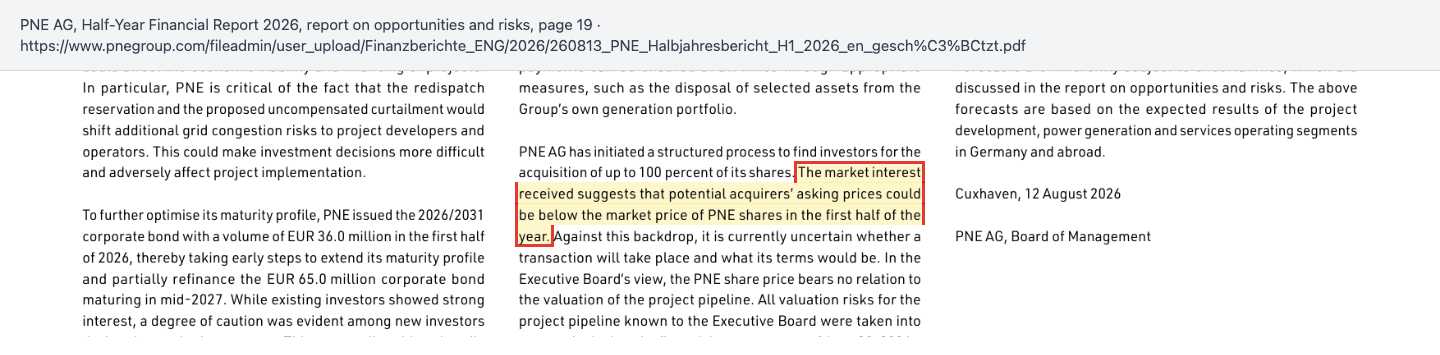
For anyone who has been waiting for a buyer to pay a premium, this is a sobering sentence: in PNE's assessment, potential acquirers' price expectations were not above but below the price at the time of around €10 (Xetra close on August 10, 2026: €9.89). PNE does not mention actual bids, and the release does not say whether the assessment also holds against today's lower price. The half-year report repeats this three days later in its risk section — and management adds an assessment on the balance sheet valuation: “In the Executive Board’s view, the PNE share price bears no relation to the valuation of the project pipeline.” In the same paragraph, management adds that all valuation risks for the pipeline known to it have been taken into account in the interim financial statements; in other words, it does not derive any additional impairment need from the lower price expectations.
And a successful sale would not be free of side effects for PNE itself. The 2025 annual report rates exactly this risk as red in its own risk matrix:
“If an investor were to acquire more than 50% of the Company’s shares, this could trigger termination rights for lenders under credit agreements for external financing as well as under the 2022/2027 bond. The risk “Consequence of takeover by majority shareholders” is categorised as red in the risk matrix.”
— PNE AG, Annual Report 2025, report on opportunities and risks, page 128
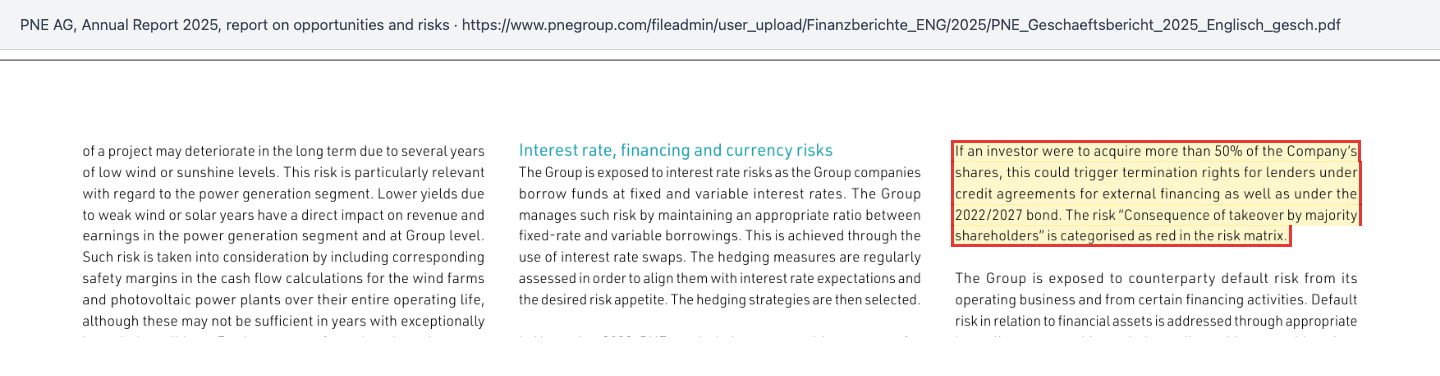
Under the bond terms, a change of control occurs once a person or a group acting in concert becomes the owner of shares carrying 50 percent or more of the voting rights; according to the annual report, this did not happen in fiscal 2025. Photon Management GmbH holds 48.03 percent; according to the investor relations page, the other voting rights attributed to Morgan Stanley relate wholly or partly to client securities (2.03 percent) and other instruments (0.01 percent). A termination right is not a termination. Banks and bondholders can stand still or renegotiate, and a buyer would price the financing into the bid. But it helps explain why a buyer does not simply pay the market price plus a premium: it would be buying a company whose loans could be reshuffled by the takeover.
Uncomfortable Truth No. 2: Equity Is Shrinking — and New Equity Keeps Failing the 75 Percent Hurdle
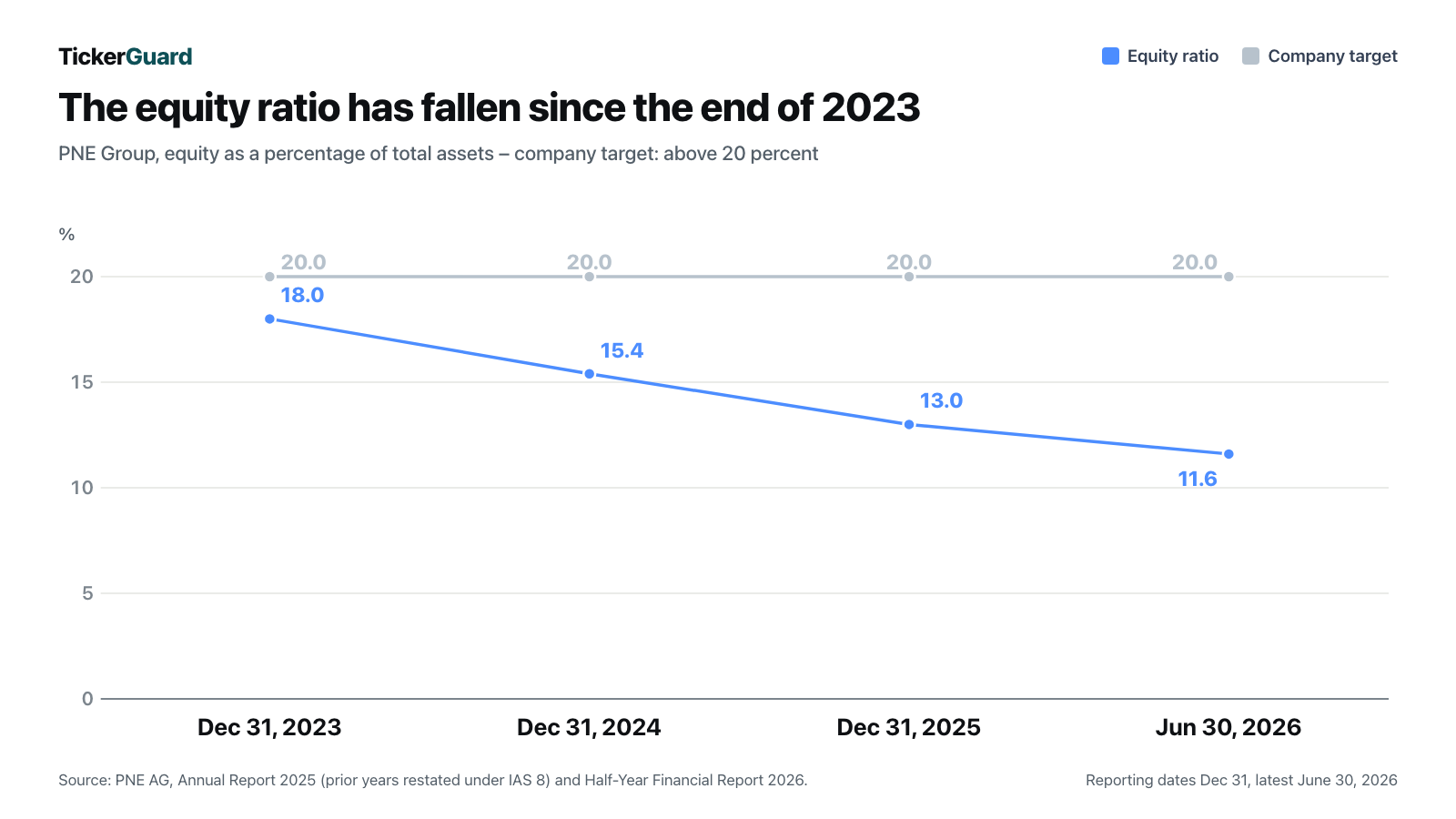
The equity ratio shows how much of the balance sheet belongs to the owners and how much is financed with debt. At PNE, it has fallen every year since the end of 2023: from about 18 percent (our calculation from the restated figures as of January 1, 2024: €199.1 million of equity against €1,103.8 million of total assets) to 15.4 percent at the end of 2024, 13.0 percent at the end of 2025 and 11.6 percent as of June 30, 2026. Group equity fell from €154.1 million to €131.4 million in the first half of 2026 alone. According to the half-year report, “The PNE Group aims for an equity ratio above 20%.”
The usual way to rebuild equity is a capital increase. For that, PNE's management needs what German law calls authorized capital — a standing permission from the shareholders' meeting to issue new shares. It requires a 75 percent majority. That majority failed at three annual general meetings in a row: on May 30, 2024, on May 13, 2025, and on May 19, 2026. The half-year report records it this way:
“In addition to the approval of the remuneration report and the reappointment of KPMG AG Wirtschaftsprüfungsgesellschaft, Bremen, as the (Group) auditor for the 2026 financial year – both again with a large majority – the requisite 75% majority for the proposal to create new authorised capital was unfortunately once again not achieved.”
— PNE AG, Half-Year Financial Report 2026, foreword by the Board of Management, page 6
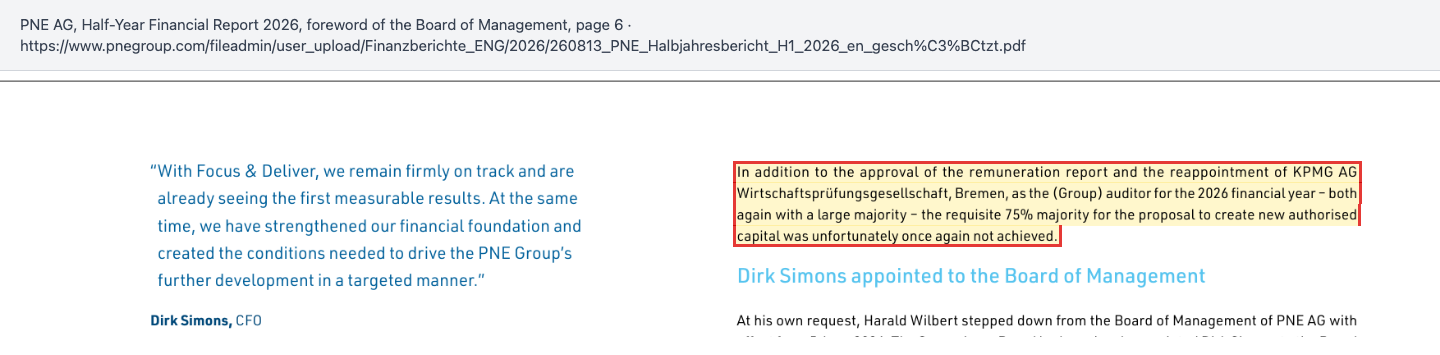
According to the published voting results (in German), 64.98 percent of the votes cast in 2026 supported the first proposal (Authorized Capital 2026, which according to the invitation did not allow excluding subscription rights) and 35.02 percent opposed it; the second proposal (Authorized Capital 2026/II, which would also have allowed excluding subscription rights) received 65.87 percent. Who voted no is not disclosed. For a sense of scale: according to the investor relations page, Active Ownership and Samson Rock together hold about 24 percent of the voting rights (as of October 5, 2026); how they voted is not shown in the published documents. In both votes, valid votes were cast for about 77.5 percent of the share capital. All that is clear is this: more than a third of the votes cast opposed the standing permission to issue new shares.
The fallback was debt. On May 20, 2026, PNE resolved to issue a new bond of up to €65 million. On June 11, 2026, it announced a placement of just €36.0 million, at a coupon of 7.000 percent; the 2022/2027 bond it partly replaces pays 5.0 percent. According to the half-year report, €28.0 million of the €36 million went toward redeeming the old bond — so fresh money was about €8 million. PNE itself wrote that “some restraint was observed in marketing to new investors.” The rest of the old bond, with a carrying amount of €37.8 million, matures in June 2027. Against that, PNE held cash of €56.9 million as of June 30, 2026, of which €2.8 million was pledged to banks. Management writes in its foreword:
“After the required majority for a capital increase was not secured at the Annual General Meeting, we successfully placed a corporate bond, raising EUR 36 million. To finance our continued growth, we are also evaluating additional capital market options, including debt financing measures, for the second half of the year.”
— PNE AG, Half-Year Financial Report 2026, foreword by the Board of Management, page 5
PNE still pays a dividend: €0.04 per share for 2025, €3.1 million in total, paid out of the parent company's distributable profit under German commercial law. It is not much money, but it is a notable signal in a year in which the group reported a loss of €47.4 million.
Uncomfortable Truth No. 3: Operating Profit Does Not Cover the Interest
Interest coverage answers a simple question: how many times does the interest bill fit into operating profit? Above 1, the business earns its interest; below 1, it does not. Picture a landlord whose rent, after all running costs and depreciation, no longer covers the interest on the mortgage. At PNE, operating profit (EBIT) was €12.9 million in 2025, while interest and similar expenses came to €35.8 million. In the first half of 2026, EBIT of €8.5 million faced €19.9 million of interest expense. Part of the reported interest expense does not leave the company as cash right away — in the first half of 2026, for example, the subsequent measurement of bank liabilities (€3.5 million) and the valuation of interest rate swaps (€0.8 million) and of a financial power purchase agreement (“financial PPA,” €0.9 million). But even against interest actually paid (€22.0 million in 2025, €9.4 million in the first half of 2026), EBIT fell short.
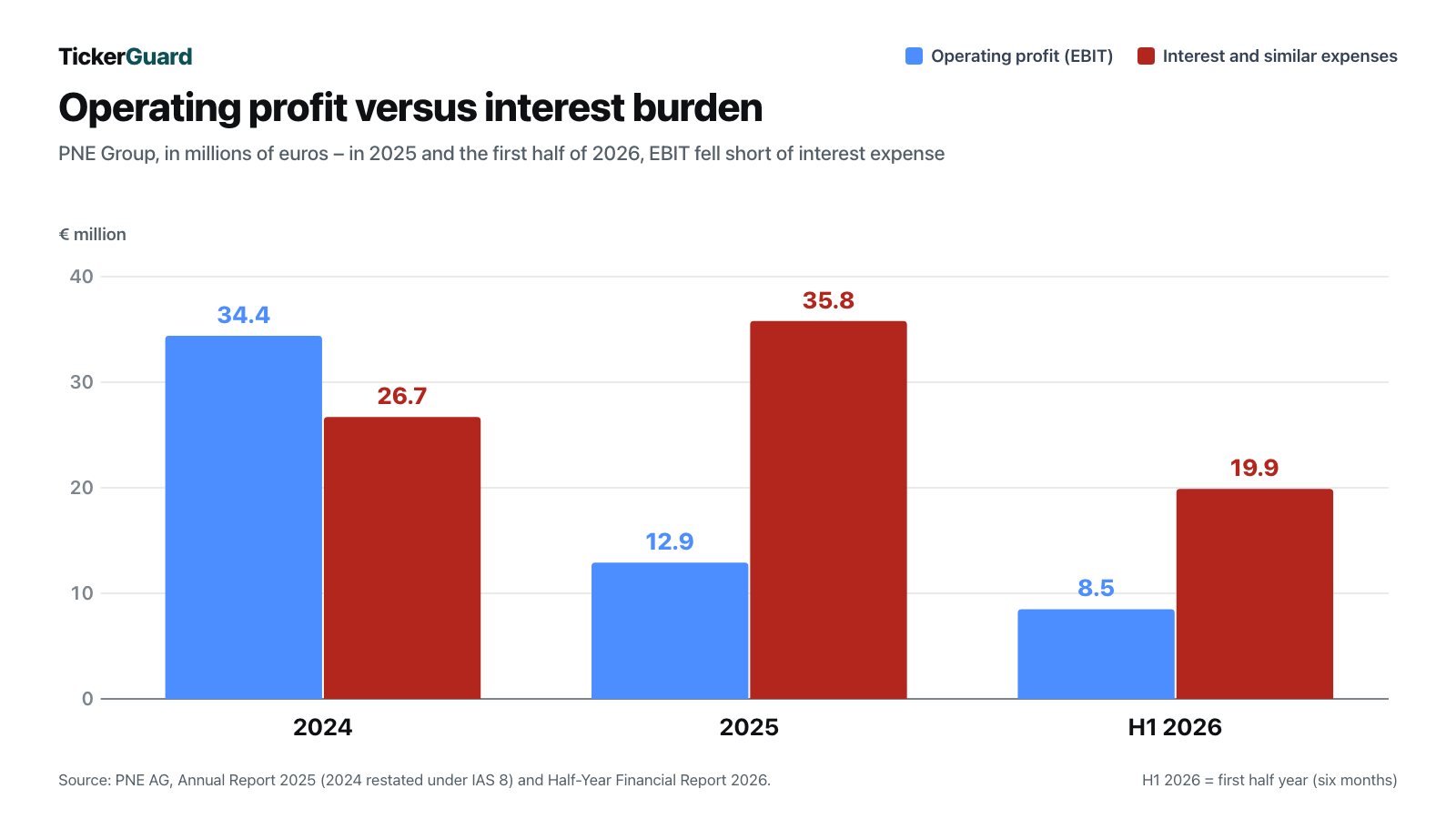
Fairness requires context. Most of the bank debt consists of project financing for individual wind farms without recourse to the parent company — €570.2 million had been drawn as of June 30, 2026. Such loans are generally serviced from the power revenue of the respective wind farm, and before depreciation, earnings do cover the interest: EBITDA was €55.3 million in 2025. Depreciation on the wind farms is not an accounting trick, though; it reflects the wear on the turbines. Net debt — financial liabilities minus cash — was €771.5 million as of June 30, 2026. According to the 2025 annual report, PNE did not breach a covenant on any loan in 2025.
One more correction belongs in this chapter. The 2025 annual report restates errors from earlier years:
“As part of internal reviews, the Group determined in 2025 that the subsequent measurement of certain financial liabilities arising from subsidised promotional loans in previous financial years had not been fully in accordance with the requirements of IFRS 9.”
The effects are not small: the restatement shrank the 2024 group loss from €12.7 million to €3.8 million, and equity as of January 1, 2024, fell by about €9 million. The affected items are low-interest promotional loans for the wind farms; PNE does not expect material effects on future periods. A correction of errors under IAS 8 is a regulated procedure. It does show, however, that the measurement of certain promotional loans, and thus of part of the debt, was not presented correctly in earlier years.
Uncomfortable Truth No. 4: Three Quarters of the Annual Target Are Still Ahead
Management has set ambitious goals for 2026, and it is sticking to them:
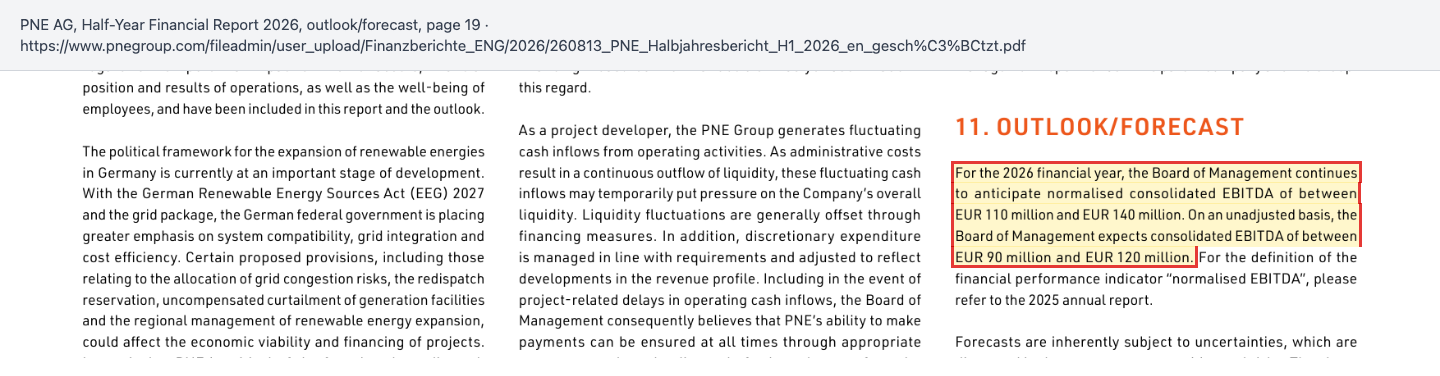
After six months, the tally is €27.4 million — the same figure adjusted and unadjusted, as the key figures table of the half-year report shows. Even to reach the low end of the adjusted range, the second half must add about €83 million; for the high end, about €113 million — three to four times as much as in the first half. For a project developer, that is not impossible: sales often bunch up at year-end, and in 2025 the second half also delivered the larger share. But it means that most of the year depends on sales that had not yet been announced when the half-year report came out. Management writes in its foreword: “So far, we have navigated the challenging environment of 2026 and are mindful of the challenges that still lie ahead.” In the half-year results presentation, the outlook slide carries this headline:
“AMBITIOUS TARGETS IN CHALLENGING MARKET ENVIRONMENT”
— PNE AG, investor relations presentation H1 2026 of August 13, 2026, slide “Outlook for FY 2026 confirmed”
Two points complete the picture. First, PNE itself expects special items of about €20 million in 2026 that are excluded from the adjusted figure — which explains the gap between €110–140 million and €90–120 million. Second, management already had to cut its 2025 guidance significantly in January 2026. The first test is the third-quarter statement, scheduled for November 12, 2026.
What the Stock Costs
At €7.19 (Xetra close on October 9, 2026) and 76,603,334 shares, PNE has a market value of about €551 million. Adding net debt of €771.5 million (June 30, 2026) gives an enterprise value of about €1.32 billion. That is what a buyer would have to pay for the shares and the debt together.
Measured against 2025 adjusted EBITDA of €87.0 million, that is about 15 times. If management hits the midpoint of its 2026 guidance (€125 million), it would be about 10.6 times; at the low end (€110 million), about 12 times. The market value is a little over four times the equity attributable to PNE AG's shareholders (€133.8 million as of June 30, 2026; group equity of €131.4 million is lower because non-controlling interests in subsidiaries are negative at minus €2.4 million). Adding the hidden reserves of €153.1 million (pre-tax) cited by the company, it is just under twice. The dividend of €0.04 equals a yield of about 0.6 percent at €7.19.
What these numbers do not tell you is what a buyer would actually pay. The only reliable statement on that comes from PNE itself, and it reads “below the current market price level” — referring to the price in early August 2026, which was around €10.
Upside and Risks at a Glance
What speaks for PNE:
- An owned portfolio of 484 megawatts (June 30, 2026), more than 90 percent of it on 20-year fixed feed-in tariffs according to the company, with hidden reserves of €153.1 million before taxes.
- Projects keep selling, in 2026 too: 163.2 megawatts in the first half, 45 megawatts in July and the 153-megawatt “Karolew” project in September 2026.
- The services business is growing steadily: 3,256 megawatts under operations management as of June 30, 2026, after 3,103 megawatts at the end of 2025; the segment was profitable in the first half with €4.3 million of EBITDA.
- A pipeline of 21.7 gigawatts, about 12 gigawatts of it in the core markets of Germany, France and Poland.
- The sale process is ongoing as of the latest update (half-year report of August 13, 2026); according to PNE, whether it leads to an offer is open, but it has not been ruled out.
What speaks against it:
- According to the ad hoc release of August 10, 2026, the price expectations of potential buyers were below the market price at the time; a change of control above 50 percent would trigger termination rights for lenders and bondholders.
- An equity ratio of 11.6 percent against a target above 20 percent; authorized capital failed to reach the 75 percent threshold in 2024, 2025 and 2026.
- EBIT did not cover interest in 2025 or the first half of 2026; three reporting periods in a row with a group loss.
- The 2026 guidance requires the second half to deliver three to four times the first; the 2025 guidance had to be cut in January 2026.
- Regulation: in the half-year report, management criticizes planned German rules such as the redispatch reservation and uncompensated curtailment, which shift grid congestion risks to developers and operators.
A Human Conclusion
Back to the disposition effect. If you have been holding PNE stock at a loss for years, you are not just waiting for better numbers but for a rescuer: the buyer who takes the company over and makes up for the decline with a premium. August 10, 2026, did not end that hope, but it gave it a direction: according to the company, potential acquirers' price expectations were below the market price at the time.
That does not mean PNE is worthless. Its own wind farms generate predictable power, its projects find buyers, and its services business is growing. But the balance sheet has grown thin, operating profit does not cover the interest, authorized capital missed the required 75 percent majority three times, and the full-year target hinges on the second half. One sober question helps against the disposition effect: would you buy this stock today at €7.19 if you did not already own it? What you do with that is your decision. And that is how it should be.
Sources
All original documents used, so you can read them yourself:
- PNE AG — Half-Year Financial Report 2026 (as of June 30, 2026, published August 13, 2026)
- PNE AG — Investor relations presentation H1 2026 (August 13, 2026)
- PNE AG — Quarterly Statement Q1 2026 (May 13, 2026)
- PNE AG — Annual Report 2025 (published March 26, 2026)
- PNE AG — Annual Report 2024
- PNE AG — Ad hoc release “PNE AG updates on ongoing sales process” (August 10, 2026)
- PNE AG — Pipeline write-downs and reduced 2025 guidance (January 14, 2026) and forecast for the 2026 financial year (March 19, 2026)
- PNE AG — Resolution to issue a corporate bond (May 20, 2026) and placement of the 2026/2031 bond (June 11, 2026)
- PNE AG — Voting results of the annual general meeting of May 19, 2026 (in German)
- PNE AG — Sale of “Wulfsdorf A” and “Kuhstedt III” (August 5, 2026) and sale of “Karolew” in Poland (September 29, 2026)
- PNE AG — Shareholder structure on the investor relations page (voting rights notifications as of October 5, 2026)
- Fundamental data (Xetra price history and closing prices, share count; data as of October 9, 2026). All earnings, balance sheet and cash flow figures come from the reports above; enterprise value, interest coverage and valuation multiples are our own calculations on that basis.
Transparency & disclaimer: This analysis is a journalistic assessment of publicly available information. It is not investment advice, not financial analysis in the regulatory sense and not a solicitation to buy or sell securities. Investing in stocks involves substantial risks, up to and including total loss. All information without guarantee; the data date is noted in the text. Positions held by the operator are disclosed daily; where one exists, it appears as a notice at the top of this deep dive.
Our Bottom Line at a Glance
- Owned wind portfolio positive
- 484 megawatts in its own operation (June 30, 2026), more than 90 percent of it on 20-year fixed feed-in tariffs according to the company; the power generation segment earned EBITDA of €34.1 million in the first half of 2026, and PNE puts its hidden reserves at €153.1 million before taxes.
- Project sales positive
- 163.2 megawatts in the first half of 2026, 45 megawatts in July and the 153-megawatt Polish “Karolew” project in September 2026 — projects find buyers even in a difficult market.
- Sale process negative
- According to the ad hoc release of August 10, 2026, potential acquirers' price expectations were below the market price at the time; a change of control above 50 percent would trigger termination rights for lenders and bondholders (Annual Report 2025, risk rating red).
- Balance sheet and capital negative
- Equity ratio of 11.6 percent as of June 30, 2026 (restated end of 2023: about 18 percent), target above 20 percent; authorized capital failed the 75 percent majority in 2024, 2025 and 2026, and the new bond raised €36.0 million instead of up to €65 million.
- Earnings power and interest burden negative
- EBIT of €12.9 million against €35.8 million of interest expense in 2025, and €8.5 million against €19.9 million in the first half of 2026; group losses in 2024 (restated), 2025 and the first half of 2026; restatement under IAS 8 for promotional loans.
- 2026 guidance neutral
- Confirmed at €110 million to €140 million of adjusted EBITDA, with €27.4 million after the first half; the 2025 guidance had to be cut in January 2026. The test is the quarterly statement on November 12, 2026.
PNE has real assets: owned wind farms with long-term fixed tariffs, a large pipeline and projects that find buyers. Against that stand an equity ratio that has fallen to 11.6 percent, operating profit below the interest bill, a standing authorization for new shares that failed three times and a sale process in which, according to the company, potential buyers' price expectations in August 2026 were lower than the market price. Not investment advice.
What Our Rating Means
Substance risk
We found at least one documented issue that threatens the company itself — regardless of how the stock is currently valued.
Red does not signal an acute insolvency risk here: in its 2025 annual report, management identifies no individual risks that could jeopardize the company as a going concern, most of the bank debt consists of project loans for individual wind farms, and no covenant was breached in 2025. Red stands for a documented substance risk under our criteria: interest coverage was below 1 in 2025 (EBIT of €12.9 million against €35.8 million) and in the first half of 2026 (€8.5 million against €19.9 million), with an equity ratio of 11.6 percent and a shareholders' meeting that has not approved authorized capital since 2024. If management meets its 2026 guidance, the picture would improve markedly; that has not been shown yet. The decision is yours.
A journalistic assessment by our editorial team at the time of the deep dive, based on public sources — not investment advice and not a solicitation to buy or sell. Your personal circumstances (investment goals, risk capacity, taxes) cannot be taken into account. What our levels mean, how verdicts are formed, and what conflicts of interest exist →
Worth Noting
- Trigger: the forum ranking of wallstreet-online (as of 10/11/2026), not our in-house stock scanner.
- PNE is not an SEC filer; all evidence comes from PNE AG's English-language reports and releases on pnegroup.com. Latest periodic report: Half-Year Financial Report 2026 of 08/13/2026; next date: Q3 statement on 11/12/2026.
- Figures for 2024 and the end-2023 equity position are the values restated under IAS 8 in the 2025 annual report. Enterprise value, interest coverage and multiples are our own calculations.
Stock Watch
This analysis is as of October 11, 2026. Stock Watch will tell you what's changed at PNE3.DE since then.
Later $1 a month per stock — signing up is free, and you'll be the first to know when it launches.
The full analysis as a PDF for later
We will send you this analysis as a PDF — to print, file away, and read at your own pace. And we will add you to the free Stock Watch list for PNE AG (PNE3.DE), so you hear about it when something material in this analysis changes.
Frequently Asked Questions
PNE develops onshore wind farms and solar projects and sells them to investors, operates part of them itself (484 megawatts as of June 30, 2026, mostly with 20-year fixed feed-in tariffs) and offers services such as operations management for third-party assets. Its pipeline comprised 21.7 gigawatts as of June 30, 2026.
That is open. PNE has started a structured process to find investors for the acquisition of up to 100 percent of its shares. According to its ad hoc release of August 10, 2026, however, potential buyers' price expectations were below the market price at the time, and it was uncertain whether a transaction would happen at all. PNE had not announced an outcome as of October 11, 2026.
On August 10, 2026, PNE announced in an ad hoc release that the price expectations of potential buyers in the ongoing sale process were below the stock's market price at the time. Between the Xetra closing prices of August 10 and 11, the stock fell from €9.89 to €7.96, a drop of 19.5 percent.
According to the investor relations page (voting rights notifications as of October 5, 2026), funds managed by Morgan Stanley Infrastructure Partners hold 48.03 percent through Photon Management GmbH, and a total of 50.07 percent of the voting rights is attributed to Morgan Stanley. Active Ownership follows with 14.01 percent and Samson Rock with 9.99 percent of the voting rights.
Net debt was €771.5 million as of June 30, 2026. Most of it is project financing for individual wind farms without recourse to the parent company (€570.2 million drawn). In addition, there is the 2026/2031 bond of €36.0 million at 7.0 percent and the rest of the 2022/2027 bond with a carrying amount of €37.8 million, due in June 2027.
To get a standing authorization to issue new shares (authorized capital), PNE needs 75 percent of the votes at its shareholders' meeting. That majority failed in 2024, 2025 and 2026; in 2026, 64.98 percent voted in favor of the first proposal. The published results do not show who voted against.
Management expects adjusted EBITDA (normalised EBITDA) of €110 million to €140 million and €90 million to €120 million unadjusted. After the first half, the figure stood at €27.4 million. The third-quarter statement is scheduled for November 12, 2026.
Found an error?
Did you spot a factual error, an outdated number, or a typo in this deep dive? Let us know briefly — your report goes straight to the editorial team.