Tenax Therapeutics: trial missed, cash intact — and a target drawn after the shots were fired
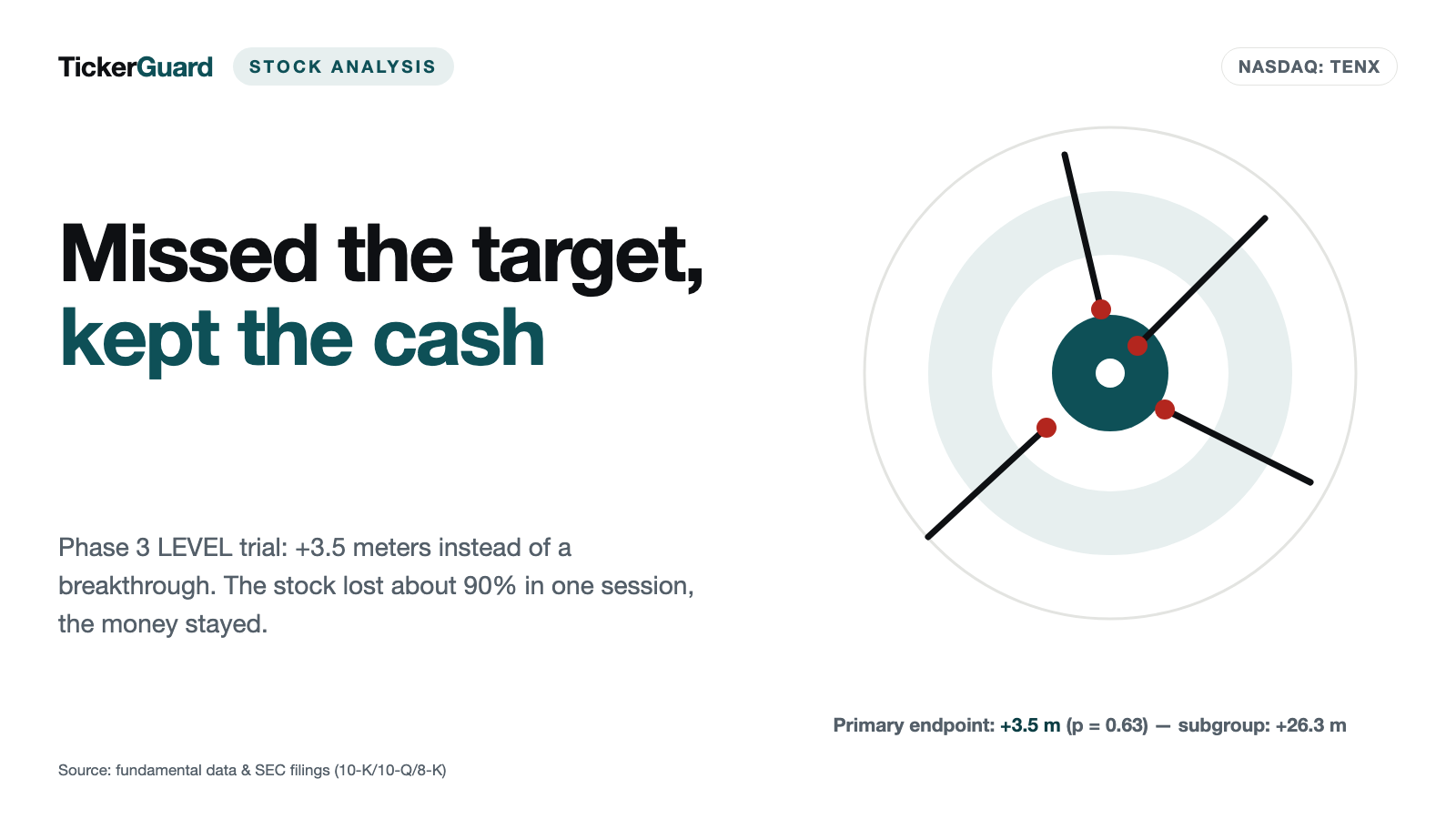
On August 10, 2026, Tenax Therapeutics’ Phase 3 LEVEL trial missed its primary endpoint, and the stock lost about 90 percent in a single session. What is left is $118 million in cash, a subgroup with a good-looking result and a second trial whose completion the money no longer covers. We separate what the SEC filings document from what is being read into the data after the fact.
 Thomas Mücke
Founder & Publisher
Thomas Mücke
Founder & Publisher
As of Today
As of: October 9, 2026
- Closing price
- 1.90 $ +0.50%
- Market Capitalisation
- 73.0 $M
- AAQS
- 0/10
Price change since October 9, 2026: +1.6%
This analysis has a cut-off date. The Stock Guard tells you when something material changes in the numbers. Reserve your free spot
Chart
Interactive price chart (TradingView).
52-week range: 1.40 $ to 18.30 $ · Last price: 1.90 $ (As of: October 9, 2026)
Note: pure fact-based analysis, not investment advice and not a solicitation to buy or sell. All figures without guarantee.
Do you know the story of the Texas sharpshooter? He empties a magazine into the side of a barn, walks over and paints a bull’s-eye around the spot where most of the holes are. Then he shouts: “Dead center!” Statisticians call this the Texas sharpshooter fallacy: you pick the target after you have seen the results. Investors fall into it when a trial fails and a subgroup then surfaces in which the drug did seem to work. That is exactly what happened at Tenax Therapeutics (Nasdaq: TENX) of Chapel Hill, North Carolina. On August 10, 2026, its Phase 3 LEVEL trial missed its primary endpoint, and the stock fell from a close of $13.44 on August 7 to $1.375, a drop of about 90 percent in a single session. So here is the deal: before you decide whether this is a bargain or a wreck, let’s read together what Tenax itself reported to the U.S. securities regulator, the SEC — the annual report (10-K) for 2025, the quarterly reports (10-Q) through June 30, 2026, and the current reports (8-K) through October 8, 2026. False statements in these filings carry penalties, which is why it pays to look inside. In the end, you decide.
What Tenax actually does — an old heart drug in a new form
Tenax has no product on the market and no revenue. The company develops a single compound: levosimendan, as an oral capsule under the code TNX-103. The compound is not new. The Finnish drugmaker Orion developed it as an infusion for patients with acute heart failure; according to Tenax, it is approved in 60 countries, but not in the United States or Canada. Tenax licensed from Orion the worldwide rights for one specific disease: pulmonary hypertension in heart failure with preserved ejection fraction, or PH-HFpEF. In everyday terms: the heart still pumps with force but is stiff and fills poorly. Blood backs up into the lungs, and patients get short of breath after a few steps. There is no approved drug for exactly this condition. Levosimendan is meant to widen the veins in the abdomen so that less blood presses on the heart and lungs.
The company is both small and old. By its own account it has financed itself through stock and debt since September 1990; it was called Synthetic Blood International until 2008 and Oxygen Biotherapeutics until 2014. As of December 31, 2025, it had 14 full-time and two part-time employees; the trials are run through contract service providers. The accumulated deficit since inception stood at $401.0 million as of June 30, 2026. That defines the central tension of this analysis: the decisive trial missed its goal, and yet there is more money in the bank than ever before. Is Tenax a failed drug with a cash pile — or an effective drug that got the wrong patients in its first trial?
Company history for investors
-
2014
Oxygen Biotherapeutics becomes Tenax
The company, called Synthetic Blood International until 2008, has been named Tenax Therapeutics since September 2014 — its third identity since 1996.
-
2024
1-for-80 reverse split and private placement
After a 1-for-20 split in January 2023, the next reverse split follows in January 2024. In August 2024, Tenax raises about $100M gross for its Phase 3 trials.
-
2025
LEVEL-2 begins
In December 2025, the second, global Phase 3 trial starts. With two costly trials running in parallel, the quarterly loss rises to about $16M.
-
2026
August: LEVEL misses its primary endpoint
+3.5 m in the walk test, p = 0.63. The stock falls from $13.44 to $1.375 in one session; the $4.50 warrants expire in September.
-
2026
October: LEVEL-2 enrollment paused
Tenax tightens the entry criteria based on the LEVEL subgroups and requests an FDA meeting. Further updates are expected in the first quarter of 2027.
How the stock landed on our desk
Not through a metric, but through other investors’ excitement: since August 11, 2026, the day after the crash, Tenax has appeared on the hot-discussion list of the German investor portal wallstreet-online. That is an attention signal and explicitly not an argument to buy. According to fundamental data, 65.5 million Tenax shares changed hands on August 10, compared with 2.1 million in the session before. Whoever buys after a crash like this usually has two thoughts: “The company still has cash” and “The subgroup looked good.” We test both. Gossamer Bio showed a similar pattern: there, too, the decisive Phase 3 trial missed its primary walk-test endpoint in February 2026, and there, too, the disease was pulmonary hypertension — see our analysis of Gossamer Bio.
The numbers over the years — given their due
First, what genuinely impresses: the fundraising. In August 2024 and March 2025, Tenax raised about $125 million gross in two private placements, $25.0 million of it in March 2025. On top came warrants that investors exercised through mid-2026: in the first half of 2026 alone, they brought in $43.8 million. That is why cash grew despite all the losses, from $97.6 million (December 31, 2025) to $118.0 million as of June 30, 2026, and according to the quarterly report another $8.1 million came in from exercises after the balance-sheet date. Tenax has no meaningful debt; total liabilities came to $8.1 million as of June 30, 2026. The chart shows the other side:
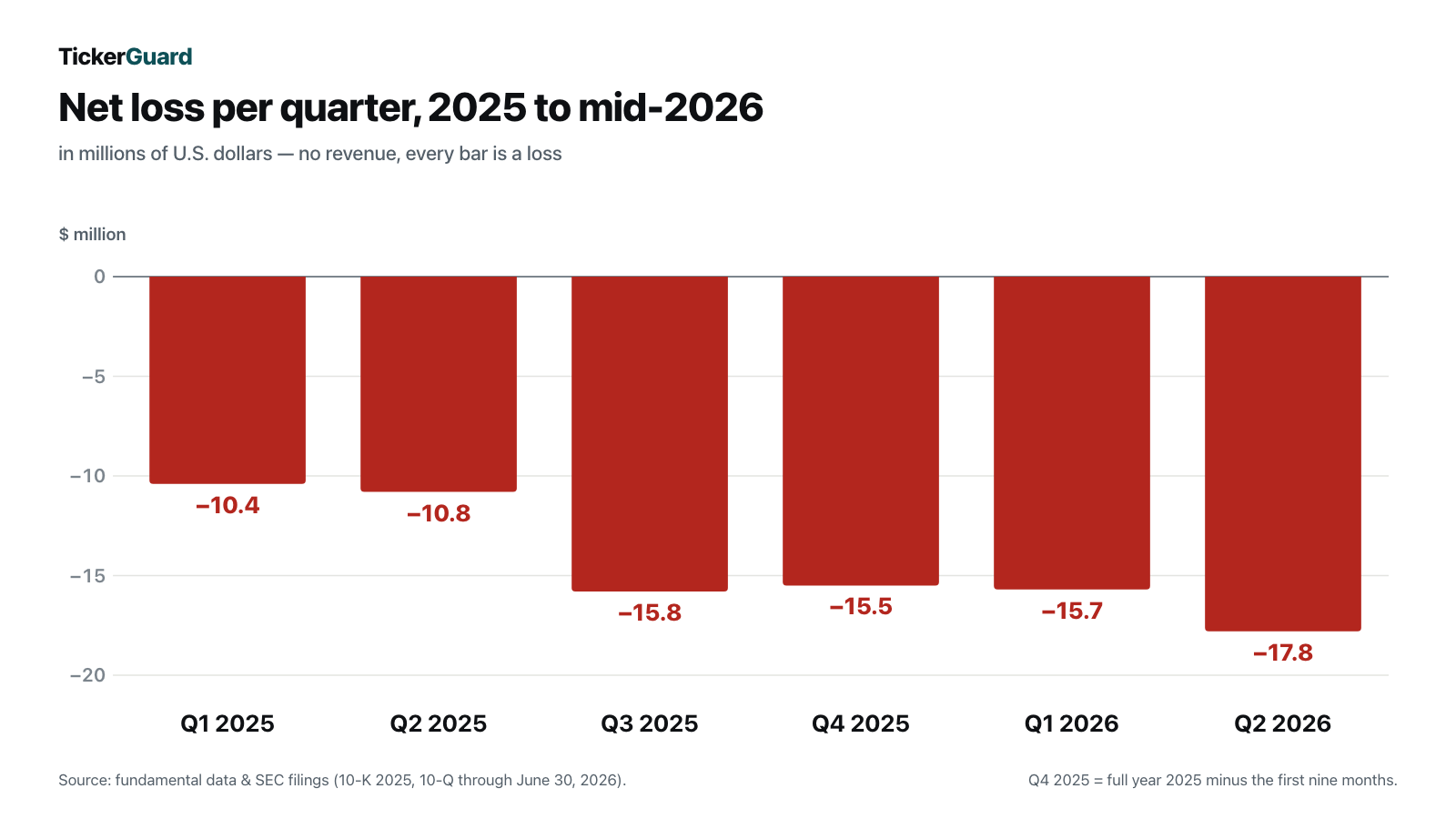
The annual net loss rose from $7.7 million (2023) to $17.6 million (2024) and $52.6 million (2025). In the first half of 2026 it was $33.5 million, $24.4 million of it for research and development. Operations consumed $23.5 million in cash over the same half-year, about $14.2 million in the second quarter alone. For a company running two large trials, that is not a high burn rate. Still, remember: cash grew not from the business but from warrants — and that source dried up on August 10. Uncomfortable truth No. 3 explains why.
Uncomfortable truth No. 1: the primary endpoint was clearly missed
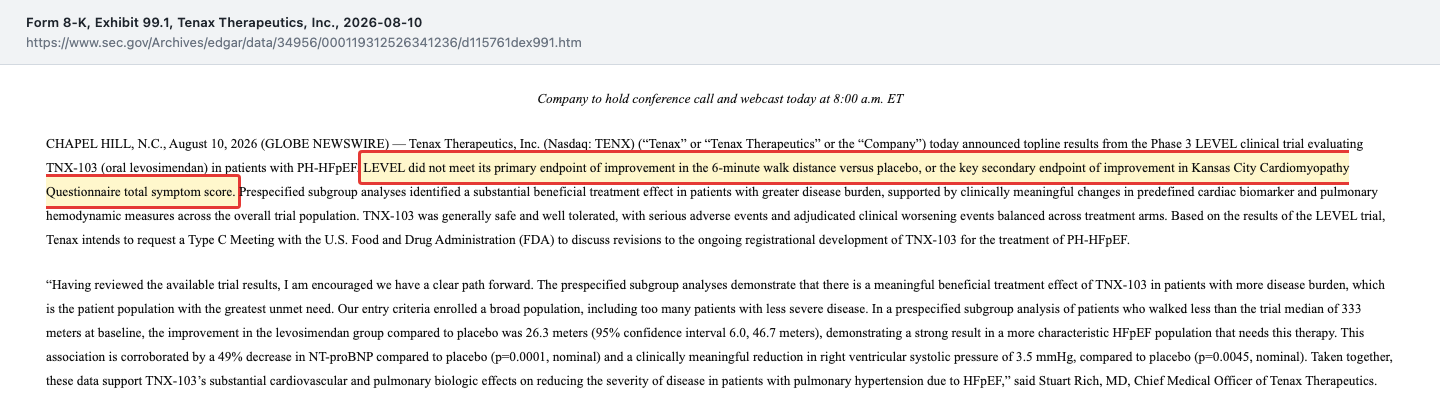
LEVEL was a Phase 3 trial with 241 patients at 41 sites in the United States and Canada; half received TNX-103, the other half a placebo. It measured how far patients could walk in six minutes after twelve weeks of treatment. The result: patients on TNX-103 walked 14.0 meters farther than at baseline on a statistically adjusted average (least-squares mean), the placebo group 10.4 meters farther. Average here means all changes added up and spread evenly across patients; individual outliers can shift it. The difference of 3.5 meters is statistically indistinguishable from chance (p = 0.63; a trial is usually considered a success only below p = 0.05). The key secondary endpoint, a symptom questionnaire, showed practically no difference either: 0.1 points. Tenax says it in its own current report:
“LEVEL did not meet its primary endpoint of improvement in the 6-minute walk distance versus placebo, or the key secondary endpoint of improvement in Kansas City Cardiomyopathy Questionnaire total symptom score.”
— Tenax Therapeutics, SEC current report 8-K of August 10, 2026, Exhibit 99.1
In fairness, here is what else the trial showed. The cardiac stress marker NT-proBNP, a blood value that rises when the heart walls are under strain, was 49 percent below the placebo level after twelve weeks on TNX-103. Pressure in the right ventricle fell by 3.5 mmHg. Serious adverse events were equally common in both groups (10.8 versus 10.7 percent). But: 86.7 percent of treated patients reported adverse events overall versus 71.9 percent on placebo, mainly headache, palpitations and low blood pressure, and 8.3 percent stopped treatment because of them (placebo: 1.7 percent). A blood value is not a walk. A drug gets approved for making patients better — and that is exactly what LEVEL did not show in the overall picture.
Uncomfortable truth No. 2: the target was painted afterwards
Now the Texas sharpshooter enters the story. Tenax sorted patients by how far they walked at baseline. Among those who managed less than 333 meters at the start, TNX-103 beat placebo by 26.3 meters (119 patients). The 333 meters are the trial’s median, the typical value: half the patients walked less at baseline, half walked more. This subgroup was prespecified in the statistical analysis plan, which counts in its favor. But split the patients into four equal groups, and a pattern emerges that Tenax only calculated after the fact:
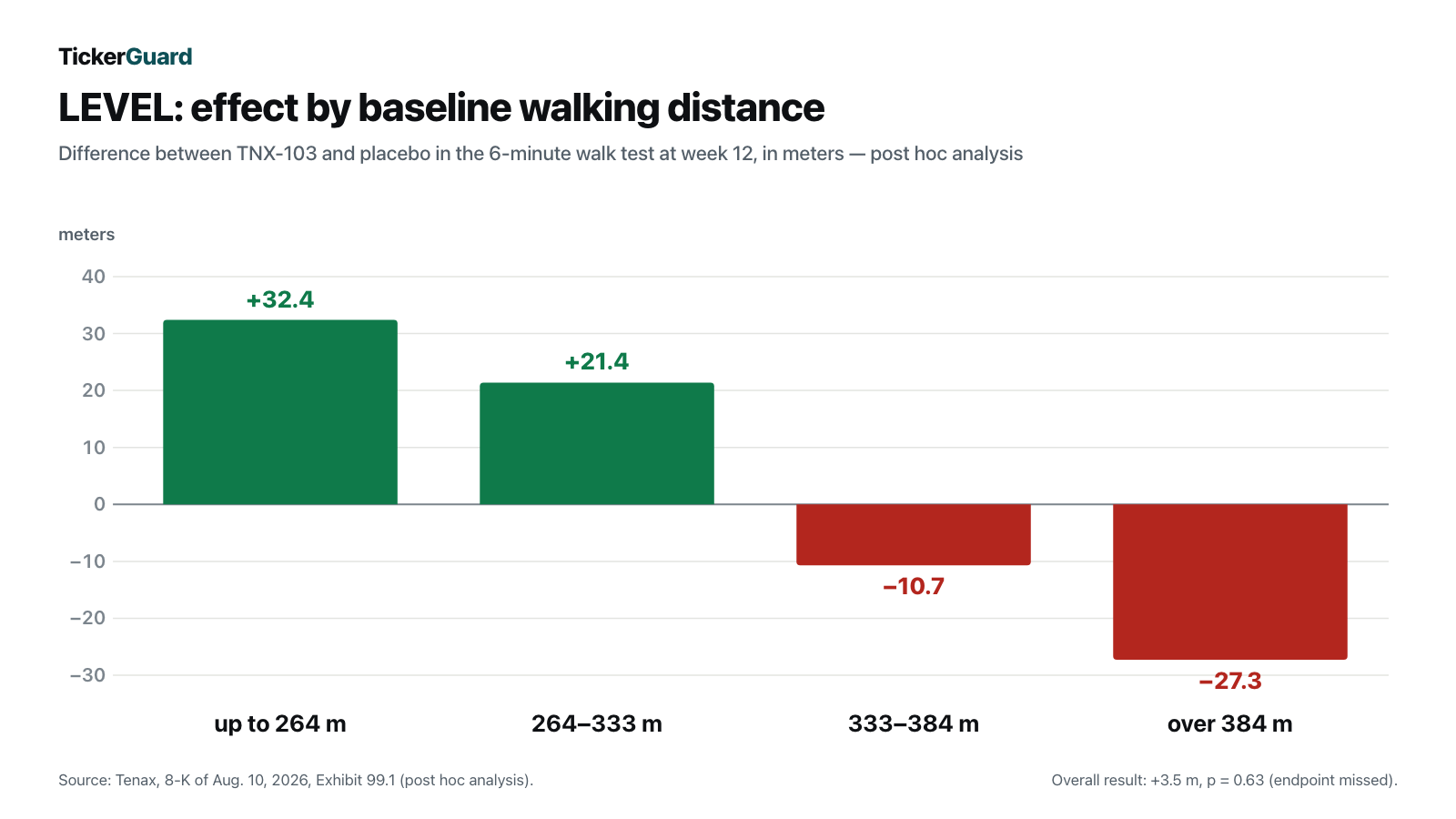
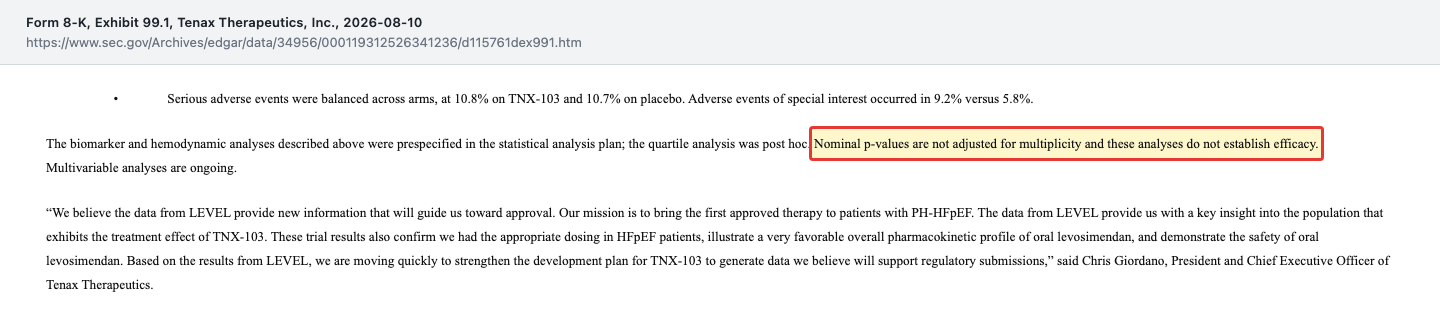
That may be a real finding: sicker patients have more room to improve, and other pulmonary hypertension trials have seen something similar. It may also be chance, because anyone who forms enough subgroups almost always finds one that looks good. The mirror-image pattern stands out: in the half with the longer baseline walk, TNX-103 did 17.6 meters worse than placebo, according to Tenax’s presentation of October 8, 2026. Tenax itself put the crucial caveat into the August 10 release:
“Nominal p-values are not adjusted for multiplicity and these analyses do not establish efficacy.”
— Tenax Therapeutics, SEC current report 8-K of August 10, 2026, Exhibit 99.1
What Tenax does with this is consistent but costly. The second Phase 3 trial, LEVEL-2, started in December 2025, is to admit only patients who walk at most 300 meters at baseline, or 300 to 400 meters with an enlarged right atrium. According to Tenax’s presentation of October 8, 2026, such patients would have gained more than 34 meters in LEVEL — again a retrospective analysis. To put the new rules in place, Tenax has temporarily stopped enrolling new patients in LEVEL-2:
“To maximize the enrollment of these patients, whom LEVEL results suggest are those most likely to demonstrate improved exercise tolerance in the primary endpoint of LEVEL-2, the Company has temporarily paused enrollment in LEVEL-2.”
— Tenax Therapeutics, SEC current report 8-K of October 8, 2026, Item 8.01
A meeting with the U.S. Food and Drug Administration (a so-called Type C meeting) has been requested; Tenax expects further updates in the first quarter of 2027. According to Tenax, the FDA had previously agreed that a single Phase 3 trial with a p-value of 0.01 would suffice for a new drug application. The sub-333-meter subgroup reached a nominal p-value of 0.0112, unadjusted. Remember: the new target is sensibly drawn. Whether the drug hits it will only be shown by LEVEL-2 — not by the trial from which the target was derived.
Uncomfortable truth No. 3: the money lasts until 2028 — the second trial does not
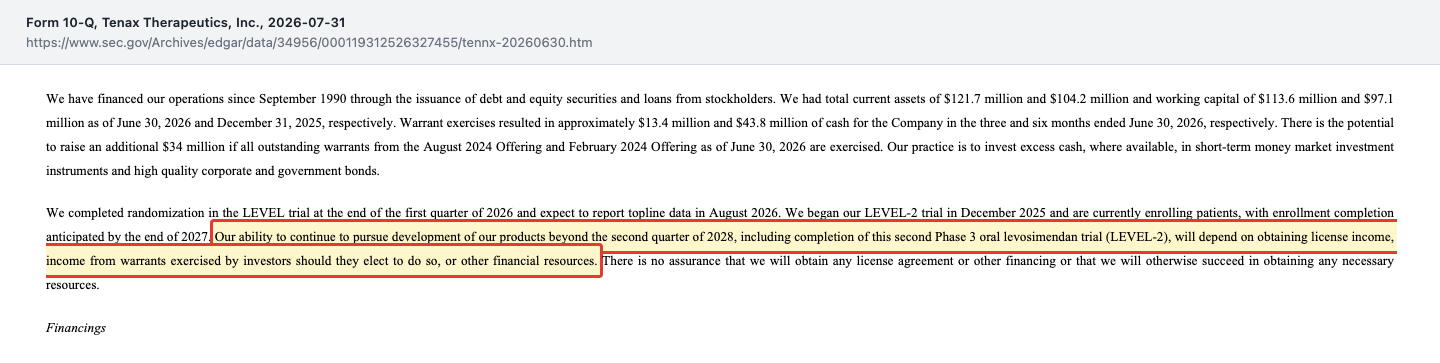
Tenax says its cash will last into the second quarter of 2028. That sounds comfortable. But the same quarterly report says what comes after, and that explicitly includes completing LEVEL-2:
“Our ability to continue to pursue development of our products beyond the second quarter of 2028, including completion of this second Phase 3 oral levosimendan trial (LEVEL-2), will depend on obtaining license income, income from warrants exercised by investors should they elect to do so, or other financial resources.”
— Tenax Therapeutics, SEC quarterly report 10-Q as of June 30, 2026, Item 2, section “Liquidity, Capital Resources and Plan of Operation”
The most important of these sources, the warrants, is practically gone. The largest block of outstanding warrants from the August 2024 financing carried an exercise price of $4.50 per share and, under their terms, expire 30 trading days after the announcement of the LEVEL data — by our count on September 22, 2026. Of 7,267,749 such warrants outstanding on June 30, 2026, 1,797,973 were exercised afterwards, according to the quarterly report; together with 3,667,440 pre-funded warrants, that brought in the $8.1 million. The remaining roughly 5.5 million were deep under water with the stock around $1.90; exercising at $4.50 made no sense. Before the data, Tenax had written that all outstanding warrants could bring in about another $34 million. That bridge collapsed with the share price.
That leaves license income, which is hard to negotiate after a failed Phase 3 trial, and new money from the capital markets. Tenax already has the framework: a shelf registration with the SEC for up to $300 million, effective since April 1, 2026 — a standing permit to issue new shares at any time. At a share price of $1.87 (October 9, 2026), any sizable raise would mean a lot of new shares. Put simply: your slice of the pie could get noticeably thinner before the LEVEL-2 result is on the table.
Uncomfortable truth No. 4: the license has an expiry date
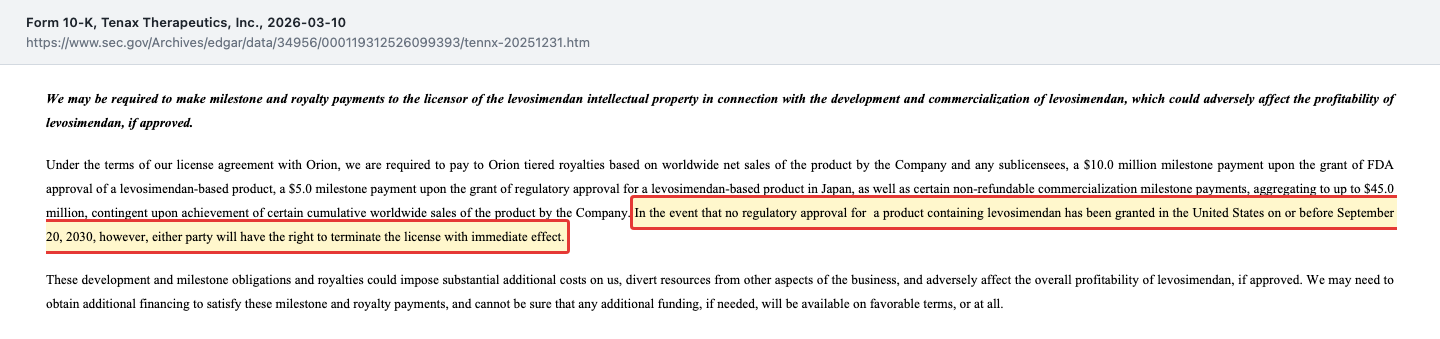
Tenax does not own levosimendan; it licenses it from Orion. Orion is also the supplier: on June 29, 2026, the two signed a supply agreement for the oral product, with a five-year term from first delivery. On U.S. approval, Tenax owes Orion $10 million, on approval in Japan $5 million, plus sales-based royalties and milestone payments of up to $45 million. That is customary for a licensed product. After the LEVEL result, though, one deadline in the annual report becomes unusually important:
“In the event that no regulatory approval for a product containing levosimendan has been granted in the United States on or before September 20, 2030, however, either party will have the right to terminate the license with immediate effect.”
— Tenax Therapeutics, SEC annual report 10-K for 2025, Item 1A Risk Factors
Count backwards: according to the earnings release of July 31, 2026, LEVEL-2 was supposed to finish enrolling all patients by the end of 2027; enrollment is now on hold. Patients enrolled so far stay blinded in the trial for one year, according to Tenax’s presentation. After that come analysis, the new drug application and FDA review, which takes about a year under the standard process. Just under four years remain until September 2030. That is doable, but without much cushion, and every further delay eats into it. Then there are the patents: the key U.S. patents for use in PH-HFpEF run until 2039 to 2041. A patent until 2040 is of little use if the license becomes terminable in 2030.
Valuation: how much cash is in the market value?
This is where careful math pays off. As of July 28, 2026, there were 37,423,917 Tenax shares. On top come pre-funded warrants, which convert into shares for $0.01 each and are therefore economically shares already: 19,858,043 as of June 30, 2026, of which 3,667,440 were exercised after the balance-sheet date. By our count, that adds up to about 53.6 million shares. At $1.87 (October 9, 2026), that is a market value of about $100 million; fundamental data shows only the common stock, at about $70 million.
Against that stand $118.0 million in cash as of June 30, 2026, plus $8.1 million from later exercises, minus $8.1 million in liabilities. That is about $2.20 per share. But while the cash stands still, the burn does not. Extrapolating the first-half operating outflow ($23.5 million, about $11.7 million per quarter), cash as of September 30, 2026, should be roughly $110 million — an estimate, not a reported figure. The market value is therefore roughly equal to the cash. The market currently values the drug at roughly zero — and already deducts the future cash burn. That is not a market error but arithmetic: a company that keeps burning cash until 2028 is not worth today’s cash balance.
The view from the pros: according to fundamental data, six of ten analysts rate the stock a buy and four a hold; the average price target is about $12.56 (data as of October 10, 2026). Average means all targets added up and spread evenly — a single old, high target from before the crash pulls it up sharply. Whether all targets were updated after August 10 cannot be seen from that — with the stock below $2, caution is warranted. The ownership filings are more revealing: fund manager Fidelity (FMR) still reported 14.9 percent as of June 30, 2026, but only 1.4 percent as of August 31. Hedge fund ADAR1 Capital moved the other way, reported 14.0 percent as of August 31 and bought another 900,000 shares at about $1.78 on September 8, after which it held 6,524,151 shares according to Form 4. Three insiders also bought in September at prices around $1.82 to $1.94: CEO Christopher Giordano 10,850 shares, CFO Thomas Staab 5,675 and director Declan Doogan 53,000. Together that is a little over $130,000 — a gesture, not a weight.
Upside and risks at a glance
What speaks for Tenax:
- A lot of cash for its size: $118.0 million as of June 30, 2026, no meaningful debt, enough for operations into the second quarter of 2028 under its own plan.
- A well-known compound with a long safety record: serious adverse events in LEVEL were as common as on placebo.
- Clear biological signals: cardiac stress marker NT-proBNP 49 percent below placebo, right-ventricular pressure −3.5 mmHg.
- A prespecified subgroup with +26.3 meters in the walk test; LEVEL-2 is being tailored to exactly these patients.
- No approved drug for PH-HFpEF — whoever gets there has a market without approved competition.
What speaks against it:
- The first Phase 3 trial clearly missed its primary and key secondary endpoints (+3.5 meters, p = 0.63).
- By Tenax’s own account, the subgroup results do not establish efficacy; the quartile analysis is post hoc.
- Completion of LEVEL-2 is not funded, the warrants as a cash source have expired, and new shares loom.
- One product, one licensor: without U.S. approval by September 20, 2030, Orion can terminate the license.
- Enrollment in LEVEL-2 has been on hold since October 2026, and the talks with the FDA are still ahead.
A human conclusion
Back to the Texas sharpshooter. The nasty thing about his fallacy is that his target does not have to be wrong. Maybe next time he really would have hit exactly that spot. Tenax is similar: the idea that a drug against blood congestion helps the very sick more than the almost healthy is plausible. The biological markers support it. It is not proven, and Tenax says so itself. What the filings actually show: a missed Phase 3 trial, a well-stocked bank account that lasts until 2028, a second trial whose completion is not paid for, and a license that becomes terminable from September 2030. The market value roughly equals the cash — so the market has little faith in the drug. The honest question for you is therefore not “Is the stock cheap?” but: do you believe the newly drawn target will be hit in LEVEL-2 — and are you prepared to sit through a capital raise until then? What you make of it is your decision. And that is how it should be.
Sources
All original documents used in this analysis — for you to check yourself:
- Tenax Therapeutics, Inc. — SEC quarterly report 10-Q as of June 30, 2026 (filed July 31, 2026)
- Tenax Therapeutics, Inc. — earnings release for the second quarter of 2026, 8-K Item 2.02 with Exhibit 99.1 (July 31, 2026)
- Tenax Therapeutics, Inc. — current report 8-K on the LEVEL results, Exhibit 99.1 (August 10, 2026)
- Tenax Therapeutics, Inc. — current report 8-K on the LEVEL-2 enrollment pause with corporate presentation October 2026 (Exhibit 99.1) (October 8, 2026)
- Tenax Therapeutics, Inc. — current report 8-K on the supply agreement with Orion (June 30, 2026)
- Tenax Therapeutics, Inc. — SEC quarterly report 10-Q as of March 31, 2026 (filed May 12, 2026)
- Tenax Therapeutics, Inc. — SEC annual report 10-K for 2025 (filed March 10, 2026)
- Tenax Therapeutics, Inc. — SEC annual report 10-K for 2024 (filed March 25, 2025)
- Tenax Therapeutics, Inc. — shelf registration S-3 for $300 million (March 24, 2026)
- Complete SEC filing history: EDGAR overview (sec.gov) — reviewed after the quarterly report through October 10, 2026, including beneficial ownership reports Schedule 13G/13G/A by ADAR1 Capital (September 8, 2026), FMR (September 8, 2026) and Dellora (October 9, 2026) and insider filings (Form 3/4) by ADAR1, Christopher Giordano, Thomas Staab and Declan Doogan (August and September 2026)
- Fundamental data (prices, trading volume, analyst consensus; data as of October 10, 2026), checked against the SEC filings.
- Hook: wallstreet-online hot-discussion list, first seen on August 11, 2026 (not a data source for company figures).
Transparency & disclaimer: This analysis is a journalistic assessment of publicly available information. It is not investment advice, not a financial analysis in the regulatory sense and not a solicitation to buy or sell securities. Investing in stocks involves substantial risk, up to and including total loss. All information without guarantee; the data date is noted in the text. Positions held by the operator are disclosed daily; where one exists, it appears as a notice at the top of this deep dive.
Key figures at a glance
All monetary figures in millions of $; earnings per share as reported.
| Metric | 2021 | 2022 | 2023 | 2024 | 2025 |
|---|---|---|---|---|---|
| Revenue | 0.0 | 0.0 | 0.0 | 0.0 | 0.0 |
| Operating Income (EBIT) | -32.7 | -11.1 | -8.2 | -19.5 | -56.4 |
| Net Income | -32.5 | -11.0 | -7.7 | -17.6 | -52.6 |
| Earnings Per Share | -2,525.22 $ | -600.72 $ | -31.04 $ | -1.15 $ | -1.34 $ |
Source: fundamental data & SEC filings (annual and quarterly reports, 10-K/10-Q)
Our Bottom Line at a Glance
- Clinical evidence negative
- Phase 3 LEVEL missed its primary and key secondary endpoints on 08/10/2026 (+3.5 m, p = 0.63). The sub-333 m subgroup (+26.3 m) is prespecified but unadjusted; Tenax itself says it does not establish efficacy.
- Biology and safety neutral
- NT-proBNP −49% and right-ventricular pressure −3.5 mmHg versus placebo; serious adverse events equally common (10.8% vs. 10.7%), but discontinuations due to adverse events 8.3% vs. 1.7%.
- Cash positive
- $118.0M as of 06/30/2026 plus $8.1M afterwards, hardly any liabilities, runway into Q2 2028 per Tenax; operating cash outflow H1 2026 $23.5M.
- Funding of LEVEL-2 negative
- Per the 10-Q as of 06/30/2026, completing LEVEL-2 depends on license income, warrants or new money; the $4.50 warrants expired in September 2026, and new shares are likely.
- License dependence negative
- One compound, one licensor and supplier (Orion); without U.S. approval by 09/20/2030, the license can be terminated. LEVEL-2 enrollment has been paused since October 2026.
After the failed Phase 3 LEVEL trial, Tenax has a drug with clear biological signals but no proof of efficacy, and a well-stocked bank account that lasts into the second quarter of 2028. Completion of the second trial is not funded, the license becomes terminable from September 2030 without U.S. approval, and the market value roughly equals the cash. Not investment advice.
What Our Rating Means
Open questions
The business works in principle, but one material question is open. As long as it stays open, our findings do not carry a quality verdict.
Yellow because the company hinges on a single event: whether TNX-103 works will only be decided by the amended LEVEL-2 trial, after LEVEL missed its primary endpoint. A threat to the company’s substance in the sense of red is not documented as of 06/30/2026 — cash of $118.0 million lasts into the second quarter of 2028 per Tenax, there is hardly any debt, and the Orion license only becomes terminable from September 20, 2030. It gets tight if LEVEL-2 is delayed further or fails to find funding. The decision is yours.
A journalistic assessment by our editorial team at the time of the deep dive, based on public sources — not investment advice and not a solicitation to buy or sell. Your personal circumstances (investment goals, risk capacity, taxes) cannot be taken into account. What our levels mean, how verdicts are formed, and what conflicts of interest exist →
Worth Noting
- Edition of October 10, 2026, based on the quarterly report 10-Q as of June 30, 2026, and the current reports 8-K through October 8, 2026; the other filings through October 10, 2026 (Schedule 13G/13G/A, Form 3/4) are reflected in the valuation. The quarterly report as of September 30, 2026, was not yet available. The hook is the wallstreet-online hot-discussion list, where Tenax has appeared since August 11, 2026 — an attention signal, not a data source.
- Do not confuse: Tenax Therapeutics (TENX) has nothing to do with 10x Genomics (ticker TXG), even though the names sound alike.
- Market value including pre-funded warrants, cash per share and estimated cash as of September 30, 2026, are our own calculations from the sources named. The expiry date of September 22, 2026, is derived from the contractual rule (30 trading days after August 10, 2026). All share prices before 2024 are not comparable with today’s prices because of the 1-for-20 (January 2023) and 1-for-80 (January 2024) reverse stock splits.
Stock Watch
This analysis is as of October 10, 2026. Stock Watch will tell you what's changed at TENX since then.
Later $1 a month per stock — signing up is free, and you'll be the first to know when it launches.
The full analysis as a PDF for later
We will send you this analysis as a PDF — to print, file away, and read at your own pace. And we will add you to the free Stock Watch list for Tenax Therapeutics Inc (TENX), so you hear about it when something material in this analysis changes.
Frequently Asked Questions
Tenax Therapeutics (Nasdaq: TENX) of Chapel Hill, North Carolina, develops levosimendan as an oral capsule (TNX-103) for pulmonary hypertension in heart failure with preserved ejection fraction (PH-HFpEF). The compound is licensed from Orion and approved as an infusion for acute heart failure in 60 countries, but not in the U.S. Tenax has no revenue and had 14 full-time employees at the end of 2025.
On August 10, 2026, Tenax reported that its Phase 3 LEVEL trial had missed its primary endpoint: patients on TNX-103 walked only 3.5 meters farther in the 6-minute walk test than on placebo (p = 0.63). The key secondary endpoint was also missed. The stock fell from a close of $13.44 on August 7 to $1.375, about 90 percent.
In patients who walked less than 333 meters at baseline, TNX-103 beat placebo by 26.3 meters (nominal p = 0.0112). This subgroup was prespecified, but the p-value is not adjusted for multiple testing. Tenax itself states that these analyses do not establish efficacy. The amended LEVEL-2 trial is supposed to deliver the proof.
Tenax had $118.0 million in cash as of June 30, 2026, and received another $8.1 million from warrant exercises afterwards. The company expects that to last into the second quarter of 2028. According to its quarterly report, completing the second Phase 3 trial, LEVEL-2, additionally requires license income, warrant proceeds or other financing.
LEVEL-2 has been running since December 2025. After the LEVEL results, Tenax wants to admit only patients who walk at most 300 meters at baseline, or 300 to 400 meters with an enlarged right atrium. To do so, enrollment has been temporarily paused since October 2026. A meeting with the FDA has been requested; Tenax expects updates in the first quarter of 2027.
Roughly the same. With about 53.6 million shares including pre-funded warrants, the share price of $1.87 (October 9, 2026) implies a market value of about $100 million. Cash stood at $118.0 million as of June 30, 2026, but the company burns about $12 million per quarter. The market therefore currently values the drug at roughly zero.
Found an error?
Did you spot a factual error, an outdated number, or a typo in this deep dive? Let us know briefly — your report goes straight to the editorial team.