Australian Mines: Scandium for AI Data Centers — a Chain of Many Ifs
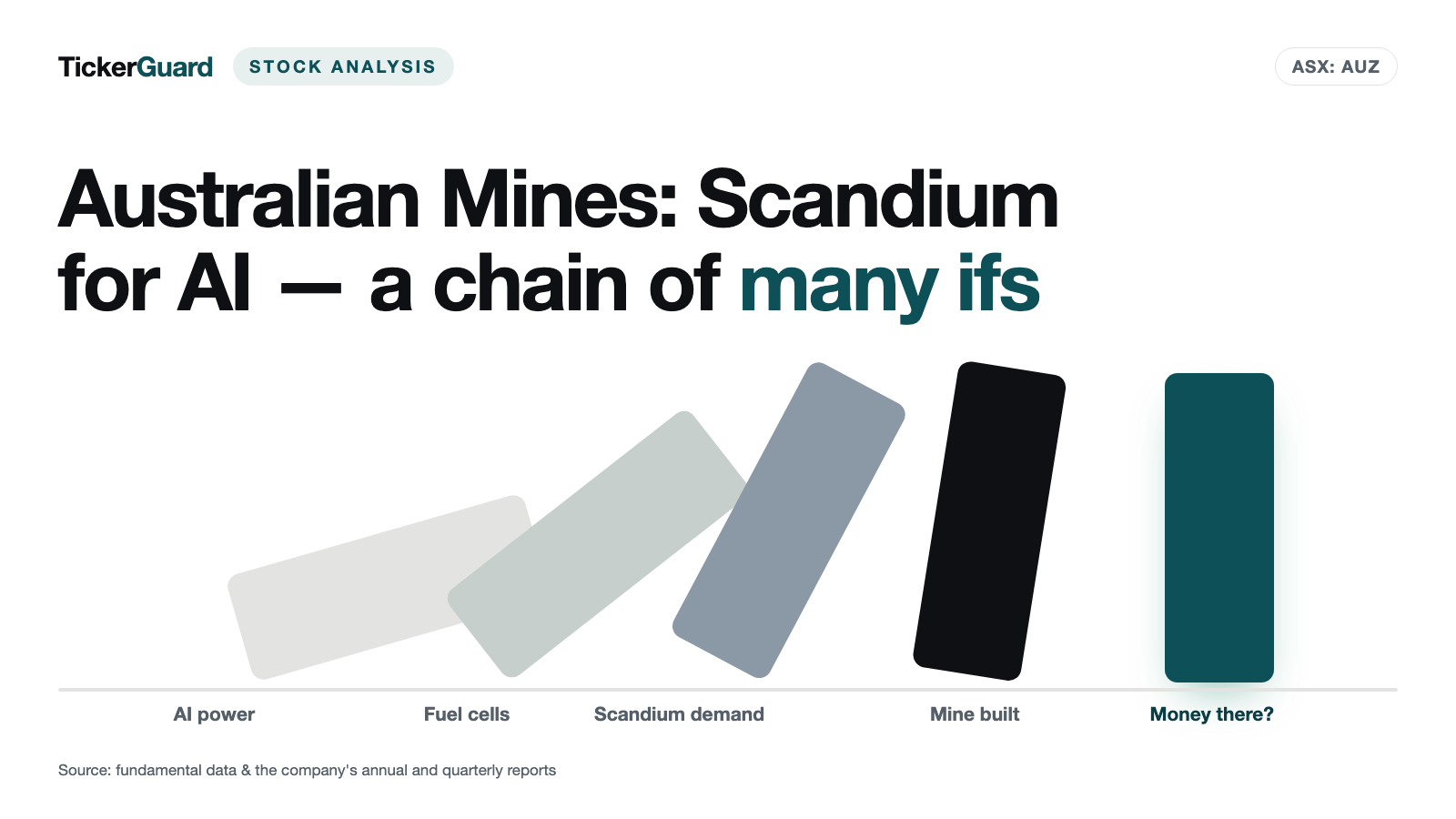
If AI data centers need power, if fuel cells need scandium for it, and if Flemington in New South Wales gets built, then Australian Mines (ASX: AUZ) gets paid — that is the story. The filings show a study rather than a mine, an auditor’s note on doubts about the company’s ability to continue as a going concern and 57 percent more shares in 15 months. Each single if sounds plausible; shareholders only get paid when every one of them comes true.
 Thomas Mücke
Founder & Publisher
Thomas Mücke
Founder & Publisher
Chart
Interactive price chart (TradingView).
Note: pure fact-based analysis, not investment advice and not a solicitation to buy or sell. All figures without guarantee.
There is a thinking error that psychologists Amos Tversky and Daniel Kahneman made famous: the conjunction fallacy. The more vivid details a story has, the more likely it feels — even though every additional condition actually makes it less likely. A chain is only as strong as all its links together. If you need five conditions, each with a 70 percent chance, you end up at about 17 percent (0.7 to the fifth power). That is a worked example, not a forecast — but it shows how quickly plenty of good reasons add up to a weak bet.
Australian Mines Limited tells exactly such a chain, and tells it well: artificial intelligence needs data centers, data centers need power fast, fuel cells from Bloom Energy deliver it, those fuel cells need scandium — and with Flemington in New South Wales, Australian Mines owns what the company calls one of the highest-grade scandium resources reported anywhere. Let’s make a deal: we pick up each link one at a time and read what the 2026 accounts, the quarterly reports and the releases through October 9, 2026, actually say. At the end, you decide.

What Australian Mines actually does
Australian Mines is an explorer: a company that searches for resources and wants to develop projects to construction readiness, but produces nothing yet. Think of a property developer with land, surveys and blueprints, but no building and no tenants. The 2026 accounts list five workstreams:
- Flemington (New South Wales, 100 percent): scandium, plus nickel and cobalt. The resource comprises 6.30 million tonnes at 446 grams of scandium per tonne of rock (ppm) at a 300 ppm cut-off, almost entirely in the more certain Measured and Indicated categories. Flemington is contiguous with the Syerston scandium project of its neighbor Sunrise Energy Metals. Today it is the centerpiece.
- Boa Vista (Pará, Brazil): a gold project in the Tapajós region covering 9,201 hectares, in which Australian Mines has held an earn-in right since July 2025 — up to 80 percent if conditions are met. More on that in the second uncomfortable truth.
- Sconi (Queensland): the former flagship, a nickel-cobalt-scandium project with granted mining leases, idle because of weak nickel and cobalt prices.
- Resende and Jequié (Brazil): early-stage targets for tin, tantalum, lithium and rare earths.
- Hydrogen storage: a proprietary scandium-magnesium metal hydride technology being tested independently by the team of a U.S. Department of Energy national laboratory (National Laboratory of the Rockies).
Australian Mines has no mining revenue. The money comes from new shares — in fiscal 2026 from three placements totaling A$9.5 million before costs.
Company history for investors
-
2023
New CEO with a Sconi bonus
Andrew Nesbitt becomes CEO in October; half of his 20 million loan shares depend on a decision to build Sconi.
-
2025
Boa Vista and new shares
An earn-in right to the Boa Vista gold project in July, then placements of A$6.5 million; in December, the CEO’s bonus condition is switched from Sconi to Boa Vista.
-
2026
Scoping Study, going-concern note, consolidation
The Flemington study in April, accounts with a going-concern note in September, and the 5-for-1 consolidation approved in October.
Where the numbers come from: ASX, not SEC
Australian Mines files no annual report (10-K) and no quarterly report (10-Q) with the U.S. Securities and Exchange Commission; it is not an SEC reporting company. It reports under Australian law in Australian dollars: audited accounts as of June 30, a half-year report as of December 31 and — mandatory for explorers on the ASX — a quarterly report with a cash flow statement, the so-called Appendix 5B. Resources are reported under the Australian JORC Code and signed off by a named Competent Person.
The fiscal year ends on June 30: “fiscal 2026” means July 2025 through June 2026. We reviewed the 2026 accounts of September 21, 2026, the four quarterly reports of the fiscal year and all releases through October 9, 2026. The quarterly report to September 30, 2026, was not yet available on that date; according to the reporting calendar in the accounts, it is due by October 31, 2026. Every figure is therefore labeled “Source: fundamental data & the company's annual and quarterly reports”.
How the stock landed on our desk
Australian Mines is not a hit from our in-house stock scanner, and it cannot be: the scanner works with revenue, earnings, margins and balance-sheet ratios, and an explorer without production fails every one of those filters. The stock made our research list via the forum ranking of wallstreet-online, the list of stocks most discussed by German retail investors (as of October 10, 2026). That is an attention signal, not a quality signal.
A note for anyone comparing prices right now: on October 7, 2026, shareholders approved a 5-for-1 share consolidation. According to the timetable, October 15, 2026, is the last trading day of the old shares; from October 16, 2026, the consolidated shares trade. Five shares become one, and the price multiplies by five on paper — the value of your stake does not change. All prices and share counts in this analysis are pre-consolidation; the closing price of A$0.026 on October 9, 2026, equals about A$0.13 afterward.
The numbers over the years — a fair look
Let’s start with what is genuinely impressive. In April 2026, consultancy SRK Consulting delivered a Scoping Study for Flemington — a first rough calculation of whether a mine could pay off. Its key figures according to the accounts: 60 tonnes of scandium oxide a year over 28 years, a recovery of 90.8 percent, construction costs of about $125 million (accuracy plus/minus 35 percent), operating costs (C1) of $561 and a breakeven price of $815 per kilogram. At the study’s design price of $1,500 per kilogram, it shows a post-tax net present value of about $270 million at an 8 percent discount rate and an internal rate of return of 32 percent. The Pre-Feasibility Study (PFS) is under way; according to the release of September 23, 2026, it is targeted for mid-first quarter of 2027.
In Brazil, the drilling is not bad either: the best company hole at Boa Vista, VGADD0010, hit 142.6 meters at 1.37 grams of gold per tonne from 161 meters down, and VGADD0002 returned 120 meters at 1.34 grams. Those are broad, continuous intervals; the accounts themselves note that they do not establish economic significance on their own. And the capital market played along: in May 2026, fund manager Tribeca Investment Partners took A$2.7 million of a placement at A$0.028 — according to the release, a 16 percent premium to the 30-day volume-weighted average price.
Now the other half of the picture: the money. The chart shows cash at the end of each quarter of fiscal 2026.
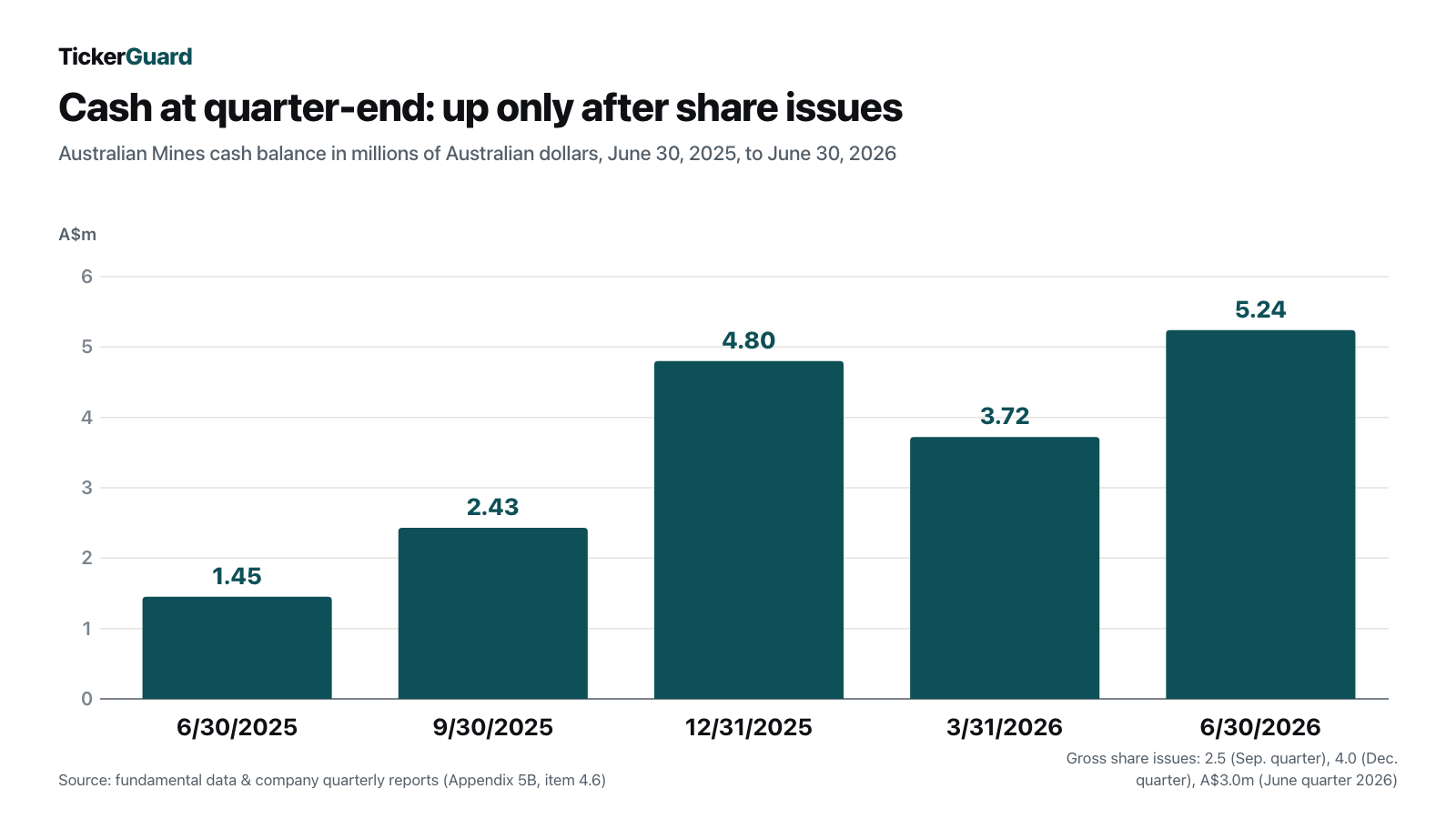
The pattern is clear: cash only grows when new shares are sold. In fiscal 2026, according to the cash flow statement, A$1.43 million went into day-to-day operations and A$3.55 million into exploration; A$9.5 million came in from share issues, less A$0.70 million in costs. The loss rose from A$1.88 million (fiscal 2025) to A$7.11 million — of which A$5.02 million were non-cash write-downs that we come back to shortly. Without revenue, an explorer has little other choice. But it means every link in the chain is paid for with new shares.
What the reports say — the uncomfortable truths
Now come the passages you won’t find on the cover of an investor presentation. All of them are from the company’s own documents.
Uncomfortable truth No. 1: A single mine would be as large as today’s world market
Scandium is not a bulk commodity like copper but an industrial spice: it makes aluminum stronger and fuel cells more durable. That is where the story starts. The accounts describe how Bloom Energy is supplying its fuel cells to data centers at scale — Oracle intends to procure up to 2.8 gigawatts — and conclude that these cells use scandia-stabilized zirconia, so their rollout could materially increase demand for scandium. That is the first link of the chain. The second one comes a few paragraphs later, and it is sobering:
“Sunrise itself estimates current global scandium oxide demand at approximately 50-60 tpa and forecasts demand increasing to approximately 300 tpa by 2030 and 600 tpa by 2035, compared with Syerston's initial planned production capacity of approximately 60 tpa.”
— Australian Mines Ltd, 2026 accounts, Directors’ Report, section 6 (Operating and Financial Review)
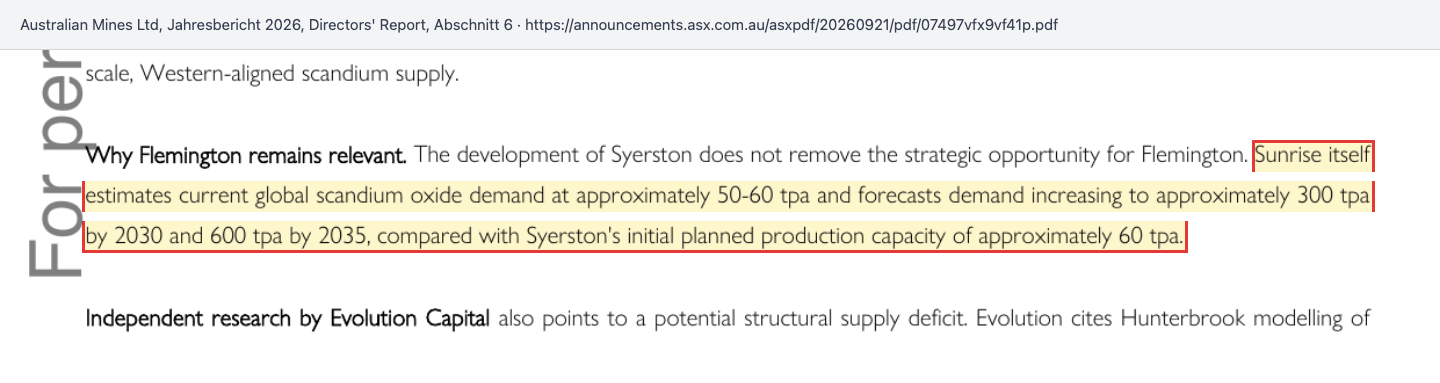
Read that twice. Neighbor Syerston, directly adjacent to Flemington, plans 60 tonnes a year — and on August 7, 2026, received a conditional $400 million loan commitment from the Office of Strategic Capital of the U.S. Department of War. Flemington also plans 60 tonnes in its base case; according to the release of August 25, 2026, the PFS is even assessing up to 180 tonnes. Two mines side by side, each as large as today’s world market. For this to work, demand does not need to double but to multiply, as Sunrise expects — a forecast by a competitor, not by Australian Mines, as the accounts themselves stress.
And the price? It is hard to check. The accounts state it themselves: “The scandium market remains relatively small and opaque, with limited transparent price discovery.” The chart shows which prices the study assumes.
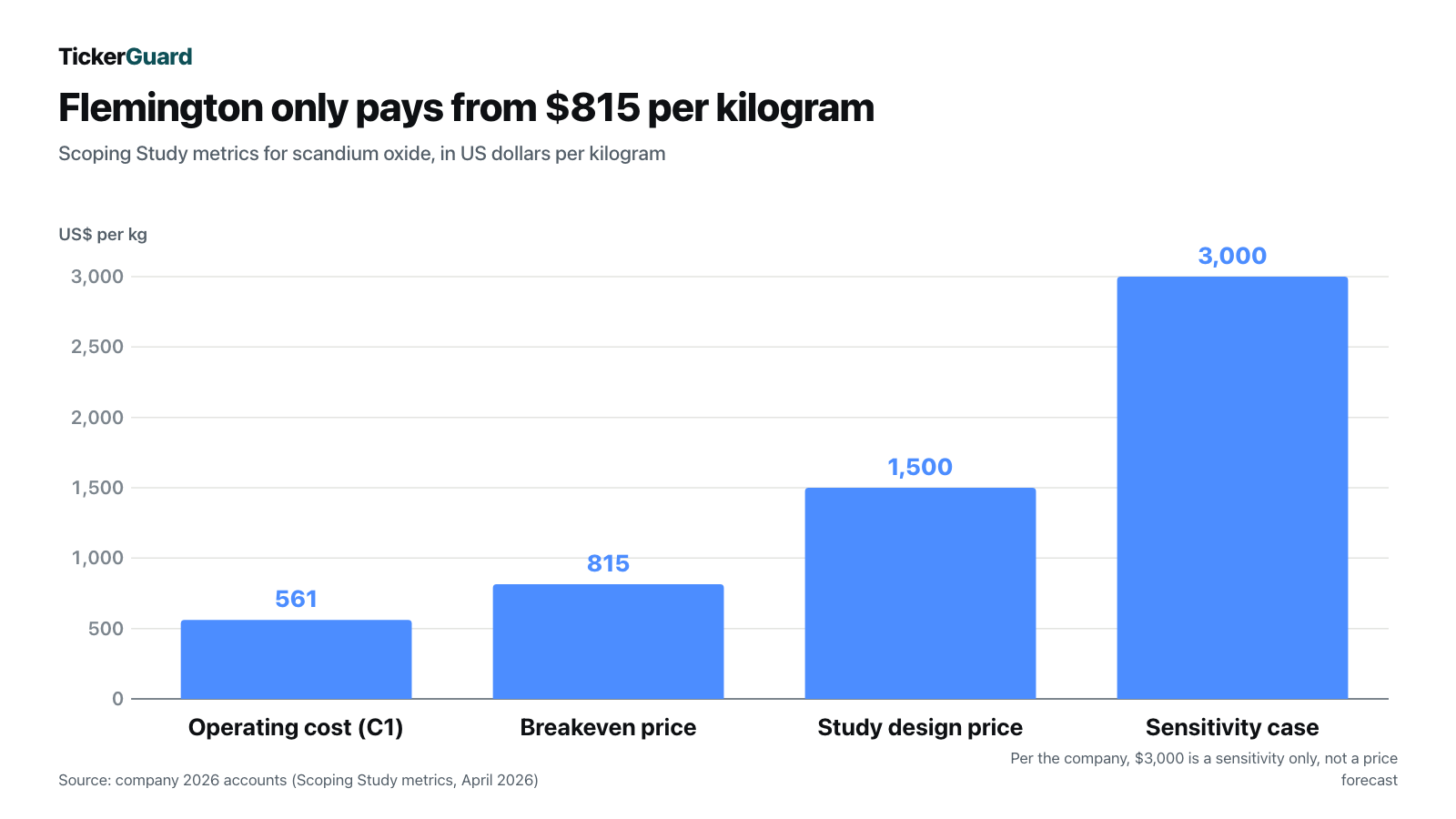
To be fair: the breakeven price sits well below the design price, which speaks for the deposit. The uncomfortable part: for a market that would have to be split between two new mines, there is little transparent price discovery against which the $1,500 could be checked. That is why the company explicitly treats market development, product qualification and offtake as part of the PFS. The accounts name no offtake agreement for Flemington; offtake is expressly still a PFS workstream there. What another scandium project with a similar dependence on the scandium price looks like is something we worked through in our NioCorp analysis.
Uncomfortable truth No. 2: Boa Vista does not belong to Australian Mines yet
The second big project is a gold project in Brazil — with a catch that many releases only mention in the fine print. In July 2025, Australian Mines agreed an earn-in: a right to acquire a stake by spending money and doing the work, like a tenant who earns a share of ownership with every renovation — but only if all conditions are met at the end. The partners are Cabral Resources, a subsidiary of GoldMining Inc., and Majestic D&M Holdings. For the first 51 percent, the release of July 4, 2025, lists A$4.5 million of spending, 6,000 drill meters, three payments of C$250,000 and, as the fourth condition:
“announcing a JORC-compliant Mineral Resource of ≥500,000 ounces, including at least 250,000 ounces in the Measured + Indicated categories.”
— Australian Mines Ltd, ASX release of July 4, 2025, on the Boa Vista earn-in, Stage 1 – First Option, condition iv
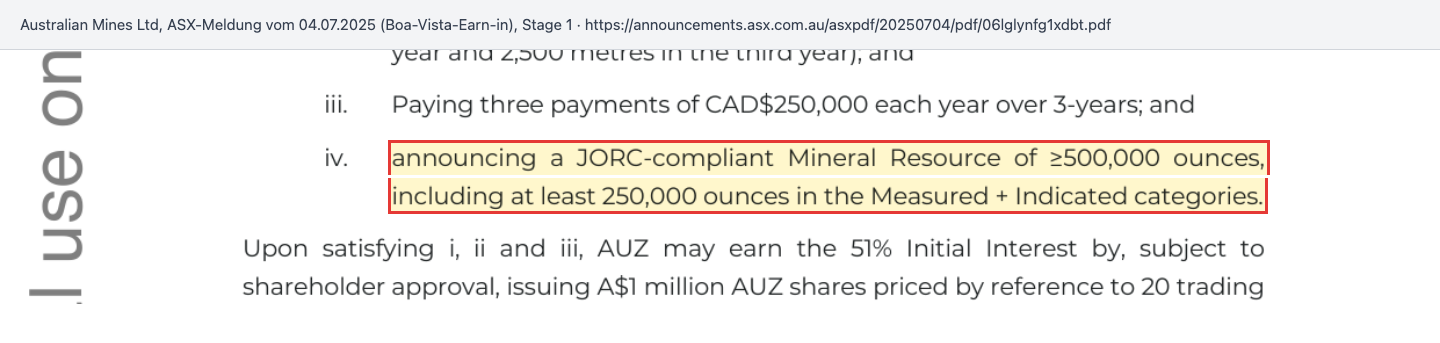
What exists so far? A single estimate for the core VG1 deposit, and it is old: 8.47 million tonnes at 1.23 grams per tonne, about 336,000 ounces at a 0.5-gram cut-off, from a Canadian technical report dated November 22, 2013. The ASX calls this a “foreign estimate”; it was not prepared under JORC, and the accounts themselves say it is uncertain whether it can ever be reported as a JORC resource. Even if you lower the cut-off to 0.1 grams, the table shows about 399,000 ounces. The 500,000-ounce threshold therefore sits above everything estimated so far. The contract wording is not fully clear, though: right after condition iv, the release says that upon satisfying conditions i to iii, Australian Mines may earn the 51 percent by issuing A$1 million of shares. Whether the resource threshold is therefore mandatory, the release leaves open; the accounts, in any case, tie the CEO’s bonus to exactly this threshold within the first stage. If the first stage fails, the exit interest is zero, according to the release — the money spent until then would be sunk into a project that Australian Mines does not own. The drill results are encouraging, and the next program is meant to cover 6,000 to about 10,000 meters. But between encouraging and 500,000 JORC ounces lies a link in the chain that nobody has seen yet.
Uncomfortable truth No. 3: The auditor warns, and the share count grows faster than any project
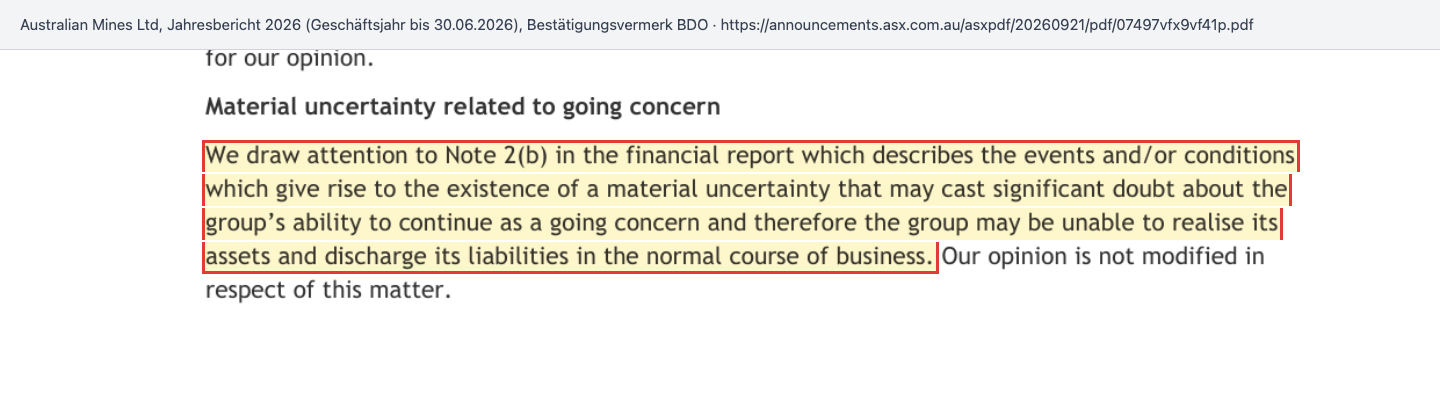
Auditor BDO did not qualify its opinion on fiscal 2026, but it added a paragraph worth knowing:
“We draw attention to Note 2(b) in the financial report which describes the events and/or conditions which give rise to the existence of a material uncertainty that may cast significant doubt about the group’s ability to continue as a going concern and therefore the group may be unable to realise its assets and discharge its liabilities in the normal course of business.”
— BDO Audit Pty Ltd, auditor’s report in the Australian Mines 2026 accounts, section Material uncertainty related to going concern
One way to put the note in context: it is common among explorers without revenue. On June 30, 2026, cash stood at A$5.24 million, there is no debt, and current assets exceeded current liabilities by A$4.92 million. The Appendix 5B calculates a runway of 5.19 quarters — but at the pace of the June quarter, in which A$1.01 million went out for operations and exploration. Against that stand mandatory outlays: just to keep its exploration licenses, Note 16 shows minimum spending of A$4.96 million for the next twelve months (authorities can vary these obligations or grant exemptions), on top of the planned 6,000 to 10,000 drill meters in Brazil and the Flemington PFS. At the pace of the plans, the cash lasts considerably shorter than at the pace of the past.
Where the missing money comes from is shown by the share count. Dilution means your slice of the cake gets smaller because more people are eating from the same cake. On June 30, 2025, there were 1,398,512,124 shares; on June 30, 2026, there were 2,158,606,705; and according to the consolidation notice of October 7, 2026, there are 2,201,337,854 — up 57 percent in about 15 months. In addition, 594.8 million options were outstanding before the consolidation: 264.7 million at A$0.022 (expiring February 2, 2027), 305.1 million at A$0.032 (expiring May 6, 2027) and 25 million at A$0.03 (expiring July 30, 2029). If all were exercised, there would be about 2.8 billion shares. The cheapest series was in the money at the closing price of A$0.026 on October 9, 2026; 42.7 million of those options were already exercised between August 17 and September 11, 2026.
That the 5-for-1 consolidation was not uncontroversial is shown by the vote: according to the results of October 7, 2026, 23.44 percent of the votes cast were against it. For the board, the same meeting brought a new incentive model — more on that in a moment.
Uncomfortable truth No. 4: The old flagship is melting — and the CEO’s bonus target moved with it
Sconi, the nickel-cobalt-scandium project in Queensland, was the flagship until recently — even the CEO bonus granted in 2023 was tied to a construction decision there. In the 2026 accounts, what is left of it is mainly a write-down. Mining Lease ML 10324 expired on February 28, 2026, and its carrying value of A$2.19 million was written off. On top came full write-downs of the Broken Hill (A$1.57 million) and Jequié (A$1.23 million) projects, for which, according to Note 11, there are no approved work programs. Together with the write-off of a Flemington license (A$0.02 million), that is A$5.02 million — non-cash, just over 70 percent of the annual loss. A further obligation remains in the background for Sconi: A$6.75 million in compensation to landowners, payable within 90 days of financial close for the project (Note 16).
The notes also describe how CEO Andrew Nesbitt’s bonus developed. In 2023 he received 20 million shares under a loan share plan, financed by an interest-free loan from the company; half of them were to vest only upon a decision to build Sconi. The notes describe what happened next:
“On 3 December 2025 the Board exercised its discretion under the Loan Share Plan Rules to vary the vesting conditions attaching to the Tranche 2 shares, having determined that the Sconi condition would not be capable of satisfaction within the performance period through no fault of the Chief Executive Officer.”
— Australian Mines Ltd, 2026 accounts, Note 12 (Share-based payments)
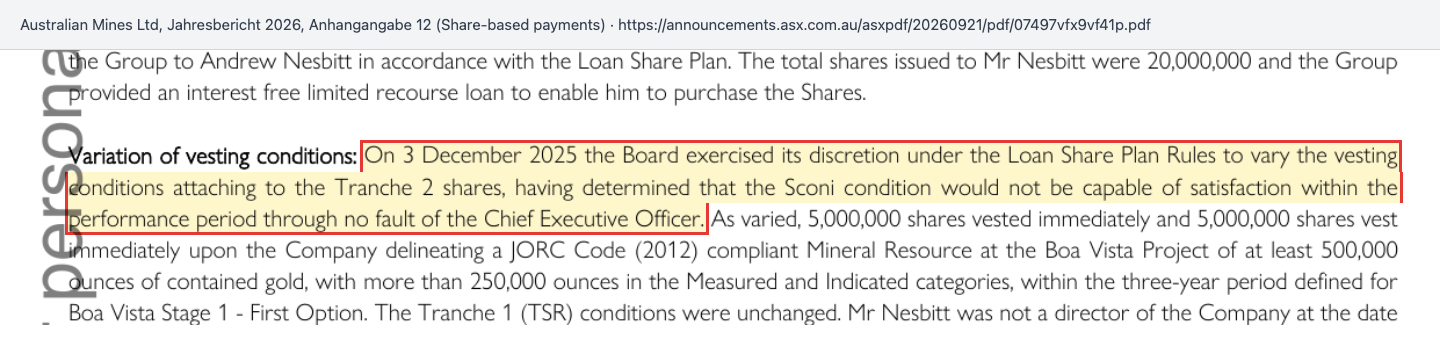
The result, according to the same note: 5 million shares vested immediately, and the other 5 million now depend on a JORC resource of at least 500,000 ounces at Boa Vista — the same threshold as in the earn-in. Formally, this was handled properly: the board has discretion under the plan rules, and the change was announced on December 3, 2025. For you as a shareholder, the takeaway is: when the Sconi condition became unattainable, the CEO’s target was moved, not removed. On October 7, 2026, shareholders also approved that the 95.6 million shares held under the loan share plan be forfeited and cancelled, and, linked to it as a package, a new set of performance rights and options for the board and the CEO; according to the notice of meeting, these are expressly not replacement securities and not consideration for the cancelled shares. The performance rights vest partly at a 20-day average share price of A$0.15 or A$0.30 (post-consolidation) and partly only upon a JORC gold resource of 0.5 or 1.0 million ounces, in each case by July 30, 2031; the new options carry an exercise price of A$0.15.
Valuation: What the market pays for the chain of ifs
With 2,201,337,854 shares (October 7, 2026) and a closing price of A$0.026 on October 9, 2026, Australian Mines is valued at about A$57.2 million on the market. Subtract the cash of June 30, 2026 (A$5.24 million, no debt), and about A$52 million remains for all projects combined. A price-to-earnings or price-to-sales ratio is meaningless: there are neither earnings nor revenue.
Two yardsticks help. The balance sheet shows equity of A$47.95 million, almost all of it exploration assets (A$42.87 million); the market therefore pays about 1.2 times book value. And the study puts the net present value of Flemington at about $270 million — a multiple of the market value. That sounds like a bargain, but it is exactly the conjunction fallacy from the start: that net present value assumes that about $125 million in construction costs get financed — more than twice the entire market value — that the scandium price sits at $1,500 and that someone buys the tonnes. The study itself says it is insufficient to support Ore Reserves or provide assurance of an economic development case. How strongly the market prices each release is shown by the day of the study: on April 28, 2026, the closing price rose from A$0.0185 to A$0.026, with about 62 million shares traded.
The range of closing prices in the twelve months through October 9, 2026, ran from A$0.012 (November 18, 2025) to A$0.038 (August 12 to 14, 2026). Who is buying is public: Singapore-based shareholder Flynn Huang bought 30.1 million shares for A$917,837 on September 23, 2026 (reported on September 24, 2026), and now holds 6.17 percent. We deliberately do not give price targets. What an Australian resource developer looks like after a final investment decision and a financing package is shown in our Vulcan Energy analysis.
Opportunities and risks at a glance
What speaks for the company:
- High-grade, well-drilled scandium resource. 6.30 million tonnes at 446 ppm, almost entirely Measured and Indicated, breakeven price of $815 per kilogram according to the study.
- Tailwind for scandium. Fuel cells for data centers and the U.S. loan commitment for neighbor Syerston show that Western scandium supply has political backing.
- Broad gold intercepts in Brazil. Up to 142.6 meters at 1.37 grams per tonne at Boa Vista; a larger drilling program is planned.
- Balance sheet without borrowings. A$5.24 million in cash on June 30, 2026, plus A$0.94 million from option exercises afterward; a fund investor subscribed above the average price in May 2026.
What speaks against it:
- Tiny, opaque market. Today’s global demand of 50 to 60 tonnes equals a single planned mine; there is little transparent pricing and no offtake agreement.
- Boa Vista is not owned yet. The earn-in release lists, among other things, a JORC resource of 500,000 ounces as a condition; the old estimate shows about 336,000.
- Auditor’s note and high mandatory spending. Material uncertainty about going concern, A$4.96 million in minimum spending over twelve months against A$5.24 million in cash.
- Dilution. 57 percent more shares in about 15 months, plus 594.8 million options before the consolidation.
- Write-downs and moved targets. A$5.02 million in write-downs, mainly on Sconi, Broken Hill and Jequié; the CEO’s bonus condition was changed after the fact.
A human conclusion
Remember the conjunction fallacy from the start — the well-told chain that feels more likely than it is? At Australian Mines, every single link makes sense on its own: data centers need power, fuel cells need scandium, Flemington has a good deposit, Boa Vista delivers broad gold intercepts. That is more than many explorers can show.
The filings, however, show how many links have to hold at the same time: a world market that multiplies, a price with little transparent price discovery, about $125 million for construction, 500,000 ounces for a project that does not yet belong to the company — and shareholders paying for all of it with ever more new shares while the auditor points to going-concern risk. Whether the chain holds will first be shown by three public dates: the quarterly report to September 30, 2026, the expiry of the cheap options on February 2, 2027, and the Flemington PFS in the first quarter of 2027.
What you make of it is your decision. And that is how it should be.
Sources and data as of
- 2026 accounts (fiscal year to June 30, 2026, “Full Year Statutory Accounts”), published on September 21, 2026, with the auditor’s report of BDO Audit Pty Ltd
- Quarterly reports with Appendix 5B: to September 30, 2025, to December 31, 2025, to March 31, 2026 and to June 30, 2026
- Projects: Boa Vista earn-in (July 4, 2025), Flemington Scoping Study (April 28, 2026) and amended version (May 8, 2026), Flemington drilling program (August 25, 2026), PFS team (September 23, 2026)
- Capital and leadership: placement with Tribeca (May 4, 2026), notice of general meeting (September 8, 2026), new chair (September 17, 2026), substantial holder notice Flynn Huang (September 24, 2026), results of meeting (October 7, 2026), consolidation notice, Appendix 3A.3 (October 7, 2026)
- Price and market value data: source fundamental data, as of October 9, 2026 (ASX)
Data as of: company figures as of June 30, 2026, or the respective date stated; shares and options as of October 7, 2026, before the 5-for-1 consolidation; prices as of October 9, 2026. The ASX announcement list was last checked on October 10, 2026. The reporting currency is the Australian dollar (A$); amounts in U.S. dollars are shown with a plain $ sign. Derived values (market value, value net of cash, price-to-book multiple, share of write-downs in the loss, worked example on the conjunction fallacy) are our own arithmetic.
Disclaimer: This article is journalistic commentary and not investment advice. It is not a recommendation or a solicitation to buy or sell securities. Shares of explorers without production are especially volatile; a total loss of the capital invested is possible. Positions held by the operator are disclosed daily; where one exists, it appears as a notice at the top of this analysis.
Our Bottom Line at a Glance
- Flemington deposit positive
- The scandium resource comprises 6.30 million tonnes at 446 ppm, almost entirely Measured and Indicated. The April 2026 Scoping Study puts the breakeven price at $815 per kilogram.
- Sales market negative
- According to neighbor Sunrise’s estimate, today’s global demand for scandium oxide is 50 to 60 tonnes a year, as much as Flemington alone. Price discovery is limited, and there was no offtake agreement as of October 9, 2026.
- Boa Vista neutral
- Broad gold intercepts, for example 142.6 meters at 1.37 grams per tonne. Australian Mines holds no stake yet; the earn-in release lists a JORC resource of 500,000 ounces as a condition, the 2013 estimate about 336,000.
- Financial position negative
- Cash stood at A$5.24 million on June 30, 2026, with no debt. Auditor BDO points to a material uncertainty about going concern; minimum license spending is A$4.96 million over twelve months.
- Dilution negative
- The share count rose 57 percent to 2,201.3 million between June 30, 2025, and October 7, 2026. Before the 5-for-1 consolidation, another 594.8 million options were outstanding.
- Governance neutral
- New chair since September 17, 2026. The CEO’s bonus condition was switched from Sconi to Boa Vista on December 3, 2025, with 5 million shares vesting immediately.
With Flemington, Australian Mines owns a high-grade scandium deposit whose Scoping Study shows a breakeven price of $815 per kilogram. The market for it is tiny at 50 to 60 tonnes a year, Boa Vista does not belong to the company yet, the auditor points to a material uncertainty about going concern, and the share count rose 57 percent in about 15 months. Market value about A$57.2 million on October 9, 2026. Not investment advice.
What Our Rating Means
Substance risk
We found at least one documented issue that threatens the company itself — regardless of how the stock is currently valued.
Red here is not about a share price of a few Australian cents, nor about the deposit, which the study rates as sound. Red is here because there is a documented substance risk: auditor BDO points to a material uncertainty about the company’s ability to continue as a going concern in the 2026 accounts. Cash of A$5.24 million on June 30, 2026, lasts a little over five quarters at the June-quarter pace according to the Appendix 5B, but minimum license spending alone is A$4.96 million over twelve months, plus the drilling program and the PFS. Without revenue, the company depends on new shares. Yellow would be conceivable once funding for Flemington, an offtake agreement or a cash report with a much longer runway is in place. The decision is yours.
A journalistic assessment by our editorial team at the time of the deep dive, based on public sources — not investment advice and not a solicitation to buy or sell. Your personal circumstances (investment goals, risk capacity, taxes) cannot be taken into account. What our levels mean, how verdicts are formed, and what conflicts of interest exist →
Worth Noting
- This analysis was triggered by the wallstreet-online forum ranking (as of October 10, 2026). There is no hit from our in-house stock scanner, and there cannot be one: the company produces nothing and has no revenue. Classic metrics such as P/E or P/S cannot be calculated.
- Australian Mines is not an SEC reporting company. All company figures come from the Australian mandatory documents: 2026 accounts (9/21/2026), quarterly reports to 9/30/2025 through 6/30/2026 and ASX releases through 10/9/2026. Earnings call transcripts were not available.
- All share counts, options and prices are pre-consolidation; the 5-for-1 consolidation takes effect on 10/14/2026, and the consolidated shares trade from 10/16/2026. The price anchor of A$0.026 (10/9/2026) equals about A$0.13 afterward.
- Derived values are our own arithmetic: market value from 2,201,337,854 shares (10/7/2026) times the closing price of 10/9/2026, value net of cash as of 6/30/2026, price-to-book multiple, share of write-downs in the loss, potential option exercise proceeds.
The full analysis as a PDF for later
We will send you this analysis as a PDF — to print, file away, and read at your own pace.
Frequently Asked Questions
Australian Mines is an Australian explorer without production. Its key project is the Flemington scandium project in New South Wales (100 percent), alongside an earn-in right to the Boa Vista gold project in Brazil, the idle Sconi nickel-cobalt project in Queensland, early-stage targets in Brazil and a hydrogen storage technology.
Bloom Energy fuel cells that power data centers use scandia-stabilized zirconia, so Australian Mines considers more demand possible. But according to an estimate by neighbor Sunrise Energy Metals, today’s global demand is only 50 to 60 tonnes of scandium oxide a year — as much as Flemington alone is meant to deliver.
On October 7, 2026, shareholders approved combining every five shares into one. The new shares trade from October 16, 2026. According to the company’s estimate, about 2.2 billion shares become about 440 million, and the price multiplies by five on paper. The value of a stake does not change.
On June 30, 2026, Australian Mines had A$5.24 million and no debt. At the pace of the June quarter, the Appendix 5B calculated 5.19 quarters. For the following year, however, the accounts show minimum license spending of A$4.96 million, and auditor BDO points to a material uncertainty about going concern.
Not yet. Australian Mines has held an earn-in right since July 2025. For the first 51 percent, the release lists spending of A$4.5 million, 6,000 drill meters, three payments and a JORC resource of at least 500,000 ounces of gold; per the release, after the first three conditions are met the stake is to be acquired against A$1 million of shares; whether the resource threshold is mandatory, the release leaves open. The only estimate so far, from 2013, shows about 336,000 ounces.
The share count rose from 1,398.5 million on June 30, 2025, to 2,201.3 million on October 7, 2026, an increase of 57 percent. Before the consolidation, 594.8 million options with exercise prices between A$0.022 and A$0.032 were also outstanding.
Because Australian Mines is not a U.S. reporting company. It is listed on the ASX and reports under Australian law in Australian dollars: annual accounts as of June 30, a half-year report and quarterly reports with a cash flow statement (Appendix 5B), all published on the ASX platform.
Found an error?
Did you spot a factual error, an outdated number, or a typo in this deep dive? Let us know briefly — your report goes straight to the editorial team.