Vulcan Energy: The Lithium Project Is Paid For — Your Share of It Has Shrunk
In Germany's Upper Rhine Valley, Vulcan Energy is building a project meant to draw lithium and geothermal heat from the same source, and the money is in place: €2.2 billion from banks, governments and industrial partners. But the stock has fallen about 65 percent since the end of 2025, the share count has more than tripled since mid-2022, partners hold stakes directly in the project, and the loans flow only as milestones are met. We read the half-year report, the loan terms and the cash flow statement filed with the exchange. An excavator in a press photo is not yet a profit in your account.
 Thomas Mücke
Founder & Publisher
Thomas Mücke
Founder & Publisher
As of Today
As of: October 9, 2026
- Closing price
- 1.50 A$ -6.15%
- Market Capitalisation
- 0.7 A$B
Price change since October 8, 2026: -1.6%
This analysis has a cut-off date. The Stock Guard tells you when something material changes in the numbers. Reserve your free spot
Chart
Interactive price chart (TradingView).
Last price: 1.50 A$ (As of: October 9, 2026)
Note: pure fact-based analysis, not investment advice and not a solicitation to buy or sell. All figures without guarantee.
You know the feeling. You see a photo of the groundbreaking — excavators, hard hats, a state premier holding a shovel — and suddenly a project feels as good as finished. Psychologists call this the availability heuristic: what we can picture vividly, we judge to be more likely than it is. In our heads, a press photo beats any table in the notes to the accounts. And Vulcan Energy is producing those pictures in series right now: construction under way in Landau, a groundbreaking at Frankfurt's Höchst industrial park in April 2026 attended by Hesse's Minister-President Boris Rhein and Frankfurt's Lord Mayor Mike Josef, plus loan agreements with the European Investment Bank and seven major banks and an equity stake from Germany's state-owned development bank KfW.
So let's make a deal: we set the photos aside for a moment and read together what the mandatory reports say — the 2026 half-year report, the loan terms and the cash flow statement filed with the Australian exchange. The tension running through this analysis: Lionheart is financed and under construction — but what that secures first and foremost is the project, not the share of it that is left for you as a shareholder.
What Vulcan Energy Actually Does — Lithium From Hot Deep Water
Vulcan Energy Resources is an Australian company headquartered in Perth whose entire business is in Germany. In the Upper Rhine Valley between Karlsruhe, Landau and Frankfurt, it pumps hot, salty water up from deep underground — according to the 2026 half-year report, the two most recent wells reached depths of roughly 3,600 and 3,000 meters. Think of a thermal spring whose water carries two things: heat and dissolved lithium. The heat drives a power plant and warms homes; the lithium is captured with Vulcan's own filter material, VULSORB, and the water is then pumped back underground. In Frankfurt-Höchst, the lithium is to be turned into lithium hydroxide, a raw material for electric-vehicle batteries.
The first phase is called Lionheart. According to the company, it targets 24,000 metric tons of lithium hydroxide a year, enough for about 500,000 electric vehicles, plus 275 gigawatt hours of power and 560 gigawatt hours of heat, over an estimated 30-year life. First commercial production is targeted for 2028. The buyers are lined up: according to the 2025 annual report, Stellantis, Umicore, LG Energy Solution and Glencore have signed binding take-or-pay offtake agreements running six to ten years. Today, Vulcan still earns its money from something else entirely: power from the Insheim geothermal plant, district heating from Landau and services from its drilling subsidiary Vercana. As of June 30, 2026, the group employed 444 people.
A note on the evidence trail: Vulcan does not report to the U.S. securities regulator, the SEC. Its home exchange is the Australian Securities Exchange (ticker VUL), and the stock is also listed on the regulated market of the Frankfurt Stock Exchange, likewise as VUL. The company reports in euros; in Sydney the stock trades in Australian dollars. Since 2023, the fiscal year has matched the calendar year; until mid-2022 it ran from July to June.
Company history for investors
-
2018
Founded by Francis Wedin
Wedin founds Vulcan and leads it as CEO until 2023. With no lithium revenue of its own, the company funds itself mainly through new shares in the years that follow.
-
2023
Feasibility study and revision
In February the Phase One feasibility study is published, in November the revised study with the 24,000 t target. By year-end, 172.1 million shares are on issue.
-
2025
Investment decision and €2.2bn package
The final investment decision comes on December 3. The raise at A$4.00 brings in about €545 million — and lifts the share count to 477.9 million.
-
2026
May: financial close
The package closes. KfW and the investment vehicle take stakes in the holding and the project company — Lionheart no longer belongs to Vulcan alone.
-
2026
September: Ludwig study and new chair
Pre-feasibility study for a second phase with €1.26 billion in construction costs; founder Wedin leaves the board, Angus Barker becomes chair.
How the Stock Landed on Our Desk
Honestly, not through our in-house stock scanner. It screens for revenue, profit, margin and balance-sheet quality, and a company without lithium revenue fails every one of those filters. Vulcan made our research list through the forum ranking of wallstreet-online, the list of stocks most discussed by German retail investors (as of October 9, 2026). That is a signal of attention, not of quality. And it fits the share price: Vulcan closed 2025 in Sydney at A$4.41 and October 8, 2026, at A$1.525 — down about 65 percent in a year in which the company sent out one construction update after another.
When progress and share price diverge like this, it pays to ask who owns the progress. We worked through a similar pattern — a giant lithium build-out in which partners participate directly at the project level — in our analysis of Lithium Americas and its mine in Nevada.
The Numbers Over the Years — Credit Where It Is Due
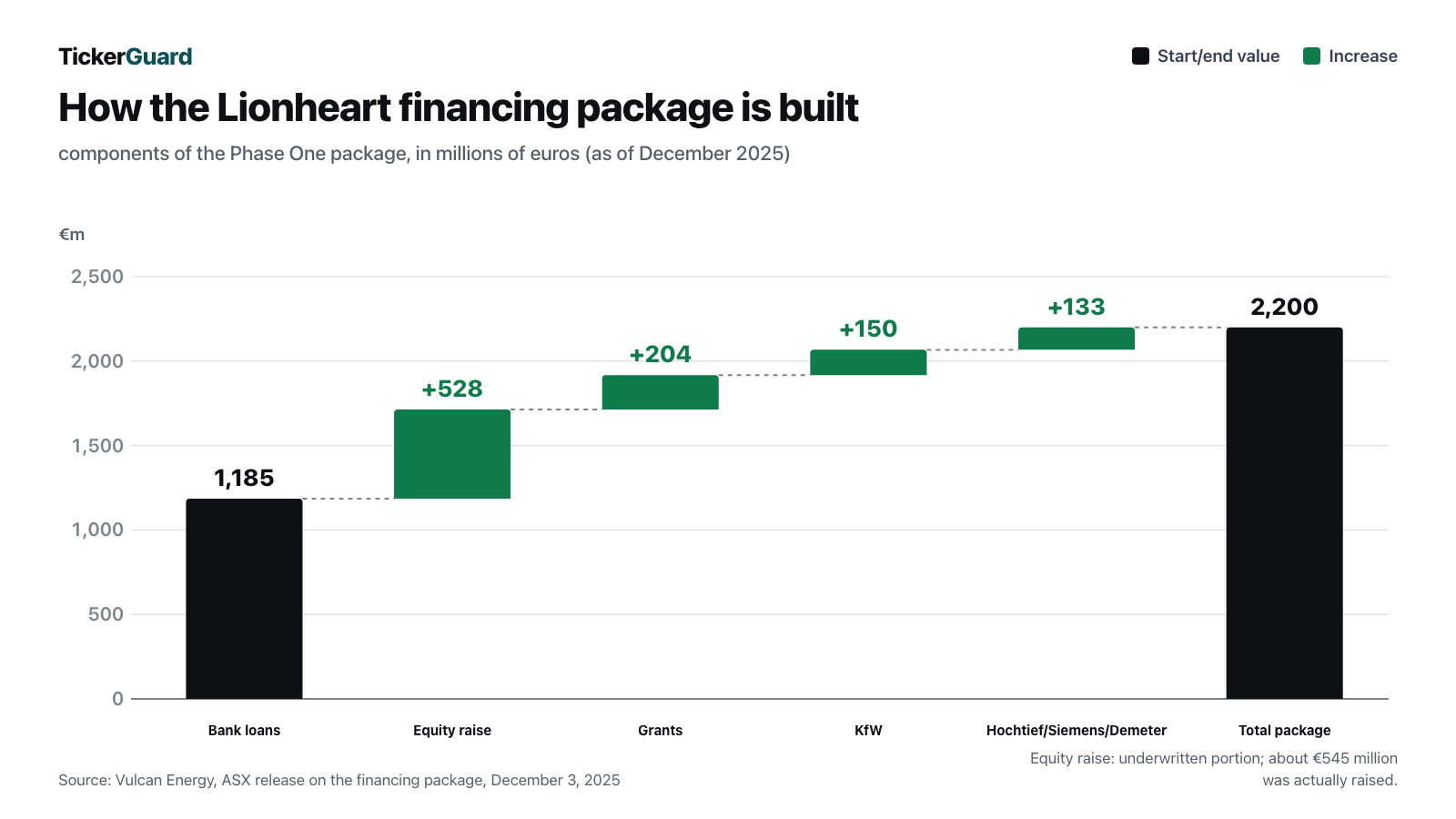
First, what genuinely impresses, without qualification. Vulcan has done what many resource developers fail at: the final investment decision came on December 3, 2025, and the financing package of about €2.2 billion reached financial close on May 28, 2026. The building blocks: €1,185 million in loans from 13 lenders, including the European Investment Bank and five government export credit agencies; €204 million in federal and state grants; €150 million from KfW through its raw materials fund; €133 million from Hochtief, Siemens Financial Services and Demeter; and an equity raise whose underwritten portion came to €528 million.
On site, too, there is evidence rather than promises. In March and September 2026, the mining authority of Rhineland-Palatinate granted the first two lithium production licences in the Upper Rhine Valley, the state exempted lithium production from its royalty, and since September 2026 Vulcan has been producing its VULSORB filter material at commercial scale. In the first half of 2026, two more production and re-injection wells were completed, with temperatures and lithium grades within the expected range.
Now the sober part. A company under construction does not make money yet, and it shows. Revenue was €6.8 million in 2023, €8.1 million in 2024 and €7.4 million in 2025. In the first half of 2026 it fell to €2.3 million from €4.1 million a year earlier, because both existing geothermal plants were shut down for maintenance and repair. The net loss grew from €27.0 million (2023) to €42.4 million (2024) and €69.6 million (2025). The first half of 2026 added another €51.8 million, including a €12.7 million foreign-exchange loss that, according to the report, involved no cash, and €11.8 million in finance costs. What sits behind that figure is one of the punch lines of this analysis.
The balance sheet as of June 30, 2026, on the other hand, is solidly built: €945.6 million in assets, €479.4 million of it in property, plant and equipment, against only €120.1 million in liabilities. There was no bank debt at that date, because not a single euro of the loans had been drawn.
Uncomfortable Truth No. 1: Your Slice of the Pie Has Shrunk on Two Levels
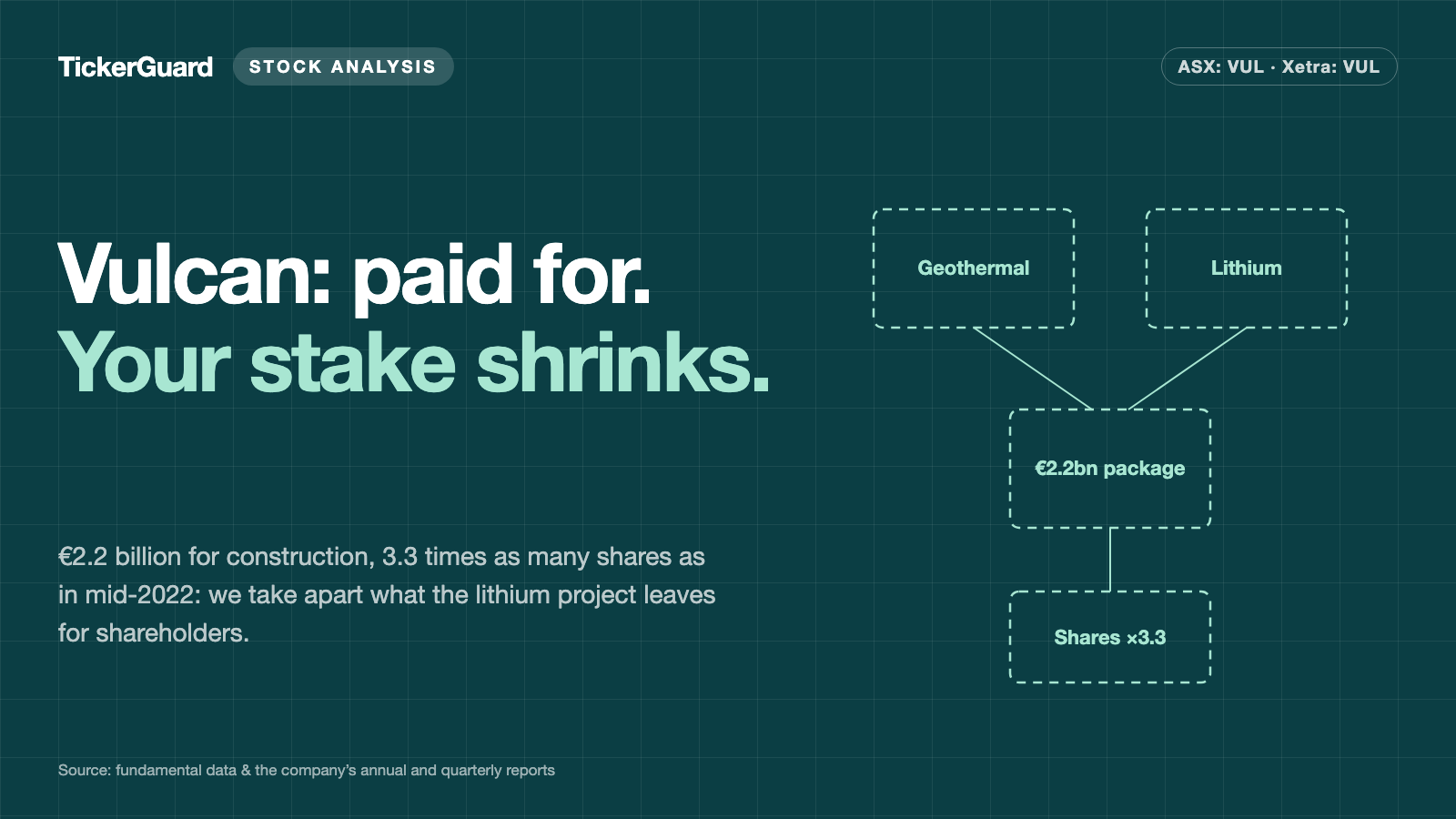
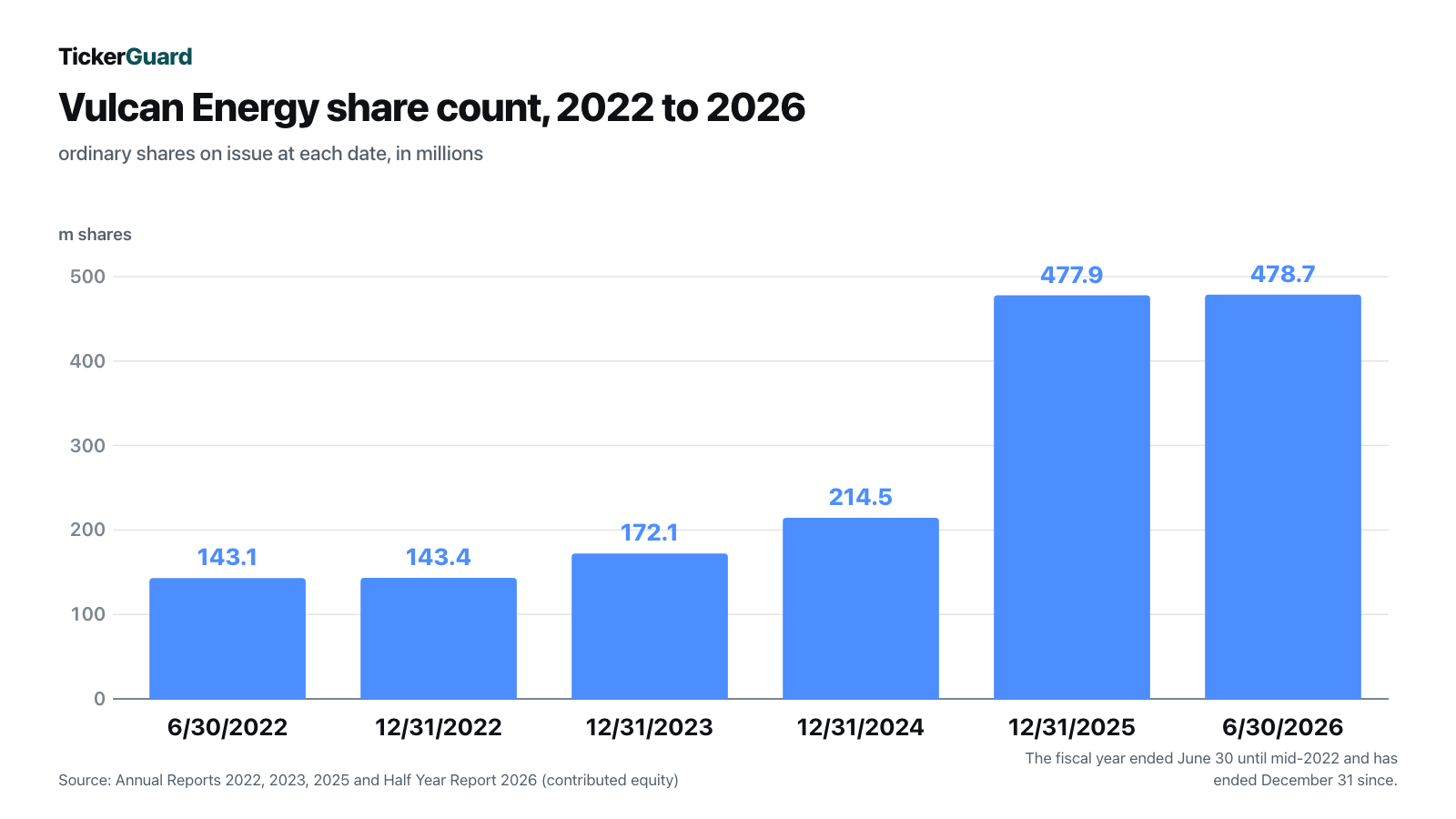
The first level is the stock itself. Dilution is what happens when a cake is cut into more and more slices: the cake may grow, but your slice still gets smaller. On June 30, 2022, Vulcan had 143.1 million shares on issue; by June 30, 2026, it had 478.7 million — 3.3 times as many. The biggest jump came in December 2025: to fund its share of the package, Vulcan raised about €545 million by selling new shares at A$4.00 (€2.24). That was 34.7 percent below the last traded price of A$6.13 before the announcement.
Who bought is revealing. According to the release announcing the completion of the retail offer at the end of December 2025, eligible retail shareholders applied for only about 7.7 million new shares; according to the placement release of December 4, 2025, up to roughly 91 million were to be offered to them. About 58 million went to Hochtief, which had agreed to take up any shortfall of up to €130 million. Since then the German construction group has been Vulcan's largest notified shareholder with 15.41 percent (shareholder information as of March 20, 2026). On October 8, 2026, the stock traded 62 percent below the A$4.00 issue price of that raise.
The second level is less visible. Lionheart no longer belongs entirely to Vulcan. Since May 27, 2026, KfW has held 14.49 percent of the German holding company Vulcan Energie Ressourcen GmbH, and the investment vehicle of Hochtief, Siemens Financial Services and Demeter has held 10.35 percent of the project company VER GEO LIO GmbH. Those investors are paid not in cash but in additional stakes:
“The preferred shares do not carry cash dividend entitlements. Instead, investors are entitled to a Payment-in-Kind ("PIK") dividend entitlements, which accrue over time and will be settled through the issue of ordinary shares in accordance with the terms of the investment agreements.”
— Vulcan Energy Resources, Half Year Report 2026, Note 20 Non-controlling Interests

What that means in numbers is spelled out in the December 2025 terms: the investor group starts with about 10 percent of the project company (10.35 percent as of June 30, 2026), and through the payment-in-kind mechanism — in the words of the terms, “growing by 15% p.a.” — its stake rises to 15 percent by Lionheart's completion. Every quarter of construction costs the Vulcan shareholder a small piece of the project. Remember: building with partners means sharing the risk, but also the profit — and at Vulcan, two partners share on two different levels.
Uncomfortable Truth No. 2: The Money Only Comes When the Construction Site Delivers
“Fully funded” sounds like a bulging bank account. It isn't. The €2.2 billion consists of commitments paid out in installments, and every installment comes with conditions. The half-year report says so with unusual clarity in its going-concern section:
“Drawdowns under the strategic equity and debt facilities are linked to the achievement of defined project milestones. Accordingly, the Group’s ability to continue as a going concern is dependent not only on the availability of committed funding, but also on the Group’s capacity to execute its development plan in line with agreed timelines and performance criteria.”
— Vulcan Energy Resources, Half Year Report 2026, Note 1(d) Going Concern

For context, so no false impression arises: the directors see no material uncertainty about the company's survival, and RSM's review of the half-year accounts contains no such warning. The question is a different one — how much cushion is left before the first loan drawdown. According to the quarterly report, that drawdown is expected in the first quarter of 2027. Until then, Vulcan builds with its own cash and the installments from its strategic investors, the first of which arrived in July 2026. Cash fell from €517.8 million at the end of 2025 to €193.9 million on June 30, 2026. On top of that come €80.0 million in term deposits accessible only after more than 90 days and €42.5 million held as collateral. In the second quarter of 2026 alone, Vulcan paid €92.0 million for property, plant and equipment, and according to the interim management report, capital spending is set to keep rising as construction progresses.
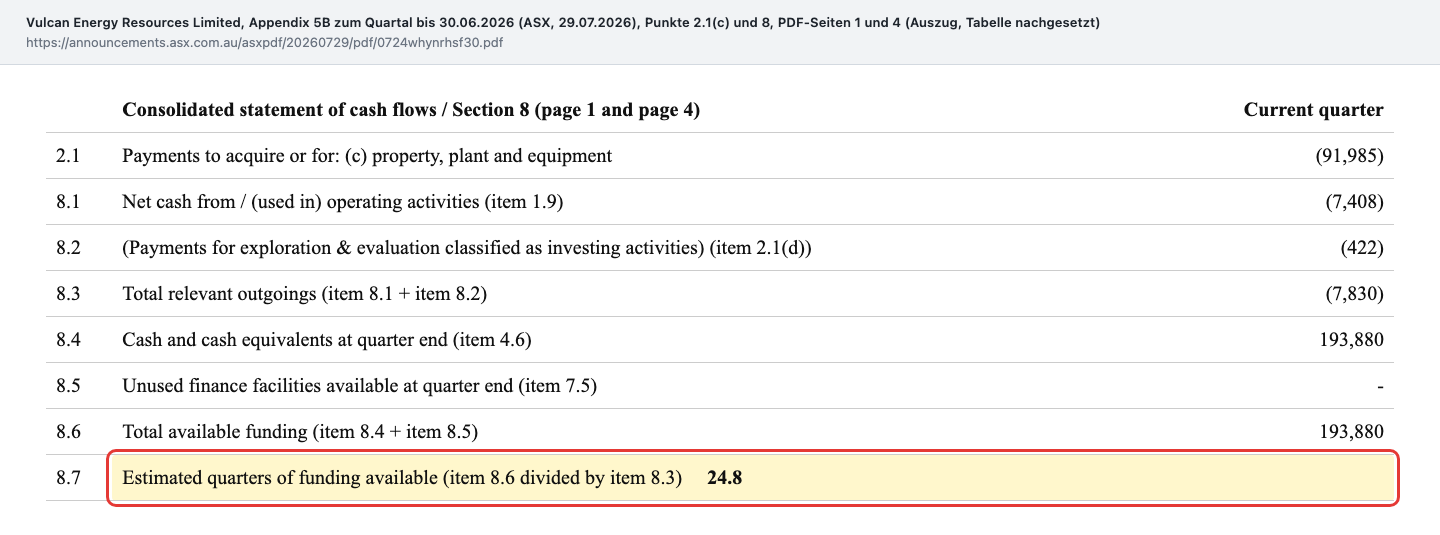
This is where the cash flow statement filed with the ASX contains a figure worth knowing. Australian resource companies must calculate every quarter how many quarters their money will last. Vulcan arrives at 24.8 quarters — more than six years. But the formula counts only ongoing operating and exploration outflows of €7.8 million a quarter, not construction spending, which in the same quarter was almost twelve times as high.
Then there are the €11.8 million in finance costs for the half year. €8.0 million of that are commitment fees — what banks charge for keeping a loan available — or just under one-sixth of the half-year loss, for loans of which not a euro had been drawn. On top of that comes an obligation that only the shareholder carries: Vulcan has given the lenders a completion guarantee and, until Lionheart is completed, may spend no more than €100 million outside the project on other ventures (with an option to extend by another €100 million).
Uncomfortable Truth No. 3: The Banks Assume a Different Lithium Price
Every project stands or falls with the price it gets for its product. Vulcan disclosed the economics behind its December 2025 investment decision: construction costs of €1,476 million including a 15 percent contingency, an average realized price of €20,456 per metric ton of lithium hydroxide over the first ten years, and on that basis average annual revenue of €566 million and EBITDA of €427 million — a 75 percent margin, calculated on 100 percent of the project.
The lenders built their repayment schedule on a different world. The loan terms state, in a parenthesis, which prices they assume for the first years of production:
“100% cash sweep to repay the unpaid balance (if applicable) of the difference between the Target Principal Repayments Profile and the Scheduled Principal Repayments Profile (which assumes LHM prices of US$8,000/t, US$9,000/t and US$12,000/t for 2030, 2031 and 2032 respectively)”
— Vulcan Energy, ASX release on the financing package, December 3, 2025, Annexure 1 (key terms of debt financing)

Let's translate. At the euro reference rate of October 8, 2026, €20,456 equals about $22,900 (our conversion). For the scheduled repayment profile, the banks therefore assume only about a third to just over half of that price. This compares a ten-year average with three individual years, and the reports we reviewed do not give a current market price for lithium hydroxide — the gap shows the banks' caution, not today's market. That is neither a contradiction nor a scandal, since banks usually calculate more cautiously than builders. But it shows who gets paid first: until the debt falls below €0.9 billion, 60 percent of excess cash goes to the lenders, and distributions from the project company are allowed only after completion, which the loan agreements schedule for December 31, 2029.
Remember: if the lithium price ends up closer to the banks' case than to the investment case, Lionheart is still paid for. But the shareholder at the back of the line is left with considerably less. In its 2026 interim management report, the company writes that lithium prices recovered in early 2026 from their June 2025 lows, but that short-term volatility is likely to continue. According to CEO Cris Moreno, the offtake agreements provide “robust downside price protection”; the reports we reviewed do not disclose the pricing formulas themselves.
Uncomfortable Truth No. 4: The Largest Shareholder Is Also a Builder
Hochtief appears in this story in four places. The construction group is Vulcan's largest shareholder with 15.41 percent. It invested €39 million directly in the project company as part of the investment vehicle with Siemens Financial Services and Demeter. In a joint venture with Sedgman, it manages engineering, procurement and construction of both lithium plants, a contract with an estimated value of about €72 million. And it has a seat on the board:
“The appointment was made pursuant to the terms of the HOCHTIEF cornerstone investment as part of Vulcan’s Lionheart financing package”
— Vulcan Energy Resources, quarterly report for the period ended June 30, 2026, page 2, on the appointment of Hochtief Chief Strategy Officer Roberto Gallardo in April 2026
All of this is disclosed and nothing unusual for large projects. But the interests are not identical. As construction manager, Hochtief earns from building; as project investor, from its growing stake; and only as a shareholder from whatever is left for everyone in the end. There has also been a shift at the top: according to the release of September 10, 2026, founder Francis Wedin handed the board chair to deputy chair Angus Barker effective September 12; according to his final director's interest notice, he left the board on September 11 holding 15.7 million shares directly and another 0.8 million through a related company, about 16.5 million or roughly 3.4 percent in total. He remains connected to the company in a founder consultancy role focused on growth projects.
What the Stock Costs
At the closing price of A$1.525 on October 8, 2026, and 478.7 million shares, Vulcan is worth about A$730 million, or roughly €453 million (euro reference rate of October 8, 2026). A price-to-earnings or price-to-sales ratio makes no sense for a company without lithium revenue. That leaves book value: equity attributable to Vulcan's shareholders stood at €684.2 million on June 30, 2026. The market therefore values Vulcan at about 0.66 times book.
That sounds cheap, but it is a snapshot in the middle of construction. Book value consists largely of construction work and cash, and the cash is earmarked for the build. One of the company's own figures helps as a yardstick: in December 2025, Vulcan put Lionheart's post-tax net present value at €1,152 million, calculated on 100 percent of the project — that is, before the stakes of KfW and the investors, and using its own price scenario. A rough calculation of our own turns that into the shareholders' portion: assuming the project company is held entirely through the German holding company — as the financing release suggests, since KfW contributes pro rata to the holding company's contributions to Lionheart — Vulcan shareholders keep 85.51 percent times 89.65 percent, or about 77 percent of the project, and about 73 percent at completion once the investor group holds 15 percent. Applied to the net present value, that would be about €840 million using the stake at completion. This is explicitly not a valuation: the net present value applies as of the investment decision, excludes financing costs and uses the company's price scenario, not the banks'. Whether the market value below that is too low or realistic depends on exactly the three questions of the previous chapters: how much of the project will the shareholders own in the end, will the money arrive on schedule, and which lithium price applies?
The outlook is documented, too: on September 3, 2026, Vulcan presented a pre-feasibility study for a second phase called Ludwig near Ludwigshafen, with €1.26 billion in construction costs and 21,100 metric tons of lithium carbonate a year. The investment decision is planned only after Lionheart's successful start-up, and according to the release the search for strategic partners is already under way. Until Lionheart is completed, the loan terms cap Vulcan's spending outside the project at €100 million anyway.
Opportunities and Risks at a Glance
What speaks for Vulcan Energy:
- Financing for Phase One reached financial close on May 28, 2026: €2.2 billion from loans, grants, the KfW stake, industrial partners and the equity raise; the first installment from the strategic investors arrived in July 2026.
- Permits and licences are in place, including two lithium production licences (March and September 2026) and a royalty exemption; production of the proprietary filter material has been running since September 2026.
- The entire output of the first years is sold under binding offtake agreements with Stellantis, Umicore, LG Energy Solution and Glencore.
- The balance sheet holds up: €945.6 million in assets against €120.1 million in liabilities as of June 30, 2026, no bank debt, no material uncertainty about the going concern.
What speaks against Vulcan Energy:
- The share count has risen 3.3-fold since mid-2022, most recently through a raise at A$4.00; on October 8, 2026, the stock traded 62 percent below that.
- At the project level, KfW (14.49 percent of the holding company) and the investment vehicle of Hochtief, Siemens and Demeter (10.35 percent, growing to 15 percent) hold stakes of their own.
- Loans and investor installments flow only as milestones are met; until the first loan drawdown in the first quarter of 2027, Vulcan has to build with cash and investor installments, with €92.0 million in construction spending in the second quarter of 2026 alone.
- The banks' repayment schedule assumes $8,000 to $12,000 per metric ton, the investment case about €20,456; distributions from the project are only possible after completion.
- The largest shareholder, Hochtief, is also a project investor, the construction manager and represented on the board.
A Human Conclusion
Remember the groundbreaking photo? It is real, and it shows something real: Vulcan has taken a project that, according to the company, is set to become Europe's first fully domestic lithium supply chain all the way to a construction site, bringing banks, governments and industry to the same table. That deserves respect. But the availability heuristic quickly turns that picture into a conclusion the reports do not support — that construction also secures the shareholder's return.
The notes tell the second half of the story. Three times as many shares as in 2022, two partners with their own stakes in the project, loans only against milestones, and a repayment schedule that assumes a far lower lithium price than the company does. The next test comes with the quarterly report for the period ended September 30, 2026, due by the end of October: how much did construction cost, how much money came from the partners, and is the path to the first loan drawdown holding? If the groundbreaking photo is what you picture when you think of Vulcan, put the cash flow statement right next to it. What you make of this is your decision. And that is how it should be.
Sources
- Vulcan Energy Resources — Half Year Report 2026 (half year to June 30, 2026, published September 10, 2026; reviewed by RSM Australia Partners; latest periodic report)
- Interim Management Report 2026 (September 10, 2026; employees, outlook)
- Quarterly activities report for the period ended June 30, 2026 and Appendix 5B cash flow report (July 29, 2026)
- Annual Report 2025 (March 27, 2026; offtake agreements, shareholder information as of March 20, 2026) and the Annual Reports 2022 and 2023 (share counts, losses)
- Financing package and final investment decision (December 3, 2025, with annexures on the loans, grants, KfW and the investment vehicle), EPCM contract with Sedgman and Hochtief (December 3, 2025)
- Equity raise: institutional placement (December 4, 2025) and completion of the retail entitlement offer (late December 2025)
- ASX releases 2026: groundbreaking at Höchst (April 24), financial close (May 28), first investor installment (July 15), Ludwig pre-feasibility study (September 3), change of board chair (September 10), second production licence (September 11), final director's interest notice, Francis Wedin (September 14), VULSORB production (September 21)
- European Central Bank — euro reference rates of October 8, 2026 (A$1.6110 and $1.1186 per euro)
- Source: fundamental data & the company's annual and quarterly reports (closing price October 8, 2026)
This analysis is a journalistic assessment based on publicly available company reports. It is not investment advice and not a solicitation to buy or sell securities. Stocks can lose value, up to a total loss. All figures carry the date of their source; prices are dated snapshots. Positions held by the operator are disclosed daily; where one exists, it appears as a notice at the top of this deep dive.
Our Bottom Line at a Glance
- Financing and permits positive
- The roughly €2.2 billion package for Phase One reached financial close on May 28, 2026, and the first investor installment arrived in July 2026. Two lithium production licences (March and September 2026) and the construction permits are in place.
- Sales positive
- According to the 2025 annual report, output from the first years is committed under binding take-or-pay offtake agreements with Stellantis, Umicore, LG Energy Solution and Glencore, running six to ten years.
- Earnings and revenue negative
- With no lithium revenue, the loss keeps growing: €27.0 million in 2023, €69.6 million in 2025 and €51.8 million in the first half of 2026 alone. Revenue from power and heat fell to €2.3 million in the half year.
- Dilution negative
- The share count rose 3.3-fold from mid-2022 to mid-2026 (478.7 million). At the project level, KfW holds 14.49 percent of the holding company and an investment vehicle 10.35 percent of the project company, growing to 15 percent.
- Liquidity until the loan drawdown neutral
- On June 30, 2026, Vulcan had €193.9 million in cash and €80.0 million in term deposits, against €92.0 million in construction spending in the second quarter. The first loan drawdown is planned for the first quarter of 2027 and is tied to milestones.
- Price assumptions and ranking negative
- The banks' repayment schedule assumes $8,000 to $12,000 per metric ton for 2030 to 2032, the investment case about €20,456. Distributions from the project are allowed only after completion, scheduled for the end of 2029.
Vulcan Energy has financed its Lionheart lithium and geothermal project with about €2.2 billion and taken it into construction. Less of it is left for shareholders than the headlines suggest: 3.3 times as many shares as in mid-2022, partners with their own stakes in the project, loans only against milestones and a repayment schedule built on much lower lithium prices. At A$1.525 (October 8, 2026), Vulcan was worth about A$730 million. Not investment advice.
What Our Rating Means
Open questions
The business works in principle, but one material question is open. As long as it stays open, our findings do not carry a quality verdict.
Yellow — deliberately neither green nor red. Not red, because no threat to the company's substance is documented: the directors see no material uncertainty about the going concern, the review of the half-year accounts contains no such warning, there is no bank debt yet, and the Phase One financing has reached financial close. Not green, because the decisive operating question is still open: Vulcan has no lithium revenue yet, the money flows only against milestones, cash has to carry construction until the first loan drawdown in the first quarter of 2027 — construction that cost €92 million in the second quarter of 2026 alone — and the economics hinge on a lithium price that the banks put considerably lower for the first years. That shareholders now own a smaller part of Lionheart through equity raises and partners at the project level is a question of price and ownership, not of quality — but it belongs in an honest assessment. The decision is yours.
A journalistic assessment by our editorial team at the time of the deep dive, based on public sources — not investment advice and not a solicitation to buy or sell. Your personal circumstances (investment goals, risk capacity, taxes) cannot be taken into account. What our levels mean, how verdicts are formed, and what conflicts of interest exist →
Worth Noting
- This analysis was prompted by the wallstreet-online forum ranking (stocks most discussed by German retail investors) as of October 9, 2026. There is no hit from our in-house stock scanner: the company has no lithium revenue. The common thread is the availability heuristic: images of construction progress feel more certain than the numbers are for shareholders.
- On the evidence: Vulcan Energy is not an SEC filer; VULNF is a US over-the-counter symbol without its own reporting obligation (no SEC identifier, checked on October 9, 2026). All company figures come from the original ASX documents: Half Year Report 2026 (reviewed by RSM), Interim Management Report 2026, quarterly report and Appendix 5B to June 30, 2026, Annual Reports 2022, 2023 and 2025 and ASX releases up to September 22, 2026. The quarterly report for the period ended September 30, 2026, had not yet been published as of October 9, 2026.
- Our own calculations: share count multiple (478.7 vs. 143.1 million), market value (478,660,737 shares times A$1.525, matching the ASX figure of A$729.96 million), euro conversion and price-to-book (about €453 million vs. €684.2 million), ratio of construction spending to counted outflows in the second quarter of 2026 (€92.0 vs. €7.8 million), conversion of the investment-case price of €20,456 into about $22,900, distance between share price and the A$4.00 issue price, the shareholders' look-through stake in the project (85.51 times 89.65 percent = about 77 percent; at completion 85.51 times 85 percent = about 73 percent; assumption: project company held entirely through the German holding company) and its application to the net present value of €1,152 million (about €840 million). Conversions at the ECB reference rate of October 8, 2026 (A$1.6110 and $1.1186 per euro).
- Hochtief stake: 15.41 percent according to the shareholder information in the 2025 annual report (as of March 20, 2026). The substantial-holder notices published after that, up to September 22, 2026, came from State Street, VanEck and Citigroup, not from Hochtief. Wedin holding according to the Appendix 3Z of September 14, 2026: 15,655,785 shares directly plus 812,500 shares through Magni Associates Pty Ltd, a related party, for a total of 16,468,285 shares (about 3.4 percent of 478,660,737).
- Prices: closing price of A$1.525 on the ASX on October 8, 2026 (fundamental data); year-end 2025 closing price of A$4.41 according to the 2025 annual report.
Stock Watch
This analysis is as of October 9, 2026. Stock Watch will tell you what's changed at VUL.AU since then.
Later $1 a month per stock — signing up is free, and you'll be the first to know when it launches.
The full analysis as a PDF for later
We will send you this analysis as a PDF — to print, file away, and read at your own pace. And we will add you to the free Stock Watch list for Vulcan Energy Resources Limited (VUL.AU), so you hear about it when something material in this analysis changes.
Frequently Asked Questions
Vulcan Energy is building the Lionheart project in Germany's Upper Rhine Valley: hot deep water supplies heat and power, the lithium dissolved in it is extracted in Landau and processed into battery-grade lithium hydroxide at the Höchst industrial park in Frankfurt. The target is 24,000 metric tons a year from 2028. Today, its small revenue comes from power, heat and drilling services.
Legally, no. Vulcan Energy Resources Limited is an Australian company headquartered in Perth, with its home listing on the ASX (ticker VUL) and an additional listing on the regulated market of the Frankfurt Stock Exchange. Its operations, however, are entirely in Germany, where its subsidiaries are based in Karlsruhe. It reports in euros.
Commitments of about €2.2 billion reached financial close on May 28, 2026. The money flows in installments, though, and only when defined project milestones are met. Vulcan plans its first loan drawdown for the first quarter of 2027; until then, construction is paid for from its own cash and the installments from its strategic investors.
The number of shares rose from 143.1 million on June 30, 2022, to 478.7 million on June 30, 2026, a 3.3-fold increase. The biggest step was the December 2025 equity raise at A$4.00. In addition, KfW and an investor consortium hold stakes of their own at the level of the holding company and the project company.
Hochtief is the largest shareholder with 15.41 percent (as of March 20, 2026), has invested €39 million in the project company, manages engineering, procurement and construction of the lithium plants in a joint venture with Sedgman and, since April 2026, has had a board seat through Roberto Gallardo. The roles are disclosed, but the interests are not identical.
Not for the foreseeable future. The 2026 half-year report provides for no dividend, and under the loan terms the project company may distribute cash only after Lionheart is completed. The loan agreements schedule completion for December 31, 2029; after that, repayments to the banks come first.
Found an error?
Did you spot a factual error, an outdated number, or a typo in this deep dive? Let us know briefly — your report goes straight to the editorial team.