q.beyond: The cash is half the company — and it is being spent right now
At mid-2026, about half of today’s market value of Cologne-based IT services provider q.beyond sat in its bank account as cash. But the 2025 profit only happened thanks to one-off income, and the 2026 outlook was cut by more than half three months after being confirmed. We read the annual report, the half-year report and every announcement through October: a buyback, an acquisition and an AI restructuring are eating into the cash. A cushion only helps as long as nobody takes money out of it.
 Thomas Mücke
Founder & Publisher
Thomas Mücke
Founder & Publisher
Chart
Interactive price chart (TradingView).
Note: pure fact-based analysis, not investment advice and not a solicitation to buy or sell. All figures without guarantee.
The cash alone plus its own data center in Hamburg are worth more than the entire company on the stock market — q.beyond prints that analyst’s argument in its own annual report:
“The analyst pointed out that merely q.beyond’s existing net liquidity and the value of its proprietary data centre in Hamburg exceeded its market capitalisation at the time.”
— q.beyond AG, Annual Report 2025, chapter “q.beyond shares,” page 16
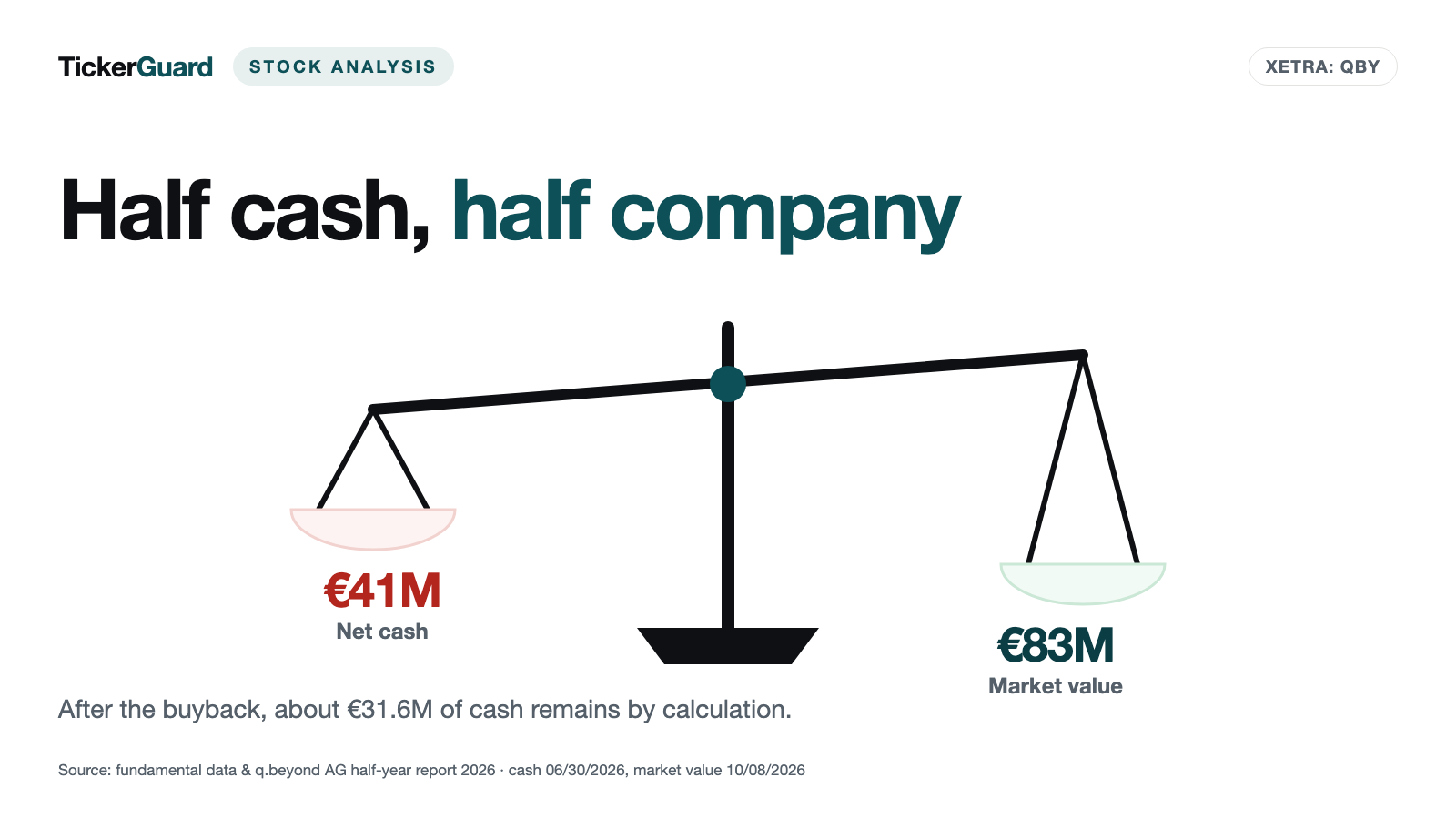
This is exactly where a thinking error kicks in that you could call the cash anchor. When a company holds a lot of cash, our brain anchors the value of the stock to that pile of money — and whispers: “Not much can go wrong here, the money is right there.” At q.beyond AG of Cologne, Germany, that anchor is heavy: as of June 30, 2026, the IT services provider had no bank debt and €41.0 million in net cash; on October 8, 2026, at €3.34 per share, the market valued it at about €83 million.
We test that anchor against what q.beyond has published since — the Half-Year Financial Report as of June 30, 2026 (published August 10, 2026), the ad hoc announcements of August 10 and August 25, 2026, and the final result of the share buyback of October 5, 2026. q.beyond is a German company and does not report to the U.S. securities regulator, the SEC; its own English-language reports are our sources. The central tension of this analysis: The cash makes the stock look safe. But 2026 is the year that cash goes to work — for a buyback, an acquisition and a restructuring that uses AI to cut the company’s own jobs, mainly in IT operations and administration. At the same time, the core business that is supposed to refill the cash box has just slipped back into the red. What is left once you let go of the anchor? In the end, you decide.
What q.beyond actually does — IT operations and consulting for mid-sized companies
q.beyond runs and modernizes the IT of mid-sized companies. The business has two parts. In its Managed Services segment, q.beyond takes over day-to-day operations: servers, cloud, workplaces, applications, often in its own data centers in Germany. That segment generated €54.5 million of the €85.9 million in revenue in the first half of 2026, or almost two-thirds. In its Consulting segment, q.beyond advises and develops, mainly around SAP, Microsoft and AI — €31.3 million in the half-year. Picture it this way: Managed Services is the building-maintenance contract, Consulting is the kitchen remodel. The maintenance crew comes every month; these days the remodel carries the better margin (gross margin in the first half of 2026: 22 versus 17 percent).
The strength of this model is repetition: 71 percent of revenue in the second quarter of 2026 was recurring, and according to the half-year report, contracts run for 48 months on average. Customers come mainly from retail (25.0 percent of half-year revenue), manufacturing (19.2 percent), logistics (13.1 percent) and banking and insurance (10.0 percent). As of June 30, 2026, the group had 1,133 employees, with locations in Germany as well as Latvia, Spain, Romania, India and the U.S.
Longtime investors know the stock under a different name. Until September 2020, the company was called QSC AG, listed on the Frankfurt Stock Exchange since April 19, 2000. In 2019, QSC sold its telecommunications subsidiary Plusnet to the German utility EnBW and became a pure IT services provider. According to the company’s shareholder page, founders Bernd Schlobohm (chairman of the supervisory board) and Gerd Eickers together held 25.36 percent of the shares as of September 30, 2026 (12.70 and 12.66 percent). How another German mid-sized IT company whose founders are also its largest shareholders is doing is covered in our Serviceware analysis.
One detail you need to know before you look at any price chart. On January 30, 2026, an extraordinary shareholders’ meeting approved consolidating every five old shares into one new share — a reverse split. Since March 12, 2026, only the new share trades (ISIN DE000A41YDG0), at five times the price in purely arithmetic terms. Think of it as swapping five one-dollar bills for a five-dollar bill: you are no richer. The year-end 2025 closing price of €0.69 thus became roughly €3.45. Where price data simply chains the old and the new share together without adjustment, it shows an apparent jump of several hundred percent. That jump never happened. Why the move? The annual report says it openly:
“Others avoid investing in smaller second-tier stocks and especially in “penny stocks”, i.e. shares listed below the 1 euro mark.”
— q.beyond AG, Annual Report 2025, chapter “q.beyond shares,” page 16
The second reason was more tangible: the capital reduction offset the old accumulated deficit under German accounting rules and thereby created the legal basis for share buybacks and future dividends. The company made use of that this fall — more on that below.
Company history for investors
-
2000
IPO as QSC AG
Listed on the Frankfurt Stock Exchange since April 19, 2000, in the Prime Standard since 2003. Longtime shareholders still know the stock under its old name.
-
2019
Sale of Plusnet
QSC sells its telecom subsidiary Plusnet to EnBW and becomes a pure IT services provider. A late payment from that sale still lifted 2025 earnings by €2.6 million.
-
2020
QSC becomes q.beyond
In September 2020, q.beyond AG emerges from QSC AG. For shareholders, the name changes, not the security.
-
2025
Back in the black
Net income €1.6 million, EBITDA €12.3 million — with €2.6 million of one-off income from the Plusnet sale. Without it, a loss would have remained by calculation.
-
2026
March: 5-to-1 reverse split
Since March 12, only the new share (ISIN DE000A41YDG0) trades, at five times the price. The value of your stake is unchanged, and buybacks become possible.
-
2026
August: outlook cut
2026 EBITDA target cut from €10M–€16M to €3M–€7M, net loss expected. At the same time, a majority stake in GITG, price undisclosed.
-
2026
October: 10% of shares bought back
2,490,905 shares at €3.78 for about €9.42 million, almost twice oversubscribed. Cash shrinks; whether the shares will be canceled is open.
How the stock landed on our desk
Through other investors’ curiosity: on October 8, 2026, q.beyond appeared on the most-discussed list of the German investor portal wallstreet-online. That is an attention signal and expressly not a reason to buy — a stock gets discussed because it interests someone, not because it is good. The trigger was obvious: three days earlier, q.beyond had reported the result of its first share buyback, and the offer was almost twice oversubscribed. For our in-house stock scanner, the stock is a tricky case: before March 12, 2026, only prices of the old share exist, so every twelve-month metric mixes two price levels. We therefore rely on the reports here.
The numbers over the years — an honest assessment
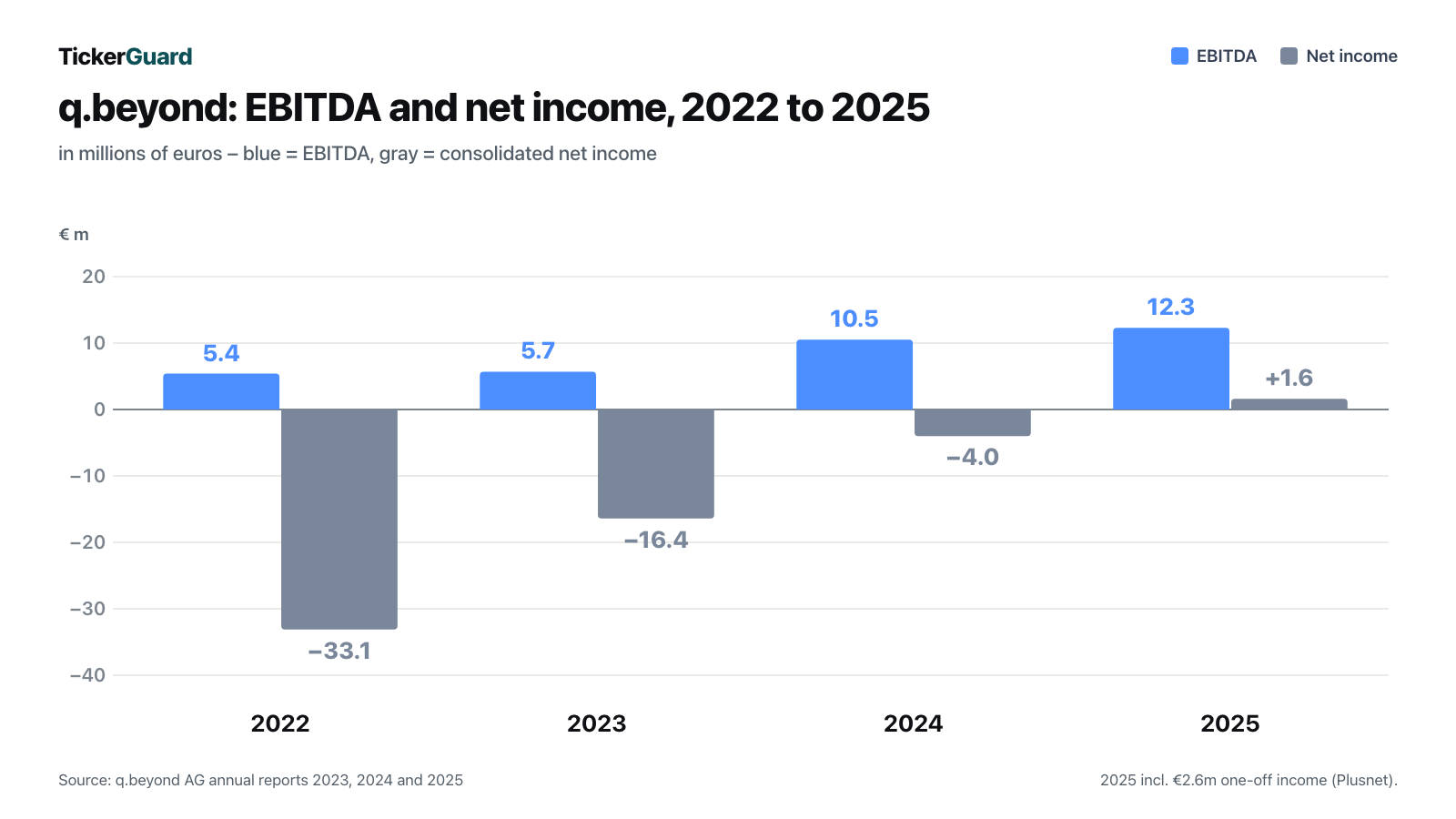
First, what is genuinely impressive. Since launching its “2025 Strategy” in spring 2023, q.beyond has turned a loss-maker into an operation that makes money. EBITDA — earnings before interest, taxes, depreciation and amortization, roughly what day-to-day business throws off — rose from €5.4 million (2022) to €5.7 million (2023), €10.5 million (2024) and €12.3 million in 2025. Consolidated net income improved from a loss of €33.1 million to losses of €16.4 million and €4.0 million, then to a profit of €1.6 million. Free cash flow was positive in 2023, 2024 and 2025 (€1.7 million, €3.2 million and €5.5 million), and net cash rose from €35.9 million at the end of 2022 to €42.0 million at the end of 2025.
Revenue tells a different story: €173.0 million (2022), €189.3 million (2023), €192.6 million (2024), €182.6 million (2025). Part of the decline was deliberate — q.beyond says it walked away from low-margin contracts — and part reflected the investment slump among German mid-sized companies. Then, in the first half of 2026, the picture flipped: revenue fell 5 percent to €85.9 million, EBITDA dropped from €5.1 million to €3.1 million, and the bottom line showed a net loss of €2.0 million. The bright spot is Consulting: gross profit — revenue minus the direct cost of delivering the service — rose from €4.3 million to €6.8 million in the half-year, and the gross margin in the second quarter climbed from 15 to 26 percent.
Uncomfortable truth No. 1: The first profit in years had help
“As planned, our company returned to profitability in the past year,” q.beyond writes in its 2025 annual report. That is true. But part of that profit did not come from the IT business — it came from the past, namely the 2019 sale of Plusnet. Only in 2025 was the tax audit of that sale completed, which allowed an outstanding contractual component with the buyer to be settled:
“This resulted in one-off other operating income and a corresponding inflow of liquidity of € 2.6 million in the past financial year.”
— q.beyond AG, Annual Report 2025, Group Management Report, “Business Performance,” page 33
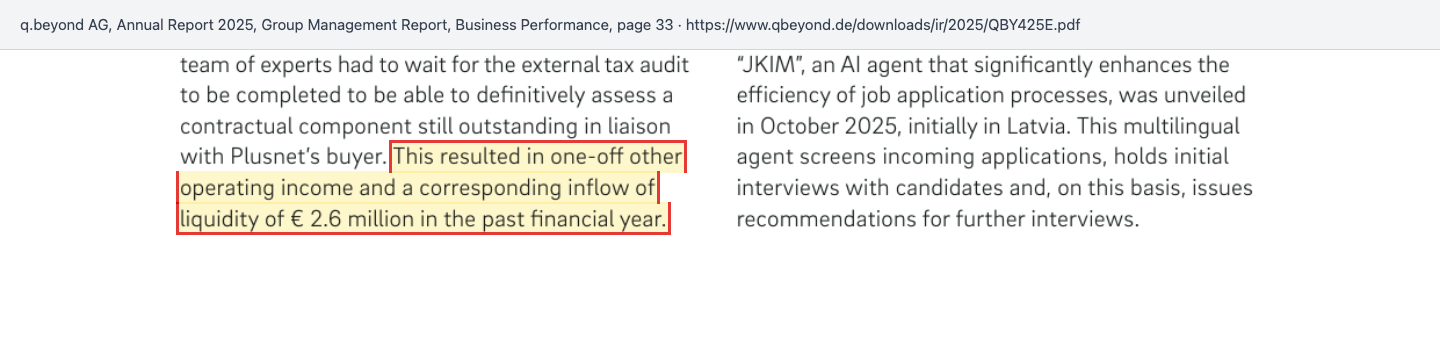
Do the math: other operating income rose from €1.5 million to €4.6 million in 2025, mainly because of this one-off item. Without the €2.6 million, EBITDA would have come in at about €9.7 million — below the €10.5 million of 2024. And the €1.6 million profit would arithmetically have turned into a loss of about €1.0 million (our calculation, before tax effects). That does not make the progress since 2022 any smaller; it is real. But the 2025 break-even rested on income that will not recur. Rule of thumb: when a company announces it is “back in the black,” read the other operating income first.
Uncomfortable truth No. 2: Confirmed in May, cut by more than half in August
On May 11, 2026, with its first-quarter statement, q.beyond confirmed its 2026 outlook: revenue of €182 million to €190 million, EBITDA of €10 million to €16 million, a net profit and positive free cash flow. On August 10, 2026, at 7:29 a.m. local time, the ad hoc announcement came. The half-year report published the same day states:
“We are therefore adjusting the outlook and now expect to generate revenues of between € 176 million and € 180 million (previously between € 182 million and € 190 million), EBITDA of € 3 million to € 7 million (previously: € 10 million to € 16 million) and, as a result, negative consolidated net income and negative free cash flow.”
— q.beyond AG, Half-Year Financial Report as of June 30, 2026, Outlook, page 9
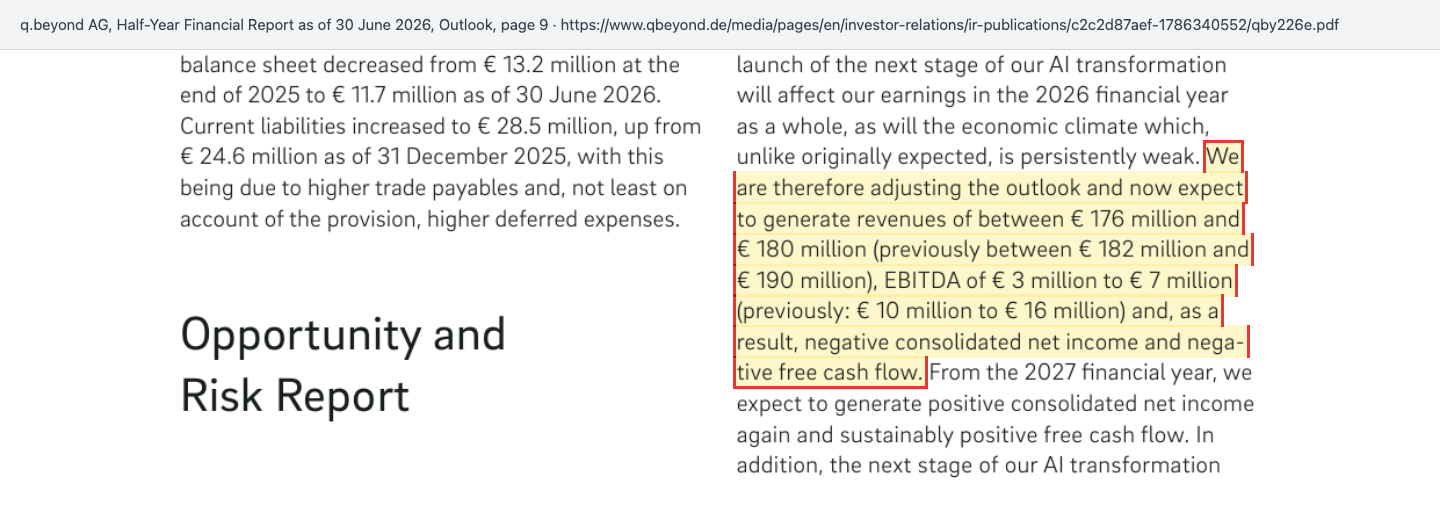
The midpoint of the EBITDA range thus fell from €13 million to €5 million, a drop of about 60 percent. q.beyond gives two reasons. The first is an accelerated restructuring with one-off costs of about €5 million to €6 million, of which €0.9 million was already booked in the second quarter; from 2027, it is supposed to save about €7 million a year. The second, according to q.beyond, is the persistently weak economy — and it hits above all the business of running customers’ IT. That is less comfortable because it is not a one-off. In Managed Services, half-year revenue fell 10 percent to €54.5 million, gross profit dropped from €13.4 million to €9.2 million, and the gross margin in the second quarter slid from 22 to 16 percent. Already in the business performance section on page 3, the half-year report says: “Price competition is tough, also when existing contracts are extended.” On the segment itself, q.beyond writes on page 8:
“We expect this to continue for several quarters before new sales initiatives and follow-up orders from the Consulting business result reverse the trend.”
— q.beyond AG, Half-Year Financial Report as of June 30, 2026, Earnings by Segment, page 8
That is honest, and it matters. The segment with the 48-month contracts is precisely the part that is supposed to make q.beyond “resilient.” If prices give way at renewal, recurring revenue still recurs — but a little smaller each time.
Uncomfortable truth No. 3: Two customers account for a quarter of revenue
The notes to the half-year report contain a sentence that is easy to skim past:
“In the first half of the 2026 financial year, two customers at the overall Group accounted for more than 10% of consolidated revenues (14% and 11% respectively). Of the revenues with these two major customers, 95% are reported in the Managed Services segment and 5% in the Consulting segment.”
— q.beyond AG, Half-Year Financial Report as of June 30, 2026, Notes, Section 5, page 24
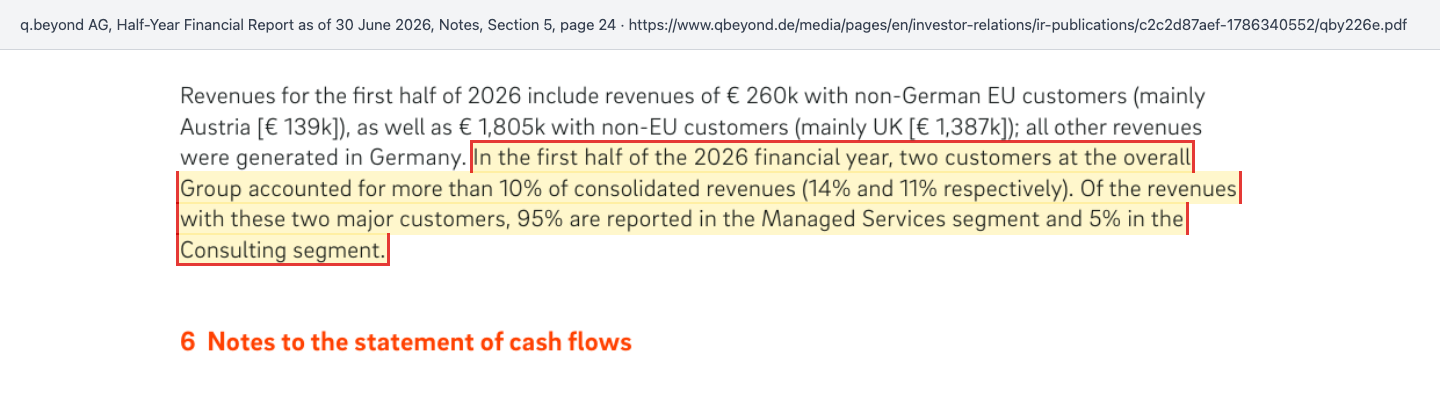
In plain terms: of €85.9 million in half-year revenue, about €21 million came from just two customers — almost entirely from the shrinking IT operations business. The report does not name them. In 2025, three customers were above the 10 percent threshold. That is a noticeable dependency: if one of the two switches providers, at least about €9 million of half-year revenue would go missing — three times the entire half-year EBITDA of €3.1 million. And even a price cut at renewal would, at these volumes, come straight out of the margin. Given this balance sheet, it is not an existential threat. But it explains why the sentence about tough price competition “also when existing contracts are extended” carries so much weight.
Uncomfortable truth No. 4: The AI q.beyond sells saves money at q.beyond first
q.beyond says it wants to establish itself as a “leading sovereign AI orchestrator for European SMEs”: its own AI platform in German data centers, in-house AI agents, and since the second quarter of 2026 a bookable service for the EU’s AI regulation (“AI Act as a Service”). By 2028, about 10 percent of revenue is supposed to come from this area. But the clearest evidence of what the technology can do comes from inside the company:
“By the end of July 2026, more than 300 processes had been fully automated. These activities previously required more than 6,000 working hours a month, equivalent to the capacity of nearly 40 full-time staff members.”
— q.beyond AG, Half-Year Financial Report as of June 30, 2026, Interim Group Management Report, page 4
According to the report, more than 1,000 further processes are in development. The consequence follows two pages later: the next stage of the AI transformation “will also involve cutting jobs, particularly in Managed Services and administration.” On top of that comes a new site in Cluj, Romania, with up to 50 employees by year-end, which is to handle AI-assisted round-the-clock customer support; the nearshoring and offshoring ratio, meaning the share of work done at sites in nearby and faraway countries, is to rise from 20 percent at the end of 2025 to 40 percent in 2028.
For q.beyond’s own cost base, that is good news — the announced €7 million in annual savings from 2027 would equal more than half of 2025 EBITDA. For the business model, it cuts both ways. Whatever q.beyond automates in-house, its customers can have automated too — and then they need fewer paid operating hours. An IT provider that runs other companies’ systems sells, to a large extent, exactly the kind of work AI is making cheaper. Our assessment: the price pressure in Managed Services could be related to this as well; the report itself cites the weak economy as the reason. Rule of thumb: when a company uses AI to shrink its own workload by 40 full-time staff, ask yourself how much work its customers will still want to pay for.
The cash: cushion, buyback money and purchase price
Back to the anchor. How much of the cash will still be there after this year? The chart shows what is documented — and what remains open.
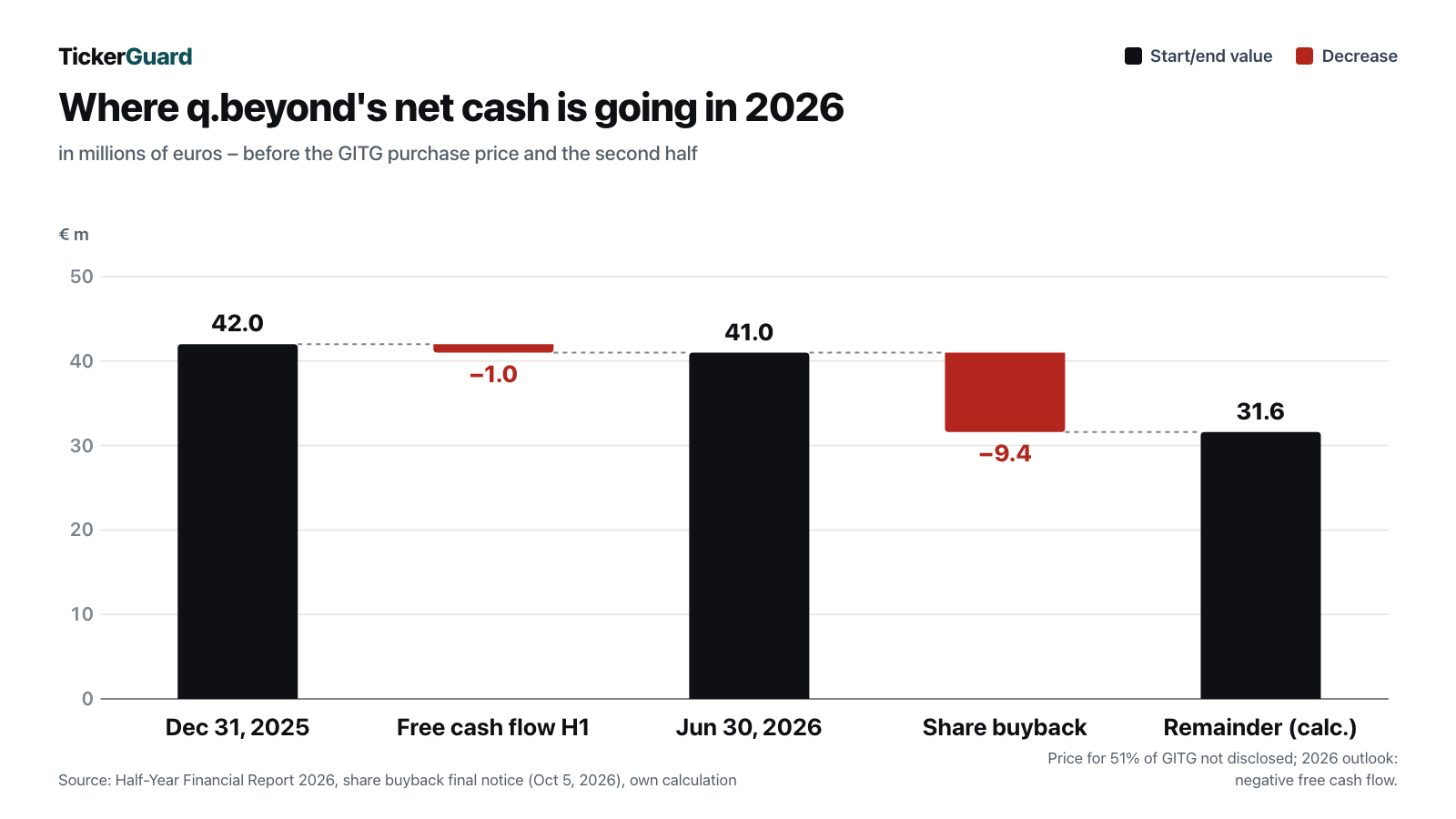
Three outflows hit the cash in the second half of 2026. First, the share buyback: q.beyond offered to buy up to 2,491,589 shares at €3.78 each. Shareholders tendered 4,878,907 shares — almost a fifth of all shares. The company bought 2,490,905 shares for about €9.42 million; according to the October 5 release, payment was “expected to take place on 7 October 2026.” CEO Thies Rixen explains:
“In light of our current valuation, purchasing treasury shares represented the best option for deploying our high volume of net liquidity.”
— q.beyond AG, IR release “q.beyond successfully completes public share buyback offer,” October 5, 2026
Two observations. The offer price of €3.78 almost exactly matched book equity per share as of June 30, 2026 (€94.4 million divided by 24,915,897 shares, about €3.79). And the oversubscription means: at that price, almost twice as many shares were offered as q.beyond wanted to buy — many shareholders preferred cash to stock. According to the ad hoc announcement of August 25, 2026, “No decision has yet been made regarding the use of the treasury shares.”
Second, the acquisition: as of July 30, 2026, q.beyond acquired 51 percent of GITG AG of Hamburg, an SAP specialist for hospitals with almost 40 employees. The rationale is understandable: SAP is discontinuing its current hospital software, IS-H, in 2030, and according to q.beyond more than 500 hospitals in Germany, Austria and Switzerland still use it. q.beyond does not disclose the price: “Confidentiality has been agreed concerning the purchase price,” and the deal is financed “entirely from internal funds.” What that means for you: the third-quarter statement on November 9, 2026, will show cash as of September 30 — after the GITG purchase but before the buyback, whose payment was only scheduled for October. How much is left at year-end will only be visible in the 2026 annual report. Third, the restructuring, with its one-off costs and the negative free cash flow announced for 2026.
And the data center from the analyst’s argument? The consolidated balance sheet shows land and buildings of €14.2 million (June 30, 2026); how much of that relates to the Hamburg data center, and what it would fetch on the market, the half-year report does not say. And unlike cash, a data center that runs your own operations business cannot simply be spent. And then there is a cushion that sits in no cash box. According to note 38 of the 2025 annual report, q.beyond AG had corporate income tax loss carryforwards of €419 million at year-end — five times its market value. Loss carryforwards are past losses that can shield future profits from tax. They are not recognized on the balance sheet because of the company’s history of losses. They are only worth something if q.beyond becomes sustainably profitable again — and even then with limits: under German tax law, large profits can only partly be offset against past losses (minimum taxation), and a major change in ownership can wipe out loss carryforwards in whole or in part.
Valuation: What the market charges for the IT business
At €3.34 (Xetra close on October 8, 2026), all 24,915,897 shares were worth about €83.2 million. Excluding the 2,490,905 treasury shares bought back — they carry no voting or dividend rights — the figure is about €74.9 million. Subtract the roughly €31.6 million of net cash left by calculation, and you are paying about €43 million for the actual IT business — against expected 2026 revenue of €176 million to €180 million. That is about a quarter of one year’s revenue, which is a low price measured against revenue. Measured against the 2026 EBITDA target of €3 million to €7 million, it is 6 to 14 times, which is no longer quite as cheap. The price-to-book ratio is about 0.9: the stock costs slightly less than book equity per share.
The professionals’ view: the analysts captured by our fundamental data had an average price target of about €5.18 (data as of October 8, 2026; when the individual targets were last updated is not shown). Average means all price targets added up and spread evenly — a single very optimistic analyst can pull it up noticeably. According to the annual report, the four analysts who regularly cover q.beyond set price targets of €1.10 to €1.30 per old share in early 2026, equivalent to €5.50 to €6.50 after the reverse split — before the August outlook cut. (The English edition of the report lists Redeye at €1.20 rather than €1.10.) A price target is an opinion, not evidence. The real valuation question is this: do you believe the IT business will return to profit from 2027, as q.beyond says it will? Then the price is low. If you do not, the cash is not a floor but a supply that shrinks year after year.
Opportunities and risks at a glance
Opportunities
- No bank debt, €41.0 million in net cash and a 70 percent equity ratio as of June 30, 2026 — a solid cushion even after the buyback.
- Consulting is growing profitably: gross profit in the first half of 2026 rose from €4.3 million to €6.8 million, with a 26 percent gross margin in the second quarter.
- The restructuring is supposed to save about €7 million a year from 2027; by the end of July 2026, the company’s own AI had automated the work of nearly 40 full-time staff.
- With GITG, a foothold in the hospital market, where SAP is discontinuing its IS-H software in 2030 (more than 500 hospitals affected, according to q.beyond).
- Tax loss carryforwards of €419 million can shield a large part of future profits from tax (limits: minimum taxation, possible forfeiture after a major change in ownership); the founders together hold 25.36 percent.
Risks
- 2026 outlook cut three months after being confirmed: EBITDA of €3 million to €7 million instead of €10 million to €16 million, with a net loss and negative free cash flow expected.
- Managed Services is shrinking (half-year revenue down 10 percent) amid tough price competition, including at contract renewals.
- Two customers account for 25 percent of half-year revenue, almost entirely in the shrinking IT operations business.
- The 2025 profit relied on €2.6 million of one-off income; without it, a loss would have remained by calculation.
- Cash shrinks in 2026 due to the buyback, the GITG price (undisclosed) and restructuring costs; AI could permanently reduce the paid operating hours of customers (our assessment).
A human conclusion
Back to the cash anchor. At q.beyond, it is not imaginary: the company has hardly any debt, plenty of equity and has returned part of its money to shareholders. But the anchor tempts you to treat the cash as the value — and the business behind it as an afterthought. The reports show the opposite: the first profit in years had help, the operations business is losing revenue and margin, two customers carry a quarter of revenue, and 2026 will be a loss year. So the question that matters is not “How much money is in the bank?” but: Will the IT business earn enough from 2027 for the cash to grow again instead of just being spent? The answer will not come from an analyst note but from the next reports — the first on November 9, 2026. What you make of it is your decision. And that is how it should be.
Sources
All original documents used in this analysis — so you can check for yourself:
- q.beyond AG — Half-Year Financial Report as of June 30, 2026 (published August 10, 2026, unaudited) and German edition — most recent periodic report; key figures, segments, major customers, balance sheet, cash flow statement, outlook, GITG acquisition
- q.beyond AG — Q1 2026 quarterly statement (May 11, 2026, German) — 2026 outlook confirmed
- q.beyond AG — Annual Report 2025 (published March 30, 2026) — key figures 2024 and 2025, Plusnet one-off income, risk report, tax loss carryforwards (note 38), analysts, capital reduction
- q.beyond AG — Annual Report 2024 and Annual Report 2023 (German editions) — key figures 2022 to 2024
- q.beyond AG — ad hoc announcement of August 10, 2026 (outlook), ad hoc announcement of August 25, 2026 (buyback offer), final buyback result (October 5, 2026), GITG acquisition (August 3, 2026), exchange of shares at 5:1 (March 10, 2026)
- q.beyond AG — shareholder structure (as of September 30, 2026) and voting rights notifications
- Fundamental data (closing prices through October 8, 2026, analyst price targets), cross-checked against the share count in the 2026 half-year report. Company announcements after August 10, 2026 reviewed through October 8, 2026. Earnings-call transcripts were not available for q.beyond; we evaluated the reports and the second-quarter 2026 presentation instead.
Transparency & disclaimer: This analysis is a journalistic contextualization of publicly available information and is not investment advice, not a financial analysis in the regulatory sense and not a solicitation to buy or sell securities. Investing in stocks involves substantial risk, up to and including total loss. All information without guarantee; the data date is noted in the text. Positions held by the operator are disclosed daily; where one exists, it appears as a notice at the top of this deep dive.
Our Bottom Line at a Glance
- Balance sheet and cash positive
- No bank debt, net cash €41.0M, equity ratio 70% (06/30/2026); after the buyback about €31.6M by calculation, before the GITG price.
- Consulting positive
- H1 2026 gross profit up from €4.3M to €6.8M, Q2 gross margin up from 15% to 26%; segment revenue H1 up 4% to €31.3M.
- Managed Services negative
- H1 2026 revenue down 10% to €54.5M, Q2 gross margin down from 22% to 16%; tough price competition, including at contract renewals.
- Earnings quality negative
- 2025 profit (€1.6M) included €2.6M of one-off income; 2026 outlook cut on 08/10/2026 to EBITDA of €3M–€7M, net loss expected.
- Customer concentration negative
- Two customers with 14% and 11% of revenue in H1 2026, 95% of it in the shrinking IT operations business.
- AI restructuring neutral
- More than 300 processes automated (nearly 40 FTEs, July 2026), €5M–€6M one-off costs in 2026, about €7M in annual savings announced from 2027.
q.beyond is a debt-free IT services provider with a large cash cushion and a growing consulting business. But its larger operations business is losing revenue and margin, the 2025 profit had help from one-off income, and 2026 will be a loss year while cash shrinks through the buyback, an acquisition and restructuring. Not investment advice.
What Our Rating Means
Open questions
The business works in principle, but one material question is open. As long as it stays open, our findings do not carry a quality verdict.
Yellow here signals an open operational question, not a threat to the company’s substance: q.beyond has no bank debt, a 70 percent equity ratio and, even after the share buyback, a cash cushion that can fund the announced restructuring. What is open is whether the core business earns money sustainably: the 2025 profit partly relied on one-off income, the 2026 outlook was cut by more than half three months after being confirmed, IT operations are shrinking under price pressure, and two customers account for a quarter of revenue. That the stock trades below book value and cash makes up a large part of its market value is a price argument and does not change the rating. The decision is yours.
A journalistic assessment by our editorial team at the time of the deep dive, based on public sources — not investment advice and not a solicitation to buy or sell. Your personal circumstances (investment goals, risk capacity, taxes) cannot be taken into account. What our levels mean, how verdicts are formed, and what conflicts of interest exist →
Worth Noting
- Version of October 8, 2026, based on the Half-Year Financial Report as of June 30, 2026 (published August 10, 2026), the 2025 annual report (March 30, 2026) and announcements through October 5, 2026. The hook is the most-discussed list of wallstreet-online — an attention signal, not a data source.
- q.beyond does not report to the U.S. securities regulator, the SEC; all evidence comes from the company’s English-language reports and announcements. Since the 5-to-1 share consolidation, only the new share trades (ISIN DE000A41YDG0, from March 12, 2026); price series that chain old and new shares without adjustment show an apparent price jump. Next date: third-quarter statement on November 9, 2026.
- Net cash, free cash flow and EBITDA as defined by the company. 2025 EBITDA and net income excluding one-off income, net cash remaining after the buyback, market value, enterprise value and price-to-book are our own calculations from the sources named.
The full analysis as a PDF for later
We will send you this analysis as a PDF — to print, file away, and read at your own pace.
Frequently Asked Questions
q.beyond (Xetra: QBY) runs and modernizes the IT of mid-sized companies. In the first half of 2026, €54.5 million of its €85.9 million in revenue came from day-to-day IT operations (Managed Services) and €31.3 million from consulting and development around SAP, Microsoft and AI (Consulting). In the second quarter, 71 percent of revenue was recurring.
On January 30, 2026, an extraordinary shareholders’ meeting approved consolidating every five old shares into one new share. Since March 12, 2026, only the new share with ISIN DE000A41YDG0 trades, at five times the price in purely arithmetic terms. The value of your stake is unchanged; the share count fell from 124.6 million to 24.9 million.
As of June 30, 2026, q.beyond had no bank debt and €41.0 million in net cash. About €9.42 million of that goes into the share buyback, with payment expected on October 7, 2026, according to the company. By calculation, about €31.6 million remains before the undisclosed price for 51 percent of GITG and the negative free cash flow expected for 2026.
According to the ad hoc announcement of August 10, 2026, q.beyond is accelerating its AI-driven restructuring, which costs about €5 million to €6 million one-off in 2026 and is supposed to save about €7 million a year from 2027. In addition, German mid-sized companies remain reluctant to invest. The EBITDA target fell from €10 million–€16 million to €3 million–€7 million.
Not currently. According to the cash flow statement, no distribution was paid in the first half of 2026. The February 2026 capital reduction offset the old accumulated deficit and thereby created the legal basis for dividends. As a first step to share its cash cushion with shareholders, q.beyond chose a buyback of about 10 percent of its shares in fall 2026.
According to the financial calendar, the third-quarter 2026 statement is due on November 9, 2026; the fiscal year equals the calendar year. It will show net cash as of September 30, 2026, after the GITG acquisition; payment for the share buyback was only expected on October 7, 2026, and falls into the fourth quarter.
Found an error?
Did you spot a factual error, an outdated number, or a typo in this deep dive? Let us know briefly — your report goes straight to the editorial team.