Aurania Resources: A Famous Gold Hunter, a Drill Rig in Iceland — and an Ecuador Bill as Big as the Whole Company
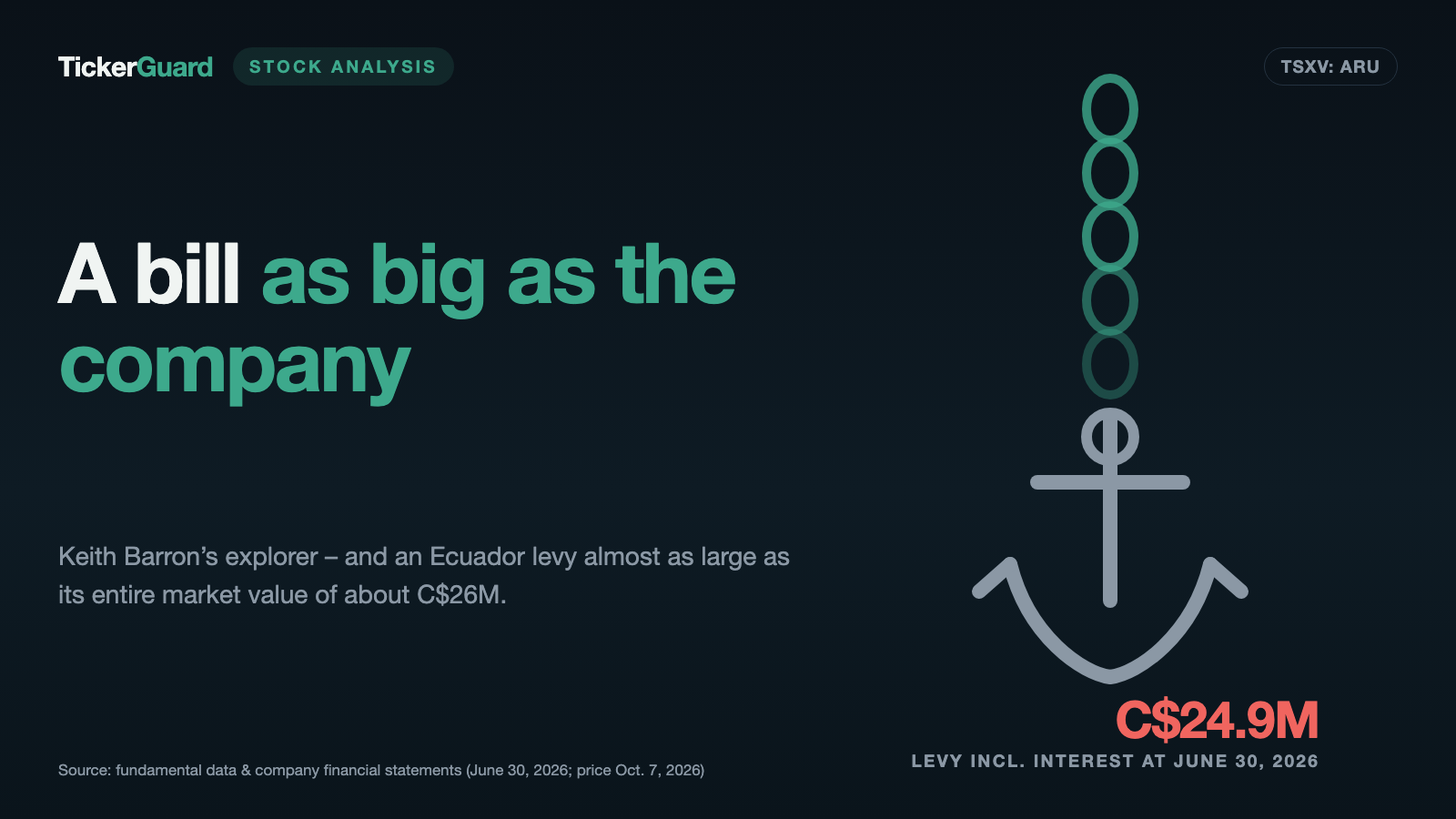
Aurania Resources (TSXV: ARU, OTCQB: AUIAF) is run by Keith Barron, whose former company found the Fruta del Norte gold deposit. But an Ecuadorian levy plus interest sits on its books at C$24.9 million — almost the entire market value. Buying in means betting on a regulator’s ruling in Quito.
 Thomas Mücke
Founder & Publisher
Thomas Mücke
Founder & Publisher
As of Today
As of: October 8, 2026
- Closing price
- 0.185 C$ -2.63%
- Market Capitalisation
- 26.6 C$M
This analysis has a cut-off date. The Stock Guard tells you when something material changes in the numbers. Reserve your free spot
Chart
Interactive price chart (TradingView).
Last price: 0.185 C$ (As of: October 8, 2026)
Note: pure fact-based analysis, not investment advice and not a solicitation to buy or sell. All figures without guarantee.
Picture a chef with three Michelin stars opening a new restaurant. You book a table without looking at the menu. Why would you — he has proven himself before. Psychologists call this the halo effect: one shining success colors everything that follows. It is human, and it gets expensive when it keeps us from reading the bill.
Aurania Resources has a name like that at the top. CEO Keith Barron founded Aurelian Resources, whose exploration led to the 2006 discovery of the Fruta del Norte gold deposit in Ecuador — today a Lundin Gold mine. His new company is exploring in Ecuador again, and also in France, Iceland and Italy. Today we read the bill: financial statements, MD&A, news releases. And the bill from Ecuador is almost as big as the whole company. In the end, the decision is yours.
What Aurania Resources actually does
Aurania is an explorer: it looks for metals but produces none and has no revenue. The company was incorporated in Bermuda in 2007; its office is in Toronto. It does not earn its money, it raises it — from shareholders and above all from Keith Barron.
For years the centerpiece was the Lost Cities – Cutucú project in southeastern Ecuador: 42 exploration concessions covering about 206,000 hectares, which Aurania acquired in 2017 through EcuaSolidus, a company owned by Barron himself. The name comes from archival research into legendary gold mines of the Spanish colonial era. According to the MD&A, Aurania has identified several targets there: epithermal gold-silver systems similar to Fruta del Norte, possible copper porphyries at depth, and sediment-hosted copper over 14 kilometers at Tsenken. For the copper targets at Awacha, the MD&A itself draws a comparison with Warintza, the Solaris Resources project south of Aurania’s concessions — our Solaris Resources analysis shows how that neighbor stands. None of Aurania’s targets has a resource estimate. All work in Ecuador has been suspended since 2025 — why is the core of this analysis.
These days Aurania is mostly exploring in Europe:
- France: In December 2025, its subsidiary Breizh Ressources was granted three exploration permits in Brittany and the northern Pays de la Loire (Epona, Taranis, Bélénos, about 850 square kilometers combined) for gold, antimony, tungsten and other metals. A project on Corsica is on hold.
- Iceland: Since April 2026, Aurania can earn up to 70 percent of the Thormodsdalur (Thor’s Valley) gold project about 20 kilometers east of Reykjavík by spending $5 million on exploration over four years — at least $500,000 by the first anniversary in April 2027. A six-hole program of about 770 meters started on September 8, 2026. The appeal: per the MD&A and the September 8, 2026 news release, earlier drilling returned peak values of up to 415 grams of gold per tonne (32 holes, 2005 and 2006) and up to 113 grams (11 holes, 2020). These are historical individual results, not a resource; five of the six new holes are meant to twin them under modern QA/QC standards. The program was expected to take about a month; no results had been announced as of October 7, 2026.
- Italy: A one-year memorandum of understanding signed October 20, 2025, is meant to determine whether nickel and cobalt can be recovered from the waste piles of the former Balangero asbestos mine near Turin. The company itself calls its tonnage figures “conceptual.”
Company history for investors
-
2017
Ecuador concessions bought from Keith Barron
In May 2017, Aurania acquired EcuaSolidus and its 42 concessions from its principal shareholder. Barron kept a 2 percent royalty.
-
2024
Peru subsidiary sold
In September 2024, the Peru subsidiary went to Palamina for 350,000 shares and a 1 percent royalty. The share count rose to 104.2 million over the year.
-
2025
TASA and standstill in Ecuador
From June 2025, Ecuador demanded $24.2 million a year. Aurania did not pay, suspended its work and in December received three permits in France.
-
2026
Going-concern warning, Iceland and an exemption without clarity
2025 statements with a going-concern paragraph, an option in Iceland, an exemption for explorers from 2026 with retroactivity unresolved; drilling in Iceland from September 8.
Why there is no annual report with the SEC
Aurania files no annual report (10-K) and no quarterly report (10-Q). Under CIK 0001568183, the SEC holds only three notices of private placements (Form D from 2013, 2021 and 2024). The company does not file periodic reports there.
It reports under Canadian rules (National Instrument 51-102) and IFRS, in Canadian dollars, on SEDAR+ and identically on its investor website. The fiscal year is the calendar year. One quirk: since April 2026, Aurania reports only semi-annually. That is why every number in this analysis carries “Source: fundamental data & the company’s financial statements and MD&A.” There are no earnings call transcripts for Aurania; we worked from the financial statements, MD&A, the Annual Information Form and news releases.
How the stock landed on our desk
To be honest: Aurania is not a hit from our in-house stock screener, and it cannot be. The screener works with revenue, earnings, margins and balance sheet metrics, and an explorer without revenue fails every one of those filters. The stock made our research list through the forum ranking of the German investor site wallstreet-online, the list of stocks most discussed by German retail investors (as of October 8, 2026), under the U.S. ticker AUIAF. That is a signal of attention, not of quality.
AUIAF is the same stock as ARU on the TSX Venture Exchange in Toronto and 20Q in Frankfurt. The OTCQB is an over-the-counter U.S. market; price discovery happens in Toronto in Canadian dollars. Trading is thin: on some days only a few thousand shares change hands in Toronto.
On timeliness: the most recent report is the interim statements as of June 30, 2026, with the MD&A dated August 26, 2026. Since then, Aurania announced the start of drilling in Iceland on September 8 and stock options for directors in lieu of fees on October 1. Neither drill results from Iceland nor a new financing had been announced as of October 7, 2026.
The numbers over the years — a fair assessment
Let’s start with what speaks for Aurania. The company has a major shareholder who has stepped in with his own money for years: per the Annual Information Form dated April 27, 2026, Keith Barron held about 45 percent of the shares; he bought another 1.67 million units in June 2026 and lent another C$1 million in January and April 2026. Several directors have regularly forgone cash fees for years and taken stock options instead — announcements of such grants go back at least to April 2023, the latest dated October 1, 2026. And with Iceland, Brittany and Balangero, Aurania set up three new projects in politically more stable countries within a year.
Now the other half. There was no revenue in any year. The net loss was C$12.3 million in 2022, C$10.0 million in 2023 and C$10.8 million in 2024. In 2025 it jumped to C$30.2 million because Aurania expensed seven months of the new TASA levy — $14.1 million. The first half of 2026 added a C$12.7 million loss, including C$4.4 million of interest on the unpaid levy and concession fees, a C$1.3 million foreign exchange loss on its U.S.-dollar liabilities, and the $2.5 million of 2026 concession fees. Cash used in operations was C$8.3 million in 2025 and C$1.7 million in the first half of 2026 — a large part of the loss consists of obligations that have not been paid.
A company without revenue has to issue new shares. Dilution means your slice of the pie gets smaller because more people are eating from the same pie. At Aurania, the share count has more than doubled in three and a half years.
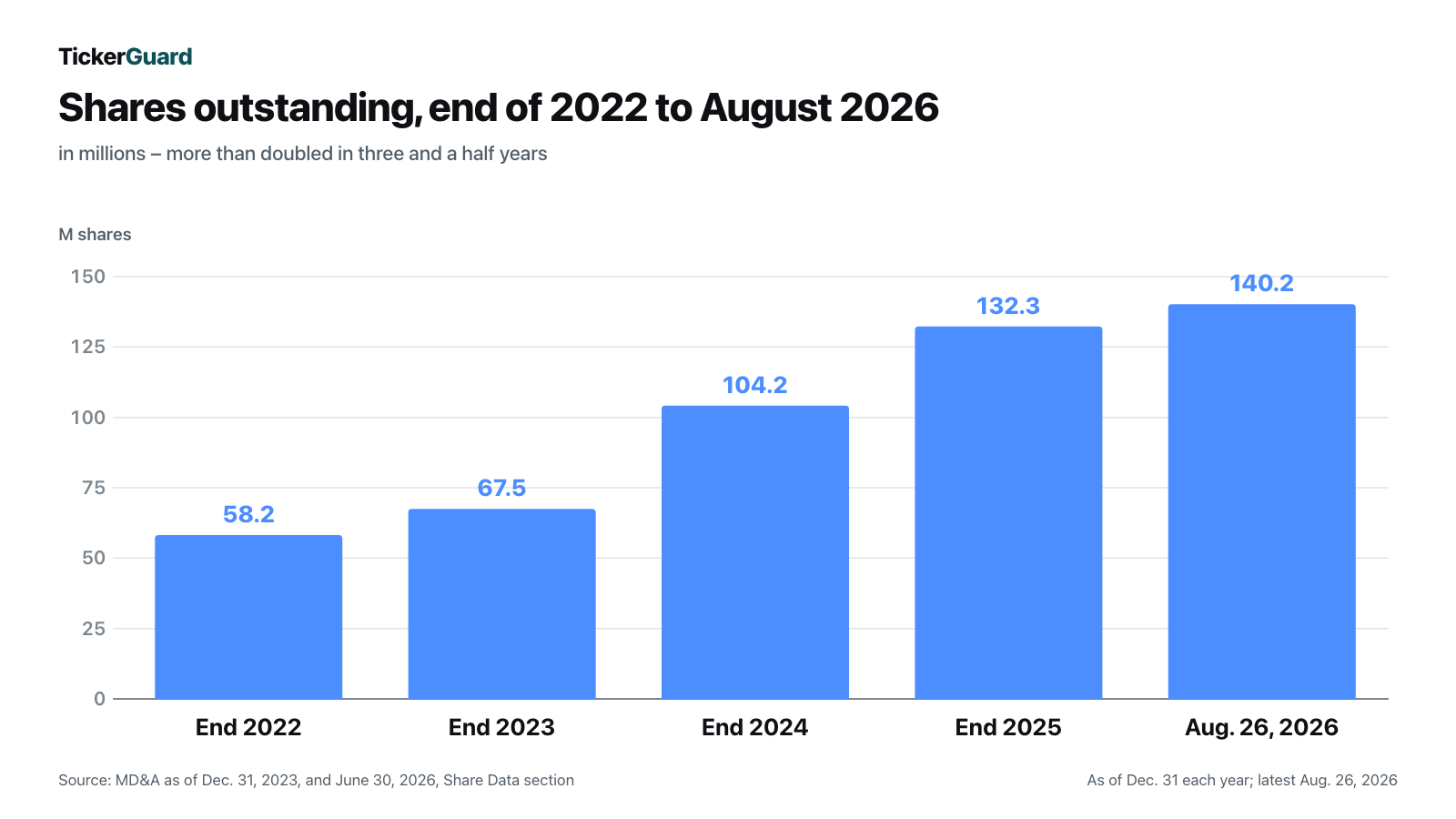
Issue prices were C$0.30, C$0.12 and C$0.12 per unit in 2025 and C$0.18 in June 2026, each with one warrant per share. The June 2026 placement raised C$1.26 million — up to C$1.5 million had been announced.
What the filings say — the uncomfortable truths
Now come the passages you won’t find on the cover of an investor presentation.
Uncomfortable truth #1: A levy almost as large as the market value
On June 20, 2025, Ecuador’s mining regulator ARCOM introduced an oversight levy, the TASA (Tasa de Supervisión y Control Minero). For Aurania, it set $24,151,420 a year — for a company that by its own table has never spent more than $12.8 million in a single year on its Ecuador project (2021). In its Annual Information Form, Aurania calls the levy disproportionate and not financially viable for an exploration company; seven constitutional challenges against it are pending. Aurania has paid nothing. The regulator started enforcement proceedings in September 2025.
On June 24, 2026, came a turn: ARCOM exempted companies in the exploration phase from the levy starting in 2026. The 2025 liability remains, however, as long as nobody says whether the exemption is retroactive. The MD&A as of June 30, 2026:
“It does not specify if the resolution is retroactive and clarification is still pending. Until the retroactive elimination is confirmed, the Company continues to present the balance from 2025 and accrued interest as an account payable. As at June 30, 2026, the Company has recognized an accrued liability of USD17,542,002 ($24,927,184 at an exchange rate of 1.4210 USD/CAD) in respect of the TASA and its interest and penalties, presented within accounts payable.”
— Aurania Resources Ltd., MD&A as of June 30, 2026, Section 3.7.1(e) Mining Service Fee
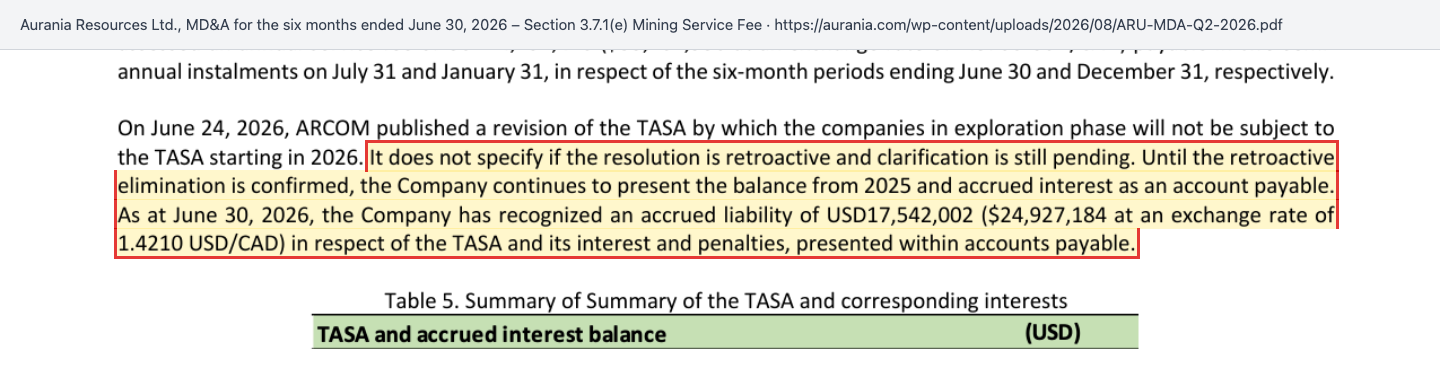
This is the central tension of the stock. If the 2025 levy turns out not to apply, Aurania would reverse the accrued amounts according to its 2025 MD&A, and more than half of its liabilities would disappear at a stroke. If it does apply, a company with C$0.92 million in cash owes the state of Ecuador almost C$25 million. Interest keeps running: in the first half of 2026 alone, C$4.4 million of interest accrued on the levy and the concession fees combined.
Uncomfortable truth #2: The concessions are not in good standing
Concessions are to an explorer what the lease is to a store: without them there is nothing to explore. Each of the 42 concessions in Ecuador carries an annual fee. For 2025, the total was $2.44 million. Aurania paid 20 percent, covering 9 of the 42 concessions. Negotiations over the rest ended when the TASA arrived — any payment would first be applied to the levy, the company says. For 33 concessions, $1.91 million from 2025 is outstanding, plus the 2026 fees of $2.50 million, due since March 31, 2026. The balance sheet carries C$6.57 million for these fees including interest.
“These concessions are not in good standing as the fees remain unpaid, and this underlying situation could result in the expiration of the concessions if payment is not fulfilled.”
— Aurania Resources Ltd., MD&A as of June 30, 2026, Section 3.3, Annual Concession Fees
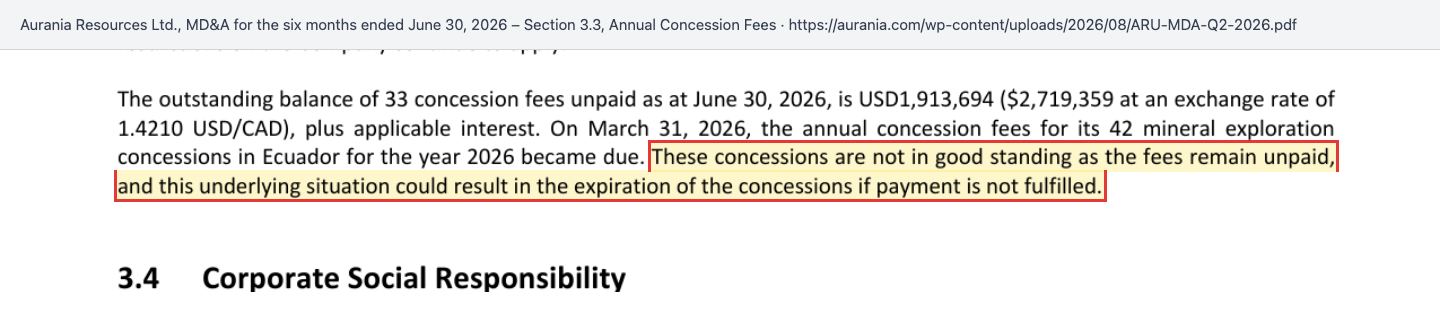
Per the MD&A, Aurania is evaluating whether to maintain, restructure or relinquish specific concessions. On top of that, a new mining law dated March 2, 2026, caps the exploration phase at 15 years. The company’s former core project now rests on shaky ground.
Uncomfortable truth #3: The auditor doubts the company’s ability to continue
Every set of financial statements assumes the company will keep operating for at least another twelve months. At Aurania, that assumption comes with a caveat. Auditor McGovern Hurley LLP added a separate paragraph to its report on the 2025 statements — and per the report it is the only key audit matter:
“We draw attention to Note 1 in the consolidated financial statements, which indicates that the Company has working capital deficiency and accumulated deficit as at December 31, 2025. As stated in Note 1, these events or conditions, along with other matters as set forth in Note 1, indicate that material uncertainties exist that cast significant doubt on the Company’s ability to continue as a going concern.”
— McGovern Hurley LLP, Independent auditor’s report on the 2025 consolidated financial statements, April 27, 2026
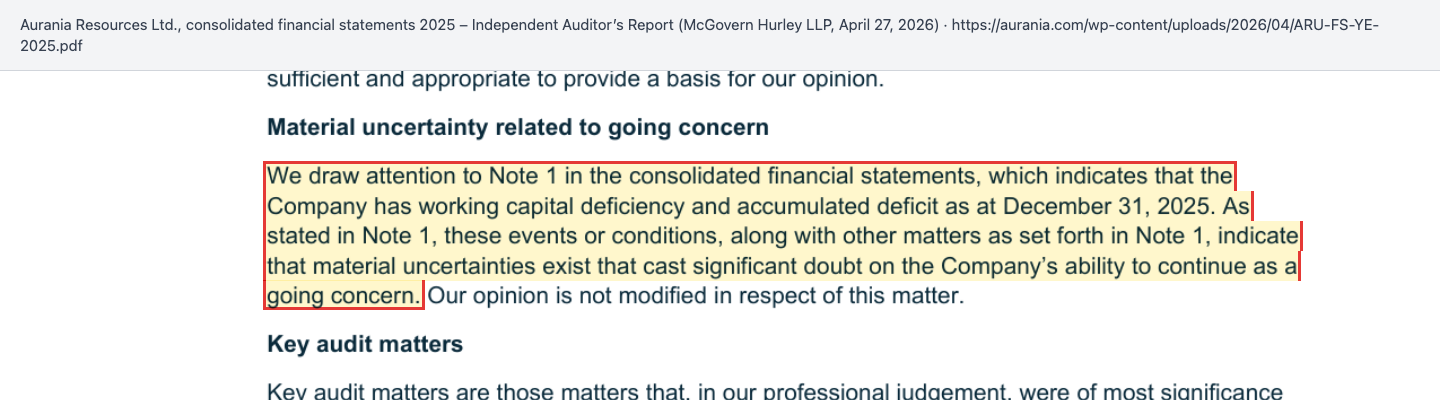
Things have not improved since. At June 30, 2026, Aurania held C$918,150 in cash. Against that stood current liabilities of C$32.1 million and long-term liabilities of C$12.0 million. The waterfall shows how the balance sheet tips from assets into the red:
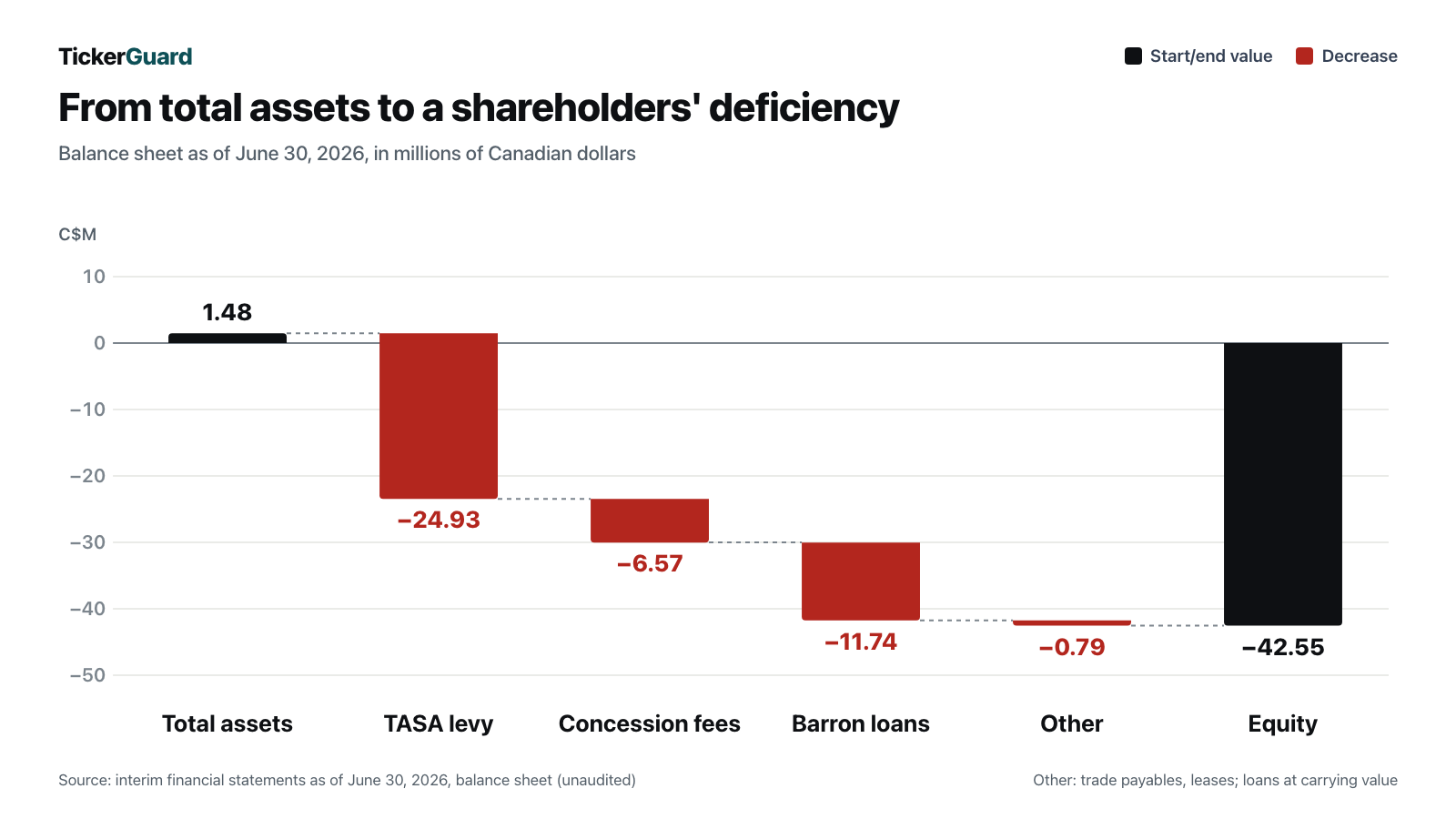
In the first half of 2026, operating activities used C$1.73 million, about C$0.86 million per quarter. On that basis, the June 30 cash covered a little more than one quarter — before the Iceland drill program began. The MD&A itself says it is “highly probable” that additional financing will be required in the following months. No new financing had been announced as of October 7, 2026. And because Aurania now reports only semi-annually, the next statements will show cash only as of December 31, 2026 — due by the end of April 2027.
Uncomfortable truth #4: Everything hinges on one man
Keith Barron wears many hats at Aurania: CEO, president, chairman, largest shareholder with about 45 percent per the Annual Information Form — and its most important lender. The MD&A lists loans from 2017, 2019, 2022, 2023, 2024 and 2025; another C$1 million loan followed in 2026. The loans are unsecured, carry 2 percent interest and become due twelve months and one day after he demands repayment. At June 30, 2026, they were carried at C$11.74 million. Because 2 percent is far below a market rate, which the company estimates at 20 percent, Aurania books the interest benefit as a shareholder contribution. Barron is also the person who sold the Ecuador concessions in 2017, and he shares in any future production:
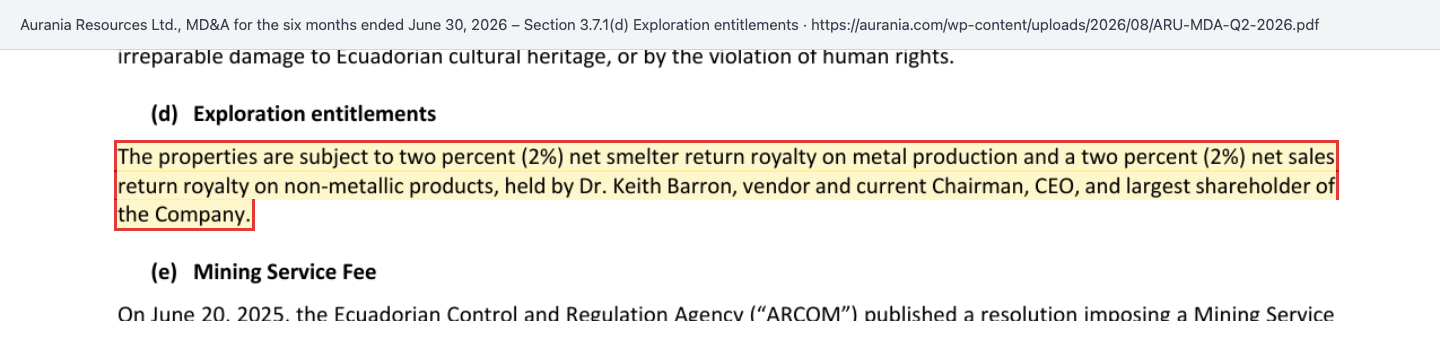
“The properties are subject to two percent (2%) net smelter return royalty on metal production and a two percent (2%) net sales return royalty on non-metallic products, held by Dr. Keith Barron, vendor and current Chairman, CEO, and largest shareholder of the Company.”
— Aurania Resources Ltd., MD&A as of June 30, 2026, Section 3.7.1(d) Exploration entitlements
All of this is disclosed and is not misconduct in itself. Barron has carried Aurania through difficult years with his own money. But lender, major shareholder, royalty holder and boss are the same person. If he demands repayment, the loans fall due twelve months and a day later. What must then be repaid is the principal plus interest, which exceeds the C$11.74 million carrying value — against C$0.92 million in cash. If he stops funding, the company loses its most important source of money.
Uncomfortable truth #5: Less visibility just when it matters most
On April 13, 2026, Aurania opted for semi-annual reporting. A Canadian exemption for smaller TSX Venture issuers (Blanket Order 51-933) allows this, and it saves costs. For shareholders, though, it means there is no further report with numbers between the MD&A of August 26, 2026, and the 2026 annual statements. At a time when cash covers a little more than one quarter and a regulator is deciding on a multiple of that amount, new numbers arrive only twice a year.
Valuation: What the market pays for a company with negative equity
With 140,227,593 shares (August 26, 2026) and a close of C$0.185 on October 7, 2026, Aurania has a market value of about C$26 million. Over the twelve months to early October 2026, the closing price ranged from C$0.135 (November 20, 2025) to C$0.36 (October 20, 2025).
There is no price-to-earnings or price-to-sales ratio, and no price-to-book ratio either: equity is negative at minus C$42.5 million. Buying the stock means buying no balance sheet substance, but two hopes. The first is a clarification from the mining regulator ARCOM in Quito. If the 2025 levy does not apply, Aurania would reverse the accrued C$24.9 million according to its 2025 MD&A — about 96 percent of the market value. Equity would still be negative, at about minus C$17.6 million, because the concession fees and the Barron loans remain. The second hope is a discovery: in Iceland, where drilling has been underway since September, in Brittany, or someday again in Ecuador.
Our back-of-the-envelope math, not the company’s: market value plus all liabilities minus cash gives an enterprise value of about C$69 million. Without the TASA, it would be about C$44 million. For that money there is so far no resource estimate on any project. And every new financing comes at prices that were most recently C$0.18 per unit — warrant included.
Upside and risks at a glance
What speaks for the company:
- A discoverer with money on the line. Keith Barron’s former company found Fruta del Norte; he owns about 45 percent and has funded Aurania himself for years.
- The levy could fall away. Since June 24, 2026, explorers are exempt from 2026 on. If the 2025 levy does not apply, Aurania would reverse C$24.9 million of liabilities.
- New projects in Europe. Three permits in Brittany, an option on up to 70 percent in Iceland with drilling underway, an evaluation in Italy.
- A large land package in Ecuador. 42 concessions with several gold and copper targets — provided they are kept.
What speaks against it:
- Negative equity. C$44.0 million in liabilities against C$1.48 million in assets; equity of minus C$42.5 million at June 30, 2026.
- Going-concern doubt. The auditor flags material uncertainties; C$0.92 million in cash against about C$0.86 million of outflows per quarter.
- Concessions at risk. Fees for 2025 and 2026 unpaid; per the MD&A the concessions are not in good standing.
- Dependence on one person. Barron is CEO, major shareholder, lender (C$11.74 million carrying value) and royalty holder.
- Ongoing dilution. Share count up 141 percent since the end of 2022; 197.6 million shares fully diluted.
- Less transparency. Semi-annual reports only; the next statements are due by the end of April 2027.
A human conclusion
Remember the chef with three stars? At Aurania Resources the star is real: Keith Barron’s former company found the Fruta del Norte gold deposit, today a Lundin Gold mine, and he stands behind the new company with his own money. But even a great chef can open a restaurant where the landlord demands a new levy that is higher each year than the entire restaurant’s current market value. That is how it turned out with the TASA — the company itself calls it disproportionate. The bill is on the table, and whether it stands is decided not by Barron but by a regulator in Quito.
It doesn’t have to end badly. If the levy falls away retroactively, Barron keeps funding and Iceland delivers good drill results, the story could take a new turn. The milestones are visible: ARCOM’s clarification, the Iceland drill results, the next financing and the 2026 annual statements. Read the bill before you let the name lead you.
What you make of it is your decision. And that’s how it should be.
Sources and data as of
- Unaudited interim financial statements as of June 30, 2026 and MD&A as of June 30, 2026, both dated August 26, 2026
- 2025 consolidated financial statements with the McGovern Hurley LLP auditor’s report dated April 27, 2026, 2025 MD&A and 2025 Annual Information Form dated April 27, 2026
- 2023 MD&A (share count at the end of 2022 and 2023)
- News releases: start of drilling in Iceland (September 8, 2026), options in lieu of director fees (October 1, 2026), closing of the private placement (June 25, 2026), semi-annual reporting and loan amendment (April 13, 2026)
- SEC listing for CIK 0001568183 (Form D only, from 2013, 2021 and 2024)
- Price and market value data: source fundamental data, as of October 7, 2026
Data as of: company figures as of June 30, 2026, or the date stated; share count as of August 26, 2026; news through October 1, 2026; prices as of October 7, 2026. The news pages were last checked on October 8, 2026. The reporting currency is the Canadian dollar; the TASA and the concession fees are denominated in U.S. dollars and converted at the June 30, 2026, rate (1.4210). Calculated values (market value, enterprise value, equity without the TASA, cash runway) are our own estimates and labeled as such.
Disclaimer: This article is journalistic analysis, not investment advice. It contains no recommendation to buy or sell and no solicitation to trade securities. Shares of explorers without revenue are particularly volatile and often thinly traded; a total loss of the capital invested is possible. We disclose the publisher’s own positions daily; if one exists, it appears as a note at the top of this analysis.
Our Bottom Line at a Glance
- TASA mining levy negative
- For 2025, the balance sheet at June 30, 2026, carries C$24.9 million including interest and penalties — almost the entire market value. Explorers are exempt from 2026 on; whether retroactively is open.
- Ecuador concessions negative
- Fees for 2025 (33 of 42 concessions) and 2026 are unpaid, and per the MD&A the concessions are not in good standing. All work in Ecuador has been suspended since 2025.
- Financial position negative
- Cash of C$0.92 million, liabilities of C$44.0 million and equity of minus C$42.5 million at June 30, 2026; the auditor flags material uncertainties about the going concern.
- Keith Barron’s role neutral
- A stake of about 45 percent and loans carried at C$11.74 million keep the company going. At the same time, the top job, the lender position and a 2 percent royalty are concentrated in one person.
- New projects in Europe neutral
- Three permits in Brittany (five lawsuits pending), an option in Iceland with drilling underway since September 8, 2026, an evaluation in Italy. There is no resource estimate anywhere yet.
- Dilution and transparency negative
- Shares outstanding rose from 58.2 million (end of 2022) to 140.2 million (August 26, 2026). Since April 2026, Aurania reports only semi-annually.
Aurania Resources is an explorer with no revenue, led by Keith Barron, whose former company discovered Fruta del Norte. The stock hinges above all on a regulator in Quito: if the 2025 levy does not apply, Aurania would reverse C$24.9 million of liabilities, more than half of the total. Beyond that, the Iceland drill results and the next financing matter. At the C$0.185 close on October 7, 2026, Aurania is valued at about C$26 million. Not investment advice.
What Our Rating Means
Substance risk
We found at least one documented issue that threatens the company itself — regardless of how the stock is currently valued.
Red here does not reflect Keith Barron or the European projects but documented substance risks in the company’s own statements: equity is negative at minus C$42.5 million, the auditor flags material uncertainties about the going concern, cash of C$0.92 million covered a little more than one quarter at the first-half 2026 burn rate, and the Ecuador concessions are not in good standing because of unpaid fees. If the TASA falls away retroactively, the balance sheet improves sharply but stays negative.
A journalistic assessment by our editorial team at the time of the deep dive, based on public sources — not investment advice and not a solicitation to buy or sell. Your personal circumstances (investment goals, risk capacity, taxes) cannot be taken into account. What our levels mean, how verdicts are formed, and what conflicts of interest exist →
Worth Noting
- This analysis was prompted by the U.S. OTCQB ticker AUIAF on the forum ranking of the German investor site wallstreet-online (as of October 8, 2026); we list the company under its home listing ARU (TSX Venture Exchange) as ARU.TO. There is no hit from our in-house stock screener, and there cannot be one: the company has neither revenue nor earnings.
- Aurania is not an SEC periodic filer (CIK 0001568183, Form D only from 2013, 2021 and 2024). All company figures come from the Canadian mandatory filings: 2025 consolidated statements (auditor McGovern Hurley LLP), interim statements and MD&A as of June 30, 2026, the 2025 and 2023 MD&A, the 2025 Annual Information Form and news releases through October 1, 2026. There are no earnings call transcripts.
- Calculated values are our estimates: market value from 140,227,593 shares times the October 7, 2026, close (C$0.185); enterprise value from market value plus liabilities of C$44.03M minus cash of C$0.92M; equity without the TASA from −42.54 plus 24.93 (C$M); cash runway from first-half 2026 operating outflows.
- The TASA and the concession fees are denominated in U.S. dollars; Canadian-dollar amounts follow the company’s June 30, 2026, conversion rate (1.4210). The end-2022 share count comes from the 2023 MD&A (Share Data section).
Stock Watch
This analysis is as of October 8, 2026. Stock Watch will tell you what's changed at ARU.TO since then.
Later $1 a month per stock — signing up is free, and you'll be the first to know when it launches.
The full analysis as a PDF for later
We will send you this analysis as a PDF — to print, file away, and read at your own pace. And we will add you to the free Stock Watch list for Aurania Resources Ltd (ARU.TO), so you hear about it when something material in this analysis changes.
Frequently Asked Questions
Aurania Resources is a Toronto-based explorer with no revenue. It holds 42 exploration concessions in Ecuador (work suspended since 2025), three exploration permits in Brittany, an option to earn up to 70 percent of the Thormodsdalur gold project in Iceland, and it is evaluating whether nickel and cobalt can be recovered from old waste piles in Italy.
The TASA is an oversight levy that Ecuador’s mining regulator ARCOM has charged since June 2025. Aurania was assessed $24.2 million a year. At June 30, 2026, the balance sheet carried C$24.9 million for it, including interest and penalties — almost the entire market value. Since June 24, 2026, explorers are exempt from 2026 on; whether that applies retroactively to 2025 is still open, the MD&A says.
Per its 2025 MD&A, Aurania would reverse the accrued amounts if the levy does not apply for 2025. Liabilities would fall by about C$24.9 million. By our math, equity would still be negative at about minus C$17.6 million, because the unpaid concession fees and Keith Barron’s loans remain.
Per the MD&A as of June 30, 2026, they are not in good standing because the fees for 2025 (33 of 42 concessions) and for 2026 are unpaid. That could lead to their expiration if payment is not made. Aurania is evaluating whether to maintain, restructure or relinquish specific concessions.
Keith Barron is CEO, president and chairman, held about 45 percent of the shares per the Annual Information Form dated April 27, 2026, and is the most important lender: his loans were carried at C$11.74 million at June 30, 2026. He also holds a 2 percent royalty on the Ecuador concessions he sold to Aurania in 2017. His former company Aurelian Resources discovered Fruta del Norte in 2006.
Because Aurania has no revenue, a deeply negative working capital position and a constant need for new money. At June 30, 2026, it held C$0.92 million in cash against current liabilities of C$32.1 million. Auditor McGovern Hurley pointed to material uncertainties about the going concern in the 2025 statements.
It is the same stock. ARU is the ticker on the home exchange, the TSX Venture Exchange in Toronto, where prices are set in Canadian dollars. AUIAF is the ticker on the U.S. over-the-counter market OTCQB, and 20Q is the Frankfurt symbol. TickerGuard lists the stock as ARU.TO.
Because Aurania is not a U.S. reporting company. The SEC holds only three notices of private placements. The company reports under Canadian rules in Canadian dollars under IFRS on SEDAR+ — since April 2026 only semi-annually; the next statements are the 2026 annual statements, due by the end of April 2027.
Found an error?
Did you spot a factual error, an outdated number, or a typo in this deep dive? Let us know briefly — your report goes straight to the editorial team.