H-Power (Formerly AFC Energy): 15 Generators Unpaid, Now Speedy Hire Orders 15 New Ones
In May 2026, AFC Energy became H-Power plc. The name and the ticker changed; the math did not: £253,000 of revenue in the half-year to April 2026, £17.4 million in cash, and, by the company's own forecast, a need for new money in the second half of 2027 unless revenue rises substantially by then. We read the annual and half-year reports and every regulatory announcement through October 2026. The most striking finding: the joint venture whose unpaid bill for 15 generators was written off is now getting an order for 15 new ones.
 Thomas Mücke
Founder & Publisher
Thomas Mücke
Founder & Publisher
As of Today
As of: October 8, 2026
- Closing price
- 0.093 £ -2.21%
- Market Capitalisation
- 0.1 £B
This analysis has a cut-off date. The Stock Guard tells you when something material changes in the numbers. Reserve your free spot
Chart
Too few trading days on record for a price history - here are the key figures.
Last price: 0.093 £ (As of: October 8, 2026)
Note: pure fact-based analysis, not investment advice and not a solicitation to buy or sell. All figures without guarantee.
A company delivers generators to its own joint venture, 15 of them go unpaid, the receivable is written off — and in June 2026 it announces an order for 15 new generators for that very joint venture. That is what the reports of H-Power, called AFC Energy until May 2026, say, spread across several regulatory announcements.
There is a small trick our minds fall for reliably. We call it the new-label effect: give a company a new name, a new logo and a new ticker, and it feels like a new company. The old share-price chart, the old losses, the old promises — they seem to belong to a different name. That is what makes the effect so powerful: it does not need a single new number.
Since May 12, 2026, AFC Energy has been called H-Power plc; on May 13, the London Stock Exchange ticker changed from AFC to HPOW. So we do what we always do: reports first, judgment second. The tension running through this analysis: the technology is hitting its milestones — a new generator with certification, a development contract with Komatsu, the first hydrogen sale. But revenue is tiny, the loss is large, and by the company's own forecast it will need either substantially more revenue or new money in the second half of 2027. Whether the business behind the new sign has changed is the question this piece sets out to answer.
What H-Power Actually Does — Hydrogen From Ammonia, and Power Without a Diesel Generator
H-Power is based in Dunsfold, Surrey, southwest of London, was founded in 2006 according to fundamental data, and employed an average of 121 people in fiscal 2025. It builds two kinds of equipment. The first is an ammonia cracker. Think of ammonia as a shipping container for hydrogen: hydrogen itself is hard to store and transport, while ammonia has been shipped around the world for decades. The cracker splits the ammonia back apart on site and recovers the hydrogen. The new unit is called HY5 and is designed to produce up to 500 kilograms of hydrogen a day; according to the interim report, launch is planned by the end of calendar 2026.
The second kind is fuel cell generators. They turn hydrogen into electricity — quietly and without exhaust — and are meant to replace diesel generators on construction sites. The current model is the LC30 (30 kilowatts). According to the announcement of January 21, 2026, it costs about 85 percent less to manufacture than its air-cooled predecessor; on August 26, 2026, H-Power reported TÜV SÜD's attestation of conformity, the prerequisite for the CE mark needed to sell in Europe. The generators are sold, among other channels, through a 50/50 joint venture with U.K. equipment rental company Speedy Hire and, in the Middle East, through exclusive distributor TAMGO.
Company history for investors
-
2020
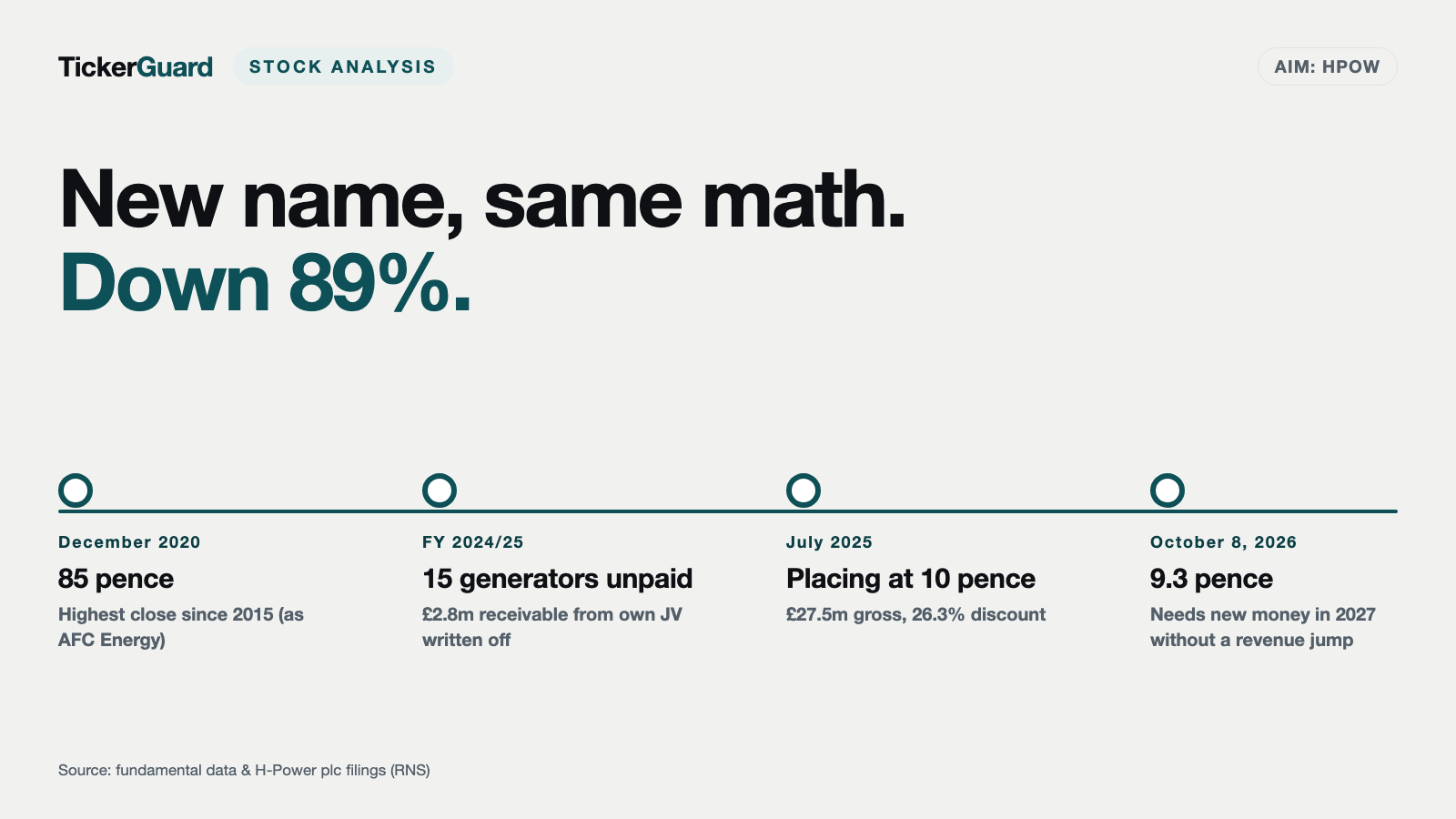
Highest close since 2015: 85 pence
On 12/29/2020 the AFC share closed at 85 pence. Anyone who bought then is down about 89 percent at 9.30 pence on 10/08/2026.
-
2024
£4.0 million of revenue from AR2 generators
The highest annual revenue in the five-year series — the model went to the company's own joint venture with Speedy Hire; a £2.8m receivable was written off in 2025.
-
2025
Placing at 10 pence
£27.5m gross at a 26.3% discount to the July 16, 2025 close; the share count rose by about one third to 1.13 billion.
-
2026
February: 2027 funding need disclosed
In the full-year results, the board writes that without a substantial revenue increase, new money is needed in the second half of 2027 — a signal of possible further dilution.
-
2026
May: AFC Energy becomes H-Power
New name, new ticker HPOW, same ISIN. The stock closed at 17.02 pence on 05/06/2026 and fell to 9.30 pence by 10/08/2026.
-
2026
August: CE attestation for the LC30
TÜV SÜD confirms conformity — the condition for the replenishment order for 15 LC30s from Speedy Hire. Whether it gets paid, the next annual report will show.
How the Stock Landed on Our Desk
Via the forum hot list of wallstreet-online, the ranking of stocks most discussed by German retail investors — on October 8, 2026, still listed under the old U.S. ticker AFGYF. A list like that measures attention, not quality. How much retail investors shape this stock is visible in the shareholder list on the company's website (as of September 30, 2026): the largest positions sit with U.K. investment platforms Hargreaves Lansdown (14.39 percent), Interactive Investor (11.69 percent), HSDL (5.21 percent), AJ Bell (4.53 percent) and Barclays Smart Investor (3.72 percent), plus German securities bank DWP Bank (3.22 percent) — custodians that mostly hold private accounts. The only classic fund investor above 3 percent is Janus Henderson with 7.47 percent.
The attention came mainly from the share price. On November 6, 2025, the stock closed at 8.38 pence according to fundamental data; on May 6, 2026 — shortly before the name change — at 17.02 pence, more than double. On October 8, 2026, the close was 9.30 pence, about 45 percent below the May high. For comparison: at the end of 2020, at the peak of the first hydrogen euphoria, the stock closed at 85 pence on December 29.
Two notes on every number in this piece. First, H-Power's fiscal year ends October 31. "Fiscal 2025" means November 2024 through October 2025; the first half of fiscal 2026 covers November 2025 through April 2026. Second, H-Power does not report to the U.S. securities regulator, the SEC. The ticker AFGYF is merely a U.S. over-the-counter listing with no reporting obligation of its own. All evidence therefore comes from the company's original documents — the full-year results of February 25, 2026 (for earlier years, those of March 19, 2025), the interim results of June 10, 2026 and the regulatory announcements published through the London Stock Exchange's news service (RNS). We did not evaluate analyst call transcripts for H-Power.
The Numbers Over the Years — Given Their Due
First, what has genuinely improved. John Wilson has run the company since early 2025, and under him the cash burn has come down. In the first half of fiscal 2026, by the company's own definition — operations including spending capitalized as development costs — £7.5 million flowed out, versus £10.7 million in the prior-year half. Revenue rose from £17,000 to £253,000, and the net loss fell from £10.1 million to £5.8 million. On the technical side, H-Power has so far kept its announced dates: the LC30 with its CE attestation in August 2026, the first phase of the Komatsu development contract completed in August 2026, and since June 2026 a contract to sell 5,000 kilograms of hydrogen from its own pilot plant to U.K. company Protium.
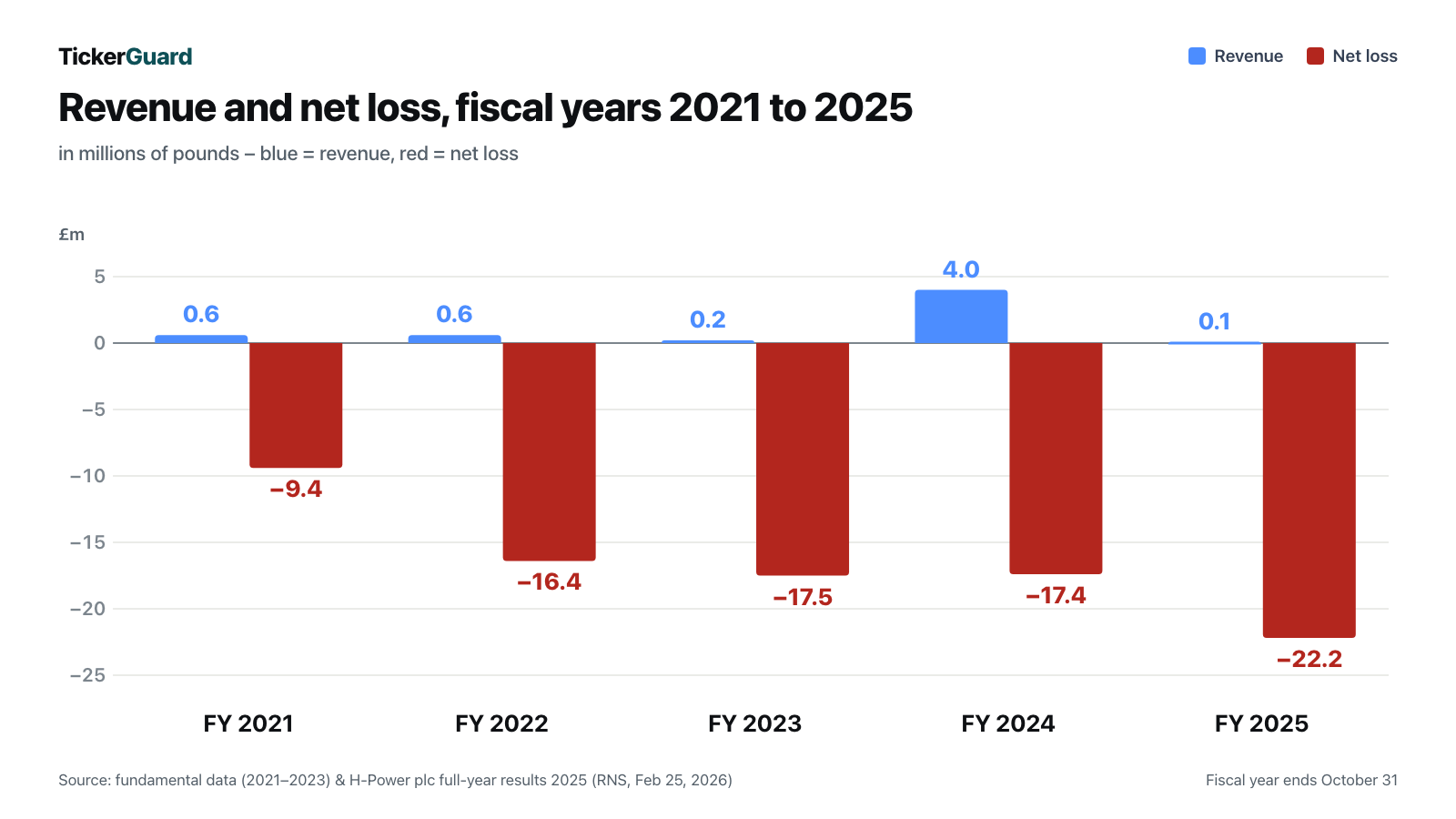
Now the long view. According to fundamental data, the company has posted a loss in each of the ten fiscal years from 2016 through 2025. In the past five years, revenue topped £1 million only once: £4.0 million in fiscal 2024, from the sale of the AR2 generator model. In fiscal 2025 it was £125,000, against a net loss of £22.2 million. That loss includes special items of roughly £5.5 million combined: a £2.6 million write-down of AR2 inventory because the model was discontinued, and £2.9 million in credit-loss allowances, £2.8 million of it against the company's own joint venture — more on that shortly.
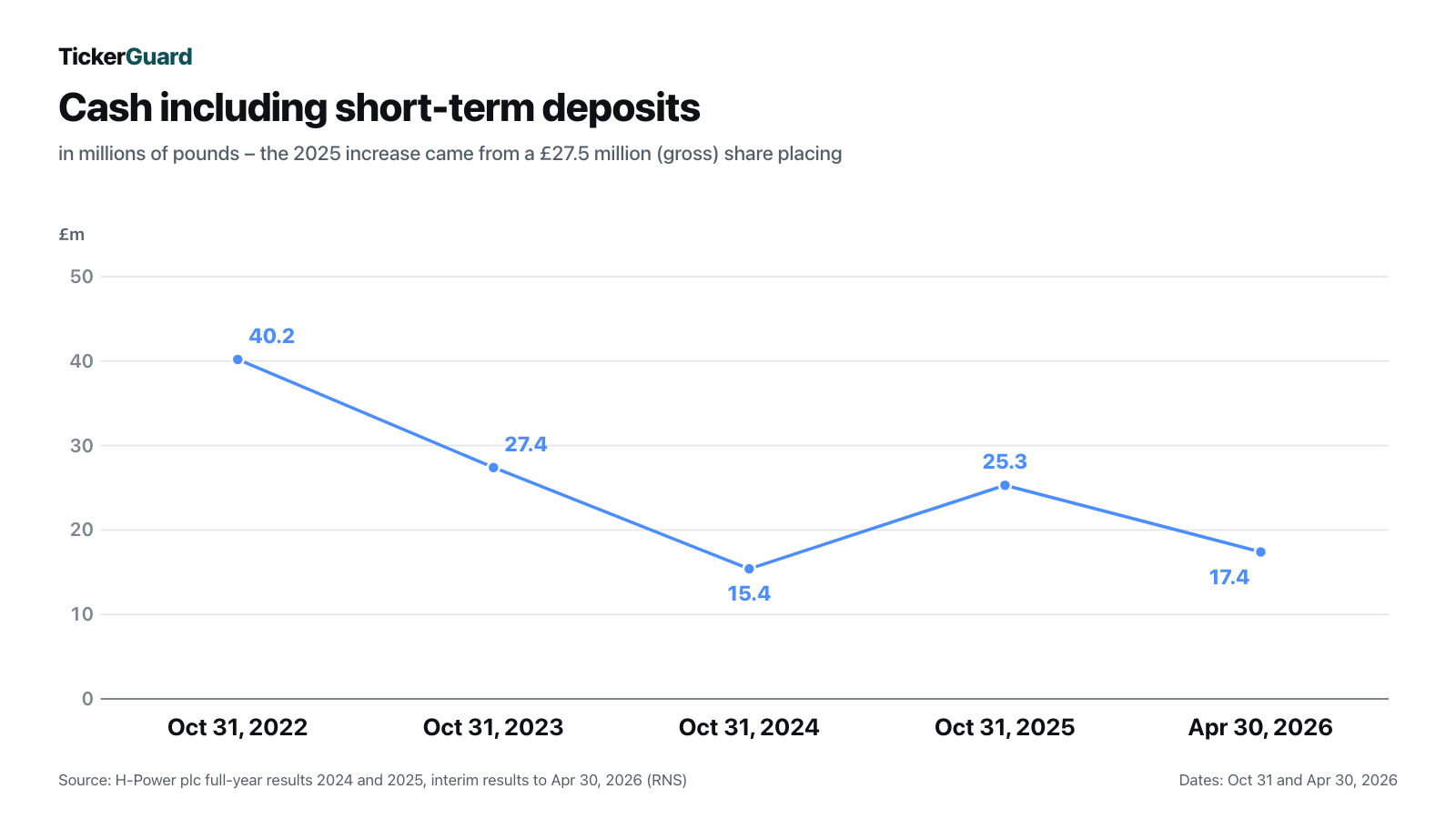
How has a company with so little revenue lasted this long? With its shareholders' money. As of April 30, 2026, the balance sheet showed £159.0 million of share premium — the surplus paid in across all past share issues — against an accumulated deficit of £136.7 million. Cash including short-term deposits fell from £40.2 million (October 31, 2022) to £15.4 million (October 31, 2024), was topped up to £25.3 million by the summer 2025 placing, and stood at £17.4 million on April 30, 2026. H-Power has practically no bank debt; equity was £31.6 million.
One detail deserves a second look: of the £7.5 million that flowed out in the half-year, H-Power capitalized £4.0 million (54 percent) as development costs. Those outlays do not appear as expenses in the income statement but as an asset on the balance sheet — they only become expenses later, through amortization. The company reads the high share as a sign that the money is being spent "better." That may be true. It also explains why the half-year loss (£5.8 million) looks smaller than the cash outflow. Rule of thumb: at a development-stage company, cash is more honest than earnings.
Uncomfortable Truth No. 1: First 15 Generators Unpaid, Then 15 New Ones for the Same Customer
The revenue jump to £4.0 million in fiscal 2024 is the one number that stands out in the five-year series. The fiscal 2024 results of March 19, 2025 explain where it came from: the delivery of 20 S-Series generators (later called AR2) to Speedy Hydrogen Solutions, the joint venture H-Power owns 50/50 with Speedy Hire. According to the notes, £3,829,000 of the £4,002,000 in revenue came from that joint venture; the invoices were raised in October 2024, just before fiscal year-end, and £4.1 million was outstanding as a receivable on October 31, 2024. H-Power made no money on them: the run produced a gross loss of £1.7 million. A year later, the related-party section shows what became of the receivable:
“Following a detailed review of the JV's financial position and a change in its business plan, the receivable has been considered irrecoverable.”
— AFC Energy (now H-Power), full-year results of February 25, 2026, “Related party transactions,” Joint venture

The numbers: on October 31, 2025, the joint venture owed H-Power £3.4 million; deliveries in fiscal 2025 added only £56,000. £2.8 million of it was written off as irrecoverable, and the rest, according to the report, is reclaimable VAT. The financial review gives management's reasoning: the receivable relates to the 15 remaining AR2 generators the joint venture has not paid for. To give it "the lowest cost possible" for the best available technology, the receivable was provided for — on the assumption that the joint venture will switch to the new model.
An everyday picture: a manufacturer delivers twenty cars to a dealership it half-owns. The revenue sits in its books; for fifteen of them, the money never arrives. A year later it writes off the invoice because it would rather let the dealership have the new models cheaply. That is neither illegal nor hidden — it is in the report. But it means that the largest revenue figure of the past five years was 96 percent revenue with the company's own joint venture, and most of it was never paid. In June 2026, H-Power announced a replenishment order from Speedy Hire for 15 LC30 generators for that same joint venture, subject to CE certification, which arrived in August. The question the next annual report must answer: will these be paid for?
Uncomfortable Truth No. 2: The Half-Year's Revenue Came From a Development Contract, Not From Selling Hydrogen
£253,000 of revenue in the first half of fiscal 2026, almost fifteen times the prior year — that sounds like a market launch. The financial review in the interim report describes revenue as coming from hydrogen sales and the Komatsu development contract. The notes are more precise:
“Other revenue 2026 relates to revenue recognised cost to cost basis in accordance with IFRS15, regarding the Komatsu JDA.”
— H-Power, interim results of June 10, 2026, Note 3 “Revenue”
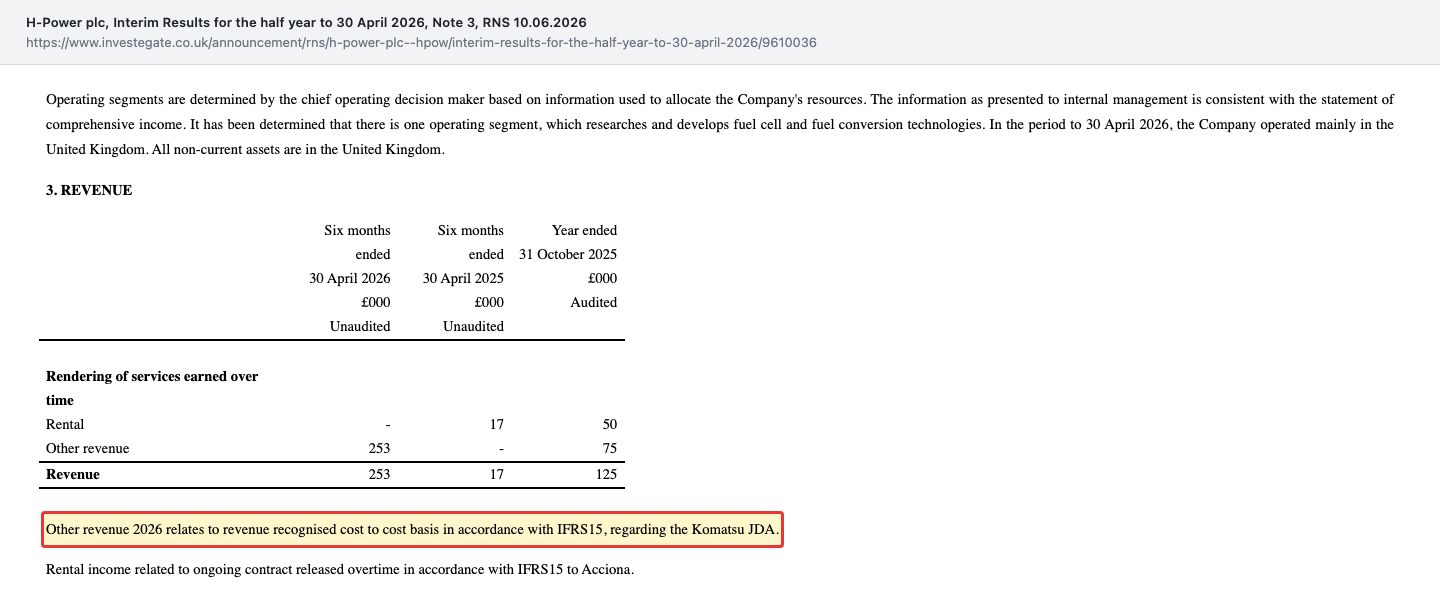
So according to the notes, the entire £253,000 came from the Komatsu contract. H-Power has only been allowed to sell hydrogen from its pilot plant to third parties since the Environment Agency revised its permit on February 18, 2026; the Protium contract came on June 10, 2026, after the balance-sheet date. Komatsu is a strong name, and the contract is real money: about $2 million, recognized as work progresses. According to the announcement of August 10, 2026, the second and final phase runs from September 2026 to December 2027. But a development contract is not a product sale — it ends when development ends.
Two more details from the same report. Gross profit was negative (minus £76,000) because, according to the report, H-Power subsidizes the hydrogen for the joint venture's generators until its own hydrogen from Dunsfold takes over. And the Environment Agency's permission to sell hydrogen from the pilot plant to third parties ran, according to the announcement of June 10, 2026, until August 31, 2026. Whether it was extended, H-Power had not announced by October 8, 2026; according to the fiscal 2025 results, the pilot plant is due to move to Port Clarence on Teesside anyway, to the joint venture with Industrial Chemicals Group (ICL).
Uncomfortable Truth No. 3: By Its Own Math, the Money Lasts Into 2027 — Then Revenue or New Capital Has to Come
The going-concern assessment is required to cover at least twelve months. In its full-year results of February 25, 2026, H-Power looked further ahead and wrote down the result openly:
“The longer term forecasts (beyond the assessment period) show that the business will require a sizable increase in revenue (delivering sustainable commercial revenues in excess of total costs) or additional funding through debt or a further fundraise in order to be able to continue to trade in the medium term (second half of calendar year 2027).”
— AFC Energy (now H-Power), full-year results of February 25, 2026, “Going Concern – Longer Term Assessment”

The rest of the passage deserves a fair reading too: there is no material-uncertainty warning on going concern, the auditor issued an unqualified opinion on the 2025 accounts, and the interim report extends the going-concern assessment to June 2027. The board is confident that new money will be available and points to the 2025 placing. The order of magnitude can be checked. In the first half, cash fell by £7.9 million; for the second half, H-Power expects £3.2 million in R&D tax credits. By our own calculation — not a company figure — £17.4 million plus £3.2 million would last about two and a half half-years at an unchanged pace, which from April 30, 2026 means roughly to July/August 2027. That fits the statement in the report.
What "a sizable increase in revenue" means becomes clear from the reverse calculation: to cover one half-year's outflow, H-Power would need not £253,000 of revenue but sales that leave about £7.5 million after production costs. The company is far from that today. For shareholders, the realistic reading is therefore: by 2027 it will be decided whether the new products sell fast enough — or whether shareholders will be asked to pay up again.
Uncomfortable Truth No. 4: The Last Placing Was Priced at 10 Pence — the Stock Now Trades Below It
What such a capital raise looks like at H-Power was shown in July 2025. The company raised £27.5 million gross through a placing with investors, a subscription by directors and an offer to retail investors. The price was in the announcement:
“The Issue Price represents a discount of approximately 26.3 per cent. to the closing mid-market price of 13.6 pence per Ordinary Share on 16 July 2025, being the latest practicable date prior to the publication of this Announcement.”
— AFC Energy (now H-Power), announcement of July 16, 2025 (“Proposed Placing & Subscription & RetailBook Offer”)
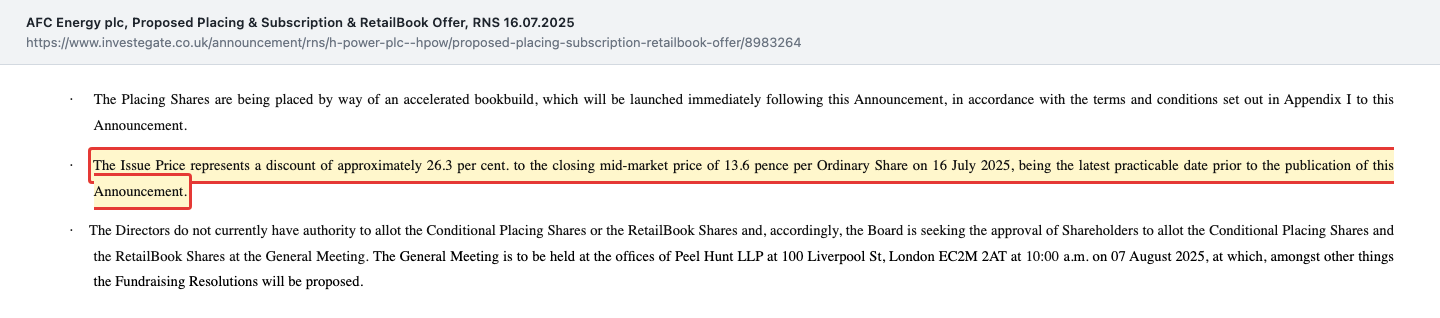
Dilution means your slice of the pie gets smaller because more people are eating. After second admission on August 8, 2025, the share capital comprised 1,131,502,399 shares. Measured by the share capital on the balance sheet (nominal value 0.1 pence per share), there were about 855 million on April 30, 2025 — an increase of roughly one third in a single summer. After £1.7 million in costs, £25.8 million net remained. Since then, bonus shares and exercised options have lifted the count to 1,137,347,223 (as of September 30, 2026, per the company's shareholder page). Then there are options: on June 29, 2026, directors and staff received further options over 10,397,437 shares. They vest in June 2029 only if total shareholder return reaches at least 15 percent a year over the three years — a quarter at that threshold, in full only at 30 percent a year.
And the share price? On October 8, 2026, the stock closed at 9.30 pence — below the 10 pence at which the new shareholders came in during the summer of 2025. Anyone watching the next capital raise now has a benchmark: the 26.3 percent discount of July 2025.
What the Stock Costs
At the October 8, 2026 close of 9.30 pence and 1,137.3 million shares, H-Power is worth about £106 million. That is roughly 3.3 times equity of £31.6 million (April 30, 2026). Subtracting cash of £17.4 million at the same date leaves an enterprise value of about £88 million — for a business that booked £253,000 of revenue in its last half-year. With sales this small, a price-to-sales ratio is not a meaningful yardstick, and there is no price-to-earnings ratio for lack of earnings. The market is paying purely for expectations: that the LC30 and HY5 will sell in volume, and that partners like Komatsu will turn development contracts into orders.
The analyst estimates in the fundamental data (as of October 8, 2026) still expect a loss per share for the current and the next fiscal year (minus 1.18 and minus 1.38 pence); the estimates come from two analysts.
For comparison, two neighbors are worth a look. ITM Power, also listed on AIM, builds electrolyzers and, with £197.8 million in cash as of October 31, 2025, has far more time — but it, too, posted no gross profit in its fiscal years through 2024/25. And Ballard Power has been building fuel cells for more than thirty years; according to our analysis, its losses since 2016 add up to roughly $1.06 billion, and its quarterly gross margin has only been positive since the third quarter of 2025 (second quarter of 2026: 20 percent).
Opportunities and Risks at a Glance
The case for H-Power:
- Cash burn is falling: £7.5 million outflow in the first half of fiscal 2026 (including capitalized development) versus £10.7 million in the prior-year half.
- Technical milestones have arrived on time so far: LC30 with CE attestation (August 2026), manufacturing cost about 85 percent below the predecessor, Komatsu phase 1 completed.
- Well-known partners: Komatsu (development contract of about $2 million), Speedy Hire (joint venture, replenishment order for 15 LC30s), Protium (5,000 kilograms of hydrogen), TAMGO in Saudi Arabia, Volex as manufacturing partner.
- Hardly any debt, equity of £31.6 million, and no going-concern qualification from the auditor for 2025.
- According to the interim report, the price of ammonia made from natural gas has risen by up to 60 percent since the escalation of the Iran conflict, green ammonia by only about 5 percent — a tailwind for its "fuel as a service" model, as the company presents it.
The case against H-Power:
- Losses in each of the ten fiscal years 2016 through 2025 (according to fundamental data); most recently a £22.2 million loss on £125,000 of revenue (fiscal 2025).
- According to its own long-term forecast, a substantial increase in revenue or new money is needed in the second half of 2027; cash stood at £17.4 million on April 30, 2026.
- 96 percent of fiscal 2024 revenue went to the company's own joint venture; a £2.8 million receivable was written off as irrecoverable in 2025.
- According to the notes, the half-year revenue of £253,000 came from the Komatsu development contract, not from product sales.
- Dilution: roughly one third more shares from the 2025 placing at 10 pence and a 26.3 percent discount; the stock closed at 9.30 pence on October 8, 2026, below that price.
A Human Conclusion
Remember the new-label effect from the start? H-Power is a good name, and it describes today's business better than AFC Energy did. But a new sign does not change the math. The math reads: ten loss-making years in a row, half-year revenue that came from a development contract, a written-off receivable from the company's own joint venture, and a board that writes itself that by the second half of 2027, either substantially more revenue or new money has to come.
None of that makes H-Power a hopeless case. The technology is keeping its dates, costs are falling, and a major industrial group, Komatsu, has signed a development agreement. But the proof that milestones turn into revenue is still outstanding. The next tests are concrete: whether the 15 LC30s are delivered to Speedy Hire and paid for this time, whether the HY5 arrives by the end of 2026, and how much cash is left at fiscal year-end on October 31, 2026. Anyone who looks only at the new name sees half the picture. What you make of it is your call. And that is exactly as it should be.
Sources
- H-Power — interim results to April 30, 2026 (RNS of June 10, 2026; most recent periodic report)
- AFC Energy — full-year results for the fiscal year to October 31, 2025 (RNS of February 25, 2026; going concern, joint venture, cash summary 2023–2025)
- AFC Energy — full-year results for the fiscal year to October 31, 2024 (RNS of March 19, 2025; delivery of 20 generators to Speedy Hydrogen Solutions, revenue with the joint venture)
- Placing of July 16, 2025 and general meeting results of August 7, 2025 (1,131,502,399 shares after second admission)
- Trading update of November 6, 2025 and LC30 operational update of January 21, 2026
- Komatsu development agreement of February 10, 2026 and completion of phase 1, August 10, 2026
- Change of name to H-Power plc, May 12, 2026
- Protium contract of June 10, 2026 and TAMGO contract of June 10, 2026
- Option grant of June 29, 2026, total voting rights of July 31, 2026 and LC30 CE attestation of August 26, 2026
- H-Power — Shareholders (share count and major holders, as of September 30, 2026)
- Source: fundamental data & H-Power plc reports (annual and half-year reports, RNS regulatory announcements)
This analysis is a journalistic assessment based on publicly available company reports. It is not investment advice and not a solicitation to buy or sell securities. Stocks can lose value, up to a total loss. All figures carry the date of their source; share prices are dated snapshots. Positions held by the operator are disclosed daily; where one exists, it appears as a notice at the top of this deep dive.
Our Bottom Line at a Glance
- Revenue negative
- Below £1m in four of the five fiscal years 2021 to 2025, most recently £0.125m (FY 2025); the £0.253m in H1 fiscal 2026 came from the Komatsu development contract according to Note 3.
- Cash and funding negative
- £17.4m on 04/30/2026 after a £7.9m cash decrease in the half-year; per the full-year results of 02/25/2026, a substantial revenue increase or new money is needed in H2 2027.
- Cost discipline positive
- Outflow including capitalized development cut to £7.5m in H1 fiscal 2026 (prior year £10.7m); LC30 about 85% cheaper to manufacture than its predecessor, according to the company.
- Technology and partners positive
- LC30 CE attestation (08/26/2026), Komatsu phase 1 completed (08/10/2026), Protium contract for 5,000 kg of hydrogen (06/10/2026), replenishment order for 15 LC30s from Speedy Hire.
- Joint venture negative
- Receivable from Speedy Hydrogen Solutions of £3.4m (10/31/2025), of which £2.8m for 15 unpaid AR2 generators was written off as irrecoverable.
- Dilution negative
- 2025 placing at 10p with a 26.3% discount, roughly one third more shares; 1,137,347,223 shares (09/30/2026) plus 10,397,437 new options (06/29/2026).
H-Power, formerly AFC Energy, keeps its technical dates and is cutting its cash burn, but it has not made a profit in ten fiscal years and booked only £253,000 of revenue in its last half-year, from a development contract. By its own forecast, a substantial revenue increase or new money must come by the second half of 2027. The market value of about £106 million (10/08/2026) pays solely for the expectation that the LC30 and HY5 will sell in volume. Not investment advice.
What Our Rating Means
Substance risk
We found at least one documented issue that threatens the company itself — regardless of how the stock is currently valued.
Red because of a documented threat to the business itself: the company writes that, without a substantial increase in revenue, it needs new money in the second half of 2027 to continue to trade. Cash of £17.4m (04/30/2026), at an unchanged pace and with £3.2m in expected tax credits, lasts roughly five quarters by our calculation, revenue covers only a fraction of costs, and survival therefore depends on the capital markets. No going-concern qualification from the auditor, hardly any debt, and the technical milestones arrived on time — so this is not a verdict on the technology but on the funding. The decision is yours.
A journalistic assessment by our editorial team at the time of the deep dive, based on public sources — not investment advice and not a solicitation to buy or sell. Your personal circumstances (investment goals, risk capacity, taxes) cannot be taken into account. What our levels mean, how verdicts are formed, and what conflicts of interest exist →
Worth Noting
- The trigger was the wallstreet-online forum hot list (10/08/2026) under the U.S. OTC ticker AFGYF; the analysis covers the home listing HPOW on the London Stock Exchange's AIM market.
- As of 10/08/2026. The most recent periodic report is the interim report to 04/30/2026 (published 06/10/2026); all RNS announcements through 08/26/2026 were reviewed, with none between then and 10/08/2026. Fiscal 2026 ends on 10/31/2026.
- H-Power is not an SEC filer: no 10-K, no 10-Q, no 20-F. All evidence comes from the full-year results, the interim report and RNS announcements; figures for fiscal 2021 to 2023 come from fundamental data.
- Cash figures include short-term deposits, as the company presents them in its summaries (04/30/2026: £8.2m cash at bank plus £9.2m deposits). The runway of about five quarters is our own calculation.
- Do not confuse: the former AFC Energy plc has nothing to do with U.S. insurer Aflac (ticker AFL) or with "AFC" tickers on other markets.
Stock Watch
This analysis is as of October 8, 2026. Stock Watch will tell you what's changed at HPOW.LSE since then.
Later $1 a month per stock — signing up is free, and you'll be the first to know when it launches.
The full analysis as a PDF for later
We will send you this analysis as a PDF — to print, file away, and read at your own pace. And we will add you to the free Stock Watch list for H-Power Plc (HPOW.LSE), so you hear about it when something material in this analysis changes.
Frequently Asked Questions
H-Power of Dunsfold, Surrey (England) develops ammonia crackers that recover hydrogen from ammonia on site (HY5 model, up to 500 kilograms a day) and fuel cell generators that turn it into electricity for construction sites and other off-grid uses (LC30 model, 30 kilowatts). The stock is listed on the London Stock Exchange's AIM market under HPOW.
Yes. AFC Energy plc has been called H-Power plc since May 12, 2026; since May 13, 2026 the shares trade on AIM under HPOW instead of AFC, and the ISIN GB00B18S7B29 is unchanged. AFGYF is a U.S. over-the-counter ticker for the same shares. H-Power does not file reports with the SEC; the U.K. regulatory announcements are authoritative.
No. In the fiscal year to October 31, 2025, revenue of £125,000 compared with a net loss of £22.2 million; in the first half of fiscal 2026, revenue was £253,000 and the loss £5.8 million. According to fundamental data, the company posted a loss in every fiscal year from 2016 through 2025.
On April 30, 2026, H-Power had £17.4 million in cash including deposits, and it expects £3.2 million in R&D tax credits in the second half. According to the full-year results of February 25, 2026, it needs a substantial increase in revenue or new money in the second half of 2027. The auditor did not issue a going-concern qualification.
According to the company's website (as of September 30, 2026), mainly investment platforms: Hargreaves Lansdown 14.39 percent, Interactive Investor 11.69 percent, HSDL 5.21 percent, AJ Bell 4.53 percent, Barclays Smart Investor 3.72 percent and German DWP Bank 3.22 percent. The only classic fund investor above 3 percent is Janus Henderson with 7.47 percent.
Fiscal 2026 ends on October 31, 2026. Last year, a trading update followed on November 6, 2025 and the full-year results on February 25, 2026. Under AIM rules, audited accounts must be published within six months of fiscal year-end, i.e., by the end of April 2027.
Found an error?
Did you spot a factual error, an outdated number, or a typo in this deep dive? Let us know briefly — your report goes straight to the editorial team.