ITM Power Keeps Selling More Electrolyzers — and Still Loses Money on Every One
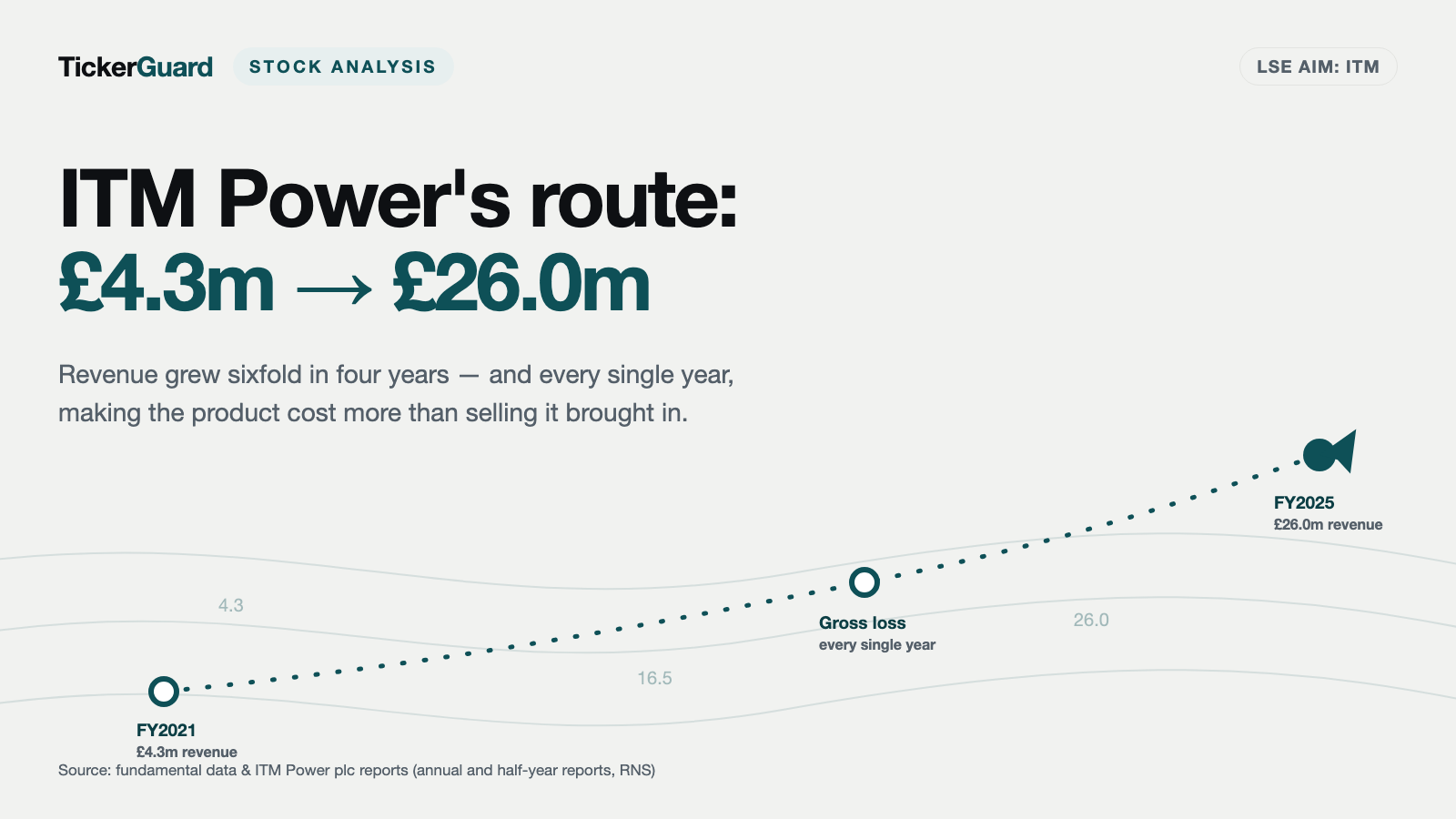
Revenue at the British hydrogen specialist grew sixfold in four fiscal years, from £4.3 million to £26.0 million, and the U.K. government bought in with £40 million in April 2026. Yet ITM Power has not earned a gross profit in any of those years. We read the annual and half-year reports and every regulatory announcement through September 2026 to see how much of the hydrogen story has actually reached the income statement.
 Thomas Mücke
Founder & Publisher
Thomas Mücke
Founder & Publisher
There is a trap investors fall into especially easily when the subject is the future of energy. It has no official name; we call it the story trap: a narrative is so convincing that we stop asking for the bill. Green hydrogen is that kind of story. Steel mills, refineries and chemical parks need it to get off coal and gas; governments back it with billions; and someone has to build the machines that make it from water and clean electricity. Whoever builds those machines, the story goes, sits at the source.
ITM Power of Sheffield, England, builds exactly those machines, and for years its stock has been a favorite of German retail investors. So let's do the opposite of what the story trap wants: read the reports first, then decide what we think of the story. The tension running through this analysis is simple: revenue is growing fast, but ITM Power has not earned a gross profit in any of the past five fiscal years — making the product cost more than selling it brought in, every single time. Whether that turns is the one question everything hinges on.
What ITM Power actually does — machines that split water into hydrogen
ITM Power was founded in 2000 and has been listed since 2004 on AIM, the growth market of the London Stock Exchange. The company makes electrolyzers. Think of an electrolyzer as a battery running in reverse: you push electricity through water, and the water splits into oxygen and hydrogen. If the power comes from wind or solar, the result is called green hydrogen. ITM uses PEM technology, in which a wafer-thin polymer membrane keeps the two gases apart. The heart of the system is the stack of such cells — ITM's current stack is called TRIDENT, and its successor, CHRONOS, is in development.
Out of those stacks come complete plants in three sizes: NEPTUNE V, a 5-megawatt containerized plant; POSEIDON, a 20-megawatt module for large projects; and, since October 2025, ALPHA 50, a complete 50-megawatt plant that ITM prices at €50 million, according to its half-year report. On top of that come maintenance, engineering studies and, since June 2025, a subsidiary called Hydropulse that is meant to build, own and operate hydrogen plants itself and sell the hydrogen to industrial customers. As of April 30, 2025, ITM had 306 employees.
Its best-known reference projects are in Germany. Together with Linde Engineering, ITM is supplying RWE with two 100-megawatt plants in Lingen, in Lower Saxony — the first is fully installed, according to the half-year report, and for the second, all skids and 40 percent of the stacks had been installed by January 2026; on August 4, 2026, ITM announced that hydrogen from Lingen had, for the first time, reached Evonik's chemical park in Marl through roughly 120 kilometers of pipeline. For Shell, the 100-megawatt REFHYNE II project is under way in Wesseling. Germany was by far the most important market in the first half of fiscal 2026, with £15.3 million of £18.0 million in revenue.
Two notes that matter for every number in this piece. First, ITM's fiscal year ends on April 30. “FY2025” means May 2024 through April 2025. Second, ITM Power does not report to the U.S. securities regulator, the SEC. The symbol ITMPF is merely a U.S. over-the-counter quote with no reporting obligation. All evidence therefore comes from the company's own reports — the 2025 annual report, the half-year report of January 29, 2026, and the regulatory announcements distributed through the London Stock Exchange's news service (RNS).
Company history for investors
-
2004
Listing on London's AIM market
Since then, ITM has funded itself through share issues: £542.8m of share premium stands against an accumulated deficit of £361.4m as of 10/31/2025.
-
2022
Cash peaks
£365.9m on April 30, 2022. Cash has fallen at every fiscal year-end since — for shareholders, the gauge of how long the losses can still be carried.
-
2023
Gross loss of £79.1 million
The FY2023 gross loss was more than 15 times revenue of £5.2m, mainly losses on inventory and customer contracts, per the annual report. CEO Dennis Schulz has led the reset since December 2022.
-
2025
£13.0 million settlement with Linde
In FY2025, ITM paid its own major shareholder £13.0m to settle a dispute — half of that year's revenue of £26.0m.
-
2026
April: the state buys in
Great British Energy subscribes £40m at 55.56 pence, 13.7% below the prior close, plus a £46.5m grant for the CHRONOS line. The share count rises by about 12%.
-
2026
August: first hydrogen from Lingen reaches the customer
Hydrogen from the RWE plant reaches the chemical park in Marl via about 120 km of pipeline. Technical proof at scale — the financial proof still awaits the annual accounts.
How the stock landed on our desk
Through the forum ranking of the German finance portal wallstreet-online — the list of stocks German retail investors discuss most — in late September 2026, where it appeared under its U.S. symbol ITMPF. A list like that measures attention, not quality. How big the German fan base really is shows up in the shareholder register on the company's website (as of July 15, 2026): among the notifiable holders, next to the British investment platforms Hargreaves Lansdown (8.21 percent) and Interactive Investor (5.63 percent), sit Deutsche WertpapierService Bank (5.50 percent), ING-DiBa (3.11 percent) and Commerzbank (3.10 percent) — custodians that mostly hold shares for private accounts.
There was plenty to talk about. The stock moved a lot this year: based on the regulatory announcement published the next day, it closed at about 64.4 pence on April 8, 2026 (the issue price of 55.56 pence was 13.7 percent below that). On September 15, 2026, the three executive directors bought shares under the employee share plan at 98.89 pence. That is a gain of just over 50 percent in five months. In between came the investment by state-owned Great British Energy, an approved £46.5 million government grant, a collaboration with Rheinmetall and the first hydrogen from Lingen. Exactly the stuff stories are made of.
The numbers over the years — given their due
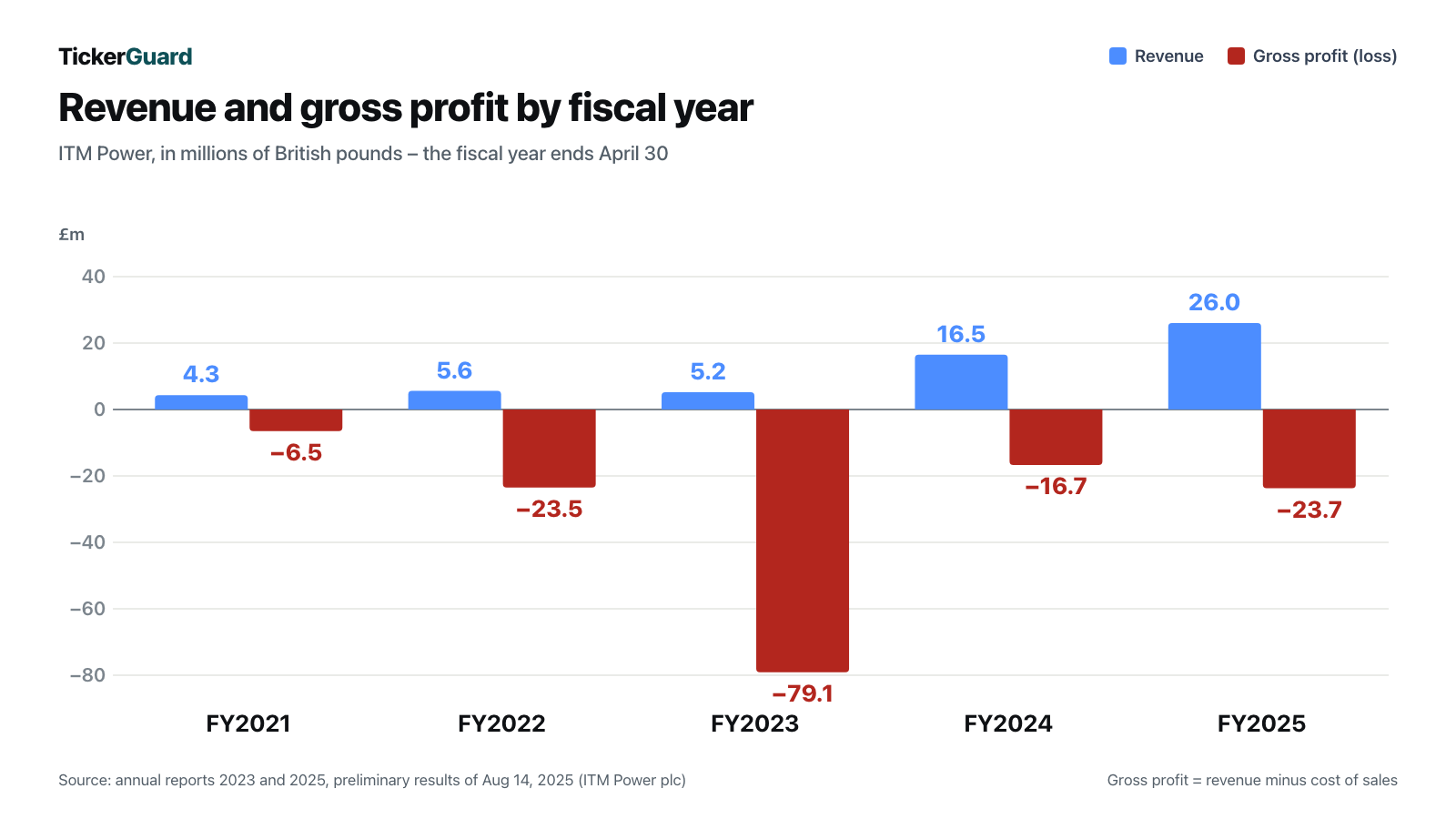
First, what is genuinely impressive: the growth. Revenue was £4.3 million in FY2021, stalled for two years at £5.6 million and £5.2 million, then jumped to £16.5 million (FY2024) and £26.0 million (FY2025). The first half of fiscal 2026 (May through October 2025) alone brought in £18.0 million — more than two thirds of the entire prior year and, according to the company, the strongest half year in its history. On February 17, 2026, ITM raised its full-year FY2026 revenue guidance to £40 million to £43 million. The factory is running better, too: the share of plants that pass the factory acceptance test on the first attempt rose from below 50 percent to 99 percent, according to the full-year results.
Now the other line of the income statement. Gross profit — revenue minus what it cost to make the plants that were sold — was negative in every one of those years: minus £6.5 million, minus £23.5 million, minus £79.1 million, minus £16.7 million and minus £23.7 million in FY2025. In the first half of fiscal 2026 it was minus £6.5 million. Adjusted EBITDA (a company measure of operating earnings before depreciation, excluding one-offs and share-based pay) was minus £33.0 million in FY2025, and the pre-tax loss was £45.4 million.
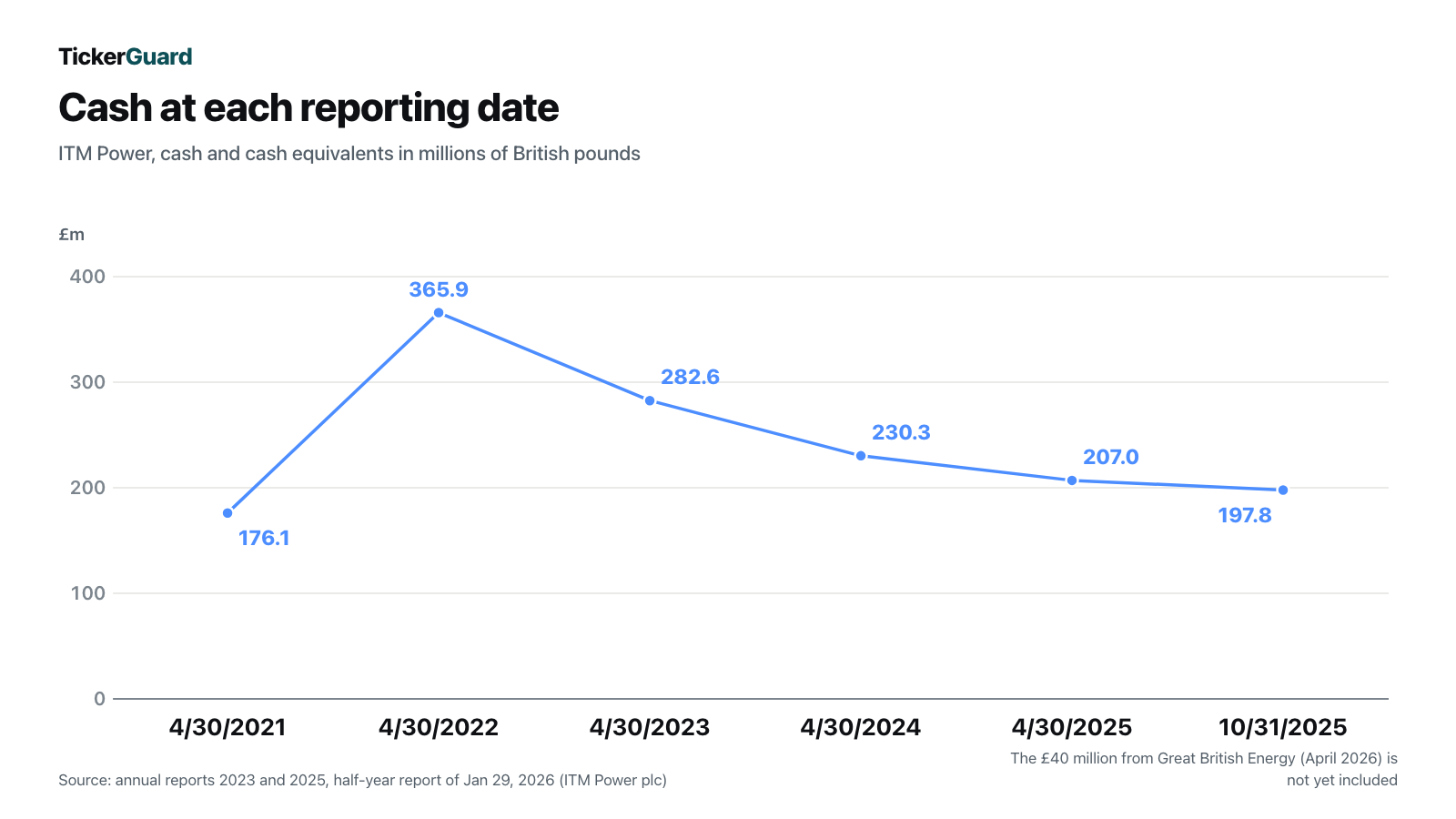
What has made the losses bearable so far is the cash pile. Over the years, ITM has repeatedly raised fresh money from shareholders; as of October 31, 2025, the balance sheet showed £542.8 million of share premium (the money raised above par value in share issues) against an accumulated deficit of £361.4 million. Cash peaked at £365.9 million on April 30, 2022, and has fallen at every fiscal year-end since. A year before the peak, on April 30, 2021, it was £176.1 million. It then stood at £282.6 million (2023), £230.3 million (2024) and £207.0 million (2025), each on April 30. Only once did it rise in between: in the second half of FY2025, from £203.1 million to £207.0 million. On October 31, 2025, cash stood at £197.8 million. ITM has practically no debt apart from lease obligations. And the money works: interest income brought in £10.2 million in FY2025.
An important note on where this analysis stands: fiscal 2026 ended on April 30, 2026, but the full-year results had not been published by September 26, 2026. Last year, ITM released its preliminary results on August 14. Under the AIM rules, the audited accounts must be published no later than six months after the fiscal year-end — in this case by the end of October 2026. The latest published periodic report is therefore the half-year report to October 31, 2025. What happened since comes from regulatory announcements — above all the guidance: revenue of £40 million to £43 million, adjusted EBITDA of minus £27 million to minus £29 million, and cash of £210 million to £215 million on April 30, 2026. Rule of thumb: guidance is a promise, not a result. Whether it was kept, only the annual accounts will show.
Uncomfortable truth No. 1: every pound of revenue has cost more than a pound so far
In FY2025, £26.0 million of revenue came with cost of sales of £49.7 million. For every pound a customer paid, ITM spent about £1.91 before a single penny went to administration, research or sales. In the first half of fiscal 2026, the ratio improved to £24.5 million of costs against £18.0 million of revenue, about £1.36 per pound of revenue — but still above one. The company's explanation: the factory is not yet fully utilized, so its fixed costs are spread over too few plants. And the order book still contains old contracts signed at prices on which ITM cannot make money:
“The remaining legacy projects, which do not contribute to margin but are fully provided for, are expected to be recognised over the next 18 months.”
— ITM Power, half-year report of January 29, 2026, section “Income statement”
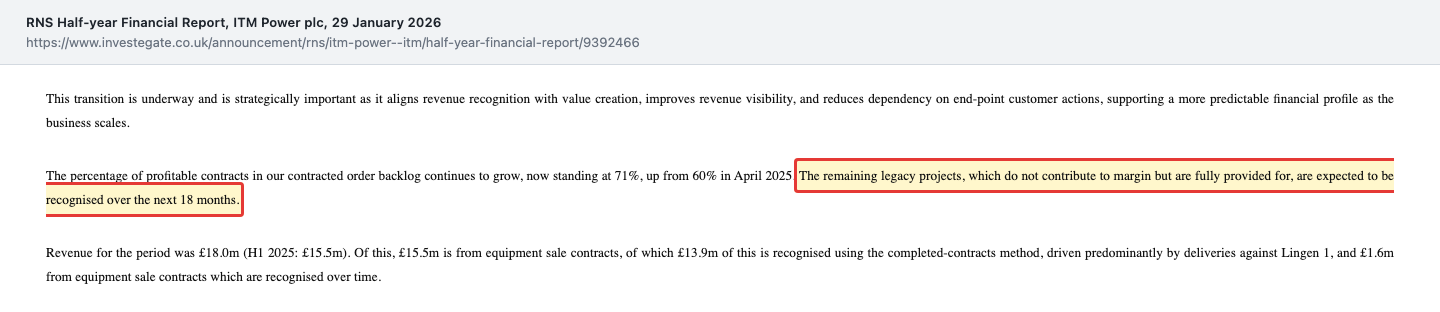
In plain English: of the £152 million order backlog, 71 percent comes from profitable contracts, according to the half-year report, and 29 percent — roughly £44 million — from legacy contracts with no margin. ITM already booked the losses on those contracts as provisions in earlier years. That has a side effect worth knowing: in the first half of fiscal 2026, ITM used £7.5 million of that provision for onerous contracts. The cost of those deliveries therefore does not show up again in the half-year gross result — it was booked earlier. Part of the improved gross result is genuine progress; part of it is simply that old losses don't count twice.
On top of that comes a change in how revenue is booked. ITM used to recognize revenue only at milestones such as delivery or acceptance. For new, non-standard contracts (POSEIDON, ALPHA, non-standard NEPTUNE), revenue is now spread according to construction progress. In the first half that amounted to only £1.6 million. But when ITM raised its revenue guidance on February 17, 2026, it explicitly cited this method as one reason, because it brings revenue from recently announced orders onto the books earlier. More revenue by percentage of completion does not mean more business — it means business booked sooner. How much of it is in the annual accounts is one of the questions for October.
The guidance itself offers a hint. With adjusted EBITDA of minus £11.9 million in the first half and minus £27 million to minus £29 million for the full year, the second half implies a loss of £15.1 million to £17.1 million — larger than in the first half, even though, according to the guidance, most of the year's revenue is supposed to land there.
Uncomfortable truth No. 2: part of the cash pile is customers' money
In the first half of fiscal 2026, cash fell by only £9.2 million. That sounds like a company almost covering its own losses. The half-year report explains why the picture is too flattering:
“Cash at 31 October 2025 was £198m (31 October 2024: £203m), representing an outflow since the year-end of £9.2m as we continued manufacturing customer commitments for which cash had been received in previous periods.”
— ITM Power, half-year report of January 29, 2026, section “Cash flow and balance sheet”
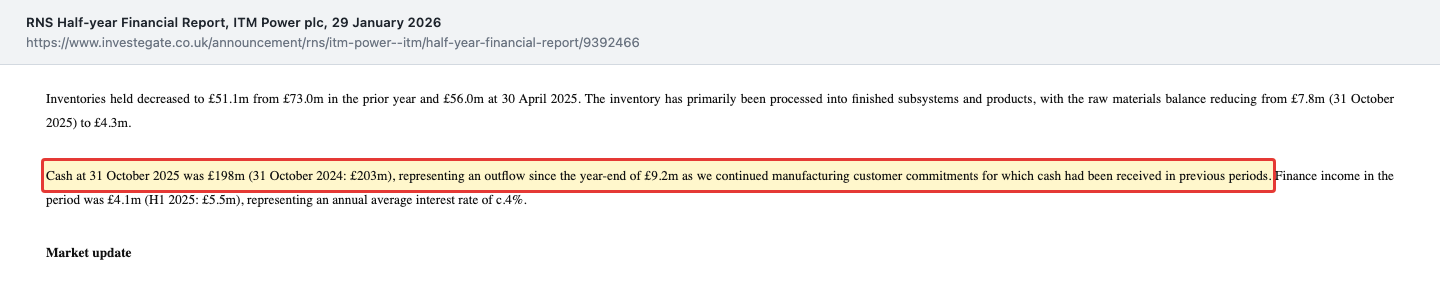
Picture a contractor who takes a deposit on every job. As long as new jobs with deposits keep coming in, his bank account looks healthy — even if he makes nothing on the individual jobs. At ITM those deposits sit on the balance sheet as “deferred income”: £64.2 million as of April 30, 2025. The annual report says openly that ITM structures its payment milestones to cover material costs up front.
The half-year cash flow statement shows how big the effect was. Before changes in working capital, operations consumed £12.1 million. That the operating outflow ended at only £5.9 million was due to £12.7 million from working capital, above all a £14.9 million increase in payables. Capital spending added £6.9 million. Anyone who annualizes the £9.2 million half-year outflow is counting on a tailwind that only blows as long as new deposits outrun the production of old orders. The company's own guidance confirms it: without the £40 million from Great British Energy, cash on April 30, 2026, would have been £170 million to £175 million — an outflow of £32 million to £37 million for the full year, more than three times the first half.
The fair counterpoint: an outflow of that size against more than £200 million in cash is not an acute danger. According to the half-year report, management even stress-tested its going-concern forecast through the end of January 2027 in a scenario in which no customer pays at all — and cash would still stay positive for twelve months. ITM has time. The only question is whether the time is enough for the factory to start making money.
Uncomfortable truth No. 3: one customer delivered 70 percent of the half year — and Linde sits on every side of the table
The half-year report does not name its customers, but it gives their size. A single customer, labeled “Customer B,” accounted for £12.6 million of £18.0 million in revenue in the first half of fiscal 2026, just under 70 percent. According to the report, the half-year revenue came predominantly from deliveries for Lingen 1; the report does not name Customer B. In FY2025, two other customers together accounted for 76 percent (£10.8 million and £9.0 million of £26.0 million). A few large projects make up most of the revenue, and each of them ends at some point. For the first Lingen plant, ITM's scope was fully delivered and installed, according to its December 2025 announcement.
Even more remarkable is the role of another name: Linde. The industrial-gas group is ITM's largest shareholder with 100 million shares (14.46 percent as of July 15, 2026), has a representative on the board, is a partner in the joint venture ITM Linde Electrolysis and a project partner in Lingen. It is also a customer: in the first half of fiscal 2026, ITM billed the Linde/BOC group £5.0 million in milestone payments, according to the notes. And it was the opposing party in a dispute that cost ITM a lot of money:
“In the last financial year, the Group reached the conclusion of the commercial dispute with Linde/BOC Group, represented on the Board by M von Plotho, leading to a payment to Linde of £13.0m.”
— ITM Power, half-year report of January 29, 2026, Note 7 “Related Parties”
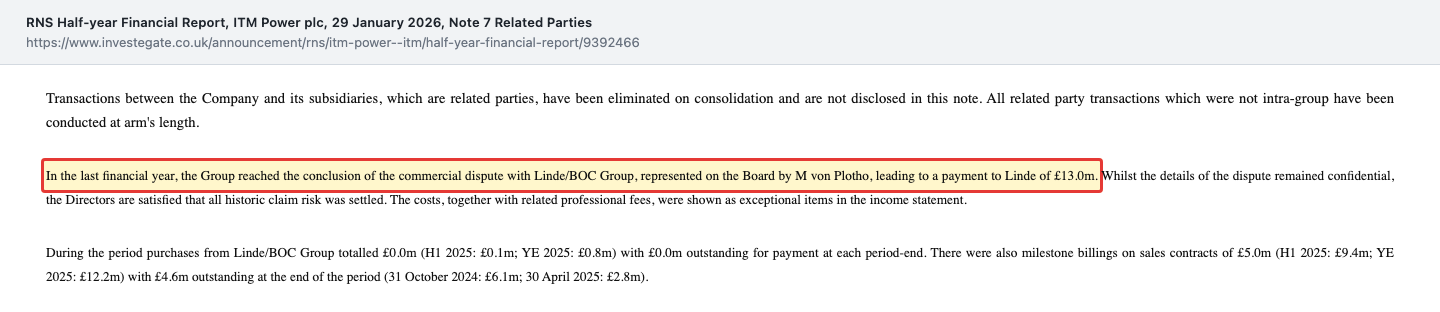
£13.0 million — half of FY2025's entire revenue, paid to the company's own major shareholder. The details of the dispute remained confidential. Add the people at the top: CEO Dennis Schulz joined from Linde in December 2022. Since January 15, 2026, Jürgen Nowicki has chaired the board; according to the annual report, he previously spent five years as Linde's nominated board representative, and most recently he was CEO of Linde Engineering. The annual report says this prior role will be taken into account in the annual assessment of his independence. Since June 24, 2026, Oleg Williamson from Linde's treasury function has represented the major shareholder on the board.
None of this is hidden; all of it is disclosed. But it means that at ITM a single group is at once the largest owner, a partner, a customer and — until recently — an opposing party in a dispute, and the people at the top know it from the inside. That can be an advantage, because it opens doors. It can also mean that in a conflict it is not obvious who sits on which side of the table. Anyone holding the stock should read the related-party disclosures in the next annual report carefully.
Uncomfortable truth No. 4: the state bought in at a 13.7 percent discount
On April 9, 2026, ITM announced two pieces of good news at once. Great British Energy, the U.K.'s publicly owned energy company, is investing £40 million in new shares. And the Department for Energy Security and Net Zero signaled a grant of £46.5 million, formally awarded on July 9, 2026. Both are meant to fund an automated production line in Sheffield for the new CHRONOS stack with one gigawatt of annual capacity; ITM expects to invest up to £120 million over three years and targets commercial operation in 2028. The grant is paid quarterly in arrears, and ITM has committed to adding about 250 jobs in the U.K. over five years.
The terms appear further down in the same announcement:
“The Subscription Shares will represent approximately 10.4% of the Company's issued share capital immediately following the Subscription and the Subscription Price represents a 13.7% discount to the closing mid-market price of an ITM Power ordinary share on 8 April 2026.”
— ITM Power, regulatory announcement of April 9, 2026, section “The Subscription”
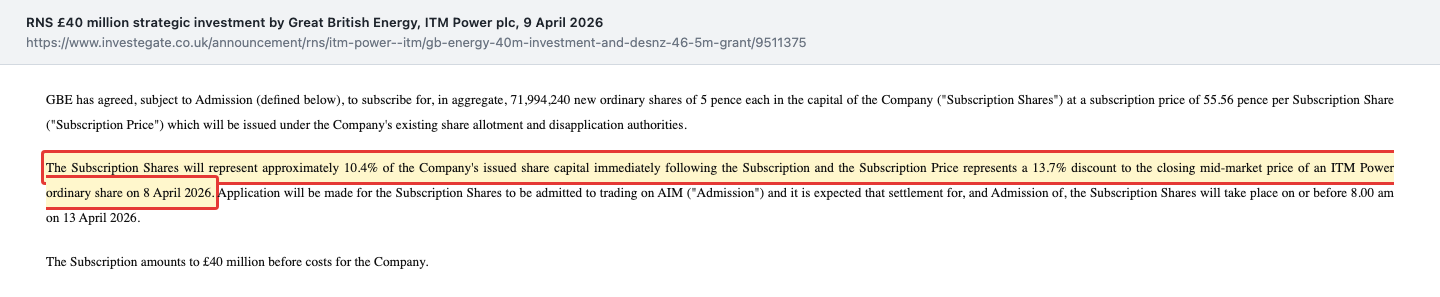
Dilution means your slice of the cake gets smaller because more people are eating. Great British Energy received 71,994,240 new shares at 55.56 pence, without existing shareholders being able to participate. The share count rose from 617.4 million to 689.4 million and, through employee plans, to 691,405,563 by April 30, 2026. Options come on top: as of October 31, 2025, 12.1 million potentially dilutive shares were outstanding, and in April 2026 the three executive directors received further options over a combined 3.1 million-plus shares, including a one-off discretionary award of 1.3 million to the CEO.
The same announcement contains a clause that is easy to miss: if ITM raises capital again within six months at a deeper discount, the company must compensate Great British Energy as if it had subscribed at that discount. The new major shareholder may also send an observer to board meetings and, with a stake of at least 10 percent, nominate a director. That is not unusual for a strategic investor. But it does mean that the register now contains two major shareholders with their own agendas, Linde and the British state — according to the company, 24.88 percent of the shares are not in public hands.
What the stock costs
At 98.89 pence, the price at which the executive directors bought on September 15, 2026, ITM Power is worth about £684 million with 691.4 million shares. Measured against FY2025 revenue of £26.0 million, that is just over 26 times sales; against the midpoint of FY2026 guidance (£41.5 million), about 16.5 times. Subtract the announced cash of £210 million to £215 million — not yet confirmed by audited accounts — and the enterprise value is roughly £470 million, a little more than 11 times guided revenue.
There is no price-to-earnings ratio because there are no earnings. Against equity of £210.6 million as of October 31, 2025, the market pays a little over three times book value; the Great British Energy investment is not yet included in that figure. The “as of today” box on this page shows how far the share price has moved since. The order of magnitude is what matters: at ITM, the market is not paying for profits today but for the expectation that the factory fills up and the legacy contracts roll off. That is a price argument, not a verdict on quality — but it shows how much future is already in the price.
For comparison, it's worth looking at Plug Power, the American hydrogen company that also sells electrolyzers and has faced the same gross-margin question for years. And for the defense angle of the story: the collaboration agreed with Rheinmetall in April 2026 targets decentralized plants for synthetic fuels for NATO forces, initially in the U.K. — so far a collaboration without a quantified order.
Upside and risks at a glance
What speaks for ITM Power:
- Revenue is growing strongly: from £16.5 million (FY2024) to £26.0 million (FY2025), £18.0 million in the first half of fiscal 2026 alone, with full-year guidance of £40 million to £43 million.
- The share of profitable contracts in the backlog rose from 60 percent (April 2025) to 71 percent (January 2026); the no-margin legacy contracts are expected to be worked off by around mid-2027.
- The balance sheet is debt-free, with £197.8 million in cash as of October 31, 2025; including the Great British Energy investment, ITM expected £210 million to £215 million by April 30, 2026.
- The British state is both a shareholder and a grant provider (£40 million of equity plus a £46.5 million grant) — which strengthens ITM's credibility for large projects in its home market.
- Reference projects with RWE, Shell and Linde, and the first hydrogen from Lingen in August 2026, show the technology works at scale.
What speaks against ITM Power:
- There was no gross profit in any fiscal year from FY2021 through FY2025; in FY2025, production cost £1.91 per pound of revenue.
- The cash pile is propped up by customer deposits (£64.2 million as of April 30, 2025); without the state investment, the FY2026 outflow would have been £32 million to £37 million, according to guidance.
- High customer concentration: one customer with just under 70 percent of half-year revenue, plus Linde's multiple roles as major shareholder, partner, customer and former opposing party.
- Dilution: the share count rose by about 12 percent in 2026 to 691.4 million, and the new shares were issued at a 13.7 percent discount.
- The FY2026 results were still outstanding five months after year-end, and at roughly 16.5 times guided revenue the price assumes a lot of success.
A human conclusion
Remember the story trap from the start? ITM Power's story is not made up. The plants run, hydrogen from Lingen flows through a pipeline to a chemical park, the British state has put money on the table, and revenue has grown sixfold in four years. But the story has one line it rarely tells: so far, ITM has lost money on every plant it sold, before a single office was paid for. The cash pile has been shrinking since 2022, and part of it is carried by customers' money.
None of that makes ITM Power a bad company. It makes it a company that still owes the proof — the proof that a full factory, new contracts and the new CHRONOS stack can make money. The next test comes with the FY2026 accounts, which under the AIM rules must be out by the end of October 2026: did revenue reach the £40 million to £43 million guidance, how much of it came from the new booking method, and how far has gross profit turned positive — or not? Anyone who reads only the story until then is reading half of it. What you make of it is up to you. The decision is yours.
Sources
- ITM Power — half-year report to October 31, 2025 (RNS of January 29, 2026; latest published periodic report)
- ITM Power — Annual Report 2025 (fiscal year to April 30, 2025; shareholders, board, notes on contract balances)
- ITM Power — preliminary results FY2025 (RNS of August 14, 2025) and Annual Report 2023 (key figures FY2021 to FY2023)
- Trading update of December 4, 2025 and guidance raise of February 17, 2026
- Regulatory announcement of April 9, 2026 (Great British Energy, grant) and grant award of July 9, 2026
- Option awards of April 17, 2026 and total voting rights of April 30, 2026 (691,405,563 shares)
- MorGen Energy investment decision of March 11, 2026, Rheinmetall of April 17, 2026, Protium of June 3, 2026, DB Systemtechnik of June 24, 2026
- New chair of January 16, 2026 and new Linde representative of June 25, 2026
- First hydrogen from Lingen, August 4, 2026 and directors' dealings of September 17, 2026 (purchase at £0.9889 on September 15, 2026)
- ITM Power — Major Shareholders (as of July 15, 2026) and AIM Rules for Companies (Rule 19, deadline for annual accounts)
- Source: fundamental data & ITM Power plc reports (annual and half-year reports, RNS regulatory announcements)
This analysis is a journalistic assessment based on publicly available company reports. It is not investment advice and not a solicitation to buy or sell securities. Stocks can lose value, up to a total loss. All figures carry the date of their source; share prices are dated snapshots. Positions held by the operator are disclosed daily; where one exists, it appears as a notice at the top of this analysis.
Our Bottom Line at a Glance
- Revenue growth positive
- From £4.3m (FY2021) to £26.0m (FY2025) and £18.0m in the first half of fiscal 2026; FY2026 guidance raised to £40–43m on 02/17/2026.
- Gross margin negative
- Negative in all five fiscal years through FY2025, most recently −£23.7m on £26.0m of revenue; −£6.5m in the first half of fiscal 2026. 29% of the backlog consists of no-margin legacy contracts (half-year report, 01/29/2026).
- Balance sheet and cash positive
- £197.8m of cash and no bank debt (10/31/2025), plus £40m from Great British Energy in April 2026. The going-concern stress test stays positive for twelve months even with no customer receipts at all.
- Quality of the cash outflow neutral
- The half-year outflow of only £9.2m was supported by customer deposits; before working capital, £12.1m went out. Excluding the state investment, ITM expected an outflow of £32–37m for FY2026.
- Customer concentration and Linde negative
- One customer accounted for £12.6m of £18.0m in half-year revenue. Linde is a major shareholder (14.46%), partner and customer, and received a £13.0m settlement in FY2025; the chair spent five years as Linde's board representative.
- Dilution negative
- Share count up about 12% in 2026 to 691,405,563; the 71,994,240 shares for Great British Energy were issued at a 13.7% discount at 55.56p, plus 12.1m potentially dilutive options (10/31/2025).
ITM Power is growing fast and is well cushioned financially thanks to its cash pile and the state investment, but it has not earned a gross profit in any fiscal year so far. Whether a full factory, the roll-off of legacy contracts and the new CHRONOS stack change that will show at the earliest in the FY2026 accounts, due by the end of October 2026. Until then, investors are mainly buying an expectation. Not investment advice.
What Our Rating Means
Open questions
The business works in principle, but one material question is open. As long as it stays open, our findings do not carry a quality verdict.
No threat to the company's survival is evident: around £200m of cash, no bank debt, a stress test with zero customer receipts that stays positive for twelve months, and the state as a shareholder. What is missing for a green rating is the most important thing — proof that the business model works. In every fiscal year since FY2021, making the product cost more than selling it brought in, almost a third of the backlog is no-margin contracts, and revenue depends on a handful of large projects. That is an unproven turnaround, hence yellow. At a market value of about £684m on 09/15/2026, a lot of hope is priced in — a price argument, not a quality verdict. The decision is yours.
A journalistic assessment by our editorial team at the time of the deep dive, based on public sources — not investment advice and not a solicitation to buy or sell. Your personal circumstances (investment goals, risk capacity, taxes) cannot be taken into account. What our levels mean, how verdicts are formed, and what conflicts of interest exist →
Worth Noting
- The trigger was the forum ranking of wallstreet-online (late September 2026) under the U.S. OTC symbol ITMPF; this analysis covers the home listing ITM on London's AIM market.
- Data as of September 26, 2026. The latest published periodic report is the half-year report to 10/31/2025 (01/29/2026). FY2026 results (fiscal year to 04/30/2026) were not yet available; guidance figures come from the announcements of 02/17 and 04/09/2026.
- ITM Power is not an SEC filer: no 10-K, no 10-Q, no 20-F. All evidence comes from annual reports, the half-year report and RNS regulatory announcements.
- The price anchor is £0.9889, the price at which the executive directors bought under the employee share plan on 09/15/2026 (announcement of 09/17/2026). The price on 04/08/2026 (about 64.4p) is derived from the 55.56p subscription price and the stated 13.7% discount.
- Possible confusion: ITM Power has nothing to do with the identical ticker ITM of a U.S. municipal-bond ETF; the joint venture ITM Linde Electrolysis is consolidated by Linde, not by ITM.
The full analysis as a PDF for later
We will send you this analysis as a PDF — to print, file away, and read at your own pace.
Frequently Asked Questions
ITM Power, based in Sheffield, England, builds electrolyzers — plants that use electricity to split water into hydrogen and oxygen; powered by renewable electricity, they produce green hydrogen. Its products include the containerized NEPTUNE V (5 megawatts), the POSEIDON module (20 megawatts) and the complete ALPHA 50 plant (50 megawatts). The stock has been listed on London's AIM market since 2004.
Not yet. In FY2025 (fiscal year to April 30, 2025), £26.0 million of revenue came with a gross loss of £23.7 million and a pre-tax loss of £45.4 million. In the first half of fiscal 2026, the gross loss was £6.5 million on £18.0 million of revenue. There has been no gross profit in any fiscal year since FY2021.
The fiscal year ended on April 30, 2026. As of September 26, 2026, ITM had not yet published the results; last year they came out on August 14. Under AIM Rule 19, audited accounts must be published no later than six months after the fiscal year-end — that is, by October 31, 2026. Guidance calls for revenue of £40 million to £43 million.
As of October 31, 2025, ITM held £197.8 million in cash and had no bank debt. In April 2026, Great British Energy added £40 million, and ITM expected £210 million to £215 million by April 30, 2026. Part of the cash consists of customer deposits (£64.2 million as of April 30, 2025).
According to the company's website (as of July 15, 2026), Linde holds 14.46 percent and state-owned Great British Energy 10.41 percent. They are followed by investment platforms and custodian banks such as Hargreaves Lansdown (8.21 percent), Interactive Investor (5.63 percent), Deutsche WertpapierService Bank (5.50 percent), and ING-DiBa and Commerzbank at just over 3 percent each.
Yes. ITMPF is a U.S. over-the-counter symbol for the shares of ITM Power plc, which trade on the London Stock Exchange's AIM market under ITM (ISIN GB00B0130H42). ITM Power is not registered with the U.S. securities regulator, the SEC, and files no reports there; the British regulatory announcements and annual reports are what count.
ITM Power uses a fiscal year that runs from May 1 to April 30. FY2025 covers May 2024 through April 2025, and the first half of fiscal 2026 covers May through October 2025. Half-year results usually come out in January, full-year results in late summer or fall.
Found an error?
Did you spot a factual error, an outdated number, or a typo in this deep dive? Let us know briefly — your report goes straight to the editorial team.