Rheinmetall: 80 billion in the order book — and cash is currently leaving the building
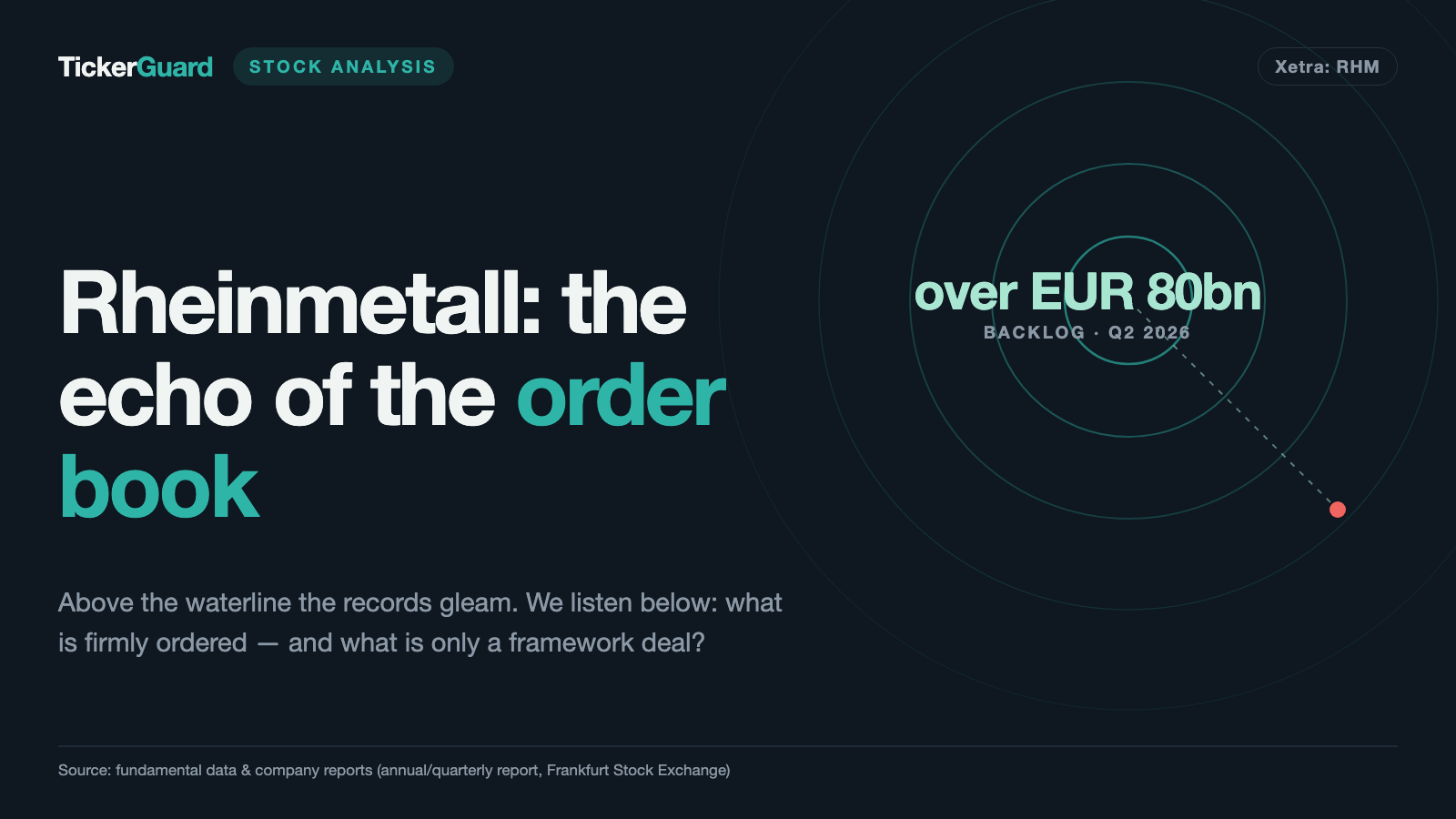
The half-year financial report of August 6, 2026 shows both sides in one set of numbers: the Rheinmetall Backlog reached EUR 80,467 million on June 30, 2026, first-half revenue rose 39 percent to EUR 5,227 million, and the operating margin climbed to a record 17.1 percent in the second quarter. At the same time EUR 1,616 million of operating free cash flow drained out, net liquidity of EUR 369 million turned into net financial debt of EUR 2,722 million, and revenue guidance was cut to EUR 13.7 to 14.2 billion. No buy or sell recommendation — just the question of what an order book is worth before it has turned into cash.
 Thomas Mücke
Founder & Publisher
Thomas Mücke
Founder & Publisher
Chart
Interactive price chart (TradingView).
Note: pure fact-based analysis, not investment advice and not a solicitation to buy or sell. All figures without guarantee.
There is one investor weakness that is most dangerous around the most successful stocks: the hero bonus. Once we have privately crowned a company a winner, we stop checking. Numbers we would pull apart at any other company get a friendly nod at a hero — "things are clearly going well there". Rheinmetall is such a hero. The stock closed 2021 at EUR 83.06 and 2025 at EUR 1,561.00, both figures printed in the key-figure table of the company's own annual report. Four years, a factor of almost nineteen. So let us make a deal: we leave the applause where it belongs and instead read the Annual Report 2025 (published March 11, 2026) and the half-year financial report 2026 that Rheinmetall filed on August 6, 2026. There is a great deal to admire in them — and a handful of places where you pause.
The tension in this analysis fits in one sentence: Rheinmetall has more orders than ever before — and cash is currently leaving the company rather than flowing in. Both are true, both are explainable, and both belong side by side.
What Rheinmetall actually does — from auto supplier to pure defense group
Rheinmetall AG, based in Düsseldorf, traces back to the "Rheinische Metallwaaren- und Maschinenfabrik Actiengesellschaft" founded in 1889 to supply ammunition to the German Reich. For more than a century the group had two halves: defense on one side, automotive components (pistons, pumps, aftermarket) on the other. That split ended on December 17, 2025, when the executive board decided to sell the civil Power Systems division and to classify it as a discontinued operation.
On June 3, 2026 the purchase agreement was signed: Munich-based industrial group AEQUITA acquires Power Systems for a preliminary purchase price of EUR 350 million for 100 percent of the shares, with closing targeted for the fourth quarter of 2026 subject to regulatory approval. Power Systems generated revenue of roughly EUR 2 billion in 2025 and employs about 6,250 people worldwide; the Pierburg, Kolbenschmidt and Motorservice brands stay with the divested business. Three pieces are carved out: the three German sites of KS Huayu AluTech, the stake in Dermalog SensorTec (which moves into the Weapon and Ammunition division) and the Spanish Abadiano plant, which will be converted to military production over time.
What remains is a pure defense company organized in five segments. Vehicle Systems builds military wheeled and tracked vehicles (Puma and Lynx infantry fighting vehicles, tactical trucks). Weapon and Ammunition is the historic core: weapon systems, ammunition, propellants, protection systems. Air Defence supplies ground-based air and counter-drone defense (Skyranger, Skynex). Digital Systems covers digitization of armed forces, soldier equipment, simulation and aviation systems. And since February 27, 2026 there is Naval Systems: on that day Rheinmetall acquired 100 percent of the shipyard group Naval Vessels Lürssen (NVL), with four yards in northern Germany, 31 companies and around 2,100 employees. The group now covers the sea as well — from unmanned surface vessels to corvettes and frigates. Effective January 1, 2026, the former Electronic Solutions division was split into Air Defence and Digital Systems, and the U.S. business was moved into a separate U.S. America division.
At the end of 2025 the Rheinmetall group employed 32,251 full-time equivalents (prior year 28,539), of which 25,865 were in continuing defense operations; 16,558 worked in Germany and 15,694 abroad. Following the NVL acquisition the company cites roughly 34,000 employees at around 160 locations (as of June 3, 2026). The stock has been in the DAX since March 2023 and in the EURO STOXX 50 since 2025.
Why there is no 10-K here — and where the numbers come from instead
One point up front, because it shapes the entire evidence chain: Rheinmetall files no annual report on Form 10-K and no quarterly report on Form 10-Q with the U.S. securities regulator, the SEC. It is not a U.S. reporting company. Mandatory reporting runs through the regulated market (Prime Standard) of the Frankfurt Stock Exchange: audited IFRS consolidated accounts — for 2025 audited by Deloitte, appointed at the annual general meeting on May 13, 2025 — a half-year financial report and short, unaudited quarterly statements. On top of that come ad-hoc releases under Article 17 of the EU Market Abuse Regulation whenever information becomes price-sensitive.
Every figure in this analysis therefore carries the line "Source: fundamental data & company reports (annual/quarterly report, Frankfurt Stock Exchange)". You know the same setup from our analysis of HENSOLDT and our analysis of RENK — both German defense names without SEC registration, where the entire evidence chain runs through the company's original reports.
And one note on timing, because it matters. The most recent complete periodic report is the half-year financial report 2026 covering January 1 to June 30, 2026, published on August 6, 2026. It is fully evaluated here; the preliminary figures from the ad-hoc release of July 29, 2026 are superseded by the final ones. Note that a German half-year report is not audited — it is neither subject to a statutory audit nor to a mandatory review. The next interim report, the quarterly statement for the first nine months, is due on November 5, 2026.
How this stock landed on our desk
Honestly: not through a screener hit, but through an attention ranking. On August 4, 2026 Rheinmetall sat near the top of the most-discussed lists in the forum of wallstreet-online, Germany's largest retail investor community — in other words, where private investors were talking loudest at that moment. That is an attention signal and explicitly not a buy argument. A stock appears in such lists when a lot is being written about it; that can be enthusiasm, argument, fear or simple habit. It says nothing about the value of the business.
We still find such lists useful — as a topic radar. When many people talk about a stock at the same time, the sober look into the original reports pays off precisely because details get lost in the noise. Those details are what we pull out now.
Update: the first half of 2026 in five numbers
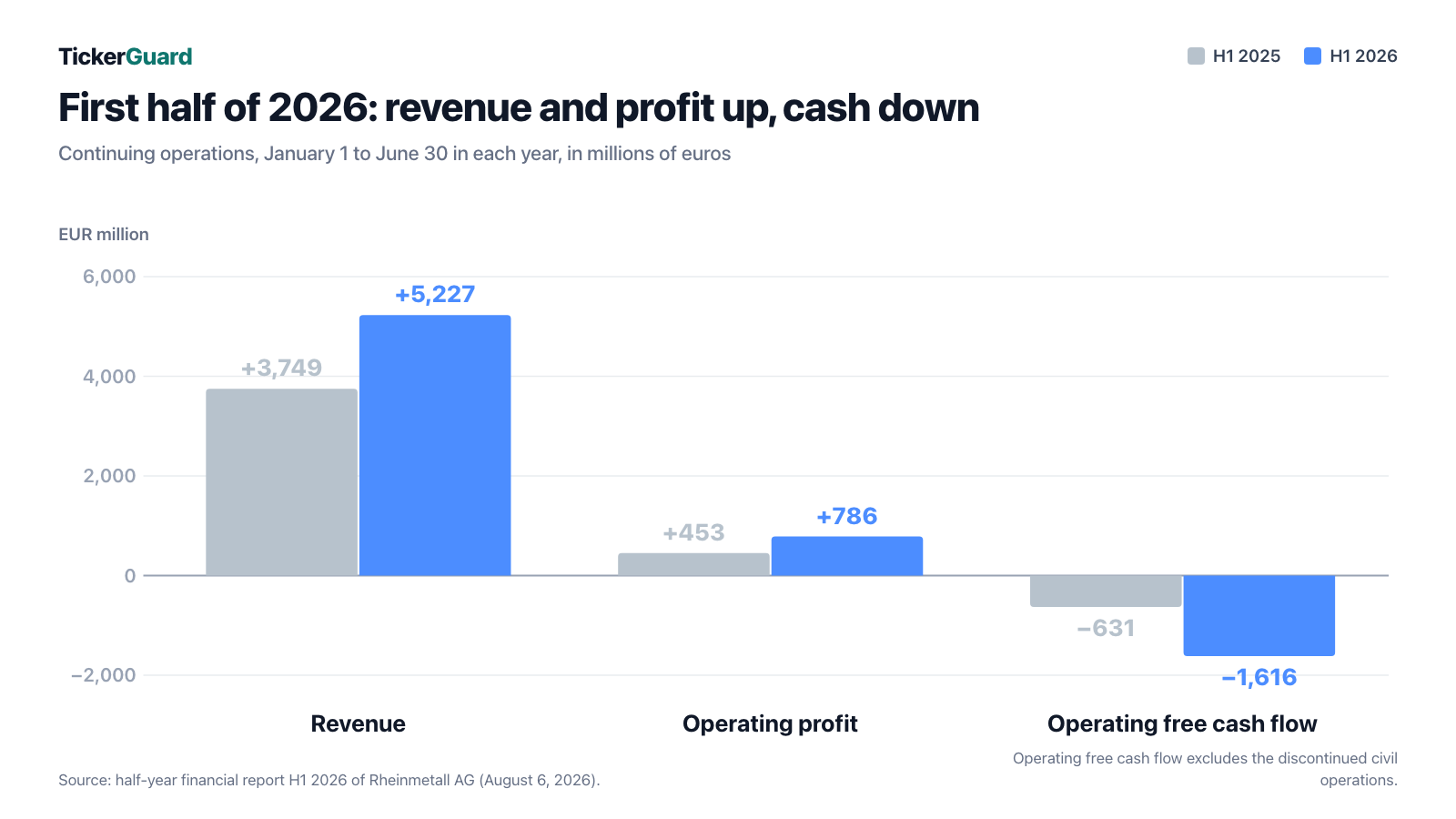
At 7:30 a.m. on August 6, 2026 Rheinmetall published its half-year financial report for January 1 to June 30, 2026. It confirms the operating strength — and makes visible what the capacity build-out costs. Five numbers frame the half-year:
- Revenue of EUR 5,227 million, up EUR 1,477 million or 39 percent on the first half of 2025 (EUR 3,749 million). Adjusted for currency and acquisition effects, organic growth was 29.8 percent.
- Operating profit of EUR 786 million after EUR 453 million — up 74 percent. The operating margin rose to 15.0 percent (prior year 12.1 percent), and to 17.1 percent in the second quarter alone after 13.4 percent.
- Rheinmetall Backlog of EUR 80,467 million at June 30, 2026 after EUR 55,972 million a year earlier. NATO members and NATO partner countries account for 94.9 percent of it.
- Operating free cash flow of minus EUR 1,616 million from continuing operations, after minus EUR 631 million in the prior-year period — a further EUR 985 million of deterioration.
- Net financial debt of EUR 2,722 million, where the balance sheet still showed net liquidity of EUR 369 million at December 31, 2025.
Chief executive Armin Papperger puts the margin front and center in the press release:
“Wir bleiben auf unserem soliden Wachstumskurs und steigern die Profitabilität weiter, auch durch eine erhebliche Ausweitung unserer Kapazitäten. Im zweiten Quartal konnten wir die operative Ergebnismarge sogar auf 17,1% steigern – ein neuer Höchstwert.”
Translation: "We remain on our solid growth path and continue to raise profitability, not least through a considerable expansion of our capacities. In the second quarter we even lifted the operating margin to 17.1 percent — a new record."
— Armin Papperger, chief executive officer of Rheinmetall AG, press release on the half-year financial report H1 2026, August 6, 2026
From the same release, and the most telling number on the demand side: “Unsere Book-to-Bill-Ratio ist mit einem Wert größer 3 bemerkenswert hoch, auch im Vergleich zum Wettbewerb.” — "Our book-to-bill ratio, at a value above 3, is remarkably high, including against the competition." Book-to-bill means that for every euro the company invoices, more than three euros of new orders come in. As long as that ratio stays above one, the order mountain grows faster than it is worked off. Concretely, EUR 16,238 million of Rheinmetall Nomination — order intake plus newly signed framework agreements — stood against EUR 5,227 million of revenue in the first half.
Two things in that report did not make the headline, and both belong in the picture: the balance sheet flipped from net liquidity into net debt, and revenue guidance for 2026 was cut. We will look at both in turn.
The numbers over the years — honestly appreciated
First the part that genuinely impresses, and there is plenty of it. Revenue from continuing operations rose 29 percent to EUR 9,935 million in 2025 (prior year EUR 7,715 million). Operating profit climbed disproportionately, up 33 percent to EUR 1,841 million (prior year EUR 1,389 million), lifting the operating margin to 18.5 percent from 18.0 percent. For scale: in 2019 the same margin was 8.1 percent. The group now earns more than twice as much on every euro of revenue as it did six years ago.
The balance sheet has turned as well. Equity grew 25.8 percent to EUR 5,614 million in 2025, lifting the equity ratio to 33.5 percent. Financial liabilities fell 47.1 percent to EUR 1,281 million while cash rose to EUR 1,650 million. The result: net financial debt of EUR 1,292 million (end of 2024) turned into net liquidity of EUR 369 million — in plain terms, there was more money in the account than the bank still had coming. That state lasted exactly six months; at June 30, 2026 the balance sheet carries net debt again, more on which below. Return on capital employed jumped from 25.7 to 33.5 percent in 2025. And the dividend rose from EUR 2.40 per share (for 2019) via EUR 8.10 (for 2024) to EUR 11.50 for 2025, approved at the annual general meeting on May 12, 2026, a payout ratio of 45.5 percent.
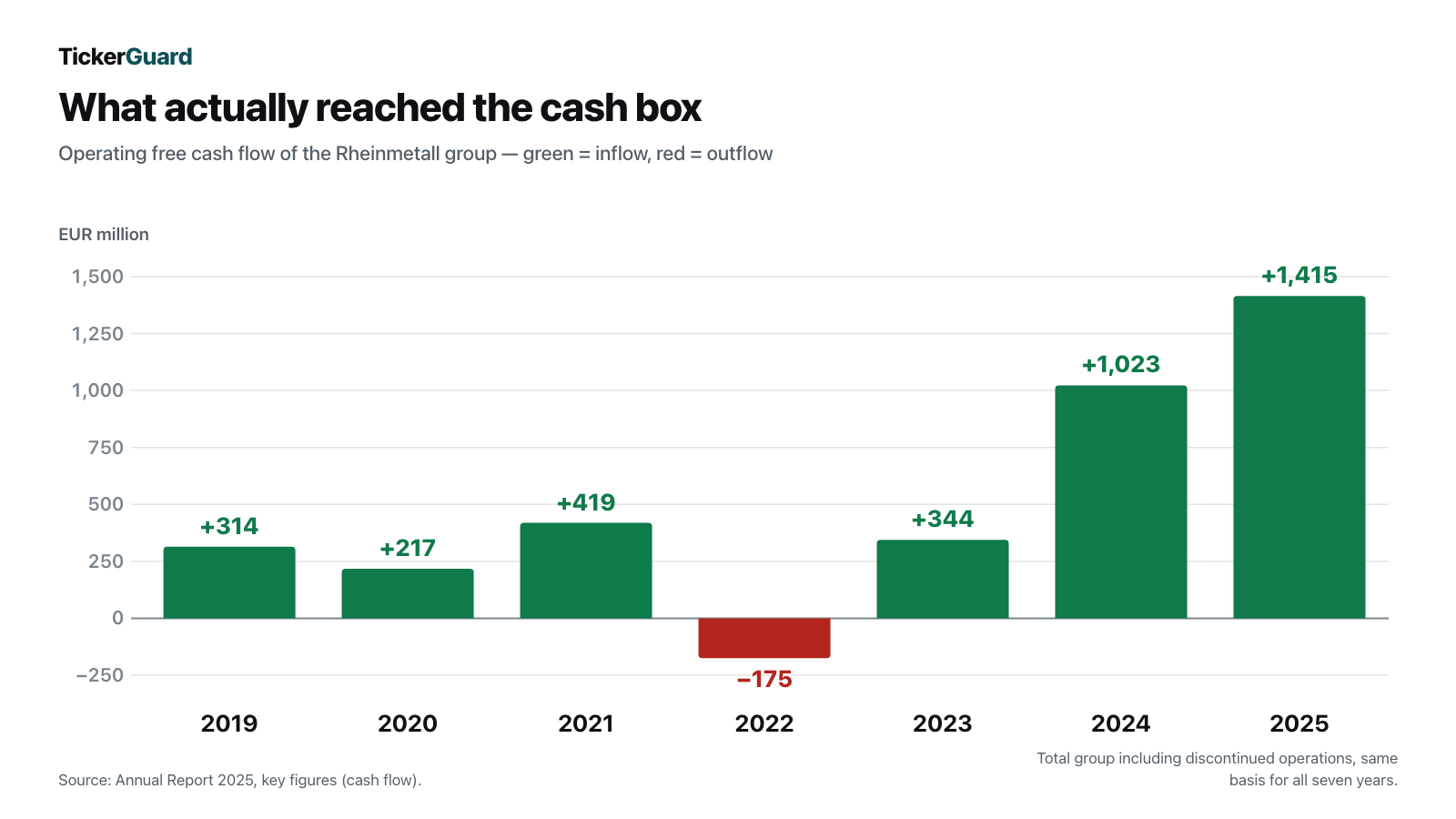
Cash looked excellent in 2025 too: group operating free cash flow — including discontinued operations, so that all years rest on the same basis — reached EUR 1,415 million after EUR 1,023 million a year earlier. That is the amount left over after all running costs and after capital expenditure, the most honest number of them all, because it is hard to dress up. The earlier years read as follows: EUR 314 million (2019), EUR 217 million (2020), EUR 419 million (2021), minus EUR 175 million (2022) and EUR 344 million (2023). Rheinmetall’s fiscal year is the calendar year.
And 2026 is growing faster still. First-quarter revenue rose 8 percent to EUR 1,938 million and operating profit 17 percent to EUR 224 million. The second quarter delivered the leap: revenue of EUR 3,289 million against EUR 1,949 million a year earlier, up 69 percent, with operating profit more than doubling to EUR 562 million from EUR 262 million. Across the half-year every segment contributes: Vehicle Systems EUR 2,431 million of revenue (up 28 percent, margin 11.3 percent), Weapon and Ammunition EUR 1,757 million (up 33 percent, margin 23.7 percent), Digital Systems EUR 820 million (up 23 percent, margin 7.7 percent), Air Defence EUR 478 million (up 62 percent, margin 16.0 percent) and the new Naval Systems segment EUR 334 million in just four months of ownership (margin 9.8 percent).
Something reaches the bottom line as well: earnings per share from continuing operations rose from EUR 4.69 to EUR 8.43 over the half-year. Interest barely registers — net interest expense was EUR 46 million against EBIT of EUR 664 million. In plain terms, the group earns roughly fourteen times what it pays in interest.
So much for the hero story, and much of it is deserved. Now the part the applause drowns out.
What the reports say — the uncomfortable truths
Uncomfortable truth no. 1: almost a third of the order cushion is not an order yet
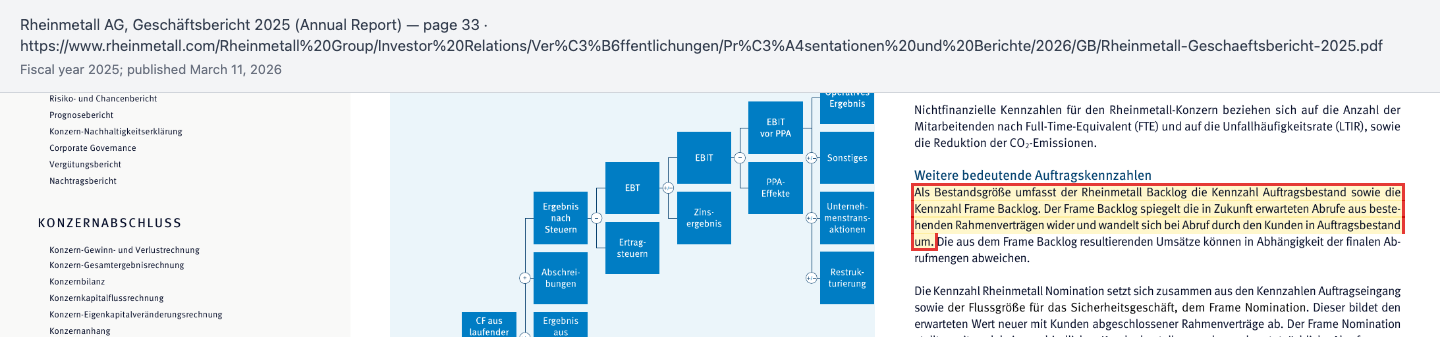
"EUR 80 billion order backlog" sounds like a vault full of signed purchase orders. Rheinmetall means something else by it, and says so plainly in its annual report:
“Als Bestandsgröße umfasst der Rheinmetall Backlog die Kennzahl Auftragsbestand sowie die Kennzahl Frame Backlog. Der Frame Backlog spiegelt die in Zukunft erwarteten Abrufe aus bestehenden Rahmenverträgen wider und wandelt sich bei Abruf durch den Kunden in Auftragsbestand um.”
Translation: "As a stock figure, the Rheinmetall Backlog comprises both the order backlog and the frame backlog. The frame backlog reflects the call-offs expected in future from existing framework agreements and converts into order backlog when the customer calls them off."
— Rheinmetall AG, Annual Report 2025, section "Weitere bedeutende Auftragskennzahlen", page 33
In plain terms: a framework agreement is a menu, not a meal that has been ordered. The customer may call off volumes over the years — but does not have to. Rheinmetall itself writes that revenue resulting from the frame backlog may "deviate depending on the final call-off volumes".
So how big is the menu compared with the ordered meal? At June 30, 2026 the Rheinmetall Backlog of EUR 80,467 million consisted of EUR 56,342 million of binding order backlog and EUR 24,126 million of frame backlog. That is 30.0 percent not yet ordered. At December 31, 2025 the split was EUR 40,847 million of binding order backlog against EUR 22,914 million of frame backlog — EUR 22,914 million of EUR 63,761 million, or 35.9 percent. At the end of 2022 the two figures were EUR 15,089 million and EUR 3,427 million, with EUR 21,977 million and EUR 7,931 million (end of 2023) and EUR 30,728 million and EUR 16,215 million (end of 2024) in between.
Here the half-year report brings good news for once. The firm portion grew by EUR 15,495 million in the first half of 2026, the framework portion by only EUR 1,212 million. Rheinmetall even discloses the mechanism separately: EUR 4,817 million was called off from framework agreements during the half-year and thereby became real order backlog ("frame utilisation", the company's own term). The menu is indeed being ordered. Part of the jump does come from the acquisition, though: since the end of February 2026 the NVL shipyard group has been consolidated as the Naval Systems division, contributing EUR 6,255 million of backlog on its own at June 30, 2026.
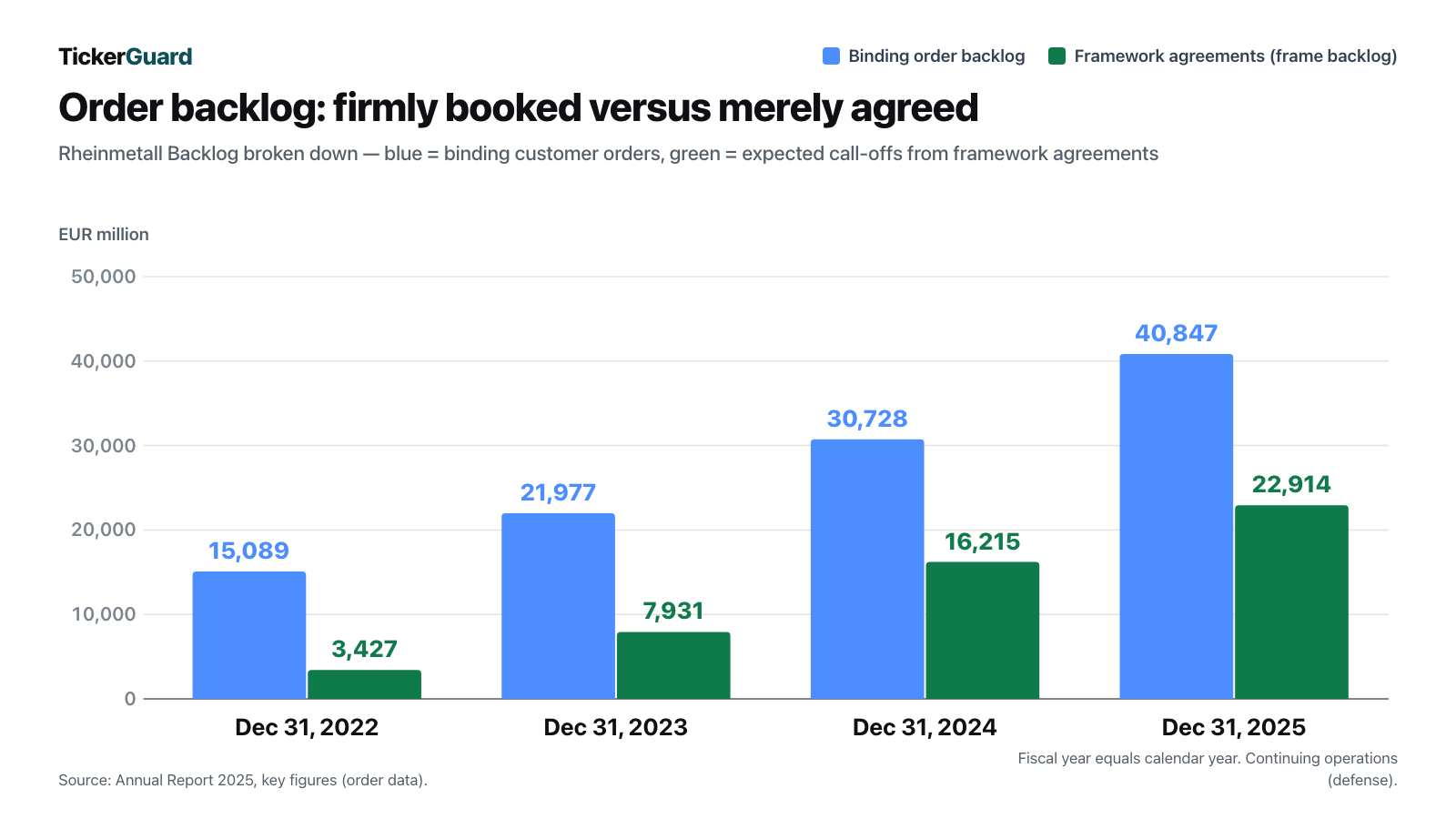
This is not sleight of hand — Rheinmetall discloses the split, and framework agreements are standard in defense because they let governments stay flexible for years. It is simply a reason not to read the headline "more than EUR 80 billion" as "EUR 80 billion of future revenue, guaranteed". Rule of thumb: an order book is a promise. Only the call-off turns it into an invoice.
Uncomfortable truth no. 2: the cash is running the wrong way
Here is the tension of this analysis. While the order mountain grows, the cash box runs backwards. The quarterly statement for March 31, 2026 is unambiguous:
“Der operative Free Cashflow aus fortgeführten Aktivitäten sank gegenüber dem Vorjahreszeitraum deutlich um -527 MioEUR auf -285 MioEUR, nachdem er im Vergleichszeitraum des Vorjahres noch bei 243 MioEUR gelegen hatte.”
Translation: "Operating free cash flow from continuing operations fell sharply versus the prior-year period, by EUR 527 million to minus EUR 285 million, after standing at EUR 243 million in the comparable prior-year period."
— Rheinmetall AG, quarterly statement Q1 2026, published May 7, 2026, page 2
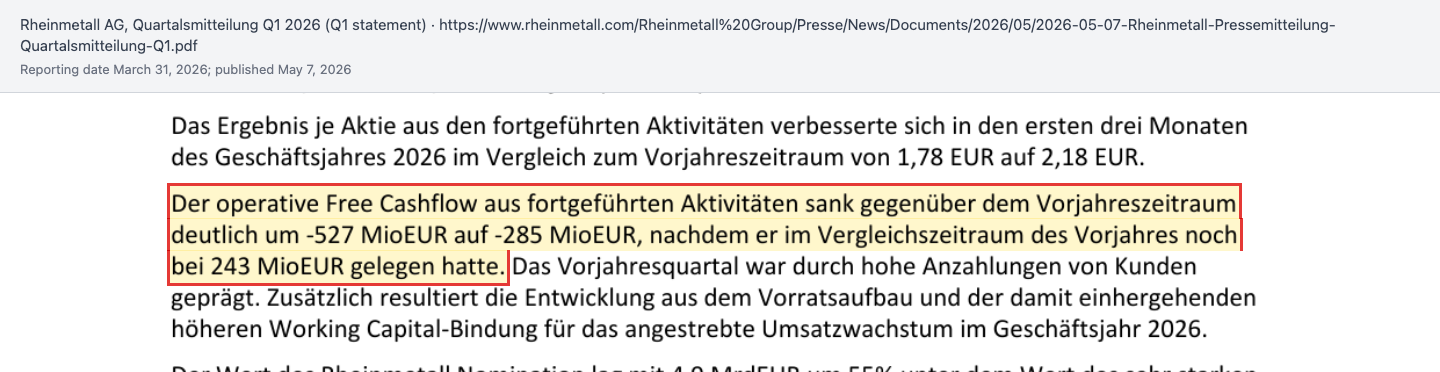
And the second quarter made it considerably worse, not better. The half-year financial report puts the second quarter alone at minus EUR 1,331 million; over the half-year the outflow from continuing operations therefore adds up to minus EUR 1,616 million after minus EUR 631 million a year earlier. Rheinmetall gives the same three reasons as in the spring: deferred advance payments, high customer receivables from heavy revenue recognition at quarter-end, and inventory build-up for the quarters ahead, plus undiminished capital spending. The cash flow statement confirms it: the change in working capital alone pulled EUR 1,793 million out of the till during the half-year.
How does that fit with record revenue? Think of a construction firm: your order book is full for years, so you buy materials now, hire people and build a second workshop. You only get paid when you deliver. That is exactly what is happening here — the group intends to raise 2026 revenue by 28 to 31 percent organically, and that leap has to be pre-financed. Capital expenditure in continuing operations came to EUR 374 million in the half-year, after EUR 310 million.
One figure eases the worry, one sharpens it. In favor: defense customers pay a lot up front, and contract liabilities — essentially money received but not yet earned — rose to EUR 6,265 million by June 30, 2026 from EUR 5,642 million at the end of 2025. Against: the company's own cash conversion rate, the share of operating profit that actually arrives as cash, stood at minus 205.4 percent in the first half of 2026, after minus 139.3 percent a year earlier and plus 66.2 percent for full-year 2025. In the very same report Rheinmetall sticks to a full-year 2026 target of "above 40 percent". The entire second half sits between minus 205 and plus 40 percent — that is the number the company will be measured against on November 5 and with the annual accounts.
Uncomfortable truth no. 3: net liquidity of EUR 369 million became net debt of EUR 2.7 billion
This is the finding that sits furthest from the headline in the half-year report — and it changes the balance sheet the most. Six months earlier Rheinmetall had proudly reported holding more cash than bank debt. At June 30, 2026 it is the other way around:
“Die Eigenkapitalquote zum 30. Juni 2026 lag bei 28,0% (31. Dezember 2025: 33,5%). Die Nettofinanzverbindlichkeiten aus fortgeführten Aktivitäten sind zum Ende des ersten Halbjahres des Geschäftsjahres 2026 auf -2.722 MioEUR gesunken (31. Dezember 2025: 369 MioEUR).”
Translation: "The equity ratio at June 30, 2026 stood at 28.0 percent (December 31, 2025: 33.5 percent). Net financial liabilities from continuing operations fell to minus EUR 2,722 million at the end of the first half of fiscal 2026 (December 31, 2025: EUR 369 million)."
— Rheinmetall AG, half-year financial report H1 2026, interim management report, assets and capital structure
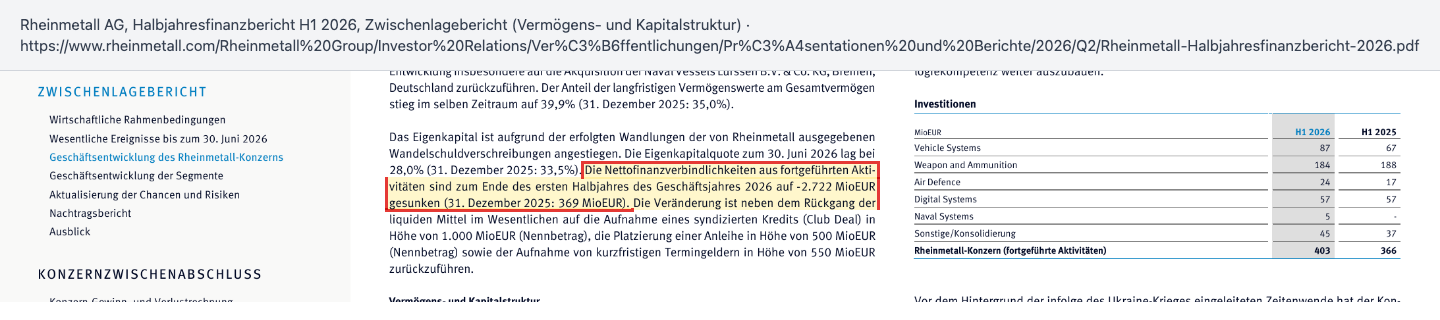
Rheinmetall names the causes itself: the drop in cash, a EUR 1,000 million syndicated loan for the shipyard acquisition, a EUR 500 million bond placed in May 2026 maturing in 2031 with a 3.375 percent coupon, and EUR 550 million of short-term deposits. So this is not a hole but deliberate funding — the group raised money to pay for plants, inventories and an acquisition.
Two things still belong in the picture. First, cash fell from EUR 1,650 million to EUR 255 million. For a group that burned EUR 1.6 billion of operating free cash flow in half a year, that is a thin cushion; it works only because credit lines and bond markets are open. Second, the equity ratio slipped to 28.0 percent despite equity growing to EUR 5,769 million, because total assets jumped from EUR 16,772 million to EUR 20,637 million in six months.
One more item weighs on earnings and is easy to miss: on the civil business held for sale, Rheinmetall had to book an impairment of EUR 212 million during the half-year. That is why consolidated net income shows only EUR 295 million even though continuing operations alone earned EUR 455 million — discontinued operations cost EUR 160 million, after contributing EUR 13 million in the prior-year half. The agreed purchase price of EUR 350 million is explicitly preliminary and may still change before the targeted closing in the fourth quarter of 2026.
For proportion: with EBIT of EUR 664 million against net interest expense of EUR 46 million in the half-year, interest cover remains comfortable, and under "update on opportunities and risks" the report states plainly: “Bestandsgefährdende Risiken bestehen nicht.” — "There are no risks that threaten the continued existence of the company." This is not about survival. It is an open operating question: whether the order mountain turns back into cash in the second half.
Uncomfortable truth no. 4: first the timetable was stretched — now the guidance has been cut
In the Annual Report 2024 Rheinmetall had set out medium-term targets of EUR 20 billion in revenue for fiscal 2027, an operating margin of around 18 percent and a cash conversion rate above 40 percent. The Annual Report 2025 shows far bigger numbers — but with a new year above them:
“Daher wurde der Zeithorizont für die Erreichung mittelfristiger Ziele von dem Geschäftsjahr 2027, wie im Geschäftsbericht 2024 ausgewiesen, auf das Geschäftsjahr 2030 ausgeweitet.”
Translation: "The time horizon for reaching the medium-term targets has therefore been extended from fiscal 2027, as stated in the Annual Report 2024, to fiscal 2030."
— Rheinmetall AG, Annual Report 2025, section "Strategie", page 37
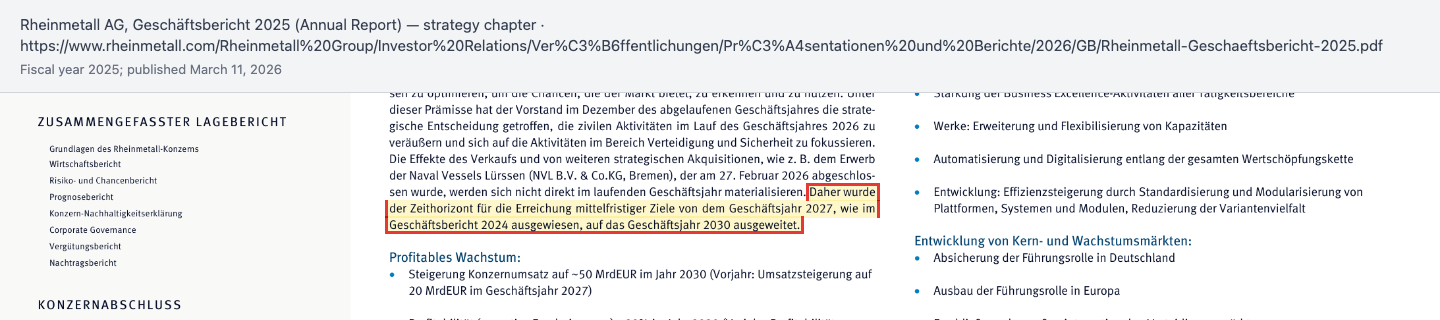
The new targets are revenue of around EUR 50 billion in 2030, an operating margin above 20 percent and a cash conversion rate above 50 percent. The report explains that the effects of the civil divestment and of acquisitions such as NVL will "not materialize directly in the current fiscal year". That is reasonable. It is still a postponement: anyone who penciled in EUR 20 billion for 2027 now has to wait three more years — for considerably more, admittedly.
And this year the warning has turned real. At the end of June 2026 the German defense ministry decided not to proceed with the six F126 frigates, a program in which Rheinmetall's Blohm+Voss subsidiary was a subcontractor. On July 2, 2026 the group announced by ad-hoc release that the target of EUR 20 billion of Rheinmetall Nomination for 2026 was therefore out of reach. With the half-year report came the consequence for revenue guidance:
“Der Konzern rechnet nun für das Geschäftsjahr 2026 mit einem Umsatz in der Spanne von 13,7 MrdEUR bis 14,2 MrdEUR und unverändert mit einem organischen Umsatzwachstum von 28% bis 31%. Die operative Ergebnismarge im Konzern wird bei rund 19% erwartet.”
Translation: "The group now expects revenue of EUR 13.7 billion to EUR 14.2 billion for fiscal 2026 and, unchanged, organic revenue growth of 28 to 31 percent. The group operating margin is expected at around 19 percent."
— Rheinmetall AG, press release on the half-year financial report H1 2026, August 6, 2026
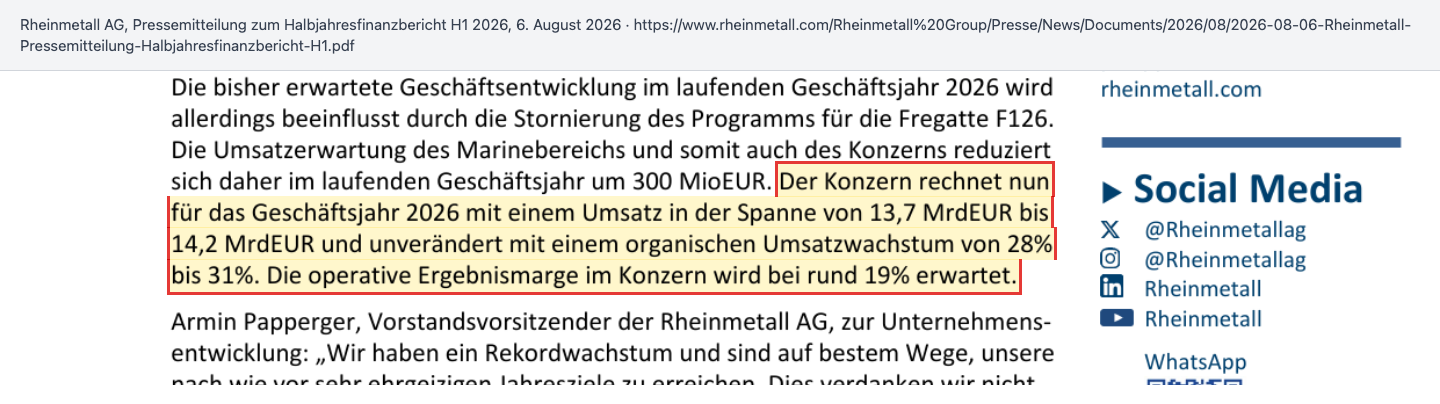
The hit lands almost entirely on one segment: for Naval Systems, Rheinmetall cut the 2026 revenue expectation from EUR 1.3–1.5 billion to EUR 1.0–1.2 billion and the margin expectation from 11–13 percent to 10–11 percent. All other divisional targets stayed unchanged, as did the group margin target of around 19 percent. Manageable, then — but proof of how quickly a single political decision topples guidance that had been confirmed three months earlier.
Uncomfortable truth no. 5: the pie was sliced quietly — and now that is over
A convertible bond is a loan with an entry ticket: the lender hands over money and may later swap the claim for new shares. If the price rises, that is exactly what happens — and your slice of the pie gets smaller, because the same profit is spread across more shares. At Rheinmetall the share count climbed from 43,558,850 (December 31, 2024) to 46,002,534 (December 31, 2025) and to 46,777,223 by June 30, 2026, with EUR 239 million nominal of tranche B converted in the first half of 2026 alone.
That chapter now has an ending, and the half-year report writes it into the subsequent-events note itself:
“Einhergehend mit der im Mai 2026 durch die Rheinmetall AG bekanntgegebenen Kündigung der im Jahr 2030 fälligen Wandelschuldverschreibung (Tranche B) wurden in den ersten Tagen des Juli 2026 die letzten ausstehenden Wandelschuldverschreibungen der Tranche B im Volumen von 4 MioEUR (Nennbetrag) gewandelt. In der Folge hat sich die Anzahl der ausgegebenen Aktien um 12.344 Stück auf 46.789.567 Stück erhöht.”
Translation: "Following the redemption of the convertible bond maturing in 2030 (tranche B) announced by Rheinmetall AG in May 2026, the last outstanding tranche B convertible bonds with a volume of EUR 4 million (nominal amount) were converted in the first days of July 2026. As a result the number of shares issued rose by 12,344 to 46,789,567."
— Rheinmetall AG, half-year financial report H1 2026, note (13) events after the reporting date
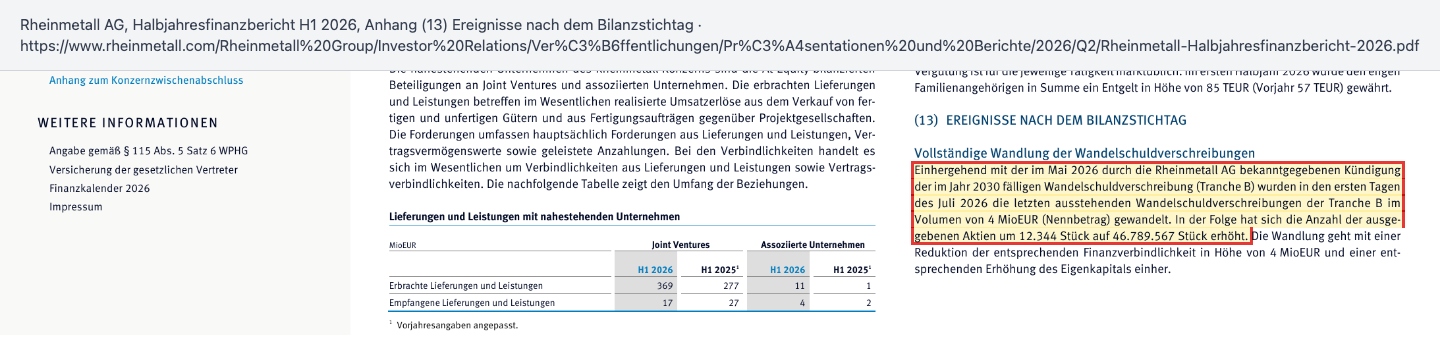
All told, 43,558,850 shares became 46,789,567 in eighteen months: 3,230,717 more, or 7.4 percent. Anyone invested at the end of 2024 now owns a 6.9 percent smaller share of the company for the same money. To be fair: for the balance sheet this was good — the conversions lifted the capital reserve by EUR 694 million before deferred taxes in 2025 alone, and another EUR 222 million of financial liabilities disappeared in the first half of 2026. The price was paid by long-standing shareholders, and it was written in the subsequent-events note, not in the headline.
What matters looking forward: this source of dilution has run dry, the bond is fully converted. What remains open is the authorization granted by the annual general meeting of May 14, 2024 to issue further debt instruments with a total nominal amount of up to EUR 7.4 billion until May 13, 2029, backed by contingent capital of up to EUR 22,302,100. With a balance sheet that has just swung from net liquidity to EUR 2.7 billion of net debt, that authorization is worth keeping an eye on.
Uncomfortable truth no. 6: the most important customer is a budget line
Rheinmetall sells to a great many states — 62 percent of 2025 revenue came from abroad, 38 percent from Germany. But every customer obeys the same logic. The risk report puts it soberly:
“Risiken bestehen in der Abhängigkeit vom Ausgabeverhalten öffentlicher Haushalte im Inland und in ausländischen Kundenländern. In Staatshaushalten kann es grundsätzlich zu Umschichtungen und Kürzungen kommen, von denen auch die Verteidigungsressorts betroffen sein können.”
Translation: "Risks arise from the dependency on the spending behavior of public budgets at home and in foreign customer countries. Government budgets are always subject to reallocations and cuts, which can also affect defense departments."
— Rheinmetall AG, Annual Report 2025, risk and opportunity report, customer risks, page 72
2026 showed how real that is, twice. On the upside: on May 29, 2026 Romania awarded the largest international order package in the company's recent history under the EU's SAFE program — EUR 5.7 billion for 298 Lynx combat vehicles, Skyranger air defense, medium-caliber ammunition and four naval vessels, with deliveries running from 2028 to 2030. On the downside: the F126 cancellation one month later. Both decisions were taken in ministries, not in sales meetings.
Picture a construction firm with a bulging order book whose customers are all government agencies whose budgets are re-approved every year. As long as budgets grow, it is a dream business. That is exactly what the stock is betting on. Rheinmetall itself points in the report to NATO decisions to raise defense spending to 5 percent of gross domestic product by 2035, of which 3.5 percent for classic military expenditure, and to a European investment volume of up to EUR 800 billion. That is the growth story — and the dependency at the same time.
Valuation — orders of magnitude, not a daily price
We quote no daily price here, only dated anchors from the reports themselves. On December 31, 2025 the stock closed at EUR 1,561.00 according to the key-figure table. Multiplied by the 46,002,534 shares then outstanding, that gives a market value of roughly EUR 71.8 billion and, measured against earnings per share from continuing operations of EUR 22.73, a price-to-earnings ratio of roughly 69.
Six months later the same calculation looks very different. The half-year report puts the share price at EUR 990.50 on June 30, 2026 (June 30, 2025: EUR 1,797.00). With the 46,777,223 shares outstanding at that date, market value works out at roughly EUR 46.3 billion — about 35 percent below the end of 2025, even though revenue and profit rose sharply over the same period. Measured against the lowered 2026 revenue guidance (EUR 13.7 to 14.2 billion) that is roughly 3.3 times sales; measured against 2025 earnings per share from continuing operations (EUR 22.73), a price-to-earnings ratio of roughly 44. Doubling the half-year figure of EUR 8.43 to a full year puts the multiple around 59 — a back-of-the-envelope number, and if anything a cautious one, because in 2025 only EUR 3,749 million of the EUR 9,935 million annual revenue fell in the first half.
More interesting than the single figure is the trend. On the same basis — year-end closing price divided by earnings per share from continuing operations, both from the key-figure table of the Annual Report 2025 — the series reads: about 9 in 2021, about 17 in 2022, about 22 in 2023, about 36 in 2024, about 69 in 2025. Earnings per share more than doubled from EUR 9.04 to EUR 22.73; the price the market pays for them rose sevenfold. One caveat on the cleanliness of that series: Rheinmetall restated the 2024 and 2020 figures under IFRS 5 after carving out the civil business and the small-bore piston business respectively, while earlier years contain no such adjustment. The series therefore shows the direction reliably, not the third decimal.
The dividend hardly changes the picture: EUR 11.50 per share for 2025 equals a yield of roughly 0.7 percent on the year-end 2025 close of EUR 1,561.00, and roughly 1.2 percent on the June 30, 2026 price. Anyone buying Rheinmetall is buying growth, not income. For the cash box, though, the payout is a visible item: EUR 535 million left the group for dividends in the first half of 2026, after EUR 369 million a year earlier.
And what do the professionals think? Rheinmetall itself publishes no analyst estimates in its reports. What is solid instead is its own guidance from the half-year report: revenue of EUR 13.7 to 14.2 billion and an operating margin of around 19 percent for 2026 — which would put operating profit in the order of EUR 2.6 billion, after EUR 786 million in the first half. Whether the market keeps paying a multiple in the mid-to-high forties for that growth is a price question, not a quality question. It decides the return, not the substance.
Opportunities and risks at a glance
Opportunities
- Order cushion of EUR 80,467 million (June 30, 2026) against annual revenue of EUR 9.9 billion — arithmetically more than eight years of visibility, with 94.9 percent of it owed by NATO members and NATO partner countries.
- The firm part grows faster than the loose part: binding order backlog rose EUR 15,495 million to EUR 56,342 million in the first half of 2026, and the framework share fell from 35.9 to 30.0 percent.
- Book-to-bill above 3 in the first half of 2026: EUR 16,238 million of Rheinmetall Nomination against EUR 5,227 million of revenue.
- Structurally rising defense budgets: NATO target of 5 percent of gross domestic product by 2035, the EU's SAFE program, a European investment volume of up to EUR 800 billion (all figures from the Annual Report 2025).
- Rising profitability: operating margin up from 8.1 percent (2019) via 18.5 percent (2025) to 17.1 percent in the second quarter of 2026 against 13.4 percent a year earlier; target above 20 percent for 2030.
- A new domain at sea: Naval Systems brought EUR 6,255 million of backlog with it at June 30, 2026 and generated EUR 334 million of revenue at a 9.8 percent margin in four months of ownership.
- Focus: the sale of Power Systems for a preliminary EUR 350 million (agreement of June 3, 2026, closing targeted for the fourth quarter of 2026) removes the low-margin auto components business.
Risks
- Operating free cash flow of minus EUR 1,616 million in the first half of 2026 after minus EUR 631 million a year earlier; cash conversion rate of minus 205.4 percent against a full-year target above 40 percent.
- The balance sheet has turned: net financial debt of EUR 2,722 million (June 30, 2026) instead of EUR 369 million of net liquidity, cash down to EUR 255 million from EUR 1,650 million, equity ratio 28.0 percent after 33.5 percent.
- 30.0 percent of the backlog at June 30, 2026 consists of framework agreements without a binding order (EUR 24,126 million of EUR 80,467 million).
- Dependency on public budgets, named explicitly in the risk report — the F126 cancellation costs EUR 300 million of 2026 revenue, broke the EUR 20 billion nomination target and pushed group guidance down to EUR 13.7–14.2 billion.
- An impairment of EUR 212 million on the civil business held for sale: discontinued operations cost EUR 160 million in the first half of 2026, after contributing EUR 13 million a year earlier.
- Dilution through convertible bonds: 7.4 percent more shares since the end of 2024, to 46,789,567. The bond is fully converted, but an authorization for up to EUR 7.4 billion nominal runs to 2029.
- Execution risk: lifting revenue to EUR 13.7–14.2 billion requires new plants (Unterlüß, Lithuania, Latvia, Bulgaria, Romania, barrel production in the United Kingdom) and staff — headcount rose from 30,640 to 35,971 full-time equivalents within twelve months.
- Valuation: roughly 44 times 2025 earnings at the June 30, 2026 price leaves little room for disappointment.
- Integration risk at NVL: only four months of consolidation, refinanced through a EUR 1,500 million club deal with a term of up to twelve months, of which EUR 1,000 million was drawn on March 4, 2026 — that short facility needs refinancing.
A human conclusion
Back to the hero bonus. It is seductive because it feels like loyalty: you spotted early that something big was happening here, and you do not want to spoil it with small print. Except that checking the numbers is not small print. It is the only way to tell a good company from a good price.
After the reading, a double picture remains. Rheinmetall is undeniably a strong company: 39 percent revenue growth in the first half of 2026, a 17.1 percent operating margin in the second quarter, a binding order backlog of EUR 56.3 billion, more than three euros of new orders per euro of revenue, and a dividend that has almost quintupled in six years. And at the same time: almost a third of the celebrated backlog is not an order yet, cash is flowing out faster than ever, net liquidity has turned into EUR 2.7 billion of net debt, and revenue guidance has just been cut.
The half-year report did exactly what a report is supposed to do: it turned guesses into numbers. Two of them came in better than expected — the margin and the firm share of the order book. Two came in worse — the cash outflow and the balance sheet. The next chance to check the arithmetic is November 5, 2026, when the nine-month statement appears. That is when we find out whether the order mountain turns back into cash.
What you make of it is your decision. And that is exactly how it should be.
Sources
- Rheinmetall AG, half-year financial report 2026 for January 1 to June 30, 2026 (published August 6, 2026, unaudited) — key figures, interim management report, segment sections, update on opportunities and risks, outlook, notes (6) impairment and (13) events after the reporting date, financial calendar
- Rheinmetall AG, press release on the half-year financial report H1 2026, August 6, 2026 — quotes from chief executive Armin Papperger, segment figures, adjusted full-year guidance
- Rheinmetall AG, Annual Report 2025 (IFRS consolidated accounts, audited by Deloitte, published March 11, 2026) — key figures, strategy, management report, risk and opportunity report, notes (26) and (41), financial calendar on page 285
- Rheinmetall AG, quarterly statement Q1 2026 (published May 7, 2026)
- Rheinmetall AG, ad-hoc release of July 29, 2026: "Q2 übertrifft mit Rekordumsatzwachstum und Ergebnis deutlich die Markterwartung"
- Rheinmetall AG, ad-hoc release of July 2, 2026 on the cancellation of the F126 program
- Rheinmetall AG, press release of June 3, 2026: sale of the Power Systems division to AEQUITA
- Rheinmetall AG, press release of June 2, 2026: major order from Romania worth EUR 5.7 billion
- Rheinmetall AG, press release on the fiscal 2025 results (March 11, 2026)
- Ranking of the most-discussed stocks in the wallstreet-online forum, as of August 4, 2026 (the hook for this analysis, not a source for company figures)
Disclaimer: this article is journalistic analysis. It is not investment advice, not a buy or sell recommendation and not a solicitation to buy or sell securities. All figures come from the original publications of Rheinmetall AG named above and carry the reporting dates stated there; the analysis was published on August 4, 2026 and updated on August 6, 2026 with the half-year financial report 2026. A German half-year financial report is not audited; the next interim report appears on November 5, 2026 and may refine the values quoted here. Stocks can cause substantial losses up to the total loss of the invested capital. Positions held by the operator are disclosed daily; where one exists, it appears as a notice at the top of this deep dive.
Our Bottom Line at a Glance
- Growth and profitability positive
- In the first half of 2026 revenue rose 39 percent to EUR 5,227 million and operating profit 74 percent to EUR 786 million; the operating margin climbed to 15.0 percent from 12.1 percent, and to a record 17.1 percent in the second quarter from 13.4 percent. Earnings per share from continuing operations rose from EUR 4.69 to EUR 8.43 (half-year report of August 6, 2026).
- Balance sheet and funding negative
- Net liquidity of EUR 369 million (December 31, 2025) turned into net financial debt of EUR 2,722 million by June 30, 2026. Cash fell from EUR 1,650 million to EUR 255 million and the equity ratio from 33.5 to 28.0 percent. The causes are a EUR 1,000 million club deal, a EUR 500 million bond and EUR 550 million of short-term deposits. Interest cover remains comfortable at EUR 46 million of net interest expense against EUR 664 million of EBIT.
- Cash position in the current year negative
- Operating free cash flow from continuing operations came in at minus EUR 1,616 million in the first half of 2026, after minus EUR 631 million a year earlier; working capital alone absorbed EUR 1,793 million. The cash conversion rate stands at minus 205.4 percent while Rheinmetall still guides for above 40 percent for the full year 2026.
- Quality of the order backlog positive
- Of the Rheinmetall Backlog of EUR 80,467 million at June 30, 2026, EUR 56,342 million was firmly ordered; the frame backlog share fell from 35.9 percent (December 31, 2025) to 30.0 percent. EUR 4,817 million was called off from framework agreements during the half-year, the book-to-bill ratio ran above 3, and 94.9 percent of the backlog is owed by NATO members and NATO partners.
- Dependency on public budgets negative
- The risk report in the Annual Report 2025 (page 72) names the dependency on the spending behavior of public budgets explicitly. The cancellation of the F126 program at the end of June 2026 costs EUR 300 million of revenue and forced Rheinmetall to cut 2026 revenue guidance to EUR 13.7–14.2 billion on August 6, 2026 — offset by the Romanian order worth EUR 5.7 billion awarded on May 29, 2026.
- Share count and dilution neutral
- Conversions of convertible bonds lifted the share count from 43,558,850 (December 31, 2024) to 46,777,223 (June 30, 2026); the last tranche B notes were converted in early July 2026, taking the final count to 46,789,567 — up 7.4 percent in eighteen months. This source of dilution is now exhausted, but an authorization covering up to EUR 7.4 billion nominal runs until May 13, 2029.
Rheinmetall is growing faster than ever: revenue up 39 percent in the first half of 2026, a 17.1 percent operating margin in the second quarter, a binding order backlog of EUR 56.3 billion and a book-to-bill ratio above 3. The price shows up in the same set of accounts: minus EUR 1,616 million of operating free cash flow, only EUR 255 million of cash left, EUR 2,722 million of net financial debt instead of net liquidity, and an equity ratio of 28.0 percent. On top of that the company cut its 2026 revenue guidance to EUR 13.7–14.2 billion because of the F126 cancellation. The decisive number arrives with the quarterly statement on November 5, 2026. Not investment advice.
What Our Rating Means
Open questions
The business works in principle, but one material question is open. As long as it stays open, our findings do not carry a quality verdict.
Until the half-year report this rating was green, and the stated reason was the balance sheet with net liquidity. That basis disappeared on June 30, 2026: EUR 369 million of net liquidity became EUR 2,722 million of net debt, cash melted down to EUR 255 million, and the operating cash outflow more than doubled to EUR 1,616 million over the half-year. That leaves one material operating question open — whether the order mountain turns back into cash in the second half, as the company's own target of a cash conversion rate above 40 percent assumes. This is explicitly not red: the company itself states that no risks threaten its continued existence, equity grew to EUR 5,769 million, interest is covered roughly fourteen times at EUR 46 million against EUR 664 million of EBIT, and the outflow is explainable working capital for organic revenue growth of 28 to 31 percent. Kept separate and deliberately without influence on this rating: at the June 30, 2026 price the stock still traded at roughly 44 times 2025 earnings, and almost a third of the backlog is not yet ordered — those are price and timing arguments. The decision is yours.
A journalistic assessment by our editorial team at the time of the deep dive, based on public sources — not investment advice and not a solicitation to buy or sell. Your personal circumstances (investment goals, risk capacity, taxes) cannot be taken into account. What our levels mean, how verdicts are formed, and what conflicts of interest exist →
Worth Noting
- Updated on August 6, 2026: the half-year financial report 2026 replaces the preliminary Q2 figures previously quoted from the ad-hoc release of July 29, 2026. Originally published on August 4, 2026.
- Hook: on August 4, 2026 Rheinmetall ranked near the top of the most-discussed lists in the wallstreet-online forum — an attention signal, not a buy argument.
- Data as of August 6, 2026. The most recent periodic report is the half-year financial report 2026 (January 1 to June 30, 2026); it is unaudited. The next interim report appears on November 5, 2026.
- The rating moved from green to yellow with the half-year report — not because of the share price, but because the balance sheet swung from net liquidity to EUR 2,722 million of net debt and the half-year cash outflow reached EUR 1,616 million.
- Rheinmetall is not an SEC filer: no 10-K, no 10-Q. All evidence comes from the half-year financial report 2026, the Annual Report 2025, the Q1 2026 quarterly statement and the company's ad-hoc and press releases.
- Easily confused: the "Rheinmetall Backlog" is not the order backlog. It additionally contains the frame backlog from framework agreements, and the "Rheinmetall Nomination" metric contains, alongside order intake, the frame nomination — the expected value of newly signed framework agreements.
- The 2024 and 2020 key figures were restated under IFRS 5 (civil business and small-bore piston business respectively) while earlier years were not, so multi-year series show the direction rather than the third decimal.
The full analysis as a PDF for later
We will send you this analysis as a PDF — to print, file away, and read at your own pace.
Frequently Asked Questions
Rheinmetall AG of Düsseldorf is a systems house for security and defense technology with five segments: Vehicle Systems (wheeled and tracked vehicles), Weapon and Ammunition, Air Defence, Digital Systems (digitization of armed forces) and, since February 2026, Naval Systems (naval shipbuilding). At June 30, 2026 the group employed 35,971 full-time equivalents, of which 29,636 were in continuing defense operations.
The Rheinmetall Backlog stood at EUR 80,467 million on June 30, 2026, up from EUR 55,972 million a year earlier. Binding orders accounted for EUR 56,342 million; the other EUR 24,126 million are expected call-offs from framework agreements that only become order backlog when called off. The framework share therefore fell from 35.9 percent at the end of 2025 to 30.0 percent.
Operating free cash flow from continuing operations came in at minus EUR 1,616 million in the first half of 2026, after minus EUR 631 million a year earlier. Rheinmetall cites deferred customer advances, higher receivables from heavy revenue recognition at quarter-end, inventory build-up and undiminished capital spending. Working capital alone absorbed EUR 1,793 million.
The half-year financial report published on August 6, 2026 shows revenue of EUR 5,227 million (up 39 percent), operating profit of EUR 786 million (up 74 percent) and an operating margin of 15.0 percent, rising to 17.1 percent in the second quarter. Working against that: operating free cash flow of minus EUR 1,616 million and net financial debt of EUR 2,722 million.
Yes. For fiscal 2025 the company paid EUR 11.50 per share, up from EUR 8.10 a year earlier, a payout ratio of 45.5 percent approved at the annual general meeting on May 12, 2026. Against the year-end 2025 closing price of EUR 1,561.00 that equals a dividend yield of roughly 0.7 percent.
The German defense ministry stopped construction of the six F126 frigates at the end of June 2026. With the half-year report Rheinmetall therefore cut its 2026 revenue guidance from EUR 14.0–14.5 billion to EUR 13.7–14.2 billion; for Naval Systems the expectation fell from EUR 1.3–1.5 billion to EUR 1.0–1.2 billion. The group margin target of around 19 percent stayed unchanged.
Yes, again since the first half of 2026. At June 30, 2026 the group reported net financial debt of EUR 2,722 million, after net liquidity of EUR 369 million at December 31, 2025. The causes are a EUR 1,000 million club deal, a EUR 500 million bond and the drop in cash to EUR 255 million from EUR 1,650 million.
At the June 30, 2026 price of EUR 990.50 and 2025 earnings per share from continuing operations of EUR 22.73, the price-to-earnings ratio works out at roughly 44, down from roughly 69 on the year-end 2025 close of EUR 1,561.00. At the end of 2021 the same measure was about 9. Earnings have risen; the price paid per unit of earnings has risen considerably more.
Found an error?
Did you spot a factual error, an outdated number, or a typo in this deep dive? Let us know briefly — your report goes straight to the editorial team.