Forward Air: The Goodwill From Omni Now Stands at Zero — and the Credit Agreement Keeps Tightening
Forward Air bought the logistics group Omni in January 2024 and paid a premium of $1,272.4 million above the net assets acquired. Two impairments later — $1,028.4 million in 2024 and another $244.0 million in the second quarter of 2026 — that premium sits at zero. Shareholders' equity has been negative since June 30, 2026, interest costs more than the operating business earns, and from December 31, 2026 the credit agreement demands tighter ratios than it does today. We read the filings submitted to the U.S. securities regulator, the SEC, and worked out how tight it really gets.
 Thomas Mücke
Founder & Publisher
Thomas Mücke
Founder & Publisher
As of Today
As of: September 18, 2026
- Closing price
- 14.80 $ -3.76%
- Market Capitalisation
- 0.5 $B
- Growth Score
- 1/10
- AAQS
- 1/10
Price change since June 22, 2026: +10.4%
This analysis has a cut-off date. The Stock Guard tells you when something material changes in the numbers. Reserve your free spot
Chart
Interactive price chart (TradingView).
52-week range: 8.30 $ to 30.20 $ · Last price: 14.80 $ (As of: September 18, 2026)
Note: pure fact-based analysis, not investment advice and not a solicitation to buy or sell. All figures without guarantee.
There is one mental trap that costs more than any other, and it has a clumsy name: the sunk cost fallacy. It works like this. We have put a lot of money, time or nerves into something — and we stay in because of it. Not because it still pays, but because walking away would mean admitting the stake is gone. Everyone knows it from the film that turns dull after twenty minutes, and we stay in our seat anyway. On the stock market you sit longer and pay more.
Forward Air Corporation (NASDAQ: FWRD) is a lesson in that, written in numbers. The Dallas-based freight company bought the global logistics group Omni in January 2024 and paid a premium over the net assets acquired of $1,272.4 million — in accounting language, goodwill. Two and a half years later that premium stands at zero. So here is the deal: before you decide whether this is an unfairly punished freight business or a bottomless pit, let us read together what Forward Air itself has told the U.S. securities regulator, the SEC. Those filings have to be truthful under penalty of law — and this one describes negative shareholders' equity, a credit agreement that tightens quarter by quarter, and a large customer leaving at exactly the wrong moment.
What Forward Air actually does — freight forwarding without trucks
At its core Forward Air sells one thing: capacity it does not own. The model is called asset-light. Instead of buying trucks, hiring drivers and paying for diesel, Forward Air buys transportation from independent owner-operators and third-party carriers and resells it as a finished freight service. The largest cost line is accordingly called purchased transportation, and in the second quarter of 2026 it consumed $335.9 million of $673.0 million in revenue — every second dollar taken in goes straight back out.
Three businesses have grown out of that.
Expedited Freight is the original business: less-than-truckload shipments that have to arrive faster than a standard carrier delivers, typically freight arriving by air that then has to move overland. In the second quarter of 2026 the segment produced $275.9 million of external revenue and $34.9 million of segment profit. It is by some distance the group’s largest source of earnings.
Omni Logistics is the unit acquired in 2024 and now the largest: $338.5 million of external revenue in the second quarter of 2026, split into ground ($132.9 million), contract logistics ($112.3 million) and air and ocean ($93.4 million). Contract logistics means Forward Air runs warehouses for customers and performs work those customers used to do themselves. Excluding the $244.0 million goodwill impairment, the segment would have earned $14.0 million in the second quarter of 2026; with it, the line reads a loss of $230.0 million.
Intermodal is the smallest segment: moving containers to and from seaports and railheads, the so-called first and last mile. The second quarter of 2026 brought $58.6 million of revenue and $6.1 million of profit; across the 2025 financial year Intermodal booked $230.5 million — which the annual report (Form 10-K) puts at roughly 10 percent of consolidated revenue, and which is 9.2 percent measured against the reported $2,495.1 million.
As of December 31, 2025 Forward Air employed 6,062 full-time staff, including 1,994 freight handlers, plus 294 part-time employees; none of them were covered by a collective bargaining agreement. The company is run by Shawn Stewart as President and Chief Executive Officer and Jamie Pierson as Chief Financial Officer.
A word on the company's history, because it confuses older databases: the registrant was called Landair Services Inc. until August 14, 1998 and has traded as Forward Air Corporation ever since. Anyone comparing data series from the 1990s should know that.
That sets up the central tension of this analysis, and it runs through every chapter: the operating business is working, and even growing — it simply no longer belongs to the shareholders, but to the lenders first.
Company history for investors
-
2023
Sale of the Final Mile business (December 20)
The delivery of heavy household appliances goes for roughly $260.9 million, at a pre-tax gain on sale of $155.8 million. The discontinued operation adds $124.5 million after tax in 2023 and makes the year look like the best on record — but it is a one-off.
-
2024
Acquisition of Omni Logistics (January 25)
Forward Air doubles in size overnight and takes on roughly $1.85 billion of debt to do it: $1,125.0 million of term loans and $725.0 million of notes. After an $80.0 million paydown later in 2024 the balance stands at $1,770.0 million.
-
2024
First goodwill impairment of $1,028.4 million
Most of the premium paid for Omni is written off in the very first year. The 2024 loss per share is $30.63 — almost all of it accounting, not cash leaving the company.
-
2025
The board opens a strategic review (January)
Sale, merger or going it alone — the board keeps every option open and hires Goldman Sachs as its adviser. For investors the takeover story is now official.
-
2026
The largest customer announces a partial exit (May to July)
First the disclosure on May 7, then a non-binding memorandum of understanding on July 20: at least half of roughly $250 million of revenue stays, the rest moves to other providers from December 2026.
-
2026
The search for a buyer ends without an offer (quarterly report, May 11)
After negotiations with multiple parties, no actionable proposal for the company as a whole came in — first disclosed in the quarterly report for the period ended March 31, 2026 and repeated verbatim in the report for the period ended June 30, 2026. Non-core assets are to go instead, expressly including the profitable Intermodal segment.
-
2026
Change at the top of the board (July 10)
Jerome Lorrain steps down as Executive Chairman and Christine M. Gorjanc becomes independent Chair. Lorrain's special award tied to the outcome of the strategic review is forfeited.
-
2026
Second goodwill impairment — the rest to zero (Q2, reported August 5)
Another $244.0 million is written off and equity falls to minus $122.7 million. For shareholders this is the point at which the buffer is gone.
How this stock landed on our desk
Forward Air did not come from a recommendation list. It was thrown up by our in-house stock scanner "Reddit hype". That scanner does not look for good companies; it looks for stocks that are being talked about unusually often in retail investor forums. It measures attention, not quality. Which is exactly why it is useful to us: where there is a lot of talk, there is rarely much arithmetic. A name from this scanner is a reason to look something up, never an argument.
Why there is a lot of talk in this case is easy to explain. On paper Forward Air has everything a story needs: a collapsed share price, an acquisition that went wrong, a board that from January 2025 openly negotiated a sale of the company — and a valuation that looks absurdly low at first glance. Roughly $453 million of market capitalization for a company that generated $2,495.1 million of revenue in 2025. Put those two numbers side by side and the stock looks like a bargain.
One word on the basis of our arithmetic, so you can check every figure: every figure in this analysis comes from an SEC filing, and the valuation anchor is deliberately not a live quote but a price Forward Air itself put on file with the SEC. The fee table of its June 25, 2026 registration of new employee shares states a basis of $13.40 — the average of the high and low sales prices on Nasdaq on June 22, 2026. That keeps the calculation verifiable a year from now, instead of resting on a quote nobody can place any more. For context: our fundamental data showed a market capitalization of roughly $521 million as of September 18, 2026, a good seventh above our anchor. That does not change the order of magnitude here — and the key figures in the fact box above carry their own, continuously updated cut-off date in any case.
If you want to see the same industry without a mountain of debt, the comparison sits at Freightos — a booking platform for international freight, likewise without trucks of its own, holding cash rather than debt, and a good deal smaller. And if you want the opposite case, a carrier that owns everything and still earns money, look at Old Dominion Freight Line.
The numbers over the years — given their due
First the case for Forward Air, which is stronger than the headline suggests. The operating business is growing and improving. In the second quarter of 2026 the company posted $673.0 million of revenue, the highest quarterly figure in its history, against $618.8 million a year earlier — up 8.8 percent. Operating income excluding the goodwill impairment came to $42.7 million, more than double the $19.5 million of a year before. Consolidated EBITDA as defined in the credit agreement rose from $79.1 million to $93.0 million.
The cash is working again, too. In the first half of 2026 operating activities produced an inflow of $40.9 million, against $14.4 million in the prior-year period, with only $10.2 million spent on property and equipment. Across the full year 2025 it was $44.4 million of inflow against $29.1 million of capital expenditure — after an outflow of $69.0 million in 2024. The chief financial officer put liquidity as of June 30, 2026 at $401 million: $139 million of cash plus $261 million of undrawn credit facility.
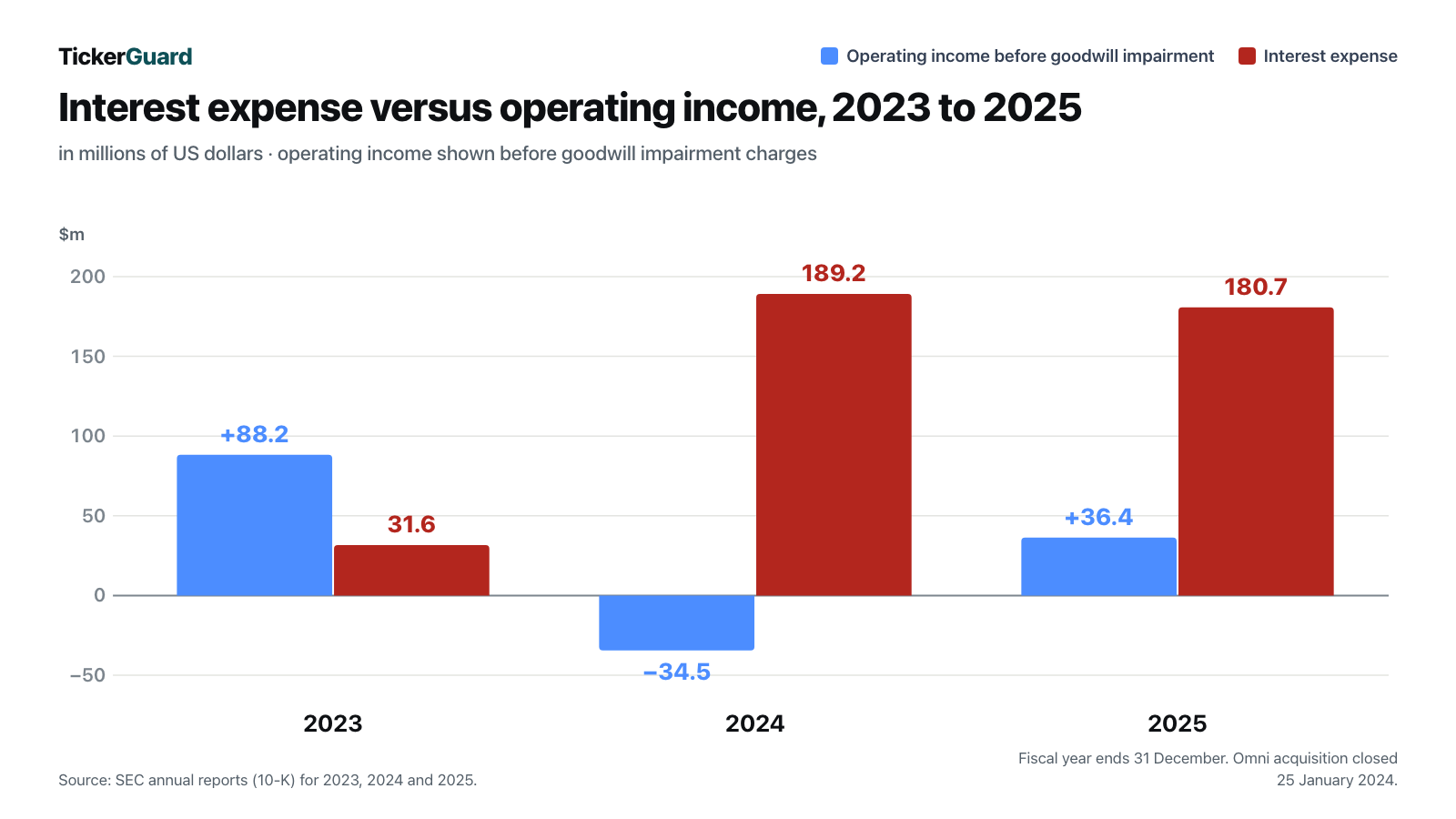
Now the line that overrides everything else. Here interest expense sits next to what the business earns operationally — adjusted for goodwill impairment charges so the years stay comparable:
Revenue tells the same story from the other side. It rose from $1,370.7 million (2023) to $2,474.3 million (2024) and $2,495.1 million (2025) — almost doubled, but almost entirely through the acquisition. In the first half of 2026 it came to $1,255.1 million against $1,232.1 million, up 1.9 percent. In none of those years was there a profit at the bottom: minus $1,131.2 million (2024), minus $141.7 million (2025) and minus $286.1 million in the first half of 2026. The loss per share deserves a second look, because both figures sit side by side in the filing and still cannot be derived from one another: earnings per share cover only the portion of the loss attributable to Forward Air shareholders — the rest is borne by the holders of the Omni units not yet exchanged. Of the $141.7 million loss in 2025, $107.8 million fell to shareholders, giving $3.51 per share; in 2024 it was $817.0 million of $1,131.2 million, giving $30.63, and in the first half of 2026 $241.6 million of $286.1 million, giving $7.54.
What the filings say — the uncomfortable truths
Uncomfortable truth no. 1: the entire premium paid for Omni is gone
Here the sunk cost fallacy from the opening returns for the first time — in its purest accounting form. Goodwill is the premium a buyer pays above the net assets of the company acquired. It sits on the balance sheet as an asset for as long as the buyer can credibly argue that the acquired unit will earn that premium. When he no longer can, he has to impair it.
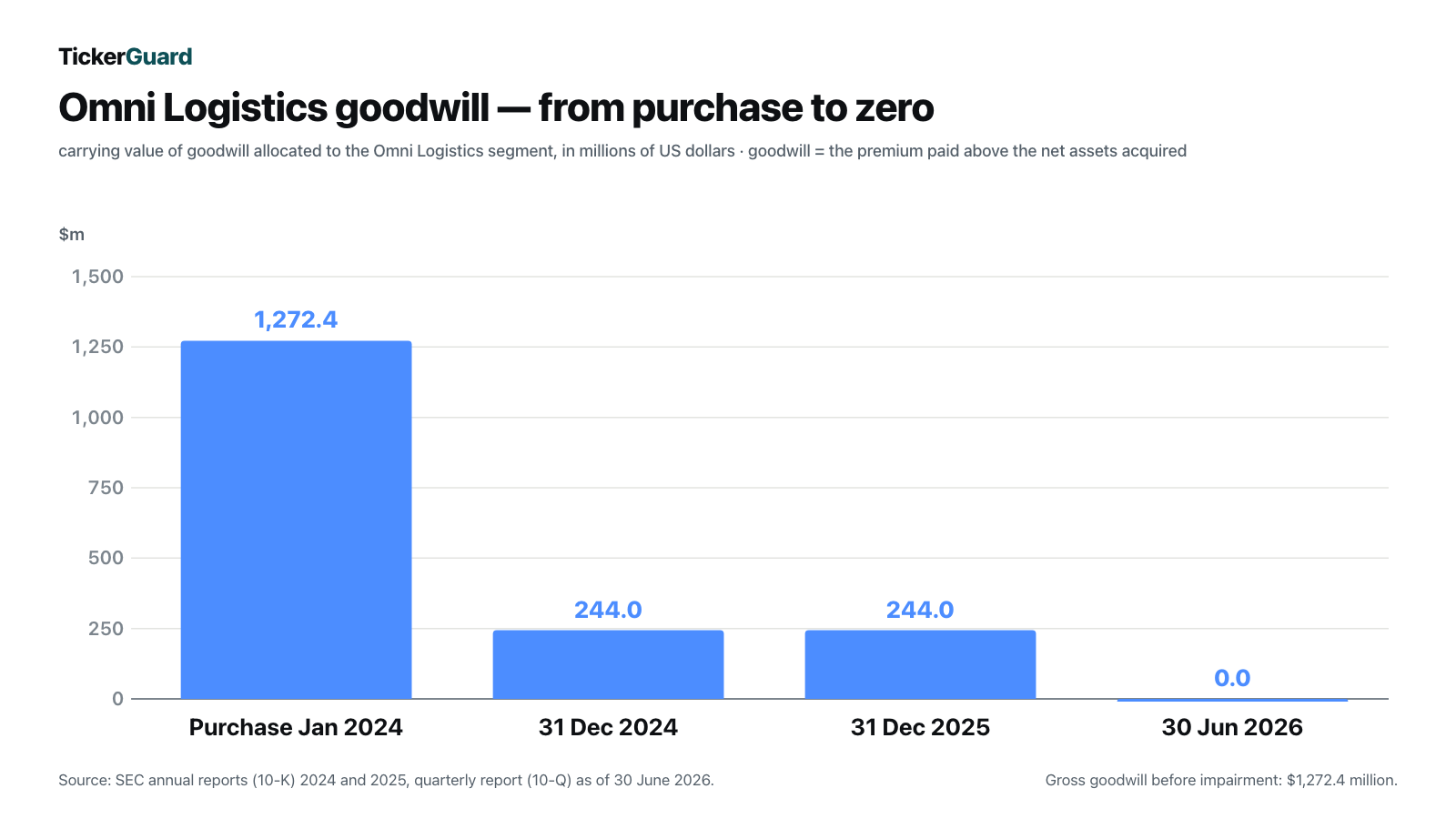
The Form 10-Q for the quarter ended June 30, 2026 describes the second step in plain words:

"The Omni Logistics reporting unit's calculated fair value was less than its carrying value. As a result, the Company recorded a non-cash goodwill impairment charge of $244,006 during the three months ended June 30, 2026 … which reduced the carrying value of the goodwill allocated to the Omni Logistics reporting unit to zero."
— Forward Air Corporation, SEC Form 10-Q for the quarter ended June 30, 2026, Note 5 "Goodwill and Other Intangible Assets"
The filing names two reasons: the expected decline in revenue from the largest customer — more on that shortly — and a sustained decrease in the share price since early May 2026. The second deserves a footnote, because it is rarely stated this openly: the company's own share price is here the cause of an accounting entry. If the stock falls, goodwill must be impaired; the impairment depresses equity, and depressed equity in turn depresses the stock. It is also worth noting that in the same quarter Forward Air moved the date of its annual goodwill test from June 30 to October 1, citing its own budgeting calendar. No test was skipped or delayed as a result: the triggering-event test as of May 31, 2026 took place, and it produced the impairment.
In fairness: a goodwill impairment costs no money. Not a cent leaves the company, no truck stops rolling, no customer cancels because of it. It is the belated admission of having overpaid. But it has one very real consequence, and that is the next section.
Uncomfortable truth no. 2: shareholders' equity is negative
As of June 30, 2026 the balance sheet showed $2,410.8 million of assets against $2,533.5 million of liabilities. The difference is equity, and it is negative: minus $122.7 million. Six months earlier, at December 31, 2025, it was positive at $161.7 million. The accumulated deficit is $690.3 million.
In everyday terms: this is the position of someone who sells the house and still owes money afterwards. It is not automatically the end — plenty of companies with long-term contracts and steady cash flow live that way for years. But it means the buffer is gone. Every further loss shifts the balance between shareholders and lenders towards the lenders, immediately.
The other half of the balance sheet explains why. On the liability side sit $1,770.0 million of debt at face value: a secured term loan of $1,045.0 million maturing on December 19, 2030 and secured notes of $725.0 million due 2031. After deducting $76.7 million of unamortized discount and issuance costs they are carried at $1,693.3 million. The term loan bears interest at the reference rate SOFR plus 4.50 percentage points and was issued at 96.0 percent of face value — the lenders took their premium twice. Nothing amortizes before maturity; the contractual amortization was prepaid in 2024 with an $80.0 million paydown.
On top of that come lease obligations that are easy to miss next to the interest line: $384.9 million of operating lease liabilities and $31.8 million of finance lease obligations as of June 30, 2026. For the 2025 financial year the annual report shows total lease cost of $588.9 million. Only the smaller part of that is rent, though: $141.3 million of operating lease cost, $18.3 million of short-term lease cost, $20.4 million of finance lease cost — and $414.4 million of variable lease cost, of which $368.6 million is compensation of Leased Capacity Providers already sitting inside purchased transportation.
Uncomfortable truth no. 3: the largest customer is leaving, by half, from December 2026
The Form 10-Q for the quarter ended March 31, 2026 contains, for the first time, a section headed "Customer Update". It is written soberly and is nonetheless the most important paragraph of the year:

The annual report for 2025 had still treated the same customer as a growth story, describing one customer at "just under 10% of our total revenue, which we expect to continue to grow in 2026". Three months later the company was negotiating its partial exit. On July 20, 2026 a non-binding memorandum of understanding was reached, which Forward Air published the following day:
"Under the current MOU, the Company expects to retain at least half of the approximate $250 million of revenue attributable to the Customer for the fiscal year ended December 31, 2025, with the potential of retaining an additional approximate 25%. Furthermore, the MOU extends the term of the contract for the retained services for a period of no less than two years."
— Forward Air Corporation, SEC Form 8-K dated July 21, 2026 (Item 7.01), Exhibit 99.1
Work the arithmetic through. Of roughly $250 million of annual revenue, 25 percent goes in the better case — about $62.5 million — and half in the worse case, roughly $125 million. Against consolidated 2025 revenue of $2,495.1 million that is 2.5 to 5.0 percent. Manageable, it sounds — until you remember where this customer sits: concentrated in Omni Logistics, the segment that earned $14.0 million before impairment in the second quarter of 2026. A revenue loss of that size does not hit the group evenly; it hits precisely the segment with the thinnest margin cushion.
And then there is the timing. The transition begins "later this year" per the press release, with the majority in December 2026 and through 2027. Why that particular month is inconvenient is the subject of the next section.
Three qualifications belong here. First, the memorandum of understanding is non-binding — no contract has been signed. Second, Forward Air states in the quarterly report that it received "additional clarity" after the measurement date and now expects to retain a majority of the business. Third, the same memorandum extends the contract for the retained services by at least two years, which makes that part more predictable than before. In the press release the chief executive speaks of a "20-year relationship"; the Form 10-Q filings for the quarters ended March 31 and June 30, 2026 both refer to 25 years.
Uncomfortable truth no. 4: the credit agreement tightens quarter by quarter
The credit agreement that governs the $1,045.0 million term loan and the $300 million revolving facility — the $725.0 million of notes sit under a separate indenture — comes with conditions, and the most important is the leverage ratio: net debt divided by earnings before interest, taxes, depreciation and amortization. It must not exceed a contractually agreed limit, or the borrower is in default — with the banks entitled to accelerate everything. At Forward Air that limit falls by design through 2026:

"As of June 30, 2026, the Company's leverage ratio was 5.2 to 1.00. The required leverage ratio will decrease by 0.25 turns at the end of each quarter in 2026 to 5.50 to 1 at the end of December 31, 2026 and all quarters thereafter, as defined in the Credit Agreement."
— Forward Air Corporation, SEC Form 10-Q for the quarter ended June 30, 2026, "Liquidity and Capital Resources"
The gap between actual and limit therefore shrinks from 0.8 to 0.3 turns. How much room that is can be calculated, because Forward Air named the denominator itself: $319 million of consolidated EBITDA for the twelve months to June 30, 2026, measured as the credit agreement defines it. Holding debt constant, that figure can fall to roughly $302 million before the 5.50 limit is breached — headroom of about $17 million, or 5.5 percent. That is our own calculation, not a company disclosure.
And the quarter in which this limit is first tested at 5.50 is exactly the quarter in which the large customer's transition begins. Even in the better case — $62.5 million less revenue — and assuming that revenue carried a ten percent margin, the earnings hit would be a good $6 million. That is a third of the calculated headroom, from a single event.
In fairness: Forward Air states in the same filing that it expects to remain in compliance over the next twelve months, and it was in compliance with all covenants as of June 30, 2026. The $300 million revolving facility was undrawn, with $261 million available. The company is also selling peripheral businesses: a disposal within Omni Logistics in the second quarter of 2026 brought $8.7 million net and a $3.6 million book gain, and a second one in July 2026 brought roughly $16.5 million with an expected gain of $8 million to $10 million. Every such sale reduces debt — and revenue.
Uncomfortable truth no. 5: the company's own tax agreement blocks the way out
For many investors the bet is simple: somebody buys the business and the stock jumps. That bet took a knock in the spring of 2026. From January 2025 the board reviewed "strategic alternatives" with Goldman Sachs as its adviser; the Form 10-Q for the quarter ended March 31, 2026 — filed on May 11, 2026 — describes "extensive negotiations and discussions with multiple parties" and states that "no actionable proposals for a sale of the Company were ultimately received". The report for the quarter ended June 30, 2026 repeats the sentence verbatim. What is on the block now is a set of non-core assets: expressly the Intermodal segment and two smaller legacy Omni businesses, one sold in the second quarter of 2026 and one in July 2026. Should a buyer for the whole company appear after all, the annual report for 2025 contains a sentence that makes that bet more expensive.

"We expect that the payments that we may make under the Tax Receivable Agreement in the event of a change of control will be substantial. As a result, our accelerated payment obligations and/or the assumptions adopted under the Tax Receivable Agreement in the case of a change of control may impair our ability to consummate change of control transactions or negatively impact the value received by stockholders in a change of control transaction."
— Forward Air Corporation, SEC Form 10-K for 2025, Item 1A "Risk Factors"
What this is about: as part of the Omni deal Forward Air promised the sellers 83.5 percent of certain future tax savings. As long as everything runs normally, payment follows the saving. In a change of ownership, by contrast, it is assumed that all tax benefits materialize — and the whole amount falls due at once. The recorded liability already rose in ordinary operations from $11.5 million (December 31, 2025) to $26.8 million (June 30, 2026); $15.5 million of that hit the first-half 2026 non-operating result. In a sale the amount may, per the filing, be "substantially in excess" of that.
In everyday terms: it is a prepayment penalty paid not by the seller but by the buyer — before he knows whether the deal works. Every dollar of it comes off the price that would reach shareholders.
Two further points belong in this chapter. First, on July 10, 2026 Jerome Lorrain resigned as Executive Chairman and stayed on as an ordinary director; Christine M. Gorjanc took over as independent Chair of the Board. The same filing notes that Lorrain's "special one-time equity award tied to the achievement of certain goals relating to the Company's ongoing strategic review" is forfeited on his departure. His remaining stock awards continue to vest, per the same filing, for as long as he stays on the board; what lapses are the performance-based awards and that one special grant. Second, the shareholder suit brought in 2023 over the lack of a vote on the Omni acquisition has been resolved — the Tennessee court granted final approval of the settlement orally on July 21, 2026, with the defendants denying all liability per the filing and with the entire amount funded by the directors' and officers' insurers.
Valuation — what $453 million of market value next to $1.77 billion of debt means
As of July 29, 2026 the cover page of the quarterly report showed 33,780,862 shares outstanding. Valued at the only price we can document from a filing — $13.40, the Nasdaq average of June 22, 2026 from the fee table of the Form S-8 registration dated June 25, 2026 — that gives a market capitalization of roughly $453 million. Three orders of magnitude follow, explicitly as ranges and not as point forecasts.
The price-to-sales ratio is around 0.18 against 2025 revenue of $2,495.1 million. Taken alone that is dirt cheap — a dollar of revenue costs 18 cents. There is no price-to-earnings ratio, because there are no earnings; and no price-to-book ratio, because book equity is negative.
The number that matters is therefore enterprise value: market capitalization plus debt minus cash. That is $453 million plus $1,770.0 million minus $139.4 million, or roughly $2.08 billion. Measured against consolidated EBITDA for the last twelve months — $319 million as the credit agreement defines it — that equals 6.5 times. For a logistics business that is neither conspicuously cheap nor expensive. The low share price is therefore not a discount on the business; it is the price of shareholders ranking behind $1.77 billion of debt.
The same arithmetic from the other side: of every dollar of enterprise value, roughly 78 cents belong to lenders and 22 cents to shareholders. That is the lever, and it works both ways. If EBITDA rises ten percent and debt stays flat, the implied equity value rises disproportionately. If it falls ten percent, the same happens downward — and the credit limit moves closer at the same time. Buying this stock is not buying a cheap company; it is a leveraged bet on two years without an accident.
A word on dilution, because it is missing from the arithmetic above: alongside the 33.78 million shares sit 6.568 million unexchanged units in the intermediate entity Clue Opco, exchangeable one for one into stock — roughly 19.5 percent of additional shares, measured against the 33,736 thousand shares outstanding at June 30, 2026. Economically this is not a new loss, because those units already appear as noncontrolling interest. For the supply of stock on the market it still counts.
For comparison: at Old Dominion Freight Line we saw what the market is prepared to pay for a low-debt less-than-truckload carrier. The gap between the two valuations is not a market failure — it is the price of the balance sheet.
Upside and risks at a glance
What speaks for Forward Air:
- The operating business is growing: $673.0 million of quarterly revenue in the second quarter of 2026 was the highest in company history, and adjusted operating income rose from $19.5 million to $42.7 million.
- The cash is working again: $40.9 million of operating cash inflow in the first half of 2026 against only $10.2 million of capital expenditure; $401 million of liquidity as of June 30, 2026.
- The Omni goodwill is fully written off — the same charge cannot come a second time, and it never cost cash.
- The business model ties up little capital: only $29.1 million went into property and equipment in 2025, because trucks and drivers are bought in rather than owned.
- No amortization and no maturity on the drawn debt before December 19, 2030; the $300 million revolving facility was untouched as of June 30, 2026 — though the facility itself expires on January 25, 2029.
- The board — independently chaired since July 2026 — intends, per the Form 10-Q for the quarter ended June 30, 2026, to sell non-core assets including the Intermodal segment; every disposal reduces debt.
What speaks against it:
- Negative shareholders' equity of $122.7 million as of June 30, 2026 with an accumulated deficit of $690.3 million — the buffer is used up.
- Interest exceeds operating earnings: $87.3 million of interest expense against $63.1 million of adjusted operating income in the first half of 2026, interest coverage of 0.72.
- From December 31, 2026 the credit agreement caps leverage at 5.50 instead of 6.00; the reported figure was 5.2 — by our own calculation about 5.5 percent of earnings headroom.
- That same month the transition of part of the large customer begins, a customer worth roughly $250 million of 2025 revenue; the July 20, 2026 memorandum of understanding is non-binding.
- The Tax Receivable Agreement with the Omni sellers accelerates in a change of ownership and, per the company, reduces the value reaching shareholders.
- 6.568 million unexchanged units equal roughly 19.5 percent of additional shares (measured against 33,736 thousand shares at June 30, 2026); two large holders together owned about 27 percent as of December 31, 2025.
A human bottom line
The sunk cost fallacy from the opening wears two faces at Forward Air, and they belong to different people. The first is the company's: in 2024 it paid for an acquisition that has since dissolved entirely in the books — $1,272.4 million of premium, today zero. Management drew the right conclusion and cleaned the balance sheet instead of dragging the number along. That is more than one often sees.
The second face is the investor's, and it is the more dangerous one. Anyone holding the stock since 2024 is sitting on a large loss and is now hearing: record quarterly revenue, operating income doubled, cash flow positive, large customer perhaps three-quarters saved. All of that is true. And all of it happens above a line that stood at $180.7 million of interest in 2025 and at $31.6 million in 2023. The business earns money — it just belongs to somebody else first.
What follows is not a recommendation but a question everyone has to answer for themselves: are you buying a healthy freight forwarding business at a fifth of its annual revenue, one that needs only two calm years to swim free? Or are you buying the thin remainder left after $1.77 billion of debt, in the very quarter when the largest customer leaves and the credit limit tightens? Both readings sit in the same documents. The numbers are there, the evidence is linked — and the question of how much you have already lost does not belong in that calculation.
What you make of it is your decision. And that is exactly as it should be.
Sources and disclosures
- SEC Form 10-Q for the quarter ended June 30, 2026 (filed August 5, 2026) — balance sheet, segments, notes 2, 4, 5, 7, 8, 9 and 10, "Liquidity and Capital Resources"
- SEC Form 10-Q for the quarter ended March 31, 2026 (filed May 11, 2026) — "Customer Update"
- SEC Form 10-K for 2025 (filed March 11, 2026) — business model, employees, risk factors, credit agreement, Tax Receivable Agreement, consolidated financial statements
- SEC Form 10-K for 2024 (filed March 24, 2025) — comparative figures and the first goodwill impairment
- SEC Form 8-K dated August 5, 2026 (Item 2.02) with Exhibit 99.1 — quarterly results, liquidity, last-twelve-months consolidated EBITDA
- SEC Form 8-K dated July 21, 2026 (Item 7.01), Exhibit 99.1 — memorandum of understanding with the large customer
- SEC Form 8-K dated July 10, 2026 (Item 5.02) — resignation of the Executive Chairman, new independent Chair
- Filing fee table of the Form S-8 dated June 25, 2026 — documented Nasdaq average price of $13.40 on June 22, 2026
- In-house stock scanner "Reddit hype" (selection trigger, as of September 18, 2026). Every figure in this analysis comes from the SEC filings linked above; fundamental data served only to cross-check the share count and market capitalization on September 19, 2026.
- SEC EDGAR issuer profile for CIK 0000912728 — registrant data, Nasdaq listing and the former company name Landair Services Inc. (until August 14, 1998)
Disclosure: this article is journalistic research and context, not investment advice and not an invitation to buy or sell securities. Share prices can move sharply; a total loss of the capital employed is possible. All figures come from the original documents linked above and carry the reporting date stated there. The author holds no position in Forward Air Corporation at the time of publication.
Key figures at a glance
All monetary figures in millions of $; earnings per share as reported.
| Metric | 2021 | 2022 | 2023 | 2024 | 2025 |
|---|---|---|---|---|---|
| Revenue | 1,387.2 | 1,679.6 | 1,370.7 | 2,474.3 | 2,495.1 |
| Operating Income (EBIT) | 147.0 | 247.6 | 88.2 | -1,062.9 | 36.4 |
| Net Income | 105.9 | 193.2 | 167.4 | -817.0 | -107.8 |
| Net Margin | 7.6% | 11.5% | 12.2% | -33.0% | -4.3% |
| Earnings Per Share | 3.88 $ | 7.17 $ | 6.44 $ | -29.66 $ | -3.48 $ |
Source: fundamental data & SEC filings (annual and quarterly reports, 10-K/10-Q)
Our Bottom Line at a Glance
- Balance sheet and equity negative
- As of June 30, 2026 assets of $2,410.8 million stood against liabilities of $2,533.5 million — equity is negative at minus $122.7 million, after positive $161.7 million at December 31, 2025. The accumulated deficit is $690.3 million. The buffer for further losses is used up.
- Interest burden and funding negative
- In the first half of 2026 interest expense of $87.3 million faced operating income before goodwill impairment of $63.1 million — interest coverage of 0.72. In 2025 it was $180.7 million of interest against $36.4 million of operating income. Before the Omni deal, in 2023, the ratio was $31.6 million against $88.2 million.
- Operating business positive
- At $673.0 million, Forward Air posted the highest quarterly revenue in its history in the second quarter of 2026, up 8.8 percent. Operating income before goodwill impairment rose from $19.5 million to $42.7 million, consolidated EBITDA from $79.1 million to $93.0 million. Operating activities produced $40.9 million of inflow in the first half of 2026.
- Credit covenants negative
- The contractual leverage cap falls 0.25 turns at the end of each quarter in 2026 and stands at 5.50 instead of 6.00 from December 31, 2026. The reported figure at June 30, 2026 was 5.2. On last-twelve-months earnings of $319 million that leaves headroom of roughly $17 million, or 5.5 percent, by our own calculation, before the limit is breached.
- Customer concentration negative
- The largest customer generated roughly $250 million of revenue in 2025 and about 12 percent of consolidated operating revenues in the first quarter of 2026, and sits concentrated in Omni Logistics. Under the non-binding memorandum of understanding of July 20, 2026 at least 50 and possibly 75 percent remains; the transition of the rest begins mostly in December 2026 — the same quarter in which the tighter covenant first applies.
- Ownership and dilution neutral
- Alongside 33,780,862 shares (July 29, 2026) sit 6,568 thousand units in the intermediate entity Clue Opco, exchangeable one for one into stock — roughly 19.5 percent of additional shares measured against the 33,736 thousand outstanding at June 30, 2026, against 50,000 thousand authorized. The two largest holders together owned about 27 percent at the end of 2025. The Tax Receivable Agreement with the Omni sellers accelerates in a change of ownership.
Forward Air runs an asset-light freight forwarding business that is growing operationally: $673.0 million of quarterly revenue in the second quarter of 2026 was the highest in company history, and adjusted operating income rose from $19.5 million to $42.7 million. Underneath sits a balance sheet that leaves shareholders little: minus $122.7 million of equity, $1,770.0 million of debt at face value and interest expense that exceeds operating earnings. The $1,272.4 million of goodwill from the Omni deal is fully written off. A tighter credit covenant applies from December 31, 2026 — the same month in which part of the largest customer's business starts to move away. Not investment advice.
What Our Rating Means
Substance risk
We found at least one documented issue that threatens the company itself — regardless of how the stock is currently valued.
Red, because two hard substance criteria are documented as met. First, shareholders' equity is negative: as of June 30, 2026 assets of $2,410.8 million stood against liabilities of $2,533.5 million, a deficit of $122.7 million, after positive equity of $161.7 million six months earlier; the accumulated deficit is $690.3 million. Second, interest coverage is below one: in the first half of 2026 operating income before goodwill impairment of $63.1 million faced interest expense of $87.3 million, a ratio of 0.72; across 2025 it was $36.4 million against $180.7 million. The business therefore does not earn its own interest from ordinary operations. Two aggravating circumstances come on top: the contractual leverage cap falls from 6.00 to 5.50 at December 31, 2026 against a reported 5.2 — roughly 5.5 percent of earnings headroom by our own calculation — and that is exactly the month in which part of the largest customer's business begins to move away, a customer worth roughly $250 million of 2025 revenue sitting concentrated in the segment with the thinnest margin cushion. Explicitly not relevant to the rating is the valuation: a price-to-sales ratio of 0.18 is a price argument and justifies neither red nor green. Nor is the goodwill impairment itself a reason for red — it costs no cash and cannot repeat, because the balance stands at zero. What would argue for amber rather than red is the operating picture: record quarterly revenue, adjusted operating income more than doubled, $40.9 million of cash inflow in the first half of 2026, $401 million of liquidity, no maturity on the drawn debt before December 2030 and an untouched credit facility. Between two levels the more cautious one applies, however, and negative equity combined with interest coverage below one is a documented substance risk, not a single open question. Amber would come into view once equity turns positive again or interest coverage exceeds one across a full reporting period. The decision is yours.
A journalistic assessment by our editorial team at the time of the deep dive, based on public sources — not investment advice and not a solicitation to buy or sell. Your personal circumstances (investment goals, risk capacity, taxes) cannot be taken into account. What our levels mean, how verdicts are formed, and what conflicts of interest exist →
Worth Noting
- Forward Air reached the research list via the in-house stock scanner "Reddit hype", which flags stocks with unusually high attention in retail investor forums. The scanner measures attention, not quality; it is a reason to look something up, not an argument.
- Currency of the data: the most recent periodic report evaluated is the Form 10-Q for the quarter ended June 30, 2026, filed on August 5, 2026, together with the earnings release (Form 8-K, Item 2.02) of the same day. Every filing submitted after that was reviewed: two Schedule 13G ownership filings dated August 6 and August 13, 2026. They do not change the picture and therefore do not appear in the article. Review date: September 19, 2026 — no later filing had been submitted by then.
- Data basis: every figure in this analysis comes from SEC filings. The valuation anchor is deliberately not a live quote but the $13.40 Nasdaq average price of June 22, 2026 documented in the filing fee table of the Form S-8 dated June 25, 2026 — which keeps the valuation arithmetic verifiable over time. Cross-check on September 19, 2026 against fundamental data: the share count reported there, 33,780,862, matches the cover page of the quarterly report exactly; the market capitalization of roughly $521 million shown there (as of September 18, 2026) sits about 15 percent above the $453 million anchor derived from the filing price, and therefore within the permitted deviation. The ratios displayed in the fact box (among them the equity ratio and price-to-book) rest on the 2025 annual accounts, when equity was still positive — the article text works from the balance sheet as of June 30, 2026.
- Company history: the registrant was called Landair Services Inc. until August 14, 1998; the SEC identifier CIK 0000912728 has been unchanged since 1995. The 2023 result includes $124.5 million of income from the Final Mile business sold on December 20, 2023 — the after-tax result of that discontinued operation, which contains a $155.8 million pre-tax gain on sale. The 2023 figures are therefore not comparable with later years.
Stock Watch
This analysis is as of September 19, 2026. Stock Watch will tell you what's changed at FWRD since then.
Later $1 a month per stock — signing up is free, and you'll be the first to know when it launches.
The full analysis as a PDF for later
We will send you this analysis as a PDF — to print, file away, and read at your own pace. And we will add you to the free Stock Watch list for Forward Air Corporation (FWRD), so you hear about it when something material in this analysis changes.
Frequently Asked Questions
Forward Air Corporation (NASDAQ: FWRD) is a transportation and logistics provider without its own truck fleet. It buys capacity from independent owner-operators and third-party carriers and resells it as a freight service. It reports three segments: Expedited Freight (expedited less-than-truckload, local pick-up and delivery, customs brokerage), Omni Logistics (air and ocean freight, customs brokerage, time-definite ground transportation, contract logistics) and Intermodal (container drayage to and from seaports and railheads). Headquarters are in Dallas, Texas.
In two steps and for two reasons. At the January 2024 purchase gross goodwill of $1,272.4 million was recorded; $1,028.4 million was impaired in 2024. The remaining $244.0 million followed in the second quarter of 2026. The Form 10-Q for the quarter ended June 30, 2026 names the triggers as the expected decline in revenue from the largest customer and a sustained decrease in the share price since early May 2026. The test was performed as of May 31, 2026 with the help of a third-party valuation specialist.
Yes. As of June 30, 2026 assets of $2,410.8 million stood against liabilities of $2,533.5 million — equity of minus $122.7 million, of which minus $115.4 million is attributable to Forward Air shareholders and minus $7.2 million to noncontrolling interests. At December 31, 2025 it was still positive at $161.7 million. The accumulated deficit stood at $690.3 million.
As of June 30, 2026 debt was $1,770.0 million at face value: a secured term loan of $1,045.0 million maturing December 19, 2030 and secured notes of $725.0 million due 2031. After $76.7 million of unamortized discount and issuance costs they are carried at $1,693.3 million. The term loan bears interest at SOFR plus 4.50 percentage points and requires no amortization before maturity. In addition there is an undrawn $300 million revolving facility, of which $261 million was available.
It is moving part of its business elsewhere. The customer accounted for roughly $250 million of revenue in 2025, just under 10 percent of consolidated revenue, and about 12 percent in the first quarter of 2026; it sits concentrated in the Omni Logistics segment. A non-binding memorandum of understanding was reached on July 20, 2026: Forward Air expects to retain at least half of that revenue, potentially another 25 percent, and the contract for the retained services is extended by at least two years. The transition begins later in 2026, mostly in December 2026 and through 2027.
It divides net debt by earnings before interest, taxes, depreciation and amortization and must not exceed a contractual limit. As of June 30, 2026 Forward Air reported 5.2 against a limit of 6.00. The limit falls by 0.25 turns at the end of each quarter in 2026 to 5.50 at December 31, 2026 and stays there. A breach would be an event of default and would allow the banks to accelerate all borrowings. The company states that it expects to remain in compliance over the next twelve months.
In the Omni deal Forward Air committed to paying the sellers 83.5 percent of certain future tax benefits. In a change of ownership the calculation assumes that all available tax benefits are used — so the payment falls due immediately and in full. In its 2025 annual report the company states that these payments will be substantial and may impair its ability to consummate change-of-control transactions or reduce the value shareholders receive in one. The recorded liability rose from $11.5 million (December 31, 2025) to $26.8 million (June 30, 2026).
Yes. The registrant was called Landair Services Inc. until August 14, 1998 and has carried the name Forward Air Corporation since. The SEC identifier (CIK 0000912728) has been unchanged since 1995. Anyone comparing data series from the 1990s will find the company under the old name depending on the database.
Found an error?
Did you spot a factual error, an outdated number, or a typo in this deep dive? Let us know briefly — your report goes straight to the editorial team.