Freightos: $422 Million Booked in a Quarter — and $7.7 Million of Revenue
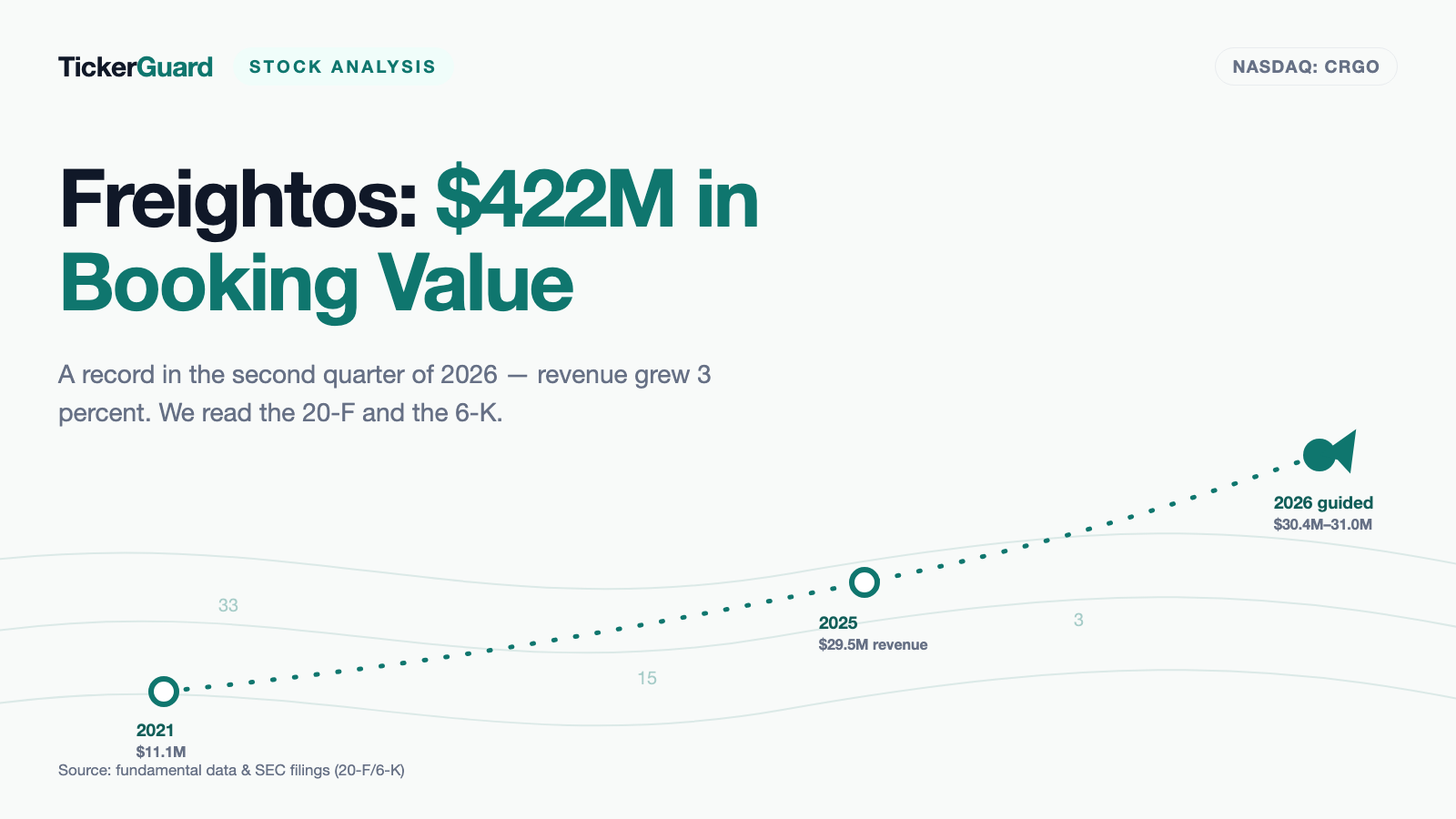
Freight orders worth $422 million were booked through the Freightos platform in the second quarter of 2026 — a record and 33 percent more than a year earlier. Of that, $7.7 million reached the company itself, 3 percent more than in the year-earlier quarter. The interim report to June 30, 2026 also shows that the loss, down to $1.6 million, shrank largely because of a revaluation of warrants rather than because of the business. And the founder, who left the chief executive role in January 2026, has been demanding a rebuilt board since June 29, 2026 with 6.1 percent of the shares. Not investment advice — just the question of how much of a record number ends up in the till.
 Thomas Mücke
Founder & Publisher
Thomas Mücke
Founder & Publisher
As of Today
As of: October 5, 2026
- Closing price
- 0.90 $ -7.40%
- Market Capitalisation
- 43.0 $M
- Growth Score
- 6/10
- AAQS
- 4/10
Price change since August 21, 2026: -33.8%
This analysis has a cut-off date. The Stock Guard tells you when something material changes in the numbers. Reserve your free spot
Chart
Interactive price chart (TradingView).
52-week range: 0.90 $ to 4.10 $ · Last price: 0.90 $ (As of: October 5, 2026)
Note: pure fact-based analysis, not investment advice and not a solicitation to buy or sell. All figures without guarantee.
There is an investor weakness that strikes precisely when you are paying attention: the tollbooth trap. It works like this — you read a big number a company proudly reports, and your brain quietly turns it into business. "$422 million" sounds like a company of $422 million scale. But that sum rolls past the company the way a truckload rolls past a tollbooth; what stays is the fee for passing through. At Freightos Limited (Nasdaq: CRGO) those fees came to exactly $7.691 million in the second quarter of 2026. So let us make a deal: we read the interim report to June 30, 2026, the annual report for 2025 and everything filed with the U.S. securities regulator, the SEC, since — and we sort out which number describes the pipe and which one describes the till. What you make of it is up to you.
What Freightos actually does — a booking engine for freight
When you send a parcel, you click on a website, see a price and book. In international freight — containers crossing oceans, pallets riding in the bellies of aircraft — it did not work that way for decades. Prices were requested by email, sent around in spreadsheets and negotiated on the phone. That is the gap Freightos went after: the company runs a vendor-neutral marketplace where airlines, ocean carriers and forwarders publish prices and available capacity — and where others can book them in real time. In everyday terms it is a booking portal for freight, roughly what travel portals are for airline tickets. Vendor-neutral means the company is not owned by an airline or a shipping line: it sells everyone's capacity and earns on the matching, not on the moving. It owns no aircraft, no ships and no trucks.
The marketplace carries several brands. WebCargo connects forwarders with airlines and is the heart of it; Freightos.com serves importers and exporters; Shipsta (acquired in August 2024, based in Luxembourg) runs the annual tenders of large shippers; Clearit handles digital customs brokerage in North America; and the FBX and FAX indexes provide price benchmarks for container and air freight. At December 31, 2025 the annual report counted more than 3,500 forwarding companies across roughly 10,000 offices.
The money arrives in two pots, and that distinction is the key to everything that follows:
- Platform — fees per booking, often a percentage of booking value or a flat fee per transaction. 2025: $9.881 million, or 34 percent of revenue.
- Solutions — software subscriptions and data packages, usually priced per user or per site per period. 2025: $19.579 million, or 66 percent of revenue.
That names the central tension of this analysis, and it runs through every chapter: the platform is growing at record speed, revenue is not — and the new management and the ousted founder are now publicly arguing about what follows from that.
One word on the legal setup, because it determines what paperwork exists: Freightos is registered in the Cayman Islands, managed from Barcelona and operates sites in Modi'in (Israel), Ramallah, Nablus, Luxembourg, Montreal and Chennai, among others. To the SEC it is therefore a foreign private issuer. In practice that means there is no annual report on Form 10-K and no quarterly report on Form 10-Q. The annual report is a 20-F, interim figures arrive on a 6-K. Anyone searching the SEC for "Freightos 10-K" finds nothing and might conclude there are no filings. There are — they simply have different names, and they are prepared under IFRS in U.S. dollars.
Company history for investors
-
2023
Listing via a special purpose acquisition company
Freightos reached Nasdaq in January 2023 through the combination with Gesher I. The one-time, non-cash charge for it came to $46.7 million and shaped the 2023 result.
-
2024
Acquisition of tender platform Shipsta
In August 2024 Freightos bought the Luxembourg provider Shipsta. Much of the 2025 revenue increase came from it — growth that does not repeat itself the following year.
-
2025
Best revenue year and a new chairman
Revenue rose 24 percent to $29.5 million in 2025. On July 28, 2025 Udo Lange took the independent chair — the board deliberately kept the chair and the chief executive roles separate.
-
2026
The founder leaves, a new chief executive takes over
Zvi Schreiber left on January 31, 2026 and the board in February. Pablo Pinillos has run the company since March 16, 2026 — and, for now, the finance function as well.
-
2026
Cost program cuts up to 15 percent of jobs
Announced March 26, 2026: roughly $1.3 million of one-time charges and about $4.5 million of annual savings from the fourth quarter of 2026, targeting adjusted EBITDA breakeven by year-end.
-
2026
The founder reports 6.1 percent — as an activist
On June 29, 2026 Schreiber moved from a passive Schedule 13G to a Schedule 13D. For shareholders that means strategy and board are now being contested in public.
-
2026
Record booking value, revenue almost unchanged
Reported August 17, 2026: $422 million of booking value (+33 percent) and $7.691 million of revenue (+3 percent). Guidance for 2026 extends that gap.
How the stock landed on our desk
Not through one of our valuation or momentum scanners: Freightos has no earnings for the classic value screens, and the share price is moving the wrong way for momentum lists. It reached our list through our in-house Reddit hype scanner, which tracks which stocks retail investors are writing about most (run of August 22, 2026, a few days after the quarterly figures of August 17). That is an attention signal and explicitly not a reason to buy. For us it is a topic radar: when many people talk about a stock at once, the sober look into the original filings is worth all the more — because the lines that matter are exactly the ones that get lost in the noise.
And in the case of Freightos there are a few of them. The second-quarter 2026 press release carries two pieces of good news in its headline block — "Record Revenue" and "Well-Capitalized" — and, in the same bullet list, the number 3 percent. Both are true. They just tell different stories.
The numbers over the years — honestly credited
Start with what genuinely impresses. Freightos has more than doubled its revenue in five years: from $11.1 million in 2021 to $29.5 million in 2025, with 24 percent growth in 2025 alone. Gross margin — the share of revenue left after direct costs — was 67 percent in 2025 and 67.6 percent in the second quarter of 2026. That is a software number, not a forwarding number, and it shows this really is a platform business rather than freight broking on thin spreads. Add a detail rarely seen at companies this size and clearly in Freightos' favor: no single customer accounted for 10 percent or more of income in 2023, 2024 or 2025. If you want to see how uncomfortable the opposite looks, our analysis of Zebra Technologies shows a turnaround that hung on a credit line.
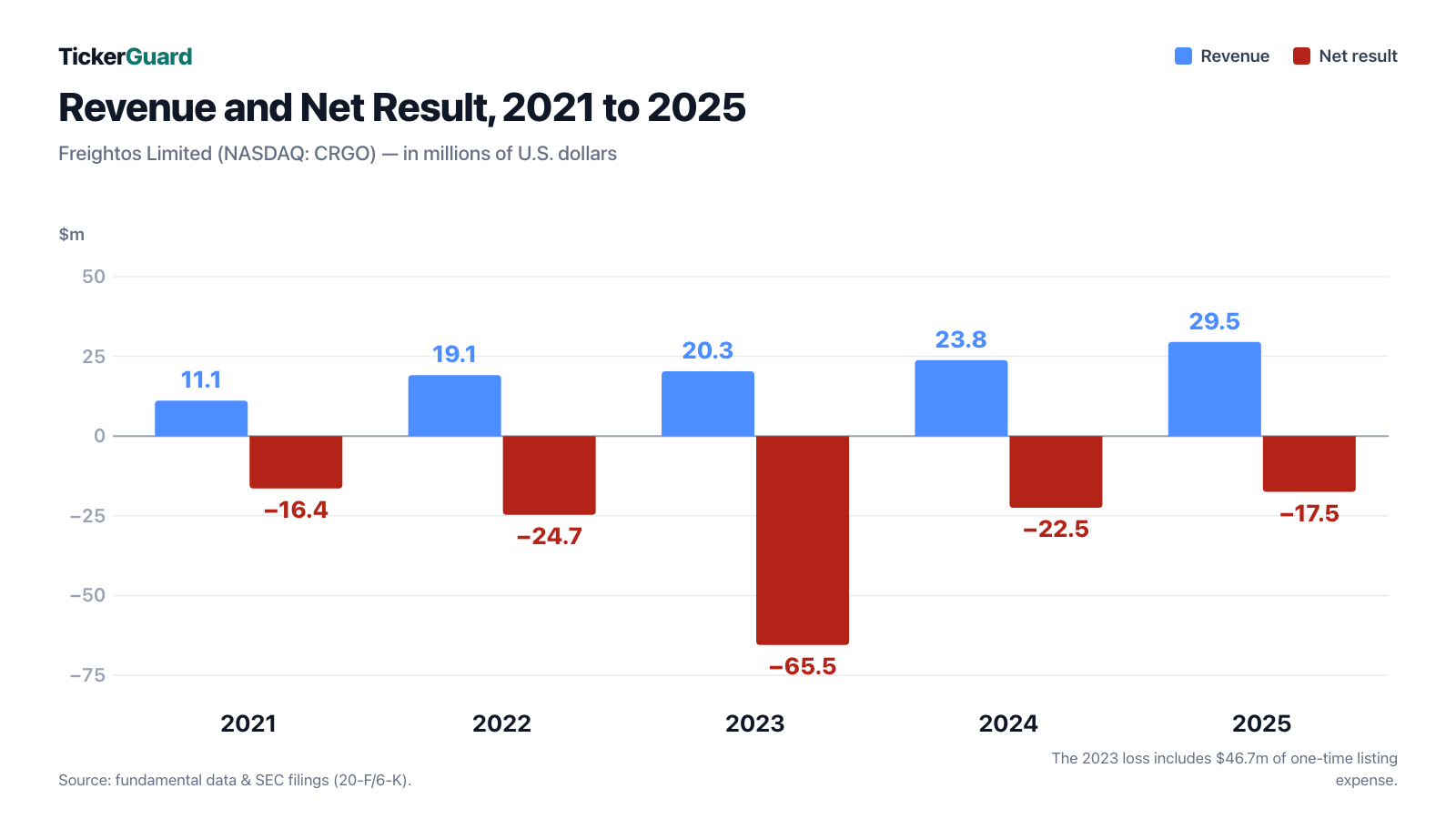
Two things sit side by side in that chart. First, the blue bar grows every year — real growth, not an accounting trick. Second, the red bar never disappeared. Freightos has never closed a year with a profit. Accumulated losses since inception stood at $232.3 million at June 30, 2026 — more than three times today's market capitalization. The 2023 outlier deserves an explanation so it does not mislead: of that year's $65.5 million loss, $46.7 million was "share listing expense", a one-time, non-cash charge arising from the January 2023 listing via a special purpose acquisition company. Without it, 2023 would have shown roughly $18.8 million of loss, in line with the other years.
What has genuinely improved lately is the pace of cash burn. Operating activities consumed $5.985 million in the first six months of 2026 and only $1.522 million in the second quarter alone, against $2.822 million in the year-earlier quarter. Adjusted EBITDA — the measure management asks to be judged on — improved in the second quarter of 2026 from negative $2.897 million to negative $2.031 million. And the balance sheet is decently stocked for a company this size: $13.311 million of cash plus an $8.058 million short-term bank deposit at June 30, 2026, equity of $36.6 million — and no financial debt, only lease liabilities of $2.166 million. The annual report puts it plainly:
"The Company's management concluded that the Company has sufficient funds to continue its operations and meet its obligations for a period of at least twelve months from the date the financial statements were authorized for issuance."
— Freightos Limited, SEC annual report on Form 20-F for 2025, note 1(e)
That is not a given. A going concern warning — routine at small, loss-making companies — is absent here. Remember it for the assessment later: Freightos does not have an urgent cash problem. Freightos has an earnings problem. Which brings us to the uncomfortable truths.
What the filings say — the uncomfortable truths
Uncomfortable truth no. 1: the record in the window never reaches the till
The press release of August 17, 2026 reports a record booking value for the second quarter of 2026. The technical term is gross booking value, or GBV, and it measures the total value of all freight orders processed through the platform — freight, ancillary charges, even pass-through duties:
"The total value of transactions processed on the Freightos platform, or GBV, reached a record of $422 million for Q2 2026, up 33% from Q2 last year and above management's expectations."
— Freightos Limited, SEC filing on Form 6-K dated August 17, 2026, Exhibit 99.1

Two lines higher, in the same release, sits the number that matters to a shareholder:
"Revenue of $7.7 million for the second quarter of 2026, up 3% compared to $7.4 million in the second quarter of 2025."
— Freightos Limited, SEC filing on Form 6-K dated August 17, 2026, Exhibit 99.1

The gap fits into four bars — and it opens up not only between booking value and revenue, but inside revenue itself:
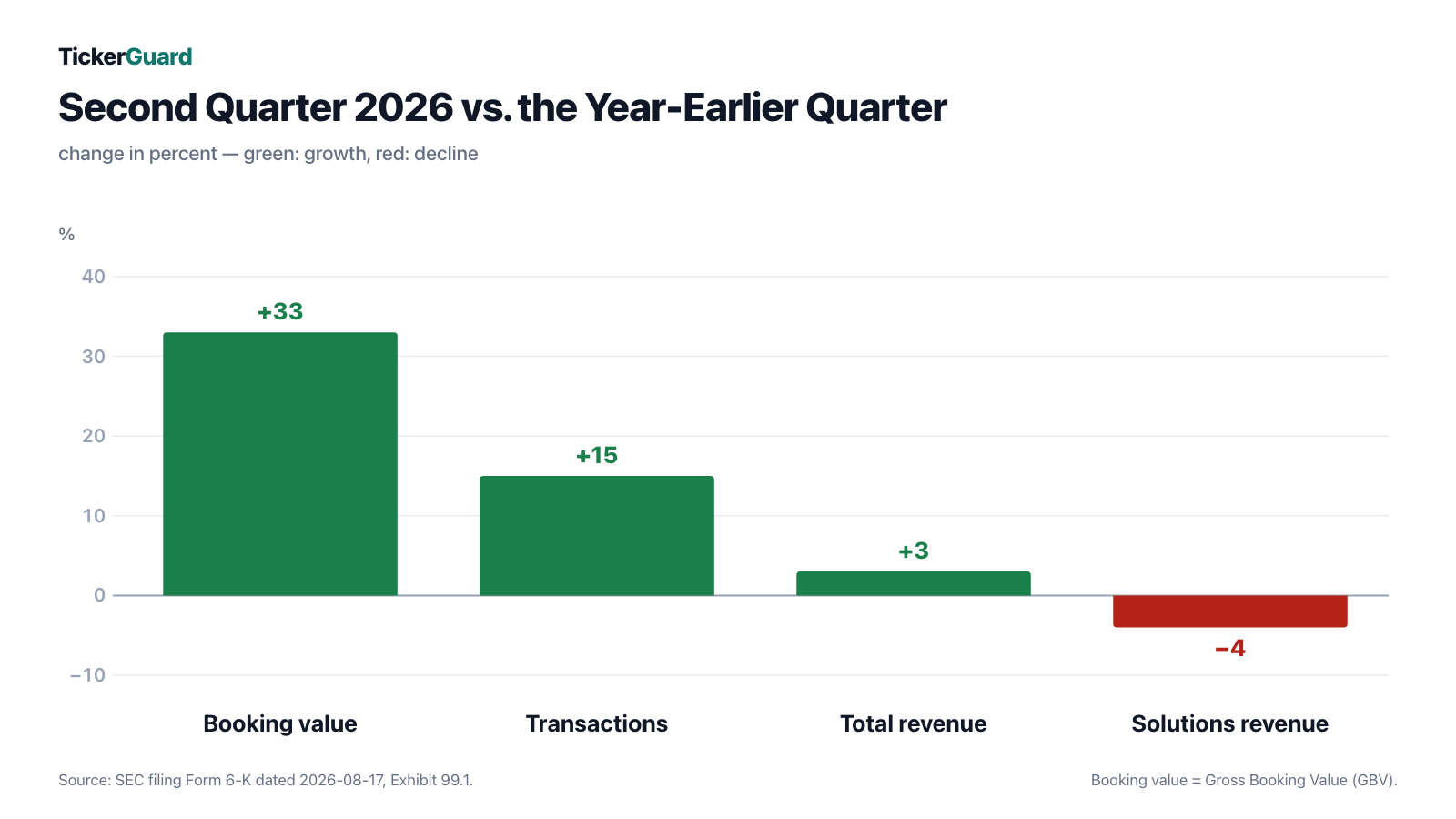
Why do the bars diverge so far? Because booking value largely measures freight prices, not what Freightos does. The release says so itself: the record also reflects air freight rates that remain "approximately 25% above pre-Middle East conflict levels". The annual report quantifies what happened: the closure of large swathes of airspace and the loss of the Dubai, Doha and Abu Dhabi hubs removed an estimated 16 to 22 percent of global air cargo capacity in early 2026; on the Europe–Middle East lane, rates jumped 73 percent within a matter of days. If the same pallet suddenly costs twice as much, booking value doubles — the booking fee only does so to the extent that it is a percentage. And a substantial part is not: when forwarders book with airlines, the sellers typically pay "a pre-negotiated flat fee per transaction".
In everyday terms: Freightos is the notary at a house sale. If property prices rise by a third, the sums in the deeds rise by a third — the fee does not necessarily follow. Mistaking the deeds for the income means buying the wrong number.
And one point weighs more than the price effect: the larger revenue pot is shrinking. Solutions, the software subscriptions that made up 66 percent of 2025 revenue and grew 27 percent that year, fell 4 percent to $4.8 million in the second quarter of 2026. The company cites "lower-than-expected performance in SaaS". Yet this was the declared growth engine — and a large part of the 2025 increase came, according to the annual report, from the first full year of Shipsta, acquired in August 2024. Growth bought in does not repeat itself. We have seen the same pattern elsewhere: at SOPHiA GENETICS the platform also grew faster than what actually landed in the till.
What happens next is set out by the company itself — and the guidance is the real news. For full-year 2026 management expects revenue of $30.4 million to $31.0 million, which would be 3 to 5 percent of growth after 24 percent in 2025. Booking value, meanwhile, is expected to rise 19 to 21 percent to between $1.533 billion and $1.560 billion. The gap is not closing — it is planned.
Uncomfortable truth no. 2: two thirds of the earnings improvement is accounting
The headline for the second quarter of 2026 reads: loss down from $4.278 million to $1.628 million, a 62 percent improvement. That sounds like a breakthrough. The income statement in the same document tells it more precisely. Operating loss — everything to do with the actual business — improved from $4.514 million to $3.546 million. That is $0.968 million. The remaining roughly $1.7 million of the improvement comes from a single line below it: "change in fair value of warrants", a gain of $1.822 million in the second quarter of 2026 against a cost of $0.285 million a year earlier.
What happened there? Warrants were issued in the 2023 listing — instruments that entitle their holder to buy a share later at a fixed price, here $11.50. Such warrants sit in the balance sheet as a liability and are remeasured every quarter. Here is the twist: the further the share price falls, the more worthless they become — and the larger the accounting gain. The position fell from $2.223 million at December 31, 2025 to $0.702 million at June 30, 2026. In everyday terms: you promised someone they could buy your car for $11,500 if they wanted. If the car loses value, your promise gets cheaper — and your bookkeeper records a gain. You are not richer for it.
That is why adjusted EBITDA is, unusually, the more honest figure here: it strips the warrant revaluation out and came to negative $2.031 million in the second quarter of 2026 against negative $2.897 million a year earlier. That is a real improvement of $0.866 million — solid, but not a 62 percent leap. And for full-year 2026 the company still expects adjusted EBITDA of negative $6.9 million to negative $6.4 million. The chief executive frames the goal like this:
"We remain committed to our profitability targets by exiting the year at Adjusted EBITDA breakeven and expect to become cash generative by mid-2027."
— Pablo Pinillos, chief executive and chief financial officer, SEC filing on Form 6-K dated August 17, 2026, Exhibit 99.1
The plan rests on the cost program announced on March 26, 2026: a global workforce reduction of up to 15 percent, roughly $1.3 million of one-time charges, and about $4.5 million of annualized savings from the fourth quarter of 2026. Restructuring charges of $1.488 million had already been booked in the first half of 2026. Do the rough arithmetic: $4.5 million of savings against adjusted EBITDA of negative $8.2 million on a trailing twelve-month view — the cost program alone does not close the gap. Without revenue growth, breakeven will be tight. Which is exactly why the 3 percent guidance is no footnote.
Uncomfortable truth no. 3: the founder is out — and is now fighting his own board
Freightos was founded in 2012 by Zvi Schreiber, who ran it as chief executive until January 2026. The annual report describes the departure the way statutory documents do — soberly and still clearly: the parties "mutually determined to part ways" in December 2025, effective January 31, 2026. He left the board in February 2026. Pablo Pinillos, who had joined as chief financial officer in March 2025, became chief executive on March 16, 2026.
On March 11, 2026 Schreiber still reported his stake on a Schedule 13G — the form for shareholders who explicitly do not intend to influence management. On June 29, 2026 the same stake was refiled on a Schedule 13D. In the United States that switch is a signal every professional reads instantly: a quiet holder has turned into an activist one. The reported position is 3,131,931 shares, or 6.1 percent. What he wants is set out in Item 4:
"The Reporting Person believes that the strategic direction and execution being pursued by the Board, particularly since the first quarter of 2026, are impairing the Issuer's performance and short-term and long-term shareholder value, and that substantial value can be created for all shareholders by returning the Issuer to a platform-first, high-growth strategy and by making changes to the composition and leadership of the Board, including the role of chairman."
— Zvi Schreiber, SEC Schedule 13D dated June 29, 2026, Item 4
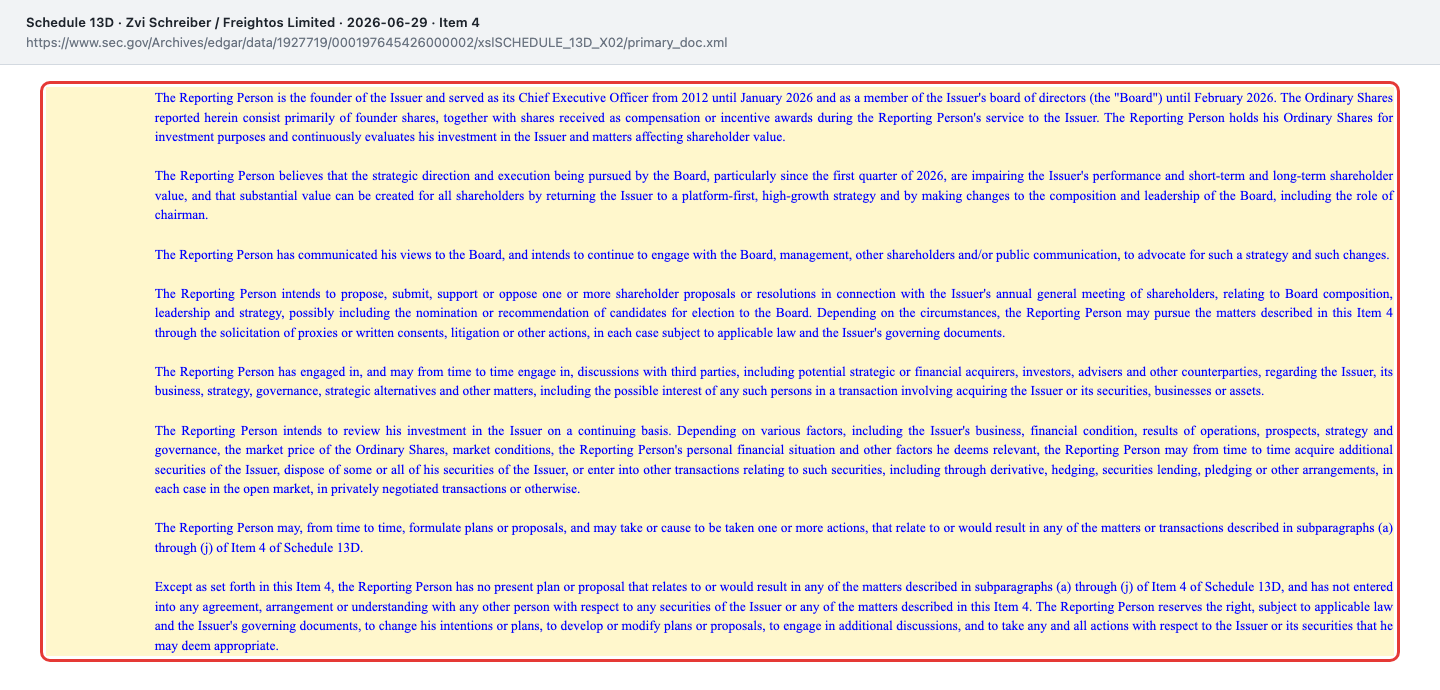
For an investor this cuts both ways. A fight at the top is poison for execution — the company itself now lists "disruptions and instability caused by Freightos' CEO transition, changes to its board of directors, and its other leadership changes" among the risks to its own guidance. On the other hand, pressure from a 6 percent holder can move a stuck situation, and Schreiber explicitly mentions discussions with potential acquirers of the company.
There is a second personnel question, stated with surprising candor in the risk section of the annual report: Pablo Pinillos is chief executive and chief financial officer in one person. The report notes that he had "not previously served as the chief executive officer of a principal operating business or a publicly traded company", and that the search for a permanent finance chief has only recently begun. In a company that is rebuilding its strategy, cutting up to 15 percent of its jobs and arguing publicly with its founder, the steering wheel and the cash book are in the same pair of hands.
Uncomfortable truth no. 4: 7.2 million claims on new shares — and a one-dollar line on the horizon
Dilution is best explained with a cake: your slice gets smaller when new slices keep being cut without the cake growing. At Freightos, 7,208,918 options, unvested restricted share units and unearned performance shares were outstanding at December 31, 2025 — roughly 14 percent of the 51,683,498 shares outstanding at March 1, 2026. And the number keeps growing by design: the 2022 incentive plan tops itself up every January 1 by up to 5 percent of shares outstanding; 2,568,845 shares went into the pool on January 1, 2026.
"7,208,918 options, unvested RSUs and unearned performance shares to employees, directors and consultants outstanding as of December 31, 2025 under the share-based compensation plan (6,718,602 and 5,828,733 as of December 31, 2024 and 2023, respectively)."
— Freightos Limited, SEC annual report on Form 20-F for 2025, note 23 "Loss per Ordinary Share"

Fairness demands the counter-calculation: a further 14,850,000 warrants are outstanding, which at first glance look like massive dilution. They entitle the holder to buy a share for $11.50 — against a share price of $1.36 (close of August 21, 2026) they are effectively worthless. They only become relevant if the stock multiplies; at that point they would also bring roughly $171 million of fresh cash into the company. Today's realistic dilution is the 14 percent from employee compensation, not the warrants.
A second point belongs in the same place, because it has the same cause: the low share price. The annual report lists Nasdaq's continued listing rules explicitly as a risk:
"To maintain our listing, we are required to comply with certain continued listing requirements, including a minimum bid price of $1.00 per share. As of early March 2026, the market price of our shares has been volatile and has traded at levels approaching this threshold."
— Freightos Limited, SEC annual report on Form 20-F for 2025, Item 3.D Risk Factors
For perspective, without drama: if the closing bid price stays below $1.00 for 30 consecutive business days, a formal deficiency notice follows, usually with a grace period to regain compliance. The stock closed at $1.36 on August 21, 2026; the twelve-month low was $1.14 and the high $4.24. So it is not an acute issue, but it is a real one — and the report names a reverse stock split as a possible answer. Note the connection: a falling share price helps the warrant accounting and hurts the listing. It is the same number.
Valuation: what the market pays for $30 million of revenue
A price/earnings ratio cannot be formed — there has never been an annual profit. That leaves revenue and substance. Market capitalization stood at roughly $70 million on August 21, 2026 (data as of that day). Cross-checked against a price documented in a filing — the Form 144 dated July 17, 2026 covered 1,760 shares with an aggregate value of $2,411.20, or about $1.37 per share — 51,683,498 shares give roughly $70.8 million. The two figures are less than one percent apart, so we can work with them.
That implies roughly 2.3 times trailing twelve-month revenue (about $29.9 million). Deducting the $21.4 million of cash and deposits and leaving the $0.7 million warrant liability in place gives an enterprise value of roughly $49 million, or about 1.6 times revenue. On book value the stock trades at roughly 1.9 times equity of $36.6 million. For context: a software and marketplace business with a 67 percent gross margin usually commands a much higher multiple — but it usually grows, too. At expected revenue growth of 3 to 5 percent, a revenue multiple of 2.3 is no obvious bargain; it is a price somewhere between "software company" and "turnaround case".
The second calculation, cash runway, is more reassuring. With $21.4 million of cash and deposits at June 30, 2026 and $5.985 million of operating cash outflow in the first half of 2026, the money lasts roughly seven quarters on paper — and the outflow is falling: only $1.522 million in the second quarter alone. Freightos is therefore not forced to issue new shares tomorrow. At a loss-making small company, that is the single most important difference.
One more number completes the picture: since the January 2023 listing, when the stock started around $10, the share price has fallen roughly 87 percent. Anyone buying today is not buying the 2023 story but a company that still has to prove its case.
Opportunities and risks at a glance
What speaks for Freightos:
- A genuine platform business with software margins: 67.6 percent gross margin in the second quarter of 2026 and 67 percent in 2025 — plus a network of more than 3,500 forwarding companies across roughly 10,000 offices and 75 active airlines and ocean carriers in the second quarter of 2026.
- No customer concentration: no single customer accounted for 10 percent or more of income in 2023, 2024 or 2025 — unusual for a company this size.
- A solid balance sheet with no financial debt: $13.311 million of cash plus an $8.058 million bank deposit and $36.6 million of equity at June 30, 2026; management confirms sufficient funds for at least twelve months, and there is no going concern warning.
- Cash burn is visibly falling: operating outflow of only $1.522 million in the second quarter of 2026 against $2.822 million a year earlier; adjusted EBITDA of negative $2.031 million against negative $2.897 million; the cost program should deliver about $4.5 million a year from the fourth quarter of 2026.
- Volume growth is there: 458,000 bookings in the second quarter of 2026, up 15 percent — and excluding routes touched by the Middle East conflict, the company says growth was in line with its long-term model of 20 to 30 percent.
What speaks against it:
- Revenue has been essentially flat for six quarters, and the company's own guidance extends that: $30.4 million to $31.0 million for 2026 is 3 to 5 percent of growth after 24 percent last year — while booking value is guided up 19 to 21 percent.
- The larger revenue pot is shrinking: Solutions subscriptions fell 4 percent in the second quarter of 2026 although they are the declared growth engine; their 27 percent gain in 2025 came in good part from the Shipsta acquisition.
- Never a profitable year: accumulated losses of $232.3 million at June 30, 2026, and roughly two thirds of the quarter's 62 percent earnings improvement came from the warrant revaluation rather than from the business.
- Leadership and strategy are openly contested: the founder left in January 2026, the chief executive doubles as finance chief and had never run a listed company, and since June 29, 2026 an activist holder of 6.1 percent wants the composition and chairmanship of the board changed.
- Dilution and the listing threshold: 7,208,918 outstanding options and share awards (around 14 percent of shares), an incentive pool that refills by up to 5 percent a year — and a share price of $1.36 on August 21, 2026 above a Nasdaq minimum bid price of $1.00 that the annual report itself flags as a risk.
A human conclusion
Back to the tollbooth trap. Its point is not that the big number is a lie — freight orders worth $422 million really did run through the Freightos platform in the second quarter of 2026, and that is a considerable feat for a company with 382 employees. Its point is that the big number saves you from asking the question you should be asking: how much of it stays here — and is that share growing? At Freightos the answer for the second quarter of 2026 is $7.691 million, up 3 percent. And for 2026 as a whole, on the company's own guidance: 3 to 5 percent.
So the stock stands at a very clear fork, and both roads are evidenced. On one road, management delivers what it promises: the software gets embedded deeper into forwarders' daily work, the subscription business turns positive again, the cost program bites, and adjusted EBITDA reaches zero by the end of 2026. Then you own a debt-free platform company with a 67 percent gross margin trading at 2.3 times revenue. On the other road, revenue stays where it has sat for six quarters, the fight at the top eats the attention, and the company keeps burning a fifth of its cash every year — until the question of fresh money is back on the table.
The honest question is therefore not "is Freightos cheap?" but: do you believe this company can finally turn a growing flow of goods into growing revenue — under a leadership its own founder is publicly contesting? If yes, you have a thesis and a schedule to test it against: the quarterly figures in November 2026 and the annual report in the spring of 2027. If no, you had a big number. What you make of it is your decision. And that is exactly how it should be.
Sources
Every original document used in this analysis — to read for yourself:
- Freightos Limited — SEC filing on Form 6-K dated August 17, 2026, Exhibit 99.1: second quarter 2026 results
- Freightos Limited — SEC annual report on Form 20-F for 2025 (filed March 26, 2026)
- Freightos Limited — SEC annual report on Form 20-F for 2023 (filed March 21, 2024)
- Freightos Limited — SEC filing on Form 6-K dated July 15, 2026: platform KPIs for the second quarter of 2026
- Freightos Limited — SEC filing on Form 6-K dated April 15, 2026: platform KPIs for the first quarter of 2026
- Freightos Limited — SEC filing on Form 6-K dated March 26, 2026: cost optimization plan
- Zvi Schreiber — SEC Schedule 13D dated June 29, 2026 (Item 4)
- Complete SEC filing history of Freightos Limited: EDGAR overview (sec.gov)
- Fundamental data (price, market capitalization, trading range, trailing twelve-month revenue; data as of August 21, 2026), reconciled with the SEC filings.
- Origin of the idea: our in-house Reddit hype scanner, run of August 22, 2026.
Transparency & disclaimer: this analysis is journalistic commentary on publicly available information. It is not investment advice, not a regulated financial analysis and not a solicitation to buy or sell securities. Equity investments carry substantial risk, up to and including total loss. All information is provided without warranty; the as-of date for each figure is stated in the text. Positions held by the operator are disclosed daily; where one exists, it appears as a notice at the top of this deep dive.
Key figures at a glance
All monetary figures in millions of $; earnings per share as reported.
| Metric | 2021 | 2022 | 2023 | 2024 | 2025 |
|---|---|---|---|---|---|
| Revenue | 11.1 | 19.1 | 20.3 | 23.8 | 29.5 |
| Operating Income (EBIT) | -16.3 | -22.3 | -28.1 | -19.9 | -19.2 |
| Net Income | -16.4 | -24.7 | -65.5 | -22.5 | -17.5 |
| Net Margin | -147.1% | -129.4% | -322.8% | -94.6% | -59.5% |
| Earnings Per Share | -7.47 $ | -1.69 $ | -1.46 $ | -0.46 $ | -0.35 $ |
Source: fundamental data & SEC filings (annual and quarterly reports, 10-K/10-Q)
Our Bottom Line at a Glance
- Business model and margin positive
- A genuine platform business with a software margin: 67.6 percent gross margin in the second quarter of 2026 and 67 percent in 2025, a network of more than 3,500 forwarding companies and 75 active airlines and ocean carriers in the second quarter of 2026. No single customer accounted for 10 percent or more of income from 2023 to 2025.
- Revenue momentum negative
- Revenue has sat between $7.0 million and $7.7 million a quarter for six quarters. It grew 3 percent in the second quarter of 2026 while booking value rose 33 percent to $422 million; the Solutions subscription business fell 4 percent. The company guides 3 to 5 percent for 2026 after 24 percent last year.
- Earnings quality neutral
- The IFRS loss fell from $4.278 million to $1.628 million in the second quarter of 2026 — but the operating loss improved only from $4.514 million to $3.546 million. Roughly $1.7 million of the improvement came from the warrant revaluation. Adjusted EBITDA improved genuinely but modestly, from negative $2.897 million to negative $2.031 million.
- Balance sheet and liquidity positive
- At June 30, 2026: $13.311 million of cash plus an $8.058 million bank deposit, $36.6 million of equity and no financial debt. Operating cash outflow fell to $1.522 million in the second quarter of 2026 from $2.822 million. Management confirms sufficient funds for at least twelve months, and there is no going concern warning.
- Leadership and ownership negative
- Founder Zvi Schreiber left on January 31, 2026 and on June 29, 2026 reported 6.1 percent of the shares on a Schedule 13D, demanding changes to strategy and to the composition and leadership of the board. Chief executive Pablo Pinillos has also run finance since March 16, 2026 and, per the annual report, had never previously led a publicly traded company.
- Dilution and listing negative
- 7,208,918 options, share awards and performance shares outstanding at December 31, 2025 equal roughly 14 percent of the 51,683,498 shares, and the incentive pool refills by up to 5 percent a year. The annual report also flags Nasdaq's $1.00 minimum bid price as a risk; the stock closed at $1.36 on August 21, 2026.
Freightos runs a functioning, vendor-neutral freight marketplace with a 67 percent gross margin, no customer concentration and no financial debt. The problem sits one line below: booking value rose 33 percent to a record $422 million in the second quarter of 2026, while revenue rose only 3 percent to $7.691 million — and the subscription business, the declared growth engine, shrank 4 percent. Roughly two thirds of the quarter's earnings improvement came from a warrant revaluation. Cash and deposits of $21.4 million fund roughly seven quarters, so there is no urgent need for money; at the same time the departed founder, holding 6.1 percent, is publicly contesting strategy and board. Not investment advice.
What Our Rating Means
Open questions
The business works in principle, but one material question is open. As long as it stays open, our findings do not carry a quality verdict.
Yellow, because the decisive question is operational and still open: can Freightos finally turn a growing flow of goods into growing revenue? Booking value rose 33 percent in the second quarter of 2026, revenue rose 3 percent, and the subscription business fell 4 percent — and the company's own guidance for 2026 is 3 to 5 percent after 24 percent last year. Red lacks evidence: equity is positive at $36.6 million, there is no financial debt, no going concern warning and no customer concentration, and $21.4 million of cash and deposits funds roughly seven quarters at an outflow that has fallen to $1.522 million a quarter. Green lacks proof that the business stands on its own: there has never been a profitable year, roughly two thirds of the quarterly earnings improvement came from an accounting revaluation, and management and founder are arguing publicly about strategy while a permanent finance chief is missing. That the stock trades at 2.3 times trailing revenue and has fallen roughly 87 percent since the listing is a price argument and does not change this rating. The decision is yours.
A journalistic assessment by our editorial team at the time of the deep dive, based on public sources — not investment advice and not a solicitation to buy or sell. Your personal circumstances (investment goals, risk capacity, taxes) cannot be taken into account. What our levels mean, how verdicts are formed, and what conflicts of interest exist →
Worth Noting
- Freightos reached our research list through our in-house Reddit hype scanner (run of August 22, 2026), not through a valuation or momentum scanner. An attention signal is not a reason to buy.
- Freightos is a foreign private issuer at the SEC: the annual report is filed on Form 20-F and interim figures on Form 6-K — there is no 10-K and no 10-Q. The accounts are prepared under IFRS in U.S. dollars, and the fiscal year equals the calendar year.
- Gross booking value is not a revenue measure: it captures the total value of freight orders booked through the platform, including pass-through duties, and rises with freight prices. Price and valuation figures carry an as-of date of August 21, 2026 and are not a reason to buy.
Stock Watch
This analysis is as of August 26, 2026. Stock Watch will tell you what's changed at CRGO since then.
Later $1 a month per stock — signing up is free, and you'll be the first to know when it launches.
The full analysis as a PDF for later
We will send you this analysis as a PDF — to print, file away, and read at your own pace. And we will add you to the free Stock Watch list for Freightos Limited (CRGO), so you hear about it when something material in this analysis changes.
Frequently Asked Questions
Freightos Limited (Nasdaq: CRGO) runs a vendor-neutral marketplace for international freight. Airlines, ocean carriers and forwarders list prices and available capacity there, and more than 3,500 forwarding companies book through it. The offering includes WebCargo, Freightos.com, the tender tool Shipsta, the customs brokerage Clearit and the FBX and FAX freight price indexes. The company owns no aircraft, ships or trucks.
Gross booking value measures the total value of freight orders booked through the platform, not what Freightos earns. In the second quarter of 2026 it rose 33 percent to $422 million while revenue rose only 3 percent to $7.691 million. Two reasons: booking value rises with freight prices — air freight rates were roughly 25 percent above pre-conflict levels — and part of the fees is a flat charge per booking rather than a percentage.
No. Freightos has never closed a year with a profit; accumulated losses stood at $232.3 million at June 30, 2026. The IFRS loss for the second quarter of 2026 was $1.628 million against $4.278 million a year earlier, and adjusted EBITDA was negative $2.031 million. Management targets adjusted EBITDA breakeven on exiting 2026 and cash generation from mid-2027.
Because the U.S. securities regulator, the SEC, treats Freightos as a foreign private issuer: the company is registered in the Cayman Islands and managed from Barcelona. For that group the annual report is filed on Form 20-F and interim figures come on Form 6-K. The accounts are prepared under IFRS in U.S. dollars, and the fiscal year equals the calendar year.
At June 30, 2026 the balance sheet showed $13.311 million of cash and an $8.058 million short-term bank deposit, roughly $21.4 million together, plus equity of $36.6 million and no financial debt. Operating activities consumed $5.985 million in the first half of 2026 and $1.522 million in the second quarter alone. On paper that funds roughly seven quarters; management confirms sufficient funds for at least twelve months.
Zvi Schreiber founded Freightos in 2012 and ran it until January 2026. On June 29, 2026 he reported a stake of 3,131,931 shares, or 6.1 percent, on a Schedule 13D — after filing passively on March 11, 2026. He considers the strategy pursued since early 2026 value-destroying, wants a return to a platform-first growth strategy, and wants the composition and chairmanship of the board changed.
Not acutely, but the annual report names it as a risk. Nasdaq requires a minimum bid price of $1.00 per share; if the closing bid stays below that for 30 consecutive business days, a formal deficiency notice follows together with a grace period. The stock closed at $1.36 on August 21, 2026, with a twelve-month low of $1.14. The report explicitly names a reverse stock split as a possible response.
Yes, as a user rather than a vendor. The annual report on Form 20-F for 2025 discloses the use of third-party AI models from Anthropic (the Claude series) within internal operations and Solutions segment offerings, for example to improve booking and pricing predictions. The board has set up a dedicated product, AI and technology committee. Freightos does not sell an AI product of its own.
Found an error?
Did you spot a factual error, an outdated number, or a typo in this deep dive? Let us know briefly — your report goes straight to the editorial team.