Emergent BioSolutions: A Smallpox Surge, Free Competition for NARCAN — and a Bond Due in 2028
Emergent BioSolutions’ CEO pitches warnings about AI bioweapons — the company’s filings with the U.S. securities regulator, the SEC, tell a more sober story. In the second quarter of 2026, total revenue rose 66 percent on pulled-forward government orders for smallpox and botulism countermeasures, while the company wrote down its NARCAN nasal spray by $191.3 million and cut its full-year outlook. About $590 million of debt has a date: the notes come due in August 2028, and even the maturity of the new bank loan hinges on them. Which of the two businesses pays off that bond decides this stock.
 Thomas Mücke
Founder & Publisher
Thomas Mücke
Founder & Publisher
As of Today
As of: October 6, 2026
- Closing price
- 7.00 $ -4.00%
- Market Capitalisation
- 0.4 $B
- Growth Score
- 6/10
- AAQS
- 4/10
Price change since October 5, 2026: -3.3%
This analysis has a cut-off date. The Stock Guard tells you when something material changes in the numbers. Reserve your free spot
Chart
Interactive price chart (TradingView).
52-week range: 4.50 $ to 13.90 $ · Last price: 7.00 $ (As of: October 6, 2026)
Note: pure fact-based analysis, not investment advice and not a solicitation to buy or sell. All figures without guarantee.
On September 14, 2026, Emergent CEO Joe Papa took the stage at an investor conference hosted by H.C. Wainwright and showed a slide titled “Anthropic Warns of AI Biological Weapon Threats.” One slide earlier: an Ebola outbreak in the Democratic Republic of the Congo, according to the presentation, which cites the U.S. Centers for Disease Control and Prevention, the third largest on record. Add the U.S. intelligence community’s annual threat assessment, which says biological warfare capabilities continue to grow. Three weeks later, on October 5, 2026, the stock closed at $7.24, about 14 percent above the prior day, on roughly 2.3 million shares traded — more than two and a half times the average of the ten previous sessions (source: fundamental data, our calculation).
If those images make you think “the world is getting more dangerous, so it needs more biodefense vaccines, so this is the stock,” you have just walked into the availability trap. Psychologists use the term for our habit of judging how likely something is by how easily an example comes to mind. Ebola footage and AI bioweapons come to mind very easily. Whether one particular company profits from them — and profits enough to pay its debts — is a very different question. The answer is not in the news. It is in the reports Emergent BioSolutions must file, under penalty of law, with the U.S. securities regulator, the SEC.
So here is the deal: we set the headlines aside and read the annual report for 2025 (Form 10-K of February 27, 2026), the latest quarterly report (Form 10-Q of August 6, 2026), the earnings release of August 5, 2026, and every filing through October 5, 2026. The tension running through this analysis: a government business in smallpox and anthrax vaccines just had its strongest second quarter since 2020 — a mass-market business in the NARCAN nasal spray is collapsing under free competition — and in between sits about $590 million of debt, most of it due in August 2028.
What Emergent BioSolutions actually does — vaccines for the worst case and a nasal spray
Emergent BioSolutions is based in Gaithersburg, Maryland, and employed about 900 people at the end of 2025 (10-K 2025). At its core, the company sells two very different things. The first is a kind of fire-brigade stockpile for epidemics and attacks: drugs and vaccines that governments store so they are on hand in an emergency — the company calls them medical countermeasures (MCM). They include the smallpox and mpox vaccine ACAM2000, the smallpox treatment TEMBEXA, the smallpox immune globulin VIGIV, the anthrax vaccines BioThrax and CYFENDUS, and the botulism antitoxin BAT. The main customer is the U.S. government. In the second quarter of 2026 this business brought in $168.0 million of revenue — according to the conference presentation of September 14, 2026, the highest second-quarter figure since 2020.
The second business is a pharmacy product: NARCAN, a nasal spray containing naloxone that can reverse an opioid overdose in an emergency. Since 2023 it has been sold over the counter in the U.S. It is joined by KLOXXADO, a prescription naloxone spray and a trademark of Hikma. A small remainder of revenue comes from contract manufacturing for other drugmakers and from government-funded development work.
How much the company depends on Washington is spelled out in the notes to the annual report:
“The USG accounted for approximately 46%, 39% and 38% of total revenues for 2025, 2024 and 2023, respectively.”
— Emergent BioSolutions Inc., SEC annual report 10-K for 2025, Note 2

The share is rising not because Washington buys so much more, but because the second leg is shrinking. Picture Emergent as a house on two pillars. One pillar is a single large customer that places very large orders at irregular intervals. The other was, until 2024, a dependable stream of pharmacy sales — and that is the one crumbling. Rule of thumb: the smaller NARCAN gets, the more Emergent depends on one government’s ordering calendar.
Company history for investors
-
2021
Pandemic peak and class actions
Peak revenue of $1,773.6M from vaccine contract manufacturing; at the same time shareholder suits alleging misleading statements on quality controls, settled in 2025.
-
2023
Heavy loss, two cost-cutting rounds
Net loss of $760.5M; about 525 positions eliminated in January and August 2023, contract manufacturing scaled back.
-
2025
A profit from one-time gains
Net income of $52.6M, carried by $50.0M of milestone payments (Bavarian Nordic) and the Bayview plant sale; NARCAN revenue fell 43%.
-
2026
Refinancing in April
A new $150M term loan to 2031 replaces the legacy loan; its maturity depends on retiring the 2028 notes.
-
2026
Write-down and lower outlook
On August 5, 2026: a $191.3M NARCAN write-down, revenue outlook cut to $645–675M, the fifth restructuring plan since 2023.
How the stock landed on our desk — via the Reddit hype scanner
Not through a valuation or quality filter in our in-house stock scanner, but through the Reddit hype scanner, which counts which tickers suddenly come up often in the big investor forums. EBS showed up there in early October 2026, in step with the price and volume jump of October 5. The company filed no Form 8-K that day; the only filing with the SEC was a Form 4 insider report on the sale of 3,000 shares by a senior vice president under a plan adopted in November 2025. You already know the story being told in the forums: bioterrorism, Ebola, artificial intelligence.
The company feeds that story itself. In the second-quarter earnings release, CEO Papa says:
“Additionally, we seek to collaborate with AI partners for bioterrorism preparedness.”
— Emergent BioSolutions Inc., Second-quarter 2026 earnings release (Form 8-K of August 5, 2026, Exhibit 99.1)
No contract, partner or revenue stands behind that sentence so far. In its 2025 annual report, the company describes its own use of AI as “limited and in early stages.” In our company-specific AI classification, Emergent is therefore rated “neutral.” Rule of thumb: an intention in a press release is not a business — a contract in an 8-K is.
The numbers over the years — given their due
First, what deserves credit. In 2025 Emergent showed it can make money again after a deep crisis. After three loss-making years, it booked net income of $52.6 million, and operations generated $170.6 million in cash (10-K 2025). Debt came down meaningfully from 2023 to mid-2026, and in April 2026 the company replaced a $150 million legacy term loan with a new loan running to 2031. The government business is working, too: in the first half of 2026 it generated $269.8 million in revenue, up 25 percent from a year earlier.
The long view, however, shows where the company is coming from:
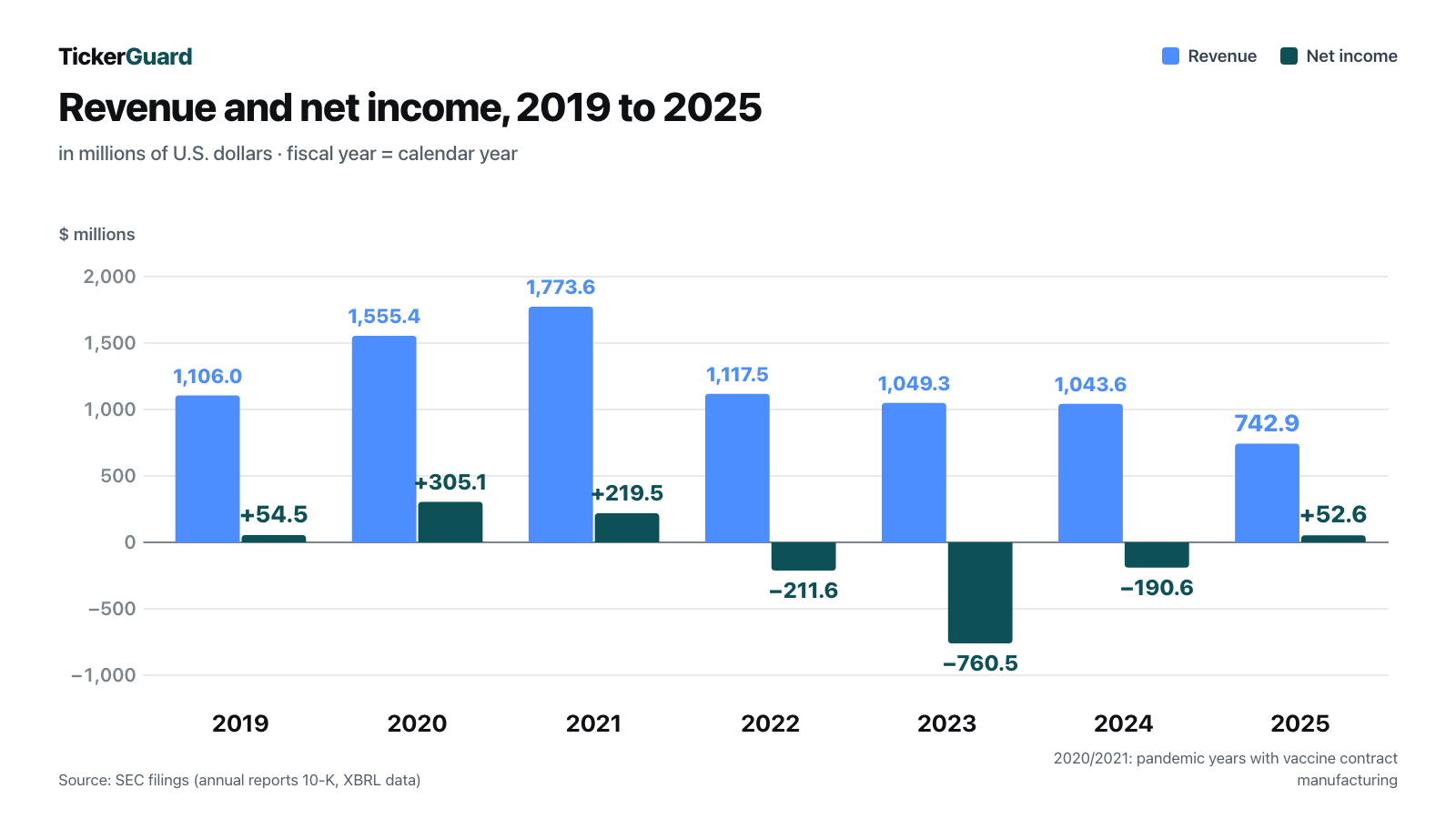
2020 and 2021 were exceptional years: Emergent manufactured large quantities of COVID-19 vaccine for the U.S. government and for pharmaceutical companies (10-K 2025, Item 1A). What followed were shareholder class actions alleging misleading statements about quality controls in vaccine production, a settlement the court finally approved in February 2025 (a settlement is not an admission of wrongdoing), and an exit from contract manufacturing, including the sale of its Baltimore plants. How quickly a pandemic boom fades is something we also saw at Novavax.
And the 2025 profit is less solid than it looks. It included $54.2 million of “other, net” income, including $50.0 million of milestone payments from the 2023 sale of the travel health business to Bavarian Nordic and gains on the sale of the Bayview plant (10-K 2025, Item 7; 10-Q for the second quarter of 2026). That $54.2 million is more than the entire net income for the year. Rule of thumb: proceeds from past divestitures can only be booked once.
Uncomfortable truth No. 1: NARCAN is losing to free competition
For years NARCAN was Emergent’s dependable half. In 2024 the naloxone products still brought in $398.9 million; in 2025 only $226.1 million — down 43 percent in a single year (10-K 2025, Item 7). The decline continued in the first half of 2026, down 16 percent; for the full year the company expects a drop of 20 to 25 percent. The reason is in the risk factors of the annual report, and it is harsher than “pricing pressure”:
“As part of state settlements, including in Florida, Texas, Rhode Island, and West Virginia, Teva has agreed to supply Medication- Assisted Treatment (“MAT”) and generic opioid overdose reversal agents, like naloxone, to states at no cost in lieu of additional monetary compensation. The terms of these product donation agreements stretch 10 to 15 years.”
— Emergent BioSolutions Inc., SEC annual report 10-K for 2025, Item 1A (Risk Factors)

Imagine running a corner store while someone across the street hands out the same drink for free for ten years — because it agreed to do so in a settlement instead of paying more money. No advertising beats “free.” On top of that, according to the conference presentation, come new 4-milligram and 10-milligram naloxone sprays, more aggressive pricing across the sector and, fortunately, falling overdose deaths. In the second quarter of 2026, the NARCAN business kept a gross margin of just 13 percent, down from 32 percent a year earlier.
The consequence is in the quarterly report: Emergent had to cut the book value of its NARCAN rights sharply.
“The Company recognized a non-cash impairment charge of $191.3 million during the three and six months ended June 30, 2026, which was attributed entirely to the NARCAN® finite-lived intangible asset.”
— Emergent BioSolutions Inc., SEC quarterly report 10-Q for the second quarter of 2026, Note 7

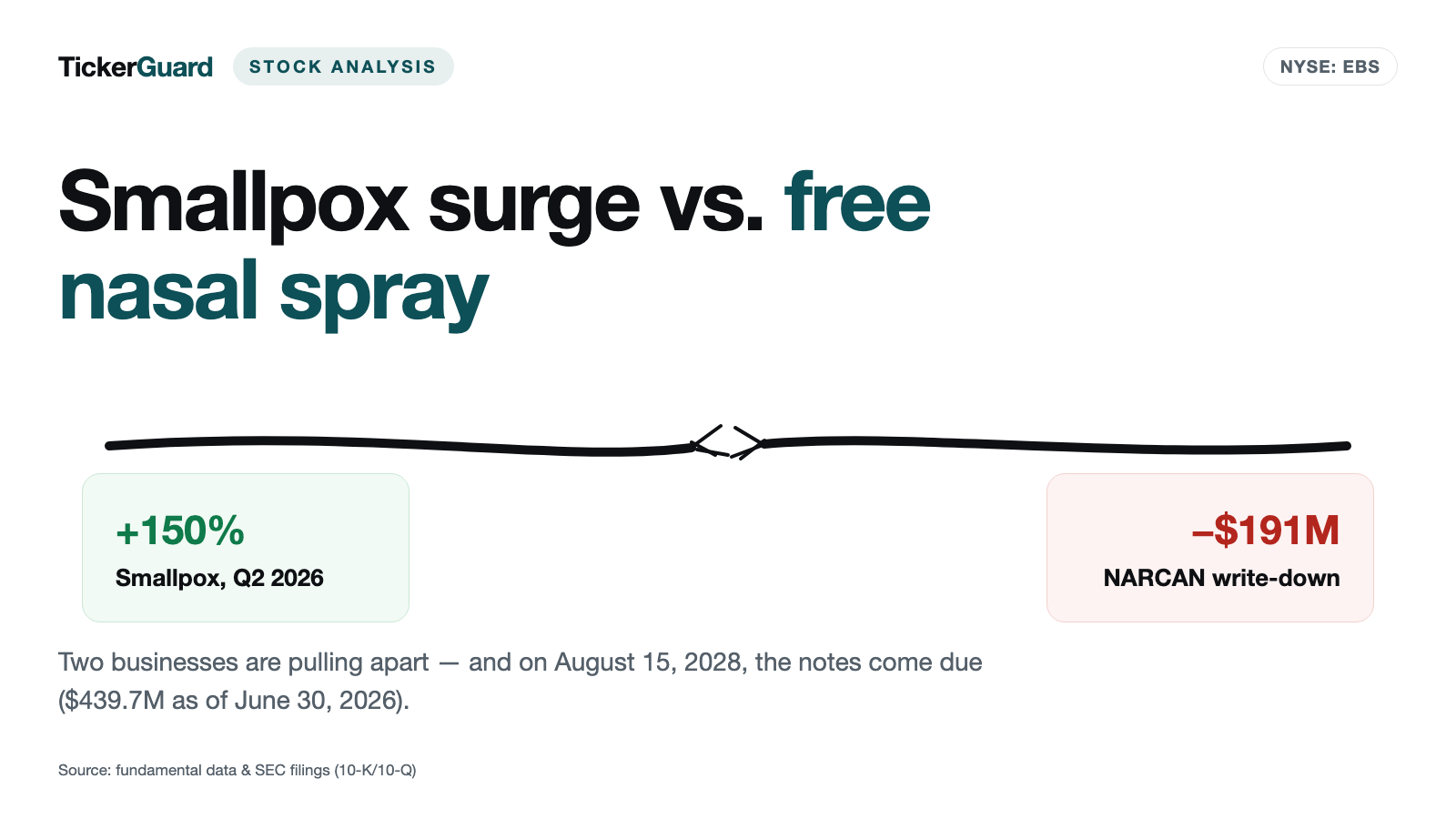
“Non-cash” means no money left the company. The write-down is an admission that NARCAN will bring in far less money in the future than the balance sheet had assumed. After the charge, the NARCAN rights were carried at $81.9 million, and stockholders’ equity fell from $522.6 million at the end of 2025 to $341.4 million on June 30, 2026. CEO Papa put it this way in the earnings release: “we are at a critical juncture in our turnaround and transformation, primarily stemming from our naloxone business.”
Uncomfortable truth No. 2: the strong quarter was pulled forward
$234.3 million in second-quarter 2026 revenue, up 66 percent — that is the headline. Smallpox products alone brought in $101.6 million, 150 percent more than a year earlier; the government business as a whole grew from $58.4 million to $168.0 million. Read on and the same release explains it: the jump was “primarily driven by accelerated MCM/biodefense contract modifications” with the U.S. government. Most of an ACAM2000 delivery worth about $52.7 million had already shipped in June, and a $64.5 million contract modification for the botulism antitoxin BAT came on top. That is real business — but business booked in this quarter instead of later ones. On the same day, the company cut its full-year outlook:
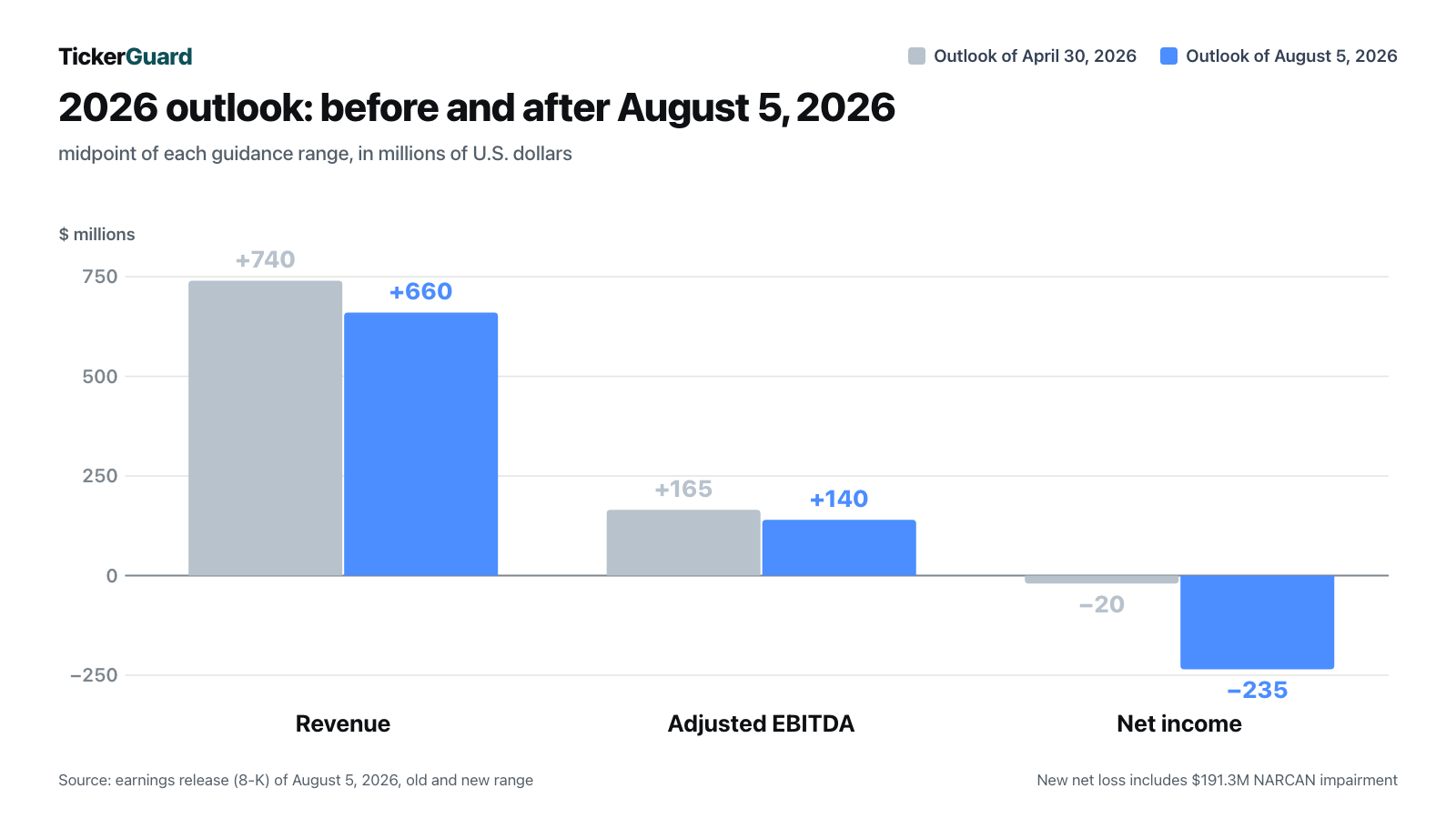
The ranges verbatim: revenue of $645 million to $675 million instead of $720 million to $760 million; net income of minus $245 million to minus $225 million instead of minus $30 million to minus $10 million; adjusted earnings before interest, taxes, depreciation and amortization (adjusted EBITDA) of $130 million to $150 million instead of $155 million to $175 million (earnings release of August 5, 2026). The third-quarter forecast is even clearer: $110 million to $130 million in revenue. In the third quarter of 2025 it was $231.1 million (10-Q of October 30, 2025). That would roughly halve it. Do the math yourself: $390.4 million in the first half plus about $120 million in the third quarter leaves about $135 million to $165 million for the fourth quarter to land inside the full-year range.
A word on “adjusted”: for the second quarter, Emergent reported a net loss of $180.2 million and, at the same time, “adjusted net income” of $30.9 million. Adjusted figures leave out items management considers non-recurring — here mainly the write-down, but also amortization of intangible assets, the loss on debt extinguishment and stock-based compensation. That can be sensible. It also means: the adjusted number shows what would be left if nothing went wrong. Debt gets repaid with the unadjusted one.
Uncomfortable truth No. 3: the debt has a date — August 2028
On June 30, 2026, Emergent had $589.7 million of debt: $150.0 million under a new term loan running to 2031 and $439.7 million of 3.875 percent senior unsecured notes due August 15, 2028 (10-Q, Note 9). Against that stood $139.7 million in cash. According to the conference presentation of September 14, 2026, the company repurchased notes with a principal amount of $75 million in the third quarter, lowering debt on paper to about $515 million. The exact remaining balance and the price paid will only appear in the next quarterly report. The fine print of the new loan, however, turns the bond into a deadline for the whole company:
“The Term Loan will mature on the first to occur (such date, the “Term Loan Maturity Date”) of (i) April 16, 2031, (ii) the date of acceleration of the Term Loan upon the occurrence and during the continuance of an event of default and (iii) the date that is 91 days prior to the scheduled maturity date of the Senior Unsecured Notes, but solely to the extent that on such date, the aggregate principal amount outstanding under the Notes exceeds $75.0 million and the Company does not have Liquidity (as defined in the Term Loan Agreement) in an amount equal to $75.0 million plus the amount necessary to repay in full the Senior Secured Notes.”
— Emergent BioSolutions Inc., SEC quarterly report 10-Q for the second quarter of 2026, Note 9

A side note: at the end of the sentence, the original refers to “Senior Secured Notes,” even though the rest of the paragraph speaks of the unsecured notes (Senior Unsecured Notes) — that is how the quarterly report reads. In plain English: the loan only runs to 2031 if Emergent has largely retired the notes by May 2028 or holds enough cash. According to Note 9, the Wells Fargo revolving credit facility also ends on May 17, 2028, if notes are still outstanding then; its capacity stood at $50 million on June 30, 2026, versus $100 million at the end of 2025. It is like a mortgage where the bank says the term only holds as long as you pay off your car loan first. Starting with the quarter ending September 30, 2026, total leverage may also not exceed 5.25 times a contractually defined earnings measure. On June 30, 2026, Emergent was in compliance with all covenants, and according to the presentation, net debt stood at 1.9 times adjusted EBITDA for the trailing twelve months. Those twelve months, however, include the strong third quarter of 2025 with $231.1 million in revenue — once the weaker third quarter of 2026 replaces it, the ratio rises. Rule of thumb: the question is not whether Emergent can pay today, but whether enough cash is left in 2027 to deal with the bond in 2028.
Uncomfortable truth No. 4: five cost-cutting programs in four years
On August 5, 2026, Emergent announced a new restructuring plan. The current report says:
“These strategic actions will lead to a reduction of the Company’s current workforce by approximately 93 employees across all areas of the Company and the elimination of approximately 21 positions that are currently vacant, as well as the closure of wet laboratories in Gaithersburg, Maryland.”
— Emergent BioSolutions Inc., Form 8-K of August 5, 2026, Item 2.05
The company expects charges of $10 million to $11.5 million and annualized savings of about $40 million. On its own, that would be unremarkable. The pattern is what stands out: the 2025 annual report lists four earlier plans — about 125 positions in January 2023, about 400 in August 2023, about 300 in May 2024 and about 70 in August 2024. With the new plan, that makes five rounds since January 2023 and about 990 employee positions cut in total — not counting the vacant roles eliminated on top — more than the roughly 900 people who still worked at Emergent at the end of 2025. At the same time, the role of chief medical officer and head of research and development is eliminated; R&D, business development and strategy are folded into a new “Growth” organization.
Cutting costs is no shame, and the company is leaner today than in 2022. But each round was, according to the company, meant to cut costs or strengthen its financial position, and each was overtaken by the next. Rule of thumb: a turnaround that starts over every year is not a turnaround, it is a condition. And research that gets cut is missing later, when the products that are supposed to replace NARCAN need to exist.
Valuation: about $371 million market value as of October 5, 2026
At the October 5, 2026, close of $7.24 and 51.27 million shares (10-Q cover page, as of July 30, 2026), Emergent was worth about $371 million. Add net debt as of June 30, 2026 ($450.0 million), and the whole company costs about $821 million (our calculation). The market value equals about 0.5 times trailing twelve-month revenue ($770.2 million); the enterprise value equals about 1.1 times that revenue and about 5.9 times the adjusted EBITDA the company expects for 2026 (range midpoint: $140 million). For a profitable company, that would be little. Stockholders’ equity stood at $341.4 million on June 30, 2026, or about $6.66 per share — the stock trades slightly above that. A meaningful price-to-earnings ratio does not exist because of the loss.
Cheap here means: the market is pricing in a shrinking business and hard years until 2028. The three analysts covering the stock, according to fundamental data, disagree — two rate it a buy, one a sell, and the average price target is $11 (as of October 6, 2026). With three voices, that is not a consensus but a sample. Two things can shift the math: the company bought back about $18 million of its own stock in the first half of 2026, and the share count fell from 52.1 million to 51.3 million. And former lenders hold warrants on 2.5 million shares at $9.88 and $15.72, exercisable until August 30, 2029 (10-K 2025) — they would only dilute shareholders at clearly higher prices.
Upside and risks at a glance
What speaks for Emergent BioSolutions:
- A government business with few competitors: smallpox, anthrax and botulism countermeasures that governments have to stockpile; in the first half of 2026 this revenue rose 25 percent to $269.8 million, about 20 percent of it international.
- New orders after the quarter: a contract modification worth about $24 million for the anthrax vaccine CYFENDUS (Form 8-K of September 1, 2026).
- Debt is coming down: from $700.0 million (June 30, 2025) to $589.7 million (June 30, 2026), followed by $75 million of note repurchases; operating cash flow of $170.6 million in 2025.
- Low valuation: market value about 0.5 times revenue and slightly above book value; about $40 million in annual savings announced from the new restructuring plan.
What speaks against it:
- NARCAN is shrinking against free competition: 2025 revenue down 43 percent, a $191.3 million write-down in the second quarter of 2026, a segment gross margin of 13 percent.
- Dependence on the U.S. government’s ordering calendar (46 percent of 2025 revenue and rising); the strong second quarter was pulled forward, and only $110 million to $130 million in revenue is guided for the third quarter of 2026.
- Notes of $439.7 million (June 30, 2026) due in August 2028, with the new term loan’s maturity tied to them; a leverage covenant from the third quarter of 2026.
- Five restructuring plans since January 2023, the head of R&D is leaving, equity down from $522.6 million to $341.4 million; much of the 2025 profit came from one-time gains on earlier divestitures (milestones, Bayview plant).
A human conclusion
Back to the availability trap. The images Emergent brings to investors — Ebola in the Congo, AI bioweapons, intelligence reports — are real and easy to recall. They explain why governments stockpile smallpox and anthrax vaccines. They do not explain why NARCAN is losing to a free product, why the second quarter’s momentum is already missing in the third, or who pays off the bond in August 2028. The company is not a bankruptcy case: it has positive equity, earns good money in the government business, is paying down debt and meets its loan covenants. But it is a bet that the government business grows faster than NARCAN shrinks, and that enough cash comes together by 2028. So don’t ask how dangerous the world is. Ask whether Emergent earns enough by May 2028 to retire the 2028 notes. The next chance to check is the quarterly report for the third quarter of 2026: it shows revenue against the $110 million to $130 million range, the remaining note balance after the buyback and the first test of the leverage covenant. What you do with that is your decision. And that is how it should be.
Sources
All original documents used in this analysis — so you can read them yourself:
- Emergent BioSolutions Inc. — Quarterly report on Form 10-Q for the second quarter of 2026 (August 6, 2026; latest periodic report: NARCAN impairment, debt and loan terms, restructuring, liquidity, share count)
- Emergent BioSolutions Inc. — Form 8-K of August 5, 2026 (restructuring plan, departure of the head of R&D) with the second-quarter 2026 earnings release (Exhibit 99.1): quarterly results, segments, lowered outlook
- Emergent BioSolutions Inc. — Annual report on Form 10-K for 2025 (February 27, 2026): business description, employees, risk factors (generics, Teva), annual results, U.S. government revenue share, restructuring plans, warrants
- Emergent BioSolutions Inc. — Annual report on Form 10-K for 2024 (March 4, 2025) and quarterly report on Form 10-Q for the third quarter of 2025 (October 30, 2025)
- Emergent BioSolutions Inc. — Forms 8-K of September 1, 2026 (CYFENDUS order) and September 14, 2026 (conference presentation: note repurchase, naloxone market, AI slide)
- Form 4 insider filing of October 5, 2026, and Schedule 13G of August 14, 2026, available via the SEC’s EDGAR database
- Revenue and net income 2019 to 2025: SEC XBRL data from the annual reports. Closing prices and trading volume through October 5, 2026 (price anchor $7.24), analyst ratings and price target: source: fundamental data. Market value, enterprise value and valuation multiples are our own calculations.
Transparency & disclaimer: This analysis is a journalistic assessment of publicly available information and is not investment advice, not a financial analysis in the regulatory sense and not a solicitation to buy or sell securities. Investing in stocks involves substantial risk, up to and including the total loss of your investment. All information without guarantee; data dates are noted in the text. Positions held by the operator are disclosed daily; where one exists, it appears as a notice at the top of this deep dive.
Key figures at a glance
All monetary figures in millions of $; earnings per share as reported.
| Metric | 2021 | 2022 | 2023 | 2024 | 2025 |
|---|---|---|---|---|---|
| Revenue | 1,773.6 | 1,117.5 | 1,049.3 | 1,043.6 | 742.9 |
| Operating Income (EBIT) | 341.4 | -170.0 | -726.4 | -108.7 | 110.2 |
| Net Income | 219.5 | -211.6 | -760.5 | -190.6 | 52.6 |
| Net Margin | 12.4% | -18.9% | -72.5% | -18.3% | 7.1% |
| Earnings Per Share | 4.06 $ | -4.22 $ | -14.85 $ | -3.60 $ | 0.93 $ |
Source: fundamental data & SEC filings (annual and quarterly reports, 10-K/10-Q)
Our Bottom Line at a Glance
- Government business (MCM) positive
- Smallpox, anthrax and botulism countermeasures with few competitors; first-half 2026 revenue up 25% to $269.8M, $168.0M in the second quarter; new CYFENDUS order worth about $24M (09/01/2026).
- NARCAN negative
- 2025 revenue down 43% to $226.1M, second-quarter 2026 gross margin 13% (prior year 32%), $191.3M write-down; Teva gives naloxone to states for free for 10 to 15 years.
- Earnings quality negative
- Much of the 2025 profit ($52.6M) came from milestone payments ($50.0M) and the Bayview plant sale; the strong Q2 2026 included pulled-forward government orders, and Q3 2026 revenue is guided at $110–130M (prior year $231.1M).
- Balance sheet and debt neutral
- Debt cut from $700.0M to $589.7M (06/30/2025 to 06/30/2026), another $75M of notes repurchased in Q3; but the notes are due in August 2028 and tied to the term loan’s maturity, with a leverage covenant from Q3 2026.
- Valuation neutral
- About $371M market value (about 0.5x revenue) and about $821M enterprise value (about 5.9x guided adjusted EBITDA) as of 10/05/2026, slightly above book value of $6.66 per share.
Emergent BioSolutions consists of two businesses heading in opposite directions: vaccines and countermeasures for governments are growing, while the NARCAN nasal spray is shrinking under free competition and cost a $191.3 million write-down in the second quarter of 2026. The 2026 outlook was cut, the third quarter is guided at half of last year’s revenue, and the notes, most recently $439.7 million, come due in August 2028. Not investment advice.
What Our Rating Means
Open questions
The business works in principle, but one material question is open. As long as it stays open, our findings do not carry a quality verdict.
Yellow, because a material operating question is open: whether the government business can make up for NARCAN’s decline is unproven — results hinge on the irregular orders of a single government, and much of the 2025 profit came from one-time items. We considered red and rejected it: stockholders’ equity is positive ($341.4 million on June 30, 2026), operating cash flow was positive in 2025 and in the first half of 2026, the loan covenants were met, and 2026 interest expense of about $40 million (an assumption in the August 5, 2026, outlook) is covered by the expected adjusted EBITDA of $130 million to $150 million — although after capital spending of about $17 million and taxes, the cushion is considerably thinner. The 2028 notes are the test: if the government business stays weak and NARCAN keeps falling, the open question becomes a threat to the company itself. Whether $7.24 per share (October 5, 2026) is a reasonable price for these uncertainties is not what this rating answers. The decision is yours.
A journalistic assessment by our editorial team at the time of the deep dive, based on public sources — not investment advice and not a solicitation to buy or sell. Your personal circumstances (investment goals, risk capacity, taxes) cannot be taken into account. What our levels mean, how verdicts are formed, and what conflicts of interest exist →
Worth Noting
- Edition of October 6, 2026, based on the quarterly report on Form 10-Q of August 6, 2026 (latest periodic report), the earnings release and the restructuring Form 8-K of August 5, 2026, the annual reports on Form 10-K for 2025 and 2024, the 10-Q for the third quarter of 2025 and all filings through October 5, 2026 (Forms 8-K of September 1 and 14, 2026, Schedule 13G, Form 3, Form 144, Form 4). The trigger was our in-house Reddit hype scanner in early October 2026.
- Revenue and net income 2019 to 2025 from SEC XBRL data; the $75 million note repurchase in the third quarter of 2026 comes from the conference presentation of September 14, 2026 (Form 8-K, Exhibit 99.1); the remaining balance and the price paid will only be reported in the next quarterly report.
- The price anchor is the October 5, 2026, close of $7.24 (source: fundamental data). Market value is our own calculation (51.27 million shares × $7.24); cross-checked against the sale price in the Form 4 filing of October 5, 2026 (sale on October 1, 2026, at an average of $6.53). Enterprise value = market value plus net debt as of June 30, 2026 ($450.0 million), our calculation.
Stock Watch
This analysis is as of October 6, 2026. Stock Watch will tell you what's changed at EBS since then.
Later $1 a month per stock — signing up is free, and you'll be the first to know when it launches.
The full analysis as a PDF for later
We will send you this analysis as a PDF — to print, file away, and read at your own pace. And we will add you to the free Stock Watch list for Emergent Biosolutions Inc (EBS), so you hear about it when something material in this analysis changes.
Frequently Asked Questions
Emergent BioSolutions, based in Gaithersburg, Maryland, makes vaccines and drugs against biothreats and outbreak pathogens such as smallpox, anthrax and botulism, which mainly the U.S. government stockpiles. It also sells the NARCAN naloxone nasal spray for opioid overdoses. In 2025 revenue was $742.9 million, and about 900 people worked for the company.
Because NARCAN is bringing in far less money than expected. Generics from Teva, Padagis and Amneal, free supplies from Teva to several states and new competing products are pushing down prices and volumes. In the second quarter of 2026, Emergent tested the value of its NARCAN rights and cut it by $191.3 million to $81.9 million. No cash left the company.
On June 30, 2026, Emergent had $589.7 million of debt: $150 million under a term loan running to 2031 and $439.7 million of 3.875 percent notes due August 15, 2028. Cash stood at $139.7 million. According to its September 2026 presentation, the company repurchased $75 million of the notes in the third quarter of 2026.
On August 5, 2026, Emergent cut its revenue outlook from $720 million to $760 million to $645 million to $675 million, mainly because of the shrinking NARCAN business, where it expects revenue to fall 20 to 25 percent. Government orders had also been pulled into the second quarter. For the third quarter of 2026, the company expects only $110 million to $130 million in revenue.
Little so far. In its August 5, 2026, earnings release, the company says it seeks to collaborate with AI partners on bioterrorism preparedness; no contract or revenue has been reported. In its 2025 annual report, Emergent calls its own use of AI limited and in early stages. Our AI classification is therefore “neutral.”
At the October 5, 2026, close of $7.24 and 51.27 million shares, Emergent was worth about $371 million. Including net debt of $450 million (June 30, 2026), the whole company costs about $821 million, or about 5.9 times the adjusted EBITDA it expects for 2026.
Found an error?
Did you spot a factual error, an outdated number, or a typo in this deep dive? Let us know briefly — your report goes straight to the editorial team.