Alector: Five Drug Candidates Halted, $100 Million From Genentech — and a Market Value the Size of Its Cash
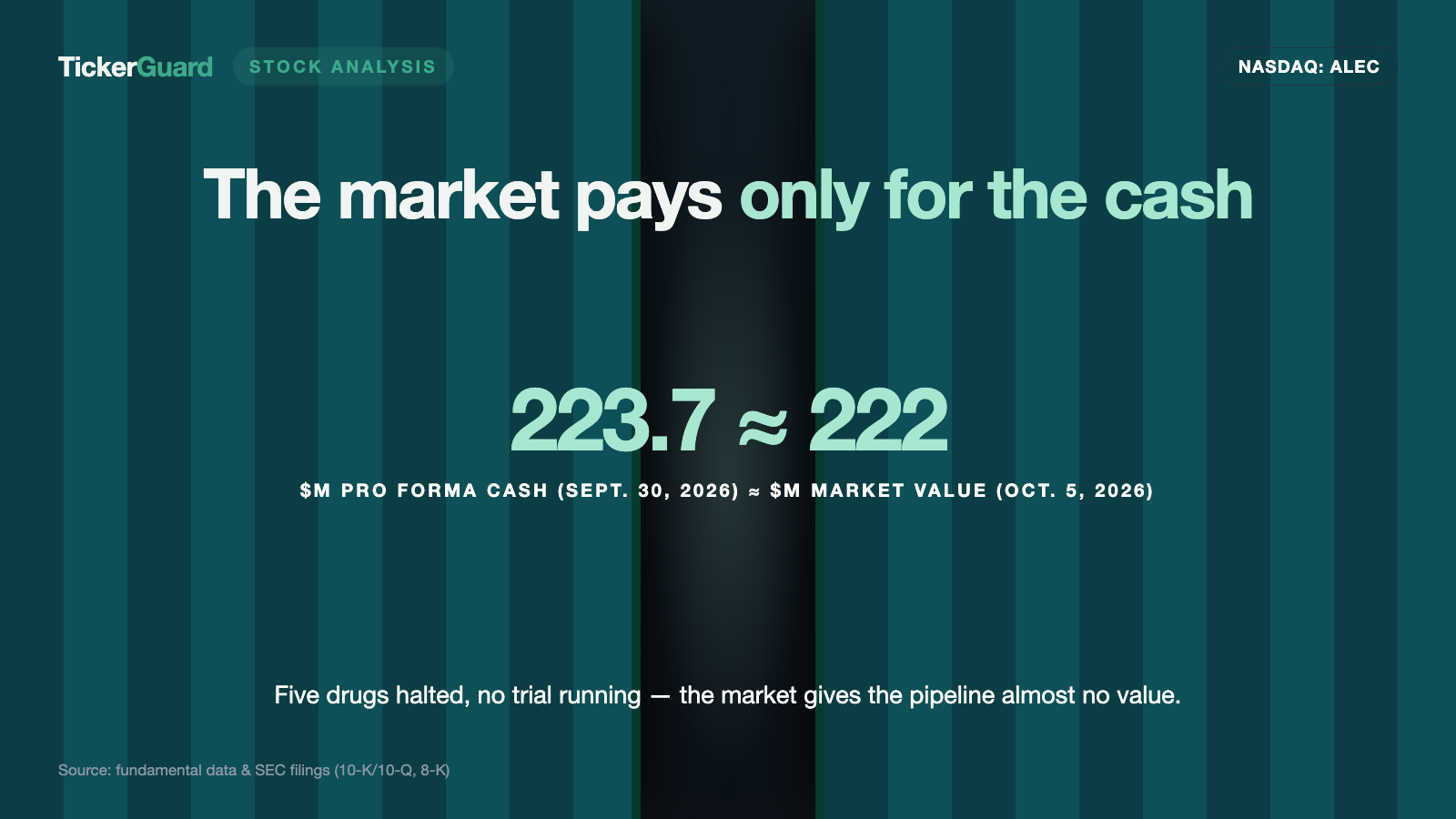
Alector set out to slow Alzheimer's and dementia with antibodies. After five drug candidates were halted, not a single clinical trial is running, and GSK has terminated the big collaboration. Then came the October 5, 2026 announcement now making the rounds on Reddit: Genentech pays $100 million upfront for a Parkinson's enzyme, with up to $1.17 billion in potential milestones. Pro forma, that puts $223.7 million in the bank — and the market value that same day was about $222 million. We read the filings to see how much of the billion-dollar headline actually reaches shareholders and what the market is really paying for. Strip out the cash, and what is left is a bet on a technology no human has tested yet.
 Thomas Mücke
Founder & Publisher
Thomas Mücke
Founder & Publisher
As of Today
As of: October 6, 2026
- Closing price
- 1.80 $ -9.00%
- Market Capitalisation
- 0.2 $B
- Growth Score
- 3/10
- AAQS
- 4/10
Price change since October 5, 2026: -9.5%
This analysis has a cut-off date. The Stock Guard tells you when something material changes in the numbers. Reserve your free spot
Chart
Interactive price chart (TradingView).
52-week range: 1.10 $ to 3.30 $ · Last price: 1.80 $ (As of: October 6, 2026)
Note: pure fact-based analysis, not investment advice and not a solicitation to buy or sell. All figures without guarantee.
There is an investor weakness that starts with a single number: the headline trap. A company announces a deal "worth up to $1.17 billion," and the number locks into your head like an anchor. Everything that follows — the conditions, the deductions, the odds — gets measured against that billion instead of against the fine print. At Alector a second anchor weighs just as heavily: the stock closed at $39.49 in July 2021 and at $1.99 on October 5, 2026. "Down 95 percent from the high, plus a billion-dollar deal — it has to be cheap," the trap whispers.
Let's make a deal: we set both anchors aside for a moment and read what Alector itself has reported to the U.S. securities regulator, the SEC — the annual report (10-K) for 2025, the quarterly reports (10-Q) for March 31 and June 30, 2026, and the current report (8-K) of October 5, 2026 on the Genentech agreement. False statements in an SEC filing carry penalties — which makes it the most reliable source we have. And it answers the question that really matters here: how much of the headline reaches you — and what is the market paying for when it values the company at roughly the size of its cash?
What Alector actually does — a brain ferry that has never carried a human
Alector, Inc. is based in South San Francisco, began operations in 2013 and had 103 full-time employees as of December 31, 2025; the cut of roughly 47 percent of the workforce decided in October 2025 was completed in the first half of 2026, according to the quarterly report. The company develops drugs for diseases in which nerve cells in the brain die — Alzheimer's, Parkinson's, frontotemporal dementia. It sells nothing: there is no approved product and no product revenue.
The heart of today's strategy is the Alector Brain Carrier (ABC). Picture it this way: the brain is a fortress with a very strict doorman, the blood-brain barrier. Large molecules such as antibodies barely get in. ABC is a kind of ferry that docks onto a transport receptor (the transferrin receptor) and is meant to carry its cargo — antibodies, enzymes or gene silencers (siRNA) — through the barrier. The most important wholly owned program is AL137, an antibody against amyloid plaques in Alzheimer's that is designed to be injected under the skin. Alector is targeting an application for its first human trial in the first quarter of 2027 and first dosing in Australia "no later than April 2027." Behind it are a tau siRNA program (AL164) in IND-enabling studies and early-stage siRNA projects. How tough the market for Alzheimer's antibodies is, we worked through using Biogen and LEQEMBI.
That names the central tension of this analysis: the market values Alector at roughly its cash. The question is whether the ferry proves it works before the cash runs out — or whether in the end you have simply bought a shrinking pile of money.
Company history for investors
-
2017
Collaboration with AbbVie
In October 2017 Alector signs its first major partnership. For shareholders it meant a drugmaker co-funded the research — until the termination in February 2025.
-
2021
$700 million upfront from GSK
GSK pays $500 million in August 2021 and $200 million in January 2022 for the progranulin antibodies. The stock closed at $39.49 in July 2021, its high to date.
-
2024
AL002 misses its trial goal
The Phase 2 INVOKE-2 trial fails in November 2024; AbbVie then ends the collaboration. A potential $250 million payment for the program fell away with it.
-
2025
Phase 3 with latozinemab fails
In October 2025 INFRONT-3 misses its primary endpoint; Alector cuts about 47 percent of its jobs. The closing price halved within a day, from $3.21 to $1.61.
-
2026
GSK exits, Genentech arrives
After nivisnebart is stopped (April), GSK terminates effective Jan. 2, 2027; on Sept. 30, 2026 Genentech licenses AL050 for $100 million upfront. Pro forma cash rises to $223.7 million.
How the stock landed on our desk
No metrics screen flagged Alector; other investors' attention did. Our in-house Reddit hype scanner counted 7 mentions in 24 hours (ApeWisdom, as of October 6, 2026); the day before, the ticker was not on the leaderboard at all. The trigger is easy to find: on October 5, 2026 Alector announced the Genentech agreement. According to fundamental data, about 90 million shares changed hands that day — on ordinary days in late September 2026 it was roughly one million. The closing price rose from $1.81 (October 2, 2026) to $1.99.
What stands out is not the jump but its size. After the payment to Spur, Alector nets $85 million; yet market value rose only from about $202 million (111.66 million shares at $1.81) to about $222 million, an increase of roughly $20 million. Our reading: the market expects much of the new money to be spent on research before it creates any value. The forums read the headline; the stock price reads the cash. Why is spelled out in the filings. Keep this line in mind: volume is not a valuation.
The numbers over the years — given their due
First, what deserves respect. Alector twice pulled off what most young biotechs never manage: convincing big pharma of its research. AbbVie came in 2017, GSK in 2021 — GSK alone paid $700 million upfront ($500 million in August 2021, $200 million in January 2022). That money fed the revenue of recent years: $207.1 million in 2021, $133.6 million in 2022, $97.1 million in 2023, $100.6 million in 2024. And even now, after every setback, Genentech has put $100 million upfront on the table for a program from the same lab. The research clearly has a reputation.
The catch: this revenue is partner money, not product sales. It arrives in bursts, and in no single year has it covered the costs.
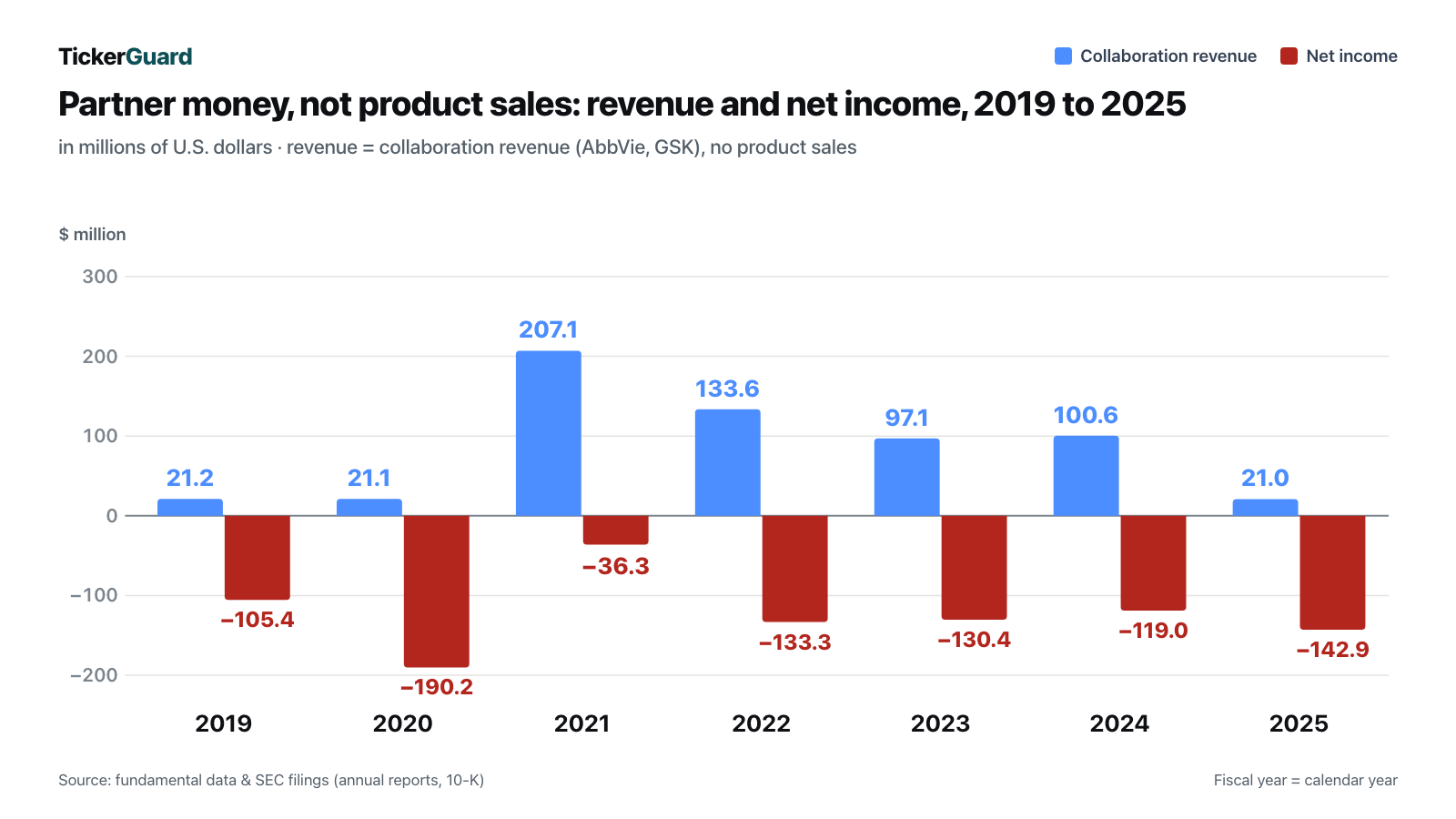
The losses year by year: $105.4 million (2019), $190.2 million (2020), $36.3 million (2021), $133.3 million (2022), $130.4 million (2023), $119.0 million (2024) and $142.9 million (2025); revenue was $21.2 million in 2019 and $21.1 million in 2020. In 2025 revenue collapsed to $21.0 million while the loss widened to $142.9 million. In the first half of 2026, $4.4 million of revenue faced a $45.9 million loss; the second quarter alone brought $3.3 million in revenue and a $23.0 million loss. Costs did come down sharply — research and development expense in the second quarter of 2026 was $19.5 million, against $27.6 million a year earlier. All told, Alector has built up an accumulated deficit of $1,018.0 million (as of June 30, 2026). And this is the cash pile that pays for all of it:
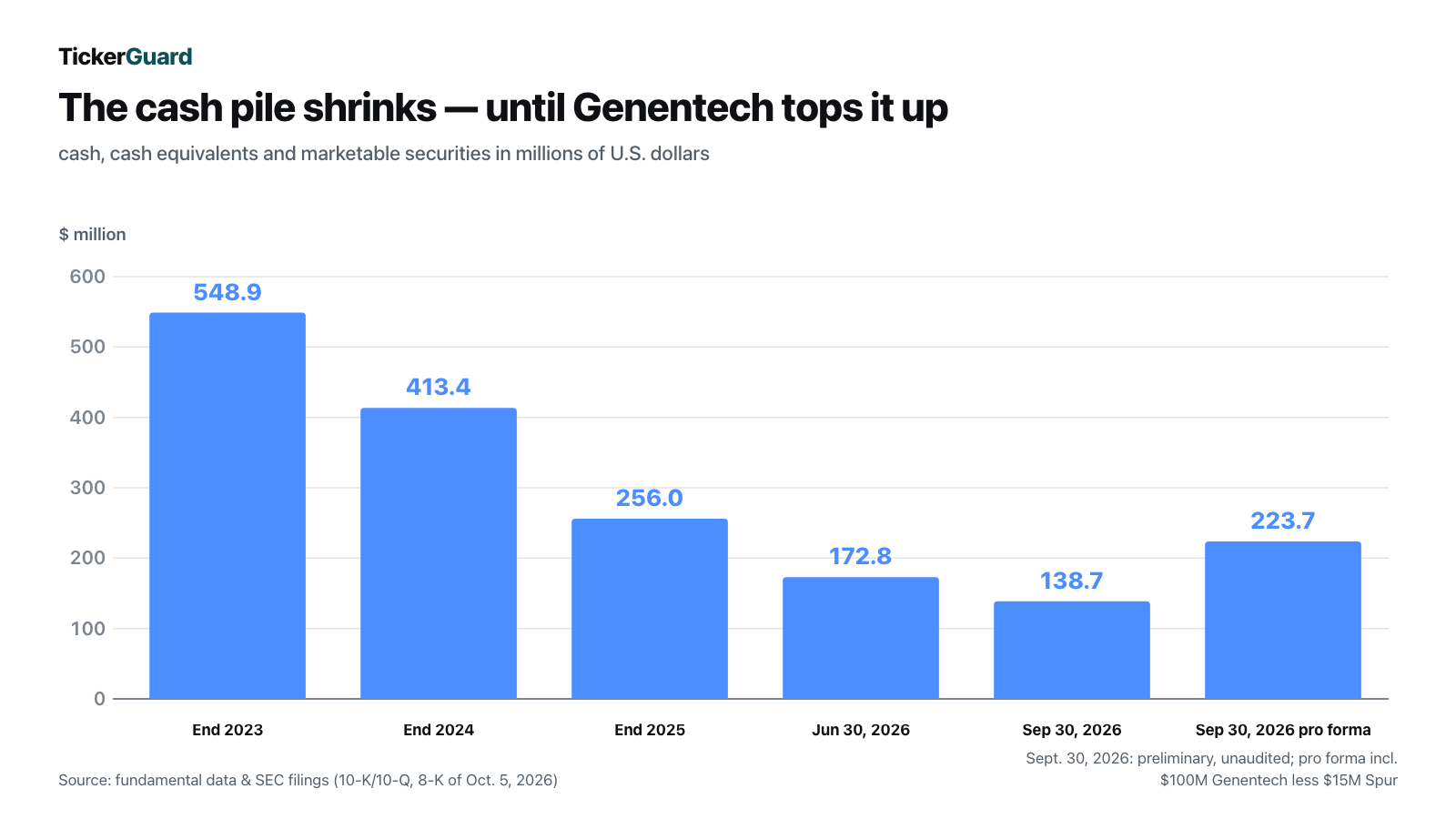
The stops in between: $413.4 million at the end of 2024, $256.0 million at the end of 2025, $172.8 million on June 30, 2026. Between June 30 and September 30, 2026 the cash pile fell by $34.1 million; that figure, however, includes the early repayment of the $10.4 million Hercules loan on July 8, 2026. Since then Alector has had no financial debt. Keep the picture in mind: for years the company has lived off a reserve that only partners refill.
What the filings say — the uncomfortable truths
Uncomfortable truth No. 1: five candidates halted — and today not a single trial is running
The 2025 annual report sums up the clinical history in one sentence:
"To date, clinical development of four of our product candidates has been terminated."
— Alector, Inc., SEC annual report 10-K for 2025, Item 1A "Risk Factors"
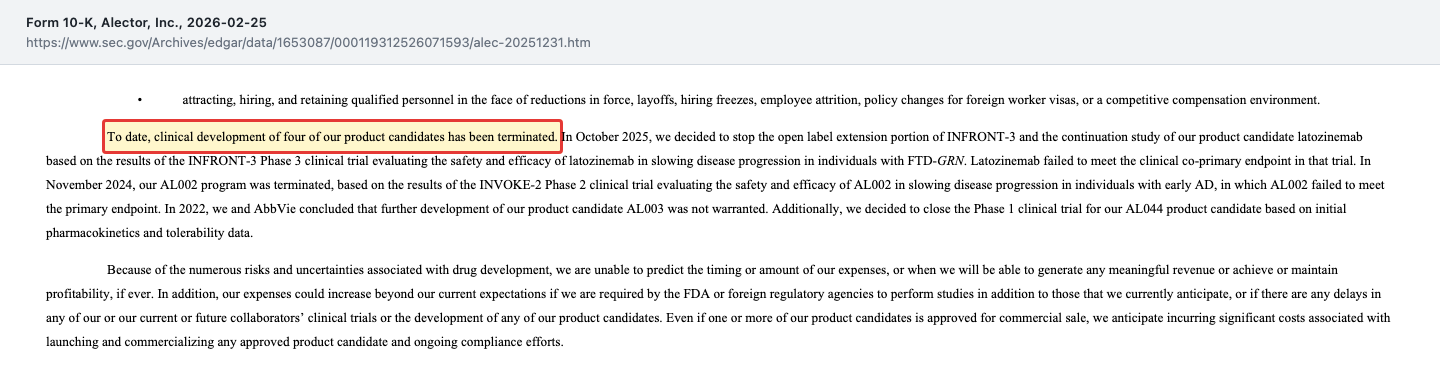
The list has grown since that report. In April 2026 GSK stopped the Phase 2 PROGRESS-AD trial of nivisnebart after an interim analysis, because an independent committee no longer expected success — candidate number five. On July 6, 2026 GSK terminated the entire collaboration agreement, effective January 2, 2027. The quarterly report for June 30, 2026 draws the sober conclusion:
"We currently have no active clinical trials."
— Alector, Inc., SEC quarterly report 10-Q for June 30, 2026, Item 1A "Risk Factors"
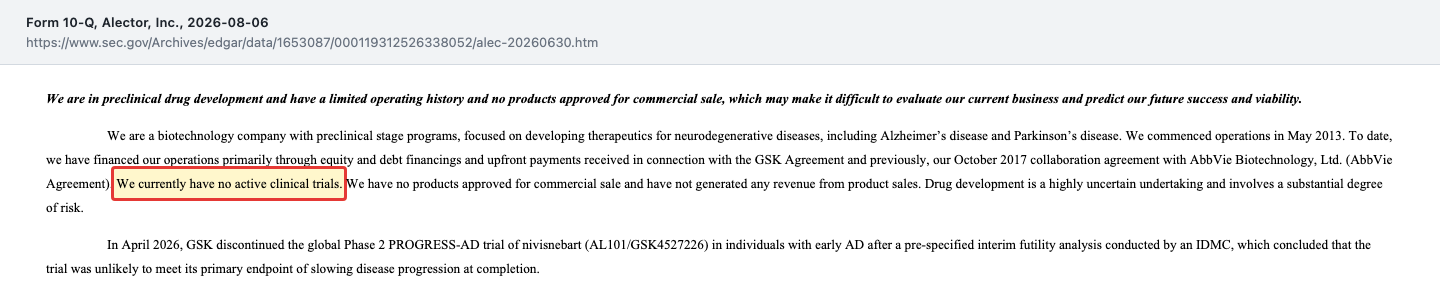
Picture it this way: you are buying into a shipyard whose last five ships were all pulled from service before their maiden voyage — and the next one is still a blueprint in a drawer. That does not mean the next ship will sink. The new programs rely on different mechanisms than the failed ones. But it does mean the yard cannot show you anything today that has ever floated. The earliest new human data will come with the first dose of AL137, which Alector plans for no later than April 2027.
Uncomfortable truth No. 2: a fixed share of the billion-dollar headline goes to a third party
The good news is spelled out in black and white in the October 5, 2026 8-K:
"Alector will receive a $100 million upfront payment from Genentech under the Genentech License Agreement."
— Alector, Inc., SEC current report 8-K of October 5, 2026, Item 1.01
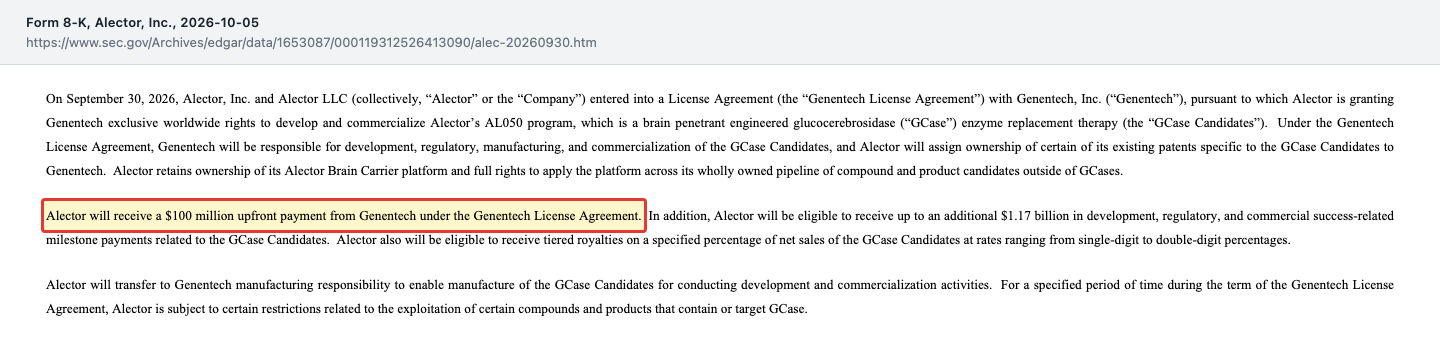
The $1.17 billion, however, is not a balance in the bank but a ladder with many rungs: payments for development, regulatory and sales successes of a program that has never been tested in a human. According to the 8-K, Genentech may terminate the agreement "for convenience" at any time, without giving a reason. And then there is a name that does not appear in the press release: Spur Therapeutics. Alector licensed patents on the engineered enzyme from that company — and Spur earns on every step:
"Following the exercise of the option under the Spur Agreement and receipt of the upfront payment related to the Genentech License Agreement, Alector will pay Spur $15 million under the Spur Agreement plus a percentage in the teens of any milestone and other non-royalty partnering income that Alector receives with respect to a sublicense of the Spur Patents, which includes any milestone payments to be received under the Genentech License Agreement."
— Alector, Inc., SEC current report 8-K of October 5, 2026, Item 1.01
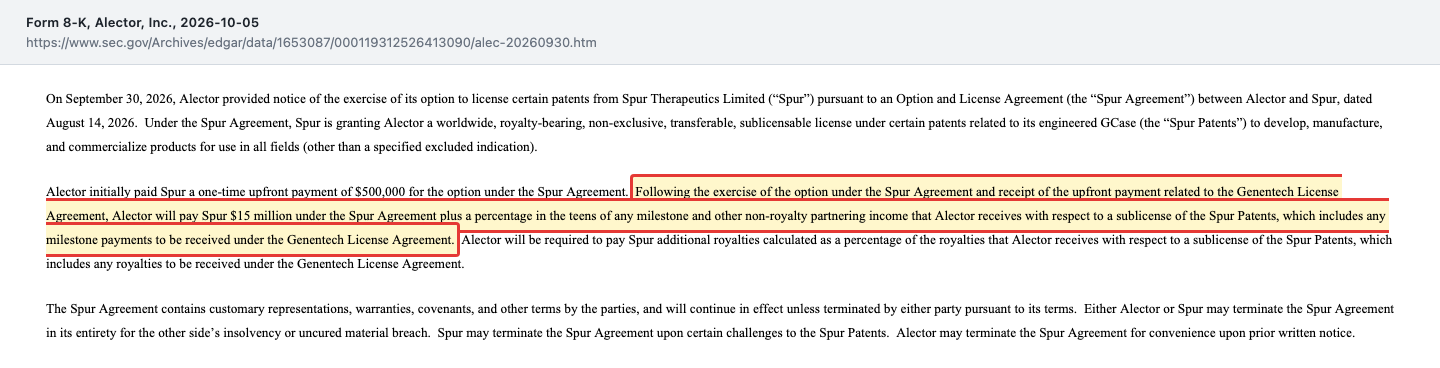
Let's do the rough math. Of the $100 million upfront, $85 million remains after the $15 million to Spur — exactly the gap between $138.7 million and $223.7 million in pro forma cash. Of every future milestone dollar, 13 to 19 cents go to Spur; Alector does not disclose the exact rate. So even in the unlikely case that every single rung is reached, Alector would not receive $1.17 billion but, by our arithmetic, roughly $0.95 billion to $1.02 billion — spread over many years. Keep this line in mind: a headline names the ceiling; the fine print names the deduction.
Uncomfortable truth No. 3: equity is negative — and for once that is not an alarm bell
Open the balance sheet for June 30, 2026 and you trip over a line that normally flashes red: stockholders' equity stood at minus $10.0 million (minus $9.97 million), down from plus $30.6 million at the end of 2025. Negative equity normally means debts exceed assets. At Alector that is true only on paper. The largest item among the liabilities is not a loan but an accounting entry:
"The deferred revenue related to the GSK Agreement was $162.9 million and $171.2 million as of June 30, 2026 and December 31, 2025, respectively."
— Alector, Inc., SEC quarterly report 10-Q for June 30, 2026, Note 5 "Collaboration Agreement with GSK"
Deferred revenue is money GSK wired long ago that Alector may only book as revenue bit by bit. Alector does not have to repay any of it; according to the same note, the refund liability to GSK stood at zero as of June 30, 2026. Without these $162.9 million, equity would be clearly positive. The catch lies elsewhere: when the GSK agreement ends on January 2, 2027, a large part of that sum is likely to move into the income statement as revenue — a book gain without a single dollar of cash. Our reading: anyone who then sees a suddenly "profitable" Alector is reading an accounting entry, not a business. Keep the picture in mind: here the balance sheet looks worse than the cash — and the income statement will soon look better than the business.
Uncomfortable truth No. 4: a share-sale program worth more than half the company
On May 7, 2026 Alector signed a new agreement with TD Cowen to sell new shares into the market on an ongoing basis, a so-called at-the-market program. Put simply, the company can sell new shares on the exchange on an ongoing basis to raise money; the sales are disclosed in the following quarterly report. The quarterly report describes the size:
"On May 7, 2026, the Company entered into an at-the-market sales agreement with TD Cowen, pursuant to which the Company may offer and sell from time to time through TD Cowen up to $125,000,000 of shares of its common stock …"
— Alector, Inc., SEC quarterly report 10-Q for June 30, 2026, Note 1 "The Company and Liquidity"
As of June 30, 2026 Alector had not sold a single share under the program — that deserves to be said. But the scale matters: at the October 5, 2026 closing price of $1.99, $125 million would correspond to roughly 63 million new shares, more than half of the 111.66 million outstanding at the end of July 2026. On top of that come 12.7 million shares from options and employee equity that the quarterly report lists as potentially dilutive, and a universal shelf registration (Form S-3) for up to $400 million. The everyday picture: your slice of the cake gets smaller when someone keeps cutting new slices — even if the cake itself stays the same size. For the announced runway into 2029, Alector does not need the program under its own plan. Whether it gets used anyway, each quarterly report will show.
Valuation: the market is paying roughly for the cash
Alector has no price-to-earnings ratio, and a price-to-sales ratio would be meaningless on $21.0 million of partner money in 2025. The most honest yardstick is cash. At the October 5, 2026 closing price of $1.99 and 111.66 million shares, market value was about $222 million. Pro forma cash was $223.7 million — about $2.00 per share. Financial debt has been zero since July 2026. Keep this threshold in mind: whenever the stock trades below about $2.00, the market values Alector at less than its pro forma cash.
Put differently: the market values the ABC platform, AL137, the siRNA programs and all future Genentech milestones together at roughly zero. That sounds like a bargain, but only if the cash pile stops shrinking. It will shrink: operating activities used $84.0 million in the first half of 2026, although that includes paying down liabilities to GSK and from trial wind-downs; the company itself expects its runway to last "into 2029." A rough cross-check confirms the order of magnitude: in the third quarter of 2026 cash fell by $34.1 million, or roughly $24 million excluding the $10.4 million Hercules loan repayment. At about $24 million per quarter, $223.7 million would last a little over nine quarters — roughly until early 2029. By this arithmetic, about $175 million would be left at the planned first AL137 dose in April 2027, or about $1.57 per share. That is our back-of-the-envelope estimate, not company guidance; trial costs could raise the burn. Anyone buying today is buying a cash pile meant to be used up by 2029 — and an option that study data or further partnerships along the way will be worth more than the money spent.
The professionals are split: according to fundamental data (as of October 6, 2026), there are 3 buy, 2 hold and 2 sell ratings; the average price target is $3.10. Whether those targets already include the Genentech agreement is not visible. The ratings are third-party information for context, not a price target of ours.
Upside and risks at a glance
What speaks for Alector:
- Market value roughly equals cash: about $222 million in market value (October 5, 2026) against $223.7 million in pro forma cash, with no financial debt since July 8, 2026.
- Runway into 2029 per the company — no pressure to raise capital in the coming quarters.
- Outside validation of the platform: Genentech pays $100 million upfront for an ABC program; Alector keeps the ABC rights for all wholly owned programs outside the GCase enzyme.
- Up to $1.17 billion in potential milestones plus tiered royalties — payments Alector does not have to fund itself.
- A clear next test: IND filing for AL137 in the first quarter of 2027, first dosing no later than April 2027; a specialist biotech investor (BVF Partners) reported an 8.4 percent stake in September 2026.
What speaks against it:
- Five drug candidates halted in the clinic, no active trial, every wholly owned program preclinical (10-Q for June 30, 2026).
- No product revenue, losses every year since 2019, accumulated deficit of $1,018.0 million (June 30, 2026); the cash pile shrinks until the next partner payment.
- 13 to 19 percent of every Genentech milestone goes to Spur Therapeutics; Genentech can terminate at any time without cause.
- At-the-market program for $125 million — by our arithmetic more than half the share count at the October 5, 2026 price.
- The likely book gain from the end of the GSK agreement (up to $162.9 million) can produce earnings that have nothing to do with the business.
A human conclusion
Back to the headline trap from the start and its two anchors. The first anchor, the $39.49 high from July 2021, says nothing about today's value — it belonged to a company with two pharma partners and drug candidates that were still in the race back then. None of that situation is left. The second anchor, the $1.17 billion, is a ceiling, part of which goes to Spur, and it hinges on trials that have not even started. What remains once you let go of both anchors is surprisingly simple: you are buying roughly two dollars of cash per share, meant to be turned into research by 2029, plus a ticket on a brain ferry that has never carried a human.
That can be a reasonable bet — if you understand that the money shrinks every quarter and that the stock's value depends on whether the research delivers results faster than the cash melts. So the honest question for you is not "What is a billion worth?" but: would you entrust two dollars per share to a team whose last five candidates were halted, so it can build attempt number six? What you make of it is up to you. And that is how it should be.
Sources
All original documents used in this analysis — so you can check them yourself:
- Alector, Inc. — SEC current report 8-K of October 5, 2026 (Genentech and Spur agreements, preliminary cash) and press release (Exhibit 99.1)
- Alector, Inc. — SEC quarterly report 10-Q for June 30, 2026 (filed August 6, 2026) and second-quarter 2026 earnings release (8-K, Exhibit 99.1)
- Alector, Inc. — SEC quarterly report 10-Q for March 31, 2026 (filed May 7, 2026)
- Alector, Inc. — SEC annual report 10-K for 2025 (filed February 25, 2026)
- Alector, Inc. — SEC current report 8-K of July 8, 2026 (termination by GSK, repayment of the Hercules loan)
- Alector, Inc. — Prospectus supplement 424B5 of May 7, 2026 (at-the-market program)
- BVF Partners L.P. — Schedule 13G ownership filing on Alector (filed September 18, 2026)
- Complete SEC filing history of Alector, Inc.: EDGAR overview (sec.gov)
- Fundamental data (closing prices, trading volume, analyst ratings; as of October 6, 2026), cross-checked against the SEC filings and the SEC's XBRL financial data.
- Reddit mentions: ApeWisdom (as of October 6, 2026); retrieved via our in-house Reddit hype scanner.
Transparency & disclaimer: this analysis is journalistic commentary on publicly available information. It is not investment advice, not a regulated investment research product and not a solicitation to buy or sell securities. Equity investments carry substantial risk up to and including total loss. All information is provided without warranty; the as-of date for each figure is stated in the text. Positions held by the operator are disclosed daily; where one exists, it appears as a notice at the top of this analysis.
Key figures at a glance
All monetary figures in millions of $; earnings per share as reported.
| Metric | 2021 | 2022 | 2023 | 2024 | 2025 |
|---|---|---|---|---|---|
| Revenue | 207.1 | 133.6 | 97.1 | 100.6 | 21.0 |
| Operating Income (EBIT) | -37.4 | -137.8 | -151.7 | -145.0 | -145.8 |
| Net Income | -28.0 | -133.3 | -130.4 | -119.0 | -142.9 |
| Net Margin | -13.5% | -99.8% | -134.3% | -118.4% | -679.2% |
| Earnings Per Share | -0.35 $ | -1.62 $ | -1.56 $ | -1.23 $ | -1.39 $ |
Source: fundamental data & SEC filings (annual and quarterly reports, 10-K/10-Q)
Our Bottom Line at a Glance
- Clinical track record negative
- Five drug candidates halted in the clinic (four per the 2025 10-K, nivisnebart in April 2026), no active trial per the 10-Q for June 30, 2026; every wholly owned program is preclinical, and the next human trial is planned for no later than April 2027.
- Cash & runway positive
- Pro forma $223.7 million in cash and marketable securities as of September 30, 2026 (preliminary and unaudited $138.7 million plus $100 million from Genentech minus $15 million to Spur), no financial debt since July 8, 2026, runway into 2029 per the company.
- Partnerships neutral
- Genentech pays $100 million upfront for AL050 (up to $1.17 billion in milestones), but 13 to 19 percent of milestones go to Spur, Genentech can terminate at any time, and GSK ends the former flagship collaboration effective January 2, 2027.
- Earnings & balance sheet quality negative
- Losses every year since 2019 (2025: −$142.9 million), accumulated deficit $1,018.0 million (June 30, 2026); equity −$9.97 million due to $162.9 million of deferred revenue that is likely to show up as a non-cash book gain when the contract ends.
- Dilution negative
- At-the-market program for $125 million since May 7, 2026 (unused through June 30, 2026) — at the October 5, 2026 price roughly 63 million new shares against 111.66 million outstanding; plus 12.7 million potentially dilutive securities.
Alector is a research company with a full safe and an empty clinic: five candidates are halted and no trial is running, but the Genentech agreement lifts pro forma cash to $223.7 million — roughly its market value on October 5, 2026. The billion-dollar headline is a ceiling, 13 to 19 percent of which goes to Spur. Investors are buying cash meant to be turned into research by 2029, plus an option on a brain ferry that has never been tested in humans. Not investment advice.
What Our Rating Means
Open questions
The business works in principle, but one material question is open. As long as it stays open, our findings do not carry a quality verdict.
The traffic light is yellow, not red: the negative equity at June 30, 2026 stems from $162.9 million of deferred GSK revenue that does not have to be repaid, the company says its cash lasts into 2029, and there is no financial debt — so no substance risk in the sense of over-indebtedness or a short runway is on the record. What remains open is the essential operating question: after five halted candidates, it is unproven that the ABC platform works in humans. Until the first AL137 trial, this is a bet on research, not on a business. The decision is yours.
A journalistic assessment by our editorial team at the time of the deep dive, based on public sources — not investment advice and not a solicitation to buy or sell. Your personal circumstances (investment goals, risk capacity, taxes) cannot be taken into account. What our levels mean, how verdicts are formed, and what conflicts of interest exist →
Worth Noting
- Alector reached our research list via the Reddit hype scanner (7 mentions in 24 hours, ApeWisdom, as of October 6, 2026), triggered by the announcement of the Genentech agreement on October 5, 2026. The stock is not a metrics-scanner hit.
- The cash figures for September 30, 2026 ($138.7 million, $223.7 million pro forma) are preliminary and unaudited; per the 8-K, the auditor has neither audited nor reviewed them. The 10-Q for September 30, 2026 was not yet available as of our data date.
- Valuation figures are dated and evergreen: market value of about $222 million from 111,656,919 shares (10-Q cover, July 31, 2026) × closing price of $1.99 (October 5, 2026); analyses are evergreen, daily prices are not a buy argument. The milestones of up to $1.17 billion are contractual maximums, not expected values.
Stock Watch
This analysis is as of October 6, 2026. Stock Watch will tell you what's changed at ALEC since then.
Later $1 a month per stock — signing up is free, and you'll be the first to know when it launches.
The full analysis as a PDF for later
We will send you this analysis as a PDF — to print, file away, and read at your own pace. And we will add you to the free Stock Watch list for Alector Inc (ALEC), so you hear about it when something material in this analysis changes.
Frequently Asked Questions
Alector, Inc. (NASDAQ: ALEC) of South San Francisco develops drugs for neurodegenerative diseases such as Alzheimer's and Parkinson's. Its core is the in-house Alector Brain Carrier (ABC) platform, designed to carry antibodies, enzymes and siRNA across the blood-brain barrier. There is no approved product; according to the 10-Q for June 30, 2026 no clinical trial is currently active, and every wholly owned program is preclinical.
For the Parkinson's enzyme program AL050, Genentech pays $100 million upfront according to the 8-K of October 5, 2026, plus up to $1.17 billion in milestones and tiered royalties. Alector passes $15 million to patent licensor Spur Therapeutics, along with 13 to 19 percent of all milestones. Genentech may terminate the agreement at any time without giving a reason.
As of September 30, 2026 Alector reported a preliminary $138.7 million in cash, cash equivalents and marketable securities. Pro forma — including the Genentech upfront payment and net of the payment to Spur — that is $223.7 million. The company expects this to fund operations into 2029. There has been no financial debt since the Hercules loan was repaid on July 8, 2026.
As of June 30, 2026 equity stood at minus $10.0 million because $162.9 million of deferred revenue from the GSK agreement sits on the balance sheet as a liability. These are upfront payments already received that have not yet been booked as revenue and do not have to be repaid. When the contract ends on January 2, 2027, much of it is likely to appear as a non-cash book gain.
The 2025 annual report names four terminated candidates: latozinemab missed the primary endpoint of the Phase 3 INFRONT-3 trial in October 2025, AL002 missed that of the Phase 2 INVOKE-2 trial in November 2024, AL003 was discontinued in 2022 and the Phase 1 trial of AL044 was closed. In April 2026 GSK also stopped the Phase 2 PROGRESS-AD trial of nivisnebart after an interim analysis.
At the October 5, 2026 closing price of $1.99, market value was about $222 million — almost exactly the pro forma cash of $223.7 million. The pipeline is therefore valued at roughly zero. That is only cheap as long as the cash does not shrink faster than the research creates value; the company plans for a runway into 2029.
Found an error?
Did you spot a factual error, an outdated number, or a typo in this deep dive? Let us know briefly — your report goes straight to the editorial team.