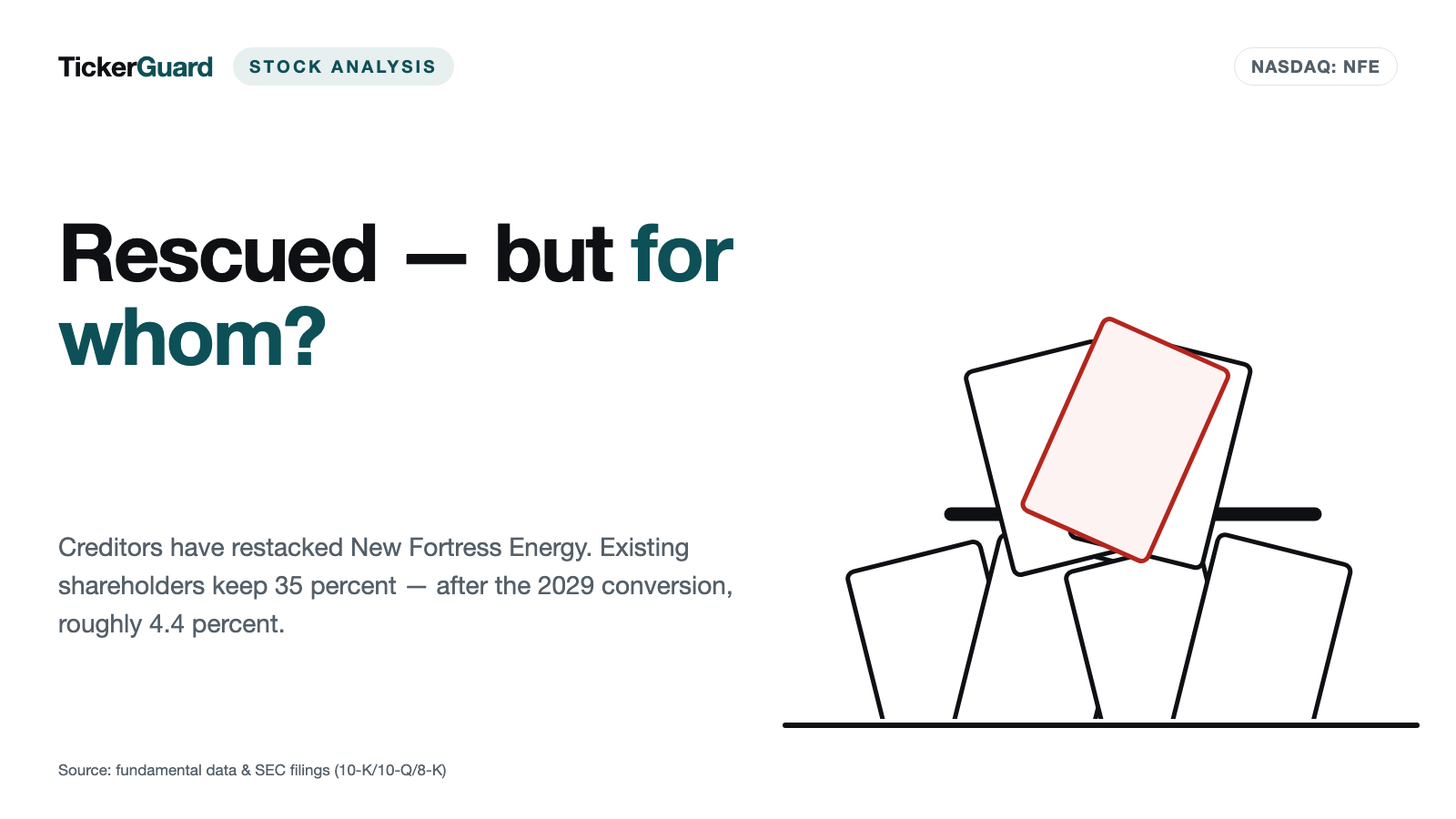
New Fortress Energy: Rescued — but for Whom? Old Shareholders Are Left With Roughly 4.4 Percent From 2029
The debt is billions lighter and the stock still trades on Nasdaq — and yet since September 11, 2026, New Fortress Energy belongs mostly to its creditors. Whoever held the stock before owns 35 percent of the common shares today and, once the creditors’ preferred converts in September 2029, roughly 4.4 percent on our math. On top of that, even the slimmed-down company posted a pro forma operating loss of $305.0 million for the first half of 2026, and according to a filing of October 5, 2026 its own liquefaction unit is offline. Why “restructuring completed” can be a trap for existing shareholders: we work out who owns the rescued company now.
 Thomas Mücke
Founder & Publisher
Thomas Mücke
Founder & Publisher
As of Today
As of: October 5, 2026
- Closing price
- 5.90 $ -10.70%
- Market Capitalisation
- 1.7 $B
- Growth Score
- 2/10
- AAQS
- 1/10
Price change since October 5, 2026: +0.5%
This analysis has a cut-off date. The Stock Guard tells you when something material changes in the numbers. Reserve your free spot
Chart
Interactive price chart (TradingView).
52-week range: 0.2581 $ to 13.90 $ · Last price: 5.90 $ (As of: October 5, 2026)
Note: pure fact-based analysis, not investment advice and not a solicitation to buy or sell. All figures without guarantee.
There is an investor trap that becomes especially tempting after a few bad years. Call it the phoenix trap. It goes like this: a company was at the edge of the cliff, the stock has lost 99 percent — and then comes the headline “restructuring completed, debt slashed, listing preserved.” Your mind immediately paints the bird rising from the ashes, and quietly puts you on its back. New Fortress Energy (NASDAQ: NFE) published exactly that kind of headline on September 11, 2026. So let’s make a deal: before you climb onto the phoenix, let’s read together what the company itself told the U.S. securities regulator, the SEC — the annual report (10-K) for 2025, the quarterly report (10-Q) for June 30, 2026, and the current reports (8-K) on the closing of the rescue and everything that came after. Anyone who gives the SEC false information risks penalties — which is why these filings are among the most reliable sources there are; that even they can be restated is part of this story. And these filings describe a rescue that did happen — just not for the people who held the stock before. At the end, the call is yours.
What New Fortress Energy actually does — gas by ship to places no pipeline reaches
New Fortress Energy sells liquefied natural gas (LNG) — in everyday terms: natural gas chilled to minus 162 degrees Celsius until it turns liquid and fits on a ship. That way it can reach islands and coastlines no pipeline gets to, where it is turned back into gas that power plants burn instead of expensive diesel. New Fortress builds the whole chain: buying gas or liquefying it itself, shipping it, landing it at terminals and, in part, turning it into electricity in its own plants. After the September 2026 overhaul, four pillars remain. First, Puerto Rico: the terminal in the Port of San Juan supplies the plants of the public utility PREPA; in December 2025 New Fortress won a new seven-year agreement for up to 75 TBtu of gas a year, and its subsidiary Genera has operated the island’s thermal power plants since July 1, 2023. Second, Mexico: the terminal and power plant in La Paz with a take-or-pay contract with the state utility CFE, extended to ten years from November 3, 2024. Third, the company’s own floating liquefaction unit FLNG 1 off Altamira with 1.4 million tonnes of annual capacity, producing since July 2024. Fourth, projects under construction: a terminal and power plant in Nicaragua (commissioning expected by the company in the first half of 2027) and the second liquefaction unit, FLNG 2, into which New Fortress says it does not plan significant capital spending after the restructuring; it is in talks with third parties about co-developing it. Gone is the Brazil business with its new large power plants — it has belonged to the creditors since September 11, 2026. That names the central tension of this analysis, and it runs through every chapter: the company is rescued and the assets keep running — but the rescue has handed almost all of the ownership to the creditors, and even the smaller company does not yet earn its interest.
Company history for investors
-
2019
Nasdaq listing
The Class A stock is registered on Nasdaq in early 2019 (8-A12B of 01/30/2019). Founder Wesley Edens and Fortress partners keep substantial influence through their own entities.
-
2023
Highest net income since the IPO: $548.2 million
On $2.39 billion of revenue, New Fortress earns $548.2 million net (restated, 10-K 2025) — the peak before the fall, financed with fast-growing debt.
-
2024
FLNG 1 starts producing, Klondike launches
The floating liquefaction unit off Altamira delivers gas from July 2024; the same month the Klondike data center venture launches, which the 2025 annual report abandons again.
-
2025
Net loss of $1.83 billion
A goodwill impairment of $582.2 million, the sale of the Jamaica business and an operating cash outflow of $583.4 million: for shareholders, the start of the debt crisis.
-
2026
Rescue closes, old holders cut to 35 percent
After restating prior years (March) and a UK restructuring plan, closing on 09/11/2026 brings a 1-for-50 reverse split, 65 percent to creditors; conversion in 2029 into 87 percent of the fully diluted shares leaves old holders with roughly 4.4 percent on paper.
How the stock landed on our desk
New Fortress Energy did not reach our research list through a valuation or quality scanner, but through our in-house Reddit hype scanner: 2 mentions in 24 hours, rank 140 among all tracked stocks (ApeWisdom, as of October 6, 2026). That is not much — but it is the typical moment when a fallen stock gets talked about again: shortly after a rescue, with a new share price after the reverse split and a headline that sounds like a fresh start. After the 1-for-50 reverse split the stock closed at $13.88 on September 14, 2026 and at $5.87 on October 5, 2026 — down by more than half in three weeks. For comparison: on January 2, 2025 it had closed at $16.30, which is $815 in today’s count (50 old shares = 1 new share). Classic scanner metrics are of little help here: there is no price-to-earnings ratio because there are no earnings, and the market value shown on quote pages counts only a fraction of the shares (more on that shortly). So keep this in mind from the start: with a freshly restructured company, the most important number is not the price but the question of who owns the company after the rescue.
The numbers over the years, given their due
First, what New Fortress built — and that is a lot. Revenue grew from $1.32 billion in 2021 to $2.37 billion in 2022 and $2.39 billion in 2023; net income came to $0.09 billion (2021), $0.18 billion (2022) and, in 2023, $548.2 million. Within a few years it built terminals in several countries, a fleet of its own and, with FLNG 1, an offshore liquefaction unit that has produced gas since July 2024. The Puerto Rico contract has been renewed, and the Mexican take-or-pay contract runs until 2034. Then the picture flips: a net loss of $244.5 million in 2024 and of $1.83 billion in 2025 on revenue of $1.50 billion.
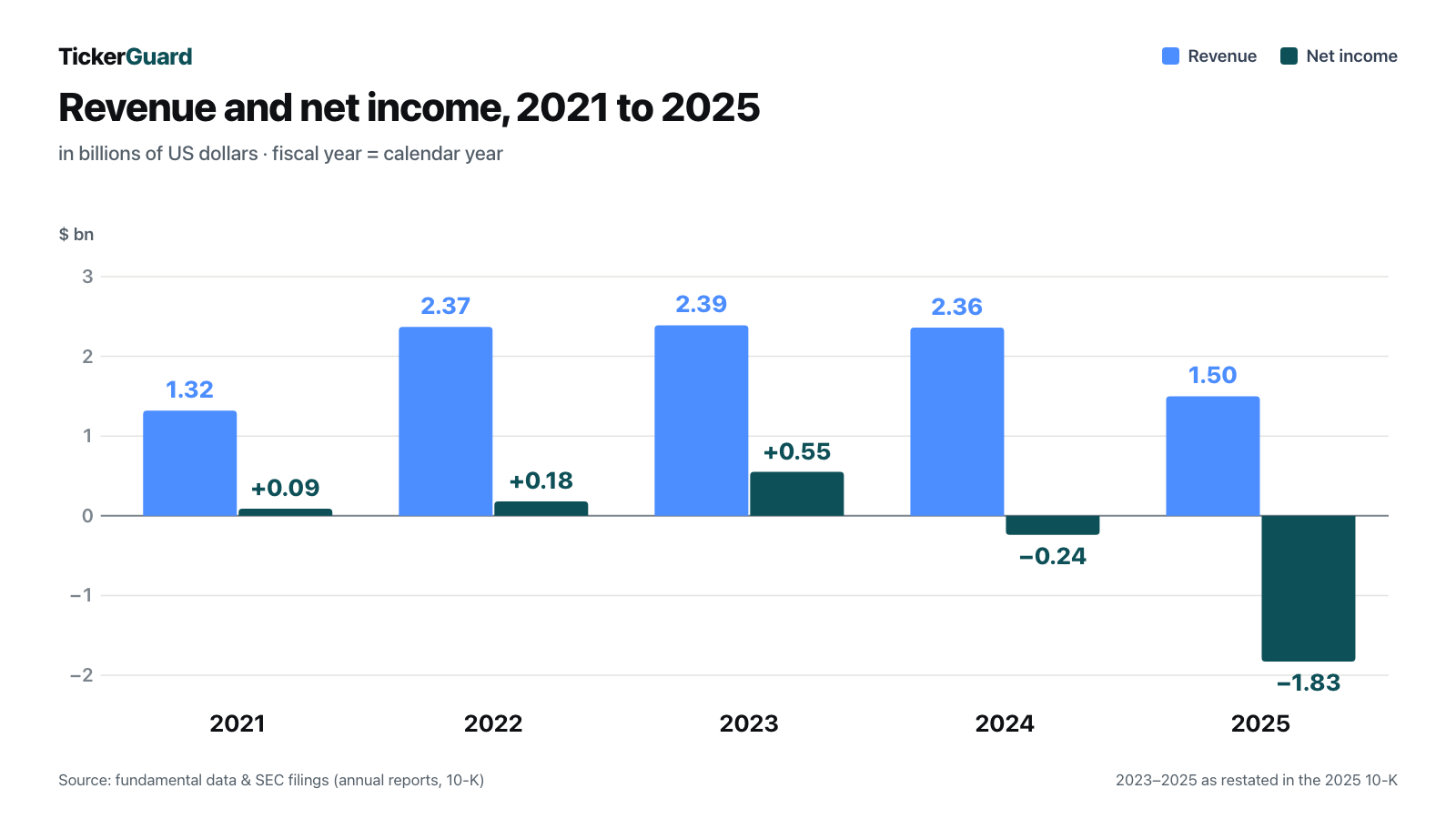
Where the crash came from is spelled out in the 2025 annual report: an operating loss of $1.12 billion, operating cash outflow of $583.4 million (after +$602.2 million in 2024) and a goodwill impairment of $582.2 million in the first half of 2025. At the same time part of the revenue disappeared because New Fortress had sold its Jamaica business. In the end came defaults: the 10-Q for June 30, 2026 lists events of default (missed interest payments) under six financings. At June 30, 2026, total equity was −$432.4 million; current debt stood at $6.73 billion against cash of $161.2 million. The first half of 2026 added $539.5 million of revenue and a net loss of $773.6 million. Keep this picture in mind: the business was never the only problem — it was a business built very fast with a great deal of borrowed money.
What the filings say: the uncomfortable truths
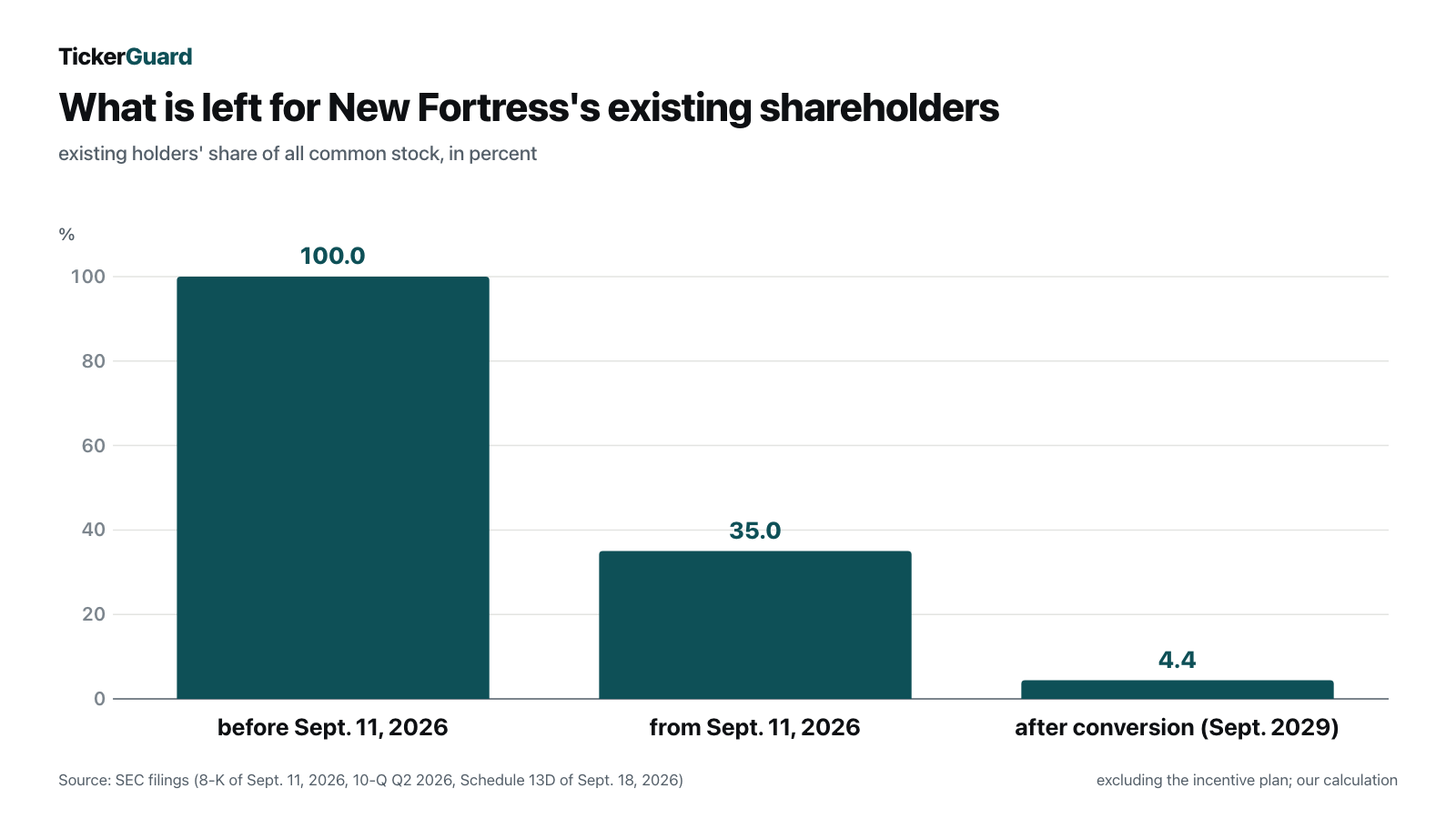
Uncomfortable truth No. 1: The rescue belongs to the creditors — 35 percent now, roughly 4.4 percent from 2029
The restructuring did not run through a U.S. bankruptcy case (chapter 11) but through a UK restructuring plan under Part 26A of the Companies Act: the High Court in London sanctioned the plans on June 18, 2026, and a New York bankruptcy court recognized them for the U.S. under chapter 15 on June 29, 2026. For shareholders that sounds kinder than it is, because the rescue was paid for with ownership. Creditors received the entire Brazil business, $571.3 million of new term loans, 10,608,922 new common shares (65 percent) and 2,454,936 mandatorily convertible preferred shares with an aggregate initial liquidation preference (the amount due to them ahead of the common stock in a liquidation) of $2.45 billion. The quarterly report described the consequences in advance:
“Upon consummation of the Restructuring Transaction, all shares of our Class A common stock outstanding immediately prior to the Restructuring Transaction will represent only 35% of the outstanding Class A common stock of the Company, with the remaining 65% held by creditors and other stakeholders following the restructuring. Furthermore, the mandatory conversion of the CoreCo Convertible Preferred Stock into Class A common stock on the third anniversary of the closing date of the Restructuring Transaction into a number of shares of Class A common stock representing 87% of the fully-diluted Class A common stock outstanding as of the closing of the Restructuring Transaction (after giving effect to the shares of the Company’s Class A common stock to be issued on the closing date of the Restructuring Transaction and shares authorized under the Incentive Plan), will result in the issuance of additional shares, further diluting the ownership interests of existing stockholders.”
— New Fortress Energy Inc., SEC quarterly report 10-Q for June 30, 2026, Item 1A “Risk Factors”

Let’s do the math. After closing there are 16.3 million common shares; 35 percent of them, about 5.71 million, belong to the old shareholders. The preferred converts at 46.441271 to 1 into roughly 114.0 million common shares — the same figure appears in the Schedule 13D filed by the creditor group Strategic Value Partners on September 18, 2026. Together that is about 130.3 million shares. 5.71 million out of 130.3 million is roughly 4.4 percent — before any shares for the employee incentive plan. The mirror image: the creditors then hold about 95.6 percent — their 10.61 million current common shares plus all 114.0 million conversion shares, 124.6 out of 130.3 million. One caveat belongs to this math: per the 8-K, New Fortress may redeem or repurchase the preferred at any time before conversion at the then-current liquidation preference — funded, for example, from operating cash flow, asset sales or junior capital. That would take at least roughly $2.45 billion, almost nine times the pro forma cash of $278.6 million at June 30, 2026. In everyday terms: you owned a whole pizza. After the rescue you get a bit more than a third back — and in three years so many new slices are cut from the rest that your third shrinks to a single bite. And you have little say even today: according to the 8-K of September 11, 2026, the preferred already votes as if it had converted.
Uncomfortable truth No. 2: Even the smaller company does not yet earn its interest
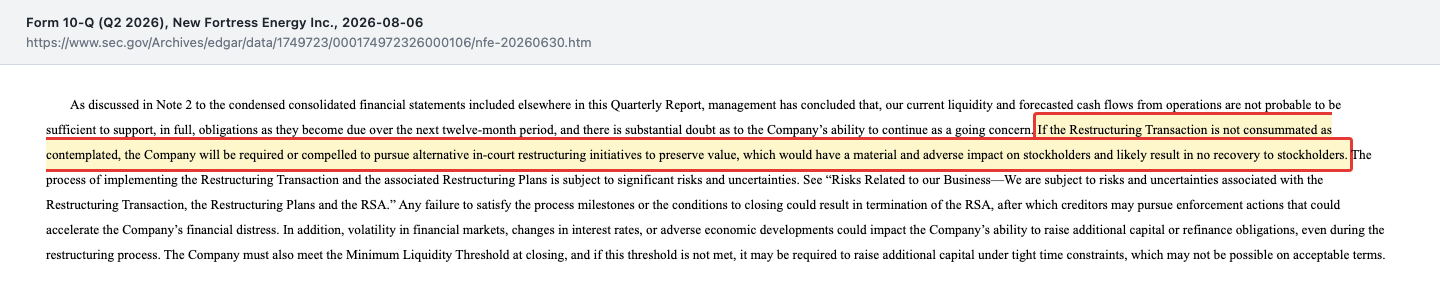
Before the rescue, the 10-Q for June 30, 2026 contained one of the harshest sentences a company can write about itself — substantial doubt about its ability to continue as a going concern — and a clear statement of what would have happened without the rescue:
“If the Restructuring Transaction is not consummated as contemplated, the Company will be required or compelled to pursue alternative in-court restructuring initiatives to preserve value, which would have a material and adverse impact on stockholders and likely result in no recovery to stockholders.”
— New Fortress Energy Inc., SEC quarterly report 10-Q for June 30, 2026, Item 1A “Risk Factors”
The rescue has closed and the old defaults are resolved — that is the good news. The uncomfortable part sits in the pro forma figures New Fortress filed on September 15, 2026. “Pro forma” means: the income statement is drawn up as if the rescue had been completed on January 1, 2025 — without Brazil, with the new, smaller debt; the pro forma balance sheet is as of June 30, 2026. Result for the first half of 2026: $396.9 million of revenue, an operating loss of $305.0 million and interest expense of $102.3 million, for a bottom line of −$416.6 million. Part of that is one-off: $125.7 million of transaction costs and $61.9 million of asset impairments. Take both out and an operating loss of about $117.5 million remains — and that has to cover interest before a shareholder sees anything. Interest coverage — how many times operating profit could pay the interest bill — is therefore below zero. The new loans cost Term SOFR (a forward-looking benchmark rate derived from the Secured Overnight Financing Rate) plus 6.125 percent (senior) or plus 8.125 percent (junior); until the end of the first full fiscal quarter after the 18-month anniversary, New Fortress may choose to pay interest in kind, with new debt instead of cash — and interest paid that way carries a rate 1.5 or 2.0 percentage points higher. Pro forma at June 30, 2026, a little over $2.08 billion of debt faced only $278.6 million of cash.
Uncomfortable truth No. 3: Payments delayed, numbers restated
On March 17, 2026, New Fortress had to tell investors in a current report (8-K, Item 4.02) that its financial statements for 2023 and 2024 and all quarterly reports for 2024 and 2025 should no longer be relied upon. The reason is telling:
“During the periods covered by the Prior Period Financial Statements, the Company delayed payments to certain vendors on certain significant development projects, which allowed the Company to improve the Company’s working capital and liquidity.”
— New Fortress Energy Inc., SEC current report 8-K of March 17, 2026, Item 4.02

Put plainly: if you leave construction invoices unpaid far beyond the usual terms, you are really borrowing from your supplier. Those payments therefore should have been classified as financing, not investing. By the company’s own account, the delayed payments improved working capital and liquidity; in the cash flow statement, however, that supplier credit appeared as capital spending rather than financing. The company stresses that there was no override of controls and no misconduct. Still, the 2025 annual report lists several material weaknesses in internal control over financial reporting and concludes that disclosure controls were not effective as of December 31, 2025; the auditor, Ernst & Young, issued an adverse opinion on internal control and included a going-concern explanatory paragraph in its report on the financial statements. The 2025 annual report and the report for the quarter ended March 31, 2026 were both late (Form NT 10-K and NT 10-Q). Remember this: when a company has had to correct its past, read its numbers about the future twice.
Uncomfortable truth No. 4: Three weeks after the rescue, New Fortress reports its own gas plant offline
The slimmed-down New Fortress depends heavily on FLNG 1: according to the 10-Q for June 30, 2026, the unit supplies a “significant portion” of the company’s own LNG needs and is expected to deliver up to 70 TBtu a year; anything beyond that is bought in the open market. On October 5, 2026 came this report:
“New Fortress Energy Inc. ("NFE" or the “Company”) today announced that the Company’s Fast LNG unit is offline, following a mechanical issue with the facility’s gas turbine. NFE is actively working with the manufacturer of the turbine to return the FLNG unit to operation as soon as possible. The Company expects the Fast LNG unit to return to service during the fourth quarter.”
— New Fortress Energy Inc., SEC current report 8-K of October 5, 2026, Item 8.01

The report does not say what the outage will cost. It does name the risks itself: whether replacement LNG can be sourced on the spot market, if necessary, or “at commercially feasible prices,” and possible nonpayment or nonperformance of obligations under existing contracts. In everyday terms: a baker whose own oven breaks has to buy rolls from a competitor to keep his regulars supplied — he loses the margin but not the customers, as long as the oven is fixed soon. That is exactly the open question here.
Uncomfortable truth No. 5: The creditors are at the wheel now — and the CEO sat on both sides
At closing, six existing directors resigned, including Fortress co-founder Randal Nardone; five new directors were designated by the creditors, according to the 8-K of September 11, 2026, among them the new non-executive chair, William P. Wall. CFO Christopher Guinta resigned effective August 21, 2026; since September 3, 2026, chief accounting officer Frederick Hundt has run finance as interim CFO. Founder and CEO Wesley Edens has stayed — and during the rescue he sat on both sides of the table:
“As previously disclosed, on March 31, 2026, Wesley R. Edens, the Chief Executive Officer of the Company and a member of the Board of Directors of the Company (the “Board of Directors”), purchased at a discount approximately $110 million aggregate principal amount of the loans issued pursuant to Term Loan A Credit Agreement.”
— New Fortress Energy Inc., SEC current report 8-K of September 11, 2026, Item 1.01
Two weeks after the restructuring support agreement with creditors (March 17, 2026), the CEO bought the company’s loans below face value; according to the Schedule 13D/A of September 15, 2026, he signed a support agreement on substantially the same terms as the other creditors. At closing he received, as a creditor, 208,588 new common shares and 48,288 preferred shares; on the same day he bought another 28,313 common and 6,671 preferred shares from other creditors for $1,667,985.02 (Form 4 of September 15, 2026). At the same time, Edens is himself one of the largest old shareholders: through his entities he held about 1.07 million shares before closing (post reverse split), according to Form 4, and is hit by the dilution too. So today he holds both — old shares and creditor shares. That is disclosed; his additional money went to the creditors’ side.
Valuation: which market value is the right one?
Quote pages show New Fortress with a market value of about $96 million — 16.3 million common shares times the $5.87 close on October 5, 2026. That is an incomplete number, because it ignores the 114.0 million shares coming from the preferred. Counting all roughly 130.3 million future shares at the same price gets you to about $765 million. A second, filing-documented price comes from the preferred itself: according to Form 4 filings, the funds King Street and Strategic Value Partners (the latter itself a creditor) bought it in September 2026 at $400 to $505.00 per share — 40 to 50.5 percent of its initial $1,000 liquidation preference. At $440 (King Street, September 30, 2026) that equals about $9.47 per future common share — well above the common stock’s $6.27 close on the same day. The premium has a reason: the preferred ranks ahead of the common stock, and its liquidation preference, initially $1,000, grows automatically until conversion — by 3 percent in the first year, 5 percent in the second and 7 percent in the third (per the 8-K of September 11, 2026). In a liquidation it is paid only after all debt — the 8-K of September 11, 2026 calls it “subordinated in right of payment to all existing and future indebtedness” — but ahead of the common stock. The professionals are paying for a better place in line; the common stock is not cheaper, it is less protected. For all preferred shares together that is roughly $0.98 to $1.24 billion. Add a little over $2.08 billion of pro forma debt. Against that stand pro forma 2025 revenue of $1.26 billion and — see above — an operating loss. A price-to-earnings ratio cannot be calculated. Pro forma book equity at June 30, 2026 was $1.46 billion, propped up by an accounting gain from the debt exchange; whether the assets earn that book value is something the operating business still has to show. How another LNG name looks from the shareholder’s seat before the plant is built is worked through in our NextDecade analysis; how a debt load can squeeze an energy company is shown in our analysis of NGL Energy Partners. Remember: whoever buys the common stock is not buying the company, but its smallest and most junior slice.
Upside and risks at a glance
What speaks for New Fortress Energy:
- The rescue has closed: the defaults under the old financings were resolved on September 11, 2026, debt fell from $8.86 billion (group including Brazil, June 30, 2026) to a little over $2.08 billion pro forma, and the Nasdaq listing remains.
- Long-term contracts with state utilities: a new seven-year agreement with PREPA in Puerto Rico for up to 75 TBtu of gas a year (December 2025) and a take-or-pay contract with Mexico’s CFE running to 2034.
- Its own liquefaction unit (FLNG 1, 1.4 million tonnes a year) whose feed gas is bought at prices based on the U.S. Henry Hub index — as long as it runs.
- Large investors with real skin in the game: the creditor Strategic Value Partners and the fund King Street (a holder of 10 percent or more since September 24, 2026, per Form 3) hold large preferred positions and bought more in the market in September 2026 — as preferred holders they rank ahead of the common stock, but with that much at stake they have an interest in the company creating value.
- A much smaller interest bill: $102.3 million of pro forma interest expense in the first half of 2026, versus $358.2 million in the continuing business before the rescue.
What speaks against it:
- Massive dilution: existing holders own 35 percent of the common stock and, after the mandatory conversion in September 2029, roughly 4.4 percent; the preferred already votes today.
- No operating profit even pro forma: −$305.0 million operating and −$416.6 million net in the first half of 2026; interest coverage is below zero.
- FLNG 1 offline according to a filing of October 5, 2026; replacement gas may have to be bought on the spot market, and the return expected in the fourth quarter is not yet proven.
- Restated prior-year financial statements, material weaknesses in financial controls, an adverse opinion on internal control, a going-concern paragraph in the audit report and, since September 2026, only an interim CFO.
- Overhang: creditors are entitled to a registration of their own to resell their shares — per the 8-K due within ten business days of closing, but not yet on file with the SEC as of October 6, 2026; the stock lost more than half its value in the three weeks after closing ($13.88 to $5.87, September 14 to October 5, 2026).
A human conclusion
Back to the phoenix trap from the beginning. Its core is not that the bird fails to rise — New Fortress Energy has been rescued, the terminals are running, the contracts with Puerto Rico and Mexico stand, and the debt is several billion dollars lighter. Its core is that you silently assume there is still room for you on the bird’s back. The filings say otherwise: the creditors bought the phoenix. They hold 65 percent of the common stock today, already cast almost all the votes through their preferred, and in September 2029 receive so many new shares that the old shareholders are left with roughly 4.4 percent on our math. Add a company that still posts a pro forma operating loss after the debt exchange, whose own gas plant is offline according to the October 5, 2026 filing and whose past had to be restated. So the honest question for you is not “Will New Fortress rise again?” but: if the phoenix does rise — how much of its flight still belongs to you? If you know the answer and it is enough for you, you have a thesis. If not, you only had a nice picture. What you make of it is your call. That is how it should be.
Sources
All original documents used in this analysis — so you can check them yourself:
- New Fortress Energy Inc. — SEC quarterly report 10-Q for June 30, 2026 (filed August 6, 2026)
- New Fortress Energy Inc. — SEC quarterly report 10-Q for March 31, 2026 (filed May 14, 2026)
- New Fortress Energy Inc. — SEC annual report 10-K for 2025 (filed April 13, 2026)
- New Fortress Energy Inc. — SEC annual report 10-K for 2024 (filed March 10, 2025)
- New Fortress Energy Inc. — SEC current report 8-K of March 17, 2026 (Item 4.02, non-reliance on prior financial statements)
- New Fortress Energy Inc. — SEC current report 8-K of May 7, 2026 (Item 3.01, Nasdaq minimum bid price)
- New Fortress Energy Inc. — SEC current report 8-K of August 21, 2026 (CFO resignation) and 8-K of September 10, 2026 (interim CFO)
- New Fortress Energy Inc. — SEC current report 8-K of September 11, 2026 (closing of the restructuring, reverse split, new board)
- New Fortress Energy Inc. — SEC current report 8-K/A of September 15, 2026 (pro forma financial information)
- New Fortress Energy Inc. — SEC current report 8-K of October 5, 2026 (FLNG 1 offline)
- Strategic Value Partners — Schedule 13D of September 18, 2026; Wesley R. Edens — Schedule 13D/A of September 15, 2026
- Insider filings (Form 4) of September 15, 16 and 22 and October 1, 2026: EDGAR Form 4 overview (sec.gov)
- Full SEC filing history: EDGAR overview for New Fortress Energy (sec.gov)
- Fundamental data (price, market value, share count; as of October 5–6, 2026), reconciled with the SEC filings and the SEC’s XBRL data series.
- Reddit mentions: ApeWisdom (as of October 6, 2026), surfaced by our in-house Reddit hype scanner.
Transparency & disclaimer: this analysis is journalistic commentary on publicly available information. It is not investment advice, not a regulated investment research product and not a solicitation to buy or sell securities. Equity investments carry substantial risk up to and including total loss. All information is provided without warranty; the as-of date for each figure is stated in the text. Positions held by the operator are disclosed daily; where one exists, it appears as a notice at the top of this deep dive.
Key figures at a glance
All monetary figures in millions of $; earnings per share as reported.
| Metric | 2021 | 2022 | 2023 | 2024 | 2025 |
|---|---|---|---|---|---|
| Revenue | 1,322.8 | 2,368.3 | 2,413.3 | 2,364.9 | 1,504.0 |
| Operating Income (EBIT) | 238.9 | 737.4 | 942.7 | 538.6 | -170.6 |
| Net Income | 97.1 | 194.5 | 547.9 | -249.0 | -1,843.6 |
| Net Margin | 7.3% | 8.2% | 22.7% | -10.5% | -122.6% |
| Earnings Per Share | 24.07 $ | 46.34 $ | 132.67 $ | -56.96 $ | -331.02 $ |
Source: fundamental data & SEC filings (annual and quarterly reports, 10-K/10-Q)
Our Bottom Line at a Glance
- Business model & contracts positive
- Long-term contracts with state utilities carry the remaining business: a new seven-year PREPA agreement for up to 75 TBtu of gas a year (December 2025), Genera’s power plant operations since July 2023 and a take-or-pay contract with Mexico’s CFE running to 2034. The assets exist and are running.
- Earnings power after the rescue negative
- No operating profit even pro forma: in the first half of 2026, $396.9 million of revenue faced an operating loss of $305.0 million, with $102.3 million of interest expense; excluding one-offs, an operating loss of about $117.5 million would remain (8-K/A of 09/15/2026). Interest coverage is below zero.
- Ownership & dilution negative
- Since 09/11/2026 existing holders own 35 percent of the common stock; the 2,454,936 preferred shares convert into roughly 114.0 million shares in September 2029, leaving roughly 4.4 percent on our math. The preferred already votes today.
- Reporting quality & controls negative
- Restatement of the 2023/2024 annual and 2024/2025 quarterly financial statements because of delayed vendor payments (8-K of 03/17/2026), material weaknesses and an adverse opinion on internal control, a going-concern paragraph in the 2025 audit report, late filings and, since 09/03/2026, only an interim CFO.
- Operations & concentration risk negative
- The company’s own liquefaction unit FLNG 1 is offline after a turbine failure, according to the 8-K of 10/05/2026; any missing LNG has to be bought on the spot market if necessary, and the company expects a return in the fourth quarter of 2026.
- Debt load neutral
- The rescue cut debt to a little over $2.08 billion pro forma (from $8.86 billion at 06/30/2026, group including Brazil) and ended the defaults under the old financings. The new loans cost Term SOFR plus 6.125 to 8.125 percent and may initially be serviced in kind.
New Fortress Energy is the phoenix trap in its purest form: the September 11, 2026 restructuring rescued the company but handed almost all of the ownership to the creditors — 65 percent of the common stock right away and, through mandatorily convertible preferred, roughly 95.6 percent from September 2029 on our math (65 percent of today’s common stock plus all conversion shares). Even the smaller company posted a pro forma operating loss of $305.0 million in the first half of 2026, prior-year financial statements had to be restated, and according to an October 5, 2026 filing its own liquefaction unit is offline. Whoever buys the common stock buys the smallest and most junior slice of a company that still has to prove its operating profit. Not investment advice.
What Our Rating Means
Substance risk
We found at least one documented issue that threatens the company itself — regardless of how the stock is currently valued.
The traffic light is red because several documented substance risks come together: even after the debt exchange, pro forma operating results do not cover interest (first half of 2026: −$305.0 million operating against $102.3 million of interest expense), the last quarterly report before closing flagged substantial doubt about the company as a going concern, prior-year financial statements had to be restated, and the company’s own gas plant is down according to an October 5, 2026 filing. If you wait, check the next quarterly report: is the going-concern doubt removed? Is FLNG 1 running again? And does the business turn profitable without one-offs? For existing shareholders the dilution to roughly 4.4 percent is the hardest number of all. The decision is yours.
A journalistic assessment by our editorial team at the time of the deep dive, based on public sources — not investment advice and not a solicitation to buy or sell. Your personal circumstances (investment goals, risk capacity, taxes) cannot be taken into account. What our levels mean, how verdicts are formed, and what conflicts of interest exist →
Worth Noting
- New Fortress Energy reached our research list through our in-house Reddit hype scanner. The restructuring ran under UK law (Part 26A) with U.S. recognition under chapter 15, not under chapter 11; the stock still trades on Nasdaq.
- Pro forma figures come from the 8-K/A of September 15, 2026 and draw up the income statement as if the restructuring, including the handover of Brazil, had been completed on January 1, 2025; the pro forma balance sheet is as of June 30, 2026. The figures are unaudited. The years 2023 to 2025 are shown as restated in the 2025 annual report, 2021 and 2022 as originally reported.
- Valuation dated and evergreen: the market value in quote feeds (about $96 million on October 5, 2026) counts only the 16.3 million common shares; including the roughly 114.0 million conversion shares, there are about 130.3 million shares. Do not confuse NFE (common stock) with NFEGP (mandatorily convertible preferred).
Stock Watch
This analysis is as of October 6, 2026. Stock Watch will tell you what's changed at NFE since then.
Later $1 a month per stock — signing up is free, and you'll be the first to know when it launches.
The full analysis as a PDF for later
We will send you this analysis as a PDF — to print, file away, and read at your own pace. And we will add you to the free Stock Watch list for New Fortress Energy LLC (NFE), so you hear about it when something material in this analysis changes.
Frequently Asked Questions
New Fortress Energy Inc. (NASDAQ: NFE), based in New York, sells liquefied natural gas (LNG) and runs terminals and gas-fired power plants. After the September 11, 2026 restructuring, the core is the San Juan terminal with a seven-year PREPA supply agreement, operation of Puerto Rico’s thermal power plants through its subsidiary Genera, the terminal and power plant in La Paz, Mexico, and the floating liquefaction unit FLNG 1 off Altamira. The Brazil business now belongs to the creditors.
No, there was no chapter 11 case. New Fortress restructured its debt through a UK restructuring plan under Part 26A of the Companies Act; the High Court in London sanctioned the plans on June 18, 2026, and a U.S. bankruptcy court recognized them under chapter 15 on June 29, 2026. Before that, the company had missed interest payments, was in default under six financings and reported substantial doubt about its ability to continue as a going concern in its 10-Q for June 30, 2026. The rescue closed on September 11, 2026.
Heavily. Since September 11, 2026, the old shareholders own 35 percent of the 16.3 million common shares, about 5.71 million. Creditors received 65 percent plus 2,454,936 mandatorily convertible preferred shares that convert into roughly 114.0 million common shares in September 2029 unless the company redeems them earlier. After that, the old holders’ stake is roughly 4.4 percent on our math, before any incentive plan shares. The preferred already votes as if converted.
On September 11, 2026, every 50 old shares were combined into one new share; the stock still trades as NFE on Nasdaq, under the new CUSIP 644393308. One reason was a Nasdaq notice of May 1, 2026, because the stock’s closing bid price had been below $1 for 30 consecutive trading days; the cure period runs until October 28, 2026, and no notice of regained compliance had been filed as of October 6, 2026. A reverse split does not change the value of your stake — the dilution from the restructuring does.
No, not on its own pro forma numbers. Calculated as if the rescue had been completed on January 1, 2025, the first half of 2026 shows $396.9 million of revenue, an operating loss of $305.0 million and $102.3 million of interest expense; net −$416.6 million. Excluding transaction costs ($125.7 million) and asset impairments ($61.9 million), the operating loss would still be about $117.5 million. The source is the 8-K/A of September 15, 2026.
NFEGP is the ticker of New Fortress Energy’s Series A mandatorily convertible preferred stock, listed on Nasdaq since September 11, 2026. It carries a $1,000 liquidation preference per share that accretes at 3, 5 and 7 percent a year, and converts on the third anniversary into 46.441271 common shares per preferred share. According to Form 4 filings, funds such as Strategic Value Partners and King Street bought it at $400 to $505.00 in September 2026.
Found an error?
Did you spot a factual error, an outdated number, or a typo in this deep dive? Let us know briefly — your report goes straight to the editorial team.