US Antimony: A Defense Contract Worth Up to $245 Million — and a Revenue Forecast Cut by Up to Half
United States Antimony says it is the only permitted antimony processor operating in the U.S., has held a supply contract with the Pentagon's strategic stockpile since September 2025 (first deliveries in June 2026) and won a grant from the Department of War in 2026. It sounds like a stock that cannot lose — and that is exactly the flag trap: since October 2025 the stock has lost about 77 percent. The filings with the U.S. securities regulator, the SEC, tell a different story: in the second quarter of 2026 the company kept 36 cents of gross profit per pound of antimony, its 2026 revenue guidance fell from $125 million to $60 million to $75 million, and the build-out since 2025 has been paid for mainly with new shares. We read what the flag is worth when the price is set in China.
 Thomas Mücke
Founder & Publisher
Thomas Mücke
Founder & Publisher
As of Today
As of: October 6, 2026
- Closing price
- 4.00 $ +1.00%
- Market Capitalisation
- 0.6 $B
- Growth Score
- 6/10
- AAQS
- 5/10
Price change since October 5, 2026: +1.3%
This analysis has a cut-off date. The Stock Guard tells you when something material changes in the numbers. Reserve your free spot
Chart
Interactive price chart (TradingView).
52-week range: 4.00 $ to 17.50 $ · Last price: 4.00 $ (As of: October 6, 2026)
Note: pure fact-based analysis, not investment advice and not a solicitation to buy or sell. All figures without guarantee.
There is an investor trap that feels especially good, because it sounds like patriotism and common sense at the same time: the flag trap. It goes like this. A raw material is “critical,” China dominates the market, the Pentagon is buying, and Washington chips in grant money. The mind draws a comfortable conclusion: “If the government needs this company, the stock can’t go wrong.” The trap is that two separate questions melt into one — whether a company is important and whether it makes money.
United States Antimony (NYSE: UAMY) is a vivid example of that mix-up. The stock closed at $17.47 on October 14, 2025 and at $3.95 on October 5, 2026. So let’s make a deal: we leave the flag in the closet for a moment and read what the company itself has reported to the U.S. securities regulator, the SEC — the 2025 annual report (10-K), the quarterly reports (10-Q) for March 31 and June 30, 2026, and the current reports (8-K) through early October 2026. False statements in these filings carry penalties, which makes them the most reliable source we have. And they answer the question that matters here: what is a strategically important supplier worth when the price of its product is set somewhere else?
What US Antimony actually does — a smelter that mostly refines other people’s ore
United States Antimony Corporation started mining antimony in Montana in 1970. Mining ended in the 1980s because imported ore was cheaper; since then the company has mostly lived off refining purchased ore. Today it is a Texas corporation headquartered in Dallas and had 100 full-time employees as of December 31, 2025, most of them in Montana, Idaho and Mexico.
Antimony is an unassuming metal with important jobs. As antimony oxide it makes plastics, textiles and paints flame-retardant; as metal it goes into batteries, bearings and ammunition; as antimony trisulfide it is the primer in cartridges. Think of USAC as a kind of refinery: ore arrives with impurities and too little antimony, and at Thompson Falls, Montana, and two smelters in Mexico it is cleaned up and upgraded to about 71.4 percent (trisulfide), 83 percent (oxide) or 99.65 percent (metal). The Montana ore also yields gold and silver, which are sold back to the ore supplier. The second leg is zeolite from Preston, Idaho, a mineral that soaks up ammonium and heavy metals like a sponge — used in water filters, animal feed and soil conditioners.
Since 2024 USAC has been buying mining claims in Alaska, Montana and Ontario, including the Fostung tungsten project. According to the quarterly report for June 30, 2026, none of them has run a revenue-producing operation so far in 2026, only exploration and limited surface mining. The company describes its position this way:
“We are the only U.S. domestic operating, permitted processor of antimony products.”
— United States Antimony Corporation, SEC quarterly report 10-Q for June 30, 2026, Item 2 “Description of Business”
Washington has rewarded that position. In September 2025 USAC won a five-year, sole-source contract from the Defense Logistics Agency (DLA), which manages the National Defense Stockpile. In March 2026 the U.S. Department of War awarded a milestone-based grant of up to $27.0 million under the Defense Production Act; $16.2 million of it is currently obligated, and $12.8 million was paid in April 2026. That defines the central tension of this analysis: US Antimony is strategically wanted — but whether it makes money is decided by the world price of antimony, and Washington does not set that price.
Company history for investors
-
1970
Starts as an antimony miner in Montana
Its own mining ends in the 1980s because imported ore is cheaper. For shareholders that meant decades of living off other people's ore and the world price.
-
2025
DLA contract and $110 million of fresh capital
The framework contract worth up to $245 million arrives in September 2025; $110 million flows in from stock and warrants. On 10/14/2025 the stock closes at $17.47.
-
2026
NYSE, grant and guidance cut
March 2026 brings the NYSE listing and a grant of up to $27 million from Washington; on 08/11/2026 revenue guidance falls from $125M to $60–75M and the stock drops about 24 percent in a day.
How the stock landed on our desk
No financial-metrics screen flagged US Antimony; other investors’ attention did. Our in-house Reddit hype scanner picked up the ticker. According to ApeWisdom, UAMY had 2 mentions in 24 hours on October 6, 2026 and ranked 181st, up from 562nd the day before. That is a whisper, not a storm — and that is exactly why a closer look is worthwhile: the stock has lost about 77 percent since its closing high of $17.47 (October 14, 2025), and in the forums it usually shows up wrapped in the flag.
The biggest single blow came after the half-year numbers: the stock closed at $6.58 on August 11, 2026 and at $4.97 the day after the guidance cut — a drop of about 24 percent in one session. It has kept crumbling since. Remember this line: a raw material can be critical without its supplier being profitable.
The numbers over the years — given their due
First, what deserves respect. 2025 was the strongest revenue year since at least 2019: $39.3 million, up 163 percent, with gross profit rising from $3.5 million to $9.9 million. Thanks to the equity raises, the balance sheet is well padded and carries practically no financial debt ($0.3 million of equipment financing): on June 30, 2026, assets of $190.6 million faced liabilities of just $9.6 million, and stockholders’ equity stood at $181.0 million. The zeolite business is growing — second-quarter 2026 revenue rose 110 percent to $1.9 million. And the company says the Thompson Falls expansion is substantially complete.
Now the long view — revenue and net income since 2021:
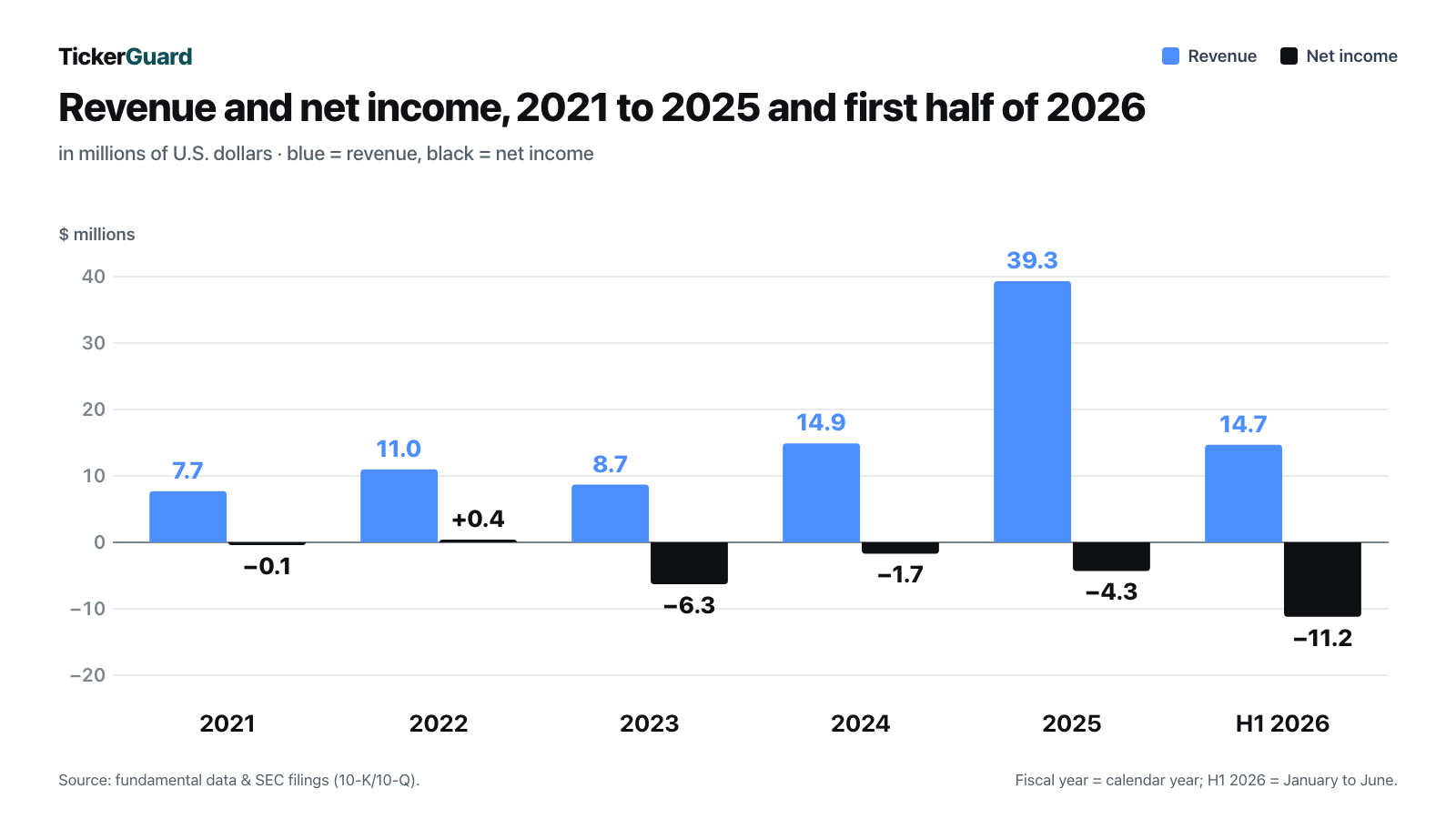
The details: revenue of $7.7 million (2021), $11.0 million (2022), $8.7 million (2023), $14.9 million (2024) and $39.3 million (2025); net income of minus $0.1 million, plus $0.4 million, minus $6.3 million, minus $1.7 million and minus $4.3 million. Even in the record year 2025, gross profit was not enough: operating expenses rose from $5.9 million to $18.3 million, including $7.1 million of share-based compensation — pay in stock and options that costs no cash but shrinks shareholders’ slice of the pie. In the first half of 2026, $14.7 million of revenue came with a loss of $11.2 million. Keep this picture in mind: revenue climbed with the antimony price, costs climbed with the build-out — and no profit has come out of it so far.
What the filings say — the uncomfortable truths
Uncomfortable truth No. 1: profit per pound depends on the world market — and the world market has turned
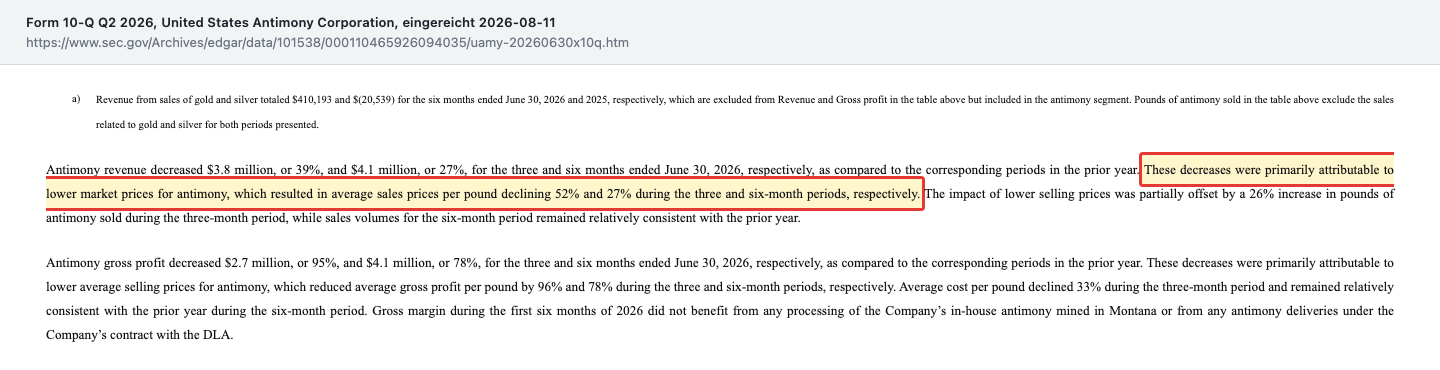
In 2025 USAC did not sell more antimony than in 2024; it sold less, 1,408,513 pounds versus 1,459,557. The entire jump came from price: the average selling price per pound rose from $7.61 to $25.12, and profit rose with it. In 2026 the same film runs in reverse. The quarterly report for June 30, 2026 puts it plainly:
“These decreases were primarily attributable to lower market prices for antimony, which resulted in average sales prices per pound declining 52% and 27% during the three and six-month periods, respectively.”
— United States Antimony Corporation, SEC quarterly report 10-Q for June 30, 2026, Item 2 MD&A, antimony segment
What that means per pound is shown in the chart: in the second quarter of 2026, selling price and cost sit almost on top of each other.
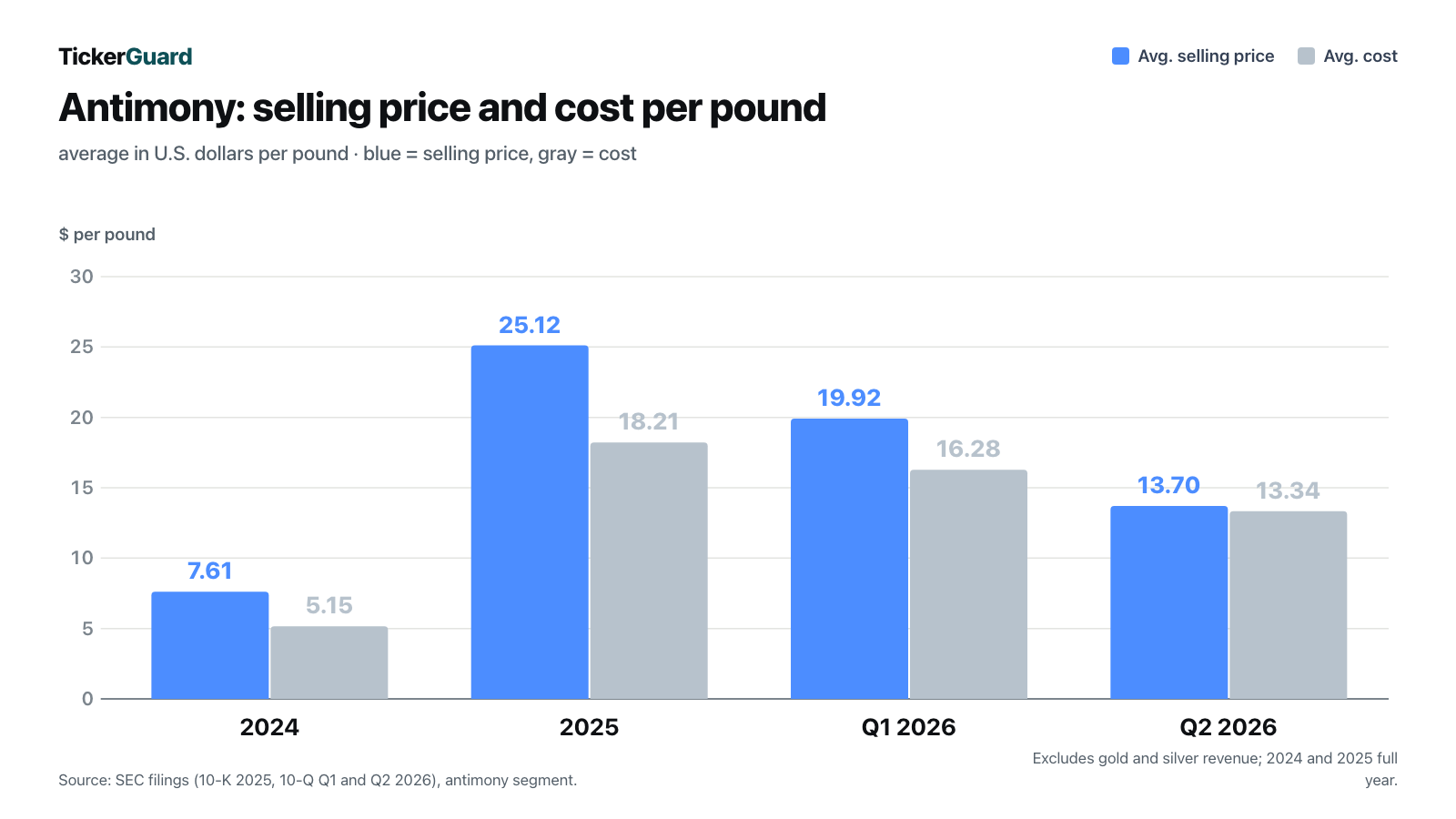
$0.36 of gross profit per pound — before administration, salaries and interest. Consolidated gross margin fell to 7 percent in the second quarter of 2026 from 27 percent a year earlier. One detail matters for the “fully integrated” antimony story: the company’s own ore has not supported the margin so far. The report says gross margin in the first six months of 2026 “did not benefit from any processing of the Company’s in-house antimony mined in Montana or from any antimony deliveries under the Company’s contract with the DLA.” Who sets the price? Chief executive Gary Evans said it himself on the August 11, 2026 conference call: “The price is undoubtedly manipulated by China.” That is his view, not an established fact — but it shows how little control the company has over the biggest lever on its earnings. How hard the antimony price hits others, too, we worked through in our analysis of Southern Cross Gold and its gold-antimony project.
Uncomfortable truth No. 2: the defense contract has a ceiling, but no floor
The DLA contract is the heart of the flag story. The annual report describes it like this:
“The contract, with a maximum value of $248 million, is for the sale of antimony metal ingots (99.65% purity) through September 2030. Pricing is determined at the time each delivery order is placed.”
— United States Antimony Corporation, SEC annual report 10-K for 2025, Item 1 “Government and Industrial Sales Agreements”
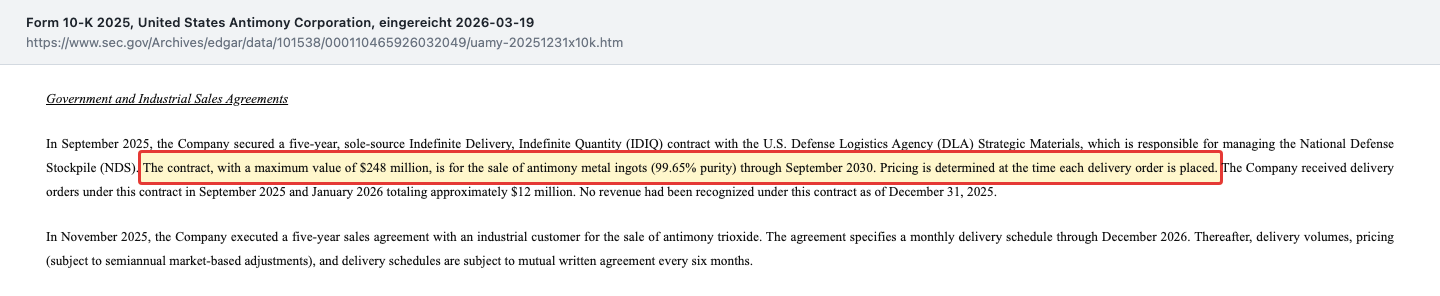
Two words matter here: maximum and pricing. This is an indefinite-delivery, indefinite-quantity (IDIQ) contract; the August 11, 2026 earnings release expressly calls it a contract that “does not guarantee any minimum purchase volume.” And the price is set order by order, so the Pentagon is not buying at a fixed price that shields USAC from the world market. According to the annual report, orders of about $12 million arrived through January 2026, and the quarterly report for June 30, 2026 still cites the same order of magnitude. In the earnings release of the same day, however, Gary Evans speaks of “$57.3 Million in antimony ingot orders from the DLA on our books today” — about $57.3 million of DLA orders. Even that higher figure is just under a quarter of the ceiling, which the latest quarterly report puts at $245 million (the annual report still said $248 million). The first two shipments, about 82,000 pounds of metal ingots, went out in June 2026; the DLA accepted them in July, so about $2.6 million will only be booked in the third quarter. According to the delivery schedule in the earnings release, the two delivered shipments are followed by two in transit and three awaiting inspection, together about $9.17 million. Put simply: $245 million is the size of the shop window, not the contents of the store.
Uncomfortable truth No. 3: guidance was reaffirmed in May — and cut by up to half in August
On March 19, 2026 USAC reaffirmed revenue guidance of $125 million for 2026, and again on May 14, 2026. On August 11, 2026 came the correction:
“The Company is updating its full-year 2026 gross revenue guidance to a range of $60 million to $75 million, revised from prior guidance of $125 million.”
— United States Antimony Corporation, Second-quarter 2026 earnings release (8-K of August 11, 2026, Exhibit 99.1)
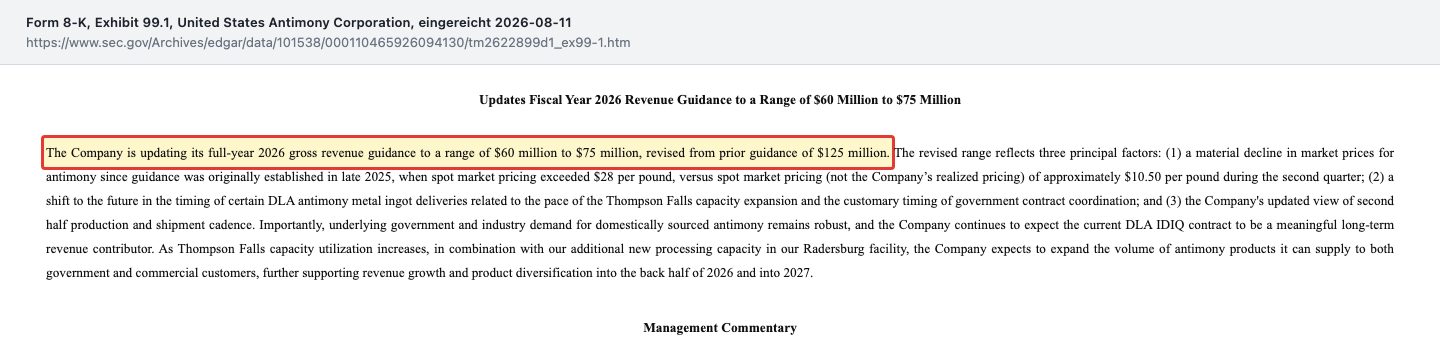
Even the new range is demanding. First-half 2026 revenue was $14.7 million. To reach $60 million to $75 million, the second half would need roughly $45 million to $60 million — three to four times the first half. The company is counting on more DLA deliveries, all furnaces at Thompson Falls running from the third quarter, and its own ore from Montana and Mexico. At the same time, antimony inventory stood at $21.4 million on June 30, 2026, up from $12.0 million at year-end — material that still has to be sold at current prices. A company that reaffirms in May and halves in August delivers one thing above all with the new number: a test for the fourth quarter.
Uncomfortable truth No. 4: the quarterly profit came from Australia
For the second quarter of 2026 USAC reported a small net income of $0.1 million. Operating income, however, was minus $7.0 million. A stock price closed the gap: in October 2025 USAC paid $37.2 million for about 10 percent of Australia’s Larvotto Resources, which explores and develops antimony and gold deposits. Larvotto’s share price rose, and the gain went straight into the income statement although nothing was sold:
“These increases were primarily attributable to unrealized gains on the Company’s investment in Larvotto of $6.8 million during the second quarter of 2026 and $2.7 million for the six-month period.”
— United States Antimony Corporation, SEC quarterly report 10-Q for June 30, 2026, Item 2 MD&A “Other Income, Net”
Think of a craftsman whose workshop is in the red but whose brokerage account went up — on paper, there is a profit. That is perfectly legal and fully disclosed. But it is not a business result, and it can reverse just as fast: in the first quarter of 2026 the same stake cost $4.1 million. Even so, Gary Evans said on the August 11, 2026 call: “we are generating revenues, we are generating EBITDA, we are generating cash flow.” The filings show first-half 2026 operating income of minus $14.5 million; even after adding back $7.7 million of share-based compensation and $0.9 million of depreciation and amortization, about minus $5.8 million remains. Operating cash outflow was $20.7 million — $12.1 million in the first quarter and $8.7 million in the second. Remember the pattern: when management talks about cash flow, read the cash flow statement.
Uncomfortable truth No. 5: new shares pay the bills — and the controls leak
Where does the money for the smelter expansion, mining claims, Larvotto and inventory come from? From shareholders. In 2025 USAC raised $110 million: $36.7 million from at-the-market stock sales, $67.6 million from three registered direct offerings with institutions and $5.7 million from warrant exercises. 2026 continued the pattern:
“Significant financing activities in 2026 have included $49.1 million of net proceeds received from the sale of common stock in “at the market offerings” and $2.0 million of proceeds received from the exercise of pre-existing common stock warrants, offset in part by $7.8 million of treasury stock purchases.”
— United States Antimony Corporation, SEC quarterly report 10-Q for June 30, 2026, Item 2 MD&A “Capital Resources and Liquidity”
The $7.8 million of “treasury stock purchases” is not a buyback in the usual sense: according to the report, USAC withheld shares to cover employee option exercise prices and payroll taxes on vested stock awards. On the other side, it sold 4,326,433 new shares in the first half of 2026 at an average $11.56. Overall the share count rose from 107.6 million (April 9, 2024) to 149.7 million (August 7, 2026), an increase of 39 percent. The everyday picture: your slice of the pie shrinks when new slices keep getting cut. Then, on August 19, 2026, the board authorized a buyback program of up to $100 million — more than the $62.2 million of cash and debt securities on June 30, 2026. Whether any shares were bought will only show in the next quarterly report.
Then there is the bookkeeping. The 2025 annual report concludes that internal control over financial reporting was not effective, citing too few staff and a lack of segregation of duties; the quarterly report for June 30, 2026 says this has not yet been fixed. And the annual report contains an unusual sentence:
“We have been informed by our transfer agent, Equiniti Trust Company (the “Transfer Agent”), that there is a discrepancy between the number of outstanding shares of our common stock as determined by the Transfer Agent and the number of outstanding shares of our common stock as determined by the Depositary Trust Company.”
— United States Antimony Corporation, SEC annual report 10-K for 2025, Item 1A “Risk Factors”
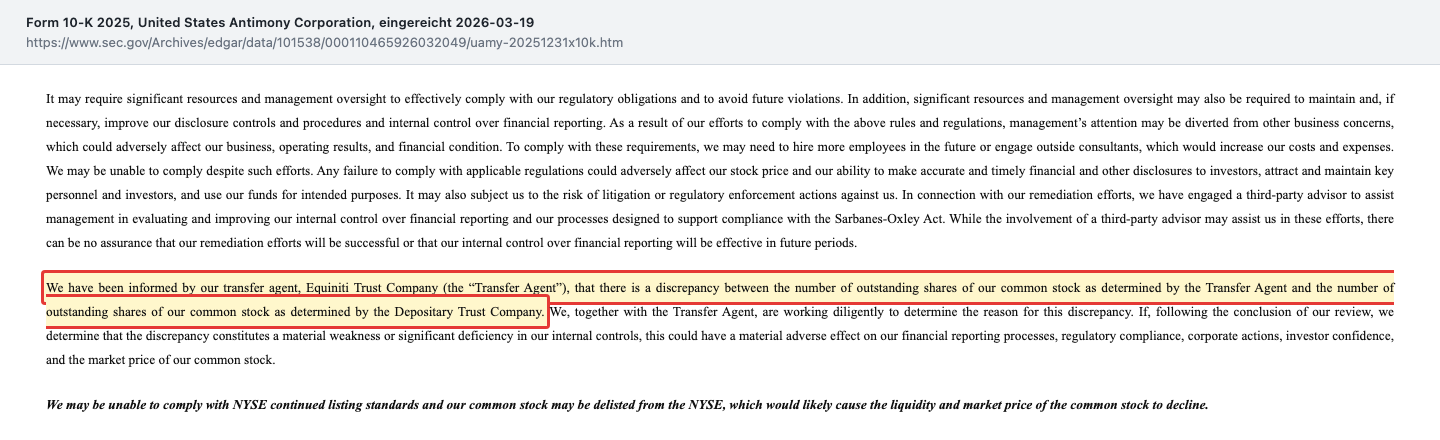
The report does not say how large the discrepancy is, and the quarterly report for June 30, 2026 still lists the issue among its risks. That is no proof of an error in the financial statements — but it fits the picture of a company that has grown faster than its back office. So does the change in the finance chair: CFO Richard Isaak went on personal leave on May 4, 2026; effective September 30, 2026 his interim replacement Shawn Winkler was appointed permanently and Isaak’s employment was terminated “without cause” in the contractual sense. According to the 8-K of October 2, 2026, that was not related to the company’s results or to any disagreements over its reporting. The auditor change in June 2026 also came without disagreements: the previous firm, Assure, was acquired by Sadler Gibb, and the lead engagement partner and team stayed the same.
Valuation: what the market pays for the flag
There is no price-to-earnings ratio for USAC, because there are no earnings. At the October 5, 2026 close of $3.95 and 149,669,384 shares, the market value was about $591 million. That is roughly 15 times 2025 revenue and 8 to 10 times the new 2026 guidance — for a business with a 7 percent gross margin in the second quarter of 2026. Stockholders’ equity of $181.0 million (June 30, 2026) is priced at about 3.3 times.
Subtract what is safely there: $41.4 million in cash, $20.7 million in debt securities and the Larvotto stake at a market value of $43.2 million, together about $105 million, or roughly $0.70 per share. For the actual business — smelters, zeolite, mining claims and the DLA framework — the market is paying about $486 million. That sum is the price of the flag: the expectation that access to Washington and the build-out will one day add up to a business that earns money at $10 or $13 a pound, too.
The professionals are uniformly upbeat: according to fundamental data (as of October 6, 2026), there are four buy ratings and no dissenting vote, with an average price target of $10.44. Whether every target already reflects the August 11, 2026 guidance cut is not clear. These ratings are third-party views for context, not a price target of ours. At the same time, the same data source shows about 23 percent of the free float sold short — part of the market is explicitly betting against the story. A short interest that high also means good and bad news can move the stock more than usual, because short sellers rush to cover or pile on when surprised.
Opportunities and risks at a glance
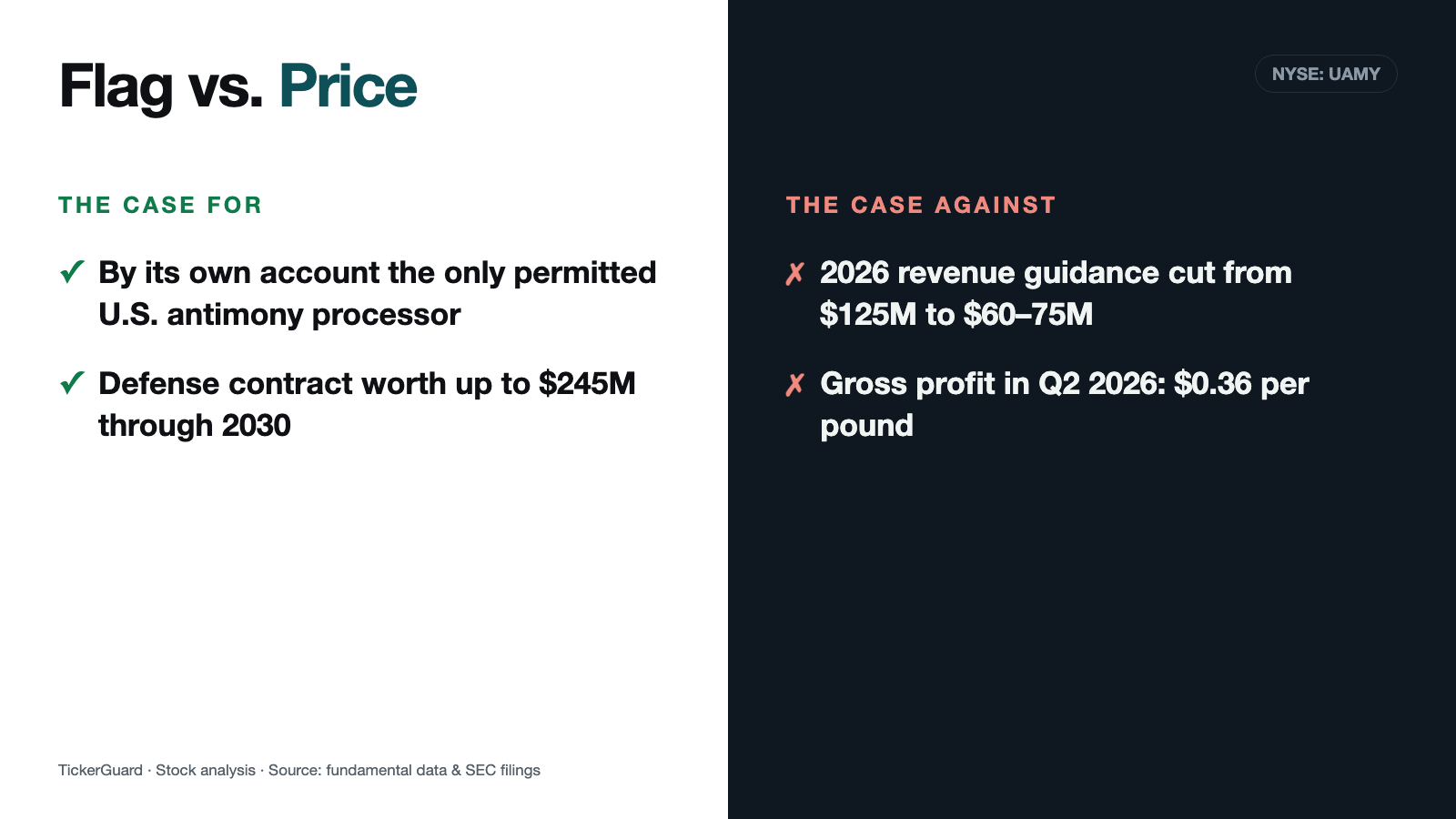
The case for United States Antimony:
- Strategic position: by its own account the only U.S. domestic operating, permitted antimony processor; DLA framework contract worth up to $245 million through September 2030 (per the latest 10-Q; the 2025 10-K said $248 million).
- Government support: a Department of War grant of up to $27.0 million, of which $16.2 million is obligated and $12.8 million was received in April 2026; applications for another $274 million filed (not awarded).
- A balance sheet with practically no financial debt ($0.3 million of equipment financing): $181.0 million of equity, $62.2 million of cash and debt securities plus a $43.2 million Larvotto stake (June 30, 2026).
- Build-out nearly done: Thompson Falls expansion substantially complete, Radersburg flotation mill commissioned, mining at Stibnite Hill, Montana, restarted in April 2026 per the company and continued since late July 2026 after regulatory approval.
- Zeolite is growing: second-quarter 2026 revenue up 110 percent to $1.9 million.
The case against:
- Earnings tied to the world price: $0.36 of gross profit per pound of antimony in the second quarter of 2026, consolidated gross margin of 7 percent.
- Guidance cut: 2026 revenue cut from $125 million to $60 million to $75 million after $14.7 million in the first half.
- No operating profit: first-half 2026 operating income of minus $14.5 million and an operating cash outflow of $20.7 million; the quarterly profit came from Larvotto mark-to-market gains.
- Dilution: share count up 39 percent since April 2024, build-out funded mainly with new shares since 2025.
- Controls: internal control over financial reporting not effective, an unresolved share-count discrepancy between transfer agent and depositary, a change in the finance chair in 2026 (per the 8-K unrelated to the results).
A human conclusion
Back to the flag trap from the beginning. Its core is not that the flag lies — antimony is important, the DLA really is buying, and the grant money did arrive. Its core is that a company’s importance spares you the question of whether it makes money. For 2026 the filings answer that question fairly clearly so far: 36 cents per pound in the second quarter, guidance cut by up to half, operating outflows covered with new shares, and a quarterly profit that came from an Australian share price. That the company has almost no debt and enough cash for the next few quarters is the good news — but buying a commodity with price risk does not turn into buying a Treasury bond.
The first test comes with the quarterly report for September 30, 2026: does it show the first DLA revenue, and is gross profit per pound clearly back above $0.36? Anyone buying today is therefore betting less on the Pentagon than on two other things: that the antimony price recovers, and that Thompson Falls, Radersburg and the company’s own ore push the cost per pound down far enough to leave something over even at low prices. The honest question is not “Does America need this company?” but: Would you still buy this stock if there were no flag on the sign — just the number $0.36 per pound? What you do with that is your decision. And that’s how it should be.
Sources
All original documents used in this analysis — so you can check for yourself:
- United States Antimony Corporation — SEC quarterly report 10-Q for June 30, 2026 (filed August 11, 2026)
- United States Antimony Corporation — Second-quarter 2026 earnings release with guidance cut (8-K of August 11, 2026, Exhibit 99.1) and conference call transcript (8-K of August 17, 2026, Exhibit 99.1)
- United States Antimony Corporation — SEC current report 8-K of August 19, 2026 (buyback program)
- United States Antimony Corporation — SEC current report 8-K of October 2, 2026 (CFO transition) and 8-K of June 8, 2026 (auditor change)
- United States Antimony Corporation — SEC quarterly report 10-Q for March 31, 2026 (filed May 14, 2026)
- United States Antimony Corporation — SEC annual report 10-K for 2025 (filed March 19, 2026) and 10-K for 2024 (filed March 20, 2025)
- United States Antimony Corporation — SEC current report 8-K of March 6, 2026 (move to the NYSE)
- Full SEC filing history: EDGAR overview (sec.gov)
- Fundamental data (closing prices, market value, analyst ratings, short interest; as of October 6, 2026), reconciled with the SEC filings and the SEC’s XBRL data series.
- Reddit mentions: ApeWisdom (as of October 6, 2026), surfaced by our in-house Reddit hype scanner. On tungsten, see also our analysis of Almonty Industries.
Transparency & disclaimer: This analysis is a journalistic assessment of publicly available information. It is not investment advice, not a financial analysis in the regulatory sense and not a solicitation to buy or sell securities. Investing in stocks involves substantial risk, up to and including total loss. All information without guarantee; data dates are noted in the text. Positions held by the operator are disclosed daily; where one exists, it appears as a notice at the top of this deep dive.
Key figures at a glance
All monetary figures in millions of $; earnings per share as reported.
| Metric | 2021 | 2022 | 2023 | 2024 | 2025 |
|---|---|---|---|---|---|
| Revenue | 7.7 | 11.0 | 8.7 | 14.9 | 39.3 |
| Operating Income (EBIT) | -0.7 | 0.3 | -7.1 | -2.4 | -8.9 |
| Net Income | -0.1 | 0.4 | -6.3 | -1.7 | -4.3 |
| Net Margin | -0.8% | 3.9% | -73.0% | -11.6% | -11.1% |
| Earnings Per Share | 0.00 $ | 0.00 $ | -0.06 $ | -0.02 $ | -0.04 $ |
Source: fundamental data & SEC filings (annual and quarterly reports, 10-K/10-Q)
Our Bottom Line at a Glance
- Strategic position positive
- By its own account the only U.S. domestic operating, permitted antimony processor; DLA framework contract up to $245 million through 09/2030 and a Department of War grant of up to $27.0 million ($16.2 million obligated, $12.8 million received in April 2026).
- Earning power negative
- Results hinge on the world price: Q2 2026 average price per pound $13.70 (−52%), cost $13.34 — $0.36 of gross profit per pound; H1 2026 operating income −$14.5 million, 2026 revenue guidance cut from $125 million to $60–75 million.
- Balance sheet & liquidity positive
- Equity of $181.0 million, practically no financial debt ($0.3 million equipment financing), $62.2 million in cash and debt securities plus a $43.2 million Larvotto stake (06/30/2026); by the company's own assessment sufficient for the next twelve months.
- Funding & dilution negative
- $110 million raised from stock and warrants in 2025, another $49.1 million net from at-the-market sales in H1 2026; share count up from 107.6 million (04/2024) to 149.7 million (08/2026). The buyback program of up to $100 million exceeds the $62.2 million of cash and debt securities on 06/30/2026.
- Controls & leadership negative
- Internal control over financial reporting not effective (10-K 2025, 10-Q Q2 2026), unresolved share-count discrepancy between transfer agent and depositary, change in the finance chair in 2026 (per the 8-K unrelated to the results), audit firm changed through an acquisition.
United States Antimony is strategically wanted and economically unprotected: the DLA contract (up to $245 million) and the grant from Washington secure access, not a price. In the second quarter of 2026 the company kept $0.36 of gross profit per pound, 2026 revenue guidance fell from $125 million to $60 million to $75 million, and the build-out has been funded mainly with new shares since 2025. The balance sheet carries practically no financial debt; the earning power is unproven. Not investment advice.
What Our Rating Means
Open questions
The business works in principle, but one material question is open. As long as it stays open, our findings do not carry a quality verdict.
Yellow, not red: no substance risk is documented — no going-concern warning, practically no financial debt ($0.3 million of equipment financing), $181.0 million of equity and $62.2 million of cash and debt securities as of June 30, 2026. The key operating question is open instead: whether the business can make money at low antimony prices. It has not done so in any of the last three years, and 2026 guidance was cut by up to half. Weak internal controls add to that. At a market value of about $591 million, the market is paying a lot of future for a business that does not set its own price. The decision is yours.
A journalistic assessment by our editorial team at the time of the deep dive, based on public sources — not investment advice and not a solicitation to buy or sell. Your personal circumstances (investment goals, risk capacity, taxes) cannot be taken into account. What our levels mean, how verdicts are formed, and what conflicts of interest exist →
Worth Noting
- United States Antimony made our research list via the Reddit hype scanner (ApeWisdom on October 6, 2026: 2 mentions in 24 hours, rank 181 after 562 the day before). It is not a hit from a financial-metrics screen.
- The stock has been listed on the New York Stock Exchange since March 11, 2026; the Form 25 of March 16, 2026 only withdrew the listing from NYSE American and is not a delisting. The company is now incorporated in Texas, no longer Montana.
- Valuation figures are dated and evergreen: market value of about $591 million from 149,669,384 shares (10-Q cover, 08/07/2026) × closing price of $3.95 (10/05/2026); the DLA maximum of $245 million (10-Q for 06/30/2026; $248 million in the 2025 10-K) is a ceiling, not a revenue expectation. The quarterly report for September 30, 2026 was not yet available at the data cut-off.
Stock Watch
This analysis is as of October 6, 2026. Stock Watch will tell you what's changed at UAMY since then.
Later $1 a month per stock — signing up is free, and you'll be the first to know when it launches.
The full analysis as a PDF for later
We will send you this analysis as a PDF — to print, file away, and read at your own pace. And we will add you to the free Stock Watch list for United States Antimony Corporation (UAMY), so you hear about it when something material in this analysis changes.
Frequently Asked Questions
United States Antimony Corporation (NYSE: UAMY), based in Dallas, processes antimony ore at Thompson Falls, Montana, and two smelters in Mexico into antimony oxide, metal and trisulfide, used as flame retardants, in batteries and in ammunition. It also recovers gold and silver from ore and mines zeolite in Idaho. By its own account it is the only U.S. domestic operating, permitted processor of antimony products.
The September 2025 framework contract with the Defense Logistics Agency has a maximum value of $245 million (per the June 30, 2026 10-Q; the 2025 10-K said $248 million) and runs through September 2030. No minimum purchase volume is guaranteed, and pricing is set with each delivery order. Per the filings, orders of about $12 million were received through January 2026; per CEO Evans on August 11, 2026, about $57.3 million were on the books. The first deliveries, about $2.6 million, are booked as revenue in the third quarter of 2026.
On August 11, 2026 the company cut guidance from $125 million to $60 million to $75 million. It cited the fall in the antimony price (spot above $28 per pound in late 2025, about $10.50 in the second quarter of 2026), later DLA deliveries tied to the Thompson Falls expansion and a different production and shipment cadence. First-half 2026 revenue was $14.7 million.
No. In 2025 it posted a net loss of $4.3 million on $39.3 million of revenue, and a loss of $11.2 million in the first half of 2026. First-half 2026 operating income was minus $14.5 million and operating cash outflow $20.7 million. The small second-quarter 2026 net income of $0.1 million came from a $6.8 million unrealized gain on the Larvotto stake.
Mostly with new shares. 2025 brought $110 million from stock sales and warrant exercises, and the first half of 2026 another $49.1 million net from at-the-market sales. The share count rose from 107.6 million (April 2024) to 149.7 million (August 2026). On June 30, 2026 it held $62.2 million in cash and debt securities and only $0.3 million of equipment financing as financial debt. On August 19, 2026 it added a buyback program of up to $100 million.
At the October 5, 2026 close of $3.95, the market value was about $591 million — roughly 15 times 2025 revenue and 3.3 times stockholders' equity. Cash, debt securities and the Larvotto stake account for about $105 million of that. There is no price-to-earnings ratio because there are no earnings.
Found an error?
Did you spot a factual error, an outdated number, or a typo in this deep dive? Let us know briefly — your report goes straight to the editorial team.