Almonty Industries: A record quarterly profit of C$181.8 million — and nobody paid C$173.1 million of it
Almonty Industries mines tungsten, the metal everybody suddenly wants: for munitions, armor and tool steel. The earnings release of August 11, 2026 reads like a triumph — revenue up 498 percent to C$43.0 million, net income of C$181.8 million, C$1.2 billion in cash. The same document says that C$173.1 million of that profit is a non-cash revaluation, that output at the only producing mine fell 20.8 percent, and that management considers its own disclosure controls not effective as of June 30, 2026. Not investment advice — just the question of what is left of a record once you hold it against the company's own filing.
 Thomas Mücke
Founder & Publisher
Thomas Mücke
Founder & Publisher
As of Today
As of: September 25, 2026
- Closing price
- 13.70 $ +10.60%
- Market Capitalisation
- 3.9 $B
- Growth Score
- 4/10
- AAQS
- 5/10
This analysis has a cut-off date. The Stock Guard tells you when something material changes in the numbers. Reserve your free spot
Chart
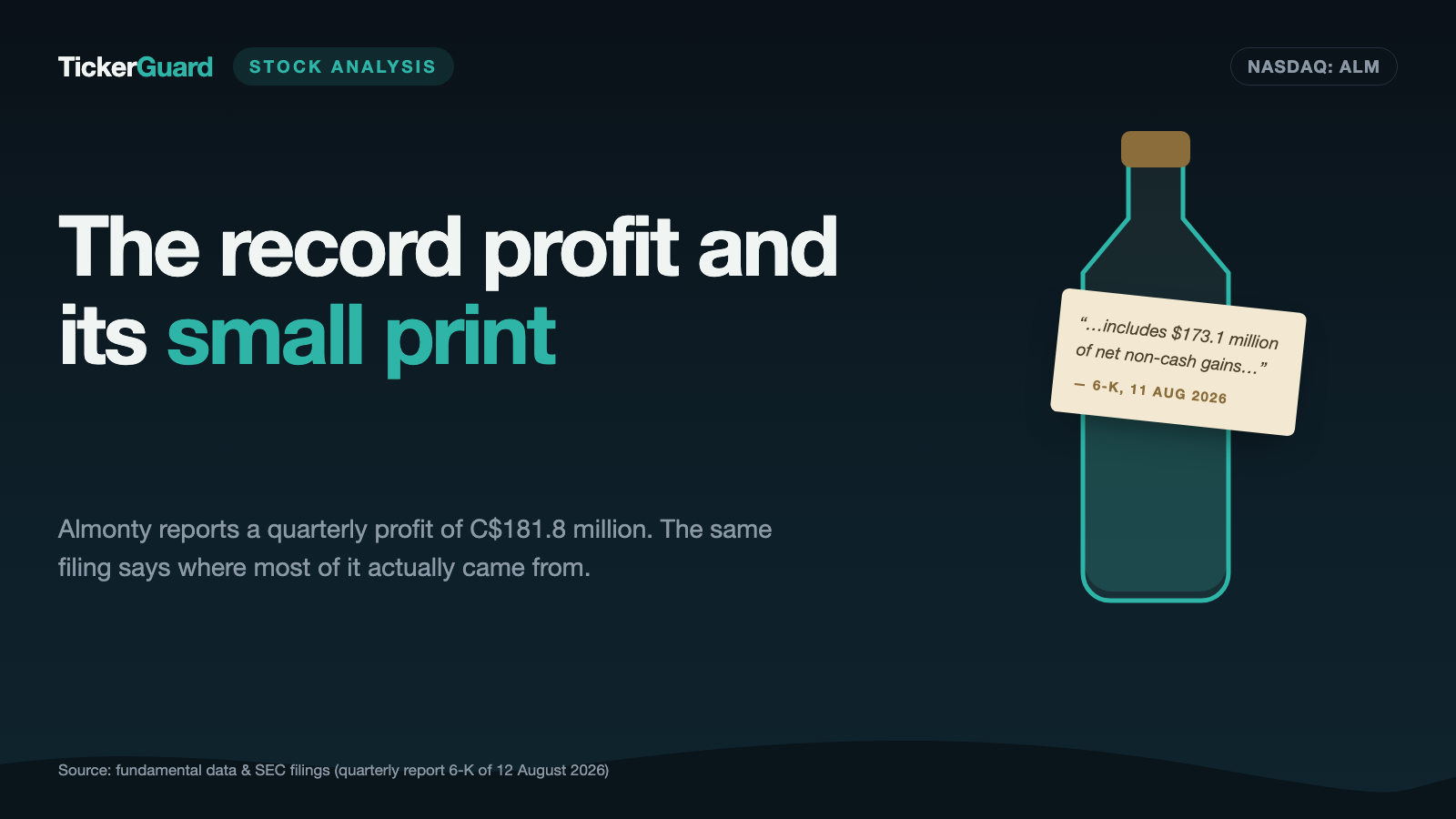
Interactive price chart (TradingView).
52-week range: 5.60 $ to 23.40 $ · Last price: 13.70 $ (As of: September 25, 2026)
Note: pure fact-based analysis, not investment advice and not a solicitation to buy or sell. All figures without guarantee.
There is an investor trap that springs precisely when everything looks good: the fanfare trap. It works like this — a company puts out a release with three superlatives in the headline. Revenue up 498 percent. Record profit. C$1.2 billion in cash. Your brain has finished its valuation before you reach the second paragraph. That is exactly what happened on August 11, 2026 at Almonty Industries (Nasdaq: ALM), a tungsten producer with mines in Portugal and South Korea. So let us make a deal: we read the same release again — this time to the end, together with the MD&A and the interim statements filed alongside it with the U.S. securities regulator, the SEC. Filings like these are honest under penalty of law. And this one describes a profit that mostly nobody paid, a revenue jump without any extra output, controls that management itself calls not effective — and a mine that still has to prove it can carry all of it. What you make of that is your decision.
What Almonty Industries actually does — one metal, two holes in the ground
Almonty mines tungsten. It is a heavy metal with the highest melting point of all metals (3,422 degrees Celsius), and it turns up wherever something has to stay hard while getting hot: drill bits and milling cutters, armor, armor-piercing munitions, electronics. What Almonty sells is not the pure metal but tungsten concentrate — crushed, upgraded ore. Its price tracks the APT price (ammonium paratungstate), quoted in U.S. dollars per MTU, a metric tonne unit equal to ten kilograms of tungsten trioxide. Clunky, but essential: almost everything at Almonty currently hangs on that one number.
Almonty owns five properties, and exactly one of them earns money today. That is the Panasqueira mine in Portugal, a century-old tin and tungsten operation whose exploitation concession runs for 60 years from December 16, 1992. The star of the story sits in South Korea: the Sangdong mine in Gangwon Province, historically one of the largest and highest-grade tungsten deposits in the world. Commercial mining started there in December 2025, but as of the MD&A dated August 11, 2026 the processing plant was still in commissioning and ramp-up, which the company expects to complete during the third quarter of 2026. Targeted throughput is around 640,000 tonnes of ore a year, with a fully permitted second phase contemplated at up to 1.2 million tonnes. Three more properties carry no current earnings: the Los Santos mine on care and maintenance and the Valtreixal project, both in Spain, plus the Gentung project in Beaverhead County, Montana, acquired in late 2025.
That sets the central tension of this analysis, and it runs through every chapter: the market is valuing Sangdong while the income statement shows Panasqueira. What appears in the numbers today comes from a mine whose output is falling; what carries the share price has yet to deliver.
One more move is worth knowing, because it explains why this share trades on Nasdaq at all. Almonty is a Canadian corporation under the Canada Business Corporations Act and therefore files with the SEC under the multijurisdictional disclosure system: an annual report on Form 40-F rather than a 10-K, and quarterly figures as exhibits to Form 6-K rather than a 10-Q. In April 2026 the company moved its head office from Toronto to Dillon, Montana; in July 2026 it left its home exchange in Toronto; and a formal redomiciling to the United States sits in the risk disclosures as "proposed". A Canadian miner is becoming an American one, step by step.
How the stock landed on our desk
Not through one of our valuation or momentum filters, but through the attention of German retail investors. In the hot list of the investor forum wallstreet-online, Almonty Industries ranked third with 60 posts in the 24-hour window on August 4, 2026 — just ahead of names such as Deutsche Rohstoff AG, which we have taken apart elsewhere and which draws a large part of its record 2026 result from selling exactly these Almonty shares. When a small-cap suddenly leads a German forum, that is not a buy signal; it is a sign that a story is running faster than the numbers. Keep the sentence handy: attention is a leading indicator of volatility, not of quality.
The story behind the attention is real, and it fits into one sentence: China controls most of the world's tungsten output, Western governments want that changed, and Almonty is one of very few listed producers outside China. The company describes itself as a supplier of "conflict-free tungsten" for defense and advanced technology. Whether that story supports the valuation will not be decided by the narrative but by the processing plant in Sangdong. So let us look at the numbers.
The numbers over the years — given their due
Start with what genuinely impresses, because there is plenty. Revenue was small and steady for years: C$22.5 million in 2023, C$28.8 million in 2024, C$32.5 million in 2025. A solid little mining business. In the first half of 2026 Almonty booked C$68.4 million — more than the whole of the prior year, in half the time. The second quarter alone brought C$43.0 million, more than the full years 2023 or 2024. Equally striking: an operating cash outflow of C$14.9 million in the first half of 2025 turned into an operating cash inflow of C$31.6 million in the first half of 2026. That is real money, not accounting.
Gross profit margin in the second quarter of 2026 stood at 60.7 percent of revenue, and income from mining operations at C$26.1 million, against a loss of C$0.9 million a year earlier. The balance sheet has been transformed: C$1.23 billion of cash as of June 30, 2026, up from C$268.4 million at the end of 2025. Total assets jumped from C$589.7 million to C$1,704.0 million and equity from C$357.8 million to C$551.8 million. This is what it looks like when a small producer becomes capital-markets ready overnight.
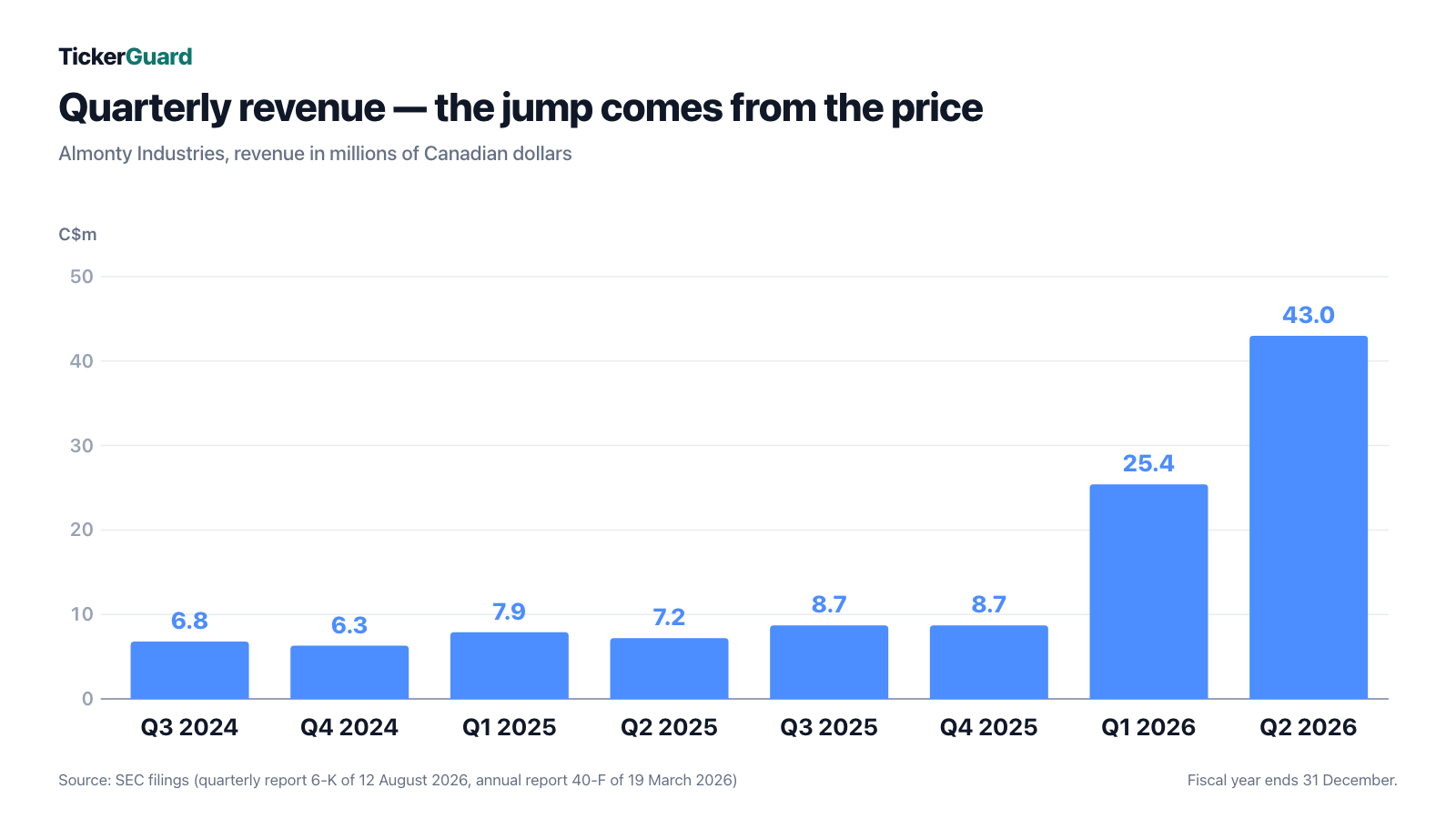
The series in plain text, each figure in millions of Canadian dollars: 6.8 in the third quarter of 2024, 6.3 in the fourth, 7.9 in the first quarter of 2025, 7.2 in the second, 8.7 in the third, 8.7 in the fourth — then 25.4 in the first quarter of 2026 and 43.0 in the second. Six quiet quarters, two loud ones. Where the break comes from is the next question.
One figure already clouds the picture, and we will see shortly why it matters: net income shows no trend at all, only swings. Minus C$8.8 million in 2023, minus C$16.3 million in 2024, minus C$161.9 million in 2025 — and then plus C$176.5 million in the first half of 2026. A company whose revenue moves between C$22 million and C$33 million cannot produce a C$162 million loss out of operations. It comes from somewhere else. Which brings us to the uncomfortable truths.
What the filings say — the uncomfortable truths
Uncomfortable truth no. 1: 95 percent of the record profit is accounting
The chief financial officer says it in the company's own release, and plainly enough to quote:
"Reported net income of $181.8 million includes $173.1 million of net non-cash gains on the revaluation of derivative and warrant instruments, which are a function of IFRS fair value accounting on our convertible instruments and capped calls."
— Almonty Industries Inc., Jorge Beristain (Chief Financial Officer), Form 6-K filed August 12, 2026, exhibit 99.1 (earnings release dated August 11, 2026)

What does that mean in practice? In June 2026 Almonty issued a convertible bond — debt the holder may later exchange for shares. Because the company can choose whether to settle a conversion in shares or in cash, IFRS does not treat that conversion feature as equity but as a liability that is remeasured at every reporting date. And that liability tracks the company's own share price. In everyday terms: you have promised someone the option to buy your car at a fixed price. If the market value of your car falls, your promise becomes less valuable to them — and you get to book that decline as a gain, even though no money moved and your car is worth less than before.
That is exactly what happened. The interim statements disclose the valuation inputs: on the trade date of the notes, June 4, 2026, the share price was $20.68; at the June 30, 2026 reporting date it was $16.56. The price fell about a fifth in those three weeks — and that produced a C$204.4 million revaluation gain on the embedded derivative liability. Keep this sentence: a large part of this quarter's record profit is the consequence of the company's own share price falling. If the price recovers next quarter, the same mechanism turns into an equally large book loss.

The second chart shows how the record is assembled — from the measure the company itself presents for the operating business all the way down to the bottom line:
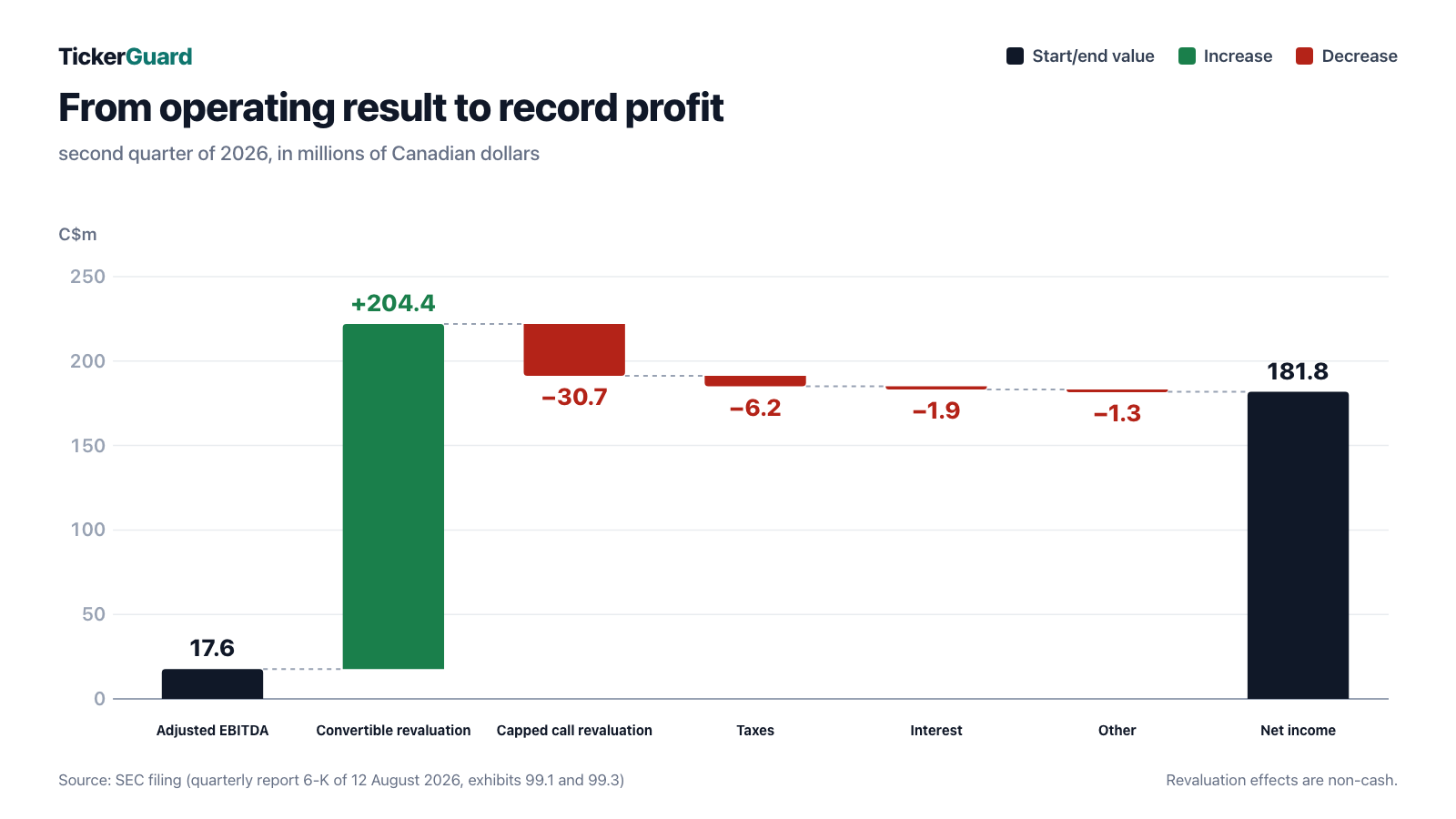
The bridge in figures, all in millions of Canadian dollars: adjusted EBITDA of 17.6, plus 204.4 from the revaluation of the convertible; from that, 30.7 for the revaluation of the capped calls, plus 6.2 of taxes, 1.9 of interest and 1.3 for everything else (share-based compensation, warrants, currency effects, depreciation). What remains is the reported 181.8. Only the first and the last figure make it into the headline.
A word on fairness: the company hides nothing. The full reconciliation from net income to adjusted EBITDA sits in the release, and the valuation inputs sit in the notes. But they sit below the headline — and the headline is what sticks. That is precisely why this trap is called the fanfare trap.
Uncomfortable truth no. 2: the revenue jump is price, and output is falling
Revenue growth of 498 percent sounds like a mine running flat out. The MD&A says the opposite:
"Production at the Panasqueira Mine during the three months ended June 30, 2026 decreased by 20.8% compared to the three months ended June 30, 2025."
— Almonty Industries Inc., Form 6-K filed August 12, 2026, exhibit 99.3 (MD&A), section 4

The answer sits two paragraphs further on: the average European APT price rose from $453 per MTU in the second quarter of 2025 to $3,075 in the second quarter of 2026 — almost sevenfold. The sequential jump from the first to the second quarter of 2026 (C$25.4 million to C$43.0 million, up 69 percent) also came with 21.1 percent fewer MTUs sold. The entire second-quarter revenue increase was attributable to Panasqueira: C$35.8 million, exactly the group's gain. Sangdong contributed no revenue in the reporting quarter.
This is not an accusation — a miner earns on the commodity price, and today's tungsten price is real. But it changes the question you ask of this stock. It is not "how fast is the company growing?" but rather: how long does the price hold, and what is left if it does not? A fifth less output at nearly seven times the price makes a record quarter only for as long as the price stays up. And tungsten prices are historically anything but stable.
Uncomfortable truth no. 3: management considers its own controls not effective
This passage sits on page 21 of the MD&A, far behind the good numbers, and it is the most serious finding in this analysis:
"Based on this evaluation, management concluded that the Company's disclosure controls and procedures were not effective as of June 30, 2026, due to the continuing impact of previously identified material weakness in ICFR."
— Almonty Industries Inc., Form 6-K filed August 12, 2026, exhibit 99.3 (MD&A), section 14

What is a material weakness? The filing supplies the definition: a gap in the control system where there is more than a remote likelihood that a material misstatement of the financial statements will occur and go undetected before publication. Specifically, Almonty names ineffective design of controls over the financial statement close process, insufficient segregation of duties in transaction processing, and gaps in system data integrity. In everyday terms: too few people perform too many steps alone in accounting, and there are too few points at which a mistake would be caught.
The company is working on it: it has engaged an outside firm, is expanding the accounting team and expects the assessment to be substantially completed in the third quarter of 2026. Management also states that it reviewed every significant and non-routine adjustment of the half-year and believes the statements are fairly presented. Even so: believing a record profit means believing the control system that produced it. And the company itself rates that system as not effective. One piece of the puzzle sits in the annual report: as of December 31, 2025 the corporate office employed three full-time staff, plus five full-time and one part-time consultant. Of 341 employees, 245 worked at Panasqueira and 82 at Sangdong. For a group with more than a billion Canadian dollars in cash, that is a very lean head office — which explains a good deal. Fitting alongside it: key management compensation rose to C$6.4 million in the first half of 2026, from C$1.7 million a year earlier, and general and administrative expenses doubled in the second quarter to C$8.9 million. The company attributes this to building out the management team and expects a normalization.
Uncomfortable truth no. 4: the whole story hangs on a mine in a foreign legal system
Sangdong is why this stock is valued the way it is. And Sangdong sits in South Korea, held through the subsidiary Almonty Korea Tungsten Corporation. The MD&A carries an emerging-market issuer section containing two sentences worth reading. The first concerns the mining rights:
"However, if the Minister of Trade, Industry and Energy (the "Minister") deems the mining operation to be detrimental to the public interest or interfering with projects of national importance, the Minister has the power to revoke the mining rights or order a reduction of the mining area in accordance with Article 34 of the Mining Industry Act."
— Almonty Industries Inc., Form 6-K filed August 12, 2026, exhibit 99.3 (MD&A), section 17
The second is disarmingly candid and concerns the people who are meant to run the project:
"The Board of Directors and officers of Almonty have some but generally limited experience conducting business in Korea."
— Almonty Industries Inc., Form 6-K filed August 12, 2026, exhibit 99.3 (MD&A), section 17
Neither is a scandal; both are ordinary risks of a foreign project — but they belong in the calculation. A single mine in a foreign legal system, run by a team that describes its own country experience as limited, currently carries most of the valuation. For balance: Almonty has secured a long-term offtake agreement for phase I concentrate from Sangdong with Global Tungsten & Powders, a member of Austria's Plansee Group. On July 14, 2026 that agreement was extended and improved: six more years of term, 40 percent more contracted volume and roughly 6.3 percent better pricing across all contracted volumes. That is a genuine seal of approval — and a concentration risk, because the sales side of the key mine rests on one customer.
Cash, debt and your slice of the cake
The C$1.23 billion in the bank was not earned; it was borrowed and raised. In order: the Nasdaq listing on July 15, 2025 brought gross proceeds of $90 million, a further placement in December 2025 added gross $129.4 million, and on June 9, 2026 came the big one — $800 million of convertible senior notes at 2.25 percent, maturing July 1, 2031. Long-term debt therefore rose from C$162.1 million at the end of 2025 to C$813.1 million as of June 30, 2026. On the other hand, Almonty repaid its EUR 14.7 million KfW IPEX-Bank term loan in full on July 15, 2026.
Now to dilution — the effect that makes your slice of the cake smaller because the cake is cut into more pieces. Shares outstanding rose from 176.9 million on December 31, 2024 to 262.8 million a year later and 288.1 million as of June 30, 2026; the MD&A of August 11, 2026 reported 288.5 million. That is roughly 63 percent more shares in eighteen months. The convertible adds to it: at a conversion rate of 36.4950 shares per $1,000 of principal, it represents about 29.2 million additional shares, a good ten percent on top, once the price clears the $27.40 conversion price for good.
A detail for connoisseurs: Almonty simultaneously paid $94.8 million for capped calls — hedges meant to soften the dilution up to a cap price of $41.36. That is close to twelve percent of the money raised, gone immediately. As of June 30, 2026 that hedge was worth only $72.6 million — a book loss of C$30.7 million within three weeks, which you can see as the second red bar in the waterfall chart above.
Valuation — orders of magnitude, not a daily price
Let us use the numbers in the filing rather than a screen quote. As of June 30, 2026 there were 288.1 million shares outstanding, and the interim statements disclose a share price of $16.56. That implies a market capitalization on the order of $4.8 billion at that date, against revenue of C$68.4 million for the first half. Even annualizing the second quarter (C$43.0 million, so C$172 million or roughly $125 million), the price-to-sales ratio lands around 38. For scale: even fast-growing software companies rarely trade above 15, and miners typically sit in the low single digits.
That does not make the valuation wrong; it means the valuation already contains Sangdong at full capacity and a permanently high tungsten price. A price-to-earnings ratio cannot be built honestly: reported earnings consist mostly of revaluation effects, and each of the past three full fiscal years ended in a loss. Adjusted EBITDA of C$17.6 million in the second quarter of 2026 annualizes to roughly C$70 million — against a market capitalization of $4.8 billion. Keep the order of magnitude in mind: the market is not paying for the current business, it is paying for the second mine.
A note on the analyst view: the consensus price target stood at roughly $25 at the data cutoff of August 12, 2026. That too is an opinion with a date, and it rests on the same assumptions about Sangdong and the tungsten price that the market capitalization contains. For a second opinion, look at our analysis of Hensoldt: it shows how defense demand actually converts into orders and revenue in an established business — and how long the road runs from political will to a paid invoice.
Opportunities and risks at a glance
What speaks for Almonty:
- Strategic position: tungsten is designated a critical raw material in both the United States and the European Union, and China dominates supply. Almonty produces in Portugal, is building Sangdong in South Korea and holds a project in Montana.
- Proven price leverage: C$43.0 million of second-quarter 2026 revenue turned into C$26.1 million of income from mining operations at a 60.7 percent gross profit margin. The model scales with the price.
- Funding secured: C$1.23 billion of cash as of June 30, 2026, the KfW loan repaid in full in July 2026, and the convertible not due until 2031 at a modest 2.25 percent coupon.
- Offtake contracted and improved: the agreement with Global Tungsten & Powders was extended by six years on July 14, 2026, with contracted volume up 40 percent and pricing improved by roughly 6.3 percent.
- Real operating cash: an inflow of C$31.6 million in the first half of 2026, after an outflow of C$14.9 million a year earlier — cash, not a revaluation.
What speaks against it:
- Earnings quality: C$173.1 million of the C$181.8 million quarterly profit is non-cash and reverses as soon as the share price recovers. Net income is not a usable yardstick at Almonty.
- Controls not effective: management rates its own disclosure controls "not effective" as of June 30, 2026; the material weakness in financial reporting persists and remediation is still under way.
- Dependence on one price: the entire revenue jump came from the APT price ($453 to $3,075 per MTU in the year-on-year second-quarter comparison) while output fell 20.8 percent. If the price falls, the business falls with it.
- Sangdong does not deliver yet: the processing plant was in commissioning as of August 11, 2026, with completion announced for the third quarter of 2026. Until then all revenue comes from a century-old mine in Portugal.
- Dilution: 63 percent more shares in eighteen months, plus roughly 29.2 million potential shares from the convertible. Anyone buying today shares future profits with far more owners than in 2024.
- The valuation front-runs success: a price-to-sales ratio near 38 on the annualized second quarter assumes everything works and the price stays high.
A human conclusion
Remember the fanfare trap from the opening? It works precisely because it does not lie. Everything in the headline is true: revenue really did rise 498 percent, net income really is C$181.8 million, the cash pile really is full. The trap is not falsehood but sequence — the three good numbers sit at the top, the explanations sit below. And our brains stop reading the moment they have a verdict.
What is left if you read to the end? A company with a genuine, scarce asset — tungsten outside China, a customer of standing, a mine in South Korea that could one day earn a great deal of money. And beside it a quarterly report in which the profit is mostly a valuation formula, output is falling, the head office counts three full-time staff and the company's own controls are rated not effective. Both are true. Both sit in the same document.
So the decisive question is not whether Almonty is a good or a bad company, but what proof you want to see before you believe the story. The next quarterly report supplies it: is there a revenue contribution from Sangdong? Does the gross margin hold if the price stops rising? And has the material weakness in financial reporting been remediated? Until then the simplest lesson of this analysis applies: read the line underneath the headline. What you make of that is your decision. And that is exactly as it should be.
Sources
- Almonty Industries, Form 6-K filed August 12, 2026, exhibit 99.1 — second-quarter 2026 earnings release (dated August 11, 2026)
- Almonty Industries, Form 6-K filed August 12, 2026, exhibit 99.2 — unaudited interim condensed consolidated financial statements as of June 30, 2026 (notes 10 and 11)
- Almonty Industries, Form 6-K filed August 12, 2026, exhibit 99.3 — management's discussion and analysis for the second quarter of 2026 (sections 3, 4, 5, 6, 7, 9, 14 and 17)
- Almonty Industries, Form 40-F annual report for fiscal 2025 (filed March 19, 2026)
- Almonty Industries, Annual Information Form 2025 (exhibit 99.1 to the Form 40-F) — employees, concessions, project chronology
- Almonty Industries, fiscal 2025 management's discussion and analysis (exhibit 99.3 to the Form 40-F) — multi-year summary
- SEC EDGAR, filing index for Almonty Industries Inc. (CIK 0001670061)
- Fundamental data: master data, share-count cross-check and analyst consensus, data cutoff August 12, 2026
- Hook: wallstreet-online hot list, retrieved August 4, 2026, 24-hour window (Almonty Industries third with 60 posts)
Legal notice: this article is journalistic research and analysis. It is not investment advice and not a solicitation to buy or sell securities. All figures come from the primary sources linked above and carry their own date; prices and ratios may have changed since the data cutoff. Shares in mining companies can suffer severe losses up to the total loss of the capital invested — particularly where the business depends on a single commodity price and a single project. Positions held by the operator are disclosed daily; where one exists, it appears as a notice at the top of this deep dive.
Key figures at a glance
All monetary figures in millions of C$; earnings per share as reported.
| Metric | 2021 | 2022 | 2023 | 2024 | 2025 |
|---|---|---|---|---|---|
| Revenue | 20.8 | 24.8 | 22.5 | 28.8 | 32.5 |
| Operating Income (EBIT) | -5.1 | -7.4 | -5.9 | -6.9 | -28.2 |
| Net Income | -7.8 | -14.5 | -8.8 | -16.3 | -161.9 |
| Net Margin | -37.2% | -58.4% | -39.3% | -56.5% | -498.0% |
| Earnings Per Share | -0.06 C$ | -0.10 C$ | -0.06 C$ | -0.10 C$ | -0.78 C$ |
Source: fundamental data & SEC filings (annual and quarterly reports, 10-K/10-Q)
Our Bottom Line at a Glance
- Market position & commodity positive
- Tungsten is designated a critical raw material in the United States and the European Union, and supply is dominated by China. Almonty produces in Portugal, is building the Sangdong mine in South Korea (target 640,000 tonnes of ore a year, permitted phase II up to 1.2 million tonnes) and holds a project in Montana. The offtake agreement with Global Tungsten & Powders was extended by six years on July 14, 2026, with volume up 40 percent and pricing improved by roughly 6.3 percent.
- Earnings quality negative
- Of C$181.8 million of net income in the second quarter of 2026, C$173.1 million came from non-cash revaluations of derivative and warrant instruments (earnings release of August 11, 2026). The C$204.4 million revaluation gain arose because the company's own share price fell between June 4 ($20.68) and June 30, 2026 ($16.56). On an adjusted basis, C$17.6 million of EBITDA remained.
- Operating substance neutral
- The running business does carry: C$26.1 million of income from mining operations in the second quarter of 2026 at a 60.7 percent gross profit margin, and C$31.6 million of operating cash inflow in the first half after an outflow of C$14.9 million a year earlier. But it carries only through price: Panasqueira production fell 20.8 percent, and Sangdong contributed no revenue in the reporting quarter.
- Balance sheet & funding positive
- C$1,227.2 million of cash as of June 30, 2026 against C$813.1 million of long-term debt; the $800 million convertible carries a 2.25 percent coupon and does not mature until July 1, 2031, and the EUR 14.7 million KfW loan was repaid in full on July 15, 2026. Equity rose from C$357.8 million to C$551.8 million.
- Dilution negative
- Shares outstanding rose from 176,947,216 (December 31, 2024) through 262,776,228 (December 31, 2025) to 288,480,750 (MD&A of August 11, 2026) — roughly 63 percent in eighteen months. At 36.4950 shares per $1,000 of principal, the convertible represents about 29.2 million more shares. Hedging that dilution cost $94.8 million, whose fair value had fallen to $72.6 million by June 30, 2026.
- Control environment & governance negative
- Management rates its disclosure controls as not effective as of June 30, 2026, citing a continuing material weakness in internal control over financial reporting (close process, segregation of duties, data integrity). The corporate office employed three full-time staff as of December 31, 2025. Key management compensation rose to C$6.4 million in the first half of 2026, from C$1.7 million a year earlier.
Almonty Industries is the fanfare trap in pure form: the headline of the earnings release of August 11, 2026 carries three correct numbers — revenue up 498 percent to C$43.0 million, net income of C$181.8 million, C$1.2 billion of cash — and the explanations sit underneath. There you learn that C$173.1 million of that profit is non-cash and stems from the company's own falling share price, that output at the only producing mine fell 20.8 percent while the whole revenue jump came from the tungsten price ($453 to $3,075 per MTU), and that the company rates its own disclosure controls as not effective as of June 30, 2026. The strategic value of the commodity is real, the cash is real, the offtake is real — but none of it has yet been proven by Sangdong, and the valuation already front-runs the proof. Not investment advice.
What Our Rating Means
Open questions
The business works in principle, but one material question is open. As long as it stays open, our findings do not carry a quality verdict.
The business works in principle and is comfortably funded: C$1.23 billion of cash as of June 30, 2026, C$31.6 million of operating cash inflow in the first half, and an extended and improved offtake agreement. It is yellow rather than green for two operating reasons: earnings depend almost entirely on the tungsten price while output is falling, and the second, decisive mine has not finished its ramp-up. On top of that sits a control environment the company itself calls not effective as of June 30, 2026 — not a solvency risk while the cash pile is full, but a reason to check every reported figure twice. Red would overstate it and green would be premature: the burden of proof rests on the next quarterly report. The decision is yours.
A journalistic assessment by our editorial team at the time of the deep dive, based on public sources — not investment advice and not a solicitation to buy or sell. Your personal circumstances (investment goals, risk capacity, taxes) cannot be taken into account. What our levels mean, how verdicts are formed, and what conflicts of interest exist →
Worth Noting
- Almonty Industries reached our research list through the hot list of the German investor forum wallstreet-online: third place with 60 posts in the 24-hour window (retrieved August 4, 2026). That is an attention signal, not a valuation signal.
- Almonty reports under IFRS in Canadian dollars but trades in U.S. dollars. All amounts in this analysis are Canadian dollars unless explicitly marked as U.S. dollars — which applies in particular to the convertible notes ($800 million), the capped calls ($94.8 million) and every share price.
- The market capitalization does not come from the data feed but from the filing itself: 288,109,013 shares times $16.56 as of June 30, 2026 gives roughly $4.8 billion. The feed value deviated by more than one fifth and was therefore discarded, together with every ratio derived from it.
- Not to be confused: Almonty Industries (Nasdaq: ALM) is not the same company as Deutsche Rohstoff AG, which booked a substantial part of its 2026 result from selling Almonty shares. The filings of one company say nothing about the share price of the other.
Stock Watch
This analysis is as of August 26, 2026. Stock Watch will tell you what's changed at ALM since then.
Later $1 a month per stock — signing up is free, and you'll be the first to know when it launches.
The full analysis as a PDF for later
We will send you this analysis as a PDF — to print, file away, and read at your own pace. And we will add you to the free Stock Watch list for Almonty Industries Inc. (ALM), so you hear about it when something material in this analysis changes.
Frequently Asked Questions
Almonty Industries Inc. (Nasdaq: ALM) mines and sells tungsten concentrate. Only the Panasqueira mine in Portugal currently generates revenue. The central project is the Sangdong mine in South Korea, which began commercial mining in December 2025; its processing plant was still in commissioning as of August 11, 2026. The company also holds the Los Santos mine on care and maintenance and the Valtreixal project in Spain, plus the Gentung project in Montana.
Because the profit is mostly bookkeeping. Of the C$181.8 million of net income in the second quarter of 2026, roughly C$173.1 million came from non-cash revaluations of derivative and warrant instruments, according to the earnings release of August 11, 2026. The convertible notes issued in June 2026 are carried under IFRS as a liability whose value tracks the company's own share price. Adjusted EBITDA came to C$17.6 million.
From the price. The average European APT tungsten price rose from $453 per MTU in the second quarter of 2025 to $3,075 in the second quarter of 2026. Over the same comparison, production at the Panasqueira mine fell 20.8 percent, and 21.1 percent fewer MTUs were sold than in the first quarter of 2026. The entire revenue increase of C$35.8 million was attributable to Panasqueira.
Almonty is a Canadian corporation and files under the multijurisdictional disclosure system. Instead of a U.S.-style annual report (10-K) it files an annual report on Form 40-F, most recently on March 19, 2026 for fiscal 2025. Instead of quarterly reports (10-Q), quarterly figures appear as exhibits to Form 6-K, most recently on August 12, 2026 for the second quarter of 2026. The fiscal year ends on December 31.
Management rates its own disclosure controls as not effective as of June 30, 2026. The filing names ineffective design of controls over the financial statement close process, insufficient segregation of duties in transaction processing, and gaps in system data integrity. Almonty has engaged an outside firm, is expanding its accounting team and expects the assessment to be substantially completed in the third quarter of 2026.
The convertible senior notes issued in June 2026 total $800 million at 2.25 percent and mature on July 1, 2031. The conversion rate is 36.4950 shares per $1,000 of principal, which equals a conversion price of about $27.40 per share and roughly 29.2 million potential new shares — a good ten percent of the 288.5 million shares reported on August 11, 2026. Almonty also paid $94.8 million for capped calls with a cap price of $41.36.
Almonty voluntarily consolidated its listings. The head office moved from Toronto to Dillon, Montana in April 2026. The Toronto Stock Exchange listing ended at the close of trading on July 31, 2026, and removal from the Australian ASX was announced for September 1, 2026, with the depositary interests trading there for the last time on August 28, 2026. The shares now trade on Nasdaq and in Frankfurt.
Not on the figures in the filing. As of June 30, 2026, 288.1 million shares stood against the $16.56 share price disclosed in the interim statements — a market capitalization of roughly $4.8 billion. Annualizing the second quarter of 2026 (C$43.0 million of revenue) gives a price-to-sales ratio of about 38. A price-to-earnings ratio cannot be built honestly, because there is no dependable profit.
Found an error?
Did you spot a factual error, an outdated number, or a typo in this deep dive? Let us know briefly — your report goes straight to the editorial team.