Mutares Pays a €2 Dividend — and Warns in Its Own Report of a Financing Risk That Could Threaten the Company
Mutares buys struggling businesses, fixes them and sells them on. In the first half of 2026 the holding company, whose profit funds the dividend, posted a loss of €3.1 million because planned sales slipped. Group earnings are still made up largely of accounting gains on cheap acquisitions. And management itself sees a financing risk that could threaten the company as a going concern: a bond covenant was breached at the end of 2025, and a €232.3 million bond comes due on March 31, 2027. We read the half-year and annual reports and worked out what the payout really rests on.
 Thomas Mücke
Founder & Publisher
Thomas Mücke
Founder & Publisher
Chart
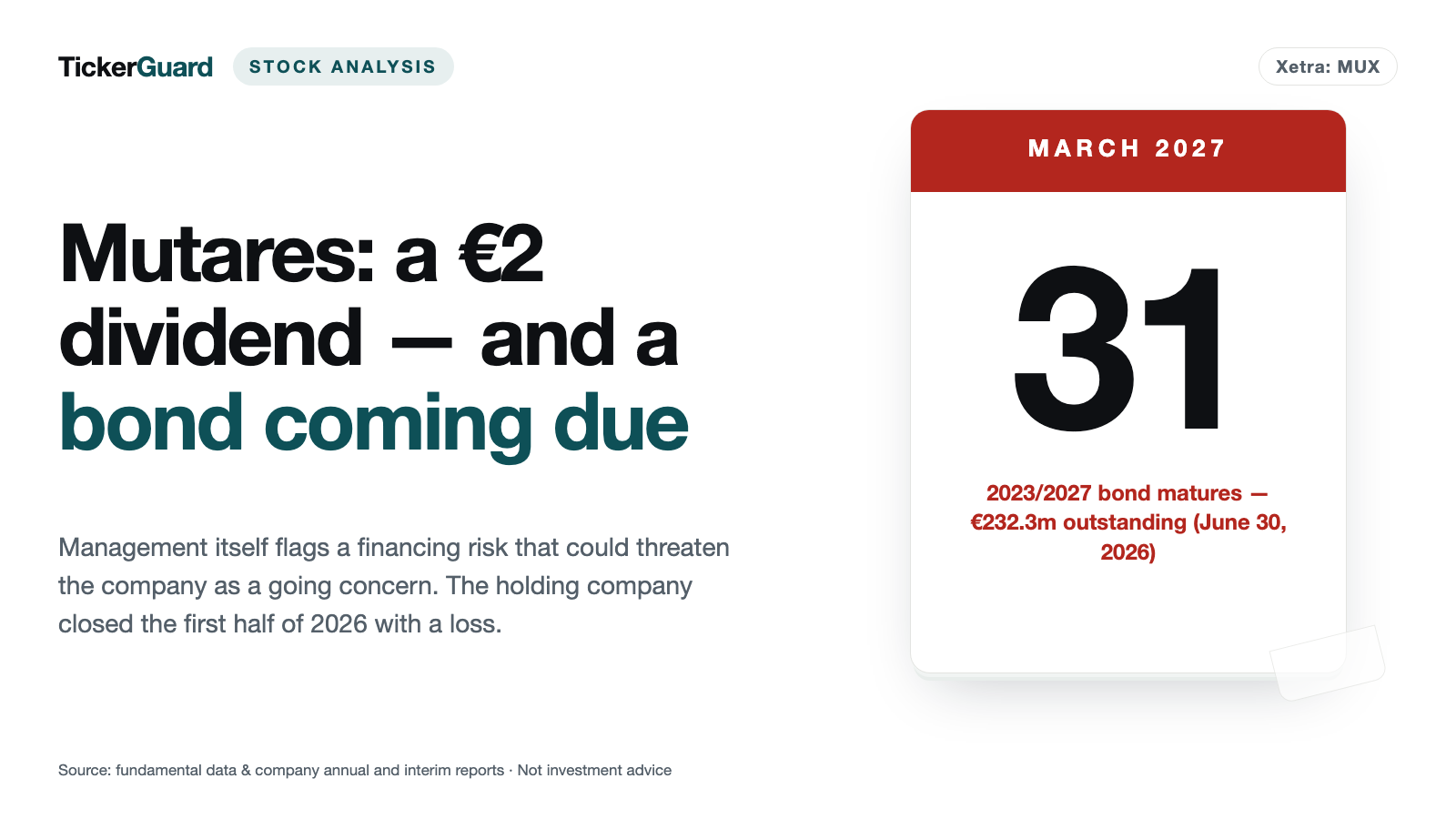
Interactive price chart (TradingView).
Note: pure fact-based analysis, not investment advice and not a solicitation to buy or sell. All figures without guarantee.
Some numbers lodge in our heads before we have even started thinking. With Mutares, it is this one: a €2.00 dividend per share. At €24.30 on September 25, 2026, that works out to a yield of about 8.2 percent. Psychologists call it the anchoring effect: the first striking number becomes the yardstick for everything that follows, and whatever does not fit it drifts to the edge of our attention. Someone with “8 percent” anchored in their mind reads a half-year report differently from someone without it.
So let's do it the other way round. We put the anchor aside for a moment and read what Mutares itself reports: the Interim Financial Report 2026, published in mid-August 2026, the results release of August 4, 2026, and the Annual Report 2025. The tension running through this analysis is simple: the dividend is real and was paid in July 2026 — but it depends on company sales that have been delayed, and on a refinancing that management itself describes as a possible risk to the company's survival. In the end, the call is yours.
What Mutares actually does — a turnaround investor with two wallets
Mutares, based in Munich, is a listed investor in turnaround situations. The pattern is always the same: a large corporation wants to get rid of a unit that is losing money or no longer fits. Mutares buys it — often for a token price — sends in its own consultants, cuts costs, looks for new customers and sells the business again a few years later. As of June 30, 2026, the portfolio held 35 companies, from auto suppliers through energy and infrastructure engineering to retail and, since 2026, chemicals; the group employed more than 35,000 people, the holding company itself including its country subsidiaries about 250.
One distinction matters for everything that follows, because Mutares has two wallets. The first is the group: every company it buys is fully consolidated into the group accounts under international accounting standards (IFRS). That is where the multi-billion revenue comes from — €6.5 billion in fiscal 2025 — along with large accounting effects on acquisitions. The second is the holding company, Mutares SE & Co. KGaA itself. It reports under German commercial law (HGB) and earns consulting fees it charges its subsidiaries, dividends from them and above all proceeds from sales. The dividend is paid out of this holding company's profit, and this holding company owes the two bonds. Think of it this way: the group is the repair shop with every car on the lot, the holding company is the owner's wallet. How many cars are on the lot tells you little about what is in the wallet.
Company history for investors
-
2025
Steyr Motors sold off completely
The sale carried the holding company's first half of 2025 (+€69.8M) and full-year net income of €130.4M — proof of how much the dividend depends on sales.
-
2025
Bond covenant breached at year-end
Group debt-to-equity ratio not met; the auditor added a section on going-concern uncertainty to its opinion.
-
2026
April: 20 percent capital increase
4,269,651 new shares at €24.50, €104.6M gross. The share count rises to 25,617,907, and the Laik family's stake falls to about 21 percent.
-
2026
June: covenants met again
After a bondholder waiver until 06/29/2026, all bond ratios are met again at 06/30/2026; €17.9M of the 2023/2027 bond bought back.
-
2026
August: half-year with a holding company loss
Holding company −€3.1M, guidance of €165–200M confirmed. Management sees a financing risk that could threaten the going concern. SABIC plastics business acquired.
-
2026
September: NEM sale and refinancing plan
Sale of NEM Energy Group completed (09/09), buyback offer and planned Q4 refinancing of the 2023/2027 bond announced (09/25).
How the stock landed on our desk
Honestly: not through our in-house stock scanner, which primarily covers U.S. listings. Mutares is one of the German small caps that retail investors discuss most, mainly because of the dividend; as of June 30, 2026, the company counted about 24,200 shareholders in its share register, up from about 18,500 a year earlier. Our German sister publication first analyzed Mutares in July 2026 based on the Annual Report 2025; this English edition is based on the fully revised version after the half-year report. That revision also added passages from the Annual Report 2025 that the first version had missed — above all the auditor's note on the company's ability to continue as a going concern, which we come to below.
If you have followed Mutares for a while, you know one of its biggest exit stories from one of our own analyses: the engine maker Steyr Motors, which Mutares took public in 2024 and sold off completely in 2025 (see our Steyr Motors stock analysis). That sale carried the holding company's first half of 2025 — and a sale of that kind was exactly what the first half of 2026 lacked.
Update: what the first half of 2026 shows
First, the group figures Mutares reported on August 4, 2026. Revenue rose 9 percent to €3,383.6 million in the first half of 2026 (prior year: €3,106.3 million), driven mainly by acquisitions; the first quarter contributed €1,678.7 million, the second by calculation €1,704.9 million. Reported EBITDA — earnings before interest, taxes, depreciation and amortization — fell from €598.2 million to €348.8 million. The measure Mutares itself calls more meaningful, EBITDA adjusted for acquisition and disposal effects, swung from minus €88.5 million to plus €66.7 million. Group net income came to €98.0 million (prior year: €270.5 million), including €33.1 million of deferred tax income. Cash flow from operating activities was minus €145.8 million (prior year: minus €92.7 million).
Now the holding company, which is what matters for the dividend. Here the half was clearly weak: consulting revenue fell from €53.4 million to €48.8 million, the holding company's EBITDA swung from plus €3.1 million to minus €9.2 million, and the financial result — where gains on sales land — collapsed from €69.4 million to €6.8 million. Net income of the holding company under German GAAP: minus €3.1 million, after plus €69.8 million in the first half of 2025. With minus €0.9 million in the first quarter, that leaves minus €2.2 million for the second quarter by calculation. By its own rounded figures, Mutares strips out about €10 million of capital-markets costs for the capital increase and the bondholder consent procedure and reports an adjusted result of €6.0 million.
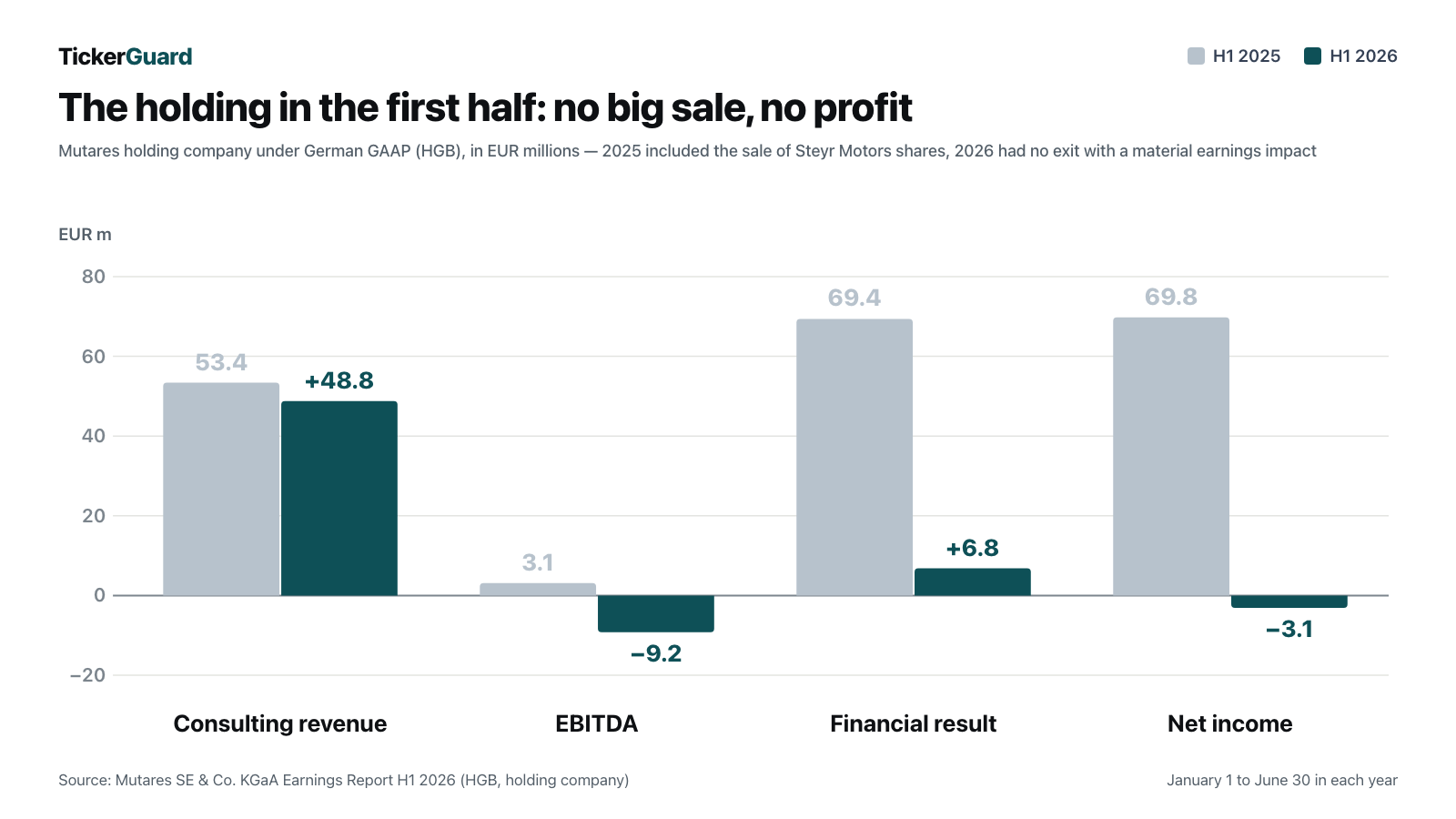
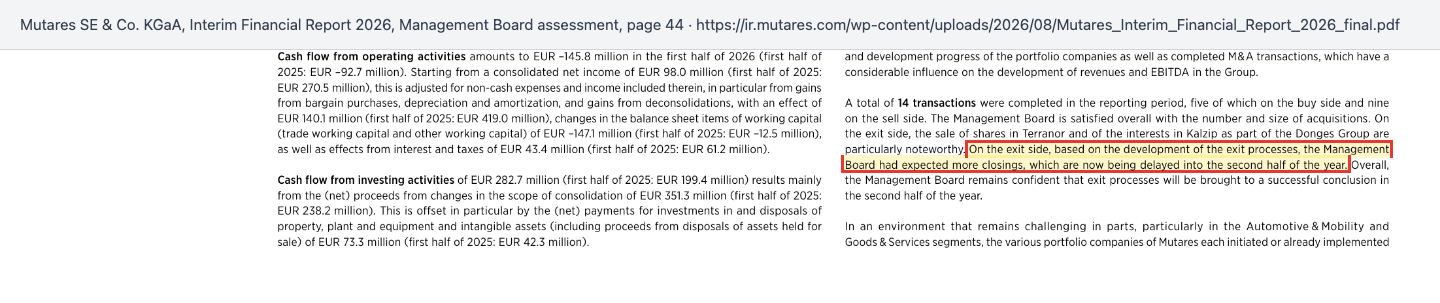
Why? Because although nine companies were sold in whole or in part in the first half of 2026 — among them Kalzip, the remaining Terranor shares and Peugeot Motocycles — none of those sales moved the holding company's result in a meaningful way. Management says openly that it had hoped for more:
“On the exit side, based on the development of the exit processes, the Management Board had expected more closings, which are now being delayed into the second half of the year.”
— Mutares SE & Co. KGaA, Interim Financial Report 2026, section 3.3 “Assessment of the Management Board”, p. 44
Some of that has moved since the reporting date. On September 9, 2026, Mutares announced the completed sale of NEM Energy Group to Hyundai Heavy Industries Power Systems — by its own account the largest exit of the year and a “significant contribution” to the full-year guidance; Mutares did not disclose a price. On September 18 it sold the auto supplier Cimos (about €120 million of revenue), and on September 23 Prénatal Netherlands (about €80 million of revenue). On the buy side, Mutares closed the largest acquisition in its history on August 3, 2026: the engineering thermoplastics business of the Saudi chemicals group SABIC in the Americas and Europe, with about €2.0 billion of annual revenue, now called NexPoint Materials. August and September also brought Magna's car top systems business, Symrise's U.S. terpene business (AmeriTerpenes) and the airport equipment makers TREPEL and MAFI.
Mutares confirmed its guidance on August 4, 2026: group revenue of €7.9 billion to €9.1 billion and holding company net income of €165 million to €200 million for 2026, followed by at least 25 percent annual growth in group revenue and holding company net income through 2030. On September 25, 2026, the company repeated these targets. Do the math: after minus €3.1 million in the first half, the holding company needs to earn at least about €168 million in the second half to reach the low end — more than in all of fiscal 2025 (€130.4 million). That is not impossible, because that is how the model works: profits arrive in bursts, with the sales. But it means the entire full-year figure hinges on the sales of July through December 2026.
For the earnings call on August 18, 2026, Mutares published a presentation whose message is: bond covenants fully complied with again as of June 30, 2026, significant exit proceeds expected in the second half, guidance confirmed. We did not have a transcript of the call — and therefore of the Q&A, where analysts push back; we evaluated only the presentation and the written reports.
The numbers over the years — given their due
First, what is genuinely impressive. Within a few years Mutares has grown from a small investment company into a group with €6.5 billion of revenue (fiscal 2025, prior year: €5.3 billion), and by its own count the portfolio now adds up to about €10 billion of annual revenue including signed but not yet closed deals (as of August 2026). The holding company earned €108.3 million under German GAAP in 2024 and €130.4 million in 2025, largely from sales. And Mutares has kept its dividend promise: €2.00 per share for 2024 and for 2025, paid on July 8, 2026, a total of €51.2 million — up from €42.7 million a year earlier.
Group earnings, on the other hand, need to be read with great care, as the first version of this analysis already explained. When Mutares buys a company for less than the net assets on its balance sheet, the difference must be booked as income immediately — a so-called bargain purchase. No cash changes hands. The chart shows how large this item is:
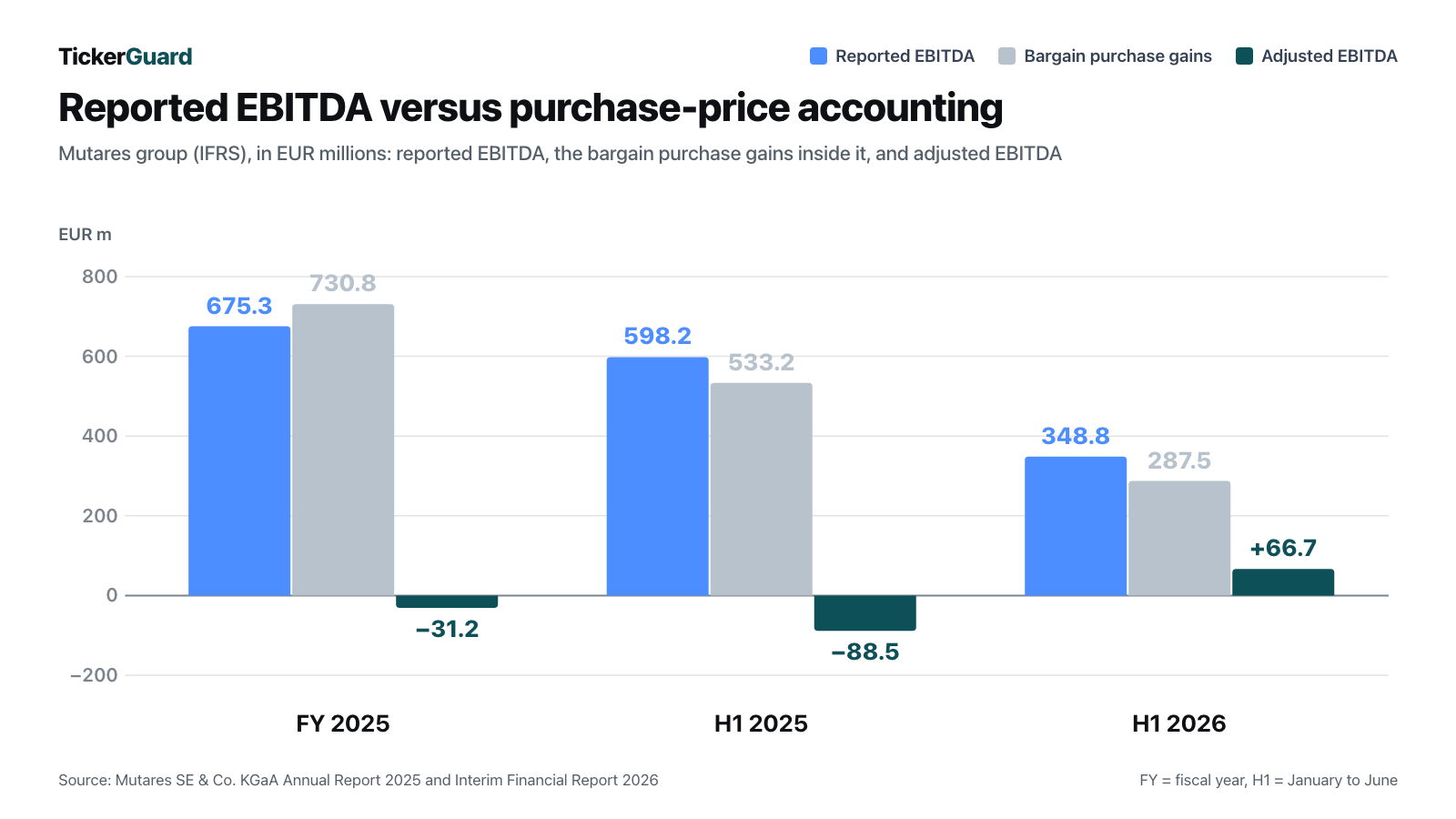
Rule of thumb: at the Mutares group, reported EBITDA mainly measures how cheaply it bought. Adjusted EBITDA is the more honest number — and that is exactly the one that improved in the first half of 2026. This is the good news of the half, and it deserves to be said: according to management, several older holdings such as Efacec, Guascor Energy and NEM Energy now make solid money. The picture is still weighed down by new arrivals such as Fratelli Ferrari, Mimovrste, Novastruct and Haro, which reduced adjusted EBITDA by €17.1 million in the half, and by problem cases such as Lapeyre, Prénatal, Stuart, La Rochette and Natura. In July 2026, three Dutch companies of the portfolio business Byldis filed for insolvency.
Uncomfortable truth No. 1: group earnings are largely accounting
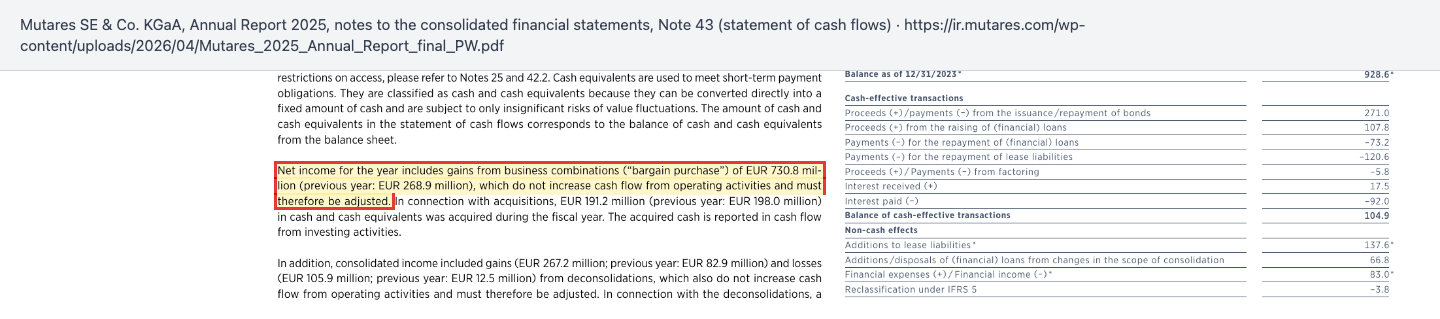
Anyone reading Mutares's group figures should know one sentence from the notes to the Annual Report 2025. It sits in the notes to the cash flow statement and says plainly what the purchase-price gains are:
“Net income for the year includes gains from business combinations (‘bargain purchase’) of EUR 730.8 million (previous year: EUR 268.9 million), which do not increase cash flow from operating activities and must therefore be adjusted.”
— Mutares SE & Co. KGaA, Annual Report 2025, notes to the consolidated financial statements, Note 43 (statement of cash flows)
Take these book gains out and nothing was left of reported EBITDA in 2025 — adjusted EBITDA stood at minus €31.2 million, group net income after taxes at minus €73.5 million (prior year: minus €459.9 million). The first half of 2026 again contains €287.5 million of purchase-price gains within EBITDA of €348.8 million. And the next large item is already in sight: for the SABIC business with about €2.0 billion of annual revenue, Mutares paid preliminary consideration of $8.1 million (about €7.1 million) at closing on August 3, 2026. Further payments may follow later: a share for the seller in free cash flow for 2029 through 2032 and in any sale proceeds, plus a contractually fixed amount at the end of that period, against which those payments are credited. The report does not state the amount. How large the book gain from this deal will be is still open — the purchase price allocation had not been finalized according to the half-year report. At that price, it seems likely to shape group earnings for 2026.
This is not an accounting trick but mandatory accounting, and Mutares reports adjusted EBITDA itself. For you as an investor it simply means: the group headline (“EBITDA of several hundred million”) says nothing about whether cash is there for dividends and interest.
Uncomfortable truth No. 2: the dividend depends on sales — and they came late
The holding company pays the dividend. And its profit, as Mutares writes in the Annual Report 2025, comes mainly from sales:
“Holding net income under commercial law amounted to EUR 130.4 million in fiscal year 2025 (previous year: EUR 108.3 million). The increase in earnings was significantly influenced by increased exit activity during the reporting period, with the complete divestment of Steyr Motors representing the standout transaction that had a decisive impact on earnings in fiscal year 2025.”
— Mutares SE & Co. KGaA, Annual Report 2025, letter from the Management Board
The first half of 2026 is the stress test of that dependence: no sales with a material earnings impact, holding company net income of minus €3.1 million. The €51.2 million dividend was paid anyway — out of the prior year's retained profit, as is normal for a dividend. The question is the next dividend. And a new factor comes in: since the capital increase in April 2026 there are 25,617,907 shares instead of about 21.35 million. Mutares issued 4,269,651 new shares at €24.50 each and raised €104.6 million gross. If it stays at €2.00 per share, the dividend will cost about €51 million a year from now on. According to the company, about 80 percent of the proceeds are earmarked for further acquisitions, mainly in the U.S., and about 20 percent for strengthening the balance sheet.
The capital increase had a side effect on ownership: the voting stake of the family of founder and CEO Robin Laik fell from just over 25 percent to about 21 percent, without Laik selling any shares. According to the half-year report, the family is therefore below the blocking-minority threshold; the Management and Supervisory Boards hold a further 9 percent or so together.
Uncomfortable truth No. 3: covenant breached, auditor warns, bond coming due
This is the part the first version of this analysis missed, and it is the most important. The holding company has two floating-rate bonds outstanding: the 2023/2027 bond at 3-month EURIBOR plus 8.50 percentage points, which matures on March 31, 2027 and had €232.3 million outstanding as of June 30, 2026, and the 2024/2029 bond at EURIBOR plus 6.25 percentage points with €135.0 million outstanding. Both bonds carry covenants — financial ratios the borrower must meet, or the creditors may demand their money back early. At the end of 2025, Mutares missed one of them:
“As of the balance sheet date December 31, 2025, the financial ratio regarding the ratio of debt to equity in the Group was not complied with.”
— Mutares SE & Co. KGaA, Interim Financial Report 2026, section 2.2 “Business performance”, p. 25
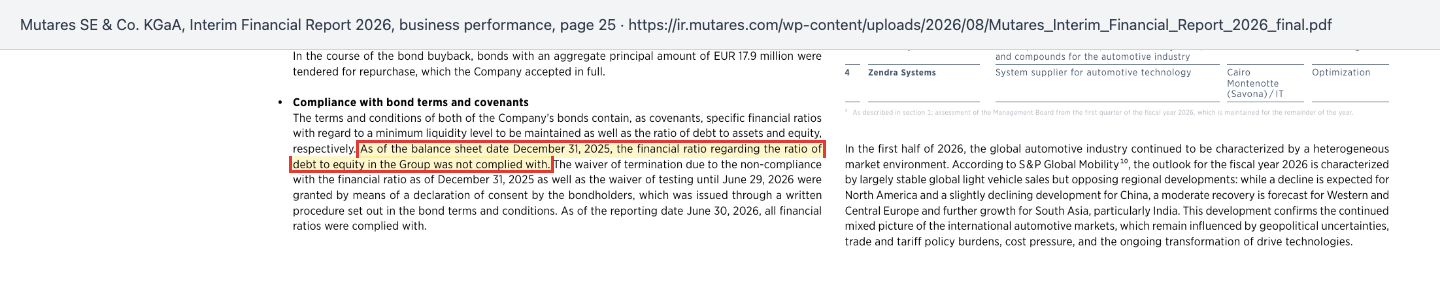
In a written consent procedure, bondholders waived their right to terminate and suspended testing of the ratio until June 29, 2026. As of June 30, 2026, all ratios were met again — that is the all-clear of the half-year report, and it is genuine. But it does not make the problem go away. The auditor, Deloitte, had already included a separate section “Material Uncertainty Related to Going Concern” in its opinion on the Annual Report 2025. And management writes in the half-year report 2026:
“Due to the material uncertainties, the Management Board sees a liquidity and financing risk that could jeopardize the ability to continue as a going concern.”
— Mutares SE & Co. KGaA, Interim Financial Report 2026, risk report, “Overall statement on the risk situation”, p. 49
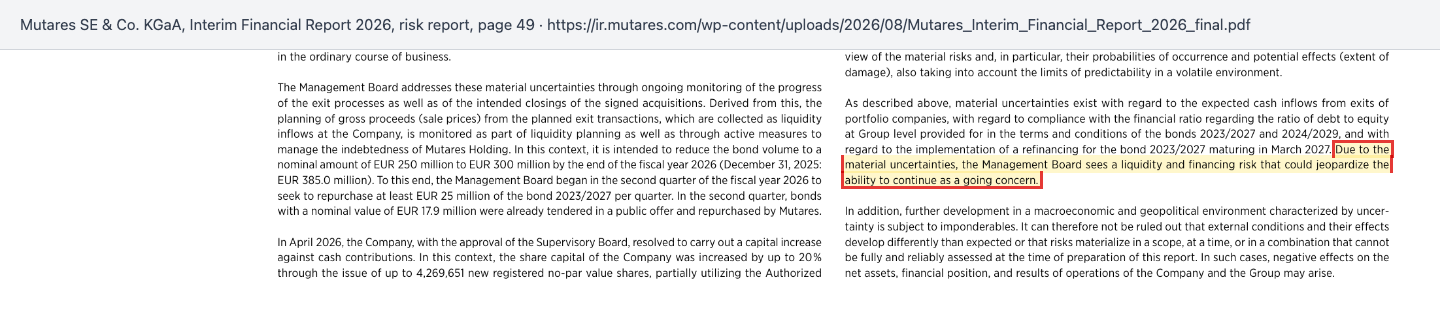
Management names three uncertainties explicitly: whether the expected exit proceeds materialize, whether the bond covenant continues to be met, and whether the 2023/2027 bond can be refinanced. In the same section it states that it considers the company's continuation “with predominant probability” to be given. Both statements are there, and they belong together. The orders of magnitude: as of June 30, 2026, the holding company had €103.6 million of cash, €51.2 million of which went out as the dividend in July. Against that stands the €232.3 million bond that falls due in just over six months. Mutares aims to cut total bond volume from an original €385 million to €250 million to €300 million by the end of 2026; the plan was to buy back at least €25 million every quarter starting in the second quarter. In the buyback offer that ran until June 2, 2026, however, only €17.9 million were tendered. On September 25, 2026, Mutares announced a second buyback offer for up to €25 million and wrote that it intends to refinance the bond in the fourth quarter of 2026, “which may be carried out at different terms.”
Rule of thumb: a dividend is paid out of profit, a bond out of cash or new borrowing. As long as sales succeed and the capital market stays open, both work out. The reports themselves say that this is exactly the open point.
Valuation: cheap — if the guidance holds
At €24.30 (September 25, 2026) and 25,617,907 shares, Mutares has a market value of about €622 million. Measured against 2025 holding company net income (€130.4 million), that is about 4.8 times; against 2026 guidance (€165 million to €200 million), 3.1 to 3.8 times. For a company with this growth record that is very little. One way to read it is that the market does not fully trust the guidance and prices in the financing risk. For context on the share price: the first-half 2026 high was €34.90 (January 14), the low €23.25 (April 24, around the capital increase), and the half-year close €27.20.
The professionals' view: according to the half-year report, four firms covered the stock (Cantor, Jefferies, Warburg Research and Sphene Capital), all rating it “Buy” or “Overweight,” with price targets from €41.00 to €49.40 (as of June 30, 2026). That is the list the company itself publishes; whether it is complete cannot be verified. And a price target is an expectation, not a value — it assumes that sales and refinancing go the way management plans.
Upside and risks at a glance
What speaks for Mutares:
- Adjusted group EBITDA swung from minus €88.5 million to plus €66.7 million in the first half of 2026; according to management, several older holdings now make solid money.
- Since July 2026, NEM Energy (closed September 9), Cimos and Prénatal Netherlands have been sold — the delayed sales are getting under way.
- The €2.00 dividend per share was paid for 2025 as well (€51.2 million, July 8, 2026); Mutares calls it a minimum dividend.
- The €104.6 million gross capital increase in April 2026 was fully placed, and the company says the pre-placement with institutional investors was almost three times oversubscribed; all bond ratios were met again as of June 30, 2026.
- Measured against its own guidance, the stock trades at a low 3.1 to 3.8 times holding company net income (price €24.30, September 25, 2026).
What speaks against it:
- Management sees a liquidity and financing risk that could threaten the company as a going concern; the auditor included a separate section on this in its 2025 opinion.
- The €232.3 million 2023/2027 bond (as of June 30, 2026) matures on March 31, 2027; the refinancing is planned for the fourth quarter of 2026 but has not happened yet.
- The group burned €145.8 million in operating cash flow in the first half of 2026 (prior year: €92.7 million) — the better adjusted EBITDA had not yet turned into cash.
- A bond covenant was breached at the end of 2025; bondholders had to waive it in a written consent procedure.
- The holding company closed the first half of 2026 at minus €3.1 million; the full-year guidance requires at least about €168 million in the second half.
- Group earnings consist largely of book gains on cheap acquisitions (2025: €730.8 million) that bring in no cash; the group posted a net loss of €73.5 million after taxes in 2025.
A human conclusion
Back to the anchor from the beginning. The 8 percent is not made up — the dividend was paid, on time, in July 2026. But the anchor hides how that yield comes about: not from a business that earns steadily, but from company sales that arrive in some half-years and not in others, and from a holding company that at the same time has to repay a €232.3 million bond by March 31, 2027. Management puts both into the same report: the confidence that the sales will come in the second half, and the warning that if they do not, the company's survival could be at risk. So the honest question for you is not “Is 8 percent a lot?” but: Do you trust Mutares to sell enough companies at good prices and refinance a bond over the next six months — and can you live with it if that takes longer than planned? What you make of it is your decision. And that is how it should be.
Sources
All original documents used in this analysis — so you can check them yourself:
- Mutares SE & Co. KGaA — Interim Financial Report 2026 (reporting date June 30, 2026, published in August 2026) — latest periodic report; source for the covenant, risk report, guidance, share count and bonds
- Mutares SE & Co. KGaA — Earnings Report H1 2026 (German GAAP, holding company, August 4, 2026)
- Mutares SE & Co. KGaA — Press release on the half-year results (August 4, 2026)
- Mutares SE & Co. KGaA — H1 2026 earnings call presentation (August 18, 2026) — no transcript was available
- Mutares SE & Co. KGaA — Earnings Report Q1 2026 (May 12, 2026)
- Mutares SE & Co. KGaA — Annual Report 2025 (audited by Deloitte, April 2026) — source for bargain purchase gains, holding company net income and the auditor's report
- Mutares SE & Co. KGaA — Completed sale of NEM Energy Group (September 9, 2026)
- Mutares SE & Co. KGaA — Buyback offer for the 2023/2027 bond and planned refinancing (September 25, 2026)
- Mutares SE & Co. KGaA — press releases on Cimos (September 18, 2026), Prénatal Netherlands (September 23, 2026), AmeriTerpenes (September 1, 2026), TREPEL/MAFI (September 2, 2026) and Magna Car Top Systems (August 5, 2026) on mutares.com; directors' dealings and voting-rights notifications on ir.mutares.com (checked September 26, 2026, no notices after June and April 2026 respectively)
- Fundamental data (price €24.30 on September 25, 2026), cross-checked against the share count in the half-year report.
Transparency & disclaimer: This analysis is a journalistic assessment of publicly available information. It is not investment advice, not a financial analysis in the regulatory sense and not a solicitation to buy or sell securities. Investing in stocks involves substantial risk, up to and including total loss. All information without guarantee; the data date is noted in the text. Positions held by the operator are disclosed daily; where one exists, it appears as a notice at the top of this deep dive.
Our Bottom Line at a Glance
- Growth and the exit machine positive
- Group revenue of €6.5B (2025) and €3,383.6M in the first half of 2026 (+9%); since July 2026, sales of NEM Energy (closed 09/09/2026), Cimos and Prénatal Netherlands. Holding company net income 2025: €130.4M.
- Operating improvement in the portfolio positive
- Adjusted EBITDA of plus €66.7M in the first half of 2026 after minus €88.5M a year earlier; Efacec, Guascor Energy, NEM Energy and other holdings clearly positive according to management.
- Group earnings from accounting negative
- In 2025, bargain purchase gains (€730.8M) exceeded reported EBITDA (€675.3M); group net income after taxes −€73.5M. Another €287.5M of purchase-price gains in the first half of 2026.
- Holding company result depends on sales negative
- Holding company at −€3.1M in the first half of 2026 (prior year +€69.8M) because sales slipped. Guidance of €165–200M requires at least about €168M in the second half.
- Financing and going concern negative
- Bond covenant breached at 12/31/2025, waived by bondholders in a consent procedure; management sees a financing risk that could threaten the company as a going concern. €232.3M 2023/2027 bond due 03/31/2027, refinancing planned for Q4 2026.
- Valuation neutral
- At €24.30 (09/25/2026), a market value of about €622M, 3.1 to 3.8 times guided holding company net income — low, because the market does not fully trust the guidance and the refinancing.
Mutares is growing fast, and adjusted group earnings improved markedly in the first half of 2026. But the holding company, which carries the dividend and the bonds, closed the half at a loss because sales slipped, and management itself describes a financing risk that could threaten the company as a going concern — with a €232.3 million bond maturing on March 31, 2027 as the deadline. Not investment advice.
What Our Rating Means
Substance risk
We found at least one documented issue that threatens the company itself — regardless of how the stock is currently valued.
Red here is not about the business model but about a documented financing risk: the auditor included a section on material uncertainty about the going concern in its 2025 opinion, and management writes in the Interim Financial Report 2026 that it sees a liquidity and financing risk that could threaten the company as a going concern. A bond covenant was breached at the end of 2025; on March 31, 2027, a €232.3 million bond comes due, against which the holding company had €103.6 million of cash as of June 30, 2026, before the €51.2 million dividend. The operating picture has improved, the bond ratios are met again, and management considers continuation predominantly probable. If the second-half sales and the refinancing planned for the fourth quarter of 2026 succeed, the reason for this rating falls away — until then the more cautious rating applies. The decision is yours.
A journalistic assessment by our editorial team at the time of the deep dive, based on public sources — not investment advice and not a solicitation to buy or sell. Your personal circumstances (investment goals, risk capacity, taxes) cannot be taken into account. What our levels mean, how verdicts are formed, and what conflicts of interest exist →
Worth Noting
- Version of September 26, 2026 and first English publication: based on the Interim Financial Report 2026 (reporting date June 30, 2026), the results release of August 4, 2026, the earnings call presentation of August 18, 2026 and company announcements through September 25, 2026. The first German version from July 2026 relied on the Annual Report 2025 and the Q1 report 2026 and rated the company yellow; it had not taken the auditor's going-concern note into account.
- Mutares does not report to the U.S. securities regulator, the SEC; all evidence comes from the company's own reports and announcements (ir.mutares.com, mutares.com). Group figures are under IFRS, holding company figures under German GAAP (HGB) — the two levels are not comparable and are kept separate in the text. The half-year report is unaudited.
- No transcript of the August 18, 2026 earnings call was available; we evaluated the published presentation.
The full analysis as a PDF for later
We will send you this analysis as a PDF — to print, file away, and read at your own pace.
Frequently Asked Questions
Mutares (Xetra: MUX) buys struggling business units, often from large corporations, restructures them with its own consultants and sells them a few years later. The holding company earns consulting fees, dividends from its subsidiaries and, above all, proceeds from sales. As of June 30, 2026, the portfolio held 35 companies.
Group revenue rose 9 percent to €3,383.6 million, and adjusted EBITDA swung from minus €88.5 million to plus €66.7 million. The holding company, by contrast, closed the half at minus €3.1 million under German GAAP (prior year: plus €69.8 million) because planned sales slipped into the second half. Guidance for 2026 was confirmed.
In the Interim Financial Report 2026, management names three uncertainties: whether the expected exit proceeds materialize, whether the bond covenant on the ratio of debt to equity is met, and whether the 2023/2027 bond maturing on March 31, 2027 can be refinanced. Taken together, it sees a liquidity and financing risk that could jeopardize the company as a going concern; it considers continuation to be given with predominant probability.
For 2025 it was paid: €2.00 per share, €51.2 million in total, on July 8, 2026. The next dividend depends on 2026 holding company net income, which in turn depends on sales. After minus €3.1 million in the first half, the holding company must earn at least about €168 million in the second half to reach its own guidance of €165 million to €200 million.
A bargain purchase gain arises when a buyer pays less than the net assets of the acquired company are worth on the balance sheet. The difference must be booked as income immediately, without any cash flowing. At Mutares these gains totaled €730.8 million in 2025 and another €287.5 million in the first half of 2026.
The holding company has two bonds outstanding: €232.3 million of the 2023/2027 bond (maturing March 31, 2027) and €135.0 million of the 2024/2029 bond (as of June 30, 2026). On the same date it held €103.6 million of cash, €51.2 million of which went out as the dividend in July. Mutares plans to refinance the 2023/2027 bond in the fourth quarter of 2026.
After the capital increase in April 2026 there are 25,617,907 shares. Mutares issued 4,269,651 new shares at €24.50 each and raised €104.6 million gross. The voting stake of CEO Robin Laik's family fell from just over 25 percent to about 21 percent as a result.
Found an error?
Did you spot a factual error, an outdated number, or a typo in this deep dive? Let us know briefly — your report goes straight to the editorial team.