Assembly Biosciences: Gilead Pays, Gilead Owns, Gilead Decides
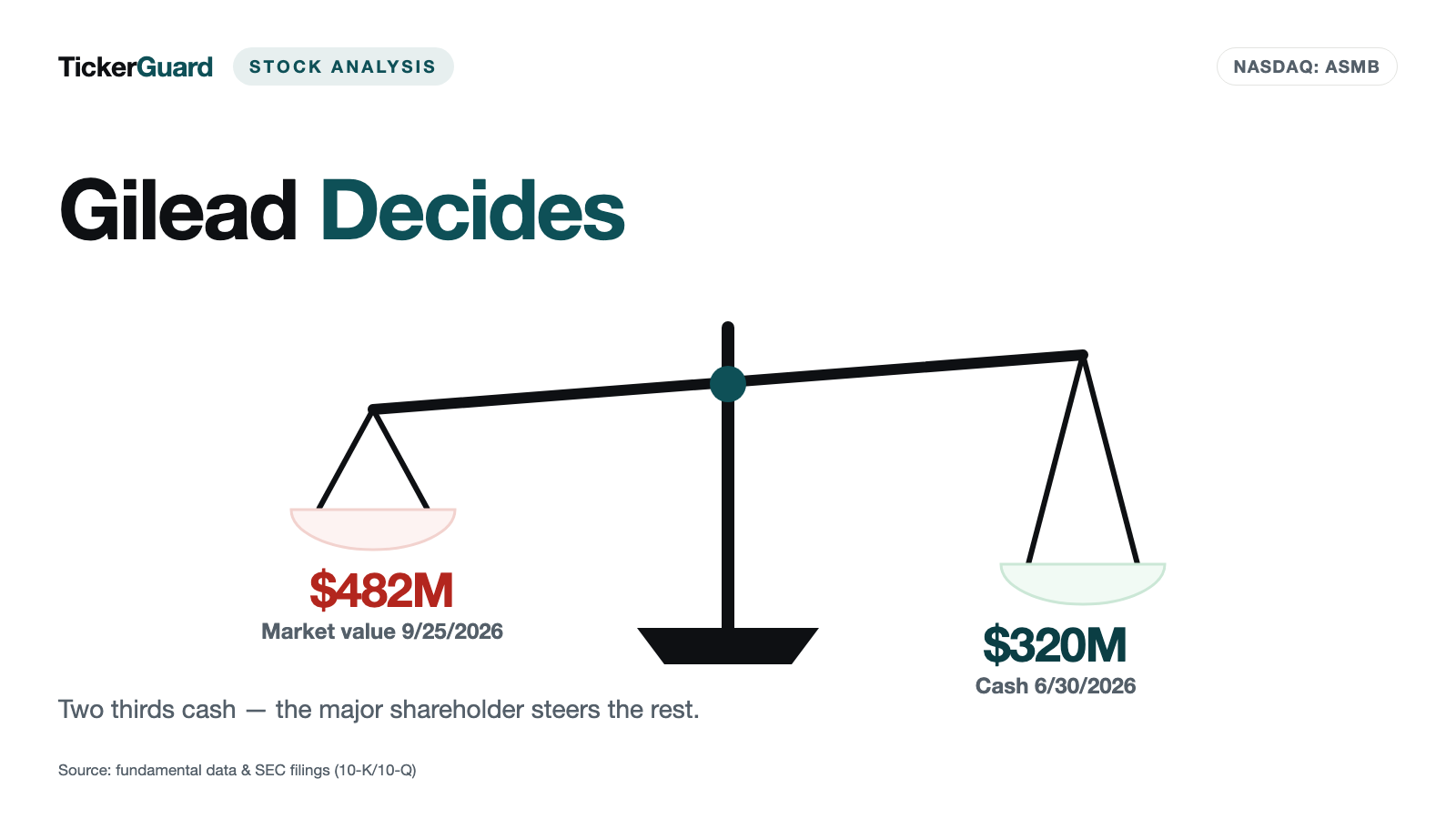
At the end of June 2026 Assembly Biosciences held $320.4 million in cash and securities — roughly two thirds of its own market value. Its largest shareholder is also its only paying customer and the partner that alone decides the fate of its most advanced program: Gilead Sciences. In June 2026 Gilead chose to run the next herpes study not with Assembly's own compound but with the one Gilead had brought into the partnership itself. And on November 15, 2026, 4.46 million warrants hinge on a number that exactly matches the fee Gilead owes this fall. We read the filings to see what a famous partner is worth to everyone else on the cap table.
 Thomas Mücke
Founder & Publisher
Thomas Mücke
Founder & Publisher
As of Today
As of: September 25, 2026
- Closing price
- 23.70 $ 0.00%
- Market Capitalisation
- 0.5 $B
- P/E
- 301.4
- Growth Score
- 5/10
- AAQS
- 1/10
This analysis has a cut-off date. The Stock Guard tells you when something material changes in the numbers. Reserve your free spot
Chart
Interactive price chart (TradingView).
52-week range: 22.30 $ to 38.50 $ · Last price: 23.70 $ (As of: September 25, 2026)
Note: pure fact-based analysis, not investment advice and not a solicitation to buy or sell. All figures without guarantee.
The halo effect: when a big name does your thinking for you
There is a thinking error that catches well-read investors in particular. Psychologists call it the halo effect: one shining trait radiates onto everything else. The doctor in the white coat seems competent about money, too; the company with the famous partner seems solid on its balance sheet, too. And in the stock market one sentence sounds almost like a seal of quality: “Gilead is in.”
Gilead Sciences is one of the most successful antiviral drugmakers in the world. When a company like that buys a quarter of a small biotech, sends two people to its board and wires money year after year — what could go wrong? The halo answers that question for you before you have even asked it.
Assembly Biosciences is the textbook case. Here Gilead is everything at once: largest shareholder, only paying customer and sole decision-maker over the most advanced program. That is the tension running through this analysis: the same partner that funds the company also decides which of its ideas get a future. So let's make a deal: we set the halo aside for a moment and read only what the company reported, under penalty of law, to the U.S. securities regulator, the SEC.
Company history for investors
-
2014
Ventrus becomes Assembly Biosciences
Ventrus acquires Assembly Pharmaceuticals and takes its name. For shareholders this began the antiviral bet — and a loss history that now totals $845 million.
-
2023
Collaboration with Gilead
In October 2023 Gilead pays $100.0 million including an equity purchase. The company gains breathing room — and a partner that is customer, shareholder and decision-maker at once.
-
2024
1-for-12 reverse stock split
To regain compliance with Nasdaq's minimum bid price rule, every twelve shares become one. A warning sign from the past that no longer shows up in any current metric.
-
2025
Gilead licenses the herpes program
In December 2025 Gilead licenses herpes compounds 5366 and 1179 for a net $35.0 million. Shareholders got the highest annual revenue since 2020 — and gave up control of their most advanced program.
-
2026
Offering at $26.50 per share
In May 2026 new shares and pre-funded warrants raise $115.0 million gross. Cash grows to $320.4 million, the share count to 20.36 million by August.
-
2026
Gilead picks its own compound
Gilead's June 2026 development plan advances 1179, which Gilead itself had contributed. For Assembly shareholders, milestones now depend on a molecule from someone else's lab.
What Assembly Biosciences actually does — research with a giant in the house
Assembly Biosciences is based in South San Francisco, had 73 employees as of December 31, 2025 and develops small molecules — pills rather than injections — for viral and liver diseases. The company has a longer history than its name suggests: incorporated in Delaware in 2005 as South Island Biosciences, it later became Ventrus Biosciences and on July 11, 2014 acquired the privately held Assembly Pharmaceuticals, whose name it adopted. That is what the annual report 10-K for 2025 says.
The pipeline has four branches, and for two of them Gilead holds the key:
- 1179 and 5366 — two long-acting drugs for recurrent genital herpes. They target a viral enzyme, the helicase-primase, which the virus needs to copy its genetic material. In December 2025 Gilead exclusively licensed the entire program; since then development has been in Gilead's sole control, according to the quarterly report.
- ABI-6250 — a pill that blocks the protein NTCP on liver cells. That protein is the front door the hepatitis delta virus uses to enter the cell, and at the same time the gate through which bile acids are absorbed. That is why 6250 is slated for Phase 2 studies both in hepatitis delta (planned start in the fourth quarter of 2026) and in the cholestatic liver diseases PBC and PSC (primary biliary cholangitis and primary sclerosing cholangitis, planned start in the first quarter of 2027). So far only a Phase 1a study in healthy participants has been completed. For scale: per the annual report, hepatitis delta affects a subset of approximately 12 to 72 million people infected with hepatitis B; per the quarterly report, about 150,000 adults in the United States are diagnosed with PBC, and about 40 percent fail first-line therapy.
- 4334 — a hepatitis B compound the company does not plan to advance further without a partner, according to the quarterly report.
- 7272 — a compound for herpesviruses after transplants that is still in studies to enable a regulatory filing.
The business model fits one image: Assembly is an inventor's workshop with one regular client. The client pays for the research, may pick the best ideas and then develops them itself. Assembly receives option fees, later milestone payments and royalties — or instead takes on 40 percent of the costs and profits in the United States. Per the quarterly report, Assembly remains eligible for up to $330.0 million in regulatory and commercial milestones for the herpes program, plus tiered royalties ranging from the high single digits to the low teens. According to the August 13, 2026 earnings release, management plans to decide by year-end 2026 whether to opt into the cost and profit share instead — but only after receiving Gilead's commercial cost estimates; the quarterly report itself no longer names a date after the earlier mid-2026 target lapsed. Per the quarterly report, the milestones apply to the program (“on that program”), not to a single molecule.
What does not exist, the annual report states itself:
“As of December 31, 2025, we had an accumulated deficit of $832.0 million. Because we do not generate revenue from any of our product candidates, our losses will continue as we further develop and seek regulatory approval for, and commercialize, our product candidates.”
— Assembly Biosciences, SEC annual report 10-K for 2025, Item 1A “Risk Factors”
By June 30, 2026 the accumulated deficit had grown to $845.0 million. Anyone looking at the company for the first time should keep that number in mind: it is larger than the company's entire current market value.
How the stock landed on our desk
Assembly Biosciences did not reach us through a success story but through two warning lights in our in-house stock scanner. As of September 26, 2026 the stock sat in two screens that have little to do with each other:
- Stage 4 (downtrend) — under the phase model of market author Stan Weinstein, the price is in its declining phase. That describes the chart only, not the company.
- Beneish M-Score — a model by Professor Messod Beneish that combines eight balance-sheet ratios into one score. A reading above −1.78 is treated as a reason to look more closely. Assembly scored −1.52.
A Beneish hit is not an accusation. Among other things the model measures how fast revenue and receivables grow and how margins shift; for a biotech whose revenue jumped 154 percent to $72.3 million in 2025 because a partner licensed a program, it trips easily. But it is a good reason to read exactly the line that makes the model nervous: revenue. And there, in the quarterly report as of June 30, 2026, we did find a number that appears in no headline of the earnings release. More on that in a moment.
How similar such setups can look is shown by Arcus Biosciences: there, too, Gilead holds about a quarter of the shares, and there, too, the partner is backbone and concentration risk at the same time.
The numbers over the years — honestly appraised
Let's start with what genuinely impresses. In four years Assembly has almost made its loss disappear: from $129.9 million in 2021 through $93.1 million (2022), $61.2 million (2023) and $40.2 million (2024) to $6.1 million in 2025. Over the same period revenue rose from $6.3 million to $72.3 million. If you only see those two lines, you see a company on the verge of breaking even.
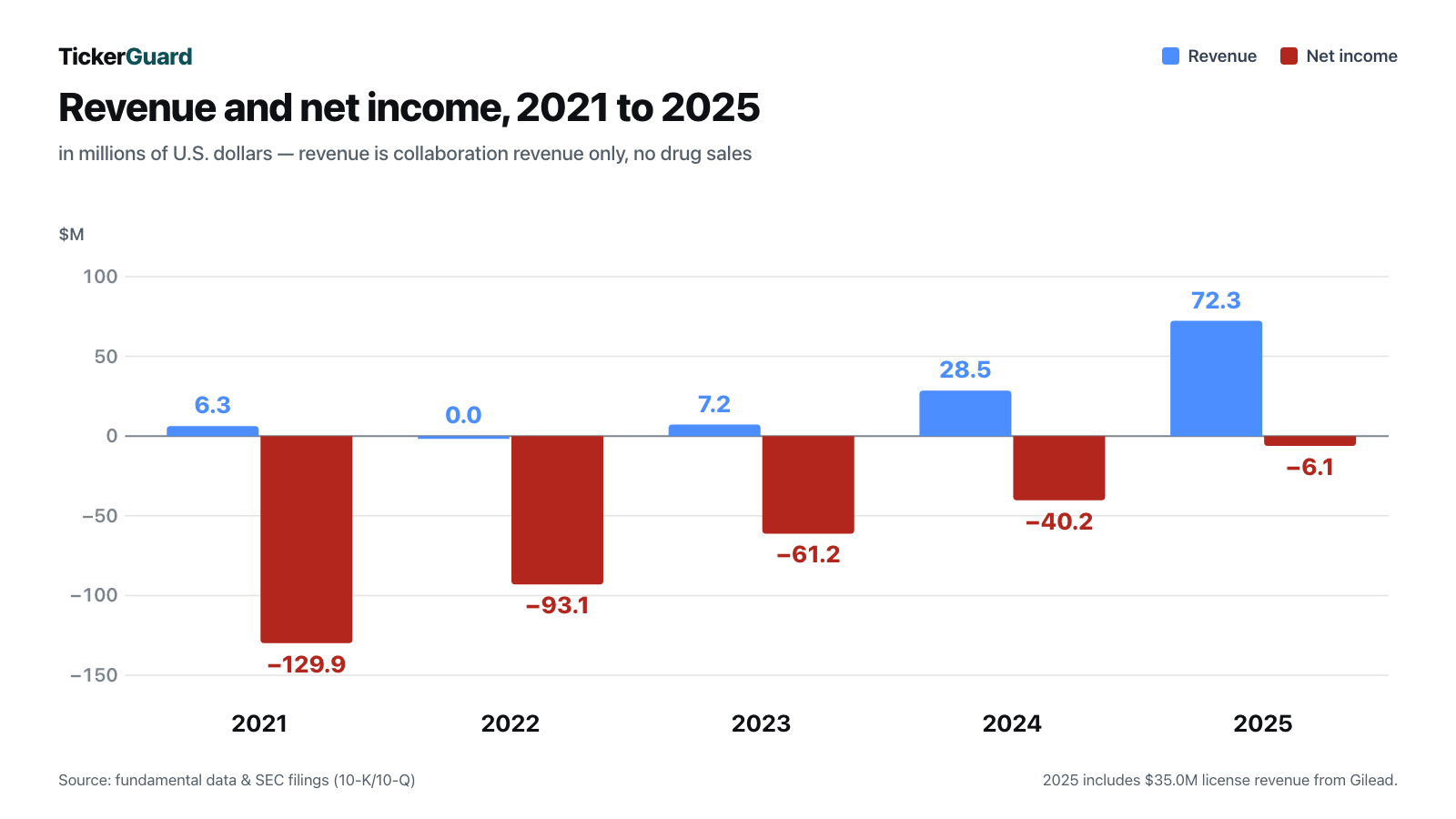
Now the second look. 2025 revenue consists of two parts, and both are Gilead. $35.0 million is the net payment for Gilead licensing the herpes program in December 2025 — a $45.0 million option fee minus $10.0 million Gilead had already advanced in December 2024. The rest is the gradual release of upfront money: in October 2023 Gilead wired $100.0 million together with an equity purchase, $84.8 million of it as an upfront payment, and that money is booked as revenue quarter by quarter as Assembly performs the agreed research.
The everyday image is a subscription paid in advance. The cash has long been in the account; the income statement only shows it bit by bit. That is why the bank account tells a different story than the bottom line: although the 2025 net loss was only $6.1 million, operating activities used $41.1 million, after $51.1 million in 2024. In the first half of 2026 it was $37.6 million. Remember this: a small loss on paper is not a small burn in the bank account.
The balance sheet as of June 30, 2026 is still strong: $32.3 million in cash plus $288.1 million in marketable securities add up to $320.4 million. Total liabilities are $25.2 million, there is no financial debt, and equity stands at $305.6 million. Per the quarterly report, the company expects this to fund operations into late 2028 — and into 2029 with the $75.0 million Gilead extension fee due in the fourth quarter of 2026.
What the filings say — the uncomfortable truths
Uncomfortable truth no. 1: more than a third of the quarter's revenue is a catch-up entry
The earnings release of August 13, 2026 reports second-quarter revenue of $13.4 million, up from $9.6 million a year earlier — a 39 percent gain, though far below the roughly $42.5 million of the license quarter at the end of 2025 — and a net loss of just $3.9 million, down from $10.2 million. That sounds like momentum. The quarterly report explains where it comes from.
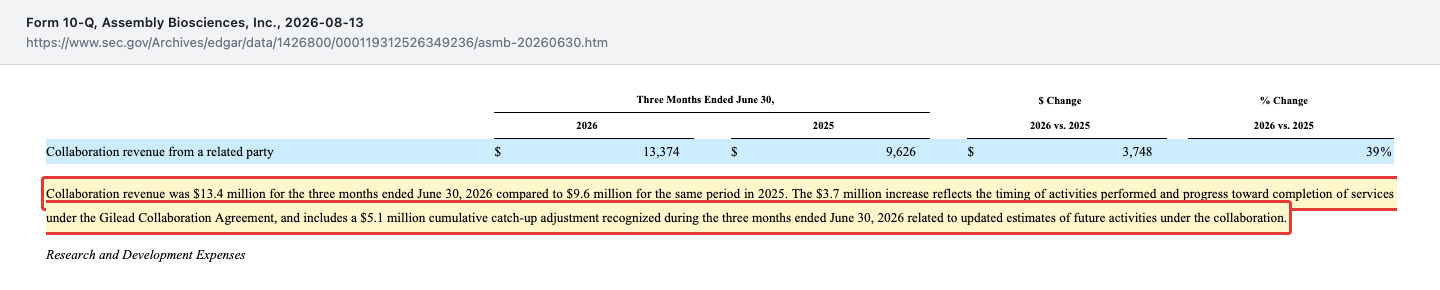
“Collaboration revenue was $13.4 million for the three months ended June 30, 2026 compared to $9.6 million for the same period in 2025. The $3.7 million increase reflects the timing of activities performed and progress toward completion of services under the Gilead Collaboration Agreement, and includes a $5.1 million cumulative catch-up adjustment recognized during the three months ended June 30, 2026 related to updated estimates of future activities under the collaboration.”
— Assembly Biosciences, SEC quarterly report 10-Q as of 6/30/2026, Item 2 “Results of Operations”
What does that mean in plain terms? Picture a contractor who was paid upfront for a renovation and books his fee according to progress. If he realizes less work is left than planned, the job counts as further along in hindsight — and he may book more fee in one go without a single extra dollar changing hands. That is a catch-up adjustment. Accounting rules require it and it is openly disclosed, so it is no trick. But it is not growth either.
Take it out and the picture flips: without the $5.1 million, revenue would have been about $8.3 million — below the $9.6 million of the prior-year quarter. The net loss would have been about $9.0 million instead of $3.9 million; the quarterly report itself puts the effect on earnings per share at $0.27. And the well feeding this revenue is running dry: deferred revenue from Gilead fell from $36.9 million at the end of 2025 to $16.3 million as of June 30, 2026. A prepaid subscription that is nearly used up cannot carry revenue for long.
Uncomfortable truth no. 2: the partner picked its own molecule
The herpes program was Assembly's showcase. Compound 5366 came out of its own research; in August 2025 the company reported interim data from the Phase 1b portion of its study. Compound 1179, by contrast, was in-licensed from Gilead as part of the collaboration, according to the quarterly report. In December 2025 Gilead took an exclusive license to the whole program — and in June 2026 Gilead delivered its development plan.

“Gilead controls the clinical development of 5366 and 1179, and initiation of a Phase 2 study of 1179 is expected by the end of 2026. Gilead does not intend to develop 5366 further at this time.”
— Assembly Biosciences, SEC quarterly report 10-Q as of 6/30/2026, Item 2, “Our Clinical Programs”
To be fair: for Assembly shareholders this is not automatically bad news. Milestones and royalties apply to the program, not to one particular molecule; a faster-moving compound may be the better one for Assembly, too. The report gives no reason for the choice, and we imply none. But the episode shows how the roles are divided. The halo says: “Gilead is in, so it must be fine.” The filing says: Gilead decides — and Gilead chose what Gilead brought to the table.
How deep the ties run is spelled out a few paragraphs later in the same report.
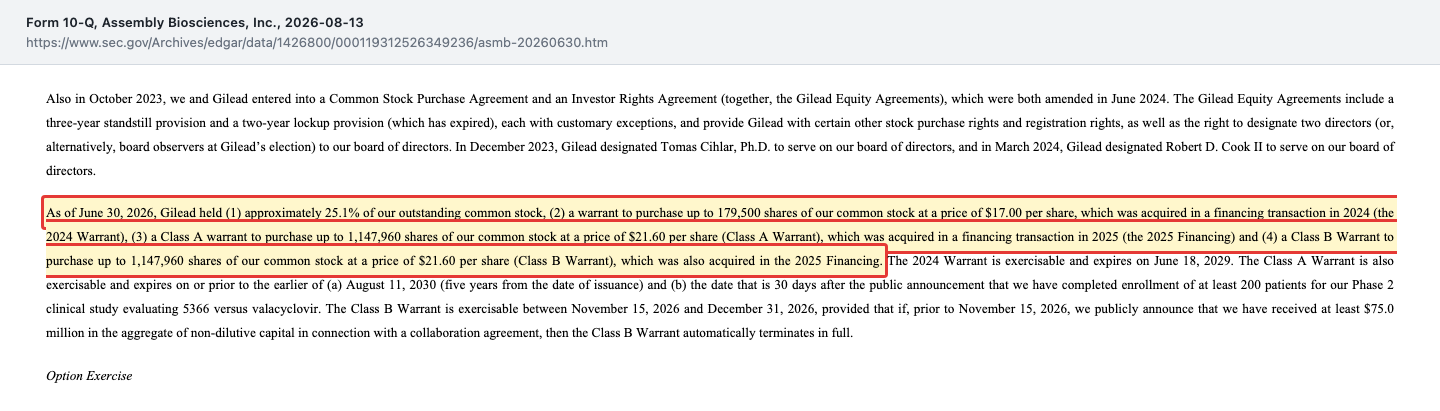
“As of June 30, 2026, Gilead held (1) approximately 25.1% of our outstanding common stock, (2) a warrant to purchase up to 179,500 shares of our common stock at a price of $17.00 per share, which was acquired in a financing transaction in 2024 (the 2024 Warrant), (3) a Class A warrant to purchase up to 1,147,960 shares of our common stock at a price of $21.60 per share (Class A Warrant), which was acquired in a financing transaction in 2025 (the 2025 Financing) and (4) a Class B Warrant to purchase up to 1,147,960 shares of our common stock at a price of $21.60 per share (Class B Warrant), which was also acquired in the 2025 Financing.”
— Assembly Biosciences, SEC quarterly report 10-Q as of 6/30/2026, Gilead collaboration section
Add one detail that is easy to miss: Gilead has the right to designate two directors and has appointed Tomas Cihlar (December 2023) and Robert D. Cook II (March 2024). The partner whose decisions shape Assembly's programs therefore also sits on the body that evaluates those decisions. The filing itself names the risk of conflicts explicitly — for instance over the clinical data supporting an opt-in decision or the interpretation of financial provisions.
Uncomfortable truth no. 3: the safety was paid for with your slice of the pie
Dilution, in everyday terms: the pie is cut into ever more slices, and your slice shrinks even if you do nothing. At Assembly, that is the price of the handsome cash pile.
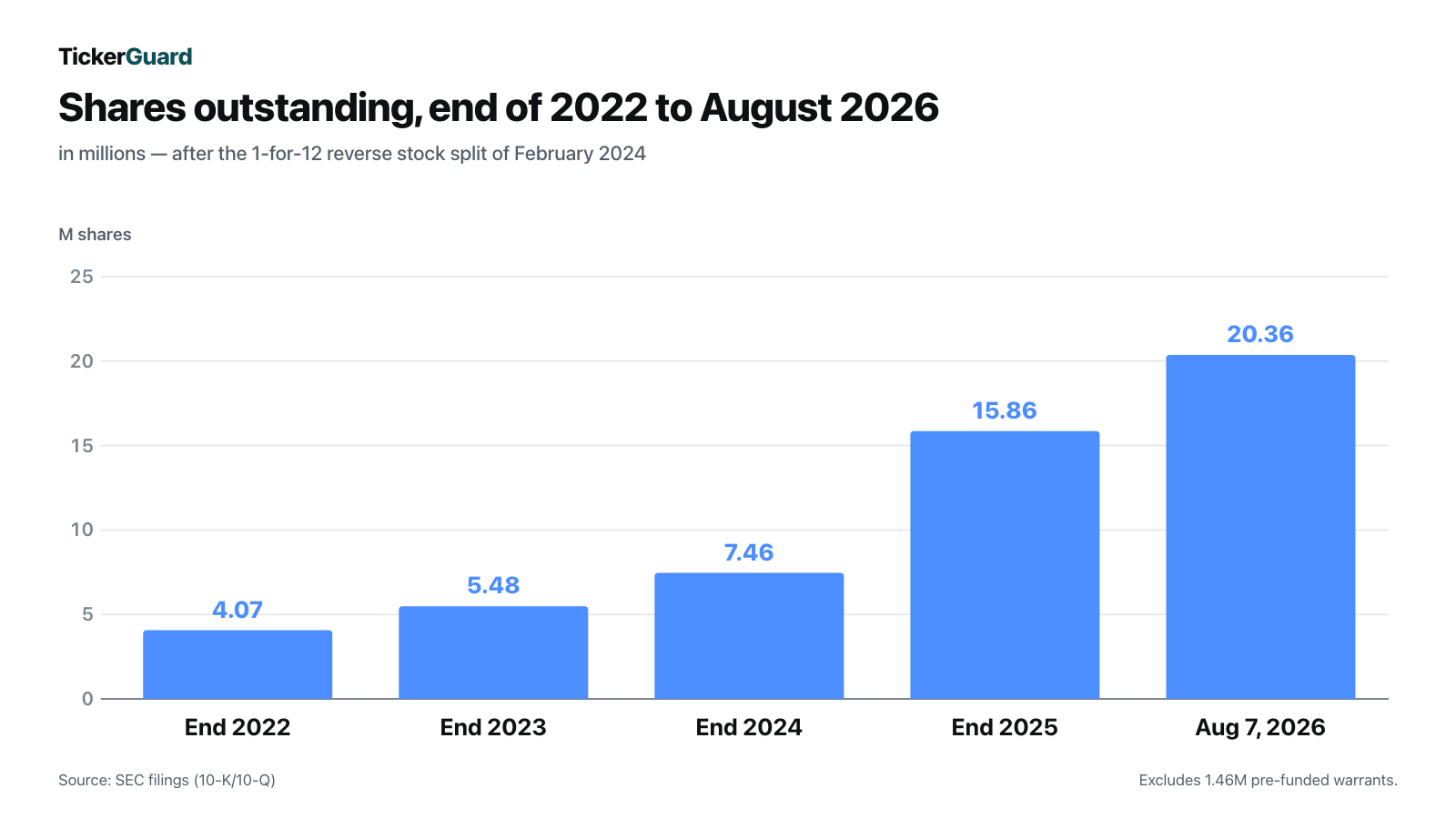
The big jumps have names. In August 2025 a financing with new shares, pre-funded warrants and warrants raised $175.0 million gross — $130.0 million from new investors and $45.0 million from Gilead, each at $19.60 per unit. In May 2026 another $115.0 million gross followed at $26.50 per share. And the back story belongs here, too: in February 2024 the company had to combine every twelve shares into one to regain compliance with Nasdaq's minimum bid price rule.
It is not over. As of June 30, 2026 the 19,850,342 shares faced 11,561,764 potentially dilutive securities — 9,487,477 warrants, 1,197,331 options, 657,436 restricted stock units, 215,620 performance stock units and 3,900 shares under the employee stock purchase plan. That is 58 percent of the share count. On top come 1,455,820 pre-funded warrants that the company already counts as shares in earnings per share. In July 2026 holders exercised 510,205 Class A warrants for about $11.0 million, and on June 4, 2026 the annual meeting approved another 1,200,000 plan shares and 290,000 employee purchase plan shares, which the company registered on Form S-8 on August 20, 2026.
Uncomfortable truth no. 4: 4.46 million warrants are waiting for November 15, 2026
The single largest item on that list has an expiration date. The Class B warrants from the August 2025 financing entitle holders to buy 4,464,290 shares at $21.60 — exercisable only between November 15 and December 31, 2026. That is 21.9 percent of the August 7, 2026 share count; fully exercised, they would bring in about $96.4 million. But they can also vanish beforehand without replacement.
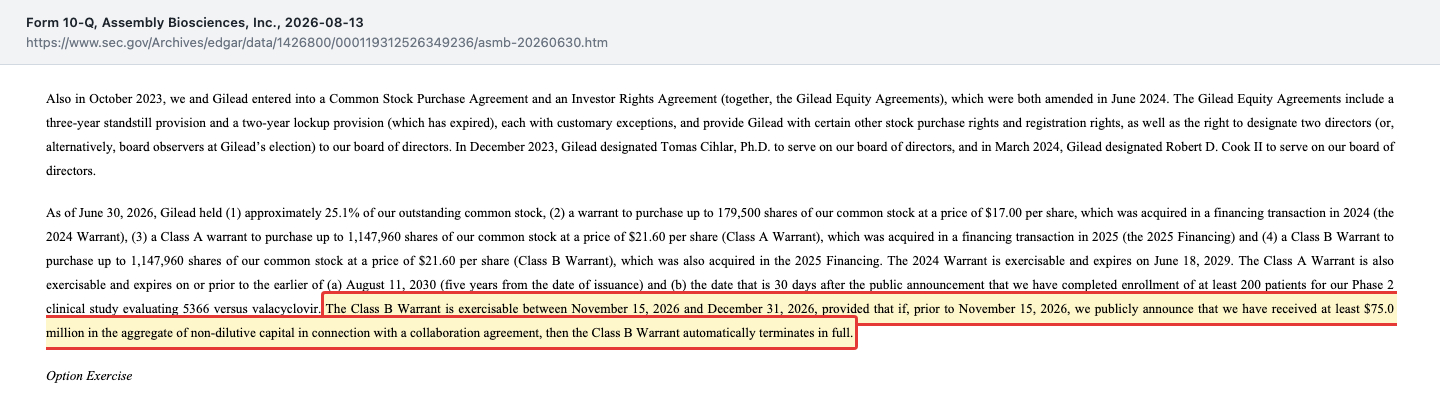
“The Class B Warrant is exercisable between November 15, 2026 and December 31, 2026, provided that if, prior to November 15, 2026, we publicly announce that we have received at least $75.0 million in the aggregate of non-dilutive capital in connection with a collaboration agreement, then the Class B Warrant automatically terminates in full.”
— Assembly Biosciences, SEC quarterly report 10-Q as of 6/30/2026, Gilead collaboration section
Now put a second passage from the same report next to it: per the quarterly report, Gilead owes an extension fee of $75.0 million, due in the fourth quarter of 2026 following the third anniversary of the October 2023 collaboration. The amount matches the threshold exactly. The report does not explicitly link the two passages, and the form of warrant (Exhibit 4.2 to the 10-Q of November 10, 2025) does not define “non-dilutive capital” further. Only the mechanics are clear: if the payment arrives before November 15 and is announced, no new shares will come from this position — but no $96.4 million from warrant exercises will flow either. If it comes later, the holders decide whether to buy at $21.60. For a small shareholder, that is a date worth putting in the calendar.
Valuation: what the market pays beyond the cash
The usual yardsticks fail here. There is no price-to-earnings ratio, and a price-to-sales ratio would mislead, because “revenue” consists largely of released upfront payments and a one-time license fee. So we work in building blocks.
At the $23.70 closing price of September 25, 2026 and the 20,360,596 shares on the cover of the quarterly report, the market value comes to about $482 million; counting the 1,455,820 pre-funded warrants, it is about $517 million. Of that:
- $320.4 million is covered by cash and securities as of June 30, 2026 — about two thirds, or roughly $15.70 per share. In July another $11.0 million or so came in from warrant exercises.
- about $160 million is the premium. That is what the market pays for ABI-6250, for the prospect of up to $330.0 million in herpes milestones, for future Gilead fees and for the remaining research.
The professionals' view comes, for once, not from an analyst consensus but from the company's own offering. In May 2026 investors bought new shares at $26.50 through an underwriting syndicate led by Guggenheim Securities and UBS; the base prospectus of March 2026 documents a price of $27.52 on March 18, 2026. The September 25, 2026 close of $23.70 sat below both. Whoever bought in May is under water — at a company whose cash grew over the same period.
Whether $160 million is a lot or a little for this pipeline cannot be read off a spreadsheet. What can be said: the premium rests on two things Assembly only partly controls — the success of a compound so far tested only in healthy volunteers, and a herpes program whose development Gilead steers. For a comparable pre-product biotech with a very different balance-sheet problem, see Fate Therapeutics: there, cash that runs out before the company's own trial ends — here, cash that lasts, but leaves a partner with a lot of power.
Opportunities and risks at a glance
What speaks for Assembly Biosciences
- $320.4 million in cash and securities as of June 30, 2026, no financial debt, $305.6 million of equity — enough into late 2028 per the company, into 2029 with the Gilead fee.
- A deep-pocketed partner that has paid repeatedly since October 2023: $100.0 million at the start, $10.0 million in December 2024, a net $35.0 million for the license in December 2025, plus extension fees of $75.0 million each on the third, fifth and seventh anniversaries.
- Up to $330.0 million in milestones plus royalties for the herpes program, without Assembly bearing the development costs — unless it voluntarily opts into the cost share.
- ABI-6250 targets a mechanism already proven in hepatitis delta: per the annual report, the only approved therapy, bulevirtide (in the EU, Australia and Canada), blocks the same front door but requires daily injections; 6250 is designed to be taken by mouth.
- The net loss shrank by more than 95 percent from 2021 to 2025 — helped by the license payment — and total operating expenses in the first half of 2026 were slightly below the prior-year period at $39.3 million (versus $40.1 million).
What speaks against it
- No approved product and an accumulated deficit of $845.0 million as of June 30, 2026.
- Every revenue dollar comes from Gilead; second-quarter 2026 revenue includes a $5.1 million catch-up adjustment, and deferred revenue has shrunk to $16.3 million.
- Gilead is a roughly 25.1 percent shareholder, customer and decision-maker at once — and in June 2026 it picked its own contributed compound.
- The share count has risen 3.7-fold since the end of 2023, and another 11.56 million potentially dilutive securities are outstanding.
- ABI-6250 has no patient data yet; both Phase 2 studies are only slated to begin in the fourth quarter of 2026 and the first quarter of 2027, respectively.
- If Assembly opts into the 40 percent cost and profit share, it will carry part of the development costs of a program it does not control.
A human conclusion
Remember the halo from the beginning? The sentence “Gilead is in,” which feels like a check someone else did for you? After reading the filings we know what that sentence actually means at Assembly Biosciences — and what it does not.
It means: here is a company with a lot of money in the bank, no debt and a partner that pays when it wants something. It does not mean that this partner represents your interests. Gilead has a quarter of the shares, two board seats, the herpes program and the decision on the next compound. You have your slice of the pie — a slice that has become considerably smaller since the end of 2023, because the safety did not fall from the sky.
So what you buy here is not Gilead's judgment but something simpler and harder at the same time: roughly $15.70 of cash per share, a hepatitis delta pill that has yet to face its first patient study, and the hope that the decisions of a much larger partner work out for you, too. The halo is not wrong. It just is not your lawyer.
We will not tell you how this story ends — we do not know, and anyone who claims to know is selling you something. What you make of it is your decision. And that is exactly as it should be.
Sources
- SEC quarterly report 10-Q as of June 30, 2026 (filed 8/13/2026) — balance sheet, results, catch-up adjustment, Gilead stake, warrants, programs, runway
- Second-quarter 2026 earnings release (Exhibit 99.1 to the 8-K of 8/13/2026, corrected to Item 2.02 by 8-K/A on 8/14/2026) — quarterly figures, milestones, runway
- SEC quarterly report 10-Q as of March 31, 2026 (filed 5/7/2026) — first-quarter comparison figures
- SEC annual report 10-K for 2025 (filed 3/19/2026) — business model, corporate history, employees, risk factors, 2025 figures
- SEC annual report 10-K for 2024 (filed 3/20/2025) — 2023/2024 figures, 1-for-12 reverse stock split
- SEC quarterly report 10-Q as of September 30, 2025 (filed 11/10/2025) — August 2025 financing, Class A and Class B warrants, form of warrant (Exhibit 4.2)
- 8-K of May 26, 2026 — offering at $26.50, net proceeds of about $107.4 million
- Release of May 22, 2026 (Exhibit 99.1 to the 8-K) — expansion of ABI-6250 into PBC and PSC
- Prospectus supplement 424B5 of May 26, 2026 — offering terms, documented prices
- 8-K on the June 4, 2026 annual meeting — increases to the equity plans
- Form S-8 of August 20, 2026 — 1,200,000 plan shares and 290,000 employee purchase plan shares
- SEC XBRL company facts, CIK 0001426800 — 2021-2025 annual series for revenue, net income and cash flow
This analysis is journalistic commentary based on publicly available documents. It is not investment advice, not a recommendation to buy or sell, and not a solicitation to trade securities. Shares of clinical-stage biotechnology companies are especially volatile; a total loss of the capital invested is possible. All figures come from the sources linked above and carry the cut-off dates stated there; they may have changed since publication. Positions held by the operator are disclosed daily; where one exists, it appears as a notice at the top of this deep dive.
Key figures at a glance
All monetary figures in millions of $; earnings per share as reported.
| Metric | 2021 | 2022 | 2023 | 2024 | 2025 |
|---|---|---|---|---|---|
| Revenue | 6.3 | 0.0 | 7.2 | 28.5 | 72.3 |
| Operating Income (EBIT) | -132.7 | -94.1 | -64.6 | -45.4 | -12.1 |
| Net Income | -129.9 | -92.1 | -61.2 | -40.2 | -6.1 |
| Net Margin | -2,076.4% | – | -854.8% | -140.9% | -8.5% |
| Earnings Per Share | -36.00 $ | -22.82 $ | -13.38 $ | -6.69 $ | -0.55 $ |
Source: fundamental data & SEC filings (annual and quarterly reports, 10-K/10-Q)
Our Bottom Line at a Glance
- Balance sheet and runway positive
- As of 6/30/2026 the company held $320.4 million in cash and securities against $25.2 million of total liabilities, with no financial debt and $305.6 million of equity. Per the quarterly report it expects a runway into late 2028, into 2029 with the $75.0 million Gilead fee — against $37.6 million of operating cash outflow in the first half of 2026.
- Partner Gilead neutral
- Since October 2023 Gilead has contributed upfront payments, equity purchases and a net $35.0 million license fee (December 2025), and it owns approximately 25.1 percent. The same partner controls the herpes program alone, chose its own contributed compound 1179 in June 2026 and does not intend to develop 5366 further at this time.
- Revenue quality negative
- Every revenue dollar comes from a single contract. The $13.4 million in the second quarter of 2026 includes a $5.1 million catch-up adjustment; without it, revenue would be below the prior-year quarter. Deferred revenue from Gilead fell from $36.9 million (12/31/2025) to $16.3 million (6/30/2026).
- Dilution negative
- The share count rose from 5,482,752 (12/31/2023) to 20,360,596 (8/7/2026). As of 6/30/2026 another 11,561,764 potentially dilutive securities were outstanding, including 9,487,477 warrants; in July 2026 holders exercised 510,205 Class A warrants for about $11.0 million.
- Own pipeline neutral
- ABI-6250 has completed a Phase 1a study in healthy participants; Phase 2 studies in hepatitis delta (fourth quarter of 2026) and in the cholestatic liver diseases PBC and PSC (first quarter of 2027) have been announced but not started. The company does not plan to advance hepatitis B candidate 4334 without a partner.
Assembly Biosciences is a well-funded research company without a product whose value sits largely in its cash and largely in the decisions of a single partner. The balance sheet reaches into 2028, revenue is Gilead's money from yesterday, and shareholders paid for that safety with a near-quadrupling of the share count. Anyone investing here is betting on ABI-6250 and on Gilead's interests continuing to point in the same direction as everyone else's. Not investment advice.
What Our Rating Means
Open questions
The business works in principle, but one material question is open. As long as it stays open, our findings do not carry a quality verdict.
Red has no basis here: $320.4 million in cash, $305.6 million of equity, no financial debt and a company-stated runway into late 2028 sit far above any substance threshold. Green lacks its counterpart: there is no approved product, every revenue dollar comes from a partner that also owns a quarter of the company and alone decides the fate of its most important program, and the company's own lead asset ABI-6250 has yet to enter its first patient study. A holder is betting that Gilead's choices keep favoring all shareholders; a new buyer additionally pays a premium of about $160 million over the cash for a pipeline without patient data. The decision is yours.
A journalistic assessment by our editorial team at the time of the deep dive, based on public sources — not investment advice and not a solicitation to buy or sell. Your personal circumstances (investment goals, risk capacity, taxes) cannot be taken into account. What our levels mean, how verdicts are formed, and what conflicts of interest exist →
Worth Noting
- Hook: our in-house stock scanner, data as of 9/26/2026 — the stock appears in the “Stage 4 (downtrend)” and the Beneish M-Score screens. Both are research prompts, not signals and not an accusation.
- Data as of: 10-Q for 6/30/2026 (filed 8/13/2026), same-day earnings release (8-K, corrected to Item 2.02 by 8-K/A on 8/14/2026), 10-K for 2025 (3/19/2026), 424B5 prospectus supplement of 5/26/2026 and Form S-8 of 8/20/2026. No further filing through 9/26/2026.
- The market value of about $482 million is calculated: 20,360,596 shares (10-Q cover, 8/7/2026) times the $23.70 closing price on 9/25/2026. Including the 1,455,820 pre-funded warrants it would be about $517 million.
- All share counts reflect the 1-for-12 reverse stock split effective 2/9/2024.
Stock Watch
This analysis is as of September 26, 2026. Stock Watch will tell you what's changed at ASMB since then.
Later $1 a month per stock — signing up is free, and you'll be the first to know when it launches.
The full analysis as a PDF for later
We will send you this analysis as a PDF — to print, file away, and read at your own pace. And we will add you to the free Stock Watch list for Assembly Biosciences Inc (ASMB), so you hear about it when something material in this analysis changes.
Frequently Asked Questions
Assembly Biosciences develops small-molecule drugs for viral and liver diseases: two herpes compounds (1179 and 5366) exclusively licensed to Gilead since December 2025, the candidate ABI-6250 for hepatitis delta and two cholestatic liver diseases, a hepatitis B compound, and a compound for transplant-related herpesviruses that is still in filing-enabling studies. No product has been approved.
Only through its collaboration with Gilead Sciences. Revenue was $72.3 million in 2025, of which $35.0 million came from Gilead licensing the herpes program in December 2025. The rest is the gradual recognition of earlier upfront payments. There are no drug sales; the annual report 10-K for 2025 says so explicitly.
As of June 30, 2026 Gilead held approximately 25.1 percent of the outstanding shares, according to the quarterly report. On top of that it holds a warrant for 179,500 shares at $17.00 and 1,147,960 Class A and 1,147,960 Class B warrants at $21.60 each. Gilead may designate two directors and has appointed Tomas Cihlar and Robert D. Cook II.
As of June 30, 2026 the company held $320.4 million in cash and securities. According to the quarterly report it expects this to fund operations into late 2028, and into 2029 with the $75.0 million Gilead extension fee due in the fourth quarter of 2026. Operating activities used $37.6 million in the first half of 2026.
Rights to buy 4,464,290 shares at $21.60 each from the August 2025 financing, exercisable only from November 15 to December 31, 2026. They terminate in full if Assembly publicly announces, before November 15, 2026, that it has received at least $75.0 million of non-dilutive capital in connection with a collaboration agreement.
The quarterly report as of June 30, 2026 gives no reason. It states that Gilead's June 2026 development plan advances 1179 into a Phase 2 study expected to start by the end of 2026, and that Gilead does not intend to develop 5366 further at this time. Gilead contributed 1179 to the collaboration; 5366 came out of Assembly's own research.
The balance sheet as of June 30, 2026 shows no financial debt. Total liabilities were $25.2 million, of which $16.3 million was deferred revenue from Gilead. Stockholders' equity stood at $305.6 million, and the accumulated deficit since inception at $845.0 million.
Found an error?
Did you spot a factual error, an outdated number, or a typo in this deep dive? Let us know briefly — your report goes straight to the editorial team.