Fate Therapeutics: The Cells Work — the Cash Still Runs Out
In January 2021 Fate Therapeutics sold its own shares at $85.50. In March 2024 it sold them at $5.50. In August 2026 its own filing fee table at the SEC documented a price of $2.795. In between sit a terminated partnership, $1,595.7 million of accumulated losses and a cost program that cut operating expenses from $404.7 million to $154.4 million. Then, in August 2026, the other headline: the first patient in a potentially registrational trial was treated — as an outpatient, discharged the same day. We read the filings to find out what a platform is worth when it has never sold a medicine.
 Thomas Mücke
Founder & Publisher
Thomas Mücke
Founder & Publisher
As of Today
As of: September 18, 2026
- Closing price
- 2.50 $ +0.40%
- Market Capitalisation
- 0.3 $B
- Growth Score
- 2/10
- AAQS
- 1/10
Price change since August 10, 2026: -10.6%
This analysis has a cut-off date. The Stock Guard tells you when something material changes in the numbers. Reserve your free spot
Chart
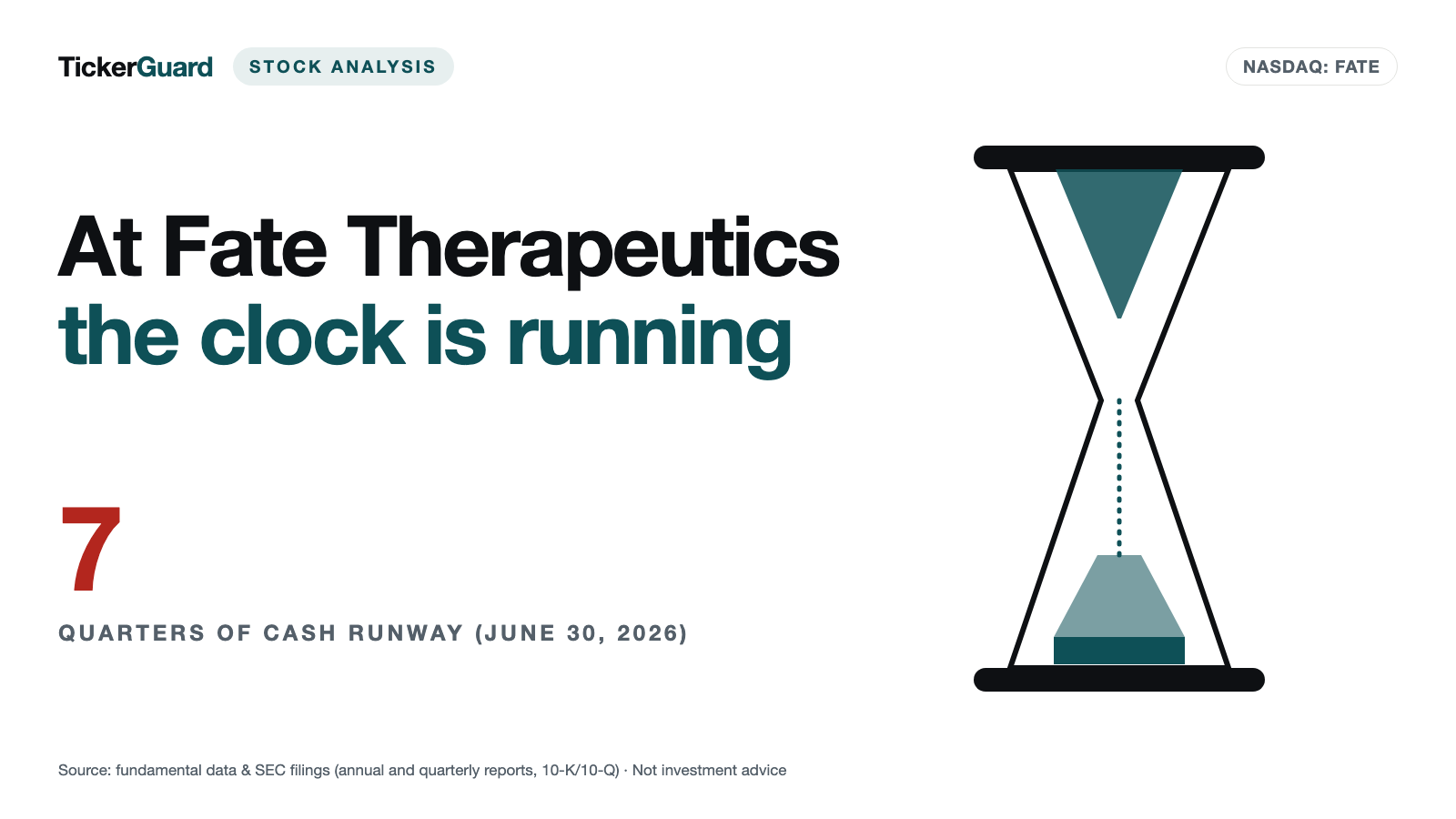
Interactive price chart (TradingView).
52-week range: 0.95 $ to 3.10 $ · Last price: 2.50 $ (As of: September 18, 2026)
Note: pure fact-based analysis, not investment advice and not a solicitation to buy or sell. All figures without guarantee.
The ruin trap: why a low price looks like a bargain
There is a mental trap that catches almost anyone who has been around markets long enough. It works like this: you see today's price, you remember an older one, and your brain automatically computes the gap. "The stock was once $85. Now it is $3. It only has to get a tenth of the way back." Call it the ruin trap: we mistake the distance from the past for a statement about the present. But an old price is not a price tag. It is a souvenir.
At Fate Therapeutics the gap is unusually wide, and it can be documented without a single market data feed. Every annual report cover page must state the aggregate market value of shares held by non-affiliates as of the middle of the fiscal year. As of June 30, 2021 that figure was $6,960 million. As of June 30, 2025 it was $113 million. That is 98 percent less in four years, straight from the company's own filings.
And this is exactly the tension that runs through this analysis: over those same four years the science moved forward. In August 2026 the first patient was treated in a trial that can lead to approval. The research advances, the cash recedes, and both point into the same future. So we will not read the chart. We will read the filings. Deal?
Company history for investors
-
2013
Nasdaq listing
After six years as a privately funded company, Fate goes public. From then on the capital market pays for every research dollar — a pattern that still holds today.
-
2021
Offering at $85.50 per share
In January 2021 the company issues shares at the highest price in its history. Anyone who bought then holds the most expensive anchor its own filings document.
-
2023
Janssen ends the collaboration
The annual report itself names the January 2023 announcement as a share-price event. For shareholders it removed the largest external revenue source — and a class action followed.
-
2024
Equity raise at $5.50
In March 2024 Fate sells 14,545,454 shares for roughly $80.0 million gross. The price sits 94 percent below the 2021 level — existing holders pay the cost of dilution.
-
2026
Operating expenses cut to $154.4 million
The February 2026 annual report shows the third consecutive year of cuts. For shareholders that means more time per dollar, but also fewer programs running at once.
-
2026
First patient dosed in RECLAIM-LN
In August 2026 a patient receives FT819 in a potentially registrational trial for the first time — as an outpatient, discharged the same day. From here the data decides, not the theory.
What Fate Therapeutics actually does — cells off the shelf
Picture a cancer or autoimmune therapy as a bespoke suit. In a conventional CAR T-cell treatment, immune cells are collected from the patient, genetically re-engineered in a laboratory, expanded, and given back. It takes weeks, it costs six figures, and every batch is a one-off — with all the variability one-offs bring.
Fate Therapeutics took the other route: ready-to-wear, from inventory. The company turns human cells into induced pluripotent stem cells — cells that divide indefinitely and can become any cell type in the body. From a single such cell it derives a precisely engineered clonal master cell bank: the sourdough starter from which the same loaf can be baked again and again. The finished cells sit frozen in depots and can be shipped to a clinic on demand.
The advantage is easy to grasp, and the company demonstrated it in the earnings release of August 13, 2026: the first patient in its registrational trial was treated as an outpatient and discharged the same day, using drug product that was already in inventory. With a bespoke therapy that is not possible.
Three candidates carry the story. FT819 targets the B-cell marker CD19 and is being tested in autoimmune disease — lupus, lupus nephritis and systemic sclerosis. FT839 carries 13 targeted genetic edits and hits CD19 and CD38 at once; the U.S. Food and Drug Administration (FDA) cleared the investigational new drug application in July 2026. FT836 targets the stress ligands MICA and MICB and is being tested in solid tumors. Behind all three sits a portfolio the annual report 10-K for 2025 puts at more than 600 issued patents and 550 pending patent applications.
One thing the company does not do: make money. The annual report for 2025 puts it without decoration.

“We have not yet obtained regulatory approval for any of our product candidates or generated any revenues from therapeutic product sales.”
— Fate Therapeutics, SEC annual report 10-K for 2025, Risk Factors (Item 1A)
What does show up as revenue comes from a single contract: the collaboration with Japanese pharmaceutical company Ono Pharmaceutical, signed September 14, 2018. Ono paid $10.0 million upfront, committed to roughly $20.0 million of research funding, and paid a further $10.0 million milestone in December 2020. That is contract research — not medicines anyone buys.
How the stock landed on our desk
No valuation screen flagged Fate Therapeutics. Other investors' attention did. Our in-house Reddit hype scanner lists tickers that are being discussed unusually often in retail forums, and FATE appeared on that list on September 18, 2026. That is not a recommendation and not a signal — it means somebody, somewhere, is telling a story. Our job is to hold the story against the filings.
And the filings tell the story of the fall with surprising precision, without any market data at all. Three prices appear verbatim in the company's own SEC documents:
- $85.50 — in January 2021, alongside a public offering, Fate issued pre-funded warrants at $85.499 each, which the quarterly report defines as the public offering price per share less the $0.001 exercise price.
- $5.50 — in March 2024 the company sold 14,545,454 shares at that price for roughly $80.0 million in gross proceeds.
- $2.795 — stated in the filing fee table of the Form S-8 filed August 13, 2026 as the average of the high and low sales prices on the Nasdaq Global Market on August 10, 2026.
Three numbers, five and a half years, down 97 percent. Keep one sentence in mind from the start: a low price is not a discount, it is a question. The question here is what is left, and whether it is enough.
A neighbouring case helps with the framing. At cell therapy developer ImmunityBio we looked at a biotech where the substance question has already been answered — with an explicit going-concern paragraph and negative shareholders' equity. Fate sits at a different point on the same road: the balance sheet is still intact. The question is for how long.
The numbers over the years — fairly credited
Start with what genuinely impresses, and at this company that is not the science but the bookkeeping. Fate Therapeutics shrank its cost base radically in three years without abandoning the programs that matter.
Total operating expenses fell from $404.7 million in 2022 to $154.4 million in 2025 — down 62 percent. Research and development costs dropped over the same span from $320.5 million to $107.8 million, and general and administrative costs from $84.2 million to $46.5 million. Cash used in operations, the money that actually leaves the account, fell from $248.2 million to $106.1 million.
The notable part: the program has not stopped. In the first half of 2026 operating expenses came in another $14.3 million below the prior-year period — research and development down 13 percent, general and administrative down 27 percent. Anyone who has watched an organisation try to shrink knows that is real work.
Now the other half of the picture. While costs fell, revenue fell faster.
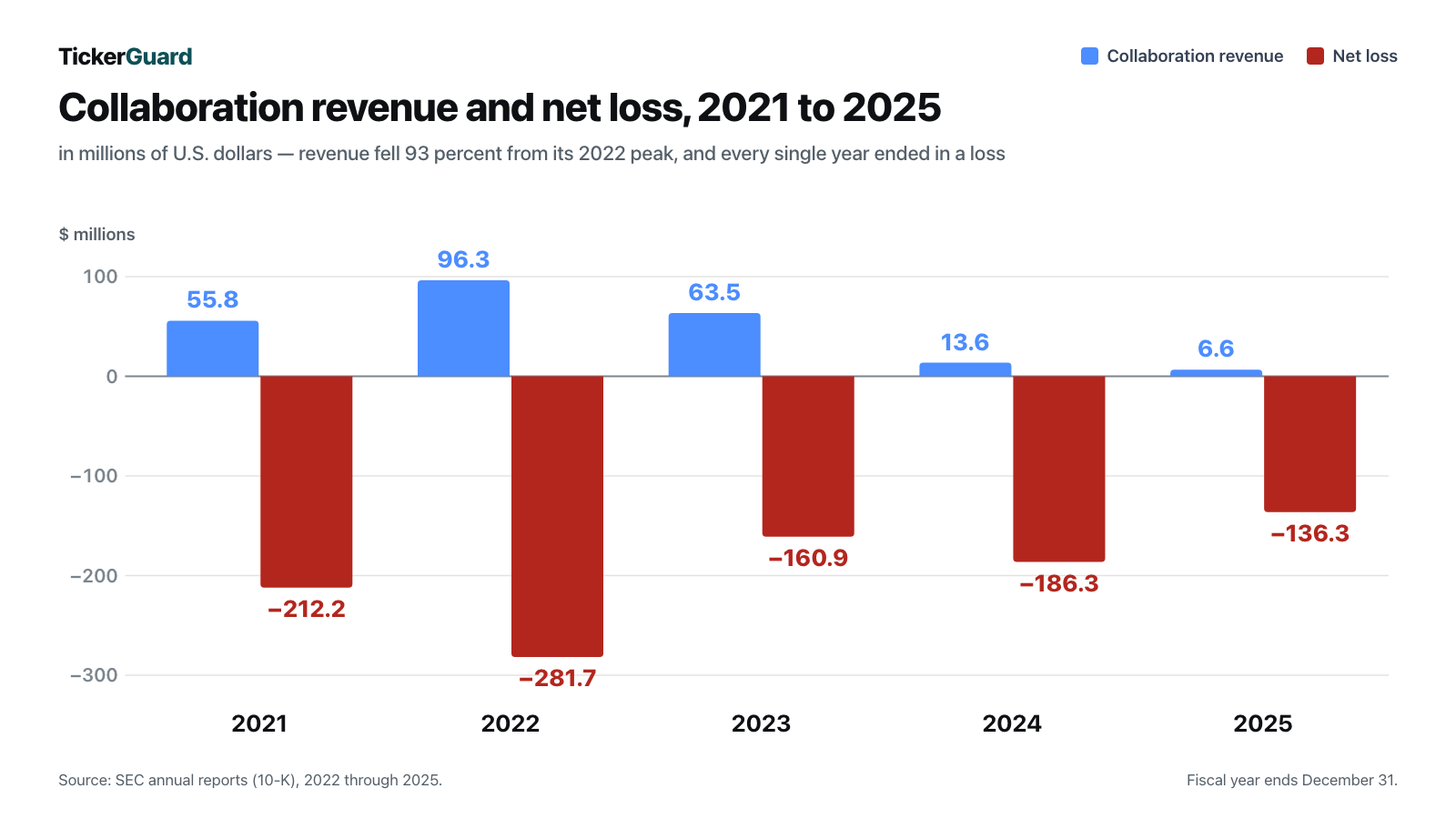
The series reads like a demolition: $55.8 million (2021), $96.3 million (2022), $63.5 million (2023), $13.6 million (2024), $6.6 million (2025). The second quarter of 2026 brought $2.082 million, slightly more than the $1.907 million of the year-ago quarter — but at a level where percentage comparisons explain nothing.
The net loss has narrowed considerably: from $281.7 million (2022) to $136.3 million (2025), and in the second quarter of 2026 to $30.2 million, or $(0.25) per share, after $(0.29) a year earlier. But a smaller loss is not a profit. It is slower consumption.
And that consumption can be followed line by line in the balance sheet.
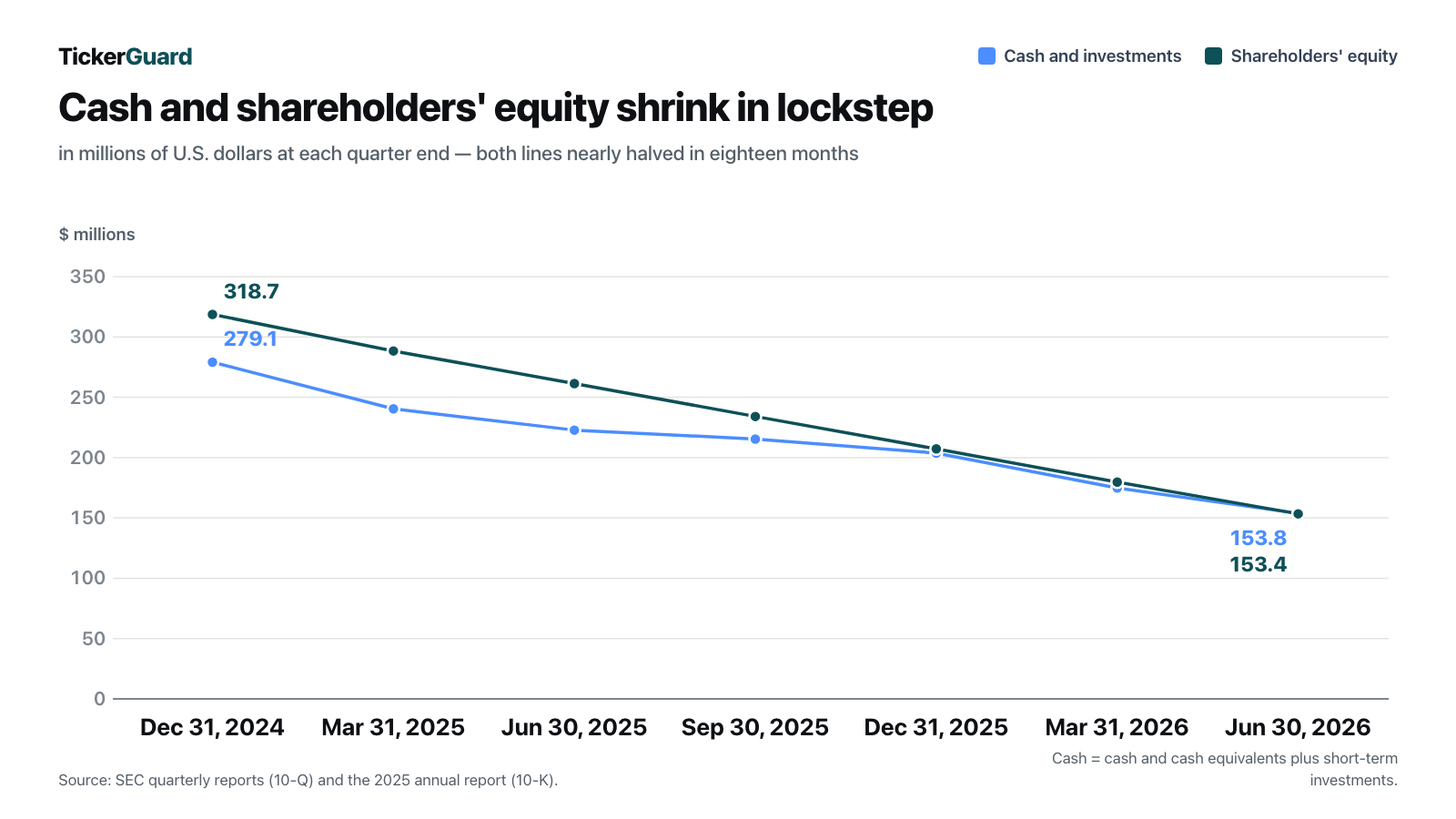
The balance sheet as of June 30, 2026 is remarkably clean: $32.4 million of cash and cash equivalents plus $121.3 million of short-term investments make $153.8 million. Total assets are $260.1 million, current liabilities $32.6 million, shareholders' equity $153.4 million. There is no financial debt. An investor who only screens for leverage will find nothing to object to here — the pressure comes from a different direction.
What the filings say — the uncomfortable truths
Uncomfortable truth no. 1: $1,595.7 million has been spent — and it continues
The accumulated deficit is the sum of every loss since incorporation. At Fate Therapeutics it stood at $1,595,681 thousand on June 30, 2026 — roughly $1.6 billion. For comparison: total shareholders' equity is $153.4 million. Over nineteen years the company has therefore consumed more than ten times what is left today.

“We have incurred losses and negative cash flows from operations since inception. As of June 30, 2026, we had an accumulated deficit of $1.6 billion and anticipate that we will continue to incur net losses for the foreseeable future.”
— Fate Therapeutics, SEC quarterly report 10-Q as of June 30, 2026, "Liquidity and Capital Resources"
The second half of that same paragraph matters just as much: the company states that its funds will cover at least twelve months from the date the financial statements were issued. That is the formal language that rules out a going-concern qualification — and here it is not boilerplate but arithmetically supported.
Uncomfortable truth no. 2: the cash runs out before the trial does
Do the arithmetic with the figures from the August 13, 2026 earnings release. Cash and investments stood at $153.8 million, and the second-quarter decline was $21 million. At that pace the money lasts about seven quarters — roughly to the spring of 2028. The company itself guides to runway "into 2028" in the same release. Both calculations agree.
Now the second figure from that same release: enrollment in the registrational RECLAIM-LN trial is targeted to complete in the first half of 2028. Completing enrollment means the last of roughly 53 patients has been taken in. The primary endpoint is measured 26 weeks after treatment. Data would therefore arrive at the earliest toward the end of 2028 — and analysis, submission and a regulatory decision would come considerably later.
Which leaves one plain sentence that no press release phrases this way: the company's own cash does not reach the result of the company's own trial. Fresh capital here is not an accelerant but a precondition. And that leads straight to the next truth.
Uncomfortable truth no. 3: your slice of the pie keeps shrinking
Dilution, in everyday terms: the pie does not get bigger, but it gets cut into more slices. Your slice shrinks without you doing anything. At Fate Therapeutics that happens along three tracks at once.
First, the rights already issued. As of June 30, 2026 there were 39,126,625 potentially dilutive securities outstanding: 13,775,430 from convertible preferred stock, 16,350,779 from options and 9,000,416 from restricted stock units. A year earlier the figure was 33,517,954. Measured against 116,694,106 shares outstanding, that is a little over one third. On top of that sit 3,893,674 pre-funded warrants from the January 2021 and March 2024 placements; because their exercise price is $0.001, the company already counts them as shares in its per-share loss.
Second, the mere passage of time. The balance sheet as of June 30, 2026 shows 116,694,106 shares. The cover page of that same report, dated August 6, 2026, shows 119,820,514 — 3,126,408 more in five weeks, with no meaningful cash coming in. Restricted stock units granted in July 2024 vested on August 4, 2026; the insider reports (Form 4) filed the next day show executives selling partial amounts solely to cover tax withholding. And the supply is already replenished: shareholders approved another 7,000,000 plan shares on June 12, 2026, registered for issuance on August 13, 2026.
Third, the open shelf. Since November 2023 Fate has had a shelf registration statement from which roughly $220.0 million can still be drawn, including $100.0 million through a live at-the-market program with investment bank Jefferies. Nothing had been sold under it through June 30, 2026. The company spells out the consequence itself.
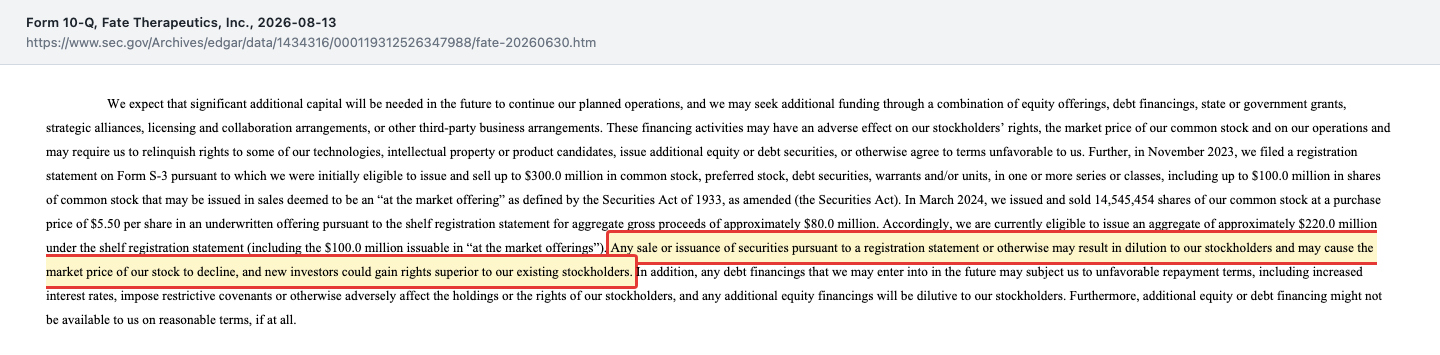
“Any sale or issuance of securities pursuant to a registration statement or otherwise may result in dilution to our stockholders and may cause the market price of our stock to decline, and new investors could gain rights superior to our existing stockholders.”
— Fate Therapeutics, SEC quarterly report 10-Q as of June 30, 2026, Part II, Risk Factors (Item 1A)
This is not a suspicion but a precedent: the last offering, in March 2024, priced at $5.50 per share — 94 percent below the January 2021 level. Whoever bought in 2021 paid for it in 2024.
Uncomfortable truth no. 4: a lease that outlasts the cash
This number appears in no press release. In the commitments note of the quarterly report as of June 30, 2026 sits a line of $113.8 million in future undiscounted minimum contractual payments for office and laboratory space — due over a weighted-average remaining term of 9.7 years.

“As of June 30, 2026, future undiscounted minimum contractual payments under the Company’s operating leases were $113.8 million, which will be paid over a remaining weighted-average lease term of 9.7 years.”
— Fate Therapeutics, SEC quarterly report 10-Q as of June 30, 2026, Note 7 "Leases"
Place the two figures side by side: $113.8 million of lease obligation against $153.8 million of cash. That is 74 percent of total liquidity, committed to square footage into the 2030s — at a company whose own runway ends in 2028. The schedule in the report shows $11.4 million for 2027, $10.3 million for 2028 and $53.8 million for the years after 2031 combined.
This is not a balance-sheet scandal, and it is not a mistake: anyone manufacturing cells needs cleanrooms, and cleanrooms are not rented by the month. But it is a fixed cost block of roughly eleven million dollars a year that no cost program touches — about a fourteenth of the $154.4 million of operating expenses recorded in 2025, and not negotiable away.
Uncomfortable truth no. 5: the 2023 lawsuit is still open
On January 20, 2023 a shareholder filed a securities class action in the U.S. District Court for the Southern District of California (Hadian v. Fate Therapeutics). The allegation: misleading disclosures about the Janssen Biotech collaboration and its termination, reaching back to August 2020. The court dismissed the complaint twice — on September 19, 2024 and again on September 22, 2025 — each time with leave to amend. On October 17, 2025 the plaintiff filed a third amended complaint; the company's motion to dismiss of November 17, 2025 was still undecided as of the quarterly report on August 13, 2026.
Three derivative actions against directors and officers run alongside it: two consolidated cases in California and a further suit filed in December 2025 in the Delaware Court of Chancery. So far this has cost the cash nothing — the balance sheet carries no provision. It still matters for the picture: three and a half years after the Janssen termination, the chapter is not legally closed.
Valuation: what the market pays for a platform without a product
The usual tools do not work here. There is no price-to-earnings ratio because there are no earnings. A price-to-sales ratio could be calculated but would be nonsense: the $6.6 million of "revenue" is research funding from a single contract, not a product business. So we build the valuation from blocks instead.
At the documented price of $2.795 (the average of the high and low sales prices on August 10, 2026, as stated in the filing fee table of August 13, 2026) and with 119,820,514 shares (as of August 6, 2026), the market value comes to roughly $335 million. Of that:
- $153.8 million is covered by cash and short-term investments — about 46 percent of the market value, or roughly $1.28 per share.
- $153.4 million is covered by book equity, which implies a price-to-book ratio of about 2.2 — the market pays a little over two dollars for every dollar of book value.
- Roughly $180 million is the remainder. That is the price of the platform, of more than 600 issued patents, of the clonal master cell bank, of three clinical programs — and above all of the chance that FT819 works.
Whether $180 million is a lot or a little for that chance cannot be read off a spreadsheet. What can be said: it is a small number for a company where, according to the earnings release of August 13, 2026, a patient was dosed for the first time with an off-the-shelf iPSC-derived cell therapy in a potentially registrational trial in an autoimmune disease — to the company\'s knowledge the first such case. And it is a large number for a company that needed $1.6 billion over nineteen years to get there and needs the capital markets again for the rest of the road.
One more point belongs in the valuation, and it does not appear in the income statement. Anyone buying a share today buys into a structure in which a single fund — Redmile Group — reported 14.9 percent in its Schedule 13D/A of April 22, 2026. That ceiling is not a market decision but a contract: Redmile raised it from 9.99 to 14.99 percent in July 2025, effective August 31, 2025, and may raise it further on 61 days' notice — to 19.99 percent at its own election, and beyond that on the basis of the shareholder approval of May 2, 2017. For a retail shareholder that means: at the next equity raise there is one address at the table able to hold its stake while everyone else is diluted. How strongly balance sheet structures away from the operating business can move the value of a biotech share is something we saw at Zymeworks: there a royalty-backed loan rewrote the balance sheet without anything changing in the business itself.
Upside and risks at a glance
Upside
- The first patient in a potentially registrational trial was treated in August 2026 — as an outpatient, discharged the same day, with drug product taken from inventory. That is the proof of the platform's central promise.
- FT819's safety profile in Phase 1 has been notably clean: among the 16 patients treated under the less-intensive conditioning regimen, the August 13, 2026 release reports no dose-limiting toxicities, no Grade 2 or higher cytokine release syndrome, no neurotoxicity and no graft-versus-host disease.
- The balance sheet is unencumbered: $153.8 million of cash, $153.4 million of equity, no financial debt, and no going-concern paragraph from the auditor.
- The cost base has been cut 62 percent in three years and keeps falling — every dollar saved is additional time.
- The FDA granted FT819 Regenerative Medicine Advanced Therapy designation and cleared the FT839 application in July 2026; the company has also been admitted to an FDA pilot program on manufacturing readiness.
Risks
- Since incorporation in 2007 there has been no approved product and no revenue from therapeutic product sales — the annual report says so verbatim.
- The only revenue stream is a single research agreement; revenue fell from $96.3 million (2022) to $6.6 million (2025).
- Cash covers roughly seven quarters — while enrollment in the company's own registrational trial is targeted to complete only in the first half of 2028.
- 39,126,625 potentially dilutive securities against 116,694,106 shares, plus 7,000,000 newly approved plan shares and roughly $220.0 million of shelf capacity.
- $113.8 million of lease obligations over 9.7 years — a fixed cost block that outlives any cost program.
- The January 2023 class action is pending in its third amended form after two dismissals, alongside three derivative suits against directors and officers.
- The competition is large: the annual report lists AstraZeneca, Bristol-Myers Squibb, Gilead, Novartis, Regeneron and Takeda, among others.
A human conclusion
Remember the ruin trap from the opening? The reflex that treats a low price as a bargain because it once stood far higher? At Fate Therapeutics the reflex is especially strong, because the drop is so well documented: $85.50 in January 2021, $2.795 in August 2026. And because the story attached to it is genuinely good.
That is the honest summary of this analysis: the science delivered, the bookkeeping delivered — and the sum still does not add up. A company that cuts costs 62 percent in three years while putting its first patient into a registrational trial has done a great deal right. But in this business "a great deal right" is not enough. It is enough only when a medicine is approved and sold. Until then, every balance sheet line is a countdown.
So what are you buying if you buy here? You are buying $1.28 of cash per share, a debt-free balance sheet, a patent portfolio — and beyond that a single question: does FT819 work well enough in lupus nephritis for a regulator to approve it and a payer to fund it? If yes, today's $335 million market value would look very low in hindsight. If no, what remains is a company with a lease running into the 2030s.
We will not tell you how that question resolves — we do not know, and anyone who claims to know is selling you something. What we can do is lay the numbers out so you can see the difference between a hope and a balance sheet. What you do with that is your decision. And that is exactly as it should be.
Sources
- SEC quarterly report 10-Q as of June 30, 2026 (filed August 13, 2026) — balance sheet, results, liquidity, commitments, legal proceedings, equity
- Second quarter 2026 earnings release (Exhibit 99.1 to the 8-K of August 13, 2026) — cash position, runway, RECLAIM-LN status, FT839, FT836
- SEC annual report 10-K for 2025 (filed February 26, 2026) — business model, employees, competition, risk factors, Janssen history
- SEC quarterly report 10-Q as of March 31, 2026 (filed May 13, 2026) — first quarter comparatives
- SEC annual report 10-K for 2024 (filed March 5, 2025) — prior-year series for revenue, expenses and cash flow
- Filing fee table for the Form S-8 (filed August 13, 2026) — 7,000,000 new plan shares, $2.795 price on August 10, 2026
- 8-K on the annual meeting of June 12, 2026 — resolutions, voting power, equity plan
- Schedule 13D/A filed by Redmile Group (April 22, 2026) — 18,229,078 shares, 14.9 percent
- Form 4 insider filing of August 5, 2026 — vested restricted stock units and sales to cover withholding tax
- SEC XBRL company facts, CIK 0001434316 — annual and quarterly series for revenue, expenses, results, balance sheet and cash flow
This analysis is journalistic commentary based on publicly available documents. It is not investment advice, not a recommendation to buy or sell, and not a solicitation to trade securities. Shares of clinical-stage biotechnology companies are exceptionally volatile; a total loss of invested capital is possible. All figures come from the sources linked above and carry the as-of dates stated there; they may have changed since publication. Positions held by the operator are disclosed daily; where one exists, it appears as a notice at the top of this deep dive.
Key figures at a glance
All monetary figures in millions of $; earnings per share as reported.
| Metric | 2021 | 2022 | 2023 | 2024 | 2025 |
|---|---|---|---|---|---|
| Revenue | 55.8 | 96.3 | 63.5 | 13.6 | 6.6 |
| Operating Income (EBIT) | -217.0 | -308.4 | -190.5 | -210.3 | -147.7 |
| Net Income | -212.2 | -255.1 | -160.9 | -186.3 | -136.3 |
| Net Margin | -379.9% | -264.9% | -253.3% | -1,366.5% | -2,051.1% |
| Earnings Per Share | -2.24 $ | -2.63 $ | -1.64 $ | -1.64 $ | -1.15 $ |
Source: fundamental data & SEC filings (annual and quarterly reports, 10-K/10-Q)
Our Bottom Line at a Glance
- Balance sheet and funding positive
- As of June 30, 2026 the balance sheet carries $153.8 million in cash and short-term investments and $153.4 million of shareholders' equity, with no financial debt. Auditor Ernst & Young included no going-concern paragraph in the annual report 10-K for 2025, and the company states in its quarterly report that its funds will cover at least the next twelve months.
- Cost discipline positive
- Total operating expenses fell from $404.7 million (2022) to $154.4 million (2025), and cash used in operations from $248.2 million to $106.1 million. In the first half of 2026 expenses came in another $14.3 million below the prior-year period: research and development down 13 percent, general and administrative down 27 percent. That is a sustained program, not an accounting effect.
- Revenue base negative
- The only source of revenue is the research agreement with Ono Pharmaceutical. Collaboration revenue fell from $96.3 million (2022) to $6.6 million (2025) and was $2.082 million in the second quarter of 2026. There has been no revenue from therapeutic product sales since incorporation in 2007 — the annual report 10-K for 2025 says so verbatim.
- Dilution negative
- As of June 30, 2026 there were 39,126,625 potentially dilutive securities against 116,694,106 shares outstanding; a year earlier the figure was 33,517,954. By August 6, 2026 the share count had risen to 119,820,514. Shareholders approved another 7,000,000 plan shares on June 12, 2026, and roughly $220.0 million remains available under the shelf registration statement.
- Clinical progress neutral
- In August 2026 the first patient was dosed in the Phase 2 RECLAIM-LN trial — as an outpatient, discharged the same day. In the preceding Phase 1 study in systemic lupus, the earnings release of August 13, 2026 reports no dose-limiting toxicities, no Grade 2 or higher cytokine release syndrome, no neurotoxicity and no graft-versus-host disease among the 16 patients treated under the less-intensive conditioning regimen. Only registrational data will settle the question.
- Timeline versus runway negative
- Enrollment in RECLAIM-LN is targeted to complete in the first half of 2028 according to the August 13, 2026 release — while the same release guides runway only "into 2028". The company therefore cannot carry its own registrational trial to a result on its own balance sheet; additional capital is not an option but a precondition.
After nineteen years and $1,595.7 million of accumulated losses, Fate Therapeutics has for the first time reached the point that matters: its own drug candidate is being given to patients in a potentially registrational trial. At the same time the revenue base has shrunk to $6.6 million for the full year 2025, and $153.8 million of cash does not reach the end of its own enrollment period. Anyone investing here is not buying earnings or revenue but a bet on a single trial and on continued access to the capital markets. Not investment advice.
What Our Rating Means
Open questions
The business works in principle, but one material question is open. As long as it stays open, our findings do not carry a quality verdict.
Red has no evidentiary basis here: $153.8 million of cash, $153.4 million of equity, no financial debt, no going-concern paragraph from the auditor, and a calculated runway of roughly seven quarters — comfortably above the threshold at which we would call a substance risk. Green is equally unsupported: after nineteen years there is no approved product, the only revenue stream is a research agreement worth $6.6 million in the last full year, and the outcome rests on a single trial whose enrollment is not expected to finish until after the cash runs out. That is the textbook definition of an open operational question. The decision is yours.
A journalistic assessment by our editorial team at the time of the deep dive, based on public sources — not investment advice and not a solicitation to buy or sell. Your personal circumstances (investment goals, risk capacity, taxes) cannot be taken into account. What our levels mean, how verdicts are formed, and what conflicts of interest exist →
Worth Noting
- Trigger: our in-house Reddit hype scanner, flagged on September 18, 2026. The scanner measures attention in retail forums, not quality — it is a reason to research, not a signal.
- As-of data: annual report 10-K for 2025 (filed February 26, 2026), quarterly report 10-Q as of June 30, 2026 (filed August 13, 2026), 8-K of August 13, 2026 with Exhibit 99.1, Form S-8 of August 13, 2026 and Schedule 13D/A of April 22, 2026. No further filing was submitted between August 13 and September 19, 2026.
- Every price named comes from an SEC filing rather than a trading session: $85.50 (January 2021 offering), $5.50 (March 2024 offering) and $2.795 (filing fee table of the Form S-8, average of the high and low sales prices on August 10, 2026).
- Possible confusion: the ticker FATE belongs to Fate Therapeutics, Inc. of San Diego. Janssen Biotech, named in the competition section of the annual report, is part of Johnson & Johnson and was a partner until January 2023, never an owner.
Stock Watch
This analysis is as of September 19, 2026. Stock Watch will tell you what's changed at FATE since then.
Later $1 a month per stock — signing up is free, and you'll be the first to know when it launches.
The full analysis as a PDF for later
We will send you this analysis as a PDF — to print, file away, and read at your own pace. And we will add you to the free Stock Watch list for Fate Therapeutics Inc (FATE), so you hear about it when something material in this analysis changes.
Frequently Asked Questions
Fate Therapeutics develops immune cell therapies from induced pluripotent stem cells (iPSCs). A single genetically engineered stem cell line can be expanded into an unlimited number of identical batches that sit frozen in inventory. Conventional CAR T-cell therapies are manufactured individually for each patient from that patient's own blood.
No. The annual report 10-K for 2025 states that no product candidate has received regulatory approval and that the company has never generated revenue from therapeutic product sales. What appears as revenue in the income statement is collaboration revenue from the agreement with Ono Pharmaceutical — $6.6 million in 2025.
As of June 30, 2026 the company held $153.8 million in cash and short-term investments, and the second quarter decline was $21 million. Management guides to runway "into 2028" in the earnings release of August 13, 2026. At an unchanged burn rate that works out to roughly seven quarters.
RECLAIM-LN is an open-label, single-arm Phase 2 trial of FT819 in lupus nephritis, a severe kidney manifestation of systemic lupus. It is designed to enroll about 53 patients, with complete renal response at Week 26 as the primary endpoint. The first patient was dosed according to the August 13, 2026 earnings release; enrollment is targeted to complete in the first half of 2028.
The annual report explicitly names the January 2023 announcement that the Janssen Biotech collaboration had been terminated as a share-price event. The public float reported on the annual report cover page fell from $6,960 million as of June 30, 2021 to $113 million as of June 30, 2025.
As of June 30, 2026 there were 116,694,106 shares outstanding, plus 39,126,625 potentially dilutive securities from preferred stock, options and restricted stock units, plus 3.9 million pre-funded warrants. By August 6, 2026 the share count had risen to 119,820,514. Roughly $220.0 million remains available under the shelf registration statement.
The balance sheet as of June 30, 2026 shows no financial debt. The largest long-term commitment is real estate: $113.8 million of undiscounted minimum lease payments over a weighted-average remaining term of 9.7 years. Shareholders' equity stood at $153.4 million and total assets at $260.1 million.
Yes. The securities class action Hadian v. Fate Therapeutics, filed January 20, 2023, has been dismissed twice, most recently on September 22, 2025. The plaintiff filed a third amended complaint on October 17, 2025; the company's motion to dismiss of November 17, 2025 was still pending as of the August 13, 2026 quarterly report. Three derivative actions against directors and officers are also outstanding.
Found an error?
Did you spot a factual error, an outdated number, or a typo in this deep dive? Let us know briefly — your report goes straight to the editorial team.