Zymeworks: The $250 Million Milestone May Still Arrive — the $481 Million Bill Has Already Been Written
Zymeworks pulled off what most small biotechs never do: it took a drug of its own all the way to approval, and that drug is now being sold. Even so, second-quarter 2026 revenue came to $4.6 million, down from $48.7 million a year earlier. The money is coming from somewhere else. In March 2026 the company sold 30 percent of its future royalties to a special purpose entity of its own, which borrowed $250.0 million from Royalty Pharma against them — a loan that carries up to $481.3 million in repayments through 2042. Since August 2024 a cumulative $213.6 million has gone into buying back its own stock, and stockholders' equity fell from $268.5 million to $80.4 million in six months. We read the filings to see what a date on the calendar is worth once the bill behind it is already on paper.
 Thomas Mücke
Founder & Publisher
Thomas Mücke
Founder & Publisher
As of Today
As of: October 6, 2026
- Closing price
- 25.70 $ -2.10%
- Market Capitalisation
- 1.8 $B
- Growth Score
- 3/10
- AAQS
- 5/10
Price change since August 21, 2026: -10.4%
This analysis has a cut-off date. The Stock Guard tells you when something material changes in the numbers. Reserve your free spot
Chart
Interactive price chart (TradingView).
52-week range: 16.50 $ to 31.10 $ · Last price: 25.70 $ (As of: October 6, 2026)
Note: pure fact-based analysis, not investment advice and not a solicitation to buy or sell. All figures without guarantee.
The countdown trap: when a date replaces the thinking
There is a kind of stock that does not lure you with numbers. It lures you with an appointment. Somewhere there is a date on the calendar — a regulatory decision, a court ruling, a trial readout — and from that moment your brain works differently. You stop calculating and start counting down. Everything before the date becomes backstory; everything after it becomes promise. Call it the countdown trap: the date replaces the homework, because a date is beautifully specific while a balance sheet is annoyingly approximate.
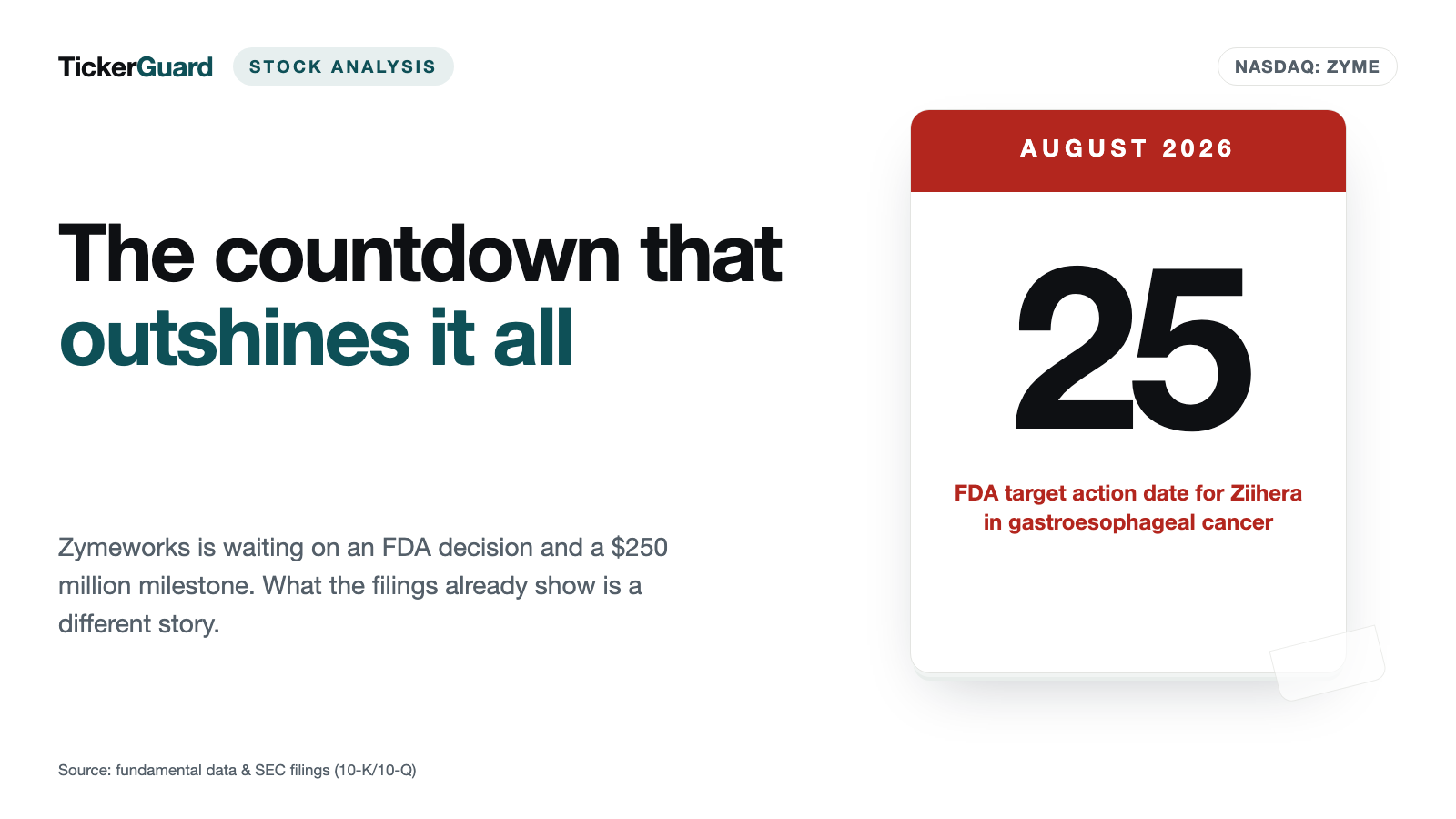
Zymeworks has such a date. The U.S. drug regulator, the FDA, had set August 25, 2026 as its target action date for approving the antibody Ziihera in a new cancer indication — and a $250.0 million payment hangs on it. As of the data cutoff for this analysis on August 23, 2026, that decision was still pending. A perfect countdown, in other words, so we are going to do something else here. We are going to read what the company did in the months before that date. Because that part is already settled, audited, signed and filed with the U.S. securities regulator, the SEC. And it tells a different story than the countdown does. No recommendation, no forecast — only the paperwork that already exists.
Company history for investors
-
2022
Redomiciliation to the United States
In October 2022 the Canadian company becomes a Delaware corporation; the old entity is renamed Zymeworks BC Inc. For investors, today's SEC reporting history under CIK 0001937653 starts there.
-
2024
First approval, and the buybacks begin
Ziihera is cleared for previously treated HER2-positive biliary tract cancer; in August 2024 the board authorizes a first $60.0 million repurchase program. A research operation starts acting like a capital allocator.
-
2025
Best revenue year — and still an $81.1 million loss
Revenue rises to $106.0 million as several partners trigger milestones. Because such payments are one-time, none of it became recurring earnings: the loss only narrowed from $122.7 million to $81.1 million.
-
2026
Royalties sold: $250 million in, up to $481.3 million out
On March 2, 2026 the company pledges 30 percent of its future Ziihera royalties for a $250.0 million loan. The price is an estimated effective interest rate of 10.7 percent through maturity in 2042.
-
2026
Acquisition agreed, cash runway guidance withdrawn
The merger agreement for Theravance Biopharma follows on June 28, 2026, and on August 6, 2026 the company stops saying how long its money lasts. Shareholders lose the simplest gauge of the financial position.
What Zymeworks actually does — and why so little money comes in
Zymeworks Inc. builds antibodies. Operations sit in Vancouver, the legal domicile has been in Delaware since October 2022, and as of December 31, 2025 the company had 264 full-time employees, 204 of them in research and development and 184 of them in Canada. What comes out of the labs are engineered proteins: bispecific antibodies that grab two targets at once (the Azymetric platform) and antibody-drug conjugates, where a cell-killing payload rides piggyback on an antibody so that it only fires where the antibody docks. In plain language: you build the mail carrier and the parcel separately, then glue them together so the parcel only goes off at the right door.
The decisive point for an investor is not the biology, though. It is the business model. Zymeworks does not sell medicines. The one compound out of its own labs that made it all the way to approval — Ziihera (generic name zanidatamab), cleared for previously treated HER2-positive biliary tract cancer in the United States, China, Europe and Canada — is sold by two other companies: Jazz Pharmaceuticals across most of the world and BeOne Medicines in Asia excluding Japan, plus Australia and New Zealand. Zymeworks gets three things in return: upfront payments, milestone payments on defined events, and royalties on sales. Through June 30, 2026 those two agreements had delivered $491.0 million in non-refundable upfront and milestone payments; the platform collaborations with GSK, Daiichi Sankyo, Johnson & Johnson and Merck added a further $233.4 million.
That explains why the revenue line reads like a random number generator. It does not measure how many patients were treated. It measures whether a contractual event happened to land in the quarter. And it explains the second oddity: since 2025 the company has been rebuilding itself. In its earnings release of August 6, 2026 it describes itself as a "biotechnology company managing a portfolio of licensed healthcare assets." The research lab is supposed to become a royalty and asset holding company that collects other people's cash flows. What that looks like in practice comes next. For anyone interested in the pattern: a biotech whose numbers are set almost entirely by partner contracts is not unusual — we walked through the same mechanics in a different shape at Arcus Biosciences.
How the stock landed on our desk
No screening filter flagged Zymeworks. Other investors' attention did. Our in-house Reddit hype scanner first recorded the ticker ZYME on August 20, 2026 with 7 mentions in 24 hours, at a market capitalization of roughly $1.85 billion. That is neither a recommendation nor a signal — it is a hint that somebody in a forum is telling a story. Our job is then to hold the story against the paperwork.
The price action shows what the talk was about: the closing price rose from $25.12 on August 14, 2026 to $28.67 on August 21, 2026, and the 52-week range ran from $13.60 to $29.75 as of the August 22, 2026 data cutoff. A stock that has more than doubled off its low within a year and sits just under its high — right before a regulatory date. Exactly the setting in which the countdown trap snaps shut. Remember the sentence: a date is not a result.
The numbers over the years, given their due
Start with what genuinely impresses. Zymeworks took a compound from nothing to market approval and collected more than $700 million from partners along the way, without ever having to build a sales force. Most small biotechs never get there. And the loss narrowed sharply in 2025: from $122.7 million (2024) to $81.1 million, with revenue up 39 percent at the same time.
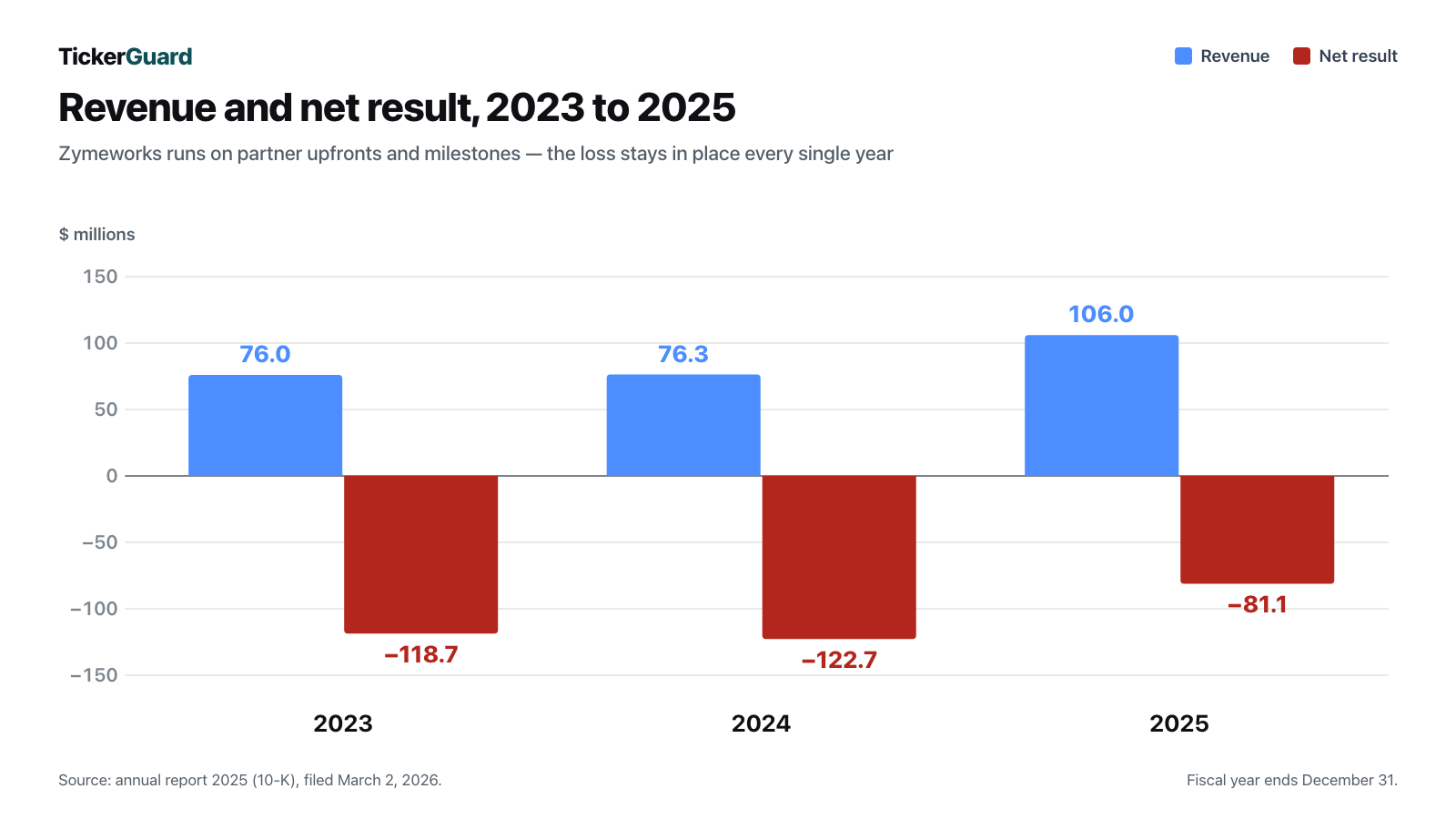
Now the sobering part. The 2025 jump did not come from ongoing business but from one-time contractual events, and those do not repeat. In the first half of 2026 revenue fell to $7.0 million (prior-year period: $75.8 million), and in the second quarter of 2026 to $4.6 million against $48.7 million a year earlier. The quarterly report itemizes the difference line by line: a $20.0 million development milestone from BeOne, $18.3 million of deferred revenue recognized on an amended license agreement, and a $7.5 million option exercise fee from Bristol Myers Squibb — all in the prior-year quarter, none of it in the current one. Net income of $2.3 million in the second quarter of 2025 turned into a net loss of $45.0 million in the second quarter of 2026.
The royalty stream that is meant to close that gap is still a trickle: $1.8 million in the second quarter of 2026. The company states its own starting position plainly:
"We reported a net loss of $89.2 million for the six months ended June 30, 2026 and as of June 30, 2026, we had an accumulated deficit of $1,171.2 million."
— Zymeworks Inc., SEC quarterly report on Form 10-Q for the period ended June 30, 2026, Item 2 (MD&A)
The counterweight is on the asset side: $322.5 million in cash, cash equivalents and marketable securities as of June 30, 2026 ($179.4 million in cash and equivalents plus $143.1 million in marketable securities). At a cash burn in the order of the first half of 2026 that funds well more than four quarters — this company is not against the wall. It simply faces one question: where recurring revenue is supposed to come from.
What the filings say: the uncomfortable truths
Uncomfortable truth No. 1: $250 million now, up to $481 million later
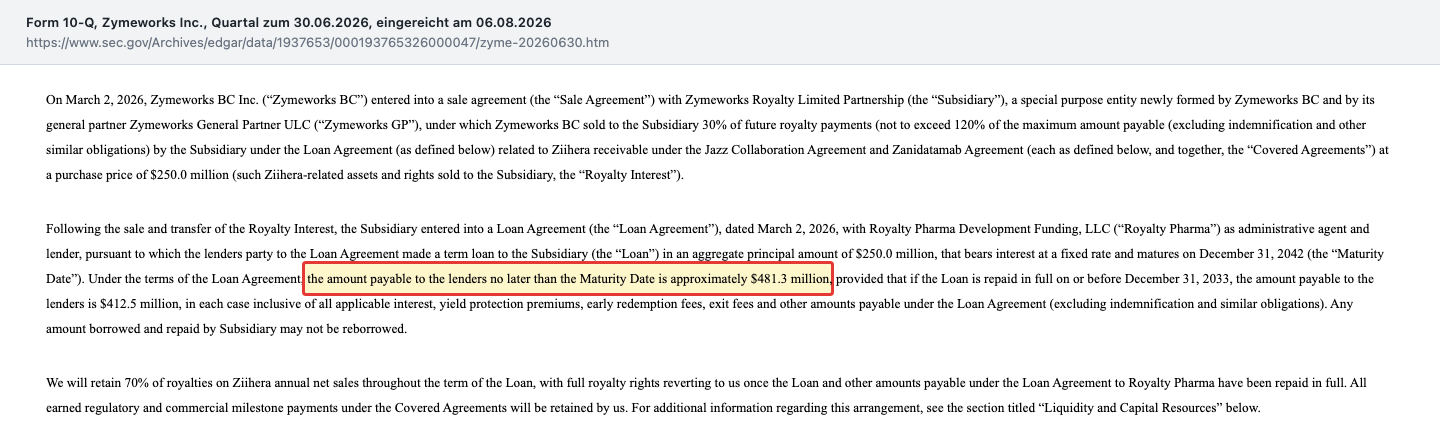
By far the largest cash inflow of 2026 was not a deal but a loan — and an expensive one. On March 2, 2026 the subsidiary Zymeworks BC sold 30 percent of future Ziihera royalties under the Jazz and BeOne agreements to a newly formed special purpose entity. That entity borrowed $250.0 million from Royalty Pharma at a fixed rate, maturing December 31, 2042. What has to go back out is spelled out in the quarterly report:
"Under the terms of the Loan Agreement, the amount payable to the lenders no later than the Maturity Date is approximately $481.3 million, provided that if the Loan is repaid in full on or before December 31, 2033, the amount payable to the lenders is $412.5 million, in each case inclusive of all applicable interest, yield protection premiums, early redemption fees, exit fees and other amounts payable under the Loan Agreement (excluding indemnification and similar obligations)."
— Zymeworks Inc., SEC quarterly report on Form 10-Q for the period ended June 30, 2026, MD&A, "Royalty Pharma Loan Arrangement"
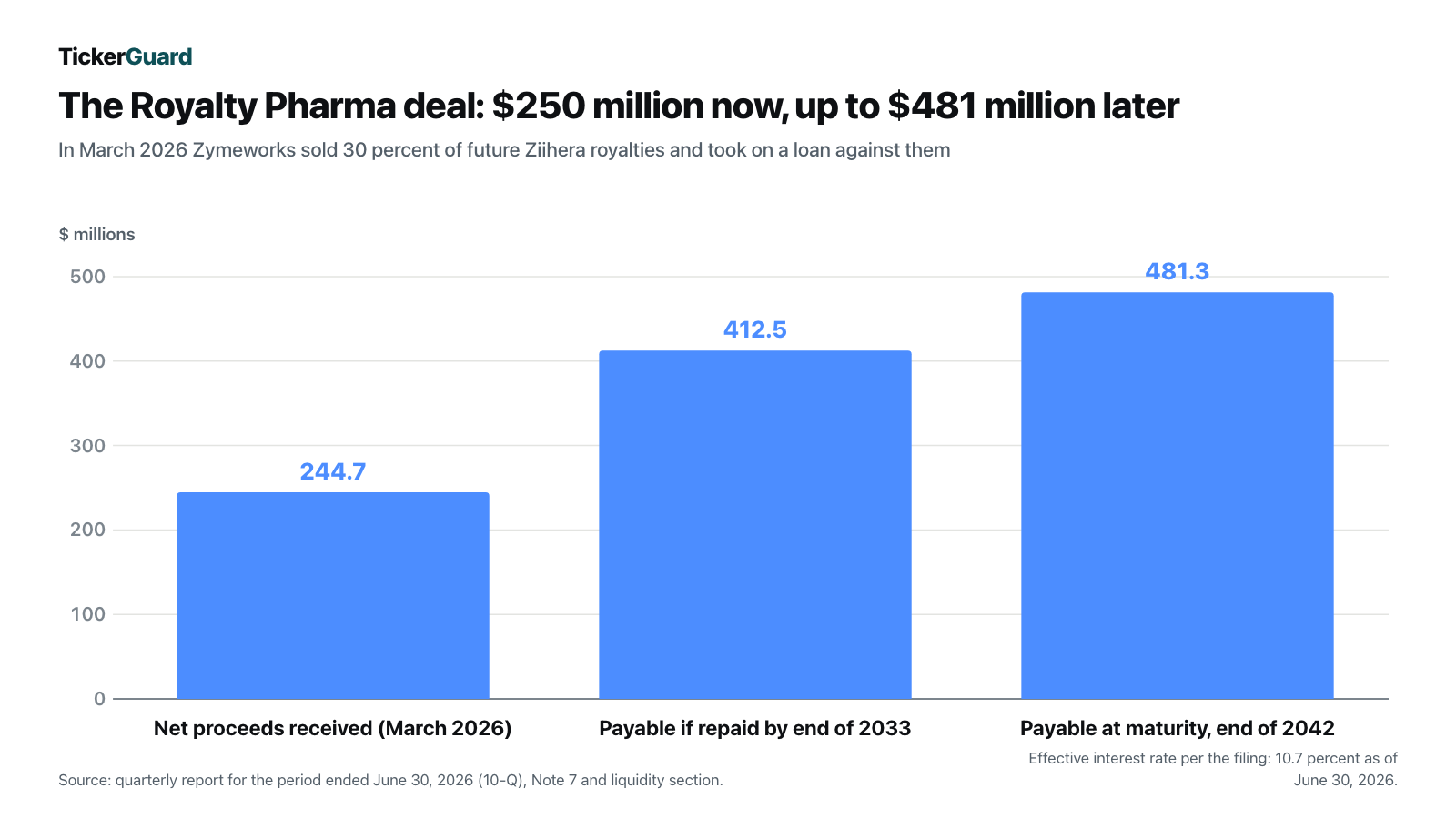
In everyday terms: you pledge the rent from your apartment for the coming years, take a lump sum today, and pay back roughly double at the end. Nothing about that is illegal or exotic — for a company without dependable cash flow a royalty monetization is often the only financing that does not create new shares and therefore does not shrink your slice of the pie. But the price sits in the balance sheet: the estimated effective interest rate was 10.7 percent as of June 30, 2026, interest expense in the second quarter of 2026 alone was $6.6 million, and until the loan is retired 30 percent of every Ziihera royalty goes straight to Royalty Pharma. The gap between what came in and the maximum that goes out is roughly $236.6 million — nearly three times the stockholders' equity reported on June 30, 2026.
Uncomfortable truth No. 2: equity fell 70 percent, and it was on purpose
Put the June 30, 2026 balance sheet next to the one from December 31, 2025 and you trip over a collapse: stockholders' equity fell from $268.5 million to $80.4 million, down 70 percent in two quarters. The accumulated deficit rose from $953.2 million to $1,171.2 million. Now, an $89.2 million half-year loss is only half the explanation. The other half is a deliberate choice: Zymeworks has been buying back its own stock since August 2024, and those repurchases are charged directly against the accumulated deficit. In the first half of 2026 that consumed $128.1 million of cash.
"Since initiating its share repurchase program in August 2024, the Company has cumulatively utilized $213.6 million to reacquire 10,571,316 shares at an average price of $20.21 per share (exclusive of commission expense and estimated excise tax). As of August 4, 2026, the Company had approximately 71.0 million common shares outstanding."
— Zymeworks Inc., SEC quarterly report on Form 10-Q for the period ended June 30, 2026, MD&A (Item 2), "Other Matters — 2026 Repurchase Program"
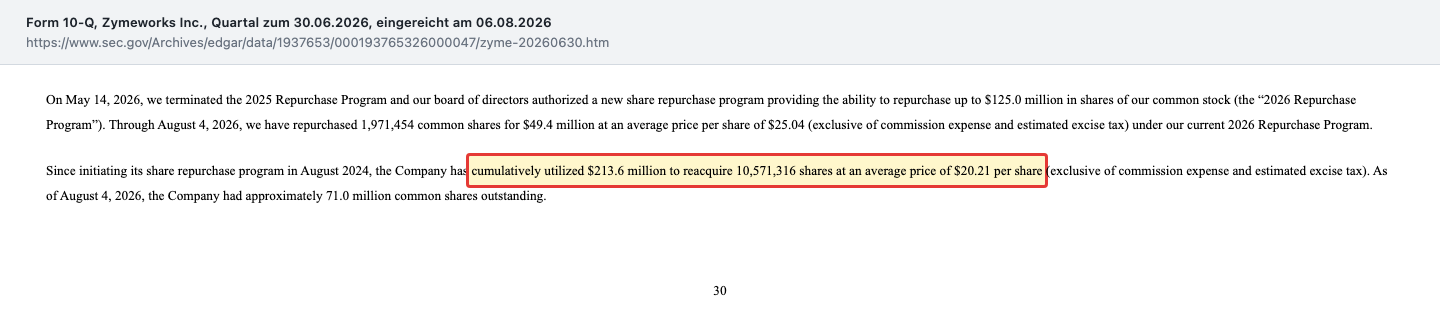
Buybacks are not a bad thing in themselves — quite the opposite, they raise your share of the company without you lifting a finger. The share count did fall, from 74,638,413 on December 31, 2025 to 71,412,072 on June 30, 2026. But the order of events deserves a second look. In March 2026 a loan at a 10.7 percent effective rate came in; in the first half of 2026 $128.1 million went back out for the company's own shares; and on May 14, 2026 the board terminated the running program early in order to authorize a new one for $125.0 million. Of that, $49.4 million had already been used by August 4, 2026 — at an average of $25.04 per share, well above the long-run repurchase average of $20.21. Remember the pattern: when a company raises expensive debt and uses it to support its own share price, the buyback is not a return. It is a bet.
Uncomfortable truth No. 3: almost everything rides on two outside sales organizations
The biggest risk here is not a money risk but a control risk. Zymeworks does not decide how Ziihera is marketed, in which countries it is filed, how fast those filings move, or at what price it sells. Jazz and BeOne do. The company names the exposure itself in the risk factors of its quarterly report:
"We depend on our collaborative relationships with Jazz, BeOne and J&J to further develop and commercialize zanidatamab and other product candidates, and if our relationships are not successful or are terminated, we may be delayed in or unable to effectively develop and/or commercialize zanidatamab and other product candidates, which could have a material adverse effect on our business."
— Zymeworks Inc., SEC quarterly report on Form 10-Q for the period ended June 30, 2026, Item 1A (Risk Factors)

A small number in the notes shows how tight that is: of $5.930 million in accounts receivable as of June 30, 2026, 48 percent was owed by Jazz (December 31, 2025: 37 percent). And the Royalty Pharma loan ties the two together: if either license agreement is terminated, or if control of Zymeworks changes hands, the lender may demand immediate repayment. A contract breakdown at a partner would instantly become a financing problem.
Uncomfortable truth No. 4: the company withdrew its own cash runway guidance
Every loss-making biotech normally gives you one number to hold on to: how long the money lasts. Zymeworks dropped that disclosure on August 6, 2026, pointing to its shift toward recurring revenue:
"In light of the Company's expected transition to a revenue-generating business supported by multiple anticipated recurring cash flow streams, the Company no longer intends to provide cash runway guidance."
— Zymeworks Inc., SEC current report on Form 8-K dated August 6, 2026, Exhibit 99.1 (second-quarter 2026 earnings release)
That is explainable and still uncomfortable: a metric that gave you certainty is replaced by an expectation. The expectation has a name — Theravance Biopharma. On June 28, 2026 Zymeworks signed a merger agreement to buy that company for $17.00 in cash per ordinary share plus one contingent value right tied to future proceeds from the drug candidate ampreloxetine. Financing is meant to come largely from a $350 million non-recourse note from OMERS Life Sciences, secured solely by the U.S. profit share on the respiratory drug YUPELRI, together with Theravance's expected net cash of roughly $360 million at closing. The company expects that combination to produce roughly $60 million of annualized cash flow at current run rates.
Two items sit in the fine print. First, closing is not certain. It depends on antitrust clearance and a two-thirds vote of Theravance shareholders; the contractual deadline runs to December 28, 2026 and can extend twice by three months. Second, if the transaction fails in specified circumstances tied to antitrust clearance, Zymeworks owes a reverse termination fee of $32.515 million — roughly 40 percent of total stockholders' equity as of June 30, 2026. That figure is not in the earnings release. It is in the notes to the quarterly report.
Valuation: what the market pays for a royalty hope
A price-to-earnings ratio cannot be built here — there are no earnings. A price-to-sales ratio would be a caricature, because revenue swings between $4.6 million and $48.7 million depending on the quarter. That leaves two honest anchors.
The first is substance. At the closing price of $28.67 on August 21, 2026 and roughly 71.0 million shares, the market capitalization stood at about $2.05 billion (fundamental data, as of August 22, 2026). Against that sit $322.5 million of cash and marketable securities — around 16 percent of the market value. Book equity of $80.4 million equals just under 4 percent. Put differently: more than 80 percent of the price is being paid for things that have not happened yet.
The second anchor is exactly that future, and it is pleasingly well quantified. For approval of Ziihera in first-line HER2-positive gastric and gastroesophageal cancer, the quarterly report lists up to $440.0 million in milestone payments — $250.0 million for the United States, $100.0 million for Europe, $75.0 million for Japan, $15.0 million for China. A third indication would add up to $89.0 million. In total the company puts remaining potential milestones under the Ziihera agreements at up to $1.51 billion as of June 30, 2026, and under the platform collaborations at up to $0.78 billion in preclinical and development milestones plus $2.97 billion in commercial milestones. Those are maximum amounts, not expected values — they only land if every approval and every sales threshold is reached. For context, the average analyst price target stood at $40.33 (fundamental data, 10 estimates, as of August 22, 2026), an outside figure quoted for orientation and not a target of this publication.
So the arithmetic is clean and still uncomfortable: the market is paying roughly $1.7 billion above the cash on hand for a royalty stream that ran at $1.8 million in the second quarter of 2026, and for milestones that mostly depend on decisions taken by outside regulators. How quickly a valuation like that can turn when a single event goes the other way is something we traced at Puma Biotechnology — another company built around a HER2 drug that has only partly made the jump from hope story to earnings story.
Upside and risks at a glance
What speaks for Zymeworks:
- An approved, commercially sold medicine out of its own labs: Ziihera (zanidatamab) is cleared for previously treated HER2-positive biliary tract cancer in the United States, China, Europe and Canada — few small biotechs ever get there.
- A quantified future: up to $440.0 million in milestones for approval in first-line gastroesophageal cancer alone (of which $250.0 million for the United States), plus tiered royalties from Jazz of ten to high teens percentages on net sales up to $2.0 billion and 20 percent above that.
- Solid liquidity with no recourse to the parent: $322.5 million of cash and marketable securities as of June 30, 2026, and a Royalty Pharma loan that is non-recourse and secured only by the assets of the special purpose entity.
- Research funded by others: the pasritamig program at Johnson & Johnson (a Phase 3 study whose planned enrollment was raised to 1,203 participants) and the platform collaborations with GSK, Daiichi Sankyo and Merck cost Zymeworks nothing yet can trigger milestones.
- A pipeline with early data: for the antibody-drug conjugate ZW191 the company reported confirmed response rates of 78.6 percent in FRα-positive tumors and 47.4 percent in FRα-negative tumors in a Phase 1 dose-escalation study in platinum-resistant ovarian cancer in June 2026.
What speaks against it:
- No recurring business: revenue of $4.6 million in the second quarter of 2026 against $48.7 million a year earlier, of which $1.8 million was royalties; the net loss was $45.0 million after net income of $2.3 million.
- Expensive financing: $250.0 million raised against repayments of up to $481.3 million, an estimated effective interest rate of 10.7 percent as of June 30, 2026, and 30 percent of every Ziihera royalty flowing to the lender until the loan is retired.
- A thin capital base: stockholders' equity of $80.4 million as of June 30, 2026, down from $268.5 million six months earlier, with an accumulated deficit of $1,171.2 million. The potential Theravance break fee alone equals 40 percent of that equity.
- Full dependence on partners: Jazz, BeOne and Johnson & Johnson decide on filings, pricing and distribution; 48 percent of receivables as of June 30, 2026 were owed by Jazz, and terminating a license agreement would simultaneously be an event of default under the loan.
- Event risk instead of earnings risk: the regulatory decision date, antitrust clearance and the Theravance shareholder vote, plus the interim overall survival analysis from the HERIZON-GEA-01 trial that the company expects in the third quarter of 2026, can flip the picture within days — in either direction.
A human conclusion
Back to the countdown trap. It works precisely because it is not stupid. The date is important, the $250.0 million is real, and an approval would genuinely change this company. The trap is not that the date does not matter. The trap is that the date makes you stop asking what the company did with your money in the meantime. And that answer is in black and white in the filings: it sold future income for $250.0 million against repayments of up to $481.3 million; it put $128.1 million into its own shares in the first half of 2026; it pushed stockholders' equity down to $80.4 million doing so; and it withdrew the disclosure of how long the money lasts.
None of that is a scandal. All of it is a decision — and one you are allowed to like. If you believe Ziihera becomes a billion-dollar product over the coming years, the loan was cheap and the buyback was smart. If you doubt it, you are looking at a company that pledged its best assets to support its own share price while the operating business books $4.6 million in quarterly revenue. Both are defensible readings of the same paperwork. So the honest question is not "will the approval come?" It is this: would you still buy this company if the date on the calendar were two years away? If yes, you have a thesis. If no, you had a countdown. What you do with that is your decision. And that is exactly as it should be.
Sources
Every primary document used in this analysis, so you can read it yourself:
- Zymeworks Inc. — SEC Form 10-Q for the period ended June 30, 2026 (filed August 6, 2026)
- Zymeworks Inc. — SEC Form 8-K dated August 6, 2026, Exhibit 99.1 (second-quarter 2026 earnings release)
- Zymeworks Inc. — SEC Form 10-K for 2025 (filed March 2, 2026)
- Zymeworks Inc. — SEC Form 10-Q for the period ended March 31, 2026 (filed May 7, 2026)
- Zymeworks Inc. — SEC Form 10-K for 2024 (filed March 5, 2025)
- Full SEC filing history for Zymeworks Inc.: EDGAR overview (sec.gov)
- Fundamental data (market capitalization, price, 52-week range, analyst estimates; data as of August 21/22, 2026), reconciled against the SEC filings.
- Reddit mentions: 7 mentions, first recorded on August 20, 2026 through our in-house stock scanner.
Transparency & disclaimer: this analysis is journalistic commentary on publicly available information. It is not investment advice, not a regulated investment research product and not a solicitation to buy or sell securities. Equity investments carry substantial risk up to and including total loss. All information is provided without warranty; the as-of date for each figure is stated in the text. Positions held by the operator are disclosed daily; where one exists, it appears as a notice at the top of this deep dive.
Key figures at a glance
All monetary figures in millions of $; earnings per share as reported.
| Metric | 2021 | 2022 | 2023 | 2024 | 2025 |
|---|---|---|---|---|---|
| Revenue | 26.7 | 412.5 | 76.0 | 76.3 | 106.0 |
| Operating Income (EBIT) | -215.6 | 130.5 | -138.1 | -137.1 | -92.5 |
| Net Income | -211.8 | 124.3 | -118.7 | -122.7 | -81.1 |
| Net Margin | -794.0% | 30.1% | -156.1% | -160.8% | -76.6% |
| Earnings Per Share | -4.06 $ | 1.91 $ | -1.72 $ | -1.62 $ | -1.08 $ |
Source: fundamental data & SEC filings (annual and quarterly reports, 10-K/10-Q)
Our Bottom Line at a Glance
- Product and research positive
- With Ziihera (zanidatamab) Zymeworks carried an antibody of its own all the way to market approval — cleared for previously treated HER2-positive biliary tract cancer in the United States, China, Europe and Canada. The in-house pipeline is producing data: in June 2026 the company reported confirmed response rates of 78.6 percent (FRα-positive) and 47.4 percent (FRα-negative) for ZW191 in a Phase 1 dose-escalation study in platinum-resistant ovarian cancer.
- Earnings position negative
- Revenue measures contractual events, not ongoing business: $4.6 million in Q2 2026 after $48.7 million in the prior-year quarter, and $7.0 million in H1 2026 after $75.8 million. The net loss was $45.0 million for the quarter (prior-year quarter: net income of $2.3 million) and $89.2 million for the half year. Royalties, the intended future earnings source, ran at $1.8 million in Q2 2026.
- Financing negative
- The March 2, 2026 royalty monetization with Royalty Pharma brought in $244.7 million net and costs up to $481.3 million through the December 31, 2042 maturity ($412.5 million if repaid by the end of 2033); the estimated effective interest rate was 10.7 percent as of June 30, 2026, with $6.6 million of interest expense in Q2 2026 alone. Until repayment, 30 percent of every Ziihera royalty goes to the lender.
- Balance sheet and liquidity neutral
- $322.5 million in cash, cash equivalents and marketable securities as of June 30, 2026 sits against stockholders' equity of only $80.4 million (December 31, 2025: $268.5 million), with the accumulated deficit up to $1,171.2 million. The loan is non-recourse and secured only by the assets of the special purpose entity — liquidity funds well more than four quarters, yet the capital base has become thin.
- Dependence on partners negative
- Jazz Pharmaceuticals, BeOne Medicines and Johnson & Johnson decide on regulatory filings, pricing and distribution; the quarterly report carries that dependence as its own risk factor. As of June 30, 2026, 48 percent of accounts receivable was owed by Jazz (December 31, 2025: 37 percent). Terminating a license agreement would simultaneously be an event of default under the Royalty Pharma loan.
- Use of capital neutral
- Since August 2024 a cumulative $213.6 million has gone into 10,571,316 of the company's own shares at an average price of $20.21; the share count fell from 74,638,413 (December 31, 2025) to 71,412,072 (June 30, 2026). That raises each holder's stake — but it was funded largely from the loan carrying a 10.7 percent effective rate, and the most recent repurchases ran at an average of $25.04 (as of August 4, 2026).
Zymeworks is a research company in the middle of turning itself into a royalty holding company, and the interim scorecard of that transformation is in the filings. An antibody of its own is approved and being sold by Jazz and BeOne, yet the company's own revenue fell to $4.6 million in the second quarter of 2026 from $48.7 million a year earlier, with royalties at $1.8 million. Funding now comes from selling future income: $250.0 million raised, up to $481.3 million to be repaid, an estimated effective interest rate of 10.7 percent. Alongside that, $213.6 million has gone into buybacks since August 2024 and stockholders' equity fell from $268.5 million to $80.4 million in six months. Whether the math works depends on decisions by outside regulators and on closing the Theravance acquisition. Not investment advice.
What Our Rating Means
Open questions
The business works in principle, but one material question is open. As long as it stays open, our findings do not carry a quality verdict.
No substance risk is on the record. The June 30, 2026 accounts contain no going-concern warning, stockholders' equity is positive at $80.4 million, and $322.5 million of cash and marketable securities funds far more than the critical four quarters against a half-year loss of $89.2 million. The $250.0 million loan is non-recourse, secured only by the assets of a special purpose entity, and is serviced out of royalties rather than operations. What is missing for green is the decisive quality: there is no self-carrying ongoing business. Revenue measures contractual events rather than sales — $4.6 million in the second quarter of 2026 after $48.7 million a year earlier — royalties run at $1.8 million a quarter, and the turn to profitability depends on outside regulators and on an acquisition that has not closed. That is an open operating question, not a proven substance risk, which is why this is yellow. The fact that the stock trades near the top of its 52-week range deliberately plays no part in this rating; that is a price argument, not a quality argument. The decision is yours.
A journalistic assessment by our editorial team at the time of the deep dive, based on public sources — not investment advice and not a solicitation to buy or sell. Your personal circumstances (investment goals, risk capacity, taxes) cannot be taken into account. What our levels mean, how verdicts are formed, and what conflicts of interest exist →
Worth Noting
- The hook for this analysis is our in-house Reddit hype scanner: 7 mentions, first recorded on August 20, 2026 at a market capitalization of roughly $1.85 billion.
- Data as of August 23, 2026. All company figures come from the Form 10-Q for the period ended June 30, 2026 (filed August 6, 2026), the earnings release furnished as Exhibit 99.1 to the Form 8-K dated August 6, 2026, the Form 10-K for 2025 (filed March 2, 2026) and the Form 10-K for 2024 (filed March 5, 2025). Price and valuation data come from fundamental data, as of August 21/22, 2026.
- The FDA target action date for its decision on Ziihera in first-line HER2-positive gastroesophageal cancer was August 25, 2026. As of the data cutoff for this analysis on August 23, 2026 the decision was still pending; every reference to it is deliberately framed as a date, not as an outcome.
- Not to be confused: Zymeworks Inc. (CIK 0001937653) has been the U.S. entity since October 2022; the former Canadian Zymeworks Inc. now operates as Zymeworks BC Inc. and is a subsidiary. That reorganization is why the SEC filing history under the current CIK only begins in 2022.
- The milestone amounts quoted here (up to $440.0 million for first-line gastroesophageal cancer, up to $1.51 billion in total under the Ziihera agreements) are contractual maximums taken from the quarterly report. They are not expected values and not a forecast by this publication.
- The average analyst price target of $40.33 (fundamental data, 10 estimates, as of August 22, 2026) is an outside figure quoted for orientation, not a target of this publication.
Stock Watch
This analysis is as of August 26, 2026. Stock Watch will tell you what's changed at ZYME since then.
Later $1 a month per stock — signing up is free, and you'll be the first to know when it launches.
The full analysis as a PDF for later
We will send you this analysis as a PDF — to print, file away, and read at your own pace. And we will add you to the free Stock Watch list for Zymeworks Inc. (ZYME), so you hear about it when something material in this analysis changes.
Frequently Asked Questions
Zymeworks Inc. (NASDAQ: ZYME) engineers antibodies — bispecific antibodies built on its Azymetric platform and antibody-drug conjugates — and licenses them to large pharmaceutical companies. It does not sell a medicine itself. Its only approved compound, Ziihera (zanidatamab), is commercialized by Jazz Pharmaceuticals and BeOne Medicines. Zymeworks earns upfront payments, milestone payments and royalties. It had 264 full-time employees as of December 31, 2025.
Because revenue measures contractual events, not ongoing product sales. The second quarter of 2025 included a $20.0 million development milestone from BeOne, $18.3 million of deferred revenue recognized on an amended license agreement and a $7.5 million option exercise fee from Bristol Myers Squibb. No comparable events landed in the second quarter of 2026, so revenue fell from $48.7 million to $4.6 million. Ongoing royalties on Ziihera sales were $1.8 million in the quarter.
On March 2, 2026 the subsidiary Zymeworks BC sold 30 percent of future Ziihera royalties to a newly formed special purpose entity. That entity took a secured, non-recourse $250.0 million term loan from Royalty Pharma; net proceeds were $244.7 million. The amount payable no later than the December 31, 2042 maturity date is roughly $481.3 million, or about $412.5 million if the loan is repaid in full by the end of 2033. The estimated effective interest rate was 10.7 percent as of June 30, 2026.
It fell from $268.5 million on December 31, 2025 to $80.4 million on June 30, 2026. Two causes: the $89.2 million half-year net loss and share repurchases, which Zymeworks charges directly against the accumulated deficit. Buybacks consumed $128.1 million of cash in the first half of 2026. Since August 2024 the company has used a cumulative $213.6 million to reacquire 10,571,316 shares at an average of $20.21; roughly 71.0 million shares were outstanding as of August 4, 2026.
For approval of Ziihera in first-line HER2-positive gastric and gastroesophageal cancer, up to $440.0 million remains available: $250.0 million for the United States, $100.0 million for Europe, $75.0 million for Japan and $15.0 million for China. A third indication would add up to $89.0 million. In total the company puts remaining potential payments under the Ziihera agreements at up to $1.51 billion as of June 30, 2026. These are contractual maximums that only land if every condition is met.
On June 28, 2026 Zymeworks signed a merger agreement to acquire Theravance Biopharma for $17.00 in cash per ordinary share plus one contingent value right tied to future proceeds from the drug candidate ampreloxetine. Financing is expected to come largely from a $350 million non-recourse note from OMERS Life Sciences and Theravance's expected net cash. Closing depends on antitrust clearance and a two-thirds shareholder vote; the deadline runs to December 28, 2026 and can extend twice by three months.
The company withdrew that disclosure on August 6, 2026, saying that in light of its expected transition to a revenue-generating business it no longer intends to provide cash runway guidance. What remains are the figures: $322.5 million in cash, cash equivalents and marketable securities as of June 30, 2026 against a net loss of $89.2 million in the first half of 2026. In its forward-looking statements the company points to funding its planned operations beyond 2028 — but only assuming certain regulatory milestone payments actually arrive.
A price-to-earnings ratio cannot be formed without earnings, and a price-to-sales ratio is meaningless when quarterly revenue swings between $4.6 million and $48.7 million. At the closing price of $28.67 on August 21, 2026 the market capitalization was roughly $2.05 billion (fundamental data, as of August 22, 2026). Of that, $322.5 million is covered by cash and marketable securities and $80.4 million by book equity. The remainder is expectation about future milestones and royalties.
Found an error?
Did you spot a factual error, an outdated number, or a typo in this deep dive? Let us know briefly — your report goes straight to the editorial team.