Securitize sells the future of securities — and filed a quarterly report about an empty shell
Securitize says it is the largest provider of tokenized securities in the world: $4.3 billion of assets under management as of June 30, 2026, BlackRock, Apollo and KKR among its clients, and a New York Stock Exchange listing since July 2, 2026. Its first quarterly report as a listed company, however, describes an entity that had no business at all on the reporting date. The real numbers sit in the exhibits next door — and they show revenue falling 5 percent to $14.4 million in the second quarter of 2026 while operating costs rose 56 percent. We sort out what sits behind the premiere: a concentration above 60 percent, a 90-day termination notice and two annual accounts that had to be restated after the fact.
 Thomas Mücke
Founder & Publisher
Thomas Mücke
Founder & Publisher
As of Today
As of: September 18, 2026
- AAQS
- 2/10
This analysis has a cut-off date. The Stock Guard tells you when something material changes in the numbers. Reserve your free spot
Chart
Interactive price chart (TradingView).
52-week range: 5.40 $ to 13.70 $
Note: pure fact-based analysis, not investment advice and not a solicitation to buy or sell. All figures without guarantee.
The first-time trap: when a premiere replaces the arithmetic
There is one sentence that disables every check, and it goes: "This has never been done before." The moment a company is the first at anything, part of your brain stops calculating. If there is no comparison, there is no yardstick — and without a yardstick nothing can be too expensive, too small or too thin. Call it the first-time trap: novelty replaces scrutiny, because novelty is easy to tell and scrutiny is hard work.
Securitize supplies the textbook case. The company calls itself "the first tokenization company to go public" and, on the day of its listing, put its own stock on a blockchain as well. Both are true. Both are remarkable. And neither says anything about how much money comes in. So we do something unspectacular here: we read the documents filed with the U.S. Securities and Exchange Commission — the current reports, the prospectus, the quarterly report. Those are the papers that were reviewed, signed and can be checked. No recommendation, no forecast. Only what is written in black and white.
Company history for investors
-
2024
BUIDL makes Securitize the market leader
The money market fund BUIDL, tokenized for BlackRock, becomes one of the fastest growing products of its kind. For investors that means the company's rise hung on a single client from the start.
-
2025
Acquisition of the fund administrator MG Stover
In April 2025 Securitize buys the fund administrator MG Stover. That deal carries much of the revenue jump from roughly $18.6m to $62.2m — organic growth accounted for only part of it.
-
2025
Auditor flags internal control
During the 2024 audit material control weaknesses are identified; the 2024 and 2023 accounts have to be restated. As of 2025-12-31 the weaknesses persist and produce material errors once more.
-
2026
Listing via a special purpose acquisition company
The combination with Cantor Equity Partners II closes on 2026-07-01 and trading on the NYSE begins on 2026-07-02. Beforehand, 28.5 percent of the redeemable shares were returned — $72.5m.
-
2026
First quarter as a listed company: revenue falls
On 2026-08-12 the company reports $14.4m of revenue for the second quarter, 5 percent below the prior year, on 56 percent higher costs. On 2026-09-02 it registers 31,483,485 shares for employee plans.
What Securitize actually does — securities on a blockchain
Tokenization sounds like crypto but is at heart a question of record-keeping. When you buy a fund unit today, your name sits in a register maintained by a service provider; transfers run through banks, custodians and settlement systems and take business days. Tokenization means the same register sits on a blockchain and the unit moves as an entry on it — around the clock, in minutes rather than days. The unit itself remains an ordinary security with all the rights and obligations attached. What changes is not the product but the plumbing.
Securitize earns money from that plumbing in two ways. The first is tokenization: fund providers have their products brought onto the blockchain and pay recurring fees based on assets under management. The second is asset servicing — bookkeeping, unit calculation, regulatory reporting, investor statements. That second business grew mainly through the April 2025 acquisition of the fund administrator MG Stover. In the second quarter of 2026 tokenization brought in $7.8 million and asset servicing $6.6 million.
Unusual for a company from this corner of the market is the licence stack. In the United States the group holds a broker-dealer licence with its own alternative trading system, a transfer agent registration, an investment adviser registration and a fund administration business; in the EU a subsidiary runs a trading and settlement system under the DLT Pilot Regime. In the second quarter of 2026 FINRA approval to custody tokenized securities was added. The client list reads accordingly: BlackRock, Apollo, BNY, Hamilton Lane, KKR, VanEck. As of December 31, 2025 roughly 194 full-time employees worked for the company, 154 of them in the United States, plus 67 contractors. Anyone who wants to see how payment and settlement infrastructure earns its keep in the conventional form will find the same business principle in our analysis of Shift4 Payments.
How this stock landed on our desk
No fundamentals screen flagged SECZ — the attention of other investors did. Our in-house Reddit hype scanner pushed the ticker onto our desk on September 18, 2026. That is not a signal and not a recommendation; it is a sign that a story is being told in the forums right now. Our job begins exactly where the story ends: at the filings.
In this case the story is easy to reconstruct, because the company tells it itself. In the earnings release of August 12, 2026 chief executive Carlos Domingo says:
"On July 2nd, shortly after quarter-end, we began trading on the New York Stock Exchange, becoming the first tokenization company to go public."
— Securitize Corp., SEC Form 8-K of August 12, 2026, exhibit 99.1 (earnings release)
The company did not reach the exchange through a conventional initial public offering but through a business combination with a special purpose acquisition company — Cantor Equity Partners II. That is a company without a business that raises money first and then acquires a real company, which becomes listed along the way. Remember that detour: it explains the first uncomfortable finding.
The numbers over the years — honestly assessed
First, what genuinely impresses. Securitize turned a niche into a market and then led it. Revenue rose from roughly $18.6 million in 2024 to roughly $62.2 million in 2025 — more than a tripling. Average tokenized assets under management grew from $846.7 million (2024 average) to $3.22 billion (2025 average). And 2025 was the year adjusted EBITDA first turned positive: from minus $11.8 million (2024) to plus $3.4 million. According to the industry tracker RWA.XYZ, market share stood at 19 percent in December 2025 — the highest in the field.
And now the sobering part, which disappears in an annual comparison and only becomes visible in the quarterly grid.
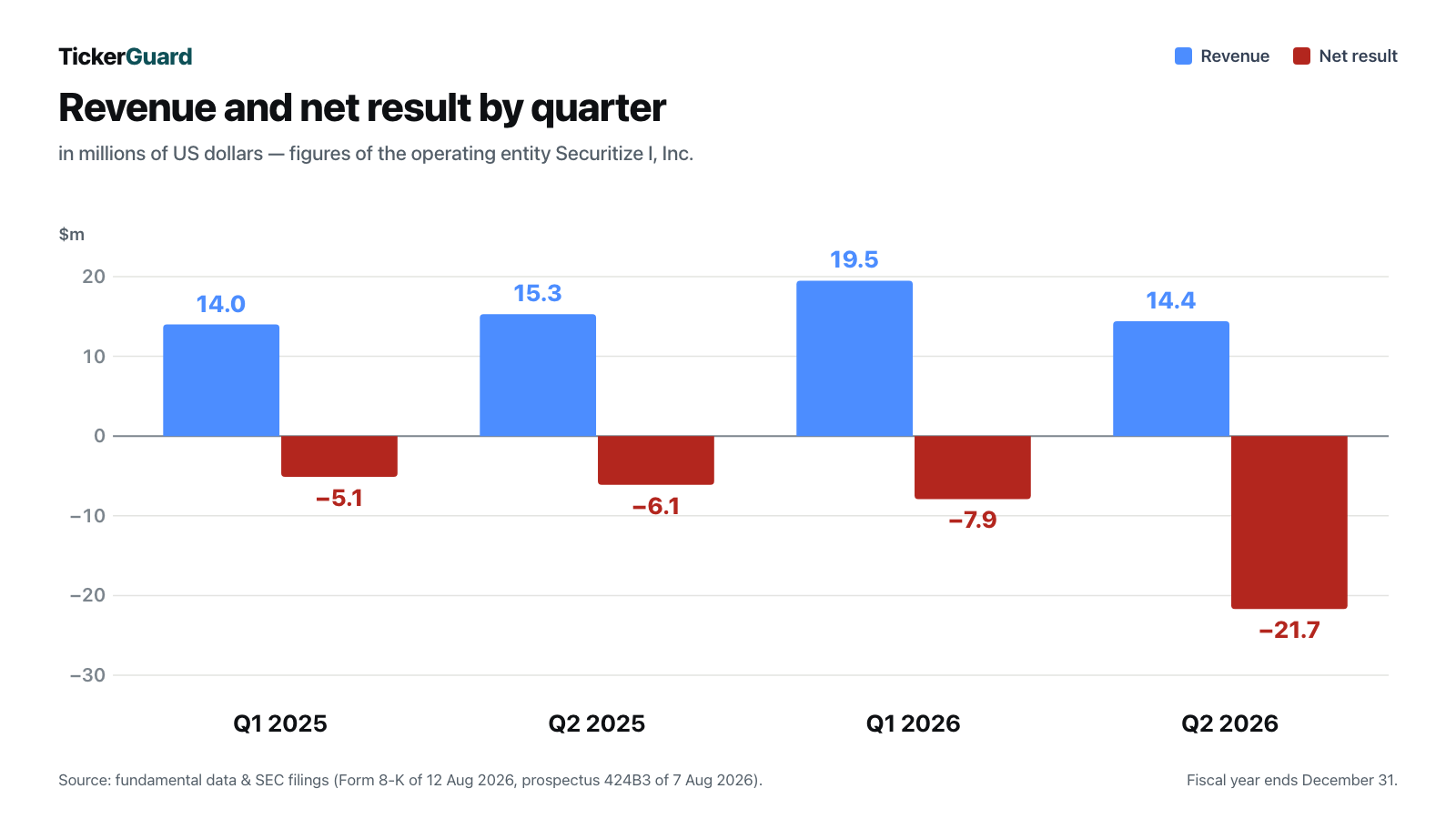
In the second quarter of 2026 revenue fell to $14.4 million — 5 percent below the prior-year quarter. The core tokenization business shrank 12 percent to $7.8 million; only asset servicing added 3 percent, to $6.6 million. The first half of 2026 did show a 16 percent gain to $33.9 million, but almost all of that came from the first quarter and from the acquisition of fund administrator MG Stover, which only counted from April 15, 2025 in the prior-year period.
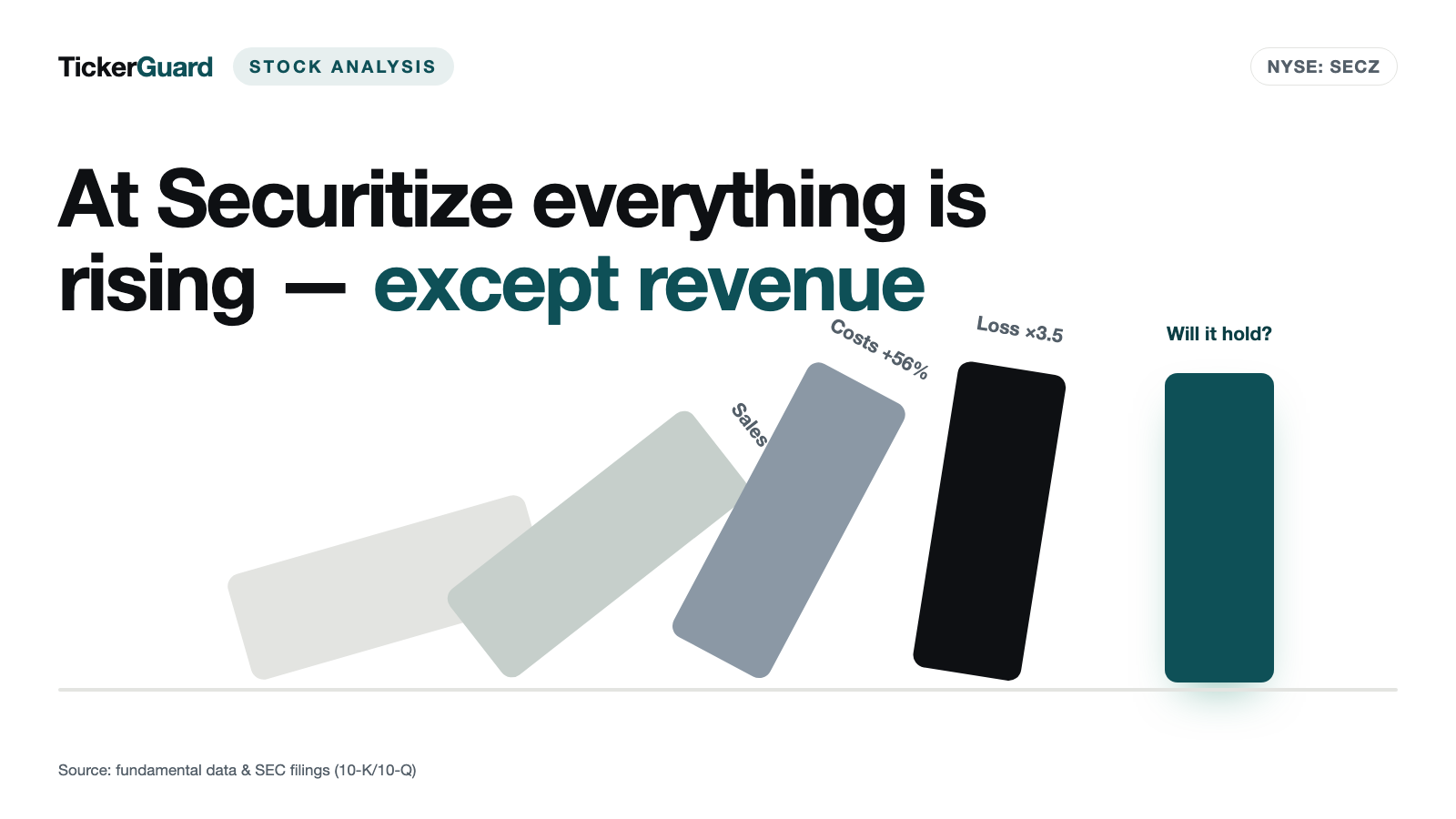
The cost side is more emphatic. Total operating expenses rose 56 percent in the second quarter of 2026, to $24.1 million: selling, general and administrative expenses up 133 percent to $8.2 million, compensation and benefits up 31 percent to $10.5 million, the provision for expected credit losses up 1,075 percent to $1.3 million. An operating loss of $0.2 million in the prior-year quarter thus became $9.7 million. Adjusted EBITDA flipped from plus $1.8 million to minus $5.5 million. The net loss came to $21.7 million, or $2.37 per share — 3.5 times the $6.1 million of the prior-year quarter. The larger part of that, though, stems from fair-value changes on financial instruments that disappeared with the business combination.
The operating metric, meanwhile, is doing fine: tokenized assets under management stood at $4.3 billion on June 30, 2026 (up 9 percent), the quarterly average likewise at $4.3 billion (up 16 percent), and aggregate transaction volume across the platform rose 147 percent to $5.3 billion. That contradiction is the heart of this analysis: assets under management are rising, revenue is not. Anyone who wants to know whether a volume figure ever becomes money has to know the fee attached to it — and that fee is evidently falling faster than the volume is growing.
What the filings say — the uncomfortable truths
Uncomfortable truth no. 1: the first quarterly report is about a company without a business
On August 13, 2026 Securitize Corp. filed its first quarterly report on Form 10-Q. Anyone opening it to read the numbers of the tokenization leader will not find them there. The report covers the period to June 30, 2026 — and on that date the reporting entity was an empty holding company formed for the business combination:
"As of June 30, 2026, PubCo was a wholly owned subsidiary of Old Securitize and had not commenced operations."
— Securitize Corp., SEC Form 10-Q for the period ended June 30, 2026, Explanatory Note
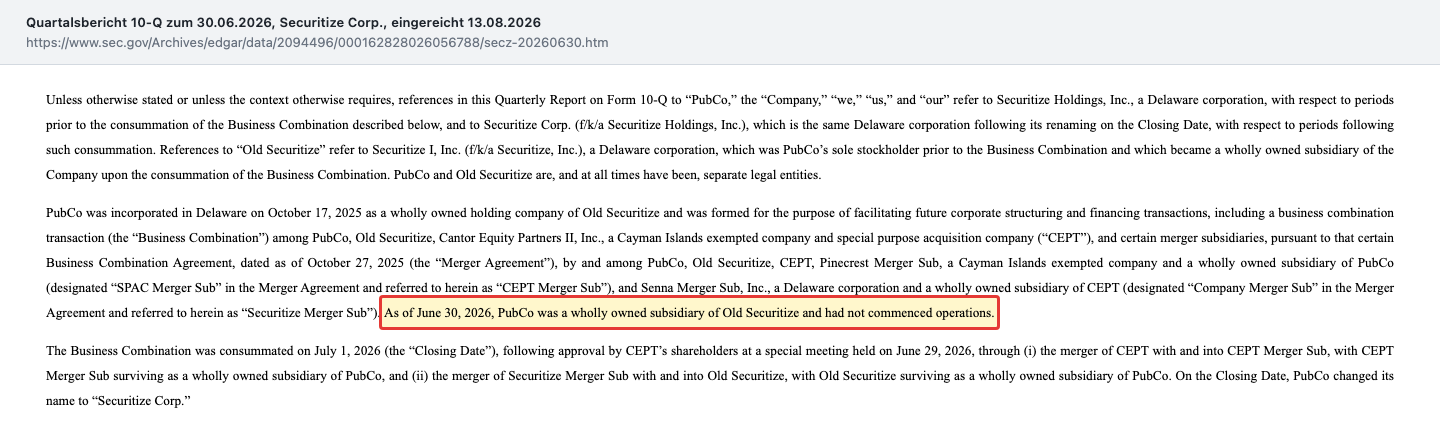
This is not an accusation but a consequence of the detour through the acquisition company: the combination closed one day after the reporting date. In practice, though, it means the company\'s operating numbers are not in the quarterly report but in the exhibits to an amended current report (Form 8-K/A of August 13, 2026) and in the earnings release of the day before. Anyone reading only the report their brokerage software shows them sees a company with petty cash and no revenue. For you as an investor: when a listing happens through an acquisition company, the first regular report is rarely the one you are looking for. The next quarterly report will be the first to show the business itself.
Uncomfortable truth no. 2: more than 60 percent hangs on one product — terminable on 90 days
The client list looks like insurance: BlackRock, Apollo, BNY, Hamilton Lane, KKR, VanEck. The prospectus of August 7, 2026 qualifies it in two places. First, the company notes that while it publicly calls these houses "partners", it has no partnership agreement with them — they are clients with terminable service contracts and no exclusivity. Second, it names the concentration outright:
"We may overly rely on certain products (such as BUIDL, which represented more than 60% of Securitize's tokenized assets under management as of September 30, 2025) and clients that provide Securitize with broader exposure and an enhanced reputation in the industry, and changes in such relationships could have broader negative effects than the direct revenues from such relationships."
— Securitize Corp., SEC prospectus 424B3 of August 7, 2026, Risk Factors
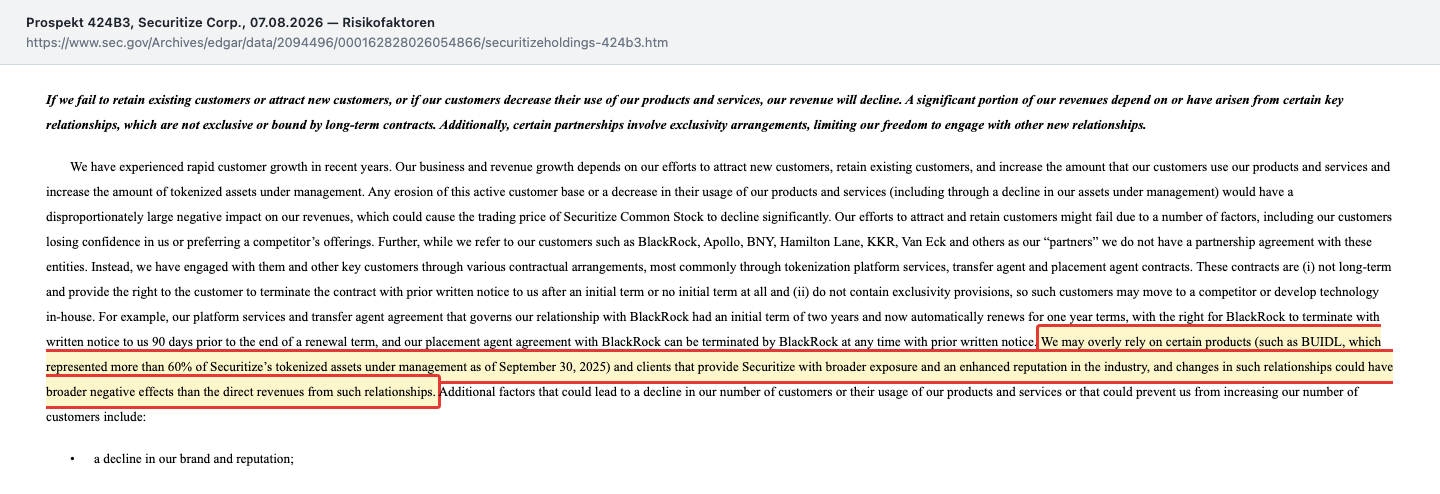
BUIDL is BlackRock\'s tokenized money market fund. Because fees in the core business are tied to assets under management, this concentration ties a substantial part of revenue to a single client. The underlying platform services and transfer agent agreement had an initial term of two years and now renews automatically for one-year terms — terminable by BlackRock on 90 days\' notice prior to the end of a renewal term. The placement agent agreement, per the prospectus, is terminable at any time. None of this is a charge against the company; service contracts in this industry look like that. It is, however, the opposite of a moat.
Uncomfortable truth no. 3: two annual accounts had to be restated
The third finding also sits in the prospectus and is the weightiest, because it concerns not the business but the reliability of the numbers we are working with here. During the audit of the 2024 accounts the independent auditor identified material weaknesses in internal control over financial reporting. The consequence was a restatement of the accounts for 2024 and 2023 — for a goodwill impairment charge, a written-off receivable, the classification of shares from an acquisition and certain expenses. The decisive part is what follows:
"Material weaknesses in our internal control over financial reporting continued to exist as of December 31, 2025, and resulted in material errors in Securitize's December 31, 2025 financial statements related to the accounting for transactions in digital asset receivable that contain an embedded derivative, incremental compensation expense on secondary stock-based transactions, certain assumptions used in Securitize's valuation in accordance with Section 409A of the Internal Revenue Code resulting in material misstatements of the derivative liability, preferred shares option, and the simple arrangements for future equity, and the assessment of certain tokenization revenue contract terms under ASC 606."
— Securitize Corp., SEC prospectus 424B3 of August 7, 2026, Risk Factors
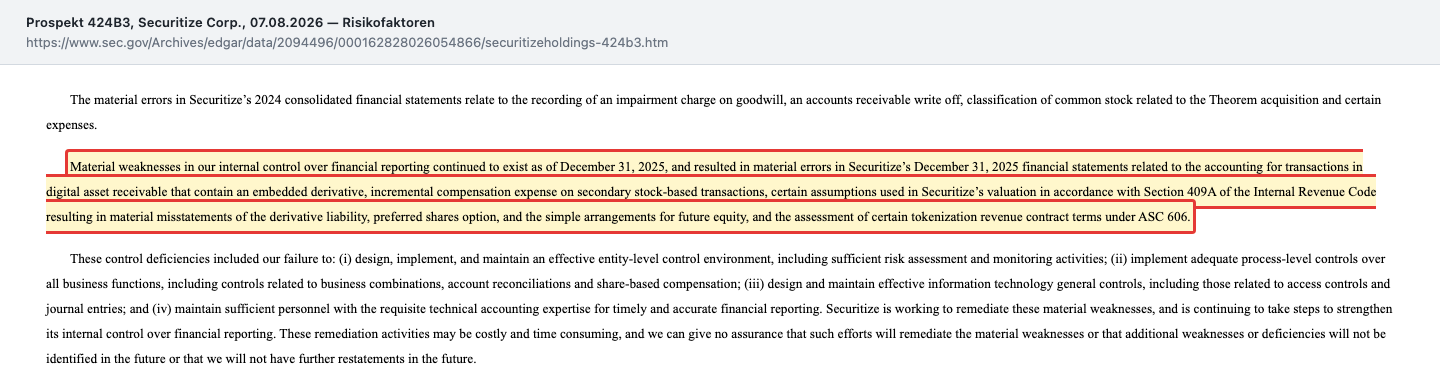
The company names four causes: an ineffective entity-level control environment, missing process-level controls, inadequate information technology general controls over access rights and journal entries, and insufficient personnel with the requisite technical accounting expertise. It states explicitly that it can give no assurance the weaknesses will be remediated or that further restatements will be avoided. For you this does not mean the numbers are wrong — it means the body that is supposed to guarantee their accuracy was called deficient by its own auditor. For a company whose result is largely driven by valuations of hard-to-measure financial instruments, that is not a side issue.
Uncomfortable truth no. 4: nearly 30 million shares are queued up
On August 13, 2026 there were 163,265,685 shares outstanding. The quarterly report lists alongside that what is not included: up to 6,250,000 earnout shares, issued in three equal tranches if the volume-weighted average price exceeds $15, $20 and $25 respectively on 20 out of any 30 trading days; 16,321,869 shares reserved for the incentive plan and the employee stock purchase plan; 3,711,658 shares from assumed warrants, of which a first tranche of 927,916 has already vested; and 3,681,510 shares from assumed options and restricted stock units. Together that is 29,965,037 shares, or 18.4 percent of today\'s count. The new charter authorises 290,000,000 shares of common stock, so there is ample room.
On September 2, 2026 came the confirmation in practice: the company registered a further 31,483,485 shares for its two employee plans on Form S-8. The two calculations overlap in part, because the S-8 also covers awards already granted. The direction is the same in both. Add to that 1,800,000 of the sponsor\'s 6,000,000 shares, which are outstanding but vest only at prices above $12.50, $15.00 and $17.50. In accounting terms these commitments sit in the books as liabilities: $63.2 million for the earnout shares and $19.7 million for the sponsor\'s — $82.9 million in total, remeasured at every reporting date and capable of moving the reported result in either direction without a cent changing hands. We described the same mechanism at Riot Platforms, where fair-value effects regularly overlay the reported profit.
A second point concerns not new shares but the existing ones. The prospectus of August 7, 2026 is a resale registration: it registers up to 151,568,524 shares for sale by the existing holders named in it — roughly 93 percent of all 163,265,685 shares outstanding. Registered does not mean sold, and the company receives no money from those sales. But registration is the precondition for shares that were previously restricted to reach the exchange at all. For a stock that has only traded since early July, that is the difference between a narrow and a broad supply — and it explains part of what moves prices in the first months after a combination of this kind.
Valuation — what the cash covers and what it does not
The good news sits in the pro forma statement, the calculation showing what the balance sheet would have looked like had the combination already closed on June 30, 2026. Before the combination the operating entity had negative equity of $169.0 million, an accumulated deficit of $195.1 million and $33.6 million in cash. Afterwards there is positive equity of $348.3 million and cash of $352.6 million.
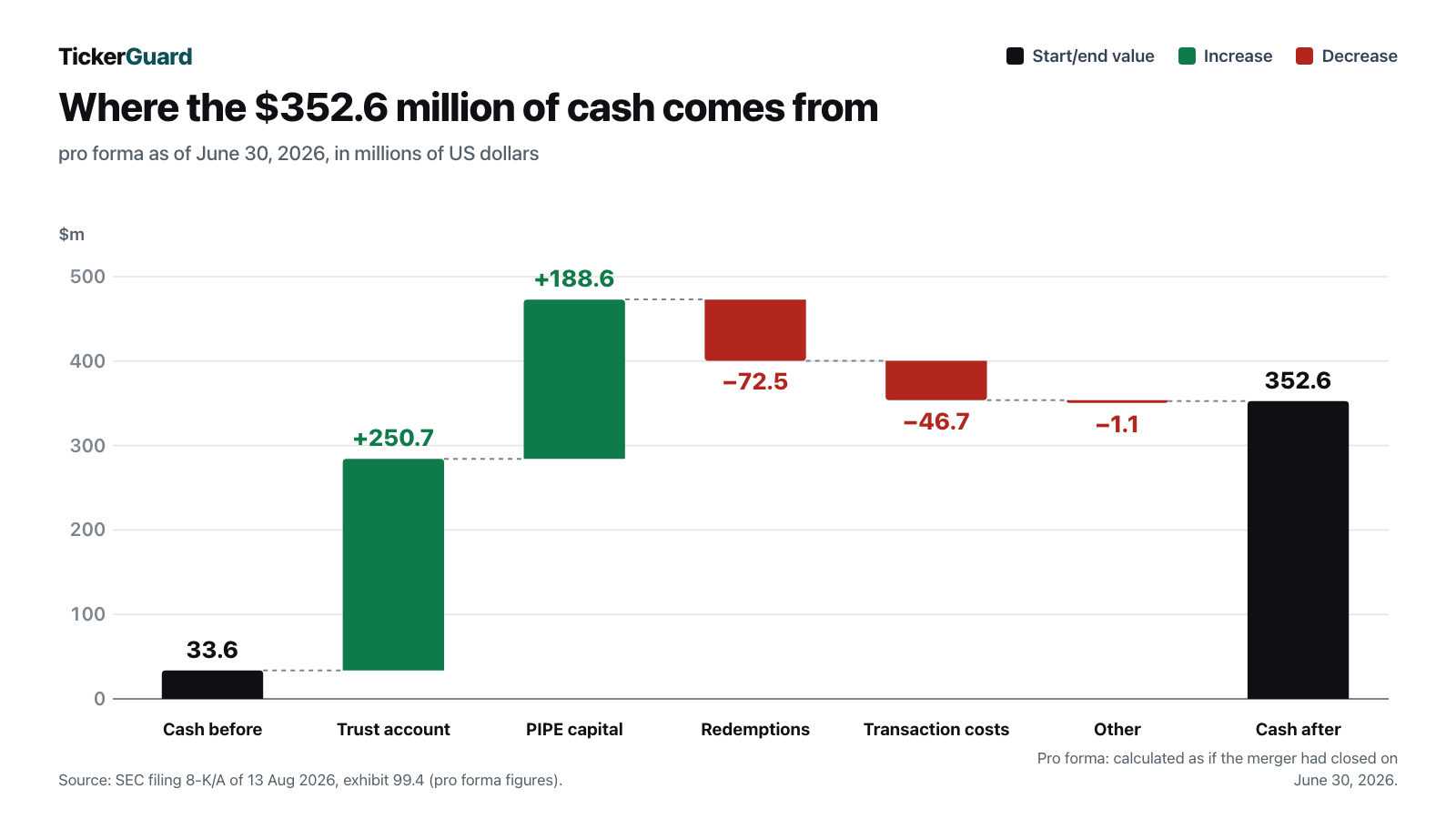
Two numbers in that picture deserve attention. The first is the $46.7 million of transaction costs — roughly 13 percent of what ends up in the bank, and more than three quarters\' revenue. That is what the route through an acquisition company costs. The second is the $72.5 million that the acquisition company\'s investors would rather have back: 28.5 percent of the redeemable shares were returned at roughly $10.60. That is the vote of the people who had the longest time to read the documents.
A price-to-earnings ratio cannot be formed for lack of earnings. A price-to-sales ratio can be — and with a price that does not come from a data feed but from the filings themselves. The two prospectus supplements dated August 13, 2026 record that the last reported sales price of the stock on August 12, 2026 was $7.86 per share. The prospectus of August 7 still cited $7.19 for August 6. Applied to the 163,265,685 shares on the cover of the quarterly report, that is a market capitalization of roughly $1.28 billion.
That order of magnitude is the real test. Measured against 2025 revenue of $62.2 million it is about 21 times sales; annualizing the first half of 2026 ($67.8 million) leaves roughly 19 times. For comparison, the $352.6 million of cash covers about a quarter of it. What the market is paying for here is not today\'s revenue but the assumption that $4.3 billion of assets under management will one day generate materially more in fees than they do now. That the stock traded on August 12 about a fifth below the $10.00 issue price, and more than a quarter below the $10.60 redemption price, shows the assumption is not going unchallenged.
What can be said independently of that is the starting position in numbers that have been audited: roughly $352.6 million of cash, annual revenue of $62.2 million (2025), half-year revenue of $33.9 million (2026) and cash used in operating activities of $13.7 million in the first half of 2026. At that pace the cash lasts many years — and that is the real value of this listing. It buys time, not earnings.
Upside and risks at a glance
What speaks for it:
- Market leadership with a licence stack: 19 percent market share per RWA.XYZ (December 2025), tokenized assets under management of $4.3 billion as of June 30, 2026, and a chain of licences covering broker-dealer activity, transfer agency, investment advice and fund administration in the United States plus a trading and settlement system in the EU.
- Financial cushion: pro forma $352.6 million of cash and $348.3 million of equity as of June 30, 2026, against $13.7 million of cash used in operating activities in the first half of 2026. No going concern qualification in the operating entity\'s accounts.
- Structural tailwind: collaborations with the transfer agents Computershare and Continental and with the NYSE for tokenized equities, FINRA approval to custody tokenized securities since the second quarter of 2026, and an arrangement with Cantor Fitzgerald for issuance on blockchain rails.
- Volume growth: transaction volume up 147 percent to $5.3 billion in the second quarter of 2026, average assets under management up 16 percent, more than seven individual products above $100 million each.
What speaks against it:
- Revenue does not follow the assets: $14.4 million in the second quarter of 2026, 5 percent below the prior-year quarter and 12 percent below it in the core tokenization business — while average assets under management rose 16 percent.
- Cost jump without a counterpart: operating expenses up 56 percent to $24.1 million, operating loss up from $0.2 million to $9.7 million, adjusted EBITDA flipped from plus $1.8 million to minus $5.5 million.
- Concentration: more than 60 percent of tokenized assets sat in a single product as of September 30, 2025; the underlying contract is terminable on 90 days\' notice, the placement agreement at any time, and there is no exclusivity.
- Reporting quality: restatements of the 2023 and 2024 accounts, material control weaknesses persisting as of December 31, 2025 with resulting errors in the 2025 accounts, and explicitly no assurance of remediation.
- Dilution: 29,965,037 possible additional shares per the quarterly report (18.4 percent), plus a registration of 31,483,485 shares for employee plans dated September 2, 2026 and earnout liabilities of $82.9 million in total that move the result at every reporting date.
- Supply overhang from existing shares: up to 151,568,524 shares — roughly 93 percent of all shares outstanding — have been registered for resale by existing holders since the prospectus of August 7, 2026.
- Valuation: roughly $1.28 billion of market capitalization at the documented closing price of August 12, 2026 stands against 2025 revenue of $62.2 million — about 21 times sales, while quarterly revenue most recently fell.
- Short history as a listed company: a first regular quarterly report with no operations, no annual report (10-K) under the current name, and emerging growth company status with reduced disclosure obligations.
A human conclusion
Back to the first-time trap. It works so well precisely because it rests on no lie. Securitize is the first tokenization company on an exchange. It is the largest provider in its market. The licences are real and the client list is not invented. The trap is not that the premiere is untrue. The trap is that the premiere obscures a far duller question, and duller questions get asked less often: will the assets running across this platform ever reliably turn into money?
The filings do not answer that yet, but they give an interim reading. Assets under management grew 16 percent in the second quarter of 2026; revenue fell 5 percent. Costs rose 56 percent; adjusted EBITDA turned negative. More than 60 percent of the assets most recently hung on a single product whose contract is terminable on 90 days\' notice. And the controls that are supposed to vouch for the accuracy of all these numbers were called deficient by the company\'s own auditor — not for the last time in 2023, but as of December 31, 2025.
Against that stands $352.6 million of cash, and that is no small thing. It gives the company years to turn volume into revenue. If you believe in tokenization, you are buying the market leader with the longest breath. If you doubt it, you see a company that can lose its most important client on 90 days\' notice and whose books had to be restated twice. Both readings rest on the same papers. So the honest question is not "Is tokenization the future?" but: would you still look at this company if it were the second of its kind on an exchange? If yes, you have a thesis. If no, you had a premiere. What you do with that is your decision. And that is exactly as it should be.
Sources
All original documents used in this analysis — for you to read yourself:
- Securitize Corp. — SEC Form 10-Q for the period ended June 30, 2026 (filed August 13, 2026)
- Securitize Corp. — SEC Form 8-K of August 12, 2026, exhibit 99.1 (second quarter 2026 earnings release)
- Securitize Corp. — SEC Form 8-K/A of August 13, 2026, exhibit 99.4 (pro forma financial information as of June 30, 2026)
- Securitize Corp. — SEC prospectus 424B3 of August 7, 2026 (business, risk factors, management discussion, 2024 and 2025 financial statements, resale registration of up to 151,568,524 shares, closing price of $7.19 on August 6, 2026)
- Securitize Corp. — SEC prospectus supplement 424B3 of August 13, 2026 (closing price of $7.86 on August 12, 2026)
- Securitize Corp. — SEC Form 8-K of July 8, 2026 (closing of the business combination, capitalisation)
- Securitize Corp. — SEC registration statement on Form S-8 of September 2, 2026 (shares for employee plans)
- Full SEC filing history of Securitize Corp.: EDGAR overview (sec.gov)
- Attention data: ticker SECZ picked up on September 18, 2026 via our in-house stock scanner (Reddit hype).
Transparency & disclaimer: this analysis is a journalistic assessment of publicly available information. It is not investment advice, not a financial analysis in the regulatory sense and not an invitation to buy or sell securities. Equity investments carry substantial risks up to total loss. All information without warranty; the as-of date of the data is noted in the text. Any position held by the publisher is disclosed and would appear as a note at the top of this analysis.
Key figures at a glance
All monetary figures in millions of $; earnings per share as reported.
| Metric | 2024 | 2025 |
|---|---|---|
| Revenue | 18.6 | 62.2 |
| Operating Income (EBIT) | -15.3 | -14.5 |
| Net Income | -24.3 | -48.5 |
| Net Margin | -130.3% | -78.0% |
| Earnings Per Share | -0.16 $ | -0.33 $ |
Source: fundamental data & SEC filings (annual and quarterly reports, 10-K/10-Q)
Our Bottom Line at a Glance
- Market position positive
- Securitize leads its market: 19 percent share per the industry tracker RWA.XYZ (December 2025), $4.3bn of tokenized assets under management as of 2026-06-30 and more than seven individual products above $100m each. The licence stack is unusually broad: broker-dealer activity with its own alternative trading system, transfer agency, investment advice and fund administration in the United States, plus a trading and settlement system in the EU under the DLT Pilot Regime.
- Earnings negative
- Volume growth is not reaching the revenue line: $14.4m in the second quarter of 2026 is 5 percent below the prior-year quarter and 12 percent below it in the core tokenization business — while average assets under management rose 16 percent. Operating expenses climbed 56 percent to $24.1m, the operating loss from $0.2m to $9.7m, and adjusted EBITDA flipped from +$1.8m to −$5.5m.
- Balance sheet and liquidity positive
- The combination turned the financial position around: negative equity of $169.0m (2026-06-30, before closing) became $348.3m positive on a pro forma basis, and $33.6m of cash became $352.6m. Against that stands $13.7m of cash used in operating activities in the first half of 2026 — cash runway therefore far exceeds the critical four quarters. The operating entity's accounts contain no going concern qualification.
- Client concentration negative
- As of 2025-09-30, per the prospectus of 2026-08-07, more than 60 percent of tokenized assets under management sat in a single product, BlackRock's money market fund BUIDL. The underlying platform services and transfer agent agreement renews annually and is terminable by BlackRock on 90 days' notice, the placement agent agreement at any time. There is no exclusivity; in the same paragraph the company notes that it has no partnership agreement with the houses it publicly calls "partners".
- Reporting quality and controls negative
- The independent auditor identified material weaknesses in internal control over financial reporting during the 2024 audit; the 2024 and 2023 accounts had to be restated. The weaknesses continued to exist as of 2025-12-31 and produced material errors in the 2025 accounts as well, among them embedded derivatives, compensation expense on secondary transactions and the assessment of tokenization contracts. The company explicitly gives no assurance of remediation.
- Capital structure neutral
- On top of 163,265,685 shares (2026-08-13), up to 29,965,037 more may follow per the quarterly report (18.4 percent): 6,250,000 earnout shares, 16,321,869 for employee plans, 3,711,658 from warrants and 3,681,510 from assumed awards. On 2026-09-02 the company registered a further 31,483,485 shares for its employee plans. The earnout shares sit in the pro forma balance sheet as liabilities of $63.2m and the sponsor's as $19.7m, remeasured at every reporting date.
Securitize is the largest provider of tokenized securities and has been listed since July 1, 2026 via a special purpose acquisition company. The combination turned the balance sheet around: $352.6 million of cash and $348.3 million of equity on a pro forma basis, after a deficit of $169.0 million before. The operating picture does not yet carry the story: in the second quarter of 2026 revenue fell 5 percent to $14.4 million while assets under management rose 16 percent and operating costs 56 percent. Add two documented findings from the prospectus: more than 60 percent of tokenized assets most recently sat with a single client relationship terminable on 90 days' notice, and the 2023 and 2024 accounts had to be restated, with the cause still present as of December 31, 2025. Not investment advice.
What Our Rating Means
Substance risk
We found at least one documented issue that threatens the company itself — regardless of how the stock is currently valued.
Red here does not stand for a liquidity problem — quite the opposite: with pro forma $352.6 million of cash, $348.3 million of positive equity and $13.7 million of cash used in operating activities in the first half of 2026, the money lasts for many years, and the absence of a going concern qualification is justified. What decides the rating is a different finding, and it is one explicitly treated as a threat to substance: a break in the accounts. The independent auditor identified material weaknesses in internal control, the 2023 and 2024 accounts had to be restated, and the cause was still fully present as of December 31, 2025 — with material errors in the 2025 accounts as well. For a company whose result is largely driven by valuations of hard-to-measure financial instruments, that goes to the core: the body that vouches for the accuracy of every other figure is impaired. It is reinforced by dependence on a single counterparty — more than 60 percent of tokenized assets under management in one product whose contract is terminable on 90 days' notice. What did not decide the rating were the falling quarterly revenue and the widening loss; those are open operating questions that on their own would warrant yellow. Red is the more cautious grade, and it stands until the first annual report as a listed company reports the controls as remediated. The decision is yours.
A journalistic assessment by our editorial team at the time of the deep dive, based on public sources — not investment advice and not a solicitation to buy or sell. Your personal circumstances (investment goals, risk capacity, taxes) cannot be taken into account. What our levels mean, how verdicts are formed, and what conflicts of interest exist →
Worth Noting
- The trigger for this analysis was our in-house Reddit hype scanner: the ticker SECZ reached our desk on September 18, 2026.
- Data as of September 18, 2026. The operating figures come from the earnings release filed as exhibit 99.1 to the Form 8-K of 2026-08-12, from exhibits 99.1, 99.2 and 99.4 to the Form 8-K/A of 2026-08-13 and from the prospectus 424B3 of 2026-08-07. The Form 10-Q for the period ended 2026-06-30 (filed 2026-08-13) concerns the holding company before the combination and contains no operating figures.
- The market data feed provides no market capitalisation for SECZ. This analysis therefore derives it solely from filing evidence: 163,265,685 shares per the cover of the quarterly report (2026-08-13) times $7.86 — the last reported sales price as of 2026-08-12, documented in both prospectus supplements 424B3 of 2026-08-13. The prospectus of 2026-08-07 cited $7.19 as of 2026-08-06. This analysis states no price target.
- The quarterly figures relate to Securitize I, Inc. (formerly Securitize, Inc.), the operating entity that has been a subsidiary of Securitize Corp. since 2026-07-01. The balance sheet figures as of 2026-06-30 predate the combination; the convertible notes, preferred shares and similar instruments that produced the negative equity there were converted into equity at closing.
- Not to be confused: Securitize Corp. (CIK 0002094496) was named Securitize Holdings, Inc. until 2026-07-01; the former Securitize, Inc. is now Securitize I, Inc. and a subsidiary. That is why the SEC history under this CIK only begins in November 2025.
- The going concern qualification that appears in the documents related to the acquisition company Cantor Equity Partners II and its deadline of 2027-05-05 to complete a business combination. It became moot with the closing on 2026-07-01; the operating entity had none.
Stock Watch
This analysis is as of September 19, 2026. Stock Watch will tell you what's changed at SECZ since then.
Later $1 a month per stock — signing up is free, and you'll be the first to know when it launches.
The full analysis as a PDF for later
We will send you this analysis as a PDF — to print, file away, and read at your own pace. And we will add you to the free Stock Watch list for Securitize Corp. (SECZ), so you hear about it when something material in this analysis changes.
Frequently Asked Questions
Securitize Corp. (NYSE: SECZ) runs a regulated platform that represents fund units and securities as tokens on blockchains. It earns recurring fees based on tokenized assets under management (the tokenization segment) and fees for asset servicing such as bookkeeping, unit calculation and reporting. In the United States the group holds a broker-dealer licence with its own alternative trading system, a transfer agent registration and an investment adviser registration; in the EU a subsidiary operates a trading and settlement system under the DLT Pilot Regime. As of December 31, 2025 it had roughly 194 full-time employees.
Not through a conventional initial public offering but through a business combination with the special purpose acquisition company Cantor Equity Partners II, closed on July 1, 2026 after shareholder approval on June 29, 2026. Each share of the old Securitize was exchanged for roughly 4.4439 shares of the new company. Trading on the New York Stock Exchange began on July 2, 2026. Holders of 28.5 percent of the acquisition company's redeemable shares took their money back — 6,842,508 shares at roughly $10.60, or $72.5 million in total.
Because the report covers the period to June 30, 2026 while the business combination closed on July 1, 2026. On the reporting date the filing entity was an empty holding company that, by its own statement, had not commenced operations. The group's operating figures therefore do not appear in the quarterly report but in the exhibits to the amended current report on Form 8-K/A of August 13, 2026 and in the earnings release of August 12, 2026.
In the second quarter of 2026 it came to $14.4 million, 5 percent below the prior-year quarter ($15.3 million). The core tokenization business fell 12 percent to $7.8 million while asset servicing rose 3 percent to $6.6 million. In the first half of 2026 the company reached $33.9 million (up 16 percent). For the full year 2025 it reports roughly $62.2 million, after roughly $18.6 million in 2024.
Two reasons. First the operating business: operating expenses rose 56 percent to $24.1 million, driven mainly by selling, general and administrative expenses (up 133 percent) and compensation (up 31 percent); the operating loss widened from $0.2 million to $9.7 million. Second, fair-value effects: the remeasurement of an option liability alone cost the quarter $29.3 million, while the remeasurement of a derivative liability credited $21.8 million. The bottom line was a net loss of $21.7 million, or $2.37 per share. Those financial instruments were converted into equity with the business combination.
By its own account in the prospectus of August 7, 2026, more than 60 percent of tokenized assets under management as of September 30, 2025 sat in a single product: BlackRock's money market fund BUIDL. Because fees in the core business are tied to assets under management, a substantial part of revenue is tied to it as well. The platform services and transfer agent agreement had an initial term of two years, renews automatically for one-year terms and can be terminated by BlackRock on 90 days' notice prior to the end of a renewal term; the placement agent agreement is terminable at any time. There is no exclusivity.
During the audit of the 2024 accounts the independent auditor identified material weaknesses in the design and operating effectiveness of internal control over financial reporting. The accounts for 2024 and 2023 had to be restated as a result — among other things for a goodwill impairment charge, a written-off receivable and the classification of shares from an acquisition. The weaknesses continued to exist as of December 31, 2025 and produced material errors in the 2025 accounts as well. The company says it is working on remediation but explicitly gives no assurance that it will succeed.
On August 13, 2026 there were 163,265,685 shares outstanding. The quarterly report names in addition up to 6,250,000 earnout shares (issued in three tranches at average prices above $15, $20 and $25), 16,321,869 shares for employee plans, 3,711,658 from warrants and 3,681,510 from assumed options and restricted stock units — 29,965,037 shares in total, or 18.4 percent. On September 2, 2026 the company also registered 31,483,485 shares for its employee plans on Form S-8; the two calculations overlap in part. The charter authorises 290,000,000 shares of common stock.
Found an error?
Did you spot a factual error, an outdated number, or a typo in this deep dive? Let us know briefly — your report goes straight to the editorial team.