Alliance Entertainment: $1.15 Billion of Revenue — and the Entire Free Float Would Fit on One Bus
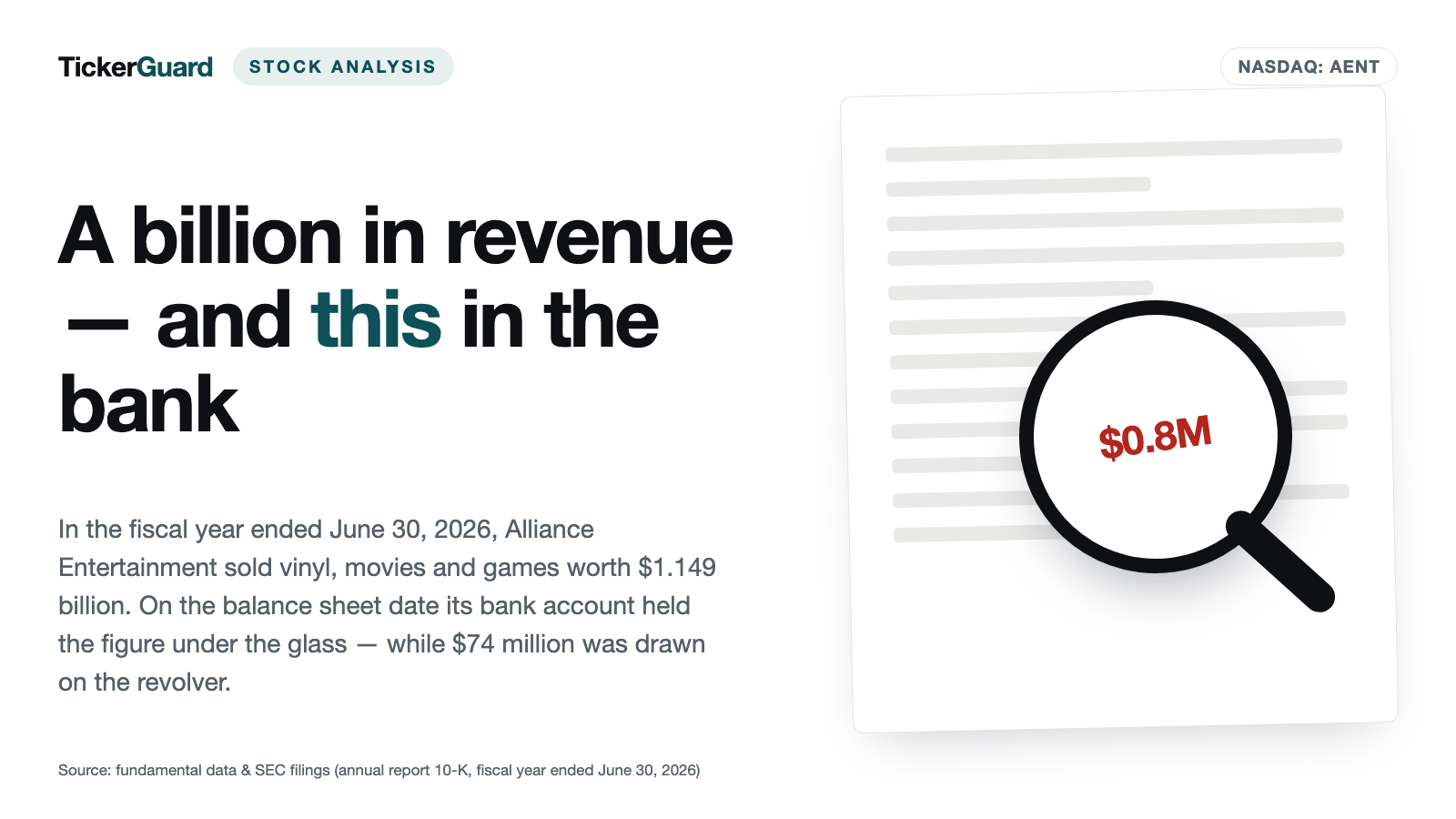
Vinyl is back, and Alliance Entertainment is making money on it: $383 million of records, $339 million of movies on disc, $1.149 billion of revenue in total for the fiscal year ended June 30, 2026. Of that, $13.1 million remained at the bottom line. On the balance sheet date the company held $814,000 in cash while $74.3 million was drawn on its revolver — and 94 percent of the shares belong to its own management. We read the annual report and worked out who actually owns this business.
 Thomas Mücke
Founder & Publisher
Thomas Mücke
Founder & Publisher
As of Today
As of: September 18, 2026
- Closing price
- 5.00 $ +3.70%
- Market Capitalisation
- 0.3 $B
- P/E
- 11.1
- Growth Score
- 3/10
- AAQS
- 7/10
Price change since June 30, 2026: -14.4%
This analysis has a cut-off date. The Stock Guard tells you when something material changes in the numbers. Reserve your free spot
Chart
Interactive price chart (TradingView).
52-week range: 4.60 $ to 8.40 $ · Last price: 5.00 $ (As of: September 18, 2026)
Note: pure fact-based analysis, not investment advice and not a solicitation to buy or sell. All figures without guarantee.
There is a trap almost every investor falls into once: the nostalgia trap. You read that records are selling again, you remember your own shelf of LPs, you walk past a rack of coloured vinyl downtown, and you think: there must be money in that. The feeling is not wrong. It is simply not an argument.
Alliance Entertainment is the company that serves exactly this feeling. It stocks the racks. And in the fiscal year ended June 30, 2026 it did indeed sell $383 million of vinyl records, 13 percent more than the year before. So the nostalgia checks out. The deal for this piece is that we look anyway at what survives of a billion dollars of revenue — and who it belongs to.
What Alliance Entertainment actually does — the shelf behind the shelf
Alliance Entertainment is not a store. It is the warehouse the stores buy from. More than 340,000 stock-keeping units sit there in inventory: vinyl records, CDs, movies on DVD, Blu-ray and 4K, video games and consoles, toys, collectible figures. From there they go out to more than 35,000 retail and e-commerce storefronts. For close to 200 film studios, music labels and other rights holders Alliance is the exclusive distribution partner in North America.
That is one half. The other is called DirectToU: owned online stores selling straight to consumers under brands such as ImportCDs, Deep Discount and Movies Unlimited. Direct-to-consumer accounted for roughly 34 percent of gross revenue in fiscal 2026, down from 37 percent — the share fell not because that business shrank, but because wholesale grew faster.
To understand where Alliance earns its money, picture the model as a transshipment point: goods come in, goods go out, and a thin markup sticks to them on the way through. In fiscal 2026 that markup was 13.3 cents per dollar of revenue, before a single salary, warehouse rent or interest payment. For comparison, a branded manufacturer often keeps 40 to 60 cents of its revenue dollar. A distributor does not live on margin; it lives on throughput.
The product mix has shifted noticeably. In fiscal 2026, 33 percent of revenue came from vinyl, 30 percent from movies on disc, 16 percent from gaming, 14 percent from CDs and 4 percent from collectibles and consumer electronics. A year earlier gaming was still, at 24 percent, almost as large as vinyl. In other words, that category lost a third of its weight within a single year, while movies climbed from 26 to 30 percent — carried by the exclusive Paramount agreement from January 2025 and a second one with Amazon MGM Studios from January 2026.
A word on origins, because older databases still get it wrong: the listed shell was called Adara Acquisition Corp. from September 25, 2020 until February 6, 2023 and was a blank-check company — a business with no operations that lists in order to acquire a real one later. On February 10, 2023 it became Alliance Entertainment. The operating business itself is more than three decades old.
And one more detail to know before comparing numbers: the fiscal year ends June 30. At Alliance, "fiscal 2026" therefore means July 1, 2025 through June 30, 2026 — the second half of calendar 2025 plus the first half of calendar 2026. Anyone laying these figures next to a calendar-year company is comparing shifted periods.
That frames the central tension of this analysis, and it runs through every chapter: the business works — but so little sticks to the throughput that every growth phase drains the bank account first. And what is left over is decided by what amounts to three people.
Company history for investors
-
2021
The Adara shell goes public (February)
Adara Acquisition Corp. raises money without running a business — investors buy an option on a future acquisition. The 9,919,993 warrants with an $11.50 exercise price date from this period.
-
2023
Merger into Alliance Entertainment (February 10)
The empty shell becomes a distributor with more than a billion in revenue. Sellers receive 60,000,000 contingent Class E shares into escrow — deferred consideration that still dilutes every voting calculation today.
-
2025
Exclusive agreement with Paramount (January)
Alliance becomes the sole distribution partner for Paramount physical media in the United States and Canada. For shareholders it is proof that scale turns into an advantage in this shrinking market.
-
2025
New Bank of America revolving credit facility (October 1)
The prior facility and a $10.0 million shareholder loan are repaid. The average effective interest rate falls from 9.2 to 6.1 percent over the fiscal year, saving $3.0 million of interest.
-
2026
Endstate acquisition and Amazon MGM deal (December/January)
Endstate Authentic brings tamper-proof authentication technology in house, and a second major studio agreement follows in January 2026. Both aim at higher-value goods rather than more volume.
-
2026
Charter restatement filed and withdrawn (July/August)
Filed in Delaware on July 29, nullified on August 26: the route into the Russell 3000 through removing the Class E voting rights is blocked for now.
-
2026
Annual report for the fiscal year ended June 30 (September 10)
Revenue up 8.0 percent to $1,148.986 million, net income $13.058 million — and, for the first time in four years, cash used by operating activities.
How this stock landed on our desk
Not through a screen, but through the filing calendar. On September 10, 2026 Alliance Entertainment filed its annual report (Form 10-K) for the fiscal year ended June 30, 2026, together with the earnings release of the same day. Reading the company's filings backwards turns up an unusual sequence: a charter restatement filed on July 29, 2026 and nullified on August 26, 2026.
That was the reason to look closer. A reason is not a verdict — but a company that has to reverse its own charter amendment within four weeks earns a second reading. Anyone who wants to follow such chains first-hand can: every document is free in the EDGAR database of the U.S. securities regulator, the SEC, under identifier CIK 0001823584.
For scale: roughly $298 million of market value (50,979,630 shares as of September 10, 2026 multiplied by the $5.84 price documented in the annual report for June 30, 2026) stands against $1,149 million of annual revenue. That is cheap — and the question in this piece is why.
The numbers over the years — given their due
Start with what genuinely impresses. Physical media were written off as a dead business ten years ago. They are not. In fiscal 2026 vinyl revenue rose 13 percent to $383 million — 7.4 percentage points of that from higher unit volume and 4.8 from higher average selling prices. CDs gained 25 percent to $156 million, movies on disc 22 percent to $339 million, collectibles 45 percent to $32 million. That is not a runoff business; it is a niche with pricing power.
Gross margin is moving the right way too: 13.3 cents of every revenue dollar remained as gross profit in fiscal 2026, up from 12.5 cents. In absolute terms gross profit rose from $132.852 million to $152.324 million — 15 percent growth on 8 percent revenue growth. The company attributes that to a better product mix, more exclusive content and lower freight costs.
The five-year view shows where that growth comes from, though: it is a recovery, not a record.
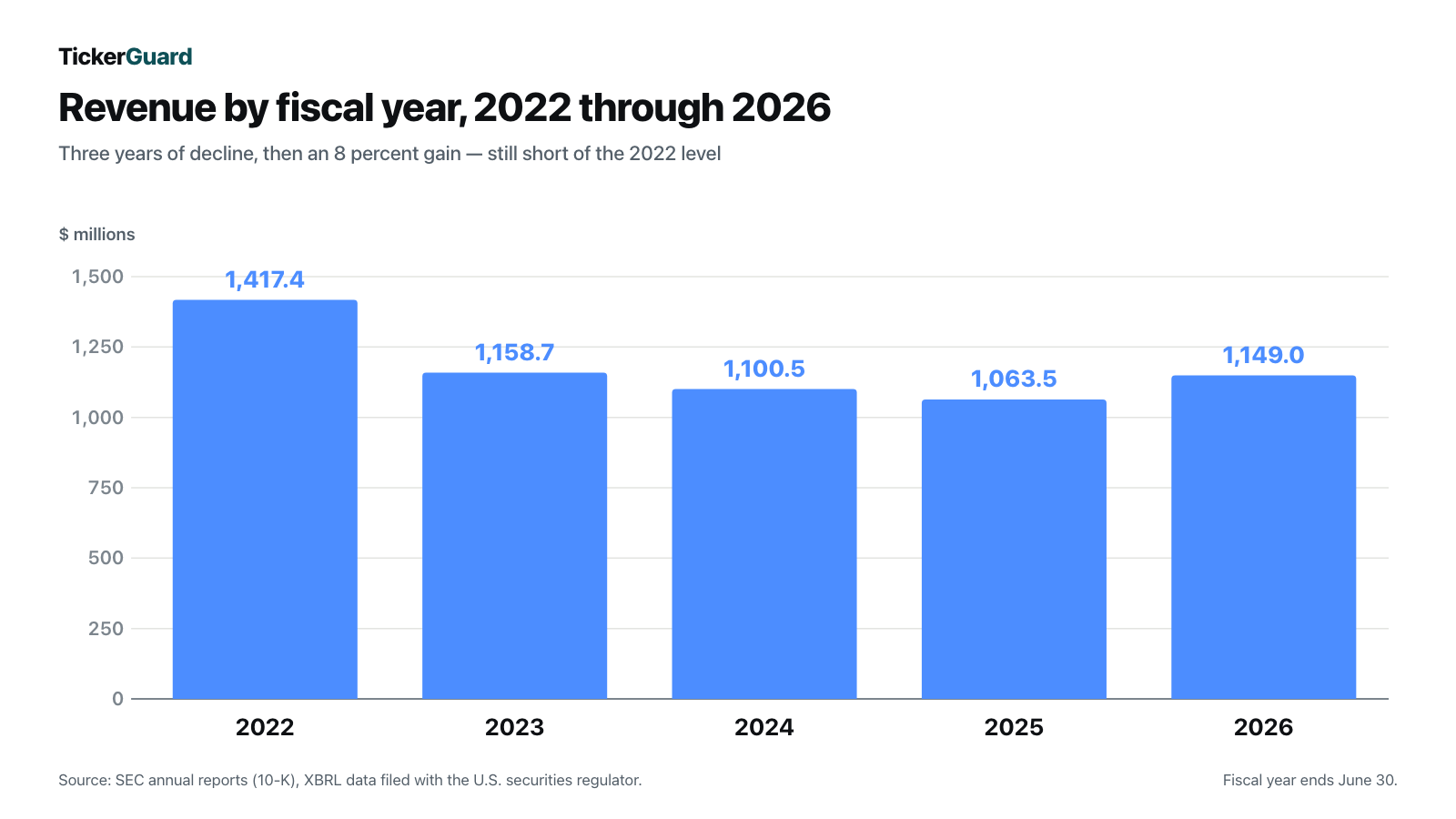
At the bottom line: $13.058 million of net income in fiscal 2026, after $15.078 million a year earlier. That is $0.26 per diluted share, down from $0.30. The decline despite higher revenue has three causes: a one-time write-off of $7.823 million (more on that shortly), selling, general and administrative expenses up by $10.177 million, and a tax charge $2.126 million higher. Interest went the other way, falling from $10.575 million to $7.606 million.
That interest saving is a real achievement and not an accounting trick: the average effective interest rate dropped from 9.2 percent to 6.1 percent because Alliance moved its revolving credit facility from a specialist lender to Bank of America on October 1, 2025. The average drawn balance actually rose slightly over the same period, from $77.5 million to $78.8 million — the saving comes purely from the rate.
And now the figure the rest of this piece turns on.
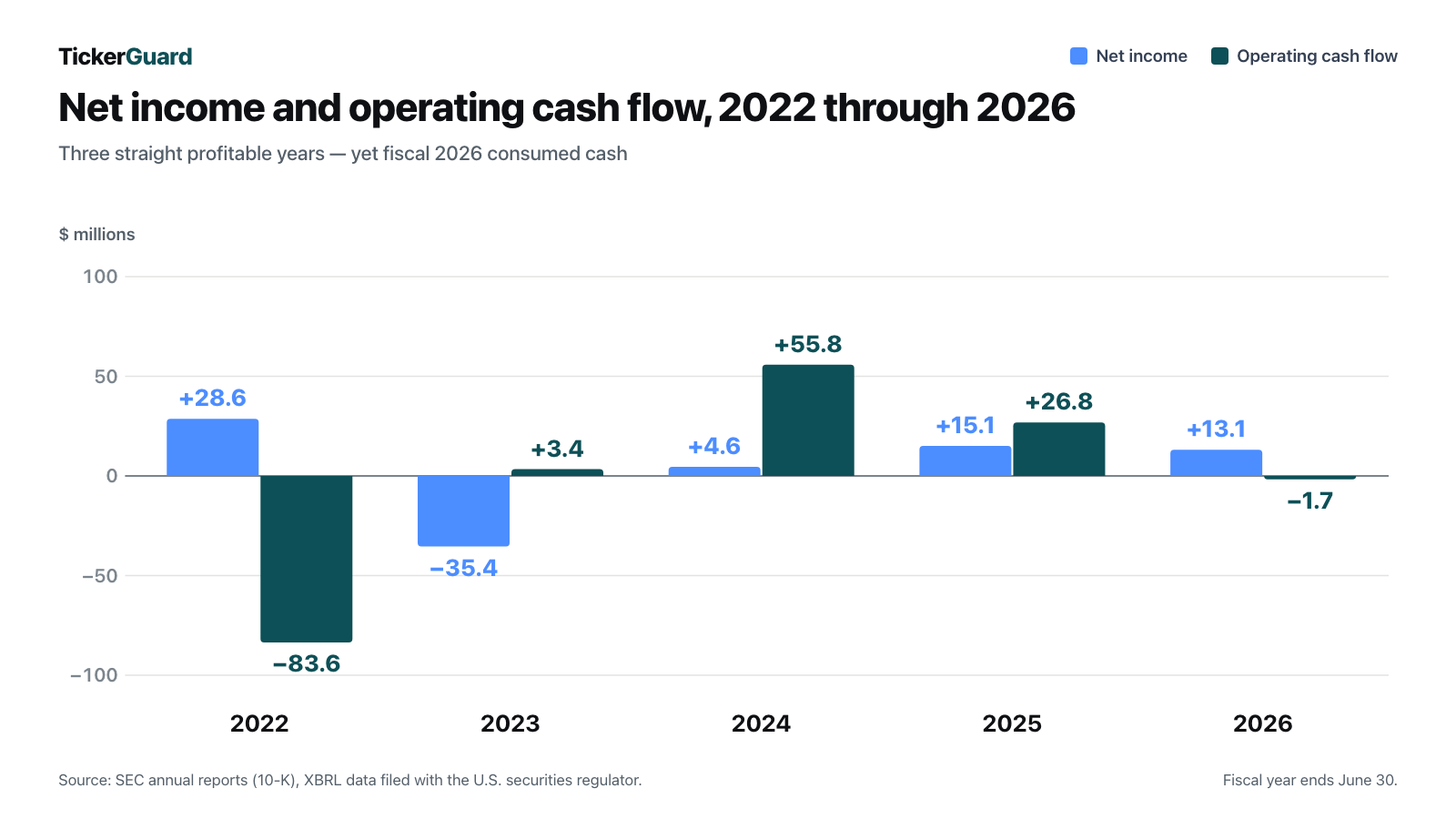
The cause is no scandal but the arithmetic of wholesale: to sell more you have to buy more first and wait longer to be paid. In fiscal 2026 inventory rose by $23.751 million and trade receivables by $17.455 million, $41.2 million combined. Accounts payable only grew by $15.658 million. The difference is money sitting on pallets and in invoices rather than in the bank. The company itself puts working capital at $62.4 million as of June 30, 2026, against $45.4 million a year earlier.
What the filings say — the uncomfortable truths
Uncomfortable truth no. 1: $814,000 in the bank on the balance sheet date
A company with $1.149 billion of annual revenue held precisely $814,000 of cash on June 30, 2026. That is roughly one sixth of a working day's revenue (assuming 250 working days a year). At the same time $74.3 million of the revolver was drawn.
“As of June 30, 2026, the Company had $0.8 million of cash on hand and $74 million outstanding under the Revolving Credit Facility.”
— Alliance Entertainment Holding Corporation, Form 10-K for the fiscal year ended June 30, 2026, Liquidity and Capital Resources

On its own that is not dramatic; it is how a distributor with an asset-based facility is built. Spare cash is swept against the loan immediately, because otherwise it only costs interest. The commitment is $120 million, of which $45.7 million was available at the balance sheet date, maturity is October 1, 2030, and up to another $50 million is possible subject to conditions. The company was in compliance with all applicable covenants at year-end.
The construction still has to be understood: how much Alliance may draw is governed not by the commitment but by a borrowing base of eligible receivables and eligible inventory — and the lenders may adjust that base at their discretion. If inventory values fall, the credit line shrinks precisely when it would be needed most. With $814,000 of cash there is no buffer of its own.
Uncomfortable truth no. 2: $7.8 million that never existed
In fiscal 2026 Alliance wrote off $7.823 million that had until then sat on the balance sheet as a receivable from a vendor. It concerned a rebate program with a supplier named Tastemakers; the accrued claims were to be recovered through future purchase order deductions. Then Tastemakers ceased operations.
“During the fiscal year ended June 30, 2026, we recorded a $7.8 million vendor transaction loss related to the write-off of a receivable associated with a historical rebate arrangement with Tastemakers.”
— Alliance Entertainment Holding Corporation, Form 10-K for the fiscal year ended June 30, 2026, Item 1A Risk Factors
For scale: the amount equals 60 percent of the entire year's net income of $13.058 million. The company excludes it from its adjusted measures, arguing that it stems from a counterparty insolvency rather than current-period operations. That is reasonable — except the same report also states that other customers may run into financial difficulty and cause significant write-offs.
So it pays to know which figure you are reading. Under GAAP, the binding U.S. accounting rules, Alliance earned $13.058 million. Adjusted, after stripping out one-time items, it was $23.449 million. Both are disclosed honestly; the adjusted one is the more comfortable.
Uncomfortable truth no. 3: three customers, 45 percent of revenue — and one debtor with 29 percent
The notes to the annual report list the dependencies plainly. In fiscal 2026 the three largest customers represented 20.8, 13.7 and 10.7 percent of revenue — 45.2 percent combined. A year earlier it was 14.5, 14.0 and 11.4 percent, or 39.9 percent. The dependency has grown, and it has concentrated on one name.
Receivables are tighter still: as of June 30, 2026 a single customer accounted for 29.3 percent of all outstanding balances, with 15.6 and 13.3 percent on two others. Against $111.038 million of total receivables that is roughly $32.5 million with one address — more than twice the year's net income. Payment terms of 30 to 60 days are normal in the trade; that does not make the exposure smaller.
The purchasing side mirrors it: the largest supplier represented 23.7 percent of purchases, two others 11.2 percent each. Anyone valuing a distributor is always valuing these two lists as well. For a comparison, another thin-margin distributor is instructive: ScanSource shows how tightly guidance in this business hangs on individual contracts.
Uncomfortable truth no. 4: 94 percent belongs to management — the free float is 3.37 million shares
This is the finding that explains the valuation. Alliance Entertainment is formally a public company. In practice it is a family business with a listing.
“As of the date of this Form 10-K, the executive officers and directors and their affiliates collectively beneficially owned, directly, or indirectly, excluding the Contingent Class E Shares, approximately 94% of the outstanding Class A common stock.”
— Alliance Entertainment Holding Corporation, Form 10-K for the fiscal year ended June 30, 2026, Item 1A Risk Factors

How little that leaves is something the company works out itself in the information statement of July 7, 2026:
“Currently, approximately 3,371,581 shares of Class A Common Stock and no shares of Class E Common Stock are held by unrestricted shareholders.”
— Alliance Entertainment Holding Corporation, Form DEF 14C information statement, July 7, 2026

Three things follow that every buyer should know. First: in any vote, the free float decides nothing. Second: with so few freely tradeable shares the price is fragile — even a mid-sized order moves it. Third: the annual report puts the aggregate market value of shares not held by affiliates at just $27.06 million as of December 31, 2025. That is the slice of the company the market actually trades.
For a sense of how narrow ownership and an overheated tape reinforce each other, another retailer of physical media is worth reading: GameStop.
Uncomfortable truth no. 5: the charter amendment that lasted 28 days
On June 24, 2026 three shareholders — two family trusts of executive chairman Bruce Ogilvie, plus chief executive Jeffrey Walker personally — approved a restatement of the certificate of incorporation by written consent. No shareholder meeting took place; under Delaware law that is permitted where a majority consents. They held about 95.3 percent of the voting power.
The aim: to strip the 60,000,000 Class E shares of their voting rights. These shares have sat in an escrow account since February 2023 and are released only if certain triggering events occur — a form of deferred consideration. Until then they still count as outstanding and voting, and they dilute every percentage calculation about voting power.
The reason given in the information statement is strikingly candid: index inclusion, specifically the Russell 3000. Its administrator requires at least 5 percent of voting shares to be held by unrestricted shareholders. With the Class E shares voting that figure is 3.0 percent; without them it would be 6.6 percent. The restatement would have cleared the bar.
On July 29, 2026 the restatement was filed in Delaware. On August 26, 2026 the company disclosed that it was void again:
“On August 26, 2026, the Company filed a Certificate of Correction with the Delaware Secretary of State, which nullified the Third A&R Certificate in its entirety on the basis that the Third A&R Certificate was not approved in compliance with the Second A&R Certificate.”
— Alliance Entertainment Holding Corporation, Form 8-K of August 28, 2026, Item 5.03

This is not about money and not about accounting fraud. It is about diligence: shareholders who control 95 percent of the votes passed a resolution that went through an official filing process — and had to reverse it because of their own procedural error. Anyone who wants to check whether a second attempt follows only has to watch this company's EDGAR filings.
Valuation — what $298 million of market value for a billion in revenue means
First the basis, so every figure stays verifiable: 50,979,630 Class A shares as of September 10, 2026 per the cover of the annual report, multiplied by the $5.84 price documented in the same report for June 30, 2026. That gives roughly $298 million of market value. Not a live quote, but a dated anchor from an official source.
From that follow these orders of magnitude:
- Price-to-sales of about 0.26. The market pays 26 cents for every dollar of annual revenue. For a distributor with a 2.4 percent operating margin that is no surprise — revenue is a weak currency here.
- Price-to-earnings of about 22.8 on reported net income of $13.058 million, but only about 12.7 on adjusted net income of $23.449 million. The entire gap sits in the $7.823 million Tastemakers write-off and the related tax effects.
- Price-to-book of about 2.6 against shareholders' equity of $116.616 million. That equity contains $94.081 million of goodwill and $18.457 million of other intangibles — more than the equity itself. Strip out goodwill and roughly $4.1 million of tangible equity remains.
- Enterprise value of about $371 million (market value plus $74.3 million of revolver borrowings less $0.8 million of cash) — 8.9 times adjusted EBITDA of $41.532 million and 11.7 times the unadjusted figure of $31.779 million.
One metric is deliberately missing from that list: the analyst consensus. For a stock whose non-affiliate float carried an aggregate market value of $27.06 million as of December 31, 2025 there is no meaningful consensus from research houses — investor relations here is handled by a specialist agency, not by a panel of sell-side analysts.
And for the record: no figure in this analysis comes from a market data feed. Every number is taken from the original filings. That keeps the arithmetic verifiable a year from now.
Upside and risks at a glance
In favour:
- Physical media are growing again, and in the higher-margin niches: vinyl up 13 percent to $383 million, CDs up 25 percent to $156 million, collectibles up 45 percent to $32 million in fiscal 2026.
- Gross margin rose from 12.5 to 13.3 percent and gross profit by 15 percent on 8 percent revenue growth — the business is not only getting bigger but slightly better.
- Funding got markedly cheaper: the effective rate fell from 9.2 to 6.1 percent, interest expense from $10.575 million to $7.606 million, with maturity on October 1, 2030 and $45.7 million of availability at the balance sheet date. A $10 million shareholder loan was repaid in full along the way.
- Exclusive agreements with Paramount (since January 2025) and Amazon MGM Studios (since January 2026) are hard competitive advantages in a market where studios are narrowing down to a handful of physical distribution partners.
- Shareholders' equity is solid at $116.616 million, interest coverage stands at 3.6 ($27.219 million of operating income against $7.606 million of interest), and all covenants were met at year-end.
Against:
- The margin is structurally thin: 2.4 percent operating and 1.1 percent net. A one-percentage-point cost shock would halve the profit.
- Growth consumes cash: operating activities used $1.700 million in fiscal 2026 because inventory and receivables grew by $41.2 million combined. On the balance sheet date $0.814 million sat in the bank.
- Three customers represent 45.2 percent of revenue; one owes 29.3 percent of all receivables. A default at that scale would no longer be a one-off — the $7.823 million Tastemakers write-off already amounted to 60 percent of the year's net income.
- The borrowing base depends on inventory and receivable values and may be adjusted by the lenders. There is no cash cushion of the company's own to absorb that.
- The free float is 3,371,581 shares. The stock is therefore narrow, volatile and irrelevant in any vote — on top of a block of 4,350,000 pledged shares from a private loan between the executive chairman and the chief executive.
- Gaming fell from 24 to 16 percent of revenue within a single year. That is the kind of shift a range-based business has to watch.
A human bottom line
Back to the nostalgia trap from the opening. In this case it was right: records sell, and Alliance Entertainment earns money from them. The feeling checked out.
Except the story does not end where the good feeling does. Out of $1.149 billion of revenue, $13.1 million of profit remained, and even that did not reach the bank account last year because it was tied up in pallets and unpaid invoices. On the balance sheet date $814,000 sat in the till of a company that moves several million dollars of goods every working day. That is not an alarm — it is how you build a distributor. But it is a business without a cushion, and businesses without a cushion do not tolerate surprises.
Then there is the other half of the truth: buying this stock does not make you a co-owner in the usual sense. Ninety-four percent belongs to the people who run the company. The freely tradeable remainder is small enough to fit on a single bus. And the last charter amendment meant to change that lasted 28 days.
Whether this turns into a cheap opportunity or a trap with an album cover hangs on one question: whether the business can start funding its growth out of its own bank account rather than its credit line. The answer will be in the next annual report, on exactly one line — net cash provided by operating activities. What you make of that is your decision. And that is exactly as it should be.
Sources and disclosures
- Annual report (Form 10-K) for the fiscal year ended June 30, 2026, filed September 10, 2026 — accession number 0001493152-26-042141
- Current report (Form 8-K) of September 10, 2026, Items 2.02, 7.01 and 9.01 — fiscal 2026 earnings release as Exhibit 99.1
- Current report (Form 8-K) of August 28, 2026, Item 5.03 — Certificate of Correction nullifying the charter restatement
- Current report (Form 8-K) of July 29, 2026, Item 5.03 — filing of the charter restatement in Delaware
- Information statement (Form DEF 14C) of July 7, 2026 — action by written consent, free float and the Russell 3000 condition
- Quarterly report (Form 10-Q) for the quarter ended March 31, 2026, filed May 14, 2026
- Registration statement (Form S-3) of May 15, 2026 — warrants and resale, with the documented closing price of May 14, 2026
- Current report (Form 8-K) of October 2, 2025, Items 1.01 and 1.02 — the $120 million Bank of America revolving credit facility, repayment of the prior facility and of the shareholder loan
- Multi-year series for revenue, earnings, equity, inventory and cash flow: XBRL data filed with the U.S. securities regulator for the same annual reports, EDGAR filing history for CIK 0001823584
- Source: fundamental data & SEC filings (annual and quarterly reports, 10-K/10-Q)
Disclosure: This article is journalistic analysis of publicly available documents. It is not investment advice, not a recommendation to buy or sell, and not a solicitation to buy or sell securities. Share prices can move sharply; a total loss of invested capital is possible. All figures are taken from the original documents linked above and carry the reporting date stated there. Positions held by the operator are disclosed daily; where one exists, it appears as a notice at the top of this deep dive.
Key figures at a glance
All monetary figures in millions of $; earnings per share as reported.
| Metric | 2022 | 2023 | 2024 | 2025 | 2026 |
|---|---|---|---|---|---|
| Revenue | 1,417.4 | 1,146.8 | 1,100.5 | 1,063.5 | 1,149.0 |
| Operating Income (EBIT) | 42.1 | -21.8 | 14.1 | 30.1 | 35.8 |
| Net Income | 28.6 | -31.4 | 4.6 | 15.1 | 13.1 |
| Net Margin | 2.0% | -2.7% | 0.4% | 1.4% | 1.1% |
| Earnings Per Share | 1.99 $ | -0.65 $ | 0.09 $ | 0.30 $ | 0.00 $ |
Source: fundamental data & SEC filings (annual and quarterly reports, 10-K/10-Q)
Our Bottom Line at a Glance
- Business model and market position positive
- Alliance is the exclusive distribution partner for close to 200 studios and labels and supplies more than 35,000 storefronts from an inventory of over 340,000 stock-keeping units. The exclusive agreements with Paramount (since January 2025) and Amazon MGM Studios (since January 2026) are hard advantages in a market that is narrowing to a handful of physical distribution partners. Revenue from movies on disc rose 22 percent to $339 million in the fiscal year ended June 30, 2026.
- Earnings power negative
- The margin is structurally thin: of $1,148.986 million of revenue in the fiscal year ended June 30, 2026, $27.219 million remained as operating income (2.4 percent) and $13.058 million as net income (1.1 percent). Gross profit did rise 15 percent to $152.324 million, but selling, general and administrative expenses grew by $10.177 million and a $7.823 million write-off was added on top. A cost shock worth one percentage point of revenue would halve the annual profit.
- Cash and working capital negative
- In the fiscal year ended June 30, 2026 operating activities used $1.700 million of cash, after providing $26.809 million the year before: inventory rose by $23.751 million and receivables by $17.455 million, while accounts payable grew only $15.658 million. On the balance sheet date $0.814 million sat in cash against $74.3 million drawn on the revolver. Working capital grew from $45.4 million to $62.4 million.
- Financing and balance sheet positive
- Shareholders' equity rose to $116.616 million as of June 30, 2026, from $103.222 million. Moving the revolver to Bank of America on October 1, 2025 cut the average effective rate from 9.2 to 6.1 percent and interest expense from $10.575 million to $7.606 million; interest coverage stands at 3.6. The $120 million commitment runs to October 1, 2030, $45.7 million was available, all covenants were met at year-end, and a $10.0 million shareholder loan was repaid.
- Customer and supplier concentration negative
- The three largest customers represented 45.2 percent of revenue in the fiscal year ended June 30, 2026, up from 39.9 percent; one of them accounted for 29.3 percent of all outstanding receivables at the balance sheet date, or roughly $32.5 million of the $111.038 million total. On the purchasing side the largest supplier represented 23.7 percent. That the risk is real was shown in the same year by the $7.823 million write-off after the vendor Tastemakers ceased operations.
- Ownership and tradeability negative
- Executive officers, directors and their affiliates held about 94 percent of the Class A common stock as of the date of the annual report; the company put the free float at 3,371,581 of 50,979,630 shares as of June 24, 2026. The charter restatement meant to strip the 60,000,000 Class E shares of their voting rights, and with it open the door to the Russell 3000, was nullified by Certificate of Correction on August 26, 2026. On top of that sits a block of 4,350,000 pledged shares from a private loan between the executive chairman and the chief executive.
Alliance Entertainment distributes physical entertainment media at scale and is growing again: revenue of $1,148.986 million in the fiscal year ended June 30, 2026, up 8.0 percent, with gross margin rising from 12.5 to 13.3 percent. What reaches the bottom line is thin — $13.058 million of net income, or 1.1 percent of revenue — and last year it did not reach the bank account at all: operating activities used $1.700 million because inventory and receivables grew by $41.2 million combined. On the balance sheet date $0.814 million sat in cash against $74.3 million drawn on the revolver. Add three customers accounting for 45.2 percent of revenue and an ownership structure in which about 94 percent of the shares belong to management. Not investment advice.
What Our Rating Means
Open questions
The business works in principle, but one material question is open. As long as it stays open, our findings do not carry a quality verdict.
Yellow, because the business works but one material operating question stays open: whether this company can fund its growth out of its own resources. In the fiscal year ended June 30, 2026 net income of $13.058 million came with operating activities using $1.700 million of cash — inventory and receivables grew by $41.2 million combined, far faster than the 8.0 percent revenue growth. At a 2.4 percent operating margin and a 1.1 percent net margin there is no cushion for that kind of swing: $0.814 million sat in cash on the balance sheet date while $74.3 million of the revolver was drawn, and the borrowing base itself depends on inventory and receivable values. Then comes the concentration — three customers at 45.2 percent of revenue, one of them holding 29.3 percent of all receivables — whose risk became visible in the same year through the $7.823 million write-off after the vendor Tastemakers ceased operations. This expressly falls short of red: shareholders' equity is positive at $116.616 million and rising, interest coverage is 3.6, all covenants were met at year-end, $45.7 million of the commitment was available, the facility runs to October 2030, and the auditors saw no reason for a going-concern paragraph. What is missing for green is evidence that reported profit reliably arrives as cash. Two points that take up considerable space in the article are expressly not part of this rating: the low share price with its 0.26 price-to-sales ratio is a price argument, and the narrow free float of 3,371,581 shares is a tradeability risk — neither is a measure of business quality. Green would come into view once operating cash flow runs well above reported profit across a full reporting period and customer concentration falls. The decision is yours.
A journalistic assessment by our editorial team at the time of the deep dive, based on public sources — not investment advice and not a solicitation to buy or sell. Your personal circumstances (investment goals, risk capacity, taxes) cannot be taken into account. What our levels mean, how verdicts are formed, and what conflicts of interest exist →
Worth Noting
- Alliance Entertainment came onto the research list through the filing calendar of the U.S. securities regulator: the annual report for the fiscal year ended June 30, 2026 arrived on September 10, 2026, and reading the filings backwards surfaced a charter restatement that was nullified four weeks after it was filed. A reason to look is not a verdict.
- Recency: the most recent periodic report evaluated is the annual report (Form 10-K) for the fiscal year ended June 30, 2026, filed September 10, 2026, together with the earnings release (Form 8-K, Item 2.02) of the same day. Every filing from that date onwards was reviewed; none newer existed as of September 19, 2026. No Form 15, no Form 25; ticker AENT and warrant AENTW unchanged on Nasdaq.
- Data basis: not a single figure in this analysis comes from a market data feed. All numbers come from the original SEC documents, and the valuation anchor is not a live quote but the $5.84 price documented in the annual report for June 30, 2026. The market capitalization cross-check required by our own procedure could therefore not be run against a second source; the share count of 50,979,630 comes directly from the cover page of the annual report. Metrics displayed automatically on the stock page may differ or be missing.
- Possible confusion: the listed shell was named Adara Acquisition Corp. from September 25, 2020 to February 6, 2023 and was a blank-check company with no operations, so older databases sometimes carry the stock under that name or its former symbol. The SEC identifier CIK 0001823584 has stayed the same. Alliance Entertainment should also not be confused with Alliance Laundry Holdings, a listed maker of commercial laundry equipment.
Stock Watch
This analysis is as of September 19, 2026. Stock Watch will tell you what's changed at AENT since then.
Later $1 a month per stock — signing up is free, and you'll be the first to know when it launches.
The full analysis as a PDF for later
We will send you this analysis as a PDF — to print, file away, and read at your own pace. And we will add you to the free Stock Watch list for Alliance Entertainment Holding Corporation (AENT), so you hear about it when something material in this analysis changes.
Frequently Asked Questions
Alliance Entertainment Holding Corporation (NASDAQ: AENT) is a wholesale distributor and e-commerce operator for physical entertainment media. It holds more than 340,000 stock-keeping units in inventory — vinyl records, CDs, movies on DVD, Blu-ray and 4K, video games, toys and collectibles — and supplies over 35,000 retail and e-commerce storefronts. For close to 200 film studios and music labels it is the exclusive distribution partner. Through its DirectToU subsidiary it also runs its own consumer web stores. Headquarters are in Plantation, Florida.
On June 30. At Alliance Entertainment "fiscal 2026" covers July 1, 2025 through June 30, 2026 — the second half of calendar 2025 plus the first half of calendar 2026. The corresponding annual report (Form 10-K) was filed with the U.S. securities regulator, the SEC, on September 10, 2026. Anyone comparing these figures with a company whose fiscal year follows the calendar is comparing shifted periods.
In the fiscal year ended June 30, 2026 the company generated revenue of $1,148.986 million and reported net income of $13.058 million — 1.1 percent of revenue, or $0.26 per diluted share. A year earlier it was $1,063.457 million of revenue and $15.078 million of net income. Operating income fell from $30.136 million to $27.219 million even though gross profit rose 15 percent; the drags were a one-time $7.823 million write-off and selling, general and administrative expenses up by $10.177 million.
Because the company sweeps spare cash straight against its revolving credit facility — that saves interest and is standard for asset-based working capital lines. As of June 30, 2026, $0.814 million of cash stood against $74.3 million drawn, with $45.7 million of the $120 million commitment still available. It was compounded by fiscal 2026 operating activities using $1.700 million of cash, as inventory rose by $23.751 million and receivables by $17.455 million.
Materially so, and the dependency has grown. In fiscal 2026 the three largest customers represented 20.8, 13.7 and 10.7 percent of revenue — 45.2 percent combined, up from 39.9 percent a year earlier. On receivables, a single customer accounted for 29.3 percent of the balance as of June 30, 2026. On the purchasing side the largest supplier represented 23.7 percent of purchases. The company typically allows its major customers 30 to 60 days to pay.
Predominantly its own management. According to the annual report for the fiscal year ended June 30, 2026, executive officers, directors and their affiliates together held about 94 percent of the outstanding Class A common stock. The information statement of July 7, 2026 puts the free float at 3,371,581 shares out of 50,979,630 outstanding. The largest single holder, executive chairman Bruce Ogilvie, holds about 30.1 percent per the annual report.
A receivable from a vendor that had to be written off. Alliance had accrued claims over several years under a rebate program with a supplier named Tastemakers, to be recovered through future purchase order deductions. In fiscal 2026 Tastemakers ceased operations, leaving the remaining balance unrecoverable. The $7.823 million charge hit operating income but consumed no cash — the amount equals roughly 60 percent of the entire year's net income.
Because of an in-house procedural error. On June 24, 2026 three major shareholders resolved by written consent to strip the 60,000,000 Class E shares of their voting rights; the stated aim was inclusion in the Russell 3000 index, which requires at least 5 percent of voting shares to be freely held. The restatement was filed in Delaware on July 29, 2026. On August 26, 2026 the company filed a Certificate of Correction nullifying it in its entirety, because it had not been approved in compliance with the charter then in force. The February 10, 2023 version is operative again.
Found an error?
Did you spot a factual error, an outdated number, or a typo in this deep dive? Let us know briefly — your report goes straight to the editorial team.