ScanSource: The Guidance Got Cut in February — Then Came the Biggest Deal in Company History
In February 2026, ScanSource cut its full-year guidance because large deals kept slipping — the stock fell below book value. Six months later, on August 20, 2026, the technology distributor reported $3.226 billion in annual revenue, $113.8 million in free cash flow — well above its own guidance — and, on the very same day, the $220.5 million acquisition that is the largest in its history. We read three earnings calls and two annual reports back to back, work out how much of the profit jump is real growth and how much is buybacks, and find a footnote in the filing with exactly 2 percent of cushion left.
 Thomas Mücke
Founder & Publisher
Thomas Mücke
Founder & Publisher
As of Today
As of: October 2, 2026
- Closing price
- 61.70 $ -0.80%
- Market Capitalisation
- 1.3 $B
- P/E
- 18.3
- Growth Score
- 4/10
- AAQS
- 4/10
Price change since August 20, 2026: +9.4%
This analysis has a cut-off date. The Stock Guard tells you when something material changes in the numbers. Reserve your free spot
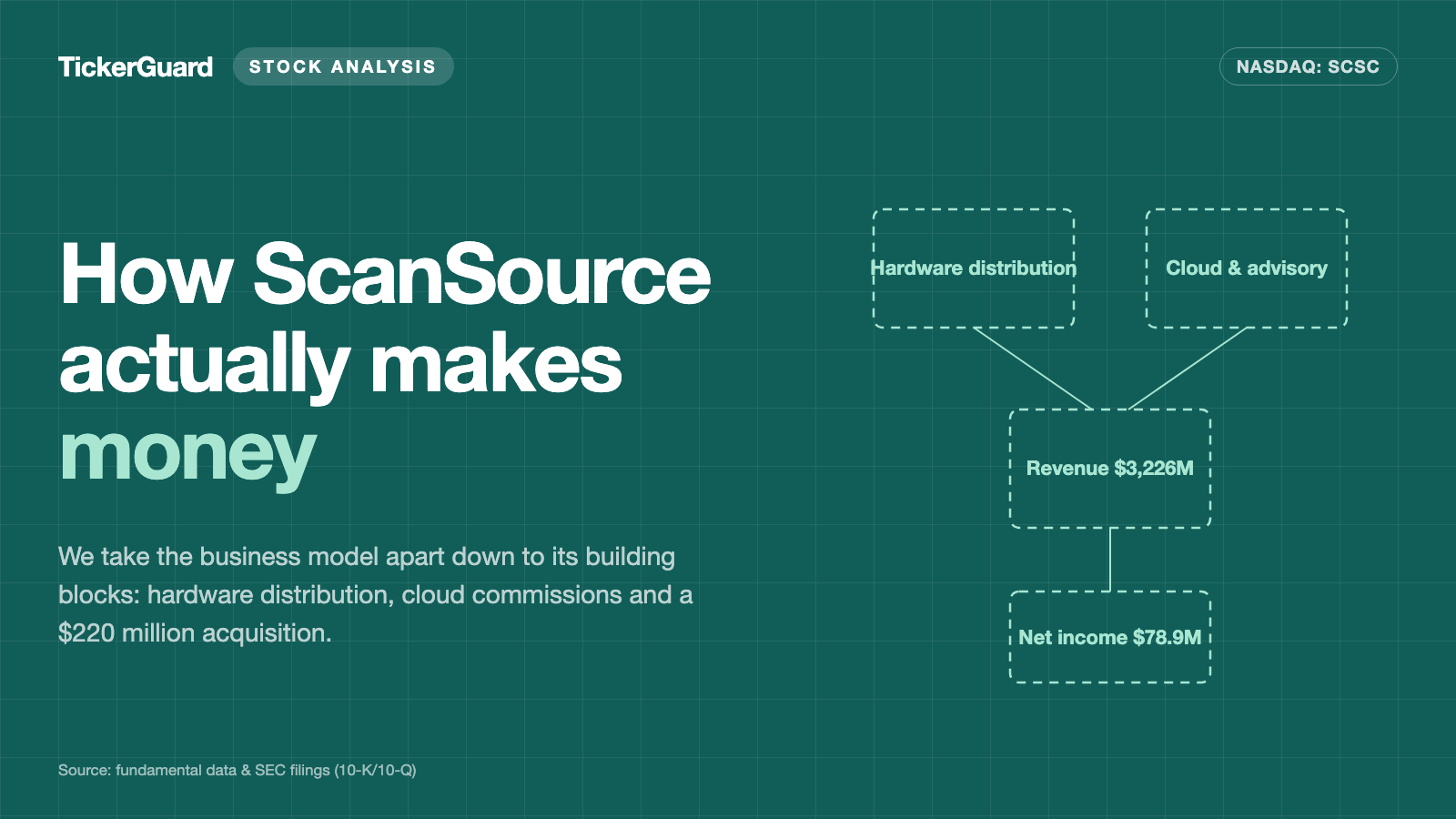
Chart
Interactive price chart (TradingView).
52-week range: 34.30 $ to 62.20 $ · Last price: 61.70 $ (As of: October 2, 2026)
Note: pure fact-based analysis, not investment advice and not a solicitation to buy or sell. All figures without guarantee.
There's an investor weakness that hits especially disciplined investors — because it feels like rigor: the snapshot trap. It works like this: a company posts a disappointing quarter, cuts guidance, the stock falls below book value — and you form a picture. A reasoned, data-backed picture. The problem isn't the picture itself; it's that you never update it. A quarterly report is a snapshot, not a movie — and whoever keeps only the February snapshot misses what happened on the same set by August.
ScanSource, Inc. (NASDAQ: SCSC) offers an unusually clean example, because both snapshots are on the public record. On February 5, 2026, management cut its full-year guidance after large deals "broke into smaller pieces" and slipped into the next quarter; one analyst on the call dryly noted the stock was now trading below book value. Six months later, on August 20, 2026, the same company reported full-year revenue above its cut guidance, free cash flow well above both promises it had made along the way — and, on the same day, the largest acquisition in its history, worth $220.5 million. The stock jumped 9.7% that day. So here's the deal: we'll read three earnings calls and two annual reports that sit between those two dates — and along the way work out how much of the profit jump is real growth and how much is buybacks. What you do with it is your call.
What ScanSource actually does — not a manufacturer, a wholesaler with a brokerage business on the side
ScanSource was incorporated in South Carolina in 1992, went public in 1994, and is still headquartered in Greenville, South Carolina. The company doesn't manufacture anything itself — it's a technology distributor: it buys hardware and software from roughly 500 vendors, bundles it into ready-to-deploy solutions, and resells it through roughly 25,000 channel sales partners — small and midsize IT solution providers that don't want, or can't sustain, a direct purchasing relationship with every individual vendor. Picture it this way: if Cisco, Zebra Technologies or Honeywell are the manufacturers, ScanSource is the wholesaler in between that handles inventory, financing, technical support and bundling so the local IT reseller doesn't have to juggle 500 separate supply contracts.
The business runs through two segments that work very differently. Specialty Technology Solutions is the classic hardware business: barcode and mobility solutions, point-of-sale systems, payment terminals, physical security (video surveillance, access control), communications equipment and networking gear — the last category explicitly including "artificial intelligence ('AI') infrastructure products," as the annual report puts it. The segment generated roughly $3.12 billion in revenue in fiscal 2026, nearly 97% of the company — but margins are thin, because hardware distribution is a volume business.
The second segment, Intelisys & Advisory, is structurally the opposite: it brokers cloud, security, communications and "Managed AI" services for a commission, without delivering the underlying services itself. Revenue is reported "netted down" as a result — only the commission counts, not the full contract value of the cloud deals it brokers. At just $101.1 million in fiscal 2026 revenue, the segment is tiny next to the hardware business — but its operating margin runs around 40%, versus low single digits for the hardware segment. Keep this picture in mind: ScanSource is 97% a low-margin hardware wholesaler and 3% a high-margin brokerage business — and the company's growth story hinges on how fast that mix shifts. That tension runs through the rest of this analysis.
One detail worth flagging up front: the annual report names two suppliers without hedging — "Products from two suppliers, Cisco and Zebra, each constituted more than 10% of our net sales for the fiscal year ended June 30, 2026." If you want to know more about one of those two names, we covered Zebra Technologies itself in a separate deep dive — a supplier ScanSource visibly depends on too.
Company history for investors
-
1994
IPO on the Nasdaq
ScanSource, incorporated in South Carolina two years earlier, goes public. The starting point of what is now a three-decade distribution story for investors.
-
2025
August: first fiscal 2026 guidance
Alongside the fiscal 2025 annual report, management issues its first FY26 guidance (revenue $3.1-3.3B) — the benchmark the entire year is later measured against.
-
2026
February 5: guidance cut
Slipping large deals force management to cut revenue and EBITDA guidance; an analyst notes the stock is trading below book value. The low point of the story for investors.
-
2026
May 7: free-cash-flow target raised
After a strong third quarter, ScanSource raises its FCF target to at least $90 million and reaffirms the February-cut revenue and EBITDA range — the turn becomes visible.
-
2026
August 19: MicroAge purchase agreement signed
ScanSource agrees to the largest acquisition in its history, worth $220.5 million — one day before releasing annual results that beat the cut guidance.
-
2026
August 20: annual results beat cut guidance
Revenue, EBITDA and free cash flow all land above the February-cut range; the stock jumps 9.7% the same day. The provisional close of this story for investors.
How the stock landed on our desk — an annual report and an acquisition on the same day
The trigger is impossible to miss: on August 20, 2026, ScanSource filed three things with the SEC at once — its Form 10-K for the fiscal year ended June 30, 2026, a current report (Form 8-K, Item 2.02) with fourth-quarter results, and, in the same 8-K under Item 1.01, the purchase agreement for MicroAge. An annual report and a $220-million strategic move on the same day is an unusual amount of news for a company this size.

MicroAge is an IT solutions integrator and managed services provider with roughly 2,400 clients and more than 200 employees, focused on cloud, data center, cybersecurity, IT operations and help desk services. The purchase price: $220.5 million in cash at closing, plus $3 million and $6.8 million held in escrow for post-closing purchase-price adjustments and indemnification claims, respectively. Closing is expected in the quarter ending September 30, 2026, subject to antitrust clearance under the Hart-Scott-Rodino Act and other customary conditions. CEO Mike Baur put it this way in the results release: "We're also excited about our agreement to acquire MicroAge, which we believe will accelerate growth, expand margins, and adds new services capabilities."
Important context: the fiscal 2027 outlook issued the same day (6 to 10% revenue growth, $158-165 million adjusted EBITDA, at least $85 million free cash flow) does not yet include MicroAge — it describes the existing business, not the combined one. How well MicroAge integrates will only show up in future reports.
What management promised — and what happened
The real reason this stock is worth a close look isn't the acquisition day itself, but what three earnings calls before it reveal. ScanSource keeps its quarterly analyst calls on the public record, and reading them back to back tells a story with a genuine turning point.
In August 2025, alongside its fiscal 2025 annual report, management issued its first guidance for the new fiscal year 2026. On November 6, 2025, on the first-quarter call, CFO Steve Jones reaffirmed it unchanged: revenue growth to $3.1 to $3.3 billion, adjusted EBITDA of $150 to $160 million, free cash flow of at least $80 million. Confidence was still intact.
Then came February 5, 2026, the second-quarter call — and the tone audibly shifted. Revenue and gross profit had grown in both segments, but slower than expected, and unexpected costs (freight, mix, a customer-specific bad-debt reserve) had squeezed margins. CEO Baur explained the core of the problem this way:
"We saw large deals get broken up into smaller pieces. And so as they're rolling out, they're not happening normally, and we saw this even last quarter. […] Implicit in our adjusted guidance is that we do need the large deals to resume, and we believe that, that will happen."
— Michael Baur, Chairman & CEO, ScanSource, Inc., second-quarter fiscal 2026 earnings call, February 5, 2026
Management then cut full-year guidance: revenue from $3.1-3.3 billion to $3.0 to $3.1 billion, adjusted EBITDA from $150-160 million to $140 to $150 million. Only the free-cash-flow target — at least $80 million — held. How sour sentiment had turned by that point shows in an aside from Raymond James analyst Adam Tindle on the same call: the stock, he noted, was now trading "below book value." For a company with positive operating cash flow and no balance-sheet problems, that's a clear signal of how skeptical the market had become.
On May 7, 2026, on the third-quarter call, the turn arrived. Revenue grew 9% in the quarter, led by networking and security. CFO Jones summed it up plainly: "When we look at our full year outlook that we gave last quarter, we said that we would need some large deals coming in, and we had growth projected for the second half. Q3 delivered on that." Management reaffirmed the February-cut revenue and EBITDA range and raised its free-cash-flow target to at least $90 million. Asked the obvious follow-up — whether some of the strong quarter had simply been pulled forward from Q4 — Jones answered: "We don't believe that we saw material pull forwards in our Q3 results."
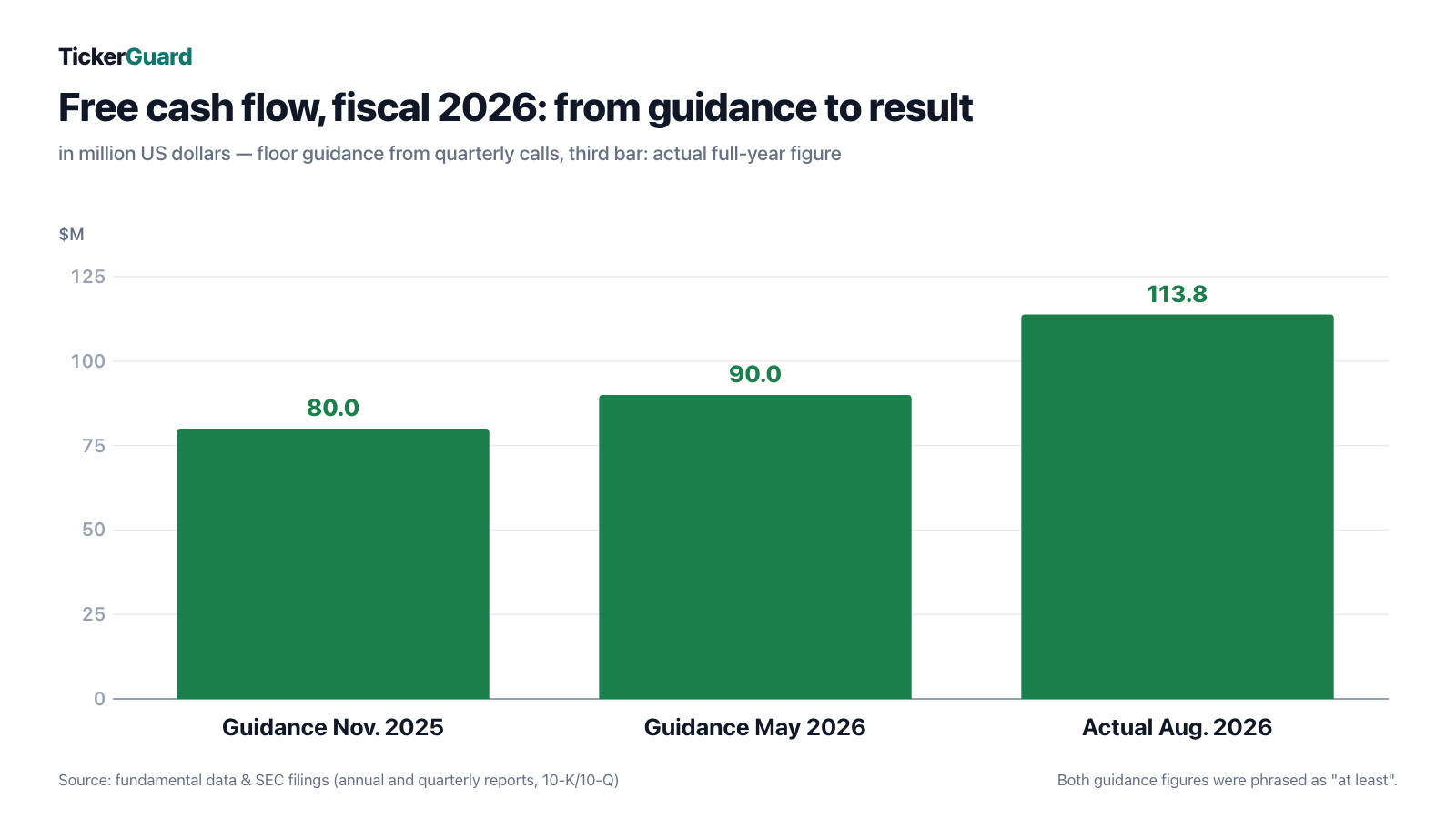
Then, on August 20, 2026, the provisional end of the story: actual full-year revenue of $3,226.1 million landed above the February-cut range and just above the midpoint of the original August 2025 range ($3.2 billion). Adjusted EBITDA of $151.5 million beat the cut range and landed almost at the low end of the original one. The sharpest contrast was in free cash flow: $113.8 million — well above both the initial $80 million floor and the $90 million floor raised in May. The chart below traces that path from first guidance to actual result:
One caveat, in fairness: a full transcript of the August 20, 2026 earnings call was not yet available at the time of this analysis — the figures and CEO quote above come from the same-day, SEC-mandated results release, which matches the call's content but contains no analyst Q&A. Still, what the three fully reviewed calls and this release show is clear: guidance was rightly cut in February 2026 — and comfortably cleared again by August 2026.
The numbers over the years — a recovery, not a record
Looking only at the fourth quarter — revenue up 17.3%, GAAP earnings per share up 40.9% — you could get the impression ScanSource is on an uninterrupted growth path. The five-year series tells a more sober story:
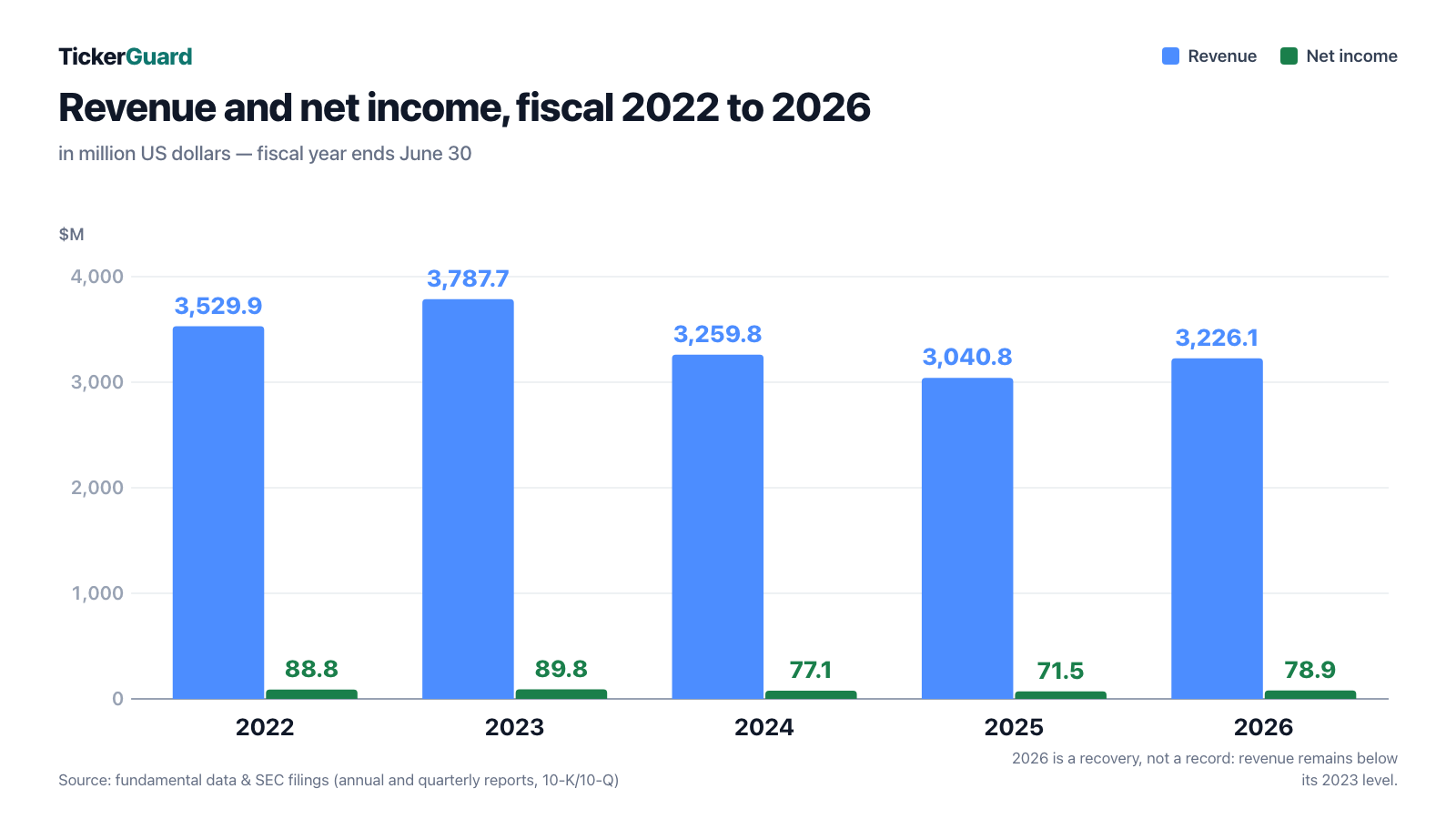
Revenue was $3,787.7 million in 2023, fell for two straight years — to $3,259.8 million (2024) and $3,040.8 million (2025) — and recovered to $3,226.1 million in 2026. That's a solid comeback, but a comeback: the company remains roughly 15% below its 2023 revenue. Net income traces the same curve on a smaller scale: $89.8 million (2023), $77.1 million (2024), $71.5 million (2025), $78.9 million (2026). Anyone extrapolating the latest quarter's pop across the full year overstates the momentum — the year-over-year check shows a recovery from a two-year decline, not a new growth phase.
What actually shifted in this series is the mix, not just the volume: gross margin rose from 13.4% (2025) to 13.6% (2026) because the share of recurring, commission-based revenue in gross profit grew from 32.8% to 33.7%. The higher-margin Intelisys & Advisory segment is growing relative to the hardware business — slowly, but visibly. And that is exactly where the first uncomfortable truth begins: part of 2026's much-discussed profit jump has nothing to do with that operating progress at all.
Uncomfortable truth #1: earnings per share grew twice as fast as earnings
This analysis just cited two numbers that look like they should move together — and don't. GAAP net income rose 10.2% in fiscal 2026 to $78.873 million. Diluted earnings per share rose 21.3% in the same year, to $3.64. Twice as fast — on essentially the same underlying business. How?
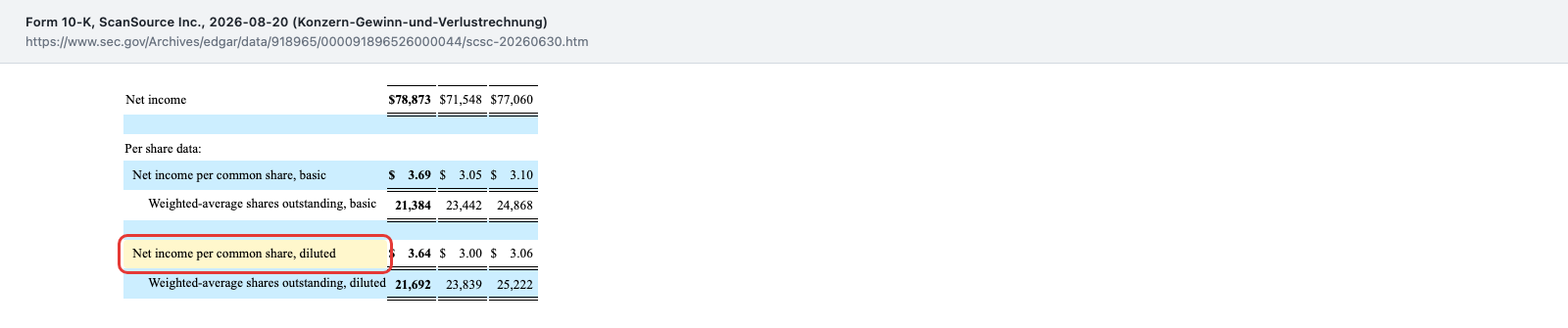
The answer sits one line below: diluted weighted-average shares fell from 23.839 million (2025) to 21.692 million (2026) — a 9.0% drop in a single year. Over two years, against 25.222 million in fiscal 2024, that's a 14.0% decline. The reason is no secret: ScanSource repurchased $97.9 million of its own stock in fiscal 2026, after $106.5 million the year before — more than $200 million over two years spent pulling its own shares out of the market.
The math checks out almost exactly: earnings up 10.2%, spread across 9.0% fewer shares, mechanically produces roughly 21% higher EPS — nearly identical to the reported 21.3%. This is not an accounting trick — buybacks are a legal, widely used form of returning capital, and ScanSource funded them from operating cash, not new debt. But it's a distinction worth knowing before reading "EPS grew by more than a fifth" as "the business grew by more than a fifth." The more honest number for operating progress is the line above the share count: up 10.2% — solid, but noticeably less dramatic than the headline suggests.
For completeness: the smaller, classic one-time items on the balance sheet — restructuring costs, a legal settlement, lingering effects of the 2023 cyberattack — ran in the low single-digit millions in fiscal 2026 and, on balance, were a slight drag rather than a boost to adjusted earnings. They don't explain the earnings jump; the buyback effect does.
Uncomfortable truth #2: the largest segment's goodwill has only 2 percent of cushion left
This number appears in no press release and wasn't mentioned on the earnings call — it's buried in the annual report's notes to the financial statements, under goodwill. A quick detour for context: when ScanSource has acquired companies in the past, a residual amount was regularly left over that couldn't be assigned to specific machines, contracts or inventory — that residual is carried on the balance sheet as goodwill and must be tested for impairment every year. If a segment's estimated fair value falls below its carrying value, the company must write it down — a direct hit to earnings.
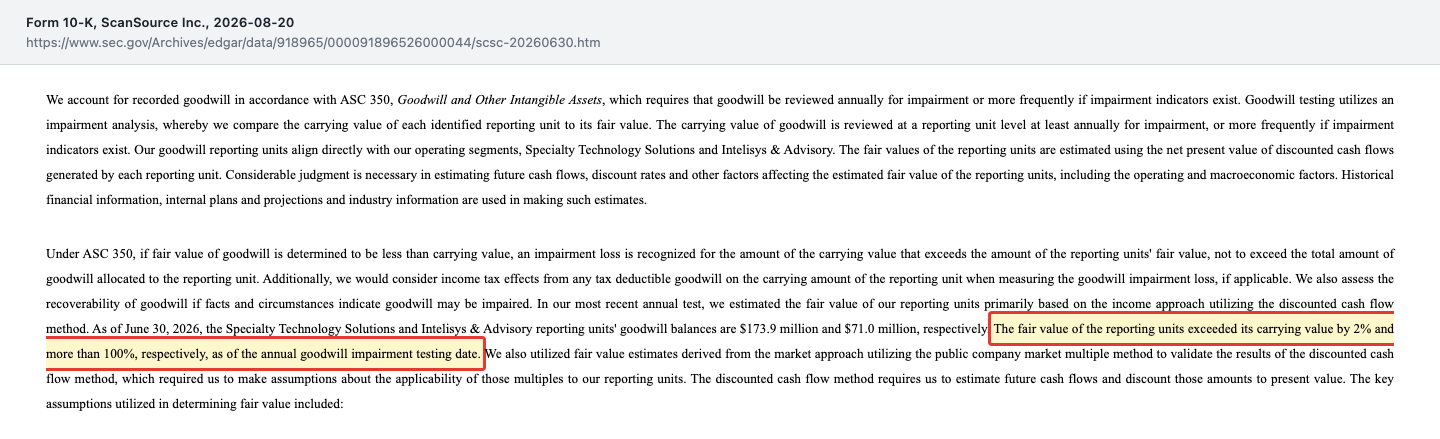
At ScanSource, the latest test shows a split picture. In the small, high-margin Intelisys & Advisory segment ($71.0 million of goodwill), estimated fair value exceeded carrying value by more than 100% — a thick, reassuring cushion. In the large hardware segment, Specialty Technology Solutions, which carries $173.9 million — more than 70% of the company's total goodwill of $244.9 million — that same cushion was just 2%. The auditor flagged exactly this point as a "critical audit matter" — a label reserved, in the auditor's own words, for matters that "involved our especially challenging, subjective, or complex judgments."
To be fair and precise: no impairment has occurred in fiscal 2026 or either of the two prior years, and a 2% cushion doesn't mean a write-down is imminent. Fair value is estimated using a model of future cash flows built on assumptions about growth, margin and the discount rate — assumptions that shift modestly from year to year without anything changing in the underlying business. Still, the cushion is remarkably thin for a segment that accounts for 97% of company revenue. Should Specialty Technology Solutions growth fall short of the 6-to-10% range guided for fiscal 2027, or should the discount rate rise with higher interest rates, an impairment at the next annual test — scheduled for fiscal Q4 2027 — stops being a purely theoretical scenario.
Uncomfortable truth #3: the high-margin segment is growing slower than management wants it to
The third uncomfortable truth isn't a single number — it's a question-and-answer exchange, and that's exactly why it deserves attention: management tends to speak less guardedly in the moment than in prepared remarks. On the third-quarter call, on May 7, 2026, analyst Keith Housum of Northcoast Research pressed CEO Baur on whether Intelisys new orders had grown at all year over year — picking up on a concern analyst Gregory Burns of Sidoti & Company had already raised earlier in the same call, about whether roughly eighteen months of investment in Intelisys & Advisory had produced the hoped-for acceleration:
"I assume that order growth didn't grow for the quarter year over year?" — "No, we didn't say that. Our belief is that we are doing everything we've said we're going to do, but we want to go faster. We don't believe it's growing at the rate we would like to see."
— Keith Housum (Northcoast Research) and Michael Baur, Chairman & CEO, ScanSource, Inc., third-quarter fiscal 2026 earnings call, May 7, 2026
That's a rare, plainly stated admission: the company's highest-margin segment — roughly 40% adjusted EBITDA margin versus low single digits for hardware — isn't delivering new orders as fast as management itself wants, despite roughly eighteen months of targeted investment (including a new sales team under Ken Mills, hired in 2024). In response, ScanSource used the same call to announce a new "Converged Communications" unit under Katherine White, aimed at putting the traditional communications hardware business and Intelisys cloud brokerage under one combined sales team for the first time.
That reorganization is a reasonable response — but it is a response to a goal already missed more than once, and its effect can only be assessed in future quarters. For investors, the takeaway is this: the high-margin growth story that part of this stock's valuation rests on is, as of this analysis, a delayed promise, not a proven result.
What the stock costs
Every figure below carries the data date August 20, 2026 and should be read as an order of magnitude, not a daily price. The closing price that day was $56.39 — up 9.7% from the prior close of $51.42, driven by the same-day release of annual results and the MicroAge deal. The 52-week range ran from $33.76 to $66.78 — closer to the top than the bottom, but well below the year's high.
With 20,142,812 shares outstanding (10-K cover page, as of August 17, 2026), that puts market capitalization at roughly $1.136 billion. The price-to-earnings ratio on GAAP diluted EPS ($3.64) is roughly 15.5; on the company's preferred non-GAAP EPS ($4.24) it's roughly 13.3. The gap comes mainly from stripping out amortization of acquired intangibles — a common, but not consequence-free, adjustment.
More telling for a company carrying its own debt is enterprise value (market cap plus debt minus cash): roughly $1.136 billion plus $101.4 million of debt minus $88.4 million of cash, or about $1.149 billion. Against fiscal 2026 adjusted EBITDA of $151.5 million, that's an enterprise-value-to-EBITDA multiple of roughly 7.6 — not an especially expensive level for a low-margin but growing, lightly indebted technology distributor, but not one that simply ignores an open question like the thin goodwill cushion in the largest segment either.
Opportunities and risks at a glance
What speaks for ScanSource:
- Guidance was met and beaten by year-end. After the February 2026 cut, actual revenue ($3,226.1M), adjusted EBITDA ($151.5M) and especially free cash flow ($113.8M) all landed above the cut range and both prior floor promises of $80M and $90M.
- A solid, lightly indebted balance sheet. $910.8 million of equity against just $101.4 million of debt and $88.4 million of cash (June 30, 2026); the company is funding buybacks and the MicroAge down payment from its own cash generation, without visible strain.
- The higher-margin part of the business is growing relative to hardware distribution. The share of recurring revenue in gross profit rose to 33.7% in fiscal 2026 (from 32.8%); Q4 grew 17.3%, the fastest in years.
- MicroAge adds higher-margin services — cloud, data center, cybersecurity — for $220.5 million cash, fundable without visible balance-sheet stress.
- Consistent capital return. $97.9 million of buybacks in fiscal 2026, more than $200 million over two years — the diluted share count fell 14.0%.
What speaks against it:
- A 2% goodwill cushion in the largest segment. Specialty Technology Solutions carries $173.9 million of goodwill with only a 2% fair-value cushion — flagged by the auditor as a critical audit matter.
- Roughly half of EPS growth is a buyback effect, not operating growth. Net income rose 10.2%; EPS rose 21.3% — about 11 of those 21.3 percentage points are mechanically explained by the 9.0% decline in share count.
- The high-margin segment is delivering slower than promised. Management itself admitted in May 2026 that Intelisys new-order growth wasn't accelerating as hoped; the response — a new sales unit — is still unproven.
- Revenue remains roughly 15% below its 2023 level — fiscal 2026 is a recovery from a two-year decline, not a new growth cycle.
- MicroAge hasn't closed yet and isn't in the fiscal 2027 outlook. Closing is subject to antitrust clearance; integration costs and risks are unquantified as of this analysis.
- Supplier concentration. Cisco and Zebra Technologies each accounted for more than 10% of net sales in fiscal 2026 — losing either relationship would be a real hit.
A human verdict
Back to the snapshot trap from the opening. Anyone who stopped paying attention in February 2026 — guidance cut, stock below book value, audible analyst skepticism on the call — would have had a plausible, well-reasoned picture. And they would still have been wrong, because the August 2026 snapshot shows a company that cleared its own, already-lowered bar by year-end while simultaneously announcing the largest acquisition in its history. Both photos are true. Neither is the whole picture.
That's exactly why it pays to look past the headline, whichever direction it points. The 21.3% per-share earnings jump is real — but roughly half of it comes from fewer shares, not more profit. The 2% goodwill cushion in the largest segment is real — but it hasn't triggered a write-down yet, only a watch item for next year. The unmet promise at Intelisys is real — but it's an execution risk, not an existential one, for a company with $910.8 million of equity and $88.4 million of cash.
What's left is a distributor with thin hardware margins and a growing, high-margin side business that's supposed to grow faster than it has so far — and a management team that publicly corrected its own guidance and publicly cleared it again. Whether that's a sign of the kind of honesty that earns trust, or a pattern that could repeat at the next stumble, is for you to decide. The question this analysis leaves you with isn't "Is ScanSource a buy?" but: Do you trust a management team that had to cut guidance once to hit it the next time — even with a $220 million integration underway at the same time? What you do with that is your decision. And that's exactly how it should be.
If you want to see how another company handles buybacks when they tip into excess, our Papa John's deep dive is the counterexample: there, $1.1 billion of buybacks pushed shareholders' equity into negative territory. At ScanSource, there's no sign of that — the buybacks here are a footnote on the balance sheet, not a structural problem.
Sources
- Form 10-K for fiscal year 2026, ScanSource, Inc., filed August 20, 2026 (SEC EDGAR, CIK 0000918965)
- Form 8-K filed August 20, 2026 — Item 1.01 (MicroAge purchase agreement) and Item 2.02 with Q4/FY2026 results release
- Form 8-K filed August 17, 2026, Item 5.02 — retirement of director Peter C. Browning
- Form 8-K filed May 29, 2026, Item 5.02 — elimination of the CIO role held by Rachel Hayden
- Form 10-Q for the quarter ended March 31, 2026, filed May 7, 2026
- Form 10-Q for the quarter ended December 31, 2025, filed February 5, 2026
- Form 10-Q for the quarter ended September 30, 2025, filed November 6, 2025
- Form 10-K for fiscal year 2025, filed August 21, 2025
- Earnings call transcripts: first- (2025-11-06), second- (2026-02-05) and third-quarter (2026-05-07) fiscal 2026 calls, official transcripts via ScanSource, Inc.'s investor relations site.
- Full SEC filing history for ScanSource, Inc.: EDGAR overview (sec.gov)
- Fundamental data (market capitalization, valuation multiples, price history; as of August 20, 2026), reconciled against the SEC filings.
Transparency & disclaimer: This article is a journalistic review of publicly available information and is not investment advice, not a regulated financial analysis, and not a solicitation to buy or sell any security. Equity investments carry substantial risk, including total loss of capital. All figures are drawn from the source documents linked above and carry the date noted in the text; accuracy and completeness are not guaranteed. Positions held by the operator are disclosed daily; where one exists, it appears as a notice at the top of this deep dive.
Key figures at a glance
All monetary figures in millions of $; earnings per share as reported.
| Metric | 2022 | 2023 | 2024 | 2025 | 2026 |
|---|---|---|---|---|---|
| Revenue | 3,529.9 | 3,787.7 | 3,259.8 | 3,040.8 | 3,226.1 |
| Operating Income (EBIT) | 122.2 | 135.9 | 90.3 | 85.2 | 98.6 |
| Net Income | 88.8 | 89.8 | 77.1 | 71.5 | 78.9 |
| Net Margin | 2.5% | 2.4% | 2.4% | 2.4% | 2.4% |
| Earnings Per Share | 3.45 $ | 3.54 $ | 3.06 $ | 3.00 $ | 3.64 $ |
Source: fundamental data & SEC filings (annual and quarterly reports, 10-K/10-Q)
Our Bottom Line at a Glance
- Guidance discipline positive
- February 2026's cut guidance was beaten on August 20, 2026 for revenue ($3,226.1M vs. $3,000-3,100M) and adjusted EBITDA ($151.5M vs. $140-150M), and clearly exceeded for free cash flow ($113.8M vs. promised at least $80M and later $90M).
- Earnings quality neutral
- Net income rose 10.2% in fiscal 2026, EPS rose 21.3% — the gap comes almost entirely from a 9.0% decline in share count (buybacks of $97.9M), not additional operating profit.
- Goodwill balance-sheet risk negative
- In the largest segment (Specialty Technology Solutions, $173.9M goodwill), the fair-value cushion was just 2% at the latest impairment test — flagged by the auditor as a critical audit matter. No impairment yet, but little reserve.
- Intelisys & Advisory growth mix negative
- The high-margin commission business (roughly 40% EBITDA margin) is growing slower than management wants, by its own admission in May 2026; the countermeasure (a new sales unit) remains unproven.
- Balance sheet & funding capacity positive
- Equity of $910.8M against just roughly $101.4M of debt and $88.4M of cash (June 30, 2026); the MicroAge acquisition ($220.5M cash) and ongoing buybacks appear fundable from internal resources.
- Concentration risk neutral
- Cisco and Zebra Technologies each accounted for more than 10% of net sales in fiscal 2026 per the 10-K — normal for a technology distributor, but a real dependency on two supplier relationships.
ScanSource cut its full-year guidance in February 2026 as large deals slipped, then clearly beat it on August 20, 2026 — revenue of $3,226.1 million, adjusted EBITDA of $151.5 million and, above all, free cash flow of $113.8 million against promised floors of $80 million and $90 million. On the same day, the company agreed to acquire MicroAge for $220.5 million, the largest deal in its history. Roughly half of the EPS growth comes from buybacks, not additional operating profit, and in the largest segment, fair value covers $173.9 million of goodwill by just 2%. Not investment advice.
What Our Rating Means
Open questions
The business works in principle, but one material question is open. As long as it stays open, our findings do not carry a quality verdict.
We rate the underlying business quality Yellow — not because of the balance sheet, which is healthy with $910.8 million of equity against just roughly $101.4 million of debt, but because of two open operating questions. First: in the segment carrying 97% of revenue, estimated fair value covers $173.9 million of goodwill by just 2% at the latest annual test — the auditor itself names it a critical audit matter. Second: the highest-margin segment, Intelisys & Advisory, is not yet delivering the promised acceleration in new orders, by management's own admission — the countermeasure is fresh and unproven. In fairness: management demonstrably cleared its own, February 2026-cut guidance within six months, which speaks to reporting discipline, and the MicroAge acquisition looks well-fundable on the balance sheet. Whether and how quickly the thin goodwill cushion and the Intelisys promise resolve will only show up in coming quarterly reports. The decision is yours.
A journalistic assessment by our editorial team at the time of the deep dive, based on public sources — not investment advice and not a solicitation to buy or sell. Your personal circumstances (investment goals, risk capacity, taxes) cannot be taken into account. What our levels mean, how verdicts are formed, and what conflicts of interest exist →
Worth Noting
- The trigger for this analysis was the fiscal 2026 annual report (Form 10-K) filed 2026-08-20, released the same day as the MicroAge acquisition — not a hit in our in-house stock scanner.
- Data date: fiscal 2026 Form 10-K (filed 2026-08-20) fully reviewed; all filings from the prior 10-Q through the 10-K and afterward (including SCHEDULE 13G/A, SCHEDULE 13G, Form 4) reviewed with no change to the picture; fundamental data and prices as of 2026-08-20.
- A full transcript of the August 20, 2026 earnings call was not yet available at research time; the same-day, SEC-mandated results release was used instead, which matches the call's content.
- The fiscal 2027 outlook (6-10% revenue growth, $158-165M adjusted EBITDA) does not yet include the MicroAge acquisition — it will likely be revised after closing, expected in the quarter ending September 30, 2026.
Stock Watch
This analysis is as of August 26, 2026. Stock Watch will tell you what's changed at SCSC since then.
Later $1 a month per stock — signing up is free, and you'll be the first to know when it launches.
The full analysis as a PDF for later
We will send you this analysis as a PDF — to print, file away, and read at your own pace. And we will add you to the free Stock Watch list for ScanSource Inc (SCSC), so you hear about it when something material in this analysis changes.
Frequently Asked Questions
ScanSource, Inc. (NASDAQ: SCSC) is a technology distributor headquartered in Greenville, South Carolina. It buys hardware and software from roughly 500 vendors and resells it through roughly 25,000 channel sales partners. The Specialty Technology Solutions segment (barcode/mobility, POS, payment terminals, physical security, networking, communications) generated roughly $3.12 billion in revenue in fiscal 2026. The smaller Intelisys & Advisory segment brokers cloud, security and "Managed AI" services for a commission ($101.1 million revenue in fiscal 2026), but runs at much higher margins.
On February 5, 2026, management cut full-year fiscal 2026 guidance because large deals were "breaking into smaller pieces" and slipping into later quarters — revenue guidance fell from $3.1-3.3 billion to $3.0-3.1 billion, adjusted EBITDA from $150-160 million to $140-150 million. On August 20, 2026, ScanSource reported $3,226.1 million in full-year revenue and $151.5 million in adjusted EBITDA — both above the cut range — plus $113.8 million in free cash flow, well above the previously promised floors of $80 million and, later, $90 million.
GAAP net income rose 10.2% in fiscal 2026 to $78.873 million, but diluted earnings per share rose 21.3% to $3.64. The reason: the diluted share count fell 9.0% in the same year (14.0% over two years) because ScanSource repurchased $97.9 million of its own stock in fiscal 2026. That buyback effect mathematically accounts for nearly the entire gap between earnings growth and EPS growth.
On August 19, 2026, ScanSource agreed to acquire MicroAge, an IT solutions integrator with roughly 2,400 clients and more than 200 employees (cloud, data center, cybersecurity, IT operations, help desk), for $220.5 million in cash — the largest acquisition in company history. Closing is expected in the quarter ending September 30, 2026, subject to antitrust clearance. The fiscal 2027 outlook issued the same day does not yet include MicroAge.
In the fiscal 2026 annual report, estimated fair value for the largest segment, Specialty Technology Solutions ($173.9 million of goodwill), exceeded carrying value by just 2% at the latest annual impairment test — flagged by the auditor as a critical audit matter. In the smaller Intelisys & Advisory segment, the same cushion exceeded 100%. No impairment has occurred so far, but the cushion in the main segment is thin.
Only partly. On the third-quarter fiscal 2026 earnings call, CEO Mike Baur admitted, when pressed, that Intelisys new-order growth wasn't accelerating as fast as management wanted, despite roughly eighteen months of targeted investment. In response, ScanSource announced a new "Converged Communications" sales unit — its effect isn't yet visible in the numbers as of this analysis.
As of June 30, 2026, roughly $101.4 million of debt ($2.9 million current, $98.5 million long-term) sat against $88.4 million of cash and $910.8 million of equity. The balance sheet is lightly leveraged; funding the MicroAge acquisition and further buybacks appears manageable on that basis.
As of the August 20, 2026 data date (closing price $56.39), the price-to-earnings ratio was roughly 15.5 on a GAAP basis and roughly 13.3 on the company's preferred non-GAAP basis. Enterprise value equaled roughly 7.6 times adjusted EBITDA — not an especially expensive level for a growing, lightly indebted technology distributor, but not one that ignores the open goodwill question in its largest segment either.
Found an error?
Did you spot a factual error, an outdated number, or a typo in this deep dive? Let us know briefly — your report goes straight to the editorial team.