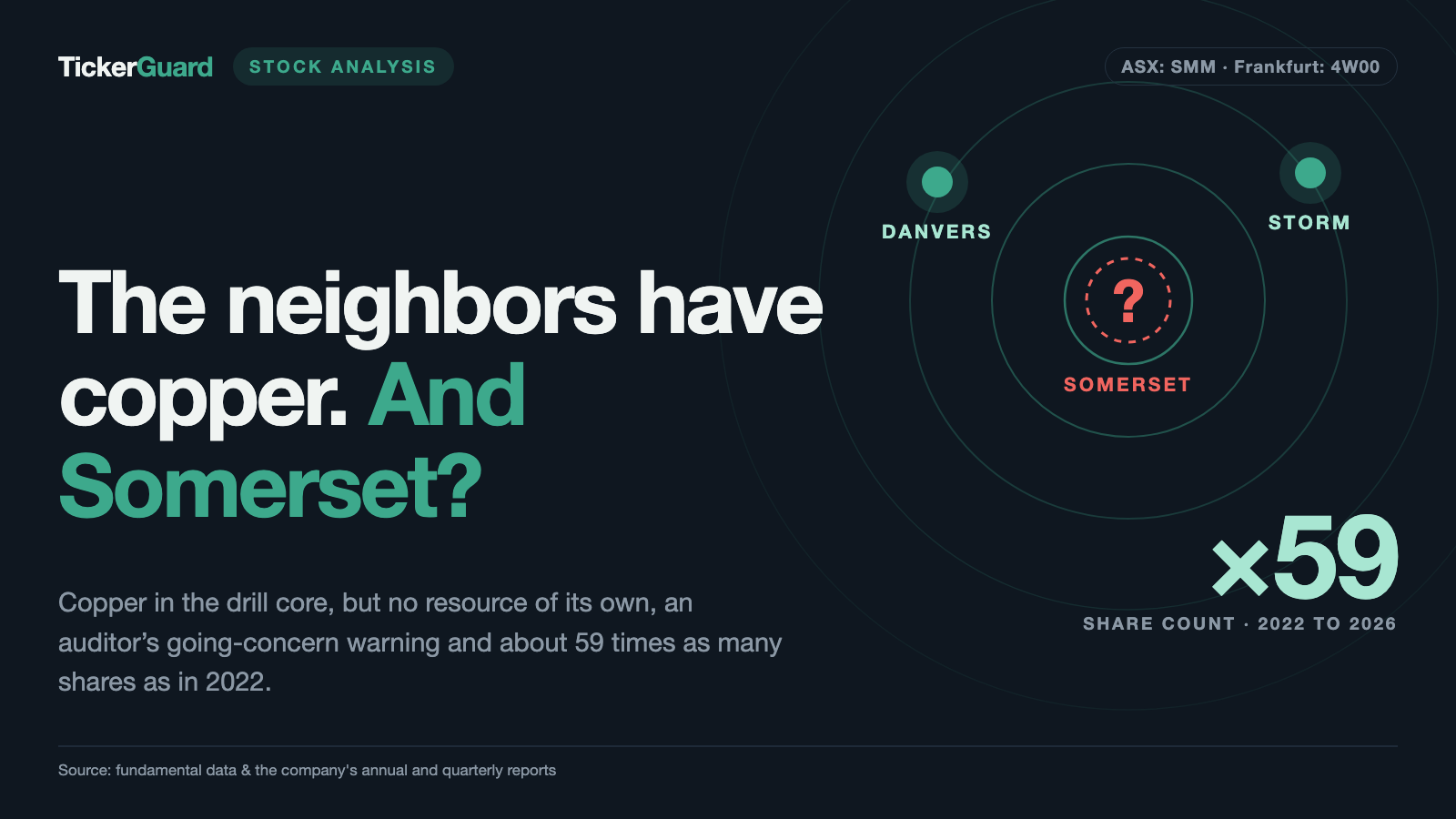
Somerset Minerals: Copper Next to Famous Neighbors — and 59 Times as Many Shares as in 2022
In mining circles, “nearology” is the belief that copper next door must also lie on your own ground. Somerset Minerals (ASX: SMM, Frankfurt: 4W00) is drilling in the Canadian Arctic next to such neighbors and hitting copper, up to 38 meters at 1.27 percent — but there is no resource estimate of its own. Good neighbors are a reason to look — they are not a discovery on your own land.
 Thomas Mücke
Founder & Publisher
Thomas Mücke
Founder & Publisher
Chart
Interactive price chart (TradingView).
Note: pure fact-based analysis, not investment advice and not a solicitation to buy or sell. All figures without guarantee.
There is an investor weakness that mining people mock with a nickname: “nearology,” the science of being nearby. It goes like this: if gold or copper was found next door, it must be on my land too. That feels logical, because rock layers do not stop at property lines. But it is a probability, not a finding. Most plots next to a deposit stay empty.
Somerset Minerals Limited is a textbook case of this weakness, because the company openly plays to it — and warns against it in every report. Almost every release mentions the neighbors: White Cliff Minerals with its Danvers copper deposit, American West Metals with its Storm project. And of all things, the dormant side stage in Ecuador received a non-binding purchase offer in July 2026 worth a little over half of the market value. So let’s make a deal: we set the neighbors aside for a moment and read together what Somerset can show on its own land — in the Annual Report 2026, the cash flow report to June 30, 2026, and the releases through October 5, 2026. In the end, you decide.

What Somerset Minerals actually does
Somerset is an explorer: a company that searches for minerals but does not mine anything yet. Picture a treasure hunter with a very large field and a metal detector — it has beeped several times, but whether there is a chest under the beep or just a few coins, nobody knows yet. The field is huge: according to the annual report, the Coppermine project in the Kitikmeot region of Nunavut, Canada’s Arctic territory, comprises 107 exploration licences and one exclusive exploration right with Nunavut Tunngavik Incorporated, 1,677 square kilometers in total. The second project, Prescott, has 52 licences on 624 square kilometers further north, next to American West Metals’ Storm copper project. Somerset owns both outright.
The main target is copper, often with silver. At Coppermine it sits in steep fault zones in basalt, sometimes as native copper at surface — in June 2026, field crews found a copper nugget of about 2.3 kilograms. But more than 90 percent of the ground lies under a thin layer of glacial cover, so Somerset works with airborne magnetics, soil samples and fast drilling. Two target areas lead the way: Jura, drilled since 2025, and Talisker, an anomaly about 17 kilometers long that was drilled for the first time in July 2026.
There is also a side stage in Ecuador. The subsidiary Condor Gold S.A. holds the Río Zarza and Valle del Inca 1 concessions, where no exploration has taken place for years; they are carried at zero on the balance sheet. Since July 2026, of all things, this side stage may be the most valuable part of the company — more on that below. Somerset has no mining revenue. The money comes from new shares.
Company history for investors
-
2024
Tempus becomes Somerset
A A$18.98m write-down of the Blackdome-Elizabeth gold project, purchase of Prescott in Nunavut, name change effective July 1. For shareholders, the farewell to the old gold dream.
-
2025
Coppermine bought, Jura drilled
Coppermine acquisition, announced on May 5, for 90m shares, part of them going to the company’s own CEO; in July, JURC001 hit 42.7 m at 2.69% copper.
-
2026
Talisker hits, Lundin offer, going-concern note
Capital raisings at A$0.008, first Talisker hits in August, a non-binding offer for the Ecuador subsidiary and an annual report with a going-concern note.
Where the numbers come from: ASX, not SEC
One point up front, because it shapes the evidence: Somerset files no annual report (10-K) and no quarterly report (10-Q) with the U.S. securities regulator, the SEC. It is not required to, like most Australian companies. It reports under Australian law in Australian dollars: an audited annual report to June 30, a half-year report to December 31 and — mandatory for explorers on the ASX — a quarterly activities report with a cash flow statement known as Appendix 5B. Drill results are reported under Australia’s JORC Code and signed off by a named competent person; at Somerset, for results from July 24, 2025, onwards that is geologist Alex Vilela according to the Annual Report 2026; he joined the board on August 31, 2026.
Every figure in this analysis therefore carries “Source: fundamental data & the company’s annual and quarterly reports.” The fiscal year ends on June 30: “fiscal 2026” covers July 2025 to June 2026. We reviewed the Annual Report 2026 of September 30, 2026, the Annual Report 2024 for comparison, the quarterly report to June 30, 2026, and all releases through October 5, 2026. The quarterly report to September 30, 2026, had not been published on that date.
How the stock landed on our desk
To be honest: Somerset is not a hit from our in-house stock scanner, and it cannot be one. The scanner works with revenue, profit, margins and balance-sheet ratios — an explorer without production fails every one of those filters. The stock made our research list through the forum ranking of the German site wallstreet-online, the list of stocks most discussed by German retail investors (as of October 5, 2026), under its Frankfurt symbol 4W00. That is an attention signal, not a quality signal.
4W00 is the same share as SMM in Sydney. Anyone looking to trade it in Germany should know this: in Frankfurt there was turnover on only 8 of 130 trading days since April 1, 2026, and the last price of €0.0005 (October 2, 2026) is more than 90 percent below the converted ASX close of the same day (A$0.010, about €0.006). Such a quote is not a price but a placeholder. Price discovery happens on the ASX.
The numbers over the years — a fair look
Let’s start with what is genuinely impressive — the drill core. At Jura, all twelve holes drilled in 2025 hit copper, the first one 42.7 meters at 2.69 percent from 15.2 meters downhole. At Talisker, the first-ever drill program delivered two thick intercepts in August 2026:
- TARC0008: 38.1 meters at 1.27 percent copper and 7.4 grams of silver per tonne from 41.15 meters, including 19.81 meters at 2.33 percent
- TARC0003: 36.58 meters at 1.62 percent copper and 11.8 grams of silver per tonne from 22.86 meters, including 9.14 meters at 4.39 percent
The release of October 5, 2026, added ten more holes, eight of which hit copper above the reporting cut-off, such as 30.5 meters at 0.71 percent in TARC0010. For an explorer, that is a solid start. The company has also cleaned up: according to the annual report (Note 27), a tax dispute in Ecuador ended in Somerset’s favor at the country’s highest court, the old Blackdome gold mine in British Columbia has been handed off together with its rehabilitation obligations, and the board now has its own geologist in Alex Vilela.
Now the other half of the picture: the money. The chart shows what flowed out for operations and investment (mostly exploration) over the past four fiscal years — counted as operating plus investing cash flow — and what came in through capital raisings.
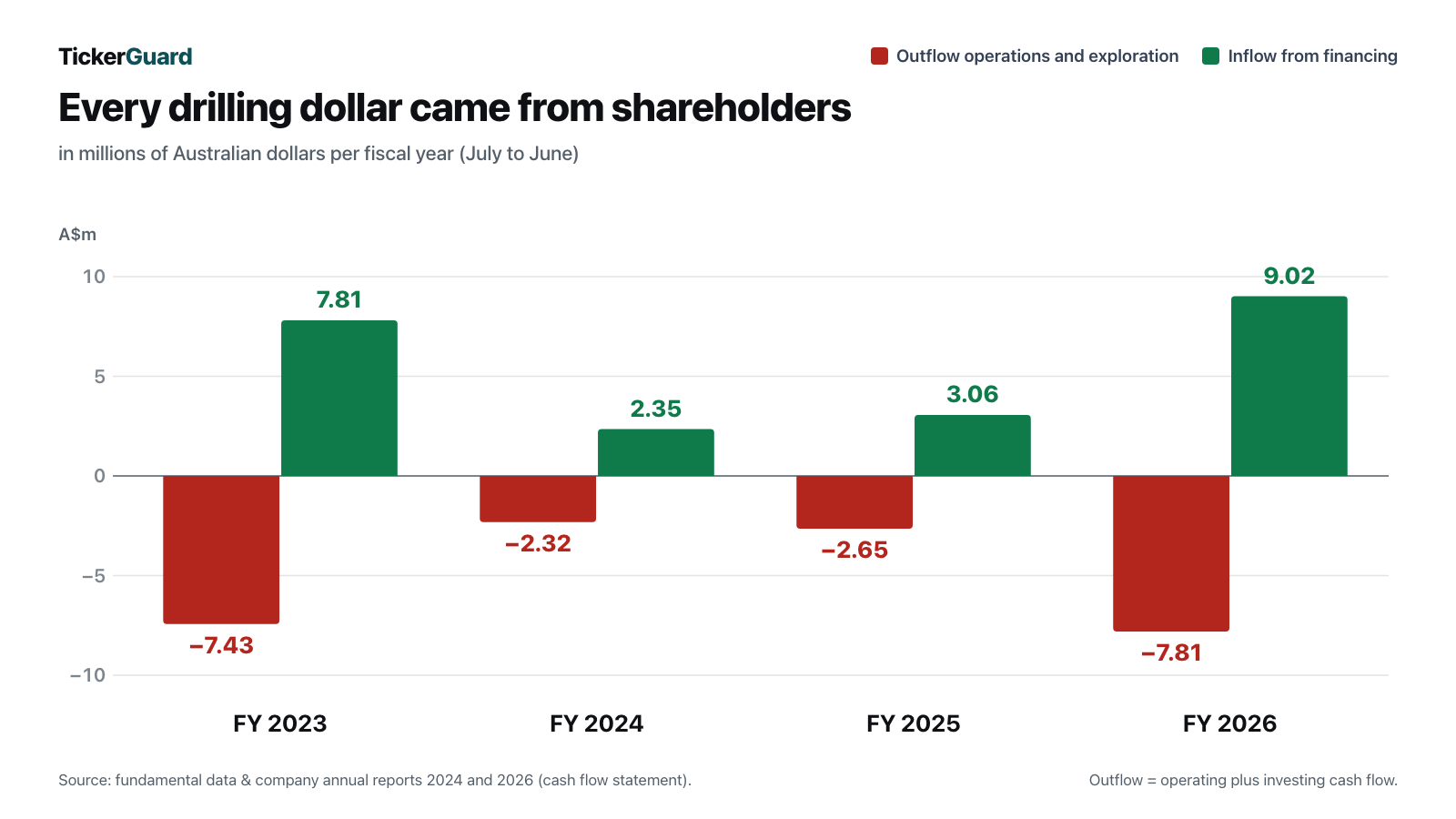
The pattern is clear: Somerset spends what shareholders paid in beforehand, year after year. In fiscal 2026 that was A$1.57 million for running the business and A$6.26 million for exploration, funded by placements raising A$9.73 million gross. That is normal for an explorer — there simply is no other way. But it also means every meter drilled is paid for with new shares. How many there are by now comes next.
What the reports say — the uncomfortable truths
Now come the passages you will not find on the cover of an investor presentation. All of them are from the company’s own documents.
Uncomfortable truth No. 1: The first profit in years is an accounting gain
For fiscal 2026, Somerset reports a profit of A$2.17 million, after a A$1.93 million loss the year before. Anyone who reads only the line “Profit for the year” might think the tide has turned. The reason sits higher up in the income statement: A$4.37 million “Gain on disposal of subsidiaries.”
This is the old Blackdome-Elizabeth gold project in British Columbia. The company — then still called Tempus Resources — spent money on it for years and wrote it down by A$18.98 million as of June 30, 2024. It was sold for a total of C$150,000 in cash: C$100,000 arrived in October 2024, the final C$50,000 (A$50,413) on June 2, 2026. Along with the subsidiary, a A$4.20 million rehabilitation obligation left the balance sheet. The notes explain it themselves:
“The gain arises principally from the derecognition of the asset retirement obligation relating to the project and from the reclassification to profit or loss of cumulative foreign exchange differences previously recognised in the foreign currency translation reserve.”
— Somerset Minerals Ltd, Annual Report 2026, Note 26 (Disposal of subsidiaries)
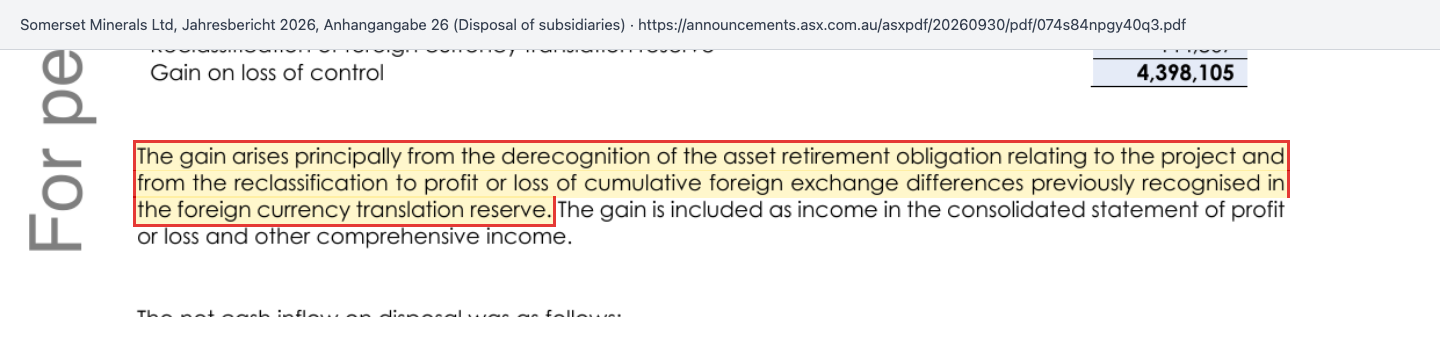
For context: the note shows A$4.40 million for Blackdome itself; after a small loss on deregistering a dormant subsidiary, A$4.37 million remain in the income statement. Without that item, the company would show a loss of A$2.20 million. Two other income items are not cash either: a A$0.68 million “flow-through” premium — an accounting gain from a Canadian tax rule for exploration shares — and A$0.25 million from releasing a tax provision in Ecuador. To be fair: getting rid of the rehabilitation obligation is real relief. It would have cost money one day. But this profit brought hardly any money into the bank: net cash from the sale in fiscal 2026 was A$48,675 (the final installment minus the cash that left with the subsidiary), while operating cash outflow was A$1.57 million.
Uncomfortable truth No. 2: The auditor warns, and the cash report counts 1.72 quarters
If you want to know how long an Australian explorer can hold out, the answer sits in a fixed place: item 8.7 of the cash flow report. For June 30, 2026, it reads: A$3.071 million in cash, no unused finance facilities, A$1.781 million spent in the quarter — a runway of 1.724 quarters. Below two quarters, the ASX requires an explanation of how the company intends to carry on. Somerset points to a placement in June and the entitlement offer in July and says it expects to keep raising capital successfully. Auditor Pitcher Partners puts it more soberly in its report:
“These conditions, along with other matters as set forth in Note 1(o) indicate the existence of a material uncertainty that may cast significant doubt about the Group’s ability to continue as a going concern.”
— Pitcher Partners BA&A Pty Ltd, auditor’s report in the Somerset Minerals Annual Report 2026, section Material Uncertainty Related to Going Concern
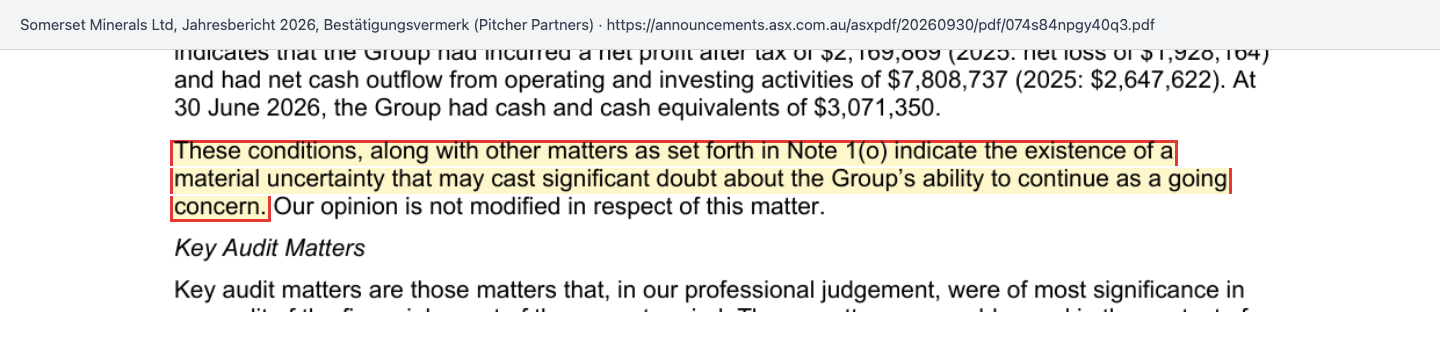
The audit opinion itself is not modified; the note is common for small explorers. It is still meant seriously. Two figures show why: trade payables rose from A$0.82 million to A$2.08 million within a year, and current assets exceeded current liabilities by only A$1.29 million on June 30, 2026. Since then, the entitlement offer has added A$1.17 million gross, and the Talisker drill program ran in July and August. Where cash stood on September 30, 2026, will only show in the next quarterly report; ASX rules require it by October 31, 2026, at the latest.
Uncomfortable truth No. 3: The share count grows faster than any drill hole
Without production, the money comes from new shares. Dilution simply means your slice of the pie gets smaller because more people are eating from the same pie. At Somerset, the table is very crowded by now.
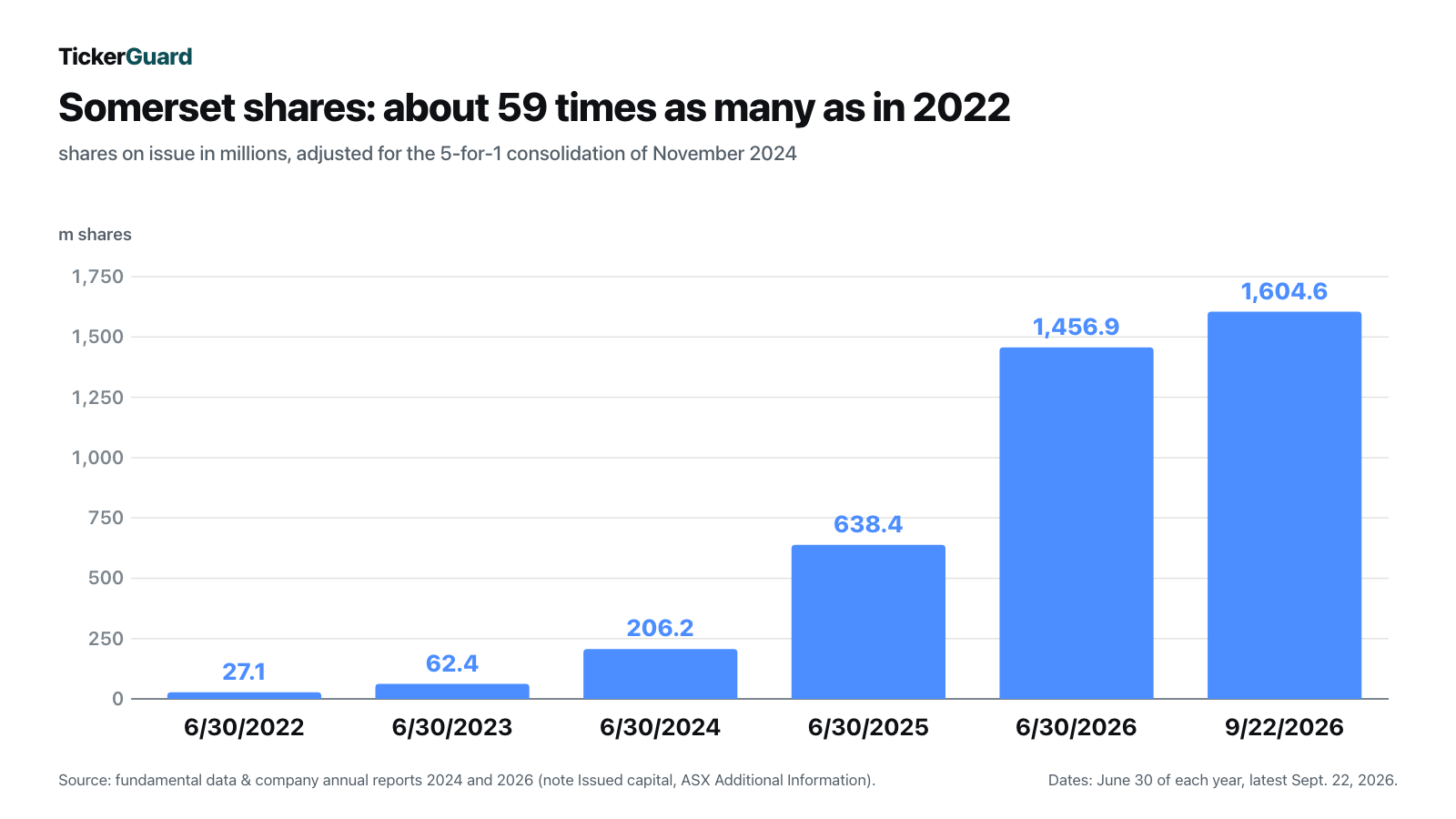
In fiscal 2026 alone, 818.5 million shares were added, among others from placements at A$0.013 (August to October 2025), at A$0.018 and A$0.012 (December 2025) and at A$0.008 (June 2026), plus shares for a claim acquisition, advisory fees and even office rent. After year-end, the entitlement offer added another 145.7 million shares — also at A$0.008. Note who took them up: existing shareholders exercised only 37 percent of their rights. Firm commitments covered the remaining roughly 92 million shares; the lead manager was to allocate them, according to the release possibly also to investors who were not yet shareholders (release of August 12, 2026).
And that is not the end. On September 22, 2026, 510.2 million options were outstanding — with exercise prices between A$0.02 and A$0.05 — plus 81.5 million performance rights for management and staff. Together that would make about 2.2 billion shares. At a share price of A$0.009 the options are far out of the money, so they do not weigh on the stock today. But they will be exercised exactly when the price rises — capping part of the upside.
Uncomfortable truth No. 4: Nearology — the big numbers belong to the neighbors
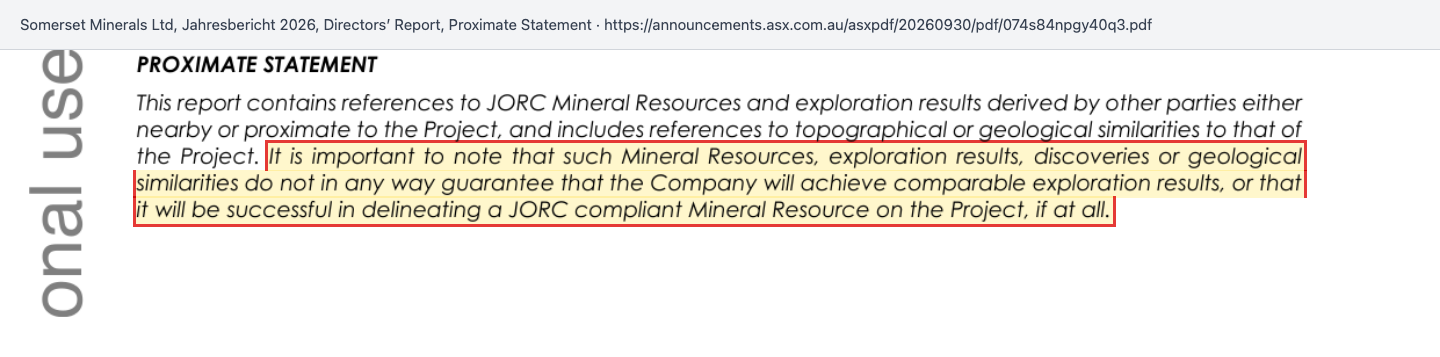
Anyone reading Somerset’s releases keeps running into other companies’ numbers: White Cliff Minerals’ Danvers with a historical estimate of 4.16 million tonnes at 2.96 percent copper, American West Metals’ Storm with 28.2 million tonnes at 1.0 percent copper, a White Cliff drill hit of 19.81 meters at 6.64 percent. According to Somerset, Talisker lies about 4 kilometers from Danvers. That is interesting. But none of those tonnes belong to Somerset. The company has not published a JORC resource estimate for any of its projects. The annual report says so itself, in the small print:
“It is important to note that such Mineral Resources, exploration results, discoveries or geological similarities do not in any way guarantee that the Company will achieve comparable exploration results, or that it will be successful in delineating a JORC compliant Mineral Resource on the Project, if at all.”
— Somerset Minerals Ltd, Annual Report 2026, Directors’ Report, Proximate Statement
Two reading aids for the company’s own drill releases. First: the reported intervals are lengths along the drill hole; according to the October 5, 2026, release, true widths are not yet known. Second: according to the company, the twelve Talisker holes assayed so far sit mostly on the edges of the anomaly along a smaller parallel fault; the main zone has barely been drilled. You can read that as an opportunity, as management does. You can also read it soberly: nobody knows yet what lies at the center.
Uncomfortable truth No. 5: When Coppermine was bought, the CEO sat on both sides
Coppermine came to Somerset through the acquisition of a company called Sentinel — approved by shareholders on April 23, 2025, and announced as completed on May 5, 2025 — paid for with 90 million new shares and a 1.5 percent net smelter royalty for the vendors — a share of the net smelter return from any future production on the licences. One of the vendors was the company’s own managing director. The release of December 10, 2024, states: “Managing Director, Chris Hansen holds an interest in 13.2% of the issued capital in Sentinel which will entitle Mr Hansen to 11,836,515 Consideration Shares.”
Somerset handled this properly: Hansen did not take part in the board meeting that considered the deal, an independent expert’s report on fairness was a condition, and shareholders had to approve. Still, as a shareholder you should note: part of the purchase price for the flagship project went to the company’s own CEO, and any future production from it carries a royalty for the vendors. Hansen also holds 28.3 million of the 81.5 million performance rights (as of September 22, 2026, according to the annual report); his total remuneration for fiscal 2026 was A$549,853, of which A$275,000 was salary.
Valuation: What the market pays for drill holes in the Arctic
With 1,604,625,050 shares (September 22, 2026) and a closing price of A$0.009 on October 5, 2026, Somerset has a market value of about A$14.4 million. Subtract cash at June 30, 2026 (A$3.07 million, no borrowings), and about A$11.4 million remain for all projects combined. A price-to-earnings or price-to-sales ratio makes no sense: the profit is an accounting gain, and there is no revenue. The popular explorer yardstick “enterprise value per tonne of copper” fails too, because there is no resource of its own.
That leaves two reference points. The balance sheet carries A$11.0 million of exploration assets and A$12.4 million of equity, so the market is paying roughly book value. And there is a price a third party has named for part of the company:
“The proposal received include a suggested exclusivity period of 90 days and on completion of the transaction contemplated total consideration payable to Somerset of US $5.25 million (~A $7.5 million).”
— Somerset Minerals Ltd, ASX release of July 27, 2026, on the Lundin Gold proposal
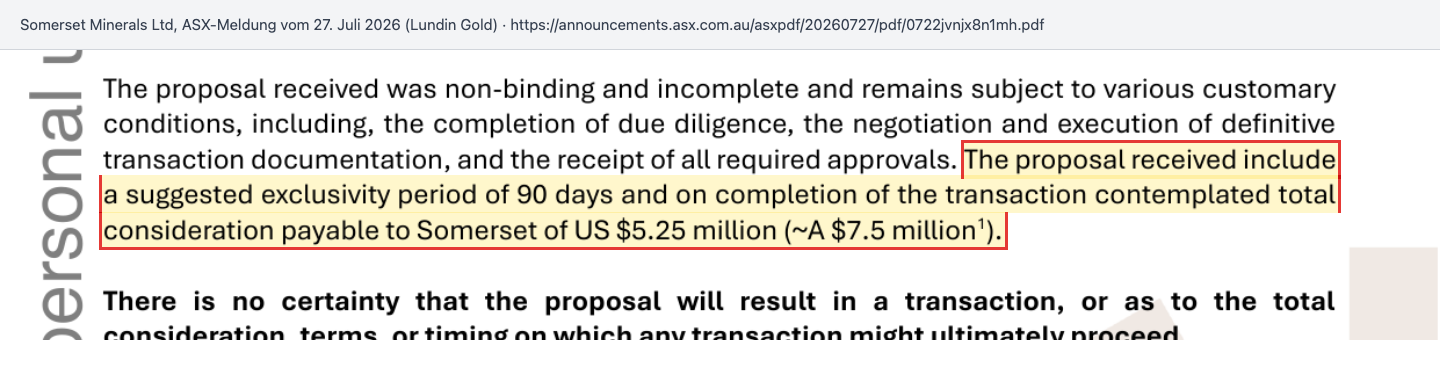
About A$7.5 million for a project carried at zero and outside the core business — that is a little over half of the entire market value, or about A$0.0047 per share against a price of A$0.009. Add cash and this offer together, and arithmetically about A$3.9 million is left for Coppermine and Prescott (14.4 minus 3.07 minus 7.5). Arithmetically that looks cheap, but there are three catches: the proposal is non-binding, no binding agreement had been announced by October 5, 2026, and even on completion the company says the money would go into more drilling in Canada, not to shareholders. For a copper project in Ecuador that already has a resource, see our Solaris Resources analysis; an Australian copper explorer with its own resource estimate and a full treasury is covered in our Prospect Resources analysis.
How much hope swings in the price shows in the twelve-month range: between A$0.006 (close on July 21, 2026) and A$0.0225 (February 27, 2026). On the day of the release the company called a discovery at Talisker, August 6, 2026, about 82 million shares changed hands, and the stock closed at A$0.013. We deliberately do not give price targets.
Opportunities and risks at a glance
What speaks for the company:
- Real copper hits. All twelve Jura holes in 2025 hit copper, the first Talisker holes up to 38.1 meters at 1.27 percent; silver comes as a by-product.
- Large, barely explored ground. 1,677 square kilometers at Coppermine; according to the company, less than 10 percent of the Talisker anomaly has been tested, with permits for up to 100 holes.
- A possible cash inflow without new shares. Lundin Gold has made a non-binding offer of $5.25 million for the dormant Ecuador subsidiary.
- Legacy issues cleaned up. Blackdome rehabilitation obligation handed off, Ecuador tax dispute won, audit opinion not modified.
What speaks against it:
- No resource of its own. The big tonnages in the releases belong to the neighbors; true widths of the company’s own intercepts are not yet known.
- Tight cash. A$3.07 million at June 30, 2026, a 1.72-quarter runway according to the Appendix 5B, and an auditor’s note on a material going-concern uncertainty.
- Massive dilution. About 59 times as many shares as in mid-2022, latest capital raisings at A$0.008, plus 510.2 million options and 81.5 million performance rights.
- Profit on paper only. The 2026 profit rests on a disposal gain with almost no cash inflow (about A$0.05 million); without it, there would be a A$2.20 million loss.
- Arctic and trading. A short field season in Nunavut, a royalty for the Coppermine vendors, and practically no trading in Frankfurt.
A human conclusion
Remember “nearology,” the science of being nearby, from the beginning? At Somerset it is especially tempting, because the neighbors really have found something and because the company’s own drilling really does hit copper. That is more than many explorers can show. But between “we hit copper” and “here is a deposit that can be mined” lie a resource estimate, studies and many millions of dollars that Somerset does not have.
The reports say it soberly: an accounting gain instead of a real one, cash for less than two quarters at the June-quarter pace, an auditor flagging the going-concern question, and a share count that every capital raising inflates further. Whether the picture turns depends on three things: the sale of the Ecuador subsidiary, the cash flow report to September 30, 2026, and the price of the next capital raising. All three will become public in the coming months. Until then, the neighbors’ discoveries are no evidence for Somerset’s own ground.
What you do with this is your decision. And that is how it should be.
Sources and data as of
- Annual Report 2026 (fiscal year ended June 30, 2026), published September 30, 2026, with the auditor’s report from Pitcher Partners BA&A
- Annual Report 2024 (fiscal year ended June 30, 2024), published September 30, 2024 — comparative figures for 2023 and 2024, Blackdome-Elizabeth write-down
- Quarterly activities report to June 30, 2026, with cash flow report (Appendix 5B), July 31, 2026
- Lundin Gold: release of July 23, 2026 and updated release of July 27, 2026
- Capital: A$2.0 million placement (June 24, 2026), entitlement offer result (August 12, 2026), results of general meeting (September 8, 2026)
- Projects: Coppermine acquisition (December 10, 2024), Talisker drill results (October 5, 2026)
- Price and market value data: source fundamental data, as of October 5, 2026 (ASX) and October 2, 2026 (Frankfurt); Australian dollar to euro exchange rate of October 2, 2026
Data as of: company figures as of June 30, 2026, or the respective date stated; shares, options and performance rights as of September 22, 2026; prices as of October 5, 2026. The ASX announcement list was last checked on October 5, 2026. The reporting currency is the Australian dollar (A$); amounts in U.S. dollars are shown with a plain $ sign. Share counts before November 2024 are adjusted for the 5-for-1 consolidation. Derived values (market value, value net of cash, result excluding the disposal gain, share of the Lundin offer in market value) are our own arithmetic.
Disclaimer: This article is journalistic commentary and not investment advice. It is not a recommendation or a solicitation to buy or sell securities. Shares of explorers without production are especially volatile; a total loss of the capital invested is possible. Positions held by the operator are disclosed daily; where one exists, it appears as a notice at the top of this analysis.
Our Bottom Line at a Glance
- Exploration positive
- All twelve Jura holes hit copper in 2025, and the first Talisker program in 2026 returned up to 38.1 meters at 1.27 percent. At 1,677 square kilometers, the ground is large and barely drilled.
- Deposit negative
- There is no JORC resource estimate for any project. The big tonnages in the releases belong to neighbors White Cliff Minerals and American West Metals.
- Financial position negative
- Cash was A$3.07 million at June 30, 2026, a runway of 1.72 quarters per the Appendix 5B. The auditor points to a material uncertainty about the company continuing as a going concern.
- Earnings quality negative
- The A$2.17 million profit for fiscal 2026 rests on a A$4.37 million disposal gain from Blackdome. Without it, there would be a A$2.20 million loss.
- Dilution negative
- Adjusted for the consolidation, the share count rose from 27.1 million (June 30, 2022) to 1,604.6 million (September 22, 2026). On top come 510.2 million options and 81.5 million performance rights.
- Ecuador subsidiary neutral
- Lundin Gold has made a non-binding offer of $5.25 million for Condor Gold, a little over half of the market value. No binding agreement had been announced by October 5, 2026.
Somerset Minerals hits copper in Nunavut but has no resource of its own, cash of A$3.07 million at June 30, 2026, with a 1.72-quarter runway, and an auditor’s going-concern note. The 2026 profit is an accounting gain, and the share count has risen about 59-fold since 2022. A non-binding Lundin Gold offer for the Ecuador subsidiary equals a little over half of the market value of about A$14.4 million on October 5, 2026. Not investment advice.
What Our Rating Means
Substance risk
We found at least one documented issue that threatens the company itself — regardless of how the stock is currently valued.
The red rating is not about a share price below one Australian cent and not about the drill results, which are decent. It is red because two documented substance findings come together: in the Annual Report 2026 the auditor points to a material uncertainty about the company continuing as a going concern, and the cash flow report to June 30, 2026, shows a runway of 1.72 quarters with ongoing cash outflow — well below the roughly four quarters at which we consider funding secure. Yellow would be conceivable if the sale of the Ecuador subsidiary to Lundin Gold becomes binding or the cash flow report to September 30, 2026, shows a much longer runway. Until then, the company depends on the next capital raising. The decision is yours.
A journalistic assessment by our editorial team at the time of the deep dive, based on public sources — not investment advice and not a solicitation to buy or sell. Your personal circumstances (investment goals, risk capacity, taxes) cannot be taken into account. What our levels mean, how verdicts are formed, and what conflicts of interest exist →
Worth Noting
- The trigger for this analysis was the Frankfurt symbol 4W00 on the forum ranking of the German site wallstreet-online (as of October 5, 2026); we list the company under its home listing SMM (ASX) as SMM.AU. There is no hit from our in-house stock scanner, and there cannot be one: the company produces nothing and has no revenue. Classic metrics such as P/E or P/S cannot be calculated.
- Somerset is not an SEC reporting company. All company figures come from the Australian mandatory documents: Annual Report 2026 (Sept. 30, 2026), Annual Report 2024 (Sept. 30, 2024), quarterly report to June 30, 2026 (July 31, 2026), and ASX releases through Oct. 5, 2026. No earnings call transcripts were available.
- Derived values are our own arithmetic: market value from 1,604,625,050 shares (Sept. 22, 2026) times the closing price of Oct. 5, 2026; value net of cash at June 30, 2026; result excluding the disposal gain; share of the Lundin offer (in Australian dollars at the company’s conversion rate) in market value. Share counts before November 2024 are adjusted for the 5-for-1 consolidation.
- The Frankfurt price of 4W00 (€0.0005 on Oct. 2, 2026) rests on very few trades and is not a reliable price.
The full analysis as a PDF for later
We will send you this analysis as a PDF — to print, file away, and read at your own pace.
Frequently Asked Questions
Somerset Minerals is an Australian copper explorer based in Perth. In Nunavut, Canada, it holds the Coppermine project (1,677 square kilometers) and the Prescott project (624 square kilometers), both 100 percent owned, plus two dormant concessions in Ecuador. It produces nothing and has no resource estimate of its own. Until June 2024, the company was called Tempus Resources.
Yes. SMM is the symbol on the home exchange, the ASX in Sydney, where prices are set in Australian dollars. 4W00 is the secondary listing in Frankfurt; there was turnover there on only 8 of 130 trading days since April 1, 2026. TickerGuard lists the stock as SMM.AU.
The A$2.17 million profit for the fiscal year ended June 30, 2026, comes from an accounting gain of A$4.37 million on disposing of the subsidiary holding the Blackdome-Elizabeth gold project. A A$4.20 million rehabilitation obligation left the balance sheet with it. Without that item, there would have been a A$2.20 million loss.
At June 30, 2026, Somerset had A$3.07 million in cash and no credit facilities. According to its Appendix 5B cash flow report, that covered 1.72 quarters at the June-quarter spending rate. In August, an entitlement offer added A$1.17 million gross. The auditor points to a material uncertainty about the company continuing as a going concern.
Adjusted for the 5-for-1 consolidation of November 2024, there were about 27.1 million shares on June 30, 2022, and 1,604.6 million on September 22, 2026 — about 59 times as many. The latest capital raisings were priced at A$0.008. In addition, 510.2 million options and 81.5 million performance rights are outstanding.
In July 2026, Lundin Gold made a non-binding proposal for the Ecuador subsidiary Condor Gold: $5.25 million on completion, about A$7.5 million, with a suggested 90-day exclusivity period. No binding agreement had been announced by October 5, 2026. Somerset intends to put any proceeds into exploration in Canada.
Because Somerset is not a U.S. reporting company. It is based in Perth, listed on the ASX and reports under Australian law in Australian dollars: an annual report to June 30, a half-year report and quarterly reports with a cash flow statement (Appendix 5B), all published on the ASX platform.
Found an error?
Did you spot a factual error, an outdated number, or a typo in this deep dive? Let us know briefly — your report goes straight to the editorial team.