Prospect Resources: The Lithium Windfall Has Been Paid Out — Now 877,000 Tonnes of Zambian Copper Are Supposed to Repeat It
Prospect Resources (ASX: PSC, Frankfurt: 5E8) has already developed one mine and sold it for hundreds of millions of dollars. Today the same team is drilling in Zambia and reports 877,000 tonnes of copper in its resource. There is no economic study yet, the copper grade has fallen with every estimate, and the share count is up about 75 percent since mid-2024. A proven team is a reason to look closer — it is not proof of the next mine.
 Thomas Mücke
Founder & Publisher
Thomas Mücke
Founder & Publisher
Chart
Interactive price chart (TradingView).
Note: pure fact-based analysis, not investment advice and not a solicitation to buy or sell. All figures without guarantee.
There is an investor weakness that feels like good judgment of character: whoever won once will win again. A coach who has won a title, a founder who has already sold a company — we almost automatically trust them to do it a second time. Let’s call it the repeat-winner trap. It is not foolish, because experience matters. But it confuses the team with the field. The best coach does not win with every squad, and the best mining team does not find a profitable mine in every patch of ground.
Prospect Resources Limited is a textbook case. The team around managing director Sam Hosack developed the Arcadia lithium mine in Zimbabwe and sold it to China’s Huayou Cobalt; a large share of the proceeds went back to shareholders. Now the same is supposed to happen with copper in Zambia. So let’s make a deal: we set the good reputation aside for a moment and read the Annual Report 2026, the resource releases and the drilling updates through October 1, 2026, together. In the end, you decide.

What Prospect Resources actually does
Prospect is an explorer: a company that searches for and measures mineral deposits but does not mine anything yet. Think of a builder who has bought a plot of land and is taking soil samples — no house is standing, and nobody knows yet whether building one will pay. The plot is called Mumbezhi. It lies in the copper belt of north-western Zambia and covers about 356 square kilometers on two large-scale mining licences granted on March 31, 2025, for 25 years. Prospect owns 90 percent through a Singapore subsidiary. Major miners produce copper from similar rock nearby; according to Prospect, First Quantum’s Sentinel mine is about 25 kilometers away.
Prospect bought Mumbezhi in 2024: 85 percent for $5.5 million in cash and $1.0 million in its own shares. Another 5 percent followed in March 2026 for $4.25 million. Besides that there is only the Omaruru lithium project in Namibia, where exploration has stopped; two non-binding offers for it arrived on July 31, 2026. The smaller Step Aside lithium project in Zimbabwe was sold in November 2025 for up to $2.2 million.
What does Prospect earn today? Interest. The “revenue” in the annual report — A$586,000 in fiscal 2026 — is essentially interest income on its cash. Everything else is spending: drilling, assays, studies, overhead. The company describes where that leads in its own annual report: “In the absence of a producing asset, the cash inflows are mainly sourced from capital raising activities.”
Company history for investors
-
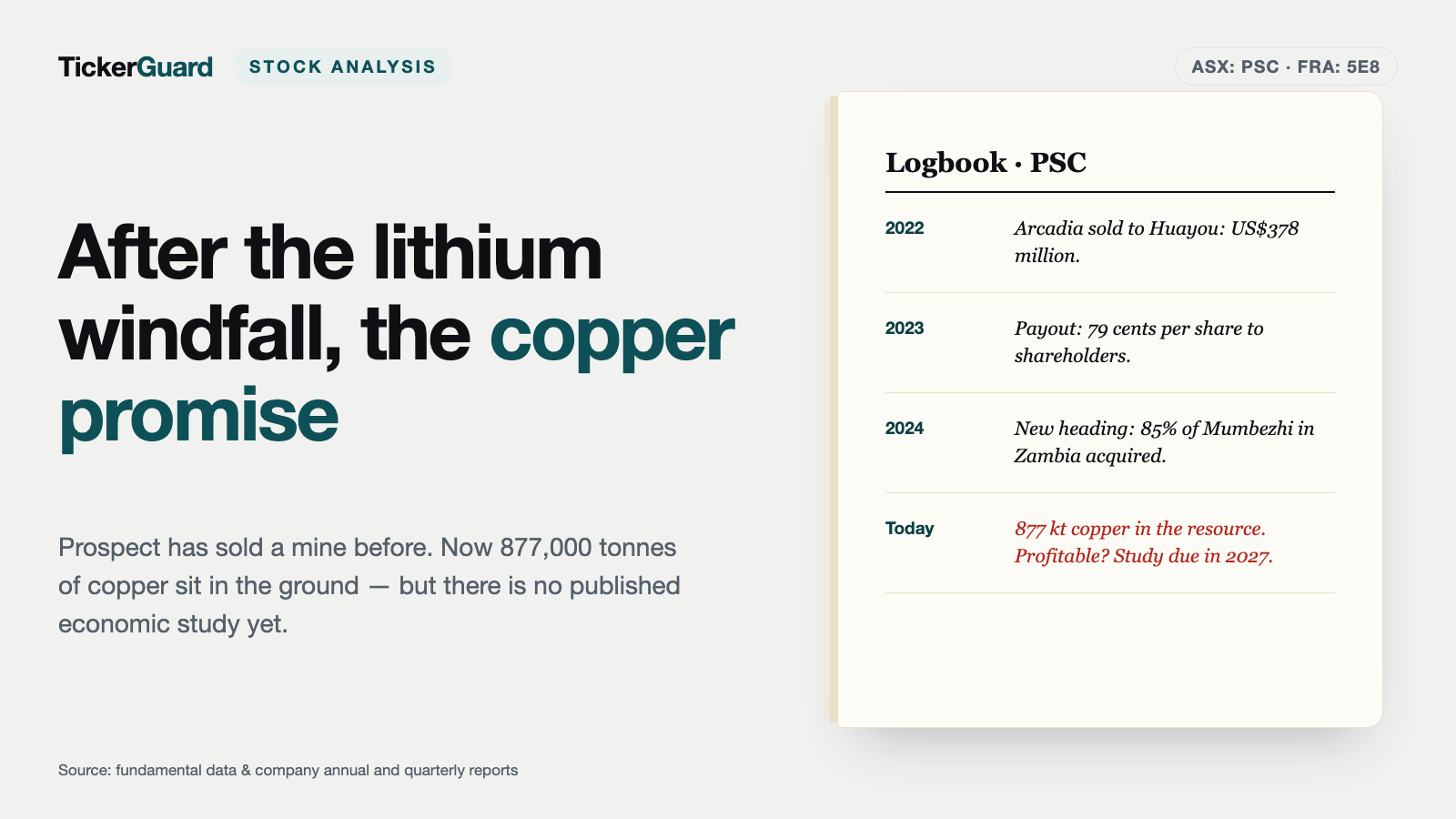
2022
Arcadia sold to Huayou
The sale of the lithium mine closed in July 2022; fiscal 2022 ended with an A$397.5 million profit. For shareholders, the moment hope turned into money.
-
2023
79 cents per share paid out
Most of the proceeds went back to shareholders. Afterwards Prospect was a small explorer again, with A$26.2 million in cash at June 30, 2023.
-
2024
Entry into Mumbezhi
85% of the Zambian copper project for $5.5 million cash plus $1.0 million in shares. The switch from lithium to copper began with a placement at A$0.10 in August.
-
2025
First Quantum buys in, licences granted
In April First Quantum subscribed for 101.06 million shares at A$0.15; on March 31, 2025, the mining licences were granted for 25 years. First resource: about 515,000 t of copper.
-
2026
A$45 million and 877,100 t of copper
Placement at A$0.38 in February, resource of 877,100 t in May with falling grade. The scoping study moved from the second half of 2026 to the first quarter of 2027.
Where the numbers come from: ASX, not SEC
One point up front, because it shapes the evidence: Prospect files no annual report (10-K) and no quarterly report (10-Q) with the U.S. securities regulator, the SEC. It is not required to, which is normal for an Australian company with its home listing in Sydney. It reports under Australian law in Australian dollars: an audited annual report to June 30, a half-year report to December 31 and — mandatory for mining explorers on the ASX — a quarterly activities report with a cash flow statement (Appendix 5B). On top come mandatory releases on drill results and resources, prepared under Australia’s JORC Code and signed off by a named competent person.
That is why every number in this analysis carries “Source: fundamental data & the company’s annual and quarterly reports.” The fiscal year ends June 30, so “fiscal 2026” covers July 2025 through June 2026. We had no earnings call transcripts for Prospect; instead we worked through the Annual Report 2026 of September 24, 2026, the quarterly report to June 30, 2026, the resource releases and every release through October 1, 2026.
How the stock landed on our desk
To be honest: Prospect is not a hit from our in-house stock scanner, and it cannot be. The scanner works with revenue, earnings, margins and balance sheet ratios — an explorer without production fails every one of those filters. The stock made our research list through the forum hot list of wallstreet-online, the ranking of the most discussed stocks among German retail investors (as of October 2, 2026), under its Frankfurt symbol 5E8. That is a signal of attention, not of quality.
5E8 is the same stock as PSC in Sydney. Price discovery happens on the ASX in Australian dollars; in Frankfurt the stock was quoted at €0.12 on October 1, 2026, and it traded there on only 37 of the preceding 130 trading days. Anyone buying in Germany therefore also carries the moves of the Australian dollar and very thin trading. Current metrics are on our Prospect Resources stock page.
On timeliness: after the annual report of September 24, 2026, Prospect published two releases, both reflected here — the issue of employee options together with the current share count (September 30) and new drill results with the timetable for the study (October 1). Since September 21, 2026, Prospect has also been a member of Australia’s All Ordinaries index (S&P Dow Jones Indices announcement of September 4, 2026).
The numbers over the years — given their due
Let’s start with what is genuinely impressive — the history. In fiscal 2022 Prospect booked a profit of A$397.5 million, almost entirely from the sale of Arcadia. In fiscal 2023 it paid out 79 cents per share to its shareholders. The Annual Report 2026 explicitly credits Sam Hosack with making sure most of the money did not vanish into new adventures:
“Mr Hosack was key in ensuring a very high proportion of the sale proceeds were returned to shareholders locking in substantial value realisation.”
— Prospect Resources Ltd, Annual Report 2026, Information on Directors, p. 16
That is rare among resource explorers and deserves respect. The annual report puts the Arcadia sale at $422 million on a 100 percent basis; in its November 5, 2025, release on the Step Aside sale, Prospect cites $378 million and July 2022 as the date.
At Mumbezhi, too, the team has delivered a lot in a short time. The first resource estimate in March 2025 came to about 515,000 tonnes of copper; the May 20, 2026, estimate reached 877,100 tonnes in 208.1 million tonnes of rock, plus 43,500 tonnes of cobalt and 262,100 ounces of gold as potential by-products. Metallurgical tests produced copper concentrate grading 25.0 to 31.9 percent copper at recoveries of about 94 percent (release of June 25, 2026). And the first infill hole of the new campaign hit 18.0 meters at 1.31 percent copper from 148 meters downhole (release of October 1, 2026).
The cash pile is healthy. At June 30, 2026, Prospect held A$36.6 million in cash plus A$5.0 million in a term deposit; it had no borrowings, and total liabilities were A$2.0 million. Auditor Stantons gave an unmodified opinion without any going concern note.
Now the other half of the picture, the income statement. From the Annual Report 2026:
- Fiscal 2022: profit of A$397.5 million (Arcadia sale)
- Fiscal 2023: loss of A$5.6 million
- Fiscal 2024: loss of A$7.0 million
- Fiscal 2025: loss of A$8.1 million
- Fiscal 2026: loss of A$7.9 million, of which A$1.9 million from discontinued lithium projects
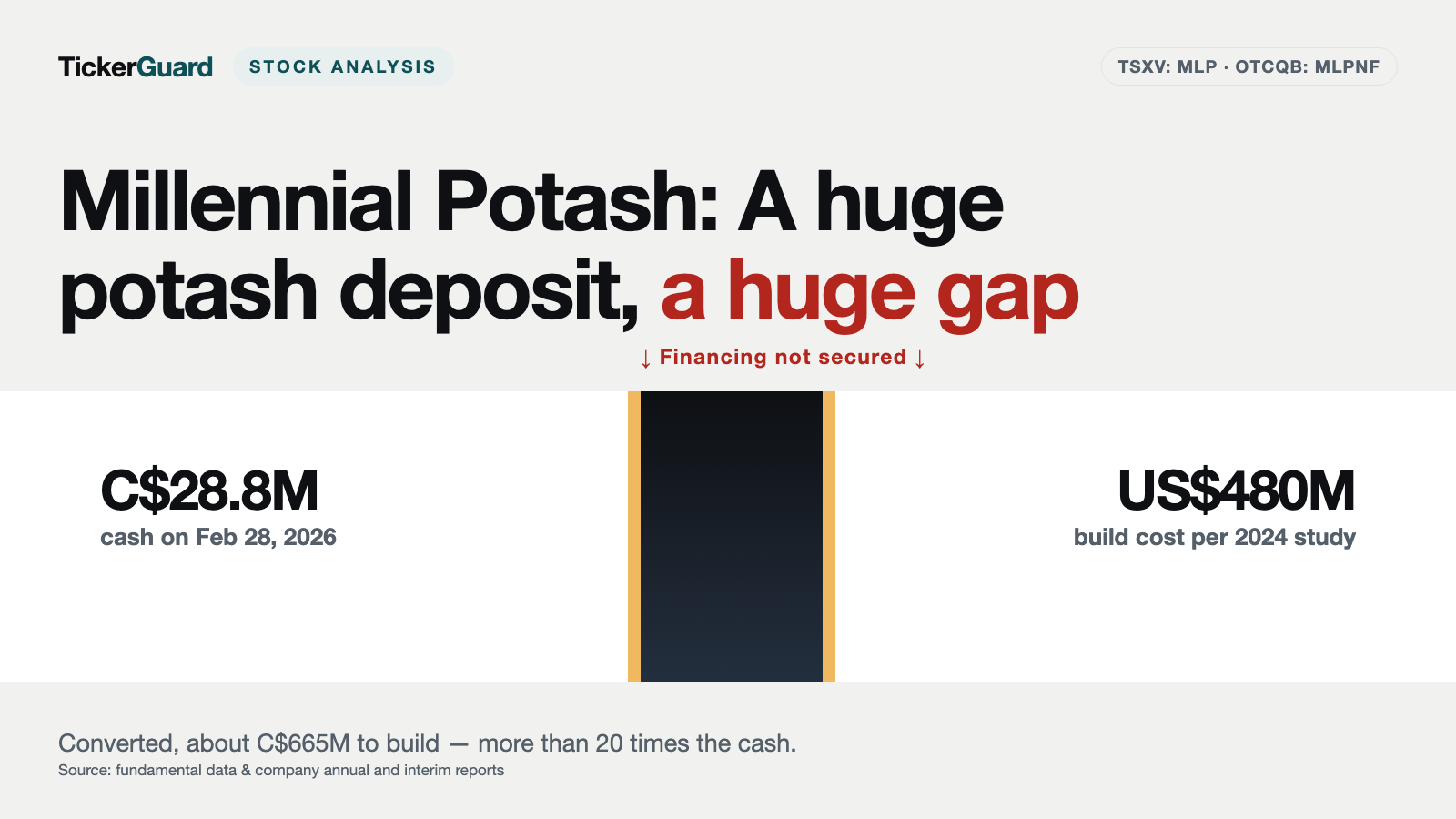
What matters more than the loss is the cash going out. In fiscal 2026 that was A$6.7 million for operations, A$11.4 million for drilling and studies capitalized as exploration assets, and A$0.7 million for equipment — about A$18.8 million in total. On top came a one-off A$6.1 million for the extra 5 percent of Mumbezhi. In early October 2026 four drill rigs were running at the same time; the burn rate is more likely to rise than fall.
What the reports say — the uncomfortable truths
Now come the passages you won’t find on the cover of an investor presentation. All of them are from the company’s own documents.
Uncomfortable truth No. 1: A resource is not a mine — and the study keeps slipping
A resource says how much copper is probably in the ground. It does not say whether it can be extracted at a profit. That question is answered by economic studies, in Australia usually in three stages: scoping study (rough feasibility), pre-feasibility study and feasibility study. Mumbezhi has none of them yet. With the placement in February 2026, Prospect promised:
“Completion of an internal Scoping Study in H2 2026, to support further evaluation works and targeted delivery of a Pre-Feasibility Study during H2 2027;”
— Prospect Resources Ltd, ASX release of February 16, 2026, on the A$45 million placement, Use of proceeds

The quarterly report of July 29, 2026, then said “Q4 2026 / Q1 2027.” The release of October 1, 2026, states: “Mumbezhi Scoping Study remains on track for completion and release in Q1 2027.” On track measured against July, that is, not against February. A one-quarter delay is nothing unusual for an explorer, and Prospect blames the slower flow of drill results on a regional backlog at assay laboratories. For you it still means: the most important number — whether a mine would pay — will not arrive before 2027, and under the February plan the pre-feasibility study not before late 2027.
Uncomfortable truth No. 2: More copper, lower grade — and the growth sits in the least certain category
Resources are sorted by confidence. Indicated means the drill holes are close enough together to estimate tonnage and grade with reasonable reliability. Inferred means there are signs, but the gaps between holes are large. An Inferred tonne is more of an educated suspicion than an inventory.
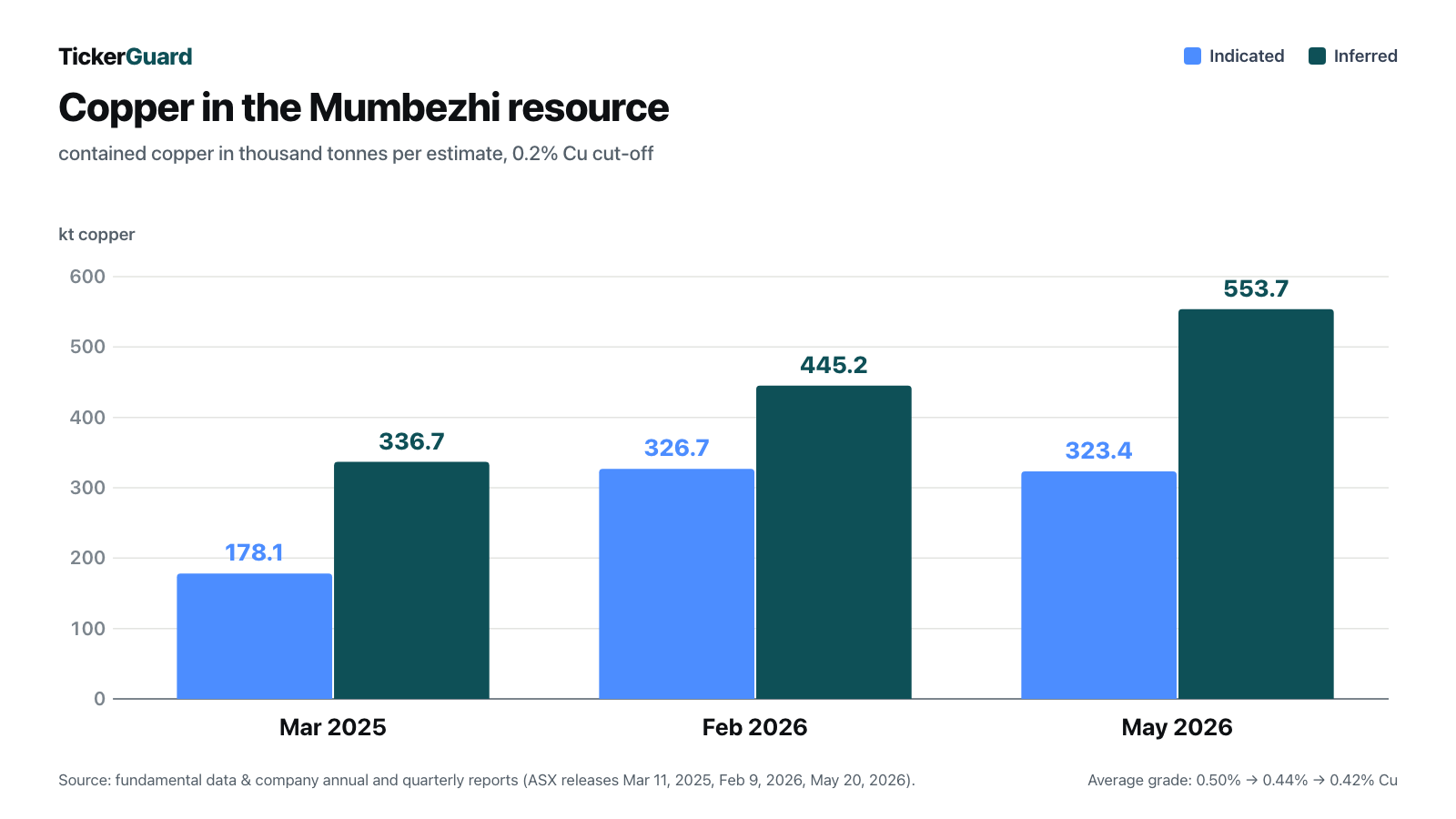
Three things stand out. First, the grade is falling: 0.50 percent copper in the maiden estimate, 0.44 percent in February 2026, 0.42 percent in May 2026. The company says so itself:
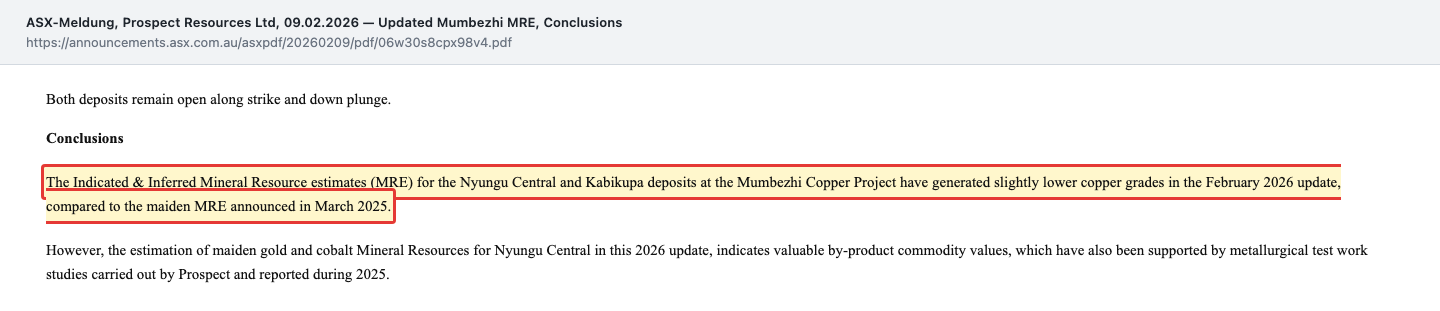
“The Indicated & Inferred Mineral Resource estimates (MRE) for the Nyungu Central and Kabikupa deposits at the Mumbezhi Copper Project have generated slightly lower copper grades in the February 2026 update, compared to the maiden MRE announced in March 2025.”
— Prospect Resources Ltd, ASX release of February 9, 2026, on the resource estimate, Conclusions
Second: the 14 percent jump in May 2026 came entirely from a new deposit. West Mwombezhi added 115,000 tonnes for the first time. In the same update the main deposit, Nyungu Central, shrank slightly, from 661,100 to 651,300 tonnes of copper — that is what Table 10 of the May 20, 2026, release shows. Third: the Indicated portion has hovered just above 320,000 tonnes since February 2026. That leaves 63 percent of the copper in the “Inferred” category. Since July 2026 Prospect has been drilling infill holes specifically to convert Inferred into Indicated — exactly what the study needs.
And a side note on the popular “copper equivalent” figure (0.49 percent): it adds gold and cobalt to the copper, using assumed prices of $11,500 per tonne of copper, $3,500 per ounce of gold and $40,000 per tonne of cobalt. According to the quarterly report, the copper and cobalt prices come from the price forecast of Canaccord Genuity — the same bank that was one of two joint lead managers on the February 2026 placement. That is not improper, but it is worth knowing.
Uncomfortable truth No. 3: Shareholders pay for the drilling — with their stake
Without production, the money comes from new shares. Dilution simply means: your slice of the pie gets smaller because more people are eating from the same pie.
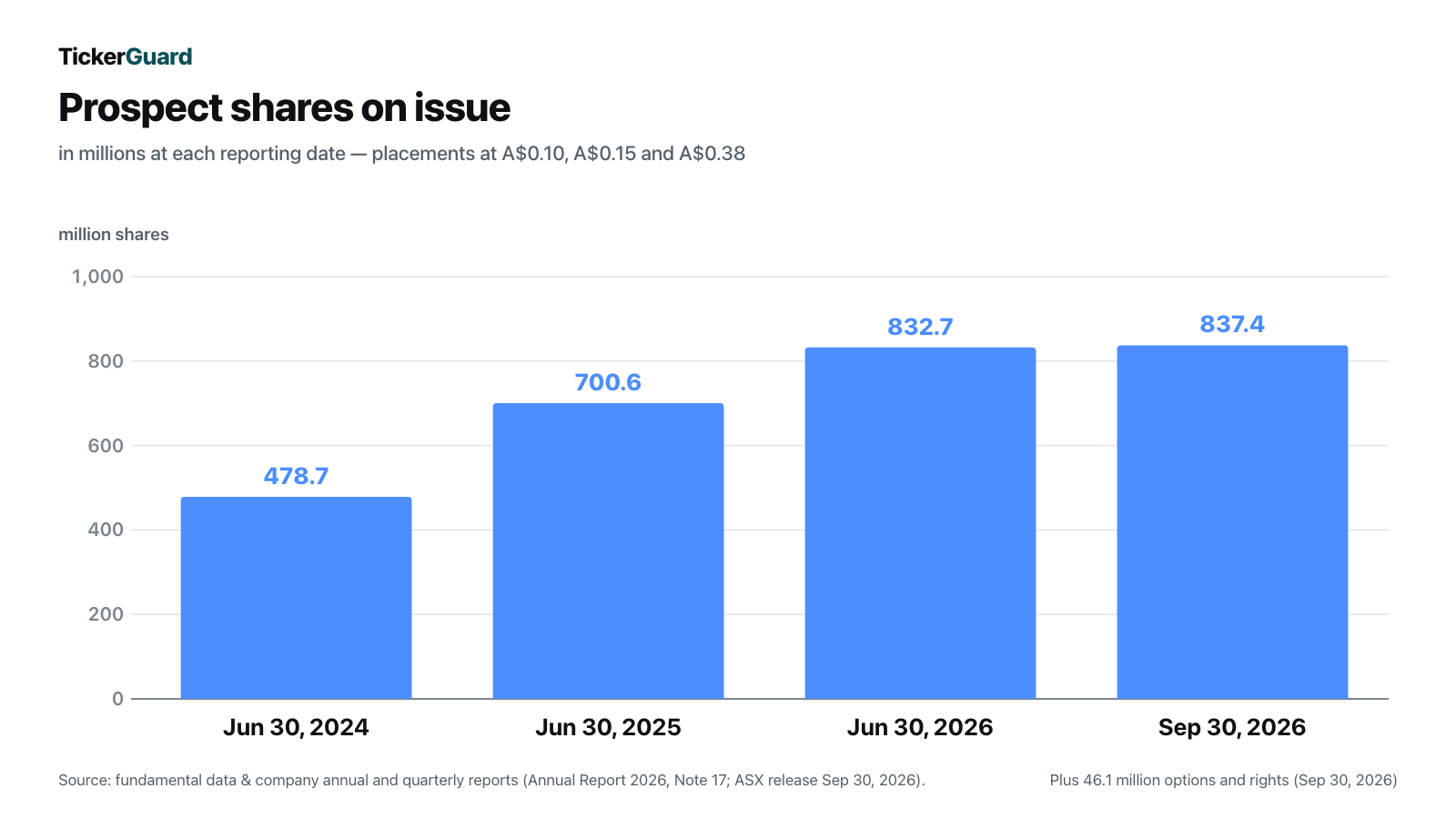
In fiscal 2025 Prospect issued 214.0 million new shares in placements — in August 2024 at A$0.10, in April and June 2025 to First Quantum and long-standing major shareholder Eagle Eye at A$0.15. Fiscal 2026 added 118.4 million shares at A$0.38 (A$45.0 million gross) and about 13.7 million from exercised options, rights and fee settlements. At September 30, 2026, another 42.1 million options and 4.0 million performance and service rights were outstanding.
In fairness: the prices rose from round to round, which is a good sign for an explorer. Still, anyone who subscribed at A$0.38 in February 2026 was down about 38 percent at A$0.235 on October 2, 2026. And the annual report makes clear the chain has not ended:
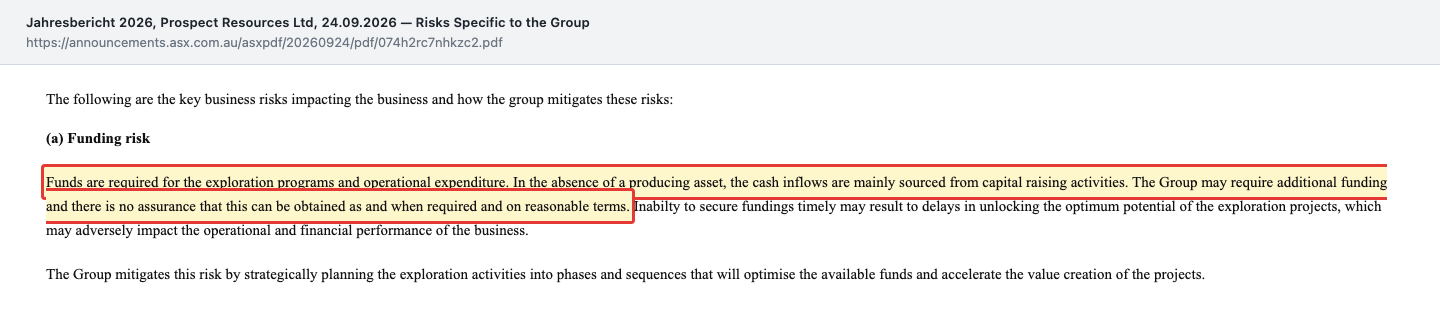
“Funds are required for the exploration programs and operational expenditure. In the absence of a producing asset, the cash inflows are mainly sourced from capital raising activities. The Group may require additional funding and there is no assurance that this can be obtained as and when required and on reasonable terms.”
— Prospect Resources Ltd, Annual Report 2026, Directors’ Report, Risks Specific to the Group, (a) Funding risk
The math: A$41.6 million in cash and term deposits at June 30, 2026, against about A$18.8 million of outflows in fiscal 2026 gives a little over two years — at the old pace. At the placement, managing director Hosack said the money would accelerate drilling and metallurgy over the next 18 to 24 months. A mine costs many times that; how much, only the study will tell.
Uncomfortable truth No. 4: Drilling news with addenda
Explorers live on news flow, and drill results are the most important part of it. In the summer of 2026 Prospect had to supplement two of those releases after the fact. On July 22, 2026, the company clarified that some of the intercepts shown in its figures were historical results from 2024 and 2025 and that lab assays were still outstanding for 11 of 13 new holes: “Of the 13 holes drilled (as listed in Appendix 1 of the Original Announcement), assays have been received for 2 holes.” On August 14, 2026, it added the mandatory caution to a release about “visual copper mineralisation”:
“Visual estimates of mineral abundance should never be considered a proxy or substitute for laboratory analyses where concentrations or grades are the factor of principal economic interest.”
— Prospect Resources Ltd, ASX release of August 14, 2026 (Clarification)
This is not a scandal but a mandatory correction — the results themselves were not withdrawn. It does show how to read drilling releases: footnotes first, headline second. “Visual mineralisation” is a look through a magnifying glass, not a lab result, and an intercept from 2024 is not a new discovery.
Uncomfortable truth No. 5: A strong partner with its own calendar
First Quantum Minerals buying in in April 2025 was an accolade: a copper miner with its own mines in Zambia bought 15 percent at A$0.15, a 36 percent premium to the share price at the time, and supports Prospect technically. According to the annual report, First Quantum now owns 12.50 percent. Most of those shares, however, are under an escrow that ends soon:

Nobody knows what First Quantum will do afterwards. It seems likely that a miner supporting a partner technically will not sell right away. The only certainty: after October 22, 2026, it is free to decide. Country risk belongs here too, since Mumbezhi lies in Zambia and depends on two government-granted licences. The annual report names permits and licences explicitly as a risk: there is “no guarantee that current permits and licences will be renewed or future permits will be granted timely.” According to the March 5, 2026, release, the former owner, Zambian company GDC, remains a co-shareholder in Mumbezhi.
Valuation: What the market pays for copper in the ground
With 837,390,933 shares (September 30, 2026) and a closing price of A$0.235 on October 2, 2026, Prospect has a market value of about A$197 million. Subtract cash and term deposits at June 30, 2026 (A$41.6 million, no debt) and about A$155 million remains. That is what the market pays for Mumbezhi, Omaruru and the team.
A price-to-earnings or price-to-sales ratio cannot be calculated. For explorers, people like to use “enterprise value per tonne of copper in the resource” instead: A$155 million divided by 877,100 tonnes is about A$177 per tonne, or about A$197 on Prospect’s 90 percent share. For context: the copper equivalent calculation assumes $11,500 per tonne. The market pays only a small fraction of the metal value — rightly so, because between copper in the ground and copper in the bank lie construction, operations, costs and years, and 63 percent of the tonnes are only inferred. Equity stood at A$82.7 million at June 30, 2026; the market pays about 2.4 times that.
Prospect itself supplies a telling number. For 85 percent of Mumbezhi it paid a combined $6.5 million in 2024, and for 5 percent in March 2026 it paid $4.25 million. By that arithmetic, the price for the whole project rose from about $7.6 million to $85 million — roughly elevenfold in under two years. Part of that is real value created by drilling and licences. Another part is a price two parties negotiated, not a valuation from a study.
A reliable analyst consensus hardly exists for a stock this size. Canaccord Genuity and Argonaut acted as joint lead managers on the February 2026 placement; anyone reading research from those houses should keep that in mind. We deliberately do not quote price targets. How much hope swings in the price shows in the range of the past twelve months: between A$0.17 (close on November 21, 2025) and A$0.475 (January 27, 2026).
What an Australian explorer whose value also rests almost entirely on drill results looks like, we worked through in our Strickland Metals analysis. And what copper looks like when it is actually mined and sold is shown in our Southern Copper analysis.
Upside and risks at a glance
What speaks for the company:
- A team with a track record. Arcadia was developed, sold and paid out (79 cents per share in fiscal 2023) — the exception rather than the rule among resource explorers.
- Full coffers, no debt. A$36.6 million plus A$5.0 million in term deposits at June 30, 2026, and an audit opinion without a going concern note.
- An industry heavyweight as partner. First Quantum owns 12.50 percent and supports exploration technically.
- A growing resource with by-products. 877,100 tonnes of copper plus gold and cobalt; according to the company all three deposits remain open, and the first infill hole hit 18.0 meters at 1.31 percent copper.
- Simple processing in testwork. Concentrates grading 25.0 to 31.9 percent copper at about 94 percent recovery, with a coarse grind and a single cleaning stage.
What speaks against it:
- No economic study. The scoping study has slipped from the second half of 2026 to the first quarter of 2027; whether a mine would pay is an open question.
- Falling grade, lots of inferred tonnes. 0.50 down to 0.42 percent copper, 63 percent of the tonnes Inferred, and the May 2026 growth came solely from a new deposit.
- Dilution as the funding route. About 75 percent more shares since mid-2024, 46.1 million options and rights, and further funding needs according to the annual report.
- News flow with addenda. Two clarifications to drilling releases in July and August 2026.
- Country and ownership risk. Licences in Zambia, First Quantum’s escrow ends on October 22, 2026, thin trading in Frankfurt.
A human conclusion
Remember the repeat-winner trap from the beginning? At Prospect it is especially tempting, because the first story really did end well. The team found a mine, sold it and handed the money back. Whoever was on board back then did well. But Arcadia was a different deposit, a different metal, a different country and a different market.
On Mumbezhi the reports are sober: a lot of copper at low grade, almost two thirds of it only inferred, no number yet on whether mining it would pay, and a treasury filled by shareholders that will need refilling. Whether the team lands the second win depends on three things: the scoping study in the first quarter of 2027, the conversion of Inferred into Indicated and the price of the next capital raising. All three are worth waiting for. You do not have to pay for the good reputation in advance.
What you do with this is your decision. And that is how it should be.
Sources and data as of
- Annual Report 2026 (fiscal year ended June 30, 2026), published September 24, 2026, with the auditor’s report from Stantons
- Quarterly activities report to June 30, 2026, with cash flow report (Appendix 5B), July 29, 2026
- Resource releases of February 9, 2026 (with comparison to the maiden estimate of March 11, 2025) and May 20, 2026
- Capital and ownership: First Quantum investment (April 15, 2025), A$45 million placement (February 16, 2026), acquisition of a further 5 percent of Mumbezhi (March 5, 2026) and completion (March 26, 2026), notice on options and securities on issue (September 30, 2026)
- Drilling and project releases: sale of Step Aside (November 5, 2025), clarification of July 22, 2026, clarification of August 14, 2026, drill results and study timetable (October 1, 2026)
- S&P Dow Jones Indices announcement (September 4, 2026): inclusion in the All Ordinaries effective September 21, 2026
- Price and market value data: source fundamental data, as of October 2, 2026 (ASX) and October 1, 2026 (Frankfurt)
Data as of: company figures as of June 30, 2026, or the respective date stated; shares on issue as of September 30, 2026; major shareholders as of September 6, 2026; prices as of October 2, 2026. The ASX announcement list was last checked on October 2, 2026. The reporting currency is the Australian dollar (A$); amounts in U.S. dollars are shown with a plain $ sign. Derived values (market value, enterprise value, value per tonne of copper, implied project value from the purchase prices, cash runway) are our own arithmetic and labeled as such.
Disclaimer: This article is journalistic commentary and not investment advice. It is not a recommendation or a solicitation to buy or sell securities. Shares of explorers without production are especially volatile; a total loss of the capital invested is possible. Positions held by the operator are disclosed daily; where one exists, it appears as a notice at the top of this deep dive.
Our Bottom Line at a Glance
- Financial position positive
- At June 30, 2026, the balance sheet held A$36.6 million in cash and A$5.0 million in a term deposit with no borrowings; the auditor signed off without a going concern note. With about A$18.8 million of outflows in fiscal 2026, that lasts a little over two years at the previous pace.
- Team and partner positive
- Management developed the Arcadia lithium mine, sold it in 2022 and paid out 79 cents per share in fiscal 2023. First Quantum has been a shareholder since April 2025 (12.50 percent on September 6, 2026) and supports exploration technically.
- Deposit neutral
- The resource grew to 877,100 tonnes of copper (May 20, 2026), plus gold and cobalt. At the same time the average grade fell from 0.50 to 0.42 percent, and 63 percent of the copper is classified only as Inferred.
- Economics negative
- There is no mining revenue and no economic study. The scoping study has slipped from the second half of 2026 (February 2026) to the first quarter of 2027 (October 2026).
- Dilution negative
- The share count rose from 478.7 million (June 30, 2024) to 837.4 million (September 30, 2026), about 75 percent. Another 46.1 million options and rights are outstanding; the annual report lists further funding needs as its first risk.
- Disclosure and ownership neutral
- Two drilling releases had to be supplemented by clarifications in July and August 2026. A voluntary escrow on 101,058,173 First Quantum shares ends on October 22, 2026.
Prospect Resources has a debt-free balance sheet with A$41.6 million in cash and term deposits, a team that has already sold a mine successfully and First Quantum as a partner. Against that stand an explorer without production or an economic study, a falling copper grade with mostly inferred tonnes and a share count that has risen about 75 percent since mid-2024. At the October 2, 2026, close of A$0.235, Prospect is valued at about A$197 million. Not investment advice.
What Our Rating Means
Open questions
The business works in principle, but one material question is open. As long as it stays open, our findings do not carry a quality verdict.
Yellow here is not about the share price. Red would be wrong: Prospect has no debt, A$41.6 million in cash and term deposits at June 30, 2026, a runway of a little over two years at the previous pace and an audit opinion without a going concern note. Green would be just as wrong, because the decisive operating question is open: no study has yet examined whether 877,100 tonnes of copper at 0.42 percent grade can support a profitable mine, and 63 percent of the tonnes are only inferred. The outcome hinges on a single event — the scoping study announced for the first quarter of 2027 — and on further capital raisings. That is exactly what the yellow level describes. Anyone watching the stock should track three things: the Indicated share in the next resource estimate, the key figures of the study and the share count. The decision is yours.
A journalistic assessment by our editorial team at the time of the deep dive, based on public sources — not investment advice and not a solicitation to buy or sell. Your personal circumstances (investment goals, risk capacity, taxes) cannot be taken into account. What our levels mean, how verdicts are formed, and what conflicts of interest exist →
Worth Noting
- This analysis was triggered by the Frankfurt symbol 5E8 on the wallstreet-online forum hot list (as of October 2, 2026); we carry the company under its home listing PSC (ASX) as PSC.AU. There is no hit from our in-house stock scanner, and there cannot be: the company does not mine and has no mining revenue. Classic ratios such as P/E or P/S cannot be calculated; we assess cash, resource and dilution.
- Prospect is not an SEC reporting company. All company figures come from the Australian statutory documents: Annual Report 2026 (September 24, 2026), quarterly report to June 30, 2026 (July 29, 2026), resource releases of February 9 and May 20, 2026, and ASX releases through October 1, 2026. No earnings call transcripts were available.
- Derived values are our own arithmetic: market value from 837,390,933 shares (September 30, 2026) times the October 2, 2026, close; enterprise value net of cash and term deposits at June 30, 2026; value per tonne of copper on a 100 percent resource basis; implied project value from the 2024 and 2026 purchase prices; and the cash runway at the fiscal 2026 pace.
- Resource categories under Australia’s JORC Code: Indicated rests on denser drilling than Inferred. A resource is not a reserve — a reserve requires an economic study, which does not yet exist for Mumbezhi.
The full analysis as a PDF for later
We will send you this analysis as a PDF — to print, file away, and read at your own pace.
Frequently Asked Questions
Prospect Resources is an Australian copper explorer. It owns 90 percent of the Mumbezhi project in the copper belt of north-western Zambia, about 356 square kilometers on two mining licences. It does not mine anything yet; the May 2026 resource estimate lists 877,100 tonnes of copper. Prospect previously developed the Arcadia lithium mine in Zimbabwe and sold it in 2022.
Yes. PSC is the symbol on the home exchange, the ASX in Sydney, where price discovery happens in Australian dollars. 5E8 is the secondary listing in Frankfurt; it traded there on only 37 of the 130 trading days through October 1, 2026. TickerGuard carries the stock as PSC.AU.
According to the October 1, 2026, release, the scoping study is due in the first quarter of 2027. At the February 2026 placement, Prospect had targeted the second half of 2026 and a pre-feasibility study in the second half of 2027. Until then there is no published calculation of whether mining would pay.
The May 20, 2026, resource estimate lists 208.1 million tonnes of rock at an average 0.42 percent copper, or 877,100 tonnes of copper, plus cobalt and gold. Of that, 323,400 tonnes are classified as Indicated and 553,700 tonnes as Inferred. A resource is not a reserve: whether mining it would pay has not been studied yet.
Prospect had 478.7 million shares on June 30, 2024, and 837.4 million on September 30, 2026 — about 75 percent more. New shares came from placements at A$0.10, A$0.15 and most recently A$0.38 (February 2026, A$45 million gross). Another 46.1 million options and rights are outstanding.
No. At June 30, 2026, Prospect held A$36.6 million in cash and A$5.0 million in a term deposit, with no borrowings; total liabilities were A$2.0 million. Operations, exploration and equipment consumed about A$18.8 million in fiscal 2026. The annual report lists further funding needs as a risk.
Because Prospect is not a U.S. reporting company. It is based in West Perth, listed on the ASX and reports under Australian law in Australian dollars: an annual report to June 30, a half-year report and quarterly activities reports with a cash flow report (Appendix 5B), all published on the ASX platform.
Found an error?
Did you spot a factual error, an outdated number, or a typo in this deep dive? Let us know briefly — your report goes straight to the editorial team.