Millennial Potash: Six Billion Tonnes of Potash Rock — and a Mine Nobody Has Paid For Yet
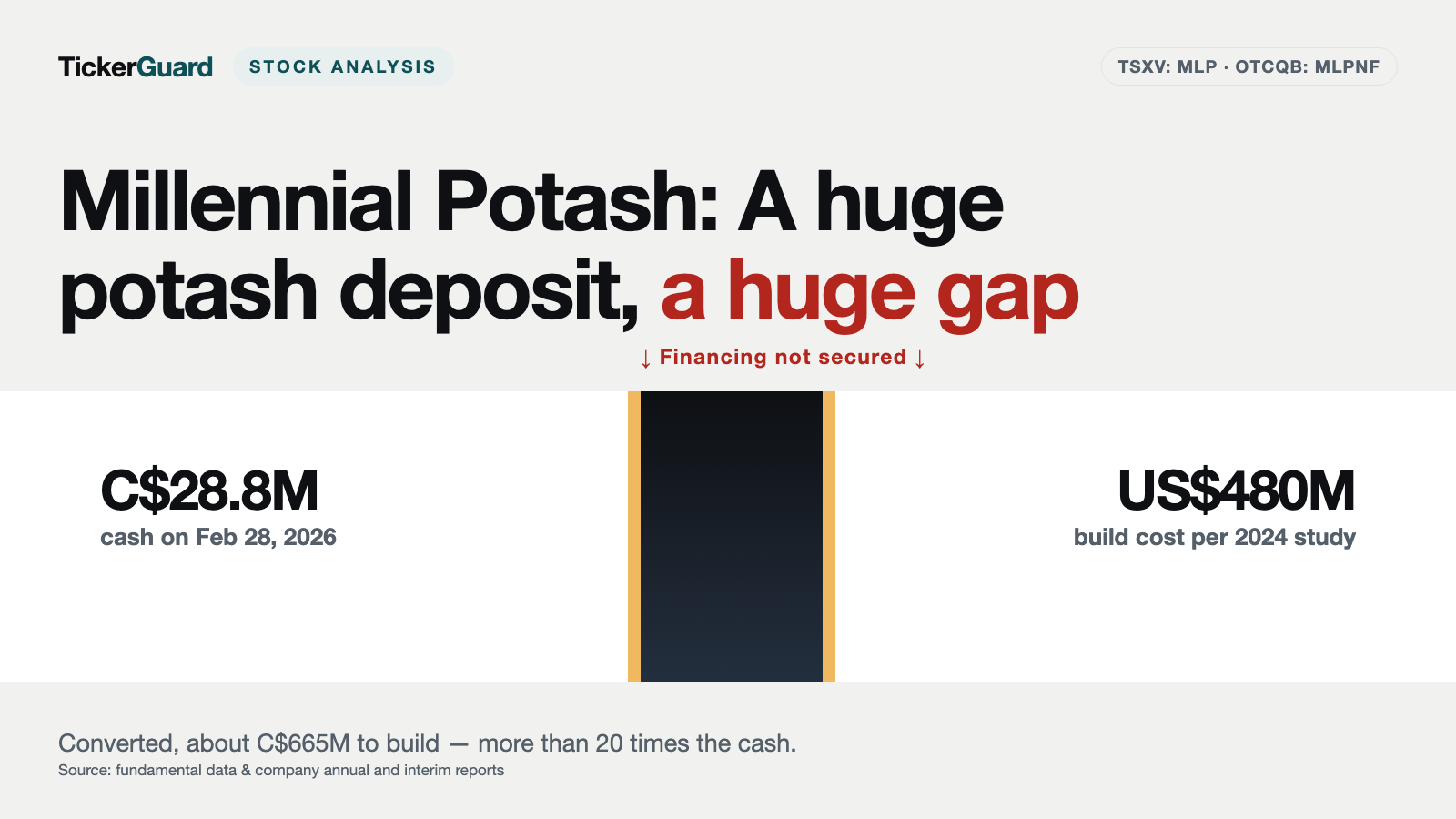
Millennial Potash (TSXV: MLP, OTCQB: MLPNF) wants to build a potash mine for fertilizer in Gabon. Its resource estimate grew to six billion tonnes of rock, the U.S. development bank DFC pledged money, and in 2025 the stock rose from C$0.345 to C$3.36. At the end of February 2026 the company held C$28.8 million in cash — the 2024 study puts the build cost at $480 million. The size of a deposit says little about who pays to dig it up.
 Thomas Mücke
Founder & Publisher
Thomas Mücke
Founder & Publisher
Chart
Interactive price chart (TradingView).
Note: pure fact-based analysis, not investment advice and not a solicitation to buy or sell. All figures without guarantee.
There is one investor weakness that works especially well with resource stocks: we let big numbers hypnotize us. A billion tonnes sounds like wealth, six billion like treasure. Call it tonnage hypnosis: the size of a deposit sticks in the mind, and the question of who will get it out of the ground — and with whose money — slips to the back.
Millennial Potash Corp. is a textbook case. The Canadian company wants to mine potash in Gabon, on the Atlantic coast of Central Africa — the raw material for potassium fertilizer. Its November 2025 resource estimate counts about six billion tonnes of potash-bearing rock. The U.S. development bank DFC pledged $3 million, two governments praise the project, and in 2025 the stock rose from C$0.345 to C$3.36. So let’s set the tonnes aside for a moment and read together what the financial statements and releases actually say. At the end, the decision is yours.
What Millennial Potash actually does
Potash is the trade name for potassium salts. The main traded product is potassium chloride, or KCl, sold as “muriate of potash” (MOP). Farmers spread it as fertilizer, and they do so every year — which makes potash a bulk commodity traded in millions of tonnes.
Millennial itself mines nothing. Through its Australian subsidiary Equatorial Potash and that company’s Gabonese subsidiary Mayumba Potasse, it owns the Banio Potash Project in southern Gabon, about 50 kilometers south of the coastal town of Mayumba on the border with the Republic of the Congo. Since April 2026 Millennial has held 80 percent; it can acquire the remaining 20 percent after the feasibility study for $3 million and 2.5 million of its own shares.
The plan in the 2024 study is a solution mine: wells are drilled into the salt beds, hot or cold water is pumped in to dissolve the potash, and the brine is piped to a plant near Mayumba, where potassium chloride is crystallized, dried and shipped. Think of dissolving a sugar cube in tea rather than breaking it up with a spoon. It saves shafts and miners but needs a lot of energy — the study plans a gas-fired power plant for that.
What does the company earn today? Nothing. The MD&A puts it this way:
“The Company does not currently have any revenue generating assets or operations.”
— Millennial Potash Corp., MD&A for the year ended August 31, 2025, Liquidity and Capital Resources
Before construction is even on the table, Millennial needs a mining license. Today it holds exploration permits — the Mayumba permit and, since February 24, 2026, the adjacent “Haute Banio” permit covering 261.39 square kilometers, about 1,500 square kilometers in total. The license application requires an environmental and social impact assessment and the feasibility study. According to the April 15, 2026, release, both are due by the end of 2026, and Millennial plans to apply in early 2027.
Company history for investors
-
2023
Black Mountain Gold becomes Millennial Potash
With approval of the purchase agreement in January 2023 the gold explorer acquired 25 percent of Banio and renamed itself on 01/24/2023. For shareholders, a complete restart.
-
2024
First resource estimate and PEA
January 2024 brought the first resource estimate, April the study with a $480M build cost. The market has measured Millennial against these figures ever since.
-
2025
DFC pledge and a multiplying share price
In June 2025 the U.S. development bank contractually pledged up to $3M; in November measured and indicated resources grew to 2.45B t. The stock rose from C$0.345 to C$3.36 over the year.
-
2026
C$18.3M in fresh money and 80 percent of Banio
The 01/29/2026 placement at C$3.05 funded the feasibility study and drilling; in April the stake rose to 80 percent, and in July the company switched to half-year reporting.
Why there is no annual report with the U.S. securities regulator
Millennial Potash files no annual report (10-K) and no quarterly report (10-Q). The company is not a reporting issuer with the U.S. securities regulator, the SEC. Under its identifier 0002066837 there is only a single Form D notice of May 22, 2025 — a private placement filing without financial statements. For a Canadian company with a home listing, that is normal.
Reporting follows Canadian rules (National Instrument 51-102) and IFRS, in Canadian dollars, on SEDAR+. The fiscal year ends on August 31, so fiscal 2026 runs from September 2025 to August 2026. That is why every figure in this analysis is sourced to “fundamental data & the company’s annual and interim reports.” We had no earnings call transcripts for Millennial; instead we worked through the financial statements, MD&As and news releases. We could not obtain the MD&A for the first half of fiscal 2026 — that half-year’s figures come from the interim financial statements themselves.
One feature is new. On July 8, 2026, Millennial announced that it will report only twice a year from now on. Canadian regulators allow this for small venture-exchange issuers with annual revenue below $10 million under an exemption (Coordinated Blanket Order 51-933):
“Pursuant to CBO 51-933, the Company is electing not to file interim financial reports and related management’s discussion and analysis (‘MD&A’) for the first and third quarters of its fiscal year.”
— Millennial Potash Corp., news release of July 8, 2026, “Millennial adopts semi-annual reporting”
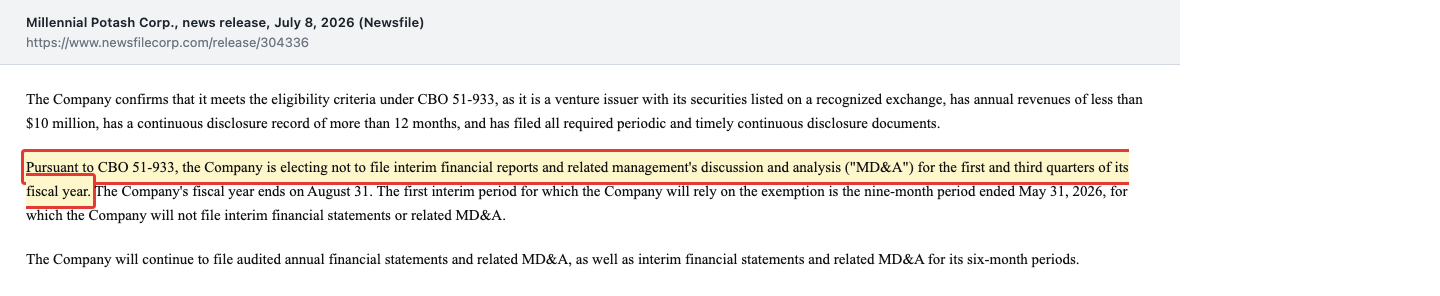
That is legal and saves money. For you it means the latest figures are as of February 28, 2026, and the next ones come with the annual statements for the year ended August 31, 2026 — last year’s are dated December 23, 2025. In between you only learn what is in news releases.
How the stock landed on our desk
To be upfront: Millennial Potash is not a hit from our in-house stock scanner, and it cannot be. The scanner works with revenue, earnings, margins and balance sheet ratios — an explorer without revenue fails every one of those filters. The stock made our research list through the forum hot list of the German investor site wallstreet-online, the ranking of stocks most discussed by German retail investors (as of October 2, 2026), under the U.S. symbol MLPNF. That is a signal of attention, not of quality.
MLPNF is the same stock as MLP on the TSX Venture Exchange in Toronto. The U.S. venue OTCQB is an over-the-counter market, not a regulated U.S. exchange; price discovery happens in Toronto in Canadian dollars. Anyone buying in the U.S. or Europe also carries the Canadian dollar’s moves.
On timeliness: since the interim statements to February 28, 2026, Millennial has announced four things that change the picture — the increase to 80 percent of Banio (April 15), the start of a four-hole drill program (May 12), the switch to semi-annual reporting (July 8) and first observations from drillhole BA-006 (August 26); the same release handed completion of the feasibility study to Micon International with Zenito and Agapito. All four are reflected here. The latest release, of September 15, 2026, about a visit by a U.S. diplomat to the project, contains no new figures.
The numbers over the years — given their due
Let’s start with what is genuinely impressive. In January 2023, after exchange approval of the purchase agreement, Millennial acquired its first 25 percent of Banio. Since then the team has turned old drill data into a project with a resource estimate, a preliminary economic assessment and a feasibility study under way, in just over three years. The resource estimate of November 17, 2025, prepared by the German engineering firm ERCOSPLAN, counts:
- measured resources: 648.2 million tonnes at 15.7 percent potassium chloride
- indicated resources: 1.80 billion tonnes at 15.6 percent
- inferred resources: 3.56 billion tonnes at 15.6 percent
Measured and indicated together come to 2.45 billion tonnes of rock containing about 383 million tonnes of potassium chloride. The estimate rests on four drillholes in the north of the permit; according to the company it covers only about 5 percent of the project area. Drillhole BA-006 in August 2026 hit about 80 meters of potash beds farther southwest; lab results are still pending.
The cash position has turned, too. On August 31, 2024, the company held C$1.57 million, a year later C$17.49 million and on February 28, 2026, C$28.82 million. There is no debt in the usual sense; the only long-term liability is an interest-free DFC advance, of which only $300,000 had been paid by February 28, 2026, which the DFC may only call if Millennial secures construction financing within ten years. The statements for the year ended August 31, 2025, carry no auditor emphasis of a material uncertainty about the company’s ability to continue as a going concern.
Now the other half of the picture. There was no revenue in any year. The losses:
- fiscal year to August 31, 2023: C$4.70 million
- to August 31, 2024: C$3.19 million
- to August 31, 2025: C$5.92 million
- first half to February 28, 2026: C$6.85 million (prior-year period C$2.57 million)
Drilling and study costs do not appear in these losses; they are capitalized as exploration assets. In the first half of fiscal 2026, C$4.30 million went out for them, plus C$3.26 million in operations and C$0.28 million for equipment — C$7.84 million in six months. At that pace, the cash on February 28, 2026, lasts a little over three more half-years. With drillholes of about 1,000 meters each and the feasibility study in the second half, the pace is more likely to rise. That is our rough arithmetic, not a company figure.
What the filings say — the uncomfortable truths
Now for the passages you will not find on the cover of a presentation. All of them come from the company’s own documents.
Uncomfortable truth No. 1: Six billion tonnes of resources, zero tonnes of reserves
Resources and reserves sound alike but are two different worlds. A resource is rock that geologists know or suspect is there. A reserve is the part of it that a feasibility study has shown can be mined profitably. It is the difference between “there is gold in the garden” and “it pays to dig for it.” Millennial says so itself:
“There are no known bodies of commercial minerals on the Company’s mineral properties.”
— Millennial Potash Corp., MD&A for the year ended August 31, 2025, Risks and Uncertainties

Then there is the type of rock. Almost all of it is carnallitite at about 15.5 percent potassium chloride; the richer sylvinite at about 24 percent accounts for only 35.2 million of the 2.45 billion tonnes of measured and indicated resources. More rock with less potash in it means more brine, more energy and more salt to get rid of. How well Banio’s carnallitite dissolves is only now being tested — according to the March 19, 2026, release, dissolution and creep tests on drill core are under way for the feasibility study.
One more detail on care: the January 13, 2026, release gives the measured and indicated grade as “16.6% KCl,” and the March 11, 2026, release gives the inferred grade as “17.6% KCl.” According to the resource estimate, both are 15.6 percent. That does not change the deposit, but it shows why figures in news releases should be checked against the technical report.
Uncomfortable truth No. 2: The build cost comes from a preliminary study — and is a multiple of the market value
The only cost estimate is the 2024 preliminary economic assessment (PEA) by Micon International and Agapito Associates. Its key figures: 800,000 tonnes of potash fertilizer a year, $480 million in build cost including a $62 million contingency, operating costs of $61 per tonne, an after-tax net present value of $1.07 billion at a 10 percent discount rate, an internal rate of return of 32.6 percent and a payback of 1.4 years. It assumes an average potash price of $387 per tonne delivered to Brazil over 25 years.
That sounds excellent. The same MD&A adds three caveats. First, the study relies on the older 2024 resource estimate and explicitly includes inferred resources that are “too speculative geologically” to be turned into reserves; “There is no certainty that the PEA will be realized.” Second, the costs are benchmark-based estimates with an accuracy of plus or minus 30 percent. Third, the math depends on components that do not exist today: a wellfield with 68 caverns, a brine pipeline of about 50 kilometers, a processing plant, a gas-fired power plant and a deep-water port at Mayumba. The Mangali port, whose first phase was completed in April 2025, has a quay for vessels with a three-meter draft — built and operated by Grande Mayumba Port Company and, according to Millennial, not built specifically for the company.
Now the comparison that breaks the tonnage hypnosis. At the exchange rate Millennial itself used for the first DFC advance ($300,000 = C$415,602), $480 million is about C$665 million. That is more than twice the market value of about C$285 million on October 1, 2026, and more than twenty times the cash on February 28, 2026. The DFC pledge of $3 million covers the feasibility study, not the mine. On construction financing, Millennial wrote on March 19, 2026, only that discussions with “numerous international institutions” are “in progress.”
Uncomfortable truth No. 3: The share count has more than doubled — and the next shares are already agreed
The cash in the bank was paid for by shareholders, with their stake in the company. Dilution simply means your slice of the pie gets smaller because more people are eating from the same pie.
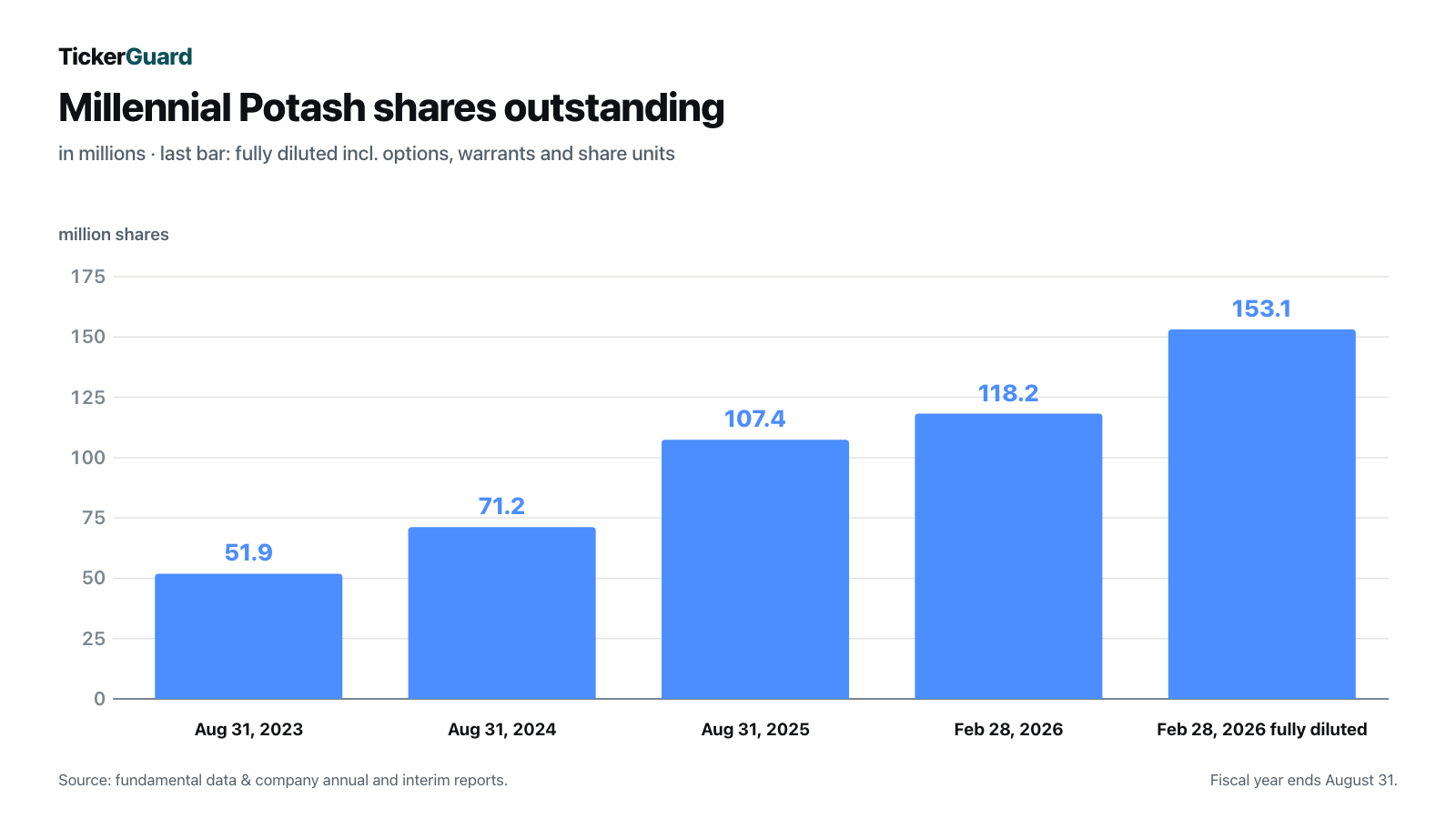
In the fiscal year to August 31, 2025, alone, Millennial raised C$22.9 million gross from placements, options and warrants, and another C$20.6 million in the following half-year — including a January 2026 placement of 6.0 million units at C$3.05 that brought in C$18.3 million gross. Each unit came with half a warrant; a whole warrant buys one share at C$4.00. On February 28, 2026, there were 10,578,050 stock options, 19,702,268 warrants and 1,624,550 restricted plus 3,000,000 performance share units outstanding. In April 2026 another 1,240,000 options at C$2.10 were granted.
And further shares are agreed that are not in any of these numbers: for the last 20 percent of Banio, $3 million and 2,500,000 shares fall due to the vendors after the feasibility study is completed. The MD&A states the underlying problem plainly: “any future financing may be dilutive to existing shareholders.” With a build cost that is a multiple of the market value, that is not boilerplate.
Uncomfortable truth No. 4: Two-thirds of expenses are stock-based pay — and investor relations cost extra
In the first half of fiscal 2026, Millennial booked C$7.16 million in expenses. The largest item is not drilling or studies but stock-based compensation for directors, officers and consultants:
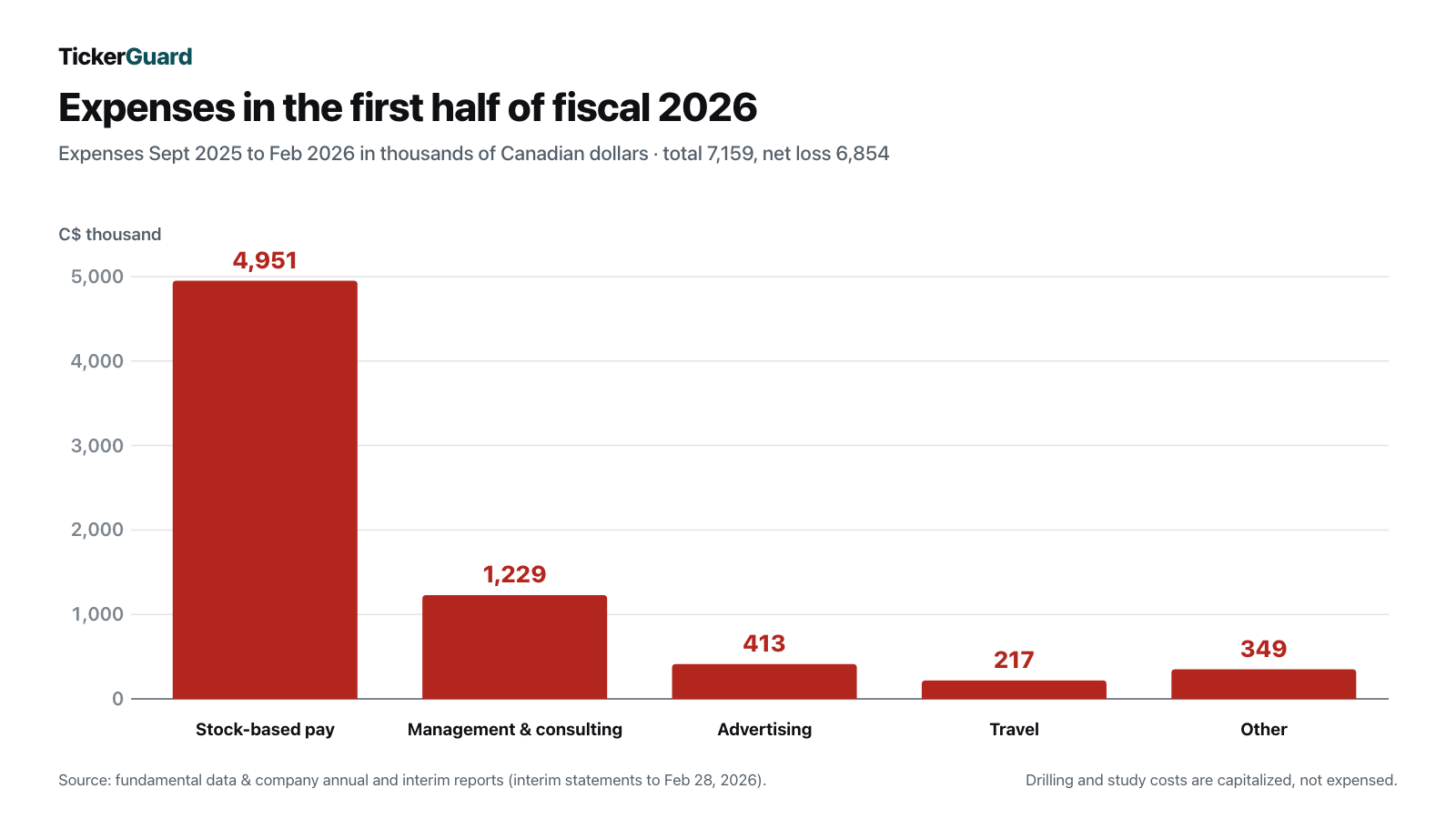
“During the six months ended February 28, 2026, the Company recorded share-based compensation of $4,950,849 (February 28, 2025 - $879,225) related to stock options vested.”
— Millennial Potash Corp., interim financial statements to February 28, 2026, Note 10

Stock-based pay costs no cash, but it is not free: it is paid by creating new shares. According to Note 12, C$3.41 million of it went to key management, whose total compensation including fees was C$4.25 million in the half-year. That is a lot for a company without revenue, even if part of the increase reflects the higher share price, which raises the value of every option.
For a company without revenue, Millennial spends a lot on visibility: C$0.41 million on advertising in the first half of fiscal 2026, plus paid service providers. In September 2025 it announced three investor relations agreements (Vorticom, $7,500 a month; Proactive, C$28,000 a year; Fundamental Research, C$29,000 for up to five research reports), and in April 2026 two more: Capital Analytica for social media work ($150,000 for six months plus 150,000 options) and Zacks Small Cap Research for paid research. Of the four analysts the investor page lists as covering the company, two come from firms that led the January 2026 placement and earned about C$1.05 million in commission for it (Cantor Fitzgerald, SCP Resource Finance), and one from Fundamental Research, which is paid for its reports. Paid research is common in Canada and disclosed. It just should not be mistaken for an independent verdict.
Uncomfortable truth No. 5: One country, one permit area, one project
Millennial has exactly one project in exactly one country. Whether it becomes a mine depends on Gabon’s government (license, royalties, infrastructure), lenders (construction financing) and the potash price. The study assumes a 7.5 percent royalty and 30 percent corporate tax; both are set politically and can change. Gabon has been led since August 2023 by Brice Oligui Nguema, who was elected president in April 2025 with 90.35 percent of the vote; Millennial described this in its April 15, 2025, release as a return to civilian rule.
The political backing is visible: in March 2026 Millennial accompanied Gabon’s mines minister at the PDAC mining convention in Toronto, in July 2026 he visited the project, and in September 2026 a U.S. embassy delegation did. Visits are not a license, though. Until the application in early 2027 and the decision that follows, Banio is legally an exploration area.
Valuation: What the market pays for a mine that does not exist yet
With 118,213,207 shares (February 28, 2026, plus 5,000 from warrants per Note 17) and a close of C$2.41 on October 1, 2026, Millennial is worth about C$285 million on the market. That is a floor: warrants at C$0.35 that expired between June and August 2026 were probably exercised in part, but nothing has been reported. Subtracting the February 28, 2026, cash leaves about C$256 million — and cash has likely shrunk since.
There is no price-to-earnings or price-to-sales ratio. Equity stood at C$49.7 million on February 28, 2026, so the market pays almost six times book value, much of which is cash (C$28.8 million) and capitalized drilling and study costs (C$19.2 million).
The valuation rests on the preliminary study. Its net present value of $1.07 billion applies to 100 percent of the project, before financing, before any dilution and based on a study with plus or minus 30 percent accuracy. Millennial holds 80 percent today. The net present value of the whole project converts to just under C$1.5 billion; the 80 percent stake accounts for about C$1.2 billion. Paying C$285 million for it is a bet that the feasibility study confirms the numbers and that construction is financed on bearable terms. Both are open.
How much hope is priced in shows in the twelve-month range: between C$1.73 (closes on March 27 and April 23, 2026) and C$3.89 (December 22, 2025). Anyone who bought in the January 2026 placement at C$3.05 is under water; anyone who bought in early 2025 at C$0.345 is up several times over. The TSX Venture Exchange ranked Millennial third on its list of top performers for 2025; the company cites a 950 percent share price gain, while the closes of January 2 and December 31, 2025, give about 874 percent. We worked through a similar pattern — a strategic raw material, government backing, construction financing still open — in our NioCorp analysis; for what happens when the cost of a planned plant is revised upward, see our Ucore Rare Metals analysis.
Upside and risks at a glance
What speaks for the company:
- The deposit is large and has grown. 2.45 billion tonnes of measured and indicated resources (November 2025) after 657 million tonnes of indicated resources in 2024; according to the company the estimate covers only about 5 percent of the project area.
- The location is favorable. The project sits on the Atlantic coast; the preliminary study assumes freight of $22 per tonne to Brazil, its assumed market.
- Cash is in place for the next step. C$28.8 million on February 28, 2026, no interest-bearing debt, fiscal 2025 statements without a going-concern emphasis; according to the company the feasibility study and environmental assessment are funded.
- Government partners. The U.S. development bank DFC has pledged up to $3 million, Gabon’s government publicly supports the project, and since November 6, 2025, potash has been on the U.S. Geological Survey’s list of critical minerals.
- An experienced project developer on board. Jack Scott, appointed in February 2026 to lead project development, was involved according to the company in an Allana Potash project that was later sold to Israel Chemicals. Millennial itself, per its February 18, 2026, release, is evaluating “strategic partnership opportunities” alongside building on its own.
What speaks against it:
- No reserves, no license, no revenue. There are only resources and exploration permits; the license application is planned for early 2027.
- The financing gap is huge. $480 million build cost per the 2024 PEA versus C$28.8 million in cash and about C$285 million in market value.
- Dilution is built in. Share count more than doubled since August 2023, 153.1 million fully diluted, 2.5 million shares agreed for the last 20 percent of Banio.
- Carnallitite rather than sylvinite. About 15.5 percent potassium chloride in the main rock; whether solution mining works as planned is being tested in ongoing dissolution trials.
- Less transparency. Only half-year reports since July 2026, plus paid research and heavy spending on investor relations.
- One country, one project. Royalties, taxes, infrastructure and the license all depend on Gabon’s government.
A human conclusion
Remember the tonnage hypnosis from the start? Millennial’s statements do not sugarcoat. They say there are no reserves, that the cost estimate is preliminary, that any financing may dilute. The hypnosis is not in the report but in us: we read “six billion tonnes” and already picture freighters off the coast of Gabon.
The deposit is real, and the team has done a remarkable amount with it in three years. But whether Banio becomes a mine will not be decided by tonnes; it comes down to three sober questions: Does the feasibility study at the end of 2026 confirm the build cost and the economics? Does Millennial get a mining license in 2027? And who pays for construction — at what price for today’s shareholders?
What you make of it is your decision. And that is exactly as it should be.
Sources and data as of
- Unaudited interim financial statements to February 28, 2026, approved by the board on April 29, 2026
- Consolidated financial statements for the year ended August 31, 2025, auditor’s report dated December 23, 2025
- MD&A for the year ended August 31, 2025, dated December 23, 2025 (with the 2024 PEA and the 2025 resource estimate)
- News releases: potash on the U.S. critical minerals list (November 10, 2025), early warning report by The Quaternary Group (December 16, 2025), technical report on the resource estimate (December 29, 2025), start of the feasibility study (January 13, 2026), closing of the placement (January 29, 2026), Haute Banio permit (February 24, 2026), mines minister at PDAC (March 11, 2026), progress report (March 19, 2026), 80 percent of Banio and agreements with Capital Analytica and Zacks (April 15, 2026), Phase 3 drill program (May 12, 2026), semi-annual reporting (July 8, 2026), drillhole BA-006 (August 26, 2026), U.S. embassy visit (September 15, 2026)
- Further releases on the company website: presidential election in Gabon (April 15, 2025), Mangali port, first phase (April 22, 2025), TSX Venture 50 (February 18, 2026)
- Investor relations agreements (September 19, 2025) and the investor page with its analyst list
- SEC entry CIK 0002066837 (a single Form D notice)
- Price and market value data: fundamental data, as of October 1, 2026
Data as of: company figures as of February 28, 2026, or the date stated; releases through September 15, 2026; prices as of October 1, 2026. The company’s news page was last checked on October 2, 2026. The reporting currency is the Canadian dollar; U.S. dollar amounts are marked as such ($). Calculated values (market value, cash runway, currency conversion of the build cost) are our own rough arithmetic and labeled as such.
Disclaimer: This article is journalistic commentary and not investment advice. It is not a recommendation or a solicitation to buy or sell securities. Shares of exploration companies without revenue are especially volatile; a total loss of the capital invested is possible. Positions held by the operator are disclosed daily; where one exists, it appears as a notice at the top of this deep dive.
Our Bottom Line at a Glance
- Deposit positive
- The resource estimate of November 17, 2025, lists 2.45 billion tonnes of measured and indicated and 3.56 billion tonnes of inferred resources at about 15.6 percent potassium chloride — based on four drillholes that according to the company cover only about 5 percent of the area.
- Financial position positive
- Cash stood at C$28.8 million on February 28, 2026, with no interest-bearing debt. The statements for the year ended August 31, 2025, carry no going-concern emphasis; according to the company the feasibility study and environmental assessment are funded.
- Project stage negative
- No reserves, no mining license, no revenue. The only cost estimate is the 2024 PEA with $480 million build cost and plus or minus 30 percent accuracy; the feasibility study is due by the end of 2026, the license application in early 2027.
- Financing gap negative
- A build cost of about C$665 million at the company’s own exchange rate compares with C$28.8 million in cash (February 28, 2026) and about C$285 million in market value (October 1, 2026). On construction financing there are, per the March 19, 2026, release, only discussions.
- Dilution negative
- Shares outstanding rose from 51.9 million (August 31, 2023) to 118.2 million (February 28, 2026); fully diluted it would be 153.1 million. Another 2.5 million shares are agreed for the last 20 percent of Banio.
- Costs and transparency neutral
- In the first half of fiscal 2026, C$4.95 million of C$7.16 million in expenses was stock-based pay. Paid research and investor relations contracts come on top. Since July 2026 Millennial reports only twice a year.
Millennial Potash is developing a large potash deposit in Gabon: 2.45 billion tonnes of measured and indicated resources, an 80 percent project interest, C$28.8 million in cash and backing from the U.S. development bank DFC. Against that stand a company without reserves, without a mining license and without revenue, a $480 million build cost per the 2024 preliminary study, a share count that has more than doubled since August 2023 and construction financing that is still open. At the October 1, 2026, close of C$2.41, Millennial is worth about C$285 million. Not investment advice.
What Our Rating Means
Open questions
The business works in principle, but one material question is open. As long as it stays open, our findings do not carry a quality verdict.
Yellow here is not about the share price. Red would be wrong: on February 28, 2026, Millennial had C$28.8 million in cash and no interest-bearing debt, its fiscal 2025 statements carry no going-concern emphasis, and at the first-half pace the money lasts a little over three more half-years. Green would be just as wrong, because the decisive operational question is open: there are no reserves, no mining license and no construction financing, and the only cost estimate is a preliminary study with plus or minus 30 percent accuracy. The outcome hinges on a single event — the feasibility study at the end of 2026 and the financing after it. That is exactly what the yellow level describes. Anyone watching the stock should track three things: the build cost in the feasibility study, the license decision and the share count in the next annual statements. The decision is yours.
A journalistic assessment by our editorial team at the time of the deep dive, based on public sources — not investment advice and not a solicitation to buy or sell. Your personal circumstances (investment goals, risk capacity, taxes) cannot be taken into account. What our levels mean, how verdicts are formed, and what conflicts of interest exist →
Worth Noting
- This analysis was triggered by the U.S. OTCQB symbol MLPNF on the forum hot list of the German investor site wallstreet-online (as of October 2, 2026); the company is carried under its home listing MLP (TSX Venture Exchange) as MLP.TO. There is no hit from our in-house stock scanner, and there cannot be: the company has neither revenue nor profit.
- Millennial Potash is not an SEC reporting issuer (CIK 0002066837, Form D only). All company figures come from the Canadian filings: consolidated statements and MD&A for the year ended 08/31/2025 (12/23/2025), interim statements to 02/28/2026 (04/29/2026) and news releases through 09/15/2026. We could not obtain the half-year MD&A; earnings call transcripts were not available.
- Since 07/08/2026 Millennial reports only twice a year. There is no interim report for the nine months to 05/31/2026; the next figures come with the annual statements for the year ended 08/31/2026.
- Calculated values are our own rough arithmetic: market value from 118,213,207 shares times the 10/01/2026 close (a floor, because exercises after 02/28/2026 have not been reported), cash runway from the first-half outflow, and the conversion of the build cost at the rate Millennial used for the first DFC advance ($300,000 = C$415,602).
The full analysis as a PDF for later
We will send you this analysis as a PDF — to print, file away, and read at your own pace.
Frequently Asked Questions
Millennial Potash is developing the Banio Potash Project in southern Gabon, about 50 kilometers south of the coastal town of Mayumba. It plans a solution mine for potassium chloride, which is sold as fertilizer. The company has held 80 percent of the project since April 2026, has no revenue and so far only exploration permits.
The November 2025 resource estimate lists 648.2 million tonnes of measured, 1.80 billion tonnes of indicated and 3.56 billion tonnes of inferred resources at about 15.6 percent potassium chloride. There are no reserves — that requires a feasibility study, which is due by the end of 2026.
The 2024 preliminary economic assessment puts it at $480 million for 800,000 tonnes of potash fertilizer a year, with an accuracy of plus or minus 30 percent. A firmer figure will come only from the feasibility study. On February 28, 2026, the company held C$28.8 million in cash.
No. The company holds exploration permits covering about 1,500 square kilometers. A license application requires the environmental and social impact assessment and the feasibility study; according to the April 15, 2026, release both are due by the end of 2026, and the application is planned for early 2027.
Because Millennial Potash is not a U.S. reporting issuer. It is incorporated in British Columbia, listed on the TSX Venture Exchange and reports under Canadian rules in Canadian dollars under IFRS on SEDAR+. The SEC holds only a single Form D notice under identifier 0002066837.
It is the same stock. MLP is the symbol on the home exchange, the TSX Venture Exchange, where prices are set in Canadian dollars. MLPNF is the symbol on the U.S. OTCQB market, an over-the-counter venue. TickerGuard carries the stock as MLP.TO.
Since its July 8, 2026, announcement, Millennial uses a Canadian exemption for small venture-exchange issuers (CBO 51-933). Interim reports for the first and third quarters are dropped, starting with the nine months to May 31, 2026. Annual and half-year reports remain mandatory.
Found an error?
Did you spot a factual error, an outdated number, or a typo in this deep dive? Let us know briefly — your report goes straight to the editorial team.