Airship AI: $29M Profit on Paper, $8M Outflow From Operations
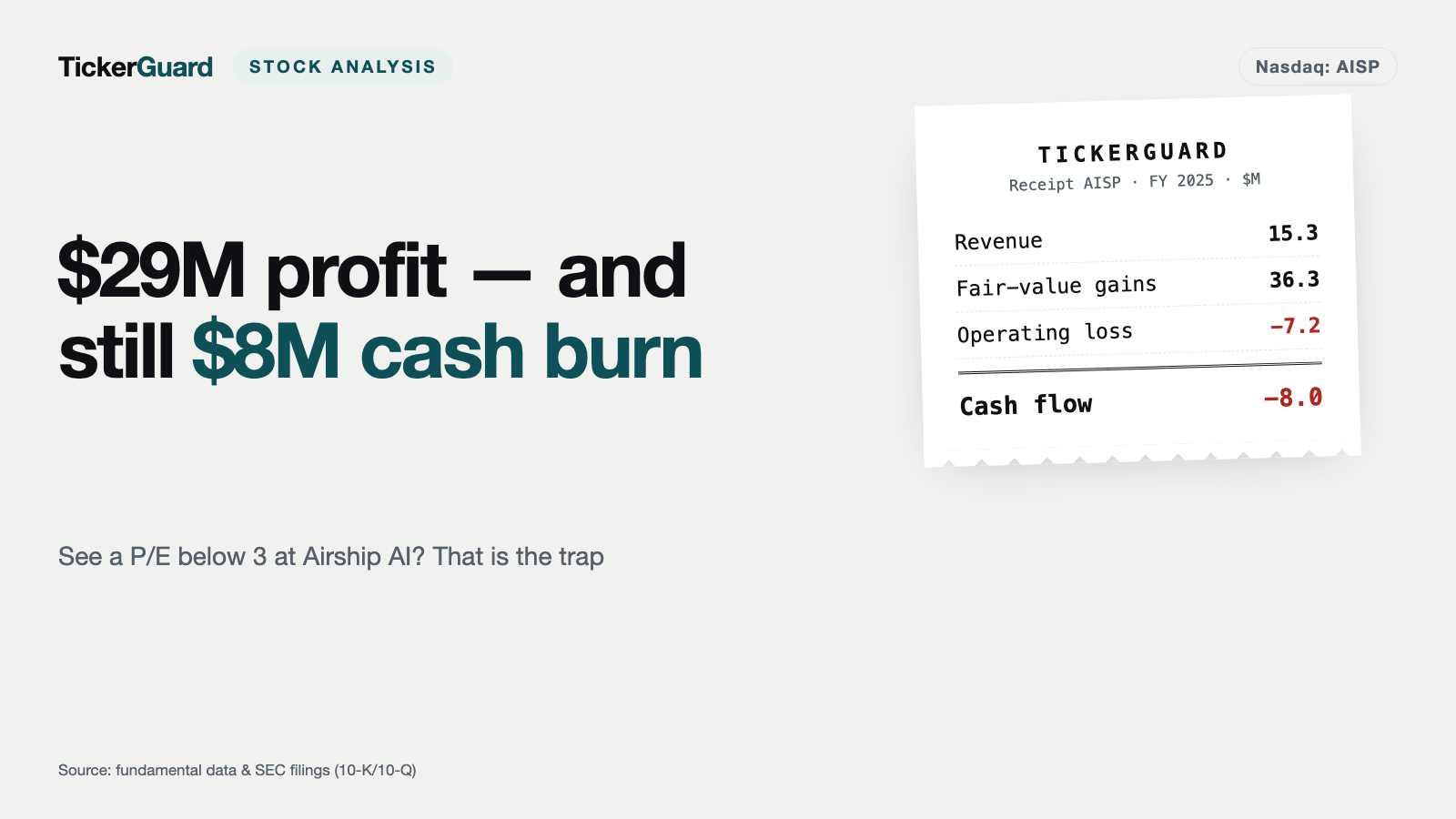
Airship AI reports a $29.3 million profit for 2025, while $8.0 million flowed out of day-to-day operations in the same year. The large numbers live on paper, the small ones in the bank account — we checked both.
 Thomas Mücke
Founder & Publisher
Thomas Mücke
Founder & Publisher
As of Today
As of: October 2, 2026
- Closing price
- 2.10 $ -4.50%
- Market Capitalisation
- 0.1 $B
- P/E
- 2.6
- Growth Score
- 6/10
- AAQS
- 2/10
Price change since October 1, 2026: -5.4%
This analysis has a cut-off date. The Stock Guard tells you when something material changes in the numbers. Reserve your free spot
Chart
Interactive price chart (TradingView).
52-week range: 1.70 $ to 7.00 $ · Last price: 2.10 $ (As of: October 2, 2026)
Note: pure fact-based analysis, not investment advice and not a solicitation to buy or sell. All figures without guarantee.
Psychologists have studied one thinking error for decades: the anchoring effect. The first big number we hear sticks in our heads and colors everything that comes after it. If you first read “$206 million,” then $15 million afterward feels surprisingly small — and you forget that the first number was a hope and the second one a fact. In the stock market, the anchor is often a headline, a price target or a ratio from a database that nobody has recomputed.
Airship AI is a textbook case of how many anchors a small company can throw out. On October 1, 2026, 41.9 million shares changed hands; on the trading days of September 2026, it was between 142,500 and 333,200. The closing price rose from $1.86 on September 30 to $2.22, after touching $2.86 during the session. There was no current report (Form 8-K) with the U.S. securities regulator, the SEC, that day — the latest earnings release dates from August 6, 2026, and management sounds very confident in it:
“The funding constraint is resolved, requirements are defined, and our partner channel is trained and in front of customers. What we said would need to happen has happened.”
— Paul Allen, President of Airship AI, earnings release of August 6, 2026, Exhibit 99.1 to the Form 8-K filed with the SEC
So let’s put the confidence next to the filings and read together what Airship AI itself has reported to the SEC — the annual reports (10-K) for 2023, 2024 and 2025, the quarterly report (10-Q) for the period ended June 30, 2026, and every filing through October 1, 2026. The central tension of this analysis: the big numbers live on paper, the small ones in the bank account. A $29.3 million annual profit, a $206 million pipeline and an addressable market of “more than $70 billion” sit next to $15.3 million in annual revenue, $12.4 million in cash and five customers who bring in almost all of the revenue. Which numbers count for you is your call. One note up front: the key-figures box on this page may show Airship AI at a P/E below 3 — why that number is an accounting artifact is explained in truth No. 1.
What Airship AI actually does — cameras that read license plates
Picture a surveillance camera at a border crossing. It produces hours and hours of video that no human can watch in full. That is where Airship AI comes in: a trained AI model spots a car in the frame, reads the license plate, identifies make, model and color, and stores the result as a searchable record. Raw video becomes a list an agency can set an alert on — for example, “tell me as soon as this plate shows up.” The annual report calls this “structuring” data.
The offering has three building blocks. Outpost AI is hardware plus software that does the analysis right at the camera, at the “edge” of the network. Acropolis is the management software behind it, which pulls everything from a handful of cameras up to hundreds of thousands into one place. Airship Command is the user interface for control rooms, browsers and phones. On top come maintenance and support contracts that run for several years. Newly in development is Ask Airship, an assistant that is meant to let users query their data in plain language.
The customers are mainly U.S. federal law enforcement and homeland security agencies, plus a few large companies. The company is based in Redmond, Washington; at the end of 2025 it had 63 employees, eight of them in research and development in Taiwan. Airship AI went public through a merger with the shell company BYTE Acquisition Corp. — a SPAC, meaning a company that listed solely to later take in a real business. The merger closed on December 21, 2023, and the stock has traded since December 22, 2023. Until that merger, Airship AI says it was 100 percent employee-owned and had never taken outside investment. It holds no patents; according to the annual report, it relies on trade secrets.
Company history for investors
-
2023
Listing via a SPAC
Merger with BYTE Acquisition Corp. on Dec. 21, 2023. Shareholders also inherit 16.7 million warrants and up to 5 million earnout shares.
-
2024
Highest revenue since 2022 and a $57.5M paper loss
Federal orders of more than $16 million lift revenue to $23.1 million. The rising share price inflates the fair-value items: net loss of $57.5 million.
-
2024
Exercise price cut twice
The SPAC warrants now cost $7.80, then $4.50 per share instead of $11.50 — the road to fresh cash runs through more shares.
-
2025
Revenue −34%, profit on paper
Revenue of $15.3 million against a $137 million pipeline at the start of the year. The falling share price creates $29.3 million of net income; operations use $8.0 million.
-
2026
Better half-year, new shelf
First-half revenue +37%, backlog $6.9 million. Since May 19, 2026, Airship AI can issue securities worth up to $100 million.
How the stock landed on our desk — 41.9 million shares in a single day
Not through a fundamentals screen. Airship AI landed on our desk in early October 2026 through our Reddit hype scanner, which tracks every day which small U.S. stocks are the talk of the investing forums. Arithmetically, every one of the 34.4 million shares outstanding changed hands more than once on October 1, 2026, in a single day.
We could not find a documented trigger: neither a current report (Form 8-K) with the SEC nor a company announcement in our news data carries that date. The only filing that day is an amendment to an insider report (Form 4/A) — it concerns a gift of 200,000 shares by CEO Victor Huang on June 3, 2026, so no sale and nothing new. A trading day like that mostly reflects the attention of many market participants, not a new finding. Rule of thumb: a volume spike without news is an anchor without a ship — it shows that many people are looking, not what they are seeing.
The numbers over the years — an honest look
First, what deserves credit. Airship AI has no bank debt. As of June 30, 2026, it held $12.4 million in cash, and in the first half of 2026 operations actually brought in money — $0.58 million — mainly because customers paid $2.7 million of open invoices. Revenue rose 37 percent to $10.5 million in the first half of 2026, and 92 percent to $4.1 million in the second quarter alone. Gross margin — what is left of revenue after the direct costs of hardware and support — was 75 percent in the second quarter; for full-year 2025 it was 50 percent. On top of that come $8.9 million of maintenance contracts that are signed but not yet delivered and will only be booked as revenue later.
A signal from the inside belongs here, too. According to the insider reports (Form 4), executives bought stock in the open market between November 2025 and March 2026: CEO Victor Huang bought 51,000 shares at $3.18 on November 20, 2025, another 10,000 the following day and 40,000 at $2.24 on March 20, 2026; President Paul Allen bought 100,000 shares at $2.74 on December 29, 2025; director Louis Lebedin bought 50,000 shares at $3.18 on November 18, 2025. The insider reports since November 2025 show no open-market sale. The picture is not entirely one-sided, though: on February 25, 2026, co-founder and Chief Operating Officer Derek Xu filed a Form 144 notice of his intent to sell 100,000 founder shares worth about $286,000; we did not find an insider report confirming the sale.
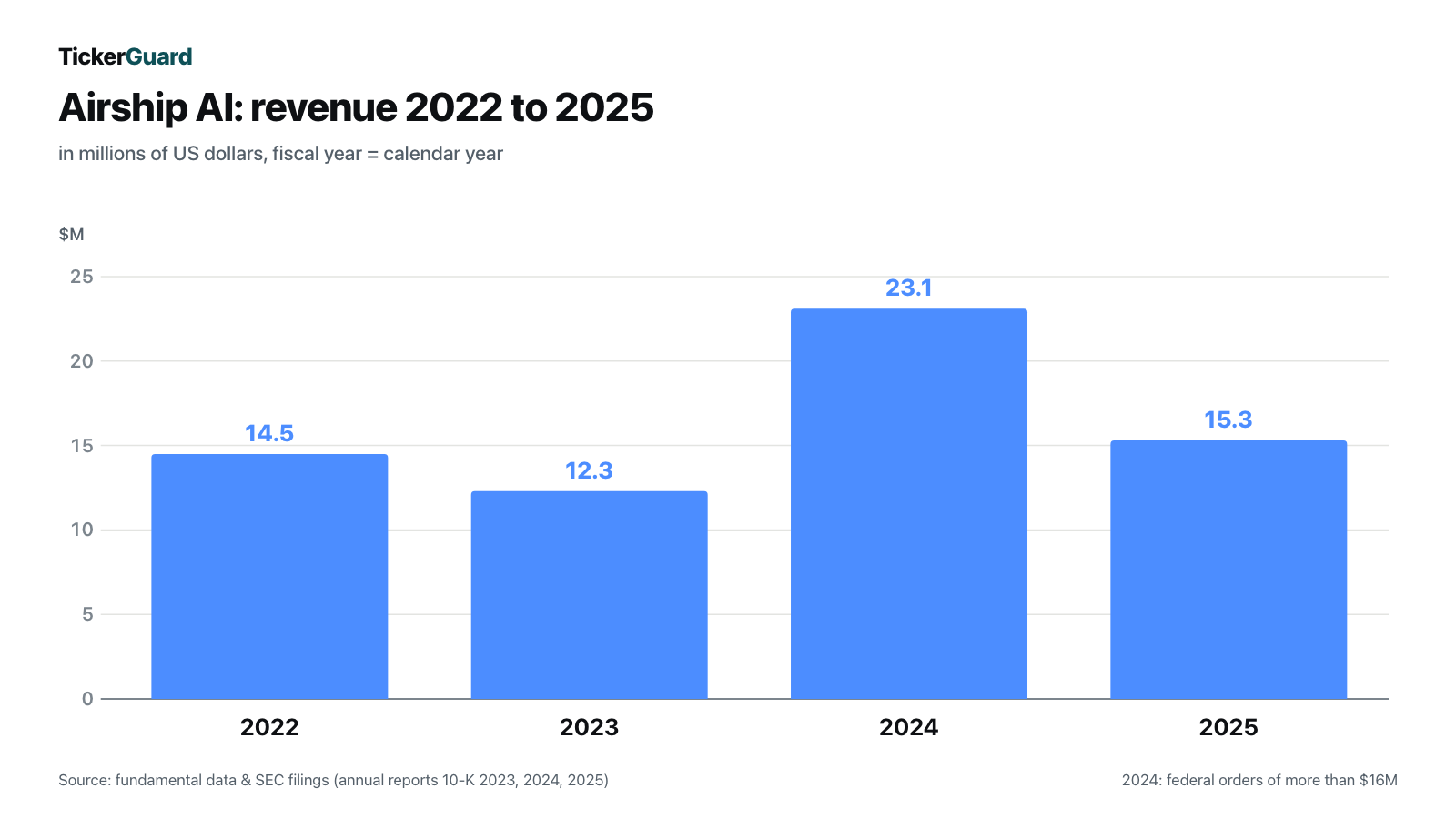
The flip side is right there in the chart. There is no growth path over the years: revenue of $14.5 million in 2022, $12.3 million in 2023, then a jump to $23.1 million in 2024 and a drop to $15.3 million in 2025 — down 34 percent. The company itself explains the jump with federal orders of more than $16 million that were mostly shipped in 2024. That is the pattern of a project business: one big order makes a good year, its absence a bad one. And Airship AI has not made money from operations in any year since going public: the operating result was a loss of $6.6 million in 2023, $3.5 million in 2024 and $7.2 million in 2025. Operating cash outflow was $6.5 million in 2024 and $8.0 million in 2025.
Uncomfortable truth No. 1: The $29 million profit did not come from the business
For 2025, Airship AI reported net income of $29.3 million — almost twice its entire annual revenue. If you only read that line, Airship AI looks like a profit machine. If you read the annual report, you find the explanation in the risk factors:
“The net income for the year ended December 31, 2025 was $29,321,000 primarily as a result of the gain from change in fair value of change in fair value [sic] of warrant liability of $20,853,000 and the gain from change in fair value of change earnout liability of approximately $15,402,000.”
— Airship AI Holdings, Inc., annual report on Form 10-K for 2025, Item 1A (Risk Factors)
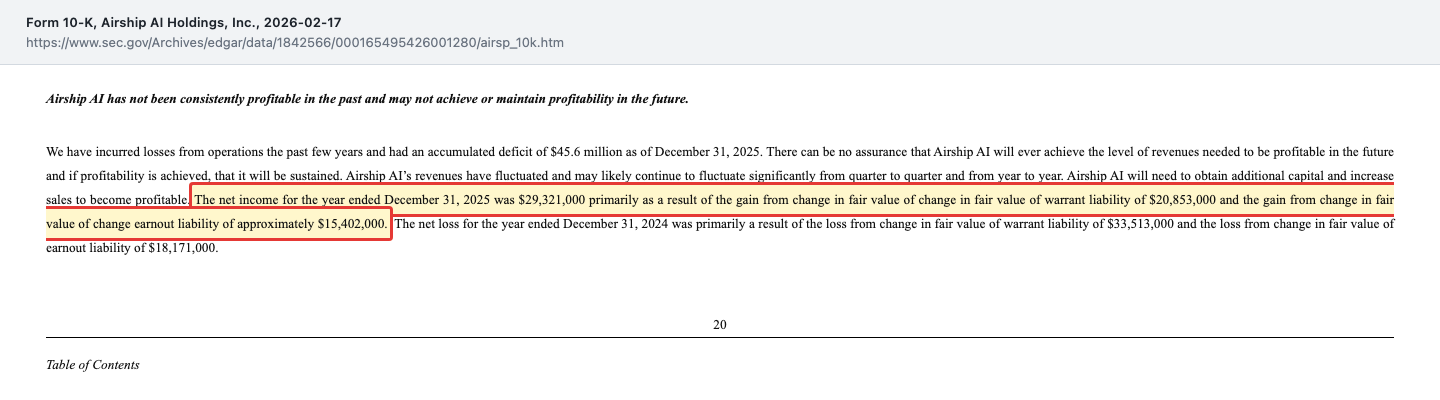
What is behind it? From the SPAC merger, Airship AI inherited two kinds of promises. The warrants let their holders buy shares at $4.50 until December 21, 2028. The earnout shares are bonus shares for the legacy owners that are only issued once certain targets are hit. Both sit on the balance sheet as liabilities, at current market value. When the share price rises, those promises become more valuable — the liability grows and the company books a loss. When the price falls, the liability shrinks and a gain appears. In 2025, the stock fell from $6.26 at the end of 2024 to $2.89 at the end of 2025 (source: fundamental data) — hence the profit. In 2024 it was the other way round: the price rose, and the same items produced a net loss of $57.5 million. None of these items moves any cash.
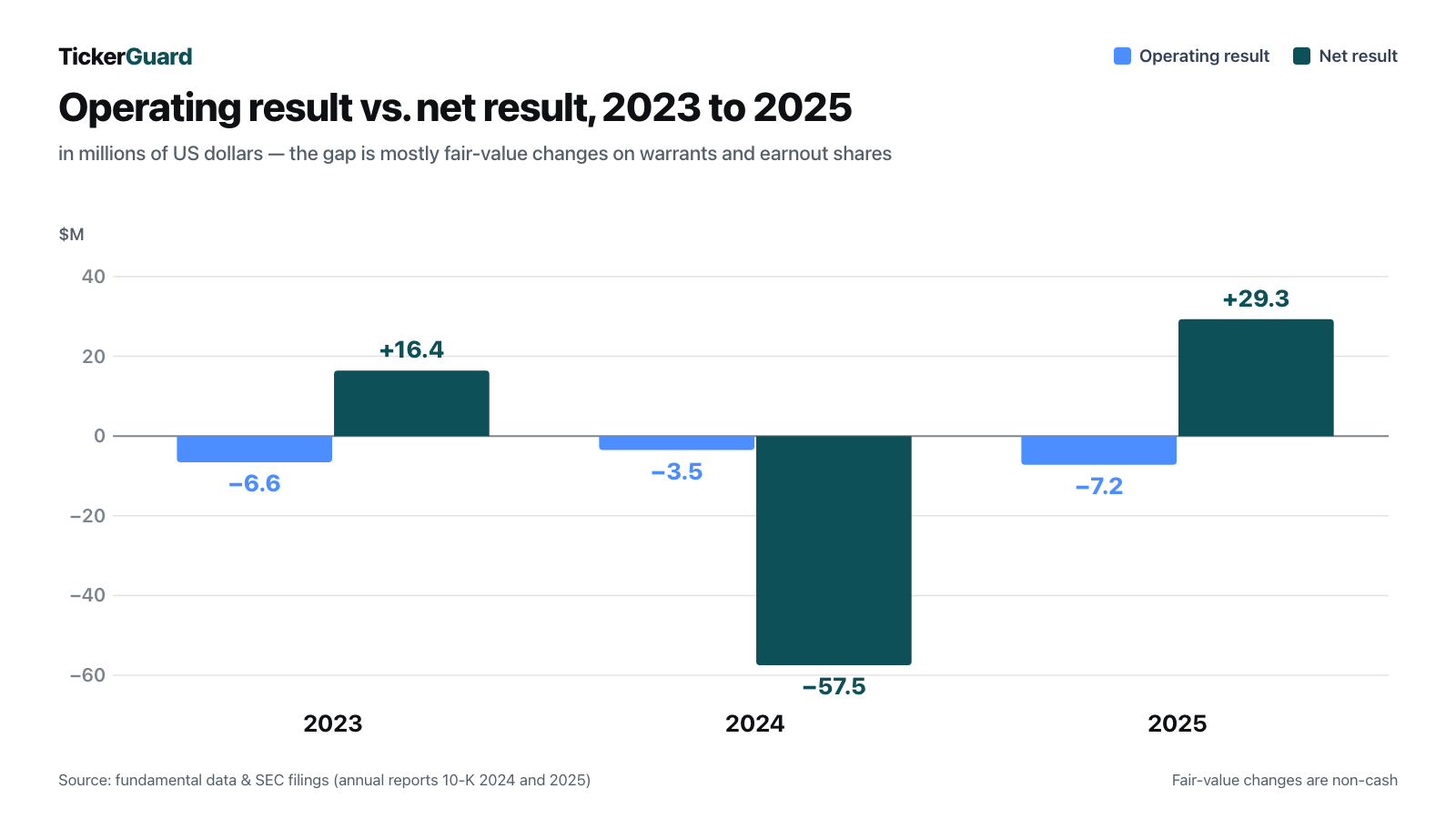
Two consequences are worth knowing. First: any database that computes the price-to-earnings ratio from net income shows Airship AI at a P/E below 3 — a seemingly dirt-cheap stock. The key-figures box on this page may show such a value, too. It is an arithmetic result, not a finding. Second: the same items push stockholders’ equity below zero. As of June 30, 2026, the balance sheet carried a $12.7 million warrant liability and a $3.5 million earnout liability, $16.2 million combined; stockholders’ equity stood at minus $8.6 million. Without those two items, it would be positive at about $7.6 million. According to the company, they are not expected to be paid out of cash:
“Derivative warrant and earnout shares liabilities are classified as non-current liabilities as their liquidation is not reasonably expected to require the use of significant current assets or require the creation of current liabilities.”
— Airship AI Holdings, Inc., quarterly report on Form 10-Q for the period ended June 30, 2026, Note 2 (Summary of Significant Accounting Policies)
That is the good news behind the bad number. The bad news behind the good one: the 2025 “profit” did not bring the company a single dollar. Rule of thumb: at former SPACs, net income often says more about the share price than about the business — read the operating result and the cash flow first.
Uncomfortable truth No. 2: A $206 million pipeline, $15 million of revenue
Here the anchoring effect returns, this time from the company itself. Airship AI regularly reports its “validated pipeline” — the sum of all contracts it is actively pursuing. The annual report for 2024, filed on February 28, 2025, said: “For 2025, we start with a pipeline of $137 million,” and called that pipeline the path to substantial growth over the next 12 to 18 months. Revenue for 2025 then fell 34 percent to $15.3 million. At the end of 2025 the pipeline stood at $173.4 million, on August 6, 2026 at $206.1 million. What that means is spelled out right after it in the quarterly report:
“Backlog reflects awards already executed, whereas pipeline reflects identified and qualified opportunities that have not yet resulted in awards. We can give no assurance as to whether, when, or in what amount pipeline opportunities will convert into backlog or revenue.”
— Airship AI Holdings, Inc., quarterly report on Form 10-Q for the period ended June 30, 2026, Item 2 (Recent Developments, Backlog and Pipeline)
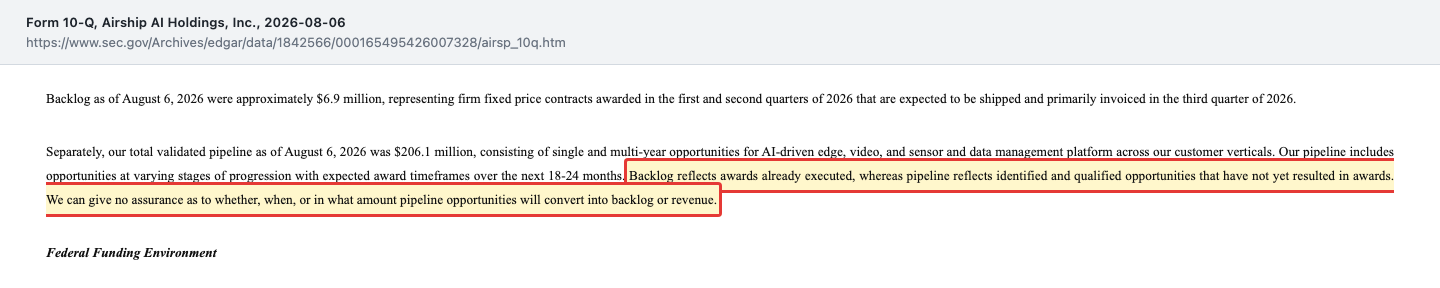
The firm backlog — signed contracts still to be delivered — stood at $6.9 million on August 6, 2026, up from $3.3 million at the end of 2025. That is real progress, but on a different scale: the pipeline is about 30 times the backlog. It is a similar story with the addressable market. In the annual report of February 17, 2026, Airship AI cited a $7 billion addressable market by 2029; in the quarterly report of August 6, 2026, it is “more than $70 billion” for 2026, because robotics and so-called agentic AI are now counted in — both areas where, by its own account, the company is still developing products. The market did not grow tenfold in six months; the math changed.
To be fair: on August 6, 2026, management wrote that several of the largest pipeline opportunities at the Department of Homeland Security were “anticipated to close in the third quarter of 2026,” and that the funding for them had been enacted in June 2026. Whether that happened will only show in the next quarterly report. Rule of thumb: a pipeline is a wish list with numbers — only what is in the backlog counts.
Uncomfortable truth No. 3: Five customers, 88 percent of revenue
Imagine your neighbor tells you his business is doing great. Then he mentions in passing that five customers bring in almost all of his revenue. Would you swallow hard for a second? At Airship AI, exactly that sits in the notes to the quarterly report:
“For the six months ended June 30, 2026, the Company had revenue from ninety three customers and five customers represented 88% of total revenue.”
— Airship AI Holdings, Inc., quarterly report on Form 10-Q for the period ended June 30, 2026, Note 2 (Concentration of Credit and Sales Risk)
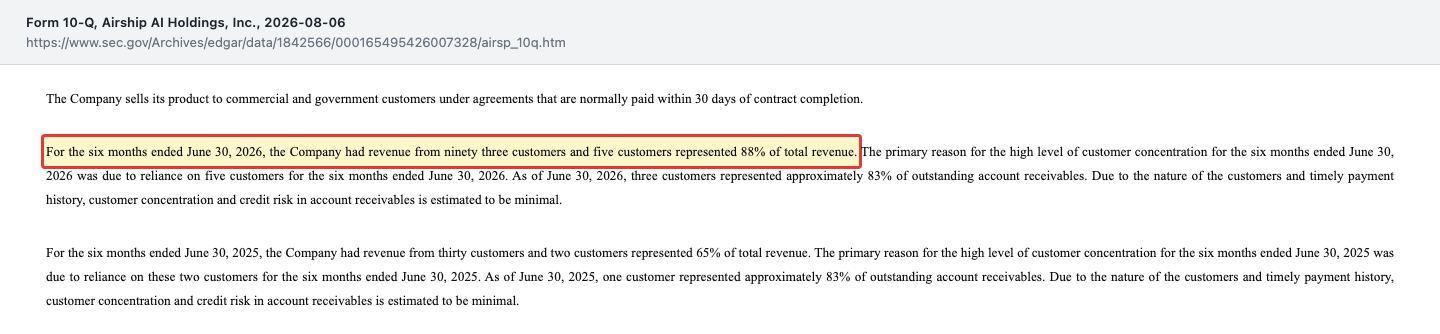
In the second quarter of 2026 alone, two customers accounted for about 84 percent of revenue, according to the quarterly report. The report does not name the five customers — it even attributes the first-half revenue increase to more commercial orders. Where revenue comes from overall, though, it states plainly: “A substantial majority of our revenue is derived from U.S. federal law enforcement and homeland security customers.” That cuts both ways. Agencies pay reliably, and a vendor that has made it through their security accreditations is not easily replaced. But the business hinges on budget decisions in Washington: in 2025, according to the quarterly report, awards were delayed because federal spending was uncertain — and revenue fell by a third. On top of that, Airship AI is often not allowed to disclose awards because of the sensitive deployments. For you, that means what is being negotiated right now often only becomes visible in the next quarterly report. Rule of thumb: a few big customers do not make a company bad — but they turn every quarter into a bet on a handful of signatures.
Uncomfortable truth No. 4: 35 million potential new shares on top of 34 million existing ones
The 2025 annual report contains a sentence that is easy to overlook because it sits between the numbers on the paper profit: “Airship AI will need to obtain additional capital and increase sales to become profitable.” For a company without operating profit, additional capital usually means new shares. For you as a shareholder, that means dilution — your slice of the pie gets smaller when new slices are cut.
The slices are already lined up. According to the quarterly report, 22.5 million warrants were outstanding as of June 30, 2026 — 16.7 million from the SPAC merger at $4.50 each (16.1 million public, 0.5 million private) and 5.8 million others at prices between $1.77 and $6.20, including 2.7 million each at $1.77 and at $6.20. On top of that came 7.3 million employee stock options with a weighted average exercise price of $1.76, 1.76 million stock appreciation rights (SARs) with a base value of $0.12 and 3.75 million earnout shares that are only issued once certain targets are met. Together, that is about 35.3 million potential new shares on top of 34.4 million existing ones — the share count could more than double if everything were exercised. The smaller figure of 23.6 million in Note 13 of the same report is only the portion excluded from diluted earnings per share, not the total pool. The 16.7 million SPAC warrants only pay off for their holders above $4.50; at that point they would also bring the company cash. The cheap instruments are a different story: at the October 1, 2026 close of $2.22, the 2.7 million warrants at $1.77, the SARs and a large part of the employee options — 2.0 million at $0.12 alone — were already in the money. The company has already cut the exercise price of the SPAC warrants twice, in 2024 from $11.50 to $7.80 and then to $4.50, to make them more attractive. In October 2025, an investor exercised 2.2 million warrants at the existing $4.50 price ($9.7 million gross) and received 2.7 million new warrants at $6.20 as an inducement.
And the path for fresh shares has been paved, too. On May 11, 2026, Airship AI filed a registration statement on Form S-3 under which it can sell common stock, preferred stock, debt securities or warrants “up to an aggregate initial offering price of $100,000,000.” According to the SEC database, that shelf has been effective since May 19, 2026. That is more than the company’s entire market value on October 1, 2026. Whether and when Airship AI uses it will show up in a prospectus supplement (Form 424B) or on the cover of the next quarterly report. Stock-based compensation is rising as well: $1.6 million in the first half of 2026 versus $0.8 million a year earlier. Rule of thumb: a price spike at a company that needs money is not only an opportunity for shareholders — it can also help the treasury, for example via the shelf; whether Airship AI uses it will only show in a filing.
Valuation: about $76 million as of October 1, 2026
At the closing price of $2.22 on October 1, 2026, and 34.4 million shares (as of August 6, 2026), Airship AI had a market value of about $76 million — our own calculation. The market value shown in the key-figures box on this page comes from the database and may differ because it is based on a different price and data date. Subtract the $12.4 million of cash as of June 30, and about $64 million is left for the business. Measured against revenue of the last four quarters of $18.1 million (third quarter 2025 through second quarter 2026), the market value equals about 4.2 times revenue — the price-to-sales ratio. For a software company with gross margins around 60 percent, that is not a fantasy valuation; for one that still loses money from operations and whose revenue can swing by a third from year to year, it is no bargain either.
The P/E ratio is no help here, for the reasons in truth No. 1. The cash tells you more: at an operating cash outflow like 2025’s $8.0 million a year, $12.4 million would last about a year and a half. In August 2026, management assessed whether the money lasts at least through August 2027 and concluded there is no substantial doubt about the company’s ability to continue as a going concern. Its stated goal is positive operating cash flow by the end of 2026 — in the first half of 2026 it was slightly positive, in the second quarter slightly negative at minus $0.2 million.
The view from the pros: only a single analyst covers the stock; the rating is positive (source: fundamental data, as of October 3, 2026). A single voice is a very thin basis, and its price target assumes that a good part of the pipeline turns into revenue. How a larger provider of AI analytics for U.S. security agencies wrestles with very similar questions is the subject of our BigBear.ai stock analysis. How another small supplier to U.S. security agencies sits between a big contract and a thin margin, you can read in our Red Cat stock analysis.
Upside and risks at a glance
What speaks for Airship AI:
- No bank debt, $12.4 million in cash (June 30, 2026); management sees no substantial doubt about the going concern through at least August 2027.
- First-half 2026 revenue up 37 percent to $10.5 million, second-quarter gross margin 75 percent; operating cash flow slightly positive for the half-year.
- Firm backlog of $6.9 million (August 6, 2026), up from $3.3 million at the end of 2025; $8.9 million of signed maintenance contracts not yet delivered.
- Federal border and homeland security funding enacted in June 2026 and, according to management, secured through fiscal 2029.
- Open-market insider purchases between November 2025 and March 2026 at $2.24 to $3.18; the two founders held about 38.6 percent of the voting power including rights to acquire shares, according to the 2025 annual report.
What speaks against it:
- Operating loss in every year since going public (2025: minus $7.2 million); the $29.3 million net income for 2025 came from fair-value items.
- Revenue swings with individual contracts: $23.1 million in 2024, $15.3 million in 2025.
- Five customers made up 88 percent of revenue in the first half of 2026; overall, revenue comes mostly from U.S. federal agencies.
- A $206.1 million pipeline with no assurance; the $137 million pipeline for 2025 came with a 34 percent revenue decline.
- About 35.3 million potential new shares on top of 34.4 million outstanding, plus a $100 million shelf; negative stockholders’ equity of minus $8.6 million (June 30, 2026), pushed below zero by $16.2 million of fair-value items.
- Negative operating cash flow precisely in the years with a reported profit: minus $3.3 million in 2023 against $16.4 million of net income, minus $8.0 million in 2025 against $29.3 million.
A human conclusion
Back to the anchoring effect. Airship AI throws out several heavy anchors at once: a $29.3 million profit, a $206 million pipeline, a market of more than $70 billion, an optimistic analyst price target. None of these numbers is made up — but none of them is in the bank account. What is in there is $12.4 million. A good part of it comes from the warrant exercise in October 2025 ($9.7 million gross), not from the business. The business has posted operating losses for years, depends on a few large customers and is only now showing that it can grow without a record contract. The first half of 2026 was the best sign of life in a long time; whether it becomes a trend will be decided by signatures at the Department of Homeland Security. With a stock like this, read the small numbers first — operating result, cash flow, backlog — and only then the big ones. The next chance to do so is the quarterly report for the third quarter of 2026: it will show whether the announced awards came in and whether the shelf was tapped. What you do with all this is your decision. And that is how it should be.
Sources
All original documents used in this analysis — so you can read them yourself:
- Airship AI Holdings, Inc. — quarterly report on Form 10-Q for the period ended June 30, 2026 (filed August 6, 2026) — latest periodic report: share count, balance sheet, customer concentration, going-concern assessment, fair-value items, dilutive securities, backlog, pipeline, liquidity
- Airship AI Holdings, Inc. — second-quarter 2026 earnings release, Form 8-K of August 6, 2026, Exhibit 99.1 (2026 outlook, expected awards, quote from Paul Allen)
- Airship AI Holdings, Inc. — annual reports on Form 10-K for 2025 (February 17, 2026; business, employees, risk factors, year-end 2025 pipeline), 2024 (February 28, 2025; $137 million pipeline for 2025) and 2023 (April 1, 2024; revenue for 2022 and 2023)
- Airship AI Holdings, Inc. — registration statement on Form S-3 of May 11, 2026 (shelf of up to $100 million)
- Insider reports (Form 4) for Victor Huang, Paul Allen and Louis Lebedin from November 2025 to March 2026, Form 144 by Derek Xu of February 25, 2026 and Form 4/A of October 1, 2026 (gift of June 3, 2026); all reports in Airship AI’s EDGAR directory
- Closing prices and trading volume in September and on October 1, 2026 (price anchor $2.22), year-end closing prices for 2024 and 2025, analyst ratings: source: fundamental data. Market value, enterprise value and ratios are our own calculations. Multi-year figures: source: fundamental data & SEC filings (annual and quarterly reports, 10-K/10-Q).
Transparency & disclaimer: This analysis is a journalistic assessment of publicly available information. It is not investment advice, not a financial analysis in the regulatory sense and not a solicitation to buy or sell securities. Investing in stocks involves substantial risk, up to and including the total loss of your investment. All information without guarantee; the data date is noted in the text. Positions held by the operator are disclosed daily; where one exists, it appears as a notice at the top of this deep dive.
Key figures at a glance
All monetary figures in millions of $; earnings per share as reported.
| Metric | 2021 | 2022 | 2023 | 2024 | 2025 |
|---|---|---|---|---|---|
| Revenue | 13.0 | 14.5 | 12.3 | 23.1 | 15.3 |
| Operating Income (EBIT) | -6.1 | -2.8 | -6.6 | -3.5 | -7.2 |
| Net Income | -5.1 | -0.5 | 16.4 | -57.5 | 29.3 |
| Net Margin | -39.3% | -3.3% | 133.1% | -249.3% | 191.4% |
| Earnings Per Share | -0.12 $ | -0.01 $ | 0.80 $ | -1.90 $ | 0.76 $ |
Source: fundamental data & SEC filings (annual and quarterly reports, 10-K/10-Q)
Our Bottom Line at a Glance
- Cash and debt positive
- $12.4M in cash, no bank debt (June 30, 2026); management sees no substantial doubt about the going concern through at least August 2027.
- Revenue and margin positive
- First half of 2026: revenue +37% to $10.5M, second-quarter gross margin 75%; backlog $6.9M (Aug. 6, 2026).
- Earnings power negative
- Operating loss in every year since 2023 (2025: −$7.2M); 2025 net income of $29.3M came from fair-value gains of $36.3M, per the 10-K.
- Customer concentration negative
- Five customers = 88% of first-half 2026 revenue (10-Q); revenue overall comes mostly from U.S. federal agencies and swings with individual contracts (2024: $23.1M, 2025: $15.3M).
- Dilution negative
- About 35.3M potential new shares against 34.4M (June 30, 2026); $100M shelf effective since May 19, 2026; per the 2025 10-K, additional capital will be needed.
- Pipeline neutral
- $206.1M pipeline (Aug. 6, 2026) with no assurance; DHS awards expected in the third quarter of 2026 had not been announced via 8-K by Oct. 1, 2026.
Airship AI has no bank debt, $12.4M in cash, more current assets ($17.0M) than current liabilities ($5.3M) and a clearly better first half of 2026; management sees no substantial doubt about the going concern through at least August 2027. Against that stand negative stockholders’ equity of −$8.6M (without $16.2M of fair-value items for warrants and earnout shares it would be +$7.6M), operating losses every year, negative operating cash flow in the profit years 2023 and 2025, very high customer concentration and a large pool of potential new shares; per the 2025 10-K, the company needs additional capital. Not investment advice.
What Our Rating Means
Substance risk
We found at least one documented issue that threatens the company itself — regardless of how the stock is currently valued.
Red, because Airship AI has posted an operating loss in every year since going public, operating cash flow was negative precisely in the profit years 2023 and 2025, the company needs additional capital according to its 2025 annual report and potential new shares could more than double the share count — a substance risk by our standard. Negative stockholders’ equity (minus $8.6 million on June 30, 2026) comes on top, but only arises from $16.2 million of fair-value items; there is no bank debt. Whether $2.22 (October 1, 2026) is a reasonable price is not what this rating answers. The decision is yours.
A journalistic assessment by our editorial team at the time of the deep dive, based on public sources — not investment advice and not a solicitation to buy or sell. Your personal circumstances (investment goals, risk capacity, taxes) cannot be taken into account. What our levels mean, how verdicts are formed, and what conflicts of interest exist →
Worth Noting
- Edition of October 3, 2026, based on the annual reports on Form 10-K for 2023, 2024 and 2025, the quarterly report on Form 10-Q for the period ended June 30, 2026 (latest periodic report, filed August 6, 2026), the earnings release of August 6, 2026, the Form S-3 of May 11, 2026, and all SEC filings through October 1, 2026. The trigger was our Reddit hype scanner in early October 2026, not a hit in the fundamentals screen.
- Not to be confused: Airship AI Holdings (AISP) is not AirSculpt Technologies (AIRS). The former name in the SEC database, BYTE Acquisition Corp., belongs to the SPAC shell until December 2023. A P/E ratio below 3 computed from net income is not meaningful because of the fair-value items.
- The price anchor is the closing price of $2.22 on October 1, 2026 (source: fundamental data); on September 30, 2026, it was $1.86. Market value, enterprise value and the price-to-sales ratio are our own calculations; revenue for the last four quarters ($18.1 million) equals full-year 2025 minus the first half of 2025 plus the first half of 2026.
Stock Watch
This analysis is as of October 2, 2026. Stock Watch will tell you what's changed at AISP since then.
Later $1 a month per stock — signing up is free, and you'll be the first to know when it launches.
The full analysis as a PDF for later
We will send you this analysis as a PDF — to print, file away, and read at your own pace. And we will add you to the free Stock Watch list for Airship AI (AISP), so you hear about it when something material in this analysis changes.
Frequently Asked Questions
Airship AI, based in Redmond, Washington, sells software and hardware that analyze camera and sensor data with trained AI models, for example reading license plates, vehicle type and color from video. Its products are Outpost AI, Acropolis and Airship Command. Most revenue comes from U.S. federal law enforcement and homeland security agencies; in 2025 revenue was $15.3 million.
According to the 2025 annual report, the $29.3 million net income came from fair-value gains on warrants ($20.9 million) and earnout shares ($15.4 million). These items track the share price, which fell sharply in 2025, and move no cash. The operating result was a loss of $7.2 million, and operations used $8.0 million in cash.
As of June 30, 2026, the balance sheet carried $16.2 million in liabilities for warrants and earnout shares, and stockholders’ equity stood at minus $8.6 million. Without those fair-value items it would be positive at about $7.6 million. According to the company, settling them is not expected to require significant current assets. There is no bank debt.
On August 6, 2026, Airship AI put its validated pipeline at $206.1 million, with firm awards of $6.9 million. The pipeline consists of opportunities, not contracts; the quarterly report says there is no assurance whether, when or in what amount it turns into revenue. For 2025, the company had reported a $137 million pipeline, yet revenue fell 34 percent.
As of June 30, 2026, 22.5 million warrants, 7.3 million employee stock options and 1.76 million stock appreciation rights were outstanding, plus 3.75 million contingent earnout shares — about 35.3 million potential new shares against 34.4 million outstanding. In addition, a shelf registration effective since May 19, 2026, allows Airship AI to issue securities worth up to $100 million.
On October 1, 2026, 41.9 million shares traded, compared with 142,500 to 333,200 a day in September 2026. The close rose from $1.86 to $2.22. We found no SEC filing or company announcement dated that day; the only SEC filing was an amendment concerning a gift of shares by the CEO in June 2026.
Found an error?
Did you spot a factual error, an outdated number, or a typo in this deep dive? Let us know briefly — your report goes straight to the editorial team.