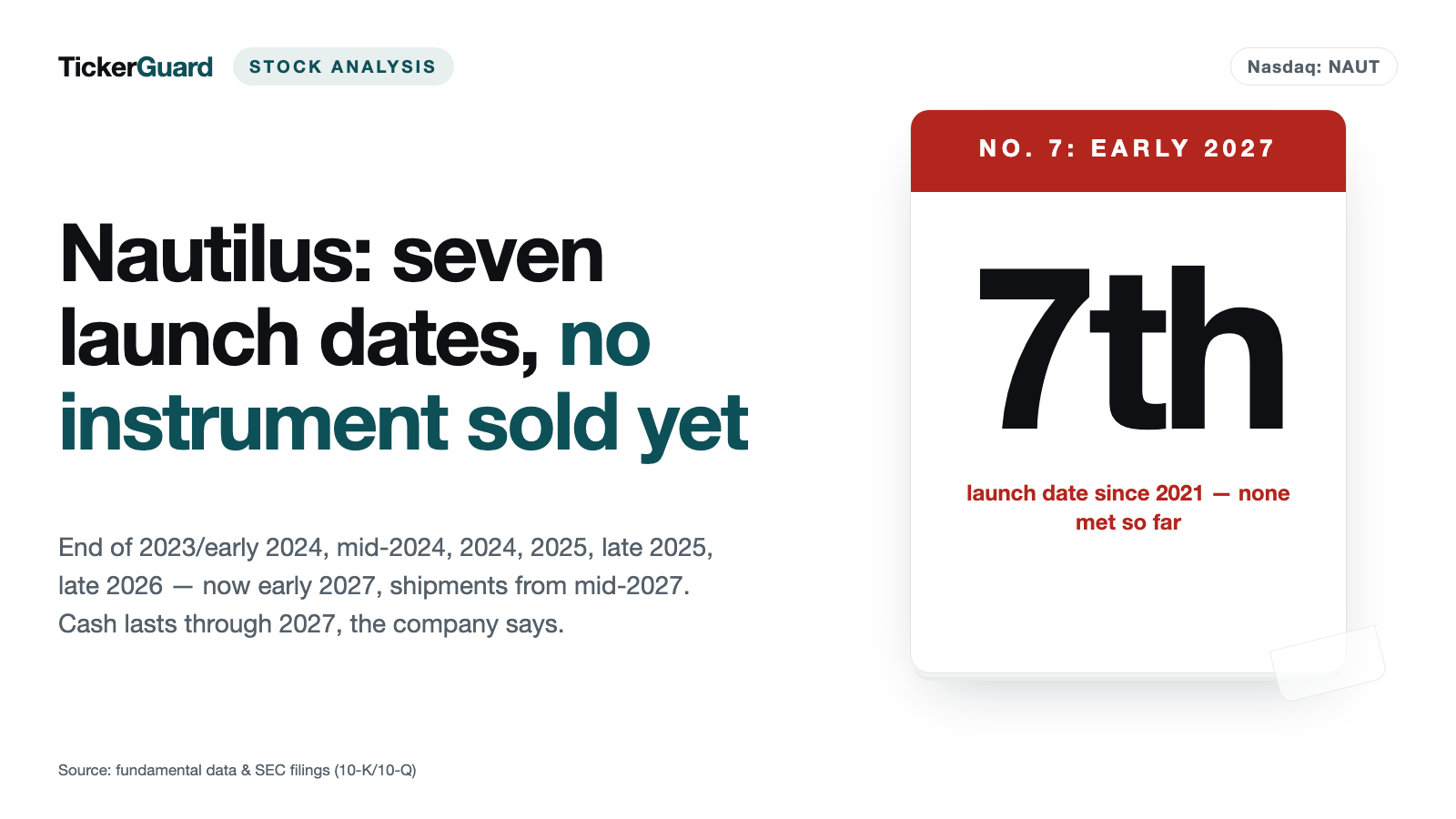
Nautilus Biotechnology: Seven Launch Dates, None Met So Far — and a Share Sale Program Worth Half the Market Value
After the Challenger disaster in 1986, sociologist Diane Vaughan described how warning signs gradually come to feel normal. For Nautilus Biotechnology investors, the warning sign is the launch date: since 2021, the company has named seven different ones in its reports, none of which has been met so far. Cash on hand: $129.2 million (June 30, 2026). In late September 2026, the stock doubled within a week — and since September 18, a program to sell up to $125 million in new shares has been in place, about half the market value as of October 2. The real question is whether you would wait for yet another launch date.
 Thomas Mücke
Founder & Publisher
Thomas Mücke
Founder & Publisher
As of Today
As of: October 2, 2026
- Closing price
- 1.96 $ +24.84%
- Market Capitalisation
- 0.2 $B
- AAQS
- 1/10
This analysis has a cut-off date. The Stock Guard tells you when something material changes in the numbers. Reserve your free spot
Chart
Interactive price chart (TradingView).
52-week range: 0.835 $ to 4.00 $ · Last price: 1.96 $ (As of: October 2, 2026)
Note: pure fact-based analysis, not investment advice and not a solicitation to buy or sell. All figures without guarantee.
After the Challenger disaster in 1986, sociologist Diane Vaughan coined a term that reaches far beyond spaceflight: the normalization of deviance. It describes a slow drift. A warning sign appears, nothing bad happens, and the next time the same warning sign already feels a little more normal. Eventually, nobody notices it anymore. In the stock market it looks like this: a company pushes its launch date back by a year — annoying. The second time — well. By the sixth time, you read the new date as if it were the first.
For investors, Nautilus Biotechnology of Seattle is a textbook case of how the eye gets used to slipping dates. The company is developing an instrument designed to count proteins one molecule at a time, and since going public it has named a launch date several times — none of which has been met so far. In July 2026, its central promise, analyzing the entire protein content of a sample, slipped out of the schedule as well. In the two trading days after the release, the stock fell 37 percent, and later spent weeks below a dollar. Then, between September 25 and October 2, 2026, it doubled from $0.963 to $1.96.
So let’s put the excitement next to the filings and read together what Nautilus has told the U.S. securities regulator, the SEC — the annual reports (10-K) from 2021 through 2025, every quarterly report (10-Q) from August 2021 through the latest one for the period ended June 30, 2026, and every filing through September 18, 2026. The central tension of this analysis: the technology is ambitious and the balance sheet is still solid, but the calendar and the cash are drifting apart. Instruments are due to ship from mid-2027, the money lasts through the end of 2027 by the company’s own account — and the program to sell new shares is already in place. Whether that is enough of a cushion for you is your call.
What Nautilus actually does — counting proteins instead of breaking them apart
Proteins are the workers inside every cell. They come not only in thousands of types, but each type in many variants: one with a chemical tag here, another with a clipped end there. Scientists call these variants proteoforms. Whether a protein does its job or causes harm often depends on exactly which variant is present — as with the protein tau, which has been linked to Alzheimer’s disease. Today’s standard method, mass spectrometry, typically breaks proteins into fragments and reassembles them computationally. In the process, the information about which variant was originally there gets lost.
Nautilus takes the opposite route. On three flow cells with — per the company, in prototypes — a combined total of roughly 10 billion landing sites per run, each protein is held in place individually and intact. Then new binding probes are washed over it again and again, and a camera records which probe docks where. From the pattern across many cycles, machine-learning software works out which protein sits at which spot — Nautilus calls the method “Iterative Mapping.” In the end, individual molecules are identified and the amount of each protein in the sample is inferred from them — an analysis molecule by molecule rather than from an averaged signal. The instrument is called Voyager; Nautilus wants to make money the way a printer maker does, once with the instrument and again and again with the consumable kits for every run.
Nautilus was founded in 2016 by Sujal Patel, who had earlier built the data storage company Isilon Systems and led it until its sale to EMC in 2010, and Stanford researcher Parag Mallick. The company went public through a merger with the shell company ARYA Sciences Acquisition Corp. III — a SPAC, meaning a company that listed solely to carry out such a merger. The merger closed on June 9, 2021, and the stock has traded as NAUT since June 10, 2021. That deal brought in about $345.5 million in gross proceeds, part of it from investors who paid $10 a share. At the end of 2025, Nautilus had 130 employees, more than a third of them with doctorates.
Company history for investors
-
2016
Founded by Patel and Mallick
Isilon founder Sujal Patel and Stanford researcher Parag Mallick start Nautilus. In 2026, the two still hold about a third of the shares.
-
2021
Listing via a SPAC
Merger with ARYA III on 06/09/2021, about $345.5M in gross proceeds. First annual report: broad commercialization by the end of 2023 or beginning of 2024.
-
2024
$125M share sale program
Agreed in February 2024 and not used once through September 2026 — Nautilus did not sell a single share under it.
-
2025
Layoffs and a Nasdaq notice
Cost cuts in the first quarter, a Nasdaq notice in May (letter of May 1, 2025), a move to the Nasdaq Capital Market in October. From November, the $1 rule was met again.
-
2026
New roadmap, new share program
Shipments only from mid-2027, broadscale without a date, stock −37% in two days. In September, a new $125M program and a16z drops below 5%.
How the stock landed on our desk — via Reddit, after doubling in a week
Not through a fundamentals screen. A company with $190,000 in first-half 2026 revenue falls through every screen that looks for earnings, growth or valuation. Nautilus landed on our desk in early October 2026 through our Reddit hype scanner, which tracks every day which small U.S. stocks are the talk of the investing forums. The trigger is plain to see in the trading data: on September 29, 2026, 22.4 million shares changed hands; on the September days through September 25, it was mostly 0.4 million to 2.0 million, never more than 3.9 million; on September 28, volume rose to 4.1 million. The closing price rose from $0.963 on September 25 to $1.96 on October 2.
There is no Nautilus filing that explains the jump — the last one before the rally is dated September 18 (as of October 3, 2026). The timing coincides with data from a competitor: Quantum-Si, another maker of instruments that read proteins, had issued a press release and a presentation for the World HUPO conference on September 28 (Form 8-K filed September 29, 2026); its stock also rose sharply afterward, from $0.795 on September 28 to $1.55 on October 2. Whether that was the trigger cannot be established from the filings. Rule of thumb: when a whole niche rises at once, the price says more about sentiment than about the individual company.
The numbers over the years — given their due
First, what deserves credit. So far, Nautilus has barely diluted its shareholders — not a given for a development-stage company. At the end of 2022, 124.9 million shares were outstanding; as of July 24, 2026, there were 127.3 million, just 1.9 percent more. According to the filing of September 11, 2026, the company never once used the share sale program it had agreed in February 2024. There is no bank debt. And the company is cutting costs: operating expenses fell from $81.5 million in 2024 to $66.8 million in 2025, after a workforce reduction in the first quarter of 2025, and again in the first half of 2026 to $32.1 million from $35.9 million a year earlier.
The second quarter of 2026 also brought the first revenue in the company’s history: $190,000, of which $180,000 came from a research grant from The Michael J. Fox Foundation for Parkinson’s Research supporting development of an assay for variants of the protein alpha-synuclein, and $10,000 from the early access program, in which Nautilus measures customer samples in its own lab. That is small, but it is the first evidence that someone pays for the measurements.
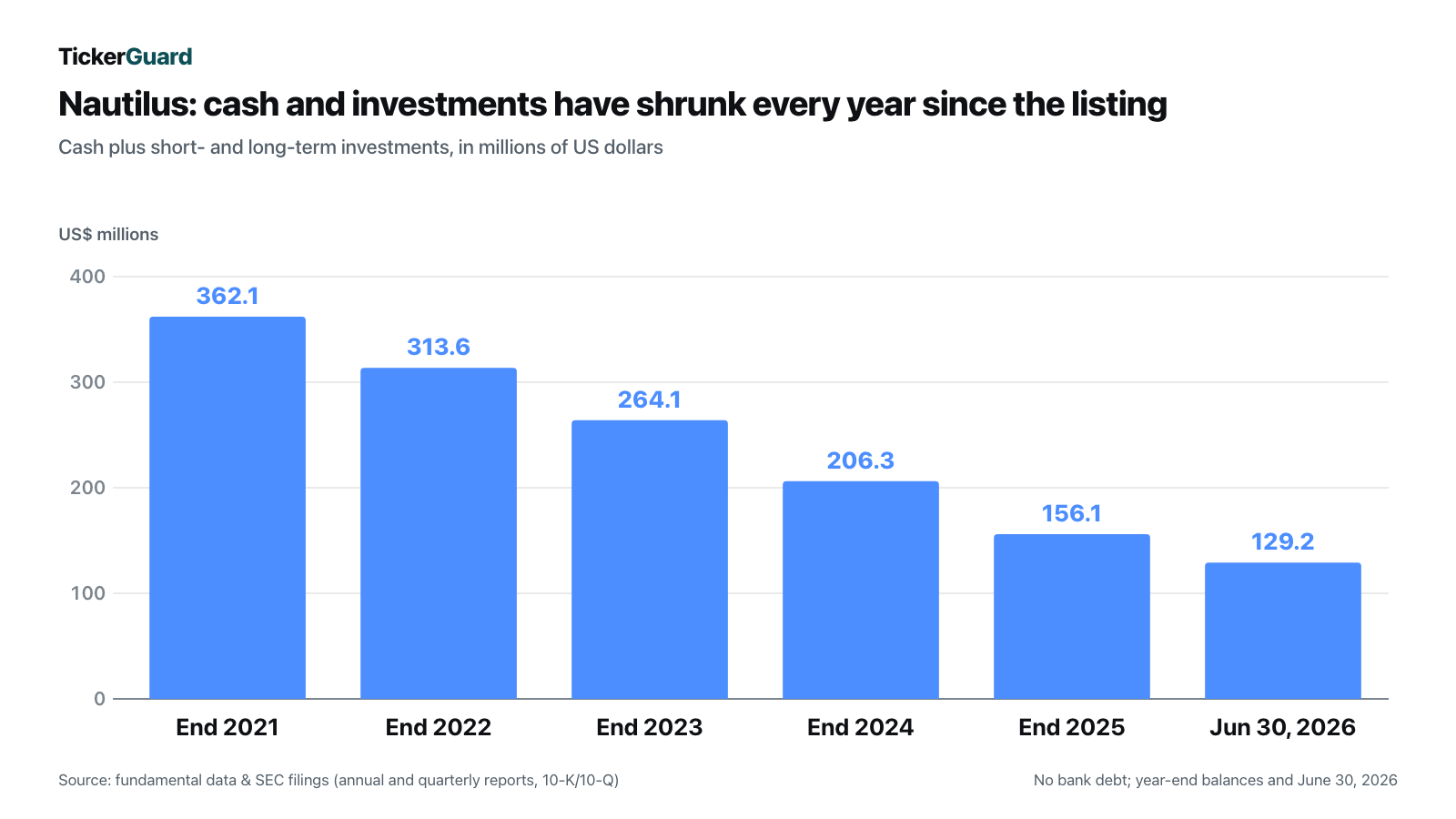
The flip side is that very chart. With hardly any outside money coming in, the cash balance is the counter that runs backward. Nautilus has posted a loss every year since going public: $50.3 million in 2021, $57.9 million in 2022, $63.7 million in 2023, $70.8 million in 2024 and $59.0 million in 2025 — $301.7 million in five years. The first half of 2026 added $29.2 million. Operations consumed $50.7 million of cash in 2025 and $26.8 million in the first half of 2026. As of June 30, 2026, the balance sheet showed an accumulated deficit of $361.2 million.
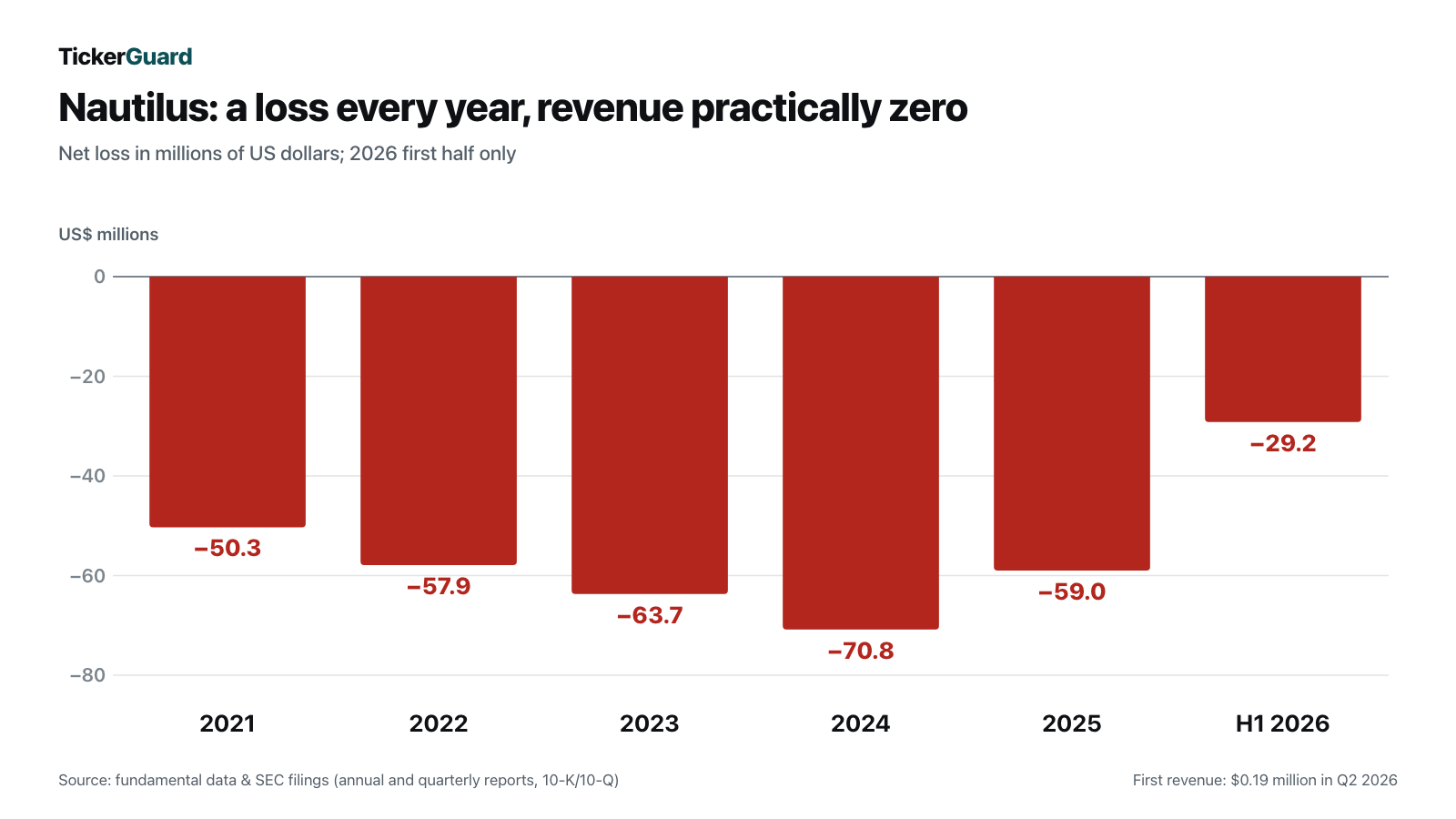
As with any development-stage company, that alone is no scandal — building an instrument like this takes years and a lot of money. But it means the math only works if Voyager arrives, sells, and does so before the cash runs out. Which brings us to the calendar.
Uncomfortable truth No. 1: seven launch dates since 2021
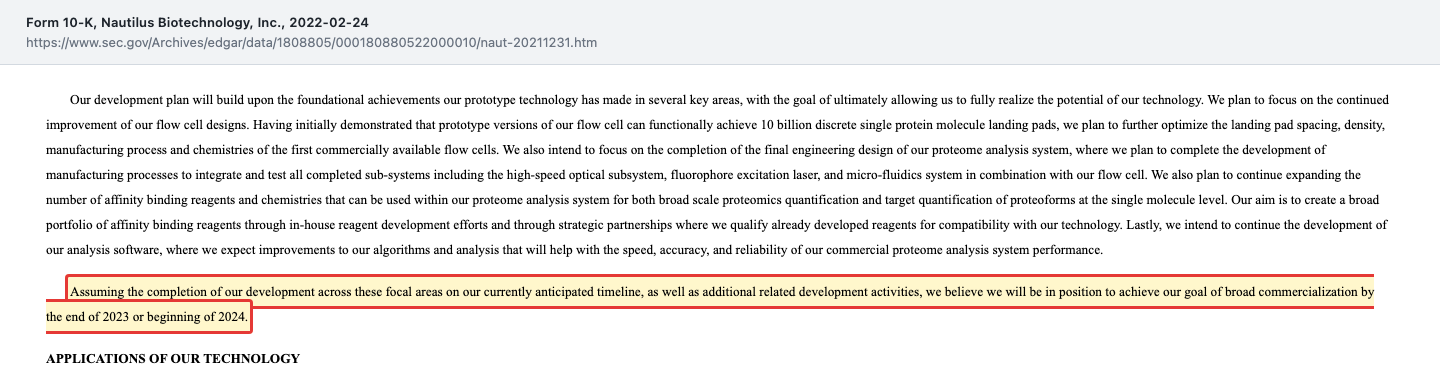
This is where the normalization of deviance comes back. In its very first quarterly report after going public, filed on August 10, 2021, Nautilus already targeted broad commercialization at the end of 2023 and the beginning of 2024. Its first annual report, filed on February 24, 2022, said:
“Assuming the completion of our development across these focal areas on our currently anticipated timeline, as well as additional related development activities, we believe we will be in position to achieve our goal of broad commercialization by the end of 2023 or beginning of 2024.”
— Nautilus Biotechnology, SEC annual report 10-K for 2021, Item 1 (Business, Development Plan)
What the filings said after that is a list worth reading slowly:
| Reports (filed) | Stated launch target |
|---|---|
| Q2 and Q3 2021 quarterly reports (Aug. 10 and Nov. 2, 2021), 2021 annual report (Feb. 24, 2022) | broad commercialization at the end of 2023 or beginning of 2024 |
| Q1 2022 quarterly report (May 3, 2022) | broad commercialization by the end of 2023 — the same first target, just without “beginning of 2024” (one passage of the 2021 annual report already read that way) |
| Q2 2022 (Aug. 2, 2022) through Q1 2023 (May 2, 2023) quarterly reports, including the 2022 annual report (Feb. 23, 2023) | broad commercialization by mid-2024 |
| Q2 and Q3 2023 quarterly reports (Aug. 2 and Oct. 31, 2023) | broad commercialization “in 2024” — the “mid” was dropped |
| 2023 annual report (Feb. 28, 2024), Q1 and Q2 2024 quarterly reports (Apr. 30 and Jul. 30, 2024) | 2025 — from July 2024 on, only the “launch” in 2025, with broad commercialization “thereafter” |
| Q3 2024 quarterly report (Oct. 29, 2024) | launch in late 2025 |
| 2024 annual report (Feb. 27, 2025), Q1 to Q3 2025 quarterly reports (Apr. 29, Jul. 31 and Oct. 28, 2025), 2025 annual report (Feb. 26, 2026) and Q1 2026 quarterly report (Apr. 28, 2026) | launch in late 2026 — specified from the 2025 annual report on: pre-orders from late 2026, first installations at customer sites in early 2027 |
| Q2 2026 quarterly report (Jul. 28, 2026) | pre-orders from early 2027, shipments from mid-2027 |
Seven different targets in just under five years, and the date changed six times. Four times the target clearly moved later: from the end of 2023/beginning of 2024 to mid-2024, from 2024 to 2025, from late 2025 to late 2026 and from late 2026 to early 2027 (each time the opening of pre-orders; the first instruments at customer sites moved from early 2027 to mid-2027 in the process). Twice the framing changed: in 2023 the “mid” before 2024 was dropped, and in October 2024 “2025” became “late 2025.” On top of that, since July 2024 the date no longer refers to broad commercialization but to the “launch,” with broad commercialization to follow “thereafter.” The sixth target, late 2026, appeared in six consecutive periodic reports — from the 2024 annual report through the first-quarter 2026 report — before it moved in July 2026. Five targets passed without the instrument reaching the market; the sixth was abandoned in July 2026 before it came due; the seventh is still pending. The wording of the latest quarterly report:
“We expect to initiate our commercial launch in early 2027 by opening the Nautilus Voyager platform for pre-orders, with instrument shipments beginning in mid 2027.”
— Nautilus Biotechnology, SEC quarterly report 10-Q for the period ended June 30, 2026, Item 2 (Management’s Discussion and Analysis, Overview)
To be fair: each individual delay came with a reasonable explanation, and an instrument that does not measure reliably at a customer site would cost more than another year of development. But that is exactly how normalization works — every explanation sounds sensible on its own, and in sum the expectation shifts without anyone noticing. Rule of thumb: a launch date only becomes a date once one has actually been met.
Uncomfortable truth No. 2: the big promise no longer has a date
From the start, Nautilus’s real goal was bigger than individual protein variants: measuring the entire protein content of a sample in one go, which the company calls “broadscale.” The annual report for 2025, filed on February 26, 2026, still put that in the first half of 2027. Five months later, the quarterly report says:
“While our development efforts continue for our broadscale assay, those efforts have not advanced sufficiently to support general availability of that assay in 2027 to our target specifications.”
— Nautilus Biotechnology, SEC quarterly report 10-Q for the period ended June 30, 2026, Item 2 (Management’s Discussion and Analysis, Overview)
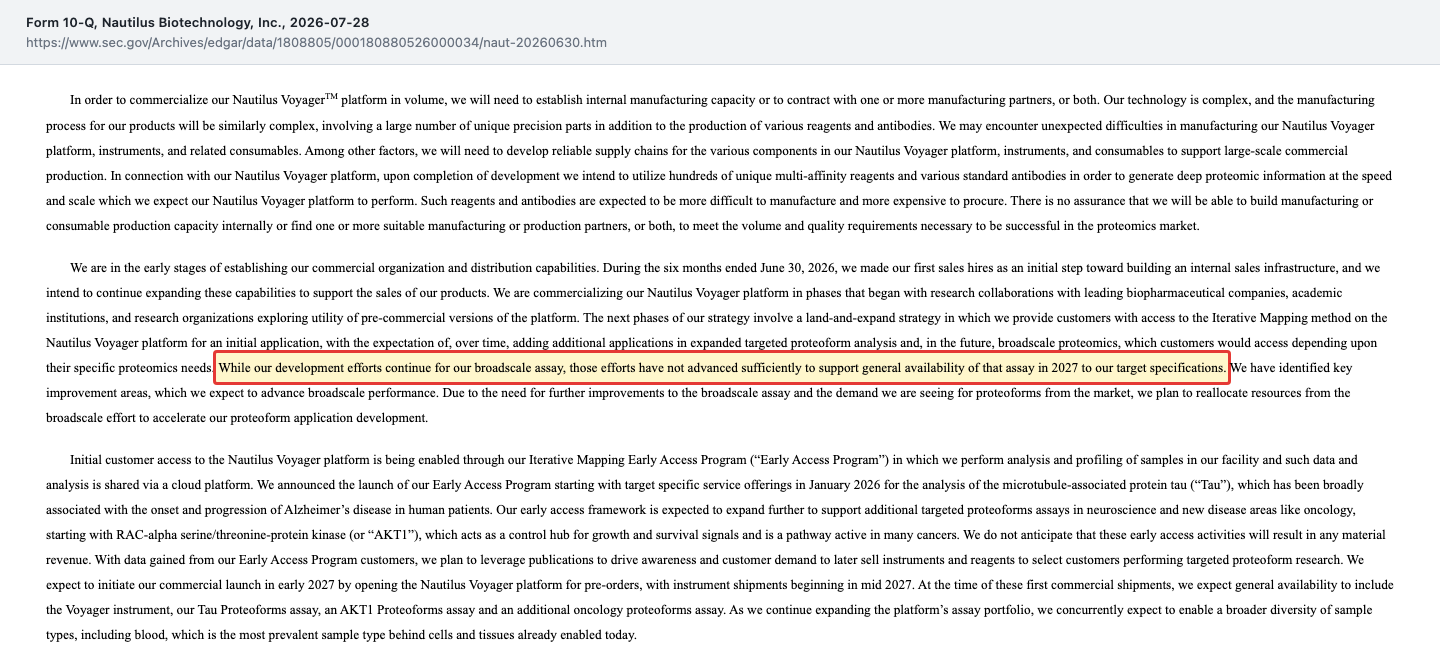
The earnings release from the same day is even clearer: Nautilus plans to report back on a commercial timeline for the broadscale assay “at a future date.” Instead, when shipments begin in mid-2027, the company wants to offer three assays for individual protein variants. The quarterly report names them itself:
“At the time of these first commercial shipments, we expect general availability to include the Voyager instrument, our Tau Proteoforms assay, an AKT1 Proteoforms assay and an additional oncology proteoforms assay.”
— Nautilus Biotechnology, SEC quarterly report 10-Q for the period ended June 30, 2026, Item 2 (Management’s Discussion and Analysis, Overview)
Tau stands for Alzheimer’s research, AKT1 and the third assay for cancer research. CEO Sujal Patel calls that “a more direct and, ultimately, faster path,” and the reasoning sounds plausible: customers in the early access program are asking for exactly that. The release coincided with a decline in the share price: the stock closed at $1.66 on July 27, 2026, and at $1.04 two trading days later — down 37 percent.
The difference matters to you as an investor. An instrument for the entire protein content would be a tool for a much broader range of labs. An instrument for selected protein variants is a specialist tool for researchers who study exactly those variants. That market can become large — but it is a different one from the market Nautilus pitched when it went public in 2021. Rule of thumb: when the goal changes, so does the math behind the stock price.
Uncomfortable truth No. 3: cash lasts through 2027 — and the share sale program equals half the market value
In its earnings release of February 26, 2026, Nautilus said it had sufficient resources to fund operations “through 2027.” For 2026, the company expected operating expenses to rise 15 to 20 percent over 2025. On July 28, 2026, it said the shift toward proteoforms did not affect its broader financial assumptions. The quarterly report itself contains only the standard statement that the money will last at least twelve months. Put that next to the roadmap and an uncomfortable calculation emerges: the first instruments are due to ship in mid-2027, and the money lasts through the end of 2027 by the company’s own account. Even if everything goes to plan, that leaves about half a year in which early sales would have to come anywhere close to covering expenses. That seems unlikely — and Nautilus itself writes that it will require “substantial additional funding.”
Where that money is supposed to come from is shown in the filing of September 11, 2026. Nautilus terminated its 2024 share sale program — unused — and set up a new one for up to $125 million with the bank TD Cowen. Through such an “at-the-market” program, the company can sell new shares directly on the exchange at any time, without announcing a capital raise in advance. It has been effective since September 18, 2026. What it would have meant at the September 9, 2026 price, the prospectus calculates itself:
“Up to 238,831,782 shares of our common stock, based on 127,224,640 shares of common stock outstanding as of June 30, 2026, and assuming sales of 111,607,142 shares of our common stock in this offering at a price of $1.12 per share, which was the closing price of our common stock on Nasdaq on September 9, 2026.”
— Nautilus Biotechnology, prospectus supplement 424B5 of September 18, 2026, The Offering

For you as a shareholder, “new shares” means your slice of the pie gets smaller, because new slices are cut and sold to others. At the $1.96 close on October 2, 2026, $125 million would buy about 63.8 million new shares — 50 percent more than today; the program thus equals about half of the roughly $249 million market value. For comparison: at the September 9, 2026 price of $1.12 that the prospectus uses, it would have been 88 percent more shares. Whether Nautilus has already sold any since September 18 will only show in the next quarterly report; last year, that report was filed on October 28. The fact that the old program was never used is no counterargument: back then, the cash lasted for years; today, counted from October 2026, it lasts about five more quarters by the company’s own account.
A second point hinges on the share price. In May 2025, Nasdaq notified Nautilus because the stock had traded below a dollar for 30 consecutive business days; the company moved to the smaller Nasdaq Capital Market tier on October 29, 2025, and regained compliance in November 2025. Between August 4 and September 8, 2026, the stock again closed below a dollar on 25 consecutive trading days — just short of the threshold for a new notice. Such a notice is not a balance sheet problem; it follows from the share price alone. Rule of thumb: at a higher share price, each dollar raised requires fewer new shares — dilution is smaller, and the program can be used at any time.
Uncomfortable truth No. 4: an early backer sheds nearly two thirds of its shares
One of Nautilus’s best-known backers is the venture capital firm Andreessen Horowitz. According to the proxy statement, funds affiliated with it still held 17,653,917 shares as of April 20, 2026, or 13.9 percent of the company. On June 2, 2026, they sold 5.0 million shares in a single block trade at $2.35 — the stock closed at $2.68 that day. On June 26, 2026, another 3.6 million shares followed in a block trade at $2.00, leaving the funds with 9,063,054 shares (7.1 percent). From July 31, 2026, they sold on the open market, in September at prices between $0.90 and $1.09. Item 5(e) of the filing of September 11, 2026, contains this sentence:
“The Reporting Persons ceased to be the beneficial owners of more than five percent of the Issuer's common stock on September 9, 2026.”
— Andreessen Horowitz, Schedule 13D/A Amendment No. 4 of September 11, 2026, Item 5(e)

From 17.65 million to 6.26 million shares: between June 2 and September 9, 2026, Andreessen Horowitz sold about 11.4 million shares — nearly two thirds, measured by the reported holdings. Further sales below five percent no longer have to be reported. The filings give no reasons for the sales; venture funds generally have fixed lifetimes, but whether that played a role is not disclosed. The other major holders per their latest filings: funds managed by Perceptive Advisors held 9.1 percent as of June 30, 2026 (filing of August 14, 2026), Cercano Management 5.6 percent and Madrona Ventures 5.3 percent (both as of April 20, 2026); founders Patel and Mallick together held about 32 percent as of April 20, 2026, and executives and directors as a group 41.1 percent (each including exercisable options).
Valuation: about $249 million as of October 2, 2026
At the $1.96 close on October 2, 2026, and 127.3 million shares (as of July 24, 2026), Nautilus had a market value of about $249 million — our own calculation. The market value shown in this page’s key data box comes from our database and may differ because it is based on a different price and data date. Subtract the $129.2 million in cash and investments as of June 30, and the market is paying about $120 million for the technology, the patents and the prospect of Voyager. Two weeks earlier, the picture looked very different: on September 16, 2026, the last price cited in the prospectus, the stock stood at $0.9721. That put the market value at about $124 million — less than the June 30 cash (which had likely shrunk somewhat by mid-September because of the ongoing outflow) and less than the $131.1 million in stockholders’ equity. Measured against those June figures, the market was valuing the business at close to zero on paper.
Classic multiples are of little help here. There is no price-to-earnings ratio without earnings, and a price-to-sales ratio on $190,000 of revenue would be meaningless. On October 2, the market paid about 1.9 times the June 30, 2026 equity. The cash math is more telling: at the first-half 2026 operating cash outflow of $26.8 million, the $129.2 million would arithmetically last just under five half-years, roughly until late 2028 (our own calculation). In February 2026, the company itself only said “through 2027,” and in July it stood by its financial assumptions — it expected 2026 operating expenses 15 to 20 percent above 2025 and anticipates rising spending on manufacturing and sales. The more cautious company figure is therefore the one that counts; our calculation only shows how far the money would go at the first-half 2026 spending pace. Either way, by the time the first instruments bring in revenue, the cash pile will be considerably smaller than today.
The view from the pros: four analysts cover the stock, all four rating it “Strong Buy,” with an average price target of $3.83 (source: fundamental data, as of October 3, 2026). Four voices are a very thin basis, and price targets for a company without a product on the market are mostly assumptions about 2027. How an established maker of life-science analysis instruments runs a business of instruments, consumables and software is shown in our 10x Genomics stock analysis. How another biotech hopeful from the 2021 SPAC year fared can be read in our Ginkgo Bioworks stock analysis.
Opportunities and risks at a glance
What speaks for Nautilus:
- A distinct approach: proteins are counted individually and intact on three flow cells with, per the company, roughly 10 billion landing sites in prototypes — capturing protein variants that are lost when proteins are broken apart.
- Barely any dilution so far: 127.3 million shares (07/24/2026) versus 124.9 million at the end of 2022; the 2024 share sale program was never used.
- No bank debt, $129.2 million in cash and investments (06/30/2026); runway through the end of 2027 per the company.
- Falling costs: operating expenses of $66.8 million in 2025 versus $81.5 million, and $32.1 million versus $35.9 million in the first half of 2026.
- First revenue in the second quarter of 2026, a research grant from The Michael J. Fox Foundation and the first paying customer in the early access program (earnings release of 07/28/2026).
What speaks against it:
- Seven different launch targets since 2021, none met so far, most recently shipments from mid-2027; no instrument sold yet.
- The assay for the entire protein content will not arrive in 2027 and has no new date (10-Q of 07/28/2026).
- Losses of $50 million to $71 million a year since 2021; accumulated deficit of $361.2 million (06/30/2026).
- A program to sell up to $125 million in new shares has been effective since 09/18/2026 — about half the market value as of October 2, 2026.
- Andreessen Horowitz cut its stake from 13.9 to 4.9 percent (04/20 to 09/09/2026); the stock spent weeks below a dollar in August and September 2026.
A human conclusion
Back to the normalization of deviance. Nautilus has a clever idea, thorough scientists and a balance sheet that has shown remarkably little dilution so far. But lay the annual and quarterly reports side by side and a pattern emerges: end of 2023/beginning of 2024, mid-2024, 2024, 2025, late 2025, late 2026 and now early 2027, with shipments from mid-2027 — plus a big promise that, as of July 2026, has no date at all. Each delay was explainable on its own. Together, in our assessment, they add up to just under five years in which the launch was mostly one to two years away, and a cash pile that shrank from $362 million to $129 million over that time. The doubling of the share price in late September changed none of that. It only changed the price at which you join this story — and the price at which the company can sell new shares. Read the next date not as a first one, but as one that has already moved several times — and ask yourself whether you would still wait for one more. The next chance to do so is the quarterly report for the third quarter of 2026: it will show whether the new share sale program has been tapped and whether the roadmap holds. What you make of it is your decision. And that is how it should be.
Sources
All original documents used in this analysis — so you can read them yourself:
- Nautilus Biotechnology, Inc. — quarterly report 10-Q for the period ended June 30, 2026 (filed July 28, 2026) — latest periodic report: share count, balance sheet, roadmap, broadscale assay, first revenue, liquidity, options
- Nautilus Biotechnology, Inc. — earnings releases filed as Exhibit 99.1 to the Form 8-K reports of July 28, 2026 (new roadmap, broadscale without a date) and February 26, 2026 (cash through 2027, 2026 expense outlook)
- Nautilus Biotechnology, Inc. — Form 8-K of September 11, 2026 (new share sale program, unused prior program terminated) and prospectus supplement 424B5 of September 18, 2026
- Nautilus Biotechnology, Inc. — annual reports 10-K for 2025 (February 26, 2026), 2024 (February 27, 2025), 2023 (February 28, 2024), 2022 (February 23, 2023) and 2021 (February 24, 2022) — launch targets, employees, Nasdaq transfer; quarterly report 10-Q for the period ended March 31, 2026
- Nautilus Biotechnology, Inc. — quarterly reports on Form 10-Q in which a new launch target or new wording first appeared: for the periods ended June 30, 2021 (filed August 10, 2021; end of 2023/beginning of 2024), June 30, 2022 (August 2, 2022; mid-2024), June 30, 2023 (August 2, 2023; 2024), June 30, 2024 (July 30, 2024; launch in 2025, broad commercialization thereafter) and September 30, 2024 (October 29, 2024; late 2025); all other periodic reports since 2021 via the SEC’s EDGAR database
- Proxy statement (DEF 14A of April 28, 2026, ownership as of April 20, 2026); Andreessen Horowitz — Schedule 13D/A of June 4, June 30, August 28 and September 11, 2026; Perceptive Advisors — Schedule 13D/A of August 14, 2026
- Quantum-Si, Inc. — Form 8-K of September 29, 2026, Item 7.01 (press release and presentation for the World HUPO conference, September 28, 2026); Quantum-Si closing prices on September 28 and October 2, 2026: source: fundamental data
- Closing prices and trading volume for June 2, July 27 to 29, August 4 to September 8, September 1 to 25, September 28 and 29, and October 1 and 2, 2026 (price anchor $1.96), analyst ratings: source: fundamental data. Market value, enterprise value and multiples are our own calculations. Multi-year figures: source: fundamental data & SEC filings (annual and quarterly reports, 10-K/10-Q).
Transparency & disclaimer: This analysis is a journalistic assessment of publicly available information. It is not investment advice, not a financial analysis in the regulatory sense and not a solicitation to buy or sell securities. Investing in stocks involves substantial risk, up to and including the total loss of your investment. All information without guarantee; the data date is noted in the text. Positions held by the operator are disclosed daily; where one exists, it appears as a notice at the top of this deep dive.
Key figures at a glance
All monetary figures in millions of $; earnings per share as reported.
| Metric | 2021 | 2022 | 2023 | 2024 | 2025 |
|---|---|---|---|---|---|
| Revenue | 0.0 | 0.0 | 0.0 | 0.0 | 0.0 |
| Operating Income (EBIT) | -50.5 | -63.6 | -76.2 | -81.5 | -66.8 |
| Net Income | -50.3 | -57.9 | -63.7 | -70.8 | -59.0 |
| Earnings Per Share | -0.60 $ | -0.46 $ | -0.51 $ | -0.56 $ | -0.47 $ |
Source: fundamental data & SEC filings (annual and quarterly reports, 10-K/10-Q)
Our Bottom Line at a Glance
- Technology positive
- Distinct approach: proteins counted individually and intact (three flow cells, about 10B landing sites in prototypes per the company); first paying service customer and research grant in Q2 2026.
- Balance sheet positive
- $129.2M in cash and investments, no bank debt (06/30/2026); share count up only 1.9% since the end of 2022.
- Timeline negative
- Seven launch targets since 2021, none met so far (end of 2023/beginning of 2024 → mid-2024 → 2024 → 2025 → late 2025 → late 2026 → early 2027, shipments from mid-2027); broadscale assay not in 2027 per the 10-Q of 07/28/2026, no new date.
- Cash vs. calendar negative
- Runway through 2027 per the company, shipments from mid-2027; per the 10-Q, substantial additional funding will be required.
- Dilution negative
- Program for up to $125M in new shares effective since 09/18/2026 — at $1.96 (10/02/2026), about 63.8M new shares (+50%), about half the market value.
- Shareholders neutral
- Founders together about 32% (04/20/2026); Andreessen Horowitz cut from 13.9% to 4.9% (09/09/2026).
Nautilus Biotechnology has a distinct technical approach, cash with no bank debt, and has barely diluted its shareholders so far. Against that stand seven launch targets since 2021, none of them met so far, a big promise without a date, losses of about $60M a year and a program for new shares worth about half of the market value. Not investment advice.
What Our Rating Means
Open questions
The business works in principle, but one material question is open. As long as it stays open, our findings do not carry a quality verdict.
Yellow here stands for an open operating question, not a view on the stock price. A substance risk as our rating defines it is not documented as of June 30, 2026: no bank debt, positive equity, no going-concern warning, and the cash lasts through 2027 by the company’s estimate, six quarters counted from June 30, 2026. What is open is almost everything that defines the business: success hinges on a single instrument that is not yet for sale, whose launch date has changed six times since 2021 and whose biggest application currently has no date. Until then, the company loses about $60 million a year and, by its own account, will need new money; the program for it is in place. Whether $1.96 a share (October 2, 2026) is a reasonable price for that bet is not something this rating answers. The decision is yours.
A journalistic assessment by our editorial team at the time of the deep dive, based on public sources — not investment advice and not a solicitation to buy or sell. Your personal circumstances (investment goals, risk capacity, taxes) cannot be taken into account. What our levels mean, how verdicts are formed, and what conflicts of interest exist →
Worth Noting
- Edition of October 3, 2026, based on the annual reports on Form 10-K for 2021 through 2025, all quarterly reports on Form 10-Q since August 2021 (for the launch targets), above all for the periods ended 03/31/2026 and 06/30/2026 (latest periodic report, filed 07/28/2026), the earnings releases of 02/26 and 07/28/2026, the Form 8-K and 424B5 prospectus on the share sale program (09/11 and 09/18/2026) and all SEC filings through 09/18/2026. The trigger was our Reddit hype scanner in early October 2026, not a fundamentals screen.
- Not to be confused: Nautilus Biotechnology (NAUT) is not the fitness equipment maker Nautilus Inc.; the former name in the SEC database, ARYA Sciences Acquisition Corp III, belongs to the 2021 SPAC shell. Market value, enterprise value and multiples are our own calculations; the fundamental-data market value ($199.8M) was based on the October 1, 2026 close ($1.57) and was not used.
- The price anchor is the closing price of $1.96 on 10/02/2026 (source: fundamental data); on 09/25/2026 it was $0.963, and per the prospectus $0.9721 on 09/16/2026. The launch targets are taken verbatim from the 21 annual and quarterly reports filed between August 2021 and July 2026; through the Q1 2024 quarterly report, the date statement referred to “broad commercialization” (from the Q2 2022 quarterly report on as “broad commercialization and launch”), and from the Q2 2024 quarterly report (07/30/2024) on only to the platform’s “launch” with broad commercialization “thereafter,” from the 2025 annual report on of a “commercial launch” with pre-orders and instrument installations at customer sites, and from the quarterly report of 07/28/2026 on with pre-orders and “instrument shipments.”
Stock Watch
This analysis is as of October 3, 2026. Stock Watch will tell you what's changed at NAUT since then.
Later $1 a month per stock — signing up is free, and you'll be the first to know when it launches.
The full analysis as a PDF for later
We will send you this analysis as a PDF — to print, file away, and read at your own pace. And we will add you to the free Stock Watch list for Nautilus Biotechnology, Inc. (NAUT), so you hear about it when something material in this analysis changes.
Frequently Asked Questions
Seattle-based Nautilus Biotechnology is developing the Voyager instrument, which counts proteins individually and intact: proteins are held on three flow cells with, per the company, roughly 10 billion landing sites in prototypes, probed repeatedly with binding reagents and identified by machine learning. Assays for protein variants such as tau (Alzheimer’s research) come first. First revenue: $190,000 in the second quarter of 2026.
Per the quarterly report of July 28, 2026, pre-orders are to open in early 2027, with the first instruments shipping in mid-2027. It is the seventh target since 2021: first, Nautilus named the end of 2023 or beginning of 2024, later mid-2024, 2024, 2025, late 2025 and late 2026. The assay for the entire protein content currently has no date.
As of June 30, 2026, Nautilus had $129.2 million in cash and investments and no bank debt. Per its earnings release of February 26, 2026, the money lasts through 2027; on July 28, 2026, the company said its new focus did not change its broader financial assumptions. Operations used $26.8 million of cash in the first half of 2026.
Since September 18, 2026, Nautilus can sell new shares worth up to $125 million on the exchange at any time through the bank TD Cowen. At the $1.96 close of October 2, 2026, that would be about 63.8 million new shares, 50 percent more than today; at the $1.12 price cited in the prospectus, it would have been 88 percent. Whether any have been sold will show in the next quarterly report.
There is no Nautilus filing that explains the rally (as of October 3, 2026). The closing price rose from $0.963 on September 25 to $1.96 on October 2, 2026, with 22.4 million shares traded on September 29. At the same time, competitor Quantum-Si had issued a press release and a presentation for the World HUPO conference on September 28; its stock also rose sharply.
Per the proxy statement, founders Parag Mallick held 17.1 percent and Sujal Patel 15.3 percent (April 20, 2026, including options). Perceptive Advisors reported 9.1 percent as of June 30, 2026; Cercano Management and Madrona Ventures held 5.6 and 5.3 percent in April. Andreessen Horowitz held 13.9 percent in April and fell below five percent on September 9, 2026.
Found an error?
Did you spot a factual error, an outdated number, or a typo in this deep dive? Let us know briefly — your report goes straight to the editorial team.