InflaRx: €158 Million in Cash, €29,331 in Annual Revenue — and Another Attempt With the Same Mechanism
In 1913, the roulette ball at Monte Carlo landed on black 26 times in a row, and gamblers kept piling onto red because red was surely due. Since its 2017 IPO, InflaRx has chased a breakthrough with one and the same goal — switching off an inflammation amplifier of the immune system: a failed skin-disease trial, a COVID-19 drug that brought in €29,331 in 2025, a halted Phase 3. By mid-2026 it had €158.4 million in the bank, twice as many shares outstanding, and a new target — a rare inflammation of the blood vessels. Whether all that experience is a head start or just a feeling is something no stock quote can settle; the next trial will.
 Thomas Mücke
Founder & Publisher
Thomas Mücke
Founder & Publisher
As of Today
As of: October 2, 2026
- Closing price
- 1.72 $ +0.58%
- Market Capitalisation
- 0.3 $B
- Growth Score
- 2/10
- AAQS
- 1/10
This analysis has a cut-off date. The Stock Guard tells you when something material changes in the numbers. Reserve your free spot
Chart
Interactive price chart (TradingView).
52-week range: 0.8254 $ to 2.70 $ · Last price: 1.72 $ (As of: October 2, 2026)
Note: pure fact-based analysis, not investment advice and not a solicitation to buy or sell. All figures without guarantee.
On August 18, 1913, the roulette ball at the Monte Carlo casino landed on black 26 times in a row. The longer the streak ran, the more money players bet on red — red simply had to be “due.” The ball disagreed, because it has no memory. Psychologists call this mistake the gambler’s fallacy: the belief that after many failures, a success is bound to come. In the stock market it sounds like this: “They have tried so many times, at some point it has to work.”
InflaRx, a biotech run out of Jena, Germany, invites that sentence more than most. Since its 2017 IPO, the company has worked on a single target in the immune system and has tried it in a skin disease, in severe COVID-19 and in a rare skin ulcer. The results: a failed trial, an emergency use authorization that brought in €29,331 in 2025, and a halted study. Since May 2026 there is a new target, a rare inflammation of the blood vessels — and more cash than the company held at any year-end since 2021.
Here is the deal: we put the hope next to the filings and read together what InflaRx itself has reported to the U.S. securities regulator, the SEC — the annual reports on Form 20-F through 2025, the half-year report as of June 30, 2026 (Form 6-K of August 6, 2026) and every SEC filing through August 17, 2026, the last one before this article. The tension running through this analysis: the cash pile has never been this big — and the plan has never been this young.
What InflaRx actually does — switching off an amplifier of the immune system
When the body fights off pathogens, part of the immune system raises the alarm — the so-called complement system. One of its messengers is called C5a. It summons immune cells and whips them up: useful against bacteria, harmful when the alarm never stops and the inflammation turns on the body’s own tissue. Think of C5a as an accelerant and of the receptor C5aR on immune cells as the lock it fits into.
InflaRx has two ways to shut that accelerant off. Vilobelimab is an antibody given by infusion that catches C5a before it can act. Under the brand GOHIBIC it has held a U.S. emergency use authorization since April 2023 and an EU approval “under exceptional circumstances” since January 2025, both for critically ill COVID-19 patients. Izicopan is a pill that blocks the lock itself. It is the company’s most important drug candidate and is in Phase 2 — the stage of trials that shows whether a drug works in sick patients at all.
A competitor using the same lock is already on the market: avacopan, sold as Tavneos, is a pill approved for ANCA-associated vasculitis (AAV) — a rare autoimmune disease in which small blood vessels become inflamed and the kidneys are often damaged. That is exactly the disease InflaRx pivoted to in May 2026. Legally, InflaRx is a Dutch public company (N.V.); the business is run by the team in Jena. It was founded in 2007 by Niels C. Riedemann, now CEO, and Renfeng Guo, now Chief Scientific Officer. It went public on Nasdaq in November 2017 at $15 per share. At the end of 2025, InflaRx had 65 employees; in January 2026 it announced plans to cut about 30 percent of its workforce.
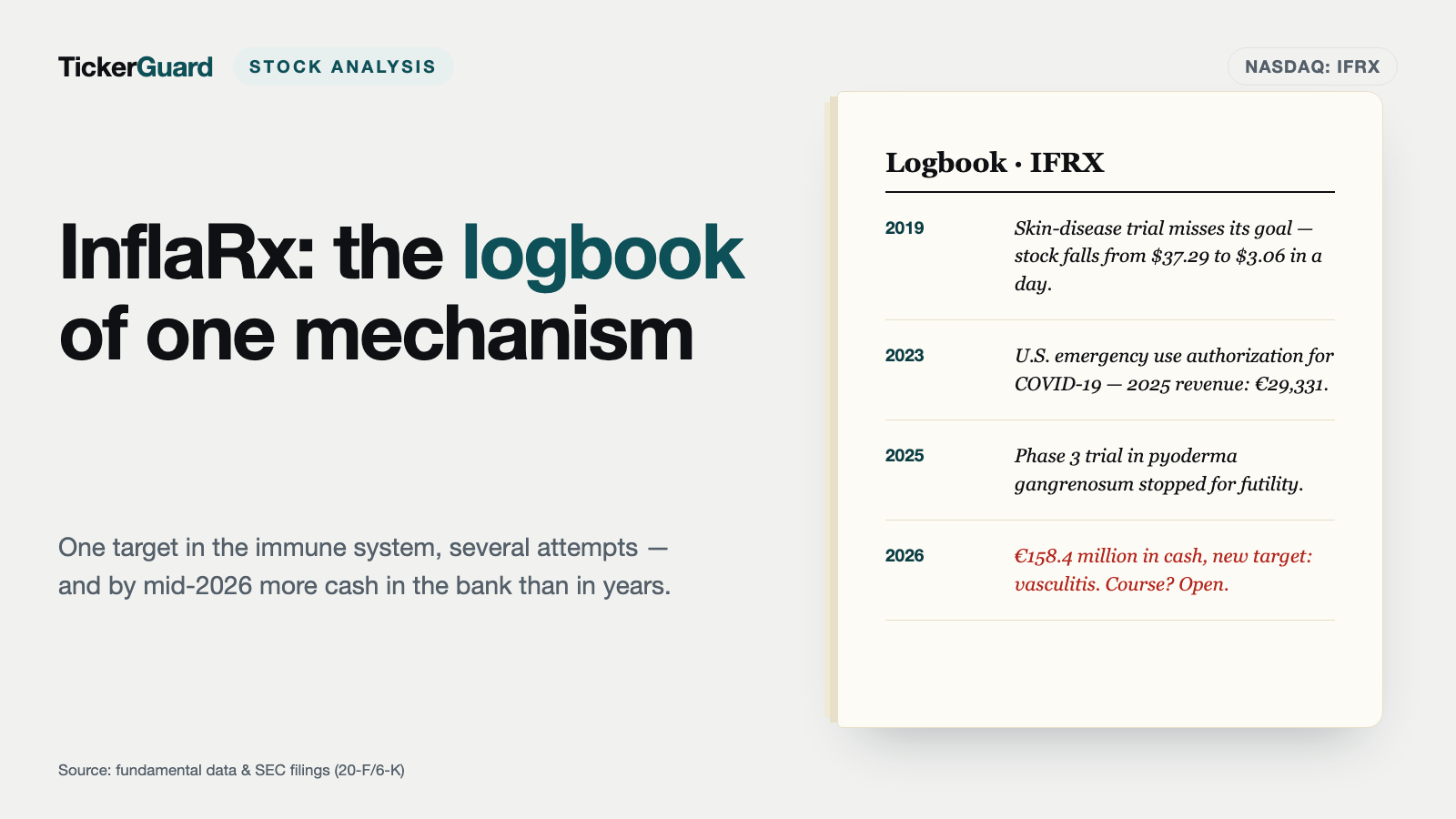
Company history for investors
-
2017
Nasdaq IPO
In November 2017 at $15 per share. On October 2, 2026, the stock closed at $1.72.
-
2019
SHINE trial misses its goal
vilobelimab (then IFX-1) showed no significant effect in hidradenitis suppurativa; the stock fell from $37.29 to $3.06 in a single day.
-
2023
U.S. emergency use authorization for GOHIBIC
vilobelimab authorized for severe COVID-19, stock jumped from $3.77 to $6.10. Revenue in 2025: €29,331.
-
2025
Phase 3 stopped in pyoderma gangrenosum
Stopped for futility after an interim analysis in May 2025; close of $0.73 on May 28, 2025.
-
2026
Pivot to AAV and $150 million in fresh money
75M new shares at $2.00, share count doubled, runway through the end of 2029. In August, the EU revoked the approval of the competing drug Tavneos.
How the stock landed on our desk — via the wallstreet-online forum rankings
Not through one of our fundamentals filters: a company without meaningful revenue slips through every screen that looks for profits or growth. InflaRx showed up in early October 2026 in the ranking of the most-discussed stocks on the forum of wallstreet-online, one of Germany’s largest retail investor sites (as of October 3, 2026). That is hardly surprising: a Nasdaq-listed biotech from Jena is closer to home for German retail investors than most U.S. names.
The 2026 price chart explains the excitement. On February 5, 2026, the stock closed at $0.83; in March, Nasdaq sent a deficiency notice because the bid price had stayed below $1 for 30 consecutive business days. By late April the issue was resolved, and on May 26, 2026, the stock closed at $2.74. On October 2, 2026, it was down to $1.72 — below the $2.00 at which InflaRx had issued 75 million new shares in May. Rule of thumb: when you read about a stock in a forum, you are reading about its price. The company is described in the filings.
The numbers over the years — credit where it is due
First, what deserves credit. In 2026 InflaRx cut its costs sharply while raising more money than it had in years. In the first half of 2026, research and development expenses fell to €8.9 million from €14.2 million a year earlier, and general and administrative expenses to €5.7 million from €8.3 million. Net cash used in operating activities dropped to just €10.0 million, from €21.6 million in the first half of 2025. The net loss for the half-year was €16.2 million, down from €22.7 million. And as of June 30, 2026, the balance sheet held €158.4 million in cash and marketable securities, with no bank debt. The company expects that money to last through the end of 2029.
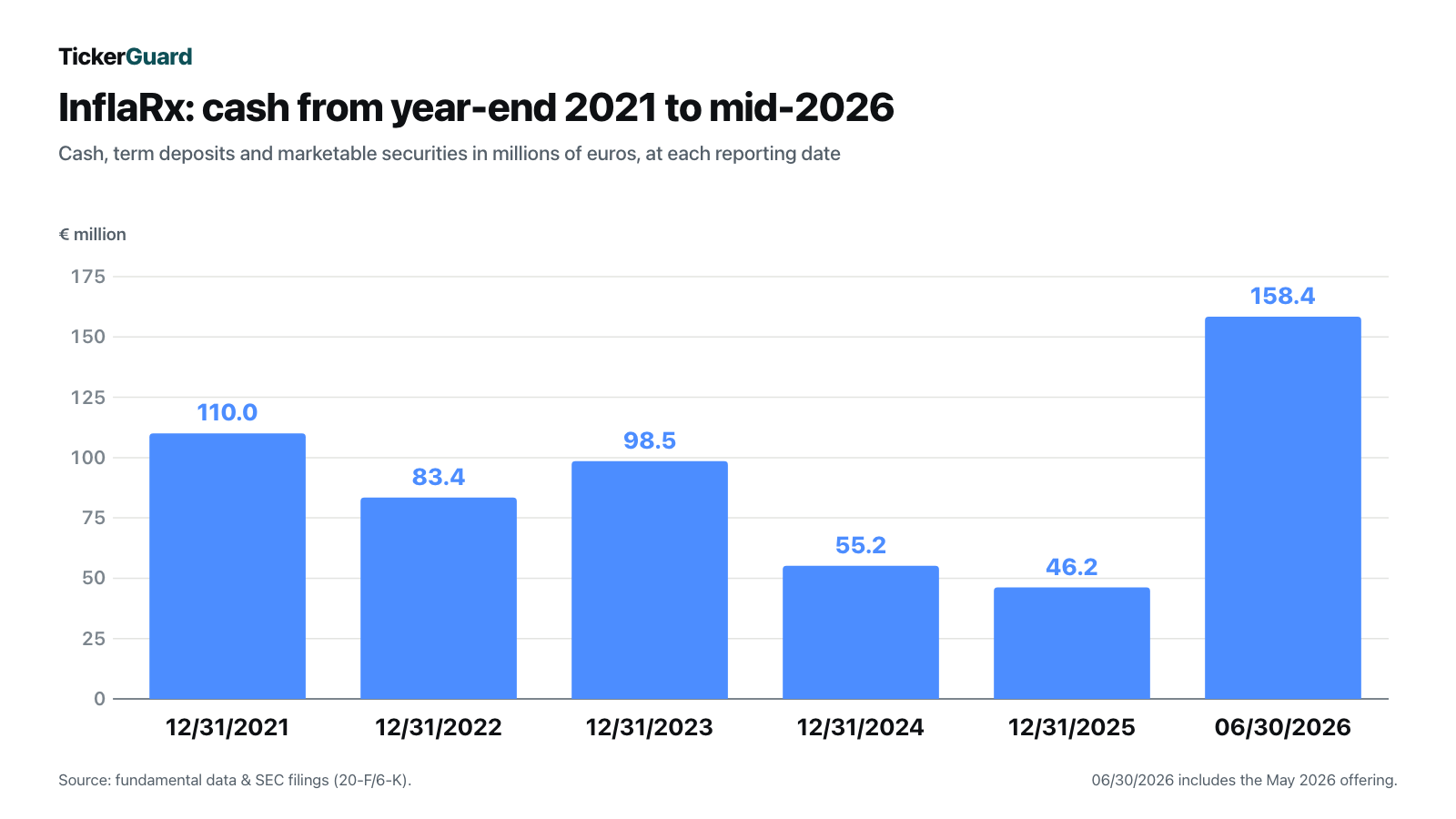
The flip side: this cash was not earned, it came from shareholders. InflaRx has lost money every single year — €45.6 million in 2021, €29.5 million in 2022, €42.7 million in 2023, €46.1 million in 2024 and €45.6 million in 2025, a total of €209.5 million over five years. Operating cash outflows ran between €33.7 million and €48.6 million a year over that period. As of June 30, 2026, the accumulated deficit stood at €394.1 million. So the chart mainly tells you one thing: the cash goes up through new shares, not through sales.
One detail on the first half of 2026: the €10.0 million outflow is low partly because few trials were running. According to the half-year report, the Phase 2 trial of izicopan in AAV is not set to start until late 2026 or early 2027, with planned studies in three kidney diseases and a study in China on top. Rule of thumb: a biotech that is spending little right now is researching little right now — the savings are a pause, not a permanent state.
Uncomfortable truth No. 1: many attempts — and an approved drug with €29,331 in annual revenue
InflaRx has tested its mechanism in several diseases. For vilobelimab alone, the 2025 annual report lists studies in sepsis, cardiac surgery, the skin disease hidradenitis suppurativa (HS), AAV, the skin ulcer pyoderma gangrenosum and COVID-19. The milestones that matter most for investors:
| Year | Attempt | Outcome |
|---|---|---|
| 2019 | vilobelimab (then IFX-1) in hidradenitis suppurativa, Phase 2b SHINE trial with 179 patients | primary endpoint missed; close of $37.29 on June 4, $3.06 on June 5, 2019 |
| 2023 | vilobelimab in severe COVID-19 | U.S. emergency use authorization on April 4, 2023, EU approval under exceptional circumstances in January 2025; 2025 revenue: €29,331 |
| 2025 | vilobelimab in pyoderma gangrenosum, Phase 3 | stopped for futility after an interim analysis in May 2025 |
| 2025/2026 | izicopan in hidradenitis suppurativa and chronic spontaneous urticaria, Phase 2a | positive topline data in November 2025; HS only with a partner since May 2026 |
| 2026 | izicopan in AAV and three kidney diseases | Phase 2 in planning, start expected in late 2026 or early 2027 |
The hardest day was June 5, 2019, when InflaRx reported the outcome of the SHINE trial in hidradenitis suppurativa:
“IFX-1 did not demonstrate a statistical significant dose dependent effect on Hidradenitis Suppurativa Clinical Response (HiSCR) rate at week 16 as primary endpoint”
— InflaRx, Form 6-K of June 5, 2019, Exhibit 99.1

The stock lost 92 percent in a single trading day. The second attempt looked like a win on paper: in April 2023, vilobelimab received an emergency use authorization from the U.S. Food and Drug Administration (FDA) for severe COVID-19, based on a trial showing a 23.9 percent relative reduction in 28-day mortality. The day after the announcement, the stock jumped from $3.77 to $6.10. But as the pandemic faded, so did the orders. The 2025 annual report records the result without fuss:
“For the twelve months ended December 31, 2025, we realized revenues from product sales of GOHIBIC (vilobelimab) in the amount of €0.0 million, which represents a decrease of €0.1 million compared to the prior year.”
— InflaRx, SEC annual report on Form 20-F for 2025, Item 5 (Operating Results, Revenues)
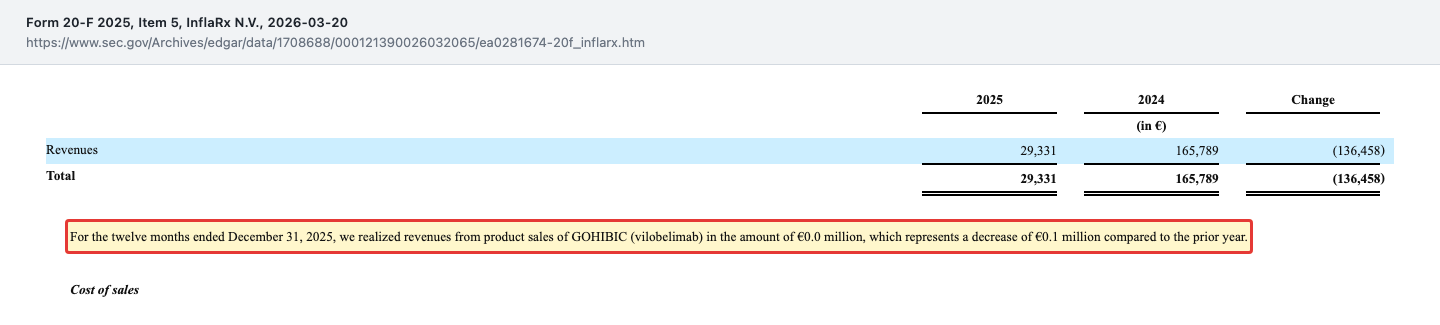
€29,331 in revenue set against about €7.27 million in cost of sales in 2025. At the end of 2025, InflaRx largely discontinued its GOHIBIC sales activities; in the U.S., the drug remains available to order only. To be fair: an emergency use authorization is a real scientific achievement, and a COVID-19 drug cannot help it if the pandemic ends. But what counts for you as an investor is this: the only approved product contributes practically nothing to the business.
Uncomfortable truth No. 2: tailwind from a competitor — but no data of its own yet
Until spring 2026, izicopan in hidradenitis suppurativa was front and center. As late as January 2026, the company talked about preparing a larger Phase 2b trial. On May 6, 2026, came the turn: InflaRx announced it would develop izicopan in AAV, plus three kidney diseases (atypical hemolytic uremic syndrome, IgA nephropathy and C3 glomerulopathy). HS is to continue only with a partner. The same day, the company priced a $150 million share offering.
Since June 2026 — seven weeks after it was announced — the pivot has had extra tailwind. On June 25, 2026, the Committee for Medicinal Products for Human Use (CHMP) of the European Medicines Agency (EMA) concluded its review of Tavneos and recommended revoking its EU marketing authorization; the recommendation was made public on June 26. Until then, Tavneos had been the only approved drug that blocks the same lock. On August 4, 2026, the European Commission issued the legally binding revocation. The reason lies not in the mechanism but in the data from the pivotal ADVOCATE trial with 331 patients:
“After reviewing the totality of the available data and new information on how the study data were handled, the CHMP concluded that the Advocate study was conducted in breach of good clinical practice (GCP) principles.”
— European Medicines Agency, “EMA recommends revoking marketing authorisation for Tavneos,” EMA/143819/2026 of August 4, 2026
The same EMA notice also points out that Tavneos is associated with an increased risk of serious liver injury, including cases with a fatal outcome — exactly the area where InflaRx is trying to set izicopan apart. On June 30, 2026, InflaRx said it intends to engage with the EMA on a path to approval in Europe, for both izicopan and vilobelimab, which has already completed two Phase 2 trials in AAV. In the European one, IXCHANGE, vilobelimab replaced glucocorticoids on top of standard background therapy; according to InflaRx, response and remission rates were comparable to standard-dose glucocorticoids, with substantially lower glucocorticoid exposure and fewer glucocorticoid-related side effects (Form 6-K of June 30, 2026). On Friday, June 26, 2026, the stock closed at $1.92; on the following Monday, at $2.28.
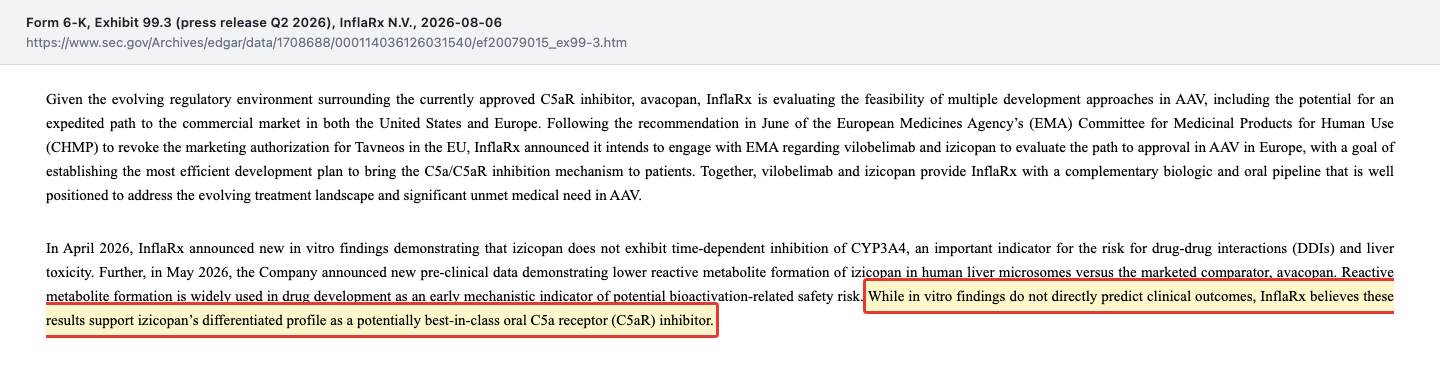
The catch: there are no patient data yet for izicopan in AAV. What InflaRx cites as advantages over avacopan so far comes from the test tube — less interaction with an important liver enzyme and fewer reactive metabolites in human liver microsomes. The company itself spells out how far that goes:
“While in vitro findings do not directly predict clinical outcomes, InflaRx believes these results support izicopan’s differentiated profile as a potentially best-in-class oral C5a receptor (C5aR) inhibitor.”
— InflaRx, Form 6-K of August 6, 2026, Exhibit 99.3 (second-quarter 2026 earnings release)
According to the half-year report, the Phase 2 trial in AAV is to start “by late 2026 or early 2027.” Judging by experience with such trials, results are more likely years than months away. InflaRx has announced a Capital Markets Day for October 8, 2026, focused on its AAV strategy. To be fair: a stumbling competitor can be a real opening, and InflaRx has worked on this mechanism since its founding in 2007. But only a company that brings its own data can fill the gap someone else leaves behind — and the lesson of the Tavneos case is that regulators look at those data very closely.
Uncomfortable truth No. 3: twice as many shares in six months
The €158.4 million came at a price, and existing shareholders paid it. On May 6, 2026, InflaRx sold 75 million new shares at $2.00 each through investment bank Guggenheim — about $150 million gross, €119.3 million net. At the end of 2025, 72.3 million shares were outstanding; as of June 30, 2026, there were 147.4 million. Anyone who owned one percent of the company before now owns just under half of that — your slice of the pie shrinks when new slices are cut and sold to others. One major shareholder added heavily during this half-year: the funds around Aaron Cowen reported 7.9 million shares (11.0 percent) under Suvretta Capital at the end of 2025 and 22.9 million (15.6 percent) under Montanova Capital as of June 30, 2026. Whether the 15 million additional shares came from the offering, the filing does not say.
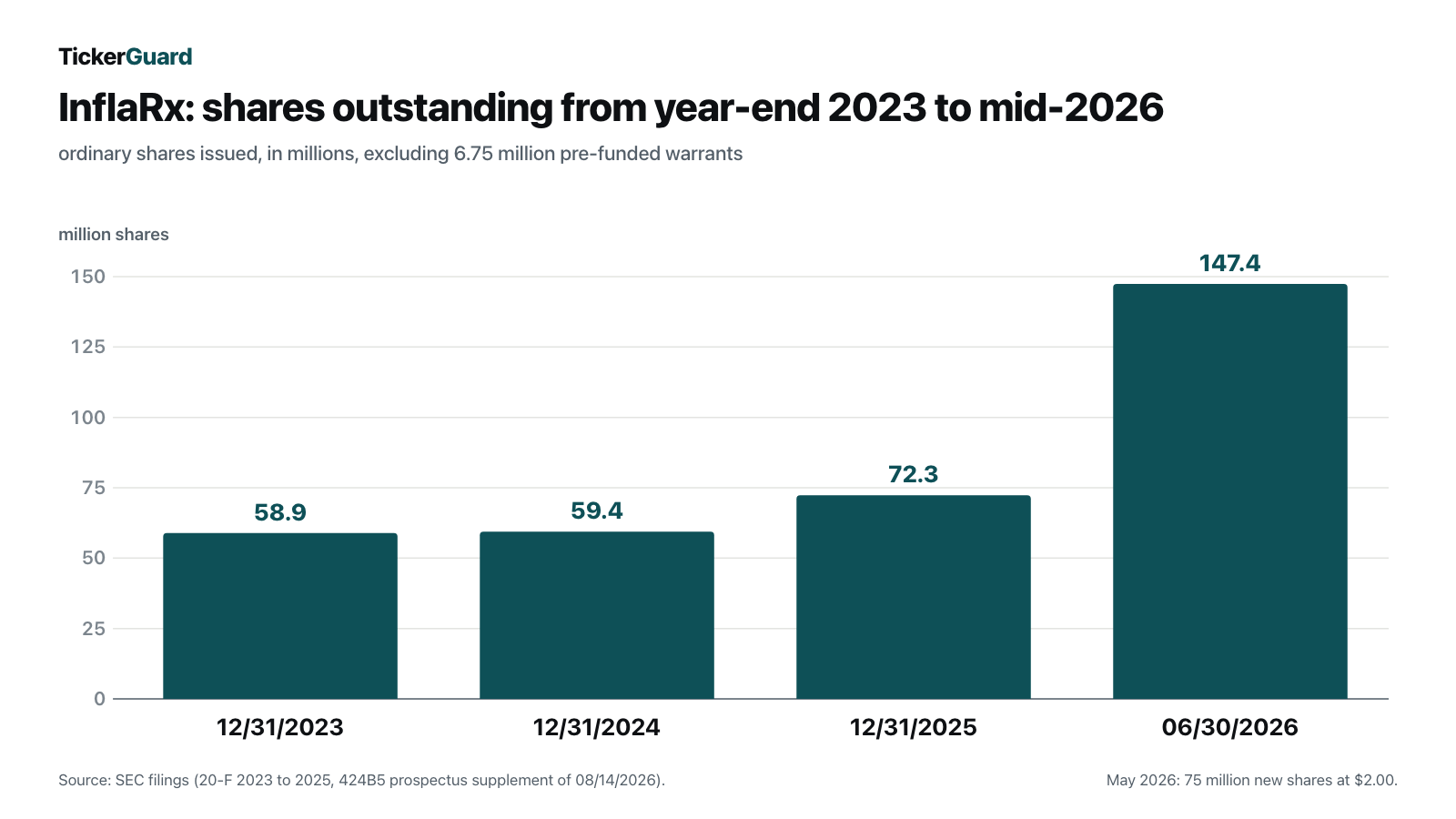
And it does not stop there. On August 14, 2026, InflaRx registered up to $65 million in additional shares under its existing sales agreement with the bank Leerink (dated June 2024). Such an “at-the-market” program lets the company sell shares directly into the market at any time, without announcing an offering first. At the October 2, 2026, close of $1.72, that would be about 37.8 million shares, a quarter more than as of June 30 (our calculation). According to the prospectus, no shares were sold under the program between June 30 and August 14. Add 14.9 million stock options for management and employees (June 30, 2026), and from 2027 the new incentive plan may use up to 6.5 percent of outstanding shares a year for employee equity, up from 4 percent (annual general meeting of April 23, 2026).
A detail from the same meeting shows how much room was created for further issuance. Shareholders raised the authorized capital to 180.73 million ordinary shares and wrote a transitional rule into the articles of association: once at least 152,292,850 shares have been issued (a nominal value of €18,275,142), the ceiling automatically rises to 380,732,125 ordinary shares. As of June 30, 2026, about 4.9 million shares were left before that threshold (our calculation). Rule of thumb: a company that doubles its ceiling for new shares in advance keeps further offerings open.
Uncomfortable truth No. 4: a going-concern sentence that no longer fits
In the 2025 annual report, filed March 20, 2026, auditor KPMG included a paragraph investors do not like to read: cash would last into mid-2027, InflaRx needed substantial new funding for its planned Phase 2b trial, and this raised “substantial doubt” about the company’s ability to continue as a going concern. That was before the offering. Since then the picture has changed completely: €158.4 million in cash instead of €46.2 million, runway through the end of 2029 instead of mid-2027.
Which makes one sentence in the management’s discussion for the period ended June 30, 2026, all the more striking. In the same section, two paragraphs after the statement that the money will last “through 2029,” it still says:
“As a result, these events and conditions indicate that a material uncertainty exists that may cast significant doubt on the Group’s ability to continue as a going concern and, therefore, the Group may be unable to realize its assets and discharge its liabilities in the normal course of business.”
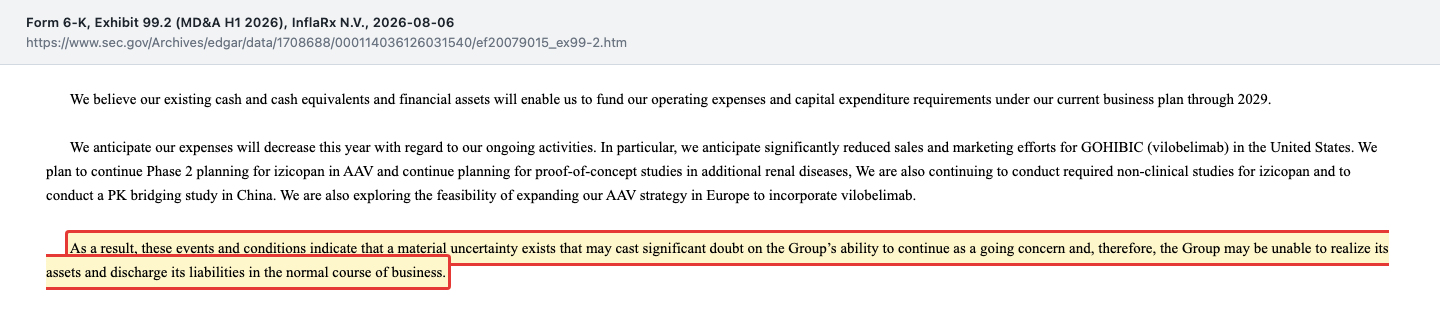
The two statements do not fit together. The sentence opens with “As a result” and refers to “these events and conditions” — yet the section before it does not describe a funding gap, it describes a runway through 2029. It reads like a leftover from before the offering. The interim financial statements themselves, Exhibit 99.1, carry no such warning. We therefore read it as an editorial remnant rather than a new warning. Still: a company that has just raised $150 million from professional investors should write its filings carefully enough that this doubt never comes up. Whether the auditor drops its going-concern paragraph will show in the 20-F for 2026. Rule of thumb: a filing is only as good as its weakest sentence.
Valuation: about $253 million as of October 2, 2026
At the October 2, 2026, close of $1.72 and 147.4 million shares (as of June 30, 2026, unchanged through August 14 according to the prospectus), InflaRx had a market value of about $253 million — our own calculation. Converting the €158.4 million in cash at the European Central Bank rate of June 30, 2026 (1.1394 dollars per euro, as used in the prospectus) gives about $180 million. For the drug candidates, the patents and GOHIBIC, the market is thus paying about $73 million; including the 6.75 million pre-funded warrants, about $85 million (our calculation). Cash has likely shrunk somewhat since June 30 through ongoing outflows.
Classic multiples do not help here. There is no price-to-earnings ratio without earnings, and a price-to-sales ratio on €29,331 in annual revenue yields no meaningful figure. The market values the €146.2 million in equity (June 30, 2026) at about 1.5 times. The cash math is more telling: if €158.4 million is to last from June 30, 2026, through the end of 2029, the company can spend at most about €45 million a year on average — more than twice the annualized first half of 2026 (our calculation). That fits the planned trials and means spending will rise again.
What the pros think: nine analysts cover the stock, seven rate it “Strong Buy,” one “Buy” and one “Hold”; their average price target was $7.69 (source: fundamental data, as of October 3, 2026). That figure is a simple average: all targets are added up and spread evenly — so a single very high target pulls it up sharply. Price targets for a company without revenue are mostly assumptions about trials that have not started yet. What it looks like when an inflammation biotech actually wins a big trial is shown in our Abivax stock analysis. How long even a large German drug discovery company can wait for a breakthrough is the subject of our Evotec stock analysis.
Opportunities and risks at a glance
The case for InflaRx:
- A big cash pile: €158.4 million in cash and marketable securities, no bank debt (06/30/2026); runway through the end of 2029 according to the company.
- Deep experience with one mechanism: two drugs against the same inflammation amplifier, a pill (izicopan) and an antibody (vilobelimab) with two completed Phase 2 trials in AAV.
- An opening in Europe: the EU approval of the competing drug Tavneos has been revoked since August 4, 2026, over flaws in its pivotal trial.
- Lower costs: operating cash outflow of €10.0 million in the first half of 2026, down from €21.6 million.
The case against:
- A long list of setbacks: primary endpoint missed in 2019, Phase 3 in pyoderma gangrenosum stopped in 2025, revenue from the approved GOHIBIC only €29,331 in 2025.
- The new plan is young: AAV only since May 6, 2026, no patient data yet for izicopan in AAV, trial start late 2026 at the earliest.
- Heavy dilution: share count from 72.3 million to 147.4 million in six months, a $65 million sales program ready to go.
- The articles of association automatically allow up to 380.7 million ordinary shares once 152.3 million have been issued.
- An inconsistent filing: the material-uncertainty sentence on the going concern sits next to the runway through 2029 in the management’s discussion of August 6, 2026.
A human conclusion
Back to Monte Carlo. The gamblers of 1913 did not lose because red never came — of course it came eventually. They lost because they believed the past made the next spin more predictable. With InflaRx it is the same, only in both directions: the failures of 2019 and 2025 do not make a success in AAV any more due — but they do not make it impossible either. Every trial is a new spin. What has actually changed is in the filings: more cash than at any year-end since 2021, twice as many shares, a plan that has only been in place since May 2026, and a competitor whose EU approval has been revoked since August 2026. So do not ask whether InflaRx is “due” after all these attempts — ask what you would be willing to pay until the first result of the new trial, in money and in patience. The next chances to take a closer look are the announced Capital Markets Day on October 8, 2026, and the next interim report, which will show whether new shares have already been sold. What you make of it is your decision. And that is how it should be.
Sources
All original documents used in this analysis — so you can check them yourself:
- InflaRx N.V. — half-year report filed as Form 6-K on August 6, 2026: Exhibit 99.1 (interim financial statements as of June 30, 2026), Exhibit 99.2 (management’s discussion), Exhibit 99.3 (earnings release) — latest periodic report: cash, costs, runway, trial plan, Capital Markets Day
- InflaRx N.V. — 424B5 prospectus supplement of August 14, 2026 (sales program of up to $65 million, 147,368,221 shares and options as of June 30, 2026, exchange rate 1.1394) and Form 6-K of May 7, 2026 (75 million shares at $2.00)
- InflaRx N.V. — annual reports on Form 20-F for 2025 (March 20, 2026; revenue, losses, audit report, employees, major shareholders), 2024, 2023 and 2021 (cash, losses and share count in prior years)
- InflaRx N.V. — Forms 6-K of May 6, 2026 (pivot to AAV and kidney diseases), June 30, 2026 (EMA recommendation on Tavneos), January 8, 2026 (workforce reduction), March 16, 2026 and April 28, 2026 (Nasdaq deficiency notice and regained compliance), April 23, 2026 with the amendment to the articles of association, and the AGM convening notice (April 2, 2026)
- InflaRx N.V. — historical Forms 6-K of June 5, 2019 (SHINE trial), April 4, 2023 (U.S. emergency use authorization) and May 28, 2025 (pyoderma gangrenosum trial stopped); IPO prospectus 424B4 of November 8, 2017
- European Medicines Agency — “EMA recommends revoking marketing authorisation for Tavneos” (EMA/143819/2026, August 4, 2026): review concluded on June 25, 2026, ADVOCATE trial in breach of good clinical practice, liver risk, legally binding European Commission decision of August 4, 2026
- Major shareholders: Schedule 13G/13G/A filings by Montanova Capital (August 14, 2026), Sirenia Capital (August 14, 2026), FMR (August 6, 2026), Commodore Capital (August 17, 2026) and TCG Crossover (May 12, 2026), available via the SEC’s EDGAR database
- Closing prices of June 4/5, 2019, April 4/5, 2023, February 5, May 26, June 26 and 29, and October 2, 2026 (price anchor $1.72), analyst ratings: source: fundamental data. Market value, cash in dollars and ratios are our own calculations. Multi-year figures: source: fundamental data & SEC filings (20-F/6-K).
Transparency & disclaimer: This analysis is a journalistic assessment of publicly available information. It is not investment advice, not a financial analysis in the regulatory sense and not a solicitation to buy or sell securities. Investing in stocks involves substantial risk, up to and including the total loss of your investment. All information without guarantee; the data date is noted in the text. Positions held by the operator are disclosed daily; where one exists, it appears as a notice at the top of this deep dive.
Key figures at a glance
All monetary figures in millions of €; earnings per share as reported.
| Metric | 2021 | 2022 | 2023 | 2024 | 2025 |
|---|---|---|---|---|---|
| Revenue | 0.0 | 0.0 | 0.1 | 0.2 | 0.0 |
| Operating Income (EBIT) | -47.6 | -32.2 | -44.6 | -52.9 | -48.3 |
| Net Income | -45.6 | -29.5 | -42.7 | -46.1 | -45.6 |
| Net Margin | – | – | -67,630.7% | -27,785.0% | -155,582.1% |
| Earnings Per Share | -1.10 € | -0.67 € | -0.78 € | -0.78 € | -0.68 € |
Source: fundamental data & SEC filings (annual and quarterly reports, 10-K/10-Q)
Our Bottom Line at a Glance
- Cash positive
- €158.4M in cash and marketable securities, no bank debt (06/30/2026); runway through the end of 2029 according to the company.
- Costs positive
- Operating cash outflow of €10.0M in the first half of 2026 versus €21.6M; workforce cut of about 30% announced (01/08/2026). Spending is set to rise again with the planned trials.
- Track record negative
- SHINE trial missed in 2019, Phase 3 in pyoderma gangrenosum stopped in 2025; the approved GOHIBIC brought in only €29,331 in revenue in 2025.
- New plan negative
- AAV since 05/06/2026; no patient data yet for izicopan in AAV, Phase 2 start in late 2026 or early 2027; tailwind from the revocation of Tavneos’ EU approval (08/04/2026).
- Dilution negative
- Share count from 72.3M to 147.4M (12/31/2025 to 06/30/2026); sales program up to $65M; articles of association automatically allow up to 380.7M ordinary shares.
- Reporting quality neutral
- Management’s discussion of 08/06/2026 cites a runway through 2029 and still contains the material-uncertainty sentence on the going concern; the interim financial statements do not.
After the May 2026 offering, InflaRx holds more cash than at any year-end since 2021 and has cut costs sharply. Against that stand a long series of setbacks, an approved drug without meaningful revenue, a doubled share count and a plan that has only been in place since May 2026, with no patient data yet for the pill izicopan in that disease. Not investment advice.
What Our Rating Means
Open questions
The business works in principle, but one material question is open. As long as it stays open, our findings do not carry a quality verdict.
Yellow here signals an open operational question, not a view on the share price. We do not see a substantive risk in the sense of our traffic light as of June 30, 2026: €158.4 million in cash with no bank debt against a half-year outflow of €10.0 million, positive equity, and the company expects a runway through the end of 2029. The material-uncertainty sentence on the going concern that still appears in the management’s discussion of August 6, 2026, contradicts that runway in the same section and is absent from the interim financial statements; the auditor’s paragraph on it dates from the March 2026 annual report, before the offering. What remains open is what matters most: the company’s value hinges on izicopan in a disease where there are no patient data yet, after a long series of setbacks and with a share count that has just doubled. Whether the stock at $1.72 (October 2, 2026) is a reasonable price for that bet is not something this rating answers. The decision is yours.
A journalistic assessment by our editorial team at the time of the deep dive, based on public sources — not investment advice and not a solicitation to buy or sell. Your personal circumstances (investment goals, risk capacity, taxes) cannot be taken into account. What our levels mean, how verdicts are formed, and what conflicts of interest exist →
Worth Noting
- Version of October 3, 2026, based on the half-year report on Form 6-K of August 6, 2026 (Exhibits 99.1 to 99.3, latest periodic report), the annual reports on Form 20-F for 2021, 2023, 2024 and 2025, the 424B5 prospectus supplements of May 7 and August 14, 2026, all Forms 6-K since December 2025 and the Schedule 13G filings through August 17, 2026. The stock came to our attention through the wallstreet-online forum rankings in early October 2026, not through a fundamentals screen.
- InflaRx is a foreign private issuer: instead of quarterly reports on Form 10-Q it furnishes interim reports on Form 6-K, and instead of an annual report on Form 10-K it files a Form 20-F. Its financials are in euros while the stock trades in U.S. dollars; conversions at the ECB rate of June 30, 2026 (1.1394 dollars per euro) are our own. Cash = cash, term deposits and marketable securities (prior years summed by us from the 20-F notes).
- The price anchor is the close of $1.72 on 10/02/2026 (source: fundamental data); according to the prospectus, the price was $2.01 on 08/13/2026. Market value computed in-house (147,368,221 shares × $1.72). The former name in the SEC database, Fireman B.V., belongs to the 2017 IPO shell; IFX-1 is the former project name of vilobelimab, INF904 that of izicopan.
Stock Watch
This analysis is as of October 3, 2026. Stock Watch will tell you what's changed at IFRX since then.
Later $1 a month per stock — signing up is free, and you'll be the first to know when it launches.
The full analysis as a PDF for later
We will send you this analysis as a PDF — to print, file away, and read at your own pace. And we will add you to the free Stock Watch list for InflaRx N.V. (IFRX), so you hear about it when something material in this analysis changes.
Frequently Asked Questions
InflaRx is a biotech company managed from Jena, Germany, legally a Dutch N.V. It develops drugs against the inflammatory messenger C5a and its receptor: the pill izicopan, which is to be tested in the blood-vessel inflammation AAV and three kidney diseases, and the antibody vilobelimab, authorized as GOHIBIC for severe COVID-19. So far it has no meaningful revenue.
As of June 30, 2026, InflaRx had €158.4 million in cash and marketable securities and no bank debt. According to the half-year report of August 6, 2026, that will last through the end of 2029. Operating cash outflow was €10.0 million in the first half of 2026; spending is set to rise again with the planned trials.
Tavneos (avacopan) blocks the same receptor as izicopan and was approved for the blood-vessel inflammation AAV. Following a June 2026 recommendation by the EMA’s medicines committee, the European Commission revoked its EU approval on August 4, 2026, because the pivotal trial breached good clinical practice. InflaRx now wants to discuss a path to approval in Europe for izicopan and vilobelimab with the EMA; there are no patient data yet for izicopan in AAV.
In May 2026, InflaRx sold 75 million new shares at $2.00 each, about $150 million gross. That lifted the share count from 72.3 million at the end of 2025 to 147.4 million as of June 30, 2026. Since August 14, 2026, the company can sell further shares worth up to $65 million into the market through its sales program with the bank Leerink.
According to the annual report on Form 20-F for 2025, revenue was just €29,331 in 2025, after €165,789 in 2024. Cost of sales rose to €7.27 million in 2025, mainly because of higher inventory write-downs. At the end of 2025, InflaRx largely discontinued sales activities; in the U.S., GOHIBIC remains available to order under the emergency use authorization.
According to Schedule 13G filings, Montanova Capital (Aaron Cowen) held 15.6 percent, Sirenia Capital 6.1 percent and FMR 5.5 percent, each as of June 30, 2026. TCG Crossover reported 9.8 percent as of May 7, 2026, and Commodore Capital 5.1 percent as of August 10, 2026. Founders Riedemann and Guo each held just under 7 percent at the end of 2025, before the offering.
Found an error?
Did you spot a factual error, an outdated number, or a typo in this deep dive? Let us know briefly — your report goes straight to the editorial team.