TriplePoint Venture Growth: An Almost 19 Percent Yield, Only 91 Percent Earned — and the Departing CIO Is Named in the Loan Agreements
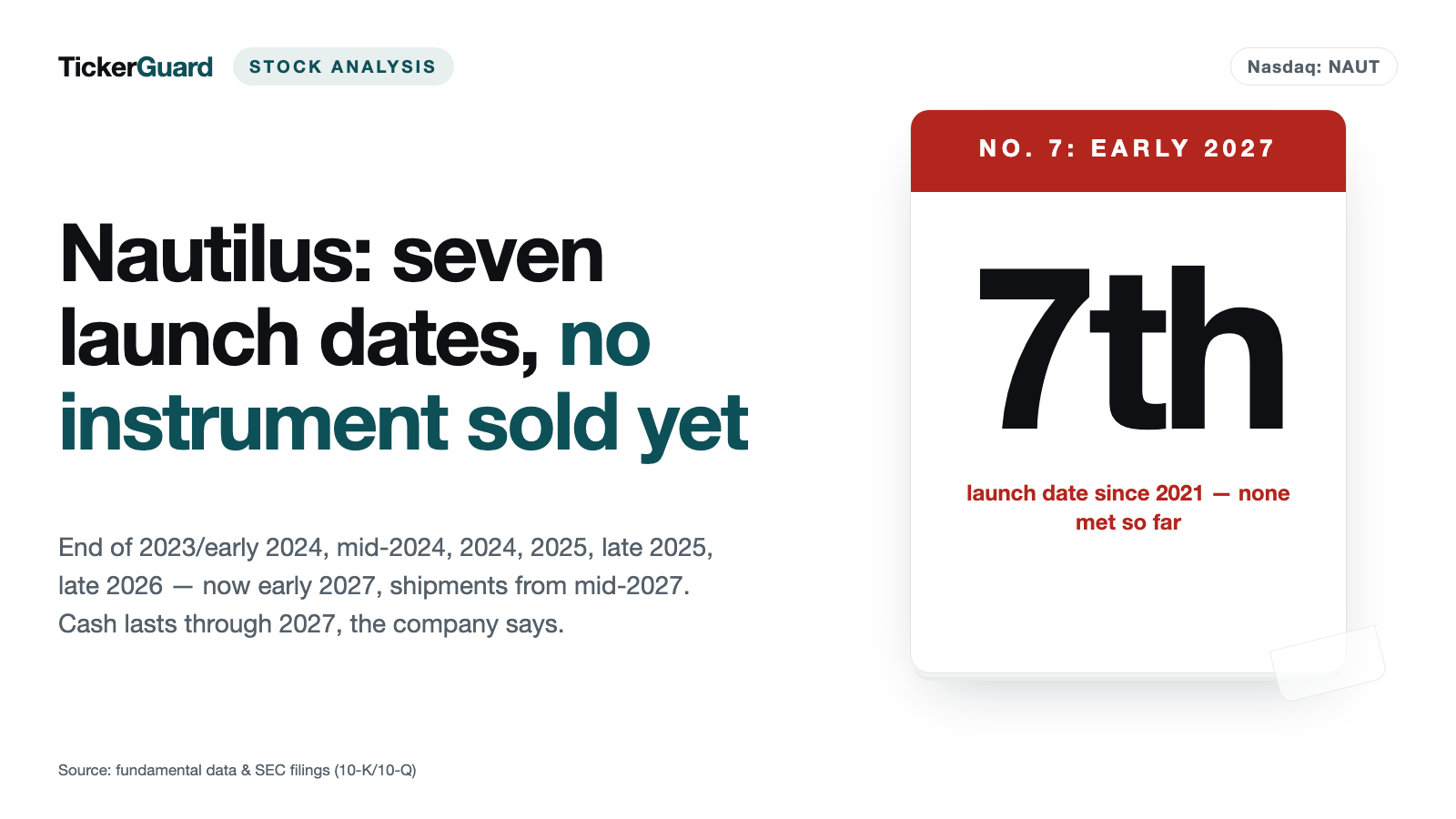
An almost 19 percent yield at the October 2, 2026 share price, a dollar of net assets for 57 cents — and still no gift. TriplePoint Venture Growth lends money to startups at roughly 13 percent. According to its filings, earnings cover the distribution only about 91 percent, and only thanks to a fee waiver that runs through the end of 2026; net asset value per share has fallen 38 percent since the end of 2021. And the departing chief investment officer is named in loan agreements covering $370 million of $445 million in debt. Not investment advice — just the math on how much of that yield is actually earned.
 Thomas Mücke
Founder & Publisher
Thomas Mücke
Founder & Publisher
As of Today
As of: October 2, 2026
- Closing price
- 4.90 $ +0.41%
- Market Capitalisation
- 0.2 $B
- P/E
- 4.9
- Growth Score
- 3/10
- AAQS
- 2/10
This analysis has a cut-off date. The Stock Guard tells you when something material changes in the numbers. Reserve your free spot
Chart
Interactive price chart (TradingView).
52-week range: 4.40 $ to 6.80 $ · Last price: 4.90 $ (As of: October 2, 2026)
Note: pure fact-based analysis, not investment advice and not a solicitation to buy or sell. All figures without guarantee.
There is one number that reliably hypnotizes investors: the double-digit yield. Put “19 percent” next to a stock, and the brain starts doing math right away. Ten thousand dollars, almost two thousand a year, without lifting a finger. What gets lost are two boring questions: Where does the money come from? And what happens to the capital it flows out of? Let’s call it yield hypnosis. It is especially strong with lending funds, because they have to pay out almost all of their earnings — so the payout always looks generous, even while the asset base underneath is crumbling.
TriplePoint Venture Growth BDC Corp. (NYSE: TPVG) is a textbook case. The company lends money to young technology companies backed by venture capital. As of June 30, 2026, each share was backed by $8.67 of net asset value — assets minus all liabilities. On October 2, 2026, the stock closed at just $4.90. The current quarterly distribution of $0.23, annualized, equals 18.8 percent of that price. A dollar of net assets for 57 cents, plus almost a fifth in yield — it sounds like a gift.
So here is the deal: before you let yourself be hypnotized, let’s read together what TriplePoint itself has told the U.S. securities regulator, the SEC — the annual report (10-K) for 2025, the quarterly report (10-Q) for the period ended June 30, 2026, and every filing through September 22, 2026. The central tension of this analysis: the discount to net asset value is large, but net asset value has been shrinking for years — and the distribution is no longer fully earned. Whether the price already reflects that is your call.
What TriplePoint actually does — loans to startups, with warrants on top
Picture a bank that only takes customers a normal bank would turn away: young technology companies that still lose money but have just raised capital from well-known venture investors. TriplePoint lends to these companies, typically for three to five years according to its annual report, secured by a senior lien on the borrower’s assets including its intellectual property. Because the risk is high, so is the interest rate: in the second quarter of 2026 the loan book yielded 12.9 percent annualized. On top come end-of-term payments and, as a sweetener, warrants — the right to buy the borrower’s shares later at the price of its last funding round. As of June 30, 2026, TriplePoint held loans to 53 companies, warrants in 117 and direct equity stakes in 60.
Legally, TriplePoint is a business development company, or BDC — a listed lending fund under the U.S. Investment Company Act of 1940. Two rules shape everything. First, a BDC pays no corporate income tax as long as it distributes at least 90 percent of its taxable income. That is why the dividend is high, and why little profit stays inside the company. Second, debt may only be so large that assets cover it at least 150 percent. TriplePoint stood at 179 percent as of June 30, 2026.
What matters for you as a shareholder: TriplePoint has no employees of its own. The work is done by the adviser, TriplePoint Advisers, a subsidiary of Menlo Park-based TriplePoint Capital, which says it has committed more than $15 billion to over 1,000 venture-backed companies since 2006. The adviser collects a base fee of 1.75 percent of gross assets — including the part bought with borrowed money — plus an incentive fee of 20 percent of income above a hurdle rate. Rule of thumb: whoever earns on the size of the balance sheet has a built-in reason to make it bigger.
Company history for investors
-
2014
IPO at $15.00
NYSE listing in March 2014. Through August 2026, TPVG declared a total of $17.94 per share in distributions — more than the offering price.
-
2021
Peak net asset value
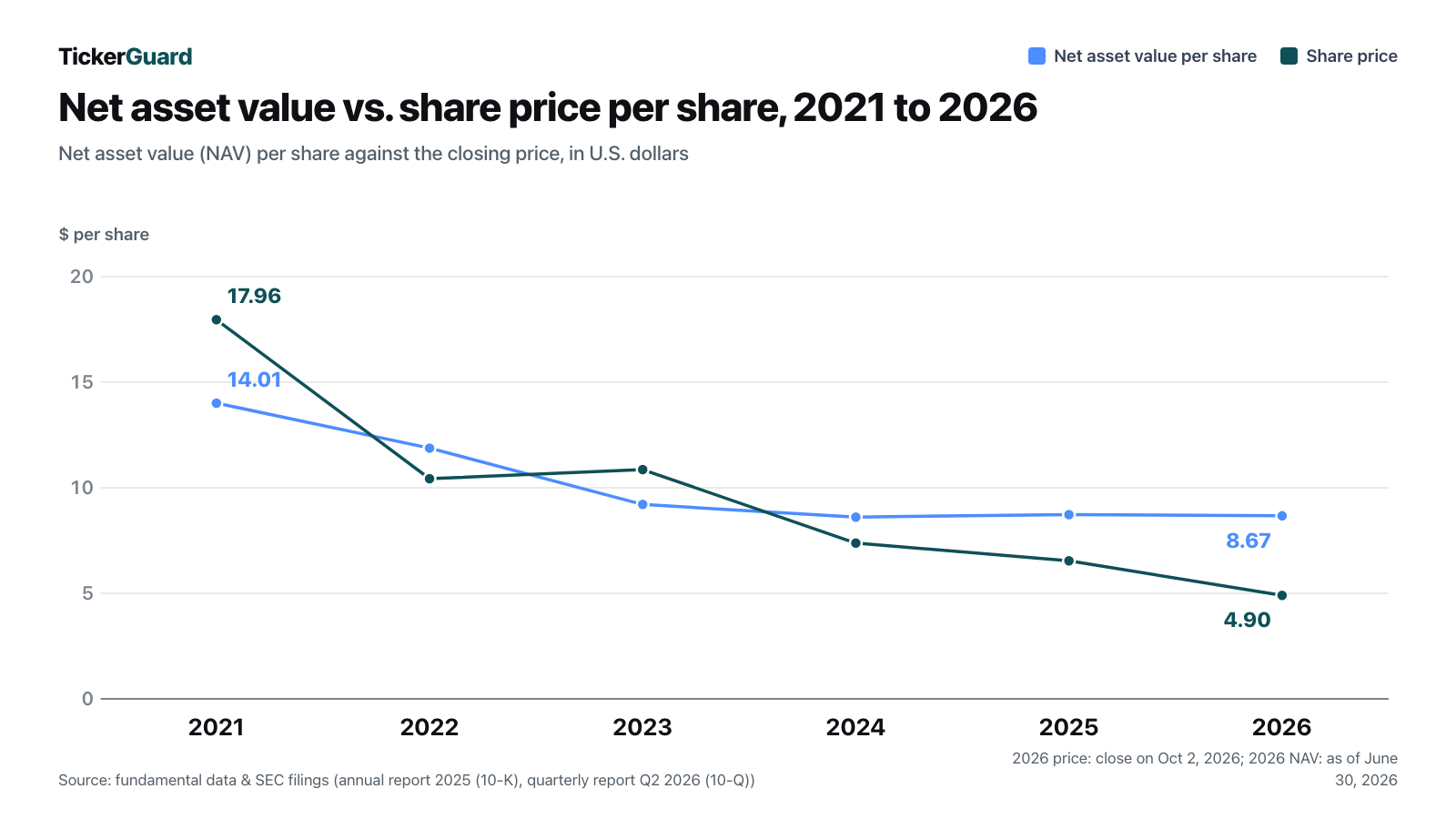
Net asset value of $14.01 per share, year-end price $17.96 — the stock cost more than its net assets.
-
2023
Two loss years after the rate shock
Realized losses of $1.41 (2022) and $2.12 (2023) per share; net asset value falls to $9.21.
-
2025
Fee waiver and rate step-up
From Q1 the adviser partly waives incentive fees, in full from August, extended through the end of 2026. Too much PIK income lifts the 2028 notes to 9.11%.
-
2026
Refinancing, Revolut gain, departure
$200M notes repaid on time in March, $12.8M gain on a partial Revolut sale, Prodigy sold for $43.8M; Srivastava announces his exit at year-end.
How the stock landed on our desk — via the wallstreet-online forum ranking
Not through one of our fundamentals screens. In early October 2026, TriplePoint showed up in the ranking of the most-discussed stocks on the forum of wallstreet-online, one of Germany’s largest retail investing sites (as of October 3, 2026). That fits the pattern of this stock: lending funds with double-digit payouts are a perennial topic in retail forums, especially when the share price falls and the yield rises optically as a result.
Let’s translate the two numbers people discuss there, and judge them. The price-to-NAV ratio of about 0.57 ($4.90 share price on October 2, 2026, versus $8.67 net asset value as of June 30, 2026) means: the market does not believe the books. A ratio of 1 would mean investors take the loan valuations at face value — a discount of more than 40 percent is not a bargain someone missed, it is a vote of no confidence. The distribution yield of 18.8 percent is honestly calculated, but it only tells you what was paid recently, not what is being earned. Put the two together and you get exactly the yield hypnosis from the start.
The numbers over the years — an honest look
First, credit where it is due. Since its IPO in March 2014 at $15.00, TriplePoint has declared a total of $17.94 per share in distributions, according to its August 5, 2026 earnings release, including $0.29 payable on September 30 and $0.06 payable on December 30, 2026 — more than the original offering price. 2025 was a good year: net asset value per share rose from $8.61 to $8.73, and the total return based on net asset value was 20.1 percent, according to the annual report. The $200 million notes that matured in March 2026 were repaid on time. And the warrants are paying off: from a partial sale of shares in the financial app Revolut, TriplePoint booked a gain of $12.8 million in the second quarter of 2026 and still holds warrants and shares there worth $47.9 million. On August 5, 2026, the company also sold its loans and stakes in Prodigy Investments for $43.8 million in cash — at the June 30 fair value plus accrued interest.
Now the longer view. The first chart shows net asset value per share next to the year-end share price. At the end of 2021, the stock still traded well above net assets, at $17.96 versus $14.01. Then came the rate shock, many startups could no longer raise fresh money, and TriplePoint had to write off loans: in 2022 and 2023, realized losses cost a combined $3.53 per share. By mid-2026, net asset value had shrunk to $8.67, while the share price fell further and now sits far below it.
The second chart shows the core of every lending fund: net investment income (NII) — interest and fees minus interest expense, management fees and running costs, excluding gains and write-downs. It is what the fund really earns from its day-to-day business. In 2023 that was $2.07 per share, in 2025 only $1.05, and in the first half of 2026 $0.43. Distributions followed it down, but not all the way: $1.08 was paid in 2025, and $0.46 in the first half of 2026.
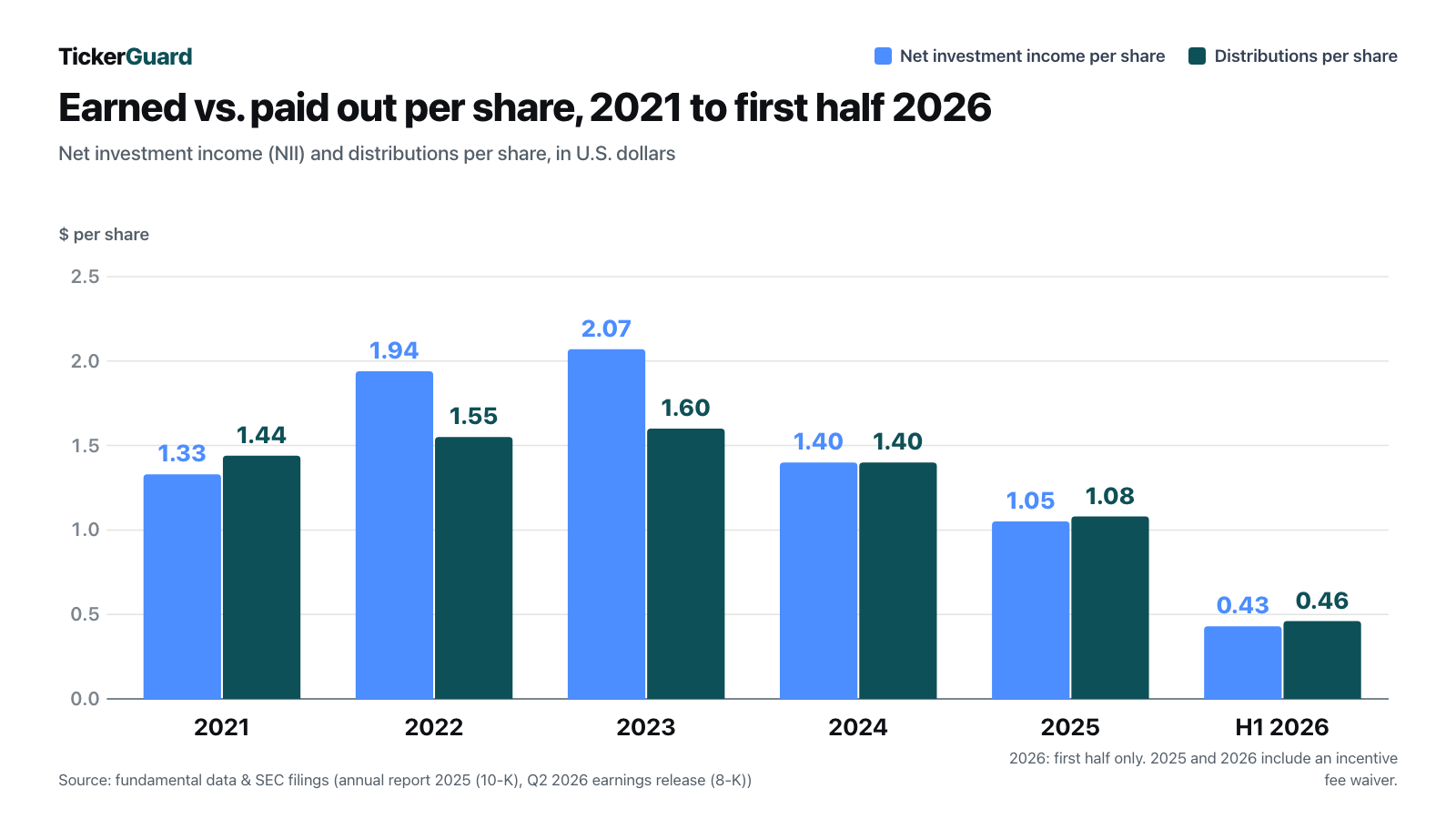
Why is income falling? Three reasons, all named in the filings. Rates have come down, and according to the earnings release, cuts to the U.S. prime rate, to which many loans are tied, pushed yields lower: the loan book yield fell from 15.7 percent (2024) to 13.7 percent (2025) and 12.9 percent in the second quarter of 2026. There were fewer early repayments, which bring extra fees. And TriplePoint’s own funding costs rose: in the second quarter of 2026 it paid $8.3 million in interest and financing fees, up from $6.7 million a year earlier. Rule of thumb: a lending fund earns the spread between its own rate and its lenders’ rate — and that spread is being squeezed from both sides.
Uncomfortable truth No. 1: The distribution is not fully earned — and part of what is earned is a gift
In the second quarter of 2026, TriplePoint earned net investment income of $0.21 per share and paid a regular distribution of $0.23. That is coverage of about 91 percent. For the third quarter, the board again declared $0.23 plus two supplemental payments of $0.06 each on September 30 and December 30, 2026. That alone would be no drama. The drama sits one level deeper, in a single sentence about the adviser’s incentive fee:
“The Adviser waived the $1.3 million and $3.2 million in income incentive fees earned for the three and six months ended June 30, 2026, respectively, pursuant to a waiver agreement whereby the Adviser has agreed to waive, in full, any and all of the income incentive fee until and including the quarter ending December 31, 2026.”
— TriplePoint Venture Growth BDC Corp., SEC quarterly report 10-Q for the period ended June 30, 2026, Item 2 (MD&A)
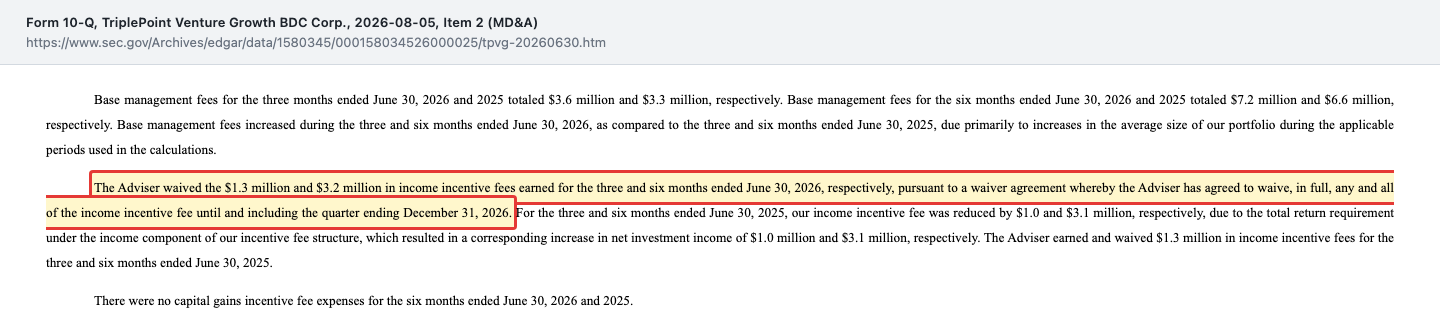
Let’s back it out. Without the waiver, net investment income in the second quarter of 2026 would have been about $7.0 million instead of $8.3 million — roughly $0.17 per share, against a $0.23 distribution. In the first half, it would have been roughly $0.35 against $0.46, coverage of a little over three quarters. On the plus side, according to the 10-Q the adviser cannot claw the waived fees back later, and there is a cushion of earlier, not yet distributed income of $41.7 million, or $1.03 per share (June 30, 2026). But a cushion is not income. The question from January 2027 on: does the adviser extend the waiver, does income grow — or does the distribution fall again?
Uncomfortable truth No. 2: Almost a third of the loans are on the watch list — four have stopped paying
TriplePoint sorts its loans into five color grades, from Clear (1, best) and White (2, on plan) to Yellow (3, performing below expectations), Orange (4) and Red (5, pending or actual default, partial or full loss possible). At December 31, 2025, 17.9 percent of the loans, measured at fair value, sat in grades 3 to 5. Six months later, at June 30, 2026, it was 30.9 percent: Yellow alone rose from 13.4 to 27.2 percent. In the second quarter, a single $28.0 million loan slipped from White to Yellow. Then there are the cases that have already stopped paying:
“As of June 30, 2026, we had investments in four portfolio companies which were on non-accrual status, with an aggregate cost and fair value of $38.6 million and $16.4 million, respectively.”
— TriplePoint Venture Growth BDC Corp., SEC quarterly report 10-Q for the period ended June 30, 2026, Item 2 (credit quality)

“Non-accrual” means the fund no longer books interest on these loans because it no longer expects to be paid. For every dollar invested, about 42 cents remain on the books. Measured against the entire loan book of $722.8 million at cost, that is 5.3 percent — a level that has barely changed since December 2025. The direction of the watch list is more worrying. A venture lender lives on the borrower’s venture investors putting in more money. If that stops, Yellow can turn Orange quickly. We saw something similar in our analysis of real estate lender Ready Capital, where almost a third of the loan book had stopped paying interest as of March 31, 2026 — at TriplePoint, so far it is the watch list, not the defaults.
Uncomfortable truth No. 3: Interest on paper — and debt that is getting more expensive
Part of the interest TriplePoint books does not arrive in cash. It is added to the loan balance and only comes due at the end — in industry jargon, PIK interest (payment in kind). Picture a tenant who says: I’ll owe you the rent, you’ll get it when I move out. In the first half of 2026, PIK interest came to $6.5 million against net investment income of $17.5 million — a little over a third. That is not just a quality question. It has already cost money:
“Subsequent to the quarter ended September 30, 2025, the Company determined that the ratio of the Company’s payment-in-kind income (“PIK Income”) to net investment income during the immediately preceding six-month period exceeded the specified threshold under the 2025 Note Purchase Agreement measured at September 30, 2025, increasing the stated interest rate on the 8.11% 2028 Notes to 9.11% from 8.11% per annum.”
— TriplePoint Venture Growth BDC Corp., SEC quarterly report 10-Q for the period ended June 30, 2026, Note 6 (Borrowings)
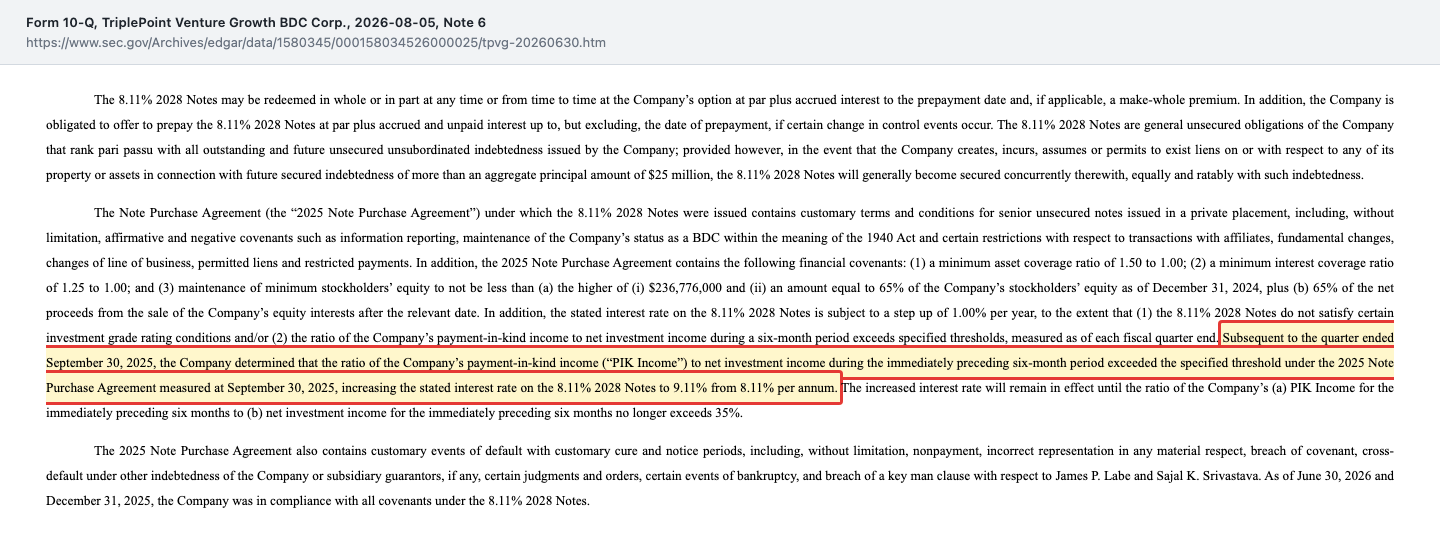
The higher rate applies until the PIK share falls back below 35 percent. In the first half of 2026 it worked out to about 37 percent. And the next cost increase is in sight: on February 28, 2027, $125 million of notes come due that cost only 5.00 percent. The most recent notes, from February 2026, carry 7.50 percent. If TriplePoint had to replace the $125 million at that rate, interest costs would rise by about $3.1 million a year, roughly 8 cents per share — against quarterly income of 21 cents. New shares are no way out: a BDC may not sell new shares below net asset value without shareholder approval, and according to its annual report, TriplePoint does not intend to seek that approval for 2026.
Uncomfortable truth No. 4: The chief investment officer is leaving — and his name is in the loan agreements
On September 21, 2026, TriplePoint reported in a current report (8-K) that Sajal Srivastava, co-founder, president and chief investment officer, will step down from all his roles effective December 31, 2026 — including his board seat. According to the filing, the departure is not the result of any disagreement relating to the company’s operations, policies or practices. Ian Schworer, at TriplePoint Capital since 2014 and most recently its Chief Credit Officer for the U.S., will become chief investment officer. On its own, that is an ordinary generational handover. What makes it sensitive is a sentence that appears in several loan agreements:
“The 2025 Note Purchase Agreement also contains customary events of default with customary cure and notice periods, including, without limitation, nonpayment, incorrect representation in any material respect, breach of covenant, cross-default under other indebtedness of the Company or subsidiary guarantors, if any, certain judgments and orders, certain events of bankruptcy, and breach of a key man clause with respect to James P. Labe and Sajal K. Srivastava.”
— TriplePoint Venture Growth BDC Corp., SEC quarterly report 10-Q for the period ended June 30, 2026, Note 6 (Borrowings)
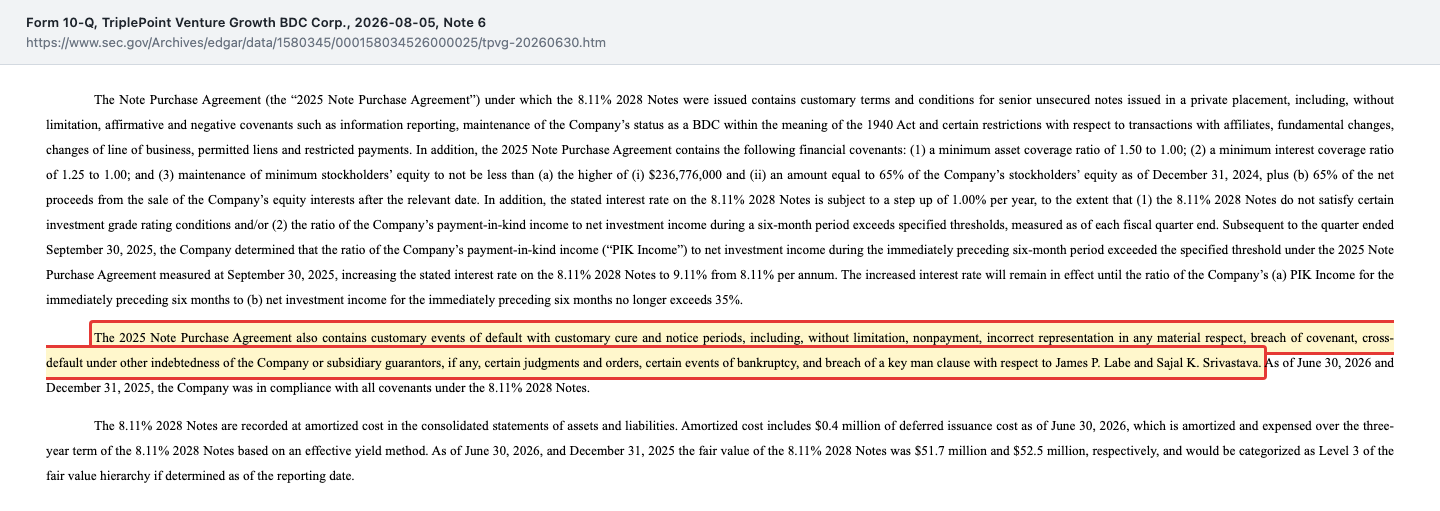
According to the 10-Q, such a clause appears not only in the $50 million notes but also in the credit facility with Deutsche Bank as administrative agent ($195 million drawn) and in the master note agreement under which the $125 million notes due 2027 were issued — together $370 million of $445 million in debt (June 30, 2026). What exactly triggers the clause — the departure of one of the two, or only of both — is not in the 10-Q. Through the data date of this analysis, October 3, 2026, TriplePoint had not reported an amendment or a waiver from its lenders. Whether the lenders waive the clause or ask for concessions in return is the central open question through December 31, 2026; an 8-K reporting an amendment or the next quarterly report would settle it. The worst case is described in the 2025 annual report for the credit facility: after an event of default, the administrative agent could assume control of the disposition of assets or restrict further use of the facility.
One more detail from the Schedule 13D of September 22, 2026: on September 18, Srivastava sold his 313,865 shares to the sponsor, TriplePoint Capital, at $4.7061 per share. According to the Schedule 13D, the sponsor had agreed in connection with the resignation to buy all of Srivastava’s shares; the price was slightly below the market price (closing price on September 18, 2026: $4.85, about 56 percent of net asset value) and equaled about 54 percent of net asset value as of June 30, 2026. A sale like this, tied to a departure, says little about the future. The buyer, the sponsor group around Madera Ventures, holds 7.36 percent of the shares afterwards, according to the Schedule 13D.
Valuation — a dollar of net assets for 57 cents
With 40,709,723 shares and a closing price of $4.90 on October 2, 2026, TriplePoint has a market value of about $199 million, against net asset value of $352.8 million (June 30, 2026). That puts the price-to-NAV ratio at about 0.57. The four analysts who cover the stock according to fundamental data (as of October 3, 2026) all rate it “hold”; their average price target is about $5.83. Average here means all four targets added up and divided by four — a single outlier would move it noticeably.
Why does the market pay so little? Because a BDC’s net asset value is an estimate. Almost all of its loans and stakes are unlisted, and their value rests on models from the adviser and outside valuation firms. The discount is the market’s bet that part of that value will not come back at these marks — as already happened in 2022 and 2023. How much cushion is there before things get serious? Let’s do the math: with debt unchanged at $445 million, net asset value could fall by about $130 million before reaching the legal 150 percent coverage. The minimum equity covenants in the note agreements are tighter. In the older master note agreement under which the 2027 notes were issued, the floor is $216.1 million plus 65 percent of net proceeds from share issuance since 2020. The August 2022 offering ($55.3 million) and the 2024 at-the-market sales ($19.4 million) alone lift it to at least about $265 million by our math — leaving less than about $90 million of room there. That is not thin ice — but it is no fortress either.
A word on the price-to-earnings ratio shown in the key figures box: for a BDC it says little, because reported earnings include valuation swings in the portfolio. Net investment income is more telling. Annualized from the second quarter of 2026, that is $0.84 per share a year; the October 2, 2026 share price equals just under six times that.
What could close the discount is also in the filings: in May 2026 the board authorized a $12.5 million buyback program, but had not bought a single share by June 30. The sponsor bought 1,998,489 shares in the open market through the end of June, 4.9 percent of all shares. And the Revolut stake of $47.9 million alone equals 13.6 percent of net asset value. Anyone buying here is therefore also betting on further sales of such stakes. For high-yield securities whose payout comes out of the asset base, it is worth looking at another case we took apart: Dynex Capital. All valuation figures are dated early October 2026 and are not daily prices.
Upside and risks at a glance
What speaks for TriplePoint:
- Large discount: share price of $4.90 (Oct. 2, 2026) versus $8.67 of net asset value per share (June 30, 2026), a price-to-NAV ratio of about 0.57.
- Warrants as a wild card: equity rights in 117 companies; Revolut alone worth $47.9 million, a $12.8 million gain from a partial sale in the second quarter of 2026, plus $43.8 million from the Prodigy sale on August 5, 2026.
- Cushions for the payout and the debt: $1.03 per share of undistributed income, asset coverage of 179 percent versus the required 150 percent, all covenants met as of June 30, 2026, BBB (low) credit rating confirmed in April 2026.
- The sponsor is buying: 1,998,489 shares in the open market through the end of June 2026; no new shares below net asset value.
What speaks against it:
- Shrinking net assets: net asset value per share down from $14.01 (end of 2021) to $8.67 (June 30, 2026), realized losses of $3.53 per share in 2022 and 2023 alone.
- Payout not fully earned: net investment income of $0.21 versus a $0.23 distribution in the second quarter of 2026, about $0.17 without the fee waiver that expires December 31, 2026.
- A restless loan book: 30.9 percent of loans in watch-list grades 3 to 5 (end of 2025: 17.9 percent), four non-payers with $38.6 million invested, PIK interest at a little over a third of income.
- Costlier money and a departure: $125 million of 5.00 percent notes due Feb. 28, 2027, a rate step-up on the 2028 notes, a key man clause naming Srivastava in $370 million of debt, and his exit on Dec. 31, 2026.
A human conclusion
Back to yield hypnosis. The 18.8 percent next to this stock is not a lie. It is only half of the math. The other half is in the filings: the asset base the payout flows from has shrunk 38 percent since the end of 2021. Current income does not fully cover the distribution, and even that only because the adviser waives its incentive fee through the end of 2026. A third of the loans are on the watch list, funding is getting more expensive, and one of the two co-founders who still lead the investment team leaves at year-end.
To be fair, though: the market knows all of this and pays just 57 cents per dollar of net assets for it. TriplePoint has paid out more since its IPO than the stock cost back then, holds valuable warrants, has serviced its notes on time so far and stays well within the legal limits. Anyone buying here is not betting on the 18.8 percent, but on net asset value finally holding — and on the discount narrowing rather than eating into the asset base. Before you buy a high yield, always ask first whether it is earned or merely paid. The next chance to check is the quarterly report for the third quarter of 2026, which will show whether the watch list keeps growing and what happens to the key man clause. The decision is yours.
Sources
All original documents used in this analysis — so you can read them yourself:
- TriplePoint Venture Growth BDC Corp. — quarterly report 10-Q for the period ended June 30, 2026 (filed August 5, 2026) — latest periodic report: balance sheet, share count, debt and loan agreements (Note 6), fee waiver, credit grades, non-accruals, Prodigy sale
- TriplePoint Venture Growth BDC Corp. — second-quarter 2026 earnings release, Form 8-K of August 5, 2026, Exhibit 99.1 (distributions, spillover income, asset coverage, Revolut, buyback program)
- TriplePoint Venture Growth BDC Corp. — Form 8-K of September 21, 2026, Item 5.02 (resignation of Sajal K. Srivastava effective Dec. 31, 2026, appointment of Ian Schworer)
- TriplePoint Capital LLC et al. — Schedule 13D of September 22, 2026 (purchase of Srivastava’s shares at $4.7061, ownership, share count of 40,709,723)
- TriplePoint Venture Growth BDC Corp. — annual report 10-K for 2025 (filed March 4, 2026) — Note 8 (financial highlights 2021–2025), Item 1A (risk factors), fee structure
- Closing price on October 2, 2026 (price anchor $4.90) and analyst ratings: Source: fundamental data. Market value, coverage ratios and cushions are our own calculations. Multi-year figures: Source: fundamental data & SEC filings (annual and quarterly reports, 10-K/10-Q).
Transparency & disclaimer: This analysis is a journalistic assessment of publicly available information. It is not investment advice, not a financial analysis in the regulatory sense and not a solicitation to buy or sell securities. Investing in stocks involves substantial risk, up to and including the total loss of your investment. All information without guarantee; the data date is noted in the text. Positions held by the operator are disclosed daily; where one exists, it appears as a notice at the top of this deep dive.
Key figures at a glance
All monetary figures in millions of $; earnings per share as reported.
| Metric | 2021 | 2022 | 2023 | 2024 | 2025 |
|---|---|---|---|---|---|
| Revenue | 83.4 | 13.4 | 6.0 | 71.2 | 97.2 |
| Operating Income (EBIT) | 76.6 | -20.1 | -39.8 | 32.0 | 75.7 |
| Net Income | 76.6 | -20.1 | -39.8 | 32.0 | 49.2 |
| Net Margin | 91.8% | -149.8% | -667.0% | 45.0% | 50.6% |
| Earnings Per Share | 2.47 $ | -0.61 $ | -1.12 $ | 0.82 $ | 1.22 $ |
Source: fundamental data & SEC filings (annual and quarterly reports, 10-K/10-Q)
Our Bottom Line at a Glance
- Net assets negative
- Net asset value per share down from $14.01 (12/31/2021) to $8.67 (06/30/2026); 2025 brought the first slight rise again ($8.61 → $8.73).
- Earning power negative
- Net investment income $2.07 (2023) → $1.05 (2025) → $0.21 in Q2 2026; regular $0.23 distribution only about 91% covered, about $0.17 without the fee waiver.
- Loan book negative
- 30.9% in watch-list grades 3–5 (12/31/2025: 17.9%); four non-accruals with $38.6M of cost and $16.4M of fair value (06/30/2026).
- Warrants positive
- Rights in 117 companies; Revolut fair value $47.9M, $12.8M gain from a partial sale in Q2 2026; Prodigy sold for $43.8M on 08/05/2026.
- Balance sheet and funding neutral
- Asset coverage 179% versus 150% required, covenants met (06/30/2026); but $125M at 5.00% due 02/28/2027 and a step-up to 9.11% on the 2028 notes.
- Management negative
- President and CIO Srivastava leaves 12/31/2026 and is named in key man clauses covering $370M of $445M in debt; no amendment reported (as of 10/03/2026).
In early October 2026, TriplePoint Venture Growth costs about 57 cents per dollar of net assets and pays a high distribution. Against that stand net assets that have shrunk 38% since 2021, income that only roughly covers the payout with the help of a temporary fee waiver, a growing watch list and the departure of the chief investment officer. Not investment advice.
What Our Rating Means
Open questions
The business works in principle, but one material question is open. As long as it stays open, our findings do not carry a quality verdict.
Yellow stands for an open operating question, not a view on the stock price. A substance risk is not documented as of June 30, 2026: assets cover the debt 179 percent, all covenants are met, and the notes have been serviced on time. What is open is earning power: net investment income nearly halved from 2023 to 2025, it only roughly covers the distribution thanks to a temporary fee waiver, and almost a third of the loans are on the watch list. The decision is yours.
A journalistic assessment by our editorial team at the time of the deep dive, based on public sources — not investment advice and not a solicitation to buy or sell. Your personal circumstances (investment goals, risk capacity, taxes) cannot be taken into account. What our levels mean, how verdicts are formed, and what conflicts of interest exist →
Worth Noting
- Version of October 3, 2026, based on the 2025 annual report (10-K), the 10-Q for the period ended June 30, 2026 (latest periodic report, filed August 5, 2026), the August 5, 2026 earnings release, the 8-K of September 21, 2026 and the Schedule 13D of September 22, 2026. The hook was the wallstreet-online forum ranking (as of October 3, 2026), not a hit in our fundamentals scanner.
- A BDC’s net asset value rests largely on estimated fair values of unlisted loans and stakes (Level 3). Coverage without the fee waiver, the cushion to the 150 percent limit and the extra cost of refinancing the 2027 notes at the rate of the latest notes (7.50%) are our own calculations.
- The price anchor is the $4.90 close on October 2, 2026 (Source: fundamental data). Market value cross-checked against the filing price of $4.7061 (Schedule 13D, September 18, 2026): $191.6 million versus $199.5 million.
Stock Watch
This analysis is as of October 3, 2026. Stock Watch will tell you what's changed at TPVG since then.
Later $1 a month per stock — signing up is free, and you'll be the first to know when it launches.
The full analysis as a PDF for later
We will send you this analysis as a PDF — to print, file away, and read at your own pace. And we will add you to the free Stock Watch list for TriplePoint Venture Growth BDC Corp. (TPVG), so you hear about it when something material in this analysis changes.
Frequently Asked Questions
TriplePoint Venture Growth BDC Corp. (NYSE: TPVG) is a listed lending fund based in Menlo Park, California. It lends to young, venture-backed technology companies at high interest rates and takes warrants on their shares in return. As of June 30, 2026, it held loans to 53, warrants in 117 and equity stakes in 60 companies. It is managed by TriplePoint Advisers.
A business development company (BDC) is a lending fund under the U.S. Investment Company Act of 1940. It pays no corporate income tax as long as it distributes at least 90 percent of its taxable income, which is why the dividend is high and little profit is retained. Its assets must cover its debt at least 150 percent; TPVG stood at 179 percent as of June 30, 2026.
Not fully. In the second quarter of 2026, TPVG earned net investment income of $0.21 per share and paid a regular distribution of $0.23, coverage of about 91 percent. Without the adviser’s incentive fee waiver, which runs through December 31, 2026, income would have been about $0.17. As a cushion, there is $1.03 per share of income not yet distributed.
On October 2, 2026, the stock closed at $4.90, while net asset value stood at $8.67 per share as of June 30, 2026. The discount reflects doubts about the estimated values of the unlisted loans: net asset value has fallen 38 percent since the end of 2021, and as of June 30, 2026, 30.9 percent of loans were on the watch list.
Srivastava, co-founder, president and chief investment officer, will step down from all roles effective December 31, 2026, according to an 8-K filed September 21, 2026; Ian Schworer becomes chief investment officer. Srivastava is named in key man clauses of the credit facility and two note agreements. Through October 3, 2026, TPVG had not reported an amendment or a waiver from its lenders.
As of June 30, 2026, TPVG had $445 million of debt against $352.8 million of net asset value, a leverage ratio of 1.26. Of that, $195 million was drawn on the credit facility with Deutsche Bank as administrative agent and $250 million sits in three series of notes. The next maturity, $125 million at a 5.00 percent rate, comes due on February 28, 2027.
Found an error?
Did you spot a factual error, an outdated number, or a typo in this deep dive? Let us know briefly — your report goes straight to the editorial team.