Hope Bancorp: The Dividend Outran the Profit — Now an Acquisition Is Supposed to Lift Returns to 12 Percent
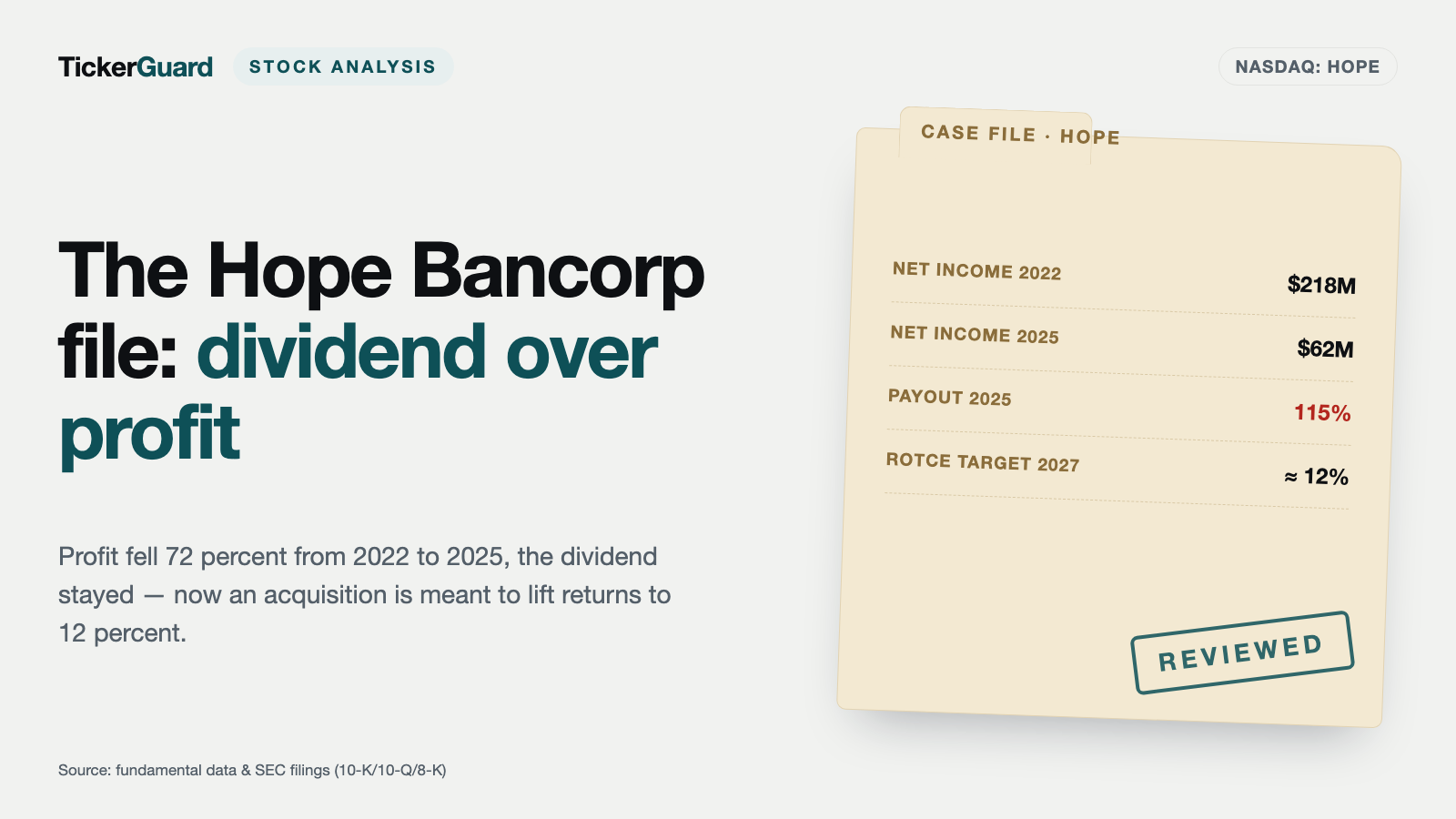
A bank stock below book value feels like a bargain, and this bank is even called Hope. The filings tell a soberer story: Hope Bancorp’s net income fell from $218.3 million (2022) to $61.6 million (2025), and in 2025 the bank paid out $70.7 million in dividends — more than it earned. Returns have been turning since early 2026, and on October 1, 2026, Hope closed an all-cash purchase of the commercial banking unit of SMBC’s subsidiary MANUBANK, which is meant to deliver a return of about 12 percent in 2027. We read what sits behind the discount to book. Whether hope is a plan here or just a name is for you to judge.
 Thomas Mücke
Founder & Publisher
Thomas Mücke
Founder & Publisher
As of Today
As of: October 2, 2026
- Closing price
- 13.68 $ +1.33%
- Market Capitalisation
- 1.7 $B
- P/E
- 13.4
- Growth Score
- 6/10
- AAQS
- 5/10
This analysis has a cut-off date. The Stock Guard tells you when something material changes in the numbers. Reserve your free spot
Chart
Interactive price chart (TradingView).
52-week range: 9.80 $ to 14.50 $ · Last price: 13.68 $ (As of: October 2, 2026)
Note: pure fact-based analysis, not investment advice and not a solicitation to buy or sell. All figures without guarantee.
There is a reflex that almost every investor who has looked at bank stocks knows. A bank is made of money — loans, deposits, securities — and that money sits on the balance sheet at a value called book value. When the stock costs less than book value, it looks like buying a dollar for 80 cents. We call it the bargain reflex: the discount feels like a margin of safety, and the brain stops asking why it exists. With Hope Bancorp, there is a second layer. The bank is called Hope, its ticker is HOPE, and the most important number in its current documents is a promise for 2027.
The discount is real. At the closing price of $13.68 on October 2, 2026, the stock cost about 76 percent of its book value of $17.97 per share (June 30, 2026). The only question is whether it is a gift or a price tag. A bank that earns little on its equity is also worth less than its equity in the market — that is not a market error, it is arithmetic. So let’s set the reflex aside and read what Hope Bancorp itself has told the U.S. securities regulator, the SEC: the annual reports (10-K) for 2024 and 2025, the quarterly reports (10-Q) through the latest one for the period ended June 30, 2026, the earnings release of July 27, 2026, and every filing through October 1, 2026. The central tension of this analysis: the bank is well capitalized and has its credit risks under control — but for three years it has earned too little on its capital, and the turnaround is now supposed to come from an acquisition that shrinks exactly that capital cushion.
What Hope Bancorp actually does — the house bank of Korean American business
Hope Bancorp is the holding company of Bank of Hope in Los Angeles. By its own description in the quarterly report, it is the only regional Korean American bank in the United States and the largest regional bank serving multicultural customers across the continental U.S. and Hawaii. As of June 30, 2026, it ran 45 branches in California, New York, New Jersey, Washington, Texas, Illinois, Georgia and Alabama, plus 28 branches in Hawaii under the Territorial Savings name; the acquisition of October 1, 2026, added seven more locations in California, according to the closing announcement. Total assets stood at $18.99 billion, and at the end of 2025 the group had 1,434 full-time equivalent employees.
The business is the oldest one in finance: take in deposits, lend money out, live off the difference. That difference is called the net interest margin — of every $100 a bank has invested in loans and securities, a small remainder is left after paying interest on its own funding. At Hope, it was only $2.76 in 2025, and $2.96 in the second quarter of 2026. Almost everything hinges on that margin: in 2025, 94.7 percent of revenue came from net interest income ($472.2 million), and only $26.5 million from fees and gains on sales. Fee income, which props up bank earnings when rates are unfavorable, barely matters here.
Where the money goes is just as clear: 57.1 percent of loans ($8.58 billion as of June 30, 2026) are commercial real estate loans, 25.9 percent commercial and industrial loans, and 17.0 percent residential mortgage and consumer loans. Behind the commercial real estate are mainly multi-tenant retail centers, industrial warehouses, gas stations and car washes, multifamily buildings and hotels — classic borrowers from Korean American small business. Office buildings — a segment bank investors have watched closely since 2023 — make up only 4 percent. The bank grew mostly through mergers: Nara Bancorp became BBCN Bancorp in 2011, the acquisition of Wilshire Bancorp on July 29, 2016, created Hope Bancorp, Territorial Bancorp of Honolulu joined on April 2, 2025, and the commercial banking unit of SMBC MANUBANK on October 1, 2026.
Company history for investors
-
2016
BBCN and Wilshire become Hope
The acquisition of Wilshire Bancorp on 07/29/2016 creates Hope Bancorp — today, by its own account, the only regional Korean American bank in the U.S.
-
2022
Record profit before the rate turn
$218.3M in net income and a 13.97% return on tangible common equity — the peak every later year has to be measured against.
-
2023
Job cuts and a shrinking margin
Rising deposit costs squeeze the margin; in the fourth quarter, Hope cuts 13% of its workforce. Net income: $133.7M.
-
2025
Territorial and a dividend above earnings
Acquisition of Territorial (Hawaii) on 04/02/2025, loss from a securities repositioning: net income $61.6M, dividends $70.7M.
-
2026
Turnaround and the MANUBANK deal
Return rises to 7.48% (Q2). On 10/01/2026, Hope closes the all-cash purchase of the MANUBANK commercial unit — target: about 12% in 2027.
How the stock landed on our desk — via Reddit, with a ticker that is an everyday word
Not through a fundamentals screen, but through our Reddit hype scanner, which counts every day which U.S. tickers come up in the investing forums. In early October 2026, HOPE appeared there. An honest caveat is in order: “hope” is an everyday English word. A counter that looks for tickers in forum posts can hardly tell an “I hope this works” from a mention of the bank. How many of the mentions actually meant Hope Bancorp, we do not know — that is our assessment, not a measured finding.
There was a real occasion nonetheless. On October 1, 2026, Hope announced in a current report (8-K) that it had closed its largest acquisition in years. The stock had already moved before: it closed at $10.66 on October 2, 2025, at $9.84 on November 17, 2025 (the 12-month low), at $14.50 on August 13, 2026, and at $13.68 on October 2, 2026 — a gain of 28 percent in a year (source: fundamental data). Rule of thumb: a ticker that is also a word gets mentioned more often than it gets traded — here, the mention count is an especially weak signal.
The numbers over the years — given their due
First, what deserves credit. Hope is well capitalized: its common equity tier 1 ratio — the safety cushion regulators look at — stood at 12.27 percent as of June 30, 2026, almost twice the 6.5 percent at which a bank counts as “well capitalized.” Credit quality is sound: nonperforming assets were 0.59 percent of total assets, net charge-offs in the second quarter of 2026 ran at 0.24 percent of loans (annualized), and criticized loans fell 19 percent within a year to $334.3 million. And since early 2026, things have been moving up: $29.5 million in net income in the first quarter, $33.0 million in the second; the margin rose from 2.69 percent (second quarter of 2025) to 2.96 percent, and the efficiency ratio fell from 115.8 to 66.6 percent.
Also fair: shareholders have barely been diluted. At the end of 2021 there were 120.0 million shares; as of July 31, 2026, there were 127.7 million — the increase comes almost entirely from the 6.98 million shares Hope used to pay for Territorial in 2025. Through the end of June 2026, the bank bought back 772,726 of its own shares for $8.7 million, at an average of $11.25.
Now the uncomfortable part, and it fits into a single number: the return on average tangible common equity (ROTCE). It measures how much the bank earns on its owners’ real money, excluding goodwill from past acquisitions. A common rule of thumb among bank analysts: below roughly ten percent, a bank is not earning its cost of capital.
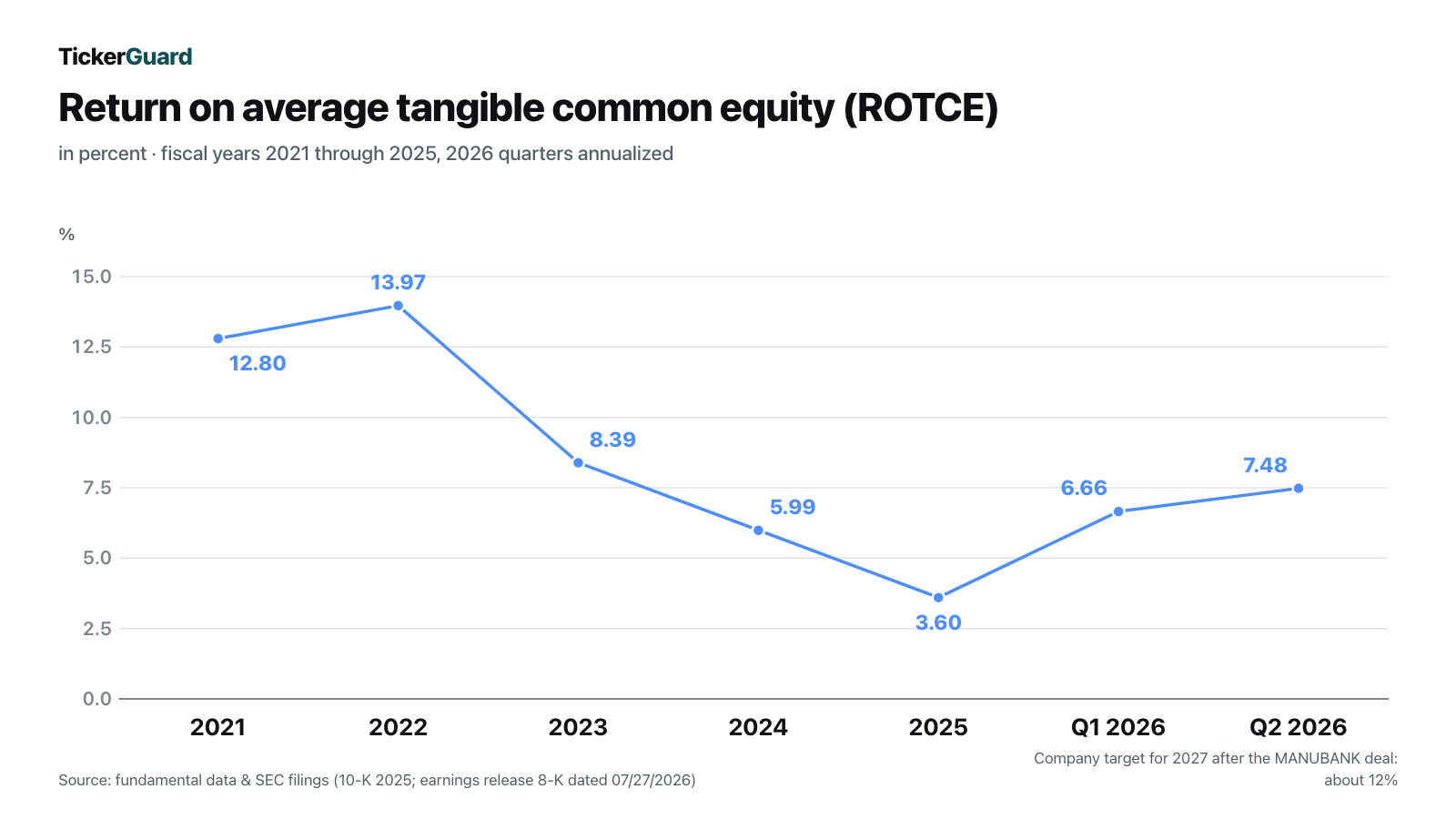
From 13.97 percent (2022) to 3.60 percent (2025) — and even the 7.48 percent of the second quarter of 2026 is still well below the rule of thumb. The reason is not a scandal but the rise in interest rates. Hope funds itself heavily with time deposits, and when rates rose from 2022, its own costs climbed faster than its income: the cost of interest-bearing liabilities jumped from 0.56 percent (2021) to 4.52 percent (2024), while the yield on loans and securities rose only from 3.42 to 5.69 percent. The margin shrank from 3.36 percent (2022) to 2.55 percent (2024). In everyday terms: a shopkeeper whose purchase prices multiply eightfold while his selling prices do not even double. On top of that came notable items of $51.8 million after tax in 2025 — mainly a $38.9 million pre-tax loss on selling lower-yielding securities in June 2025; according to the quarterly report, Hope reinvested the proceeds in higher-yielding securities. Excluding those items, 2025 net income would have been $113.3 million. Rule of thumb: a bank can be healthy and still earn too little — those are two different questions.
Uncomfortable truth No. 1: Net income shrank to less than a third in three years
The 2025 annual report puts it plainly:
“Our net income was $61.6 million for 2025 compared with $99.6 million for 2024 and $133.7 million for 2023.”
— Hope Bancorp, SEC annual report on Form 10-K for 2025, Item 7 (Management’s Discussion and Analysis, Results of Operations)

Add 2022 and the line gets steeper: $218.3 million (2022) → $133.7 million → $99.6 million → $61.6 million (2025). That is a decline of 72 percent. Diluted earnings per share fell from $1.81 to $0.49. In the same paragraph, Hope reports its return on equity: 2.77 percent for 2025 — less than the 3.77 percent Hope itself paid on average for interest-bearing deposits that year. Adjusted for notable items, 2025 looks better ($113.3 million, or $0.89 per share), but even that adjusted figure is almost half below 2022.
To be fair: 2022 was an exceptional year in which banks still had cheap deposits while loans were already repricing higher. And the first half of 2026, with $62.6 million in net income, suggests the trough may be behind it — annualized, that would be about $125 million, a little more than half of the 2022 figure. Anyone reading the discount to book as a bargain therefore has to answer one question: is a return of about seven percent this bank’s new normal — or just a waypoint on the road back?
Uncomfortable truth No. 2: In 2025, the bank paid more in dividends than it earned
While net income fell, one number stayed set in stone: a dividend of $0.56 per share, every year from 2021 through 2025, 14 cents a quarter, and again in 2026. That is pleasant for shareholders, but it has a flip side the chart makes visible:
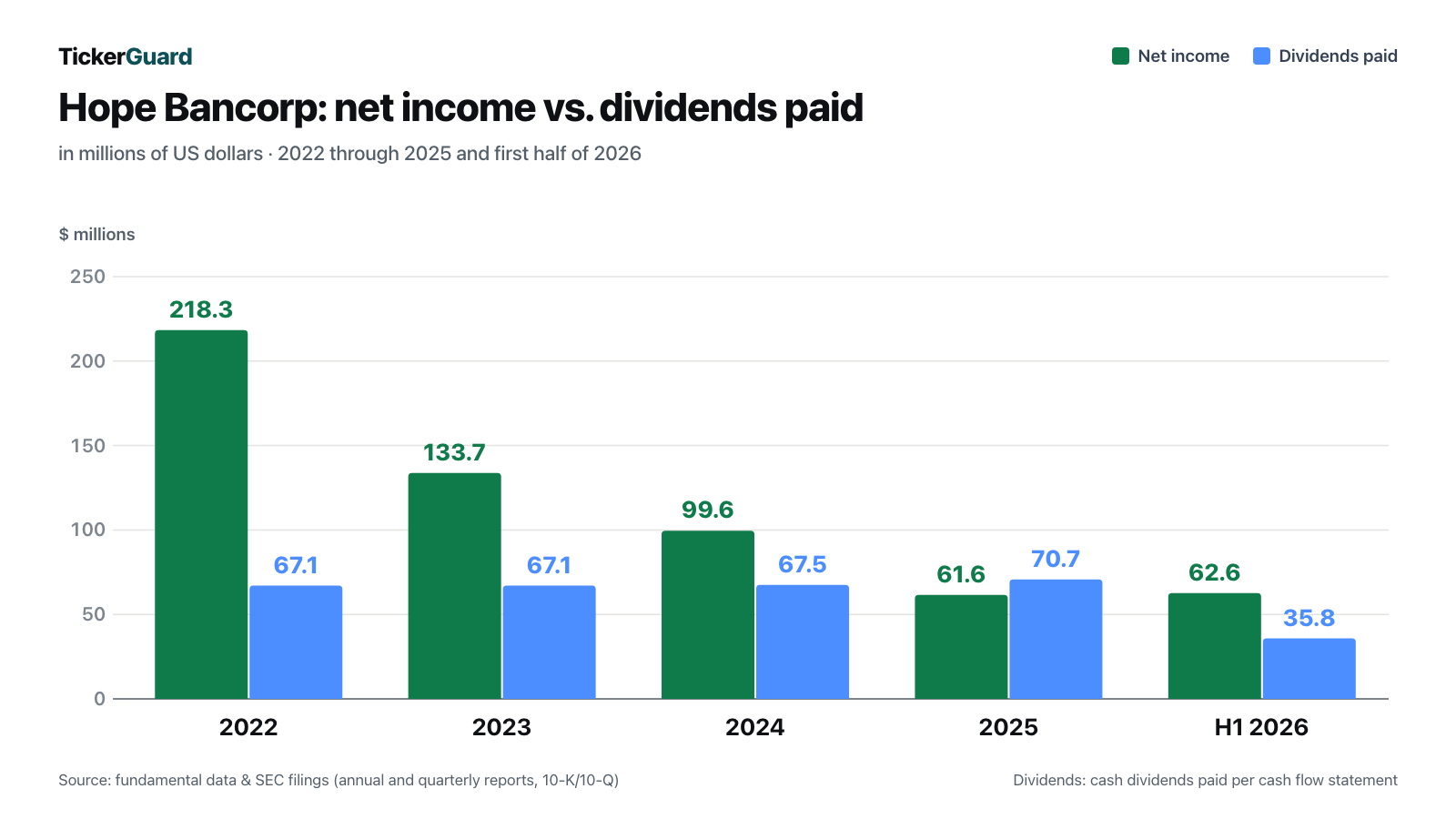
In 2025, Hope paid $70.7 million in cash dividends on net income of $61.6 million — a payout ratio of 115.27 percent according to the five-year table in the annual report (2024: 68.07 percent; 2022: 30.91 percent). A bank cannot do that indefinitely. In the risk section of the same annual report, Hope describes the Federal Reserve’s rule:
“Notification to the FRB is also required prior to our declaring and paying a cash dividend to our stockholders during any period in which our quarterly and/or cumulative twelve-month net earnings are insufficient to fund the dividend amount, among other requirements.”
— Hope Bancorp, SEC annual report on Form 10-K for 2025, Item 1A (Risk Factors, dividends)
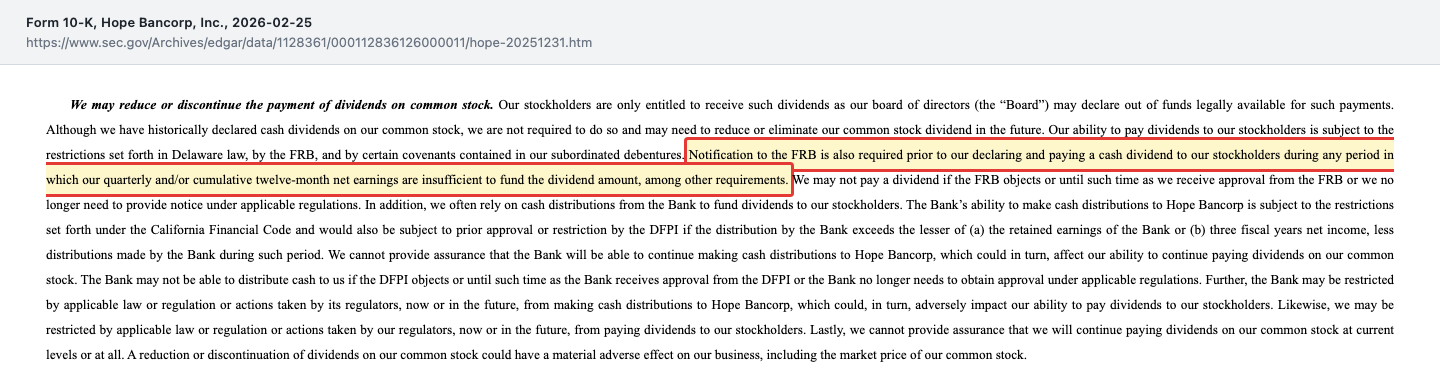
Whether Hope had to file such a notification is not stated in the filings, so we do not claim it. What matters is the mechanism: a dividend above earnings is paid out of capital. Book value per share was $17.44 at the end of 2021 and $17.97 as of June 30, 2026 — barely any growth in four and a half years. What the bank earned went out almost entirely as dividends. Since 2026, things have eased: in the first half, $62.6 million in net income stood against $35.8 million in dividends. Rule of thumb: a steady dividend on falling earnings is not a sign of strength but a bet that earnings will come back.
Uncomfortable truth No. 3: Expensive funding, heavy commercial real estate — and $1.18 billion for gas stations and car washes
The weak margin has a cause on the deposit side. As of June 30, 2026, 39.3 percent of deposits were time deposits — expensive, because savers demand market-level rates for them — and only 22.4 percent were noninterest-bearing checking accounts. The cost of interest-bearing deposits was 3.31 percent in the second quarter of 2026. Then there is a second point bank investors have been reading carefully since the spring of 2023:
“The Bank’s estimated uninsured deposits at June 30, 2026, totaled $6.42 billion (40% of deposits), compared with $5.98 billion (38% of deposits) at December 31, 2025.”
— Hope Bancorp, SEC quarterly report on Form 10-Q for the period ended June 30, 2026, Item 2 (Liquidity)

Uninsured deposits are balances above the federal deposit insurance limit ($250,000 per depositor and bank). They are not automatically dangerous — business clients naturally hold larger accounts — but they are the money that leaves first in a crisis of confidence. Forty percent is no alarm level for a commercial bank, but it is no cushion either. At the same time, the loan book is almost as large as the deposit base: the gross loan-to-deposit ratio stood at 94.7 percent as of June 30, 2026, up from 90.6 percent a year earlier.
On the lending side, one line in the commercial real estate table stands out: $1,177.8 million for gas stations and car washes — 14 percent of all commercial real estate loans and roughly half of stockholders’ equity of $2.30 billion (June 30, 2026). At the end of 2024, it was still $1,027.5 million; in 2025, the position grew 14.5 percent. The weighted average loan-to-value ratio is 51 percent, so the bank has a decent collateral cushion in the property value. The filings show no default problem. But it is a sector bet worth knowing about: gas stations depend on the combustion engine, and hotels ($820.7 million, 10 percent) on travel. In its second-quarter presentation, the bank itself said it would moderate organic commercial real estate growth ahead of the acquisition to manage the concentration. Nonaccrual loans — loans on which the bank no longer books interest — nearly tripled between the end of 2023 ($45.2 million) and the end of 2025 ($131.7 million), before falling back to $112.0 million by the end of June 2026. Rule of thumb: in banking, the average rarely decides — it is the one sector where too many loans wobble at once.
Uncomfortable truth No. 4: The turnaround is supposed to come from an acquisition — paid for with the capital cushion
On March 31, 2026, Hope announced that it would acquire the commercial banking unit of SMBC MANUBANK, a subsidiary of the Japanese banking group Sumitomo Mitsui. According to the announcement, it comprises about $2.5 billion in loans and $2.7 billion in deposits (as of December 31, 2025) — each roughly 17 percent more than Hope had on its own. The deposits are exactly what Hope lacks: only 3 percent time deposits, 22 percent noninterest-bearing checking accounts, and a deposit cost of 2.20 percent versus 2.68 percent at Hope. All regulatory approvals were in hand on September 2, 2026, and the deal closed on October 1, 2026. It is paid in cash, without new shares. The promises in the March 31 announcement are big: more than 20 percent higher earnings per share in 2027 and a return on tangible common equity of about 12 percent in 2027. The price stands in the same document:
“Tangible book value dilution at closing is expected to be approximately 4.5% and earned back in approximately two years.”
— Hope Bancorp, Current report on Form 8-K dated March 31, 2026, Exhibit 99.1 (Financial Highlights)

In the deal presentation, Hope does the math, based on figures as of December 31, 2025: tangible book value per share falls from $13.71 to $13.09, the tangible common equity ratio from 9.8 to 8.1 percent, and the common equity tier 1 ratio from 12.27 to 10.2 percent. On top of that come a core deposit intangible of about $63 million and merger costs of about $30 million after tax, spread over the first year. That is the logic of the deal: Hope trades excess capital that earns little for a business with cheaper deposits. It is a reasonable plan — but the cushion we praised above as a strength gets noticeably thinner in the process.
How such promises play out can be seen in the last deal. Territorial Bancorp joined on April 2, 2025, paid for with 6.98 million new shares worth $73.3 million. It brought the cheaper deposits Hope wanted — the July 27, 2026, earnings release cites it as one reason the cost of interest-bearing deposits fell 46 basis points in a year. But it also brought merger costs that hit the 2025 income statement. The outlook of July 27, 2026, calls for about 20 percent loan growth, 15 to 20 percent revenue growth and 25 to 30 percent growth in pre-provision net revenue for full-year 2026, each including MANUBANK from closing. Rule of thumb: a “from 2027” promise is a calculation built on assumptions — it becomes testable only with the annual report for 2027.
Valuation: just below tangible book value
At the closing price of $13.68 on October 2, 2026, and 127.7 million shares (as of July 31, 2026), Hope had a market value of about $1.75 billion — our own calculation; the market value in this page’s key figures box may be based on a different price. That is about 76 percent of book value ($17.97 per share) and about 99 percent of tangible book value ($13.85 per share, both as of June 30, 2026). After the MANUBANK dilution — using the $13.09 from the deal presentation — the stock would trade slightly above it, at about 1.05 times. So the bargain reflex is anchored to the wrong yardstick: against total book value the stock is cheap; against tangible equity without goodwill from old acquisitions, it is roughly fairly priced.
Measured against earnings: the last four quarters produced $1.01 per share (our own calculation from the 10-K and 10-Qs), a price-to-earnings ratio of about 13.5. The $0.56 dividend gives a yield of about 4.1 percent at $13.68. For 2027, analysts expect $1.57 in earnings per share on average; at the October 2 price, that would be a price-to-earnings ratio of about 8.7 — if the promise is kept. Run the numbers: $1.57 on tangible book value of a little over $13 is a return of about 12 percent. In other words, the analysts have largely adopted the company’s targets.
The view from the pros: five analysts cover the stock, two rate it a “Strong Buy” and three a “Hold”; the average price target is $15.50 (source: fundamental data, as of October 3, 2026). For a regional bank that clearly earns its cost of capital, see our Byline Bancorp stock analysis: the Chicago lender posted a net interest margin of 4.22 percent in 2025 — a good 1.4 percentage points more than Hope.
Upside and risks at a glance
What speaks for Hope Bancorp:
- Solid capital cushion: common equity tier 1 ratio of 12.27 percent, tangible common equity ratio of 9.58 percent (06/30/2026).
- Sound credit quality: nonperforming assets at 0.59 percent of total assets, criticized loans down 19 percent in a year, office loans only 4 percent of commercial real estate.
- The turnaround has started: return on tangible common equity up from 3.60 percent (2025) to 7.48 percent (Q2 2026), margin at 2.96 percent.
- MANUBANK brings cheaper deposits (only 3 percent time deposits) and is meant to enable a return of about 12 percent in 2027; paid in cash, without new shares.
- Stock trading around tangible book value, dividend yield of about 4.1 percent (price as of October 2, 2026).
What speaks against it:
- Net income down from $218.3 million (2022) to $61.6 million (2025); return of only 3.60 percent in 2025.
- 2025 dividend above earnings (payout ratio of 115.27 percent); book value per share barely higher than at the end of 2021.
- Expensive funding: 39.3 percent time deposits, 40 percent uninsured deposits, loans at 94.7 percent of deposits (06/30/2026).
- High commercial real estate share (57.1 percent of loans), including $1.18 billion for gas stations and car washes — roughly half of equity.
- MANUBANK thins the capital cushion (pro forma tangible common equity ratio of 8.1 percent) and still has to deliver on the 2027 promises.
A human conclusion
Back to the bargain reflex. Yes, the stock costs less than book value. But the filings show why: a bank that earned less and less on its capital for three years and paid out more in 2025 than it took in is not a dollar for 80 cents. It is a dollar that earns too little interest — and the market prices it almost exactly that way once you strip out goodwill from old acquisitions. At the same time, it would be unfair to write Hope off. The capital is there, the loans are holding up, and since early 2026 earnings and margin have been rising again. The real bet now is a different one: whether MANUBANK actually lifts the return to about 12 percent in 2027. The bank is called Hope, and that is exactly what this promise is until it appears in an annual report. So don’t ask whether the stock is cheap — ask whether you believe in the 12 percent return before it is delivered. The first test is the earnings release for the fourth quarter of 2026, the first with MANUBANK on the books. What you make of it is your call. And that is how it should be.
Sources
All original documents used in this analysis — so you can check them yourself:
- Hope Bancorp, Inc. — Quarterly report on Form 10-Q for the period ended June 30, 2026 (filed August 6, 2026) — latest periodic report: share count, commercial real estate by property type, uninsured deposits, first-half figures
- Hope Bancorp, Inc. — Q2 2026 earnings release as Exhibit 99.1 to the Form 8-K dated July 27, 2026 and the accompanying presentation (2026 outlook)
- Hope Bancorp, Inc. — acquisition of the MANUBANK commercial banking unit: announcement and presentation with the Form 8-K dated March 31, 2026; Forms 8-K dated September 2, 2026 (approvals) and October 1, 2026 (closing)
- Hope Bancorp, Inc. — annual reports on Form 10-K for 2025 (February 25, 2026; five-year data 2021–2025, dividend rules, Territorial acquisition) and 2024 (February 26, 2025); quarterly report on Form 10-Q for March 31, 2026
- Hope Bancorp, Inc. — quarterly report on Form 10-Q for June 30, 2025 (securities repositioning, $38.9 million loss) and proxy statement (DEF 14A dated April 10, 2026) (major shareholders)
- Closing prices for October 2, 2025, November 17, 2025, August 13, 2026, and October 2, 2026 (price anchor $13.68), analyst ratings and the 2027 earnings estimate: source: fundamental data. Market value, price-to-earnings ratio, book value multiples and dividend yield computed in-house. Multi-year figures: source: fundamental data & SEC filings (annual and quarterly reports, 10-K/10-Q).
Transparency & disclaimer: This analysis is a journalistic assessment of publicly available information. It is not investment advice, not a financial analysis in the regulatory sense and not a solicitation to buy or sell securities. Investing in stocks involves substantial risk, up to and including the total loss of your investment. All information without guarantee; the data date is noted in the text. Positions held by the operator are disclosed daily; where one exists, it appears as a notice at the top of this deep dive.
Key figures at a glance
All monetary figures in millions of $; earnings per share as reported.
| Metric | 2021 | 2022 | 2023 | 2024 | 2025 |
|---|---|---|---|---|---|
| Revenue | 552.0 | 623.9 | 1,094.5 | 1,000.1 | 967.8 |
| Operating Income (EBIT) | 275.3 | 433.7 | 177.9 | 133.0 | 80.7 |
| Net Income | 204.6 | 218.3 | 133.7 | 99.6 | 58.5 |
| Net Margin | 37.1% | 35.0% | 12.2% | 10.0% | 6.0% |
| Earnings Per Share | 1.66 $ | 1.81 $ | 1.11 $ | 0.82 $ | 0.45 $ |
Source: fundamental data & SEC filings (annual and quarterly reports, 10-K/10-Q)
Our Bottom Line at a Glance
- Capital positive
- CET1 ratio of 12.27%, TCE ratio of 9.58% (06/30/2026) — well above regulatory minimums.
- Credit quality positive
- Nonperforming assets at 0.59% of total assets, criticized loans down 19% in a year to $334.3M, office loans only 4% of commercial real estate (06/30/2026).
- Earning power negative
- Net income down from $218.3M (2022) to $61.6M (2025), ROTCE from 13.97% to 3.60%; net interest margin 2.76% (2025), 2.96% (Q2 2026).
- Dividend negative
- Payout ratio of 115.27% in 2025 ($70.7M in dividends on $61.6M in net income); book value per share only from $17.44 to $17.97 since year-end 2021.
- Funding negative
- 39.3% time deposits, 40% uninsured deposits, loans at 94.7% of deposits; 57.1% of loans in commercial real estate, including $1.18B in gas stations and car washes (06/30/2026).
- Turnaround neutral
- Q2 2026 ROTCE of 7.48%; MANUBANK (closed 10/01/2026) is meant to deliver about 12% in 2027, but lowers the pro forma TCE ratio from 9.8% to 8.1%.
Hope Bancorp is well capitalized and has its credit risks under control, but for three years it has earned too little on its capital: net income fell from $218.3M to $61.6M, and in 2025 the dividend exceeded earnings. Since 2026, margin and returns have been rising again; the purchase of the MANUBANK commercial banking unit is meant to deliver a return of about 12 percent in 2027, but shrinks the capital cushion in exchange. Not investment advice.
What Our Rating Means
Open questions
The business works in principle, but one material question is open. As long as it stays open, our findings do not carry a quality verdict.
Yellow here stands for an open operating question, not a view on the stock price. A substance risk as our rating defines it is not evidenced as of June 30, 2026: capital ratios sit well above regulatory requirements, nonperforming assets are at 0.59 percent of total assets, and the bank is profitable. What is open is earning power: return on tangible common equity was 3.60 percent in 2025 and 7.48 percent in the second quarter of 2026, earnings did not cover the dividend in 2025, and getting back to an adequate return hinges on an acquisition that has only just closed. Whether a price of $13.68 (October 2, 2026), roughly at tangible book value, is attractive is not something this rating answers. The decision is yours.
A journalistic assessment by our editorial team at the time of the deep dive, based on public sources — not investment advice and not a solicitation to buy or sell. Your personal circumstances (investment goals, risk capacity, taxes) cannot be taken into account. What our levels mean, how verdicts are formed, and what conflicts of interest exist →
Worth Noting
- Version of October 3, 2026, based on the 2024 and 2025 annual reports on Form 10-K, the quarterly reports on Form 10-Q through 06/30/2026 (latest periodic report, filed 08/06/2026), the earnings release of 07/27/2026, the MANUBANK deal documents (03/31, 09/02 and 10/01/2026) and all SEC filings through 10/01/2026. The occasion was the Reddit hype scanner in early October 2026; because “hope” is an everyday English word, the forum mention count says little here.
- Hope Bancorp was called Nara Bancorp until 2011 and BBCN Bancorp until 2016. Market value, P/E (last four quarters: $1.01 per share from the 2025 10-K and the 2025/2026 first-half figures), book value multiples and dividend yield are computed in-house; pro forma figures for the MANUBANK deal come from the presentation of 03/31/2026 and are based on figures as of 12/31/2025.
- The price anchor is the closing price of $13.68 on 10/02/2026 (source: fundamental data). The 2026 ROTCE figures are quarterly values annualized by the bank; the “rule of thumb” of about ten percent cost of capital is a common heuristic, not a figure from the filings.
Stock Watch
This analysis is as of October 3, 2026. Stock Watch will tell you what's changed at HOPE since then.
Later $1 a month per stock — signing up is free, and you'll be the first to know when it launches.
The full analysis as a PDF for later
We will send you this analysis as a PDF — to print, file away, and read at your own pace. And we will add you to the free Stock Watch list for Hope Bancorp, Inc. (HOPE), so you hear about it when something material in this analysis changes.
Frequently Asked Questions
Hope Bancorp is the holding company of Bank of Hope in Los Angeles, by its own account the only regional Korean American bank in the U.S. As of June 30, 2026, it had $18.99 billion in total assets, 45 branches in eight states and 28 in Hawaii (Territorial Savings). Commercial real estate makes up 57.1 percent of loans; about 95 percent of 2025 revenue came from net interest income.
Mainly because of the rate cycle: the cost of interest-bearing liabilities rose from 0.56 percent (2021) to 4.52 percent (2024), while income rose much more slowly. The net interest margin fell from 3.36 percent (2022) to 2.55 percent (2024). In 2025, $51.8 million in after-tax notable items were added, mainly a loss from repositioning the securities portfolio. Net income fell from $218.3 million to $61.6 million.
Hope has paid an unchanged $0.56 per share a year since 2021. In 2025, dividends of $70.7 million exceeded net income of $61.6 million (payout ratio of 115.27 percent). In the first half of 2026, net income of $62.6 million covered dividends of $35.8 million again. The bank itself writes that it may reduce or discontinue the dividend; there is no guarantee.
On October 1, 2026, Hope closed the all-cash purchase of SMBC MANUBANK’s commercial banking unit with about $2.5 billion in loans and $2.7 billion in deposits (as of year-end 2025), only 3 percent of them time deposits. It promises more than 20 percent EPS accretion and a return on tangible common equity of about 12 percent in 2027. Tangible book value per share falls by about 4.5 percent in exchange.
At the closing price of $13.68 on October 2, 2026, the stock cost about 76 percent of book value ($17.97) but about 99 percent of tangible book value excluding goodwill ($13.85, both as of June 30, 2026). With a return on tangible common equity of 7.48 percent (Q2 2026), the discount looks more like a result of the low return than a gift.
Commercial real estate makes up 57.1 percent of loans ($8.58 billion, June 30, 2026), office buildings only 4 percent. What stands out is $1.18 billion for gas stations and car washes, roughly half of equity, at an average loan-to-value ratio of 51 percent. Nonperforming assets were 0.59 percent of total assets.
Found an error?
Did you spot a factual error, an outdated number, or a typo in this deep dive? Let us know briefly — your report goes straight to the editorial team.