GFT Technologies: The market celebrates AI — the report says “influenced”
From €14 to €26.50 in just over seven months: since GFT started calling itself “AI-centric,” the market sees a different company. We read the 2025 annual report, the 2026 half-year report and the disclosures on the Wynxx AI platform. The Stuttgart-based IT services firm is growing and earning more again — but its AI revenue is “influenced,” its growth comes from Brazil and cash lags behind profit. A label is not a balance sheet, so we read both.
 Thomas Mücke
Founder & Publisher
Thomas Mücke
Founder & Publisher
Chart
Interactive price chart (TradingView).
Note: pure fact-based analysis, not investment advice and not a solicitation to buy or sell. All figures without guarantee.
Psychologists have a name for a thinking error that costs investors money: the labeling effect. The same product tastes better when it carries a fancier label. In the stock market, that label has read “AI” for two years now. In its 2025 annual report, GFT Technologies SE of Stuttgart, Germany, calls itself an “AI-centric technology partner.” On February 24, 2026, the stock closed at €14.00; on September 17, 2026, at €26.85; on October 2, 2026, at €26.50. The label whispers: “The AI boom is in here, and it is only getting started.”
Let’s make a deal: we test that sentence against what GFT itself has published — the 2025 annual report (published March 27, 2026), the 2026 half-year financial report (period ended June 30, 2026, published August 6, 2026) and the press release on the first half. GFT is a German company and does not report to the U.S. securities regulator, the SEC; its English-language reports are our sources. Fittingly, the cover of both reports carries the slogan “Let’s Go Beyond the Hype.” That is exactly what we will do. The central tension of this analysis: GFT sells an AI platform that, by its own account, makes software development much more productive — yet it earns most of its money from the work of roughly 11,800 professionals. Every hour the AI saves is a gain for the client and, for a services firm, potentially revenue that goes missing. Will AI be GFT’s engine or its cannibal? In the end, you decide.
What GFT actually does — software for banks, built in Brazil, Spain and Poland
GFT builds and modernizes software for financial institutions: core banking systems, payments, risk and regulatory reporting, cloud migrations. In the first half of 2026, 71 percent of its €462.6 million in revenue came from banks, 17 percent from insurers and 12 percent from industry and other sectors. Picture it this way: GFT is the general contractor a bank calls when it has to renovate its house while still living in it — the bank does not move out, but the wiring gets replaced anyway.
Most of the building happens where good engineers cost less than in Frankfurt or London. GFT calls this “smartshore”: of its 11,805 full-time equivalent employees at June 30, 2026, 4,628 worked in Brazil, 2,174 in Spain, 1,583 in Colombia, 924 in Italy and 733 in Poland — and only 501 in Germany. Founder Ulrich Dietz chairs the administrative board; together with Maria Dietz, he held about 35.8 percent of the shares at the end of 2025 (26.3 and 9.5 percent). Day to day, the company is run by Global CEO Marco Santos and CFO Jochen Ruetz.
The new part of the story is called Wynxx. It is GFT’s own AI platform, which uses language models such as GPT, Gemini and Claude across the entire development process: writing code, testing it, translating old mainframe programs into modern languages. At Brazilian insurer Bradesco Seguros, according to the annual report, Wynxx delivered “a 40% productivity increase across the full software development lifecycle.” How a software company approaches AI from the other direction — with its own licenses — is covered in our SAP analysis; since acquiring the Brazilian SAP consultancy Megawork in September 2025, GFT also works in that ecosystem.
Company history for investors
-
2025
March: five-year strategy
Target for 2029: revenue of about €1.5 billion and an adjusted EBIT margin of around 9.5 percent. For shareholders, the yardstick every half-year has to be measured against.
-
2025
July: guidance cut
Restructuring in the UK and at GFT Software Solutions gets costlier; the EBT target drops from €60 million to €45 million. The stock falls as low as €16.28 in September.
-
2025
Share buyback completed
761,138 shares bought for about €15 million at an average of €19.71 (April to October) — in a year in which free cash flow halved.
-
2025
September: Megawork acquired
The Brazilian SAP consultancy has been part of GFT since September 2, 2025. Acquisitions added €8.27 million of revenue in the first half of 2026; organic growth was 3 percent.
-
2026
August: a half-year with tailwind
EBT up 26 percent, Wynxx at 113 clients, order backlog up 18 percent, guidance confirmed. First-half operating cash flow stays slightly negative.
How the stock landed on our desk
Through other investors’ curiosity: in early October 2026, GFT appeared in the ranking of most-discussed stocks on wallstreet-online, one of Germany’s largest retail-investor forums. That is an attention signal and explicitly not a reason to buy — a stock gets discussed because it interests someone, not because it is good.
Our in-house stock scanner listed GFT in two strategies as of October 3, 2026. The first is EPS acceleration: earnings per share grew faster in the second quarter of 2026 than in the first. By our calculation, EPS rose from €0.24 to €0.33 (up 38 percent), after rising from €0.27 to €0.34 in the first quarter (up 26 percent). That is a real gain, not a smaller loss. The second is the Chowder Rule, a dividend screen: for yields below 3 percent, the yield plus five-year dividend growth must add up to at least 15 percent. GFT passes because its payout rose from €0.20 (paid in 2021) to €0.50 (paid in 2026). The catch: it has stayed at €0.50 for three payments in a row, and at the October 2, 2026, price the yield is only 1.9 percent. The screen measures the past, not the trend. A scanner is a coarse sieve, not a verdict — so now we read the reports.
The numbers over the years — an honest look
First, what genuinely impresses. Revenue grew from €566.2 million (2021) to €888.3 million (2025), every single year. The first half of 2026 brought €462.6 million, 5 percent more than a year earlier. Earnings before taxes (EBT) rose 26 percent to €24.0 million, and earnings per share from €0.51 to €0.67. The order backlog stood at €483.5 million at June 30, 2026, 18 percent above the prior year. And the company delivers for shareholders: a dividend of €0.50 per share for 2025, paid on June 30, 2026, plus a share buyback of about €15 million in 2025.
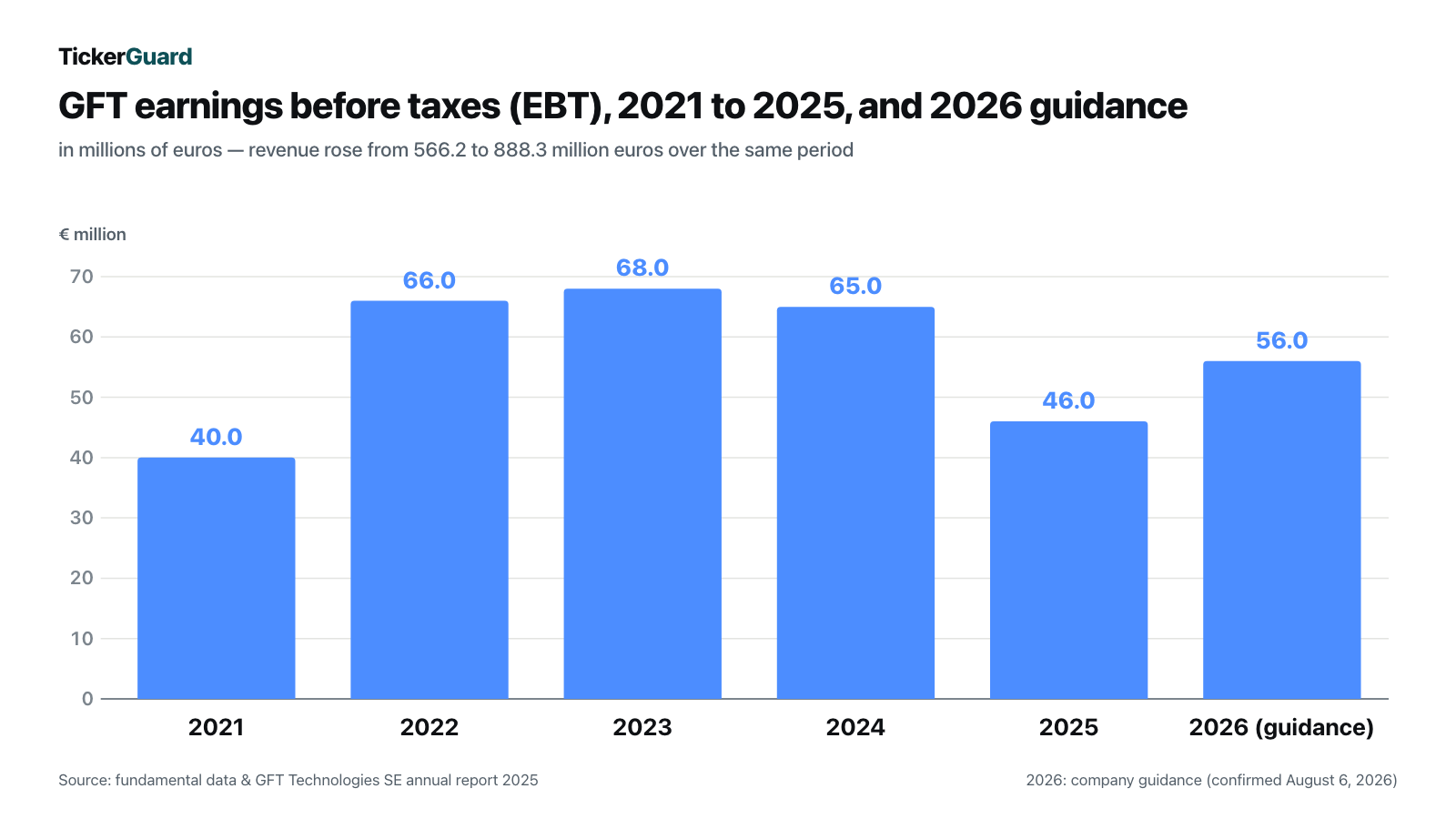
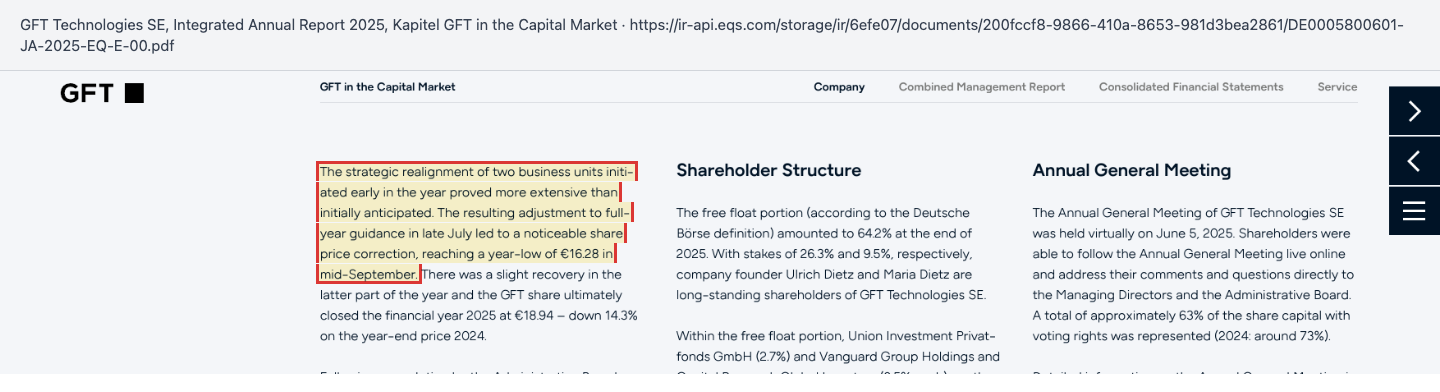
The chart also shows that growth and profit have not moved together since 2023. EBT peaked at €68.0 million in 2023 and fell to €46.0 million in 2025 — on about €86 million more revenue. The pre-tax margin dropped from 8.5 to 5.2 percent. In other words, of every €100 of revenue in 2025, a little over €5 was left before taxes. The reason was a restructuring that turned out costlier than planned: the UK business and the German subsidiary GFT Software Solutions had to be realigned, and headcount reductions cost about €13.2 million in 2025. GFT puts it this way in its annual report:
“The strategic realignment of two business units initiated early in the year proved more extensive than initially anticipated. The resulting adjustment to full-year guidance in late July led to a noticeable share price correction, reaching a year-low of €16.28 in mid-September.”
— GFT Technologies SE, Integrated Annual Report 2025, chapter “GFT in the Capital Market”
In March 2025, GFT had guided to €60 million of EBT for 2025; by late July it was €45 million, and the year ended at €46.0 million. The good news: the restructuring is working. Costs for headcount adjustments fell to €3.46 million in the first half of 2026 (prior year: €7.02 million), and pre-tax profit in the Europe segment more than doubled, from €7.80 million to €17.16 million. On August 6, 2026, GFT confirmed its 2026 guidance: revenue of about €930 million, adjusted operating profit (EBIT, earnings before interest and taxes excluding special items) of €71 million and EBT of about €56 million.
Uncomfortable truth No. 1: “influenced” is not the same as “earned”
Now to the label. How much AI is really in the revenue? GFT answers the question itself — with a carefully chosen word:
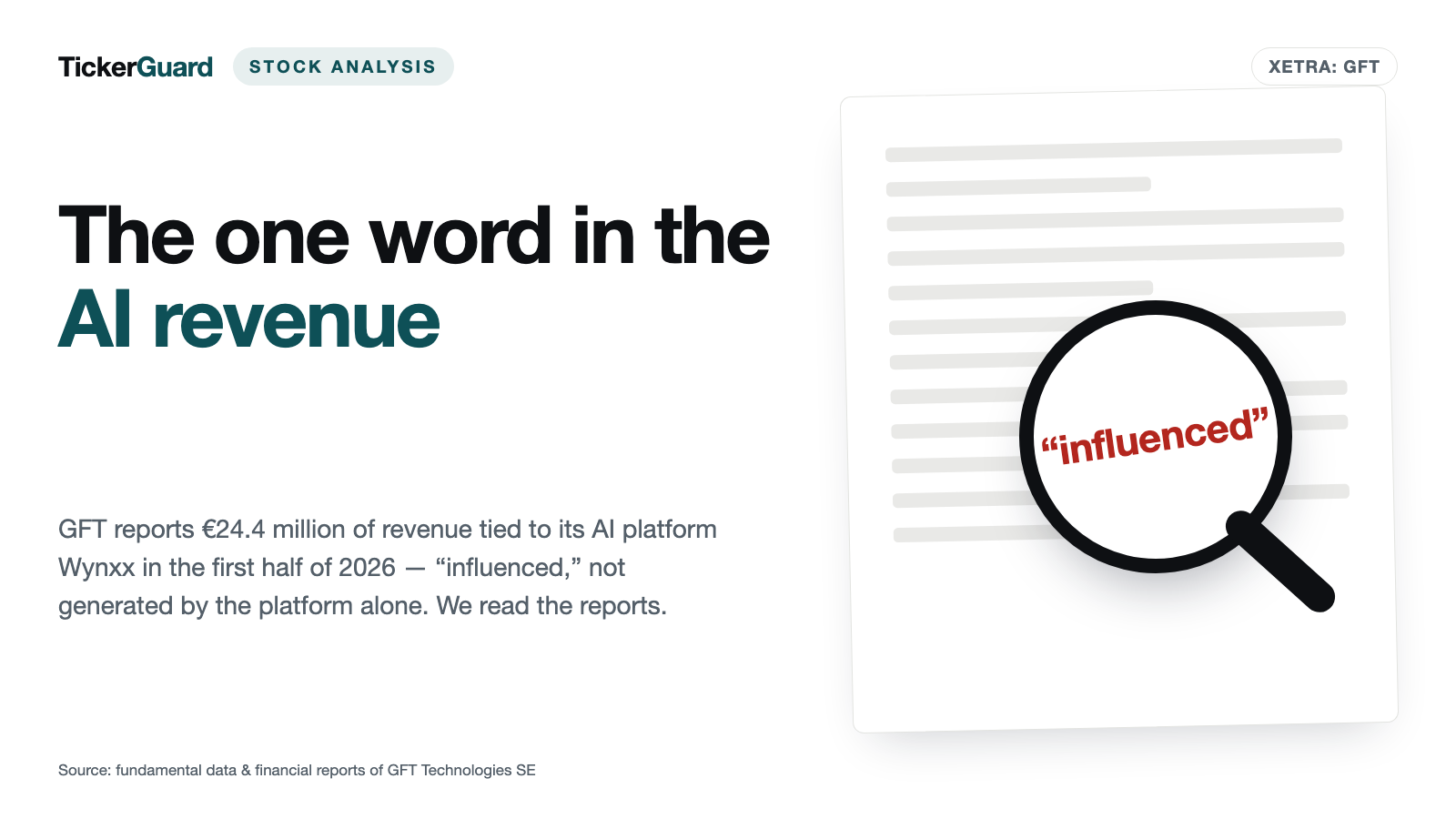
“Now deployed by 113 enterprise clients in twelve countries, the total influenced contract value since inception increased by 38 percent compared with the first quarter to more than EUR 144 million, while the actual influenced revenue reached EUR 24.4 million in the first half of 2026.”
— GFT Technologies SE, press release on the first half of 2026, August 6, 2026
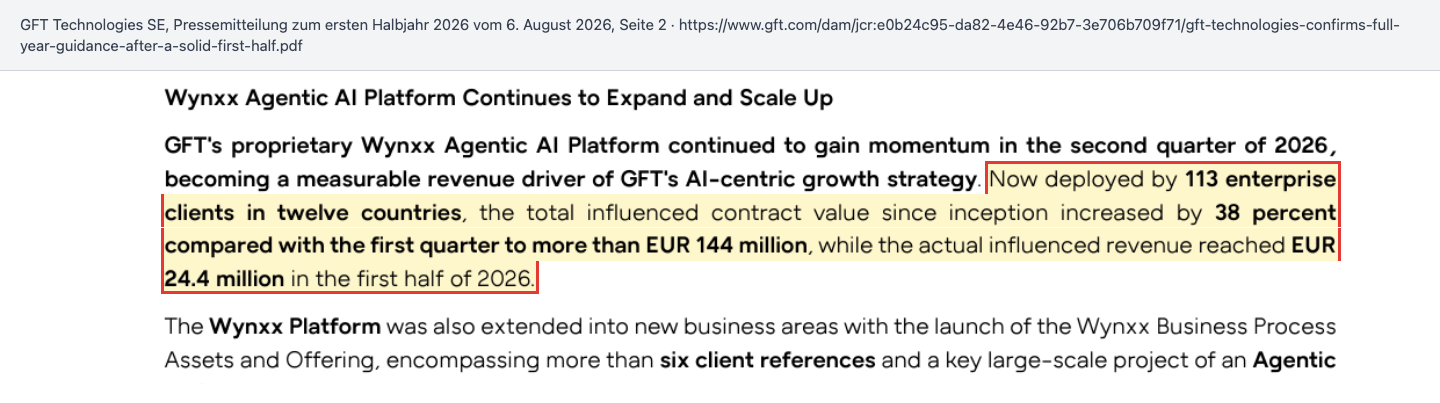
“Influenced” means revenue from projects in which Wynxx was used. It does not mean the revenue was created by Wynxx, nor that it would have been missing without it. Measured against first-half group revenue, €24.4 million is about 5 percent. On top of that comes €14.8 million of influenced revenue from a new offering for AI-supported business processes; the release does not say whether the two figures overlap. The half-year report does not break out Wynxx license revenue separately.
And now the real tension. In the first half of 2026, €247.5 million, or 54 percent of revenue, came from service contracts, another €155.1 million from fixed-price contracts and €50.0 million from maintenance contracts. So GFT earns mainly from the work of its people. If a platform makes that work 40 percent faster, the client needs fewer workdays for the same project — unless GFT can turn the time saved into more projects or higher prices per outcome. The company knows this. In the shareholder letter of its 2025 annual report, it says Wynxx is transforming GFT “from a pure services provider into a scalable AI-Native platform company.” That is the goal. What the numbers show so far is a growing services company with a promising platform. Remember: a label describes what a company wants to become. Revenue shows what it is today.
Uncomfortable truth No. 2: the growth lives in Brazil
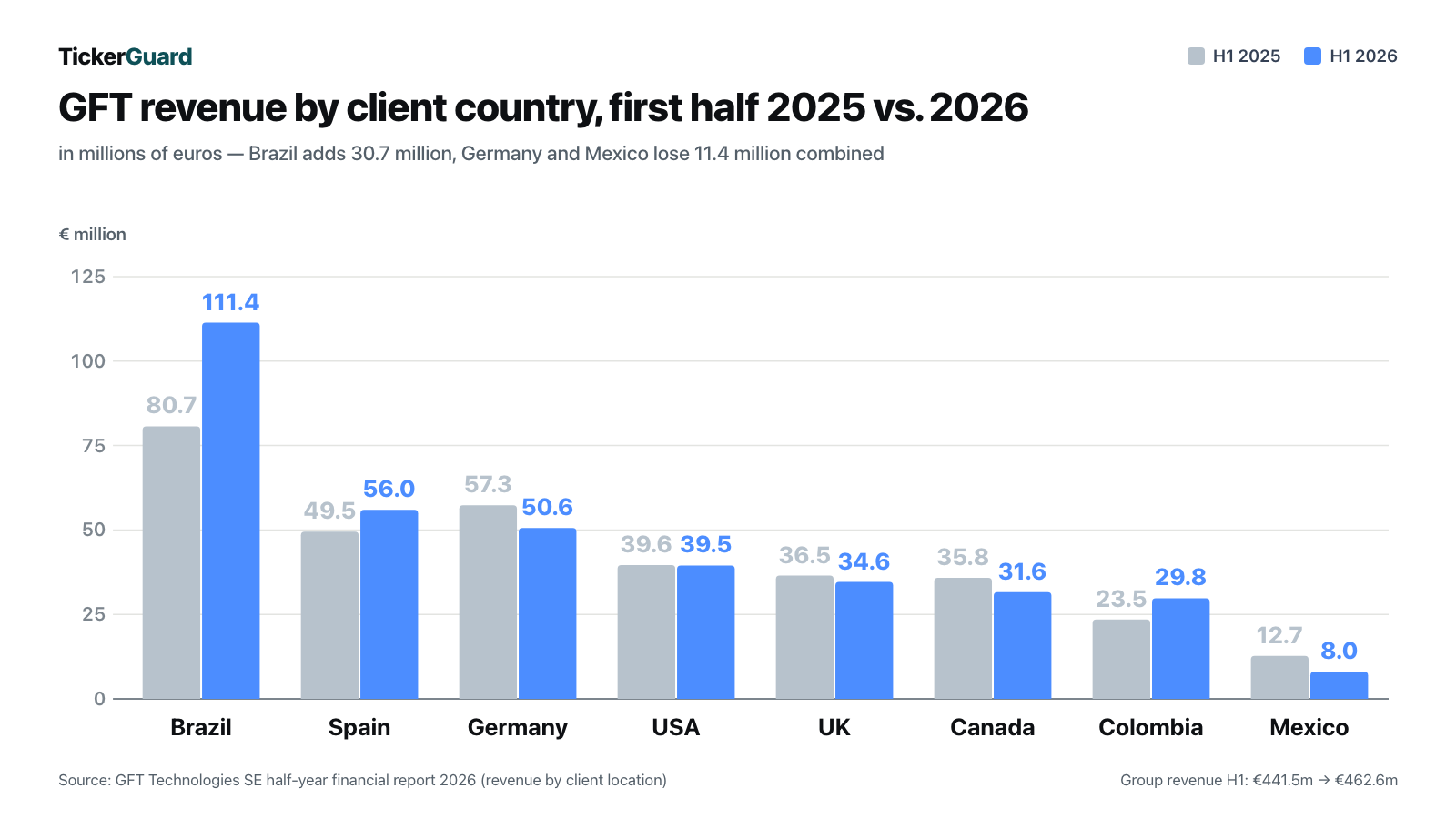
Do the math: group revenue rose by €21.0 million in the first half of 2026. Brazil alone grew by €30.7 million. Without Brazil, GFT would have shrunk. The country now accounts for 24 percent of revenue and almost 40 percent of the workforce. Excluding acquisitions and currency effects, the group grew 3 percent organically, according to the half-year report; €8.27 million of the increase came from acquisitions. Europe looks different:
“In the Europe segment, revenue fell by 3% in the first half of 2026. This was due in particular to lower revenue in Germany.”
— GFT Technologies SE, Half-Year Financial Report 2026, section 2.2 “Development of Business”
Revenue from German clients fell 12 percent, Mexico 36 percent and Canada 12 percent. Add a detail from the notes to the half-year report: revenue from the single largest client fell from €54.9 million to €43.7 million, down 20 percent. For 2025, GFT put that client’s share of group revenue at 11 percent, after 14 percent the year before. You can read that as successful diversification — or as a client ordering less. The report does not name the client.
Why it matters: a group that reports in euros but makes a quarter of its revenue with Brazilian clients also depends on the Brazilian real; the 2025 annual report explicitly lists it among its currency risks. In the first half of 2026, exchange rates helped: the appreciation of the real and the Colombian peso added €9.45 million to equity. In the first half of 2025, the same effect cost €14.51 million. And the faster GFT grows in Brazil, the more the stock also depends on Brazil’s banks.
Uncomfortable truth No. 3: profit is up, cash is not
In the first half of 2026, GFT earned €17.1 million after taxes. Yet operations produced a cash outflow of €1.0 million. The explanation is in the half-year report:
“By contrast, the development of working capital had a negative impact, leading to increased tied-up capital in the first six months of 2026, primarily due to changes in contract assets and contract liabilities. It should be noted that working capital typically makes a positive contribution to operating cash flow over the course of the year.”
— GFT Technologies SE, Half-Year Financial Report 2026, section 2.5 “Financial Position”
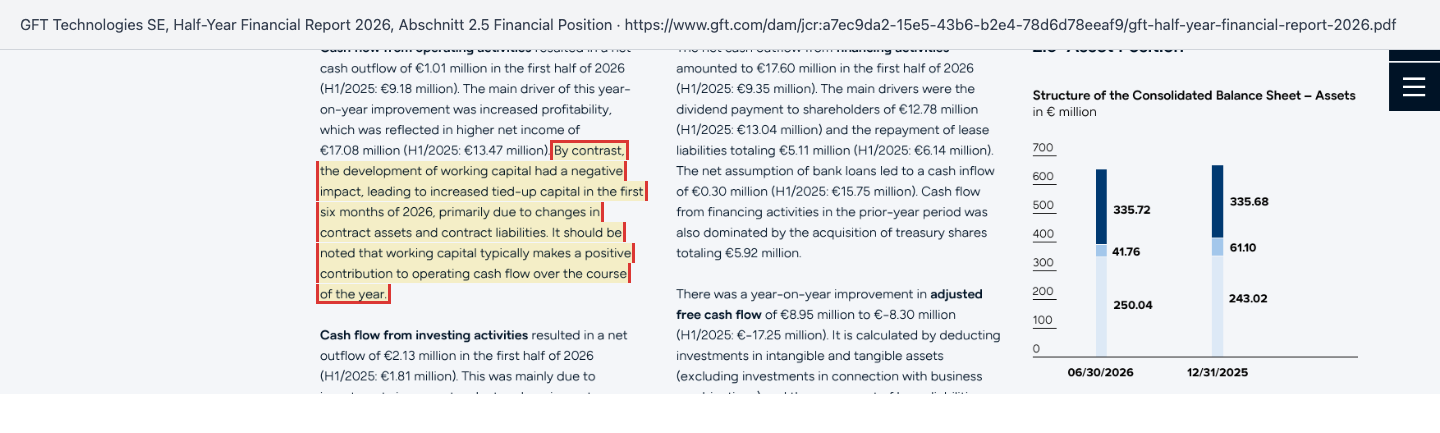
Translated: GFT has done work it has not billed yet. These contract assets — think of them as timesheets still sitting in a drawer — rose from €30.0 million to €48.9 million, up 63 percent in six months. At the same time, client prepayments shrank from €41.8 million to €29.6 million. To be fair, the pattern is seasonal at GFT. In 2025, operations generated only €2.0 million of cash after nine months, then €41.2 million in the fourth quarter. But the full year also weakened: operating cash flow fell from €72.4 million to €43.3 million in 2025, and adjusted free cash flow after capital spending and leases from €55.6 million to €28.0 million.
Of that, about €13.0 million went out as dividends in 2025 and €15.0 million into the buyback — together roughly the entire free cash flow. The Megawork acquisition came on top. That is why net bank debt grew: from €42.5 million at the end of 2024 to €55.2 million at the end of 2025 and €75.0 million at June 30, 2026, after the €12.8 million dividend was paid in June. Measured against operating profit before depreciation and amortization over the past twelve months (EBITDA, about €73.5 million by our calculation), that is roughly 1.0 times — far from GFT’s self-imposed ceiling of 2. That is not alarming. But the dividend and buyback are currently not being paid out of surplus cash; they are partly funded with credit.
Uncomfortable truth No. 4: goodwill is banking on double-digit growth
At June 30, 2026, the balance sheet showed €276.8 million of equity. Of that, €227.7 million was goodwill from acquisitions and another €36.2 million other intangible assets, mainly acquired customer relationships. Think of goodwill as the premium GFT paid on top of the hard assets when it bought other companies — for clients, know-how and hoped-for future earnings. Deduct both, and about €13 million of equity remains. As long as the acquired businesses deliver, that is no problem. Whether they do, GFT tests every year with an impairment test — and that test rests on this assumption:
“For the cash flow forecasts of the CGUs Americas, UK & APAC and Continental Europe, management assumes that business with existing and new clients will increase by an average of 12% for the CGU Americas, UK & APAC and 13% for the CGU Continental Europe between 2027 and 2030, based on planning for the financial year 2026, and thereafter each grow at a rate of 1%.”
— GFT Technologies SE, Integrated Annual Report 2025, note 4.1 “Goodwill”
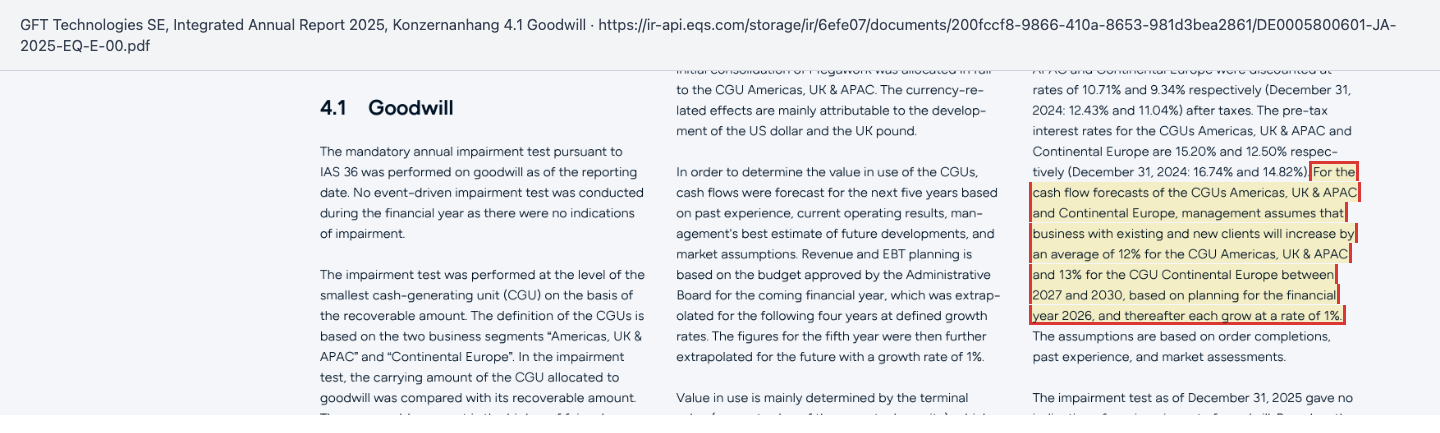
Put that next to the actual numbers. Continental Europe shrank 3 percent in 2025, and the redrawn Europe segment shrank another 3 percent in the first half of 2026. The test assumes 13 percent annual growth for the same region from 2027. At the same time, GFT lowered the rate used to discount future earnings for Continental Europe from 11.04 to 9.34 percent — a lower rate makes the same future earnings worth more today. The sensitivity analysis in the report only tests 5 percent lower revenue or a one-point higher discount rate; neither would have required an impairment. What growth of 3 percent instead of 13 percent would do is not in the report.
The test fits the five-year strategy of March 2025: revenue of about €1.5 billion and an adjusted EBIT margin of around 9.5 percent by 2029. Starting from €888.3 million in 2025, that would require roughly 14 percent growth per year — in the first half of 2026 it was 5 percent, 3 percent organically. GFT also wants to close the gap with acquisitions. Remember: an impairment costs no cash, but it tells you that book value is a hope with a date attached.
Valuation: priced like a services firm, hoped for like a platform
At €26.50 (Xetra close on October 2, 2026) and 25,564,808 shares outstanding, GFT had a market value of about €677.5 million. Adding net bank debt of €75.0 million gives an enterprise value of about €752 million — a little over 10 times the adjusted operating profit of €71 million targeted for 2026. Earnings per share over the past twelve months were €1.43, for a price-to-earnings ratio of about 18.5. The market value equals 0.75 times revenue over the past twelve months (€909.3 million) and just under 2.5 times book equity.
How to read that? For an IT services firm with margins of 5 to 7 percent, this is no longer a bargain price; for an AI platform, it would be cheap. That is the labeling effect in numbers: between the low of February 24, 2026, and October 2, 2026, the stock rose 89 percent, while the pre-tax profit expected for 2026, about €56 million, is still below the 2022 figure. For context: according to the 2025 annual report, the 2024 high was €33.36 (closing price on January 29, 2024). The view of the pros: analysts covered by our fundamental data had an average price target of about €30.83. Average means all price targets added up and spread evenly — a single very optimistic analyst can pull it up considerably. A price target is an opinion, not evidence.
Opportunities and risks at a glance
Opportunities
- The Wynxx AI platform is winning clients: 113 companies in twelve countries, more than €144 million of influenced contract value since launch (August 6, 2026).
- The order backlog stood at €483.5 million at June 30, 2026, 18 percent above the prior year.
- The restructuring in the UK and at GFT Software Solutions is working: EBT up 26 percent in the first half of 2026, Europe segment profit up from €7.80 million to €17.16 million.
- Banks have to modernize their old core systems anyway; AI can make such large projects faster and therefore affordable for more clients.
- Solid balance sheet: equity ratio of 44 percent, net debt of about 1.0 times EBITDA (June 30, 2026, our calculation).
Risks
- AI could shrink the business of selling work: 54 percent of revenue in the first half of 2026 came from service contracts.
- Dependence on Brazil (24 percent of revenue) and the real; Germany down 12 percent, Mexico down 36 percent.
- The largest single client ordered 20 percent less in the first half of 2026; 71 percent of revenue comes from banks.
- Weak conversion of profit into cash: operating cash flow of minus €1.0 million in the first half of 2026, adjusted free cash flow halved in 2025.
- Goodwill of €227.7 million rests on a plan of 12 to 13 percent annual growth from 2027.
A human conclusion
Back to the label. “AI-centric” is not an empty phrase at GFT: there is a real platform, there are real clients, and there was a half-year with clearly higher profit. But the label hides three things that are in the company’s own reports: the AI revenue is “influenced” and amounts to about 5 percent. The growth comes almost entirely from Brazil. And so far, profit turns into cash only with a delay. The question the label covers up: can GFT turn the hours its own AI saves into new work faster than they disappear from the old business? The stock price has given its answer since February 2026. The reports have not yet. What you do with that is your decision. And that is how it should be.
Sources
All original documents used in this analysis — so you can check for yourself:
- GFT Technologies SE — Half-Year Financial Report 2026 (period ended June 30, 2026, published August 6, 2026) — latest periodic report; revenue by country and contract type, largest client, balance sheet, cash flow statement, net liquidity, 2026 guidance
- GFT Technologies SE — press release on the first half of 2026 (August 6, 2026) — Wynxx figures, order backlog
- GFT Technologies SE — Integrated Annual Report 2025 (published March 27, 2026) — 2024 and 2025 figures, 2026 guidance, five-year strategy, client concentration, shareholder structure, buyback, impairment test (note 4.1), risk report
- Fundamental data (EBT 2021 to 2023, closing prices through October 2, 2026, analyst price targets), checked against the share count in the 2026 half-year report. Company releases after August 6, 2026, reviewed through October 3, 2026: no ad hoc release.
Transparency & disclaimer: This analysis is a journalistic contextualization of publicly available information and is not investment advice, not a financial analysis in the regulatory sense and not a solicitation to buy or sell securities. Investing in stocks involves substantial risk, up to and including total loss. All information without guarantee; the data date is noted in the text. Positions held by the operator are disclosed daily; where one exists, it appears as a notice at the top of this deep dive.
Our Bottom Line at a Glance
- Wynxx AI platform positive
- 113 enterprise clients in 12 countries, influenced contract value over €144M since launch (08/06/2026); influenced revenue H1 2026 €24.4M, about 5% of group revenue.
- Earnings recovery positive
- EBT H1 2026 +26% to €24.0M, Europe segment profit up from €7.80M to €17.16M; order backlog €483.5M (+18%); 2026 guidance confirmed.
- Business model in the AI shift neutral
- 54% of revenue from service contracts (H1 2026); 40% productivity gain from Wynxx at client Bradesco Seguros — both an opportunity and a risk for billable work.
- Regional dependence negative
- Brazil +€30.7M to €111.4M (24% of revenue), Germany −12%, Mexico −36%, largest client −20% (H1 2026); organic growth 3%.
- Cash conversion negative
- Operating cash flow H1 2026 −€1.0M on €17.1M of profit; adjusted free cash flow 2025 halved from €55.6M to €28.0M; net debt €75.0M (06/30/2026).
- Balance sheet and goodwill neutral
- Equity ratio 44%, net debt about 1.0x EBITDA; goodwill €227.7M against equity of €276.8M, tested with 12–13% annual growth from 2027.
GFT is a profitable, growing IT services firm for banks with its own AI platform that is winning clients. So far, though, its AI revenue is “influenced” and small, growth depends on Brazil, and profit turns into cash only with a delay. The stock has nearly doubled since February 2026. Not investment advice.
What Our Rating Means
Open questions
The business works in principle, but one material question is open. As long as it stays open, our findings do not carry a quality verdict.
Yellow here signals an open operating question, not a threat to the company: GFT is profitable, pays a dividend, has an equity ratio of 44 percent and only moderate debt at about 1.0 times EBITDA. The open question is whether a margin of 5 to 7 percent holds when GFT’s own AI replaces work it bills today, and whether growth returns outside Brazil. In 2025, GFT had to cut guidance, cash conversion has weakened, and the goodwill test assumes much more growth than the reports show today. The sharp rise in the share price since February 2026 is a price argument and does not change this rating. The decision is yours.
A journalistic assessment by our editorial team at the time of the deep dive, based on public sources — not investment advice and not a solicitation to buy or sell. Your personal circumstances (investment goals, risk capacity, taxes) cannot be taken into account. What our levels mean, how verdicts are formed, and what conflicts of interest exist →
Worth Noting
- Version of October 3, 2026, based on the 2026 half-year financial report (published August 6, 2026), the press release of the same day and the Integrated Annual Report 2025 (published March 27, 2026). The hook is the most-discussed ranking on wallstreet-online — an attention signal, not a data source.
- GFT does not report to the U.S. securities regulator, the SEC; all evidence comes from the company’s English-language reports. The fiscal year matches the calendar year. Next date: Q3 statement on November 12, 2026.
- Adjusted EBIT and adjusted free cash flow as defined by the company. Net debt as bank debt minus cash (excluding lease liabilities). Trailing twelve-month EBITDA, market value, enterprise value and P/E are our own calculations from the sources named; quarterly EPS figures are derived from half-year and quarterly data.
The full analysis as a PDF for later
We will send you this analysis as a PDF — to print, file away, and read at your own pace.
Frequently Asked Questions
GFT Technologies (Xetra: GFT) builds and modernizes software, mainly for banks and insurers. In the first half of 2026, 71 percent of its €462.6 million in revenue came from banks, 17 percent from insurers and 12 percent from industry. The work is done by 11,805 full-time equivalent employees, most of them in Brazil, Spain and Colombia.
Wynxx is GFT’s own AI platform for software development and modernizing legacy systems. According to the August 6, 2026, release, 113 enterprise clients in twelve countries use it. The revenue it “influenced” in the first half of 2026 was €24.4 million — revenue from projects in which Wynxx was used, about 5 percent of group revenue.
Partly. GFT calls itself AI-centric and sells its own AI platform, Wynxx. Measured by revenue, however, GFT is mainly an IT services firm: in the first half of 2026, 54 percent of revenue came from service contracts, while AI-influenced revenue was about 5 percent. AI can lift the business, but it can also replace billable work.
GFT paid a dividend of €0.50 per share for fiscal 2025 on June 30, 2026, €12.8 million in total. That was 39 percent of 2025 net income. At the October 2, 2026, price of €26.50, the yield is about 1.9 percent. The dividend has been unchanged at €0.50 for three payments in a row.
At June 30, 2026, bank debt of €116.7 million compared with cash of €41.8 million, for net debt of €75.0 million, up from €55.2 million at the end of 2025. By our calculation, that is roughly 1.0 times trailing twelve-month EBITDA. The equity ratio was 44 percent.
According to the financial calendar in the 2026 half-year report, GFT will publish its statement for the period ended September 30, 2026, on November 12, 2026. The fiscal year matches the calendar year. For 2026, GFT expects revenue of about €930 million, adjusted EBIT of €71 million and pre-tax profit of about €56 million.
Found an error?
Did you spot a factual error, an outdated number, or a typo in this deep dive? Let us know briefly — your report goes straight to the editorial team.