SAP: The Cloud Is Growing Faster Than the Maintenance Base Melts — For Now
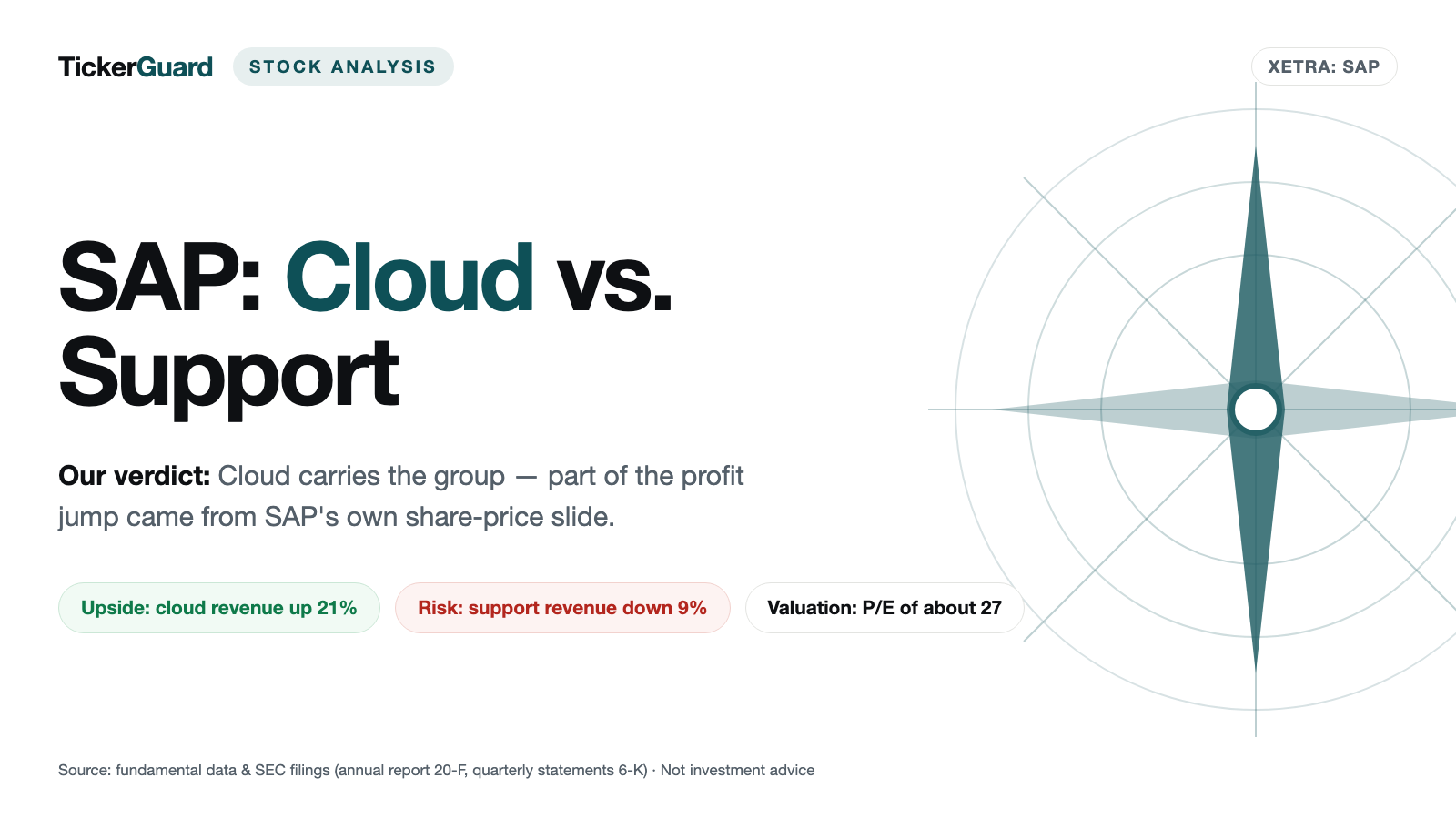
SAP sells the software large companies use to count their money — and has rebuilt itself in three years from a licence vendor into a cloud subscription business. Cloud revenue reached €21,023 million in 2025 and grew another 21 percent in the first half of 2026. At the same time the old maintenance business is shrinking, and SAP itself writes into its outlook that the decline will accelerate. A third of the first-half 2026 earnings increase also came from a source almost nobody accounts for: SAP's own share-price slide. Not a buy or sell recommendation — just the question of what exactly is being paid for at a price-to-earnings ratio of about 27.
 Thomas Mücke
Founder & Publisher
Thomas Mücke
Founder & Publisher
Chart
Interactive price chart (TradingView).
Note: pure fact-based analysis, not investment advice and not a solicitation to buy or sell. All figures without guarantee.
There is an investor weakness that hits well-informed people hardest: the label effect. A company gets a new sign on its door — the "stodgy software house" becomes the "European AI champion" — and suddenly we do the maths differently. Not because the numbers changed, but because the story did. The label feels like information. It is only packaging.
SAP is a textbook case. Over the past two years the group from Walldorf has collected just about every label the market has to hand out: Europe's most valuable company, AI winner, DAX anchor. Then came the first half of 2026, and the share price fell by around €75 — that figure, in exactly those words, appears in SAP's own quarterly statement. So let us do it the other way around: leave the label on the door frame and read the filings SAP has to submit to the U.S. Securities and Exchange Commission instead. The annual report on Form 20-F of February 26, 2026, and the quarterly statement of July 28, 2026. What sits there is a tension the market is currently pricing: the new business is growing fast — but the old one, which still carries the margin, is melting, and SAP expects it to melt faster.
What SAP actually does — the bookkeeping of the world economy
SAP SE, based in Walldorf, Germany, sells enterprise software. Put in everyday terms: if a large corporation had a nervous system, SAP would be the spinal cord. Every order, every invoice, every payroll run, every delivery, every booking passes through this software. It is unglamorous, invisible to the corporation's own customers — and practically impossible to replace once it runs. That is where SAP's pricing power comes from.
The core product is SAP S/4HANA, covering finance, procurement, manufacturing, supply chain and asset management. Around it sit SuccessFactors for human resources, Ariba and Concur for procurement and travel expenses, the SAP Customer Experience portfolio, and the SAP Business Technology Platform for development. Today most of it is sold as a subscription in bundles: RISE with SAP for existing customers migrating from their own data centre to the cloud, and SAP GROW for new customers who start in the cloud. On top of that sits the AI layer introduced in 2024: Joule as the conversational interface, plus so-called Joule Agents meant to execute workflows autonomously — SAP says it released 30 of them in 2025 alone.
As of December 31, 2025, SAP employed 111,397 people (110,650 full-time equivalents), of which 37,965 full-time equivalents worked in development — 34 percent of the workforce. Research and development spending reached €6,633 million in 2025, or 18.0 percent of revenue. The group is run by CEO Christian Klein and CFO Dominik Asam.
Why there is no 10-K here — and what sits at the SEC instead
One point up front, because it shapes the evidence base of this analysis. SAP is a German company but a U.S. reporting issuer: through American Depositary Receipts, each representing one SAP ordinary share, the stock also trades on the New York Stock Exchange. So SAP files with the SEC — just not in the format familiar from U.S. companies. Instead of an annual report (10-K) and three quarterly reports (10-Q), there is an annual report on Form 20-F and current reports on Form 6-K, with the quarterly numbers attached as exhibits. Accounting follows IFRS, not U.S. GAAP.
For you as a reader this changes nothing about reliability: a 20-F is signed under penalty of law too, and the litigation disclosures, risk factors and shareholder tables in it are just as verifiable. Every figure in this analysis therefore carries the note "Source: fundamental data & SEC filings (annual report 20-F, quarterly statements 6-K)". In the SEC register SAP appears under the identifier CIK 0001000184, listed with the tickers SAP and SAPGF on the NYSE and OTC. The former name "SAP AG" (until 2014) is on file there as well — the conversion into a European Company (SE) is the reason for today's name.
How the stock landed on our desk
SAP is not a chance find from a screener. It is the heaviest weight in the DAX and spent months with the reputation of being the only European stock with a credible AI story. That is exactly why it interests us: the louder the story, the wider the gap a look at the primary filings can expose. And the trigger was concrete — SAP lost significant ground in the first half of 2026 while its business numbers kept growing. When price and numbers diverge, at least one side has priced in something the other has not yet shown.
We have already looked at benchmarks for this: our Oracle analysis, SAP's direct competitor in enterprise software, and our ServiceNow analysis, a pure cloud vendor with no legacy licence base. Both cases pose the same underlying question from two other angles: what is a software subscription worth that nobody cancels?
The numbers over the years — given honest credit
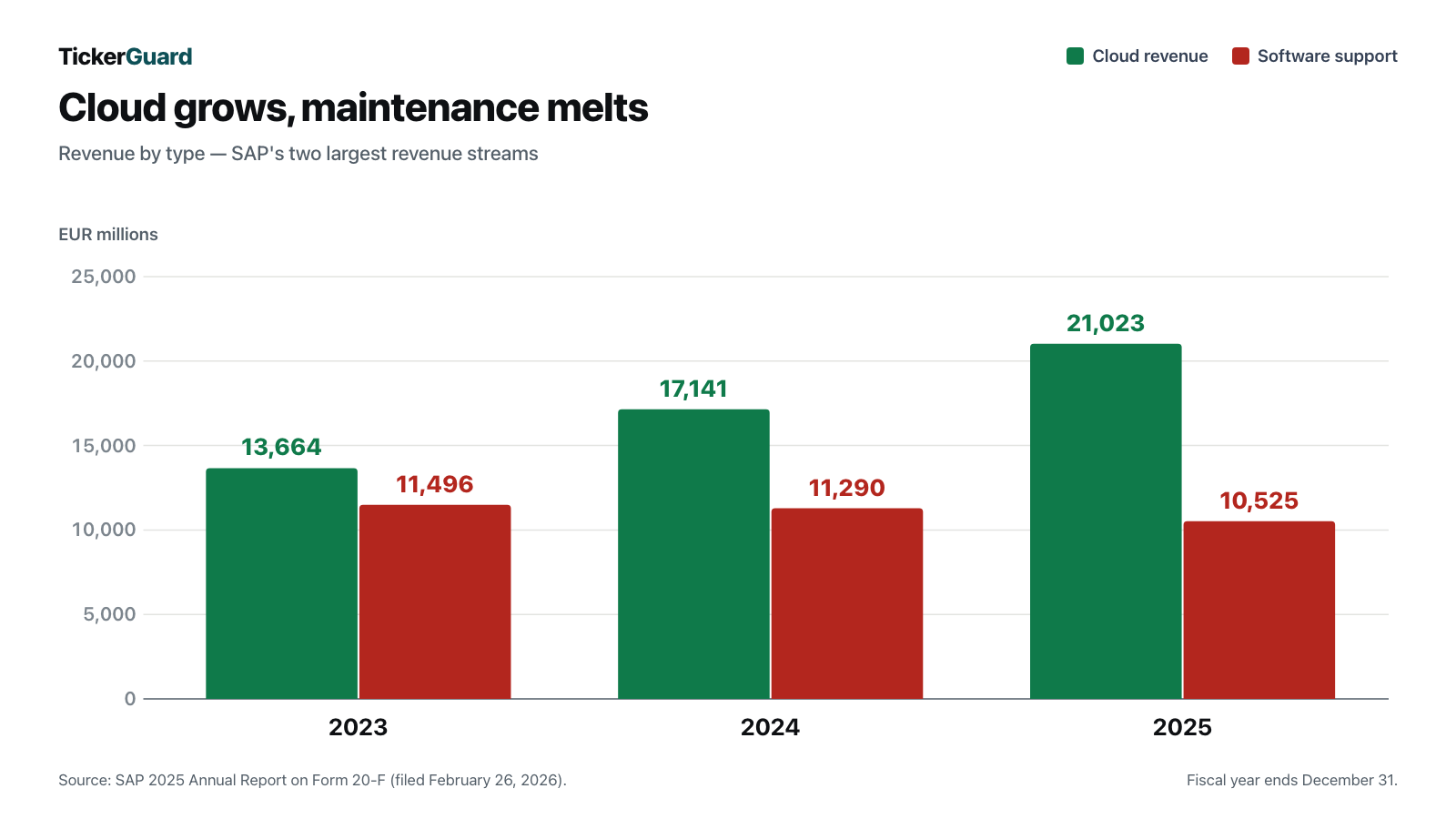
First the genuinely impressive part. SAP has pulled off a transition other software houses failed at: the shift from one-off licence sales to recurring subscriptions, without falling into a revenue hole along the way. Cloud revenue rose from €13,664 million (2023) through €17,141 million (2024) to €21,023 million (2025) — up 23 percent in the last year. The lion's share comes from the Cloud ERP Suite, that is the core business: €18,119 million, or 86 percent of cloud revenue.
Earnings power made a jump too. Operating profit under IFRS climbed to €10,293 million in 2025, more than doubling against 2024 (€4,665 million). The reason, though, is not an operational miracle but a base effect: 2024 contained €3,144 million of restructuring expenses for a company-wide programme affecting around 10,000 positions; in 2025 the figure was €3 million. Net profit rose to €7,327 million from €3,124 million a year earlier.
Free cash flow — the money left after all investments — came in at €8.24 billion in 2025; for 2026 SAP guides to about €10 billion. And the order book is full: total cloud backlog reached €77 billion at the end of 2025, up 30 percent at constant currencies. Current cloud backlog, the portion expected to convert into revenue within twelve months, stood at €22,929 million on June 30, 2026 — 27 percent above the prior year.
In short: the growth story is not made up. It is in the books. And now comes the part that is also in the books but rarely in the headlines.
What the filings say — the uncomfortable truths
Uncomfortable truth no. 1: SAP itself expects support revenue to erode faster
Alongside the cloud, SAP has a second large revenue stream almost nobody talks about: software support. Customers who bought SAP software as a licence years ago and run it on their own servers pay annual maintenance fees for updates, bug fixes and technical support. This business is old, it does not grow, it costs SAP almost nothing in development any more — and that is precisely why it is exceptionally high-margin. In 2025 it brought in €10,525 million, around 29 percent of group revenue.
Those revenues are shrinking. €11,496 million (2023), €11,290 million (2024), €10,525 million (2025) — and another 9 percent lower in the first half of 2026, from €5,403 million to €4,908 million. The reason is logical and uncomfortable at the same time: every customer who moves from their own data centre into SAP's cloud stops paying maintenance fees — and starts paying subscription fees. The cloud success eats part of the installed base. SAP writes this into its July 28, 2026 outlook with remarkable candour:
"Constant currencies software support revenue decline rate to accelerate in the coming years as a consequence of an acceleration of customers transforming to the cloud."
— SAP SE, Form 6-K filed July 28, 2026, exhibit 99.1 (Q2 2026 quarterly statement), section "Outlook"

Why this is more than a footnote: a euro of support revenue and a euro of cloud revenue are not the same thing. Cloud gross margin in the second quarter of 2026 was 74.3 percent — high, but it carries the running cost of data centres, operations and support. With maintenance those costs largely disappear because the customer runs the software. So when a customer migrates, SAP replaces high-margin installed-base revenue with somewhat lower-margin new revenue — and has to grow just to stand still. That is exactly why group revenue rose 8 percent in 2025 while cloud revenue rose 23 percent.
And the cloud margin is even edging down: it slipped from 74.7 to 74.3 percent in the second quarter of 2026, and the non-IFRS operating margin from 28.5 to 27.8 percent. This is not a collapse. But it is the opposite direction from what the "high-margin AI group" narrative suggests.
Uncomfortable truth no. 2: a third of the earnings increase was paid for by SAP's own share-price slide
Now it gets arithmetically interesting — and this is the finding we least expected from this analysis. SAP pays a large share of compensation in stock. Accounting rules require that expense to be remeasured continuously: if the share price rises, the promise gets more expensive and the expense goes up. If the price falls, it gets cheaper — and the expense goes down. SAP explains the effect itself:
"The decrease in share-based payment expenses is mainly due to a reduction in the SAP share price of around €75 in the first half of 2026, as compared to an increase in the first half of 2025 of around €20."
— SAP SE, Form 6-K filed July 28, 2026, exhibit 99.1, section (K) "Share-Based Payment Expenses"
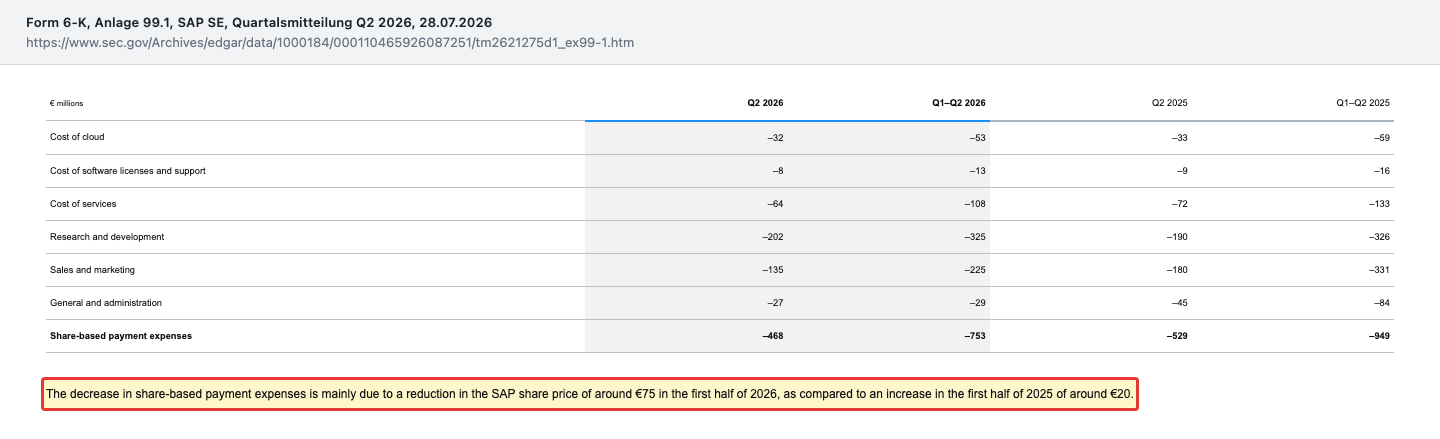
Let us do the maths. Share-based payment expenses fell from €949 million to €753 million in the first half of 2026 — a relief of €196 million. Over the same period, operating profit under SAP's own measure (non-IFRS) rose from €5,024 million to €5,609 million, an increase of €585 million. €196 million out of €585 million is roughly one third of the increase. And this item genuinely sits inside the measure: unlike restructuring or acquisition-related expenses, SAP does not strip share-based payments out of its non-IFRS result.
The quarterly cross-check gives the same picture: in the second quarter of 2026 alone the line fell from €529 million to €468 million (€61 million of relief) while operating profit (non-IFRS) rose by €175 million — again roughly a third. So this is not a rounding artefact of a single quarter.
Put in everyday terms: imagine your employer reports a profit jump, and a third of it comes from the fact that the employee equity it promised has become less valuable. That is accounting-correct and even economically real — less money genuinely flows out. It is simply not an achievement of the business, and it reverses as soon as the share price recovers. For context: in 2024, when SAP's share price rose by more than €95, this line climbed to €2,385 million for the full year; in 2025, with a decline of more than €25, it fell to €1,695 million. Remember: when earnings breathe with a company's own share price, an earnings jump in a weak price year is not proof of operational strength.
Uncomfortable truth no. 3: two-thirds of equity is goodwill from acquisitions
A look at the balance sheet as of June 30, 2026. Total assets stood at €75,609 million, equity attributable to owners of parent at €44,742 million. Of that, €30,408 million is goodwill — a good two-thirds of equity.
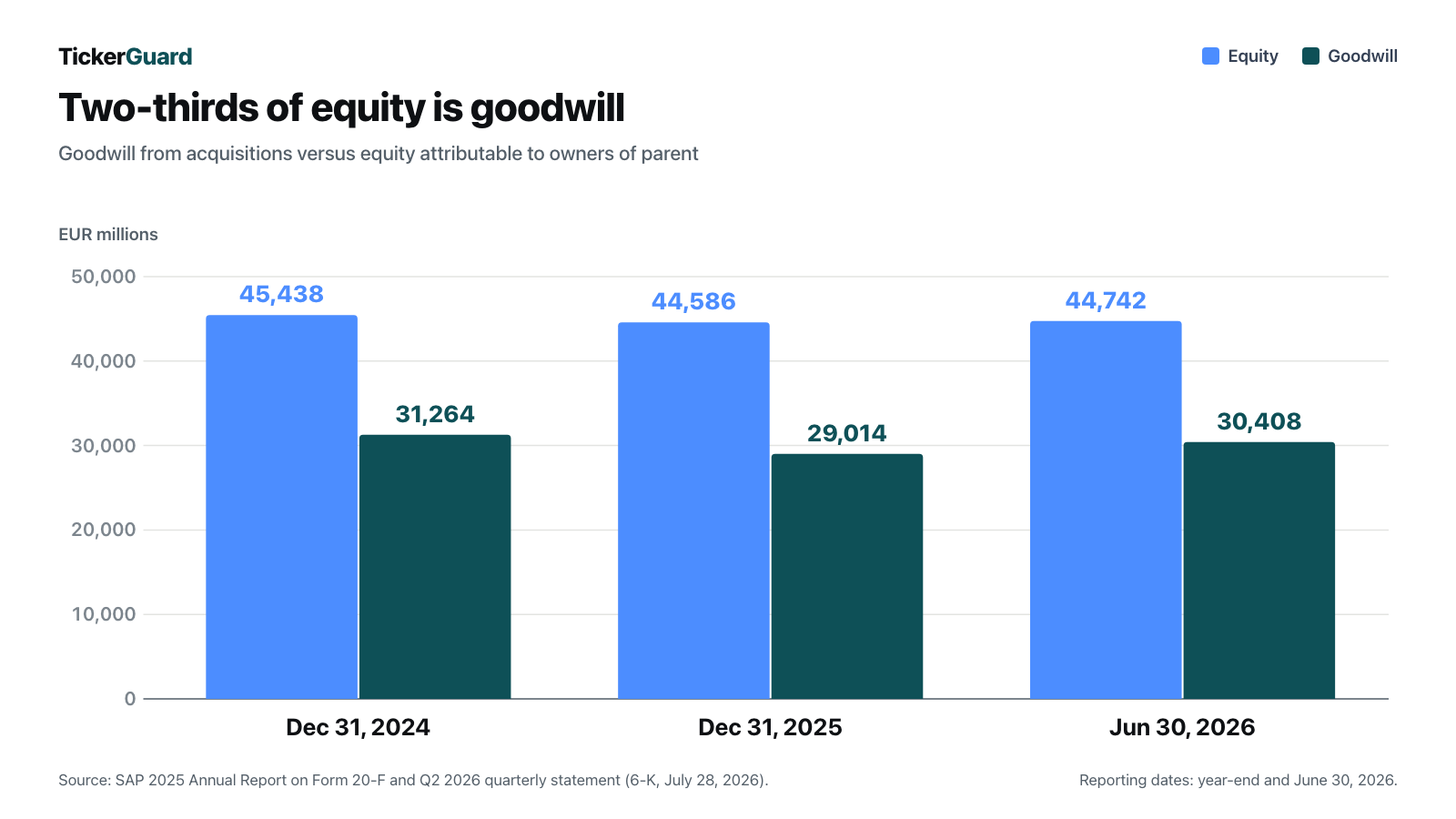
What is goodwill? When a group buys another company for more than the individual value of its assets, the difference lands on the balance sheet as goodwill. It is the price paid for brand, customer base, know-how and expectations. Translated: it is not a machine you can sell, it is a promise that the purchase price will eventually pay off. If it does not, it has to be written down — and equity disappears without a single euro moving.
Deduct the remaining intangible assets (€2,638 million) as well, and about €11.7 billion of the €44,742 million in equity remains in tangible form. A software group is intangible by nature, so this is not an indictment. But it limits the safety cushion: at SAP, balance-sheet substance rests on the assumption that the acquired businesses keep working.
And SAP keeps buying. In 2026 alone three acquisitions closed: Reltio (master data management, closed May 7, 2026, consideration US$1,259 million or €1,076 million), Dremio (data platform, July 6, 2026) and Prior Labs (AI foundation models for tabular data, July 16, 2026). Goodwill consequently rose from €29,014 million to €30,408 million in the first half of 2026. Worth noting: because of the dilutive impact of Dremio and Prior Labs, SAP lowered its 2026 operating profit guidance on July 28, 2026 — from €11.9–12.3 billion to €11.8–12.2 billion. Reltio contributed about €25 million of revenue in the second quarter and weighed on IFRS operating profit by about €13 million.
Uncomfortable truth no. 4: US$480 million to an opponent few had on their radar
The 2025 annual report shows a €387 million provision under litigation that did not exist a year earlier. The reason: database vendor Teradata sued SAP in the United States in 2018, alleging trade-secret misappropriation and U.S. antitrust violations in the development of the SAP HANA database. SAP initially got the claims dismissed in 2021; a 2024 appellate ruling reinstated them, and in October 2025 the U.S. Supreme Court declined to review the matter. A jury trial was scheduled for March to April 2026.
It never happened. At the end of February 2026 the two sides settled:
"SAP paid the full settlement amount of US$480 million (€408 million) in March 2026."
— SAP SE, Form 6-K filed July 28, 2026, exhibit 99.1, section (L) "Teradata Litigation Matter"

For a group with €10 billion of operating profit, €408 million is manageable — but it explains, for instance, why free cash flow rose only 5 percent to €6,250 million in the first half of 2026 while operating profit gained 12 percent. And this is not the only case of its kind: process-mining vendor Celonis also sued SAP in the United States in March 2025 over alleged antitrust violations, seeking around US$70 million; trial is currently set for March 8, 2027, with a parallel complaint at Germany's Federal Cartel Office. And the European Commission investigated SAP's rules for maintaining its classic, customer-installed software — the case was closed on July 9, 2026, through a commitment decision, meaning binding undertakings by SAP.
The connection between the three is no coincidence: all of them turn on the same question — how far may a vendor go whose software is effectively indispensable to its customers? The very market position that makes SAP so valuable is what attracts regulators and competitors.
Uncomfortable truth no. 5: the 10,000-position programme did not shrink the workforce
In January 2024 SAP announced a company-wide restructuring programme affecting around 10,000 positions, which cost €3,144 million in 2024. In press coverage that sounded like a job cut of considerable size. A look at the headcount table in the 2025 annual report shows something else: full-time equivalents rose from 109,121 (December 31, 2024) to 110,650 (December 31, 2025). Headcount climbed from 109,973 to 111,397.
Nothing else was ever announced — SAP itself writes that the programme ran mainly through voluntary leave and internal re-skilling and served to increase "focus on key strategic growth areas, particularly business AI". So it was a reallocation, not a reduction. For you as an investor the distinction matters: a reallocation does not create a lasting cost relief, at best a different cost structure. Anyone reading the 2025 earnings improvement over 2024 as the fruit of a savings programme is reading too generously — the lion's share is simply the disappearance of a one-off restructuring charge.
The AI question: how much is really in there?
Because the "AI" label carried the share price for months, the question deserves a clean answer: does SAP genuinely sell AI, or is it marketing on top of existing products? The answer is in the annual report — and it is more concrete than one might expect:
"At the same time, we see SAP Business AI gaining momentum, with more than two-thirds of our cloud order entry containing SAP Business AI in the fourth quarter of 2025 and therefore increasing more than 20pp compared to the third quarter of 2025."
— SAP SE, Form 20-F for fiscal 2025, filed February 26, 2026, management report

That is a hard number, and it comes from a document signed under penalty of law. The product side matches: Joule as the conversational layer across all applications, 30 Joule Agents released in 2025, SAP Business Data Cloud as the data layer beneath, plus partnerships with Anthropic, Amazon Web Services, NVIDIA, Palantir, Perplexity and Google Cloud, among others. SAP frames the strategy in the annual report as "AI-First": AI is not bolted onto existing processes, product development itself is being reoriented around it.
Two caveats remain. First, "contains SAP Business AI" says nothing about how much revenue the AI features generate on their own — it only says they were part of the bundle. The filings give no separate revenue figure for Business AI. Second, the fourth-quarter 2025 news was not purely positive: current cloud backlog grew 25 percent at constant currencies, slower than expected — SAP itself calls it a "greater-than-expected deceleration" in the annual report. And for 2026 SAP expects that growth rate to decelerate slightly again.
Valuation: what the market pays for the label
On August 7, 2026, SAP shares closed at €177.96 on Xetra. With around 1,154 million shares outstanding that corresponds to a market capitalisation of roughly €205 billion. That is more than five times annual revenue (price-to-sales of about 5.4) and about 4.6 times book equity per share.
On trailing twelve-month earnings (€6.67 per share) the price-to-earnings ratio is about 27; against current-year estimates it is about 24. Enterprise value — market capitalisation plus debt minus cash — stands at roughly €204 billion, about 16 times earnings before interest, taxes, depreciation and amortisation. The dividend of €2.50 per share yields about 1.4 percent at a payout ratio of roughly 38 percent.
Is that expensive? It depends which growth rate you plug in. Use the cloud growth rate of more than 20 percent and 27 looks almost cheap. Use group revenue growth of 8 percent (2025) — that is, after deducting the shrinking maintenance base — and 27 looks sporty. That is the label effect expressed in numbers: an "AI group" gets valued on the cloud rate, a software house on the group rate. It is the same company.
SAP is giving its own share price a tailwind: in January 2026 a new buyback programme of up to €10 billion started, running to December 31, 2027. Through June 30, 2026, it had repurchased 16,280,097 shares at an average of €161.16, a volume of about €2.6 billion. Financing is solid: in May 2026 SAP placed a €3.5 billion bond in four tranches, rated A1 (stable) by Moody's and A+ (stable) by S&P Global. As of June 30, 2026, cash of €10,511 million stood against financial liabilities of €10,507 million — essentially net debt free.
A word on currency, because in 2026 it explains a noticeable part of the gap between reported and "constant-currency" growth rates: SAP earns a substantial share of its money in U.S. dollars but reports in euros. At June 30, 2026 exchange rates, SAP expects a full-year 2026 headwind of 1.5 percentage points on cloud revenue and 2.0 percentage points on operating profit. That is why every release carries a second set of figures "at constant currencies" — the friendlier one. From 2027 SAP intends to strip currency effects out of its own non-IFRS measure as well, explicitly to improve comparability with U.S. peers.
Opportunities and risks at a glance
What speaks for SAP:
- The cloud transition is working measurably: cloud revenue of €21,023 million in 2025 (up 23 percent), up another 21 percent to €12,244 million in the first half of 2026; current cloud backlog of €22,929 million on June 30, 2026 (up 27 percent).
- Exceptionally high switching costs: nobody moves their accounting off SAP because of a better offer. It shows in a cloud gross margin of 74.3 percent (second quarter of 2026) and a return on equity of about 18 percent.
- The AI share is quantified, not merely asserted: more than two-thirds of fourth-quarter 2025 cloud order entry contained SAP Business AI — over 20 percentage points more than the prior quarter.
- Solid finances: cash of €10,511 million against financial liabilities of €10,507 million (June 30, 2026), ratings of A1 (Moody's) and A+ (S&P Global), a €3.5 billion bond placed in May 2026, and a buyback programme of up to €10 billion running to the end of 2027.
- Free cash flow is growing sharply: €8.24 billion in 2025, with about €10 billion guided for 2026 — despite the €408 million paid to Teradata in March 2026.
What speaks against it:
- SAP itself expects an accelerating decline in software support revenue (2025: €10,525 million; first half of 2026: down 9 percent) — the group's highest-margin revenue stream is eroding by design.
- Roughly a third of the first-half 2026 earnings increase came from the drop in share-based payment expenses (€949 million to €753 million), caused by SAP's own share-price slide — an effect that reverses when the price recovers.
- Goodwill of €30,408 million equals a good two-thirds of equity (€44,742 million as of June 30, 2026); tangible equity is about €11.7 billion.
- Three antitrust disputes turning on the same underlying question: the Teradata settlement of US$480 million (paid March 2026), the Celonis suit (trial set for March 8, 2027, around US$70 million sought, plus a Federal Cartel Office complaint) and the EU proceedings on maintenance policy, closed on July 9, 2026 through binding commitments.
- Margins point slightly down rather than up: cloud gross margin from 74.7 to 74.3 percent in the second quarter of 2026, non-IFRS operating margin from 28.5 to 27.8 percent. And 2026 operating profit guidance was cut on July 28, 2026 because of the Dremio and Prior Labs acquisitions.
- Currency headwind: at June 30, 2026 rates SAP expects minus 1.5 percentage points on cloud revenue and minus 2.0 percentage points on operating profit for 2026. The outlook also rests explicitly on the assumption of a near-term de-escalation of the conflict in the Middle East.
A human conclusion
Back to the label effect from the opening. The "AI champion" label is not wrong at SAP — the annual report supplies a number you cannot argue away. But the label obscures the fact that two businesses run behind that door at the same time: a young one that grows fast and gets all the attention, and an old one that shrinks slowly and pays the bill. SAP knows this precisely and even writes it into the outlook. Hardly anyone reads it, because it sits in the dullest part of the document.
And then there is the figure that occupied us longest in this analysis: €196 million of the €585 million earnings increase in the first half of 2026 came from SAP's own stock falling. It is honestly disclosed, cleanly explained, accounting-correct — and it is still the opposite of what the headline "operating profit up 12 percent" suggests. Read only the headline and you get a success story. Read to page 21 and you get the reason.
In the end that is the only skill that protects you from the label effect: reading a label takes a second, reading a quarterly statement takes twenty minutes. Those twenty minutes are the difference. What you do with that is your decision. And that is exactly as it should be.
Sources
Every primary document used in this analysis — to read for yourself:
- SAP SE — Form 6-K filed July 28, 2026, exhibit 99.1: quarterly statement for the second quarter of 2026 (most recent periodic report)
- SAP SE — Form 6-K filed July 28, 2026, exhibit 99.2: half-year report 2026 — interim consolidated financial statements, notes and financial calendar
- SAP SE — Form 20-F for fiscal 2025, filed February 26, 2026 — management report, consolidated financial statements, litigation, headcount and shareholder tables
- SAP SE — Form 6-K filed April 28, 2026, exhibit 99.1: quarterly statement for the first quarter of 2026
- SAP SE — Form 6-K filed February 3, 2026, exhibit 99.1: quarterly statement for the fourth quarter and fiscal year 2025 — source for the €77 billion total cloud backlog and the new buyback programme
- SAP SE — Form 6-K filed May 8, 2026, exhibit 99.1: voting results of the Annual General Meeting of May 5, 2026
- SEC EDGAR — filing index for SAP SE (CIK 0001000184)
- Fundamental data (share price, market capitalisation, valuation metrics; data as of August 7, 2026), reconciled with the SEC filings.
Transparency & disclaimer: this analysis is journalistic commentary on publicly available information. It is not investment advice, not a financial analysis in the regulatory sense and not an invitation to buy or sell securities. Equity investments carry substantial risks up to and including total loss. All information without warranty; the date of each figure is noted in the text, and the overall status of this version is August 9, 2026. The third-quarter 2026 quarterly statement is scheduled for October 21, 2026 according to the financial calendar. Positions held by the operator are disclosed daily; where one exists, it appears as a notice at the top of this deep dive.
Our Bottom Line at a Glance
- Business model and switching costs positive
- SAP software runs the core processes of large corporations — finance, procurement, manufacturing, human resources. Once it is in place, nobody switches. It shows in a cloud gross margin of 74.3 percent (second quarter of 2026) and a return on equity of about 18 percent.
- Cloud growth positive
- Cloud revenue rose from €13,664 million (2023) to €21,023 million (2025) and gained another 21 percent to €12,244 million in the first half of 2026. Current cloud backlog stood at €22,929 million on June 30, 2026, 27 percent above the prior year; total cloud backlog reached €77 billion at the end of 2025.
- Melting installed base negative
- Software support — the highest-margin business — fell from €11,496 million (2023) to €10,525 million (2025) and dropped a further 9 percent to €4,908 million in the first half of 2026. In its July 28, 2026 outlook SAP explicitly expects this decline to accelerate.
- Earnings quality neutral
- Roughly a third of the increase in operating profit (non-IFRS) in the first half of 2026 — €196 million out of €585 million — came from the drop in share-based payment expenses from €949 million to €753 million, caused by SAP's own share-price slide of around €75. The effect reverses when the price rises. At the same time cloud gross margin (74.7 to 74.3 percent) and operating margin (28.5 to 27.8 percent) both slipped in the second quarter.
- Balance sheet and financing positive
- As of June 30, 2026, cash of €10,511 million stood against financial liabilities of €10,507 million — essentially net debt free. Ratings of A1 (Moody's) and A+ (S&P Global), a €3.5 billion bond placed in May 2026. Caveat: €30,408 million of the €44,742 million in equity is goodwill from acquisitions.
- Regulation and legal risk neutral
- The Teradata dispute ended with a US$480 million payment in March 2026. The EU proceedings on maintenance policy were closed on July 9, 2026 through binding commitments. The Celonis suit remains open (trial set for March 8, 2027, around US$70 million sought) alongside a Federal Cartel Office complaint. All three turn on the same question: the market position of a vendor that is effectively indispensable.
SAP has completed the shift from licence vendor to cloud subscription business — cloud revenue reached €21,023 million in 2025 and grew another 21 percent in the first half of 2026. At the same time the high-margin maintenance business is melting, and SAP itself expects that decline to accelerate. A third of the first-half 2026 earnings increase also came from the drop in share-based payment expenses triggered by SAP's own share-price slide. The balance sheet is net debt free but rests to a good two-thirds on goodwill from acquisitions. Not investment advice.
What Our Rating Means
Quality confirmed
Business model, numbers and balance sheet hold up to our review. Whether the current price supports an entry is a separate question — it hangs on the price, not on the company.
Green here refers to the quality of the company, not to an entry point and not to the valuation. The business model holds: SAP software runs the core processes of large corporations and is practically irreplaceable once implemented — visible in a cloud gross margin of 74.3 percent, current cloud backlog of €22,929 million as of June 30, 2026, and free cash flow of €8.24 billion in 2025. The balance sheet is resilient: cash of €10,511 million against financial liabilities of €10,507 million, ratings of A1 and A+, no going-concern note, no visible covenant issue and no existential dependence on a single customer. The litigation is not a substance risk either: the US$480 million Teradata settlement was paid in full in March 2026, the EU proceedings were closed on July 9, 2026 through commitments, and the roughly US$70 million Celonis claim sits far below any materiality threshold for a group of this size. The two findings of this analysis deserve to be taken seriously but do not change the substance: the accelerating decline in support revenue is the planned flip side of the cloud success rather than a break, and the €196 million of relief from share-based payments is honestly disclosed — it makes the earnings quality of one half-year worse, not the company. What can argue against SAP are price arguments: a price-to-earnings ratio of about 27 on group revenue growth of 8 percent, a price-to-book ratio of about 4.6, and equity that consists to a good two-thirds of goodwill. Price arguments are not quality arguments, though — the buy decision belongs to the screeners, not to this rating. The next verifiable milestone is the quarterly statement on October 21, 2026.
A journalistic assessment by our editorial team at the time of the deep dive, based on public sources — not investment advice and not a solicitation to buy or sell. Your personal circumstances (investment goals, risk capacity, taxes) cannot be taken into account. What our levels mean, how verdicts are formed, and what conflicts of interest exist →
Worth Noting
- SAP is a Foreign Private Issuer with the U.S. Securities and Exchange Commission: instead of an annual report (10-K) and quarterly reports (10-Q) it files an annual report on Form 20-F plus current reports on Form 6-K, reporting under IFRS. Every figure in this analysis comes from the Form 20-F for fiscal 2025 (February 26, 2026) and the Forms 6-K of February 3, April 28 and July 28, 2026. SEC identifier: CIK 0001000184.
- The "a third of the earnings increase" calculation refers to operating profit under SAP's own measure (non-IFRS) in the first half of 2026: €5,609 million versus €5,024 million, an increase of €585 million. Share-based payment expenses fell over the same period from €949 million to €753 million, a relief of €196 million — that is 33.5 percent of the increase. The second-quarter cross-check gives the same share (€61 million out of €175 million). SAP does not strip this item out of its non-IFRS measure.
- Note on the ticker: the SAP.DE symbol used in this analysis is shorthand for "SAP, listed in Germany" — it is not an official exchange code. The shares trade as Xetra: SAP as well as on Tradegate, Frankfurt, Munich, Stuttgart and Düsseldorf; in the United States as a depositary receipt (ADR) on the NYSE under SAP. Not to be confused with Canadian dairy group Saputo, which also trades under the ticker SAP on the Toronto Stock Exchange.
- From fiscal 2027 SAP changes its presentation: with the new accounting standard IFRS 18 it will add two adjustments to its non-IFRS measures — foreign currency effects and interest related to taxes. SAP explicitly justifies this with easier comparison against U.S. peers. Figures from 2027 onwards will therefore only be comparable to the non-IFRS values cited here to a limited extent.
- According to the quarterly statement of July 28, 2026, the 2026 outlook rests explicitly on the assumption of a near-term de-escalation of the conflict in the Middle East; SAP notes that further consequences of an escalation cannot currently be assessed.
The full analysis as a PDF for later
We will send you this analysis as a PDF — to print, file away, and read at your own pace.
Frequently Asked Questions
SAP sells enterprise software that large companies use to run their core processes: finance, procurement, manufacturing, supply chain and human resources. The core product is SAP S/4HANA, sold today mainly as a cloud subscription through the RISE with SAP bundle (for existing customers) and SAP GROW (for new ones). As of December 31, 2025, the group employed 111,397 people.
Revenue rose 8 percent to €19,432 million and cloud revenue 21 percent to €12,244 million. IFRS operating profit gained 12 percent to €5,383 million and earnings per share 19 percent to €3.55. Free cash flow grew only 5 percent to €6,250 million — weighed down, among other things, by the Teradata settlement payment in March 2026.
Because every customer who moves from their own data centre into SAP's cloud stops paying annual maintenance fees and takes out a subscription instead. Support revenue fell from €11,496 million (2023) to €10,525 million (2025) and dropped a further 9 percent to €4,908 million in the first half of 2026. In its July 28, 2026 outlook SAP explicitly expects this decline to accelerate in the coming years.
SAP pays a large part of its workforce in shares, and that expense is remeasured continuously at the current price. Because SAP's share price fell by around €75 in the first half of 2026, the line dropped from €949 million to €753 million. That €196 million of relief equals roughly a third of the €585 million increase in operating profit (non-IFRS). If the price recovers, the expense comes back.
According to the 2025 annual report, more than two-thirds of fourth-quarter 2025 cloud order entry contained SAP Business AI — over 20 percentage points more than the previous quarter. The key building blocks are Joule as the conversational layer, 30 Joule Agents released during 2025 and SAP Business Data Cloud as the data layer. SAP does not, however, disclose a separate revenue figure for Business AI.
Because SAP is a Foreign Private Issuer: the stock trades on the New York Stock Exchange through depositary receipts while the company itself is German. For that group, the annual report on Form 20-F plus current reports on Form 6-K replace the 10-K and 10-Q. Accounting follows IFRS. SAP's identifier at the SEC is CIK 0001000184.
The dividend is €2.50 per share, a yield of about 1.4 percent at the August 7, 2026 price of €177.96 on Xetra, with a payout ratio of roughly 38 percent. On top of that a buyback programme of up to €10 billion has been running since January 2026 with a term to December 31, 2027 — through June 30, 2026, 16,280,097 shares had been repurchased at an average price of €161.16.
The Teradata litigation ended in a settlement at the end of February 2026; SAP paid US$480 million (€408 million) in March 2026. The Celonis suit alleging U.S. antitrust violations continues, with trial set for March 8, 2027 and around US$70 million sought. The EU proceedings into maintenance policy for installed software were closed on July 9, 2026 through binding commitments by SAP.
Found an error?
Did you spot a factual error, an outdated number, or a typo in this deep dive? Let us know briefly — your report goes straight to the editorial team.