BigBear.ai: The AI Is Real, the Customer Is the Pentagon — and the Share Count Grows Faster Than Revenue
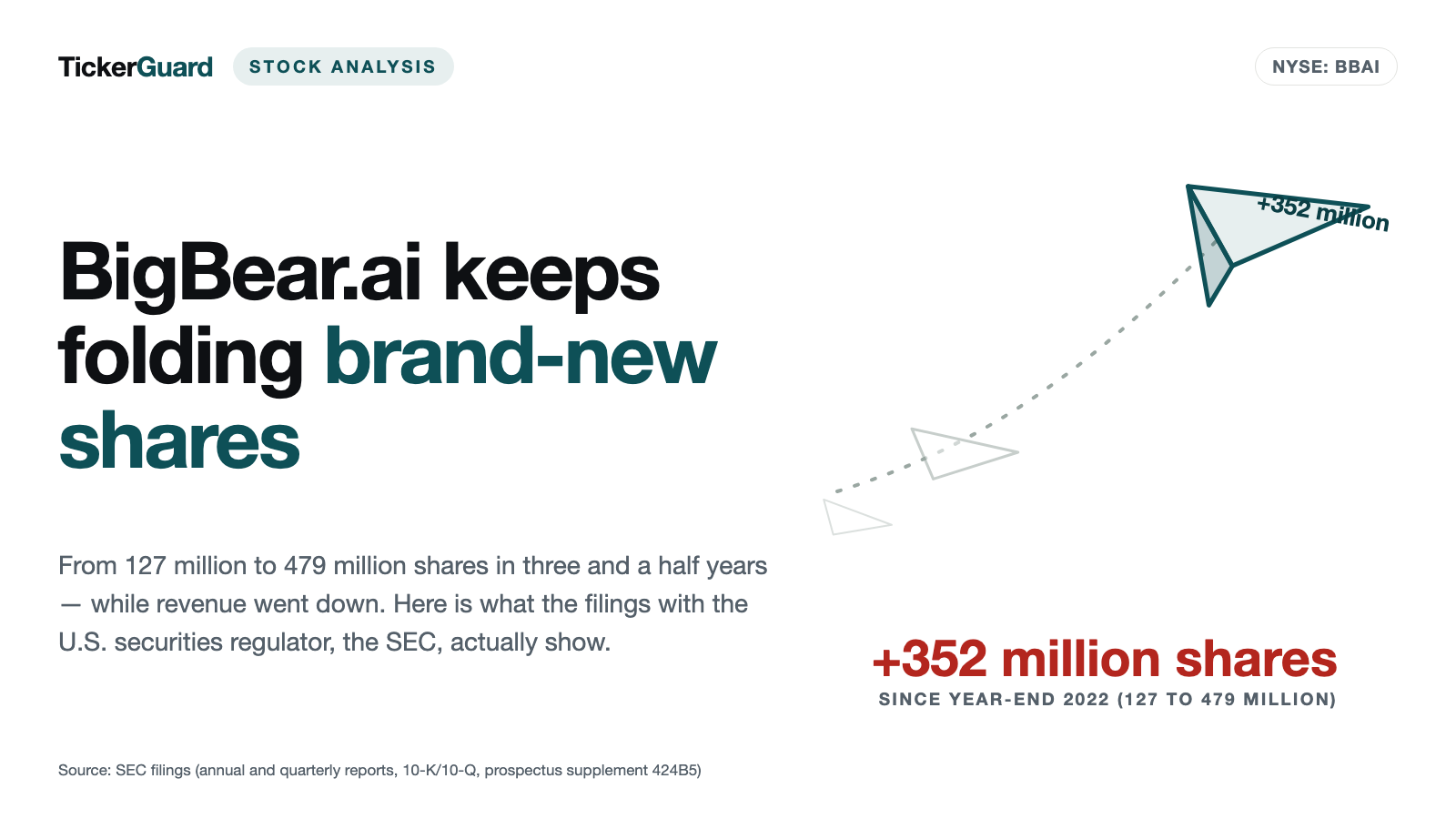
The name says AI, the ticker says BBAI, and the filings with the U.S. securities regulator, the SEC, say this: revenue fell 19.3 percent to $127.7 million in 2025 while the share count rose from 127.0 million at the end of 2022 to 479,494,493 on June 30, 2026. One day after the latest quarterly report, BigBear.ai registered a program for up to 100 million more shares — with $409.8 million of cash and investments already on the balance sheet. We read the primary documents line by line: the business, five years of numbers, and the four places where the filings tell a different story than the company name.
 Thomas Mücke
Founder & Publisher
Thomas Mücke
Founder & Publisher
As of Today
As of: September 17, 2026
- Closing price
- 2.80 $ +4.00%
- Market Capitalisation
- 1.4 $B
- Growth Score
- 2/10
- AAQS
- 4/10
Price change since July 30, 2026: -1.1%
This analysis has a cut-off date. The Stock Guard tells you when something material changes in the numbers. Reserve your free spot
Chart
Interactive price chart (TradingView).
52-week range: 2.60 $ to 8.90 $ · Last price: 2.80 $ (As of: September 17, 2026)
Note: pure fact-based analysis, not investment advice and not a solicitation to buy or sell. All figures without guarantee.
There is an investor trap so simple that we all assume we are immune to it — and it works on almost everyone anyway: the name trap. It goes like this. You read a ticker, and your brain quietly fills in an entire story. With BigBear.ai Holdings the story is written twice: in the company name and in the ticker BBAI. Two letters that have put this stock on nearly every artificial-intelligence watchlist for years. And here is the twist: the name is not even lying. BigBear.ai sells real, security-accredited AI to the U.S. military and to federal agencies — not as a label, but as a product with clearances up to Top Secret. That is exactly what makes this case instructive. The story is true, and the filings still tell a different one. So let us make a deal: we read the annual report (Form 10-K) for 2025, the quarterly report (Form 10-Q) as of June 30, 2026, the earnings release of July 30, 2026 and the prospectus supplement (Form 424B5) of July 31, 2026 — documents that carry criminal liability if they lie. What you do with the result is your call. The central tension of this analysis is already fixed, and it runs through every chapter: the AI is real and the customer pays its bills — but the fastest-growing number at this company is not revenue, it is the share count.
What the company actually sells — AI for the military, not for you
BigBear.ai sits in McLean, Virginia, a short drive from the Pentagon, and employed 579 people as of December 31, 2025 — roughly 67 percent of them software engineers, data scientists, cloud and systems engineers, analysts and cyber subject-matter experts; the vast majority hold an active security clearance. That detail describes the business model better than any product sheet: these are people who are allowed into rooms almost nobody else can enter.
The offering has four pillars. First, Ask Sage — a generative AI platform built for defense and intelligence customers, acquired on December 31, 2025 for $271.6 million in cash. The point of Ask Sage is not the model, it is the accreditation. Per the annual report it was the first platform of its kind to receive FedRAMP authorization, the standardized U.S. security assessment for cloud services, and it is certified for government data up to DoD IL5, IL6 and Top Secret. Put plainly: not everyone gets into the vault, but whoever holds the key does not have to defend it every quarter. The company says more than 16,000 government teams and 2,500 companies were using Ask Sage as of January 2026.
Second, ConductorOS, an orchestration platform for data, sensors and AI models "at the edge" — meaning wherever troops, sensors and weapons systems operate, far from any data center. In 2025, per the 10-K, ConductorOS was central to exercise Talisman Sabre, a joint exercise involving U.S., Australian and more than two dozen other allied forces. Third, digital identity: biometrics and computer vision for identity verification, largely from the Pangiam business acquired in 2024. Fourth, logistics and trade — in January 2026 BigBear.ai acquired the assets of CargoSeer, an AI platform that reads container X-ray images at customs checkpoints.
One word on the company's origin, because it still echoes through the share register. BigBear.ai did not go public through a conventional offering. It listed on December 7, 2021 through the blank-check shell GigCapital4, Inc. On the same day it issued $200 million of convertible notes. Three and a half years later those notes became an accounting problem; more on that below. Alongside the common stock, warrants from that period still trade on the New York Stock Exchange under the symbol BBAI.WS with an exercise price of $11.50 per share.
Company history for investors
-
2021
Listing via the SPAC shell GigCapital4 (December 7)
On the same day the company issued $200 million of convertible notes. Their accounting treatment triggered the restatement of prior financial statements three and a half years later.
-
2024
Pangiam acquired for $70 million (February 29)
Paid not in cash but with 61,838,072 new shares at $1.3439 apiece — that single deal lifted the share count by roughly 39 percent.
-
2025
Restatement and material weakness (March 18)
Prior statements for 2022, 2023 and six quarters had to be restated. For shareholders that meant the numbers published until then could not be relied upon.
-
2025
Impairments totaling $124.0 million
$70.6 million on goodwill and $53.4 million on long-lived assets — the third goodwill write-down since 2022, for a combined $209.2 million.
-
2025
Ask Sage acquired for $271.6 million (December 31)
Paid in cash for the first time rather than in shares, funded by that year's equity raises. It provisionally added $192.7 million of new goodwill, revised to $190.1 million in the 10-Q for the quarter ended June 30, 2026.
-
2026
New share program for up to 100 million shares (July 31)
Filed one day after the quarterly report and despite $409.8 million of cash and investments. For shareholders it means potential further dilution of roughly 21 percent.
How the stock landed on our desk — a prospectus, one day after the quarterly report
BBAI reached our research list through the SEC filing feed, not through a price move. On July 30, 2026 BigBear.ai published its quarterly report as of June 30, 2026 together with an earnings release headlined "Delivers 13% Growth, 20+ New Contract Wins, and Expanded Margins." One day later, on July 31, 2026, came a prospectus supplement (Form 424B5) covering the sale of up to 100 million new shares through the investment bank Jefferies. For scale: at that point 479,494,493 shares were outstanding. The program therefore equals roughly 21 percent of the entire share base.
That sequence — good news first, sales prospectus the next morning — is the actual hook of this analysis. It is entirely legal and fully disclosed; that is precisely why anyone can read it. An investor who follows a stock through headlines sees the first item and not the second. Note the habit early: at young technology companies the most important news rarely sits in the press release, but in the prospectus filed beside it. And while we are there: that same document contains the last price recorded in an official filing — $2.83 per share at the close on July 30, 2026. Every valuation figure below refers to that dated anchor; daily quotes deliberately play no role in this analysis.
The numbers over the years — given their due
First the things that genuinely speak for BigBear.ai, and there are more of them than the stock's reputation suggests. The second quarter of 2026 was operationally the best in years. Revenue rose 13.2 percent to $36.7 million (prior-year quarter: $32.5 million). Gross margin — the share of revenue left after direct delivery costs — jumped from 25.0 percent to 32.8 percent, because the higher-margin Ask Sage business contributed for a full quarter for the first time. Backlog grew from $248.1 million (December 31, 2025) to $269.6 million (June 30, 2026), up 9 percent. And the balance sheet is the strongest in company history: $409.8 million of cash and investments, $770.3 million of equity and essentially no long-term debt — down from $135.4 million at the end of 2024. A company that reported negative equity of $3.7 million in 2024 now holds more cash than it books in three years of revenue. That is not a small thing.
The bench is being reinforced, too. On August 13, 2026 the board elected retired Lieutenant General Sean Gainey — until April 2026 a commander in the U.S. Army Space and Missile Defense Command, and before that the four-year director of the Department of Defense's joint counter-drone office. In a business where access and trust are the product, that appointment is news.
Now the chart that frames everything else. It shows two quantities side by side: revenue in millions of dollars and the share count in millions of shares, each as of December 31.
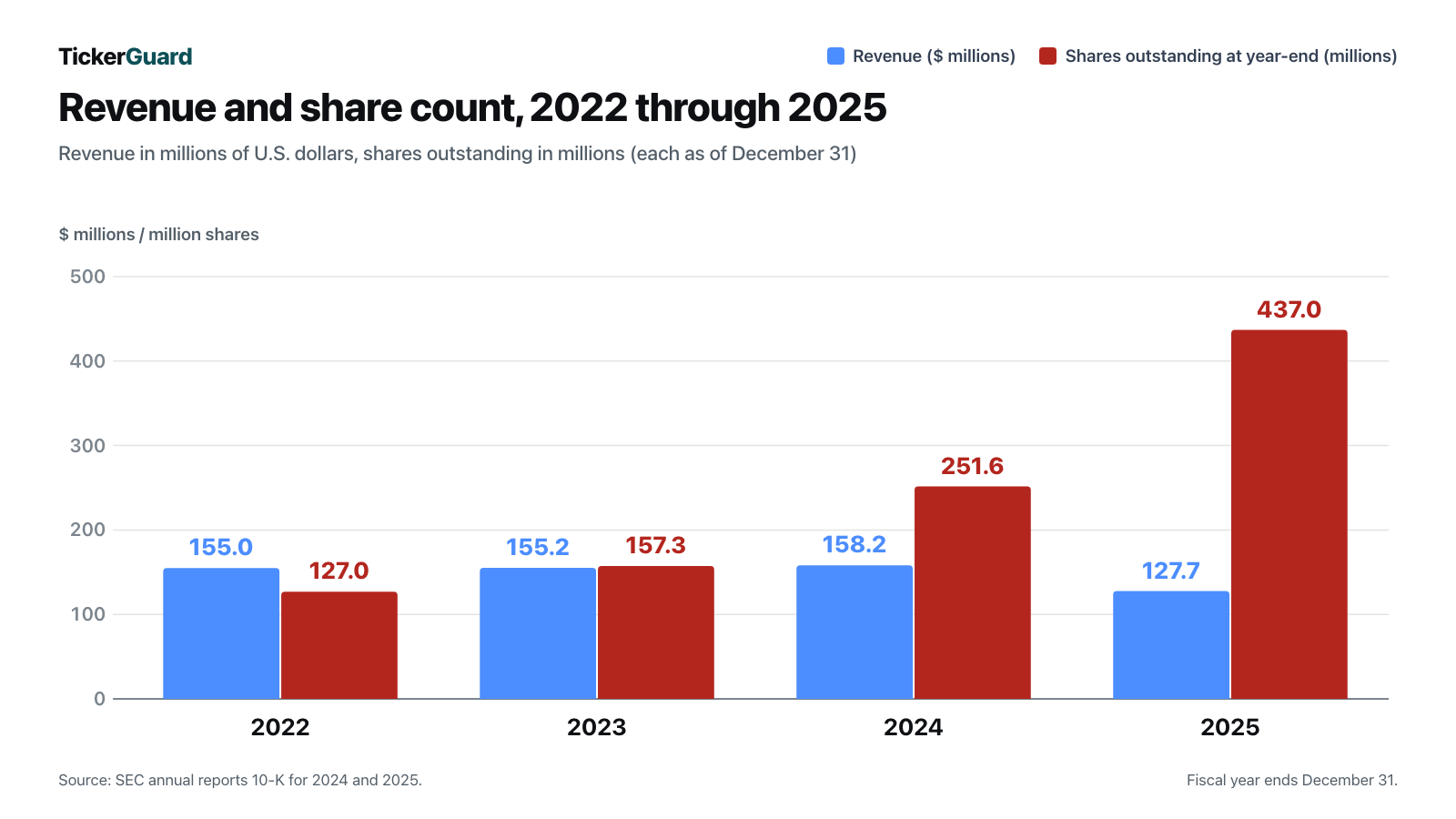
Translate that into one number anybody understands: revenue per share. In 2022 each share carried about $1.22 of revenue ($155.0 million divided by 127.0 million shares). In 2025 it was $0.29 ($127.7 million divided by 437.0 million). That is a 76 percent decline — not because the business collapsed, but because the slice attributable to each share got smaller. That is precisely what dilution means: the pie does not shrink, it simply gets cut into more pieces.
What about earnings? The second chart shows two series: operating loss — the result of the ongoing business before interest and valuation effects — and the bottom-line net loss.
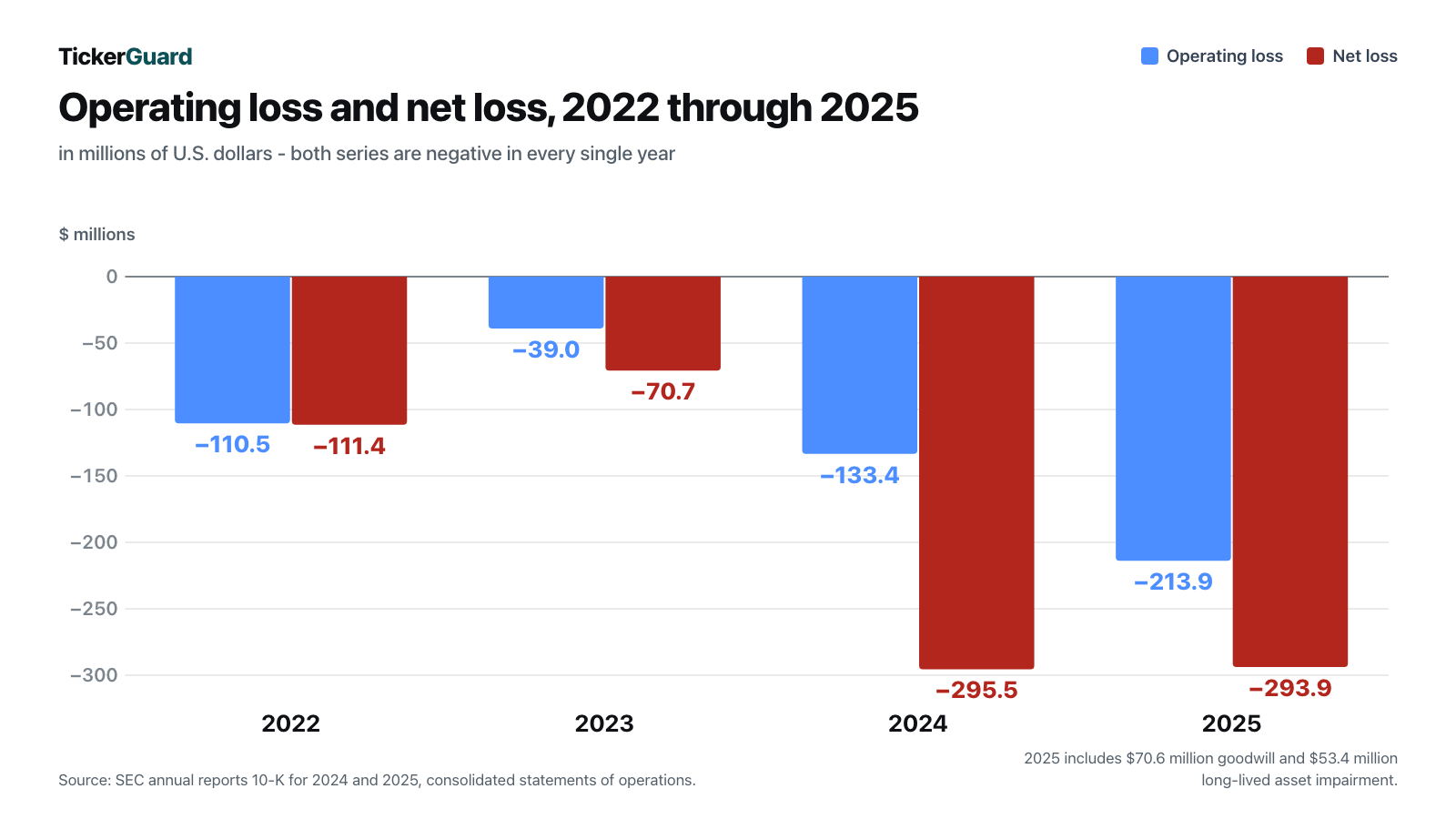
Fairness requires context: much of the jump in net loss in 2024 and 2025 is non-cash. The 2025 figure includes $70.6 million of goodwill impairment, $53.4 million of long-lived asset impairment and $92.8 million from the remeasurement of derivatives — entries where no money leaves the building. The more honest gauge of the ongoing burn is operating cash flow: in the first half of 2026, $40.2 million flowed out of operations (prior-year half: $10.5 million). Against $409.8 million of cash and investments, that arithmetic covers roughly five years. This is not a survival question, and this article does not present it as one. The questions worth asking are different.
What the filings say — the uncomfortable truths
Uncomfortable truth No. 1: The share count is the company's fastest-growing metric
Start with the number that never makes a headline. As of December 31, 2022 there were 127,022,363 shares; as of June 30, 2026 there were 479,494,493 — 352 million more, or 277 percent in three and a half years. The increase came from several sources: the Pangiam acquisition on February 29, 2024, paid with 61,838,072 new shares at $1.3439; conversions of convertible notes (38,069,987 shares for $233.4 million in the first half of 2026 alone); warrant exercises; and three at-the-market sales agreements (May 2024, June 2025, August 2025, each via Cantor Fitzgerald) that together raised 142,253,313 shares for $637.1 million gross ($628.8 million net) over the full year 2025.
On July 31, 2026 the next stage arrived. The prospectus supplement puts it this way:
„In accordance with the terms of the Sales Agreement, we may offer and sell up to an aggregate of 100,000,000 shares of common stock from time to time through Jefferies, acting as our sales agent.“
— BigBear.ai Holdings, Inc., SEC prospectus supplement 424B5 of July 31, 2026, cover of the supplement

The proceeds are earmarked for "working capital and general corporate purposes," with management retaining "broad discretion" over how they are applied. That is notable because the same quarterly report shows $409.8 million of cash and investments. And the runway is already built: authorized capital — the charter ceiling on issuable shares — was doubled from 500 million to 1.0 billion shares between December 31, 2025 and June 30, 2026. Add the amounts disclosed in the June 30, 2026 balance sheet: 13,985,327 shares from outstanding restricted stock units, 8,924,598 reserved under the employee stock purchase plan, 16,095,772 from outstanding warrants, 1,664,732 from remaining convertible notes and 1,535,493 from stock options. Together with the new program, that is a theoretical pipeline of roughly 142 million additional shares, just under 30 percent of today's base.
Uncomfortable truth No. 2: Almost nine of every ten revenue dollars come from a single type of customer
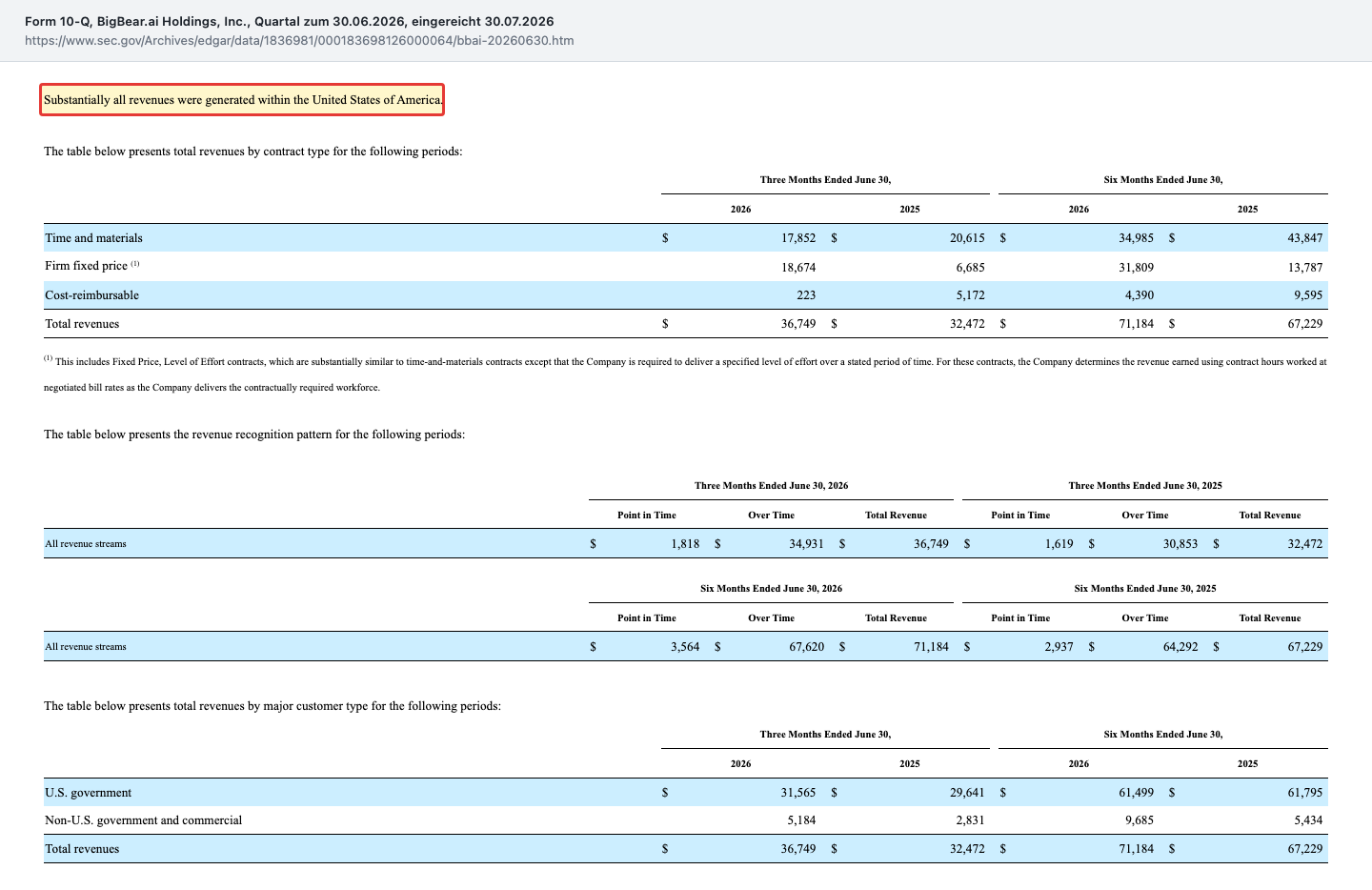
In the second quarter of 2026, $31.6 million of $36.7 million in revenue came directly from the U.S. government — 86 percent. For full-year 2025 it was $114.7 million of $127.7 million (90 percent), for 2024 $143.1 million of $158.2 million (90 percent), for 2023 $145.2 million of $155.2 million (94 percent). The quarterly report adds that substantially all revenues were generated within the United States. The international business implied by the London and Abu Dhabi offices named in the 2025 annual report (10-K, Item 1, Business) barely registers in the numbers so far.
That is not automatically a weakness — defense technology is a government business, and the customer does not go bankrupt. But it is concentration risk with one particular clause, which the annual report states openly:
„Each of our contracts with these customers includes termination for convenience provisions whereby the customer can unilaterally elect to terminate the contract.“
— BigBear.ai Holdings, Inc., SEC annual report 10-K for 2025, Item 1A Risk Factors
Put in everyday terms: you signed a ten-year lease, but only you are bound for ten years — the tenant can walk at any time and owes nothing beyond costs incurred. That is why the $269.6 million backlog (June 30, 2026) is not a receivable but a statement of intent. How fast that matters showed up in 2025: the 19.3 percent revenue decline came, per the annual report, largely from lower volume on U.S. Army programs and from one-time contracts in the prior year that did not repeat. No scandal, no breach — simply a customer ordering less. Remember the line: a backlog the customer may cancel at will is a hope with a file number.
Concentration inside that customer block adds to it: in the second quarter of 2026 four individual customers each contributed more than 10 percent — 16, 13, 12 and 10 percent, together 51 percent of quarterly revenue. Fiscal 2025 looked similar (16, 13, 11 and 11 percent).
Uncomfortable truth No. 3: An operating loss in every single year since inception — the filing says so outright
Some sentences in an annual report need no interpretation, only reading. This is one of them:
„We have incurred operating losses each year since our inception and may continue to incur net losses in the future.“
— BigBear.ai Holdings, Inc., SEC annual report 10-K for 2025, Item 1A Risk Factors

The accumulated deficit — the sum of all losses since the beginning — stood at $948.1 million as of June 30, 2026, more than seven times 2025 revenue. And the latest quarter shows where the problem sits: revenue rose by $4.3 million in the second quarter of 2026, while selling, general and administrative expenses rose by $10.4 million, from $21.5 million to $31.8 million. Measured against revenue that is 87 percent, up from 66 percent a year earlier. Put differently: of every revenue dollar in the second quarter of 2026, 87 cents went to sales and administration before a single line of software was written.
That feeds straight into the company's own preferred metric. BigBear.ai reports adjusted EBITDA — a self-defined earnings measure that strips out interest, taxes, depreciation, amortization and further special items, intended to show the underlying business. That number got worse in the second quarter of 2026: from negative $8.5 million (Q2 2025) to negative $11.6 million — despite 13 percent more revenue and a gross margin almost eight percentage points higher. When even the friendliest metric deteriorates in the best quarter, the issue is not the arithmetic.
Uncomfortable truth No. 4: The goodwill has no cushion — and has already been written down three times
As of June 30, 2026 the balance sheet carries $238.6 million of goodwill — 28 percent of total assets of $841.3 million. Goodwill arises when a buyer pays more for a company than its tangible parts are worth; it stands for brand, customer relationships and expectations. The Ask Sage purchase on December 31, 2025 alone added $192.7 million. In the same passage, the annual report explains that no safety margin remains for that item:
„Due to the proximity of the long-lived asset impairment and the acquisition of Ask Sage, the fair value of the reporting unit approximates its carrying value, and a negative change in the key assumptions used in the interim impairment analysis and the purchase price allocation or an increase in the carrying value may result in a future impairment of goodwill.“
— BigBear.ai Holdings, Inc., SEC annual report 10-K for 2025, goodwill footnote

Why that weighs more than boilerplate: BigBear.ai has already written goodwill down three times — $53.5 million (2022), $85.0 million (2024) and $70.6 million (2025). A combined $209.2 million, more than a full year of revenue. Reading the same warning on a line item for the fourth time is a different experience than reading it on the first.
One more item from the record belongs here, together with its resolution. On March 18, 2025 BigBear.ai told the SEC (Form 8-K, Item 4.02) that prior financial statements could no longer be relied upon: the convertible notes issued in December 2021 had been accounted for incorrectly for years, and 2022, 2023 and six quarterly reports had to be restated. In the process the company identified a material weakness in internal control over financial reporting — the second round of such findings after 2022 and 2023. The good news: the 2025 annual report states that all of these weaknesses have been remediated and that the independent auditor issued an attestation on the effectiveness of internal control for the first time. So this is no longer an acute problem — but it is a history worth knowing before extrapolating this company's guidance unchecked.
Valuation: what the market pays for $128 million of revenue
Let us use the only price recorded in a mandatory filing: $2.83 at the close on July 30, 2026, documented in the prospectus supplement of July 31, 2026. Across 479,494,493 shares that implies a market capitalization of roughly $1.36 billion. Subtract $409.8 million of cash and investments and add back $16.6 million of remaining debt, and enterprise value lands near $0.96 billion.
In ratios: against 2025 revenue of $127.7 million, market capitalization equals a price-to-sales multiple of roughly 10.6, enterprise value roughly 7.6. Against the midpoint of company guidance for 2026 ($150 million), it is roughly 9.0 and 6.4. A price-to-earnings ratio cannot be calculated — there are no earnings. On book value: equity of $770.3 million equals $1.61 per share, while tangible book value, after deducting goodwill and intangibles, stood at $0.84 per share per the prospectus. At $2.83 you are paying just over three times tangible substance.
What does that mean? A price-to-sales multiple near 10 is what a high-margin software business with double-digit growth costs. BigBear.ai currently runs a 32.8 percent gross margin (Q2 2026) — solid for a services provider, thin for a software house — and growth that was negative in 2025. The price is therefore not buying today's business but the expectation that Ask Sage converts the company into a high-margin platform. One more dated anchor from the annual report itself: the company puts its own market capitalization at roughly $1.1 billion in January 2024 and roughly $2.4 billion in December 2025. Against that December figure, the price at the end of July 2026 was about half — on a share count that grew another 10 percent in between. Judging this stock is not a modeling exercise; it is a bet on a transformation. What that looks like at a comparable U.S. federal services provider we took apart in our analysis of Castellum — there, too, the customer is the American state, and there, too, the share count is the quietest metric on the page.
Upside and risks at a glance
Upside
- Ask Sage is a real lead, not a label. The first FedRAMP-authorized generative AI platform for defense and intelligence, accredited up to IL5, IL6 and Top Secret, used by more than 16,000 government teams as of January 2026 per the annual report. Accreditations of that kind take years — a moat made of paperwork.
- The balance sheet has never been stronger. $409.8 million of cash and investments, $770.3 million of equity and essentially no long-term debt (June 30, 2026) — after negative equity at the end of 2024. That funds roughly five years at the current burn rate and allows acquisitions without outside money.
- Margins are turning. Gross margin of 32.8 percent in the second quarter of 2026, up from 25.0 percent a year earlier, driven by the higher-margin Ask Sage business. Backlog grew 9 percent in the first half of 2026 to $269.6 million.
- Policy tailwind. The 2025 annual report points to the U.S. government's AI Acceleration Strategy published in January 2026, which prioritizes rapid military deployment. A vendor with clearances already in hand benefits from budgets designed to move faster.
Risks
- Dilution without a brake. Share count up 277 percent since the end of 2022, plus a new program for up to 100 million shares (July 31, 2026), an authorized capital doubled to 1.0 billion shares, and roughly 42 million further shares from equity plans, warrants and convertible notes.
- Revenue does not grow reliably. Down 19.3 percent in 2025 to $127.7 million; company guidance for 2026 of $135 million to $165 million sits below the 2024 figure at the midpoint. The second-quarter 2026 increase came, per the filing, largely from the acquired Ask Sage business.
- Concentration on the U.S. government. 86 percent of quarterly revenue (Q2 2026), four individual customers above 10 percent, virtually no international business — and every contract carrying a termination-for-convenience clause.
- Goodwill without a cushion. $238.6 million on the balance sheet (June 30, 2026), with no gap between fair value and carrying value per the company's own disclosure — at a company that has written the same item down three times already (a combined $209.2 million).
- Costs outrun revenue. Selling, general and administrative expenses at 87 percent of revenue in the second quarter of 2026 (prior year: 66 percent); adjusted EBITDA deteriorated from negative $8.5 million to negative $11.6 million despite higher revenue.
A human bottom line
Back to the name trap. What makes BigBear.ai instructive is that the trap does not work through a lie. The name is accurate: this company sells real AI to real agencies, with accreditations competitors would need years to match. The trap springs somewhere else — where your brain silently converts "sells AI" into "grows like AI." That bridge is the one the filings do not support. Revenue in 2025 sits below 2022, the operating loss over the same period got larger, and the number that reliably grows is the number of shares.
At the same time, turning this into a collapse story would be unfair. A company with $409.8 million of cash and investments, no meaningful debt, an improving margin and a three-star general newly seated on its board has time. It can make mistakes and keep going. The decisive question is therefore not whether BigBear.ai survives — it is how many shares exist by the time the transformation works. Because even a complete success does little for you if your slice of it was halved along the way.
If you follow this stock, you do not need a price ticker. Three lines are enough, and all three sit in documents anyone can read for free: the share count on the cover of the next quarterly report, the revenue line measured against the company's own $135 million to $165 million guidance — and the "Goodwill impairment" line in the next annual report. What you make of that is your decision. And that is exactly how it should be.
Sources
- SEC quarterly report 10-Q as of June 30, 2026, filed July 30, 2026 (balance sheet, statement of operations, cash flow statement, notes on equity, revenue and customer concentration)
- SEC annual report 10-K for 2025, filed March 2, 2026 (business model, risk factors, goodwill, Ask Sage acquisition, backlog, headcount)
- SEC annual report 10-K for 2024, filed March 25, 2025 (2022 through 2024 figures, restatement, material weakness, Pangiam acquisition)
- SEC Form 8-K of July 30, 2026, Exhibit 99.1 (second-quarter 2026 earnings release) — 2026 revenue guidance, backlog, adjusted EBITDA
- SEC prospectus supplement 424B5 of July 31, 2026 — program for up to 100 million shares, share count, dilution table, documented closing price of July 30, 2026
- SEC Form 8-K of July 31, 2026 (Item 8.01) — Open Market Sale Agreement with Jefferies LLC
- SEC Form 8-K of August 17, 2026 (Item 5.02) — election of retired Lieutenant General Sean Gainey to the board
- SEC Form 8-K of March 18, 2025 (Item 4.02) — determination that prior financial statements could no longer be relied upon
- Source: fundamental data and SEC filings (annual and quarterly reports, 10-K/10-Q). Every figure in this analysis comes from the primary documents linked above; the $2.83 price anchor is the closing price of July 30, 2026 as documented in the prospectus supplement of July 31, 2026.
Disclosure: This article is journalism and research, not investment advice and not a solicitation to buy or sell securities. Stocks can move sharply; a total loss is possible. The author holds no position in BigBear.ai Holdings, Inc. at the time of publication. All information is drawn in good faith from the primary sources named above; no warranty is given as to completeness or accuracy.
Key figures at a glance
All monetary figures in millions of $; earnings per share as reported.
| Metric | 2021 | 2022 | 2023 | 2024 | 2025 |
|---|---|---|---|---|---|
| Revenue | 145.6 | 155.0 | 155.2 | 158.2 | 127.7 |
| Operating Income (EBIT) | -78.5 | -110.5 | -39.0 | -133.4 | -83.4 |
| Net Income | -123.6 | -111.4 | -70.7 | -295.5 | -293.9 |
| Net Margin | -84.9% | -71.8% | -45.5% | -186.8% | -230.2% |
| Earnings Per Share | -1.15 $ | -0.87 $ | -0.47 $ | -1.27 $ | -0.82 $ |
Source: fundamental data & SEC filings (annual and quarterly reports, 10-K/10-Q)
Our Bottom Line at a Glance
- Product and market access positive
- Per the 10-K for 2025, Ask Sage was the first generative AI platform of its kind to receive FedRAMP authorization, accredited up to IL5, IL6 and Top Secret, and used by more than 16,000 government teams as of January 2026. Most of the 579 employees (12/31/2025) hold an active security clearance — access competitors cannot buy quickly.
- Balance sheet and financial strength positive
- As of June 30, 2026 the books show $409.8 million of cash and investments, $770.3 million of equity and no long-term debt — after negative equity of $3.7 million on December 31, 2024. The $40.2 million operating cash outflow of the first half of 2026 would be funded from that for roughly five years.
- Growth and earnings power negative
- Revenue fell 19.3 percent in 2025 to $127.672 million, below the 2022 figure of $155.011 million; company guidance for 2026 of $135 million to $165 million (as of 07/30/2026) sits below 2024 at the midpoint. Per the 2025 10-K there have been operating losses in every year since inception, and adjusted EBITDA worsened from $(8.5) million to $(11.6) million in the second quarter of 2026 despite higher revenue.
- Dilution negative
- Share count rose from 127,022,363 (12/31/2022) to 479,494,493 (06/30/2026), up 277 percent, cutting revenue per share from roughly $1.22 to $0.29. On July 31, 2026, one day after the quarterly report, a program for up to 100 million more shares was added — on an authorized capital that had already been doubled to 1.0 billion shares.
- Customer concentration negative
- 86 percent of second-quarter 2026 revenue ($31.565 million of $36.749 million) came from the U.S. government, substantially all revenue is generated in the United States, and four individual customers each exceeded 10 percent. Per the 2025 10-K every contract carries a termination-for-convenience clause; the 2025 revenue decline arose exactly that way.
- Accounting quality and track record neutral
- Goodwill of $238.570 million (06/30/2026, 28 percent of total assets) has, per the 2025 10-K, no remaining gap between fair value and carrying value — at a company that has already taken three impairments ($53.5 million, $85.0 million and $70.6 million). The restatement and material weakness of March 18, 2025 have been remediated per the 2025 10-K, with a first-time auditor attestation.
BigBear.ai is the rare case where the AI story is true and the stock story is still a different one: Ask Sage, with clearances up to Top Secret, is a genuine lead, and the balance sheet, holding $409.8 million of cash and investments, is the strongest in company history. Against that stand revenue that fell 19.3 percent in 2025 and now sits below the 2022 level, an operating loss in every year since inception, dependence on the U.S. government of roughly 86 to 90 percent — and a share count up 277 percent since the end of 2022, with a program for 100 million more shares on top. Buying here does not buy today's numbers; it buys the bet that the Ask Sage acquisition turns into a high-margin platform business before your slice of it shrinks further. Not investment advice.
What Our Rating Means
Open questions
The business works in principle, but one material question is open. As long as it stays open, our findings do not carry a quality verdict.
We explicitly do not see a substance risk that would justify a red rating: there is no going-concern warning, equity is clearly positive at $770.3 million, long-term debt no longer exists, and $409.8 million of cash and investments covers the current operating cash outflow for roughly five years. The earlier restatement and material weakness have been remediated and confirmed by the auditor. But one material operating question is open, and it is a large one: the company has posted operating losses in every year since inception, revenue fell 19.3 percent in 2025 and now sits below the 2022 level, guidance for 2026 stays below the 2024 figure at the midpoint, and the self-defined adjusted EBITDA got worse in the best quarter in years. On top of that, dilution of 277 percent since the end of 2022 has pushed revenue per share from $1.22 to $0.29. The turnaround has begun and is visible in the gross margin, but it is proven neither in the revenue line nor in earnings — hence yellow and not green. The decision is yours.
A journalistic assessment by our editorial team at the time of the deep dive, based on public sources — not investment advice and not a solicitation to buy or sell. Your personal circumstances (investment goals, risk capacity, taxes) cannot be taken into account. What our levels mean, how verdicts are formed, and what conflicts of interest exist →
Worth Noting
- BBAI reached our research list through the SEC filing feed: the quarterly report and an earnings release touting 13 percent growth appeared on July 30, 2026, followed on July 31, 2026 by a prospectus supplement for up to 100 million new shares.
- Every figure in this analysis comes from primary SEC documents (10-K for 2024 and 2025, 10-Q as of 06/30/2026, Forms 8-K of 03/18/2025, 07/30/2026, 07/31/2026 and 08/17/2026, 424B5 of 07/31/2026). The $2.83 price anchor is the closing price of July 30, 2026 as recorded in the prospectus supplement, deliberately not a daily quote.
- Possible confusion: BigBear.ai Holdings, Inc. was named GigCapital4, Inc. until December 7, 2021 and should not be confused with similarly named consumer or leisure brands. Alongside the common stock, warrants trade on the NYSE under BBAI.WS with an exercise price of $11.50.
Stock Watch
This analysis is as of September 5, 2026. Stock Watch will tell you what's changed at BBAI since then.
Later $1 a month per stock — signing up is free, and you'll be the first to know when it launches.
The full analysis as a PDF for later
We will send you this analysis as a PDF — to print, file away, and read at your own pace. And we will add you to the free Stock Watch list for BigBearai Holdings Inc (BBAI), so you hear about it when something material in this analysis changes.
Frequently Asked Questions
BigBear.ai Holdings (NYSE: BBAI), based in McLean, Virginia, sells AI software to the U.S. military and to federal agencies. Four areas: the generative AI platform Ask Sage (accredited up to Top Secret), the sensor and model orchestration layer ConductorOS for field deployment, biometric identity verification, and AI-assisted cargo screening for customs. As of December 31, 2025 the company employed 579 people.
No. The annual report 10-K for 2025 states that the company has incurred operating losses in every year since its inception. Operating loss in 2025 was $213.9 million and net loss $293.9 million. In the first half of 2026 net loss was $82.5 million and $40.2 million flowed out of operations. Accumulated deficit reached $948.1 million as of June 30, 2026.
Revenue fell 19.3 percent in 2025, from $158.2 million to $127.7 million. The annual report cites lower volume on U.S. Army programs plus significant one-time contracts from the prior year that did not recur. For 2026 the company guides to $135 million to $165 million (earnings release of July 30, 2026); even the midpoint of that range would sit below 2024 revenue.
Substantially. There were 127,022,363 shares outstanding on December 31, 2022 and 479,494,493 on June 30, 2026 — up 277 percent in three and a half years. Revenue per share fell from roughly $1.22 in 2022 to $0.29 in 2025 as a result. On July 31, 2026 the company registered a program for up to 100 million additional shares, roughly 21 percent of the existing base.
In the second quarter of 2026, $31.6 million of $36.7 million in revenue came directly from the U.S. government, or 86 percent; from 2023 through 2025 the share ranged between 90 and 94 percent. Substantially all revenue is generated in the United States. Per the annual report, every one of those contracts contains a clause allowing the customer to terminate unilaterally. Four individual customers each contributed more than 10 percent in the second quarter of 2026.
Ask Sage is a generative AI platform built specifically for defense and intelligence customers, acquired on December 31, 2025 for $271.6 million in cash. Its value lies in the accreditations: per the annual report it was the first platform of its kind to receive FedRAMP authorization and is certified for government data up to IL5, IL6 and Top Secret. The purchase provisionally added $192.7 million of goodwill, revised down to $190.1 million in the 10-Q for the quarter ended June 30, 2026 after a purchase-price adjustment.
Found an error?
Did you spot a factual error, an outdated number, or a typo in this deep dive? Let us know briefly — your report goes straight to the editorial team.