Reformation: $90 Million on Credit to the Pre-IPO Owners — Six Weeks Before the Listing
Reformation is the fashion label people know long before they know the stock: dresses out of Los Angeles, Taylor Swift and Jennifer Lopez photographed in Ref dresses, 70 owned stores, roughly 1.2 million active customers and, by the company's own account, 21 consecutive quarters of double-digit growth. The stock has traded on the New York Stock Exchange since July 30, 2026, and its first quarterly report, filed September 11, 2026, is the first time anyone outside could see how the business behind the brand actually adds up: $155.2 million of quarterly revenue, a 66.7 percent gross margin, $12.4 million of quarterly net income — but only $0.26 million across the whole first half, because a roughly $90 million debt-funded dividend went to the pre-IPO owners in June 2026. We read the prospectus and the quarterly report side by side and say what the brand actually leaves in the balance sheet.
 Thomas Mücke
Founder & Publisher
Thomas Mücke
Founder & Publisher
As of Today
As of: September 17, 2026
- Closing price
- 15.30 $ -2.70%
- Market Capitalisation
- 0.9 $B
- P/E
- 139.1
- AAQS
- 4/10
Price change since September 11, 2026: +9.1%
This analysis has a cut-off date. The Stock Guard tells you when something material changes in the numbers. Reserve your free spot
Chart
Interactive price chart (TradingView).
52-week range: 13.20 $ to 16.80 $ · Last price: 15.30 $ (As of: September 17, 2026)
Note: pure fact-based analysis, not investment advice and not a solicitation to buy or sell. All figures without guarantee.
There is an investor trap that springs shut precisely when you feel most confident: the familiarity trap. It works like this. You know a brand. You have seen it in a shop window, on Instagram, on a friend. Your brain says "I know that one — it must be good", and because familiarity feels like knowledge, you quietly skip the part where you do the math. Psychologists call it the mere-exposure effect: the more often we see something, the more we like it, regardless of whether it is any better. Reformation (NYSE: REF) is the perfect test case. The company, based in Vernon just outside Los Angeles, makes sustainable womenswear, and its own IPO prospectus lists who wears it: "consistently spot mega-celebrities like Taylor Swift, Jennifer Aniston, Jennifer Lopez, Kendall Jenner, and Hailey Bieber wearing Ref (thanks ladies)". That sentence sits in a mandatory filing with the U.S. securities regulator, the SEC. So let us make a deal: before you mistake the brand for the business, we read together what the company told the SEC — the IPO prospectus dated July 29, 2026 with audited statements for fiscal 2023 through 2025, the earnings release of September 10, 2026, and the first quarterly report the company has ever filed, submitted on September 11, 2026. An SEC filing is honest under penalty of law. And this one describes a business that has grown reliably for years — and roughly $90 million that was paid out on credit to the pre-IPO owners six weeks before the listing. What you do with that is up to you.
What Reformation actually does: sustainable fashion out of Los Angeles
Reformation sells dresses, shoes and bags, and it sells them mostly straight to the customer. The quarterly report splits the business in two. The large channel is direct-to-consumer: the company's own e-commerce platform plus 70 owned stores in the United States, the United Kingdom, Canada and France as of June 27, 2026 — 67 full-price locations and three outlets. That channel produced $135.3 million in the second quarter of fiscal 2026, up 21.2 percent. The small channel is wholesale: department stores, online retailers, distributors. It contributed $19.9 million and grew 48.7 percent, from a much smaller base. Together, that is $155.2 million of quarterly revenue, 24.1 percent more than a year earlier.
The core of the brand is a promise: clothes that do less damage. The company calls itself the largest sustainable womenswear brand on the planet, with the disarming caveat "that we know of, anyways". In plain terms, Reformation leans on sustainable fabrics, vintage textiles and a very fast, data-driven merchandising loop. Roughly 90 percent of direct-to-consumer apparel revenue in 2025 came from styles informed by past selling performance — translated: the company invents less and repeats more of what has already worked. The result is a markdown burden that is remarkably low for the apparel trade: roughly 80 percent of 2025 direct-to-consumer revenue sold at full price. Anyone who has watched a fashion retailer burn its margin in the end-of-season sale knows how valuable that number is.
Two operating metrics describe this business better than any revenue line. The first is Active Customers, meaning people who bought at least once in the trailing twelve months. They rose from 834,000 at the end of 2023 to 946,000 (2024) and 1,083,000 (2025), and to 1,204,000 as of June 27, 2026 — 22.9 percent more than a year earlier. The second is DTC Net Revenue per Customer, which is what an average customer spends in a year: $390 (2023), $418 (2024), $422 (2025) — and in the second quarter of 2026, $417, down 1.4 percent year over year. Hold on to that pair, because it is the through-line of the whole business: Reformation grows because more women buy, not because each woman buys more. The company attributes the decline to newly acquired customers spending less at the start, which is plausible and still worth watching.
One more detail you need before you go looking for documents: the operating subsidiary is called LYMI Inc. That is why the SEC files carry "lymi" in their names even though the cover page of the quarterly report plainly reads Reformation Inc., trading symbol REF, New York Stock Exchange. Until April 11, 2025 the holding company was named REF Topco, Inc. — a name from 2019, when private equity firm Permira took majority control.
Company history for investors
-
2019
Permira takes majority control (August 26)
The private equity firm buys 65 percent of LYMI Inc. The purchase price creates $209.4 million of goodwill and $309.1 million of trade name, both still unchanged on the balance sheet.
-
2024
First bank credit facility of $165 million (May 2)
Four banks provide a five-year term loan plus a $30 million revolver. Interest expense starts here: $10.7 million in 2024 and $14.6 million in 2025.
-
2025
Tariffs take $18.5 million out of gross profit
Gross margin falls from 64.5 to 60.2 percent and net income from $32.9 million to $12.6 million. For shareholders: the margin depends on trade policy, not only on taste.
-
2026
Options are converted (March 27)
The board removes the performance condition from all options. In accounting terms that costs $23.8 million immediately and pushes first-half net income down to $0.26 million.
-
2026
An $89.7 million special dividend on credit (June 17)
The credit facility is increased by $92.0 million and the cash goes to the pre-IPO owners. Retained earnings fall from $82.5 million to $1.3 million.
-
2026
IPO at $15.00 per share (July 31)
The company raises roughly $132.2 million and puts $110.0 million of it into debt repayment. The repayment is therefore funded by the new shareholder, not the old one.
-
2026
First quarterly report as a public company (September 11)
$155.2 million of quarterly revenue, $12.4 million of net income — and guidance of $602 million to $606 million. From here, promises can finally be measured against reported numbers.
How this stock reached our desk
This analysis did not start with a momentum signal. It started with a new arrival in the SEC filing stream. On September 11, 2026 Reformation filed the first Form 10-Q in its history, one day after its first earnings release as a public company. Before July 2026 the ticker REF did not exist in any exchange registry; the company belonged to a private equity fund and published nothing an investor could read. That is exactly what makes a fresh IPO both awkward and interesting to analyze: there is a great deal of data all at once — and no public track record against which to measure a promise.
We say that openly because it limits what this analysis can claim. As a public company Reformation has published exactly one quarterly report and not a single annual report on Form 10-K. Every multi-year comparison in this piece comes from the audited financial statements in the July 29, 2026 prospectus. Those are solid, auditor-attested numbers — but they come from an offering document that no full reporting year as a listed company has yet followed. An annual report on Form 10-K, filed under the ongoing reporting obligations of a listed company, has not yet appeared.
The second reason the stock landed on the desk is valuation. Our in-house stock scanner shows, as of September 11, 2026, a price of $14.03 and a market capitalization of roughly $829 million against 59,079,320 shares outstanding (quarterly report cover page, as of September 8, 2026). The cross-check holds: 59.08 million shares times $14.03 equals $829 million, so the data feed and the filing agree. Measured against the company's own revenue guidance of $602 million to $606 million, that is a price-to-sales ratio of roughly 1.4. For a fashion brand with a 66.7 percent gross margin, that is not a fantasy multiple — it is roughly what the market pays for a sound consumer business. The only question is how sound it really is. So we keep reading.
The numbers over the years — fairly credited
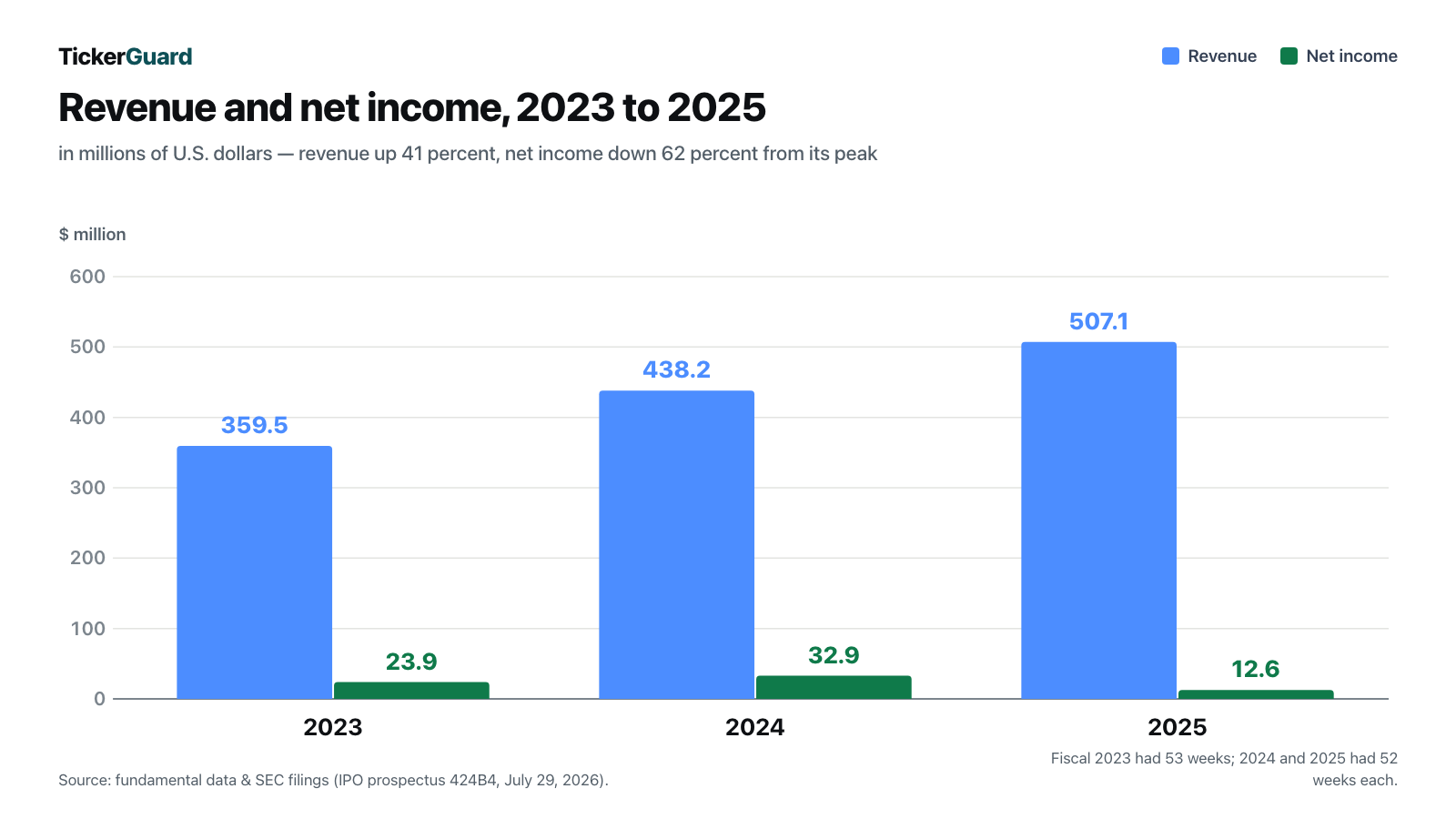
First, the part that genuinely impresses. Reformation does not grow in leaps; it grows steadily. Revenue rose from $359.5 million in fiscal 2023 (a 53-week year) to $438.2 million in 2024 and $507.1 million in 2025 — 41 percent in two years. Chief Executive Officer Hali Borenstein put it this way in the September 10, 2026 earnings release: "This marks our 21st consecutive quarter of double-digit revenue growth". That is the company speaking, not a figure we recomputed; what can be checked are the published periods, and they fit. Five years of uninterrupted growth in a business where brands come and go is not a given.
The second strength is the gross margin — the share of revenue left after sourcing, production and inbound freight, before rent, wages and marketing. It stood at 66.7 percent in the second quarter of 2026. For context: a fashion retailer at 45 to 50 percent is normal, 60 percent is good, and 66.7 percent is very good, pointing to pricing power and little discount pressure. The company attributes the 230 basis point improvement over the prior-year quarter to lower average tariff rates and higher average unit retail.
The third strength is international expansion. Revenue outside the United States rose 36.8 percent to $31.2 million in the second quarter of 2026, driven above all by the build-out in France, while U.S. revenue grew 21.3 percent to $124.0 million. A fifth of revenue now comes from outside the home market — and it is growing faster than the home market.
Now the line that complicates the picture.
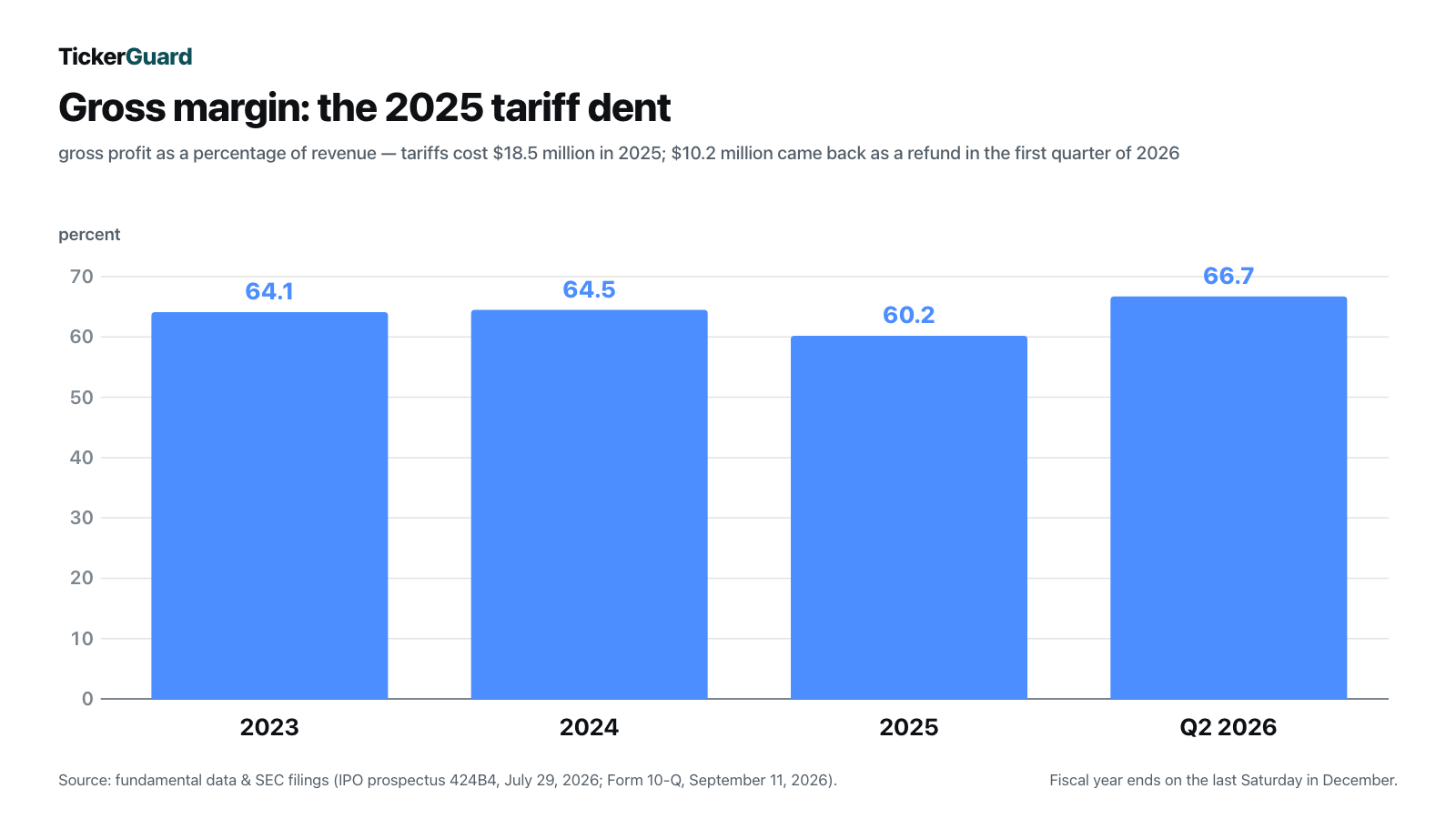
2025 was the year U.S. trade policy caught up with Reformation. The prospectus puts the hit to gross profit at $18.5 million, equal to 3.6 percentage points of margin. On top of that, another $14.3 million of one-off items landed in selling, general and administrative expense: $7.7 million for relocating the Los Angeles distribution center, $4.9 million for IPO-related executive bonuses and the chief financial officer transition, and $1.7 million from the bankruptcy of a department store customer. Together, roughly $33 million weighed on the 2025 result, which is why net income fell from $32.9 million to $12.6 million. That is the fair reading: a good share of the 2025 earnings drop was one-off, not structural decay. But tariffs are not a natural event that passes through once — they are a standing condition of this business, and we come back to that in a moment.
What the filings say — the uncomfortable truths
Uncomfortable truth No. 1: six weeks before the IPO, roughly $90 million went to the pre-IPO owners — on credit
On June 17, 2026, six weeks before the listing, Reformation declared a special dividend. The quarterly report describes it like this:
"On June 17, 2026, the Company declared a dividend in the amount of $1.63 per share (as adjusted for the 142.7-for-1 forward stock split) to holders of its common stock using proceeds from the Amendment to the Credit Agreement as discussed in Note 7. […] The aggregate amount of the dividend and cash payments in respect of certain options and RSUs was $89.7 million, of which $60.6 million was paid during the thirteen weeks ended June 27, 2026 and $29.1 million was paid shortly thereafter."
— Reformation Inc., Form 10-Q for the quarter ended June 27, 2026, Note 12 "Stockholders' Equity"

Put it in everyday terms. Imagine somebody about to sell a house. Just before the closing, they take out a fresh mortgage, have the money paid out to themselves — and then sell you the house with the new debt attached. Legal, routine in private equity, fully disclosed. But you should know it happened. In numbers: the credit facility was increased by $92.0 million on June 17, 2026 ($52.0 million of additional term loan plus a $40.0 million delayed draw facility funded the same day), maturity was extended to June 2031 and the amortization schedule stretched out. That left $246.7 million of term loans on the books, against $158.8 million at the end of fiscal 2025. Retained earnings — the profits kept in the business over the years — fell in the same move from $82.5 million to $1.3 million.
Fairness requires the second half of the story: some of that money came back. Out of the IPO proceeds, the quarterly report says Reformation used $110.0 million to partially repay the term loans and $8.5 million to repurchase shares and options from employees. So after the listing the company carries less debt than it did immediately after the dividend — but more than it did before. And the party that paid for the repayment is the new shareholder, not the old one.
Uncomfortable truth No. 2: $267 million of first-half revenue left $0.26 million of net income
The second quarter of 2026 looks excellent: $155.2 million of revenue, $19.0 million of operating income, $12.4 million of net income, $0.23 per diluted share. Take the whole first half — the 26 weeks ended June 27, 2026 — and the books show $267.5 million of revenue and net income of $0.26 million. The prior-year half produced $1.36 million. That is a net margin of 0.1 percent.
The reason sits in the first quarter and has a name: stock-based compensation. On March 27, 2026 the board removed the non-service conditions from all outstanding performance-based options, converting them into time-based awards. In accounting terms that counts as issuing new awards; the $25.3 million fair value had to be recognized, and because most of those options were already vested, it had to be recognized immediately: $23.8 million of expense in the first quarter of 2026 alone. For the half year, stock-based compensation totaled $25.9 million against $0.6 million in the prior-year half. No cash left the building — it is a bookkeeping event. But it is not nothing either: the options in question dilute new shareholders very much in reality.
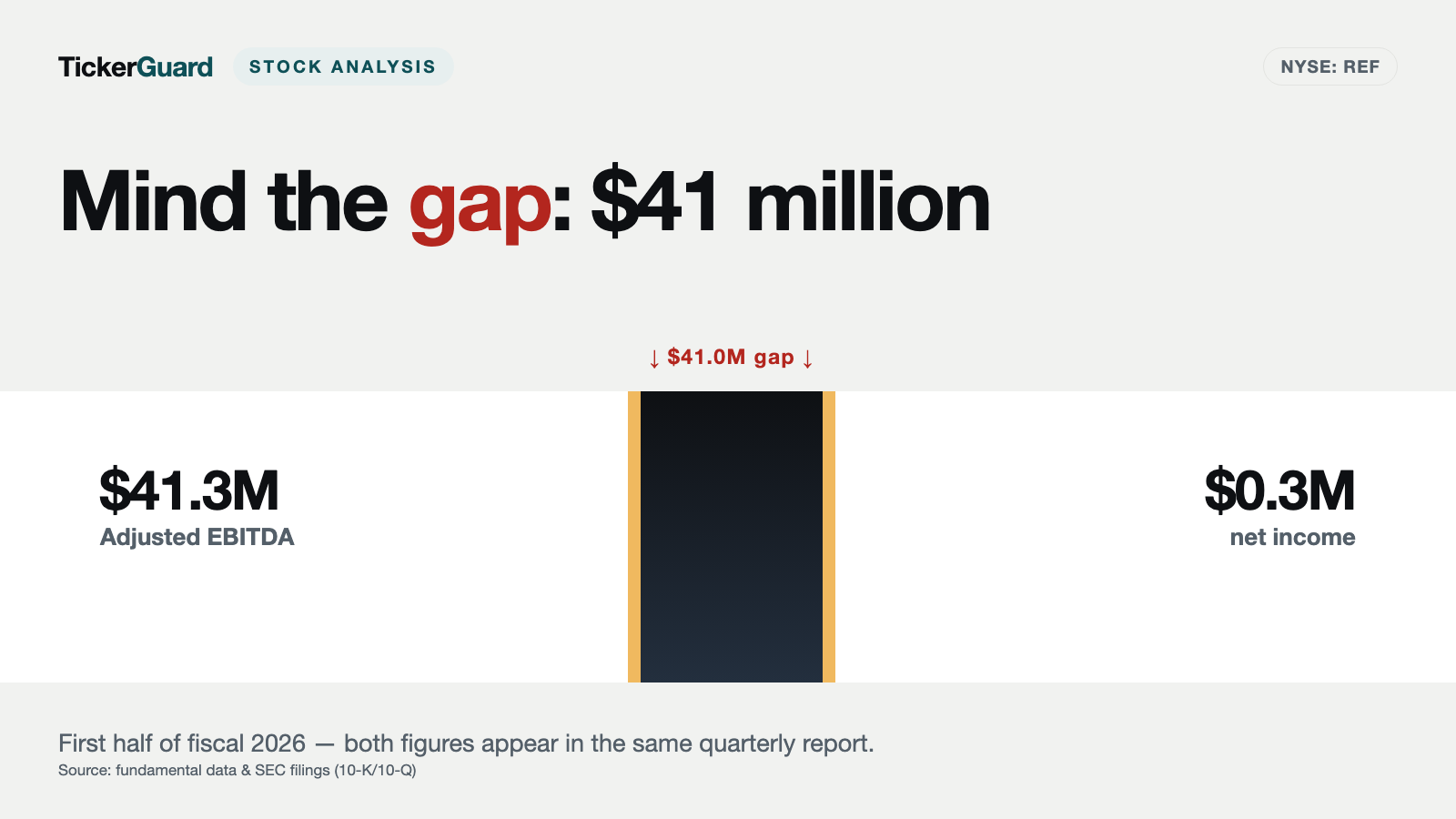
This is exactly where the gap at the heart of this analysis opens up. For the same six months the company reports Adjusted EBITDA of $41.3 million — a self-defined measure that strips out interest, taxes, depreciation and amortization, stock-based compensation and "one-time" costs. Under the binding accounting rules, $0.26 million remained. Both numbers sit in the same document, both are correct, and they tell different stories. The rule of thumb worth keeping: when two earnings figures differ by a factor of 160, the difference is the actual news. Fiscal 2025 looked similar: $45.0 million of Adjusted EBITDA against $12.6 million of net income.
Which of the two numbers sits closer to reality is answered by a third: operating cash flow, the money the business actually generates. It was $37.8 million in fiscal 2023, $44.3 million in 2024 and only $26.7 million in 2025. For the first half of fiscal 2026 it was $26 thousand — not million, an amount that disappears in the rounding (prior-year half: negative $14.2 million). Subtract capital expenditure and the picture sharpens further: in 2025, $26.7 million of operating inflow met $44.5 million of investment, largely for the new distribution center and new stores — roughly $18 million of free cash outflow for the year. Keep this triangle in mind: Adjusted EBITDA shows what the business could do, net income shows what the rules allow, and cash flow shows what ends up in the till. For fiscal 2025, the truth about Reformation sits closer to the cash flow than to the adjusted figure.
One more thing the half-year view shows: operating income across the 26 weeks was $6.2 million against interest expense of $6.8 million, so the business did not quite cover its own interest over that period. That too is largely the options effect: in the second quarter alone, $19.0 million of operating income covered $3.5 million of interest more than five times over. We record both, because both are true — and because the next quarterly report will show which of the two pictures holds.
Uncomfortable truth No. 3: ten suppliers make 76 percent of the units, and a third comes from China
That handsome gross margin rests on a supply chain narrower than a globally marketed brand might suggest. The prospectus is unusually plain about it in the risk factors:
"We depend significantly on a limited number of third-party suppliers for the sourcing of the vast majority of our products. For example, in 2025, our top ten suppliers accounted for approximately 76% of units. […] For example, in 2025, we reallocated our manufacturing to mitigate tariff impacts, successfully reducing our single-country exposure to China by 19%, though we remained dependent on Chinese manufacturing for approximately 32% of units."
— Reformation Inc., Form 424B4 IPO prospectus, July 29, 2026, risk factors ("Our business is subject to the risk of supplier concentration")
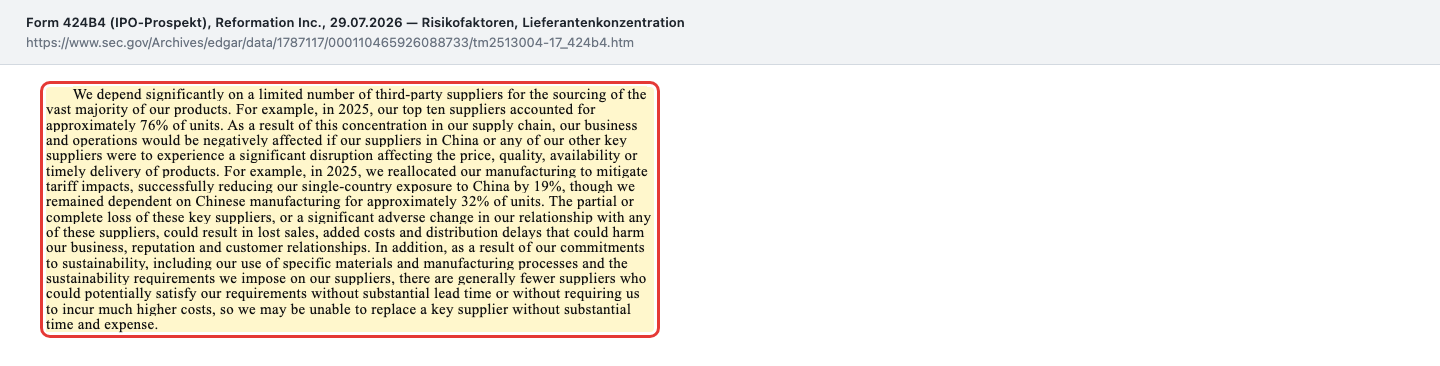
The tricky part is the reason for that concentration. Reformation cannot simply move to the cheapest factory, because its own sustainability requirements shrink the pool of eligible partners — the prospectus says so in as many words. The brand is least flexible exactly where its promise lives. And tariffs are not a closed chapter: they cost $18.5 million in 2025. Part of that came back in the first quarter of 2026, when the company established a legal right to a refund of duties already paid under the International Emergency Economic Powers Act: $10.2 million was booked as a reduction of cost of goods sold, lifting that quarter's gross margin by nine percentage points. In the second quarter of 2026, no such amount was recognized at all.

So anyone reading the 68.2 percent first-half 2026 gross margin as the new normal is counting on a windfall that will not repeat in that form. The company itself models something more conservative: full-year 2026 guidance calls for an Adjusted EBITDA margin of 14.0 percent to 14.2 percent, after 15.4 percent in the first half. In plain language: the second half of the year is expected to be weaker than the first.
Uncomfortable truth No. 4: more than half the balance sheet is goodwill and a trade name — and the float is a quarter of the company
The balance sheet at June 27, 2026 totals $1,005.2 million. Of that, $309.1 million is the trade name and $209.4 million is goodwill — together $518.5 million, or 51.6 percent of the entire balance sheet. Both items date from 2019, when Permira acquired 65 percent of the company, and neither has been written down since. Equity stands at $376.7 million. Strip out the intangibles — the things you cannot sell in a pinch — and what remains is negative tangible equity of roughly $143 million. Translated: the substance of this company is its brand. As long as the brand pulls, that is not a problem. If it ever stopped pulling, the balance sheet would carry an impairment capable of consuming the equity in a single quarter.
The second structural finding concerns the stock itself. The prospectus lays out how few shares actually trade:
"The remaining outstanding 45,013,708 shares of common stock, representing 76.2% of the total outstanding shares of our common stock following the completion of this offering […], will be deemed restricted securities under the meaning of Rule 144 […] In connection with this offering, we, our executive officers, our directors, and holders of substantially all of our common stock […] have agreed with the underwriters, subject to certain exceptions, not to offer, pledge, sell, contract to sell […] any shares of our common stock […] for a period of 180 days after the date of this prospectus."
— Reformation Inc., Form 424B4 IPO prospectus, July 29, 2026, "Shares Eligible for Future Sale"
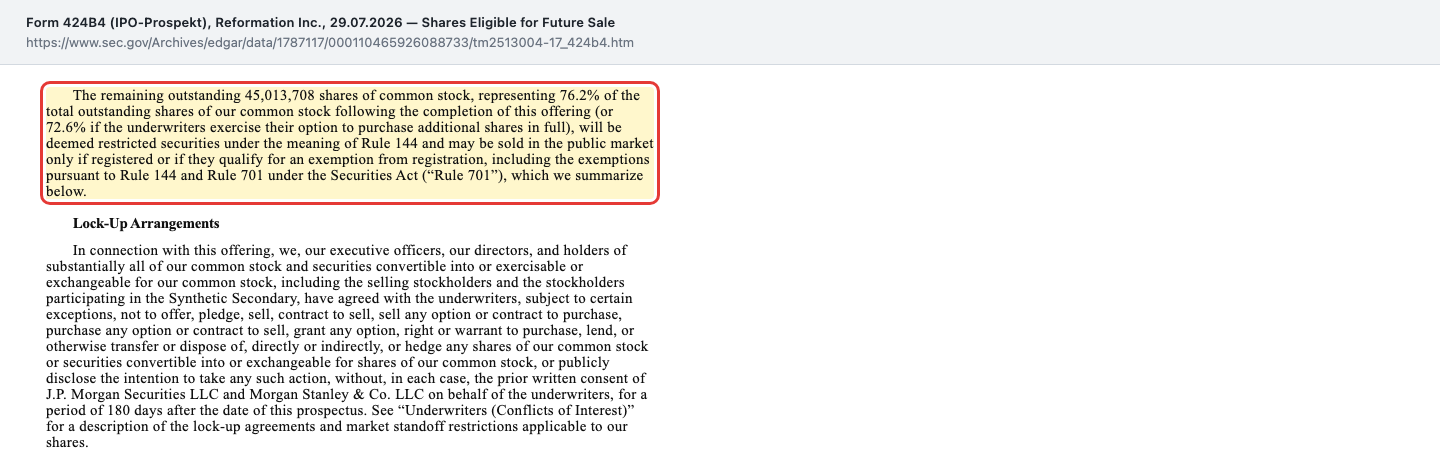
What that means in practice: the 45.0 million locked-up shares equal 76.2 percent of all shares. Permira holds roughly 49.2 percent after the offering; the Aflalo Family Trust — named after founder Yael Aflalo — roughly 19.8 percent. Four of the eight directors are Permira designees and one is the Aflalo Trust designee. There is a second source of future shares as well: for its employee plans, Reformation filed a Form S-8 registration statement on July 29, 2026 covering 11,761,807 shares — roughly 20 percent of the shares outstanding, freely sellable once issued. For comparison, the diluted share count in the earnings statement was still only 52,948,297 in the second quarter of 2026. As a minority shareholder you are therefore buying a stock whose price is measured against a very thin supply until roughly the end of January 2027, and whose ownership is set by two addresses for the foreseeable future. We have seen that pattern in other fashion groups too; for how differently a balance sheet can look when a brand portfolio is maintained on credit for years, see our analysis of Capri Holdings.
Valuation: what $829 million for $604 million of revenue means
Let us do this in orders of magnitude, not intraday prices. As of September 11, 2026 the share price was $14.03, which against 59,079,320 shares outstanding (as of September 8, 2026) gives a market capitalization of roughly $829 million. That is a good 6 percent below the $15.00 offering price of July 31, 2026 — measured against its own starting point, the stock has delivered nothing yet.
Against the company's own full-year guidance of $602 million to $606 million, that works out to a price-to-sales ratio of roughly 1.4. Add the debt — after the $110.0 million repayment out of the IPO proceeds, roughly $137 million of the $246.7 million of term loans remains on a pro-forma basis — and enterprise value lands a little under $1 billion. For context: a fashion retailer without growth usually fetches 0.5 to 1.0 times revenue; a brand growing double digits at a 66.7 percent gross margin usually fetches more. Roughly 1.4 is therefore neither cheap nor expensive — it is the price of assuming the growth continues.
Earnings are harder. On a trailing twelve-month basis the stock looks extremely expensive, because the denominator — net income — was pushed close to zero by the first-quarter 2026 option charge. Work instead from the earnings power the second quarter of 2026 displayed ($12.4 million of net income, roughly $50 million annualized) and you land at a price-to-earnings ratio in the mid-teens — roughly 16 to 17, or about 15 on the diluted quarterly figure of $0.23 per share. But treat that annualization with care: the second quarter is seasonally strong for Reformation, which says itself that it sells more in spring and summer than in the first quarter. Extrapolating a full year from the best quarter is precisely the mistake this section is supposed to avoid. The honest answer: a reliable price-to-earnings ratio for Reformation will only exist once the first full annual report is on file.
Upside and risks at a glance
What speaks for Reformation:
- Reliable growth over years: revenue of $359.5 million (2023), $438.2 million (2024) and $507.1 million (2025), plus 24.1 percent to $155.2 million in the second quarter of 2026; the company describes it as the 21st consecutive quarter of double-digit growth.
- A very high gross margin of 66.7 percent in the second quarter of 2026, with roughly 80 percent of 2025 direct-to-consumer revenue selling at full price — a sign of pricing power and low discount pressure.
- A growing customer base: 1,204,000 Active Customers at June 27, 2026 against 980,000 a year earlier (up 22.9 percent), from 70 stores instead of 53; roughly 70 percent of 2025 direct-to-consumer revenue came from returning customers.
- International revenue growing faster than domestic: up 36.8 percent to $31.2 million in the second quarter of 2026, carried by the build-out in France.
- Balance-sheet relief after the IPO: $110.0 million of the proceeds went into debt repayment, the revolver was undrawn at June 27, 2026, and all financial covenants under the credit agreement were met.
What speaks against it:
- Roughly $89.7 million was paid out to the pre-IPO owners on credit shortly before the listing; term loans rose from $158.8 million to $246.7 million and retained earnings fell from $82.5 million to $1.3 million.
- Earnings are thin and volatile: $12.6 million of net income on $507.1 million of revenue in 2025 (a 2.5 percent margin), and $0.26 million in the first half of 2026; across the half year, Adjusted EBITDA of $41.3 million sits a factor of 160 above net income.
- Cash generation weakened too: operating cash flow fell from $44.3 million (2024) to $26.7 million (2025) and to $26 thousand in the first half of 2026; after $44.5 million of capital expenditure, 2025 left roughly $18 million of free cash outflow.
- Supply chain and tariff exposure: ten suppliers accounted for roughly 76 percent of units in 2025 and roughly 32 percent came from China; tariffs cost $18.5 million in 2025, and the $10.2 million refund in the first quarter of 2026 was a one-off.
- Balance-sheet composition: $518.5 million of the $1,005.2 million total is trade name and goodwill from the 2019 buyout, leaving tangible equity at roughly negative $143 million.
- Capital-markets structure: 45,013,708 shares (76.2 percent) are restricted and locked up for up to 180 days after July 29, 2026; Permira holds roughly 49.2 percent, the Aflalo Family Trust roughly 19.8 percent, and a Form S-8 covering 11,761,807 shares for employee plans has already been filed.
- A very short public record: one quarterly report, no annual report on Form 10-K yet as a listed company; all multi-year comparisons come from the selling document.
A human conclusion
Back to the familiarity trap. Its point is not that the brand is bad — Reformation is a good brand, with real customers, real growth and a gross margin half the industry would envy. Its point is that the warm feeling attached to the name lets you skip the two questions that must come first with any fresh listing: who just pulled money out — and who pays it back? At Reformation the answers are: the pre-IPO owners took roughly $90 million out on credit six weeks before the listing, and $110 million of the offering proceeds then went into repaying it — funded by the new shareholders. None of that is illegal, unusual or hidden. It is simply something you should know before you mistake the brand for the stock.
Which leaves the honest question. It is not "is Reformation a good brand?" — it plainly is. It is this: would you credit a company that kept $12.6 million out of $507 million of revenue with a value of roughly $829 million, knowing that three quarters of its shares cannot trade until late January 2027 and that the first real annual report is still to come? If yes, you have a thesis — and you now know which numbers it rests on. If no, you have until the next quarterly report to look at the answer again. What you make of it is your decision. And that is exactly as it should be.
Sources
Every original document used in this analysis, so you can read it yourself:
- Reformation Inc. — Form 10-Q for the quarter ended June 27, 2026 (filed September 11, 2026)
- Reformation Inc. — Form 8-K filed September 10, 2026, Exhibit 99.1: second quarter fiscal 2026 earnings release with full-year guidance
- Reformation Inc. — Form 424B4 IPO prospectus dated July 29, 2026, with audited financial statements for fiscal 2023, 2024 and 2025
- Reformation Inc. — Form 8-K filed August 3, 2026 (closing of the IPO, amended charter and bylaws)
- Complete SEC filing history of Reformation Inc.: EDGAR overview (sec.gov)
- Fundamental data (price, market capitalization, share count; data as of September 11, 2026), reconciled with the cover page of the September 11, 2026 quarterly report.
- More on TickerGuard: our in-house stock scanner and the side finds section with the by-catch from this research.
Transparency & disclaimer: this analysis is journalistic commentary on publicly available information. It is not investment advice, not a regulated investment recommendation and not a solicitation to buy or sell securities. Equity investments carry substantial risk up to the total loss of capital. All figures are given without warranty; the as-of date of each figure is stated in the text. The author holds no position in Reformation shares at the time of publication.
Key figures at a glance
All monetary figures in millions of $; earnings per share as reported.
| Metric | 2023 | 2024 | 2025 |
|---|---|---|---|
| Revenue | 359.5 | 438.2 | 507.1 |
| Operating Income (EBIT) | 37.6 | 52.7 | 28.8 |
| Net Income | 23.9 | 32.9 | 12.6 |
| Net Margin | 6.6% | 7.5% | 2.5% |
| Earnings Per Share | – | 0.56 $ | 0.21 $ |
Source: fundamental data & SEC filings (annual and quarterly reports, 10-K/10-Q)
Our Bottom Line at a Glance
- Growth and brand positive
- Revenue rose from $359.5 million (fiscal 2023) through $438.2 million (2024) to $507.1 million (2025), and by a further 24.1 percent to $155.2 million in the second quarter of 2026. Active Customers grew 22.9 percent year over year to 1,204,000 and the store count went from 53 to 70. Guidance for fiscal 2026 is $602 million to $606 million.
- Margin quality positive
- A 66.7 percent gross margin in the second quarter of 2026 sits well above what apparel retailers typically achieve, and roughly 80 percent of 2025 direct-to-consumer revenue sold at full price. The dip to 60.2 percent in fiscal 2025 is fully explained by $18.5 million of tariff costs.
- Earnings and earnings quality negative
- Out of $507.1 million of fiscal 2025 revenue, only $12.6 million remained as net income (a 2.5 percent margin, down from $32.9 million). In the first half of 2026 it was $0.26 million on $267.5 million of revenue, while the company reports $41.3 million of Adjusted EBITDA for the same period. Operating cash flow fell from $44.3 million (2024) to $26.7 million (2025) and stood at $26 thousand in the first half of 2026; after $44.5 million of capital expenditure, 2025 saw net cash leave the business. Operating income across those 26 weeks ($6.2 million) did not quite cover interest expense ($6.8 million) — although in the second quarter alone it covered it more than five times over.
- Balance sheet and capital structure negative
- Six weeks before the IPO, $89.7 million left the company as a debt-funded special dividend; term loans rose to $246.7 million and retained earnings fell from $82.5 million to $1.3 million as of June 27, 2026. $518.5 million of the $1,005.2 million balance sheet is trade name and goodwill from the 2019 buyout, leaving tangible equity at roughly negative $143 million. On the other side: $110.0 million of the IPO proceeds went into repayment and all financial covenants were met.
- Supply chain and tariffs neutral
- Ten suppliers accounted for roughly 76 percent of units in 2025 and roughly 32 percent came from Chinese manufacturing, after a 19 percent reduction in single-country exposure that year. The $10.2 million tariff refund in the first quarter of 2026 was a one-off, with nothing recognized in the second quarter. The company's own sustainability requirements, the prospectus says, shrink the pool of replacement suppliers.
- Ownership and tradability neutral
- 45,013,708 shares, or 76.2 percent of the company, are restricted and locked up for up to 180 days after the July 29, 2026 prospectus date; only 14,062,500 shares plus 229,546 from the over-allotment were freely tradable at the start. Permira holds roughly 49.2 percent and the Aflalo Family Trust roughly 19.8 percent. A Form S-8 covering 11,761,807 shares for employee plans has already been filed.
Reformation is a well-run fashion business with an unusually strong brand: $507.1 million of fiscal 2025 revenue, 24.1 percent growth in the second quarter of 2026, a 66.7 percent gross margin and 1.2 million active customers. The balance sheet behind it, however, was loaded up right before the listing: an $89.7 million debt-funded special dividend on June 17, 2026, term loans at $246.7 million, retained earnings down from $82.5 million to $1.3 million — and $110.0 million of the offering proceeds then went into repayment. Of first-half 2026 revenue, $0.26 million remained as net income, while Adjusted EBITDA is reported at $41.3 million. Add a very short public record: one quarterly report, no annual report yet. Not investment advice.
What Our Rating Means
Open questions
The business works in principle, but one material question is open. As long as it stays open, our findings do not carry a quality verdict.
Yellow, because the business plainly works while several material operating questions remain open — and none of them yet evidences a threat to the substance of the company. The supporting facts: there is no going-concern language, equity is clearly positive at $376.7 million, all financial covenants under the credit agreement were met at June 27, 2026, the $30.0 million revolver was undrawn, and $110.0 million of debt was repaid after the IPO. Four things are open. First, earnings power: $12.6 million of net income on $507.1 million of revenue in fiscal 2025, and $0.26 million in the first half of 2026, is a thin cushion for a company this size, even allowing for the one-time $23.8 million option charge. Second, the quality of growth: revenue per customer fell 1.4 percent to $417 in the second quarter of 2026, so the growth comes from more customers and more stores, not from deeper baskets. Third, the supply chain: 76 percent of units from ten suppliers and 32 percent from China tie the margin to trade policy, and the $10.2 million refund in the first quarter of 2026 was a one-off. Fourth, the record: there is exactly one quarterly report as a public company and no annual report against which to measure the guidance. Explicitly not relevant to this rating: that the price sits 6 percent below the $15.00 offering price, that the trailing price-to-earnings ratio looks extreme, or that the float of roughly 14.3 million shares is thin. Those are price and trading arguments, not quality arguments. Green would come into view once a full annual report shows a mid-single-digit net margin without one-off help and revenue per customer turns up again. The decision is yours.
A journalistic assessment by our editorial team at the time of the deep dive, based on public sources — not investment advice and not a solicitation to buy or sell. Your personal circumstances (investment goals, risk capacity, taxes) cannot be taken into account. What our levels mean, how verdicts are formed, and what conflicts of interest exist →
Worth Noting
- Reformation reached our research list through the SEC filing stream: on September 11, 2026 the company filed its first quarterly report on Form 10-Q as a public company, one day after its first earnings release. It is not a classic scanner hit — multi-year momentum or valuation history simply do not exist yet.
- Recency: the most recent periodic report analyzed is the Form 10-Q for the quarter ended June 27, 2026, filed September 11, 2026. We also read the earnings release (Form 8-K, Item 2.02) of September 10, 2026 with the full-year guidance, the Form 8-K of August 3, 2026 on the closing of the IPO, and the Form 424B4 prospectus of July 29, 2026. No further filing had been submitted between September 11, 2026 and our editorial cut-off on September 13, 2026.
- On the data basis: Reformation shares have only traded since July 30, 2026, and the IPO closed on July 31, 2026. Every multi-year comparison in this analysis comes from the audited financial statements in the IPO prospectus; there is no annual report on Form 10-K as a listed company yet. Not to be confused: the SEC files carry the "lymi" prefix of the operating subsidiary LYMI Inc., and the holding company was named REF Topco, Inc. until April 11, 2025. CIK 0001787117 is the authoritative identifier.
Stock Watch
This analysis is as of September 13, 2026. Stock Watch will tell you what's changed at REF since then.
Later $1 a month per stock — signing up is free, and you'll be the first to know when it launches.
The full analysis as a PDF for later
We will send you this analysis as a PDF — to print, file away, and read at your own pace. And we will add you to the free Stock Watch list for Reformation Inc. (REF), so you hear about it when something material in this analysis changes.
Frequently Asked Questions
Reformation Inc. (NYSE: REF), based in Vernon near Los Angeles, sells sustainable womenswear through its own e-commerce platform, 70 owned stores in the United States, the United Kingdom, Canada and France, and through department stores and online retailers. The brand was founded in 2009; private equity firm Permira took majority control in 2019. After the July 31, 2026 IPO, Permira holds roughly 49.2 percent and the Aflalo Family Trust roughly 19.8 percent. Hali Borenstein is chief executive officer.
The IPO closed on July 31, 2026; the prospectus is dated July 29, 2026. The offering covered 14,062,500 shares at $15.00 per share, or $210.9 million in total. Of those, 9,478,821 were newly issued by the company, raising roughly $132.2 million after the underwriting discount. On September 1, 2026 a further 229,546 shares were sold under the partial exercise of the underwriters' option, with no proceeds to the company.
Because of a one-time, non-cash charge of $23.8 million in the first quarter of 2026. On March 27, 2026 the board converted all performance-based options into time-based awards; in accounting terms that counts as a new grant, and because most of the options had already vested, the cost had to be recognized immediately. That is why $267.5 million of first-half revenue left only $0.26 million of net income, while the second quarter alone produced $12.4 million.
On June 17, 2026 Reformation declared a special dividend of $1.63 per share. Together with cash payments on certain options and restricted stock units, the total came to $89.7 million. The payout was funded by a $92.0 million increase in the credit facility on the same day. Term loans rose from $158.8 million at December 27, 2025 to $246.7 million, and retained earnings fell from $82.5 million to $1.3 million. After the IPO the company repaid $110.0 million of that debt.
Gross margin was 64.1 percent in fiscal 2023 and 64.5 percent in 2024, fell to 60.2 percent in 2025 and recovered to 66.7 percent in the second quarter of 2026. The 2025 dip came from U.S. tariffs, which cost $18.5 million of gross profit. In the first quarter of 2026 the reverse happened: a tariff refund of $10.2 million lifted the margin by nine percentage points — a one-off, with no further amount recognized in the second quarter.
According to the prospectus, the lock-up agreements with the underwriters run for up to 180 days after the prospectus date of July 29, 2026, which points to roughly January 25, 2027. They cover 45,013,708 shares, or 76.2 percent of the share count; only the 14,062,500 shares sold in the offering plus 229,546 from the over-allotment were freely tradable at the start. J.P. Morgan and Morgan Stanley may release the lock-up in whole or in part at any time.
In its September 10, 2026 earnings release the company guided to fiscal 2026 revenue of $602 million to $606 million, which would be growth of roughly 18.6 percent to 19.5 percent, and an Adjusted EBITDA margin of 14.0 percent to 14.2 percent. Capital expenditure is expected at $23 million to $27 million, with 15 to 16 new store openings planned for the year. Fiscal 2026 ends on December 26, 2026.
Because the operating subsidiary is called LYMI Inc. The holding company was incorporated in 2019 as REF Topco, Inc. and renamed Reformation Inc. on April 11, 2025; the technical prefix in the XBRL data and file names stayed "lymi". The cover page of the September 11, 2026 quarterly report clearly names Reformation Inc., trading symbol REF, New York Stock Exchange, SEC registrant number CIK 0001787117.
Found an error?
Did you spot a factual error, an outdated number, or a typo in this deep dive? Let us know briefly — your report goes straight to the editorial team.