Xos: The Best Margin in Company History — Earned With Almost No Trucks
The headline of the August 13, 2026 release reads like a turnaround: record gross margin, lower costs, a smaller operating loss. One line below sits the explanation. Truck maker Xos delivered only 30 units in the second quarter of 2026 instead of 135, and revenue from its actual electric delivery vans fell from $17.1 million to $0.6 million. On the same day the company cut its full-year outlook. And the quarterly report filed with the U.S. securities regulator, the SEC, carries a sentence that overshadows everything else: without fresh money, Xos may have to seek bankruptcy protection. We did the arithmetic on what those record percentages actually stand on — and on how long the cash lasts.
 Thomas Mücke
Founder & Publisher
Thomas Mücke
Founder & Publisher
As of Today
As of: September 17, 2026
- Closing price
- 2.60 $ +3.60%
- Market Capitalisation
- 0.0 $B
- Growth Score
- 4/10
- AAQS
- 4/10
Price change since September 4, 2026: -13.3%
This analysis has a cut-off date. The Stock Guard tells you when something material changes in the numbers. Reserve your free spot
Chart
Interactive price chart (TradingView).
52-week range: 1.60 $ to 7.50 $ · Last price: 2.60 $ (As of: September 17, 2026)
Note: pure fact-based analysis, not investment advice and not a solicitation to buy or sell. All figures without guarantee.
There is an investor trap that springs shut precisely when you are being careful: the share-of-the-pie trap. It works like this. Somebody tells you their slice grew from 12 percent to 31 percent. Your brain hears more pie. It does not hear the second possibility — that the pie got smaller. Percentages are ratios, and a ratio can improve simply because the base collapsed. On August 13, 2026, California truck maker Xos, Inc. (Nasdaq: XOS) reported exactly such a number: the highest first-half gross margin in its history, 31.0 percent versus 11.8 percent a year earlier. That sounds like a turning point. The same report shows that Xos delivered 30 units in the second quarter instead of 135, and that revenue fell from $18.4 million to $4.7 million. So let us make a deal. Before you form a view on this stock, we will read together what Xos itself told the U.S. securities regulator, the SEC — the quarterly report (10-Q) for June 30, 2026, the annual report (10-K) for 2025, and everything filed since. An SEC filing is submitted under threat of penalty. And this one contains a sentence no press release can smile away. What you do with it is your call.
What Xos Actually Builds — Delivery Vans, Powertrains and a Battery in a Container
Xos, Inc. operates out of an 85,142-square-foot facility in Los Angeles and has three product lines. First, the vehicles: battery-electric commercial vehicles in U.S. weight Classes 5 through 8, built for routes of up to roughly 200 miles a day that end back at the depot every evening. The core product is the stepvan — the boxy delivery truck familiar from parcel fleets, with standing room in the cargo area. Alongside it sits the stripped chassis, the bare frame and drivetrain onto which another manufacturer bolts its own body. Second, the powertrains sold under the Powered by Xos brand: batteries, controls, traction motors and auxiliary drives, sold to other vehicle builders. The 2025 annual report names the most important customer outright:
"Blue Bird Corporation ("Blue Bird"), the leading alternative fuel school bus manufacturer in the United States, is a key Powered by Xos customer. Blue Bird has ordered over 100 powertrain units between the second quarter of 2025 and the first quarter of 2026, inclusive, for a variety of its school bus configurations."
— Xos, Inc., SEC annual report 10-K for 2025, Item 1 Business
We looked at that customer separately in our Blue Bird stock analysis. Third comes the energy side, branded Xos Energy Solutions: the Xos Hub, essentially a large battery on wheels or inside a shipping container that supplies power and charges vehicles where no strong grid connection exists. On top of that sits the fleet software Xosphere.
The listing history is typical of its vintage. Xos did not reach Nasdaq through a conventional initial public offering but through a SPAC shell — an already-listed empty company that absorbs a real business. The shell was called NextGen Acquisition Corporation and the combination closed on August 20, 2021. On December 6, 2023 came a 1-for-30 reverse stock split: thirty shares became one. Companies do that when the price has fallen far enough to threaten the listing; for investors it means old charts mislead unless they are adjusted. As of December 31, 2025, Xos employed 101 people (99 of them full time) plus 34 contractors, down from 114 employees and up from 16 contractors a year earlier. That sets up the central tension of this analysis, and it runs through every chapter: Xos gets operationally leaner every quarter — while selling less and less of what the company actually builds.
Company history for investors
-
2021
Listing through the NextGen SPAC shell (August 20)
Xos reached Nasdaq without a conventional IPO. The warrants from that era hung over shareholders as a dilution risk for five years.
-
2022
$20 million convertible note from Aljomaih (August 11)
The Saudi vehicle distributor becomes the most important creditor. Its terms have governed how much cash headroom Xos has ever since.
-
2023
1-for-30 reverse stock split (December 6)
Thirty shares became one. For investors that means every price series before this date is worthless without adjustment.
-
2024
ElectraMeccanica acquisition completed (March 26)
Xos grows through a combination rather than its own sales — and posts its highest annual revenue to date at $56.0 million in 2024.
-
2025
U.S. federal credit for electric commercial vehicles expires (September 30)
Buyers pull orders forward. That makes the strong second quarter of 2025 an unusually harsh comparison base for everything that follows.
-
2026
Conversion price cut from $71.45 to $12.00 (May 8)
The creditor is paid for the maturity extension in company rather than interest — roughly 1.29 million potential new shares.
-
2026
Record margin, guidance cut and going-concern doubt in one day (August 13)
The release celebrates a 31.0 percent gross margin and cuts the unit target by 29 percent — while the report names Chapters 7 and 11.
How This Stock Landed on Our Desk
Xos is not a hit from our value or momentum filters. It reached the research list through the Reddit mention scanner — the part of our in-house stock scanner that counts what retail forums are talking about (as of September 9, 2026). That is deliberately a different filter from "cheap" or "in an uptrend": it measures attention, not quality. And Xos had plenty of attention in the summer of 2026. You can read it straight off the insider filings, because every sale price has to be disclosed there. One director sold at $2.1485 on July 17, 2026, at $3.4913 on August 20, 2026 and at $3.00 on September 4, 2026; another sold at $4.1945 on August 18. So between mid-July and mid-August the share price nearly doubled — coinciding with the August 13, 2026 release that put the record margin in the headline. It then gave back a good quarter of that, from $4.1945 on August 18 to $3.00 on September 4, with no new figure-bearing filing in between. Note the finding right at the start: at this size of company, the story moves the price faster than the business does. Which makes what the filings say all the more important.
The Numbers Over the Years — Credit Where It Is Due
First the part that genuinely speaks for Xos, and it is more than the headline suggests. Xos turned a start-up with $5.0 million of annual revenue in 2021 into a company with $56.0 million in 2024. That is real industrial work: certifying vehicles, building supply chains, winning customers. And the cost discipline of the past two years is demonstrable rather than asserted. Operating expenses fell from $49.8 million in 2024 to $35.8 million in 2025, down 28 percent, and again in the first half of 2026 to $17.5 million from $19.2 million. The net loss halved from $50.2 million in 2024 to $25.3 million in 2025 and came in at $11.8 million in the first half of 2026 versus $17.6 million. Cash burn looks better still than the reported loss: net cash used in operating activities was only $4.3 million in the first half of 2026, because inventories and receivables were converted into cash. That source dries up once the warehouse is empty.
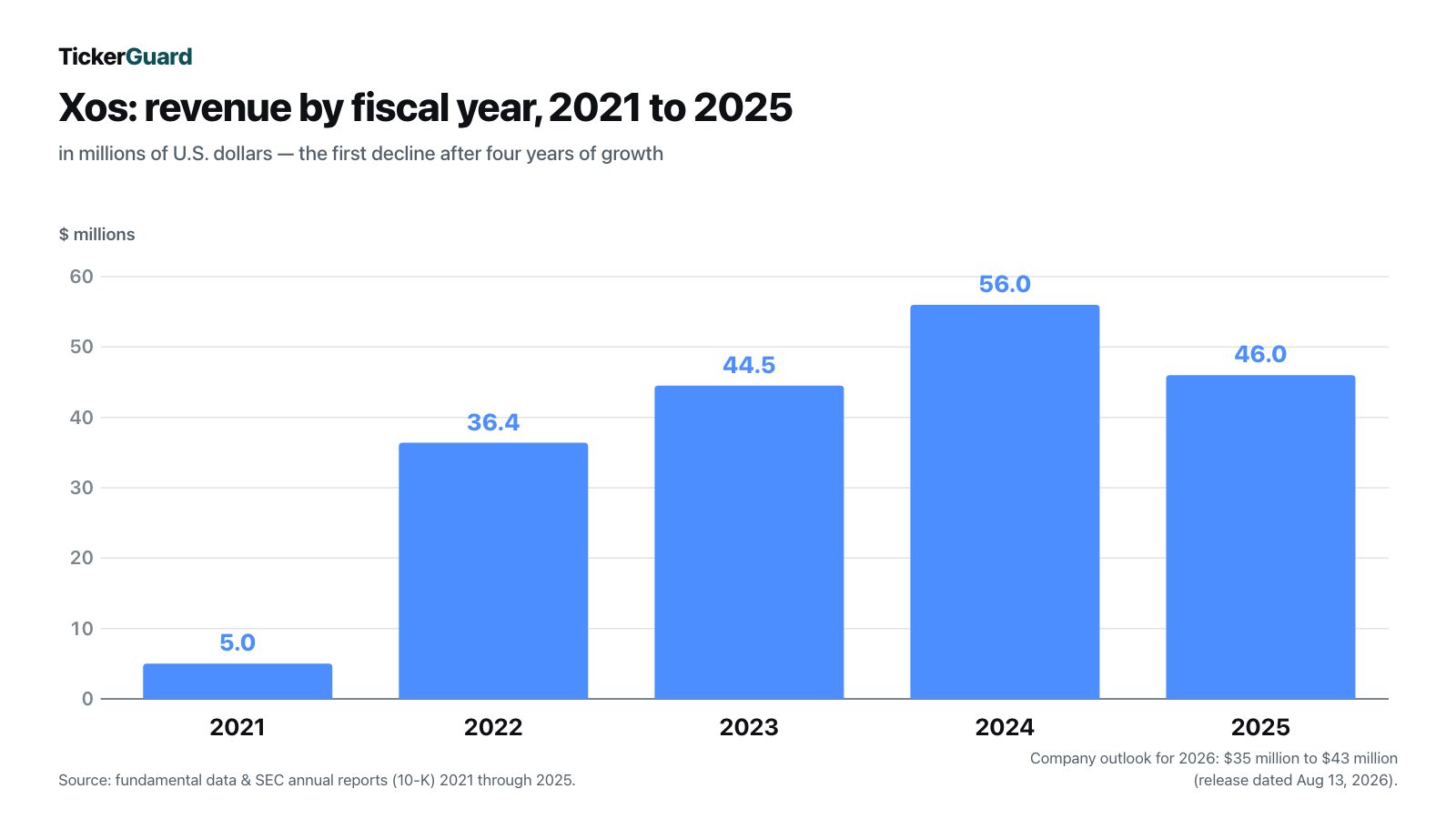
The 2025 dip has an obvious cause, and Xos names it in the annual report itself: the U.S. federal subsidy for electric commercial vehicles has expired. The filing states that the act signed on July 4, 2025 made the applicable credits "no longer available for vehicles not acquired or placed in service on or before September 30, 2025." A fleet operator who wanted an electric delivery van therefore had a very concrete reason to buy it before that cut-off date — and none afterwards. That also explains why the second quarter of 2025, with 135 units delivered, was so strong. And it explains why any comparison against that quarter looks brutal. Pulling demand forward is entirely legitimate, but it is not a trend either. Which brings us to the uncomfortable truths.
What the Filings Say — the Uncomfortable Truths
Uncomfortable Truth No. 1: The Report Names Chapter 7 and 11
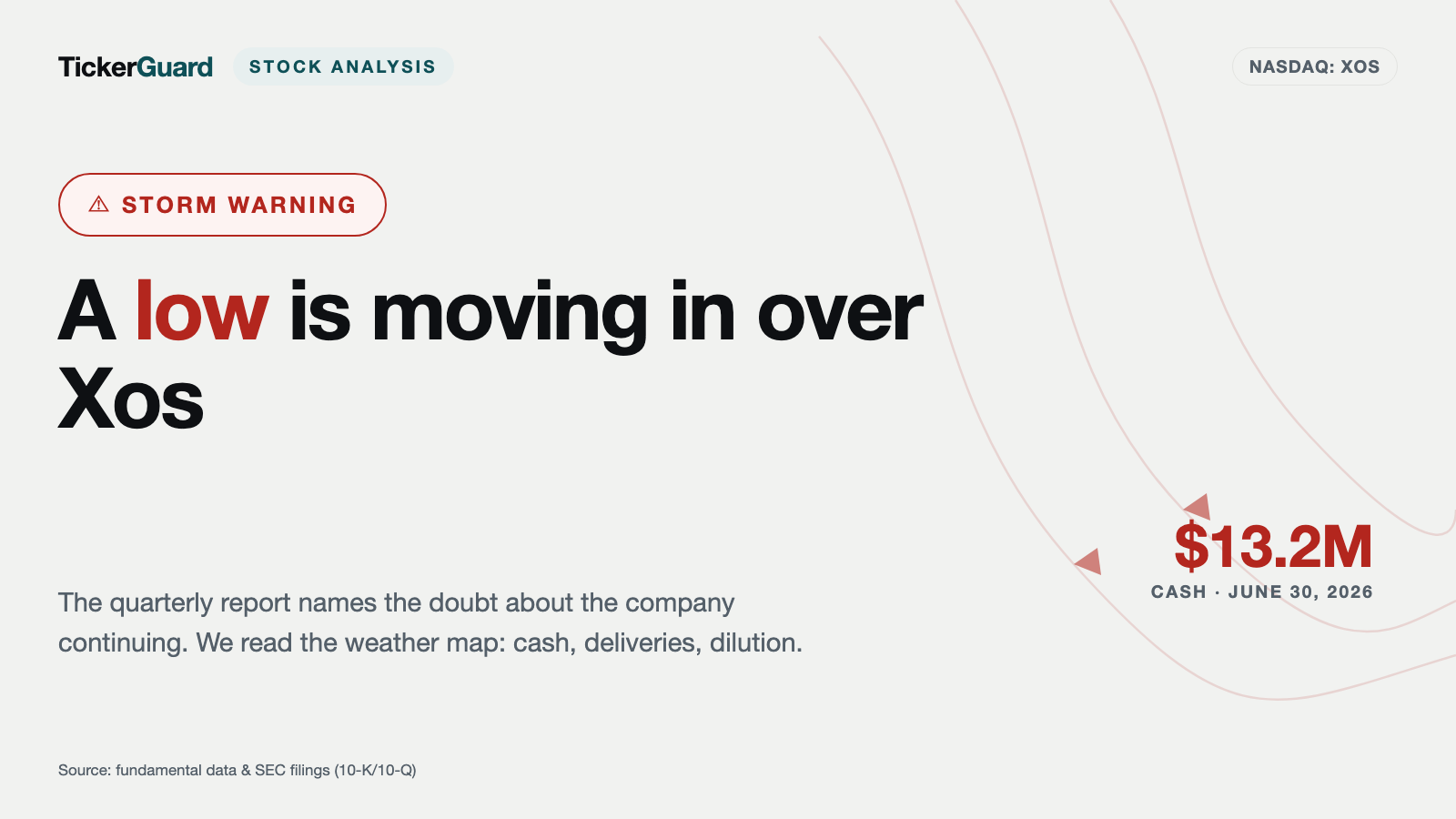
The order matters here: everything that follows — margin, product mix, guidance — sits underneath this one sentence. In the notes to the quarterly report for June 30, 2026, Xos writes that its resources are not expected to last twelve months from the report's issuance and that management's plans do not resolve that doubt. Then comes the consequence, in plain language:
"Absent the Company being able to collect on its outstanding accounts receivable, obtain a sufficient level of new capital in the near-term and/or obtain replacement financing for, or further extend the maturity of, existing debt, the Company could be required to seek protection under Chapters 7 or 11 of the United States Bankruptcy Code. This could potentially cause the Company to cease operations."
— Xos, Inc., SEC quarterly report 10-Q for June 30, 2026, Note 1 (going concern)
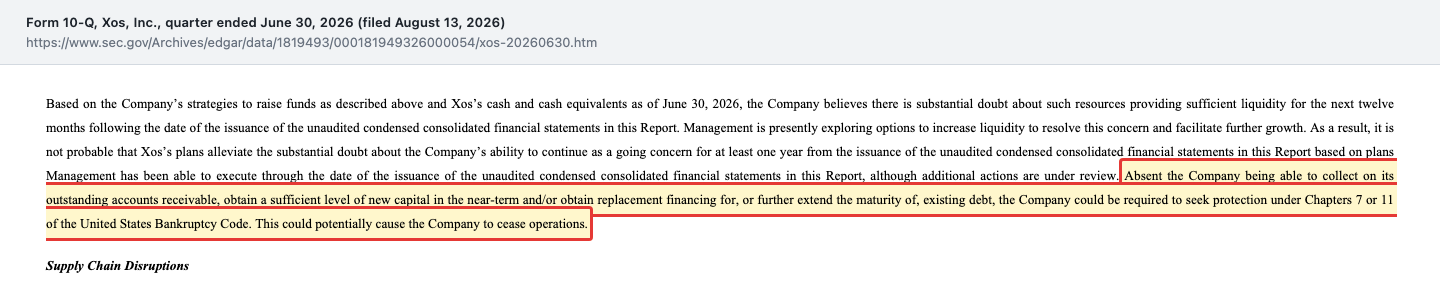
The numbers behind it are quickly told. Cash stood at $13.2 million on June 30, 2026 (December 31, 2025: $14.0 million; March 31, 2026: $9.8 million). The accumulated deficit since inception is $239.9 million. The convertible note owed to Saudi vehicle distributor Aljomaih Automotive Co. stands at $15.5 million, of which $7.5 million is due within twelve months. Do the arithmetic yourself: $13.2 million of cash, a $7.5 million current note installment, $4.3 million of operating cash burn in the first half. In everyday terms this is a household budget that still balances — but only as long as nothing unexpected happens and as long as inventory and receivables keep converting into cash. Which is exactly why that sentence sits near the front of the report.
Uncomfortable Truth No. 2: The Truck Maker Barely Sells Trucks Anymore
Now to the substance behind the record margin. The quarterly report breaks revenue out by product line, and this single table explains the whole company:
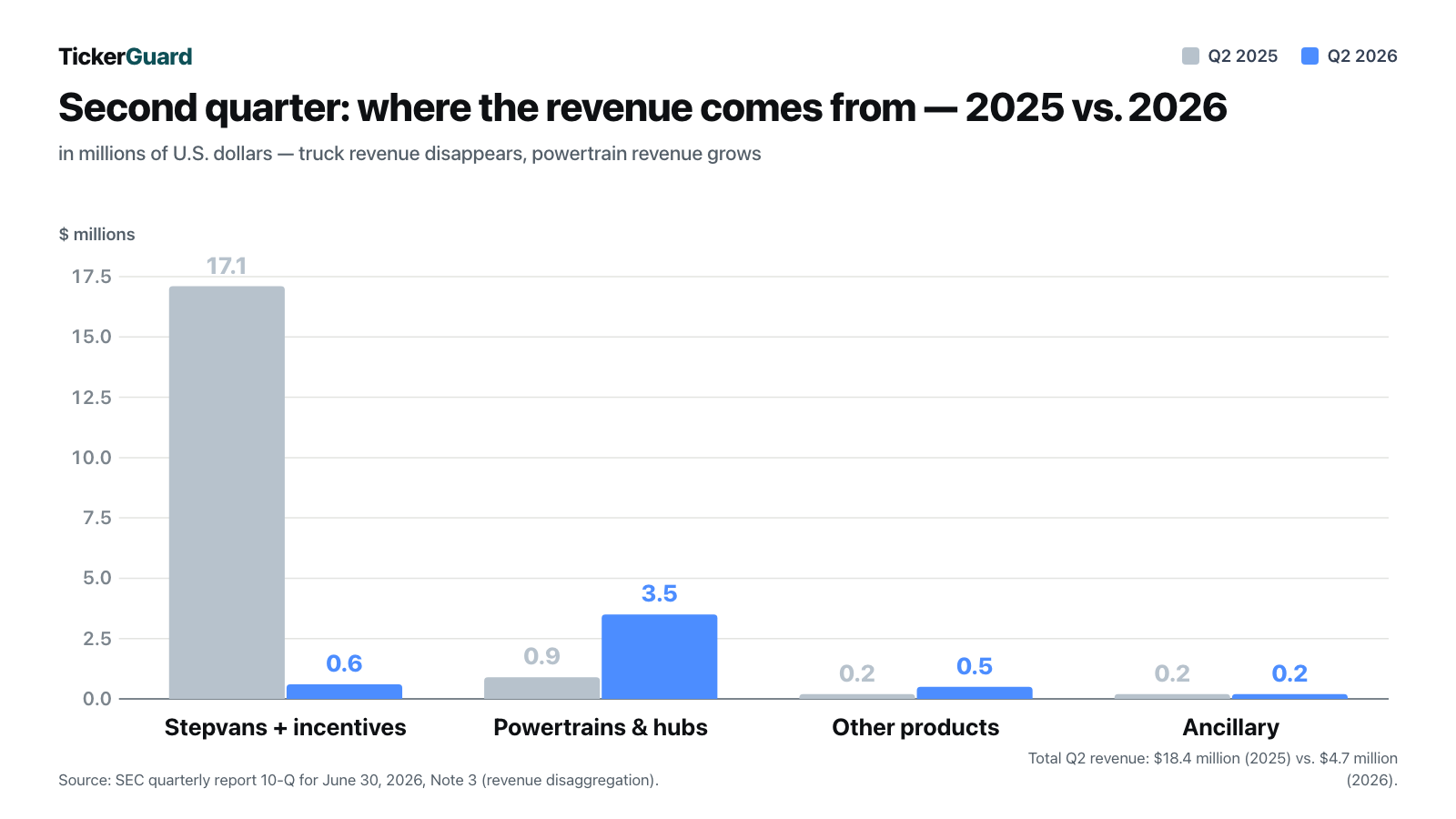
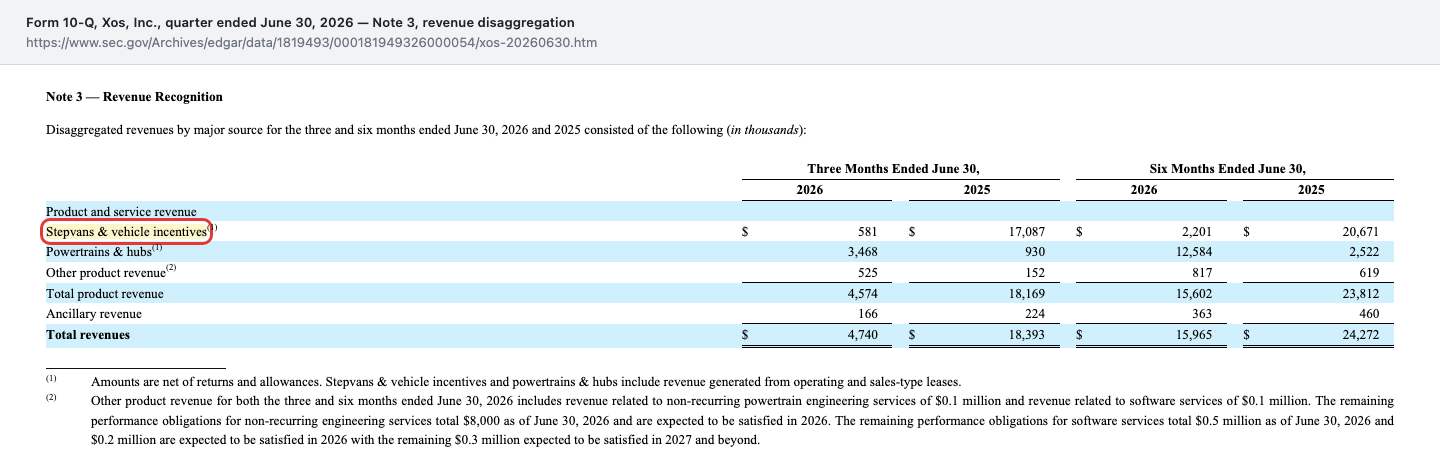
For scale: $0.581 million of vehicle revenue in a quarter, at prevailing prices for electric delivery vans, is a handful of trucks. A company whose name stands for trucks effectively stopped selling trucks in the spring of 2026 — not by announcement, but in fact. Xos calls this a "strategic focus on powertrain and hubs production." That is not untrue: powertrains and hubs grew from $2.5 million to $12.6 million over the half year, and the powertrain sale to Blue Bird alone accounted for 63 units in the first quarter of 2026. But it is also the reframing of a collapse as a decision. Both are true at once, and for you as an investor the second one matters: the new revenue pillar is a supplier business with few buyers — and it is not yet large enough to replace the old one.
Uncomfortable Truth No. 3: The Record Margin and the Guidance Cut Sit in the Same Report
This is where the share-of-the-pie trap snaps shut. First-half 2026 gross margin came in at 31.0 percent versus 11.8 percent — the number in the headline of the release. In absolute terms it means $4.944 million of gross profit instead of $2.873 million. So gross profit really did grow, by a good two million dollars. It simply does not reach far enough: against it stand $17.5 million of operating expenses in the same half. And in the second quarter alone the margin was not a record at all but 12.1 percent — on $4.7 million of revenue that is $0.573 million of gross profit against $8.5 million of quarterly costs. The flattering half-year figure comes almost entirely from the first quarter (38.6 percent on $11.2 million of revenue). The rule to remember: a margin is a yield per dollar of revenue. It says nothing about how many dollars of revenue there are.

Then there is the outlook. On May 14, 2026 Xos explicitly maintained its full-year targets: $40 million to $50 million of revenue, 350 to 500 units delivered, a non-GAAP operating loss of $11.9 million to $13.3 million. Three months later, on August 13, 2026, the same lines read: $35 million to $43 million of revenue, 250 to 350 units, non-GAAP operating loss of $11.4 million to $14.7 million. The midpoint of the unit range fell from 425 to 300 — down 29 percent. Chief Executive Dakota Semler frames it this way: "Second-quarter deliveries shifted into later quarters — deferrals, not cancellations." Possible. It only becomes verifiable with the next report — and that is the figure that matters.
Uncomfortable Truth No. 4: Every Half Year Your Slice Gets Smaller
If you invest in a company without profits, you are helping to fund it. At Xos that can be quantified precisely. Shares outstanding rose from 11.403 million (December 31, 2025) to 14.146 million (June 30, 2026) and on to 14,217,852 as of August 7, 2026 — up 24 percent in a little over seven months. Dilution in everyday terms: your slice of the pie shrinks because new guests joined the table. Where the new shares came from is in the report: 378,700 shares went out through the at-the-market program at an average of $6.71 (net proceeds $2.2 million), and another 1,090,910 shares on June 4, 2026 in a registered direct offering to institutional investors at $5.50 (net proceeds $5.4 million). Both prices sit well above what the stock was worth two weeks later: the company's own prospectus supplement cites a last reported sale price of $3.385 on June 17, 2026, after quoting $7.46 for June 3.
The second lever is the convertible note. On May 8, 2026 Xos and Aljomaih agreed a restatement whose core the 8-K of May 13, 2026 describes verbatim:
"The Third A&R Note altered the convertible promissory note issued by the Company to Aljomaih on August 11, 2022, in an original principal amount of $20 million … to reduce the conversion price from $71.451 per share … to $12.00 per share of Common Stock."
— Xos, Inc., SEC filing 8-K of May 13, 2026, Item 1.01
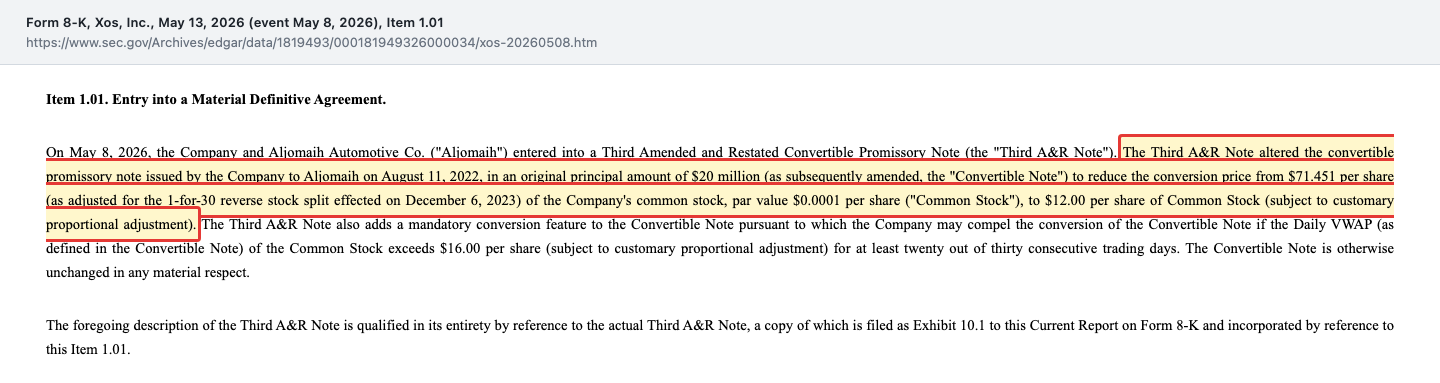
What that means for you: at the old conversion price the remaining $15.5 million of principal (as of June 30, 2026) would have produced roughly 217,000 new shares; at the new one it is roughly 1.29 million, or a good 9 percent of the share count as of August 7, 2026. On August 11, 2026 Xos repaid the scheduled $1.5 million instalment in cash; the principal has stood at $14.0 million since then, convertible into 1,166,666 shares — roughly 8 percent (Form 4 filed by Aljomaih Automotive Co. on August 26, 2026). The creditor was paid for the extension not in interest but in company. And the road ahead is already paved: a new shelf registration for up to $100 million became effective on June 22, 2026, and an at-the-market program for a further $8.8 million was set up under it on June 23, 2026.
Uncomfortable Truth No. 5: The Customer List Is Short — and It Rotates
One last detail that is easy to miss. In the second quarter of 2025, 70 percent of revenue came from a single customer; in the first half of 2025 it was 53 percent, again from one customer. A year later the spread is wider — four customers at 27, 15, 14 and 13 percent in the second quarter of 2026 — but that is not reassurance, it is a consequence of the smaller total: when the pie shrinks, the slices look more even. Receivables tell a similar story at June 30, 2026, with five customers at 19, 16, 15, 14 and 13 percent. What stands out is the balance itself: receivables fell from $26.9 million (December 31, 2024) via $6.0 million (December 31, 2025) to $4.5 million (June 30, 2026). That is good news at first glance — cash was collected, and that money is precisely what kept operating cash burn low. It is also a warning: the company names collecting receivables in the same report as one of three conditions for avoiding bankruptcy proceedings. That reserve is 83 percent used up.
Valuation: Roughly $43 Million for a Company With $13 Million in the Bank
How expensive is Xos? There is no price-to-earnings ratio — the company has not reported an annual profit since going public. That leaves the revenue comparison, and for once it is well documented, because both the share count and the price come from mandatory filings: 14,217,852 shares (10-Q cover page, as of August 7, 2026) times $3.00 (insider sale of September 4, 2026, Form 4) gives a market value of roughly $42.7 million. Against 2025 revenue of $46.0 million that is a price-to-sales ratio of about 0.9, and about 1.1 against the midpoint of the company's own 2026 outlook ($39 million). That sounds cheap — until you put the balance sheet next to it: the market value stands against $22.9 million of stockholders' equity (June 30, 2026), of which $23.5 million is inventory and only $13.2 million is cash. So the market is paying close to twice book value for a business that posted a $7.9 million operating loss in the second quarter of 2026 ($12.6 million for the first half).
One detail keeps the arithmetic clean: the 18,633,301 warrants left over from the SPAC era are no longer a dilution risk. They expired on August 20, 2026 with an exercise price of $345.00 per whole share (thirty warrants per share) — hopeless at a stock price around $3. Nasdaq removed them from listing on August 19, 2026 via Form 25-NSE. The common stock is unaffected and continues to trade on the Nasdaq Capital Market. Two sentences that belong together: one dilution risk fell away and a larger one took its place — the new $12.00 conversion price and the $100 million shelf.
Upside and Risks at a Glance
What speaks for Xos:
- Demonstrated cost discipline: operating expenses down from $49.8 million (2024) to $35.8 million (2025), and in the first half of 2026 to $17.5 million from $19.2 million; the net loss halved from $50.2 million to $25.3 million in 2025 and came in at $11.8 million versus $17.6 million in the first half of 2026.
- The margin gain is real, not just relative: $4.944 million of gross profit in the first half of 2026 against $2.873 million a year earlier — on lower revenue.
- The powertrain business is growing fast: from $2.522 million to $12.584 million half-year over half-year, with U.S. school bus maker Blue Bird named as a key customer (over 100 powertrains ordered between the second quarter of 2025 and the first quarter of 2026).
- The Xos Hub addresses a genuine bottleneck: the 2025 annual report names AI data centers and construction sites among its applications, and in the second quarter of 2026 a Hub supported a data center construction project according to the earnings release. More than 250 megawatt-hours of storage are deployed across North America.
- One dilution item is settled: the 18,633,301 SPAC warrants with a $345.00 exercise price expired worthless on August 20, 2026.
What speaks against it:
- The 10-Q for June 30, 2026 states substantial doubt about the company's ability to continue as a going concern and names proceedings under Chapters 7 or 11 as a possible outcome — with $13.2 million of cash and $7.5 million of current convertible debt.
- The core business is falling away: stepvans and vehicle incentives dropped from $17.087 million to $0.581 million in the second quarter, deliveries from 135 units to 30.
- On August 13, 2026 Xos cut its full-year outlook from 350 to 500 units down to 250 to 350, and from $40 million to $50 million of revenue down to $35 million to $43 million — three months after explicitly maintaining it.
- Dilution every half year: share count from 11.403 million to 14.146 million in six months, the note's conversion price cut from $71.451 to $12.00 (roughly 1.29 million potential new shares), plus a new shelf registration for up to $100 million.
- The U.S. federal credit for electric commercial vehicles expired on September 30, 2025; the demand pulled forward makes every year-over-year comparison harder and future volumes less certain.
A Human Conclusion
Back to the share-of-the-pie trap from the opening. Its core is not that the release was wrong — every figure of August 13, 2026 is accurate and appears the same way in the quarterly report filed with the SEC. Its core is that a percentage is a ratio, and that our brains stop asking "of what?" the moment they hear the word "record." 31.0 percent of $16.0 million is less money than 11.8 percent of $50 million would be. And the most honest sentence of the quarter is not in the release but in the notes to the report: that without fresh capital, bankruptcy proceedings are possible. None of that makes Xos a bad company — 101 people here are working on technology that is needed, they have brought costs under control and built a second leg that is growing. It makes Xos a company whose stock is a bet on the next twelve months, not on the next ten years. So the honest question for you is not "is a price-to-sales ratio of 0.9 cheap?" but: are you willing to fund a business that says itself the money is not expected to last twelve months — and that hands you a smaller slice with every financing round? If yes, you have a thesis. If no, you had a headline. What you do with it is your decision. And that is exactly as it should be.
Sources
Every original document used in this analysis, so you can read it yourself:
- Xos, Inc. — SEC quarterly report 10-Q for June 30, 2026 (filed August 13, 2026)
- Xos, Inc. — SEC quarterly report 10-Q for March 31, 2026 (filed May 14, 2026)
- Xos, Inc. — SEC annual report 10-K for 2025 (filed March 30, 2026)
- Xos, Inc. — Second-quarter 2026 earnings release, Exhibit 99.1 to the SEC filing 8-K of August 13, 2026 (with the lowered outlook)
- Xos, Inc. — First-quarter 2026 earnings release, Exhibit 99.1 to the SEC filing 8-K of May 14, 2026 (with the maintained outlook)
- Xos, Inc. — SEC filing 8-K of May 13, 2026, Item 1.01 (restated convertible note)
- Xos, Inc. — SEC prospectus supplement 424B5 of June 23, 2026 (at-the-market program, documented share prices)
- Nasdaq Stock Market LLC — SEC Form 25-NSE of August 19, 2026 (removal of the warrants that expired on August 20, 2026)
- Full SEC filing history of Xos, Inc. (CIK 0001819493), including the Form 4 insider filings of August 20, September 2 and September 4, 2026 and the Form 144 of September 2, 2026: EDGAR overview (sec.gov)
- Retail forum mentions: our in-house stock scanner, Reddit mention count, as of September 9, 2026.
Transparency & disclaimer: this analysis is journalistic commentary on publicly available information. It is not investment advice, not a regulated financial analysis and not a solicitation to buy or sell securities. Equity investments carry substantial risk up to and including total loss; at a company with a stated going-concern doubt that risk is especially pronounced. All information is provided without warranty; the as-of date for each figure is noted in the text. The author holds no position in Xos shares at the time of publication.
Key figures at a glance
All monetary figures in millions of $; earnings per share as reported.
| Metric | 2021 | 2022 | 2023 | 2024 | 2025 |
|---|---|---|---|---|---|
| Revenue | 5.0 | 36.4 | 44.5 | 56.0 | 46.0 |
| Operating Income (EBIT) | -53.2 | -111.3 | -65.0 | -45.9 | -33.1 |
| Net Income | 23.4 | -73.3 | -75.8 | -50.2 | -25.3 |
| Net Margin | 463.6% | -201.6% | -170.3% | -89.6% | -55.1% |
| Earnings Per Share | 6.51 $ | -12.62 $ | -13.11 $ | -6.69 $ | -2.71 $ |
Source: fundamental data & SEC filings (annual and quarterly reports, 10-K/10-Q)
Our Bottom Line at a Glance
- Going concern negative
- The quarterly report for June 30, 2026 states substantial doubt about the company's ability to continue as a going concern and explicitly names proceedings under Chapters 7 or 11 of the U.S. Bankruptcy Code as a possible outcome. Cash stood at $13.2 million at the balance sheet date against $7.5 million of current convertible debt; the accumulated deficit is $239.9 million.
- Core business negative
- Stepvans and vehicle incentives generated $0.581 million in the second quarter of 2026, down from $17.087 million a year earlier (a 97 percent decline); deliveries fell from 135 units to 30. Powertrains and hubs grew from $2.522 million to $12.584 million over the half year but do not fill the gap: total revenue fell from $24.3 million to $16.0 million.
- Cost discipline positive
- Operating expenses fell from $49.8 million (2024) to $35.8 million (2025) and in the first half of 2026 to $17.5 million from $19.2 million. The net loss halved from $50.2 million to $25.3 million in 2025 and came in at $11.8 million versus $17.6 million in the first half of 2026. Gross profit rose from $2.873 million to $4.944 million despite lower revenue.
- Dilution negative
- Shares outstanding rose from 11.403 million (December 31, 2025) to 14,217,852 (August 7, 2026), up 24 percent. Shares were issued at $6.71 and $5.50 while the company's own prospectus supplement cites a price of $3.385 for June 17, 2026. The note's conversion price fell from $71.451 to $12.00 on May 8, 2026, and a new shelf registration for up to $100 million has been effective since June 22, 2026.
- Guidance reliability negative
- On May 14, 2026 Xos explicitly maintained its full-year targets of $40 million to $50 million in revenue and 350 to 500 units. On August 13, 2026 the same lines read $35 million to $43 million and 250 to 350 units — the midpoint of the unit range fell from 425 to 300, down 29 percent. The company describes the shortfall as deferrals rather than cancellations.
- Product and market neutral
- The Xos Hub addresses a genuine bottleneck: the 2025 annual report names AI data centers and construction sites among its applications, in the second quarter of 2026 a Hub supported a data center construction project according to the earnings release, and more than 250 megawatt-hours are deployed across North America. At the same time the U.S. federal credit for electric commercial vehicles expired on September 30, 2025 and the customer base remains narrow (four customers at 27, 15, 14 and 13 percent of quarterly revenue).
Xos shows two pictures in the same report. The first is a company that has learned to economize: operating expenses cut from $49.8 million to $35.8 million, gross profit raised from $2.873 million to $4.944 million despite lower revenue, a growing powertrain business with Blue Bird and a battery storage product with a real market. The second is a truck maker that sold only $0.581 million of vehicles in the second quarter of 2026 instead of $17.087 million, that cut its full-year unit target by 29 percent on August 13, 2026, and whose quarterly report names Chapters 7 and 11 outright. With $13.2 million of cash, $7.5 million of current convertible debt and a share count up 24 percent in seven months, this stock is a bet on the next twelve months. Not investment advice.
What Our Rating Means
Substance risk
We found at least one documented issue that threatens the company itself — regardless of how the stock is currently valued.
Red, because there is a documented risk to the substance of the business — and not one we inferred, but one the company itself reports. The quarterly report for June 30, 2026 states substantial doubt about the ability to continue as a going concern and describes proceedings under Chapters 7 or 11 as a possible outcome if receivable collections, new capital or replacement financing fail to materialize. The figures fit: $13.2 million of cash against $7.5 million of current convertible debt, an accumulated deficit of $239.9 million and a core business whose quarterly revenue fell 97 percent. Explicitly not relevant to this rating are the points you might expect here: that the stock looks cheap at a price-to-sales ratio of about 0.9, that the price swung sharply between July and August 2026, or that the free float is small. Those are price arguments; they would neither justify red nor rule out green. Fairness requires the other side too: cost discipline is documented, gross profit rose in absolute terms, the powertrain business is growing and one dilution item from the SPAC era expired worthless on August 20, 2026. That does not change the color. As long as the going-concern statement stands in the report, the substance of the business is the open question. Green or yellow would only come back into view once a quarterly report appears without it. The decision is yours.
A journalistic assessment by our editorial team at the time of the deep dive, based on public sources — not investment advice and not a solicitation to buy or sell. Your personal circumstances (investment goals, risk capacity, taxes) cannot be taken into account. What our levels mean, how verdicts are formed, and what conflicts of interest exist →
Worth Noting
- Xos reached our research list through the Reddit mention scanner (as of September 9, 2026), not through a quality or valuation filter. That scanner measures attention in retail forums, not substance — and at a company with roughly $42.7 million of market value, attention moves the price faster than any business figure.
- All price and share-count figures in this analysis come exclusively from mandatory SEC filings, so that they stay verifiable: the share count of 14,217,852 from the 10-Q cover page (as of August 7, 2026), the $3.00 valuation anchor from the Form 4 insider filing of September 4, 2026, and the $7.46 and $3.385 prices from the 424B5 prospectus supplement of June 23, 2026.
- Easily confused: the Form 25-NSE of August 19, 2026 covers only the warrants that expired on August 20, 2026 (XOSWW), not the common stock, which continues to trade on the Nasdaq Capital Market. Also not to be confused: "XOS" is likewise the name of a vehicle operating system from a Chinese manufacturer; this analysis is about Xos, Inc. with SEC identifier CIK 0001819493.
Stock Watch
This analysis is as of September 9, 2026. Stock Watch will tell you what's changed at XOS since then.
Later $1 a month per stock — signing up is free, and you'll be the first to know when it launches.
The full analysis as a PDF for later
We will send you this analysis as a PDF — to print, file away, and read at your own pace. And we will add you to the free Stock Watch list for Xos Inc (XOS), so you hear about it when something material in this analysis changes.
Frequently Asked Questions
Xos, Inc. (Nasdaq: XOS) of Los Angeles builds battery-electric commercial vehicles in U.S. Classes 5 through 8 for routes of up to roughly 200 miles a day — mainly boxy delivery trucks known as stepvans, plus bare stripped chassis. Xos also sells powertrains under the "Powered by Xos" brand to other vehicle builders, the Xos Hub (a mobile battery in a container that charges vehicles without a strong grid connection) and the Xosphere fleet software. As of December 31, 2025 the company had 101 employees and 34 contractors.
The quarterly report (10-Q) for June 30, 2026 states substantial doubt about the company's ability to continue as a going concern: by its own assessment, resources are not expected to last twelve months. It says that absent collecting outstanding receivables, raising new capital in the near term or obtaining replacement financing, Xos could be required to seek protection under Chapters 7 or 11 of the U.S. Bankruptcy Code. Cash stood at $13.2 million at the balance sheet date, with $7.5 million of convertible debt due within twelve months.
Because the vehicle business fell away. Stepvans and vehicle incentives generated only $0.581 million in the second quarter of 2026, down from $17.087 million a year earlier, and deliveries fell to 30 units from 135. Two causes work together: Xos is shifting its focus to powertrains and hubs (half-year revenue there rose from $2.5 million to $12.6 million), and the U.S. federal credit for electric commercial vehicles expired on September 30, 2025, pulling purchases into earlier quarters.
Because a margin is a ratio. First-half 2026 gross margin was 31.0 percent, up from 11.8 percent — but on revenue of $16.0 million instead of $24.3 million. In absolute terms that is $4.944 million of gross profit versus $2.873 million, against $17.5 million of operating expenses. In the second quarter alone the margin was only 12.1 percent; the high half-year figure comes almost entirely from the first quarter at 38.6 percent.
Shares outstanding rose from 11.403 million (December 31, 2025) to 14.146 million (June 30, 2026) and to 14,217,852 as of August 7, 2026 — up 24 percent. Newly issued were 378,700 shares through the at-the-market program at an average of $6.71 and 1,090,910 shares on June 4, 2026 at $5.50. On top of that sits the convertible note: its conversion price was cut from $71.451 to $12.00 on May 8, 2026, which on $15.5 million of remaining principal works out to roughly 1.29 million further shares.
No. The Form 25-NSE that Nasdaq filed with the SEC on August 19, 2026 covers only the "Warrants expiring 08/20/2026" — the warrants left over from the SPAC era that lapsed on August 20, 2026. Their exercise price was $345.00 per whole share (thirty warrants per share), which made them hopeless. The common stock continues to trade unchanged under the ticker XOS on the Nasdaq Capital Market.
The Xos Hub is a mobile battery storage unit that supplies power and charges vehicles where no strong grid connection exists. The 2025 annual report names AI data centers, construction sites, utilities and major events among its applications. In June 2026 Xos introduced the larger Power Hub with 3.1 megawatt-hours and 1.5 megawatts of continuous output; in the second quarter of 2026 a Hub supported a data center construction project according to the earnings release. More than 250 megawatt-hours of storage are deployed across North America.
On December 6, 2023 Xos combined every thirty shares into one. Companies do this when the share price has fallen far enough to endanger exchange listing requirements. For investors the key point is that all prices and share counts from before that date are not comparable without adjustment. The $345.00 exercise price of the old SPAC warrants per whole share is a direct result of that combination.
Found an error?
Did you spot a factual error, an outdated number, or a typo in this deep dive? Let us know briefly — your report goes straight to the editorial team.