Bristow Group: The Pivot to Government Work Is On — and the Government Side Is Losing Money
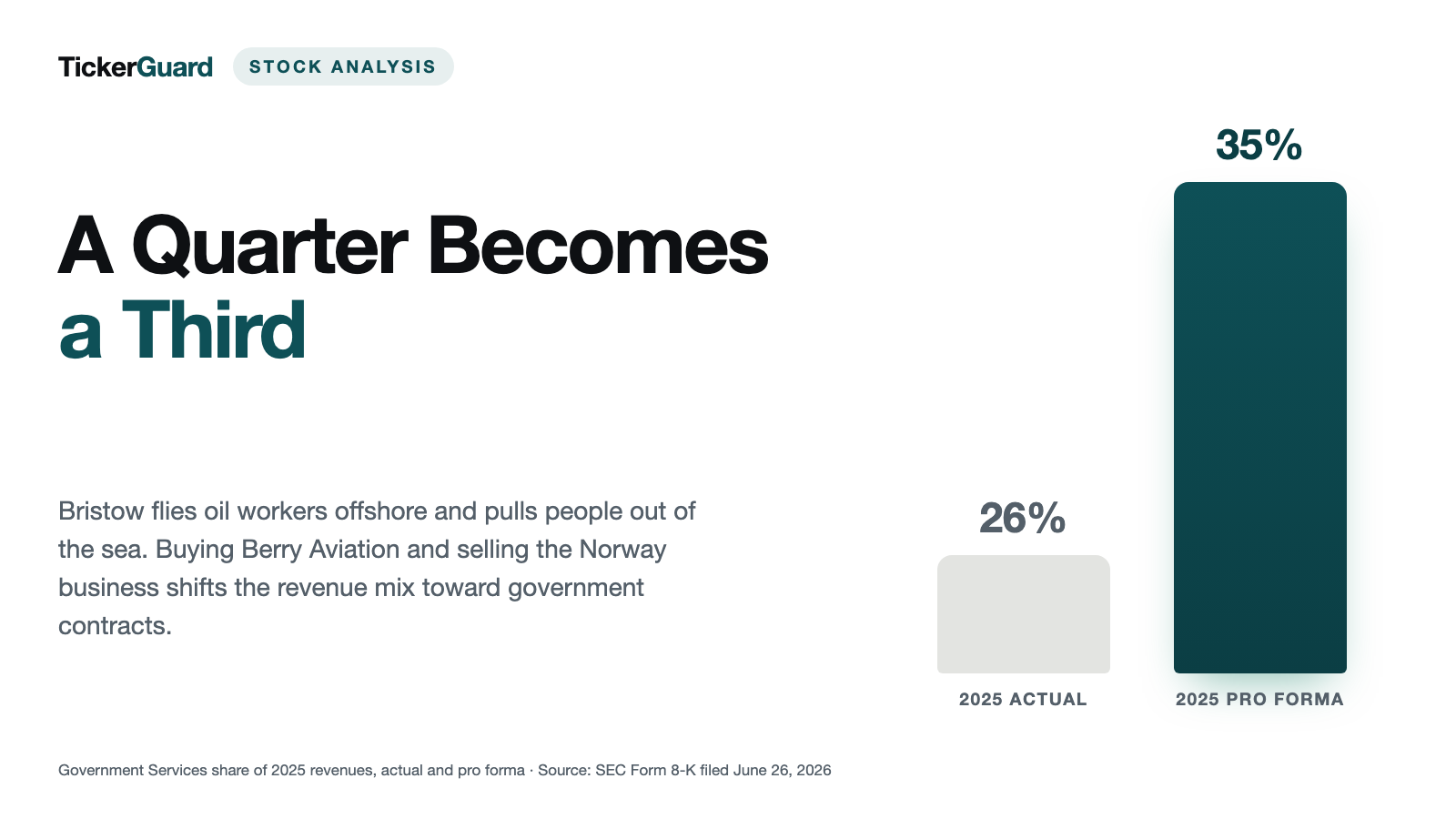
Bristow flies oil workers to offshore rigs and pulls people out of the sea. Since June 23, 2026 the company has been openly reshaping itself: Berry Aviation bought for $105.0 million in cash, the Norway offshore business put up for sale. On a pro forma basis that would have lifted the government share of 2025 revenues from 26 to 35 percent. The catch sits in the Form 10-Q for the quarter ended June 30, 2026: that same segment posted a $2.1 million operating loss, while the unloved oil business earned $46.1 million. We read the filings submitted to the U.S. securities regulator, the SEC, and worked out what the pivot has delivered so far — and what it costs.
 Thomas Mücke
Founder & Publisher
Thomas Mücke
Founder & Publisher
As of Today
As of: September 17, 2026
- Closing price
- 41.40 $ +0.20%
- Market Capitalisation
- 1.2 $B
- P/E
- 11.9
- Growth Score
- 4/10
- AAQS
- 4/10
Price change since September 11, 2026: -3.0%
This analysis has a cut-off date. The Stock Guard tells you when something material changes in the numbers. Reserve your free spot
Chart
Interactive price chart (TradingView).
52-week range: 35.70 $ to 50.00 $ · Last price: 41.40 $ (As of: September 17, 2026)
Note: pure fact-based analysis, not investment advice and not a solicitation to buy or sell. All figures without guarantee.
There is a mental shortcut that fires whenever somebody wears a uniform: the uniform effect. A person in uniform reads as reliable before saying a word. Our brain skips the check and moves on. Markets do the same thing, except there the uniform is spelled "government contract". The moment those words appear, something in us relaxes: a government does not go bankrupt, a government pays on time, a government signs for ten years. And because all of that is true, we stop asking whether the contract actually makes money.
Bristow Group Inc. (NYSE: VTOL) is the field test. The Houston company flies oil workers to offshore rigs and pulls survivors out of the North Sea — and it is deliberately reshaping itself: away from a cyclical oil business, toward long-dated government contracts. On June 23, 2026 it paid $105.0 million for Berry Aviation and put its Norway offshore business up for sale on the same day. So let us make a deal: before you decide whether an oil-cycle operator is turning into a predictable government contractor, we will read together what Bristow itself told the U.S. securities regulator, the SEC. A filing is honest under penalty of law — and this one describes a segment that is supposed to grow while it loses money, a 0.5 percent tax rate, and a metric called "Free Cash Flow" that leaves four fifths of capital spending out of the calculation.
What Bristow Actually Does — Helicopters for Oil Rigs and for the Coast Guard
Bristow sells one thing at its core: a helicopter and crew that reliably takes off when it has to. That has grown into three businesses.
Offshore Energy Services is the largest. Oil companies have to rotate crews between shore and platform every few weeks; a vessel takes hours, a helicopter minutes. In the second quarter of 2026 this business produced $261.6 million of revenue, split across Europe ($104.6 million), the Americas ($106.6 million) and Africa ($50.4 million).
Government Services is the second and the growth field. It covers state search and rescue — SAR in the industry shorthand — for the United Kingdom, Ireland, the Netherlands, the Falkland Islands, the Dutch Caribbean and the United States. Revenue in the second quarter of 2026: $112.2 million. One figure from the 2025 sustainability report, repeated in the quarterly filing, shows how real this work is: 4,416 search-and-rescue missions, 15,861 flight hours and 784 people assisted or rescued.
Other Services is the small remainder ($37.9 million in the second quarter of 2026) — among other things the Australian regional airline Airnorth and Humberside airport in England.
The fleet as of June 30, 2026: 218 aircraft, of which 202 helicopters, 13 fixed-wing aircraft and 3 unmanned systems; 167 are owned and 51 leased. Bristow operates in 20 countries, from Australia and Nigeria to Norway and Trinidad. On customers, the 2025 annual report gives two numbers worth remembering: the ten largest customers accounted for roughly 63 percent of 2025 revenues, and the three largest alone for 36 percent.
A word on the corporate history, because it causes confusion. Today's registrant was called Era Group Inc. until June 9, 2020 and has been separately listed since January 2013. The former Bristow Group Inc. — called simply "Old Bristow" in the annual report — filed for Chapter 11 bankruptcy protection in May 2019 and emerged in October 2019. The two merged on June 11, 2020; the combined company kept the Bristow name and the VTOL ticker. So historical prices or financials from before June 2020 may, depending on the database, belong to two different companies.
That frames the central tension of this analysis, and it runs through every chapter: Bristow is deliberately trading a well-earning but cyclical oil business for a predictable government business — except the government business currently earns nothing, and the oil business earns almost everything.
Company history for investors
-
2013
Era Group becomes separately listed
Today's registrant starts trading as an independent company in January 2013. Anyone comparing prices from before 2020 is comparing this company — not the later Bristow.
-
2019
The former Bristow goes through Chapter 11
Old Bristow files for bankruptcy protection in May 2019 and emerges restructured in October 2019. For investors that means today's company carries a predecessor with a bankruptcy history.
-
2020
Era Group and Bristow merge (June 11)
Two helicopter operators become one, carrying the Bristow name and the VTOL ticker. For shareholders a new series of financials effectively began — everything before it compares only in part.
-
2025
$125 million repurchase program authorized (February)
The board approves share buybacks. By June 30, 2026 only about $4 million has been used — the money stays reserved for something else.
-
2026
$500 million of notes at 6.750 percent (January)
The older 6.875 percent notes are redeemed and maturity pushed to February 2033. The coupon barely falls while total debt rises by roughly $74 million.
-
2026
First quarterly dividend of $0.125 (Q1)
Cash flows directly to shareholders for the first time — roughly $15 million a year. It signals that management considers its own earnings base durable.
-
2026
Berry acquisition and Norway exit (June 23)
The $105 million purchase closed on July 13; the sale is only announced. For shareholders that means a smaller cash pile and a promised offset not yet on the balance sheet.
How This Stock Reached Our Desk
Bristow did not arrive here on a recommendation but on an ownership threshold filing with the SEC. On September 3, 2026 the hedge fund Solus Alternative Asset Management reported that its stake had fallen to 9.61 percent, from 10.69 percent in its previous filing of June 16, 2025. Solus is not an ordinary investor: the fund first reported its stake on June 22, 2020, days after the merger, and its managing member Christopher Pucillo sits on Bristow's board according to the Form 4 filed alongside. When a fund with a seat in the boardroom crosses back below 10 percent, the filings are worth reading.
Our in-house stock scanner adds an unusually balanced picture (as of September 12, 2026). The price-to-earnings ratio is 12.3 and the price-to-book ratio 1.16 — the market pays $1.16 for every dollar of accounting equity. The equity ratio is 45.9 percent: of every hundred dollars on the balance sheet, just under 46 belong to shareholders. Interest coverage stands at 3.6 — operating profit covers interest three and a half times over, which is comfortable. Return on equity over the trailing twelve months: 10.1 percent.
Two numbers already show where it pinches. The Piotroski score, a nine-point checklist for balance-sheet health, reads 6 out of 9. That is fine, not good — a genuinely healthy company scores 8 or 9. And the pairing of the two growth figures is unusual: quarterly revenue rose 9.4 percent year over year while diluted earnings per share fell 34.6 percent. Note the pattern right at the start: when revenue rises and profit falls, the story sits between the two lines. That is exactly where we look next.
A neighboring case makes the pattern concrete: at aviation services provider AAR Corp we found the same business model in its purest form — maintenance, parts and government programs rather than owned aircraft. Bristow sits on the other side: it owns the machines, and that shows up in depreciation and capital spending.
The Numbers Over the Years — Credit Where It Is Due
Start with what genuinely argues for Bristow, and there is more of it than the headline suggests. Since the 2020 merger the company has improved operationally year after year. Revenue rose from $1,297.4 million (2023) through $1,415.5 million (2024) to $1,490.5 million (2025). Operating income went from $60.8 million through $132.6 million to $158.8 million over the same period — roughly a two-and-a-half-fold increase in two years. Below the line, Bristow turned a $6.8 million loss (2023) into profits of $94.8 million (2024) and $129.1 million (2025).
A quick note on the fiscal year, because older series otherwise confuse. Bristow changed its fiscal year: until March 2022 it ended on March 31, followed by a nine-month transition period ending December 31, 2022. Only from 2023 onward do full calendar years compare cleanly — which is where our series begins.
The balance sheet has also recovered. As of June 30, 2026 Bristow held $312.3 million of unrestricted cash plus $59.3 million of remaining revolver availability, for $371.6 million of total liquidity. In January 2026 it refinanced: $500 million at 6.750 percent maturing in February 2033 replaced the older 6.875 percent notes, and the revolving facility was extended to January 2031. Since the first quarter of 2026 the company has also paid its first quarterly dividend of $0.125 per share, or $0.50 annualized.
Now the chart that interrupts the pleasant trend — net income over the last six quarters:
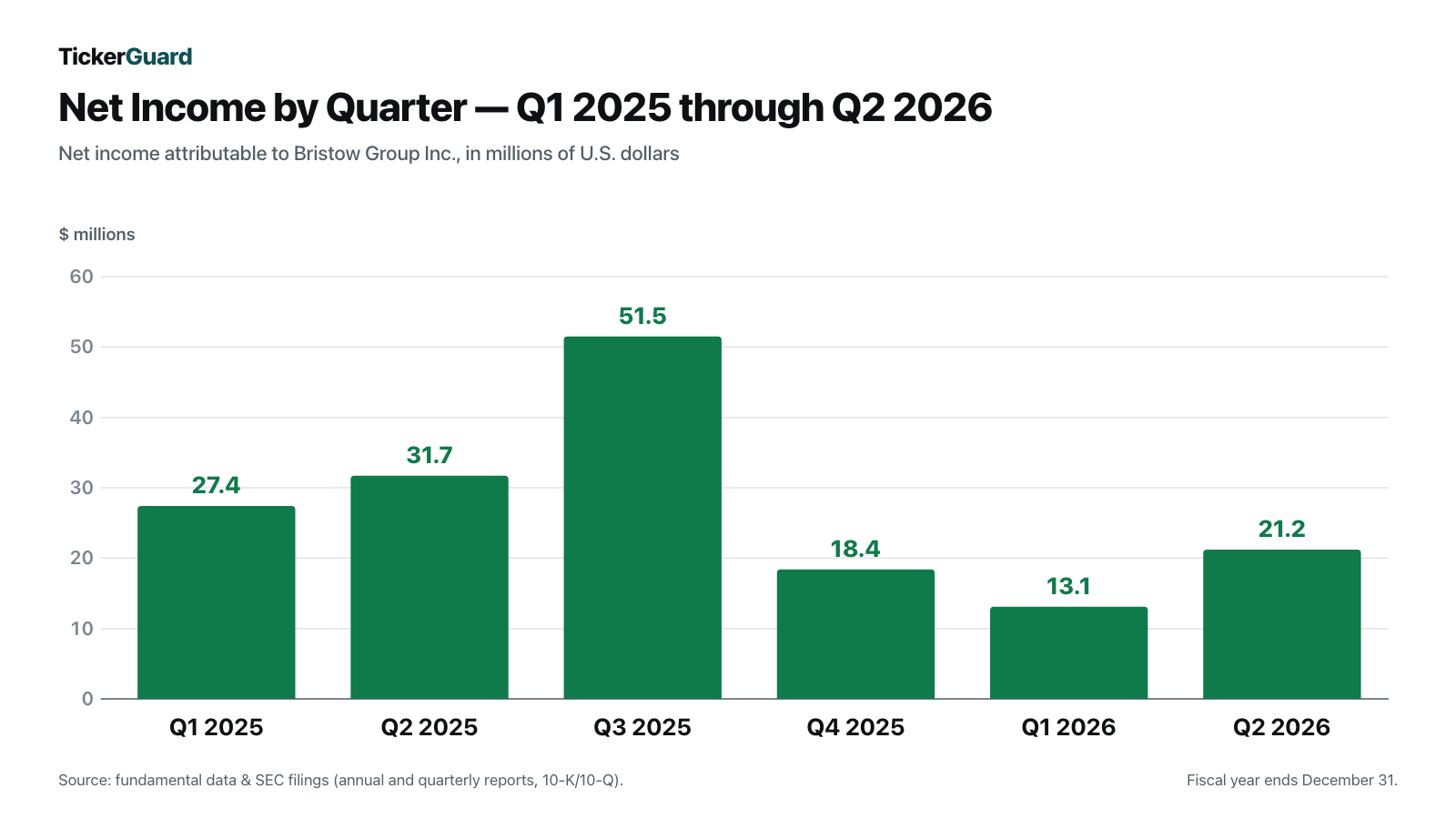
In the first half of 2026 the same movement looks like this: revenue rose from $727.0 million to $800.5 million (up 10.1 percent), while net income attributable to the company fell from $59.1 million to $34.3 million (down 42.0 percent). In fairness: operating income held almost steady at $74.3 million against $76.2 million — the drop happens mostly below the operating line. Where exactly, we settle now.
What the Filings Say — the Uncomfortable Truths
Uncomfortable Truth No. 1: The Future Segment Is Losing Money
Here the uniform effect returns for the first time. Bristow is deliberately shifting toward government work — and that segment was the only core business with an operating loss in the second quarter of 2026:
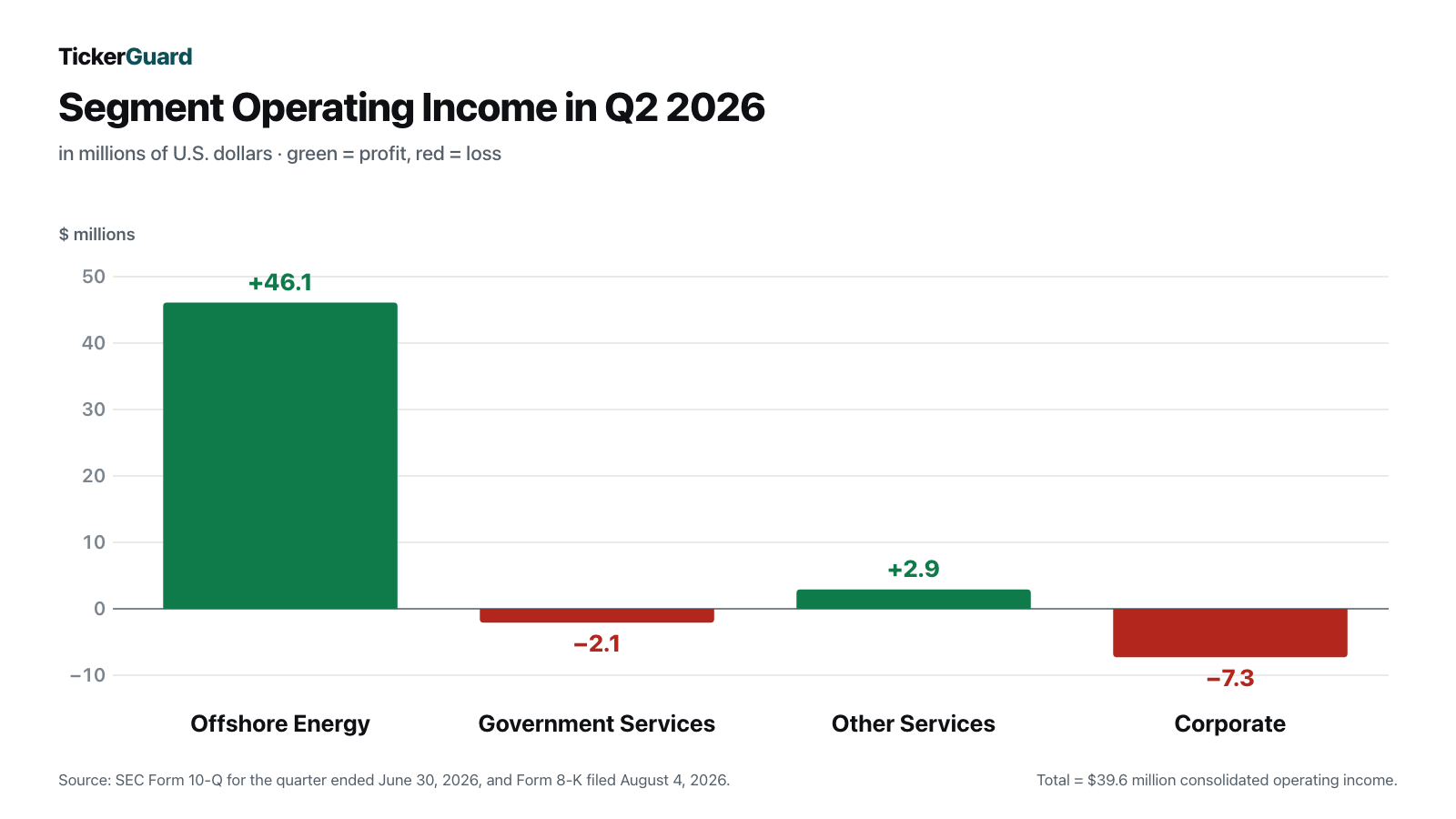
The loss is explainable, and Bristow explains it: several bases under the second-generation UK search-and-rescue contract ("UKSAR2G") and under the Irish Coast Guard contract are coming into service right now. Crews are hired and paid before full compensation flows: $3.3 million of additional personnel cost in the quarter alone, plus $1.3 million for training, travel between bases and facility costs. A contract start costs before it pays.
One item, however, is not a start-up effect but a structural problem: $3.6 million of penalties in the quarter because promised helicopters were not available. The cause, per the filing, is continued supply chain disruption in spare parts — the annual report explicitly names delays in parts for the S92 and AW189 types. That closes a loop visible in the fleet table: the S92 is the most common heavy helicopter with 60 aircraft and an average age of 16 years. The light types are older still: AS350 at 27 years on average, AW119 at 20, AW109 at 19. Across all owned helicopters the average age is 14 years. Older machines need more parts — and when parts are missing, Bristow pays a penalty. The rule of thumb: a rescue contract does not pay for the flight, it pays for availability.
In fairness, the picture improves before depreciation. Bristow's own measure, Adjusted Operating Income, shows $7.2 million for Government Services in the second quarter of 2026 — but that follows $9.5 million in the preceding quarter, with the margin falling from 9 to 6 percent. Even adjusted, the direction is down. And the company itself guides to $475 million to $495 million of segment revenue for full-year 2026 at $55 million to $65 million of adjusted operating income — roughly a 12 percent margin against the 25 percent the offshore business reached in the second quarter.
Uncomfortable Truth No. 2: Profit Falls While Revenue Rises
In the first half of 2026 revenue grew by $73.5 million while net income fell by $24.8 million. Three lines explain almost the entire gap, and none of them sits in the operating business.
First, depreciation. It rose from $34.2 million to $53.3 million — up roughly 56 percent on 10.1 percent more revenue. The reasons given: accelerated depreciation on a leased facility in the United States and on capital spare parts for S76D helicopters, plus new aircraft and equipment placed into service for the UK search-and-rescue contract. Depreciation is not a cash outflow — but it is the delayed invoice for capital spent earlier.
Second, currencies. The "other, net" line swung from positive $29.0 million to negative $14.3 million — a $43.2 million difference, more than the entire half-year profit. In the second quarter of 2026 alone that included $7.7 million of non-cash foreign exchange losses. Bristow reports in dollars but earns in pounds, euros, naira and other currencies; that moves both ways. Worth holding on to: a good part of the 2025 profit was currency — and a good part of the 2026 decline is too.
Third, interest. Interest expense rose from $19.5 million to $26.0 million. That follows the January refinancing: Bristow swapped $400 million of notes at 6.875 percent for $500 million at 6.750 percent. The coupon fell marginally, the debt load rose — from $671.5 million at December 31, 2025 to $745.5 million at June 30, 2026. A one-time $2.8 million loss on early extinguishment came on top. For 2026 Bristow guides to roughly $45 million of cash interest.
Uncomfortable Truth No. 3: A 0.5 Percent Tax Rate
The fourth line pushes the other way — it supports the result rather than dragging it down. The $21.2 million of net income in the second quarter of 2026 owes a meaningful share to a tax rate you read twice:

Bristow names the reason itself: higher utilization of tax credits in Nigeria. Work out what that is worth. On pre-tax income of $21.3 million, last year's 39.1 percent rate would have cost roughly $8.3 million; quarterly net income would then have landed near $13.0 million instead of $21.2 million. For the half year the effective rate was 9.6 percent against 34.1 percent. This is not an accusation — tax credits are legal and planned. But they are finite, and they depend on earnings in a single country. Profit that comes out of the tax line does not repeat on demand.
Uncomfortable Truth No. 4: What Bristow Calls "Free Cash Flow" Is Not Free Cash Flow
The results release of August 4, 2026 carries a cheerful number: $34.3 million of "Free Cash Flow" in the second quarter, $112.8 million over the trailing twelve months. Free cash flow is the most honest metric there is — the money left after every necessary outlay. Except Bristow defines it differently than most:
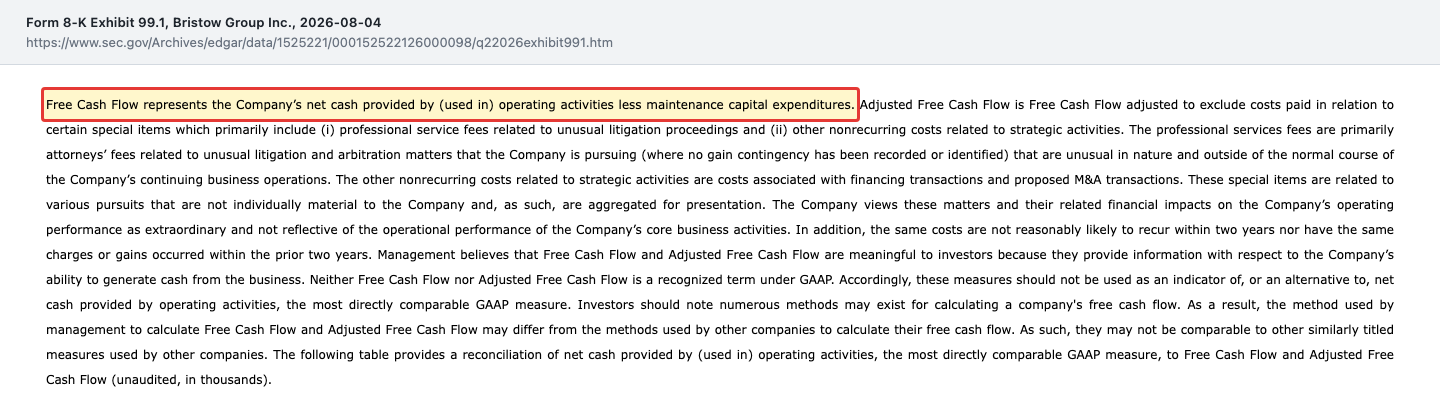
"Free Cash Flow represents the Company's net cash provided by (used in) operating activities less maintenance capital expenditures."
— Bristow Group Inc., SEC Form 8-K filed August 4, 2026, Exhibit 99.1, "Non-GAAP Financial Measures"
The difference is not a detail but an order of magnitude. In the twelve months to June 30, 2026 Bristow subtracted exactly $20.0 million of maintenance capital expenditures from $132.8 million of operating cash flow. Actual purchases of property and equipment in the first half of 2026 alone came to $108.7 million, mostly aircraft and equipment. On the conventional definition, the first half of 2026 leaves this: $32.8 million of operating cash flow, minus $108.7 million of capital spending, plus $30.0 million of asset sale proceeds — roughly negative $46 million.
Put plainly: it is like counting the repairs on your old car in the household budget but not the purchase of the new one. Both are money leaving the account. In fairness on the other side: a helicopter is not consumption but an asset with residual value and a useful life well over twenty years, and operating cash flow in the first half was also weak because of receivables built up for the new government contracts ($71.5 million went into working capital). Still, the point holds: if you run a fleet, you cannot permanently define fleet purchases out of the metric. Unfunded capital commitments as of June 30, 2026 add a further $58.8 million, including two AW189 helicopters and deposits on five EL9 aircraft for delivery in 2029 and 2030.
Uncomfortable Truth No. 5: Half the Pivot Is Paid For — the Other Half Has Not Happened
On June 23, 2026 Bristow announced two things that belong together. One is done:

Berry Aviation is based in San Marcos, Texas, operates more than 20 aircraft and generated roughly $108 million of revenue in 2025 — about 72 percent of it from government services. Customers named in the press release include the U.S. Army, the U.S. Air Force and the SOCOM and TRANSCOM commands. Bristow funded the $105.0 million from cash on hand; it has been gone from the balance since July 13, 2026.
The other half is only announced:

"… the Company evaluated its Norway business in accordance with Accounting Standards Codification ("ASC") 205-20 Presentation of Financial Statements — Discontinued Operations and ASC 360 Property, Plant, and Equipment and determined that, at this time, not all criteria had been met in order to classify its Norway business as either discontinued operations or as held for sale, in accordance with the two U.S. GAAP standards, respectively."
— Bristow Group Inc., SEC Form 10-Q for the quarter ended June 30, 2026, Note 1 "Basis of Presentation"
In plain language: there is no buyer, no price and no date — Bristow writes that timing and structure "remain subject to market conditions and other considerations." The tidy 54 / 35 / 11 revenue mix from the press release is therefore a model, not a balance sheet. It assumes the Norway business is sold at all — and in the same filing Bristow cites Norway as the reason for seasonal personnel cost swings in the offshore segment, that is, as an operating business.
The company itself supplies the honest counterweight: taken together, the purchase and the disposal would have been "neutral to Bristow's 2025 EBITDA on a pro forma basis." The pivot changes the composition of the business, not its size. Paying $105 million in cash for that buys predictability, not additional earnings.
Valuation — What Roughly $1.3 Billion for $1.5 Billion of Revenue Means
On September 11, 2026 the stock closed at $42.70. On 29,642 thousand shares outstanding (as of July 31, 2026, per the quarterly report cover page) that works out to a market capitalization of roughly $1,266 million. Four orders of magnitude follow — deliberately as ranges, not point forecasts.
The price-to-sales ratio is about 0.85 against 2025 revenues of $1,490.5 million. The price-to-earnings ratio is 12.3 on trailing twelve-month earnings (as of September 12, 2026). The price-to-book ratio is 1.16: accounting equity of $1,089.2 million equals roughly $36.75 per share. And enterprise value — market capitalization plus $745.5 million of debt less $312.3 million of cash — comes to roughly $1.70 billion. Measured against the company's own 2026 guidance for adjusted earnings before interest, taxes, depreciation and amortization of $295 million to $325 million, that is 5.2 to 5.8 times.
For a capital-intensive service business with real hard assets, that is neither expensive nor obviously cheap. The judgment hangs on a single question: does the pivot work? Bristow guides to group revenue of $1,640 million to $1,720 million for 2026 and reaffirmed that range on August 4, 2026 despite "macro uncertainties and continued supply chain challenges" — a statement with weight, because it came after a weak first quarter.
The professional view is thinly staffed here and should be treated accordingly: as of September 12, 2026 only two analyst estimates were on file, both on the buy side, with an average target price of $64.33. Two houses are two opinions, not a market view. The 52-week range ran from $34.73 to $50.10.
A word on distributions: the $0.125 quarterly dividend equals $0.50 a year, or roughly 1.2 percent on the September 11, 2026 close. Cost to the company: about $15 million a year. On buybacks Bristow is notably restrained: of the $125 million authorized in February 2025, $121.0 million was still unused as of June 30, 2026 — so only about $4 million was repurchased under the program in roughly sixteen months. The money went into Berry Aviation instead.
For comparison it is worth looking at a company that lives entirely off government customers: at U.S. prison operator GEO Group we saw how predictable state revenue can be — and how unpredictable the politics behind it. That is the other half of the uniform effect.
Upside and Risks at a Glance
What argues for Bristow:
- Market leadership in a business with high barriers to entry: a helicopter fleet, operating certificates in 20 countries and a safety record built over more than seven decades cannot be replicated quickly.
- A sound balance sheet: a 45.9 percent equity ratio, 3.6 times interest coverage, $371.6 million of liquidity as of June 30, 2026, an untouched revolving facility and no bond maturity before 2033.
- Six profitable quarters in a row and a clearly improved three-year operating picture: operating income from $60.8 million (2023) to $158.8 million (2025).
- Long-dated government contracts running up to ten years with annual rate escalations — once the start-up costs are behind, that is recurring revenue.
- A first dividend and a largely unused $125 million repurchase program held in reserve for shareholder returns.
What argues against:
- The growth segment earns nothing: a $2.1 million operating loss on $112.2 million of revenue in the second quarter of 2026, including $3.6 million of penalties for unavailable helicopters.
- Spare-parts shortages on an owned helicopter fleet averaging 14 years of age — the problem that triggers the penalties will not resolve itself.
- Reported profit leans on items outside the core business: a $43.2 million half-year swing in currency effects and a 0.5 percent effective tax rate in the second quarter of 2026.
- Customer concentration: the three largest customers accounted for 36 percent of 2025 revenues, the ten largest for 63 percent.
- The Norway sale is announced but neither contracted nor reflected in the accounts — the pro forma revenue mix is a model.
- Oil prices and energy company capital budgets still drive two thirds of the business, alongside political risk in Nigeria and other operating countries.
A Human Verdict
The uniform effect has two sides, and Bristow shows both at once. One: a contract with the UK coastguard runs ten years, escalates annually and does not move with the oil price. If your business has swung between boom and bust for decades, you have good reasons to buy something like that. The other side sits in the Form 10-Q for the quarter ended June 30, 2026: the same contract first costs crews, then training, then penalties when a helicopter stays on the ground for want of a part — and only then does it pay. In the second quarter of 2026 the oil business was the payer with $46.1 million of operating income, and the government business the recipient with a $2.1 million loss.
What follows is not a recommendation but a question everyone has to answer for themselves: are you buying a company in the middle of a deliberate rebuild whose new leg starts carrying in a year or two? Or an oil-cycle operator with a decent balance sheet that just spent $105 million in cash on a diversification it calls earnings-neutral by its own arithmetic? Both readings sit in the same documents. The numbers are there, the sources are linked, and the uniform is best taken off first.
What you make of it is your decision. And that is exactly as it should be.
Sources and Disclosure
- SEC Form 10-Q for the quarter ended June 30, 2026 (filed August 5, 2026) — balance sheet, segments, Notes 1, 4, 7, 8 and 12
- SEC Form 10-Q for the quarter ended March 31, 2026 (filed May 6, 2026)
- SEC Form 10-K for 2025 (filed February 26, 2026) — business description, customers, risk factors, executive officers
- SEC Form 10-K for 2024 (filed February 27, 2025)
- SEC Form 10-K for 2023 (filed March 6, 2024) — comparative figures around the fiscal-year change
- SEC Form 8-K filed June 26, 2026, Item 1.01 — Berry Aviation merger agreement, with Exhibit 99.1 (press release)
- SEC Form 8-K filed August 4, 2026, Exhibit 99.1 — quarterly results, segment data, 2026 guidance, non-GAAP definitions
- Schedule 13D/A filed September 3, 2026 (Solus Alternative Asset Management LP, Amendment No. 7)
- Fundamental data (metrics, analyst estimates, headcount; as of September 12, 2026) and our in-house stock scanner (as of September 12, 2026); closing price of September 11, 2026
Disclosure: This article is journalism and research, not investment advice and not a solicitation to buy or sell securities. Share prices can move sharply; a total loss of invested capital is possible. All figures come from the original documents linked above and carry the as-of dates stated there. The author holds no position in Bristow Group Inc. at the time of publication.
Key figures at a glance
All monetary figures in millions of $; earnings per share as reported.
| Metric | 2021 | 2022 | 2023 | 2024 | 2025 |
|---|---|---|---|---|---|
| Revenue | 1,185.2 | 1,198.2 | 1,297.4 | 1,415.5 | 1,490.5 |
| Operating Income (EBIT) | 1.2 | 26.0 | 60.8 | 132.6 | 143.8 |
| Net Income | -15.8 | 9.2 | -6.8 | 94.8 | 129.1 |
| Net Margin | -1.3% | 0.8% | -0.5% | 6.7% | 8.7% |
| Earnings Per Share | -0.55 $ | 0.32 $ | -0.24 $ | 3.21 $ | 4.31 $ |
Source: fundamental data & SEC filings (annual and quarterly reports, 10-K/10-Q)
Our Bottom Line at a Glance
- Balance sheet and funding positive
- As of June 30, 2026 shareholders' equity of $1,089.2 million stood against $745.5 million of debt and $312.3 million of cash; the equity ratio was 45.9 percent and interest coverage 3.6 (scanner, as of September 12, 2026). The revolving facility went untouched in the first half of 2026, and the next bond maturity is not until February 2033.
- Government Services segment negative
- The growth field currently earns nothing: a $2.1 million operating loss on $112.2 million of revenue in the second quarter of 2026, after a $0.9 million profit in the preceding quarter. That includes $3.6 million of penalties for unavailable helicopters. Even adjusted, the margin fell from 9 to 6 percent.
- Earnings quality negative
- Reported profit leans on items outside the core business. In the first half of 2026 the "other, net" line swung from positive $29.0 million to negative $14.3 million — a $43.2 million difference, largely currency. In the second quarter of 2026 the effective tax rate was 0.5 percent against 39.1 percent a year earlier; at the old rate, quarterly net income would have been around $13.0 million instead of $21.2 million.
- Core offshore energy business positive
- The largest segment delivered $261.6 million of revenue and $46.1 million of operating income in the second quarter of 2026 — an 18 percent margin, 25 percent adjusted, both better than the preceding quarter. Over three years, group operating income rose from $60.8 million (2023) through $132.6 million (2024) to $158.8 million (2025).
- Business model pivot neutral
- The $105.0 million Berry Aviation acquisition closed on July 13, 2026, while the Norway sale is only announced and, as of June 30, 2026, not classified as held for sale in the accounts. Bristow itself describes both steps together as neutral to 2025 EBITDA on a pro forma basis — the pivot changes the composition of the business, not its size.
- Fleet and supply chain negative
- Owned helicopters average 14 years of age; the S92, the most common heavy type with 60 aircraft, averages 16 years and the light AS350 27 years. The 2025 annual report cites continued delivery delays for S92 and AW189 parts — precisely the source of the availability penalties in the government segment.
Bristow is a soundly financed company, profitable for six straight quarters, with a market position that is hard to replicate — and it is in the middle of a rebuild whose payoff is still pending. Revenue rose 10.1 percent to $800.5 million in the first half of 2026 while net income fell 42.0 percent to $34.3 million. The destination of the pivot, Government Services, posted a $2.1 million operating loss in the second quarter of 2026 while the offshore business earned $46.1 million. Against that stand a 45.9 percent equity ratio, $371.6 million of liquidity, a first dividend and full-year guidance the company reaffirmed. Not investment advice.
What Our Rating Means
Open questions
The business works in principle, but one material question is open. As long as it stays open, our findings do not carry a quality verdict.
Yellow, because the business fundamentally works while one material operating question is open — and it sits precisely where the company's future is supposed to be. Government Services, the segment Bristow is steering toward, posted a $2.1 million operating loss on $112.2 million of revenue in the second quarter of 2026, after earning $0.9 million in the preceding quarter; the adjusted margin fell from 9 to 6 percent. Part of that is start-up cost for new bases in the United Kingdom and Ireland, which will pass. Another part is $3.6 million of penalties for unavailable helicopters — a problem tied to a fleet averaging 14 years of age and to delivery delays for S92 and AW189 parts, which will not clear on its own. A second open question follows: second-quarter 2026 profit benefited from an effective tax rate of 0.5 percent against 39.1 percent a year earlier, and the currency line swung by $43.2 million over the half-year comparison. There is no basis for red: no going-concern doubt, equity clearly positive at $1,089.2 million, a 45.9 percent equity ratio, interest coverage of 3.6, an untouched revolving facility in the first half of 2026 and no bond maturity before February 2033. Green is not yet warranted while the segment that just absorbed $105 million in cash is operating in the red. Explicitly not relevant to this rating is valuation: a price-to-earnings ratio of 12.3 and a price-to-book ratio of 1.16 are price arguments and justify neither yellow nor green. Green would come into view once Government Services shows positive operating income over a full reporting period and the availability penalties recede. The decision is yours.
A journalistic assessment by our editorial team at the time of the deep dive, based on public sources — not investment advice and not a solicitation to buy or sell. Your personal circumstances (investment goals, risk capacity, taxes) cannot be taken into account. What our levels mean, how verdicts are formed, and what conflicts of interest exist →
Worth Noting
- Bristow reached our research list through an ownership threshold filing with the U.S. securities regulator, the SEC: on September 3, 2026 the hedge fund Solus Alternative Asset Management, whose managing member Christopher Pucillo sits on Bristow's board according to a Form 4 insider report, reported that its stake had fallen to 9.61 percent from 10.69 percent in its previous filing of June 16, 2025.
- Currency of the data: the most recent periodic report reviewed is the Form 10-Q for the quarter ended June 30, 2026, filed August 5, 2026, together with the results release (Form 8-K, Item 2.02) of August 4, 2026. Everything filed afterwards was reviewed: one Schedule 13D/A of September 3, 2026, nine Form 4 insider reports and nine Rule 144 notices. The Rule 144 notices cover very small amounts from one director's share-based compensation and do not change the picture, which is why they do not appear in the article.
- Identity note: today's registrant was named Era Group Inc. until June 9, 2020 (SEC CIK 0001525221). The former Bristow Group Inc. ("Old Bristow") was a separate company with its own CIK; it filed for Chapter 11 in May 2019, emerged in October 2019 and merged with Era Group on June 11, 2020. Price and ratio series from before June 2020 may refer to different companies depending on the data provider.
- On the fiscal year: Bristow moved its fiscal year end from March 31 to the calendar year, with a nine-month transition period ending December 31, 2022 in between. Full calendar years are therefore only comparable from 2023 onward.
Stock Watch
This analysis is as of September 13, 2026. Stock Watch will tell you what's changed at VTOL since then.
Later $1 a month per stock — signing up is free, and you'll be the first to know when it launches.
The full analysis as a PDF for later
We will send you this analysis as a PDF — to print, file away, and read at your own pace. And we will add you to the free Stock Watch list for Bristow Group Inc (VTOL), so you hear about it when something material in this analysis changes.
Frequently Asked Questions
Bristow Group Inc. (NYSE: VTOL) operates helicopters and fixed-wing aircraft for three purposes: transporting personnel to oil and gas platforms (Offshore Energy Services), government search and rescue in the United Kingdom, Ireland, the Netherlands, the United States and other countries (Government Services), and smaller activities such as the Australian regional airline Airnorth. As of June 30, 2026 the fleet numbered 218 aircraft across 20 countries.
Revenue rose 10.1 percent to $800.5 million, while net income attributable to the company fell 42.0 percent to $34.3 million. Operating income held almost steady at $74.3 million against $76.2 million; the decline happened below that line. Depreciation and amortization rose from $34.2 million to $53.3 million, the "other, net" line swung from positive $29.0 million to negative $14.3 million (largely non-cash foreign exchange losses), and interest expense rose from $19.5 million to $26.0 million.
Bristow paid $105.0 million in cash for Berry Aviation of San Marcos, Texas; the merger agreement is dated June 23, 2026 and the deal closed on July 13, 2026. Berry operates more than 20 aircraft and generated roughly $108 million of revenue in 2025, about 72 percent of it from government services — including intelligence, surveillance and reconnaissance work, maintenance and unmanned systems for the U.S. Army, the U.S. Air Force and the SOCOM and TRANSCOM commands.
Announced yes, completed no. Bristow said on June 23, 2026 that it was pursuing a sale of its Norway offshore energy business. In the Form 10-Q for the quarter ended June 30, 2026 the company explicitly states that at that time not all criteria had been met to classify the business as discontinued operations or as held for sale. Timing and structure remain subject to market conditions, per the filing.
On pre-tax income of $21.3 million, income tax expense was $0.1 million — an effective rate of 0.5 percent, against 39.1 percent a year earlier. Bristow cites higher tax credit utilization in Nigeria together with its global mix of earnings. For comparison: at last year's rate, quarterly net income would have been around $13.0 million instead of $21.2 million.
Yes, since the first quarter of 2026. The quarterly dividend is $0.125 per share, or $0.50 annualized — roughly 1.2 percent against the September 11, 2026 close of $42.70. The most recent declaration is dated July 30, 2026, payable August 28, 2026. There is also a $125 million repurchase program authorized in February 2025, of which $121.0 million was still unused as of June 30, 2026.
Yes. Today's registrant was Era Group Inc. until June 9, 2020 and has been separately listed since January 2013. The former Bristow Group Inc. — called "Old Bristow" in the annual report — filed for Chapter 11 bankruptcy protection in May 2019 and emerged in October 2019. The two merged on June 11, 2020; the company has carried the Bristow Group Inc. name and the VTOL ticker ever since.
Materially, but not existentially. Per the 2025 annual report, the ten largest customers accounted for roughly 63 percent of revenues and the three largest alone for roughly 36 percent. On the energy side those are large oil and gas companies; on the government side they are state customers such as the UK and Irish coastguards. Contract terms generally range from one month to ten years.
Found an error?
Did you spot a factual error, an outdated number, or a typo in this deep dive? Let us know briefly — your report goes straight to the editorial team.