Nano Labs: $108 Million on the Balance Sheet, $1.3 Million in the Till
Nano Labs calls itself a "Web 3.0 infrastructure provider and crypto treasury company" in its own press releases. It started out as a chip designer. Its annual report to the U.S. securities regulator, the SEC, shows what is left of either: RMB 27.0 million of revenue in 2025, down from RMB 78.3 million in 2023, and RMB 2.8 million in the first half of 2026 — against a half-year loss of RMB 316.7 million, of which RMB 250.5 million came from the falling price of its own crypto reserve. Cash has drained out of the business for three years running; it came back in from the capital markets. Not investment advice — just the question of what is in the till once you take the sign off the door.
 Thomas Mücke
Founder & Publisher
Thomas Mücke
Founder & Publisher
As of Today
As of: September 17, 2026
- Closing price
- 2.20 $ -5.50%
- Market Capitalisation
- 0.1 $B
- Growth Score
- 3/10
- AAQS
- 2/10
Price change since September 11, 2026: -11.3%
This analysis has a cut-off date. The Stock Guard tells you when something material changes in the numbers. Reserve your free spot
Chart
Interactive price chart (TradingView).
52-week range: 1.60 $ to 5.90 $ · Last price: 2.20 $ (As of: September 17, 2026)
Note: pure fact-based analysis, not investment advice and not a solicitation to buy or sell. All figures without guarantee.
There is an investing trap that has nothing to do with greed and still gets expensive. Call it the new sign trap. It works like this: a company hangs a new sign above its door. "Chip designer" becomes "Web 3.0 infrastructure", that becomes "crypto treasury company", and finally "AI agent hardware" gets added on top. Your brain reads the sign and quietly fills in the business behind it. It pictures data centers, full warehouses, customers. Except the sign has been repainted and the shop behind it has not changed — and how full that shop is does not appear on the sign. It appears in the filings with the U.S. securities regulator, the SEC. Nano Labs Ltd (Nasdaq: NA) of Hangzhou has hung three signs in four years. So let us make a deal: before you buy one of them, we walk inside together and look in the till. The paperwork is public — the annual report on Form 20-F for 2025, filed April 13, 2026, and the interim reports on Form 6-K that followed, most recently the half-year figures of August 28, 2026. An SEC filing is submitted under penalty of law. What you do with it is your call.
What Nano Labs actually does — design chips, hoard cryptocurrency
Nano Labs is, at its core, a fabless chip designer. Fabless means it designs semiconductors but owns no factory — it is the architect, not the builder. Manufacturing runs through third-party foundries, with testing, packaging and assembly likewise outsourced. Its own designs are called Cuckoo (high-throughput computing chips) and Darkbird (high-performance computing chips), alongside bitcoin mining machines sold under the iPollo brand. As of December 31, 2025 the annual report counted 67 employees, 46 granted patents, 40 registered software copyrights and four IC layout-design rights. The company is incorporated in the Cayman Islands, operates out of Hangzhou in the People's Republic of China, and lists its Class A ordinary shares on the Nasdaq Global Market.
Since 2025 a second sign hangs above the door. Nano Labs has declared BNB, the native token of the BNB Chain, its "primary reserve asset" and buys it systematically. At December 31, 2025 it held 126,662 BNB — cost basis RMB 636.3 million, fair value RMB 768.6 million ($109.3 million) — plus a receivable for another 3,338 BNB posted as collateral with a third-party exchange. Since March 2026 there is a third sign: the iPollo ClawPC A1 Mini, a small computer built for the open-source OpenClaw AI agent system. That is not a footnote but the declared new product line — one that so far contributes no visible revenue.
Which names the central tension of this analysis, and it runs through every chapter: the Nano Labs bottom line depends almost entirely on the price of one cryptocurrency, while the business the company actually operates has shrunk to a fraction — and the capital markets, not operations, pay the bills. One structural note matters here: with the SEC, Nano Labs is a foreign private issuer. That means there is no quarterly report (Form 10-Q) — only an annual report (Form 20-F) and voluntary interim reports (Form 6-K). Anyone waiting for quarterly numbers on this stock waits in vain; reporting is semi-annual.
Company history for investors
-
2022
Nasdaq listing (trading begins July 12)
3,540,000 Class A shares go public, followed by 4,166,668 more in September. For investors the starting point — and the start of a long series of capital raises.
-
2024
Two share consolidations in ten months
2-to-1 effective January 31 and 10-to-1 effective November 3 — 20-to-1 combined. Twenty shares become one; the price rises arithmetically, the stake does not.
-
2025
BNB declared the primary reserve asset
By year-end the company has gathered 126,662 BNB at a cost of RMB 636.3 million. From here a crypto price decides whether the annual accounts are black or red.
-
2025
RMB 125.9 million profit — with RMB 108.3 million of cash out
The profit comes from a RMB 178.6 million fair-value markup. Cash left the till in the same year; for shareholders, a profit with no cash behind it.
-
2026
iPollo ClawPC A1 Mini launches (March)
A small computer for the OpenClaw AI agent system, carried in the annual report as a new product line. No revenue contribution is visible through the half-year report.
-
2026
Half-year loss of RMB 316.7 million (August 28)
The crypto position loses RMB 250.5 million and revenue falls to RMB 2.8 million. Book value per share halves within six months.
How the stock landed on our desk
Nano Labs did not surface through a quality or growth filter but through market observation: over the twelve months to September 11, 2026 the share price moved between $1.58 and $6.10 — the low was roughly a quarter of the high. As of the same date, our in-house stock scanner shows a beta of 3.47 (the share swings about three and a half times as hard as the broad market), short interest at 9.7 percent of a free float of roughly 8.4 million shares, and interest coverage of minus 6.28. That last figure translates as: operating profit does not cover interest, because operating profit is itself negative. On the nine-point Piotroski quality scale the company scores 5 out of 9. Five of nine is mediocre, not good; a genuinely healthy company sits at 8 or 9.
Two metrics are deliberately missing from the scanner, and the absence is more honest than a fabricated number: there is no Altman Z-score and no net current asset value for Nano Labs, because the books are kept in Chinese yuan while the share trades in U.S. dollars. Divide a dollar market capitalization by yuan balance-sheet items and you get a figure that looks precise and is not. So everything below is stated in yuan, with the dollar figure alongside only where the company itself supplies it — using the People's Bank of China reference rate, RMB 7.0288 per dollar at December 31, 2025 and RMB 6.8109 per dollar at June 30, 2026.
The numbers over the years — credit where credit is due
First the genuine case for Nano Labs, and it is more than nothing. The company owns real engineering: proprietary chip architectures at 55, 40 and 22 nanometers, 46 granted patents, a working sales channel for mining hardware. It did report group net income of RMB 125.9 million for 2025, after two deeply loss-making years. And its balance sheet looks solid at first glance: at June 30, 2026, total assets of RMB 736.7 million ($108.2 million) carry RMB 351.1 million of liabilities — an equity ratio of roughly 52 percent. This is not the balance sheet of an over-indebted company.
Now the chart that takes the connection apart:
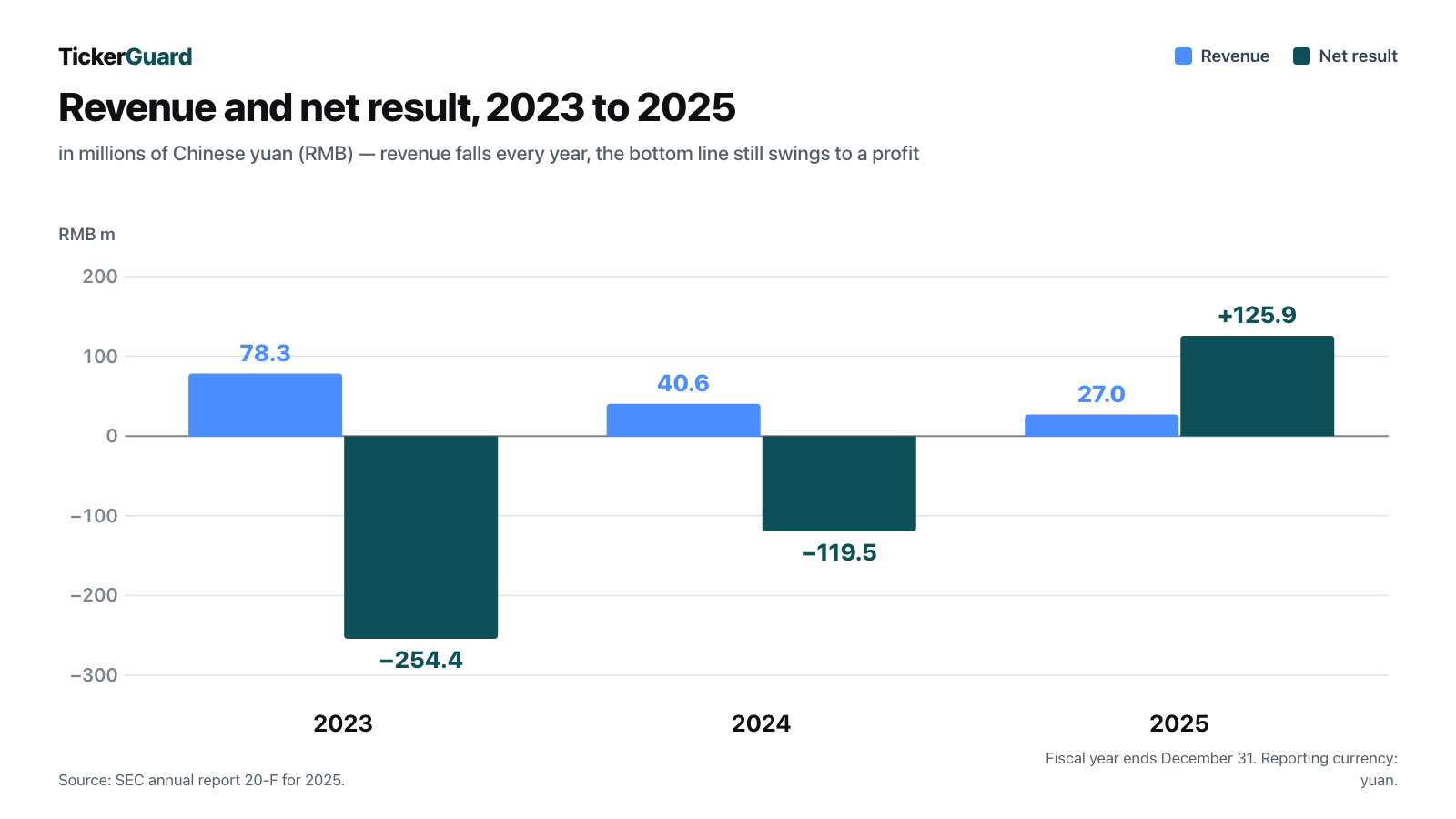
The explanation sits in the income statement, one line above operating profit: the change in fair value of cryptocurrencies. In 2024 it cost RMB 15.7 million; in 2025 it contributed RMB 178.6 million. Strip out that single line and the RMB 125.9 million profit becomes a clear loss — because 2025 also carried a gross loss of RMB 39.8 million: cost of revenues of RMB 66.8 million against revenue of RMB 27.0 million. The company sold its products for less than they cost to make.
In the first half of 2026 the same mechanism ran in reverse. Revenue fell to RMB 2.8 million ($0.4 million) from RMB 8.3 million a year earlier — the report attributes this to falling unit sales of the iPollo V series. The crypto position lost RMB 250.5 million ($36.8 million) of value. The result: a half-year net loss of RMB 316.7 million ($46.5 million), against RMB 11.8 million in the prior-year period. Chief Financial Officer Bing Chen named the cause himself in the August 28, 2026 release:
"The volatility of market prices resulted in changes in the fair value of cryptocurrencies, which in turn contributed to an increase in the net loss."
— Nano Labs Ltd, Form 6-K furnished August 28, 2026, Exhibit 99.1 (6-K 2026)
Remember that sentence: buy this stock and you are buying a crypto price first, with the chip company thrown in beside it. How far the reserve drives the picture shows elsewhere in the same release:

In fairness: the 126,662 BNB at year-end is the total holding, while the 70,000 BNB is described as a "long-term reserve" — not necessarily the same measure. What is unambiguous is the carrying value. All cryptocurrency holdings together stood at RMB 393.4 million on June 30, 2026 (RMB 109.0 million current, RMB 24.6 million restricted, RMB 259.8 million non-current), down from RMB 768.6 million six months earlier. Roughly half the reserve disappeared in six months — through price declines, disposals, or both.
What the filings say — the uncomfortable truths
Uncomfortable truth no. 1: operations have never brought cash in — the capital markets have
A profit in the income statement is an accounting figure. Whether money lands in the till shows up in the cash flow statement — and at Nano Labs it has looked the same in each of the last three years:
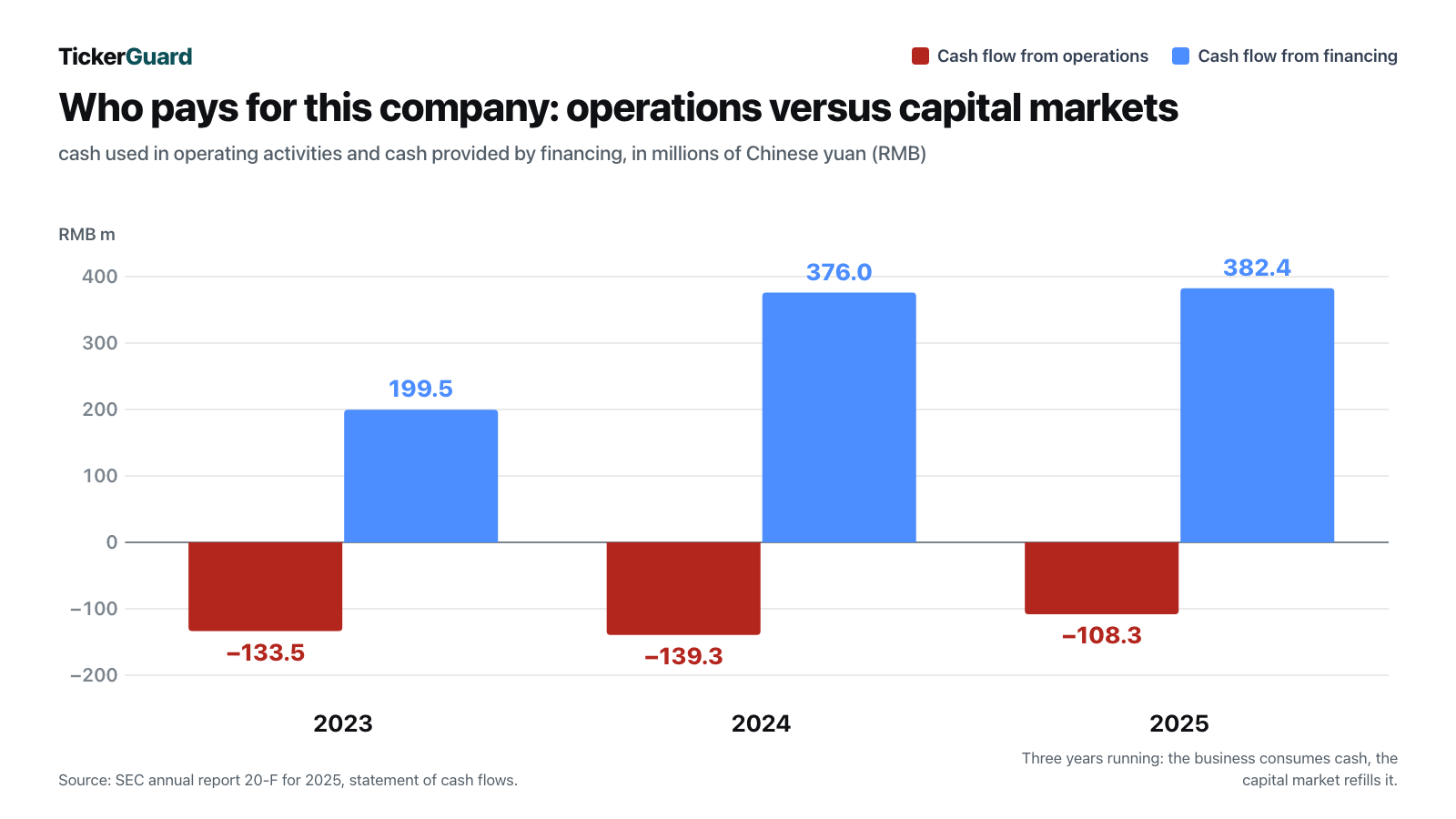
2025 is the starkest case, because profit and cash point in opposite directions: RMB 125.9 million of profit on paper, RMB 108.3 million of cash out the door. Put it in everyday terms: picture someone whose net worth rose by $20,000 last year because their portfolio rose — while they also spent $17,000 more than they earned and plugged the gap with a loan. Richer on paper, poorer in the bank account. The annual report states the consequence in plain words:
"Our ability to continue as a going concern is dependent on our management's ability to successfully execute our business plan, which includes increasing revenues while controlling costs and operating expenses as well as generating operational cash flows and continuing to gain support from outside sources of financing."
— Nano Labs Ltd, Form 20-F for 2025, Item 5 "Operating and Financial Review", section "Liquidity" (20-F 2025)

One clarification so nothing false is left standing: this is not a formal going-concern qualification from the auditor. MaloneBailey LLP signed off on the 2025 accounts without such an emphasis. It is the company's own description of its position — and it says plainly that continuation depends on continued outside financing.
Uncomfortable truth no. 2: the capital-markets money went into cryptocurrency, not into chips
When a technology company raises money, you expect it to go into technology. At Nano Labs you can do the arithmetic, and the answer is unambiguous. Research and development spending fell from RMB 88.6 million in 2023 through RMB 50.1 million in 2024 to RMB 8.1 million in 2025 — a decline of roughly 91 percent in two years. The annual report attributes it to a streamlining of development work: research salaries fell from RMB 21.0 million to RMB 2.8 million, service fees from RMB 8.0 million to RMB 0.5 million and materials from RMB 6.3 million to RMB 0.6 million. In that same year 2025, the cash flow statement shows purchases of cryptocurrency of RMB 351.4 million ($50.0 million), against disposals of RMB 55.4 million.
The ratio in one sentence: for every yuan Nano Labs put into its own technology in 2025, roughly 43 yuan went into cryptocurrency. For a company that writes in its own annual report, "We are committed to the development of HTC chips and HPC chips", that is a striking order of priorities. And it likely helps explain the revenue curve: cut development to a tenth and you have no new products to sell two years later. In the first half of 2026 development spending rose again — to RMB 4.4 million, up 39.8 percent, but from a very low base.
Uncomfortable truth no. 3: one customer supplied almost sixty percent of 2025 revenue
Customer concentration is one of those terms that looks harmless in an annual report. Translated, it means: if your neighbour tells you his business is doing well and then admits that a single client pays almost sixty percent of his invoices, would you swallow hard for a second? That is exactly what the Nano Labs risk factors disclose:
"In 2023, 2024 and 2025 we generated approximately 15.0%, 13.0% and 59.0% of our total revenues from our largest customer of each year and approximately 55.0%, 53.0% and 84.0% from the top five largest customers, respectively."
— Nano Labs Ltd, Form 20-F for 2025, Item 3.D Risk Factors (20-F 2025)

Note the direction of travel. This dependency did not build up over a decade; it jumped from 13 percent to 59 percent within a single year. Part of the reason is that total revenue collapsed — the smaller the pie, the larger any one slice. In practice: if that one customer walks away in 2026, more than half of an already tiny revenue base walks with it. We have seen this kind of dependency elsewhere in the crypto-hardware world, for instance at Riot Platforms, where the business model likewise hangs on a handful of levers.
Uncomfortable truth no. 4: $1.3 million of cash against $51.5 million of liabilities
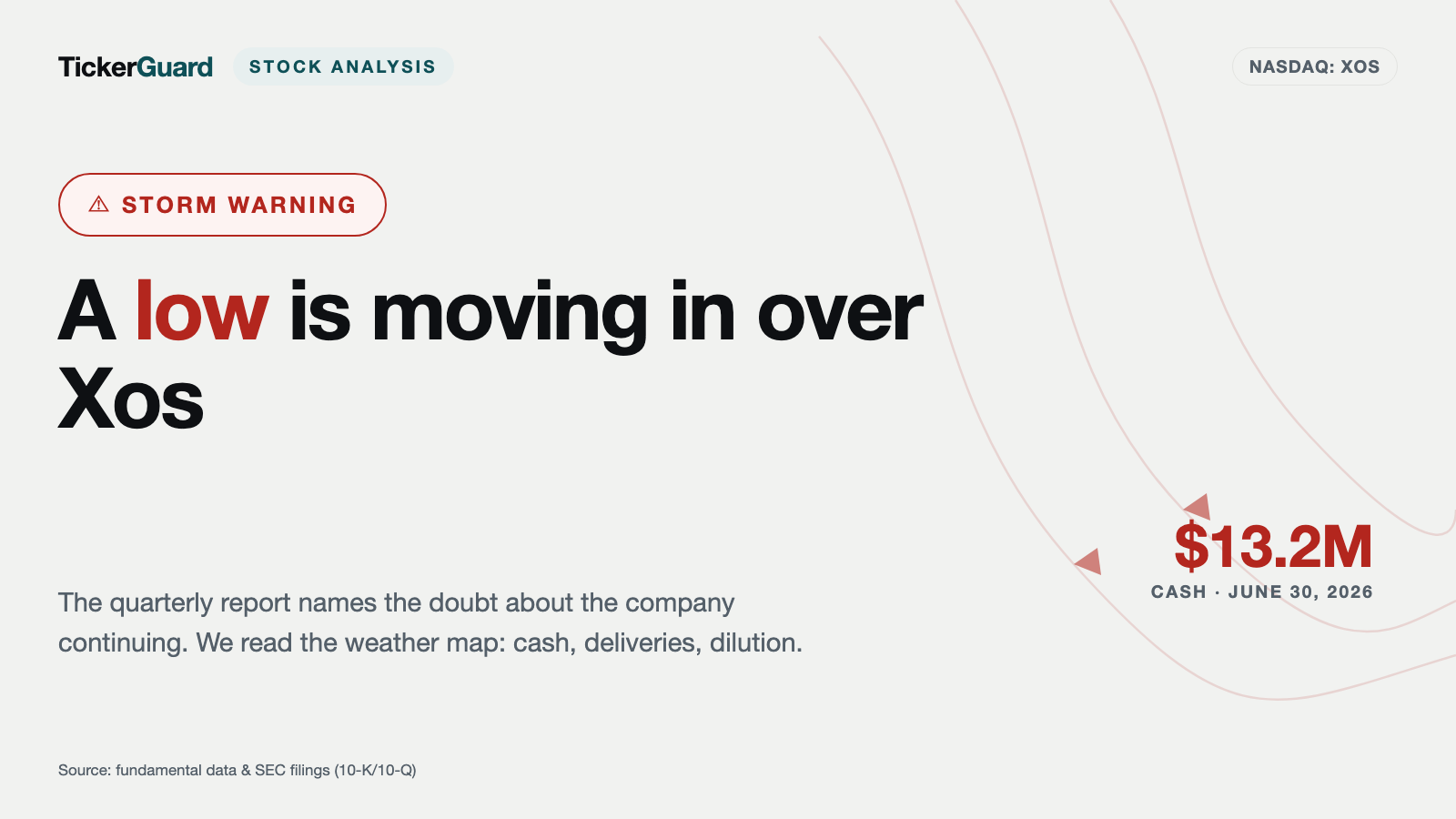
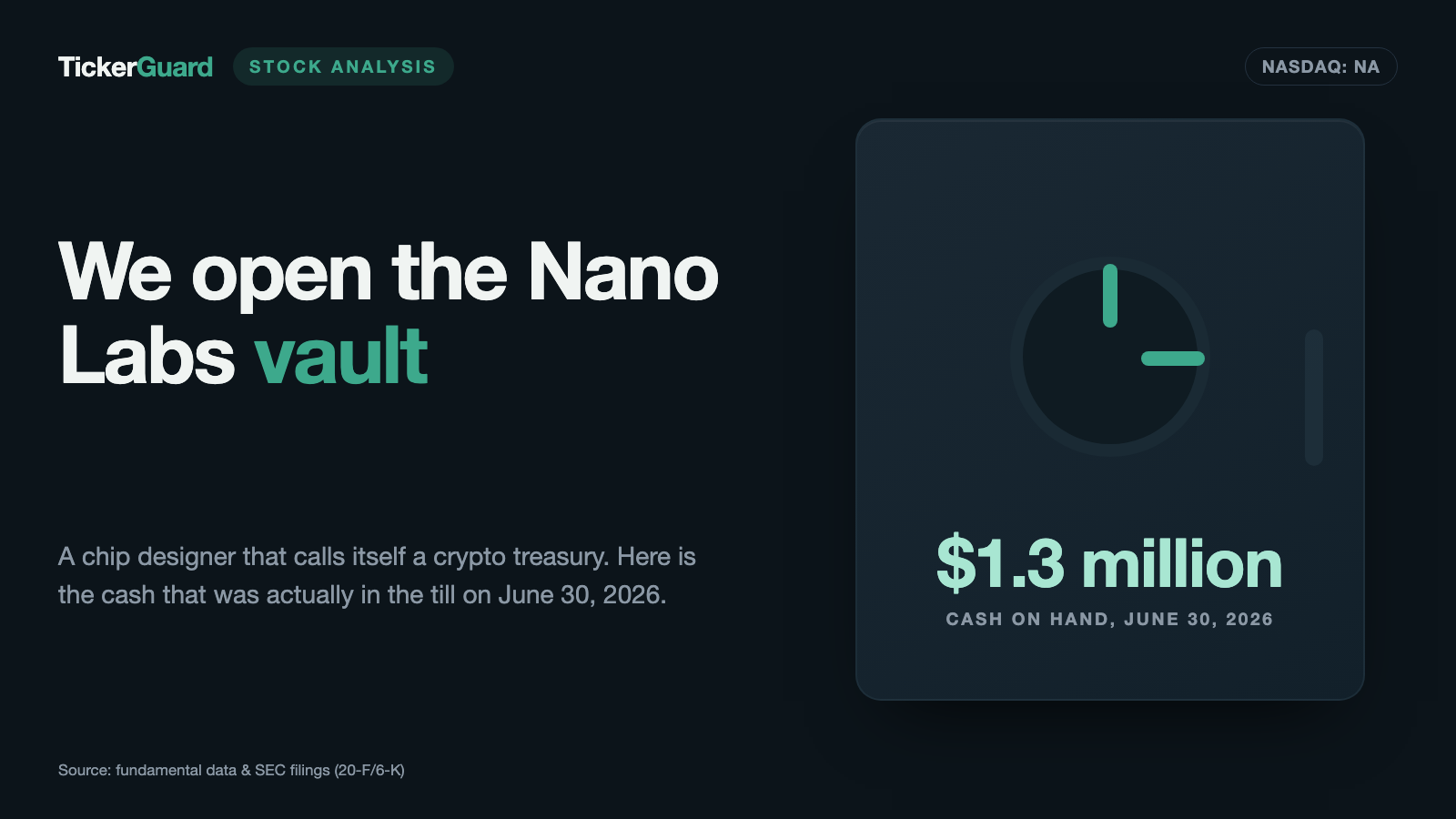
This is where the Nano Labs balance sheet stops being reassuring. At June 30, 2026 the till held RMB 9.0 million — roughly $1.3 million at the company's own conversion rate. Against that stand RMB 351.1 million ($51.5 million) of liabilities, including RMB 23.0 million of short-term debt, RMB 7.7 million of debt maturing within the year, RMB 175.0 million of long-term debt and RMB 17.7 million ($2.6 million) of borrowings denominated in cryptocurrency. For comparison, the cash operating costs of the half-year — selling, general and administrative plus research and development — added up to RMB 35.4 million. At the balance-sheet date, cash covered less than two months of them.
On the evidence of the report, staying solvent therefore rests mainly on selling cryptocurrency, issuing shares, or borrowing more. All three are happening. At December 31, 2025 Nano Labs had a credit line of RMB 198 million, of which RMB 177.8 million ($25.3 million) was drawn — secured by property, plant and equipment with a net book value of RMB 176.7 million and an intangible asset of RMB 45.8 million. In plain English: what is pledged are the buildings the company put up in Hangzhou and Shaoxing, together with the 49,452-square-metre land use right in Shaoxing that it acquired for 50 years in 2022. Which yields a rule that reaches beyond Nano Labs: a high equity ratio does not help when the equity sits in an asset that can fall by a third in a day.
Uncomfortable truth no. 5: a twenty-to-one consolidation — and three times as many shares anyway
Dilution translates as: your slice of the cake gets smaller because new slices keep being cut. At Nano Labs the cake has been recut twice. Effective January 31, 2024 the company consolidated two shares into one; effective November 3, 2024 it consolidated ten into one — a combined 20-to-1 consolidation within ten months. A consolidation by itself takes nothing away from anyone; it turns twenty small slices into one large one. It is typically done when a share price risks falling below exchange listing requirements.
What happened afterwards is the interesting part. The weighted average share count rose from 5,888,507 (2023) through 8,049,592 (2024) to 19,858,117 (2025), and to 22,674,071 in the first half of 2026 — almost four times in two and a half years, and that after the 20-to-1 consolidation. Two conversions of shareholder loans into shares (2023 and 2024) and several shelf placements sit inside that number. How much room remains is stated in the balance-sheet parenthesis: 1,097,141,091 authorized Class A ordinary shares against 20,712,924 issued. On top of that sit warrants over a weighted average of 2,348,554 shares, excluded from diluted earnings per share in 2025 only because they would have improved the result. And the votes are settled regardless: directors and executive officers held 34.9 percent of the shares but 90.7 percent of the voting power at the time of the annual report — every Class B share carries 50 votes. No shareholder meeting here decides anything the founder does not want.
Uncomfortable truth no. 6: a second, leveraged floor — the decumulator contracts
Anyone reading this far may take Nano Labs for a transparent BNB proxy: crypto up, stock up. The balance sheet at June 30, 2026 shows one more layer. It carries, for the first time, a line called "Derivative assets" at RMB 41.7 million ($6.1 million) that did not exist six months earlier. The report explains it by saying the company entered into "decumulator agreements" with third parties. A decumulator is a structured forward arrangement: you sell an underlying asset in instalments at an agreed price over a fixed period — and in the adverse case must deliver a multiple of the quantity. The annual report describes the family of these instruments itself:
"We hold BNB as a primary reserve asset and, in connection with our treasury management and investment activities, we have entered into derivative contracts such as decumulator agreements and cryptocurrency loan arrangements."
— Nano Labs Ltd, Form 20-F for 2025, Item 3.D Risk Factors (20-F 2025)
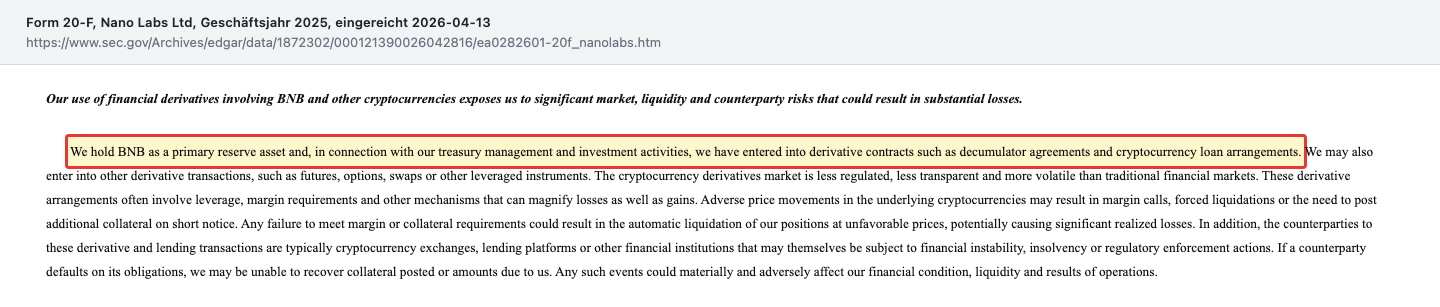
In the first half of 2026 the position already cost RMB 2.8 million in fair value. Measured against the half-year loss that is small — but the point is not the loss so far, it is the construction: the report itself names leverage, margin calls and the possibility of forced liquidation at unfavourable prices. We have therefore also logged the find in our side finds feed.
Valuation: what roughly $55 million actually buys here
Let us do the arithmetic soberly. At June 30, 2026 there were 19,147,732 Class A and 2,858,909 Class B shares outstanding, roughly 22.0 million in total. At the closing price of $2.48 on September 11, 2026 that is a market capitalization of roughly $55 million. Against it: equity attributable to Nano Labs shareholders of RMB 400.2 million ($58.8 million) — a price-to-book ratio of about 0.93. And trailing twelve-month revenue of roughly RMB 21.5 million (about $3.2 million), which puts the price-to-sales ratio at roughly 17.
Together those two numbers give the real picture. A price-to-book ratio just under 1 looks like substance — but more than half of that book value is cryptocurrency (RMB 393.4 million of RMB 736.7 million in total assets), and it lost roughly half its value in the last reported half-year. A price-to-sales ratio of 17 would be arguable for a growing software company; here it sits on revenue that has fallen for three years and is sold at a gross loss. Buy this share and you are chiefly buying a leveraged, debt-financed BNB position with a shrinking chip company attached — a pattern we have seen at other companies with crypto balance sheets, for instance in our analysis of American Bitcoin.
There is no analyst consensus: no estimates for Nano Labs exist in the data set. For a company this size that is normal, and it is itself information — nobody is pre-chewing the numbers for you. A price-to-earnings ratio cannot be formed for lack of sustainable earnings anyway; the 2025 profit was the product of a price move, not of a business.
Opportunities and risks at a glance
What speaks for Nano Labs:
- Real engineering rather than an empty shell: proprietary chip architectures at 55, 40 and 22 nanometers, 46 granted patents, 40 software copyrights and four IC layout-design rights as of December 31, 2025.
- The balance sheet is not over-indebted: RMB 736.7 million of total assets against RMB 351.1 million of liabilities at June 30, 2026, an equity ratio of roughly 52 percent; the share trades slightly below reported book value at a price-to-book ratio of about 0.93.
- The crypto reserve is a real, liquid asset: RMB 393.4 million at June 30, 2026, held in wallets at exchanges including Hashkey Exchange, CEFFU, Coinbase and Binance, protected by a multi-signature arrangement and hardware wallets kept in safes — a rising BNB price feeds straight through to book value and earnings.
- A buyback is running: in October 2025 the company announced repurchases of up to $25.0 million; as of August 26, 2026, $3.2 million of that had been executed.
- New footholds are documented rather than merely asserted: a validator node on the Canton Network (August 5, 2026) and a memorandum of understanding with ALT5 Sigma on AI data centers (April 24, 2026) — neither carries a revenue commitment, but both are on file.
What speaks against it:
- The operating business has all but vanished: revenue of RMB 78.3 million, RMB 40.6 million and RMB 27.0 million from 2023 to 2025, and RMB 2.8 million in the first half of 2026, with a gross loss throughout — RMB 39.8 million in 2025 and RMB 5.8 million in the first half of 2026.
- Operations consume cash: operating cash flow of minus RMB 133.5 million, minus RMB 139.3 million and minus RMB 108.3 million from 2023 to 2025 — including in the profitable year 2025. The annual report ties continuation explicitly to further outside financing.
- Cash is thin: RMB 9.0 million ($1.3 million) at June 30, 2026 against RMB 35.4 million of cash operating costs in the preceding half-year alone; property, plant and equipment and an intangible asset are pledged against a drawn credit line of RMB 177.8 million.
- The bottom line hangs on a single price: a RMB 250.5 million fair-value loss on cryptocurrency in the first half of 2026 against a RMB 178.6 million gain in 2025 — plus RMB 41.7 million of derivatives from decumulator contracts that the report itself describes in terms of leverage and margin calls.
- Dependencies and control: 59 percent of 2025 revenue from a single customer and 84 percent from five; directors and executive officers hold 34.9 percent of the shares and 90.7 percent of the votes, against authorized capital of 1,097,141,091 Class A shares versus 20,712,924 issued.
A human bottom line
Back to the new sign trap. Its core is not that signs lie — every Nano Labs sign is formally accurate. The company really does design chips, it really does hold BNB, it really does sell a small AI computer. Its core is that a sign implies a scale nobody actually promised. "Crypto treasury company" sounds like a war chest; the war chest held $1.3 million on June 30, 2026. "AI agent hardware" sounds like a product cycle; the half-year before it, $0.4 million of goods were sold. "Chip designer" sounds like research; research spending has fallen roughly 91 percent in two years.
All of it is legal and fully disclosed — it simply makes the stock something other than what the sign suggests. It is a leveraged ticket on the BNB price, fitted with debt, pledged buildings, one large customer and a management group holding 90.7 percent of the votes. If that is what you want, you can have it here — but then call it what it is: a crypto bet, not a chip or AI investment. So the honest question is not "is Nano Labs an AI stock?" but: would you pay a premium for a crypto portfolio that comes with a shrinking company and a thin cash balance attached — run by managers you can never vote out? If yes, you have a thesis. If no, you had a sign. What you do with it is your call.
Sources
All original documents used in this analysis, for you to read yourself:
- Nano Labs Ltd — SEC annual report Form 20-F for 2025 (filed April 13, 2026)
- Nano Labs Ltd — SEC Form 6-K furnished August 28, 2026, Exhibit 99.1: half-year results and balance sheet at June 30, 2026
- Nano Labs Ltd — SEC Form 6-K furnished March 30, 2026, Exhibit 99.1: second-half 2025 results
- Nano Labs Ltd — SEC Form 6-K furnished August 5, 2026: Canton Network validator node
- Nano Labs Ltd — SEC Form 6-K furnished April 24, 2026: memorandum of understanding with ALT5 Sigma
- Nano Labs Ltd — SEC Form 6-K furnished August 31, 2026: resignation of a director
- Complete SEC filing history for Nano Labs Ltd: EDGAR overview (sec.gov)
- Fundamental data (price history, free float, short interest, metrics; data as of September 11, 2026), reconciled with the SEC filings.
Transparency & disclaimer: This analysis is a journalistic assessment of publicly available information. It is not investment advice, not a regulated financial analysis, and not a solicitation to buy or sell securities. Equity investments carry substantial risk up to and including total loss. All information without warranty; the as-of date of each figure is stated in the text. The author holds no position in Nano Labs shares at the time of publication.
Key figures at a glance
All monetary figures in millions of CNY; earnings per share as reported.
| Metric | 2021 | 2022 | 2023 | 2024 | 2025 |
|---|---|---|---|---|---|
| Revenue | 39.4 | 983.2 | 78.3 | 40.6 | 27.0 |
| Operating Income (EBIT) | -178.8 | 20.7 | -260.8 | -98.5 | -107.2 |
| Net Income | -174.9 | 31.1 | -252.8 | -113.2 | 135.5 |
| Net Margin | -443.6% | 3.2% | -322.7% | -278.8% | 501.6% |
| Earnings Per Share | -3.37 CNY | 0.58 CNY | -4.29 CNY | -1.67 CNY | 5.74 CNY |
Source: fundamental data & SEC filings (annual and quarterly reports, 10-K/10-Q)
Our Bottom Line at a Glance
- Operating business negative
- Revenue fell three years running from RMB 78.3 million (2023) through RMB 40.6 million (2024) to RMB 27.0 million (2025), and to RMB 2.8 million in the first half of 2026. In both most recently reported periods, cost of revenues exceeded revenue — a gross loss of RMB 39.8 million in 2025 and RMB 5.8 million in the first half of 2026. Research spending fell from RMB 88.6 million to RMB 8.1 million.
- Earnings quality negative
- The reported result measures the BNB price, not the business: in 2025 the change in fair value of cryptocurrency added RMB 178.6 million to net income of RMB 125.9 million; in the first half of 2026 the same line cost RMB 250.5 million and produced a loss of RMB 316.7 million. On top sit RMB 41.7 million of derivatives from decumulator contracts.
- Liquidity & funding negative
- At June 30, 2026 cash stood at RMB 9.0 million ($1.3 million) against RMB 35.4 million of cash operating costs in the preceding half-year alone and RMB 351.1 million of liabilities. Operating cash flow was negative throughout 2023 to 2025 (RMB −133.5 / −139.3 / −108.3 million); the capital markets filled the gap (RMB +199.5 / +376.0 / +382.4 million).
- Dependencies negative
- A single customer accounted for 59.0 percent of 2025 revenue and the top five for 84.0 percent — up from 13.0 percent and 53.0 percent in 2024. At the same time more than half of total assets (RMB 393.4 million of RMB 736.7 million at June 30, 2026) hangs on the price of one cryptocurrency, part of it pledged and part of it levered through derivatives.
- Balance-sheet substance & valuation neutral
- The balance sheet is not over-indebted: RMB 736.7 million of total assets against RMB 351.1 million of liabilities, an equity ratio of roughly 52 percent; the share trades slightly below reported book value at a price-to-book ratio of about 0.93 (as of September 11, 2026). That book value, however, is mostly cryptocurrency, which lost roughly half its value in the last reported half-year.
- Shareholder structure negative
- Class B shares carry 50 votes each: at the time of the annual report, directors and executive officers held 34.9 percent of the shares and 90.7 percent of the votes. Authorized capital covers 1,097,141,091 Class A shares against 20,712,924 issued; the weighted average share count rose from 5.9 million (2023) to 22.7 million (first half of 2026) despite a 20-to-1 consolidation.
Nano Labs runs three signs above the same door: chip designer, crypto treasury company and, since March 2026, supplier of AI agent hardware. Its filings with the U.S. securities regulator, the SEC, show what stands behind them: RMB 27.0 million of revenue in 2025 and RMB 2.8 million in the first half of 2026, both at a gross loss; a bottom line that tracks the BNB price (2025: +RMB 125.9 million; first half of 2026: −RMB 316.7 million); three consecutive years of cash draining out of operations and being replaced by the capital markets; and, at June 30, 2026, $1.3 million of cash against $51.5 million of liabilities. Against that stand real patents, a balance sheet that is not over-indebted and a liquid crypto reserve. Not investment advice.
What Our Rating Means
Substance risk
We found at least one documented issue that threatens the company itself — regardless of how the stock is currently valued.
Red, because two of the hard substance findings are documented rather than merely suspected. First, persistently negative operating cash flow despite reported profit: in 2023, 2024 and 2025 operating activities used RMB 133.5 million, RMB 139.3 million and RMB 108.3 million — including in 2025, the year of the reported RMB 125.9 million profit. In its "Liquidity" section the annual report itself ties continuation as a going concern to management executing its business plan and "continuing to gain support from outside sources of financing". Second, cash runway: at June 30, 2026 cash stood at RMB 9.0 million ($1.3 million), while cash operating costs for selling, administration and development in the preceding half-year alone came to RMB 35.4 million — that is not two months of cover, let alone four quarters. Add dependence on a single counterparty on the revenue side: 59.0 percent of 2025 revenue from one customer. Explicitly not relevant to the rating are the points one might expect here: that the share looks optically cheap at a price-to-book ratio of about 0.93, that it swung between $1.58 and $6.10 over twelve months, that the free float is narrow and short interest high. Those are price and trading arguments; they neither justify red nor rule out green. Fairness requires the other side: auditor MaloneBailey LLP issued the 2025 opinion without a going-concern emphasis, equity is clearly positive at RMB 400.2 million, the equity ratio stood at roughly 52 percent on June 30, 2026, and the crypto reserve is a liquid asset that can be sold. Yellow would come back into view once a full reporting period shows positive operating cash flow and cash covers a year of running costs — without selling reserve assets. The decision is yours.
A journalistic assessment by our editorial team at the time of the deep dive, based on public sources — not investment advice and not a solicitation to buy or sell. Your personal circumstances (investment goals, risk capacity, taxes) cannot be taken into account. What our levels mean, how verdicts are formed, and what conflicts of interest exist →
Worth Noting
- Nano Labs reached our research list through market observation rather than a quality filter: a 52-week range of $1.58 to $6.10, beta 3.47, short interest at 9.7 percent of a free float of roughly 8.4 million shares, interest coverage of minus 6.28 and a Piotroski score of 5 out of 9 (data as of September 11, 2026). No Altman Z-score and no net current asset value, because the accounts are kept in yuan against a dollar listing.
- Recency: the most recent periodic report is the annual report on Form 20-F for 2025, filed April 13, 2026. As a foreign private issuer, Nano Labs files no quarterly report (Form 10-Q); the latest figures come from the Form 6-K furnished August 28, 2026 (six months to June 30, 2026). All four 6-K reports after April 13, 2026 were reviewed, along with eight insider reports (Form 4) and two Form 144 notices that do not change the picture.
- Confusion risk and currency: the ticker "NA" denotes other companies on other exchanges; this analysis covers only Nano Labs Ltd with SEC file number CIK 0001872302. The accounts are prepared under U.S. GAAP in Chinese yuan while the share trades in U.S. dollars; dollar figures in this article come from the company's own conversions (RMB 7.0288 per dollar at December 31, 2025; RMB 6.8109 at June 30, 2026).
Stock Watch
This analysis is as of September 18, 2026. Stock Watch will tell you what's changed at NA since then.
Later $1 a month per stock — signing up is free, and you'll be the first to know when it launches.
The full analysis as a PDF for later
We will send you this analysis as a PDF — to print, file away, and read at your own pace. And we will add you to the free Stock Watch list for Nano Labs Ltd (NA), so you hear about it when something material in this analysis changes.
Frequently Asked Questions
Nano Labs Ltd (Nasdaq: NA) is a fabless chip designer based in Hangzhou, China, incorporated in the Cayman Islands, with 67 employees as of December 31, 2025. It designs semiconductors for high-throughput computing (Cuckoo) and high-performance computing (Darkbird) and sells bitcoin mining machines under the iPollo brand; manufacturing runs through third-party foundries. Since 2025 it also holds the cryptocurrency BNB as a declared reserve asset.
Because the SEC treats the company as a foreign private issuer. Such filers submit an annual report on Form 20-F and furnish interim updates on Form 6-K. There is no quarterly report (Form 10-Q) for this filer type. Nano Labs reports semi-annually: the figures for the six months to June 30, 2026 were published on August 28, 2026, and the annual report for 2025 on April 13, 2026.
Revenue fell from RMB 78.3 million in 2023 through RMB 40.6 million in 2024 to RMB 27.0 million in 2025 — roughly $3.8 million at the company's own reference rate. In the first half of 2026 it was RMB 2.8 million ($0.4 million), down from RMB 8.3 million in the prior-year period. In both periods cost of revenues exceeded revenue, producing a gross loss.
Because both came from the same line: the change in fair value of cryptocurrency holdings. In 2025 it contributed RMB 178.6 million and carried the group net income of RMB 125.9 million. In the first half of 2026 the same position cost RMB 250.5 million ($36.8 million) and produced a half-year net loss of RMB 316.7 million ($46.5 million). The operating business was loss-making in both periods.
At December 31, 2025 the annual report states 126,662 BNB with a fair value of RMB 768.6 million ($109.3 million) on a cost basis of RMB 636.3 million, plus a receivable for 3,338 BNB posted as collateral with an exchange. In the interim report of August 28, 2026 the company names a long-term reserve of 70,000 BNB. On the balance sheet at June 30, 2026, all cryptocurrency holdings together carry RMB 393.4 million.
At June 30, 2026 the company held RMB 9.0 million, roughly $1.3 million at its own conversion rate — after RMB 8.5 million at December 31, 2025 and RMB 32.4 million a year before that. Against it stand liabilities of RMB 351.1 million ($51.5 million). Cash operating costs for selling, administration and development alone came to RMB 35.4 million in the first half of 2026.
Voting power is split across two share classes: each Class A share carries one vote, each Class B share 50. At the time of the annual report, directors and executive officers together held 34.9 percent of the shares but 90.7 percent of the votes. Founder, chairman and chief executive Jianping Kong accounted for 21.6 percent of the shares and 54.1 percent of the votes. Minority shareholders cannot carry a decision against the founders.
Measured against book value it looks cheap: roughly $55 million of market capitalization (22.0 million shares at the closing price of $2.48 on September 11, 2026) against attributable equity of $58.8 million, a price-to-book ratio of about 0.93. More than half of that book value, however, is cryptocurrency. Measured against trailing twelve-month revenue, the price-to-sales ratio sits at roughly 17.
Found an error?
Did you spot a factual error, an outdated number, or a typo in this deep dive? Let us know briefly — your report goes straight to the editorial team.