American Bitcoin: 8,002 bitcoin, two employees — and a majority owner with 10,000 votes per share
The name reads like the whole investment case, and a famous surname sits on the founder list. The filings with the U.S. securities regulator, the SEC, tell a plainer story. As of June 30, 2026 American Bitcoin held exactly 8,002 bitcoin worth $478.9 million — it had paid $781.9 million for them. The machines run in someone else's data centers, operated by someone else's staff: majority owner Hut 8 billed $67.7 million in the first half of 2026 against $129.1 million of consolidated revenue and held roughly 80 percent of the Class B shares carrying 10,000 votes each as of March 25, 2026. Full-time employees of its own as of December 31, 2025: two. Not investment advice — just the question of who really owns the vault.
 Thomas Mücke
Founder & Publisher
Thomas Mücke
Founder & Publisher
As of Today
As of: September 17, 2026
- Closing price
- 8.80 $ +8.50%
- Market Capitalisation
- 1.1 $B
- Growth Score
- 4/10
- AAQS
- 4/10
Price change since August 21, 2026: +11.0%
This analysis has a cut-off date. The Stock Guard tells you when something material changes in the numbers. Reserve your free spot
Chart
Interactive price chart (TradingView).
52-week range: 0.562 $ to 9.30 $ · Last price: 8.80 $ (As of: September 17, 2026)
Note: pure fact-based analysis, not investment advice and not a solicitation to buy or sell. All figures without guarantee.
There is an investor trap that requires no weakness in arithmetic, only a little reading fatigue: the label trap. It works like this — the packaging already states the entire investment case, and the brain stops checking. "American Bitcoin": America, bitcoin, done. Add a co-founder whose surname everybody knows and a chief executive who talks about building "America's bitcoin infrastructure backbone", and most readers have formed a view before the first number arrives. So let us make a deal. We will read the documents this company has to file, under penalty of law, with the U.S. securities regulator, the SEC: the Form 10-K for 2025 filed March 27, 2026, the Form 10-Q for the period ended June 30, 2026 filed August 3, 2026, and the Forms 8-K of July 6 and August 3, 2026. What you make of the label afterwards is up to you.
What American Bitcoin actually does — and how a cannabis software firm became a bitcoin miner
American Bitcoin Corp. does two things: it mines bitcoin and it keeps bitcoin. Mining means that tens of thousands of specialised computers solve the bitcoin network's puzzles around the clock and get paid in bitcoin — picture a hall full of machines that take in electricity and spit out coins. In the quarter ended June 30, 2026 that produced 932 bitcoin, the highest quarterly output in the company's history. Accumulating means the coins are not sold but held and topped up with purchases: as of June 30, 2026 the reserve stood at 8,002 bitcoin, up from 5,401 at year-end 2025.
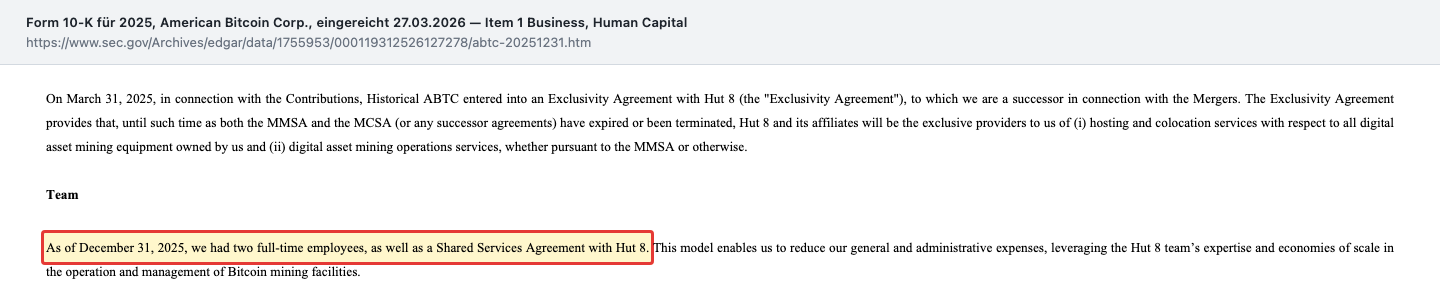
The central tension of this analysis is already contained in that plain description; you only have to ask one question: who owns the hall? The answer is Hut 8 Corp., and it runs through every chapter that follows. All five sites — Alpha in Niagara Falls, New York; Medicine Hat and Drumheller in Alberta; Salt Creek in Orla and Vega in Amarillo, both Texas — belong to Hut 8. Hut 8 operates them, Hut 8 runs the day-to-day business, Hut 8 handles accounting, human resources and legal. American Bitcoin itself had two full-time employees as of December 31, 2025. Readers who want to look at the parent in detail will find it in our Hut 8 analysis.
Before we go further, one detail that does not appear on a quote page and yet explains a great deal: this company is on its fourth name. According to the SEC's own registrant records, the entity with central index key 1755953 was called MTech Acquisition Holdings Inc. from November 7, 2018 — a blank-check vehicle raising money to take some business public. From December 4, 2018 it was Akerna Corp., selling compliance software to cannabis retailers. From February 14, 2024 it was Gryphon Digital Mining, Inc., mining bitcoin. And since September 3, 2025 it has been American Bitcoin Corp. The path there had two steps. On March 31, 2025 Hut 8 contributed its own mining rigs to a company called American Data Centers Inc. and received new Class B shares representing "80 % of the total and combined voting power and 80 % of the issued and outstanding equity interests". On September 3, 2025 that entity merged with the listed Gryphon, which then changed its name. For accounting purposes the younger company is treated as the buyer and the listed one as the target; the technical term is a reverse acquisition. In plain English: a young company bought itself a listing. What it paid comes later.
Company history for investors
-
2018
Life begins as the blank-check company MTech Acquisition Holdings
The entity with SEC central index key 1755953 starts as an empty vehicle raising capital. For today's shareholders it is the root of every later name change.
-
2018
Renamed Akerna Corp. on December 4, 2018 — software for the cannabis industry
The shell becomes a software vendor for cannabis retailers. From this era comes the $2.2 million loan settled in 2026 for roughly $2.5 million.
-
2024
Second name change: Gryphon Digital Mining
From February 14, 2024 the same entity mines bitcoin. Anyone reading price series from before that date is looking at an entirely different business model.
-
2025
Hut 8 contributes its mining rigs and takes 80 percent
On March 31, 2025 Hut 8 hands over its rigs for Class B shares representing 80 percent of equity and votes. The dependence that still shapes the business starts here.
-
2025
Merger with Gryphon and listing as ABTC
The listing arrives on September 3, 2025 at a closing price of $8.04, or $120.60 on today's basis. The price of it: $154.4 million of goodwill on the balance sheet.
-
2026
1-for-15 reverse stock split
On July 2, 2026 the 1,092,295,800 shares become roughly 73 million. That changes no holding's value — but it makes visible how far the price had fallen.
-
2026
Record quarter and a change in the finance seat
On August 3, 2026 the company reports 932 bitcoin mined and a $57.2 million loss. President and interim CFO Matthew Prusak had already announced his resignation on July 30, 2026, effective August 4, 2026.
How this stock landed on our desk
It did not come out of one of our momentum or value screens — as a standalone business the company simply lacks the history. The trigger was the SEC filing feed. On July 6, 2026 the company disclosed under Items 3.03 and 5.03 of a Form 8-K that it had carried out a 1-for-15 reverse stock split. A reverse split is pure arithmetic: fifteen shares become one, the quoted price multiplies accordingly, and the value of a holding does not change. But it says something about the price action that preceded it. And it surfaced a number that is otherwise easy to miss: the share count fell "from 1,092,295,800 shares […] to approximately 73 million shares".
The second trigger was the Form 10-Q for the period ended June 30, 2026, filed August 3, 2026, together with the earnings release of the same day. Between them they allow the first clean look at four full quarters of a standalone company. Keep this in mind for everything that follows: the corporate entity is younger than most of its bitcoin. Figures for 2023 and 2024 are carved out of a business unit inside Hut 8 and do not describe the same company.
The numbers over the years — credit where it is due
First the part that genuinely impresses, and there is a fair amount of it. The operation works and it scales. Revenue in the quarter ended June 30, 2026 was $67.0 million against $30.3 million a year earlier — a doubling. Cost of revenue, essentially electricity, came to $34.0 million, leaving a gross profit of $33.0 million, or roughly 49 percent. For a mining operation that is a solid number, especially in a quarter when the bitcoin price fell about 12 percent. Per bitcoin mined the company took in roughly $71,900 and spent roughly $36,500, so the machine earns as long as bitcoin trades well above its power cost. In April 2026 the Drumheller site brought 11,298 new rigs and 3.05 exahash per second online, lifting the operating fleet to 58,999 rigs and 25.0 exahash per second. And the balance sheet carries weight: $1,309.4 million of total assets, $672.1 million of equity and no interest-bearing debt as of June 30, 2026.
Now the chart that puts it in context. It shows revenue and net income across four periods — and why the bottom line at this company measures something other than the business:
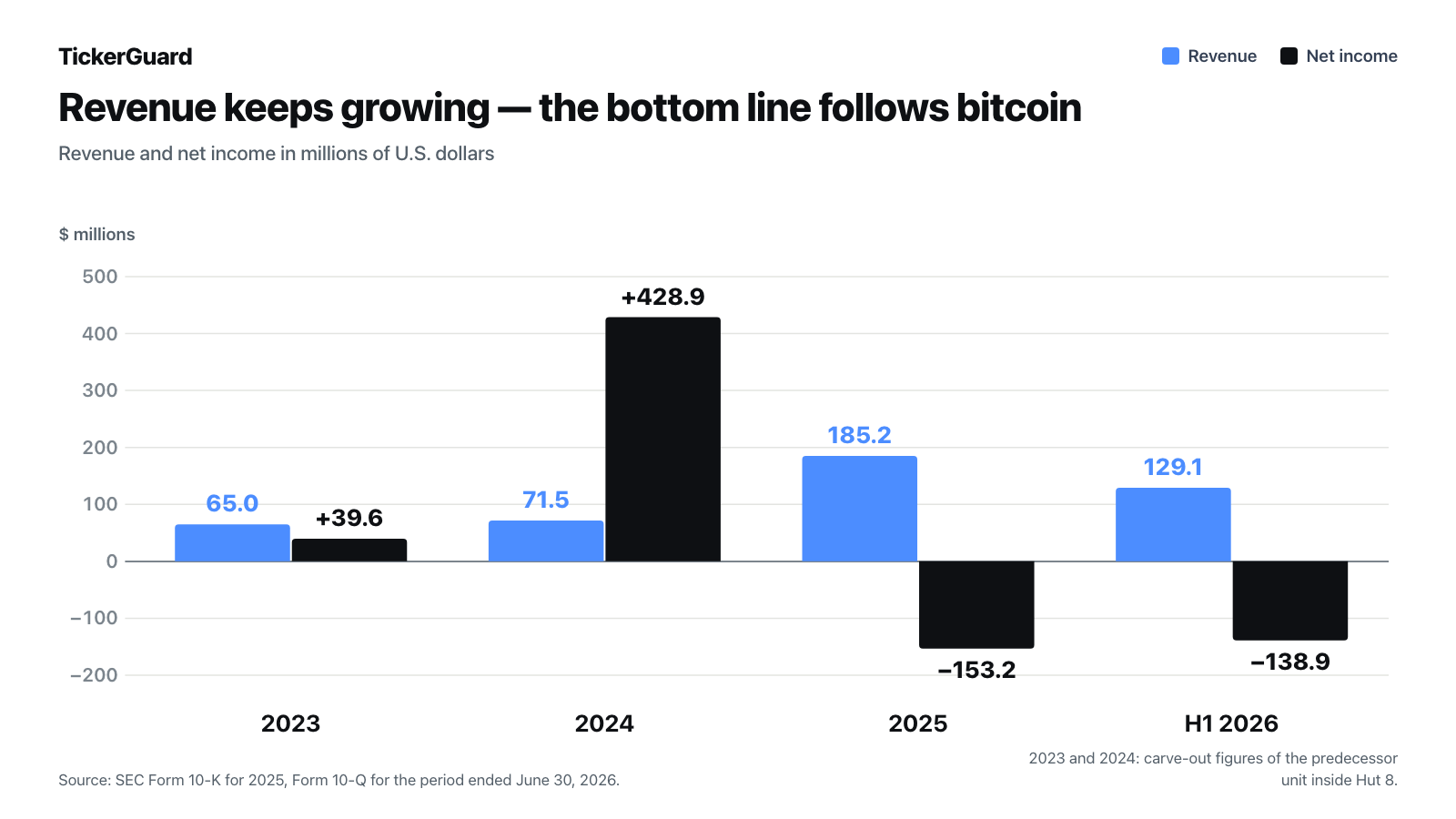
The reason for the swing is an accounting rule in force since 2025: bitcoin is remeasured at fair value on every reporting date, and the change runs straight through the income statement. In the first half of 2026 that cost $188.4 million — not as a payment, but as a write-down. Strip it out and the operating picture is one you could actually debate. Remember the image: at American Bitcoin the bottom line is a thermometer for the bitcoin price, not a report card for the business. Which is exactly why the chapters below matter.
What the filings say — the uncomfortable truths
Uncomfortable truth no. 1: the vault is worth $478.9 million and cost $781.9 million
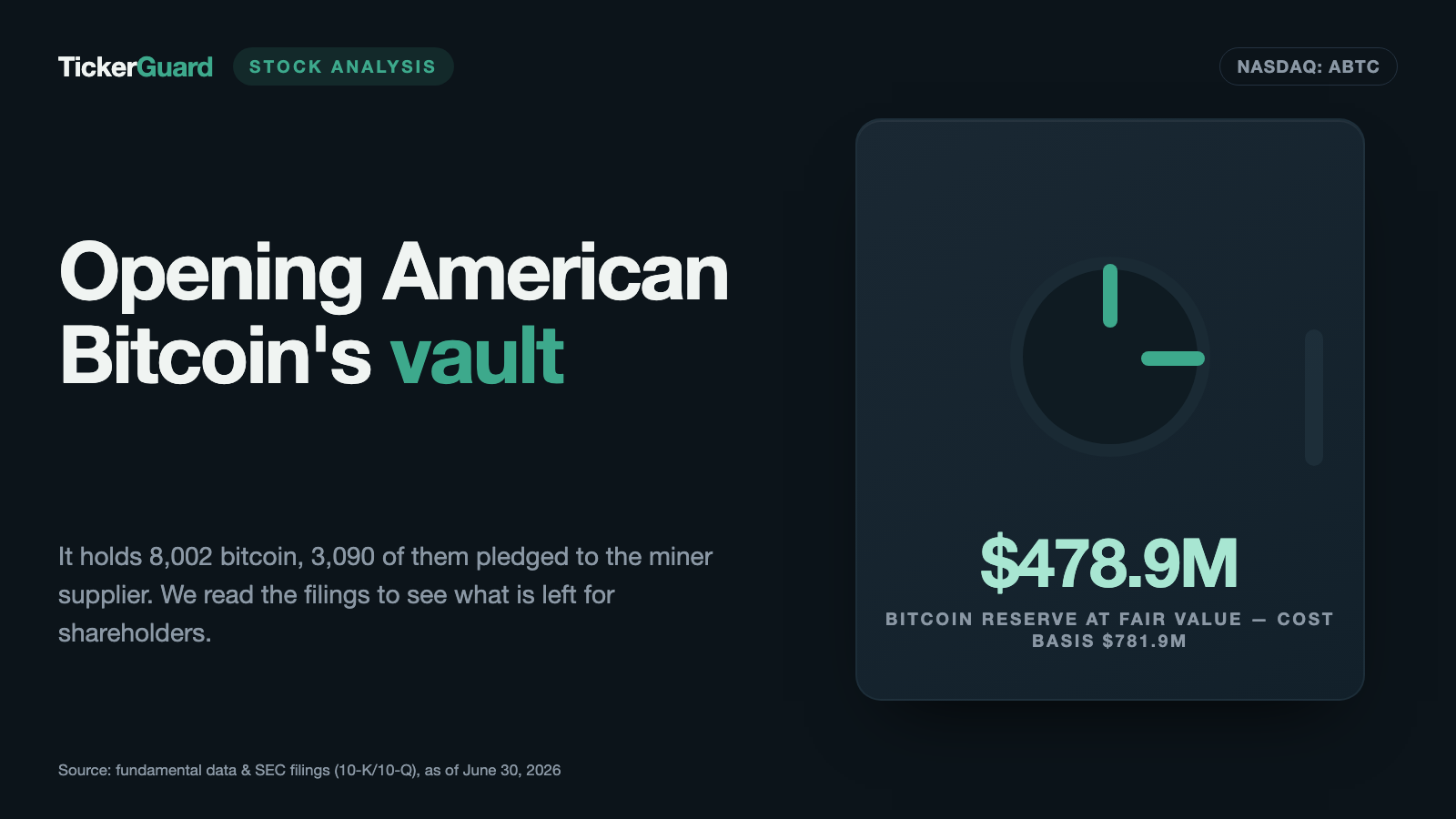
The central number of this analysis sits in a single line of the quarterly report's notes. As of June 30, 2026 American Bitcoin held 8,002 bitcoin with a fair value of $478.9 million. The cost basis of those bitcoin was $781.9 million. The $303.0 million difference is not a forecast or an opinion but arithmetic: the company built its stack at an implied average of $97,716 per bitcoin while one bitcoin was worth $59,847 on the reporting date. In everyday terms: paying $97,716 for a car that is worth $59,847 on the balance sheet date does not make it a bad car. It makes it an expensive purchase.
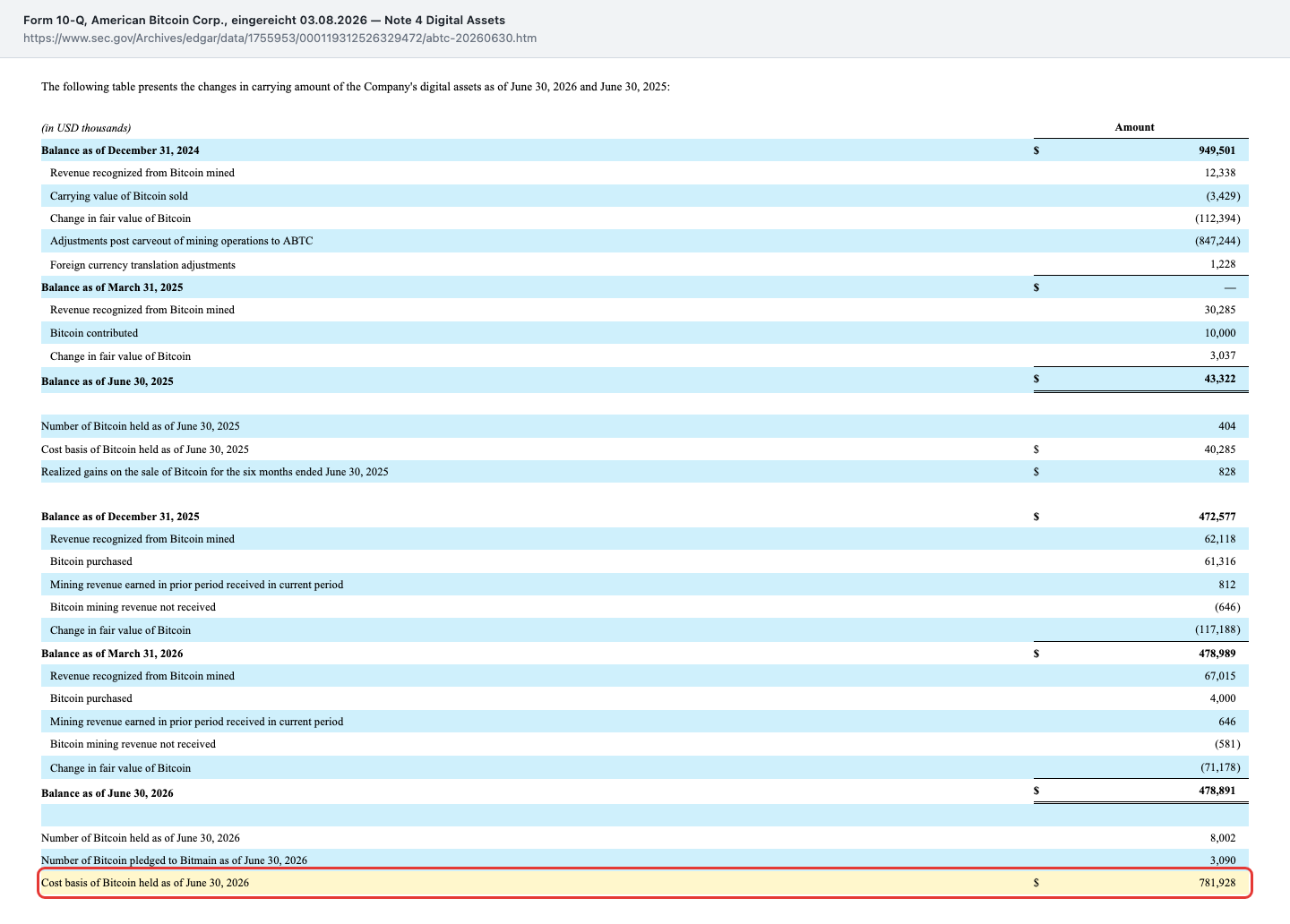
There is a further restriction that lives in the notes and appears only as a footnote in the press release: 3,090 of the 8,002 bitcoin are pledged — deposited with Chinese rig maker Bitmain as payment for mining machines. The company may redeem them for cash within roughly 24 months; if it does not, they pass to Bitmain for good. Their fair value on the reporting date was $184.9 million. The liability recorded against them: $371.7 million. The gap exists because the coins were pledged at a mutually agreed fixed price well above today's market value. That leaves 4,912 bitcoin, worth $293.9 million, freely available.
Uncomfortable truth no. 2: a share class carrying 10,000 votes apiece
American Bitcoin has three classes of common stock. Only Class A trades on Nasdaq — 24,004,726 shares as of July 30, 2026, each with one vote. Alongside sit 48,814,987 Class B shares, spread across 13 holders of record — roughly 80 percent of them held by Hut 8 — and each of them carries 10,000 votes under the charter:
"Each share of the Company's Class B common stock is entitled to 10,000 votes per share, each share of Class C common stock is entitled to 10 votes per share, and each share of Class A common stock is entitled to one vote per share."
— American Bitcoin Corp., SEC Form 10-Q for the period ended June 30, 2026, Note 12 "Stockholders' equity"

Do the arithmetic: 48,814,987 shares times 10,000 votes is roughly 488 billion votes for the Class B block as a whole, against 24 million on the listed Class A side. Those votes do not sit with a single shareholder: the 2025 annual report lists 13 holders of record of Class B stock, among them an entity connected to the chairman of the board. Hut 8 holds roughly 80 percent of them — about 390 billion votes — and with it approximately 55.3 percent of all shares of common stock as of March 25, 2026. In practice: no Class A holder and no coalition of Class A holders can outvote Hut 8, so every vote at every shareholder meeting is decided before it begins. The annual report draws the formal consequence and takes the Nasdaq exemptions available to controlled companies:
"We rely on certain 'controlled company' exemptions. As a result, we do not have a compensation committee and do not have a nominations committee or independent nominating function."
— American Bitcoin Corp., SEC Form 10-K for 2025, risk factors on control by Hut 8
No compensation committee means no independent body decides what management is paid. No nominations committee means the majority owner effectively decides who sits on the board. All of it is lawful and all of it is disclosed — and all of it is something a Class A holder should know before buying the label.
Uncomfortable truth no. 3: about half of every revenue dollar goes to the majority owner
Because American Bitcoin owns neither data centers nor meaningful staff, it buys both from Hut 8 — and by contract from nowhere else. The annual report names the arrangement: an exclusivity agreement provides that Hut 8 and its affiliates "will be the exclusive providers" of hosting and mining operations services for all of the company's equipment. What that costs sits in the related-party note. In the first half of 2026 Hut 8 billed $59.4 million for hosting and colocation, $6.5 million for management and oversight, and $1.8 million for accounting, HR, IT and legal support. That is $67.7 million against consolidated revenue of $129.1 million in the same period — roughly 52 percent of every dollar taken in.
And the invoices are not settled. As of June 30, 2026 American Bitcoin owed its majority owner $83.5 million: $42.3 million recorded as amounts due to Hut 8 and $41.2 million inside operating lease liabilities. For comparison, cash on the same date was $18.4 million. In everyday terms: the tenant owes the landlord more than four times what sits in the bank account — and the landlord is also the controlling shareholder who sets the rent. As long as both sides want the same thing this runs smoothly. The question is what happens when they do not.
Uncomfortable truth no. 4: $154.4 million of goodwill for a shell with negative net assets
What did the listing cost? The annual report lays it out. Gryphon's former holders received 16,893,390 Class A shares; valued at the September 3, 2025 closing price of $8.04 that is a purchase price of $135.8 million. In exchange American Bitcoin received $0.9 million of cash, $0.8 million of prepaid expenses, $0.1 million of digital assets, $1.8 million of property and equipment and $0.8 million of deposits — $4.3 million of assets in total. Against that stood $22.9 million of liabilities, including $9.0 million of warrant liability. On balance the company assumed net liabilities of $18.6 million. The difference to the purchase price was booked as goodwill: $154.4 million.
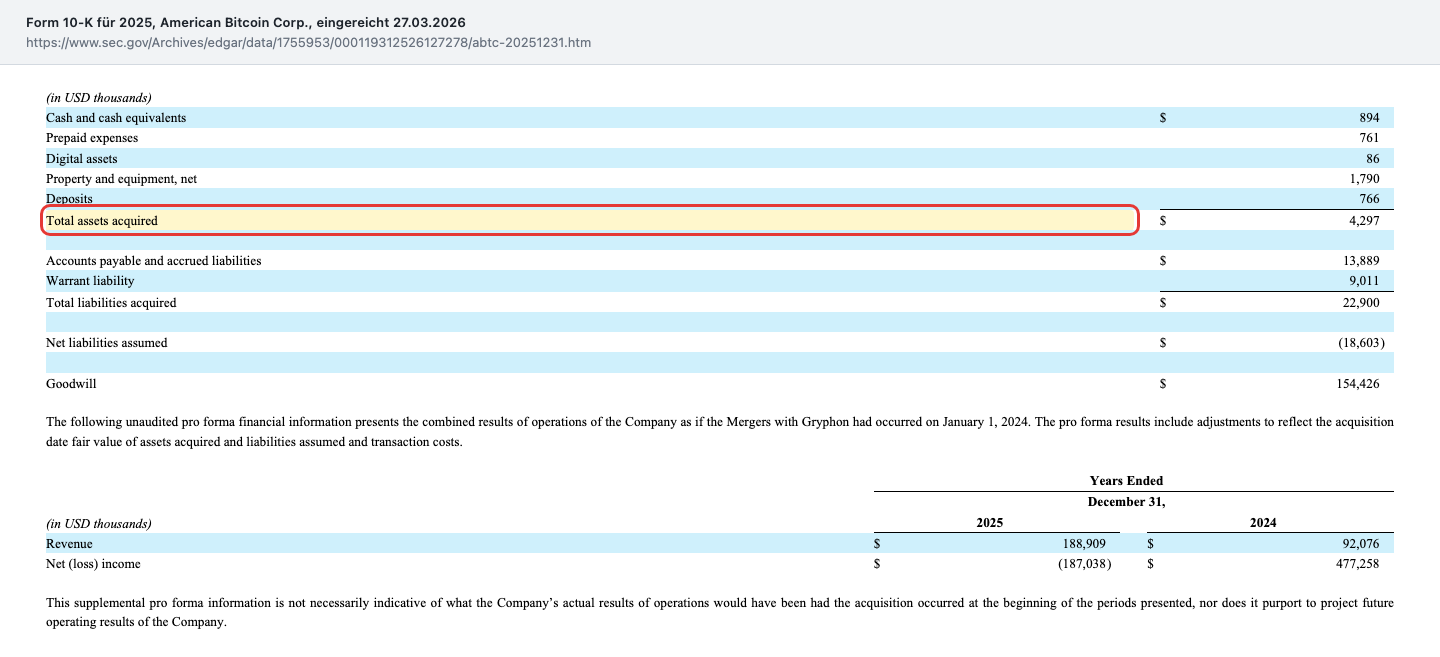
Goodwill is the premium paid over the tangible assets received — at an operating business usually a brand, a customer base or technology. Here there was none of that: what was bought was access to the public market. That goodwill still sits unchanged at $154.4 million on the June 30, 2026 balance sheet and accounts for 23 percent of total equity of $672.1 million. It is not amortised but tested annually for impairment; for 2025 that test concluded no write-down was required. For a shareholder that means almost a quarter of reported equity is not substance but a valuation assumption.
Uncomfortable truth no. 5: the cash comes from selling shares — and $1.7 billion of the program is still open
That leaves the question of where the money comes from. The statement of cash flows answers it plainly:
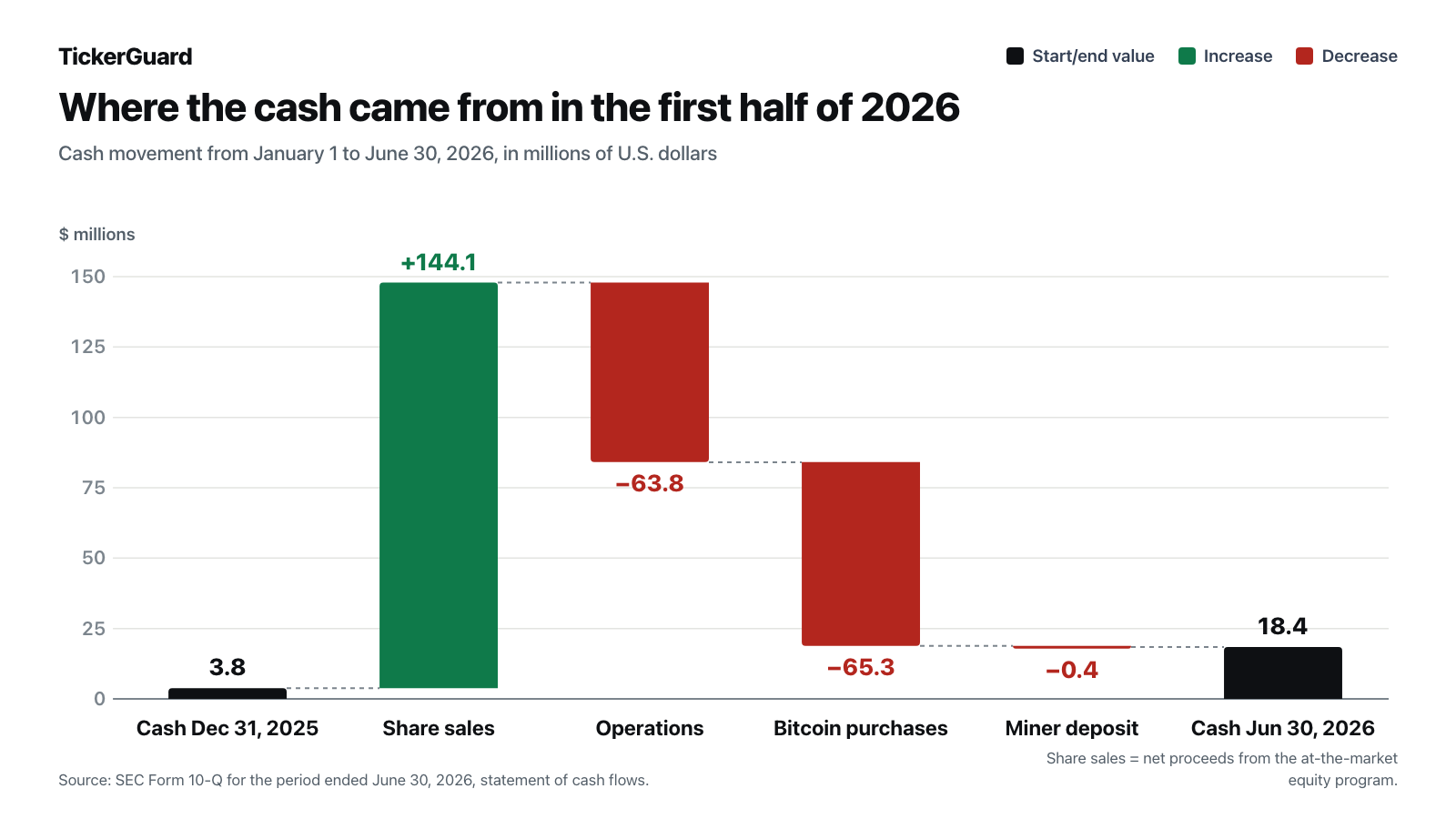
The instrument is an at-the-market program: the company may sell new shares into the open market continuously, without announcing a separate offering each time. It was established on September 3, 2025 with a size of $2.1 billion. Through June 30, 2026 it had produced 12,121,321 Class A shares sold for $385.2 million in gross proceeds — 7,755,671 of those shares, for $144.7 million, in the first half of 2026 alone. Class A shares outstanding rose from 16,196,042 on December 31, 2025 to 24,004,657 on June 30, 2026, a 48 percent increase in six months. Dilution in everyday terms: your slice of the cake gets smaller because the cake is cut into more pieces — even when the cake itself is growing.
Two honest qualifications. First, the company measures itself by a metric it calls "satoshis per share" — how many fractions of a bitcoin sit behind one share. That rose from roughly 9,943 on March 31, 2026 to roughly 10,989 on June 30, 2026, because the bitcoin stack grew 14 percent while the share count grew only 3 percent. On that logic the dilution paid off. Second, the shares sold since inception fetched an average of roughly $31.78 apiece on today's post-split basis. The closing price on August 21, 2026 was $7.93. Buyers back then paid dearly; the company benefited. About $1.7 billion of the program remains open — more than twice today's market capitalisation.
Valuation — what the market pays for the vault
A price-earnings ratio cannot be formed here because there are no earnings. So we work in orders of magnitude, and with the numbers from the filings rather than whatever a data feed prints — for this ticker the two diverge materially. The cover page of the quarterly report shows 72,819,713 shares outstanding as of July 30, 2026 (24,004,726 Class A plus 48,814,987 Class B). At the closing price of $7.93 on August 21, 2026 that is a market capitalisation of roughly $577 million. One caveat matters: counting only the listed Class A gives $190 million and understates the company by two thirds — the Class B shares carry identical economic rights, they simply do not trade.
Against those $577 million stand equity of $672.1 million (a price-to-book ratio of roughly 0.86), of which $154.4 million is goodwill. Strip out goodwill and intangible assets and roughly $516.6 million of tangible equity remains, or $7.09 per share, so the market pays about 1.1 times. Revenue for the twelve months to June 30, 2026 was $271.7 million, putting the price-to-sales ratio near 2.1. And measured in bitcoin: each share carried roughly 10,989 satoshis on June 30, 2026, which at a bitcoin price of $59,847 is about $6.58 of bitcoin per share — before any liabilities, of which $371.7 million relates to the miner purchase obligation alone.
The professional consensus is deliberately absent here: our data set carries no reliable analyst estimate for ABTC together with the number of contributing firms (as of August 22, 2026), and a consensus figure without that count would be false precision. What can be documented is the price history since listing. The closing price on merger day, September 3, 2025, was $8.04 before the reverse split — $120.60 on today's basis. On August 21, 2026 it was $7.93. That is a decline of roughly 93 percent in under a year. The lowest close in that window was $5.19 on July 29, 2026 (data as of August 22, 2026).
Opportunities and risks at a glance
What speaks for American Bitcoin:
- The mining operation earns money. Gross profit of $33.0 million on $67.0 million of revenue in the quarter ended June 30, 2026, a margin near 49 percent — and that in a quarter when bitcoin fell about 12 percent.
- Record output and a modern fleet. 932 bitcoin mined in the quarter; 58,999 rigs operating at 25.0 exahash per second and 14.1 joules per terahash after Drumheller came online in April 2026.
- No interest-bearing debt. The June 30, 2026 balance sheet shows no bank loans or notes; interest expense in 2025 was nil. Equity stands at $672.1 million.
- A large, liquid bitcoin position. 4,912 of the 8,002 bitcoin are unpledged and saleable in a pinch; their fair value on June 30, 2026 was $293.9 million.
- A partner with sites and experience. Hut 8 supplies five locations, operations and administration, sparing the company its own investment in land, grid connections and staff.
What speaks against it:
- Existential dependence on a single counterparty. The exclusivity agreement places every rig inside Hut 8 facilities; Hut 8 also decides every vote through roughly 80 percent of the Class B shares at 10,000 votes each (approximately 55.3 percent of all shares as of March 25, 2026) and billed $67.7 million in the first half of 2026.
- The stack was bought well above market. A cost basis of $781.9 million against $478.9 million of fair value on June 30, 2026 — an embedded loss of $303.0 million.
- Persistently negative operating cash flow. An outflow of $63.8 million in the first half of 2026 after $44.0 million a year earlier, against cash of $18.4 million on the reporting date.
- Dilution as a business model. Class A shares up 48 percent in six months; roughly $1.7 billion of the $2.1 billion sales program is still open, and the incentive plan's share reserve tops itself up automatically each year.
- Almost a quarter of equity is goodwill. $154.4 million from buying a listing whose assumed net assets were negative.
- Everything hangs on the bitcoin price. It drives revenue, margin, balance sheet value and the bottom line at the same time — the remeasurement alone cost $188.4 million in the first half of 2026.
A human bottom line
Remember the label trap from the opening? It is unusually well built here, because the label does not even lie. American Bitcoin really does mine bitcoin, in America and in Canada, with modern equipment and rising output. The operation is real, the record numbers are real, the 8,002 bitcoin are real. What the label leaves out is everything else: that the halls belong to somebody else, that the business is run by somebody else, that every vote is decided by somebody else, that 52 percent of revenue flows to that same somebody else — and that the coins in the vault cost $303.0 million more than they were worth on June 30, 2026.
Whether that turns into a good or a bad investment hangs on a question nobody can answer: where the bitcoin price stands in a few years. If it rises sharply, the embedded loss dissolves, the pledged coins come back, and today's dilution will look like clever pre-funding. If it stays put or falls further, a company with $18.4 million in the bank keeps financing itself by selling its own shares — and the majority owner keeps writing invoices. Both outcomes are possible, and both are visible in the filings.
What mattered to us: you should not buy or avoid this stock because a name sounds good or because a famous surname sits underneath it. You should know that there are three share classes, that one of them carries 10,000 votes apiece, that a contract binds every rig to a single provider, and that the vault cost more than its contents are worth. It is all in documents anyone may read. What you do with that is your decision. And that is exactly as it should be.
Sources and disclosures
- SEC Form 10-Q for the period ended June 30, 2026 (filed August 3, 2026) — balance sheet, statements of operations and cash flows, Note 4 "Digital assets", Note 11 "Related party transactions", Note 12 "Stockholders' equity", Note 14 "Commitments and contingencies"
- SEC Form 10-K for 2025 (filed March 27, 2026) — business description, employees, risk factors, Note 3 "Business combination"
- SEC Form 8-K of July 6, 2026 — 1-for-15 reverse stock split, effective July 2, 2026
- SEC Form 8-K of August 3, 2026, exhibit 99.1 — second quarter 2026 earnings release with production and fleet data
- SEC Form 8-K of August 3, 2026 — resignation of Matthew Prusak as president and interim chief financial officer, appointment of Paul Sacks effective August 4, 2026
- SEC submissions record for central index key 0001755953 — former names MTech Acquisition Holdings, Akerna, Gryphon Digital Mining, American Bitcoin
- Source: fundamental data & SEC filings (annual and quarterly reports, 10-K/10-Q) — price, trading and short-interest data as of August 22, 2026
Disclosure. This article is journalistic analysis of publicly available corporate filings. It is not investment advice, not a recommendation to buy or sell, and not a solicitation to buy or sell securities. Stocks can lose their entire value, and that risk is heightened at a company whose assets consist largely of a single, highly volatile asset class. All figures come from the original documents named above and carry the reporting date stated there. The author holds no position in American Bitcoin Corp. or Hut 8 Corp. at the time of publication.
Key figures at a glance
All monetary figures in millions of $; earnings per share as reported.
| Metric | 2021 | 2022 | 2023 | 2024 | 2025 |
|---|---|---|---|---|---|
| Revenue | 17.6 | 65.7 | 65.0 | 71.5 | 185.2 |
| Operating Income (EBIT) | -15.9 | -84.4 | 6.2 | 484.1 | -228.0 |
| Net Income | -31.3 | -104.2 | 39.6 | 428.9 | -153.2 |
| Net Margin | -177.7% | -158.6% | 61.0% | 599.6% | -82.7% |
| Earnings Per Share | -728,574.67 $ | -1.72 $ | 0.65 $ | 7.08 $ | -2.54 $ |
Source: fundamental data & SEC filings (annual and quarterly reports, 10-K/10-Q)
Our Bottom Line at a Glance
- Operating performance positive
- The mining business is growing and earning: 932 bitcoin mined in the quarter ended June 30, 2026 after 817 in the prior quarter, revenue up from $30.3 million to $67.0 million year over year, gross margin near 49 percent despite a bitcoin price down about 12 percent. Cost to mine one bitcoin was about $36,500 against roughly $71,900 of revenue.
- Dependence on the majority owner negative
- An exclusivity agreement requires the company to run every mining rig inside Hut 8 facilities; operations, accounting and administration come from the same source. That amounted to $67.7 million of invoices in the first half of 2026 against $129.1 million of revenue, with $83.5 million still outstanding on June 30, 2026 — against cash of $18.4 million.
- Bitcoin position negative
- The 8,002 bitcoin were worth $478.9 million on June 30, 2026 and had cost $781.9 million — an implied average of $97,716 per bitcoin against a spot value of $59,847 on the reporting date. In addition, 3,090 bitcoin are pledged to Bitmain against a recorded liability of $371.7 million.
- Dilution negative
- Class A shares outstanding rose from 16,196,042 on December 31, 2025 to 24,004,657 on June 30, 2026, an increase of 48 percent. Of the $2.1 billion at-the-market program only $385.2 million had been used by June 30, 2026, and the incentive plan tops up its share reserve automatically each year.
- Financial position neutral
- The June 30, 2026 balance sheet shows no interest-bearing debt and equity of $672.1 million. Against that stand cash of $18.4 million against a half-year operating outflow of $63.8 million, and current liabilities exceeding current assets by roughly $110.9 million. The buffer is 4,912 unpledged bitcoin worth $293.9 million.
- Shareholder rights negative
- Each of the 48,814,987 Class B shares carries 10,000 votes; each of the 24,004,726 listed Class A shares carries one. Roughly 80 percent of Class B — approximately 55.3 percent of all shares as of March 25, 2026 — sat with Hut 8. The 2025 annual report explicitly invokes the Nasdaq controlled-company exemptions: no compensation committee, no nominations committee, no independent nominating function.
American Bitcoin runs a real and growing mining operation: 932 bitcoin in the quarter ended June 30, 2026, $67.0 million of revenue and a gross margin near 49 percent. That growth is paid for in shares — Class A shares outstanding rose 48 percent in six months, and the $2.1 billion at-the-market program has been used only to $385.2 million. The 8,002-bitcoin stack cost $781.9 million and was worth $478.9 million on the reporting date, with 3,090 coins pledged. And the operation itself is contractually tied to a single counterparty: Hut 8 supplies every site, runs the business, billed $67.7 million in the half year and decides every vote through roughly 80 percent of the Class B shares at 10,000 votes each. Not investment advice.
What Our Rating Means
Substance risk
We found at least one documented issue that threatens the company itself — regardless of how the stock is currently valued.
The red rating here is not about the share price, not about the valuation and not about bitcoin's volatility — it is about a documented, existential dependence on a single counterparty. The exclusivity agreement requires American Bitcoin to run every mining rig inside Hut 8 facilities; the same counterparty runs operations, keeps the books, billed $67.7 million in the first half of 2026 against $129.1 million of consolidated revenue, held $83.5 million of outstanding claims on June 30, 2026, and effectively decides every shareholder vote through roughly 80 percent of the 48,814,987 Class B shares carrying 10,000 votes each — approximately 55.3 percent of all shares as of March 25, 2026. Add an operating cash outflow of $63.8 million for the half year against $18.4 million of cash: without the continuous sale of its own shares the business would run out of funds within a few quarters. A fair amount speaks against the rating and belongs on the record: the mining operation itself works at a gross margin near 49 percent, there is no interest-bearing debt, equity stands at $672.1 million, and 4,912 unpledged bitcoin worth $293.9 million could be sold in an emergency. Where the evidence sits between two levels, the more cautious one applies — and here the dependence is compounded by the fact that almost a quarter of equity consists of $154.4 million of goodwill created by buying a listing with negative net assets. The decision is yours.
A journalistic assessment by our editorial team at the time of the deep dive, based on public sources — not investment advice and not a solicitation to buy or sell. Your personal circumstances (investment goals, risk capacity, taxes) cannot be taken into account. What our levels mean, how verdicts are formed, and what conflicts of interest exist →
Worth Noting
- American Bitcoin reached our research list through the SEC filing feed: the Form 8-K of July 6, 2026 on the 1-for-15 reverse stock split and the Form 10-Q filed August 3, 2026.
- Beware of historical data: SEC central index key 1755953 belonged in turn to MTech Acquisition Holdings (a blank-check company), Akerna Corp. (cannabis software), Gryphon Digital Mining and, since September 3, 2025, American Bitcoin Corp. Price and ratio series before September 2025 describe different businesses. Figures for 2023 and 2024 are carved out of a business unit inside Hut 8.
- Market capitalisation deliberately calculated in-house: the figure from the fundamental data set matched neither the share count on the cover page of the quarterly report nor the price-to-book ratio in the same data set, and was therefore discarded. We use 72,819,713 shares times the closing price of $7.93 on August 21, 2026. Counting only the 24,004,726 listed Class A shares understates the company by about two thirds.
- All price figures are restated for the 1-for-15 reverse stock split of July 2, 2026. Our analyses are evergreen; a closing price here is a dated valuation anchor, not a reason to buy.
Stock Watch
This analysis is as of September 5, 2026. Stock Watch will tell you what's changed at ABTC since then.
Later $1 a month per stock — signing up is free, and you'll be the first to know when it launches.
The full analysis as a PDF for later
We will send you this analysis as a PDF — to print, file away, and read at your own pace. And we will add you to the free Stock Watch list for American Bitcoin Corp (ABTC), so you hear about it when something material in this analysis changes.
Frequently Asked Questions
American Bitcoin mines bitcoin and keeps it. In the quarter ended June 30, 2026 it mined 932 bitcoin and booked $67.0 million of revenue; the reserve stood at 8,002 bitcoin on that date. The rigs sit at five sites owned by majority holder Hut 8 in New York, Texas and Alberta. Full-time employees of its own as of December 31, 2025: two.
Hut 8 Corp. contributed its mining rigs on March 31, 2025 and received shares representing 80 percent of the equity and voting power; as of March 25, 2026 the annual report puts its stake at approximately 55.3 percent of the common stock and roughly 80 percent of the Class B shares. It supplies every data center, runs operations and handles administration. In the first half of 2026 it billed $67.7 million against $129.1 million of consolidated revenue; $83.5 million was still outstanding on June 30, 2026.
At the annual meeting on June 22, 2026 shareholders authorised the board to set a ratio between 1-for-5 and 1-for-40; the board chose 1-for-15, effective July 2, 2026. The share count fell from 1,092,295,800 to roughly 73 million. A reverse split does not change the value of a holding — only the denomination.
As of July 30, 2026 there were 24,004,726 Class A and 48,814,987 Class B shares outstanding, 72,819,713 in total. Only Class A trades on Nasdaq, with one vote each. Each Class B share carries 10,000 votes under the charter and does not convert automatically into Class A. Class B is spread across 13 holders of record; roughly 80 percent of it sits with Hut 8, which held approximately 55.3 percent of all shares as of March 25, 2026 and therefore controls the vote.
On June 30, 2026 the 8,002 bitcoin were worth $478.9 million while the cost basis was $781.9 million. That implies an average purchase price of $97,716 per bitcoin against a spot value of $59,847 on the reporting date. The $303.0 million difference already runs through earnings, because bitcoin has been remeasured at fair value each reporting date since 2025.
By selling new shares. In the first half of 2026 the at-the-market program contributed $144.1 million net while operations consumed $63.8 million and $65.3 million went into bitcoin purchases. Cash stood at $18.4 million on June 30, 2026. The balance sheet shows no bank loans or notes payable.
Eric Trump is listed in company disclosures as a co-founder and chief strategy officer. Michael Ho is chief executive officer and Asher Genoot is executive chairman. Paul Sacks has served as interim chief financial officer since August 4, 2026, taking the role alongside his position as head of derivatives after Matthew Prusak resigned.
The entity with SEC central index key 1755953 started in 2018 as the blank-check company MTech Acquisition Holdings, became Akerna Corp. in December 2018 selling software to the cannabis industry, became Gryphon Digital Mining in February 2024, and has been American Bitcoin Corp. since September 3, 2025. Historical price or ratio series therefore describe different businesses.
Found an error?
Did you spot a factual error, an outdated number, or a typo in this deep dive? Let us know briefly — your report goes straight to the editorial team.