Satellogic: Its First Operating Profit Came From Selling One of Its Own Satellites
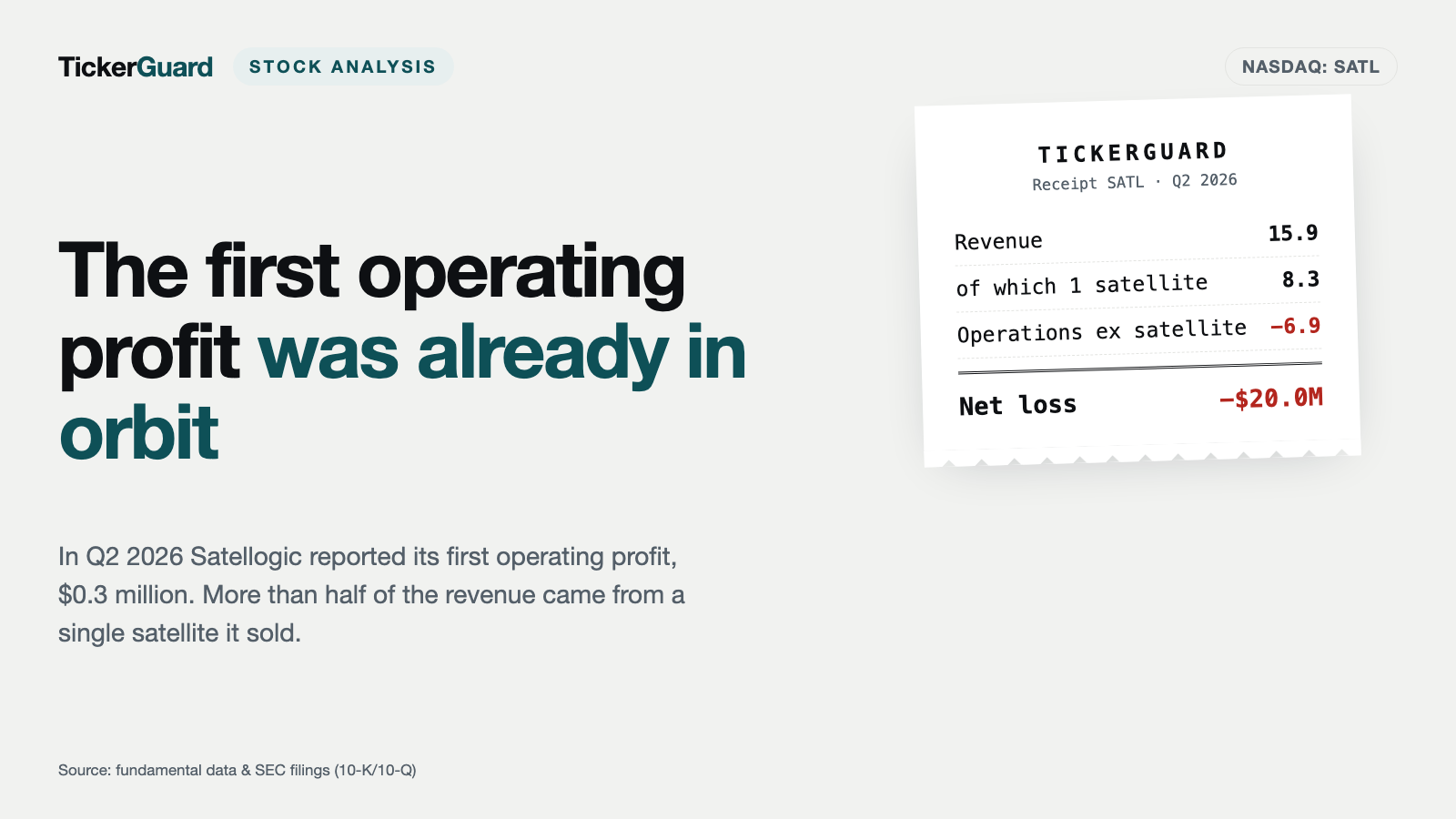
Satellite maker Satellogic reported the first operating profit in its history for the second quarter of 2026. More than half of the $15.9 million of revenue, however, came from selling a satellite that was already in orbit — and the bottom line still showed a $20.0 million loss. The filings submitted to the U.S. securities regulator, the SEC, show more: one customer has paid in software since 2021, and every rise in the stock enlarges the book loss.
 Thomas Mücke
Founder & Publisher
Thomas Mücke
Founder & Publisher
As of Today
As of: October 2, 2026
- Closing price
- 5.70 $ +5.70%
- Market Capitalisation
- 0.9 $B
- Growth Score
- 4/10
- AAQS
- 4/10
Price change since October 1, 2026: +5.2%
This analysis has a cut-off date. The Stock Guard tells you when something material changes in the numbers. Reserve your free spot
Chart
Interactive price chart (TradingView).
52-week range: 1.30 $ to 10.70 $ · Last price: 5.70 $ (As of: October 2, 2026)
Note: pure fact-based analysis, not investment advice and not a solicitation to buy or sell. All figures without guarantee.
Anyone who watches a rocket launch on TV remembers a single moment: ignition. Fire, smoke, cheering in mission control. Whether the payload reached the right orbit eight minutes later is a footnote the next day. Psychologists call this weakness the availability heuristic: whatever is vivid in our minds feels more important and more typical than it is. In the stock market, ignition is the headline — and the trajectory sits in the numbers behind it.
Satellogic Inc. (NASDAQ: SATL) announced an ignition like that in August 2026. For the second quarter of 2026 the satellite maker reported a 259 percent jump in revenue to $15.9 million and the first operating profit in its history. Both are true. Before you decide whether you are looking at a turning point or just a bright moment, let’s look at the whole trajectory together — the way Satellogic itself reported it to the U.S. securities regulator, the SEC. Those filings are the telemetry: sober and required by law. And in them you will find a satellite sold straight out of orbit, a customer that pays in software, and convertible notes that turn every rise in the share price into a book loss.
What Satellogic actually does — satellites off the assembly line
Satellogic builds Earth observation satellites — flying cameras that photograph the planet’s surface from low Earth orbit. What sets it apart is not the camera alone but the manufacturing: the satellites are small and light, and they are assembled and tested in the company’s own facilities in a free-trade zone in Montevideo, Uruguay. The annual report calls the company “vertically integrated” — in everyday terms, a baker who mills his own flour. That is meant to push the cost per satellite far below the competition. The company was founded in 2010 by Emiliano Kargieman, who still runs it as CEO, and Gerardo Richarte.
Satellogic makes money in two ways. The first is Data & Analytics: it sells imagery, monitoring services for fixed sites (“Aleph Observer”) and dedicated blocks of satellite capacity that a customer books exclusively (“Constellation-as-a-Service”). Customers are mainly defense and intelligence agencies, civil agencies and companies. The second is Space Systems: Satellogic sells complete satellites to countries that want their own Earth observation capability — newly built ones or, as in the second quarter of 2026, one that is already in orbit.
As of December 31, 2025 Satellogic had 154 full-time employees: 84 in Argentina, 29 in Uruguay, 23 in Spain and 12 in the U.S. As of March 31, 2026, according to the quarterly report (Form 10-Q), 18 of its own satellites were in orbit: 16 operational, one in commissioning and one used for testing. In Q2 2026 the company also sold a satellite out of orbit, as the next section shows. The next generation is called Merlin: a constellation designed to scan the entire planet daily and use on-board artificial intelligence to spot changes. According to the quarterly report for June 30, 2026, Satellogic plans the first Merlin launch for the fourth quarter of 2026.
A word on the company’s history: Satellogic reached the Nasdaq on January 25, 2022 through a blank-check company (SPAC) and initially reported as a foreign private issuer (annual report on Form 20-F). Since March 26, 2025 it has been a Delaware corporation headquartered in Davidson, North Carolina, reporting on Forms 10-K and 10-Q like any U.S. company — according to the 10-Q, to gain visibility with U.S. government agencies whose defense contracts Satellogic is pursuing.
That defines the central tension of this analysis, and it runs through every section: the imagery business really is growing — but the first profit rests on sales that do not repeat every quarter, and the capital structure turns every rise in the share price into a loss.
Company history for investors
-
2010
Founded by Emiliano Kargieman and Gerardo Richarte
A satellite maker is born that bets on small, cheaply built satellites. Kargieman still runs the company and controls about a tenth of the votes through Class B shares.
-
2022
Listing through a blank-check company (January 25)
Satellogic reaches the Nasdaq via CF Acquisition Corp. V. Steven Mnuchin’s Liberty group pays $150 million for 20 million shares at $7.50 plus warrants.
-
2024
Tether buys convertible notes (April 12)
$30 million of fresh money at a $1.20 conversion price. For shareholders it starts the fair-value seesaw: every rise in the stock makes the notes more expensive.
-
2025
Move to Delaware (March 26)
The British Virgin Islands company becomes a U.S. corporation headquartered in North Carolina. Since then Forms 10-K and 10-Q replace the 20-F — and Satellogic openly courts U.S. agencies.
-
2025
$90 million equity offering (October)
27.7 million new shares at $3.25 fill the coffers. With another $35 million in January 2026, cash rises to $112.8 million by June 2026.
-
2026
Liberty sells half (May 26)
10 million shares at $9.77 in a Rule 144 transaction, plus a 60-day lock-up. Afterward Liberty still holds 10 million shares plus warrants for another 22.5 million.
-
2026
First operating profit (Q2, reported August 5)
Plus $0.3 million — carried by $8.3 million from the sale of an in-orbit satellite. The net loss is $20.0 million, and operating activities use $8.6 million of cash.
How this stock landed on our desk
Satellogic did not come from a recommendation list. It was thrown up by our in-house stock scanner “Reddit hype”; the stock was on its list as of October 3, 2026. That scanner does not look for good companies; it looks for stocks that are being talked about unusually often in retail investor forums. It measures attention, not quality — and that is exactly what makes it useful: where people talk a lot, they rarely do the math. A stock from this scanner is a reason to look something up, never an argument.
Why people are talking about Satellogic shows in the share price. According to fundamental data, the stock closed at $1.27 on November 20, 2025 and at $10.74 on May 26, 2026 — more than eight times as much in six months. By October 1, 2026 it had fallen back to $5.42, roughly half of the high. Whoever bought at $10 is looking for reasons to hold on; whoever got in at $1.27 is looking for reasons to buy more. Both like to watch only the ignition.
A word on the basis of our math: every business figure in this analysis comes from an SEC filing. The valuation anchor is the October 1, 2026 close ($5.42) multiplied by the 153.7 million shares that the cover page of the quarterly report lists as of July 31, 2026. The metrics in the fact box above carry their own, continuously updated data date. For the view from a large, long-established satellite operator that has been in the market for decades, see our analysis of Eutelsat. And for another space company whose revenue headline needs a second look, see Intuitive Machines.
The numbers over the years — given their due
First, what genuinely impresses — and there is plenty. Satellogic has grown every single year. Revenue climbed from $4.2 million (2021) through $6.0 million (2022), $10.1 million (2023) and $12.9 million (2024) to $17.7 million in 2025. In the first half of 2026 it was already $22.0 million — more than in all of the previous year.
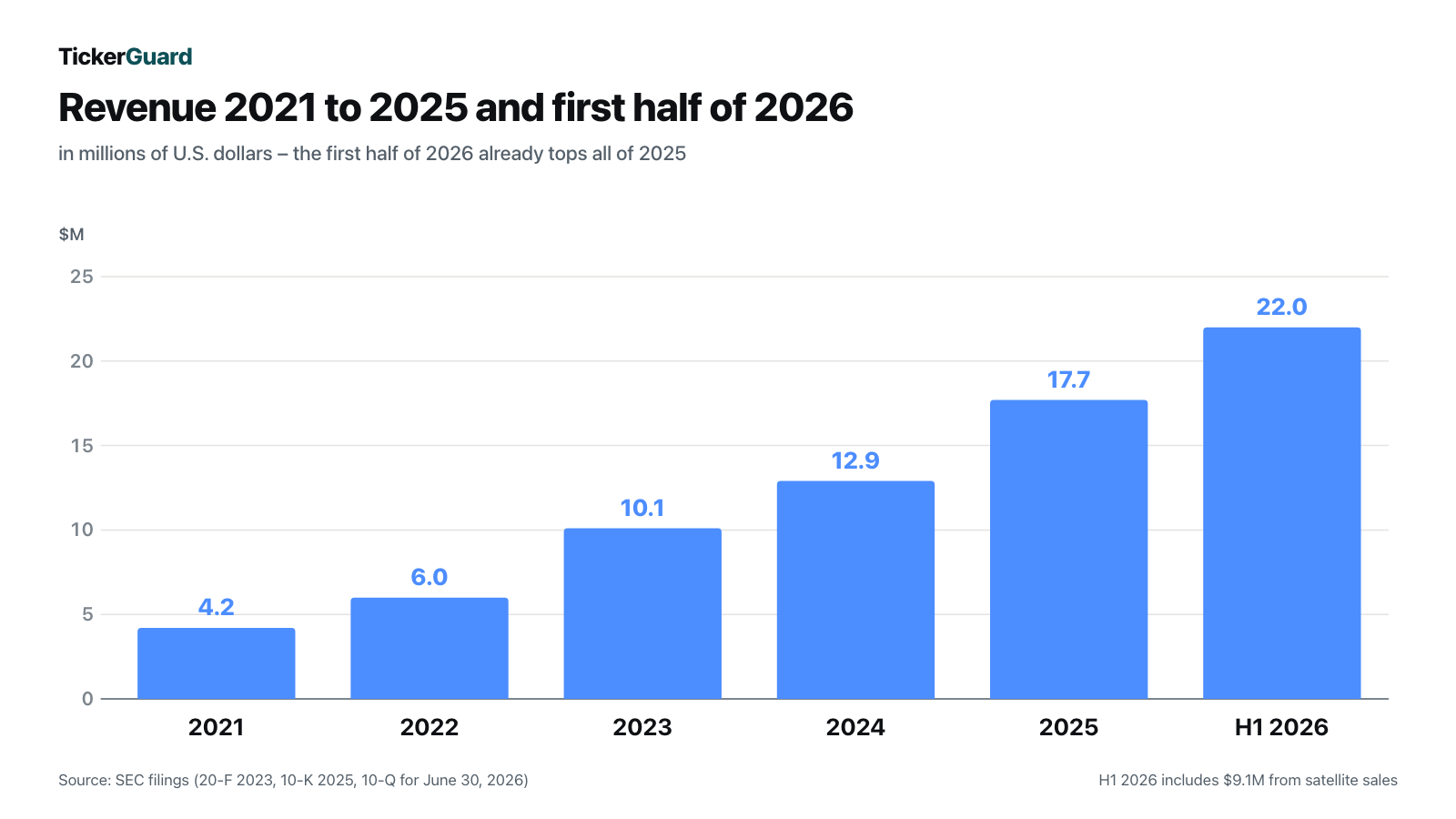
The core is growing too once satellite sales are stripped out. Service revenue from imagery and services rose from $4.4 million to $7.6 million in Q2 2026, up about 71 percent. The Data & Analytics business line alone reached $7.1 million after $4.0 million. In May 2026 Satellogic announced a one-year agreement worth more than $18 million with an international defense customer that went from an initial trial to full deployment in under six months. Contracted but not yet delivered work — “remaining performance obligations,” a kind of backlog — came to $80.7 million as of June 30, 2026, $45.8 million of it due within one year.
Costs are under control. In 2025 total costs and expenses fell by a quarter to $48.7 million, and the operating loss shrank from $52.2 million to $31.0 million. In Q2 2026 adjusted EBITDA — earnings before interest, taxes and depreciation, excluding fair-value effects and stock-based compensation — turned positive for the first time at +$2.8 million. And the bank account is well stocked: $112.8 million of cash as of June 30, 2026, after $22.5 million at the end of 2024, raised through three equity offerings — $20 million in April 2025 at $3.10, $90 million in October 2025 at $3.25 and $35 million in January 2026 at $4.73 per share. Since March 2026 Satellogic has also had an at-the-market program in place that lets it sell up to $50 million of stock through the exchange over time; according to the 10-Q, nothing was sold under it in the first half of 2026.
The bottom line is less friendly — and above all confusing. The net loss was $116.3 million (2024), only $4.8 million (2025) and then $138.4 million in the first half of 2026. The accumulated deficit since inception reached $543.2 million as of June 30, 2026. Why the loss jumps around even as the business steadily improves is one of the uncomfortable truths below. The sentence Satellogic writes about itself belongs up front:
“We are currently an early-stage company that has not demonstrated a sustained ability to generate sufficient revenue from our expected future principal business.”
— Satellogic Inc., SEC Form 10-Q for the quarter ended June 30, 2026, Item 2 “Key Factors Affecting Operating Results”
What the filings say — the uncomfortable truths
Uncomfortable truth No. 1: The first operating profit came from selling satellites
This is where the ignition from the opening comes back. Satellogic reported operating income of +$0.3 million for Q2 2026 — the first positive quarter in its history. Above it in the income statement sits a new line: product revenue of $8.3 million (precisely $8,335 thousand). A year earlier that line showed a dash. On April 30, 2026 Satellogic had announced a $12 million agreement to transfer an operational satellite from its constellation, together with its operation, to a sovereign defense customer.
The cash flow statement in the same report shows the same amount a second time: $8,335 thousand of “proceeds from sale of in-orbit satellites.” According to the earnings release of August 5, 2026, it is the proceeds from the sale of a single in-orbit satellite. And that inflow does not sit in operating cash flow but in investing cash flow:

“Proceeds from sales of in-orbit satellites are recognized as cash flows from investing activities as the components to construct the satellites were recognized as cash used in investing activities.”
— Satellogic Inc., SEC Form 10-Q for the quarter ended June 30, 2026, Note 2, “Cash Flow Information”
That is in line with the accounting rules: the satellites were once bought as assets, so the sale proceeds flow back to that line. But it has a consequence worth knowing. In the income statement the sale shows up as revenue, while the cost is only the remaining book value of the satellite sold. Total cost of product revenue for the quarter was $1.1 million. Without product revenue and those costs, operating income would have been about −$6.9 million by our own calculation — almost exactly where it was in the previous quarter (−$6.4 million) and in Q4 2025 (−$7.1 million).
The cash says the same. Operating activities used $8.6 million in Q2 2026, twice the $4.3 million of the prior-year quarter. A profitable quarter with a growing cash outflow — that is the telemetry behind the headline. A second, quiet tailwind comes on top: depreciation fell from $1.8 million to $1.1 million in the quarter, according to the report because fewer satellites still have depreciable useful lives. A company that runs down or sells its old satellites saves depreciation — until the new Merlin satellites land on the books. Remember: you can only sell a satellite once. Whether this becomes a repeatable business will be decided not by this quarter but by the next dozen.
Uncomfortable truth No. 2: A customer pays in software instead of cash
The revenue note of the quarterly report contains an agreement that is easy to overlook. In November 2021 Satellogic signed a noncancellable five-year agreement with a technology company. The customer receives $4.0 million of imagery credits each year — and pays with something other than money:

“The customer pays the Company in non-cash consideration in the form of a license to a proprietary software platform, which the Company uses in its internal operations.”
— Satellogic Inc., SEC Form 10-Q for the quarter ended June 30, 2026, Note 5 “Revenue from Contracts with Customers”
In everyday terms: the baker delivers rolls to the accountant every morning and gets his bookkeeping done in return. It is a real deal, and the accounting is correct — but not a single dollar lands in the till. At Satellogic the scale is significant. According to the 2025 annual report, this agreement produced $4.4 million of revenue, roughly a quarter of the $17.7 million total. In the first half of 2026 it was $2.3 million, a little over a tenth. And the agreement has a built-in end: five years from November 2021 run out in November 2026. The quarterly report for June 30, 2026 does not report a renewal.
Uncomfortable truth No. 3: Two customers, three quarters of the quarter
A company that sells to governments naturally has few, large customers. Even so, Satellogic’s concentration in Q2 2026 stands out — and the satellite sale made it even higher:

“We had two customers that each accounted for more than 10% of our revenue totaling $11.6 million for the three months ended June 30, 2026 and three customers that each accounted for more than 10% of our revenue totaling $3.1 million for the three months ended June 30, 2025.”
— Satellogic Inc., SEC Form 10-Q for the quarter ended June 30, 2026, Note 2 “Summary of Significant Accounting Policies”
$11.6 million out of $15.9 million is about 73 percent. If your neighbor told you his shop was doing great, but two customers bring in three out of every four dollars — wouldn’t you swallow hard? Geography confirms the picture: Europe contributed $9.2 million of revenue in the quarter after $0.5 million a year earlier, the Middle East and North Africa $3.6 million after $0.1 million. At the same time, revenue from the Americas fell from $3.5 million to $2.3 million. Growth is coming from a handful of new country deals. Satellogic does not name the customers; the 2025 annual report states that losing a major customer would have a “material adverse effect.”
Uncomfortable truth No. 4: The higher the stock, the bigger the loss
Now to the question of why the net loss jumps from $4.8 million (2025) to $138.4 million in the first half of 2026 while the business improves. The answer is fair-value effects. Satellogic has issued three kinds of financial instruments that it must mark to market at every reporting date: convertible notes, warrants and contingent shares held by its SPAC sponsor. When the stock rises, those rights become more valuable to their holders — and more expensive for Satellogic, which books the difference as a loss. The core is the convertible notes bought by Tether Investments Limited in April 2024:

“The Secured Convertible Notes are convertible into shares of the Company’s Class A common stock at an initial conversion price of $1.20 (or 833.33 shares of Class A common stock per $1,000 principal amount of Secured Convertible Notes) (“Conversion Feature”), subject to customary anti-dilution adjustments.”
— Satellogic Inc., SEC Form 10-Q for the quarter ended June 30, 2026, Note 15 “Secured Convertible Notes”
Anyone who may convert at $1.20 while the stock trades at $5 or $10 holds a very valuable right. That is why notes with $18.0 million of principal outstanding were carried at $89.7 million on June 30, 2026. Tether already converted $12.0 million into 10.0 million shares in April and May 2026. The warrant liability rose from $5.8 million to $33.5 million in the first half. Fair-value effects on all financial instruments combined — including the contingent sponsor shares and a book gain on a stake in a supplier — produced a loss of $132.7 million in the first half of 2026 — almost the entire net loss. In 2025 it ran the other way, and fair-value effects delivered a book gain of $25.9 million.
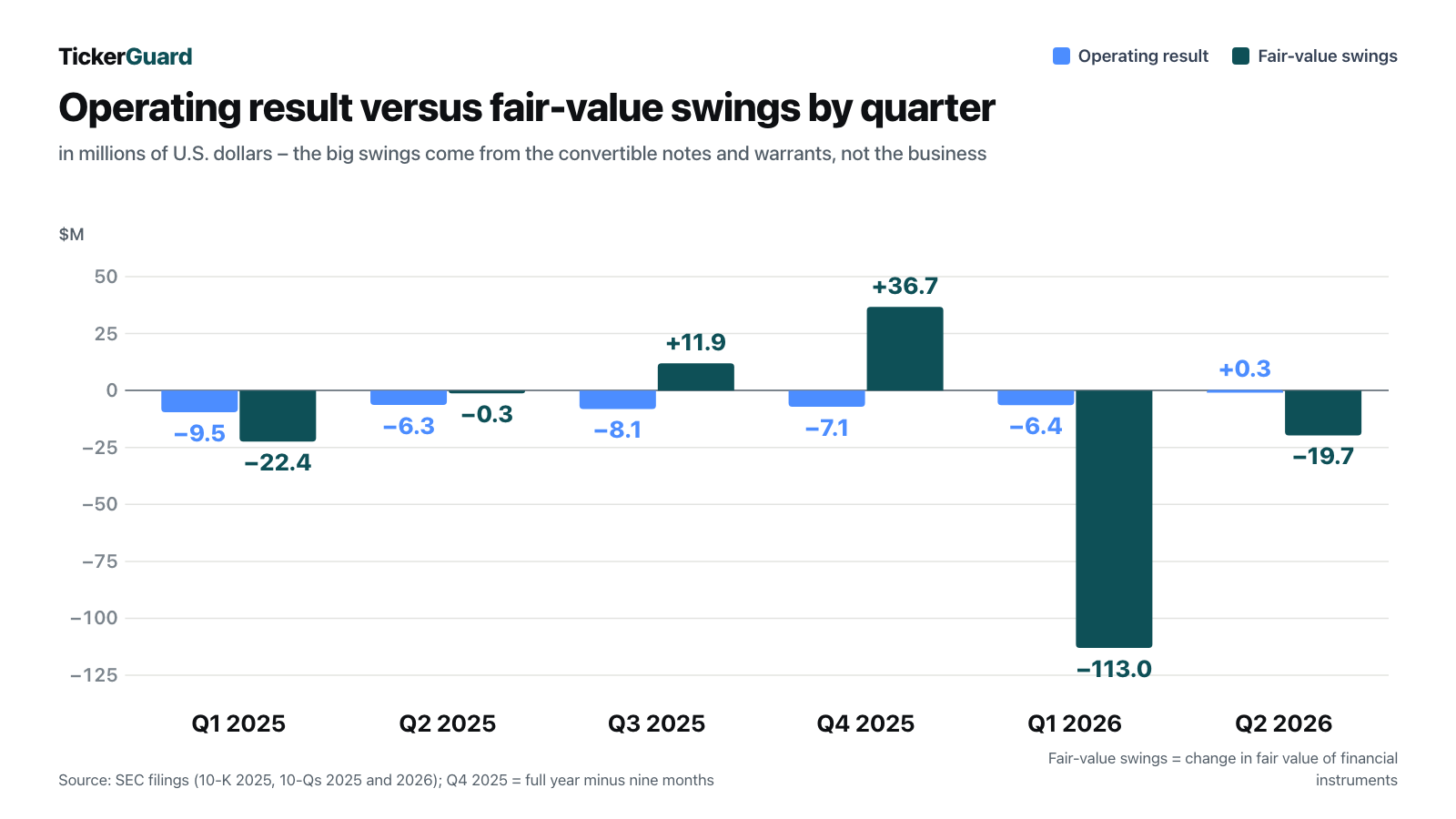
To be fair: these losses cost no cash. But they reveal something real — how much of the company has already been promised to others. According to the quarterly report, 70.9 million potential new shares were outstanding as of June 30, 2026: 49.2 million from warrants, 15.0 million from the convertible notes and the rest from employee plans and contingent sponsor shares. Shares outstanding totaled 153.7 million. If everything were converted and exercised, there would be about 46 percent more shares — your slice of the pie would shrink accordingly. Deep in the money are mainly a warrant for 15.9 million shares from a 2021 loan, exercisable for a combined $40.1 million, or $2.52 per share, and the convertible notes; about 33 million of the remaining warrants expire in early 2027, with exercise prices between $8.63 and $20.00.
A side effect: shareholders’ equity shrank from $60.5 million to $33.9 million in the first half of 2026 — even though $35 million of fresh capital came in during January. The book losses from fair-value accounting ate it up.
Ownership and management: what changed in 2026
Part of the picture is who has a say at Satellogic. According to the proxy statement (DEF 14A of April 23, 2026), the board is chaired by Steven Mnuchin, former U.S. Treasury Secretary and managing partner of the Liberty group; according to the beneficial ownership filing of May 28, 2026, he and Joseph F. Dunford, Jr. serve as Liberty’s designees on the board. Founder Kargieman holds all 10,582,641 Class B shares with roughly 1.47 votes each; according to the annual report, that equaled about 10.4 percent of the voting power as of March 14, 2026. BlackRock (5.2 percent, July 30, 2026) and State Street (5.5 percent, August 7, 2026) reported stakes above the 5 percent disclosure threshold.
The Liberty group (Liberty Strategic Capital) came in early 2022 with 20 million shares at $7.50 plus warrants — for $150 million in total. In May 2026 it sold half of those shares. Its beneficial ownership filing of May 28, 2026 records:
“On May 26, 2026, Liberty Strategic Capital (SATL) Holdings, LLC sold 10,000,000 Class A Shares at a price of $9.77 per share in a transaction in compliance with Rule 144 exemptions to the Securities Act’s registration requirements.”
— Liberty group, SEC Schedule 13D/A dated May 28, 2026, Item 5(c)
Ten million shares at $9.77 come to about $97.7 million. According to Item 4 of the same filing, the group holds its securities for investment purposes and may increase or decrease its position; the filing gives no reason for the sale. The sale price was below that day’s closing price of $10.74. Liberty still holds 10 million shares — about 6.5 percent of shares outstanding — plus warrants for another 22.5 million that expire in February 2027; according to the filing, Mnuchin and Dunford remain on the board. According to the filing, the group agreed not to sell any more shares for 60 calendar days; that period ended in late July 2026. Whether Liberty sells more shares is an open question; any material change would show up in a new beneficial ownership filing.
Management saw two changes. On June 8, 2026 Satellogic announced that CFO Rick Dunn and the company had “mutually agreed” that he would step down after a transition period. According to the filing, CEO Kargieman thanked him for seven years, called him a long-standing partner and shareholder, and said Dunn leaves Satellogic in its strongest financial position in corporate history. The handover ran until August 21, 2026; since then the former corporate controller Dustin Greer has run finance as interim CFO, and no permanent successor had been announced by the end of our research. Since September 7, 2026 the former director of the U.S. National Geospatial-Intelligence Agency (NGA), Frank Whitworth, has been the company’s president; according to the filing of September 8, 2026, he had already advised Satellogic since March 2026. That fits the company’s stated aim of winning U.S. government customers.
Valuation — what roughly $830 million of market value prices in
At this analysis’s valuation anchor — $5.42 on October 1, 2026 — and with 153.7 million shares, Satellogic has a market capitalization of about $833 million. Fundamental data showed about $850 million one trading day earlier, at the September 30, 2026 close, a difference of 2 percent. Revenue over the last four quarters (Q3 2025 through Q2 2026) was $31.9 million. That gives a price-to-sales ratio of about 26 — the market is paying $26 for every dollar of annual revenue. Whoever pays 26 times annual revenue is not paying for what is, but for what is supposed to come.
Subtract the $112.8 million of cash and add the $18.7 million of convertible note principal and accrued interest, and enterprise value comes to about $739 million, or 23 times revenue. There is no price-to-earnings ratio, because there are no earnings. And honest math has to include dilution: the convertible notes and the $2.52 warrant alone add about 30.9 million shares that are clearly in the money at this price. Including them, market capitalization would be about $1.0 billion.
The professionals’ view: the analyst price target listed in fundamental data is $10.20 (as of October 1, 2026), almost twice the anchor; the source does not say how many analysts stand behind it. For the current fiscal year they expect a small loss of about 6 cents per share. A price target is an opinion about the future, not a measurement — and for a stock that swung between $1.27 and $10.74 within a year, it is about as reliable as a weather forecast for next month.
For Merlin, Satellogic states in its August 5, 2026 earnings release that the program “is fully funded by existing customer contracts and does not require incremental capital to reach those milestones.” On the balance sheet, satellites under construction grew from $14.8 million to $24.9 million in the first half of 2026. What the price assumes can be said in one sentence: that $31.9 million of revenue turns into a multiple of that within a few years — that Merlin launches, the defense customers stay and more arrive. That is possible. It is not proven.
Upside and risks at a glance
What speaks for Satellogic:
- Uninterrupted revenue growth: from $4.2 million (2021) to $17.7 million (2025) and $22.0 million in the first half of 2026.
- The core imagery and services business grows even without satellite sales: up 71 percent to $7.6 million in Q2 2026.
- A full bank account: $112.8 million of cash as of June 30, 2026 against free cash flow of −$11.3 million in the first half, plus an unused at-the-market program of up to $50 million.
- A backlog of $80.7 million as of June 30, 2026, $45.8 million of it within one year.
- Low costs from in-house manufacturing, according to the company; total costs and expenses cut by a quarter in 2025.
- New president since September 7, 2026: former NGA director Frank Whitworth, with an eye on the U.S. defense business.
What speaks against it:
- The first operating profit rests on $8.3 million of product revenue from the sale of an in-orbit satellite; without it, operating income would have been about −$6.9 million by our own calculation.
- Operating activities used $8.6 million of cash in Q2 2026 — twice as much as a year earlier.
- Two customers accounted for about 73 percent of quarterly revenue and 74 percent of receivables.
- A quarter of 2025 revenue was paid in software rather than cash; the agreement runs out in November 2026.
- 70.9 million potential new shares against 153.7 million outstanding; the notes convert at $1.20.
- The CFO role has been filled only on an interim basis since August 21, 2026.
- A valuation of about 26 times revenue over the last four quarters.
A human bottom line
The ignition from the opening was real. Satellogic really did report its first operating profit in Q2 2026, and the imagery business really is growing strongly. At the end of 2024, according to the 2025 annual report, it held only $22.5 million of cash, and shareholders’ equity was negative at −$53.0 million; as of June 30, 2026 it has $112.8 million in the bank, an $80.7 million backlog and defense customers in Europe and the Middle East.
But the bright image of ignition may already have carried you further than the numbers do. In the telemetry is a satellite that can only be sold once; a customer that has paid in software since 2021 and whose contract is running out; two customers carrying three quarters of the quarter; and a capital structure in which every rise in the share price makes the rights of the holders of the convertible notes and warrants more valuable and shows up as a book loss. None of it is forbidden or hidden. It is all in the filings — just not in the headline.
The question to ask yourself is not about good or bad: are you buying a growth company that is just crossing the threshold to profitability and taking its next step with Merlin? Or are you buying a headline that says “first ever” at 26 times revenue, with 70.9 million potential new shares in the background? Both readings are in the same documents. The telemetry is linked.
What you make of it is your decision. And that is a good thing.
Sources and disclosures
- SEC Form 10-Q for the quarter ended June 30, 2026 (filed August 6, 2026) — income statement, balance sheet, cash flow statement, Notes 2, 5, 6, 7, 8, 12 and 15, “Liquidity and Capital Resources”
- SEC Form 10-Q for the quarter ended March 31, 2026 (filed May 12, 2026) — Q1 2026 figures
- SEC Form 10-Q for the quarter ended September 30, 2025 (filed November 10, 2025) — quarterly and nine-month figures for 2025
- SEC Form 10-K for 2025 (filed March 19, 2026) — business model, employees, constellation, customers, risk factors, voting power, consolidated financial statements
- Form 10-K/A and Form 10-Q/A dated June 17, 2026 — refiled Section 302 certifications
- SEC Form 20-F for 2023 (filed April 15, 2024) — revenue for 2021 through 2023
- SEC Form 8-K dated August 5, 2026 (Item 2.02), Exhibit 99.1 — quarterly results, backlog, statements on the operating profit
- SEC Form 8-K dated June 8, 2026 (Item 5.02), Form 8-K dated August 27, 2026 and Form 8-K dated September 8, 2026 — CFO departure, interim CFO, new president
- SEC Schedule 13D/A of the Liberty group dated May 28, 2026 — sale of 10 million shares at $9.77, lock-up
- SEC proxy statement (DEF 14A) dated April 23, 2026 — board of directors, chaired by Steven T. Mnuchin
- Schedule 13G of BlackRock dated July 30, 2026 and of State Street dated August 7, 2026 — stakes above 5 percent
- In-house stock scanner “Reddit hype” (selection trigger, as of October 3, 2026). Price data and the market capitalization cross-check: fundamental data, as of October 1, 2026. All business figures come from the SEC filings linked above.
Disclosure: this article is journalistic research and context, not investment advice and not a solicitation to buy or sell securities. Share prices can move sharply; a total loss of the capital employed is possible. All figures come from the original documents linked above and carry the reporting date stated there. Positions held by the operator are disclosed daily; where one exists, it appears as a notice at the top of this deep dive.
Key figures at a glance
All monetary figures in millions of $; earnings per share as reported.
| Metric | 2021 | 2022 | 2023 | 2024 | 2025 |
|---|---|---|---|---|---|
| Revenue | 4.2 | 6.0 | 10.1 | 12.9 | 17.7 |
| Operating Income (EBIT) | -68.6 | -90.9 | -69.4 | -52.2 | -31.0 |
| Net Income | -96.3 | -36.6 | -61.0 | -116.3 | -4.8 |
| Net Margin | -2,267.6% | -609.5% | -605.7% | -903.4% | -27.0% |
| Earnings Per Share | -1.40 $ | -0.44 $ | -0.68 $ | -1.28 $ | -0.04 $ |
Source: fundamental data & SEC filings (annual and quarterly reports, 10-K/10-Q)
Our Bottom Line at a Glance
- Growth positive
- Revenue rose without interruption from $4.2 million (2021) to $17.7 million (2025); in the first half of 2026 it was $22.0 million. Even without satellite sales, service revenue from imagery and services grew about 71 percent to $7.6 million in Q2 2026.
- Quality of the operating profit negative
- The first positive operating result of $0.3 million in Q2 2026 rests on $8.3 million of product revenue that exactly matches the proceeds from an in-orbit satellite sold. Excluding product revenue and product costs it would have been about −$6.9 million by our own calculation; operating activities used $8.6 million of cash.
- Liquidity positive
- As of June 30, 2026 Satellogic held $112.8 million of cash, against free cash flow of −$11.3 million in the first half of 2026. Its only financial debt is the convertible notes with $18.0 million of principal, maturing in April 2028.
- Customer concentration negative
- Two customers accounted for $11.6 million, about 73 percent of revenue, in Q2 2026, and two customers for 74 percent of receivables. Another customer has paid with a software license instead of cash since 2021 — roughly a quarter of 2025 revenue; the agreement runs out in November 2026.
- Dilution and capital structure negative
- As of June 30, 2026, 70.9 million potential new shares stood against 153.7 million outstanding. The notes convert at $1.20 and were carried at $89.7 million instead of $18.0 million of principal; fair-value effects cost a $132.7 million book loss in the first half of 2026.
- Management and ownership neutral
- The Liberty group sold half of its shares at $9.77 on May 26, 2026 and still holds 10 million; the CFO stepped down by mutual agreement on August 21, 2026 and the role is filled on an interim basis. New since September 7, 2026 is former NGA director Frank Whitworth as president.
Satellogic builds Earth observation satellites in-house and has grown for years: $17.7 million of revenue in 2025, $22.0 million in the first half of 2026 alone, plus $112.8 million of cash. The first operating profit in Q2 2026, however, rests on selling a satellite out of orbit; without it there would be an operating loss of about $6.9 million, and operating activities used $8.6 million of cash. Two customers carry about three quarters of quarterly revenue, and another pays in software. Convertible notes and warrants turn every rise in the stock into a book loss and hold out 70.9 million new shares. Not investment advice.
What Our Rating Means
Open questions
The business works in principle, but one material question is open. As long as it stays open, our findings do not carry a quality verdict.
Yellow, because it is open whether the business can carry itself without satellite sales: the first operating profit of $0.3 million in Q2 2026 rests on $8.3 million of product revenue from satellite sales, operating activities used $8.6 million of cash, and two customers account for about 73 percent of quarterly revenue. It is not red, because $112.8 million of cash covers first-half 2026 free cash flow of −$11.3 million many times over, shareholders’ equity is positive at $33.9 million and the only financial debt is $18.0 million of convertible notes due in 2028; valuation and dilution are questions of price and do not set the rating. The decision is yours.
A journalistic assessment by our editorial team at the time of the deep dive, based on public sources — not investment advice and not a solicitation to buy or sell. Your personal circumstances (investment goals, risk capacity, taxes) cannot be taken into account. What our levels mean, how verdicts are formed, and what conflicts of interest exist →
Worth Noting
- Satellogic reached the research list via the in-house stock scanner “Reddit hype,” which flags stocks with unusually high attention in retail investor forums (as of October 3, 2026). The scanner measures attention, not quality; it is a reason to look something up, not an argument.
- Timeliness: the latest periodic report analyzed is the Form 10-Q for the quarter ended June 30, 2026, filed August 6, 2026; the earnings release (Form 8-K, Item 2.02) came on August 5, 2026. Every filing after that was reviewed through October 3, 2026: a State Street threshold filing (August 7), two Item 5.02 Forms 8-K (August 27: interim CFO; September 8: new president) and insider filings (Forms 3 and 4) on vesting of stock awards with no sales. The personnel changes are covered in the article.
- Data: on June 17, 2026 Satellogic refiled the Section 302 certifications for its 2025 annual report and its quarterly report for March 31, 2026, because, according to the amendment, part of the required wording (paragraph 4) had been inadvertently omitted; these were exhibit-only refilings, and the figures and report text were unchanged. all business figures come from SEC filings; revenue for 2021 through 2023 from the Form 20-F for 2023, filed while Satellogic still reported as a foreign private issuer. Q4 2025 is calculated as the full year minus nine months. The valuation anchor is the October 1, 2026 close ($5.42, source: fundamental data); the resulting market capitalization of about $833 million based on 153,739,911 shares differs by 2 percent from the fundamental-data figure (about $850 million). The “excluding product revenue” figure is our own calculation: operating income of $0.3 million minus $8.3 million of product revenue plus $1.1 million of product costs.
- Name confusion: the market data feed lists the name “Satellogic V Inc”; the registrant’s name at the SEC is “Satellogic Inc.” Not to be confused with the former blank-check company CF Acquisition Corp. V, through which Satellogic reached the Nasdaq in January 2022.
Stock Watch
This analysis is as of October 2, 2026. Stock Watch will tell you what's changed at SATL since then.
Later $1 a month per stock — signing up is free, and you'll be the first to know when it launches.
The full analysis as a PDF for later
We will send you this analysis as a PDF — to print, file away, and read at your own pace. And we will add you to the free Stock Watch list for Satellogic Inc. (SATL), so you hear about it when something material in this analysis changes.
Frequently Asked Questions
Satellogic Inc. (NASDAQ: SATL) builds small Earth observation satellites in its own facilities in Montevideo, Uruguay, and operates its own constellation — 18 satellites in orbit, 16 of them operational, as of March 31, 2026 according to its quarterly report. It sells satellite imagery and monitoring services mainly to defense and civil agencies, and entire satellites to countries. It is headquartered in Davidson, North Carolina, and was founded in 2010.
No. In Q2 2026 Satellogic posted positive operating income of $0.3 million for the first time, carried by $8.3 million of product revenue from the sale of an in-orbit satellite. The bottom line showed a net loss of $20.0 million, and $138.4 million for the first half of 2026. Operating activities used $8.6 million of cash in the second quarter.
Because of fair-value effects. Satellogic must mark convertible notes with a $1.20 conversion price, warrants and contingent sponsor shares to market at every reporting date. When the stock rises, their value rises and Satellogic books a loss. In the first half of 2026 that was $132.7 million; in 2025, by contrast, it produced a book gain of $25.9 million.
According to the quarterly report for June 30, 2026, 70.9 million potential new shares were outstanding: 49.2 million from warrants, 15.0 million from the convertible notes and the rest from employee plans and contingent sponsor shares. Shares outstanding totaled 153.7 million. About 33 million of the warrants, with exercise prices between $8.63 and $20.00, expire in early 2027.
After selling 10 million shares on May 26, 2026, the Liberty group of former U.S. Treasury Secretary Steven Mnuchin still held 10 million shares plus warrants for another 22.5 million. Founder Emiliano Kargieman controlled about 10.4 percent of the voting power through Class B shares as of March 14, 2026, according to the annual report; the Class A share count has risen since. BlackRock and State Street each reported just over 5 percent in the summer of 2026.
As of June 30, 2026 Satellogic held $112.8 million of cash plus $9.1 million of restricted cash. Against that stood $18.7 million of convertible note principal and accrued interest, due in April 2028. The company put free cash flow for the first half of 2026 at −$11.3 million. An at-the-market program of up to $50 million is in place but was unused through June.
Satellogic was a British Virgin Islands company until 2025 and as a foreign private issuer filed annual reports on Form 20-F for fiscal years through 2023 and interim reports (6-K) until March 2025. Since its annual report for 2024 (filed March 26, 2025), the same day it redomiciled to Delaware, it has filed annual reports (10-K) and quarterly reports (10-Q) like any U.S. company. It cites greater visibility with investors and customers, particularly U.S. government agencies.
Merlin is Satellogic's planned next satellite generation. It is designed to scan the entire Earth daily, detect changes with on-board artificial intelligence and then task the high-resolution satellites. According to the quarterly report for June 30, 2026, the first launch is planned for the fourth quarter of 2026 and full operation for the first half of 2027.
Found an error?
Did you spot a factual error, an outdated number, or a typo in this deep dive? Let us know briefly — your report goes straight to the editorial team.