Eutelsat: The state paid €4 a share, the market €1.53 — and the bill is still coming
The anchor whispers: if the state paid €4, then €1.53 is a gift. By its own account, Eutelsat is Europe’s only operator of a global satellite network in low Earth orbit; OneWeb is growing fast, the TV business is shrinking, and the share count has more than doubled. We read the FY2025-26 financial statements, the capital raise documents and the IRIS² commitments. Eutelsat plans to invest about €4 billion through 2029 — the market values the entire company at €1.8 billion.
 Thomas Mücke
Founder & Publisher
Thomas Mücke
Founder & Publisher
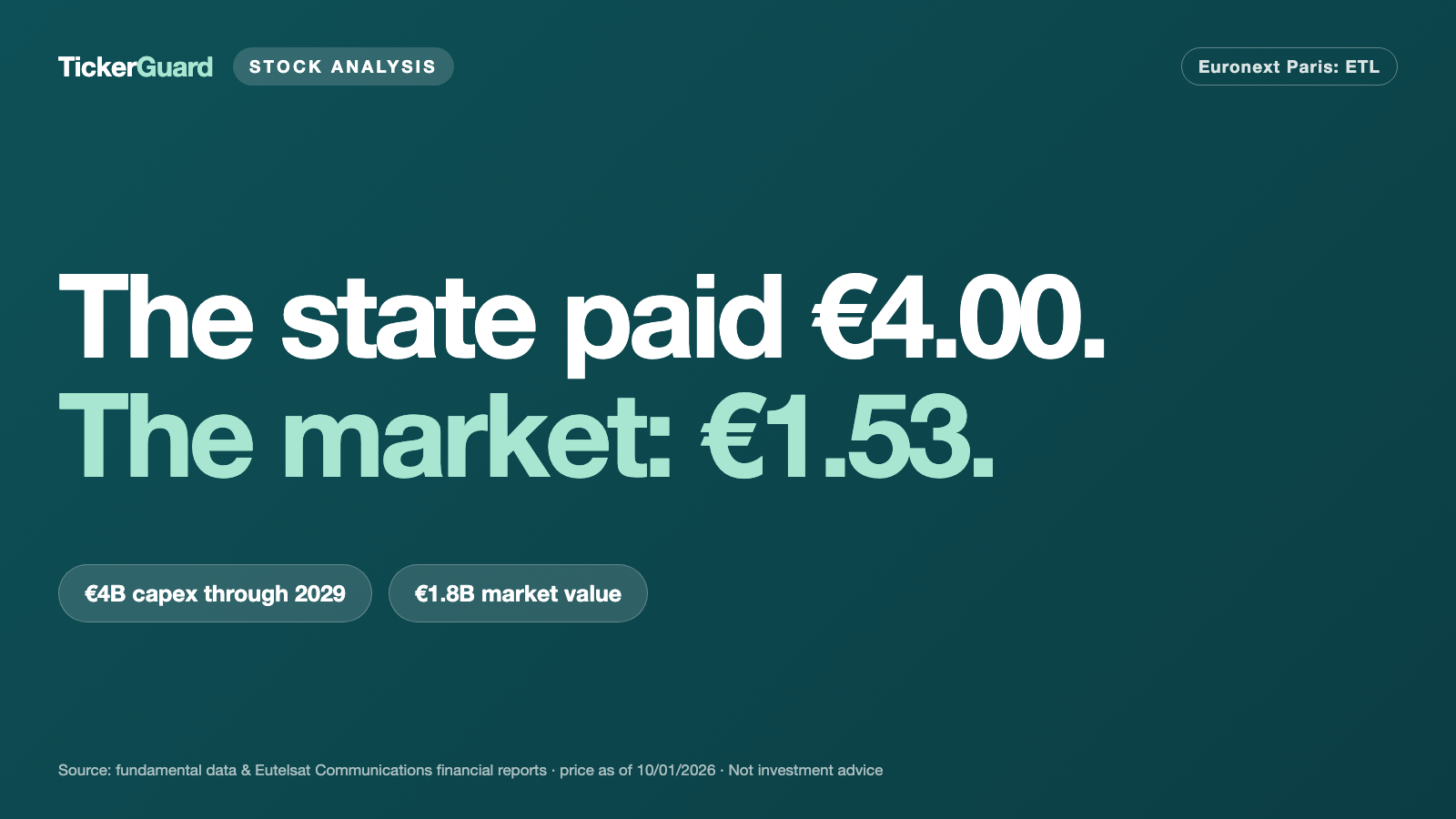
Psychologists have a name for a thinking error that costs investors a lot of money: anchoring. The first number we hear sticks in our heads, and everything after it gets measured against it. At Eutelsat, that number is €4.00. That is what the French state, India’s Bharti group, the UK government, the shipping group CMA CGM and the French Fonds Stratégique de Participations paid in November 2025 for 207 million new shares. On October 1, 2026, the stock closed in Paris at €1.5295. The anchor whispers: “If the state paid €4, then €1.53 is a gift.” And because it is the state, a second reflex chimes in: “Paris will never let it fail.”
Let’s make a deal: we test both sentences against what Eutelsat itself has published — the consolidated financial statements for fiscal year 2025-26 (period ended June 30, 2026, published August 7, 2026), the capital raise documents, the commitments for the European IRIS² satellite program and the satellite order of September 10, 2026. Eutelsat is a French company and does not report to the U.S. securities regulator, the SEC; its English-language reports and regulatory releases are our sources. The central tension of this analysis: with OneWeb, Eutelsat owns what it says is Europe’s only satellite internet in low Earth orbit, and revenue from it is growing fast — but the legacy TV business is shrinking, free cash flow is negative, and the investment plan through 2029 alone, at about €4 billion, is more than twice the company’s market value. A bargain with a state guarantee, or a construction site with no end date? In the end, you decide.
What Eutelsat actually does — TV from above, internet from orbit
Paris-based Eutelsat Communications rents out satellite capacity. The business has two floors. The old floor is 31 geostationary satellites (GEO): parked about 22,000 miles up, they appear fixed over one spot on Earth and mainly distribute television — around 5,800 channels, according to the company. The new floor is OneWeb, a constellation of more than 600 satellites in low Earth orbit (LEO) that delivers fast, low-latency internet: to governments and armed forces, ships and aircraft, telecom operators and remote regions. Eutelsat and OneWeb combined in 2023. Picture it this way: GEO is the big transmitter on the mountain that has been beaming the same program into the valley for decades. LEO is a swarm of small cell towers racing over your head every few minutes — faster, but you have to replace all of them every few years.
The business is reported in four verticals. In fiscal year 2025-26 (July 1, 2025, to June 30, 2026), 43 percent of the €1,197.1 million in vertical revenue came from Video, i.e. television, 23 percent from fixed connectivity, 20 percent from government services and 14 percent from mobile connectivity for ships and aircraft. Cutting across them is the most important number: OneWeb revenue reached €297 million, or 25 percent of group revenue, up from about 15 percent a year earlier. In its March 2026 investor presentation, Eutelsat describes itself as the “Sole European provider with a LEO constellation, offering similar connectivity as Starlink.” How the American market leader is set up is covered in our SpaceX analysis.
A few basics. The stock trades on Euronext Paris and the London Stock Exchange under the ticker ETL. The CEO is Jean-François Fallacher; Éric Labaye has chaired the board since August 2025. At June 30, 2026, the group had 1,645 full-time equivalent employees, 496 of them at OneWeb. The fiscal year ends on June 30 — so “FY2025-26” covers the second half of 2025 and the first half of 2026.
Company history for investors
-
2023
Combination with OneWeb
By its own account, Eutelsat becomes the first fully integrated operator of geostationary and low Earth orbit satellites; OneWeb is consolidated from October 2023. Losses have followed ever since.
-
2025
Impairments and a record loss
In FY2024-25, write-downs on goodwill and satellites cost €720M; the loss reaches €1,081.9M.
-
2025
€1.5B capital raise
In November, France and four partners buy in at €4.00; in December, shares at €1.35 follow for everyone. The share count grows 2.48-fold.
-
2026
June: first NEXUS call-off
The French Ministry of the Armed Forces books OneWeb capacity for a firm €138M over four years, expandable to €350M — a first sign that governments will pay for OneWeb capacity.
-
2026
August: IRIS² commitment
Eutelsat leads the EU program’s orbit segment and commits €3.39B of investment for 2027 to 2034 — almost twice its market value in October 2026.
-
2026
September: 229 more satellites
Order with Airbus for about €1B announced, on top of 440 already ordered. The capex plan through 2029 is unchanged, according to the company.
How the stock landed on our desk
Through other investors’ curiosity: in early October 2026, Eutelsat appeared in the ranking of most-discussed stocks on wallstreet-online, one of Germany’s largest retail-investor forums. That is an attention signal and explicitly not a reason to buy — a stock gets discussed because it interests someone, not because it is good.
Our in-house stock scanner shows why the conversation is happening now. Using data after the close on October 1, 2026, Eutelsat met four strategies. Two describe a downtrend: Near 52-week low (at most 10 percent above the lowest price of the past year) and Below 50- & 200-day SMA (the price sits below its average of the last 50 and the last 200 trading days). For context: on May 28, 2026, the stock still closed at €4.51, in early August at about €2.10. The third hit is Pros 80%: more than 80 percent of the shares sit with major shareholders and institutions — at Eutelsat mostly governments and strategic partners, which we cover in the fifth uncomfortable truth. The fourth hit, EPS acceleration, sounds better than it is: it fires because the loss per share is shrinking. That is an arithmetic improvement, not a profit. A scanner is a coarse sieve, not a verdict — so now we read the reports.
The numbers over the years — an honest look
First, what genuinely impresses. OneWeb is no longer a promise but a business with real revenue: €297.0 million in FY2025-26, up 59.0 percent and, at constant currency, up 69.5 percent. The fourth quarter alone brought €124.3 million, driven by the first call-off under the “NEXUS” framework agreement with the French Ministry of the Armed Forces: the “CENTAURE” contract carries a firm €138 million over four years and can grow to up to €350 million over eight years. Government services grew 17.7 percent at constant currency, mobile connectivity 15.9 percent. And the balance sheet is much sturdier after the capital raise: net debt fell from €2,626.6 million to €1,464.6 million, and the ratio to adjusted EBITDA from 3.88 to 2.32. Average debt maturity rose from 2.5 to 4.2 years, and according to the release Eutelsat has about €2.3 billion in cash and undrawn credit lines plus about €690 million of an undrawn export credit facility.
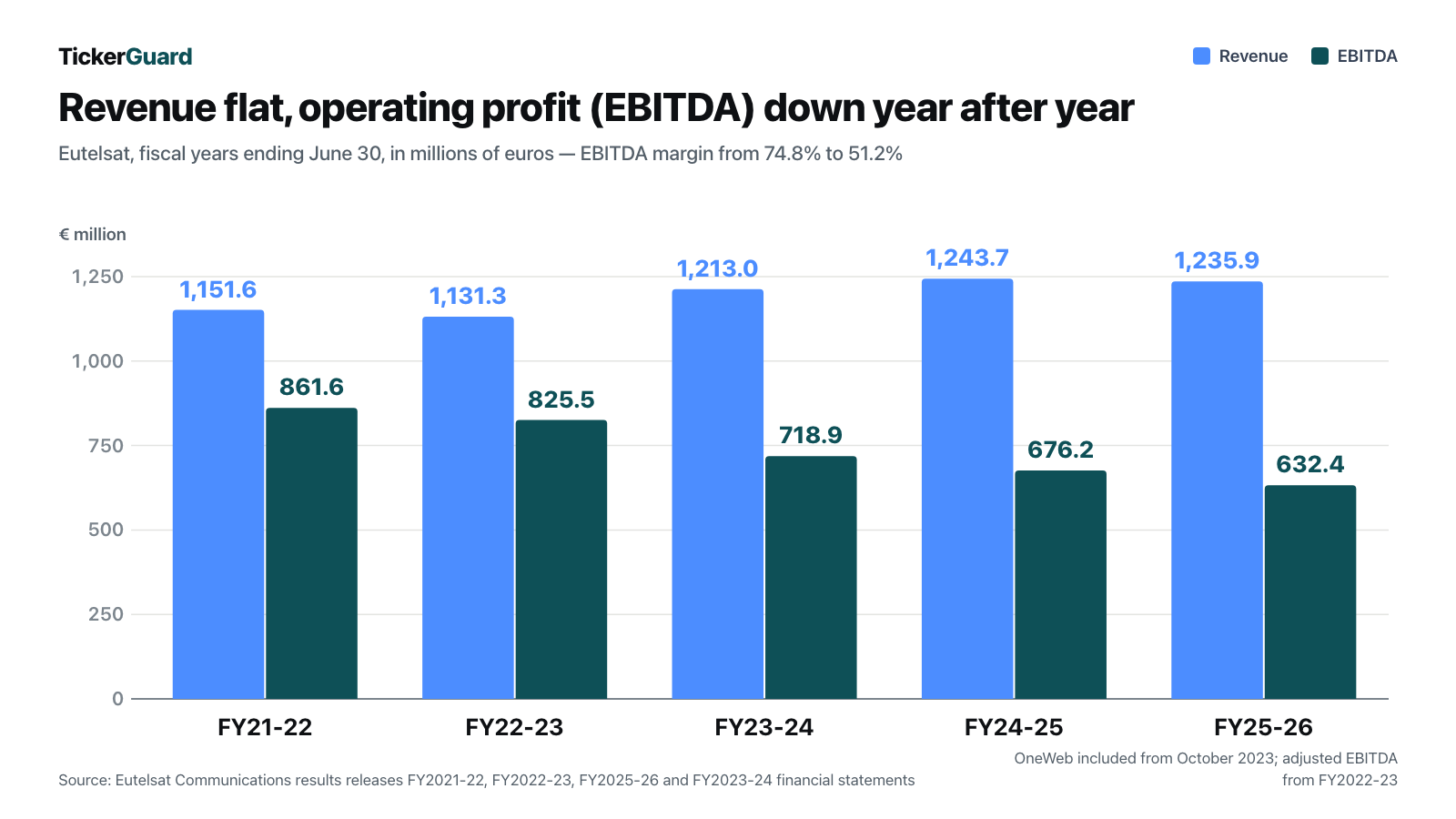
The chart also shows the other side. Revenue has gone sideways for five years: €1,151.6 million in FY2021-22, €1,235.9 million in FY2025-26 — even though OneWeb has been fully consolidated since October 2023. EBITDA, earnings before interest, taxes, depreciation and amortization, fell over the same period from €861.6 million to €632.4 million, and the margin from 74.8 to 51.2 percent. The reason is simple: broadcasting TV by satellite costs almost nothing extra to run, while internet from low Earth orbit needs ground stations, user terminals, a sales force and a constant stream of new satellites.
That is why the bottom line has been red for three years. After profits of €230.8 million (FY2021-22) and €314.9 million (FY2022-23, including one-off income of €352 million for clearing U.S. spectrum) came a loss of €309.9 million (FY2023-24), a loss of €1,081.9 million (FY2024-25, mainly due to €720 million of goodwill and satellite impairments) and a loss of €457.3 million in FY2025-26. Even excluding other operating expenses of €153.2 million, which contain the impairments, the result was minus €66.9 million last year (adjusted EBITDA minus depreciation and amortization): satellites, ground assets and intangibles lost more value, at €699.3 million of total depreciation and amortization, than EBITDA brought in. Eutelsat paid no dividend in FY2024-25 or FY2025-26.
For the current fiscal year 2026-27, the company expects OneWeb to grow by more than 30 percent, vertical revenue to rise slightly and the EBITDA margin to stay around 51.2 percent. On August 7, 2026, Eutelsat confirmed its FY2028-29 target of €1.5 billion to €1.7 billion in revenue and an EBITDA margin of above 60 percent. Measured against €1.2 billion today, that is a big leap in three years.
Uncomfortable truth No. 1: the old business is shrinking — and so far it pays for the new one
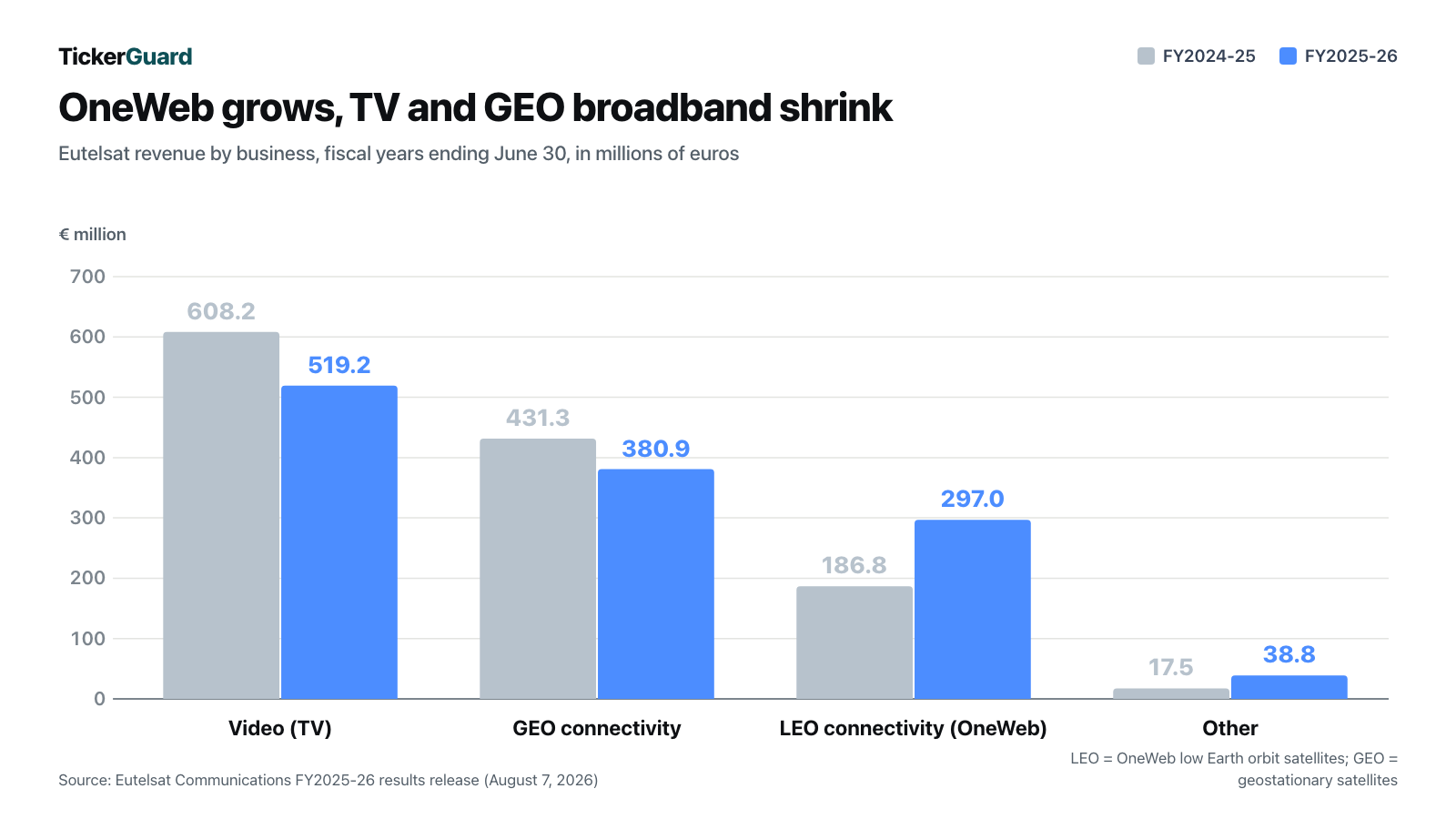
The picture is a race: the new runner is getting faster, but the old one is slowing down, and both wear the same bib. In FY2025-26, OneWeb added €110.2 million. At the same time, the TV business lost €89.0 million (down 14.6 percent, or 13.1 percent at constant currency) and internet via geostationary satellites lost €50.4 million. Eutelsat names the reasons itself:
“This reflects underlying market trends, compounded by sanctions on Russian channels imposed at the beginning of the year and by the termination of capacity contracts on the Express AT1 and AT2 satellites.”
— Eutelsat Communications, FY2025-26 results release of August 7, 2026, section “Video”
The Express AT1 satellite, which Eutelsat leased from a Russian operator, failed on March 4, 2026, and the lease ended. That is bad luck. The “underlying market trend,” by contrast, is not a one-off; it is the normal state of a business whose viewers increasingly use other routes. It hits not just revenue but the balance sheet. In FY2025-26, Eutelsat wrote down another €111 million on geostationary satellites, including €91.8 million on the Konnect VHTS broadband satellite — after €186 million the year before. The explanation in the financial statements deserves a second read:
“This reflects the fact that, for these orbital positions, the Group's most recent forecasts indicate lower operating cash flows due primarily to the increased competitive pressures observed during the period.”
— Eutelsat Communications, FY2025-26 consolidated financial statements, Note 7.1.4 “Impairment tests of non-current assets”
Why this matters: the old business is the cash cow that funds the rebuild. In its August 7, 2026, presentation, Eutelsat itself calls the legacy businesses “highly cashflow-generative.” The faster that cow gives less milk, the more of the rebuild has to be paid for from outside — with debt or new shares.
Uncomfortable truth No. 2: 475 million shares became 1,178 million
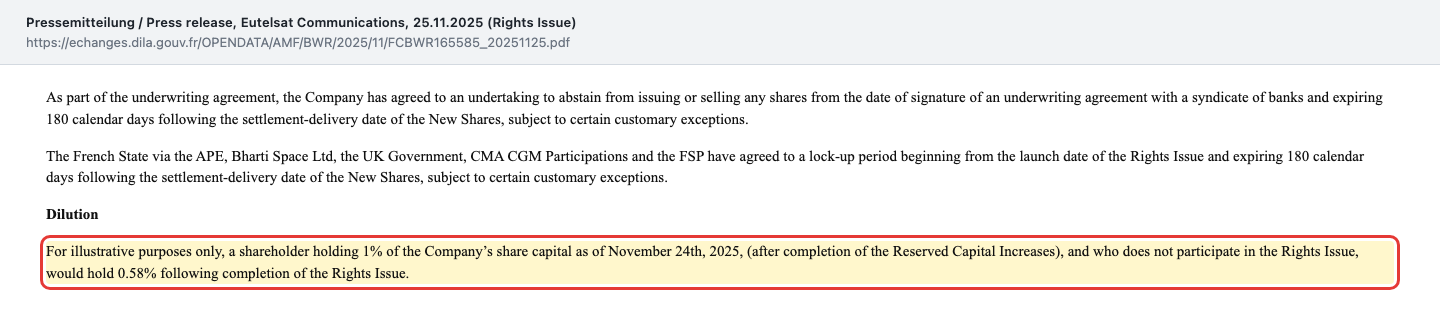
That is exactly what happened in 2025. Eutelsat raised €1.5 billion of equity in two steps. First, on November 21, 2025, the five strategic partners subscribed to 207 million new shares at €4.00 each in a reserved capital increase — €828 million in total. Then came a rights issue for all shareholders: 496.1 million new shares at €1.35 each, 8 new for every 11 held, totaling €669.8 million. Think of this dilution as a pie: it gets bigger because fresh money is baked in, but it is cut into many more slices. The share count rose from 475,178,378 (June 30, 2025) to 1,178,308,106 (June 30, 2026), or 2.48 times. Anyone who did not take part was shrunk hard:
“For illustrative purposes only, a shareholder holding 1% of the Company’s share capital as of November 24th, 2025, (after completion of the Reserved Capital Increases), and who does not participate in the Rights Issue, would hold 0.58% following completion of the Rights Issue.”
— Eutelsat Communications, rights issue release of November 25, 2025, section “Dilution”
Now back to the €4 anchor. It is crooked for two reasons. First, almost 500 million more shares at €1.35 followed that price; the company itself put the theoretical ex-rights value of the share at €2.44 (based on the €3.225 close on November 21, 2025). Second, the big shareholders did not just pay €4 either: they had committed to take up their share of the rights issue — about €475 million at €1.35. For their roughly €1.3 billion of fresh money, the five together received about 559 million new shares, an average of about €2.33 per share. That is still above the October 2026 price — but the gap is far smaller than the anchor suggests. The agreed lock-up of the five ran for 180 days after December 16, 2025, i.e. until mid-June 2026.
Rule of thumb: a big shareholder’s entry price is not a price target. Governments and strategic partners also buy for reasons that have nothing to do with your return — more on that shortly.
Uncomfortable truth No. 3: the most expensive leg is still ahead
The money from the capital raise is not a cushion; it is building material. According to the financial statements, Eutelsat depreciates its low Earth orbit satellites over just seven years; to keep the service running, the constellation has to be renewed continuously. Eutelsat has ordered 440 replacement satellites from Airbus and on September 10, 2026, announced an order for 229 more, for about €1 billion; according to the release, that does not change the capex plan through FY2029. In FY2025-26 the group invested €593.9 million, less than the €900 million previously expected, because payment milestones slipped. The release explicitly warns against extrapolating that:
“It should not be extrapolated for future years, notably FY 2026-27, where Capex is expected in the region of €1.2 billion.”
— Eutelsat Communications, FY2025-26 results release of August 7, 2026, section “Capital Expenditure”
For 2026 to 2029, Eutelsat plans investments of about €4 billion, funded from the €5 billion package of equity, bonds, bank loans and export credit. And the plan reaches further: on August 7, 2026, Eutelsat committed to investments in the European IRIS² satellite program whose size has to be seen next to a market value of about €1.8 billion.

Together that is €3.39 billion for IRIS², spread over 2027 to 2034. In return, Eutelsat gets access to more than twice today’s OneWeb capacity and expects more than €10 billion in revenue between 2032 and 2040. The company says its capital expenditure plan through FY2029 is unchanged; the release does not break down how much of the IRIS² amount is already included. The reality check from the last fiscal year: operations brought in €508.9 million. Subtract investments in satellites and equipment (€541.4 million), lease payments (€52.5 million) and interest paid (€154.6 million), and you are left with negative free cash flow of €239.6 million — after minus €242.5 million the year before. And that was in a year in which Eutelsat invested just under half of what it plans for 2026-27.
How much room is left? Several credit agreements require net debt of no more than 4.0 times adjusted EBITDA; at June 30, 2026, the ratio stood at 2.32. A rough calculation, not a company forecast: if operating cash flow (€508.9 million) and interest paid (€154.6 million) stay at FY2025-26 levels and capex including leases rises to about €1.2 billion as announced, the funding gap is 1,200 − 508.9 + 154.6 ≈ €846 million. That means net debt grows by roughly €800 million to €850 million in FY2026-27 — to about 3.6 times today’s EBITDA. That is still below the limit, but the buffer melts in exactly the years when the money is needed most.
Uncomfortable truth No. 4: the book value hangs on a few assumptions
On paper the stock is cheap: shareholders’ equity stood at €3,620.7 million on June 30, 2026, or about €3.07 per share — twice the share price. But this book value is an estimate, and the financial statements show how thin it is. For OneWeb, Eutelsat projects cash flows through 2040, discounted at 12.9 percent. The result is headroom of €222 million above book value. Raise the discount rate to 13.4 percent and it becomes a shortfall of €167.3 million; cut the assumed perpetual growth rate from 3.5 to 2.5 percent and it becomes a shortfall of €127.2 million. Half a percentage point decides whether there is a write-down. And the calculation assumes things that are not yet certain:
“Achieving these forecasts will require, among other factors, the successful launch of the additional satellites necessary to extend the operational life of the existing constellation, the successful delivery of the IRIS² programme, the achievement of sufficient technological maturity to reduce capacity costs, and the securing of the financing required to fund all planned investments.”
— Eutelsat Communications, FY2025-26 consolidated financial statements, Note 7.1.4 “LEO goodwill impairment test”

The old GEO business looks similar: the goodwill test showed headroom of €250.2 million, which turns into a shortfall of €49.7 million if annual capex is just €30 million higher. Write-downs do not cost cash. But they tell you that the book value you use to call the stock “cheap” is more fluid than the figure of €3.07 suggests.
Uncomfortable truth No. 5: the state has a hand on the wheel
After the reserved capital increases, the French state, through its shareholding agency APE, held 29.65 percent, Bharti Space 17.88 percent, the UK government 10.89 percent, CMA CGM 7.46 percent and the Fonds Stratégique de Participations 4.99 percent — 70.87 percent together; all five had committed to take up their pro rata share of the rights issue. That explains the “Pros 80%” scanner hit — and a sentence in the amendment to the registration document that shareholders should know:
“The French State will also benefit from preferential rights at the level of Eutelsat S.A. and certain subsidiaries (namely Fransat S.A. and Konnect Africa France S.A.S.) through the granting of a golden share at the level of Eutelsat S.A., including the right to appoint directors and board observers, and veto rights over decisions affecting sensitive activities, as defined by the security committee’s internal regulations.”
— Eutelsat Communications, Amendment to the 2024-25 Universal Registration Document of November 25, 2025, section 4.4.5

This cuts both ways. The good side: a state that puts this much money and political weight into a company will not drop it lightly; for customers such as armed forces, that is a selling point. The other side: a golden share protects sovereignty, not your return. The financial statements show how quickly that can matter: on January 29, 2026, Eutelsat learned that the French government had not approved the planned sale of ground infrastructure assets to the private equity firm EQT; the deal fell through. And a takeover by a third party, which puts a floor under many beaten-down stocks, is hard to imagine with this shareholder structure.
Valuation: half of book value, but no free cash flow
At €1.5295 (close on October 1, 2026) and 1,178,308,106 shares, Eutelsat had a market value of about €1.80 billion. Add net debt of €1,464.6 million (June 30, 2026), and enterprise value comes to about €3.27 billion, or 5.2 times adjusted EBITDA of €632.4 million. The market value equals 1.5 times annual revenue and roughly half of shareholders’ equity on the balance sheet. There is no price-to-earnings ratio because Eutelsat is losing money.
Measured against the company’s own targets, that looks low: if Eutelsat really reaches €1.5 billion to €1.7 billion in revenue at a margin above 60 percent in FY2028-29, that would mean more than €900 million of EBITDA. The catch is the road there. About €4 billion will go into new satellites by then, and free cash flow is already negative today. Another inflow is only in sight for 2031: for clearing upper C-band spectrum in the United States, Eutelsat expects incentive payments of $504 million (€443 million) before tax, according to the August 7, 2026, release — only if the clearing is completed within two set deadlines; transition costs are reimbursed. Miss a deadline, and the payment is in question. Anyone getting in today is not betting on book value but on the rebuild working before the money runs short.
Upside and risks at a glance
Upside
- OneWeb is growing strongly: €297 million in revenue in FY2025-26 (up 69.5 percent at constant currency), and the company expects growth of more than 30 percent in FY2026-27.
- European demand for sovereign, secure satellite links is rising; the French Ministry of the Armed Forces’ first NEXUS call-off carries a firm €138 million and up to €350 million.
- IRIS² secures Eutelsat the lead of the EU program’s low Earth orbit segment; the company expects more than €10 billion in revenue between 2032 and 2040.
- The balance sheet is much sturdier after the capital raise: net debt at 2.32 times EBITDA, about €2.3 billion in cash and credit lines plus about €690 million of export credit (June 30, 2026).
- U.S. spectrum clearing: a $504 million incentive payment before tax, expected in 2031 and only if the clearing is completed within two set deadlines; that would equal about a quarter of the market value.
Risks
- The TV business — 43 percent of vertical revenue — shrank 13.1 percent at constant currency in FY2025-26; internet via geostationary satellites lost 6.6 percent.
- Capex of about €1.2 billion in FY2026-27 and about €4 billion through 2029, with free cash flow already negative (minus €239.6 million).
- The share count rose 2.48-fold in 2025; further capital needs for IRIS² from 2027 cannot be ruled out.
- Book value depends on tight impairment tests: a discount rate half a point higher turns OneWeb’s €222 million headroom into a shortfall.
- The state holds a golden share and veto rights; strategic interests can come before the return of other shareholders.
A human conclusion
Back to the anchor. The €4 was never a price target; it was the price governments and partners paid for a seat at the table of a strategic company — and even they paid closer to €2.33 on average, because shares at €1.35 followed. The numbers at June 30, 2026, show no acute financial distress: average debt maturity is 4.2 years, the leverage ratio of 2.32 is below the 4.0 covenant cap, and OneWeb is growing. The state’s backing is for the company, not for the price of your shares. But the question the anchor pushes aside is this: will the cash from a shrinking TV business and a growing OneWeb be enough to fund about €4 billion through 2029 and the IRIS² billions through 2034 — without your slice of the pie getting smaller again? The state has given its answer with a golden share, and that answer is about Europe’s sovereignty. Yours has to be about returns. What you make of it is your decision. And that is how it should be.
If you want to see how another low Earth orbit satellite operator with a fixed government contract and its own satellites runs its business, read our Iridium analysis.
Sources
All original documents used in this analysis — to read for yourself:
- Eutelsat Communications — consolidated financial statements for FY2025-26 (period ended June 30, 2026, published August 7, 2026) — most recent periodic report; source for cash flow, share count, impairments, impairment tests, debt and covenants
- Eutelsat Communications — FY2025-26 results release (August 7, 2026) and results presentation (August 7, 2026) — revenue by vertical, outlook for FY2026-27 and FY2028-29, C-band order
- Eutelsat Communications — IRIS² release (August 7, 2026) and release on 229 additional OneWeb satellites (September 10, 2026)
- Eutelsat Communications — rights issue release (November 25, 2025) and amendment to the 2024-25 Universal Registration Document (November 25, 2025) — capital raise, shareholder structure, golden share
- Eutelsat Communications — H1 FY2025-26 release (February 13, 2026) and investor presentation (March 2026)
- Eutelsat Communications — full-year releases for FY2021-22 and FY2022-23 and the FY2023-24 results presentation and FY2023-24 consolidated financial statements — multi-year figures
- Fundamental data (closing price €1.5295 on October 1, 2026, price history), checked against the share count in the FY2025-26 financial statements. Press releases after August 7, 2026, reviewed through September 23, 2026 (retrieved October 2, 2026).
Transparency & disclaimer: This analysis is a journalistic contextualization of publicly available information and is not investment advice, not a financial analysis in the regulatory sense and not a solicitation to buy or sell securities. Investing in stocks involves substantial risk, up to and including total loss. All information without guarantee; the data date is noted in the text. Positions held by the operator are disclosed daily; where one exists, it appears as a notice at the top of this deep dive.
Our Bottom Line at a Glance
- OneWeb growth positive
- LEO revenue of €297.0M in FY2025-26 (+69.5% at constant currency), 25% of group revenue; first NEXUS call-off with a firm €138M (June 2026), FY2026-27 outlook above +30%.
- Balance sheet after the raise positive
- Net debt cut from €2,626.6M to €1,464.6M (2.32x EBITDA, 06/30/2026), average maturity 4.2 years, about €2.3B of cash and credit lines.
- Shrinking legacy business negative
- Video −13.1% and GEO connectivity −6.6% (constant currency, FY2025-26); EBITDA margin from 74.8% (FY2021-22) to 51.2%; €111M of GEO satellite impairments due to competitive pressure.
- Capex burden negative
- Free cash outflow of €239.6M (FY2025-26); planned capex of about €1.2B in FY2026-27, about €4B through 2029 and €3.39B for IRIS² from 2027 to 2034.
- Dilution and book value negative
- Share count up 2.48-fold in 2025; OneWeb impairment test with only €222M of headroom, which turns into a shortfall with a discount rate half a point higher.
- State anchor shareholder neutral
- France holds 29.65% and a golden share with veto rights; that supports financing but limits asset sales and takeovers (EQT sale not approved in January 2026).
Eutelsat is rebuilding its business from shrinking satellite TV into internet from low Earth orbit. OneWeb is growing strongly, and the balance sheet is sturdier after the capital raise. But free cash flow is negative, planned capex through 2029 is more than twice the market value, and shareholders were heavily diluted in 2025. Not investment advice.
What Our Rating Means
Open questions
The business works in principle, but one material question is open. As long as it stays open, our findings do not carry a quality verdict.
Yellow here signals an open operating question, not a solvency risk: equity is positive, net debt stood at 2.32 times EBITDA at June 30, 2026, well below the 4.0 covenant cap, average debt maturity is 4.2 years, and according to the company the €5 billion financing package covers capex needs through FY2028-29. What remains open is whether OneWeb grows fast enough to replace the shrinking TV business and earn back the investment: after depreciation the group is loss-making, free cash flow is negative, and OneWeb’s balance-sheet value rests on tight assumptions. That the stock trades at about half of book value is a price argument and does not change this rating. The decision is yours.
A journalistic assessment by our editorial team at the time of the deep dive, based on public sources — not investment advice and not a solicitation to buy or sell. Your personal circumstances (investment goals, risk capacity, taxes) cannot be taken into account. What our levels mean, how verdicts are formed, and what conflicts of interest exist →
Worth Noting
- Version of October 2, 2026, based on the FY2025-26 consolidated financial statements (published August 7, 2026), the releases of August 7 and September 10, 2026, the capital raise documents of November 2025 and press releases through September 23, 2026. The hook is the ranking of most-discussed stocks on wallstreet-online — an attention signal, not a data source.
- Eutelsat does not report to the U.S. securities regulator, the SEC; all evidence comes from the company’s English-language reports and regulatory releases on eutelsat.com and with the French market regulator AMF. The fiscal year ends June 30. The 2025-26 Universal Registration Document had not yet been published as of the data date.
- Adjusted EBITDA and net debt as defined by the company (net debt includes lease liabilities). Free cash flow, market value, enterprise value and the major shareholders’ average price are our own calculations from the sources named.
The full analysis as a PDF for later
We will send you this analysis as a PDF — to print, file away, and read at your own pace.
Frequently Asked Questions
Eutelsat (Euronext Paris: ETL) rents out satellite capacity. In fiscal year 2025-26, 43 percent of its €1,197.1 million in vertical revenue came from distributing TV over 31 geostationary satellites; the rest came from internet connectivity for households, businesses, governments, ships and aircraft — increasingly via the OneWeb constellation in low Earth orbit.
OneWeb is a constellation of more than 600 satellites in low Earth orbit that delivers fast, low-latency internet; Eutelsat and OneWeb combined in 2023. In fiscal year 2025-26, OneWeb brought in €297 million of revenue, 25 percent of the group total, and grew 69.5 percent at constant currency.
In 2025, Eutelsat raised about €1.5 billion of equity: 207 million shares at €4.00 for five strategic partners, including the French state, and 496.1 million shares at €1.35 in a rights issue. The share count rose from 475.2 million (June 30, 2025) to 1,178.3 million (June 30, 2026).
At June 30, 2026, net debt was €1,464.6 million, or 2.32 times adjusted EBITDA, down from €2,626.6 million and 3.88 times a year earlier. Several credit agreements cap the ratio at 4.0 times. Eutelsat plans about €1.2 billion of capex for fiscal year 2026-27, so debt is likely to rise again.
IRIS² is the planned European satellite network for secure communications. Eutelsat leads its low Earth orbit segment and on August 7, 2026, committed to invest €2.23 billion in the shared infrastructure and €1.16 billion in its own commercial infrastructure, phased over 2027 to 2034. The company expects more than €10 billion in revenue from 2032 to 2040.
Eutelsat’s fiscal year ends on June 30. Fiscal year 2025-26 therefore runs from July 1, 2025, to June 30, 2026; its results were published on August 7, 2026. First-quarter FY2026-27 revenue is scheduled for October 29, 2026, and half-year results for February 12, 2027.
No. According to its cash flow statements, Eutelsat paid no dividend in fiscal years 2024-25 and 2025-26. The group is losing money (a loss of €457.3 million in fiscal year 2025-26) and needs its cash for new satellites: about €1.2 billion of capex in fiscal year 2026-27 and about €4 billion through 2029.
Found an error?
Did you spot a factual error, an outdated number, or a typo in this deep dive? Let us know briefly — your report goes straight to the editorial team.