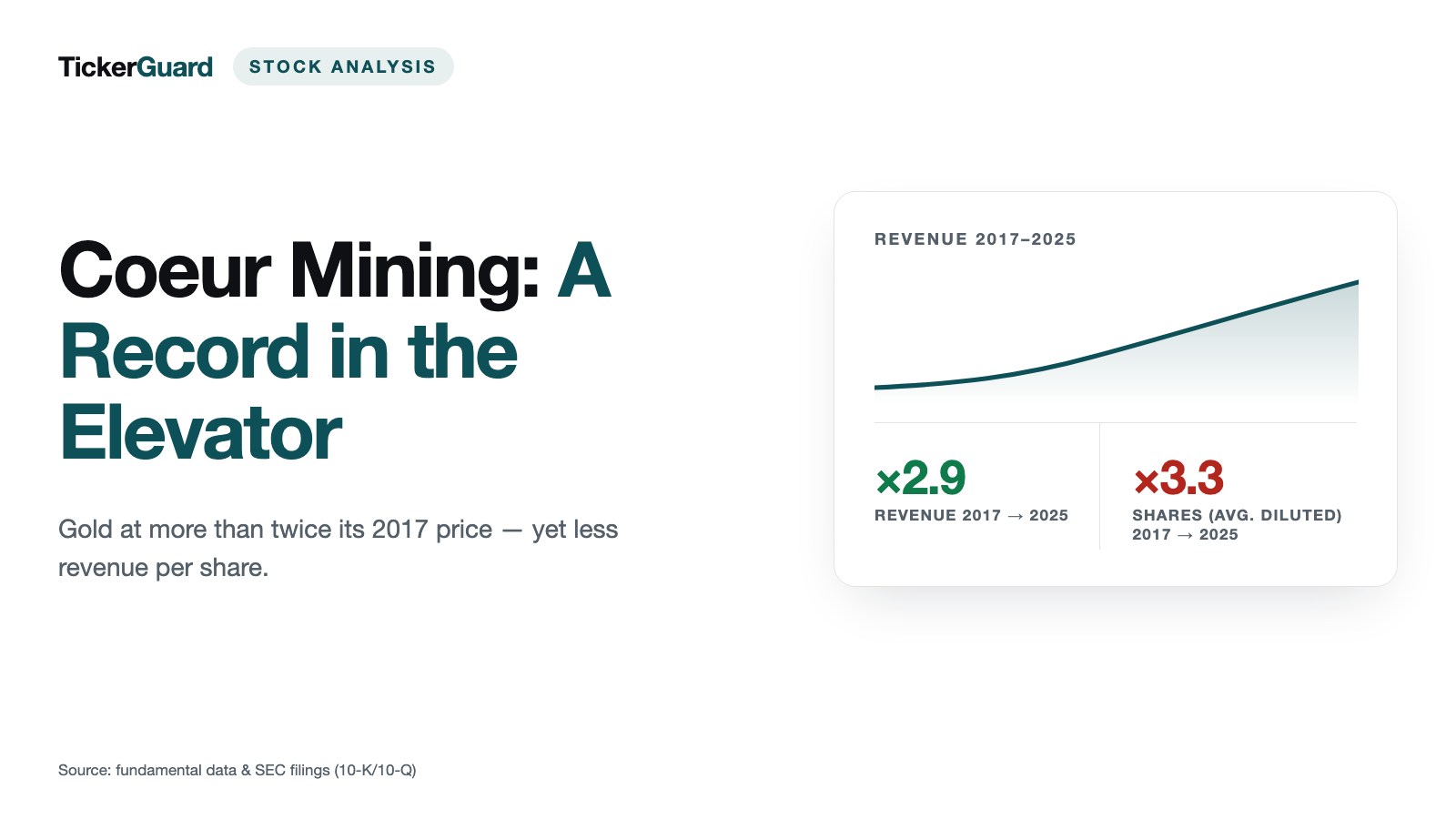
Coeur Mining: Gold at More Than Twice Its 2017 Price — Yet Less Revenue per Share
Coeur Mining posted record revenue in 2025, yet less revenue per share than in 2017 — even though gold and silver cost more than twice as much. The New Gold mines it bought with stock in March 2026 are running at a loss in Coeur’s books and had their guidance cut after a single quarter. How much of the shine comes from the ground — and how much from the price?
 Thomas Mücke
Founder & Publisher
Thomas Mücke
Founder & Publisher
As of Today
As of: October 1, 2026
- Closing price
- 17.60 $ -0.20%
- Market Capitalisation
- 19.4 $B
- P/E
- 13.7
- Growth Score
- 6/10
- AAQS
- 8/10
Price change since October 1, 2026: +0.2%
This analysis has a cut-off date. The Stock Guard tells you when something material changes in the numbers. Reserve your free spot
Chart
Interactive price chart (TradingView).
52-week range: 13.80 $ to 27.20 $ · Last price: 17.60 $ (As of: October 1, 2026)
Note: pure fact-based analysis, not investment advice and not a solicitation to buy or sell. All figures without guarantee.
There is a trap that snaps shut most easily when things are going well: the elevator trap. Ride an elevator to the top floor and it is easy to feel like a strong climber. Your pulse stays calm, the view keeps improving, and at some point you forget that you did not take a single step yourself. For mining stocks, the elevator has a name: the metal price.
Coeur Mining is riding a very fast elevator right now. In the second quarter of 2026, the company realized an average of $4,140 per ounce of gold and $71.18 per ounce of silver — in 2023, it was $1,825 and $24.21. Revenue for the first half of 2026 came to $1.94 billion, more than twice the level of a year earlier. Coeur itself states plainly what all of this depends on:
“Because we derive all of our revenues from sales of these metals, our results of operations and cash flows will fluctuate as the prices of these metals change. A period of significant and sustained lower prices would materially and adversely affect our results of operations and cash flows.”
— Coeur Mining, Inc., SEC quarterly report on Form 10-Q for the period ended March 31, 2026, Part II, Item 1A (Risk Factors)
Let’s make a deal: we step out of the elevator for a moment and read together what Coeur has told the U.S. securities regulator, the SEC — the annual reports (10-K) through 2025, the quarterly report (10-Q) for the period ended June 30, 2026 and every filing through late September 2026. The central tension of this analysis: Coeur is bigger than ever, holds more cash than debt and reports record revenue and record cash flow. But the profit jump arrived with the metal price, growth was paid for with new shares, and two streaming agreements plus the accounting for its latest acquisition shrink what ultimately reaches each share. How much of it is the company’s own strength and how much is elevator is your call.
What Coeur Mining actually does — seven mines in three countries
Coeur is a precious metals producer: it mines ore, recovers gold, silver and, since 2026, copper, and sells the metal at world market prices to refiners, smelters and off-takers. It was founded in Idaho in 1928 as Coeur d’Alene Mines Corporation; on May 16, 2013, it adopted its current name and reincorporated from Idaho to Delaware (2025 annual report, Note 1). Headquarters are in Chicago, and the stock trades in New York and Toronto under the ticker CDE. Mitchell J. Krebs serves as chairman, president and CEO.
Since buying New Gold on March 20, 2026, Coeur runs seven mines: New Afton (gold and copper, British Columbia) and Rainy River (gold and silver, Ontario) in Canada; Las Chispas (silver and gold, Sonora) and Palmarejo (gold and silver, Chihuahua) in Mexico; and Rochester (silver and gold, Nevada), Kensington (gold, Alaska) and Wharf (gold, South Dakota) in the U.S. On top of that sits the Silvertip exploration project in British Columbia. At the end of 2025, before the New Gold deal, Coeur had approximately 2,620 employees.
Many investors know Coeur as a silver stock. The numbers now tell a different story: in the second quarter of 2026, 64 percent of revenue came from gold, 30 percent from silver and 6 percent from copper. If you want silver exposure, Coeur mainly gives you a gold producer with a large silver component. For 2026, the company expects roughly 690,000 ounces of gold, 20 million ounces of silver and 45 million pounds of copper, according to its earnings release of August 5, 2026.
Company history for investors
-
1928
Founded in Idaho
Founded in Idaho as Coeur d’Alene Mines Corporation. The SEC database still lists that name as a former name of the same company.
-
2013
New name, new domicile
Renamed Coeur Mining and reincorporated in Delaware; headquarters are now in Chicago. For shareholders, only the label changed.
-
2023
Expansion funded with fresh equity
Two equity offerings and a private placement raise $168.6M for the Rochester expansion; free cash flow comes in at minus $297M.
-
2025
SilverCrest acquired, record year
239.3M new shares for Las Chispas; with metal prices, free cash flow rises to $666M and the share count to about 640M.
-
2026
New Gold, buyback, first dividend
392.7M new shares for Rainy River and New Afton; then a $750M buyback program and a $0.02 dividend per half-year.
How the stock landed on our desk — via a stock portal’s rankings
Not through a hit in our in-house stock scanner. In early October 2026, Coeur Mining showed up in the rankings of the most searched and discussed stocks on a large German investing portal. With precious metals stocks, that is no accident: when gold and silver make headlines, investors look for stocks that pass the price move on with leverage. Coeur is seen as one of those levers — and that is the very subject of this analysis.
Leverage works both ways. A mine carries high fixed costs: wages, diesel, power, explosives, maintenance. When the metal price rises, almost every extra dollar drops straight to profit. When it falls, the cost base eats the profit just as quickly. How much Coeur lives on this becomes clear once you put the good years next to the hard ones. Rule of thumb: leverage turns good news into great news — and bad news into very bad news.
The numbers over the years — an honest look
First, credit where it is due. 2025 was the best year in the company’s history: revenue roughly doubled to $2.07 billion, net income came to $585.9 million, and free cash flow — the money left after all capital spending — reached $666 million. Coeur produced 419,046 ounces of gold and 17.9 million ounces of silver, up 23 percent and 57 percent from 2024. Debt fell 42 percent to $341 million by year-end.
2026 has kept up that pace. In the first half, revenue rose 131 percent to $1.94 billion and free cash flow reached $654 million. As of June 30, 2026, Coeur held $1.05 billion of cash against only $705 million of debt; the new $1.0 billion credit facility was undrawn. For the full year, Coeur expects about $2.3 billion of adjusted EBITDA (operating earnings before interest, taxes, depreciation and amortization, excluding one-time items) and about $1.5 billion of free cash flow.
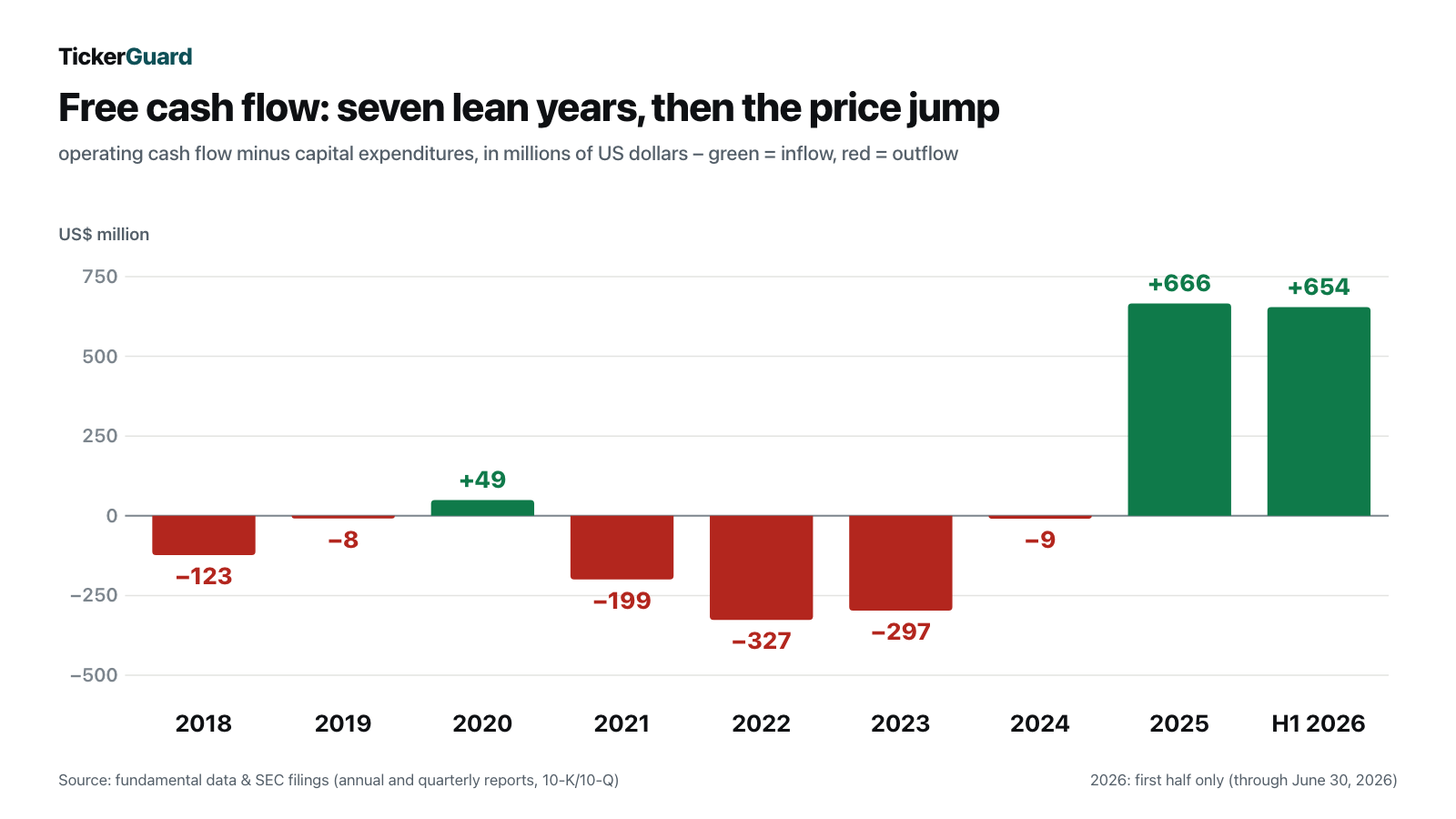
The flip side is right there in the chart. Between 2018 and 2024, Coeur spent roughly $914 million more than it generated, and it posted a net loss in five of those seven years — minus $518 million across all seven years combined. Part of that was deliberate investment, above all the expansion of the Rochester mine with a new crushing circuit and a new leach pad. But the expansion only turned into cash once prices rose: the average realized silver price in 2025 was $40.01, 65 percent above 2023, and gold was $3,184, 74 percent higher. Two special items belong in the picture: 2025 net income includes $209.8 million from the release of a valuation allowance on U.S. deferred tax assets — a non-cash accounting gain. And New Gold brought $128 million of cash on the acquisition date.
Uncomfortable truth No. 1: $3.37 instead of $3.85 — less revenue per share than in 2017
The most important number in this analysis is not an ounce count. It is the share count. Coeur did not fund its growth of recent years out of its own pocket but with new stock. For you as a shareholder, that means the pie got bigger — but a lot more people are now sitting at the table.
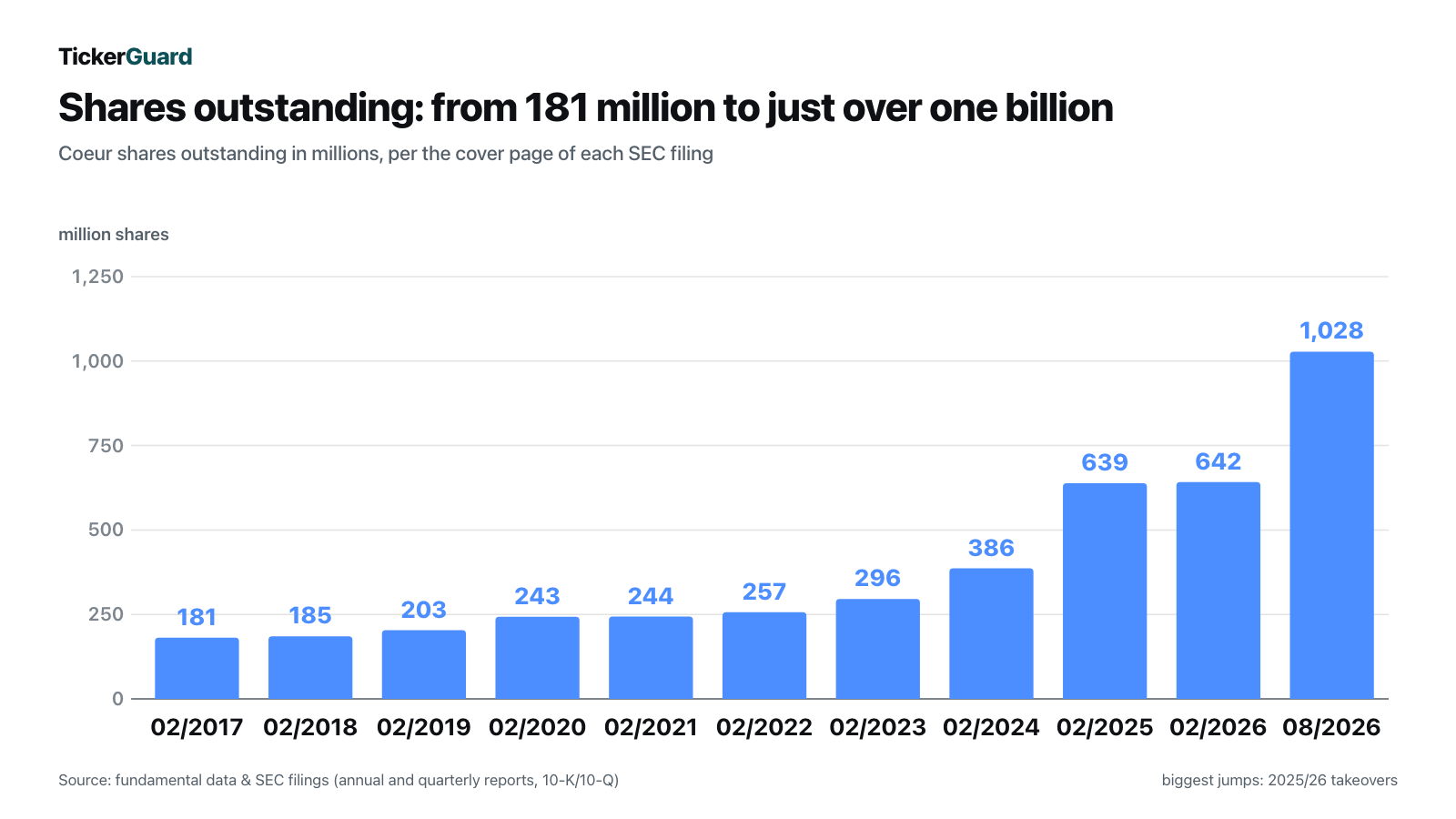
Step by step: in 2022, Coeur sold 36.8 million new shares for $147.4 million; in 2023, another 62.9 million for a combined $168.6 million; in 2024, 7.7 million more. In February 2025, Coeur paid for the Mexican silver producer SilverCrest with 239.3 million new shares (about $1.58 billion), and in March 2026 for New Gold with 392.7 million new shares at $17.67 each, about $6.9 billion in total. As of August 3, 2026, 1,027,934,998 shares were outstanding; 1.3 billion are authorized.
A simple per-share calculation shows what this means. In 2017, Coeur generated $709.6 million of revenue on 184.1 million weighted-average diluted shares — about $3.85 per share. In 2025, a record year with metal prices more than twice as high (gold averaged $3,184 instead of $1,204, silver $40.01 instead of $16.96 per ounce), it was $2.07 billion on 614.7 million shares — about $3.37 per share, less than in 2017. With New Gold, that should improve in 2026: Coeur’s guidance of $2.3 billion of adjusted EBITDA works out to a little over $2.20 per current share, versus $1.67 in 2025. Coeur has also stepped up buybacks since May 2026 under the program expanded to $750 million in March; from mid-May through the end of July, it repurchased 6.7 million shares for $121 million, according to its earnings release. In the second quarter, it paid an average of $18.44 per share — more than the $17.67 at which it handed out 392.7 million shares for New Gold in March. Rule of thumb: record revenue says little until you know how many shares it is spread across.
Uncomfortable truth No. 2: $438 million of revenue, a $52 million loss — the new mines
New Gold was the largest deal in the company’s history, and it turned Coeur into a gold producer with copper on the side. In the second quarter of 2026, the first full quarter under Coeur’s management, Rainy River and New Afton together delivered 40 percent of metal sales. Anyone expecting these mines to carry profits as well will find a surprising line in the notes to the quarterly report:
“Sales and net income in the Condensed Consolidated Statement of Comprehensive Income includes New Gold revenue of $438.1 million and $572.3 million and New Gold net loss of $52.0 million and $69.9 million in the three and six months ended June 30, 2026, respectively.”
— Coeur Mining, Inc., SEC quarterly report on Form 10-Q for the period ended June 30, 2026, Note 3 (Acquisitions)
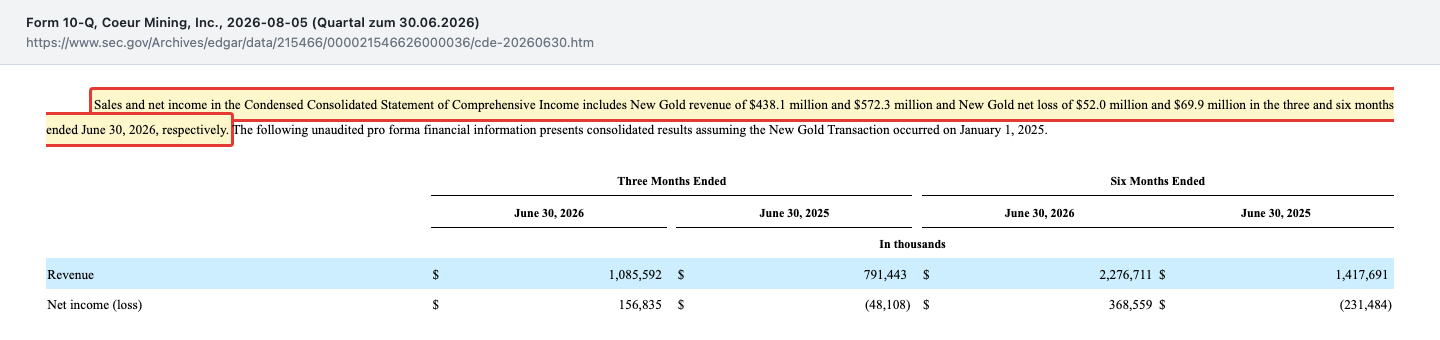
The explanation is in the same tables, and it is mostly accounting. In an acquisition, the purchased mines are not carried at their old book value but at fair value on the acquisition date. Coeur recorded New Gold’s property, plant, equipment and mineral interests at $9.59 billion; as a result, property, plant and equipment on Coeur’s balance sheet jumped from $2.74 billion to $12.16 billion. That higher value is now depreciated over the life of the mines: New Afton and Rainy River alone booked $186 million of amortization in the second quarter. A second effect came on top: Rainy River’s acquired stockpile ore was also written up to its acquisition-date value, and that step-up flows through costs as the ore is processed — $140 million in the second quarter, or $0.10 per share by Coeur’s own count. Without it, earnings per share would have been about $0.22 instead of $0.12.
That is not a trick but a rule, and no cash leaves the company because of it. A different finding in the same report is more serious: after only one full quarter, Coeur lowered its guidance for the new mines. For the nine months under its ownership, Rainy River is now expected to produce 190,000 to 230,000 ounces of gold instead of 230,000 to 275,000, and adjusted costs per ounce rise from $2,150–$2,350 to $2,700–$3,000. At New Afton, the range drops from 60,000–80,000 to 50,000–60,000 ounces of gold and from 50–65 to 40–50 million pounds of copper. The reason: underground mining at Rainy River and the new C-Zone at New Afton are ramping up more slowly than assumed. The five legacy mines remain on plan. Rule of thumb: an acquisition only succeeds once the acquired mine delivers what the purchase price assumed — not when it merely inflates revenue.
Uncomfortable truth No. 3: $800 for a $4,000 ounce — the streams
Mining has a financing structure that becomes expensive in good times: the stream. A financier pays the mine a large sum up front and, in return, receives a fixed share of production for years — at a price far below market. Picture selling part of your future harvest today at a fixed price. If the market price rises, the buyer is happy, not you. Coeur has two such agreements. The older one covers the Palmarejo mine in Mexico:
“Coeur Mexicana currently sells 50% of Palmarejo gold production (excluding production from certain properties acquired in 2015 and 2024) to a subsidiary of Franco-Nevada Corporation (“Franco-Nevada”) under a gold stream agreement for the lesser of $800 or spot price per ounce (“Franco-Nevada Gold Stream Agreement”).”
— Coeur Mining, Inc., SEC quarterly report on Form 10-Q for the period ended June 30, 2026, Note 17 (Commitments and Contingencies)
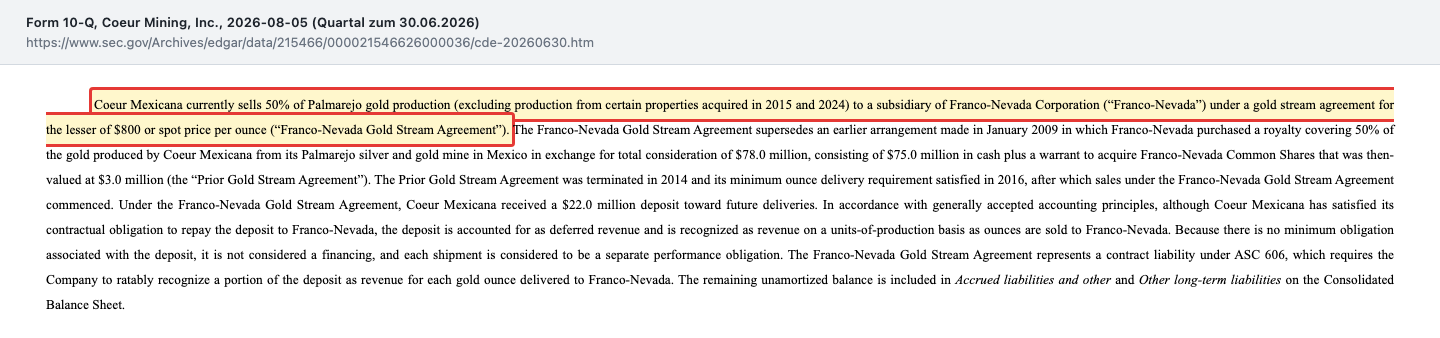
New Gold brought a second, unusual agreement. Rainy River must deliver part of its gold and most of its silver to the financier Royal Gold — and receives only a quarter of the market price for it:
“The Company is also required to deliver 60% of the mine’s silver production to Royal Gold, up to a maximum of 3.1 million ounces and then 30% of silver production thereafter. Royal Gold is required to pay 25% of the average spot gold or silver price at the time each ounce of gold or silver is delivered under the Royal Gold Stream Agreement.”
— Coeur Mining, Inc., SEC quarterly report on Form 10-Q for the period ended June 30, 2026, Note 17 (Royal Gold Stream Agreement)

In numbers: at a gold price of $4,140, Coeur receives about $1,035 for a Royal Gold ounce and at most $800 for a Franco-Nevada ounce from Palmarejo. At Rainy River, the 60 percent silver share applies until 3.1 million ounces have been delivered — as of June 30, 2026, the total stood at 2.16 million. On gold, the share halves once 230,000 ounces have been delivered; just under 95,000 ounces remain until then. Coeur does not disclose how much revenue the two agreements cost it in total. In its risk factors, Coeur itself notes that the streams at Palmarejo and Rainy River can be a reason not to mine parts of its reported reserves at all. For the other side of such deals, see our Wheaton Precious Metals stock analysis — a company that lives on exactly these streams. Rule of thumb: at a mine operator, not every ounce produced fully belongs to the shareholder — read the stream agreements for every mining stock.
Uncomfortable truth No. 4: guidance already assumes $4,000 gold instead of $4,550
Back to the elevator. Coeur’s record guidance for 2026 — about $2.3 billion of adjusted EBITDA, about $1.5 billion of free cash flow and year-end cash approaching $2.0 billion — rests on price assumptions for the second half. And the company cut them sharply in August:
“The Company’s updated guidance figures assume estimated prices of $4,000/oz gold, $60.00/oz silver, and $6.00/lb copper, as well as CAD of 1.38 and MXN of 18.00.”
— Coeur Mining, Inc., SEC quarterly report on Form 10-Q for the period ended June 30, 2026, Item 2 (2026 Guidance)

The cut did not come out of nowhere. In June 2026, Coeur realized only $3,823 per ounce of gold and $62.84 per ounce of silver, the lowest monthly figures of the year, according to its earnings release; in the first quarter, it had been $4,383 and $82.85. Earnings per share fell to $0.12 in the second quarter from $0.35 in the first — because of lower prices, the higher share count and the Rainy River purchase accounting effect. The good news: the guidance does not paint a rosy picture but uses prices below the first-half average. The uncomfortable part: even those assumptions sit far above the average prices Coeur realized in 2024 ($2,156 gold, $27.95 silver) or 2017 ($1,204 and $16.96). Its reserves, by contrast, are calculated far more conservatively, at $2,200 per ounce of gold and $26 per ounce of silver (as of December 31, 2025, before New Gold). From the required filings on share transactions by officers and directors: according to the quarterly report for the period ended June 30, 2026 (Part II, Item 5), CEO Mitchell J. Krebs adopted a prearranged Rule 10b5-1 trading plan on June 1, 2026, covering the sale of up to 250,000 shares between August 31, 2026, and February 28, 2027, and general counsel Casey M. Nault adopted one on May 19, 2026, for up to 240,000 shares. The insider filings (Form 4) since August show four sales: Nault sold 10,000 shares at an average of $20.00 on August 19, 2026, and another 10,000 at an average of $21.06 on September 8, 2026, both under his Rule 10b5-1 plan according to the filings (Form 4 of August 20, Form 4 of September 9, 2026). Director J. Kenneth Thompson sold 25,000 shares at an average of $20.77 on August 19, 2026 (Form 4 of August 20, 2026), and CFO Thomas S. Whelan sold 6,000 shares on the Toronto Stock Exchange the same day at C$28.86, or $20.87 (Form 4 of August 20, 2026); neither of these two filings refers to a Rule 10b5-1 plan. Insiders sell for many reasons, from taxes to diversification, and such sales are not, on their own, a verdict on the company. The insider filings from August 1 through September 28, 2026, contain no purchases by officers or directors. Rule of thumb: guidance is only as good as the price assumption it stands on — and for a mine, that never comes from the mine.
Valuation: about $18 billion as of October 1, 2026
An elevator runs in both directions, and the stock shows it: on September 8, 2026, it closed at $20.66; by October 1, 2026, the closing price had fallen to $17.56, a 15 percent drop in just over three weeks. With 1,027.9 million shares outstanding (August 3, 2026), that implies a market value of about $18.1 billion — our own calculation as of October 1, 2026. The market value shown in the metrics box on this page comes from the database and is based on a different price and data date, so it may differ. Subtracting net cash of about $347 million (June 30, 2026) leaves an enterprise value of about $17.7 billion.
Measured against Coeur’s own full-year guidance of $2.3 billion of adjusted EBITDA, you pay just under 8 times expected operating earnings before depreciation; the expected $1.5 billion of free cash flow would equal a little over 8 percent of market value. Earnings look less cheap: adjusted net income for the last four quarters (third quarter of 2025 through second quarter of 2026) totaled $726 million. Spread across today’s share count, that is about $0.71 per share, and the stock trades at about 25 times earnings — with the two 2026 quarters still carrying $225 million of purchase accounting charges on acquired inventory, $205 million of it on Rainy River’s stockpile ore. Shareholders’ equity stood at $10.4 billion at the end of June, a little over $10 per share; the October 1 price is about 1.7 times that. Coeur’s second-quarter buybacks at an average of $18.44 sit above today’s price. The dividend of $0.02 per half-year, a yield of about 0.2 percent, is more of a signal than income. The order of assumptions matters: all of these multiples hold only as long as gold costs around $4,000 and silver around $60. Reading the floor number in an elevator does not tell you where you will get off. If you want to see how a much smaller gold producer from Idaho, the state where Coeur was founded in 1928, operates, our Idaho Strategic Resources stock analysis offers the comparison.
Opportunities and risks at a glance
The case for Coeur Mining:
- Record results: 2025 revenue of $2.07 billion and free cash flow of $666 million; first-half 2026 revenue of $1.94 billion and free cash flow of $654 million.
- A balance sheet with net cash: $1.05 billion of cash against $705 million of debt (June 30, 2026), with an undrawn $1.0 billion credit facility.
- A broader base: seven mines in the U.S., Canada and Mexico instead of five; expected 2026 production of roughly 690,000 ounces of gold, 20 million ounces of silver and 45 million pounds of copper.
- Conservatively calculated reserves ($2,200 gold, $26 silver, as of year-end 2025) and guidance that already assumes lower prices.
- Capital returns have begun: a $750 million buyback program and a first dividend in June 2026.
The case against:
- Dependence on metal prices: in 2024, at $2,156 gold, only $58.9 million of net income and no free cash flow were left; the turnaround came only with the prices of 2025.
- Heavy dilution: the share count rose from 181 million in February 2017 to 1,028 million; 2025 revenue per share was below the 2017 level.
- The New Gold mines booked a $69.9 million loss in the first half of 2026; guidance for Rainy River and New Afton was cut after just one quarter.
- Two streams: half of Palmarejo’s gold at no more than $800, 60 percent of Rainy River’s silver at a quarter of the market price.
- 2026 guidance assumes $4,000 gold and $60 silver; in June 2026, the realized gold price was already below that. Country risk on top: in international arbitration under the USMCA trade agreement, Coeur is seeking to recover $30.2 million of value-added tax from Mexico plus interest and other damages; by the company’s account, the tax was not owed (quarterly report for the period ended June 30, 2026, Note 17).
A human conclusion
Back to the elevator trap. Coeur Mining is a different company today than three years ago: bigger, with record revenue and more cash than debt. Management earned part of that itself — with the Rochester expansion and with two acquisitions that broadened production to seven mines. But most of the climb came by elevator. The year 2024 shows what things looked like without it: at average prices of $2,156 per ounce of gold and $27.95 per ounce of silver, $1.05 billion of revenue left $58.9 million of net income, and free cash flow came in at minus $9 million. Only the prices of 2025 and 2026 lifted cash flow into the hundreds of millions. And to pay for the build-out, every existing shareholder split their stake with a lot of new ones. For every mining stock, check how high it would get without the elevator — at prices you do not take for granted. The next chances to do that: the quarterly report for the third quarter of 2026, which will show whether Rainy River and New Afton hold their lowered guidance, and the 2026 annual report with new reserves including New Gold. What you make of it is your decision. And that is how it should be.
Sources
All original documents used in this analysis — so you can check them yourself:
- Coeur Mining, Inc. — quarterly report on Form 10-Q for the period ended June 30, 2026 (filed August 5, 2026) — latest periodic report: share count, balance sheet, purchase price allocation and New Gold contribution (Note 3), stockpile ore (Note 6), debt (Note 8), streams (Note 17), 2026 guidance and price assumptions, buybacks, dividend, trading plans
- Coeur Mining, Inc. — second-quarter 2026 earnings release, Form 8-K of August 5, 2026, Exhibit 99.1 (quarterly series, June prices, 2026 outlook)
- Coeur Mining, Inc. — quarterly report on Form 10-Q for the period ended March 31, 2026 (updated risk factors on metal prices, streams and reserves)
- Coeur Mining, Inc. — annual reports on Form 10-K for 2025 (February 18, 2026; record year, valuation allowance release, reserves, employees) and 2024 (February 19, 2025; equity raises 2022–2024, SilverCrest deal)
- Coeur Mining, Inc. — Forms 8-K of March 23, 2026 (closing of the New Gold acquisition, new credit facility) and May 18, 2026 (buyback status)
- Coeur Mining, Inc. — insider filings (Form 4) of August 20, 2026 (Casey M. Nault, J. Kenneth Thompson, Thomas S. Whelan) and September 9, 2026 (Casey M. Nault). Closing prices of September 8 and October 1, 2026 (price anchor $17.56): source: fundamental data. Market value, enterprise value, multiples and yields are our own calculations. Multi-year figures: Source: fundamental data & SEC filings (annual and quarterly reports, 10-K/10-Q).
Transparency & disclaimer: This analysis is a journalistic assessment of publicly available information. It is not investment advice, not a financial analysis in the regulatory sense and not a solicitation to buy or sell securities. Investing in stocks involves substantial risk, up to and including total loss. All information without guarantee; the date of each data point is noted in the text. Positions held by the operator are disclosed daily; where one exists, it appears as a notice at the top of this deep dive.
Key figures at a glance
All monetary figures in millions of $; earnings per share as reported.
| Metric | 2021 | 2022 | 2023 | 2024 | 2025 |
|---|---|---|---|---|---|
| Revenue | 832.8 | 785.6 | 821.2 | 1,054.0 | 2,070.1 |
| Operating Income (EBIT) | 191.8 | -39.3 | -38.7 | 164.2 | 750.8 |
| Net Income | -31.3 | -78.1 | -103.6 | 58.9 | 585.9 |
| Net Margin | -3.8% | -9.9% | -12.6% | 5.6% | 28.3% |
| Earnings Per Share | -0.13 $ | -0.28 $ | -0.30 $ | 0.15 $ | 0.90 $ |
Source: fundamental data & SEC filings (annual and quarterly reports, 10-K/10-Q)
Our Bottom Line at a Glance
- Earnings power positive
- 2025 revenue $2.07B, free cash flow $666M; H1 2026 revenue $1.94B (+131%), free cash flow $654M.
- Balance sheet positive
- $1.05B of cash against $705M of debt (06/30/2026); $1.0B credit facility undrawn; net cash of about $347M.
- Metal price dependence negative
- Cash outflow in six of seven years from 2018 to 2024, about $914M in total; 2026 guidance assumes $4,000 gold and $60 silver.
- Dilution negative
- Share count from 181M (02/2017) to 1,028M (08/2026); 2025 revenue per share of about $3.37 below 2017 (about $3.85).
- New Gold integration neutral
- New Gold mines lost $69.9M in H1 2026 (mainly amortization and purchase accounting); Rainy River and New Afton guidance cut after one quarter.
- Streams negative
- Half of Palmarejo gold at no more than $800 per ounce; 60% of Rainy River silver and 6.5% of its gold at 25% of the market price.
Two acquisitions and record gold and silver prices have turned Coeur Mining into a large precious metals producer with net cash and $585.9M of 2025 net income (including a $209.8M tax benefit). Growth was paid for with new shares; profits depend almost entirely on metal prices, two streams reduce realized revenue, and the new New Gold mines cut their guidance after just one quarter. Not investment advice.
What Our Rating Means
Open questions
The business works in principle, but one material question is open. As long as it stays open, our findings do not carry a quality verdict.
Yellow here signals an open operating question, not a view on the stock price: the balance sheet is healthy, with net cash, an undrawn credit facility and strong cash generation — no substantive risk to the company is in evidence. What remains open is whether Coeur can make money without record prices: from 2018 through 2024, more cash went out than came in during six of seven years, profitability swings with the metal price, and the integration of the New Gold mines is not yet proven given the lowered guidance for Rainy River and New Afton. Heavy dilution and the streams add to that. Whether a market value of about $18 billion (October 1, 2026) is justified is not what this rating answers. The decision is yours.
A journalistic assessment by our editorial team at the time of the deep dive, based on public sources — not investment advice and not a solicitation to buy or sell. Your personal circumstances (investment goals, risk capacity, taxes) cannot be taken into account. What our levels mean, how verdicts are formed, and what conflicts of interest exist →
Worth Noting
- Edition of October 2, 2026, based on the 2024 and 2025 annual reports on Form 10-K, the quarterly reports on Form 10-Q for the periods ended 03/31/2026 and 06/30/2026 (latest periodic report, filed 08/05/2026), the earnings release of 08/05/2026 and all SEC filings through 09/28/2026. The trigger was the ticker CDE in the rankings of a large German investing portal, not a scanner hit.
- Not to be confused: Coeur Mining, Inc. is the same company as the former Coeur d’Alene Mines Corporation (renamed in 2013), not the city of Coeur d’Alene, Idaho, and not another company of that name. Multi-year figures come from the respective annual reports; free cash flow = operating cash flow minus capital expenditures. Market value, enterprise value, per-share figures and yields are our own calculations.
- The price anchor is the closing price of $17.56 on 10/01/2026 (source: fundamental data); on 09/08/2026, it had closed at $20.66. Second-quarter 2026 earnings ($0.12 per share) were reduced by $0.10 per share by a non-cash purchase accounting effect on Rainy River’s stockpile ore.
Stock Watch
This analysis is as of October 2, 2026. Stock Watch will tell you what's changed at CDE since then.
Later $1 a month per stock — signing up is free, and you'll be the first to know when it launches.
The full analysis as a PDF for later
We will send you this analysis as a PDF — to print, file away, and read at your own pace. And we will add you to the free Stock Watch list for Coeur Mining Inc (CDE), so you hear about it when something material in this analysis changes.
Frequently Asked Questions
By revenue, mainly a gold producer. In the second quarter of 2026, 64 percent of revenue came from gold, 30 percent from silver and 6 percent from copper. For 2026, Coeur expects roughly 690,000 ounces of gold, 20 million ounces of silver and 45 million pounds of copper. Its large silver mines are Rochester, Palmarejo and Las Chispas.
Coeur acquired New Gold on March 20, 2026, issuing 392,682,578 of its own shares, or 0.4959 Coeur shares per New Gold share. At the $17.67 closing price, that was about $6.9 billion. New Gold brought the Rainy River mine in Ontario, the New Afton mine in British Columbia and $400 million of senior notes.
According to its quarterly report, Coeur had 1,027,934,998 shares outstanding as of August 3, 2026, with 1.3 billion authorized. In February 2017, the figure was 181 million. The biggest jumps came with the SilverCrest acquisition in February 2025 and the New Gold acquisition in March 2026, both paid for in Coeur stock.
Yes, since 2026. On May 13, 2026, the board declared a first dividend of $0.02 per share, paid on June 10, 2026; payments are planned twice a year. At the $17.56 closing price of October 1, 2026, that is a yield of about 0.2 percent. A $750 million share buyback program runs alongside it.
In a stream, a financier pays money up front and receives a share of production at a low price for years. Coeur sells half of Palmarejo’s gold to Franco-Nevada for at most $800 per ounce and delivers 6.5 percent of Rainy River’s gold and 60 percent of its silver to Royal Gold for a quarter of the market price.
Since its quarterly report of August 5, 2026, Coeur assumes $4,000 per ounce of gold, $60 per ounce of silver and $6 per pound of copper, down from $4,550, $77.50 and $5.00 for gold, silver and copper. That underpins about $2.3 billion of adjusted EBITDA and about $1.5 billion of free cash flow for 2026.
Yes, but less than its cash. As of June 30, 2026, $705 million of debt, mainly senior notes due 2029 and 2032, was set against $1.05 billion of cash and equivalents. The new $1.0 billion credit facility was undrawn. On balance, Coeur had net cash of about $347 million.
Found an error?
Did you spot a factual error, an outdated number, or a typo in this deep dive? Let us know briefly — your report goes straight to the editorial team.