Pentixapharm: A Green Light From the FDA, a Question Mark From BaFin
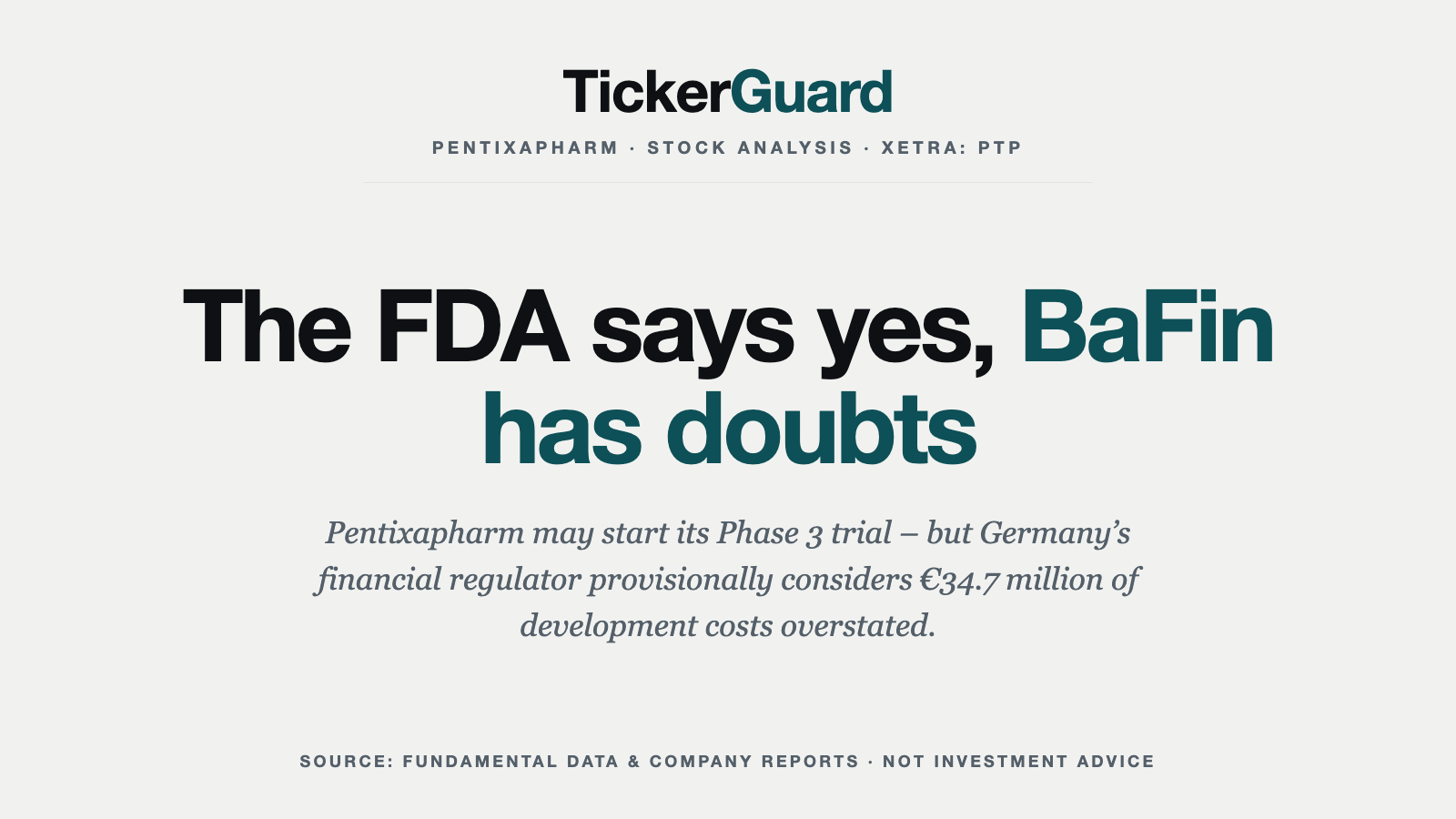
The U.S. Food and Drug Administration cleared Pentixapharm's Phase 3 PANDA trial and granted Fast Track status, and a July 2026 rights offering brought in €20.4 million. At the same time, Germany's financial regulator BaFin takes the preliminary view that €34.7 million of capitalized development costs are overstated — the largest item on the balance sheet. We put both side by side and work out what remains once the shine is stripped away.
 Thomas Mücke
Founder & Publisher
Thomas Mücke
Founder & Publisher
Chart
Interactive price chart (TradingView).
Note: pure fact-based analysis, not investment advice and not a solicitation to buy or sell. All figures without guarantee.
Ever heard of the halo effect? One shiny trait colors our judgment of everything else. Good-looking people seem smarter; someone with a doctorate seems competent about investing too. In the stock market, the shine often comes from three letters: FDA. The moment a small biotech announces “clearance” or “Fast Track” from the U.S. Food and Drug Administration, everything looks brighter — including the balance sheet nobody has read.
That kind of glow has surrounded Pentixapharm Holding AG (Xetra: PTP) since the summer of 2026. In June, the FDA gave the green light for the pivotal Phase 3 trial PANDA; in July, Fast Track status followed, and a capital increase raised €20.4 million. Almost at the same time, however, the company disclosed that Germany’s financial regulator BaFin takes the preliminary view that the largest item on its balance sheet is overstated. So let us make a deal: we set the halo aside for a moment and read what the reports actually say. Our basis is exclusively what Pentixapharm itself has published — above all the audited 2025 annual report of March 26, 2026, and the half-year report 2026 of August 6, 2026.
A word up front: Pentixapharm files no reports with the U.S. securities regulator, the SEC. The stock trades in the Prime Standard of the Frankfurt Stock Exchange, Germany’s segment with the strictest transparency requirements. The 2025 group accounts were audited; the 2026 half-year report, by the company’s own statement, was not reviewed by an auditor. Pentixapharm publishes its reports in English as well, so the quotes below are the company’s own English wording.
What Pentixapharm actually does
Pentixapharm develops radiopharmaceuticals: drugs that carry a tiny dose of radiation to a specific spot in the body. Picture a glow-in-the-dark paint that sticks only to one particular kind of cell. In a PET/CT scanner, exactly those cells light up. Swap the faint marker for a stronger radioactive payload, and the same molecule can destroy those cells. The industry calls this one-key-for-diagnosis-and-treatment approach “theranostics.”
Pentixapharm’s key is CXCR4, a receptor on the cell surface. According to the 2025 annual report, the patent-protected CXCR4 compounds are available to the company under an exclusive license. Its most important program is [⁶⁸Ga]Ga-PentixaFor, a diagnostic for primary aldosteronism. In this condition, the adrenal glands release too much of the hormone aldosterone, and blood pressure often barely responds to pills. The crucial question for treatment is whether only one adrenal gland is affected — then surgery can help — or both. Today, that is usually answered with a catheter threaded through the veins up to the adrenal glands. PentixaFor aims to answer the question with a scan. According to the company, in the United States alone, primary aldosteronism is the reason therapy fails in 6.5 million to 7 million hypertension patients, and it plans a U.S. launch in 2030 (ad hoc disclosure of June 9, 2026). Those are company estimates and targets, not audited figures. How a radiodiagnostic can actually make money once approved is something we worked through in our Lantheus analysis.
Two cancer programs run alongside: PentixaTher is meant to irradiate the bone marrow in a targeted way before stem cell transplants in leukemia and multiple myeloma (Phase I/II), and an antibody platform against the target CD24 is still preclinical. Pentixapharm has only been independent since the fall of 2024: Eckert & Ziegler SE spun off the business, the spin-off took effect on October 2, 2024, and trading began the next day. The registered seat is Berlin; the operating subsidiary Pentixapharm AG was registered in Würzburg until the spin-off.
Company history for investors
-
2024
October: spin-off and listing
Eckert & Ziegler spins off Pentixapharm, and new shares are placed at €5.10. For shareholders, the starting point — and the yardstick for everything that followed.
-
2025
Net loss of €16.5 million
First full year as a listed company: cash falls from €23.2m to €4.6m; in the audit report on that year, the auditor flags a material uncertainty about the going concern.
-
2026
June: FDA clearance and BaFin disclosure
On June 9, a single ad hoc disclosure reports both the FDA clearance for PANDA and BaFin's review of the 2024 accounts — progress in the clinic, a question mark on the balance sheet.
-
2026
July: Fast Track and capital increase
€20.4m gross at €1.85 per share, and the share count rises by just over 44 percent. Management says funding lasts into 2028; every existing holder's slice shrinks.
How the stock landed on our desk
Honestly: not through a metric. The stock showed up on the list of most-searched stocks at the German retail portal wallstreet-online. That is an attention signal and not a reason to buy. So the trigger was not our in-house stock scanner; for a company without revenue, most of its metrics would say little anyway.
The curiosity is understandable all the same. Between June and July 2026, Pentixapharm issued five ad hoc disclosures and several press releases full of words a halo loves: “Study May Proceed,” “Fast Track,” “billion-euro potential,” “significantly oversubscribed.” Let us check how much of that shows up in the numbers.
The numbers over the years — honestly appraised
First, what genuinely impresses: Pentixapharm is visibly cutting costs. The net loss for the first half of 2026 fell to €6.9 million from €8.4 million a year earlier, and net cash used in operating activities fell to €5.0 million from €8.4 million. The group employed 38 people on average in the first half of 2026, down from 61 in 2025. Fiscal 2025 already closed with a net loss of €16.5 million — below the forecast, which had been cut during the year from €23.5 million to €18 million (Annual Report 2025, German edition, page 28). And the trials are moving: the FDA allowed the PENTHERA cancer study to proceed in February 2026 and the Phase 3 PANDA trial in June 2026; in July 2026, PentixaFor received Fast Track status.
But there is practically no revenue. In 2025 it was €93,000 from selling precursor material to clinical centers; in the first half of 2026 it was zero. That is normal for a clinical-stage company — but it means every trial, every salary and every report is paid out of the cash pile. The first chart shows how that pile has developed.
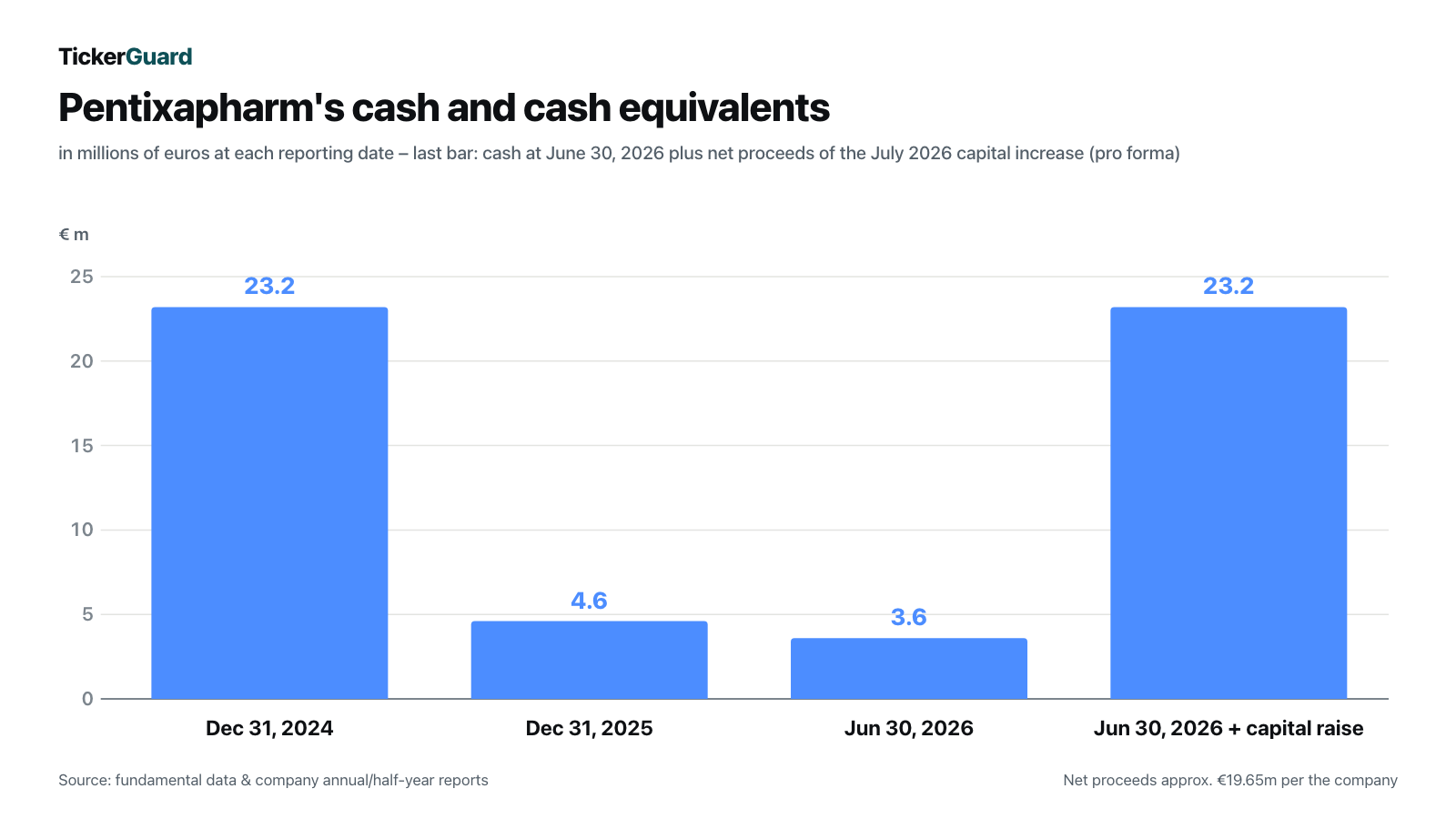
The chart tells the story of the first two years as a listed company: roughly €18 million flowed out of operations in 2025, and by the end of June 2026 only €3.6 million was left in the bank. The gap was bridged with €4.0 million from a convertible bond held by the former parent, and then came the capital increase. Rule of thumb: the cost savings are real — they extend the cash runway, but they do not replace revenue.
And the expensive part is still ahead. In the March annual report, management guided for a 2026 net loss of about €21.6 million, translating into a cash outflow of €17.5 million (page 28 of the German edition); in August, it confirmed the loss guidance. After a €6.9 million loss in the first half, that implies a loss of about €14.7 million in the second half — more than twice the first. The reason is the planned start of the Phase 3 trial; the company expected to enroll the first patient in the second half of 2026.
Uncomfortable truth No. 1: BaFin believes the largest balance sheet item is overstated
Pentixapharm’s largest asset by far is not a lab or a bank balance but an intangible asset: capitalized development costs for PentixaFor. Think of renovating your house and booking the hours you spent not as an expense but as an increase in the value of the house. That is allowed if certain conditions are met — but whether the house is really worth more only becomes clear once somebody pays for it. The auditor, msw GmbH, describes the size of this item in its report on the 2025 accounts:
“The capitalized development costs are stated under other intangible assets and measured at KEUR 31,219. As this represents 74.6% of total assets, this item has a material influence on the company’s results of operations.”
— Pentixapharm Holding AG, Annual Report 2025, independent auditor’s report, page 71
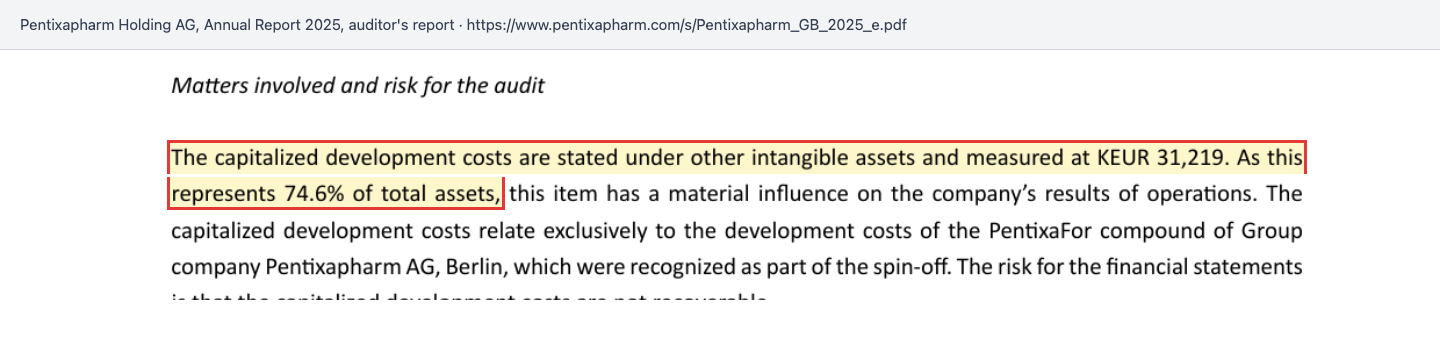
The auditor did not object to the item; it considers the assumptions behind its value appropriate. According to the notes, the company based its impairment test at the end of 2024 on a forecast of free cash flows from the planned out-licensing for 2025 through 2040 that reflected the then “state of negotiations” with a potential licensee (page 51). No signed license agreement had been reported by the time of the 2026 half-year report; the release of August 6, 2026, merely says the company is “evaluating potential strategic partnerships and out-licensing opportunities.” BaFin sees the matter more fundamentally. On June 9, 2026, Pentixapharm disclosed an ongoing enforcement review of its 2024 group accounts in an ad hoc disclosure:
“According to BaFin’s preliminary view, the intangible assets recognized in the consolidated financial statements as of December 31, 2024, in particular, are overstated by EUR 34.7 million.”
— Pentixapharm Holding AG, ad hoc disclosure of June 9, 2026, section 3 (English version)
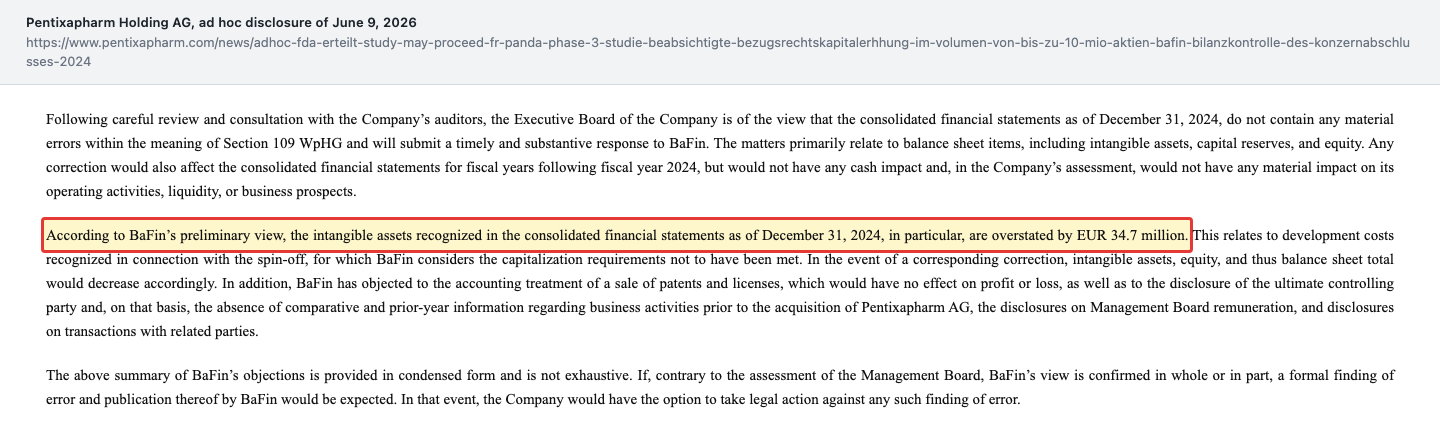
According to the same disclosure, BaFin considers the capitalization requirements for the development costs recognized in the spin-off not to have been met. For comparison: at the end of 2024, intangible assets totaled €35.4 million, of which €34.7 million were capitalized development costs for PentixaFor (Annual Report 2025, German edition, page 55). It also objects to the accounting for a sale of patents and licenses, which according to the disclosure would have no effect on profit or loss, and to disclosures on the ultimate controlling party, management board compensation and related-party transactions. After consulting its auditors, management maintains that the accounts contain no material errors; a correction would have no cash impact and, in the company’s assessment, no material effect on operations, liquidity or prospects. The company’s half-year release of August 6, 2026, says the review “is ongoing”; the company had not reported a conclusion by October 1, 2026. By its own account, the disclosure summarizes the objections in condensed form and is not exhaustive.
Why this matters even though not a single euro leaves the company is shown in the second chart.
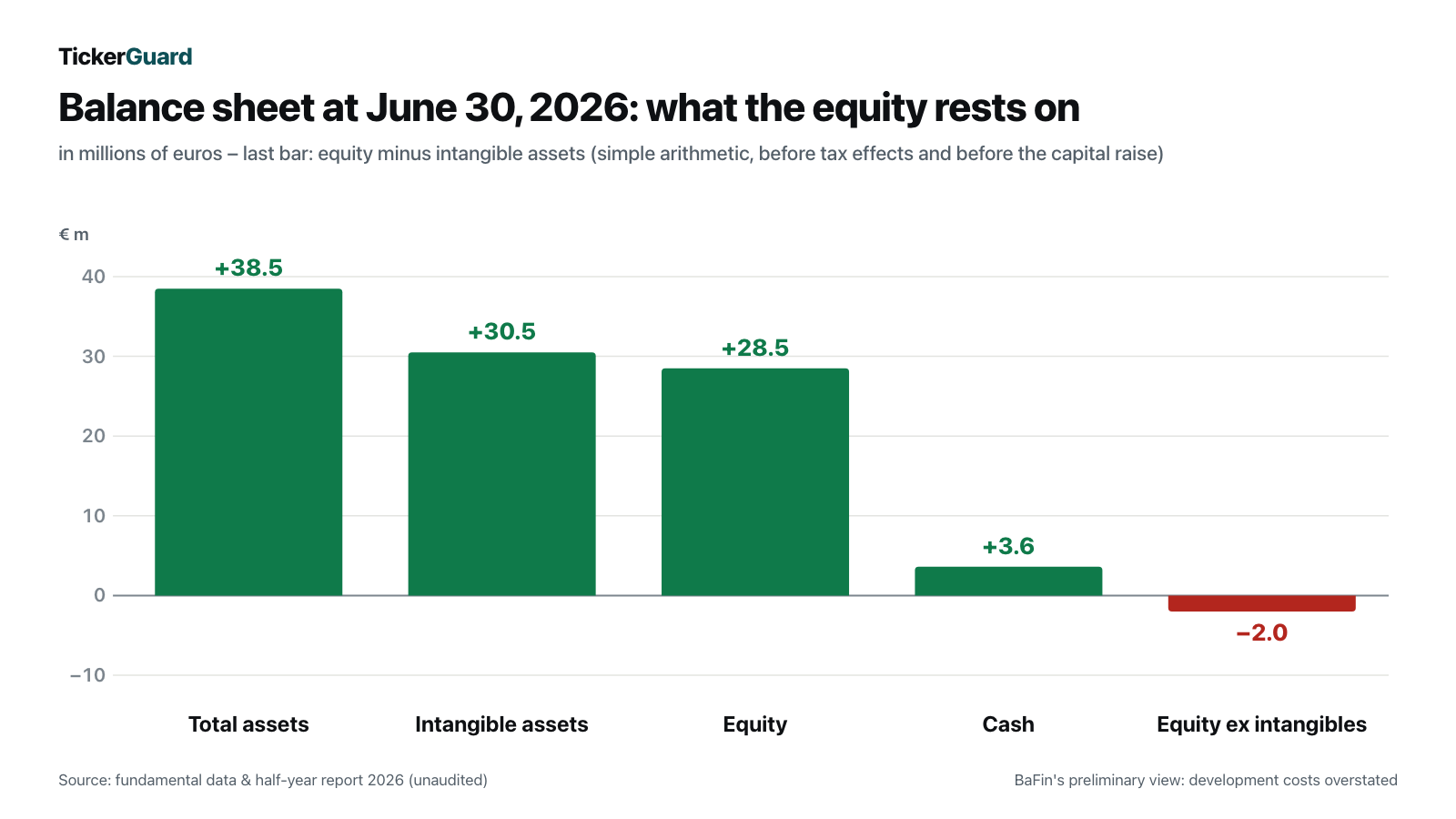
The math is simple but telling: at June 30, 2026, intangible assets of €30.5 million stood against equity of only €28.5 million. On paper, the entire equity was thus tied up in this single item. The July capital increase added roughly €19.65 million on paper; without the intangible assets — of which the development costs made up €31.2 million of €32.3 million at the end of 2025 — about €17.7 million of that cushion would remain before the losses since July. Rule of thumb: a balance sheet item that the auditor and the regulator see differently is an uncertain value — it only holds if PentixaFor one day brings in license money.
Uncomfortable truth No. 2: The fresh money pays for the next leg, not for the finish line
How tight things were before the capital increase is spelled out in the 2025 annual report. The auditor flagged a material uncertainty that may cast significant doubt on the company’s ability to continue as a going concern (page 70), and management’s forecast report warned that the group’s existence would be at risk if its financing plans could not be implemented. The July capital increase improved that picture: in the half-year report, management no longer sees any material uncertainty about the going concern, and according to its release of August 6, 2026, it expects the available funds to finance operations “into 2028.” In the going-concern section of the half-year report (page 13), though, sits the sentence that points the way:
“In order to secure liquidity beyond this period, the Management Board plans to raise additional capital.”
— Pentixapharm Holding AG, Half-Year Report 2026, notes, going concern, page 13
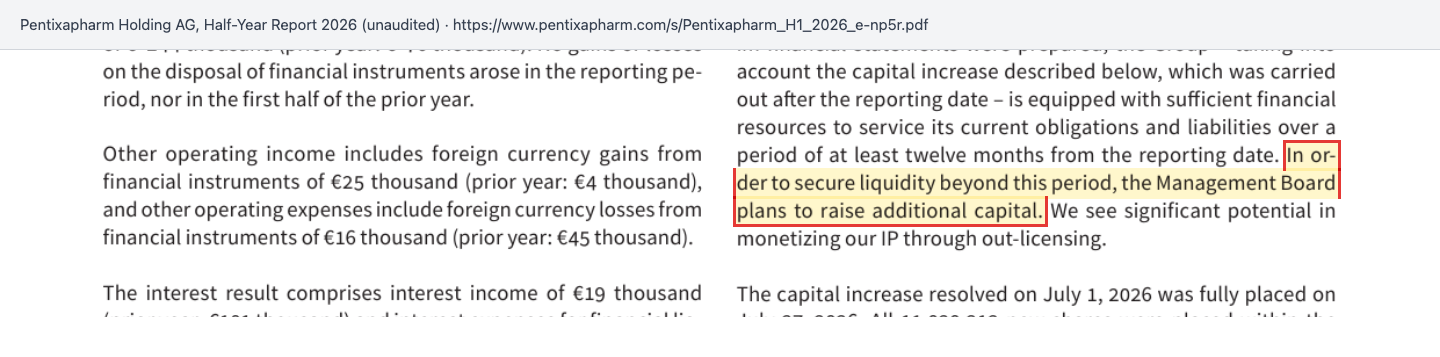
“This period” means the twelve months from the June 30, 2026, reporting date. A rough calculation: cash of €3.6 million at the end of June plus net proceeds of about €19.65 million comes to about €23.2 million. If the full-year guidance holds, about €12.5 million flows out in the second half of 2026 — the difference between the planned €17.5 million cash outflow and the roughly €5.0 million of the first half. That would leave about €10.8 million at the end of 2026 on paper. On top of that, Pentixapharm can draw up to €14.5 million more from the convertible bond held by Eckert & Ziegler SE if needed. But the company does not plan its U.S. launch until 2030 — by then, the Phase 3 trial with about 325 patients has to be run, analyzed and reviewed by the FDA.
The price for the fresh money has already been paid: the 11,020,212 new shares cost €1.85 each, about 21 percent below the Xetra closing price of June 30, 2026. At the October 2024 listing, investors had paid €5.10 for new shares (Annual Report 2024). The share count rose from 24,795,477 to 35,815,689, an increase of just over 44 percent. Anyone who did not take part now owns a correspondingly smaller slice of the company — like a cake cut into more pieces. Rule of thumb: for the period beyond the twelve-month horizon, management plans additional capital — whether through new shares, debt or license income is open.
Uncomfortable truth No. 3: Major shareholder, board chair and lender are linked
At Pentixapharm, many threads lead to one person. The half-year report describes the relationships like this:
“Eckert Wagniskapital und Frühphasenfinanzierung GmbH, which holds 31.2% of the shares of Eckert & Ziegler SE and 36.0% of the shares of Pentixapharm Holding AG and whose principal shareholder, Dr. Andreas Eckert, is Chairman of the Supervisory Board of Eckert & Ziegler SE and of Pentixapharm Holding AG.”
— Pentixapharm Holding AG, Half-Year Report 2026, notes, related parties, page 12
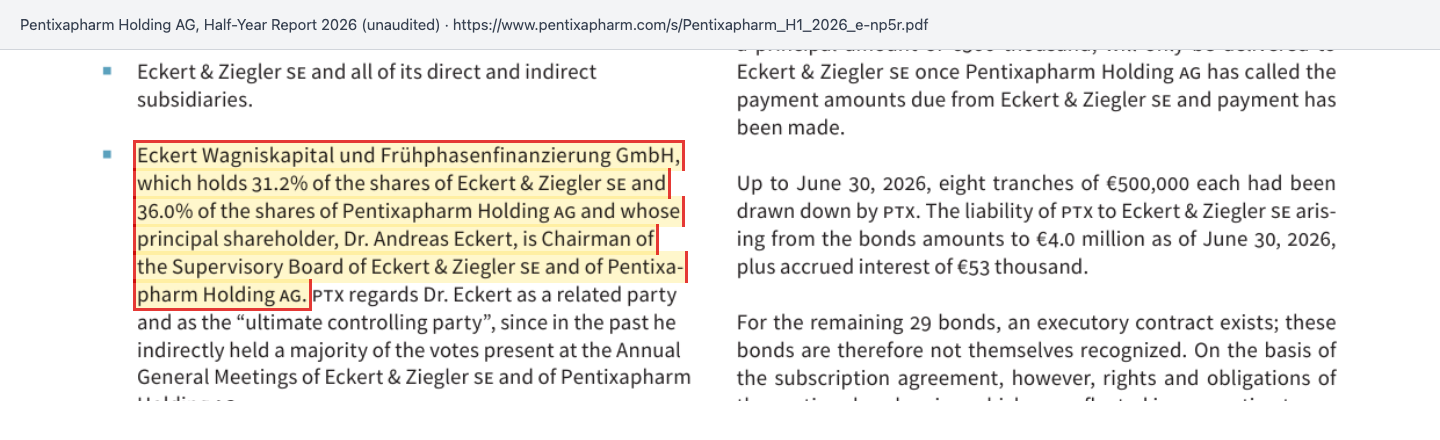
According to the report, Pentixapharm itself regards Dr. Eckert as its “ultimate controlling party,” because in the past he indirectly held a majority of the votes present at the annual general meetings of Eckert & Ziegler and Pentixapharm. The articles of association give Eckert Wagniskapital the right to appoint one third of the supervisory board as long as it holds at least 3 percent of the shares. Eckert & Ziegler SE is also a lender: it subscribed to a convertible bond of up to €18.5 million, from which Pentixapharm had drawn eight tranches totaling €4.0 million by the end of June 2026. Under the bond terms, it carries 4.0 percent interest and must be repaid on December 31, 2027, unless it is converted into shares beforehand (Annual Report 2025, German edition, pages 61 and 62). Under the terms, the conversion price is €4.70 per share, subject to adjustment for dilution; the half-year report still cites €4.70 after the capital increase — more than twice the €1.85 share price of September 30, 2026. And with Glycotope GmbH, in which Dr. Eckert indirectly holds 8.76 percent, there were transactions in 2024 and 2025: Pentixapharm AG had taken over Glycotope’s target discovery business in July 2024, sold intangible assets acquired with it for €6.7 million in December 2024, and paid the resulting earn-out of €6.091 million to Glycotope in early 2025. According to the 2025 annual report, the contractually agreed earn-out was directly linked to these sale proceeds; Pentixapharm discloses the transaction as a related-party transaction (pages 22 and 70 of the German edition); according to the half-year report, such transactions “are conducted on terms equivalent to those that prevail in arm's length transactions” (page 11).
All of this is disclosed in the reports, and it has an upside: the major shareholder stands behind the company. In the capital increase, Eckert Wagniskapital committed to exercising its subscription rights in full (ad hoc disclosure of July 1, 2026). How strongly a small biotech can depend on a few major shareholders is something our analysis of Heidelberg Pharma shows as well. For you as a minority shareholder, though, it means that in dealings with Eckert & Ziegler — such as the convertible bond or the services provided by Eckert & Ziegler Radiopharma (€153,000 in the first half of 2026) — two companies face each other whose supervisory boards are chaired by the same person; Pentixapharm discloses these as related-party transactions. Among the points BaFin objects to in its preliminary view of the 2024 accounts are the disclosures on the ultimate controlling party and on related-party transactions; management considers the accounts free of material errors.
Uncomfortable truth No. 4: Fast Track is not an approval
Now to the shine itself. The FDA clearance of June 2026 means the trial may start. Fast Track status, granted in July, means — according to the company — more frequent interaction with the agency and, under certain conditions, a more efficient review. Both are valuable, but neither says whether PentixaFor will succeed in the trial. According to the company’s release of August 6, 2026, the first patient was not expected to be enrolled until the second half of 2026; the same release cited about 325 planned participants instead of the previous roughly 270, with no material effect on timing or cash runway by its own account. Pentixapharm plans the U.S. launch for 2030.
The data so far is also worth reading closely. About one of three Phase 2 studies, the company itself writes that PentixaFor showed “high specificity and moderate sensitivity” compared with the vein catheter and surgical outcomes (release of August 6, 2026); the company does not give percentages. In plain words: when the scan reports a one-sided disease, it is usually right — but it misses some cases. Whether that is good enough to replace the catheter is what PANDA is meant to find out. Rule of thumb: the FDA has opened the door to the exam room. The exam itself has not started yet.
What the stock costs
At €1.85 (Xetra close on September 30, 2026) and 35,815,689 shares, the market value comes to about €66.3 million. Notably, the price sat exactly at the subscription price of the July capital increase — and about 64 percent below the €5.10 issue price at the October 2024 listing.
- Measured against cash: about €23.2 million of cash on paper (June 30 balance plus net proceeds, before spending since July). The market therefore values the pipeline at roughly €43 million above the cash.
- Measured against book value: equity at June 30, 2026, plus net proceeds comes to about €48 million on paper, a price-to-book ratio of about 1.4. Without all intangible assets (€30.5 million, almost entirely the development costs BaFin provisionally objects to), it would be about €17.7 million and a ratio of about 3.8.
- Measured against earnings: there is no price-to-earnings ratio. For 2026, management expects a net loss of about €21.6 million, excluding any possible licensing income.
The value of this stock therefore hinges almost entirely on one question: will PANDA succeed, and will Pentixapharm find a partner willing to pay for PentixaFor? Everything else — book value, cash, metrics — is a side note.
Upside and risks at a glance
What speaks for Pentixapharm:
- Regulatory progress. FDA clearance for the Phase 3 PANDA trial (June 2026), Fast Track status (July 2026) and clearance for the PENTHERA cancer study (February 2026).
- Funding for the next leg. €20.4 million gross from the July 2026 capital increase; according to management, funds last into 2028, with up to €14.5 million more available from the convertible bond.
- Cost discipline. First-half 2026 net loss of €6.9 million versus €8.4 million a year earlier; average headcount of 38 instead of 61.
- The major shareholder is all in. Eckert Wagniskapital (36.0 percent) committed to taking up its full subscription rights in the capital increase.
- Large potential market. According to the company, 6.5 million to 7 million affected hypertension patients in the United States alone; planned launch in 2030.
What speaks against it:
- Open enforcement review. BaFin’s preliminary view is that intangible assets in the 2024 accounts are overstated by €34.7 million — the amount of capitalized development costs; at June 30, 2026, intangible assets, which consist almost entirely of these development costs, exceeded total equity at €30.5 million.
- No revenue, rising losses. 2026 guidance: a net loss of about €21.6 million, about €14.7 million of it in the second half on paper.
- Further capital needs announced. According to the half-year report, management plans to raise additional capital; the last capital increase came at €1.85 per share, 64 percent below the listing price.
- Ties to the major shareholder. Major shareholder, supervisory board chair and lender via the convertible bond are linked through Dr. Andreas Eckert.
- Trial risk. No participant had been reported in the Phase 3 trial as of the release of August 6, 2026; one Phase 2 study showed only moderate sensitivity, according to the company.
A human conclusion
Back to the halo. It is not made up: the FDA has given Pentixapharm the green light twice, the capital increase was significantly oversubscribed according to the company, and both the loss and the cash outflow fell in the first half. That is real progress.
But we also looked behind the shine. Three quarters of the balance sheet consists of capitalized development costs whose recognition in the 2024 accounts the financial regulator, in its preliminary view, considers too high; management disagrees. Management says the money lasts into 2028, yet additional capital has already been announced. Major shareholder, board chair and lender are linked. And for the trial on which everything depends, not a single participant had been reported as of the release of August 6, 2026.
So the honest question for you is not “Did the FDA say yes?” but: Do you trust PentixaFor to pass its Phase 3 trial and find a paying partner before additional capital is needed? If that capital comes through new shares, your stake shrinks further. The first checkpoints are the Q3 report on November 12, 2026, the announcement of the first patient enrolled in PANDA, and the outcome of the BaFin review. What you make of it is your decision. And that is how it should be.
Sources and notes
- Pentixapharm Holding AG, Annual Report 2025 — published March 26, 2026: IFRS group accounts, notes, management report and independent auditor’s report (pages 70 and 71), intangible assets (page 51), related parties (page 65); German edition for the forecast report (pages 28 and 29) and the terms of the convertible bond (pages 61 and 62)
- Half-Year Report 2026 — published August 6, 2026, unaudited: balance sheet, cash flow statement, going concern (page 13), related parties (page 12), events after the reporting date
- Annual Report 2024 — issue price of €5.10 per share at the October 2024 listing
- Ad hoc disclosure of June 9, 2026 — FDA clearance for PANDA, planned capital increase, BaFin enforcement review of the 2024 group accounts
- Ad hoc disclosures of July 1, July 9, July 22 and July 27, 2026 (capital increase, Fast Track status) and releases of February 25, 2026 (PENTHERA clearance), and August 6, 2026 (status of the BaFin review, expected first enrollment, participant count, funding into 2028), at pentixapharm.com; voting rights notifications of August 4 and 7, 2026
- Price and market value: fundamental data and Xetra closing price of September 30, 2026 (€1.85). Trigger: most-searched list at wallstreet-online (not a source for company figures)
Note: This article is journalistic analysis and expressly not investment advice, not a solicitation to buy or sell securities and not a recommendation. Stocks can lose their entire value; a total loss is possible. All figures come from the original reports linked above and are given with their respective reporting dates. We disclose the publisher’s own positions on a daily basis; if one exists, it appears as a note at the top of this analysis.
Our Bottom Line at a Glance
- Clinical and regulatory progress positive
- FDA clearance for the Phase 3 PANDA trial (06/2026), Fast Track status for PentixaFor (07/2026), clearance for the PENTHERA cancer study (02/2026); first PANDA participants expected in the second half of 2026.
- Balance sheet quality negative
- Capitalized development costs made up 74.6% of total assets at the end of 2025; BaFin's preliminary view is that intangible assets in the 2024 accounts are overstated by €34.7m (the capitalized development costs); at 2026-06-30, at €30.5m, they exceeded equity of €28.5m.
- Funding neutral
- Net proceeds of about €19.65m from the capital increase (07/2026) plus up to €14.5m available under the convertible bond; according to management, funding into 2028, with additional capital planned beyond that.
- Costs and losses neutral
- H1 2026 net loss of €6.9m (prior year €8.4m), average headcount 38 instead of 61; 2026 guidance nonetheless calls for a net loss of about €21.6m, about €14.7m of it in the second half.
- Ownership and governance negative
- Eckert Wagniskapital holds 36.0%, its principal shareholder Dr. Andreas Eckert chairs the supervisory board; Eckert & Ziegler is the convertible bond lender; in its preliminary view, BaFin objects, among other things, to disclosures on the controlling party and related parties.
- Dilution negative
- Share count raised by just over 44% to 35,815,689 in July 2026, subscription price €1.85 versus a €5.10 listing price in 2024; further capital needs announced (form open).
Pentixapharm delivered on the regulatory front in 2026: FDA clearance and Fast Track for the Phase 3 PANDA trial plus €20.4 million in fresh capital. Against that stand an open BaFin enforcement review of the largest balance sheet item, no revenue, an expected 2026 net loss of about €21.6 million, already announced further capital needs and close ties to the major shareholder. Not investment advice.
What Our Rating Means
Open questions
The business works in principle, but one material question is open. As long as it stays open, our findings do not carry a quality verdict.
The trial may start; whether it succeeds and whether the balance sheet holds is open. Yellow, because a key operating question is open: whether PentixaFor passes its Phase 3 trial and finds a paying partner determines almost the entire value of the company, and there is no revenue yet. We do not assign red because, according to management, cash after the July 2026 capital increase lasts into 2028, and the half-year report no longer identifies a material uncertainty about the going concern. The open BaFin review of the capitalized development costs would have no cash impact, the company says, but could sharply reduce reported equity — if an error is formally established, this rating should be reviewed. The decision is yours.
A journalistic assessment by our editorial team at the time of the deep dive, based on public sources — not investment advice and not a solicitation to buy or sell. Your personal circumstances (investment goals, risk capacity, taxes) cannot be taken into account. What our levels mean, how verdicts are formed, and what conflicts of interest exist →
Worth Noting
- The trigger was the most-searched list at wallstreet-online — an attention signal, not a data source.
- Data as of October 1, 2026. Company figures from the Annual Report 2025 (2026-03-26) and the unaudited Half-Year Report 2026 (2026-08-06); disclosures reviewed through 2026-10-01. The Q3 report is scheduled for 2026-11-12.
- Pentixapharm is not an SEC filer; evidence comes from the reports and ad hoc disclosures at pentixapharm.com. Market size and the 2030 launch are company estimates.
- The BaFin objections reflect the regulator's preliminary view as summarized by the company in its ad hoc disclosure of 2026-06-09; no formal finding of error had been reported by 2026-10-01.
The full analysis as a PDF for later
We will send you this analysis as a PDF — to print, file away, and read at your own pace.
Frequently Asked Questions
Pentixapharm develops radiopharmaceuticals that attach faint radioactive markers or radiation-emitting drugs to the CXCR4 receptor. Its lead program is the diagnostic [68Ga]Ga-PentixaFor, which uses a PET/CT scan to show whether only one adrenal gland is affected in primary aldosteronism. It also runs the cancer program PentixaTher and preclinical CD24 antibodies. The company is based in Berlin.
According to the ad hoc disclosure of June 9, 2026, BaFin's preliminary view is that intangible assets in the 2024 group accounts are overstated by €34.7 million — the amount of development costs capitalized in the spin-off, for which BaFin considers the capitalization requirements not met. After consulting its auditors, management considers the accounts free of material errors and announced a timely response. A correction would have no cash impact, the company says; the review was ongoing according to the company’s release of August 6, 2026.
After the July 2026 capital increase with net proceeds of about €19.65 million, management expects funds to finance operations into 2028. Up to €14.5 million more can be drawn from a convertible bond held by Eckert & Ziegler SE. For the period beyond that, management plans to raise additional capital, according to the half-year report.
No. In June 2026, the FDA allowed the pivotal Phase 3 PANDA trial with about 325 patients to begin, and in July 2026 it granted Fast Track status. The company expected to enroll the first participants in the second half of 2026 and plans a U.S. launch in 2030.
According to the 2026 half-year report, Eckert Wagniskapital und Frühphasenfinanzierung GmbH holds 36.0 percent of the shares. Its principal shareholder, Dr. Andreas Eckert, chairs the supervisory boards of Pentixapharm and Eckert & Ziegler. Eckert & Ziegler SE also subscribed to a convertible bond of up to €18.5 million, of which €4.0 million had been drawn by the end of June 2026.
Pentixapharm is listed only on the Frankfurt Stock Exchange in the Prime Standard and is not registered with the U.S. securities regulator, the SEC. The key documents are the audited IFRS group accounts, the unaudited half-year and quarterly reports, and ad hoc disclosures at pentixapharm.com. The next report, the third-quarter 2026 figures, is scheduled for November 12, 2026.
Found an error?
Did you spot a factual error, an outdated number, or a typo in this deep dive? Let us know briefly — your report goes straight to the editorial team.