HAMBORNER REIT: Its Own Guidance Implies Up to Roughly 40 Percent Less FFO in the Second Half
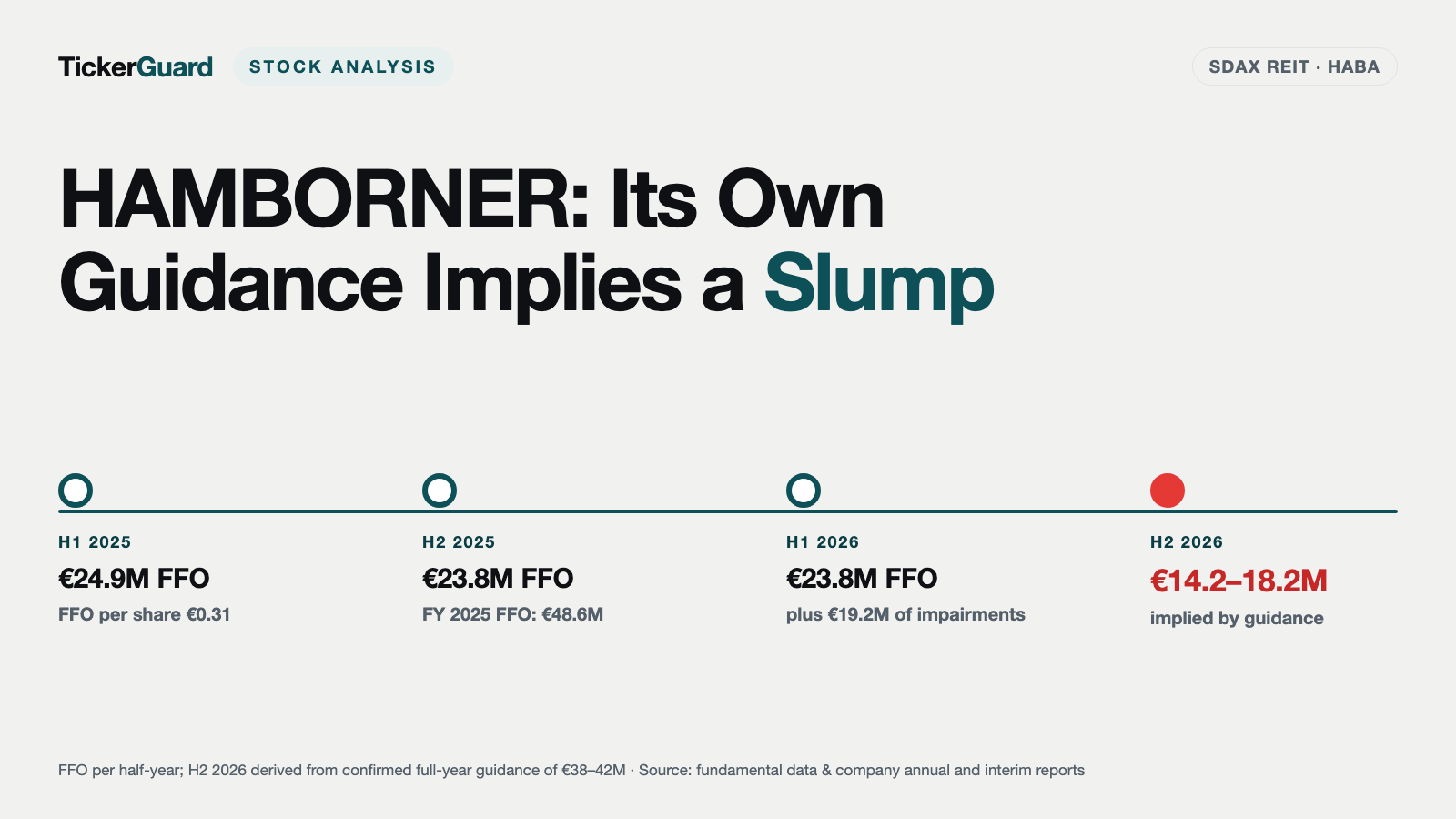
After €23.8 million of funds from operations (FFO) in the first half of 2026, HAMBORNER REIT’s confirmed full-year guidance leaves only €14.2 million to €18.2 million for the second half — up to roughly 40 percent less than a year earlier. At the October 1, 2026, price, the stock trades at about 47 percent of net asset value and yields 9.4 percent on paper. For income seekers, the calendar matters more than the headline yield.
 Thomas Mücke
Founder & Publisher
Thomas Mücke
Founder & Publisher
Chart
Interactive price chart (TradingView).
Note: pure fact-based analysis, not investment advice and not a solicitation to buy or sell. All figures without guarantee.
There is one number that draws income investors like moths to a flame: a near double-digit dividend yield. At HAMBORNER REIT AG (SDAX: HABA), the most recent €0.39 dividend works out to 9.4 percent at the Xetra close of October 1, 2026 (€4.14) — and that from a solid, unglamorous German landlord, not some speculative stock. On the 2025 year-end price it was 8.7 percent; the share price has kept falling since. The reflex kicks in immediately: “Nine percent from bricks and mortar? I’ll take it.” That is exactly where the trap lies, because a dividend yield is a fraction: payout divided by price. It can be high because the company pays generously — or because the price has collapsed and the next payout will be smaller.
Which of the two applies to HAMBORNER only the reports can tell. So let’s make our usual deal: we let the yield shine for a moment and then read together what is behind it — the 2025 annual report and, since this update, the half-year financial report as of June 30, 2026. HAMBORNER is a German company and does not report to the U.S. securities regulator, the SEC; its reports appear in German, so we quote them in the original and add our translation. It is the story of a solid but quietly shrinking company that is just saying goodbye to offices — and of the question whether a high yield is a gift or a warning. And then we ran the numbers on the confirmed guidance — with a result that is not spelled out in the August 4, 2026, press release: surprisingly little is left for the second half of 2026. In the end, you decide.
Update for the first half of 2026: what has changed since July 21
As of this update: October 1, 2026 (half-year financial report as of June 30, 2026, published August 4, 2026, together with the conference-call presentation of the same day). The first edition of this analysis, dated July 21, 2026, was based on the 2025 annual report and the first-quarter interim statement. Since then:
- Half-year results (August 4, 2026): rental income of €45.1 million (prior year €45.7 million, down 1.3 percent) and funds from operations (FFO) of €23.8 million (prior year €24.9 million, down 4.4 percent), or €0.29 per share instead of €0.31. In the second quarter alone, FFO came to €12.1 million (prior-year quarter €13.0 million).
- A loss for the half-year: impairments of €19.2 million on six office and retail properties pushed the result for the period to minus €13.7 million (prior year plus €6.5 million), or minus €0.17 per share.
- Assets and debt: the portfolio’s fair value fell to €1,315.9 million (end of 2025: €1,348.5 million), net asset value (NAV) per share to €8.72 (€9.07), and the loan-to-value ratio (EPRA LTV) rose to 45.2 percent (44.3 percent). The EPRA vacancy rate climbed to 4.1 percent (3.5 percent).
- Guidance confirmed: for 2026, management still expects rental income of €87.5 million to €89.5 million and FFO of €38.0 million to €42.0 million.
- Dividend approved and paid: the annual general meeting on June 3, 2026, approved the reduced dividend of €0.39 per share; €31.7 million was paid out.
- First office sale: on June 18, 2026, HAMBORNER signed a contract to sell an office building in Neu-Isenburg for €13.5 million — slightly below its most recent appraised fair value of €14.2 million.
- After the report: two supervisory board members bought shares in September 2026 at €4.20 to €4.28 (about €54,000 in total). There were no further ad-hoc notices, voting-rights notifications or guidance changes through October 1, 2026.
Why the steady first half is misleading
At first glance the half-year looks reassuring: FFO fell “only” 4.4 percent, and the company’s press release headline speaks of a continued “planmäßige Geschäftsentwicklung” (business development according to plan). But do the math: if the full year is to land at €38.0 million to €42.0 million of FFO and €23.8 million (precisely €23,798 thousand) is already in the bag after six months, only €14.2 million to €18.2 million remains for the second half — compared with €23.8 million in the second half of 2025 (full-year FFO of €48,644 thousand minus €24,884 thousand in the first half). That would be a drop of almost a quarter to about 40 percent in a single half-year. Management explicitly confirmed its guidance; arithmetically, it implies exactly this decline — whether the range is conservative will only become clear with the annual accounts.
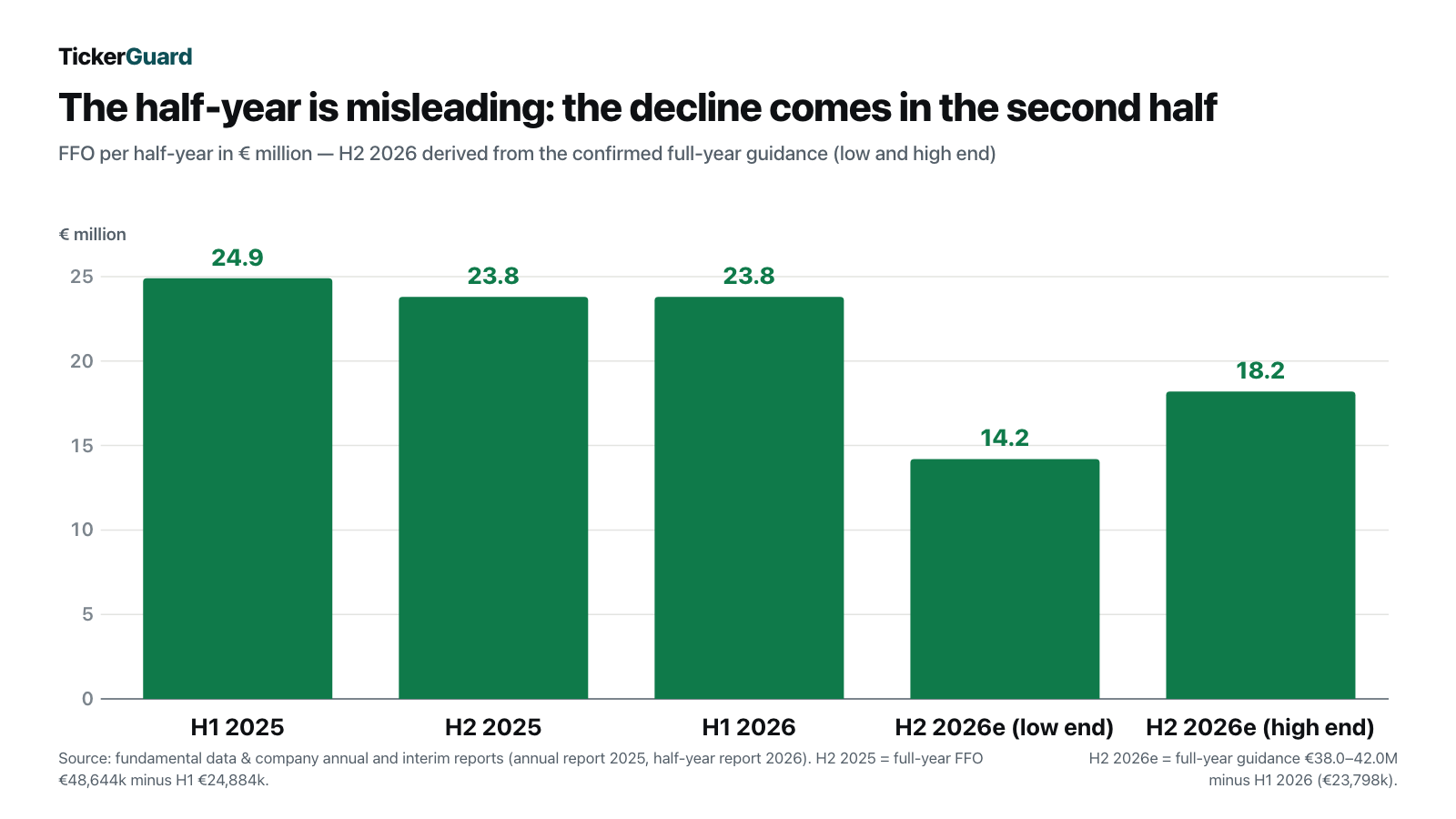
Where the drop comes from is spelled out in the presentation for the conference call on August 4, 2026. On maintenance expenses, which at €3.6 million in the first half were barely above the prior year, it says:
“Expenses relate to ongoing maintenance work and various smaller planned measures – major maintenance projects and larger tenant improvements scheduled for the second half of the year”
— HAMBORNER REIT AG, conference-call presentation “H1 Figures 2026,” August 4, 2026, slide 3
On top of that, debt is getting more expensive: interest expense rose to €7.3 million in the half-year (prior year €6.7 million), which the presentation attributes to refinancing at higher rates in the second half of 2025 and the first quarter of 2026. And the Neu-Isenburg office building, due to change hands in the third quarter, will no longer pay rent afterward (most recently €1.1 million a year). Rule of thumb: a half-year in which the big costs haven’t hit yet says little about the full year. The real test comes with the third-quarter interim statement, which HAMBORNER has scheduled for November 10, 2026.

What the conference call shows — and what it doesn’t
We did not have a transcript of the conference call on August 4, 2026; instead, we evaluated the presentation published for it, the press release of the same day and the company presentation from September 2026. They sharpen the picture in three ways. First, the office segment is the problem child: its vacancy rate stood at 6.5 percent on June 30, 2026, and its leases run for only 3.6 years on average — versus 2.0 percent vacancy and 6.2 years in retail. Second, leasing was busy, but mostly renewals: of about 23,700 square meters of leases signed in the half-year, 66 percent were office space, and the lion’s share were contract extensions rather than new lettings. Third, the guidance comes with a caveat: according to the September 2026 company presentation, it does not reflect any further acquisitions or disposals and “could” be adjusted in connection with planned transactions. The company does not say in which direction.
One more detail that appears only in passing in the press release: there was no portfolio-wide appraisal at mid-year, only “isolated fair value adjustments” for eight properties. The decline in NAV to €8.72 per share is therefore an interim reading; the full appraisal follows at year-end.
Supervisory board members buy — the guidance applies the brakes
After the half-year report, two supervisory board members bought shares: Martina Williams-Arnoldi on September 1, 2026, for €37,318.75 at €4.265, and Claus-Matthias Böge on September 4 and 10 for a combined €16,950 at €4.275 and €4.20. That is a friendly signal — people who know the numbers from the inside are putting their own money in. But weigh it soberly: about €54,000 is less than 0.02 percent of the market value, the purchase prices were above the October 1, 2026, close, and the purchases change nothing about the confirmed guidance with its weaker second half. Insiders are buying, and the company’s own guidance applies the brakes — both are true at the same time.
Company history for investors
-
2025
April: new dividend policy
Payouts of 60 to 70 percent of FFO instead of a stable dividend — the precursor to the cut from €0.48 to €0.39 per share.
-
2025
A year without acquisitions
Not a single property purchase, FFO of €48.6 million after €51.6 million — the balance sheet stayed protected, income shrank.
-
2026
February: farewell to offices
Ad-hoc notice: focus on grocery-anchored and home-improvement retail, office share 10 to 20 percent over the medium term; 2026 FFO guidance of only €38 million to €42 million.
-
2026
June: dividend approved, first office sale
The AGM approves €0.39 per share; contract to sell Neu-Isenburg for €13.5 million, slightly below its €14.2 million fair value.
-
2026
August: a half-year loss
FFO of €23.8 million, but €19.2 million of impairments and a €13.7 million loss; NAV €8.72 per share. Guidance confirmed — the second half has to be weaker.
What HAMBORNER does — and why a REIT pays out so much
HAMBORNER is a buy-and-hold commercial landlord: on June 30, 2026, it owned 63 properties — 37 retail and retail-park assets and 26 office buildings across Germany — with a fair value of about €1.32 billion. Its largest tenants are grocers and home-improvement chains: EDEKA alone accounts for 14.0 percent of annual rent, followed by Kaufland (7.5 percent), REWE (7.1 percent) and OBI (7.0 percent). What makes it special is its legal form: HAMBORNER is a German REIT (real estate investment trust). A German REIT pays no corporate income tax or trade tax — in return, it must distribute most of its profit and keep an equity ratio of at least 45 percent. On June 30, 2026, that REIT equity ratio stood at 53.9 percent.
That traditionally makes such stocks income plays: you buy them not for price jumps but for the steady rental income that is passed through year after year. That is why the decisive question for a REIT is not “Are profits growing?” but “How safe and how large is the distributable income?” — and that is measured not by net income but by FFO, funds from operations: the operating cash surplus from renting out properties, adjusted for depreciation and gains on sales. Keep that in mind; it is the thread running through this analysis. Since February 2026, a second question has been added: HAMBORNER wants to turn itself into a pure retail REIT focused on grocery-anchored and home-improvement properties and cut the office share to 10 to 20 percent over the medium term — at mid-year it was 43.7 percent of fair value.
Where the stock showed up in our scanner
When the first edition was written, HABA appeared in the price-to-cash-flow and price-to-free-cash-flow rankings of our in-house stock scanner (data as of March 31, 2026) — the filters for stocks that look inexpensive relative to the cash they generate. The price-to-FFO ratio at the end of 2025 was only 7.5: investors paid 7.5 times the annual operating cash surplus. The price-to-earnings ratio, by contrast, says little for a REIT, because valuation effects distort net income — after the 2026 half-year loss it can no longer be meaningfully calculated at all. A low price-to-FFO ratio is only a bargain if FFO holds. That is exactly the core question. To find the stock yourself: open the price-to-cash-flow ranking under “Scanner” and search for HABA.DE.
The numbers: a solid balance sheet, but shrinking income
The good news first, and it is real: HAMBORNER has a solid balance sheet. The loan-to-value ratio (EPRA LTV) stood at 45.2 percent on June 30, 2026 — a little over half of every euro of property value is paid for with equity. According to the company, the properties are 95.9 percent let (EPRA vacancy rate 4.1 percent), leases run for 5.0 years on average, and debt costs only about 2.2 percent interest on average. This is not a turnaround case but a healthy landlord. On a like-for-like basis, rents even rose 1.7 percent in the first half, supported by inflation-linked index rents.
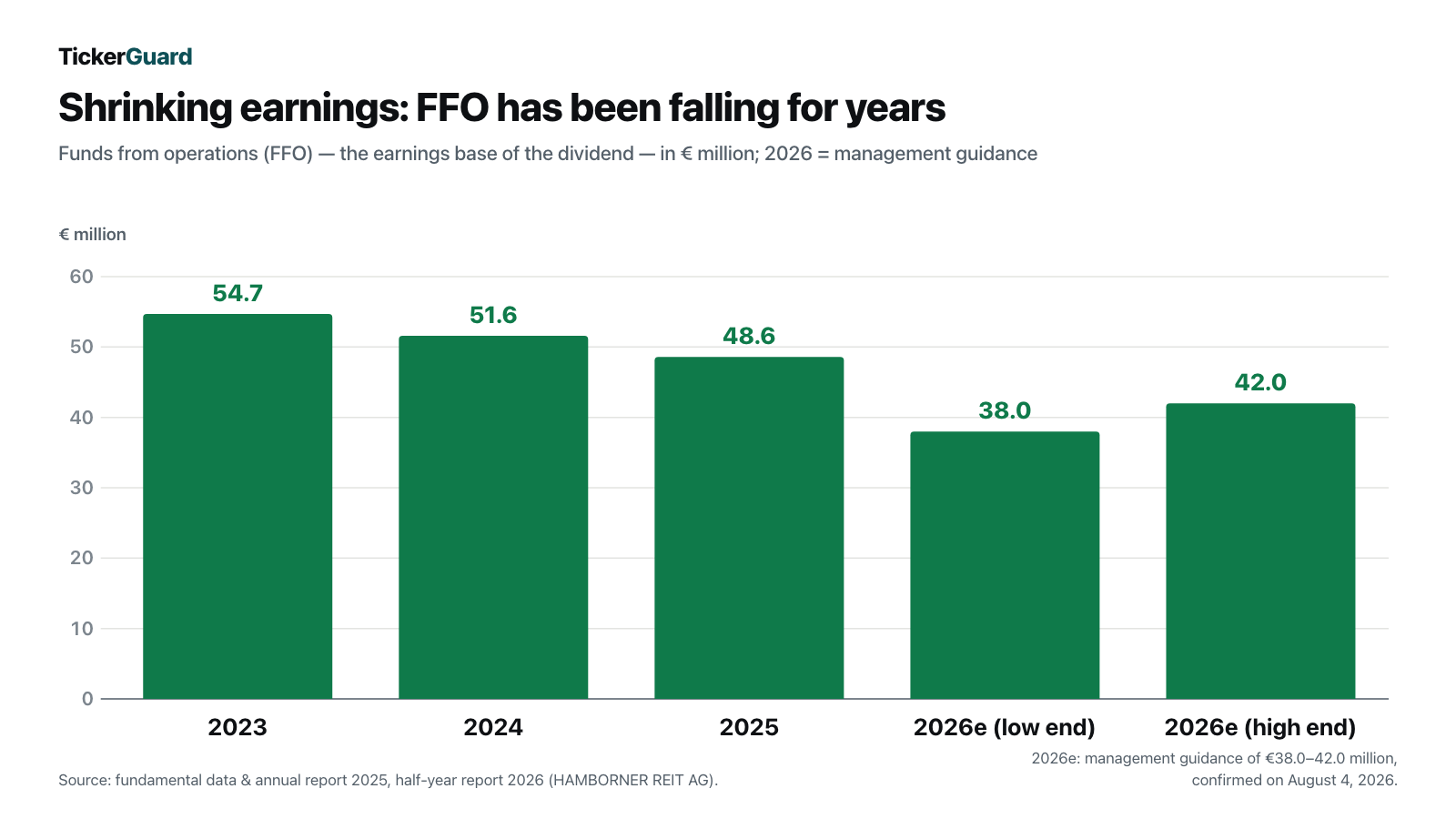
Now the catch, and it sits in a single line of figures: FFO — the operating cash surplus that funds the dividend — has been falling for years: from €54.7 million (2023) to €51.6 million (2024) and €48.6 million (2025), or from €0.67 to €0.60 per share. In the first half of 2026, FFO per share slipped to €0.29 (prior-year half €0.31), and NAV per share fell from €9.79 (end of 2024) to €9.07 (end of 2025) and €8.72 (June 30, 2026). A REIT whose income is shrinking is like a well whose inflow is drying up — as long as there is still water at the top, you hardly notice, but the direction is wrong.
The uncomfortable truths
Uncomfortable truth No. 1: in 2026, income falls even faster
The decline has not just failed to stop — it is accelerating. Management is unusually specific in its outlook:
“Hinsichtlich des operativen Ergebnisses (FFO) erwarten wir ein Resultat innerhalb einer Spanne zwischen 38,0 und 42,0 Mio. Euro.”
Translation: “With regard to operating result (FFO), we expect a result within a range of €38.0 million to €42.0 million.”
— HAMBORNER REIT AG, annual report 2025 (German original), interview with the management board

From €48.6 million to €38 million–€42 million — roughly a fifth less in a single year. The report names the reasons openly: lower rental income (partly because properties were sold and not replaced), higher maintenance and fit-out costs, more expensive refinancing and higher headcount. For an income stock, this is the single most important number, because the payout follows FFO. The half-year report confirmed the range — and as shown above, most of the decline still lies ahead, in the second half of 2026.
Uncomfortable truth No. 2: the dividend has already been cut — and the payout corridor allows less
Management has already acted on this logic. The dividend for 2025 was cut from €0.48 to €0.39 per share, approved by the annual general meeting on June 3, 2026. Officially, management says in the annual report that it “further developed” its dividend policy in 2025 (our translation): a new payout corridor of 60 to 70 percent of FFO; for 2025 it was 65 percent. That is honest and disciplined — the payout is adjusted to lower income instead of being paid out of the asset base. But it is also a cut of roughly a fifth, and it exposes the attractive yield: the high yield — 8.7 percent on the 2025 year-end price, 9.4 percent on the October 1, 2026, price — does not arise because HAMBORNER pays especially much, but because the share price fell sharply: on December 30, 2021, the stock closed at €10.02 on Xetra; on October 1, 2026, at €4.14.
Apply the corridor to the 2026 guidance: 60 to 70 percent of €38.0 million to €42.0 million of FFO, spread over 81.3 million shares, works out to €0.28 to €0.36 per share. That is our own calculation, not a company announcement — the management and supervisory boards propose the dividend only once the annual figures are available, the annual general meeting decides, and besides FFO the company cites criteria such as the market and company situation and investment opportunities. But the calculation shows where the logic leads. Run it the other way: to hold €0.39 per share at a 65 percent payout ratio, HAMBORNER would need about €48.8 million of FFO — as much as in 2025, but €6.8 million to €10.8 million more than 2026 guidance. A rising dividend yield on a falling dividend is almost always a price signal, not a payout signal.
Uncomfortable truth No. 3: the portfolio is shrinking — on purpose
Why is income shrinking in the first place? Because HAMBORNER is currently getting smaller instead of growing. The portfolio’s fair value fell from €1,471 million (2023) to €1,348.5 million (2025) and further to €1,315.9 million (June 30, 2026), and the weighted average lease term from 6.4 to 5.0 years. Management deliberately made no acquisitions in 2025:
“[…] haben wir im Geschäftsjahr 2025 auf Immobilienankäufe verzichtet, bei denen Rendite und Risikoprofil nicht im Einklang mit unserer strategischen Ausrichtung standen, und uns auf gezielte Investitionen in unseren Gebäudebestand fokussiert.”
Translation: “[…] in fiscal year 2025 we refrained from property acquisitions whose return and risk profile were not in line with our strategic direction, and focused on targeted investments in our building portfolio.”
— HAMBORNER REIT AG, annual report 2025 (German original), interview with the management board (Sarah Verheyen)
That is the double-edged truth of this analysis: passing on expensive acquisitions in a difficult market is good, disciplined management — it protects the balance sheet and prevents bad purchases. But as long as nothing is invested, nothing replaces expiring leases and sold properties, and income keeps falling. Not a single property was added in the first half of 2026 either; investment in properties amounted to €0.2 million. Management wants to reinvest the Neu-Isenburg proceeds “as promptly as possible” in grocery-anchored and home-improvement properties — whether, and at what yield, it succeeds remains open.
Uncomfortable truth No. 4: leaving the office market costs asset value first
In February 2026, HAMBORNER turned its strategy around via an ad-hoc notice — a mandatory disclosure for price-sensitive news:
“Mit der strategischen Neuausrichtung verbindet sich das mittelfristige Ziel, den Büroanteil am Gesamtportfoliovolumen auf 10 bis 20 % zu reduzieren.”
Translation: “The strategic realignment is linked to the medium-term goal of reducing the office share of the total portfolio volume to 10 to 20 percent.”
— HAMBORNER REIT AG, ad-hoc notice of February 23, 2026 (German original)
Strategically, that makes sense: offices suffer from remote work and costly refurbishment requirements; supermarkets and home-improvement stores do not. But run the numbers on the scale. On June 30, 2026, the portfolio held office properties worth €575.4 million. Holding the portfolio size constant, reaching a 20 percent office share would mean selling roughly €310 million of offices, and a 10 percent share roughly €440 million, and redeploying the money into retail — in the first case almost as much as, in the second more than, the entire market value of €336.8 million on October 1, 2026. The first sale offers a preview: Neu-Isenburg went for €13.5 million, almost 5 percent below its most recently appraised fair value of €14.2 million (according to the half-year report, in line with book value, which HAMBORNER carries at amortized cost). At the same time, six properties were written down by a combined €19.2 million at mid-year, including the office locations Stuttgart, Darmstadt, Mainz and Neu-Isenburg (plus two retail assets in Hamburg and Hallstadt). Whoever sells offices in a weak market rarely gets the last appraised value.
Uncomfortable truth No. 5: a seventh of the debt is likely to get more expensive this year
The low average interest rate of 2.2 percent is a gift from the past, and it is running out. According to the conference-call presentation, 5.7 percent of financial liabilities mature in the third quarter of 2026 and 8.2 percent in the fourth quarter — together about €87 million out of €627.6 million, which so far cost only 1.2 to 1.4 percent on average. Another 20.5 percent follows in 2027 at an average of 2.1 percent. Meanwhile, according to the risk report in the half-year report, the European Central Bank raised its key rates by 0.25 percentage points in June 2026, and HAMBORNER itself writes in its risk report that it expects “erhöhten Refinanzierungsrisiken” (increased refinancing risks). For scale: every percentage point of additional interest on those €87 million costs roughly €0.9 million of FFO a year. That is not an existential problem — interest coverage stood at 4.4 times at mid-year — but it is one more headwind for exactly the metric the dividend depends on.
Valuation — what the low share price means
Now let’s add it up, at the Xetra close of October 1, 2026 (€4.14). Yes, HAMBORNER is cheap: the stock trades at about 47 percent of NAV (€8.72 per share as of June 30, 2026), for a market value of about €337 million. But look at the price-to-FFO ratio: at the end of 2025 it was 7.5. Based on 2026 guidance (€0.47 to €0.52 of FFO per share), it is now about 8.0 to 8.9 — the stock has become cheaper in price but more expensive relative to earnings, because income is falling faster than the share price. The four analysts listed on HAMBORNER’s own website see it differently: all rate the stock a buy, with price targets between €7.00 and €10.50 (page as of October 1, 2026). Such views are third-party opinions, not a guarantee.
You have now learned to read the discount: the market pays so little because it is pricing in further declining income and a costly exit from offices — and with the confirmed guidance, management is proving it right for now. The discount to NAV is therefore not a pure gift but a bet that HAMBORNER stops the FFO decline, sells its offices without big haircuts and reinvests the money at good yields in supermarkets and home-improvement stores. If that works, today’s discount to NAV will look too steep in hindsight. If not, the value shrinks along with the business. We applied the same lens — assets and income instead of headline yield — in our Vonovia analysis and to the office and logistics landlord Branicks; for how a retail-focused REIT is positioned in the United States, see our analysis of CTO Realty Growth.
Opportunities and risks at a glance
What speaks for HAMBORNER:
- A solid balance sheet for a REIT: EPRA LTV of 45.2 percent, REIT equity ratio of 53.9 percent (minimum 45 percent), average interest rate of 2.2 percent, interest coverage of 4.4 times (June 30, 2026).
- A clear discount to NAV: the share price is about 47 percent of NAV of €8.72 per share (October 1, 2026).
- A stable retail core: grocers account for 34.3 percent of annual rent, retail vacancy is 2.0 percent, and retail leases run for 6.2 years on average.
- Disciplined management: no expensive acquisitions in 2025, payout honestly aligned with FFO; supervisory board members bought shares in September 2026 (on a small scale).
What speaks against it:
- FFO has been falling for years; the confirmed 2026 guidance leaves only €14.2 million to €18.2 million for the second half (prior-year half: €23.8 million).
- The dividend has already been cut (€0.48 → €0.39); applied to 2026 guidance, the payout corridor implies only €0.28 to €0.36 per share.
- The office exit is large (€575.4 million of offices in the portfolio) and starts with a sale below fair value; impairments of €19.2 million in the first half of 2026.
- About €87 million of loans at 1.2 to 1.4 percent mature in 2026 — refinancing is likely to cost more.
The verdict: a high yield is not the same as safe income
Remember the 9.4 percent from the start (8.7 percent on the 2025 year-end price)? After the 2025 annual report and the 2026 half-year report, they can be put into honest perspective: HAMBORNER is a soundly financed commercial REIT with a healthy retail core — currently in a phase of shrinking and restructuring. The high yield is not a sign of generosity but the result of a sharply lower share price and a reduced payout whose base keeps shrinking. This is no disaster like a turnaround case. But it is not a savings account paying nine percent either, as the yield figure suggests.
The decisive question, therefore, is not “How high is the dividend?” but “Where is FFO heading — and what will the offices fetch when sold?” The first answers come with the interim statement on November 10, 2026. Whether a bet on stabilizing income is worth half of NAV to you is a decision only you can make. And that is how it should be.
Sources
HAMBORNER REIT AG, half-year financial report as of June 30, 2026 (published August 4, 2026, unaudited, German); conference-call presentation “H1 Figures 2026” (August 4, 2026); press release of August 4, 2026; company presentation September 2026; annual report 2025; Q1 2026 interim statement (May 7, 2026); ad-hoc notice of February 23, 2026; notifications of managers’ transactions of September 2, 7 and 11, 2026 (hamborner.de); fundamental data & our in-house stock scanner (data as of March 31, 2026); Xetra closing price of October 1, 2026. Conference-call transcripts were not available. This analysis is journalistic commentary, not investment advice and not a solicitation to buy or sell securities; stocks carry price risks up to a total loss.
Our Bottom Line at a Glance
- Balance sheet & portfolio quality positive
- Solid for a REIT: EPRA LTV of 45.2 percent, REIT equity ratio of 53.9 percent (minimum 45 percent), average interest rate of 2.2 percent, interest coverage of 4.4 times (June 30, 2026). The retail core is stable at 2.0 percent vacancy and 6.2 years of lease term.
- Valuation neutral
- Share price at about 47 percent of NAV of €8.72 per share (October 1, 2026) — a visible discount. But based on 2026 guidance, the price-to-FFO ratio has risen from 7.5 to about 8.0 to 8.9: cheaper in price, not cheaper in earnings.
- Earnings power (FFO) negative
- FFO has been falling for years (€54.7M → €51.6M → €48.6M) and dropped 4.4 percent to €23.8 million in the first half of 2026. The confirmed guidance of €38 million to €42 million leaves only €14.2 million to €18.2 million for the second half.
- Dividend negative
- Already cut (€0.48 → €0.39 per share, corridor of 60 to 70 percent of FFO). Applied to 2026 guidance, the corridor implies only €0.28 to €0.36 per share; the high yield stems from the lower share price.
- Strategy & restructuring neutral
- The shift to a retail REIT is logical but large: €575.4 million of offices in the portfolio, the first sale came in almost 5 percent below fair value, and €19.2 million of impairments at mid-year. Reinvestment is still pending.
- Financing neutral
- About €87 million of loans at 1.2 to 1.4 percent interest mature in the second half of 2026, another 20.5 percent of financial liabilities in 2027. Every percentage point of additional interest on the €87 million costs roughly €0.9 million of FFO a year.
HAMBORNER REIT is a soundly financed commercial REIT (LTV 45.2 percent, average interest rate 2.2 percent) with a stable retail core — but in a phase of shrinking and restructuring: FFO has been falling for years, to €23.8 million in the first half of 2026, and the confirmed guidance requires a much weaker second half. The dividend has already been cut, and the office exit starts with discounts. The stock trades at about 47 percent of NAV — a bet that the earnings decline stops. Not investment advice.
What Our Rating Means
Open questions
The business works in principle, but one material question is open. As long as it stays open, our findings do not carry a quality verdict.
HAMBORNER is not a solvency risk: leverage, interest coverage and the REIT equity ratio remain solid after the first half of 2026. The rating stays yellow because the central operating question is open and has, if anything, sharpened: FFO keeps falling, guidance implies a markedly weaker second half of 2026, and the shift from offices to retail has begun with a single sale. The next checkpoints: whether 2026 FFO lands within €38 million to €42 million, at what prices further offices are sold and at what yields the money flows into retail — not the size of the dividend yield. The decision is yours.
A journalistic assessment by our editorial team at the time of the deep dive, based on public sources — not investment advice and not a solicitation to buy or sell. Your personal circumstances (investment goals, risk capacity, taxes) cannot be taken into account. What our levels mean, how verdicts are formed, and what conflicts of interest exist →
Worth Noting
- Rolled forward on October 1, 2026, to the half-year financial report as of June 30, 2026 (published August 4, 2026, neither audited nor reviewed); first edition of July 21, 2026, based on the 2025 annual report.
- German company without SEC filings: quotes from the annual report, half-year report, ad-hoc notice, the August 4, 2026, press release and the September 2026 company presentation are German originals with our translation; the conference-call presentation is quoted in its English original. No conference-call transcript was available.
- Price, yield and valuation figures refer, unless stated otherwise, to the Xetra close of October 1, 2026 (€4.14). Second-half FFO for 2025 and 2026 and the implied 2026 dividend range are our own calculations from company figures.
- As a German REIT, HAMBORNER is exempt from corporate income and trade tax but must meet, among other things, a minimum distribution and an equity ratio of at least 45 percent; the key metrics are FFO (income), NAV (assets) and LTV (leverage).
The full analysis as a PDF for later
We will send you this analysis as a PDF — to print, file away, and read at your own pace.
Frequently Asked Questions
HAMBORNER is a buy-and-hold German REIT based in Duisburg. On June 30, 2026, it owned 63 retail and office properties with a fair value of €1,315.9 million; its largest tenants are EDEKA, Kaufland, REWE and OBI. As a German REIT, it is exempt from corporate income and trade tax and in return distributes most of its operating income as dividends.
In the first half of 2026, rental income fell 1.3 percent to €45.1 million and FFO fell 4.4 percent to €23.8 million. Impairments of €19.2 million on six properties led to a loss of €13.7 million. NAV per share fell to €8.72 and EPRA LTV rose to 45.2 percent. Full-year guidance of €38.0 million to €42.0 million of FFO was confirmed.
The high yield stems mainly from the sharply lower share price: the dividend for 2025 was already cut from €0.48 to €0.39. Applied to 2026 guidance, the new corridor of 60 to 70 percent of FFO implies only €0.28 to €0.36 per share. That is our own calculation; the management and supervisory boards propose the dividend once the annual figures are available, and the annual general meeting decides.
FFO fell from €54.7 million (2023) to €48.6 million (2025) and is guided to €38 million to €42 million for 2026. The reasons are lower rental income from properties sold and not replaced, higher maintenance and fit-out costs, more expensive refinancing and higher headcount. According to the company, major maintenance projects are scheduled for the second half of 2026.
In February 2026, HAMBORNER announced via an ad-hoc notice that it will focus on grocery-anchored and home-improvement retail and cut its office share to 10 to 20 percent over the medium term. On June 30, 2026, the share was 43.7 percent; offices had 6.5 percent vacancy and only 3.6 years of remaining lease term. The first sale, in Neu-Isenburg, fetched €13.5 million versus a fair value of €14.2 million.
Measured against its assets, yes: at €4.14 (October 1, 2026), the stock trades at about 47 percent of NAV of €8.72 per share. Measured against income, it has not become cheaper: based on 2026 guidance, the price-to-FFO ratio is about 8.0 to 8.9, after 7.5 at the end of 2025, because FFO is falling faster than the share price.
Reported IFRS net income is distorted by depreciation, impairments and gains or losses on sales — HAMBORNER posted a loss of €0.17 per share in the first half of 2026. FFO (funds from operations) measures the recurring operating cash surplus from renting out properties, €0.29 per share in the half-year. The dividend follows FFO, not net income.
Found an error?
Did you spot a factual error, an outdated number, or a typo in this deep dive? Let us know briefly — your report goes straight to the editorial team.